Skip to content
Artwork for The Subcontractors Blueprint
EducationCoursesBusinessEntrepreneurshipManagement

The Subcontractors Blueprint

Jacob Austin

Welcome to "The Subcontractors Blueprint," the essential podcast for construction industry Subcontractors. Join host Jacob Austin, a seasoned Chartered Surveyor with a rich background in industry giants and the founder of QS.Zone. This show is your key to mastering commercial savvy and contract finesse.
Gain the knowledge and skills to manage accounts, understand rights, and boost profitability as an SME sub-contractor. Jacob's expertise guides you through risk management, cashflow maintenance, and maximizing subcontract profitability.
Tune in now to empower your subcontracting journey with "The Subcontractors Blueprint" and take confident strides toward a more prosperous future.

Play
  • 34 episodes
  • weekly
  • Avg 23 min
  • English
Counted on this page — what you have heard stays on this device, so it is not something the list can be paged by.
  • June 29 · 19 min

    Disputes Mini Series: The Mistake That Hands the Other Side Your Whole Hand

    Episode 149 of The Subcontractors Blueprint sees Jacob Austin tackle crystallisation — the jurisdictional gate every dispute must pass through before it reaches adjudication. Continuing the disputes mini series, Jacob explains why a claim is not a dispute, how the Construction Act lets you refer a dispute only once one actually exists, and why even a watertight claim can be thrown out in its first 48 hours. Drawing on the leading AMEC case, he sets out the three ingredients of a real dispute and the four mistakes that gift contractors an easy jurisdiction challenge. The message: get crystallisation right first time, or pay to teach the other side how to beat you. KEY TAKEAWAYS Why a claim sitting in an application isn't a dispute - and the single moment that turns it into one. How a perfectly valid, fully-owed claim gets knocked out in the first 48 hours, before the merits are ever heard. The three things every dispute needs before you can refer it, straight from the AMEC case. The four classic ways subcontractors crystallise too early and hand the other side a jurisdiction challenge on a plate. Why a contractor's silence and stalling can actually work in your favour - if you document the pattern. The four questions to run past yourself before you serve any notice of adjudication. BEST BITS "A claim is not a dispute." "That moment when your claim meets their refusal, that is crystallisation." "No dispute, no jurisdiction, no enforceable decision." "They can't dodge crystallization forever just by stalling." "The privilege of teaching the other side how to beat you." "You're not losing on the merits of your case. You're losing on a technicality." HOST BIO Jacob Austin is a Chartered Quantity Surveyor with over a decade of experience in UK construction, having worked across education, health, and residential developments from £1,000s to over £300m of concurrent projects with some of the industry's leading contractors. Through The Subcontractors Blueprint podcast and The Subcontractors Blueprint Academy, he's on a mission to give the UK's 1 million SME subcontractors the commercial knowledge they need to protect their margins, manage risk, and build stronger businesses. His approach is direct, practical, and grounded in real contract experience - no theory, no fluff. LinkedIn - www.linkedin.com/in/jacob-austin/ Instagram - www.instagram.com/subcontractorsblueprint/ www.subcontractorsblueprint.uk/all-links
  • June 22 · 20 min

    Disputes Mini-Series: Four Routes to Dispute Resolution

    Episode 148 of The Subcontractors Blueprint opens a new mini-series on disputes, with host Jacob Austin mapping the four routes a subcontractor can take when the work is signed off but the payments have stopped. Jacob lays out commercial conversation, statutory adjudication, mediation, and the heavyweight options of arbitration and litigation- what each one costs in pounds and in time, and when to walk through it. He explains why doing nothing is the real risk, how marking talks "without prejudice" protects a settlement offer, and why the strength of your records decides every outcome. The message is plain: see all your options first, then choose your route with your eyes open. KEY TAKEAWAYS Why doing nothing on an unpaid account quietly weakens your position every single week — and teaches the other side they can do it again. The cheapest door in the building, plus the one tool that lets you put an offer on the table without it ever being used against you later. How adjudication hands you a binding decision in 28 days, and why "pay now, argue later" was written into law for your industry specifically. When mediation beats a straight win-or-lose fight — and why flatly refusing it can count against you when a court looks at the case. Why arbitration is only ever on the table if your contract selected it, so you need to know what yours says before a dispute lands. The one question to keep in the back of your mind on every job — because evidence, not who's right, is what actually gets you paid. BEST BITS "A dispute is not a failure." "Doing nothing isn't the safe option." "You try the cheap door before you try an expensive one." "The decision stands, the money has to move." "Winning on paper and getting paid are different things." "Miss the contract detail and the commercial risk falls on you." HOST BIO Jacob Austin is a Chartered Quantity Surveyor with over a decade of experience in UK construction, having worked across education, health, and residential developments from £1,000s to over £300m of concurrent projects with some of the industry's leading contractors. Through The Subcontractors Blueprint podcast and The Subcontractors Blueprint Academy, he's on a mission to give the UK's 1 million SME subcontractors the commercial knowledge they need to protect their margins, manage risk, and build stronger businesses. His approach is direct, practical, and grounded in real contract experience — no theory, no fluff. LINKS LinkedIn — www.linkedin.com/in/jacob-austin/ Instagram — www.instagram.com/subcontractorsblueprint/ www.subcontractorsblueprint.uk/all-links
  • June 15 · 23 min

    Your Valuation Got Slashed - Here's How to Fight it Without Starting a War

    Episode 147 of The Subcontractors Blueprint sees Jacob Austin tackle the difficult commercial conversation — the phone call or meeting where a slashed valuation is either recovered or quietly lost. Jacob Austin explains why a subcontractor's entitlement is only worth what they can actually collect, and why most commercial disagreements are settled in conversation rather than adjudication. Using a groundworks variation example, the episode covers how contemporaneous records give a negotiation its teeth, why email hardens both positions, and how to identify who really owns the decision. The core message: have the conversation from a documented position, stay level, and keep the formal route in your back pocket. KEY TAKEAWAYS Why being completely right on the measure and the contract still won't put a penny in your account. The two ways subcontractors blow this — silent acceptance and going nuclear — and what both actually cost you. Why your leverage in the room is the paperwork behind you, not your personality or your history with the contractor. The one question that flips a flat "no" into a route to "yes" on a disputed variation. Why the person who cut your valuation often can't reinstate it — and how to find who can. How to keep adjudication in your back pocket without ever putting it on the table. BEST BITS "Your entitlement is only worth what you can actually get your hands on." "Peace doesn't buy a lot of variation work." "You're not arguing anymore. You're demonstrating." "He hasn't mentioned adjudication. He doesn't need to." "The strength of your conversation is the strength of your prep." "Vague complaints will get vague answers." HOST BIO Jacob Austin is a Chartered Quantity Surveyor with over a decade of experience in UK construction, having worked across education, health, and residential developments from £1,000s to over £300m of concurrent projects with some of the industry's leading contractors. Through The Subcontractors Blueprint podcast and The Subcontractors Blueprint Academy, he's on a mission to give the UK's 1 million SME subcontractors the commercial knowledge they need to protect their margins, manage risk, and build stronger businesses. His approach is direct, practical, and grounded in real contract experience — no theory, no fluff. LINKS LinkedIn — www.linkedin.com/in/jacob-austin/ Instagram — www.instagram.com/subcontractorsblueprint/ www.subcontractorsblueprint.uk/all-links
  • June 8 · 24 min

    The Art and Science of Notices: How to Serve a Notice Without Starting a War

    Episode 146 of The Subcontractors Blueprint sees Jacob Austin break down one of the most commercially dangerous areas of subcontract management: serving notices- and doing it correctly under JCT and NEC subcontracts. Miss a time bar or serve to the wrong person and you lose your entitlement to time and money- not partially, altogether. Jacob covers both the science- right form, right person, right timescale- and the equally important art: how to serve a contractual notice without triggering a dispute. The core message: a three-minute phone call before you serve can change the entire commercial outcome. KEY TAKEAWAYS - Why failing to serve a notice correctly doesn't just weaken your claim- it ends it. No extension, no adjustment to price. - The NEC eight-week time bar for compensation events- and why contractors regularly shorten it in their amendments. - Why the conversation you had with the site manager last Tuesday is not a contractual notice, no matter how clear it seemed. - The pre-notice phone call: the single most underused tool in managing your subcontract commercially. - Why copying in the wrong people can turn a routine notice into the opening shot of a dispute. - Never write a notice in anger- and what to do instead when an event has made you furious. BEST BITS "You can lose your entitlement entirely, not partially, altogether. That means no adjustment to your price and no extension to your program." "You can serve the notice perfectly and hit every contractual requirement and still make a big commercial mistake if you fire it across without any warning." "The pre-notice phone call is the single most underused asset in managing your subcontract." "The notice isn't an act of aggression, so frame it that way from the start." "Let the facts do the work. Your feelings shouldn't appear in the written document." "Never write a notice in anger." HOST BIO Jacob Austin is a Chartered Quantity Surveyor with over a decade of experience in UK construction, having worked across education, health, and residential developments from £1,000s to over £300m of concurrent projects with some of the industry's leading contractors. Through The Subcontractors Blueprint podcast and The Subcontractors Blueprint Academy, he's on a mission to give the UK's 1 million SME subcontractors the commercial knowledge they need to protect their margins, manage risk, and build stronger businesses. His approach is direct, practical, and grounded in real contract experience- no theory, no fluff. LinkedIn- www.linkedin.com/in/jacob-austin/ Instagram- www.instagram.com/subcontractorsblueprint/ www.subcontractorsblueprint.uk/all-links
  • June 1 · 19 min

    Termination Hiding Inside a Variation

    Episode 145 of The Subcontractors Blueprint sees Jacob Austin examine one of the most common and costly manoeuvres in UK construction — the unlawful omission variation. When a main contractor strips scope from a subcontract and hands it to a competitor, the variation clause is almost never broad enough to make that lawful. This episode breaks down the implied contractual right that protects subcontractors — established in Abbey Development v PP Brickwork — and sets out exactly how to identify a partial termination dressed as a variation instruction, serve the right notices, and claim the profit and overhead you've lost. KEY TAKEAWAYS - Why the variation clause is almost never broad enough to let a main contractor omit your work and hand it to a competitor - The Abbey Development v PP Brickwork case and the implied right it gives every subcontractor to complete work they've been awarded - Five telltale signs that an omission instruction is actually a partial termination in disguise - Why silence on the day the instruction arrives could cost you the entire claim even if your legal argument is solid - How to quantify the loss correctly: it's not just the omitted work, it's the profit and overhead you'd budgeted against it - When the scale of omissions crosses into repudiation — and why that opens a much larger claim BEST BITS "The variation clause is there for adjusting the scope. It's not a mechanism for the main contractor to reassign your work to a competitor while keeping you on site for everything else." "You take on the obligation, you get the right to finish what you started." "The work hasn't disappeared from the site, it's just disappeared from your order." "The instruction arrives on the contractor's standard official looking variation form it doesn't make it valid." "Compliance without any protest at all will be read as acceptance by your contractor." "Even a valid claim that misses the deadline is one that you've lost so more than anything be sure to submit on time." HOST BIO Jacob Austin is a Chartered Quantity Surveyor with over a decade of experience in UK construction, having worked across education, health, and residential developments from £1,000s to over £300m of concurrent projects with some of the industry's leading contractors. Through The Subcontractors Blueprint podcast and The Subcontractors Blueprint Academy, he's on a mission to give the UK's 1 million SME subcontractors the commercial knowledge they need to protect their margins, manage risk, and build stronger businesses. His approach is direct, practical, and grounded in real contract experience — no theory, no fluff. LinkedIn — www.linkedin.com/in/jacob-austin/ Instagram — www.instagram.com/subcontractorsblueprint/ www.subcontractorsblueprint.uk/all-links
  • May 25 · 23 min

    Can Force Majeure Really Protect Subcontractors from Material Price Surges?

    Episode 144 of The Subcontractors Blueprint tackles one of the most misunderstood clauses in construction contracts. Jacob Austin, Quantity Surveyor and host, cuts through the widespread assumption that force majeure offers subcontractors a route to recover soaring material costs — and explains why, in most cases, it does not. Drawing on real contract language across JCT and NEC frameworks, Jacob sets out exactly what force majeure does and does not provide under English law, what the courts have confirmed, and why the risk of volatile markets sits squarely with subcontractors on most domestic subcontracts. His core message is clear: understand what you are signing before you sign it, because once you have, the contract will be applied exactly as written. KEY TAKEAWAYS - Force majeure does not exist by default under English law — if your subcontract does not include an express clause, there is nothing to call on - JCT subcontracts treat force majeure as a time-only remedy in most cases — a cost increase, however severe, does not automatically change that - NEC contracts can give you both time and cost, but the notification rules are strict and missing the deadline means losing the entitlement entirely - Main contractors can absorb force majeure relief without passing it downstream — what flows to you depends entirely on your own subcontract wording - A change in government tariffs or trade restrictions may give you a route under a changes-in-law clause, but only in specific circumstances - Records are not optional — without contemporaneous supplier quotes and procurement evidence, you have no realistic basis for any claim BEST BITS "There is no standard doctrine of force majeure in English law. It doesn't exist by default." "The fact that steel went up 20% because of war in eastern Europe doesn't by itself trigger force majeure." "The notice isn't just an administrative nicety. It's a condition of your contract." "The risk sits entirely with the subcontractor and the contract is drafted that way deliberately." "If you miss the notification window, if you fail to submit your quote on time, then you lose that entitlement regardless of how legitimate the underlying event is." "If you don't have the records, you don't have a claim." #SubcontractorsBlueprint #Construction #Subcontractors #ForceMajeure #ContractLaw #MaterialCosts HOST BIO Jacob Austin is a Chartered Quantity Surveyor with over a decade of experience in UK construction, having worked across education, health, and residential developments from £1,000s to over £300m of concurrent projects with some of the industry’s leading contractors. Through The Subcontractors Blueprint podcast and The Subcontractors Blueprint Academy, he’s on a mission to give the UK’s 1 million SME subcontractors the commercial knowledge they need to protect their margins, manage risk, and build stronger businesses. His approach is direct, practical, and grounded in real contract experience — no theory, no fluff. LINKS LinkedIn — www.linkedin.com/in/jacob-austin/ Instagram — www.instagram.com/subcontractorsblueprint/ www.subcontractorsblueprint.uk/all-links
  • May 18 · 19 min

    Why Being Right Doesn't Get You Paid

    Episode 143 of The Subcontractors Blueprint sees Jacob Austin confront one of the most expensive commercial blind spots in the industry: the absence of records. Subcontractors are losing money on variations, extensions of time, and contra charges every day — not because they're in the wrong, but because they can't prove they're in the right. Jacob breaks down exactly what records close the gap across each of these risk areas, why a site diary note and real evidence are not the same thing, and what a functional records regime looks like in practice. The message is unambiguous: being right doesn't get you paid — evidence does. KEY TAKEAWAYS Why the main contractor almost always wins the argument before it starts — not because they're right, but because they've been building evidence and you haven't. The NEC eight-week window for compensation event notification isn't a guideline — miss it and your entitlement is contractually extinguished, no matter how legitimate the claim. Why a record written two weeks after the fact carries far less weight in adjudication — courts and adjudicators check creation dates and document metadata. The difference between a site diary note and actual evidence — and why only one of them holds up when a contra charge lands at final account. How verbal variations quietly become unpaid work, and the single one-line email that turns a foreman's instruction into a paper trail. Why getting an extension of time in place is the most effective defence against a contra charge for the exact same period of delay. BEST BITS "The contractor has evidence and you don't." "This isn't about bad luck. It's a commercial gap that exists from the moment your boots are on site." "It's not admin. It's commercial protection." "Records made at the time are really good evidence, a record made in response to a dispute is just an explanation." "Dates matter and courts and adjudicators will look at the dates when documents are created, including sometimes looking at the metadata for those documents." "Being right doesn't get you paid, having evidence does." HOST BIO Jacob Austin is a Chartered Quantity Surveyor with over a decade of experience in UK construction, having worked across education, health, and residential developments from £1,000s to over £300m of concurrent projects with some of the industry's leading contractors. Through The Subcontractors Blueprint podcast and The Subcontractors Blueprint Academy, he's on a mission to give the UK's 1 million SME subcontractors the commercial knowledge they need to protect their margins, manage risk, and build stronger businesses. His approach is direct, practical, and grounded in real contract experience — no theory, no fluff. LinkedIn — www.linkedin.com/in/jacob-austin/ Instagram — www.instagram.com/subcontractorsblueprint/ www.subcontractorsblueprint.uk/all-links
  • May 11 · 20 min

    Main Contractors Are Banking on Your Silence for Their Cashflow

    Episode 142 of The Subcontractors Blueprint sees Jacob Austin tackle one of the most commercially damaging patterns in UK construction: deliberate late payment. Drawing on government data showing late payment costs the UK economy £11 billion every year and closes around 14,000 businesses annually, Jacob makes the case that extended payment terms are not an oversight — they are a calculated strategy by main contractors to fund their own operations on subcontractor money. From the statutory payment mechanism under the Housing Grants, Construction and Regeneration Act 1996 to the right to suspend under section 112, Jacob sets out the enforcement tools that most subcontractors possess but rarely use. KEY TAKEAWAYS Why late payment in construction is not a cashflow problem — it's a deliberate funding strategy, and understanding that distinction changes how you respond to it. The three failure modes that amount to commercial self-sabotage: sloppy applications, silence, and the relationship trap — and why each one hands leverage to the other side. What happens when a main contractor misses both the payment notice window and the pay less notice window — and why your application figure becomes legally due in full. Why serving a section 112 suspension notice is described as a bomb going off inside a main contractor's organisation — and when to use that power. A simple payment tracker that keeps you ahead of every valuation date without needing to recall figures from memory. The incoming legislation on mandatory payment caps and statutory interest — and why you shouldn't wait for it to start protecting yourself. BEST BITS "Extended payment is not an oversight. It's part of their strategy for funding their work, dressed up in contract terms and normalized into an industry habit." "And that's the most dangerous point of this episode. Not that late payment happens, but that the industry has stopped expecting anything different." "Doing nothing gets you nothing. Creating pressure gets you paid." "It's like a bomb going off inside the contractor's organisation because most programs can't absorb a key subcontractor downing tools and stopping work." "Just being silent by default is not a strategy. It's you being taken advantage of by the main contractor." "The point is not that you're going to pull both of these triggers every time. The point is, you have them both at your disposal." HOST BIO Jacob Austin is a Chartered Quantity Surveyor with over a decade of experience in UK construction, having worked across education, health, and residential developments from £1,000s to over £300m of concurrent projects with some of the industry's leading contractors. Through The Subcontractors Blueprint podcast and The Subcontractors Blueprint Academy, he's on a mission to give the UK's 1 million SME subcontractors the commercial knowledge they need to protect their margins, manage risk, and build stronger businesses. His approach is direct, practical, and grounded in real contract experience — no theory, no fluff. LinkedIn — www.linkedin.com/in/jacob-austin/ Instagram — www.instagram.com/subcontractorsblueprint/ www.subcontractorsblueprint.uk/all-links
  • May 4 · 29 min

    The Hidden Dangers Buried in Your Subcontract

    Episode 141 of The Subcontractors Blueprint sees Jacob Austin deliver a blunt commercial warning to every subcontractor in the UK who has ever signed a subcontract without reading it in full. Covering ten hidden dangers regularly buried in subcontracts by main contractors — from time bars and termination for convenience to back-to-back obligations and retention traps — this episode exposes the clauses that look routine on the surface but carry a sting that only surfaces when something has gone wrong on site. Jacob's message is direct: subcontract review isn't admin, it's the difference between protecting your margin and losing money you'll never get back. KEY TAKEAWAYS Why the clock on a time bar starts the day the event happens — not when you raise it in your next application. How termination for convenience lets a main contractor walk away owing you what you spent, not what you were contracted to earn. The one step in the day work procedure that, if missed, gives the contractor contractual grounds to reject your sheet outright — not reduce it. Why agreeing back to back with a contract you haven't read means accepting obligations you don't even know you have. How a final account time bar can wipe out months of built-up entitlement before anyone on site notices the deadline has passed. Why "actual and proven losses" in a delay damages clause is far more dangerous than any fixed LED rate. BEST BITS "You've signed it. That's not them offering you a defence. It's a door closing in your face." "Every pound that you earn, every pound that you lose flows from that document." "The countdown on a time bar starts when the event occurs, not when you get around to raising it." "Your subcontract isn't a formality to be dealt with after you've mobilised. It's a document that sets out your entire commercial relationship with the contractor on that project." "If the subcontract says you're liable for the main contractor's losses, there's no cap." "If you forget about it, you're probably forgetting some profit along with it." HOST BIO Jacob Austin is a Chartered Quantity Surveyor with over a decade of experience in UK construction, having worked across education, health, and residential developments from £1,000s to over £300m of concurrent projects with some of the industry's leading contractors. Through The Subcontractors Blueprint podcast and The Subcontractors Blueprint Academy, he's on a mission to give the UK's 1 million SME subcontractors the commercial knowledge they need to protect their margins, manage risk, and build stronger businesses. His approach is direct, practical, and grounded in real contract experience — no theory, no fluff. LinkedIn — www.linkedin.com/in/jacob-austin/ Instagram — www.instagram.com/subcontractorsblueprint/ www.subcontractorsblueprint.uk/all-links
  • April 27 · 24 min

    Five Ways Contractors Hide Illegal Payment Clauses

    Episode 140 of The Subcontractors Blueprint sees Jacob Austin expose five ways main contractors are disguising illegal payment clauses in bespoke subcontract amendments — nearly 30 years after pay when paid was banned under the Housing Grants, Construction and Regeneration Act 1996. Jacob maps the specific clause patterns to watch for, explains why the 2009 amendment to the Construction Act extended that prohibition to pay when certified arrangements, and shows how the Scheme for Construction Contracts protects subcontractors when unlawful provisions have already been signed. The core message: these clauses survive only because subcontractors don't read their contracts and don't challenge them. KEY TAKEAWAYS Why retention release clauses tied to main contract practical completion are void — and how to challenge them. How contractors dress up "back to back" variation arrangements to avoid paying you for changes they won't recover themselves. Why a floating payment due date linked to the main contract valuation cycle fails the Construction Act. The one conditional payment clause that is still lawful — and why tight commercial management is your only real protection when it applies. Why the Scheme for Construction Contracts is already on your side, even when the contractor's terms aren't. Why challenging a non-compliant clause by email costs nothing — and why waiting until the money is gone costs everything. BEST BITS "So if you sign up to a non-compliant clause and never challenge it, you can guarantee the main contractor is going to use it against you." "How many times do they actually 100% transfer the same scope from their contractor to your contract?" "There are no legal technicalities after the fact that do a better job of managing your money than you getting your hands on it at the right time." "If you don't know, you can't manage your position and you can't challenge it, so you always need to start by reading that subcontract." "These kind of clauses have survived this long because subcontractors don't challenge them and quite often don't even appreciate that they're sat there in their subcontracts because they haven't read them." "The law doesn't enforce itself, but you can enforce it." HOST BIO Jacob Austin is a Chartered Quantity Surveyor with over a decade of experience in UK construction, having worked across education, health, and residential developments from £1,000s to over £300m of concurrent projects with some of the industry's leading contractors. Through The Subcontractors Blueprint podcast and The Subcontractors Blueprint Academy, he's on a mission to give the UK's 1 million SME subcontractors the commercial knowledge they need to protect their margins, manage risk, and build stronger businesses. His approach is direct, practical, and grounded in real contract experience — no theory, no fluff. LinkedIn — www.linkedin.com/in/jacob-austin/ Instagram — www.instagram.com/subcontractorsblueprint/ www.subcontractorsblueprint.uk/all-links
  • April 20 · 20 min

    Case Law Coffee Break

    Episode 139 of The Subcontractors Blueprint delivers Jacob Austin's Spring Case Law Coffee Break — a plain-English breakdown of four recent UK construction judgments that directly affect how subcontractors get paid, handle disputes and exercise their contractual rights. Jacob walks through a Supreme Court ruling on JCT termination (Providence v Hexagon), a subcontract payment notice case that cost a main contractor £217,000 (Vision v Jetcraft), an adjudication enforcement fight where the losing party tried every argument going (Musi v Davis), and a cautionary tale about getting the adjudicator nomination form wrong (RDN JM v Purpose Social Homes). Direct, practical, grounded in real contract consequence. Key Takeaways A payment default that gets cured inside the 28-day window never builds into a right to terminate, which means the JCT "repeated default" shortcut cannot be used unless the earlier termination right actually crystallised, and this same termination wording carries into JCT 2024. Termination is the nuclear option. The contract's other tools -interest, the seven-day right to suspend work, and adjudication - cost nothing to use and almost always force the paying party to move before anyone gets near the termination button. A late payment notice cannot be retrospectively rebranded as a pay-less notice to rescue a missed deadline. The document says what it says, and the court will not rewrite it for you. A consistent pattern of late notices between two parties is not, on its own, a waiver of the contractual deadlines. Sloppiness on both sides does not change the contract, and the payment regime resets every application cycle. The bar for resisting enforcement of an adjudicator's decision on natural justice or jurisdiction grounds is genuinely high. If you have run a clean adjudication, procedural noise from the losing party is rarely going to stop you getting paid. A misstatement on the RICS adjudicator nomination form - even one the court does not decide was deliberate - can lose you summary enforcement. Fill the paperwork out accurately, thoroughly, and exactly, or pay somebody who will. Best Bits "Termination is nuclear. It's a drastic step, and it's one that has to be clearly and strictly justified under the contract." "The payment regime has real teeth, but only if you're using them." "The payment regime resets with every application cycle." "The bar for resisting enforcement on natural justice or jurisdiction grounds is really high." "If you are going to nominate an adjudicator, fill the bloody forms out right. And if you can't trust yourself to do it, pay somebody to do it for you." "Miss the contract detail and the commercial risk falls on you." Host Bio Jacob Austin is a Chartered Quantity Surveyor with over a decade of experience in UK construction, having worked across education, health, and residential developments from £1,000s to over £300m of concurrent projects with some of the industry's leading contractors. Through The Subcontractors Blueprint podcast and The Subcontractors Blueprint Academy, he's on a mission to give the UK's 1 million SME subcontractors the commercial knowledge they need to protect their margins, manage risk, and build stronger businesses. His approach is direct, practical, and grounded in real contract experience — no theory, no fluff. Links LinkedIn — www.linkedin.com/in/jacob-austin/ Instagram — www.instagram.com/subcontractorsblueprint/ www.subcontractorsblueprint.uk/all-links
  • April 13 · 22 min

    Adjudication, Records, and the £180,000.00 Lesson.

    Jacob Austin unpacks adjudication in Episode 138 of The Subcontractors Blueprint — cutting through the fear around it to explain why it's a commercial lever, not a last resort. He breaks down two routes available under the Housing Grants Construction and Regeneration Act 1996: the smash-and-grab adjudication for enforcement of a notified sum when pay-less notices are missed, and the true value route for deeper valuation disputes. More critically, he explains what makes a claim winnable - and why most subcontractors lose before the adjudicator is ever appointed, through poor records, missed notice windows, and applications that don't meet the statutory standard. Key Takeaways A smash-and-grab adjudication only works if your payment application clearly states the sum and the basis of calculation, a vague applications undermine your position before the argument even begins. Under the S&T v Grove Court of Appeal decision, if payer fails to serve a valid pay-less notice, they must pay the notified sum in full first - any argument about valuation happens after payment. Subcontractors don't lose adjudications because their claims were wrong — they lose because records didn't exist or can't withstand scrutiny from someone who wasn't on the project. A site diary written the day an event occurs by the person who was present carries significantly more evidential weight than a narrative compiled from memory months later. Under JCT, a verbal instruction confirmed back in writing becomes as good as a written instruction if the contractor doesn't challenge it within a reasonable period — most subcontractors never do this and leave recoverable cost completely unprotected. The 28-day 3rd-party test: could someone with no knowledge of your project follow the events from contract start to the sum you're claiming, using only your documents? If not, your records need work. Best Bits "Adjudication doesn't have to be a last resort. It's a commercial lever." "By the time you're in a 28 day adjudication, you do not have time to go back and rebuild a paper trail." "A site diary with gaps can be weaker than no site diary at all, because the gaps become the story." "The contemporaneous record is your witness, so you need to build it like one." "If you serve incorrectly or to the wrong address and notice that could otherwise have been perfect can become invalid." "Your records are your case. Contemporaneous, traceable, and contract correct records are your friend in adjudication." Host Bio Jacob Austin is a Chartered Quantity Surveyor with over a decade of experience in UK construction, having worked across education, health, and residential developments from £1,000s to over £300m of concurrent projects with some of the industry's leading contractors. Through The Subcontractors Blueprint podcast and The Subcontractors Blueprint Academy, he's on a mission to give the UK's 1 million SME subcontractors the commercial knowledge they need to protect their margins, manage risk, and build stronger businesses. His approach is direct, practical, and grounded in real contract experience- no theory, no fluff. Links www.linkedin.com/in/jacob-austin www.instagram.com/subcontractorsblueprint www.subcontractorsblueprint.uk/all-links
  • April 5 · 20 min

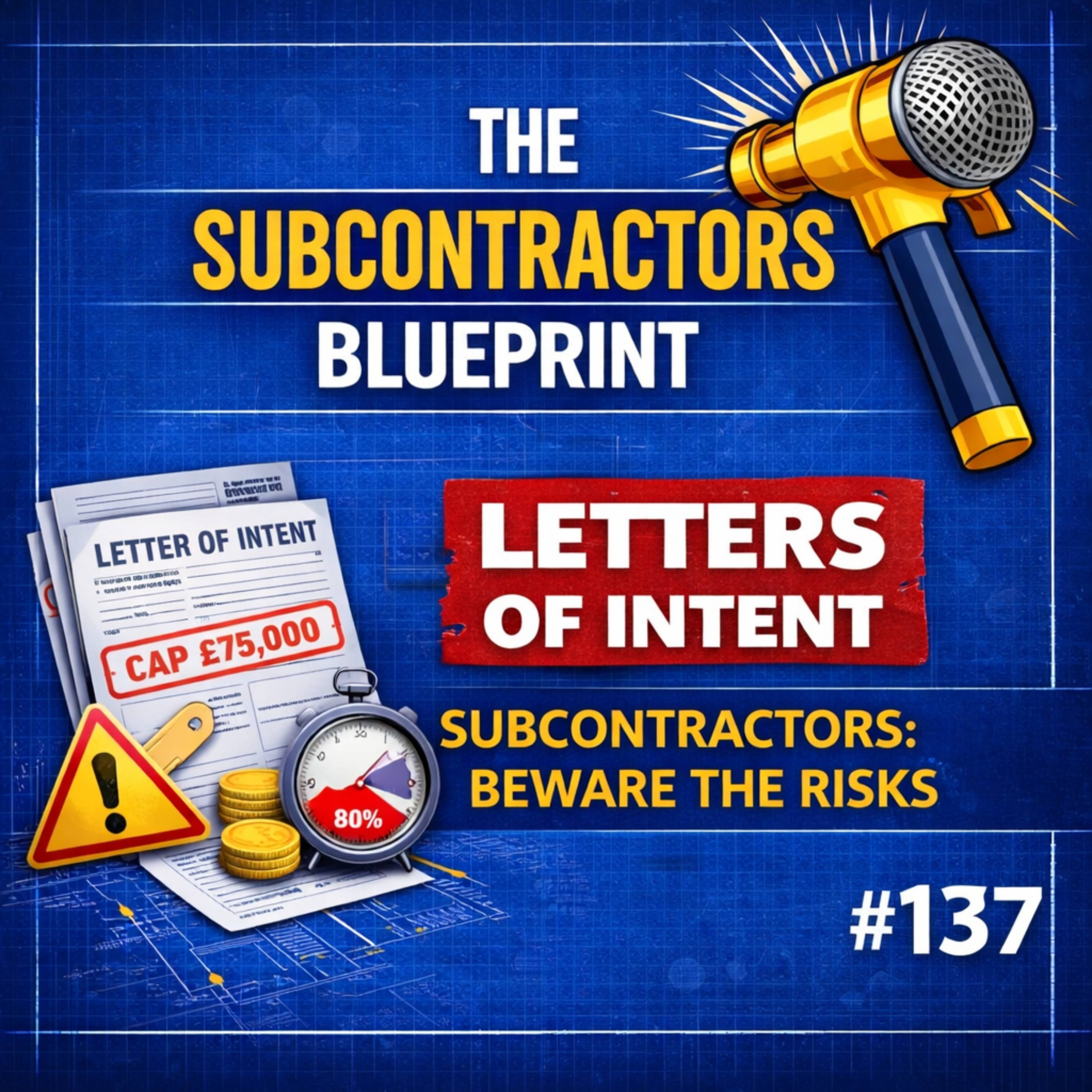
    From Financial Caps to Court Cases: What Every Subcontractor Needs to Know About Letters of Intent

    In episode 137 of The Subcontractors Blueprint, Jacob Austin of QS.Zone breaks down the real risks of letters of intent (LOIs) for subcontractors. He explains how financial caps embedded in LOIs can leave subcontractors unable to recover costs already incurred — a situation courts consistently uphold. Jacob outlines the common trap of continuing work past the cap while waiting for a formal contract that never arrives. He provides practical safeguards, including stopping work at 80% of the cap, documenting all correspondence, and consistently pushing for a formal subcontract. His core message: understand what you're signing before starting work. KEY TAKEAWAYS: The UK government has announced a ban on retention payments in construction contracts, marking a major shift for the industry. New legislation will also cap payment terms at 60 days, mandate statutory interest on late payments, and empower the Small Business Commissioner to fine persistent offenders. Specialist contractor trade bodies have welcomed the changes, while some client groups warn of potential quality risks. Main contractors may adapt by backloading payment schedules and tightening quality controls instead of using retentions. Subcontractors are advised to strengthen their commercial practices, keep thorough records, and understand their contracts to protect their cash flow. The host emphasises that while the rules are changing, the commercial culture may not, so preparation is key. BEST MOMENTS: * Letters of Intent (LOIs) are not formal contracts but can create legally binding obligations. Their meaning varies, so they must be read carefully to understand the terms. * The single biggest risk is the financial cap. Courts consistently enforce this limit, meaning any costs incurred beyond it are often unrecoverable by the subcontractor. * Subcontractors should never assume a formal contract will automatically follow. Main contractors may have no incentive to finalise one if the LOI suits their purposes. * When approaching the financial cap, you must stop work and get written authority and, either an increased cap or the formal subcontract, before committing to further costs. * Always push for the formal contract in writing from day one. This creates a paper trail and puts pressure on the main contractor to finalise the agreement. HOST BIO: Meet Jacob Austin, a Chartered Quantity Surveyor with a rich background at construction industry giants Balfour Beatty, Kier, and Vistry Group. With extensive involvement in education, health, and residential projects spanning various scales, from £1000s to over £100M in concurrent developments, Jacob brings a unique perspective. Having collaborated with numerous small businesses, he's now committed to sharing his expertise to drive their success. Join Jacob on his podcast, where he blends his profound insights and personable approach to offer guidance, industry secrets, and inspirational stories. LinkedIn - www.linkedin.com/in/jacob-austin/ Instagram - www.instagram.com/qs.zone/ www.qs.zone/all-links

  • March 30 · 25 min

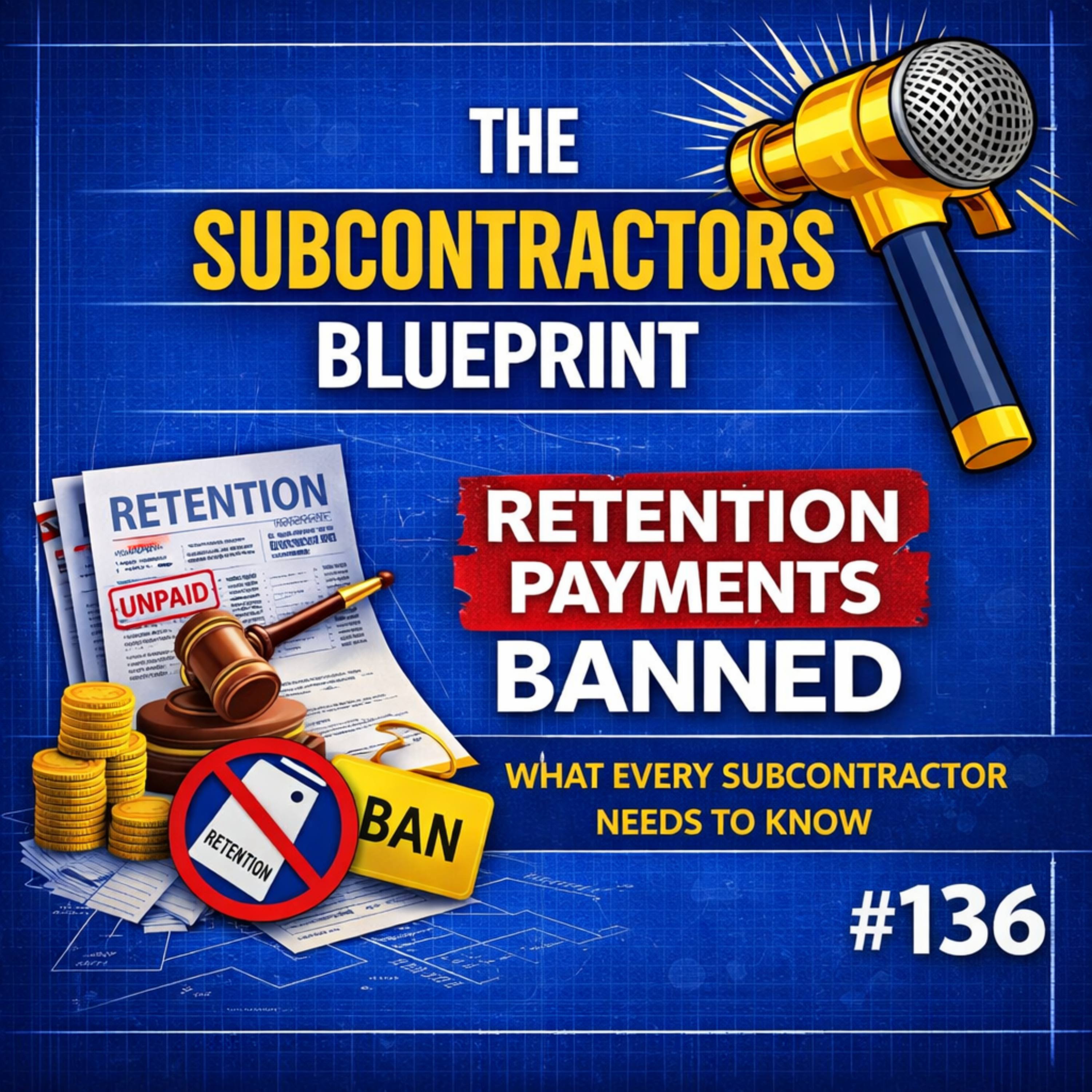
    The Retention Ban: Is It Good? Or Is It A Case Of Be Careful What You Wish For?

    In episode 136 of The Subcontractors Blueprint, Jacob Austin of QS.Zone unpacks the UK government’s landmark decision to ban retention payments in construction contracts. He explains the background, the new payment reforms, and what these changes mean for subcontractors’ cash flow and contract negotiations. Jacob highlights potential risks, such as main contractors restructuring payment schedules or increasing quality disputes, and offers practical advice on record-keeping, contract review, and preparing for increased use of retention bonds. The episode equips construction business owners with strategies to adapt and thrive in this evolving regulatory landscape. KEY TAKEAWAYS: The UK government has announced a ban on retention payments in construction contracts, marking a major shift for the industry. New legislation will also cap payment terms at 60 days, mandate statutory interest on late payments, and empower the Small Business Commissioner to fine persistent offenders. Specialist contractor trade bodies have welcomed the changes, while some client groups warn of potential quality risks. Main contractors may adapt by backloading payment schedules and tightening quality controls instead of using retentions. Subcontractors are advised to strengthen their commercial practices, keep thorough records, and understand their contracts to protect their cash flow. The host emphasises that while the rules are changing, the commercial culture may not, so preparation is key. BEST MOMENTS: "A ban on retentions doesn't mean main contractors lose their leverage. It means they look for new ways to get it." "The UK government has announced it will ban retention payments in construction contracts, which is absolutely massive." "The system has been systematically abused for decades because the reality is that money your money arguably doesn't sit in a ring fenced account waiting for you." "Every commercial contract will be required to include a statutory interest set at 8% above the Bank of England base rate." "The ban on the withholding of retention payments under the terms of construction contracts is a landmark moment." "Legislation changes the rules, but it doesn't change the culture." HOST BIO: Meet Jacob Austin, a Chartered Quantity Surveyor with a rich background at construction industry giants Balfour Beatty, Kier, and Vistry Group. With extensive involvement in education, health, and residential projects spanning various scales, from £1000s to over £100M in concurrent developments, Jacob brings a unique perspective. Having collaborated with numerous small businesses, he's now committed to sharing his expertise to drive their success. Join Jacob on his podcast, where he blends his profound insights and personable approach to offer guidance, industry secrets, and inspirational stories. LinkedIn - www.linkedin.com/in/jacob-austin/ Instagram - www.instagram.com/qs.zone/ www.qs.zone/all-links

Showing 21–34 of 34 episodes