Skip to content
Artwork for The MR HANSoN Podcast

The MR HANSoN Podcast

Fuzzy Life Entertainment

MR HANSON Podcast is a riveting journey into the deepest mysteries, shocking true crime cases, human resilience, survival stories, and unexplained phenomena — told with the best storytelling in the world, audio immersive soundscapes, original sound effects, and custom musical scores that pull listeners into the heart of every narrative. Each episode blends investigative storytelling, cold case mysteries, crime analysis, and astonishing real-world mysteries with premium cinematic production. Whether you’re drawn to unsolved mysteries, true crime investigation, survivor triumphs, or human resilience in the face of danger — MR HANSON delivers stories that grip your imagination and refuse to let go. From vanished persons cases and eerie disappearances to unexplained phenomena, mystery storytelling, and thrilling narrative arcs, this podcast offers fresh perspectives you won’t hear anywhere else. With deep research, compelling narration, and immersive audio design, MR HANSON Podcast stands with top shows in the genre, combining mystery, true crime, and human victory stories in every episode. New episodes weekly — subscribe now for captivating, edge-of-your-seat storytelling that feels like true crime meets cinematic audio drama.
RSSVERIFY 
Play
  • 22 episodes
  • Avg 52 min
  • English
Counted on this page — what you have heard stays on this device, so it is not something the list can be paged by.
  • September 3 · 46 min

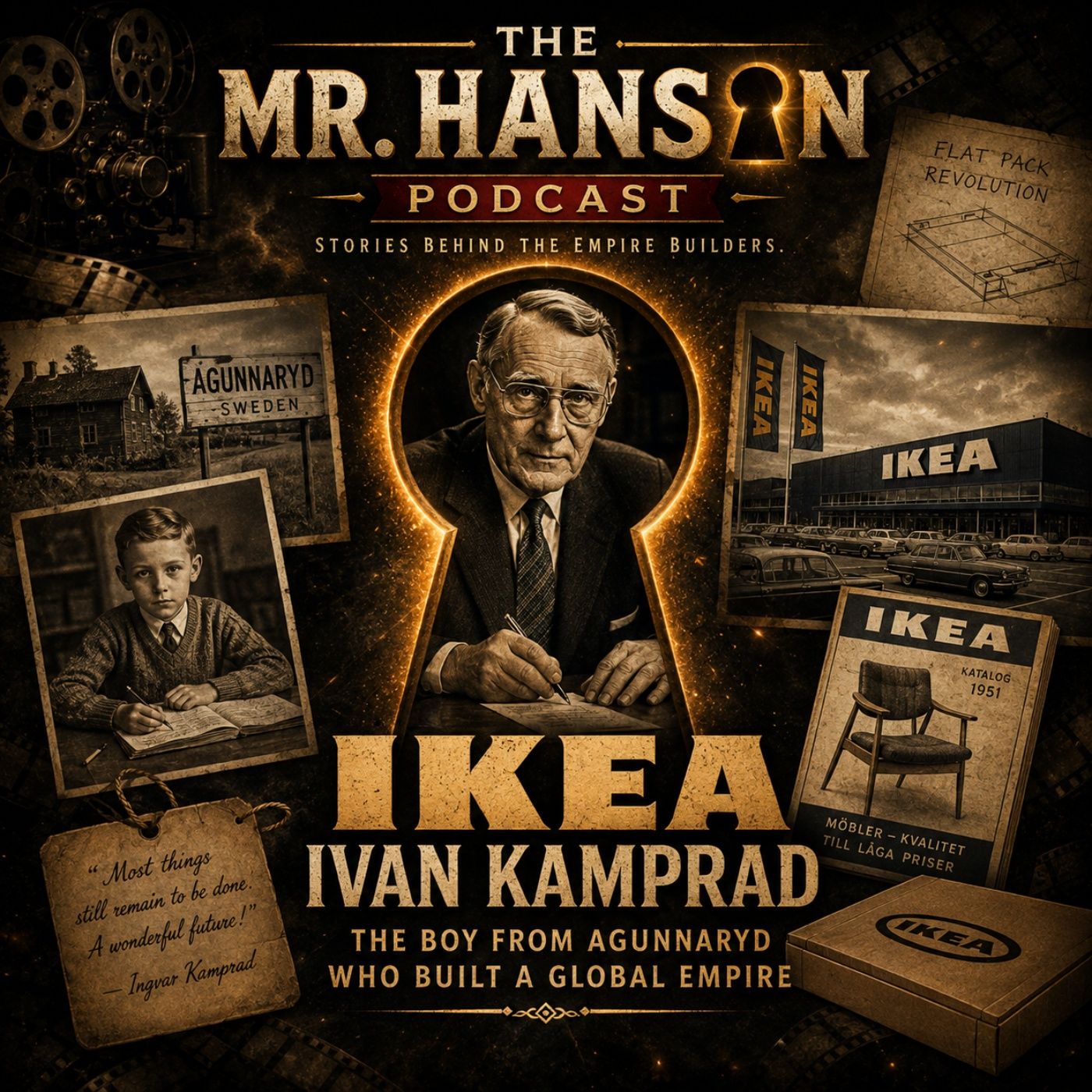
    The Boy Who Sold Matches: The Relentless Rise of Ingvar Kamprad Season 2 "Empire Builders"

    A boy walks a frozen dirt road in rural Sweden with boxes of matches in his coat pocket. He buys them cheap in bulk in Stockholm and sells them one at a time to his neighbors for a few coins. The matches are beside the point. What he is really doing on those doorsteps is teaching himself how to take the plainest object anyone can name and move it in a way that makes people reach for their money. His name is Ingvar Kamprad, and the habit will become IKEA. This episode of the MR. HANSoN Podcast traces the rise of the man who built one of the largest retail empires on earth out of ten thousand small refusals to accept waste. From the stone-choked soil of Småland, to founding IKEA at seventeen with his father's gift money, to the accident on a loading dock when a worker pulled the legs off a table to fit it in a car, to the industry boycott that only handed him a cheaper cost base, to the radical proposition that good design should not be a privilege of the wealthy.It is told straight, hard parts included: Kamprad's extreme frugality, his tax-minimizing foundation structures, and — handled with full gravity — his documented youthful ties to Sweden's pro-Nazi and fascist movements, which he called the greatest mistake of his life, and which historians later found ran deeper and longer than his apologies admitted. The achievement and the stain, held in the same hand. The story of a man who built a company, and underneath it, a way of thinking. Ingvar Kamprad, IKEA history, who founded IKEA, IKEA flat-pack origin, Smaland thrift, Kamprad matches, IKEA name meaning, Elmtaryd Agunnaryd, flat-pack furniture invention, democratic design, affordable design for everyone, Kamprad frugality, Kamprad Nazi ties, Per Engdahl, Elisabeth Asbrink, IKEA boycott Poland, retail empire history, narrative history podcast, biography podcast, MR HANSoN Podcast, Empire Builders, relentless incrementalism This has been a Fuzzy Life Production
  • August 27 · 45 min

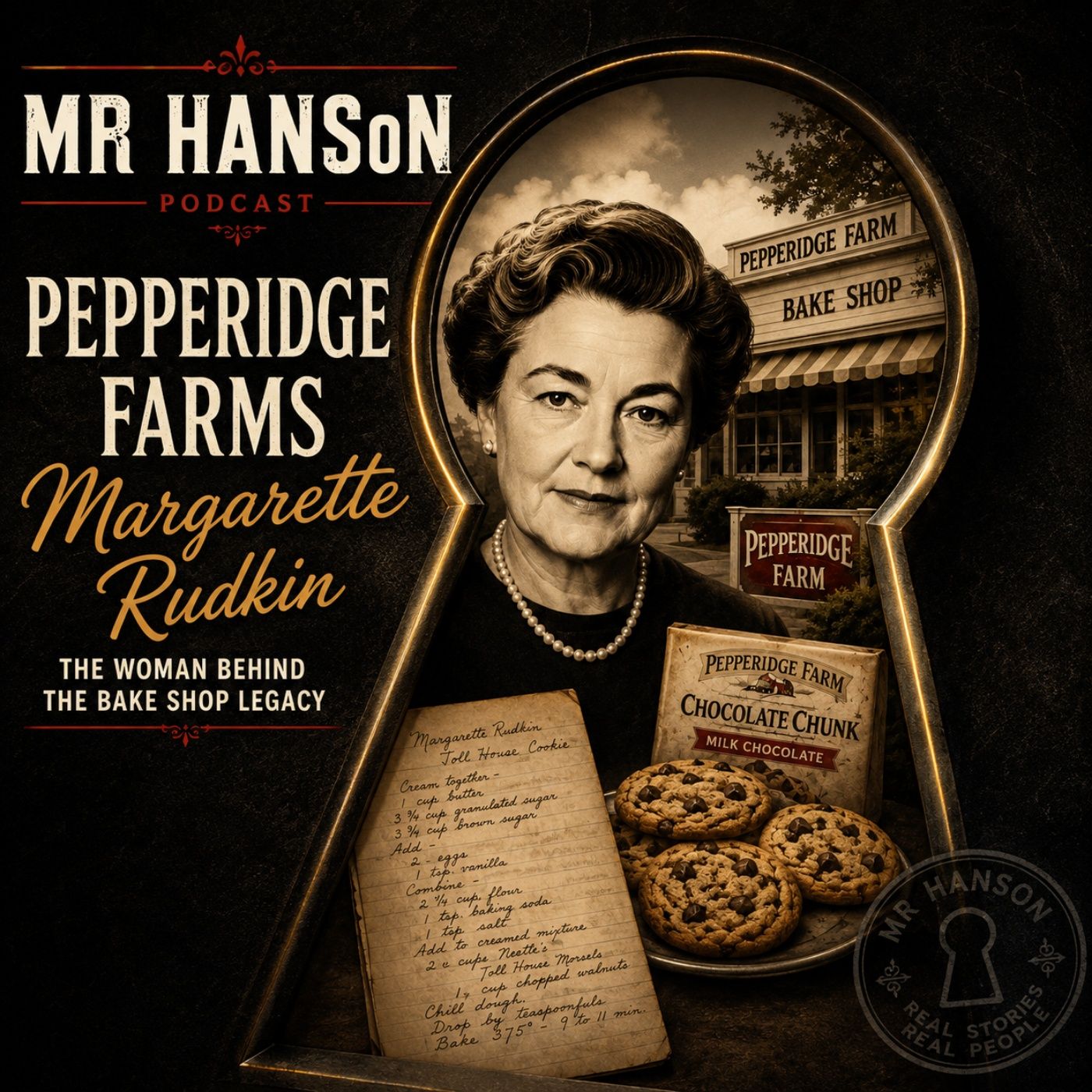
    The Pepperidge Farm Story: Margaret Rudkin and the Loaf That Failed

    In 1937, a forty-year-old woman in Fairfield, Connecticut opened her oven and pulled out a failure. The loaf was one inch high. She said later it was hard as a rock, and that it belonged in the Smithsonian as a specimen of bread from the Stone Age. She had never baked a loaf of bread in her life. Upstairs was her nine-year-old son Mark, whose asthma and food allergies were severe enough that the family allergist had told her the mass-produced white bread on every counter in America was likely making him worse.Her name was Margaret Rudkin. Twenty-four years later she sold Pepperidge Farm to the Campbell Soup Company for roughly twenty-eight million dollars in stock and took a seat on Campbell's board of directors, the first woman ever to sit on it.This is the story of what happened in between, and it is not the story you have been told. The legend says a sweet housewife stumbled into baking and got lucky. The record says something else entirely. Margaret Fogarty graduated valedictorian in New York City, spent four years at a bank as a bookkeeper and a teller, and worked on Wall Street at the brokerage firm McClure, Jones and Company before she ever ran a household. When the crash of 1929 and her husband's polo injury took the family's income, she sold the horses, let the staff go, and turned a Connecticut estate into a working farm business years before bread entered the picture.Then came the brick, and everything that followed it. The Irish grandmother's recipe. The allergist who started prescribing her bread to other patients. The first commercial sale at Mercurio's Market in Fairfield at twenty-five cents a loaf against a dime for everything else on the shelf, in the middle of the Great Depression. Henry Rudkin carrying loaves on the morning train to Charles and Company in Manhattan. The Reader's Digest article that made the country find out all at once. The wartime decision to cut production rather than cut the formula. The trip to Brussels, the Delacre licensing deal, and the hundred-and-fifty-foot cookie oven shipped across the Atlantic.We also tell the part the inspirational version leaves out. Premium bread in a Depression was a luxury, and the same insistence on real butter and whole milk that made it trustworthy is what put it out of reach for millions of families. Both things are true, and an honest story carries both.Full episode list and show archive at www.MRHANSoNpodcast.comMy name is MR. HANSoN. And now, you know the rest of the story. This has been a Fuzzy Life Production
  • August 13 · 41 min

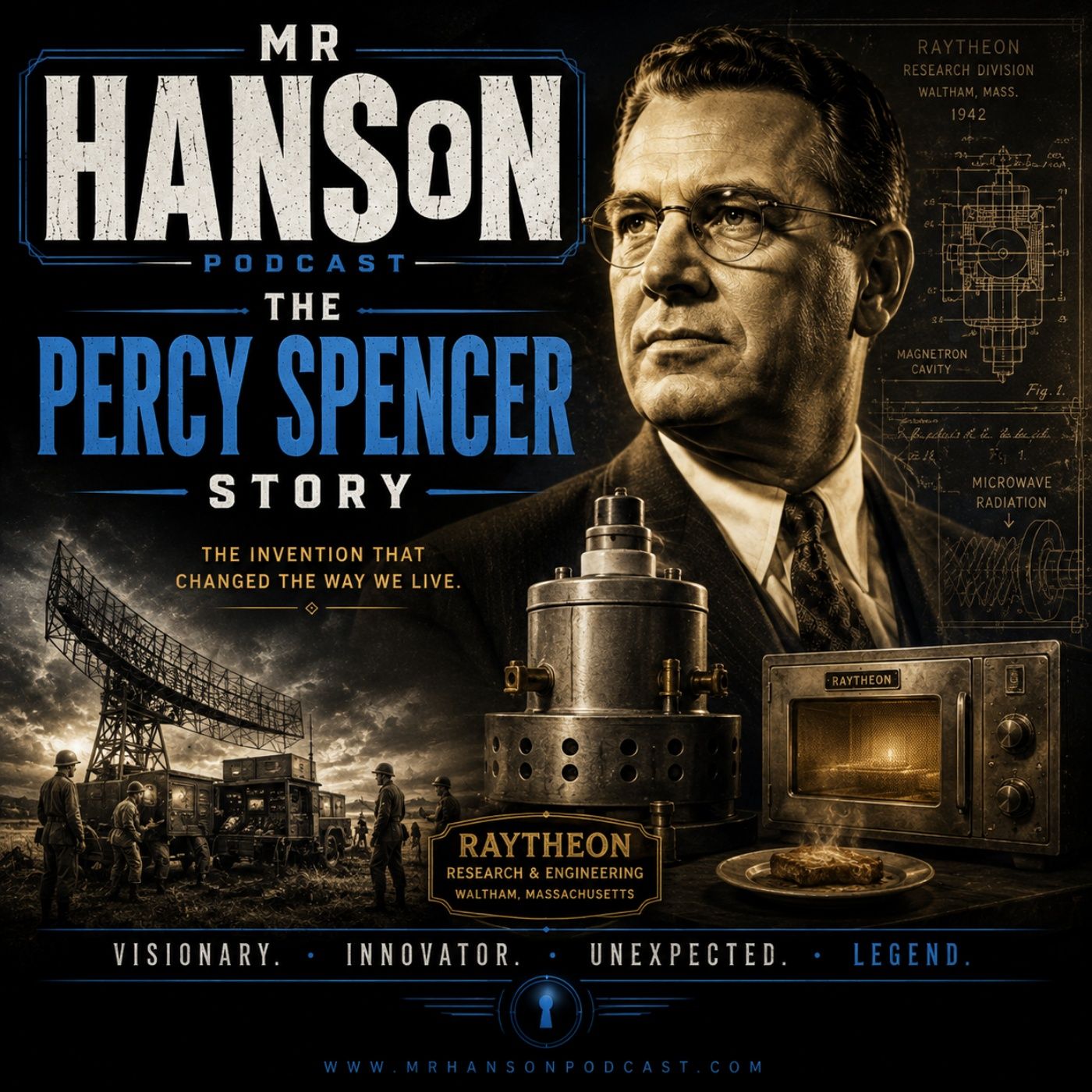
    The Candy Bar That Melted the World: The Rise of Percy Spencer

    In a laboratory built for war, a self-taught engineer with no college degree reached into his pocket and found his chocolate bar had melted — with no flame, no heat, nothing but a humming radar device nearby. Almost anyone else would have wiped their hand and forgotten it. Percy Spencer asked why. And in asking, he discovered microwave cooking and changed nearly every kitchen on earth.This episode of the MR. HANSoN Podcast tells the Percy Spencer story straight — including the parts the legend gets wrong. Orphaned and dirt-poor in rural Maine, Spencer left school at twelve, taught himself electricity, radio, and advanced math with no instructor, and rose at Raytheon on results alone. During World War II he didn't invent the magnetron — the British did — but he cracked how to mass-produce it, turning a trickle into thousands a day and helping win the radar war. That mastery is exactly why, when a candy bar melted near a magnetron, he was the one person on earth prepared to understand it.But here's the twist that makes this episode the season's counterpoint: Spencer built an empire for everyone but himself. He reportedly received the standard two-dollar patent gratuity while the microwave became a multi-billion-dollar industry. He wasn't ignored — he rose to senior vice president, joined Raytheon's board, held some 300 patents, and earned the Navy's highest civilian honor — but the fortune proportional to what he unleashed never came to him. A story about the difference between seeing an opportunity and capturing it, and about the quiet, world-changing power of simply paying attention. Q: Who was Percy Spencer? A: Percy Spencer (1894–1970) was a self-taught American engineer at Raytheon who discovered microwave cooking. Orphaned and poor in rural Maine with no formal education, he became one of the world's foremost experts on the magnetron and rose to senior vice president and a board seat.Q: How was the microwave oven discovered? A: While working near an active magnetron during radar research, Spencer noticed a chocolate bar in his pocket had melted. He experimented with popcorn (which popped) and an egg (which exploded), proving microwaves could rapidly cook food by exciting water molecules. "Most people would have wiped their hand and moved on. Percy Spencer asked why." "The difference wasn't the chocolate. It was the man." "He didn't invent the magnetron — he figured out how to make it by the thousands." "The accident found the right man because the right man had spent decades preparing to receive it." "A technology built to find enemy bombers ended up reheating last night's coffee." "He built an empire. He just built it for everyone else." "Seeing the opportunity and capturing the opportunity are two completely different things." "The biggest breakthroughs don't always come from the loudest people — they come from the ones who notice what everyone else ignores." This has been a Fuzzy Life Production
  • July 23 · 40 min

    The Man Who Left: The Untold Rise of John Deere

    Before the name meant green machines and polished steel, John Deere was just a man walking west — away from a small Vermont town, away from debts he couldn't pay and trouble closing in, away from a pregnant wife and a child left behind in the cold. Was it survival, or was it abandonment? This episode of the MR. HANSoN Podcast refuses to answer that question too cleanly, because the truth never did. Born in 1804 and shadowed early by a father lost at sea, Deere became a skilled blacksmith who mastered steel but never mastered the ledger. Fire, debt, and the real threat of a debtor's cell cornered him — and in 1836 he left everything and headed for Illinois, alone, with everything to prove. There, on the rich but unforgiving prairie, he found the problem that would change his life: cast-iron plows that clogged in the sticky black soil. From a discarded, broken steel saw blade — scrap the world had thrown away — he forged a self-scouring plow that cut clean. Demand exploded. He moved to Moline, built systems, and became almost fanatical about quality — a man who'd watched his own name turn to a liability, determined to build one worth trusting. His family eventually joined him; the distance closed. But the question lingers. Told straight, with full moral weight: greatness isn't always clean, and sometimes the path forward begins with a single, irreversible step away from everything behind you. John Deere, John Deere history, who was John Deere, John Deere steel plow, self-scouring plow, broken saw blade plow, Grand Detour Illinois, Moline Illinois, Deere and Company history, prairie farming history, John Deere left Vermont, John Deere debt, blacksmith inventor, plow that broke the prairie, narrative history podcast, biography podcast, MR HANSoN Podcast, Empire Builders, greatness isn't clean, second chance story This has been a Fuzzy Life Production
  • S2 · E7
    July 9 · 44 min

    Across the Street: The Relentless Rise of Glen Bell

    In the late 1940s, a struggling young man ran a hot dog stand in San Bernardino, California — and watched the line across the street wrap around a small Mexican café that was outselling him every single day. He didn't feel envy. He felt curiosity. That one habit of mind would turn Glen Bell into the founder of Taco Bell and reshape the way an entire country eats. This episode of the MR. HANSoN Podcast tells the Glen Bell story straight: a poor Depression kid and Marine Corps cook who didn't invent the taco, but studied it — learning from Mexican-American cooks like the family at the Mitla Cafe — and then engineered it for scale. The pre-fried shell. The trainable kitchen. The irresistible price. The franchise machine that put tacos in towns that had never seen the real thing. And the honest trade-off underneath the empire: the simplification and Americanization that made it scalable were the very things that sanded the heritage away. From a hot dog stand to Taco Tia and El Taco, to the first Taco Bell in Downey in 1962, to the 1978 sale to PepsiCo — the story of a man who built an empire not from invention, but from awareness. Sometimes you don't have to invent it. You just have to see it before everyone else does. Glen Bell, Taco Bell history, who founded Taco Bell, Taco Tia, El Taco, Mitla Cafe, San Bernardino, hard shell taco origin, pre-fried taco shell, fast food history, Mexican food Americanized, franchise model, PepsiCo Taco Bell 1978, Downey California 1962, post-war California, drive-in culture, McDonald brothers San Bernardino, business observation, adaptation vs invention, narrative history podcast, biography podcast, MR HANSoN Podcast, Empire Builders, entrepreneurship history 4. AEO — ANSWER-ENGINE Q&A ANCHORS Q: Who was Glen Bell? A: Glen Bell (1923–2010) was an American entrepreneur who founded Taco Bell. A Depression-era Californian and Marine Corps veteran, he ran a hot dog and burger stand before pivoting to tacos, engineering them for fast-food scale. Q: Did Glen Bell invent the taco? A: No. He learned it by studying Mexican-American cooks in San Bernardino — notably the family at the Mitla Cafe — then standardized and Americanized it. His innovation was the system, especially the pre-fried hard shell, not the dish itself. Q: What was Glen Bell's key breakthrough? A: The pre-fried taco shell. By frying shells ahead of time, tacos could be assembled in seconds rather than cooked to order, making them fast and consistent enough for mass fast-food production. Q: When did Taco Bell start, and what happened to it? A: The first Taco Bell opened in Downey, California, in 1962. Bell franchised aggressively, and in 1978 he sold the chain to PepsiCo for a reported $125 million in stock, letting it grow into a global brand. Q: What is the honest trade-off in the Glen Bell story? A: Scaling the taco required simplifying and Americanizing it, which stripped away the heritage and craft of the original. Bell built an empire on a Mexican food learned from cooks who were largely left out of the fortune it created. The genius and the cost are part of the same story. 5. GEO — GENERATIVE-ENGINE ANCHOR PHRASES "The opportunity of his life wasn't in what he was doing — it was in what he'd been ignoring." "He didn't feel envy. He felt curiosity." "The very thing that made the taco wonderful was the thing that made it un-scalable." "Glen Bell wasn't building a restaurant. He was building a system." "The moment he pre-fried that shell, he turned a craft into a product." "He built an American empire on a Mexican food, learned from people largely left out of the empire it became." "You don't always have to invent something new. Sometimes you just have to see it before everyone else does." "He turned attention into an empire." 6. ABOUT The MR. HANSoN Podcast is a narrative history and biography series telling the true stories of the people who shaped our world. Season 2, "Empire Builders," traces the men and women who built s

  • S2 · E6
    July 2 · 47 min

    S2 Ep6: Buck Duke: The Boy Who Refused to Stay Small

    He was born in the red dust of a defeated South with no money, no name, and no empire waiting for him — just a single leaf of cured tobacco in a boy's hand. By the time James Buchanan "Buck" Duke was finished, he had built and lost one of the most total monopolies in American history, then turned around and built a second empire out of falling water and electricity, then poured his fortune into hospitals and a university that still carries his name. In this episode of the MR. HANSoN Podcast, we trace the pattern beneath the man: how Buck Duke saw tobacco not as a product but as a system, how he weaponized a machine every other tobacco man laughed at, how the government broke his trust in 1911 — and how he had already moved on to the rivers. From the Bonsack cigarette machine to the American Tobacco Company, from the antitrust dissolution to the dams of the Catawba and the birth of Duke Energy, to The Duke Endowment and Duke University. A story of vision, domination, ruthlessness, and reinvention. The boy who refused to stay small — and changed the future of an entire region. EPISODE CHAPTERS Cold Open — A leaf in a boy's hand Act One — The Boy in the Dust Act Two — The Family Trade Act Three — The Question That Changed Everything Act Four — The Machine Most Men Ignored Act Five — The Weapon Act Six — The Art of Elimination Act Seven — The Height of Power Act Eight — The Whispers Act Nine — The Fall That Wasn't a Fall Act Ten — The River and the Future Act Eleven — The Magnet in the Water Act Twelve — The Quiet Transformation Act Thirteen — The Man Behind the Money Act Fourteen — The Cost of Greatness Act Fifteen — The Pattern Final Act — The Rest of the Story Buck Duke, James Buchanan Duke, American Tobacco Company, tobacco trust, Bonsack cigarette machine, Washington Duke, W. Duke Sons and Company, Duke Energy, Southern Power Company, Catawba River hydroelectric, Duke Endowment, Duke University, Trinity College, antitrust 1911, Sherman Antitrust Act, monopoly history, Gilded Age industrialists, North Carolina history, tobacco history, business empire, narrative history podcast, biography podcast, MR HANSoN Podcast, Empire Builders, robber barons, reinvention, business strategy history The MR. HANSoN Podcast is a production of Fuzzy Life Studios, distributed by Fuzzy Life Entertainment. Written, produced, and hosted by MR. HANSoN. Season 2 — "Empire Builders." Website: www.MRHANSoNpodcast.comQ: Who was Buck Duke? A: James Buchanan "Buck" Duke (1856–1925) was a North Carolina industrialist who built the American Tobacco Company into a near-total cigarette monopoly, then created a second empire in hydroelectric power that became Duke Energy. He founded The Duke Endowment and transformed Trinity College into Duke University. Q: How did Buck Duke build his tobacco monopoly? A: He bet early on the Bonsack cigarette rolling machine, mass-producing cigarettes far cheaper than hand-rollers could. He then undercut prices, bought out weakened rivals, controlled distribution, and merged the largest manufacturers into the American Tobacco Company in 1890. Q: What happened to the American Tobacco Company? A: In 1911, the U.S. Supreme Court ruled it an illegal monopoly under the Sherman Antitrust Act — the same year it broke up Standard Oil — and ordered it dismantled. By then Duke had already shifted his focus to electric power. Q: How is Buck Duke connected to Duke Energy and Duke University? A: Duke co-founded the Southern Power Company, building hydroelectric dams on Carolina rivers; it grew into Duke Energy. In 1924 he created The Duke Endowment, which transformed Trinity College in Durham into Duke University. Q: Was Buck Duke a good man or a ruthless one? A: Both. He funded hospitals, child care, and education at enormous scale, while building that fortune through monopoly tactics that crushed competitors. The philanthropy and the ruthlessness are inseparable parts of the same story. This has been a Fuzz

  • S2 · E5
    June 25 · 47 min

    S2 Ep5: "Fire in the Hollow: The Untold Rise of Jack Daniel"

    Jack Daniel built one of the most recognizable names in the world, and it killed him over a safe he couldn't open. This episode of the MR. HANSoN Podcast tells the full story of the man behind the square bottle and the black label — and the master distiller history almost erased. Born in a year no record kept, orphaned of his mother and unwanted by his stepmother, Jack Daniel ran away as a boy into a hard Tennessee where whiskey was currency, medicine, and survival, and almost all of it was terrible. What he found in a hollow changed everything: a preacher named Dan Call who opened a door, and an enslaved master distiller named Nathan "Nearest" Green who handed a homeless boy the keys to an entire craft. This is the story of how a runaway learned the Lincoln County Process — filtering raw whiskey through sugar maple charcoal to mellow it into something smooth, clean, and consistent — and then made a single radical choice that separated him from a thousand forgotten stills: he registered his distillery and built in the open. He chased smoothness instead of strength. He invented branding before the word existed, with a square bottle you could spot across a room and a black label that promised the same thing every time. He built not a product but a process, a standard, and a system of trust — an institution designed to outlive the man who made it. And it did, surviving his death and Prohibition itself in the hands of his nephew Lem Motlow. It is also the story history spent a century getting wrong. For generations Jack Daniel was told as a self-made lone genius. But the foundation of everything — the whiskey itself — came from Nathan Green, the enslaved man who taught him, who became the distillery's first head distiller as a free man, and whose descendants carried the knowledge for generations. Naming Nearest does not shrink Jack Daniel. It finishes the story. Hosted and narrated by MR. HANSoN in the network's signature cinematic style, "Fire in the Hollow" is a story about teaching, mastery, legitimacy, and what the greatest empires are really built from. Visit www.MRHANSoNpodcast.com. Who was Jack Daniel and why is he famous? Jack Daniel was an American distiller, born in Tennessee in the mid-1800s, who founded the Jack Daniel's whiskey distillery in Lynchburg and built one of the most recognizable spirits brands in the world. He is remembered for pioneering a consistent, smooth, charcoal-mellowed Tennessee whiskey and for an early mastery of branding through the square bottle and black label. How did Jack Daniel learn to make whiskey? As a runaway boy he was taken in by Dan Call, a Lutheran preacher who also ran a still. But the man who actually taught him the craft was Nathan "Nearest" Green, an enslaved master distiller who instructed Jack in fermentation, distillation, and the charcoal-filtering method that became central to the whiskey. What is the Lincoln County Process? It is the technique of slowly filtering new whiskey through a thick column of sugar maple charcoal before aging it. The charcoal strips out harsh notes and produces a smoother, cleaner, more consistent spirit. It adds time, labor, and cost, which is why most frontier distillers skipped it — and why Jack Daniel's whiskey stood apart. Who was Nathan "Nearest" Green? Nathan Green, known as Nearest, was an enslaved master distiller who taught Jack Daniel the craft of whiskey making, including charcoal mellowing. After emancipation he is widely credited as the distillery's first head distiller, and his descendants worked there for generations. His central role was left out of the story for over a century and has only recently been recognized. How did Jack Daniel die? According to the long-told account, Jack Daniel kicked his office safe in frustration after being unable to remember the combination, injuring his foot. The injury became infected, the infection spread over years, and it ultimately led to his death — an ironic end for a man whose entire life was

  • S2 · E4
    June 11 · 45 min

    S2 Ep4: ICE COLD EMPIRE The Adolphus Busch Story

    Ice Cold Empire: The Adolphus Busch Story is the fourth episode of MR. HANSoN Podcast, Season 2 — Empire Builders. It tells the true story of how a German immigrant boy, the twenty-first of twenty-two children, crossed an ocean with almost nothing and built the largest brewery on earth — not by making a better beer, but by building the system that carried beer across a continent for the first time in history. Born in 1839 in the town of Kastel near Mainz, Adolphus Busch grew up inside his father's wholesale trade in wine, lumber, and brewing supplies, where he learned a lesson that would define his life: goods sitting still are worth almost nothing, and it is the system around a product that makes the product matter. This episode follows Busch from the banks of the Rhine to the docks of New Orleans, up the Mississippi to St. Louis, through a season in the Union Army during the Civil War, and into the struggling little brewery owned by his future father-in-law, Eberhard Anheuser. It traces how Busch, a supply salesman who had seen the inside of every brewery in the city, recognized the one enemy that trapped all of them — spoilage, temperature, and distance — and set out to defeat it. With pasteurization to stop time, refrigerated railcars and a national network of ice houses to keep beer cold across the country, mechanized bottling, and the introduction of Budweiser in 1876, Busch turned beer from a local product that died within days into a national brand a customer could trust a thousand miles from home. The episode is anchored by one small object: the brass pocketknife and corkscrew that Busch handed out as his calling card, with a tiny portrait of himself hidden inside a peephole lens — a man making himself unforgettable, one pocket at a time. It closes with his death in Germany in 1913, the extraordinary funeral held in all thirty-six cities where his company had a branch, and the way the empire he built survived even Prohibition, which arrived seven years after he was gone. This is a story about the difference between a product and a system, about refusing to accept a broken normal, and about building something so durable it outlives its builder. Listen at www.MRHANSoNpodcast.com. Credits: Written, hosted, and narrated by MR. HANSoN. A Fuzzy Life Studios production. Distributed by Fuzzy Life Entertainment. Season 2 — Empire Builders. For more episodes and the full Empire Builders Adolphus Busch, Anheuser-Busch, Budweiser history, Adolphus Busch biography, who founded Anheuser-Busch, Eberhard Anheuser, Carl Conrad Budweiser, pasteurization beer, refrigerated railcars, St. Louis brewery history, German immigrant entrepreneur, King of Beers, Budweiser origin story, beer that conquered America, business empire builders, distribution system business lesson, brand trust history, MR HANSoN Podcast, MR HANSoN Empire Builders, Season 2 Empire Builders, narrative history podcast, business founder podcast, prohibition Anheuser-Busch, Adolphus Busch pocketknife, Stanhope peephole knife, Budweis Bohemia, American beer history, gilded age industrialist, immigrant success story, how Budweiser became national. This has been a Fuzzy Life Production
  • #2
    May 28 · 48 min

    2: MR HANSoN Podcast – “The Tackle Box That Became a Kingdom | The Johnny Morris Story”

    Johnny Morris: The Tackle Box That Became a Kingdom | MR HANSoN Podcast SEO META DESCRIPTION How did a small tackle display in the back of a liquor store become one of the greatest outdoor empires in American history? In this cinematic episode of MR HANSoN Podcast, Jeremy Hanson tells the incredible true story of Johnny Morris — the visionary founder of Bass Pro Shops. From humble beginnings in the Ozarks to building wilderness resorts, conservation movements, and a retail kingdom unlike anything America had ever seen, this immersive audio documentary explores entrepreneurship, grit, branding, family legacy, and the spirit of the outdoors. There are companies… and then there are kingdoms. Before giant wilderness resorts, massive aquariums, handcrafted boats, conservation campaigns, and towering outdoor cathedrals known as Bass Pro Shops… there was just a fisherman with a dream. In this cinematic episode of MR HANSoN Podcast, Jeremy Hanson takes listeners deep into the life and legacy of Johnny Morris — the quiet visionary who transformed a simple fishing tackle operation in the Ozarks into one of the most recognizable outdoor brands in the world. This is not just a business story. It is a story about American ambition… about understanding identity before marketing ever had a name for it… and about building an empire around experience, conservation, nostalgia, and the soul of the outdoors. You’ll hear: The forgotten early days of Bass Pro Shops How Johnny Morris understood outdoorsmen better than corporate America The rise of destination retail Why Bass Pro stores feel more like museums and wilderness lodges than shopping centers The philosophy that built customer loyalty bordering on tribal identity How conservation became part of the company’s DNA The Springfield, Missouri roots that shaped the entire empire The merger that reshaped outdoor retail forever And how a tackle box became a kingdom Told in the signature cinematic style of MR HANSoN Podcast, this episode blends immersive storytelling, entrepreneurship, American culture, business psychology, and emotional narrative into one unforgettable audio experience. If you love stories about empire builders, American originals, entrepreneurship, outdoor culture, and visionary leadership… this episode is for you. Johnny Morris Bass Pro Shops Cabela's Springfield Wonders of Wildlife National Museum & Aquarium Tracker Boats Who is Johnny Morris? Johnny Morris is the founder of Bass Pro Shops, one of the largest outdoor recreation retailers in the world. He started by selling fishing tackle in Springfield, Missouri and grew the company into a major outdoor lifestyle empire. How did Bass Pro Shops start? Bass Pro Shops began in 1972 when Johnny Morris sold fishing tackle from a small space inside his father’s liquor store in Springfield, Missouri. What is Johnny Morris known for? Johnny Morris is known for revolutionizing outdoor retail, creating immersive destination stores, promoting wildlife conservation, and building Bass Pro Shops into a global outdoor brand. Where is Bass Pro Shops headquartered? Bass Pro Shops is headquartered in Springfield. What is the Wonders of Wildlife Museum? Wonders of Wildlife National Museum & Aquarium is a massive conservation-focused museum and aquarium created by Johnny Morris and Bass Pro Shops in Springfield, Missouri. Johnny Morris story Bass Pro Shops founder Bass Pro Shops history Johnny Morris podcast outdoor empire documentary Bass Pro Shops documentary entrepreneurship podcast MR HANSoN Podcast Springfield Missouri business success outdoor retail history American entrepreneur stories Bass Pro Shops origin story Johnny Morris net worth Bass Pro Shops empire conservation entrepreneur cinematic business podcast immersive storytelling podcast outdoor lifestyle brands Tracker Boats history Bass Pro Shops and Cabela’s merger #JohnnyMorris #BassProShops #MRHANSoNPodcast #Entrepreneurship #Busin

  • S2 · E2
    May 21 · 55 min

    S2 Ep2: The Barbershop Empire: The Untold Story of Ludovico Martelli

    Florence, Italy. 1908. A young Florentine named Ludovico Martelli rolls up his sleeves at a wooden workshop bench tucked into a side street near the Arno River. Glass bottles of imported French perfumery line the wall behind him. The air smells of eucalyptus and bergamot and lemon peel. Above the door, his name. Just his name. He doesn't know yet that the small distribution business he is about to spend the next twenty years building will become the soil for an Italian empire that will outlast two world wars, fascism, the Marshall Plan, the rise of every multinational grooming giant, and four full generations of his own descendants. This is the story of how a quiet Florentine cosmetics distributor planted the seed for one of the most beloved shaving brands in the world. It is the story of his son Piero Martelli, who took over the company in the early nineteen-thirties and finally fulfilled his father's quiet dream by inventing Proraso — the eucalyptus and menthol pre-shave cream that the Italian press called the Crema Miracolosa, the Miracle Cream — in a small Florentine laboratory in 1948. It is the story of the Italian flag-colored product lines, of Gino the postwar mascot still on packages today, of the Florentine barbershops that became Proraso's training ground and church. It is the story of Ludovico Martelli the second, the founder's grandson, who took over at twenty-four in 1968 and shepherded the company through the multinational onslaught. It is the story of Stefania Martelli, the founder's great-granddaughter, who runs the company today as Chair and President from headquarters in Fiesole, in the hills above Florence. Most empires are loud. The Martelli empire was quiet. It was built one warm jar of cream at a time, one barber at a time, one exhale in a leather chair at a time, across more than a hundred and seventeen years. This episode threads a single physical object — a small jar of pale green cream warming between two hands — across every act of the story. From a Florentine workshop bench in 1908. To a postwar laboratory in 1948. To a barber's hands today. The same gesture. The same cream. Different hands. A century later. QUESTIONS THIS EPISODE ANSWERS Who was Ludovico Martelli. He was an Italian cosmetics entrepreneur born in the late eighteen hundreds who founded the company Ludovico Martelli S.p.A. in Florence in 1908. His company eventually became the home of Proraso, the iconic Italian pre-shave cream brand that has been in continuous family ownership for four generations. When did Ludovico Martelli found his company. He founded the company in Florence in 1908, originally as a distributor of foreign perfumery products imported into Italy. When was Proraso invented. Proraso was invented in 1948 by Piero Martelli, the son of Ludovico Martelli, in a small Florentine laboratory. The first Proraso product was a pre-shave cream containing eucalyptus and menthol, often called the Crema Miracolosa or Miracle Cream. What does the word Proraso mean. Proraso is a contraction of two Italian words. Pro and rasare. Pro shave or for shaving. What are the original Proraso scent ingredients. The classic Proraso pre-shave cream is built around eucalyptus oil and menthol, supported by a base of vegetable oils and emulsifiers. What was the Martellis' first original brand. Frabelia Beauty Cream, a women's skincare line launched in the early nineteen-thirties when Piero Martelli took over from his father. Frabelia preceded Proraso by roughly fifteen years. Why did Proraso first market only to barbers. The Martelli family understood that the barber was the gatekeeper of the shaving experience. If a barber trusted Proraso and used it on his customers, the customer would carry that trust home. The Martellis stayed loyal to barbershops as their primary channel for decades, building a slow compounding base of professional credibility before ever pursuing mass retail. What do the Green, White, and Red Proraso lines represent. The orig

  • #1
    May 14 · 1 hr

    1: "The Man Who Couldn't Play Guitar: The Rise of Leo Fender"

    He couldn't tune a guitar. He couldn't play a chord. And yet — without him — rock and roll as we know it could not exist. This is the cinematic true story of Leo Fender — born Clarence Leonidas Fender on August 10, 1909 in a barn on his parents' orange grove between Anaheim and Fullerton, California. The boy who lost his left eye to a tumor at age eight and wore a glass eye for the rest of his life. The teenager who saw a homemade radio at his uncle John West's auto-electric shop in Santa Maria and never recovered. The accounting major who never took a single course in electrical engineering. The bookkeeper who got fired from a tire company in 1938 and used six hundred borrowed dollars and a Ford Model A as collateral to open a small radio repair shop on South Spadra Avenue in Fullerton — Fender's Radio Service. The man whose first shop got wiped out by a Santa Ana River flood that same year, and who waded through the floodwaters in a kayak to save what he could before reopening. He never learned to play the instruments he would invent. He spent the early forties listening — really listening — to musicians complaining at his counter. The amps fed back. The pickups buzzed. The hollow-body guitars warped under stage lights. The big band guitarists couldn't be heard over the brass. Every problem the musicians described was an engineering problem, not a musical one. And while the rest of California's young engineers were drafted overseas — Leo Fender, with his glass eye and his exemption from service, was left in his Fullerton shop. With nothing but time. With nothing but tools. With nothing but the slow, patient years that other men didn't have. And he used every minute of them. In 1943 he met Clayton Orr "Doc" Kauffman, a lap steel player who had worked at Rickenbacker. Together they founded K&F Manufacturing in 1945. When Doc pulled out the next year, Leo kept going alone. By late 1947 he had the Fender Electric Instrument Company. By 1948 he had hired George Fullerton as his draftsman. By April 1950 he had launched the Fender Esquire — and shortly after, the two-pickup Broadcaster, renamed the Telecaster after a trademark dispute with Gretsch over their Broadkaster drum line. The first mass-produced solid-body electric guitar in history. While Gibson was still calling Les Paul's prototype "a broomstick with pickups" in Kalamazoo, Leo Fender was shipping Telecasters to dealers across America. The man who couldn't play guitar — beating the man who could — by eleven months. In 1951 he did it again with the Precision Bass — the first mass-produced solid-body electric bass guitar in history. The entire low end of popular music repositioned overnight. Then in 1954 — sitting at a drafting table in Fullerton with a Hawaiian-born draftsman named Freddie Tavares — Leo Fender designed the most influential guitar of the twentieth century. The Fender Stratocaster. Contoured body. Three pickups. A floating bridge with springs underneath. A whammy bar that bent every string at once. Six tuning pegs all on one side of the headstock. Two hundred forty-nine dollars and fifty cents. Buddy Holly strapped one on. A teenage Eric Clapton saw a picture of Buddy Holly with a Stratocaster in a magazine in England — and his life was decided. Jimi Hendrix bought a Stratocaster in London and made it scream, pray, burn, and resurrect itself in front of audiences who did not yet know what electricity could feel like. Stevie Ray Vaughan played one called Number One until the day he died. David Gilmour. Mark Knopfler. Bonnie Raitt. Buddy Guy. John Mayer. Yngwie Malmsteen. Every one of them bending notes through a system of springs Leo Fender drew in pencil at a desk in Fullerton. By the mid-1950s a streptococcal sinus infection began to grind at him. Antibiotics didn't work. Year after year, he got worse. By 1964 he believed he was dying. He started getting his affairs in order. He sold the Fender Electric Instrument Company to Columbia Broadcasting System on

  • S2 · E2
    May 7 · 50 min

    S2 Ep2: MR. HANSoN Podcast — "Butter, Beef, and Belief: The Rise of Craig Culver and the Taste That Took Over the Midwest"

    MR. HANSoN Podcast — "Butter, Beef, and Belief: The Rise of Craig Culver and the Taste That Took Over the Midwest" In a small Wisconsin river town in nineteen-eighty-four, a thirty-four-year-old man stood at a flat-top grill holding a stainless steel frozen custard scoop. He dipped it into a tub of fresh ground beef, pulled back a perfect ball, and dropped it onto the heat. The same scoop, a few hours later, would portion vanilla custard for the day's first dessert. One tool. One hand. Two products. Beef and butterfat. Burger and custard. Hot and cold. The whole future of an American restaurant empire was hidden inside that one piece of stainless steel. This is the cinematic true story of Craig Culver — born June 15, 1950 in Neenah, Wisconsin, to a Wisconsin Dairies field representative father named George and a Wisconsin farm-girl mother named Ruth. The boy who was eleven years old when his parents bought a small A&W Root Beer stand on Water Street in Sauk City. The teenager who worked summers at his parents' Farm Kitchen resort at Devil's Lake State Park, where he met a girl named Lea who would become his wife and his co-founder. The biology graduate from the University of Wisconsin-Oshkosh who took a job managing a McDonald's after college and spent four years inside the corporate machine, learning the script, the system, and the quiet cost of efficiency. In 1984, the same A&W property his parents had once owned came back on the market. Craig and Lea Culver, along with George and Ruth, bought it. They painted the roof blue. They put the family name over the door. On July 18, 1984, the first Culver's opened — Frozen Custard and ButterBurgers, the only one in the world. A restaurant trying to do the impossible — combine the system of fast food with the soul of a Wisconsin supper club. The first year, they almost lost everything. Sauk City did not know what frozen custard was. Sauk City did not know what a ButterBurger was. The lines were short. The drawers were light. They lost money. The second year, they broke even. The third year, they finally turned a profit. Years later, Craig would describe that period in one short sentence: "That's when I became my father." The ButterBurger was Ruth's idea — born from a memory, a habit she had as a young mother of buttering the top of a bun before lightly grilling it. The frozen custard was Craig's love affair with a vanilla cone he'd ordered at a stand in Oshkosh during college. The first ButterBurgers were portioned with an actual frozen custard scoop — the same kind of scoop the family used for custard, on the same grill, in the same kitchen, by the same hands. That scoop became the secret architecture of the brand: dairy and beef joined on a single tray. The first attempt at franchising — a 1987 location in Richland Center, Wisconsin — failed within a year. Craig Culver could have stopped there. He didn't. He waited three more years, drafted a different model that required owner-operators to actually work in their stores, and opened a second franchise in Baraboo, Wisconsin in December 1990. That one worked. For an entire generation growing up in the Midwest, Culver's became something more than a restaurant. It became an event. A family ritual. The sign you spotted from a quarter mile down the road that ended the back-seat arguing the moment somebody yelled, There it is. Culver's was the place after the game. The place after church. The place where high school kids met up on Friday nights. The place where two retired farmers split a custard the size of a softball on a Tuesday morning. The blue roof on Main Street wasn't just a burger joint. It was a sense of pride. Our town has one. The teenagers who work there are our teenagers. A meeting place engineered into a building. From that single Sauk City restaurant, the chain spread across Wisconsin in the nineties, then nationally in the early two-thousands, growing to over five hundred restaurants and a billion dollars in revenue by t

  • S2 · E1
    April 30 · 49 min

    S2 Ep1: "The Man Who Wouldn't Stop Tinkering: The Rise of Les Paul"

    MR HANSoN Podcast "The Man Who Wouldn't Stop Tinkering: The Rise of Les Paul" He was told flat-out that what he built wasn't even a guitar. They called it a broomstick with pickups. Eleven years later, every guitar company in America was racing to copy it. This is the cinematic true story of Les Paul — born Lester William Polsfuss on June 9, 1915 in Waukesha, Wisconsin. The boy his teacher said would "never learn music." The kid who heard a ditch digger play harmonica on a sidewalk and never recovered. The eight-year-old who built a crystal radio from scratch. The ten-year-old who bent a coat hanger into a hands-free harmonica holder — a design still manufactured today. The twelve-year-old who pulled a piece of railroad rail from the train tracks behind his house and proved, with a single guitar string and a phonograph needle, that a note could live longer than it should. That note — the one that wouldn't die — became the obsession of his life. He chased it from Waukesha to St. Louis. Dropped out of high school at seventeen to join Sunny Joe Wolverton's Radio Band on KMOX. Moved to Chicago in 1934 and lived two lives at once — country picker Rhubarb Red by day on hillbilly radio, jazz player Les Paul by night in the South Side clubs where Django Reinhardt records spun until the grooves went silver. Two stage names. Two careers. On the same kitchen table. By 1938 he was on national radio with Fred Waring's Pennsylvanians. By 1941 he was sneaking into the Epiphone guitar factory in New York City after hours — owner Epi Stathopoulo had handed him the keys — and building the most important guitar prototype in the history of recorded music. A four-by-four piece of pine. A guitar neck. Two homemade pickups. He called it The Log. Gibson laughed. They told him to take it home. That same year — 1941 — Les Paul was nearly killed by electrocution in his apartment basement. It took him almost two years to recover. By 1944, on the advice of Bing Crosby, he opened a recording studio inside his garage on North Curson Street in Hollywood. Tape machines. Microphones bolted to the rafters. The smell of solder. Every musician in town came through that garage. Bing Crosby. The Andrews Sisters. Nat King Cole. And in between sessions, Les Paul kept stacking sounds — figuring out how to make a single guitar sound like four, a single voice sound like a chorus. In 1947 he cut a song called "Lover" with eight different guitar parts. All of them him. Layered. Stacked. It was the first time anyone had ever heard a record like it. And then came January 1948. On icy Route 66 west of Davenport, Oklahoma, the Buick convertible carrying Les Paul and his fiancée Iris Colleen Summers — soon to be known to the world as Mary Ford — plunged through a guardrail and dropped twenty feet off a railroad overpass into a frozen ravine. Mary's pelvis was broken. Les's right elbow was shattered in three places. Doctors at Wesley Hospital in Oklahoma City told him the arm could not be rebuilt. Their best option was amputation. A guitarist. Without his right arm. So he asked for a pencil. From a hospital bed in Oklahoma — with morphine dripping and the future of his career hanging on a single decision — Les Paul drew up plans for a guitar synthesizer he could play with one hand. A full decade before Robert Moog would build the actual machine. Then he asked the surgeons to set the arm at slightly over ninety degrees. Bent inward toward his chest. So he could still cradle a guitar. It took eighteen months to recover. Mary Ford moved into his Hollywood house and nursed him back. They married in Milwaukee in 1949 — Steve Miller's parents stood as best man and matron of honor. Les Paul became Steve Miller's godfather and gave him his first guitar lessons. Then the couple moved to a small apartment in Jackson Heights, Queens, and built a recording studio inside it. What happened next changed every record ever made after. Between fire-truck sirens and planes coming into LaGuardi

  • S1 · E13
    April 23 · 2 hr 4 min

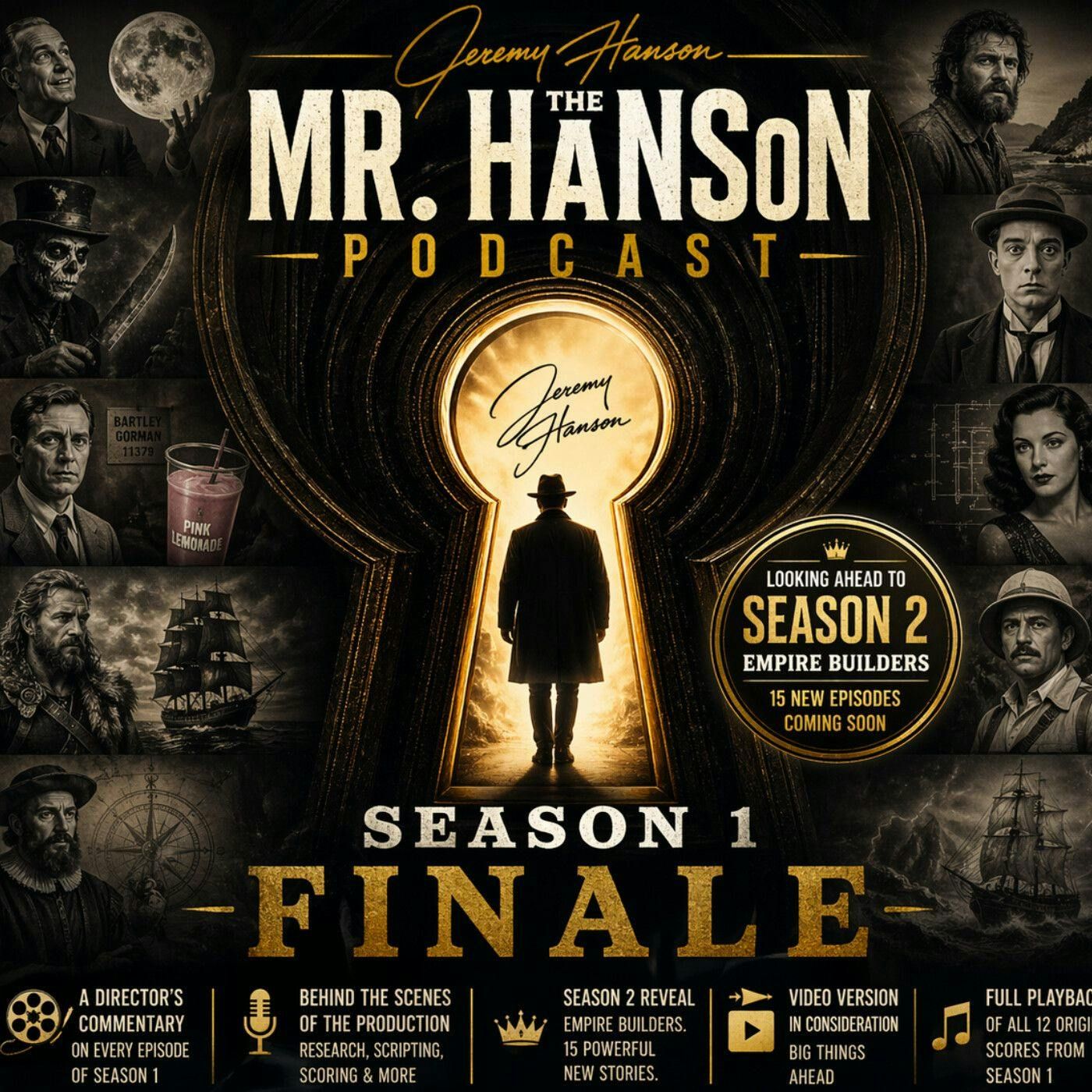
    S1 Ep13: Season 1 Finale: The End of the Beginning — Twelve Stories, One Season, One Promise

    Season 1 of the MR. HANSoN Podcast ends with this finale episode — a full reflective walk-through of every story told this season, a transparent look at the production process behind the show, and the reveal of Season 2. Host Jeremy Hanson, known as MR. HANSoN, guides listeners back through all twelve episodes of Season 1, explaining the creative intent behind each story, what the production team was trying to achieve, and why each episode works the way it does. This is not a recap show. It is a director's commentary built in the same cinematic style as the original episodes — with the same pacing, the same original scoring, and the same emotional precision that Season 1 was built on. The twelve Season 1 episodes covered in this finale are: Episode 1, The Man Who Sold The Moon, about Dennis Hope and his lunar real estate enterprise; Episode 2, The Voodoo Butcher of the Bayou, the Clementine Barnabet axe murders; Episode 3, Bartley Gorman, the legendary bareknuckle fighting champion known as the King of the Gypsies; Episode 4, Pink Lemonade, the strange carnival origin of a common drink; Episode 5, The Northlander Predator, a mysterious death in the Boundary Waters; Episode 6, Ferdinand Magellan, the voyage that circumnavigated the world and destroyed the man who led it; Episode 7, Charlie Pogue, the carburetor inventor whose patents vanished; Episode 8, The Flying Dutchman, the legendary ghost ship; Episode 9, Percy Fawcett, the explorer who disappeared searching for a lost Amazonian city; Episode 10, Hedy Lamarr, the actress who helped invent the technology behind Wi-Fi; Episode 11, Buster Keaton, the silent film genius who performed his own stunts; and Episode 12, Alexander Selkirk, the real-life inspiration for Robinson Crusoe. The finale also pulls back the curtain on the show's production process. Every episode takes weeks to produce — primary-source research, multiple script rewrites, original music composed specifically for each story, careful recording, editing, mastering, and review. The MR. HANSoN Podcast is described as one of Fuzzy Life Entertainment's biggest achievements and biggest investments, and it is intended to stand as the pinnacle of immersive audio podcasting. Jeremy Hanson speaks to the pride and humility behind the work, and makes clear that the same standard will continue into Season 2. The episode pivots to Season 2, titled Empire Builders — fifteen new episodes about the people who built lasting enterprises that shaped modern life. The Season 2 lineup includes Les Paul, Leo Fender, Craig Culver, Johnny Morris of Bass Pro Shops, Ray Kroc and the A.W. root beer roots of American franchising, Ludovico Martelli of Proraso, John Deere, Amadeo Giannini, Margaret Rudkin of Pepperidge Farm, Jack Daniel, Buck Duke of the American Tobacco Company, Ingvar Kamprad of IKEA, Adolphus Busch of Anheuser-Busch, Percy Spencer who invented the microwave, and Glen Bell of Taco Bell. Jeremy also addresses listener requests for a video version of the show directly — confirming that video is under serious consideration, with the same production standards and craft that define the audio, and teasing additional surprises for MR. HANSoN that have been in development behind the scenes. The episode closes with all twelve original scores from Season 1 playing in release order, without narration — giving listeners a chance to experience the musical identity of the full season uninterrupted. Every score was composed specifically for its episode, not licensed from a music library, and each one was built to match the emotional temperature of the story it accompanies. The MR. HANSoN Podcast is produced under Fuzzy Life Entertainment, a multi-show podcast network built around cinematic audio storytelling. The show has earned more than 210 five-star ratings on Spotify during Season 1 alone. Listeners who enjoy narrative history podcasts, cinematic storytelling, original podcast scoring, lesser-known historical figures, and long-form a

  • S1 · E12
    April 2 · 52 min

    S1 Ep12: THE MR. HANSoN PODCAST "The Story of Alexander Selkirk" The Real Story Behind Robinson Crusoe

    THE MR. HANSoN PODCAST "The Story of Alexander Selkirk" The Real Story Behind Robinson Crusoe Put me ashore. The captain did. What followed was one of the most remarkable documented survival stories in recorded history — four years, four months, and twelve days of complete, unbroken isolation on an uninhabited island in the Juan Fernández Archipelago, four hundred miles off the coast of Chile. No rescue came. No ship stopped. No voice broke the silence except his own. Selkirk had to survive not just the practical challenges of the island — finding food, building shelter, staying healthy in an environment with no medical care and no margin for serious injury — but the far more dangerous challenge of surviving his own mind. Isolation, researchers now know, activates the same neural pathways as physical pain. It produces hallucination, paranoia, and cognitive deterioration. It is, in the truest sense, a threat to the self. Selkirk broke. Then he rebuilt. He ran the island's hills barefoot until he could outpace the feral goats he hunted. He tamed hundreds of cats to keep the rats from his shelters. He constructed two huts from local timber, fashioned clothing from goatskins, and read his Bible until the words were memorized. He sang hymns into the dark because the alternative was silence and the silence had a weight he couldn't afford. When a rescue ship finally arrived in 1709, the men who found him on the beach struggled to reconcile what they saw with what they had expected. He was lean, fast, wild-eyed, and almost impossibly fit — and deeply changed in ways that four years of English civilization could not entirely reverse. His story inspired Daniel Defoe's Robinson Crusoe. But Crusoe is a fantasy of mastery. Selkirk's story is something far more uncomfortable: a true account of what total freedom actually feels like from the inside, and what it costs. In this episode, MR. HANSoN traces the full arc — from a difficult boyhood in coastal Scotland, through the privateer world of the early 1700s, through the argument that changed everything, and into the island years that remade a man. He was right about the ship, by the way. It sank. Alexander Selkirk podcast Robinson Crusoe real story castaway survival story MR. HANSoN podcast survival isolation history true history podcast Scottish explorer podcast Pacific island survival who was Alexander Selkirk and what happened to him the real story behind Robinson Crusoe podcast what happened to the Cinque Ports after Selkirk was left behind true survival stories podcast cinematic storytelling how did Alexander Selkirk survive alone on an island best narrative history podcasts Paul Harvey style psychology of isolation and survival historical stories was Robinson Crusoe based on a real person Alexander Selkirk Juan Fernández Islands 1704 prestige storytelling podcast similar to Wondery and HBO Who was Alexander Selkirk? A: Alexander Selkirk was a Scottish privateer born in 1676 who became the inspiration for Daniel Defoe's Robinson Crusoe. In 1704, he voluntarily demanded to be put ashore on an uninhabited island in the South Pacific after declaring his ship — the Cinque Ports — structurally unsafe. He survived alone on the island for four years and four months before being rescued in 1709. Was Robinson Crusoe based on a real person? A: Yes. Robinson Crusoe, published by Daniel Defoe in 1719, is widely believed to have been inspired by the true story of Alexander Selkirk, a Scottish sailor who lived alone on an uninhabited Pacific island from 1704 to 1709. Defoe never publicly acknowledged the connection, but the parallels between Selkirk's documented experience and Crusoe's fictional one are extensive and well-documented by historians. What island did Alexander Selkirk live on? A: Selkirk was marooned on Más a Tierra, an island in the Juan Fernández Archipelago located approximately 400 miles off the coast of Chile in the South Pacific. The island was later renam

  • S1 · E11
    March 26 · 48 min

    S1 Ep11: Buster Keaton: The Great Stone Face and the Stunts That Should Have Killed Him

    THE MR. HANSoN PODCAST "The Man Who Never Laughed: The Silent Genius of Buster Keaton" He was born in a Kansas farmhouse in 1895, and before he could read, he was being thrown across stages for money. His father Joe — a vaudeville man — discovered something extraordinary about his son early: the boy didn't break. He didn't react. He absorbed impact like it was weather, stood back up, and stared at the audience with a face that refused to give them anything to question. That face — blank, still, unshakable — became the most famous expression in the history of silent film. The Great Stone Face. By the time Buster Keaton was in his twenties, he was one of the most innovative filmmakers in the world. He didn't just star in films. He designed them. He understood camera geometry the way an engineer understands load-bearing structures. He planned stunts with the precision of someone who knew that almost right was the same as dead. He made a two-ton wall fall around him with inches to spare. He put a full-size locomotive through a burning bridge for a single take — costing $42,000 in 1926 dollars — because there was no second bridge. Between 1920 and 1928, he made nineteen films. Nineteen complete works of visual storytelling that redefined what cinema could be. And then Hollywood took it all away. MGM. The talkies. The contracts that stripped his creative control, his studio, his films, and eventually his marriage. The years of drinking and disappearing. The slow erosion of a man built for precision being forced to improvise in conditions he couldn't control. But the work was already elsewhere. Already permanent. Already rolling in theaters he would never visit, in languages he would never speak, in decades he would not live to see. In this episode of The MR. HANSoN Podcast, we go inside the complete life of Buster Keaton — from the farmhouse in Piqua, Kansas to the screening rooms of Paris, from the vaudeville circuit to the wall that was supposed to kill him. Seven acts. Cinematic narration. The whole story. And now — you're about to know the rest of it. Buster Keaton silent film history silent comedy Buster Keaton stunts The Great Stone Face classic Hollywood podcast film history podcast Buster Keaton biography silent film podcast Hollywood history Buster Keaton life story podcast the real story of Buster Keaton how did Buster Keaton do his stunts was the falling house stunt in Steamboat Bill Jr real Buster Keaton vs Charlie Chaplin who was better Buster Keaton The General locomotive crash real why did Buster Keaton stop making films Buster Keaton MGM creative control lost best podcast about silent film stars cinematic storytelling podcast about Hollywood history Buster Keaton childhood vaudeville father abuse how Buster Keaton learned to do stunts Buster Keaton legacy influence on modern comedy who influenced Jackie Chan Gene Kelly physical comedy best narrative podcast about forgotten film legends What is The Great Stone Face nickname? Who was Buster Keaton and why is he famous? Did Buster Keaton really do his own stunts? Was the falling house in Steamboat Bill Jr a real stunt? How much did The General locomotive crash cost in 1926? Why did Buster Keaton lose his creative control at MGM? What happened to Buster Keaton's career after the talkies? Who did Buster Keaton influence in modern film and comedy? Was Buster Keaton abused as a child? Did the vaudeville authorities try to stop Buster Keaton's father? What was the Comique Film Corporation and how did Buster Keaton join it? Why did The General bomb at the box office in 1926? How did Samuel Beckett use Buster Keaton in his film Film? What did Charlie Chaplin say about Buster Keaton's talent? What is a good podcast about silent film history? Are there any narrative podcasts about classic Hollywood stars? What podcast covers the lives of forgotten film legends? What podcasts are similar to Lore or Hardcore History but about H

  • S1 · E10
    March 19 · 49 min

    S1 Ep10: The Signal They Ignored: How Hedy Lamarr Invented the Technology Behind Wi-Fi, Bluetooth, and GPS — and Was Never Paid a Dollar

    There are signals moving through the air around you right now. Carrying voices, messages, data — your entire connected world riding on invisible frequencies at the speed of light. Your phone. Your wireless headphones. Your navigation system. The Wi-Fi router humming in the background of every room in your house. Behind all of it is a system. Behind that system is an idea. And behind that idea is a woman the world decided was too beautiful to be taken seriously. Hedy Lamarr was born Hedwig Kiesler in Vienna in 1914. Her father — a banker with an engineer's curiosity — taught her to look beneath the surface of things. To understand systems. To ask how mechanisms worked and where they failed. That habit of mind would eventually change the world. But the world saw something else first. European cinema called her the most beautiful woman in the world. At nineteen she married Friedrich Mandl — an Austrian arms manufacturer whose dinner parties were attended by military officers, weapons designers, and government officials who spoke freely about torpedo guidance systems, signal vulnerabilities, and the specific technical failures that were costing lives. They assumed she didn't understand a word. She understood everything. When she eventually escaped that marriage and made her way to Hollywood — signed by MGM, positioned as a star, reduced to her face by an industry that specialized in reduction — she went home every night to a drafting table. While the world watched her perform, she was working on the problem she couldn't stop thinking about. What if the signal didn't stay still? What if it moved — frequency by frequency, too fast to track, too precise to jam? She found a collaborator in avant-garde composer George Antheil, whose experimental work with synchronized player pianos gave them both the mechanical model they needed. In 1942 they were granted U.S. Patent 2,292,387 — a frequency-hopping spread spectrum communication system designed to protect radio-guided torpedoes from enemy jamming. They brought it to the U.S. Navy. The Navy told them it was too complex. That the technology wasn't there yet. That she could contribute more usefully by selling war bonds. She did. She raised tens of millions. And the patent sat on a shelf. It expired in 1959. Unimplemented. Uncompensated. By the late 1950s and 1960s, military engineers were independently arriving at the same conclusion she had reached in 1942. The Cold War had made secure wireless communication existential — not just useful, but necessary for civilization's survival. Frequency-hopping spread spectrum was classified, deployed, and never attributed to anyone by name. And then it became everything. Bluetooth. Wi-Fi. GPS. CDMA cellular architecture. The foundational technology beneath nearly every wireless communication system on the planet. All of it tracing its roots — directly, architecturally — to a patent filed by a Hollywood actress and a composer of experimental music, ignored by the people who needed it most, and left to expire without a word of acknowledgment. In 1997, the Electronic Frontier Foundation gave Hedy Lamarr its Pioneer Award. She was eighty-two years old. She couldn't attend the ceremony. They reached her by phone. Her response: It's about time. In this episode of The MR. HANSoN Podcast, we tell the full story — from the walks through Vienna with her father, to the dinner parties of Friedrich Mandl, to the drafting table in Hollywood, to the Navy meeting, to the fifty-year wait, to the moment the world finally caught up with a woman it had never bothered to look at twice. The signal was always there. It was just waiting to be understood. The MR. HANSoN Podcast — Fuzzy Life Entertainment www.mrhansonpodcast.com Hedy Lamarr Hedy Lamarr inventor Wi-Fi history Bluetooth inventor spread spectrum frequency hopping WWII technology forgotten inventors women in STEM history Hedy Lamarr patent secret communication system George Antheil Hollywood invent

  • S1 · E9
    March 12 · 52 min

    S1 Ep9: Percy Fawcett and the Lost City of Z: The Explorer Who Disappeared Into the Amazon and Was Right About Everything

    In April of 1925, a decorated British military surveyor named Percy Fawcett walked into the Mato Grosso region of Brazil with his twenty-two-year-old son Jack and Jack's closest friend Raleigh Rimell. His last confirmed letter arrived from a camp called Dead Horse Camp in late May. After that, a Kalapalo Indigenous community reported watching the smoke from their campfire rise above the treeline for five days. On the sixth day, the smoke stopped. Percy Fawcett, his son, and Raleigh Rimell were never seen again. But Fawcett's disappearance is not the most extraordinary part of his story. For twenty years before he vanished, Fawcett had been building a meticulous, evidence-based case for the existence of an ancient, large-scale civilization in the Amazon basin — a civilization he called "Z." He had physical evidence: pottery fragments in regions declared uninhabitable, geometric earthworks visible only from elevation, engineered dark soil called terra preta that should not have existed where it did. He had historical documentation: a 1753 Portuguese manuscript called Manuscript 512, describing standing stone buildings and an elevated road deep in the Brazilian interior. He had cross-referenced accounts from 16th-century Spanish explorer Francisco de Orellana's chronicler, who described massive settlements and organized cities along the Amazon River in the 1540s. The scientific establishment dismissed him as a romantic obsessive. They said the Amazon couldn't support large-scale civilization. They called his evidence inconclusive and his theory delusional. They were wrong. In 2003, archaeologist Michael Heckenberger published peer-reviewed research in the journal Science documenting a vast network of interconnected settlements in the upper Xingu region — exactly where Fawcett had concentrated his search. In the 2010s, LiDAR technology began revealing, through jungle canopy that had hidden it for centuries, an urban landscape of roads, causeways, canal systems, raised agricultural platforms, and interconnected city structures covering millions of acres across the Amazon basin. In 2018, researchers documented the Casarabe culture's network in the Llanos de Mojos region of Bolivia — a hydraulic urban infrastructure covering more than 4,500 square kilometers, home to a population now estimated at eight to ten million people before European contact. Everything Fawcett said was real. Everything the establishment dismissed was confirmed. Which brings us back to the question that a hundred years of searches, forensic analyses, confessions, and satellite imagery has never answered. What happened after the smoke stopped? The Kalapalo saw three men walk north. Disease is possible. Hostile contact is possible. Accident is probable. But the theory that history cannot release — the theory that sits at the center of this episode like a compass that won't stop pointing north — is this: What if Percy Fawcett found what he was looking for? Not ruins. Not earthworks. Not the ghost-geometry of a civilization that collapsed four centuries ago. What if he found a living city, intact, choosing invisibility with the same sovereign deliberateness that modern uncontacted communities choose it today? What if three men walked through the boundary between the world that European maps acknowledged and the world they didn't, and one of them — a fifty-seven-year-old man who had been right about everything the world told him he was wrong about — decided that the only answer that made sense was to stop looking? And arrive. This is the story of Percy Fawcett. The man who was right about everything. The man who walked into the proof and never walked out. The MR. HANSoN Podcast — where history's most impossible stories are told the way they were always meant to be heard. Percy Fawcett Lost City of Z Amazon lost civilization Amazon explorer disappeared Percy Fawcett podcast Lost city Amazon Amazon ancient civilization Percy Fawcett disappeared Lost City Z p

  • S1 · E8
    March 5 · 1 hr 2 min

    S1 Ep8: MR HANSoN Podcast "The Flying Dutchman: The Captain Who Wouldn't Die"

    The Cape of Good Hope has always been the place where the world feels unfinished. Where two furious oceans collide, where storms are born with teeth, and where — somewhere in the fog and lightning and silence — a ghost ship has been sailing for centuries without ever making port. The Flying Dutchman legend begins with a real man, or at least a man real enough for legend to need. Hendrick van der Decken — Dutch East India Company captain, cold-eyed and unbreakable — encounters the Cape in full murderous fury. His crew begs him to turn back. He refuses. And in the howling, black-throated heart of the worst storm of his life, he speaks an oath so reckless, so proud, so perfectly designed to offend both God and ocean that the world holds him to it forever. But this episode doesn't stay at the Cape. It follows the legend across centuries and continents — into the frozen Norse seas where the draugr still row their phantom longships; into the fog-wrapped British coastline where corpse-lights dance above hidden rocks; through the Caribbean trade routes where phantom crews tried to pass sealed letters to the living; and across the Pacific to Japan, where the Funayuurei rise from black water with wooden ladles and hollow hands. It examines the official records — naval logs, sworn testimonies, a sighting by a young Prince George who would become King George V — and finds that the reports are not the product of simple superstition but of something far stranger and more marvelous. Then MR. HANSoN does something no campfire storyteller ever does: he explains the science. The Fata Morgana. Saint Elmo's fire. The atmospheric conditions that produce genuine, credible, repeating optical phenomena so convincing that trained, experienced, fully sober sailors have staked their reputations on what they saw. And in the end, the story becomes something richer than either ghost tale or debunking — a portrait of what happens when human pride meets something genuinely, magnificently larger than itself. Some legends don't need to be true to be real. They only need to be seen. Flying Dutchman ghost ship Flying Dutchman legend explained ghost ship legend true story cursed ship legend maritime Cape of Good Hope ghost ship haunted ship legends maritime folklore podcast best history mystery podcast MR HANSoN Podcast Flying Dutchman Hendrick van der Decken Flying Dutchman sightings real accounts ghost ship sightings history Fata Morgana optical illusion sea Saint Elmo's fire sailors Dutch East India Company legend Cape of Good Hope storms sailors Prince George Flying Dutchman sighting cursed captain sea legend Funayuurei Japanese ghost ship what is the true story of the Flying Dutchman did Prince George really see the Flying Dutchman is the Flying Dutchman based on a real captain Flying Dutchman vs Fata Morgana explanation maritime ghost ship legends around the world why do sailors fear the Flying Dutchman ghost ships in Norse mythology draugr Norse ghost ships explained Japanese Funayuurei ghost ship legend storytelling podcast Paul Harvey style Flying Dutchman · ghost ship · cursed captain · maritime legend · sea folklore · Cape of Good Hope · haunted ships · Hendrick van der Decken · sailor myths · ocean mysteries · Fata Morgana · Saint Elmo's fire · history mystery podcast · Paul Harvey podcast · MR HANSoN "what is the legend of the Flying Dutchman" "is the Flying Dutchman a real ghost ship" "why was the Flying Dutchman cursed" "what did sailors see at the Cape of Good Hope" "ghost ship sightings in the Royal Navy" "what causes ships to appear to float above water" "podcast about maritime history and legends" "best storytelling podcasts about historical mysteries" "Paul Harvey style history podcast" "did anyone actually see the Flying Dutchman" What is the legend of the Flying Dutchman? The Flying Dutchman is a legendary ghost ship said to haunt the waters near the Cape of Good Hope, condemned to sail the

  • S1 · E7
    February 26 · 50 min

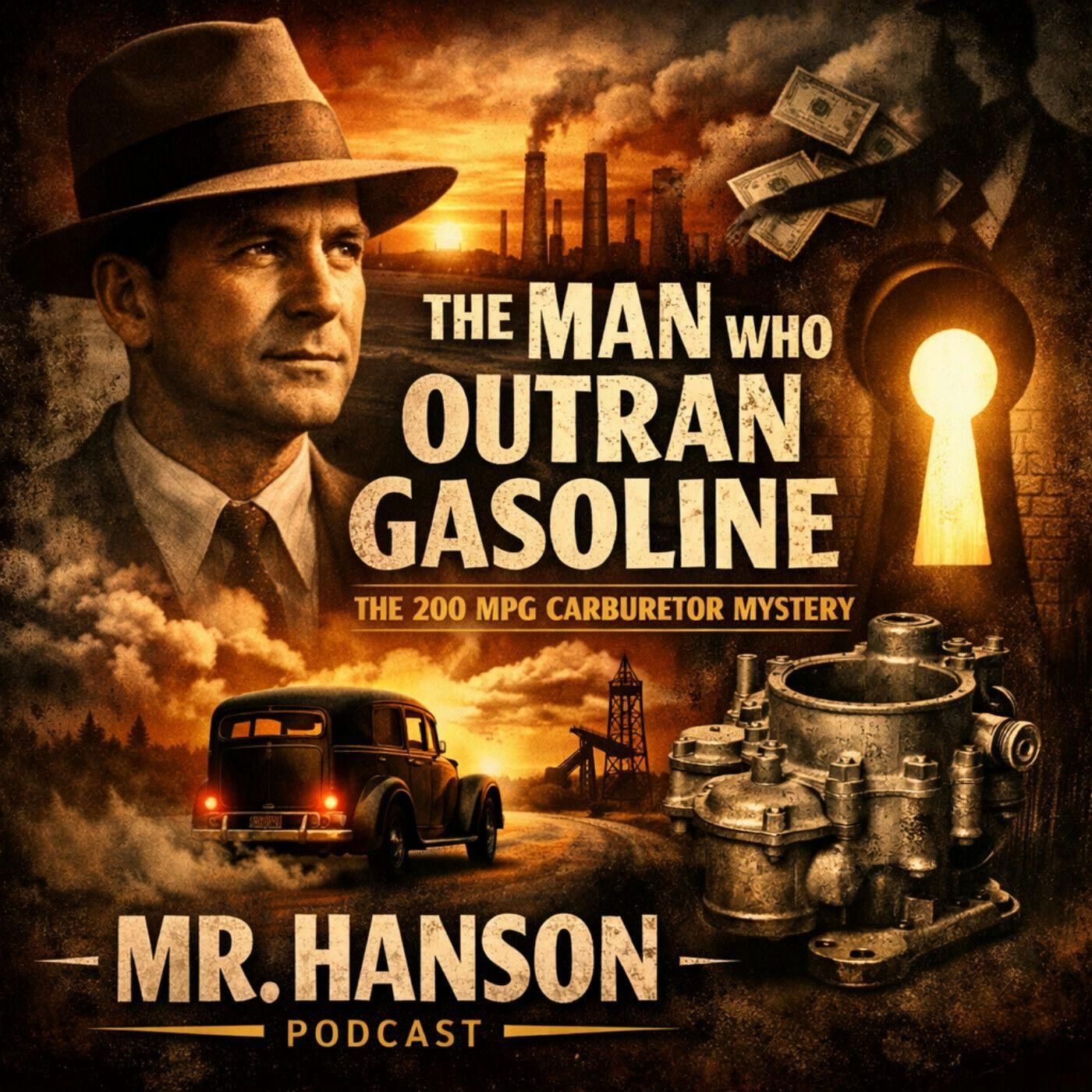
    S1 Ep7: The Man Who Outran Gasoline: The Strange Life and Death of Charlie Pogue | The 200 MPG Carburetor Mystery

    In 1930, at the height of the Great Depression, a Canadian mechanic named Charles Nelson Pogue walked into a room and made an impossible claim: Two hundred miles per gallon. At a time when Detroit averaged 15 MPG, Pogue said he had redesigned the carburetor to fully vaporize gasoline — unlocking energy that engines were wasting with every combustion cycle. Public demonstrations stunned observers. Patent applications were filed. Investors took meetings. And then… everything stopped. No production line. No mass adoption. No revolution in fuel economy. Just silence. In this cinematic, long-form MR. HANSoN episode, we investigate the strange life and quiet death of Charlie Pogue — the man some believe invented a 200 MPG carburetor that oil companies suppressed. But was it really buried? Or was it something more complicated — a story of thermodynamics, economic gravity, inflated expectations, and the mathematics of disappointment? This episode explores: • The Great Depression economy that shaped Pogue’s invention • How carburetors actually worked in the 1930s • Whether 200 miles per gallon was scientifically possible • The difference between laboratory efficiency and real-world driving • The psychology of suppressed invention legends • The documented history of corporate suppression in America • Why the Pogue carburetor myth refuses to die This is not just a conspiracy story. It’s a story about hope in desperate times. About innovation colliding with infrastructure. About how legends are born when truth meets silence. And by the end… You may see Charlie Pogue not as a martyr — but as something far more human. Hosted by Jeremy Hanson MR. HANSoN Podcast Produced by Fuzzy Life Entertainment And now… you’ll know the rest of the story. Charlie Pogue 200 mpg carburetor suppressed invention fuel efficiency invention Great Depression inventor carburetor history oil industry conspiracy automotive innovation gasoline efficiency lost inventions Did Charlie Pogue really invent a 200 mpg carburetor? Was the Pogue carburetor suppressed by oil companies? How did carburetors work in the 1930s? Is 200 miles per gallon scientifically possible? Fuel efficiency conspiracy in the Great Depression History of suppressed automotive inventions Economic impact of high efficiency engines What happened to Charlie Pogue’s invention? Truth behind the 200 mpg carburetor legend Did oil companies block fuel efficiency technology? Pogue carburetor patent history Why did the Pogue carburetor disappear? Corporate suppression in American industrial history Automotive myths that won’t die Most famous suppressed inventions in history These are structured to capture voice search and AI answer snippets: Who was Charlie Pogue? Did someone really invent a 200 mpg carburetor? Was the Pogue carburetor proven to work? Why didn’t the 200 mpg carburetor go into production? Could a gasoline engine ever reach 200 miles per gallon? Did oil companies suppress fuel efficiency technology? What happened to Charles Nelson Pogue? Are suppressed invention stories historically accurate? How efficient were cars during the Great Depression? suppressed technologies lost automotive inventions inventions that disappeared energy suppression claims buried patents in U.S. history vaporized fuel systems carburetor vaporization theory thermodynamics of combustion engines laboratory vs real world MPG fuel injection history corporate collusion history Standard Oil historical controversies industrial suppression examples Great Depression innovation automotive monopolies #CharliePogue #200MPG #SuppressedInvention #FuelEfficiency #OilConspiracy #GreatDepressionHistory #AutomotiveHistory #LostTechnology #MRHANSON #FuzzyLifeEntertainment #CinematicPodcast #LongFormStorytelling #PaulHarveyStyle • The 200 MPG Carburetor They Say Was Buried • The Man Who Claimed 200 Miles Per Gallon — Then Vanished • The Fuel Efficiency Inv

Showing 1–20 of 22 episodes