Skip to content
Artwork for The MongoDB Podcast

The MongoDB Podcast

MongoDB

Whether you're building your first app or scaling to millions of users, The MongoDB Podcast brings you the conversations worth having. Developers, founders, and technical leaders share how they architect systems, navigate hard decisions, and build with AI.

Play
  • 20 episodes
  • Avg 51 min
  • English
  • S2 · E8
    June 5 · 55 min

    Modern AIOps:
What It Takes to Build Reliable AI Products

    Watch this episode as a video on Spotify! In this episode of the MongoDB Podcast, host Jesse Hall sits down with Karthik Kalyanamaran, Co-Founder and CTO of Langtrace AI, to discuss how engineering teams are building reliable AI products. Moving from traditional, deterministic software engineering to the non-deterministic world of Large Language Models requires an entirely new approach to debugging, testing, and monitoring. Karthik shares his journey from scaling observability infrastructure at Coinbase to creating Langtrace AI, an open-source LLM application observability platform built on OpenTelemetry standards. We dive deep into what a modern AIOps stack looks like and how developers can eliminate the guesswork of LLM hallucinations, prompt adjustments, and vector database performance. Key topics discussed in this episode: The Shift to Non-Deterministic Software: Why traditional unit tests fail when building with LLMs, and how to adapt your development and production lifecycle. The Core Elements of AIOps: A breakdown of modern AI deployment, including runtime tracing, prompt engineering, and context optimization. Optimizing Vector Databases: How Langtrace integrates with MongoDB Atlas Vector Search to track aggregate pipelines, embedding queries, and semantic retrieval accuracy. Anonymization and Security: Navigating SOC 2 Type 2 compliance and tracing system performance without exposing sensitive customer data. The HTML Era of AI: Why starting with primitive, native constructs directly on top of models often yields better design insights than over-relying on complex frameworks. Introducing Hey Zest: A sneak peek into Langtrace closed beta agent platform that allows developers to deploy B2B AI bots natively inside Slack. Timestamps:00:06 Welcome to MongoDB Podcast Live with host Jesse Hall and Karthik Kalyanamaran00:55 Karthik background: From building infrastructure at Coinbase to launching Langtrace AI02:05 What is Langtrace? Solving the non-deterministic nature of LLMs04:17 The Origin Story: Realizing AI needs robust observability while building a crypto chatbot07:38 Transitioning from reactive traditional web2 monitoring to proactive AI Ops10:54 Defining the modern AI Engineer and the art of Context Engineering12:20 Security at scale: Navigating SOC 2 Type 2 compliance across data vendors like MongoDB14:57 Live Demo: Setting up OpenTelemetry tracing on top of a MongoDB Atlas Vector Search script16:44 Tracking latency, token count metrics, and indexing properties at runtime18:22 Implementing automated evaluations using LLM as a Judge22:05 Future Outlook: Mitigating long context window degradation and advanced tool calling23:05 Developer Advice: Why you should build closer to the bare metal model constructs24:52 Closing remarks, GitHub open source contributions
  • S2 · E7
    April 28 · 15 min

    How Rox Is Rebuilding the CRM for the AI Era on MongoDB

    Watch this episode in Video Format on Spotify. Are autonomous agents about to replace your traditional CRM? In this episode, Anaiya Raisinghani (Sr. Tech. Evangelist, AI Startups & Ventures at MongoDB) sits down with Ishan Mukherjee, Co-Founder and CEO of ROX. They dive under the hood of ROX, the world’s largest-scale revenue agent company that is building AI to handle the end-to-end revenue cycle autonomously.Ishan breaks down his founder journey—from Amazon Robotics to Apple's Knowledge Graph—and opens up about the technical realities of building AI agents today.What you’ll learn in this episode: The AI Agent Architecture: Discover ROX's "three-layered cake" approach, including their context system, Agent Swarms, and application layer. The Database Migration: Why ROX started on DynamoDB for speed but ultimately migrated to MongoDB to handle massive spikes and unstructured data at scale. Agents vs. SaaS: The fundamental difference between traditional SaaS platforms (where humans do the work) and autonomous agents (where the AI does the outreach, research, and contracts). Advice for AI Founders: Why you need to be highly opinionated about your architecture but extremely iterative with your product experience. ⏱️ Chapter Timestamps 00:00 - Intro & Ishan's Journey 01:57 - What is ROX? 04:52 - ROX's Technical Architecture 06:56 - Migrating to MongoDB 08:17 - Why Context is King 11:13 - Internal AI Adoption 13:05 - The Future of AI and B2B 14:33 - Lightning Round

    • Transcript
  • S2 · E6
    April 21 · 45 min

    Capgemini’s GenPAL: Payments Data Monetization in Action with MongoDB

    Watch this episode as a video on Spotify! In this episode, Luis Pazmino, Industry Principal for Financial Services at MongoDB, sits down with Saurabh Khandelwal from Capgemini to explore how financial institutions can transform payments data into a strategic revenue engine. The conversation dives into GenPAL, Capgemini’s solution powered by MongoDB’s modern data platform, and how it enables organizations to move beyond data storage toward real-time intelligence, AI-driven insights, and data monetisation. In this episode, we discuss: • Evolving Payments Landscape: Key shifts shaping data strategies and opportunities in payments • Modern Data Foundations: Building scalable, real-time architectures to support high-volume transactions and compliance needs • From Data to Value: Turning payments data into actionable insights and new revenue streams • AI at Scale: Leveraging gen AI and agentic AI for fraud detection, customer intelligence, and operational efficiency • Pragmatic Modernization: How to adopt AI and modern data platforms without a “big bang” approach Whether you’re a fintech innovator or a financial institution navigating legacy systems, this episode offers practical insights on unlocking the full value of payments data with AI and modern data platforms. Timestamps 00:09 – Introduction 01:05 – Introducing GenPAL 02:38 – The tactical shift: From standard BI to Agent AI 04:56 – Identifying strains 06:59 – Solving payment failures 08:48 – Sub-millisecond latency 12:48 – The "Experience Gap" 15:01 – Strategic advice 18:14 – High-level architecture 21:35 – Real-world success 24:09 – Future outlook

    • Transcript
  • S2 · E5
    April 15 · 46 min

    Why Python Devs Are Ditching Raw Drivers for Beanie

    Watch this episode in video format on Spotify! If you're building Python applications on MongoDB and still writing raw queries by hand, you're leaving a lot of developer productivity on the table. Beanie, the async-first ODM built on Pydantic, was created to fix exactly that — and this episode goes deep on how and why it works. You'll learn how Beanie maps Python objects to MongoDB documents without sacrificing atomicity or performance, why async-first design matters for modern Python stacks, how schema migrations actually work in a document database, and what the deprecation of Motor means for your existing codebase. The episode also covers Beanie's integration with FastAPI, how it handles indexes and aggregation pipelines under the hood, and what's coming in the next phase of the library. Ramon, the creator of Beanie and a senior software engineer at Microsoft, built this library five years ago to fill a gap nobody else had addressed. He's joined by Shubham, MongoDB's product manager for Python client libraries, for a live demo and Q&A. Follow The MongoDB Podcast so you never miss an episode. - [00:00] Introduction & Guest Welcome [01:00] What Is Beanie? The ODM Explained [04:10] ODM vs ORM — What's the Difference? [05:20] Why Ramon Built Beanie (The Origin Story) [06:30] Core Design Principles: Atomicity & Async-First [08:00] FastAPI + MongoDB: The Rising Python Stack [11:00] Bonnet: The Synchronous Beanie Backport [12:55] Live Demo: Defining Document Schemas with Pydantic [16:00] Nested Documents, Links & Polymorphic Collections [18:45] Best Practices for Schema Design [20:30] Index Management in Beanie [22:40] Complex Queries: Beanie vs Raw PyMongo [24:30] Aggregation Pipelines in Beanie [28:05] Schema Migrations: Forward, Backward & Freefall [31:30] Motor Is Deprecated — What That Means for You [34:00] Beanie v2: What Changed and What Didn't [36:20] FastAPI, Flask & Django Integration [37:45] What's Next for Beanie: Performance & Lambda Optimization [39:30] How to Contribute to Beanie [41:00] Resources, Community & Audience Q&A

    • Transcript
  • S2 · E4
    March 31 · 22 min

    From 7 Days to 2 Minutes: Automating Workflows with Knowledge Graphs

    Are you still relying on OCR for your enterprise AI? You're losing critical context. In this episode, Anaiya Raisinghani (Sr. Tech. Evangelist, AI Startups & Ventures at MongoDB) sits down with Adityavardhan Agrawal, Co-Founder and CEO of Morphik. They dive deep into how Morphik is helping developers and enterprises understand complex, unstructured data and automate high-leverage workflows. Adi breaks down the limitations of standard RAG pipelines and reveals why they turned to Vision Language Models (VLMs) to process complex documents like architectural floorplans. What you’ll learn in this episode: The OCR Trap: Why text extraction is inherently lossy for complex documents and how VLMs generate better embeddings. The RAG Misconception: Why getting high-quality context requires much more than just plain vector search. Database Architecture: Why Morphik hit the limits of Postgres/JSONB for dynamic datasets and how migrating to MongoDB Atlas simplified their multi-tenancy and querying. Massive ROI: How one manufacturing customer used Morphik to slash their quote generation time from 7 days to under 2 minutes. The Future of Knowledge: Building self-healing, self-updating data layers that leverage MQL. (Want to start building? You can use Morphik's API, Python/TypeScript SDKs, or grab the Docker image from GitHub today!) ⏱️ Chapter Timestamps 00:00 - Intro: Meet Adi and Morphik 01:18 - APIs, SDKs, and Getting Started with Morphik 02:28 - The Lightbulb Moment: Why Standard AI Fails on Unstructured Data 04:44 - The Biggest Misconception About RAG 06:24 - Vision Language Models (VLMs) vs. Traditional OCR 08:35 - Reducing Entropy: Combining Embeddings with Knowledge Graphs 10:13 - Architecture Deep-Dive: Hitting the Limits of Postgres & JSONB 12:06 - Why Morphik Migrated to MongoDB Atlas 13:24 - Simplifying Multi-Tenancy at Scale 15:13 - Ensuring Data Security and Reliability 16:33 - Accelerating Growth with MongoDB for Startups 18:10 - Real-World Impact: Cutting Quote Generation from 7 Days to 2 Minutes 20:15 - The Future: Self-Healing Data Layers and Native MQL

    • Transcript
  • S2 · E3
    March 19 · 31 min

    From Data to Decisions: Powering gen/Agentic AI with Capgemini & MongoDB

    Read more about Capgemini's Digital Cloud Platform → https://cloud.mongodb.com/ecosystem/c...In this episode of the MongoDB Podcast, Apoorva is joined by Vinay Makkaji from Capgemini and Farid Mohammad from MongoDB to discuss how enterprises are powering the next wave of Agentic AI applications. The conversation explores the shift from AI experimentation to real-world deployment, including AI agents, RAG architectures, and large-scale data modernization.They also unpack how the MongoDB–Capgemini partnership enables organizations to build scalable, production-ready AI solutions through unified data management and modern architectures. Tune in to hear practical use cases, industry examples, and where enterprise AI is headed next.Sign-up for a free cluster → https://www.mongodb.com/cloud/atlas/r...Subscribe to MongoDB YouTube→ https://mdb.link/subscribe 00:00:00 Introduction to the MongoDB Podcast 00:00:58 Meet the Experts: Vinay Makaji & Fared Muhammad 00:03:09 The Three Phases of genAI Evolution 00:04:47 Shifting from Generative to Agentic AI 00:06:55 Why AI is a System, Not Just a Model 00:10:48 The Power of Technology Partnerships 00:17:11 Case Study: Predictive Maintenance in Oil & Gas 00:20:18 How Agentic Systems Prevent $250k/Hour Downtime 00:24:22 The Future: Mainframe Modernization & Industrial IoT 00:28:28 Key Takeaway: Partnerships Build Outcomes 00:30:22 Final Advice: Data Strategy is the Foundation

    • Transcript
  • S2 · E2
    March 6 · 52 min

    Don't Build Your Own AI (Unless You Have To)

    Are you trying to figure out if your team should build an AI model from scratch or integrate an off-the-shelf solution? You aren’t alone. In this episode of the MongoDB Podcast, Shane McAlister sits down with Akshaya Murthy, Director of AI Transformation at Zendesk, to decode the maze of building enterprise AI products. They dive into why integrating is often the winning move for speed-to-market, the hidden costs of custom models, and why bad data will break even the most perfect transformer model. What you’ll learn in this episode: The Build vs. Buy Calculus: Why lower Total Cost of Ownership (TCO) and rapid deployment favor integration for most enterprises. Spotting "AI Washing": How to avoid vendor buzzword salads and focus on actual problem-solving and ROI. Architectural Must-Haves: Why your AI stack needs modular API layers, model hot-swapping, and CI/CD pipelines just like your standard code. The "Garbage In, Hype Out" Rule: Why a solid data strategy and a centralized single source of truth are non-negotiable. Ready to stop experimenting and start delivering real AI value? Tune in now.

    • Transcript
  • S2 · E1
    February 23 · 35 min

    How to Build Production-Ready AI Agents: MongoDB Atlas + Google Vertex AI

    In this episode, Michael Lynn (MongoDB) and Yang Li (Google Cloud) break down the architectural blueprint for building intelligent, production-grade applications. Move beyond simple RAG (Retrieval-Augmented Generation) and explore the world of AI Agents. What you’ll learn: The Google Cloud AI stack: Vertex AI, Agent Space, and Model Garden. Deep-dive integration: Connecting MongoDB Atlas with BigQuery and Dataflow. Real-world Demo: Building a grocery store AI assistant using Gemini and Vector Search. Startup Perks: How to access up to $350k in Google Cloud credits and $10k in MongoDB credits.

    • Transcript
  • S1 · E271
    Sep 25, 2025 · 1 hr 1 min

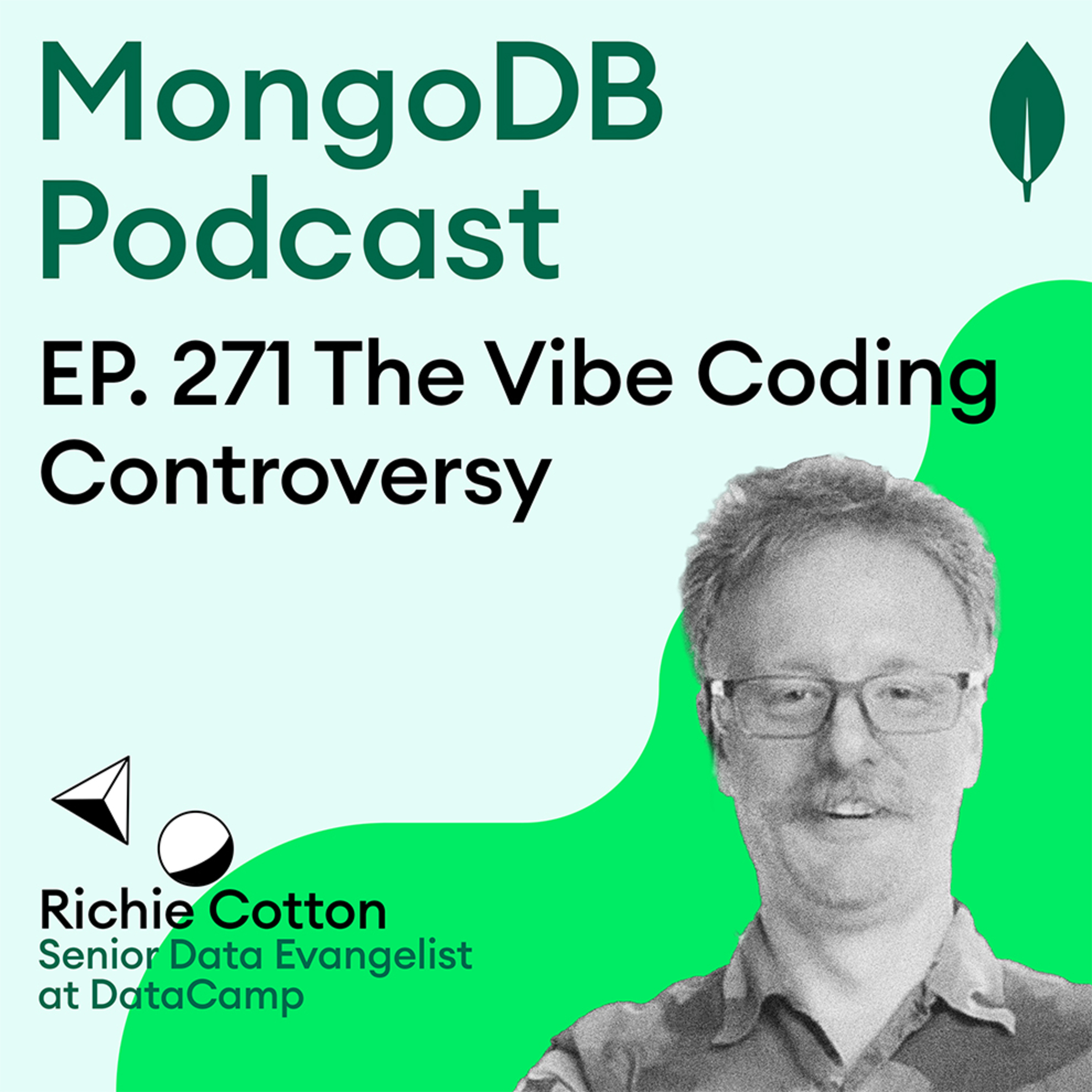
    EP. 271 The "Vibe Coding" Controversy: What Devs Are Getting Wrong About AI

    Everyone's talking about AI taking over coding jobs, but what's the real story? Shane McAllister and DataCamp's Richie Cotton dive into the "vibe coding" phenomenon and expose the biggest misconceptions developers have about AI. Learn how to shift your mindset from a pure coder to a "vibe curator" and future-proof your career. Don't miss the full video discussion, available to watch now in the Spotify app.

    • Transcript
  • S1 · E270
    Aug 27, 2025 · 1 hr

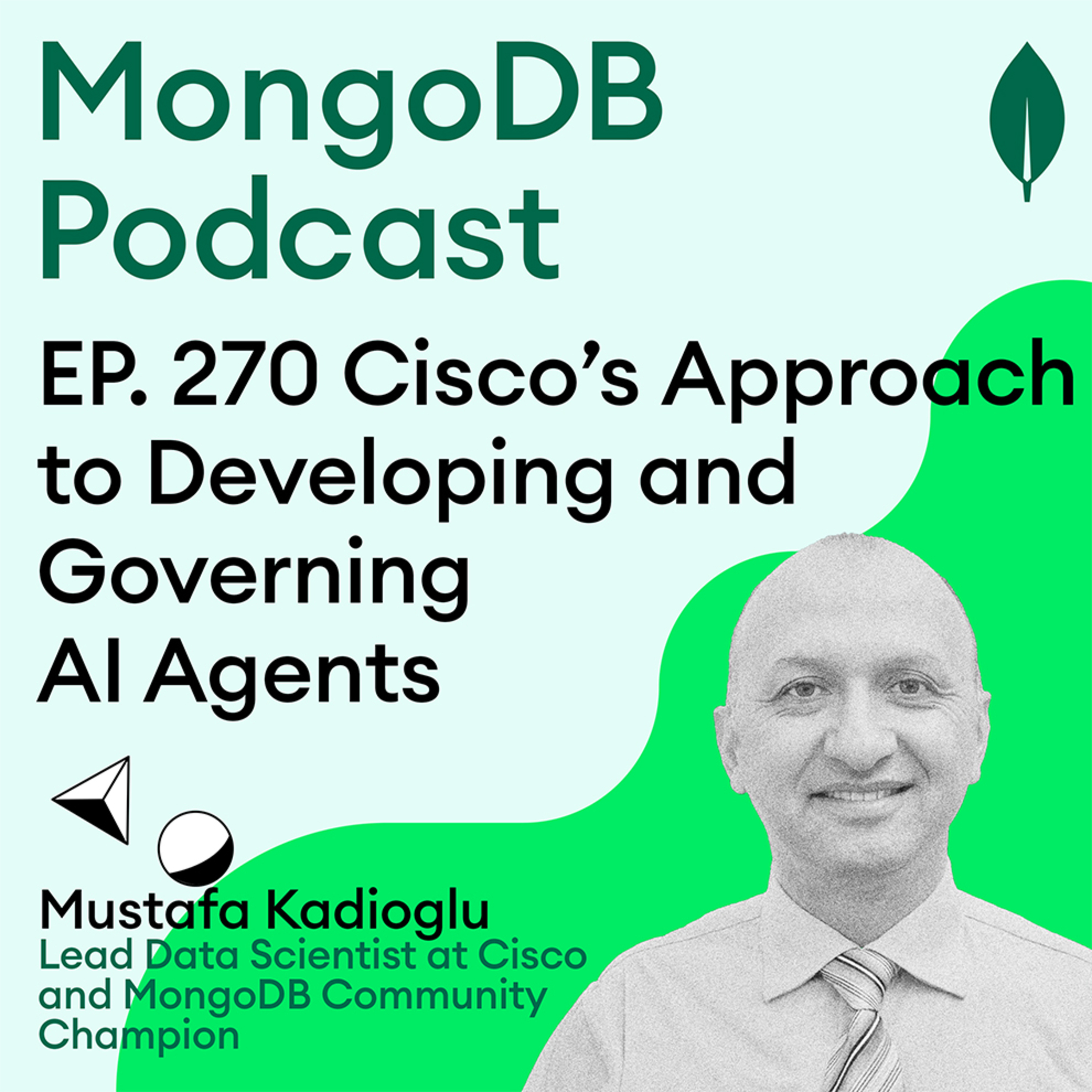
    EP. 270 Cisco’s Approach to Developing and Governing AI Agents

    In this live episode we’ll explore how Cisco harnesses the power of MongoDB Atlas Vector Search to enable cutting-edge AI capabilities across various projects. We’ll dive into its pivotal role in solutions like Retrieval-Augmented Generation (RAG) and the Agentic Framework, demonstrating how it serves as the backbone for efficient and scalable data retrieval. Learn how MongoDB Atlas Vector Search empowers Cisco to bridge the gap between unstructured data and intelligent AI-driven insights, fueling innovation across various use cases.

    • Transcript
  • S1 · E269
    Aug 12, 2025 · 1 hr 3 min

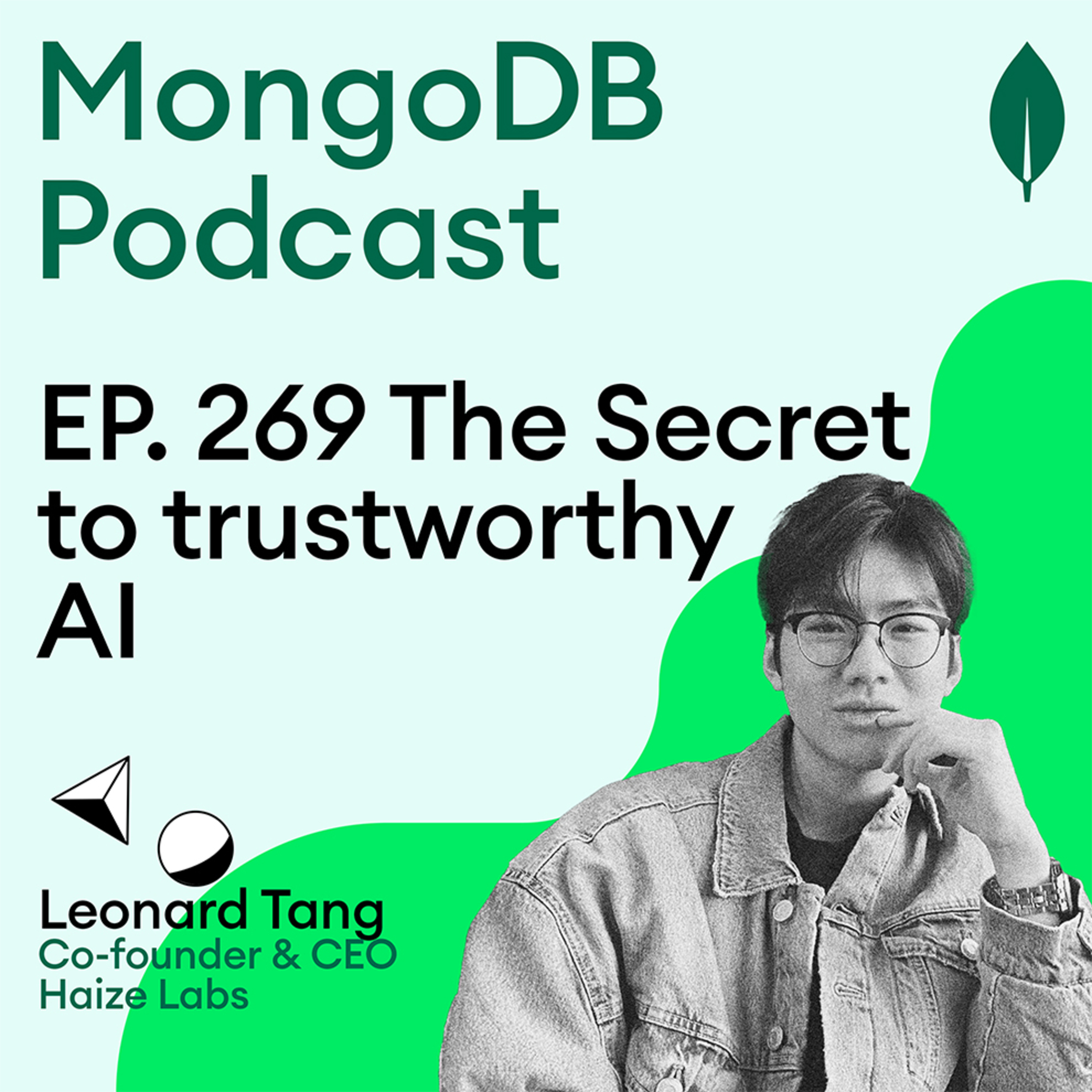
    EP. 269 The Secret to Trustworthy AI: "Fuzzing" Your Models with Haize Labs' Co-founder

    How do you test a GenAI application that's constantly changing? In this episode, Shane talks to Leonard Tang, co-founder of Haize Labs, about why traditional testing fails for LLMs and how to adopt a new evaluation strategy. Leonard introduces "fuzzing"—a powerful technique for discovering edge cases, improving reliability, and building AI you can actually trust. He also gives a live demo of the Haize Labs platform, so be sure to watch the video version on YouTube or Spotify to see it in action.

    • Transcript
  • S1 · E268
    Jul 30, 2025 · 58 min

    EP. 268 How to turn chaos into opportunity

    In this event, Shane McAllister will cover how Albert Podusenko got introduced to MongoDB and in 2016 decided to start a company using MongoDB as primary database behind their server, handling everything: From model states and real-time event generation to maintaining episodes and storing historical data.In this show we'll talk about: How to make a product out of research. Walk through it's journey that culminated with the creation of Lazy Dynamics. Show how they utilize MongoDB with demos and examples.

    • Transcript
  • S1 · E267
    Jun 12, 2025 · 1 hr

    EP. 267 Full Stack AI: Building with MongoDB, Deno, and Next.js

    Is building the backend for your AI application slowing you down? In this episode of the MongoDB Podcast, host Jesse Hall sits down with Srikar and Jimmy, the creators of Daemo AI, a revolutionary tool designed to eliminate the tedious "plumbing" of backend development. Discover how Daemo AI is building upon deprecated MongoDB features like Realm App Services, creating a more powerful and flexible solution for developers. We dive deep into their tech stack, including Next.js, Deno, and Express , and explore why they chose MongoDB for its speed and flexibility in AI applications. Plus, you'll see a live demo of Daemo's new SDK and CLI , learn how it can generate data migrations and dummy data on the fly , and get a real answer to the big question: Is AI going to take your job? In This Episode, You Will Learn: What Daemo AI is and how it accelerates development. * How to build AI agents and integrate them with frameworks like LangChain. Why MongoDB is the ideal database for rapid-growth startups and AI. The future of developer jobs in the age of AI.

    • Transcript
  • S1 · E266
    May 22, 2025 · 43 min

    EP. 266 How MongoDB Scales Atlas & Reduces Cost

    🔴 LIVE: How MongoDB Atlas Is Redefining Elasticity for Cost-Optimized PerformanceWelcome to this special episode where we explore the cutting-edge elasticity features in MongoDB Atlas—designed to help organizations optimize costs without sacrificing performance.Whether you're a software engineer, DevOps lead, or IT decision-maker, this conversation will show you how to scale smarter, faster, and more reliably.

    • Transcript
  • S1 · E265
    May 16, 2025 · 1 hr 16 min

    EP. 265 AI for Happier Teams: L10's Real-Time Feedback Revolution

    Is waiting months for employee feedback a thing of the past? Dive into the future of work with Shane McAllister and L10 founders, Zyrian Chung and Keith Chan. Discover how their AI-powered platform collects daily insights to transform workplace culture, empower managers, and address issues like silent quitting before they escalate. Learn how real-time feedback and AI can create more engaged and productive teams, and get a peek into the tech (including MongoDB) that makes it possible. Stop guessing, start understanding your team today! TAGs: #EmployeeEngagement, #AIinHR, #WorkplaceCulture, #FutureofWork, #EmployeeFeedback, #RealTimeInsights, #TeamManagement, #Leadership, #HRTechnology, #MongoDB, #L10, #ZyrianChung, #KeithChan, #SilentQuitting, #EmployeeMorale, #TeamProductivity, #PerformanceManagement, #AITools, #EmployeeSurveys, #PeopleAnalytics

    • Transcript
  • S1 · E259
    May 1, 2025 · 58 min

    EP. 264 Beyond the Database: Mastering Multi-Cloud Data, AI Automation & Integration (feat. Peter Ngai, SnapLogic)

    ✨ Heads up! This episode features a demonstration of the SnapLogic UI and its AI Agent Creator towards the end. For the full visual experience, check out the video version on the Spotify app! ✨ (Episode Summary)Tired of tangled data spread across multiple clouds, on-premise systems, and the edge? In this episode, MongoDB's Shane McAllister sits down with Peter Ngai, Principal Architect at SnapLogic, to explore the future of data integration and management in today's complex tech landscape. Dive into the challenges and solutions surrounding modern data architecture, including: Navigating the complexities of multi-cloud and hybrid cloud environments. The secrets to building flexible, resilient data ecosystems that avoid vendor lock-in. Strategies for seamless data integration and connecting disparate applications using low-code/no-code platforms like SnapLogic. Meeting critical data compliance, security, and sovereignty demands (think GDPR, HIPAA, etc.). How AI is revolutionizing data automation and providing faster access to insights (featuring SnapLogic's Agent Creator). The powerful synergy between SnapLogic and MongoDB, leveraging MongoDB both internally and for customer integrations. Real-world applications, from IoT data processing to simplifying enterprise workflows. Whether you're an IT leader, data engineer, business analyst, or simply curious about cloud strategy, iPaaS solutions, AI in business, or simplifying your data stack, Peter offers invaluable insights into making data connectivity a driver, not a barrier, for innovation. - Keywords: Data Integration, Multi-Cloud, Hybrid Cloud, Edge Computing, SnapLogic, MongoDB, AI, Artificial Intelligence, Data Automation, iPaaS, Low-Code, No-Code, Data Architecture, Data Management, Cloud Data, Enterprise Data, API Integration, Data Compliance, Data Sovereignty, Data Security, Business Automation, ETL, ELT, Tech Stack Simplification, Peter Ngai, Shane McAllister.

    • Transcript
  • S1 · E263
    Apr 25, 2025 · 1 hr 11 min

    EP. 263 Building Agents with Natural Language with guest

    **(Note: Spotify listeners can also watch the screen sharing video accompanying the audio. Other podcast platforms offer the audio-only version.)** In this episode of MongoDB Podcast Live, host Shane McAllister is joined by Sachin Hejip from Dataworkz. Sachin will showcase “Dataworkz Agent Builder” which is built with MongoDB Atlas Vector Search, and demonstrate how it can use Natural Language to create Agents and in turn, automate and simplify the creation of Agentic RAG applications. Sachin will demo the MongoDB Leafy Portal Chatbot Agent, which combines operational data with unstructured data for personalised customer experience and support, built using Dataworkz and MongoDB. Struggling with millions of unstructured documents, legacy records, or scattered data formats? Discover how AI, Large Language Models (LLMs), and MongoDB are revolutionizing data management in this episode of the MongoDB Podcast.Join host Shane McAllister and the team as they delve into tackling complex data challenges using cutting-edge technology. Learn how MongoDB Atlas Vector Search enables powerful semantic search and Retrieval Augmented Generation (RAG) applications, transforming chaotic information into valuable insights. Explore integrations with popular frameworks like Langchain and Llama Index.Find out how to efficiently process and make sense of your unstructured data, potentially saving significant costs and unlocking new possibilities.Ready to dive deeper? #MongoDB #AI #LLM #LargeLanguageModels #VectorSearch #AtlasVectorSearch #UnstructuredData #Podcast #DataManagement #Dataworkz #Observability #Developer #BigData #RAG

    • Transcript
  • S1 · E262
    Apr 16, 2025 · 56 min

    EP. 262 Solving Unstructured Data Challenges with AI & Vector Search

    **(Note: Spotify listeners can also watch the screen sharing video accompanying the audio. Other podcast platforms offer the audio-only version.)** Struggling with millions of unstructured documents, legacy records, or scattered data formats? Discover how AI, Large Language Models (LLMs), and MongoDB are revolutionizing data management in this episode of the MongoDB Podcast.Join host Shane McAllister and the team as they delve into tackling complex data challenges using cutting-edge technology. Learn how MongoDB Atlas Vector Search enables powerful semantic search and Retrieval Augmented Generation (RAG) applications, transforming chaotic information into valuable insights. Explore integrations with popular frameworks like Langchain and Llama Index.Find out how to efficiently process and make sense of your unstructured data, potentially saving significant costs and unlocking new possibilities.Ready to dive deeper?#MongoDB #AI #LLM #LargeLanguageModels #VectorSearch #AtlasVectorSearch #UnstructuredData #Podcast #DataManagement #RAG #SemanticSearch #Langchain #LlamaIndex #Developer #BigData

    • Transcript
  • S1 · E261
    Apr 1, 2025 · 1 hr

    EP.261 Building Next-Gen AI E-Commerce with Storecraft & MongoDB | Live Code Demo

    MongoDB staff developer advocate Jesse Hall teams up with Storecraft creator Tomer Shalev to dissect how this open-source commerce platform leverages MongoDB for scalable, AI-driven workflows. Watch them live-code integrations (vector search, dynamic pricing, email automation) and explore real-world use cases—from custom discount logic to OpenAI-powered product recommendations. Perfect for developers building modular, future-proof commerce solutions.

    • Transcript
  • S1 · E260
    Mar 26, 2025 · 57 min

    EP.260 Vector Search Secrets Revealed! - AI-Powered Image Search with MongoDB - Live Demo

    Ever wondered how companies like Amazon or Pinterest deliver lightning-fast image search? Dive into this episode of MongoDB Podcast Live with Shane McAllister and Nenad, a MongoDB Champion, as they unravel the magic of semantic image search powered by MongoDB Atlas Vector Search! 🔍 What You’ll Learn: Why semantic search is a game-changer for AI-driven applications (spoiler: it’s all about meaning, not just keywords!). How to transform images into vectors (embeddings) and store them alongside your data—no clunky ETL pipelines required! A live demo showcasing real-time image search on a 40,000+ product dataset (spoiler #2: it’s blazing fast and shockingly simple to build!). Pro tips on choosing embedding models, optimizing indexes, and avoiding common pitfalls. Why MongoDB’s unified data model crushes traditional databases for AI/ML workloads. 👥 For Developers & Data Engineers: Whether you’re a JavaScript, AI enthusiast, or just tired of JOINs, this episode is your roadmap to building smarter, faster apps. Plus, learn why companies like Toyota and Verizon trust MongoDB for mission-critical AI workloads.

    • Transcript
Showing 1–20 of 20 episodes