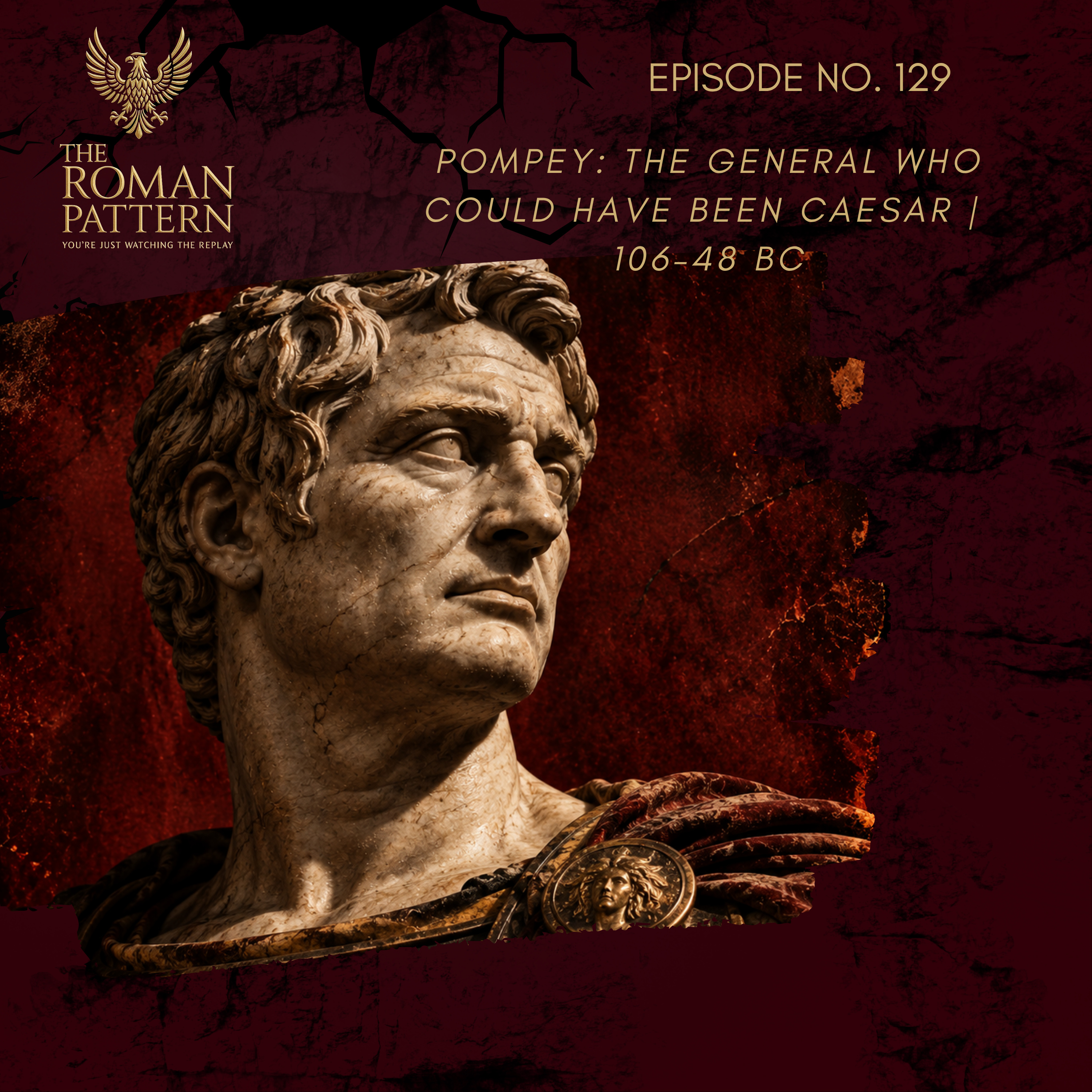
Pompey: The General Who Could Have Been Caesar | 106–48 BC
Pompey could have been Caesar. He chose the Republic, and the Republic destroyed him. Every structural ingredient Caesar would later use to end the Roman Republic, Pompey had first. He refused to use them. That refusal is what killed him. In 62 BC, Gnaeus Pompeius Magnus landed at Brindisium with the largest Roman army any general had commanded in a generation. He had just spent four years reorganizing the entire eastern Mediterranean world, ending Mithridates, annexing Syria, taking Jerusalem, raising Rome's annual revenue by nearly 70%. He had 40,000 veterans who followed him personally. He had a network of client kings whose crowns had come from his hand. Everyone in Italy expected him to march on Rome. He disbanded his army on the beach. He walked into Rome as a private citizen and asked the Senate for two things, both of them legal. Ratify his eastern settlement. Give his veterans the land they had been promised. The Senate refused both for three years. Cato blocked him on principle. Lucullus blocked him out of jealousy. Crassus blocked him out of rivalry. The most constitutional man in Rome had done the constitutional thing, and the Republic responded by proving it could not process him. That is the moment the Republic ended. Not at the Rubicon. Not at Pharsalus. In the Senate chamber between 61 and 60 BC, when the system refused to reward the one man who still played by its rules. Everything after that was mechanical. Pompey joined Caesar and Crassus in the First Triumvirate because the Senate had closed the legal route. Caesar built his own personal army in Gaul while Pompey atrophied in Rome. Julia died. Crassus died. The alliance dissolved. And when Caesar crossed the Rubicon in 49 BC, Pompey ran, because the man who had once held the greatest command in Roman history had forgotten how to use it. He was murdered on a beach in Egypt on September 28, 48 BC, the day before his 58th birthday, by a former Roman officer who had served under him in the pirate campaign fourteen years earlier. The counterfactual: in 62 BC, Pompey could still have been constitutional. By 49 BC, Caesar could not be. Individual virtue matters, but only inside the window the structure allows. Pompey is the case that proves it. This is Episode 129 of The Roman Pattern. 📖 Sources: Plutarch, Life of Pompey; Appian, Civil Wars Books 2–3; Caesar, Bellum Civile; Cicero's letters and Pro Lege Manilia; Cassius Dio, Books 36–42; Robin Seager, Pompey the Great: A Political Biography (2002); Adrian Goldsworthy, Caesar: Life of a Colossus (2006); Ronald Syme, The Roman Revolution (1939). ▶️ THE FALL OF THE REPUBLIC ARC: Tiberius Gracchus • Marius • The Social War • Sulla • Spartacus • The Men Who Bought the Republic • Pompey (you are here) • Cicero, Catiline & Caesar's Rise • Caesar in Gaul → the Rubicon • Actium CHAPTERS 00:00 Cold open: the man who could have been Caesar 01:12 Welcome back — Pompey Magnus and the Alexander obsession 02:52 The teenage warlord: three private legions at 23 04:40 Spain, Spartacus, and the credit Pompey stole 06:14 70 BC: the consulship at 35 with two armies at the walls 07:08 The Lex Gabinia and the invention of extraordinary command 08:04 The eastern settlement: 66–62 BC 10:02 Brindisium 62 BC: the moment Pompey chose the Republic 12:33 60 BC: the First Triumvirate and the lesson Pompey learned too late 15:22 Pharsalus, Egypt, and the beach at Pelusium 19:06 The counterfactual: what if Pompey had marched in 62 BC 20:51 Why Pompey's story is the Roman pattern