A Is for Apple, M Is for Martyr: How Schoolbooks Teach The Next Generation to Hate Israel | With Marcus Sheff
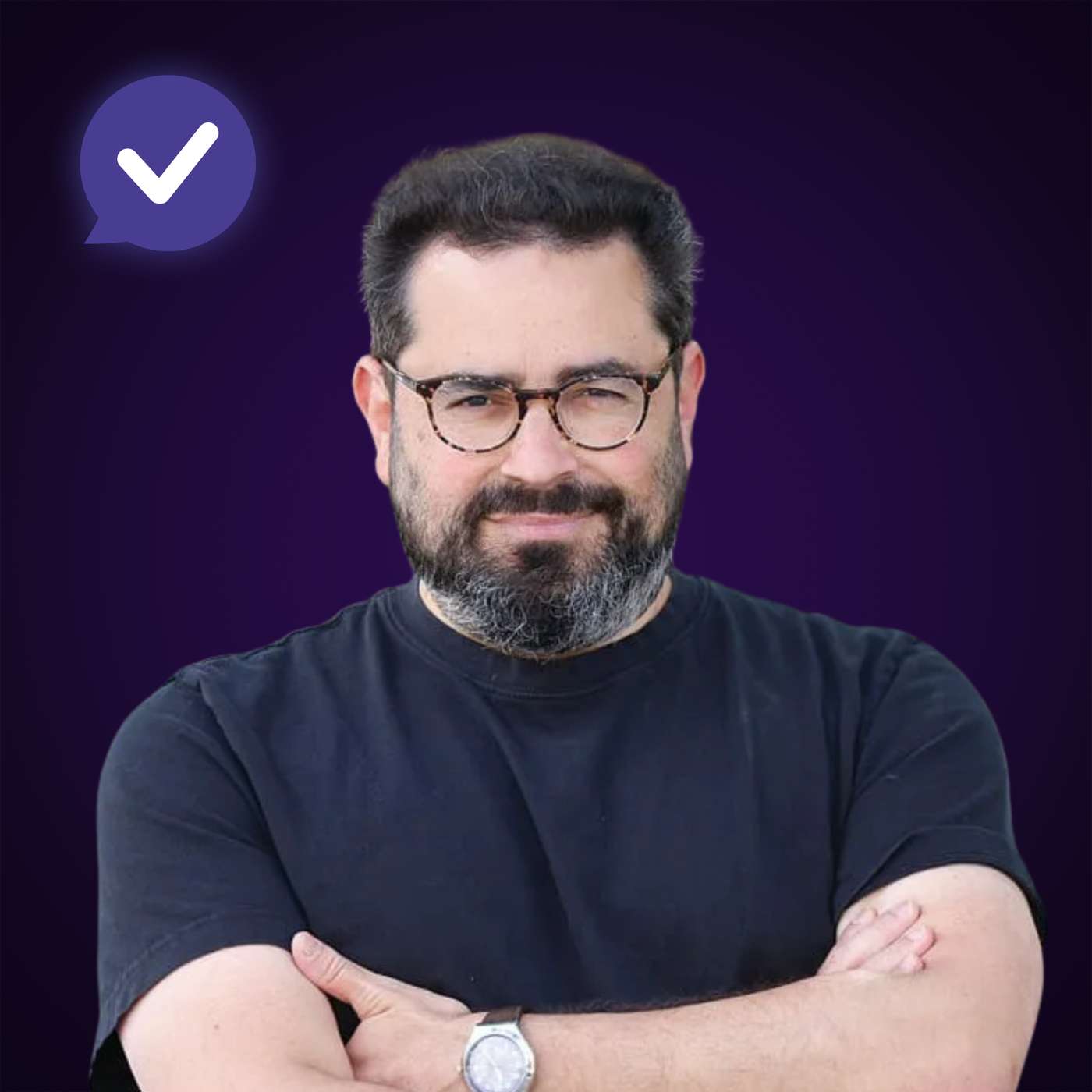
A fourth-grade math textbook asks Palestinian children to add the number of martyrs killed in the First Intifada to the number killed in the Second. A physics lesson teaches Newton's second law using a boy with a slingshot aimed at an Israeli soldier. A first-grade Arabic book introduces the letter ha with two words: attack, and martyr. Marcus Sheff runs the institute that found all of it. He was a political reporter, then an editor at The Jerusalem Post, then a foreign correspondent, and then he ran a communications firm — and now he is CEO of IMPACT-se, the Jerusalem-based research institute that reads school textbooks across the Middle East and Europe line by line and grades them against UNESCO's own standards on peace, tolerance and non-violence. His analysts go through every line of every book of every subject of every grade; one country can mean 350 textbooks in a year. The Syrian report is 300 pages. His central claim is not that the books are offensive. It is that they are predictive. "Textbooks are remarkable political predictors," Sheff says. "What children are taught today in classrooms all over the world is a pretty good indication of what the country is going to be like in ten years' time." A fourteen-year-old reading a physics problem about throwing rocks is twenty-four in a decade, and a fully formed member of a society. What a regime prints is what it intends. Sheff walks through what IMPACT-se found in the Palestinian Authority curriculum and why he reads it as strategy rather than accident: the peace agreements that used to be in the books — Israel and Egypt, Israel and Jordan, the Wye Accords — were taken out when the curriculum was rewritten between 2016 and 2018, leaving only a dismissive account of Oslo, along with the letter Yasser Arafat wrote to Yitzhak Rabin renouncing violence, which was doctored. None of that, he argues, happens by accident. It was done at the top, in the open, with the international community in the room. Then there is UNRWA — the UN agency that runs most of the schools in Gaza, teaches the Palestinian Authority curriculum in them, and has produced some of its own supplementary material besides, one piece of which describes an attack on a bus full of Israeli civilians as a barbecue party. Sheff testified to the committee the UN set up to investigate the agency after October 7; IMPACT-se was the only nonprofit asked. He describes what the committee recommended and what happened next, which was very little. The obvious objection gets its turn: does any of this actually change anyone, and isn't the whole thing impossible to fix anyway? Sheff's answer is the most useful thing on the tape. Changing a curriculum is not hard. These are thin, magazine-format books, reprinted constantly, and the world has two billion children in school — it is not short of experience in producing textbooks. The refusal is not technical. "This is not a pedagogical question," he says. "This is a political question." He also turns the same standards on Israel — IMPACT-se examines the Israeli curriculum, he says, more comprehensively than any other — and describes what the Ministry of Education's civics textbook actually teaches Israeli children about 1948, including the Palestinian account of it. And there is a genuinely hopeful half to this. The Palestinian Authority curriculum is not the regional norm; it is the outlier. The United Arab Emirates rebuilt its textbooks first. Saudi Arabia has been reforming its curriculum since 2020. Morocco's books, built on the country's 2011 constitutional reform, treat the Jewish community and the Amazigh as part of the Moroccan tapestry, right down to a photograph of a Muslim family at a Jewish Friday night table. Central Asia is doing better on antisemitism than much of Western Europe, where Sheff calls the picture a mixed bag and puts Ireland at the bottom of it. Also in this episode: what the analysts physically do with a stack of several hundred textbooks; why UNESCO doesn't conduct this kind of country-level review itself; the fact that Hamas, on taking Gaza, did not change a word of the curriculum Fatah wrote in Ramallah; why the US withdrew its UNRWA funding after IMPACT-se testified in Congress; what Sheff would say if he had one sentence in front of the UN General Assembly; and where his hope comes from after a career spent reading the worst material anyone produces. MARCUS SHEFF AND IMPACT-se IMPACT-se: https://www.impact-se.org/ All IMPACT-se reports and research: https://www.impact-se.org/blog/ Marcus Sheff, Washington Institute expert bio: https://www.washingtoninstitute.org/experts/marcus-sheff-0 IMPACT-se team page: https://www.impact-se.org/about-us/team-impact/ REFERENCED IN THIS EPISODE Sheff's written testimony to the US House Foreign Affairs Committee, "UNRWA Exposed," Jan 30 2024: https://chrissmith.house.gov/uploadedfiles/2024-1-30-_witness_testimony_of_marcus_sheff.pdf IMPACT-se, "Analyzing UNRWA's Response" — the July 2 2026 review of UNRWA's compliance with the Colonna Report, including the eighth-grade Arabic textbook: https://impact-se.org/publication/analysing-unrwas-response-to-the-un-independent-review-colonna-report/ IMPACT-se, "Review of the 2025-2026 Palestinian Authority School Curriculum, Grades 1-12," November 2025 — 290 textbooks and 71 teacher guides: https://www.impact-se.org/wp-content/uploads/Review-of-the-2025-2026-Palestinian-Authority-School-Curriculum-v2.pdf IMPACT-se, "Review of UNRWA Schools Headed by Hamas Principals," Nov 10 2024: https://impact-se.org/publication/review-of-unrwa-schools-headed-by-hamas-principals/ IMPACT-se, "When Peace Goes to School: The Emirati Curriculum 2016–21": https://www.impact-se.org/wp-content/uploads/When-Peace-Goes-to-School_The-Emirati-Curriculum-2016%E2%80%9321.pdf IMPACT-se, "Review of Saudi Textbooks 2024–2026," July 2026: https://impact-se.org/publication/review-of-saudi-textbooks-2024-2026/ IMPACT-se, "In Syria, the Real Foreign Policy Is Written in the Classroom," July 21 2026: https://impact-se.org/publication/in-syria-the-real-foreign-policy-is-written-in-the-classroom/ IMPACT-se, "Review of the Jordanian Curriculum 2025–2026," Aug 11 2026: https://impact-se.org/publication/review-of-the-jordanian-curriculum-2025-2026/ US Government Accountability Office, GAO-26-107708 — gaps in State Department reporting on UNRWA textbook content, Jan 8 2026: https://www.gao.gov/products/gao-26-107708 Dr. Charles Asher Small on The Honest Take, "Follow the Money: How the Muslim Brotherhood Bought a Seat in America's Schools": https://share.transistor.fm/s/a2cab...
- Transcript
- Chapters