Skip to content
Artwork for The Cloud Engineer’s Playbook - A Podcast by Michael Diogo

The Cloud Engineer’s Playbook - A Podcast by Michael Diogo

Michael Diogo

🎙️ The Cloud Engineer’s Playbook

Whether starting your cloud journey or leveling up your cloud and automation skills, The Cloud Engineer’s Playbook is your go-to resource. We dive into real-world cloud engineering strategies, industry insights, and hands-on guidance each week.

Tune in, get inspired, and take your skills to the next level, one episode at a time.

Play
  • 20 episodes
  • Avg 21 min
  • English
  • S1 · E27
    June 28 · 16 min

    How MySQL and PostgreSQL track every change

    A primary database gets a write. Somehow, a replica on the other side of the world has the same data seconds later. Then I learned about Binary Logging and the magic made sense. Tune in lets learn Need a team to migrate workloads to the cloud, secure your infrastructure, automate your processes, and train your team for optimal adoption, email: contact@diogomic.me to start your transformation today. Let’s make your operations and workloads more optimize and more secured.

  • S1 · E26
    March 23 · 35 min

    Introduction to AWS Well- Architected Framework - Part Two

    Every great system starts with a solid foundation. Just like constructing a building, the choices you make early in cloud architecture can determine whether your solution stands strong or slowly cracks under pressure. In this episode, we dive into the reality of architecting workloads in the cloud, where every decision is a trade-off shaped by business context. Do you optimize for cost and sustainability in development environments, or double down on reliability for mission-critical systems? How does performance directly influence revenue in ecommerce? And why are security and operational excellence non-negotiable, no matter the scenario? We continue to break down the core design principles of the Well-Architected Framework, including: The Cost of Building in the Cloud Use Serverless architectures when necessary Using automation to safely experiment and evolve architectures Expenditure usage and awareness Letting data not assumptions drive architectural decisions Maximize Utilization Adopt new, more efficient hardware and software offerings At the heart of it all are the six pillars: operational excellence, security, reliability, performance efficiency, cost optimization, and sustainability. Neglecting any one of them can undermine everything you’re trying to build. But when they’re thoughtfully balanced, they free you up to focus on what really matters delivering business value and meeting functional requirements. Need a team to migrate workloads to the cloud, secure your infrastructure, automate your processes, and train your team for optimal adoption, email: contact@diogomic.me to start your transformation today. Let’s make your operations and workloads more optimize and more secured.

  • S1 · E25
    February 17 · 34 min

    Introduction to AWS Well- Architected Framework - Part One

    Every great system starts with a solid foundation. Just like constructing a building, the choices you make early in cloud architecture can determine whether your solution stands strong or slowly cracks under pressure. In this episode, we dive into the reality of architecting workloads in the cloud, where every decision is a trade-off shaped by business context. Do you optimize for cost and sustainability in development environments, or double down on reliability for mission-critical systems? How does performance directly influence revenue in ecommerce? And why are security and operational excellence non-negotiable, no matter the scenario? We break down the core design principles of the Well-Architected Framework, including: Why guessing capacity is a thing of the past How testing at production scale becomes affordable in the cloud Using automation to safely experiment and evolve architectures Designing systems that grow with your business, not against it Letting data not assumptions drive architectural decisions Stress-testing your systems through game days before real incidents hit At the heart of it all are the six pillars: operational excellence, security, reliability, performance efficiency, cost optimization, and sustainability. Neglecting any one of them can undermine everything you’re trying to build. But when they’re thoughtfully balanced, they free you up to focus on what really matters delivering business value and meeting functional requirements. Need a team to migrate workloads to the cloud, secure your infrastructure, automate your processes, and train your team for optimal adoption, email: contact@diogomic.me to start your transformation today. Let’s make your operations and workloads more optimize and more secured.

  • S1 · E24
    February 9 · 15 min

    API Rate Limiting Architecture and Algorithms

    In networked systems, a rate limiter acts like a traffic controller, managing how often a user or service can make requests. In the world of HTTP APIs, it sets boundaries on how many requests are allowed within a given time frame. Once that limit is reached, any additional requests are automatically blocked. Think of it like setting fair-use rules: a user might only be able to post twice per second, create up to ten accounts in a day from the same IP address, or claim rewards no more than five times in a week from a single device. Need a team to migrate workloads to the cloud, secure your infrastructure, automate your processes, and train your team for optimal adoption, email: contact@diogomic.me to start your transformation today. Let’s make your operations and workloads more optimize and more secured.

  • S1 · E23
    January 1 · 16 min

    AWS Systems Manager: The Cloud Ops Command Center

    Every growing cloud environment reaches a moment where manual operations no longer scale. Patching becomes risky, access needs tightening, and visibility starts to fade. In this episode, we step into the Cloud Ops command center and explore AWS Systems Manager the service built to bring order, automation, and security to complex infrastructures. From managing fleets of instances to automating routine tasks and enforcing operational best practices, we unpack how cloud engineers regain control and operate at scale with confidence. Whether you’re running a handful of workloads or thousands of resources across hybrid environments, this deep dive shows how modern teams move from reactive firefighting to proactive cloud operations. Need a team to migrate workloads to the cloud, secure your infrastructure, automate your processes, and train your team for optimal adoption, email: contact@diogomic.me to start your transformation today. Let’s make your operations and workloads more optimize and more secured.

  • S1 · E22
    Dec 15, 2025 · 35 min

    Mastering Amazon S3

    Mastering Amazon S3 is a technical episode for developers, data engineers, IT administrators, and even beginners. We dived deep into S3’s architecture and features, explaining how to build scalable, secure, and cost-efficient storage solutions. We explore Amazon S3’s industry-leading scalability, availability, security, and performance through practical examples and expert interviews. Whether you’re managing data lakes, websites, backups, training ML models or analytics, we cover real-world strategies to optimize S3 for any application. Topics Covered Foundations & Use Cases: Understand S3 buckets, objects, versioning, tables and embeddings. Learn how organizations use S3 for data lakes, static website hosting, mobile apps, backups, and more . Security & Compliance: Protect your data with AWS best practices. We cover encryption, IAM and bucket policies, S3 Block Public Access, and other tools to keep buckets private by default and meet compliance requirements. Performance Optimization: Discover tips to maximize throughput and minimize latency. From parallel and multipart uploads to edge caching and S3 Transfer Acceleration, see how S3 can handle thousands of requests per second and deliver low-latency data access . Cost Management: Explore cost-saving strategies using S3 storage classes and lifecycle policies . Learn how analytics (e.g. S3 Storage Lens and Intelligent Tiering) can track usage patterns and automatically move data to cheaper tiers. Real-world Case Studies & Interviews: This episode shows how real S3 challenges in production is solved (reducing costs, improving performance, securing data, etc.). Need a team to migrate workloads to the cloud, secure your infrastructure, automate your processes, and train your team for optimal adoption, email: contact@diogomic.me to start your transformation today. Let’s make your operations and workloads more optimize and more secured.

  • S1 · E21
    Oct 18, 2025 · 37 min

    Disaster Recovery Strategies In The Cloud

    It’s 2:00 a.m. your phone buzzes. Alerts are flooding in. The production database is down, your main region is unresponsive, and customers are already posting on social media. Panic? Not if you’ve prepared. In this gripping episode of The Cloud Engineer’s Playbook, Disaster Recovery in the Cloud : where milliseconds matter and preparation separates chaos from control. We’ll start with the basics: What exactly counts as a disaster? From accidental deletions and server crashes to regional outages and cyberattacks, you’ll learn how to identify and anticipate threats before they take your business offline. Then, we break down how to plan, design, and execute cloud recovery strategies that keep your systems and your sanity intact. In this episode, you’ll discover: The anatomy of a disaster and why it’s not always what you think. The difference between high availability, backup, and true disaster recovery. How to build a cloud architecture that can survive anything using multi-region deployments, automated failovers, and replication strategies. How to measure resilience with RPOs and RTOs, and why those two numbers could save your business. The importance of regularly testing and updating your DR plan before disaster tests it for you. This isn’t just a technical discussion it’s a playbook for survival in the unpredictable world of cloud computing. Need a team to migrate workloads to the cloud, secure your infrastructure, automate your processes, and train your team for optimal adoption, email: contact@diogomic.me to start your transformation today. Let’s make your operations and workloads more optimize and more secured.

  • S1 · E20
    Oct 15, 2025 · 14 min

    Mastering Incident Postmortem

    Incidents happen.They just do. As our systems grow in scale and complexity, failures are inevitable. Incidents are also a learning opportunity. The best way to work through what happened during an incident and capture any lessons learned is by conducting an incident postmortem, also known as a post-incident review. An incident postmortem brings people together to discuss the details of an incident: why it happened, its impact, what actions were taken to mitigate it and resolve it, and what should be done to prevent it from happening again. In this episode we took a deep dive into why it's neccesary and how to implement an incident postmortem. Need a team to migrate workloads to the cloud, secure your infrastructure, automate your processes, and train your team for optimal adoption, email: contact@diogomic.me to start your transformation today. Let’s make your operations and workloads more optimize and more secured.

  • S1 · E19
    Sep 23, 2025 · 15 min

    Fast by Design: The Caching Effect

    The farther users are from your servers, the slower their experience with your application. In this episode we explored how caching and CDNs bridge that gap bringing data closer to users, cutting latency, and boosting reliability. We dived into caching strategies, edge delivery, and real-world practices that help developers overcome distance, scale globally, and deliver blazing-fast performance. Need a team to migrate workloads to the cloud, secure your infrastructure, automate your processes, and train your team for optimal adoption, email: contact@diogomic.me to start your transformation today. Let’s make your operations and workloads more optimize and more secured.

  • S1 · E18
    Sep 18, 2025 · 17 min

    From Chaos to Control: Incident Management Unpacked

    Downtime, outages, and unexpected crises can derail any business. This episode, From Chaos to Control: The Incident Management dives into the strategies, tools, and real-world stories that help teams respond faster, reduce impact, and learn from every incident. Insights from IT leaders, SREs, and operations experts on how to turn high-pressure moments into opportunities for resilience, growth, and continuous improvement. Need a team to migrate workloads to the cloud, secure your infrastructure, automate your processes, and train your team for optimal adoption, email: contact@diogomic.me to start your transformation today. Let’s make your operations and workloads more optimize and more secured.

  • S1 · E17
    Sep 17, 2025 · 15 min

    Database Sharding, Breaking Up Databases (Without Breaking Them)

    Struggling with slow, overloaded databases as your application scales? Database Sharding: Breaking Up Databases (Without Breaking Them) offers clear insights into how sharding can solve performance bottlenecks, boost scalability, and keep systems resilient. This episode breaks down concepts, real-world strategies, and best practices so you can confidently design, implement, and manage sharded databases without the headaches. Need a team to migrate workloads to the cloud, secure your infrastructure, automate your processes, and train your team for optimal adoption, email: contact@diogomic.me to start your transformation today. Let’s make your operations and workloads more optimize and more secured.

  • S1 · E16
    Sep 14, 2025 · 22 min

    Governance, Risk and Compliance (GRC) Blueprint Strategies for Cloud Success

    In the business world today, organizations face constant pressure to stay compliant, manage risks, and make smarter decisions. Governance, Risk, and Compliance (GRC) Blueprint Strategies for Cloud Success dives deep into Governance, Risk Management, and Compliance (GRC), a unified approach that breaks down silos and brings IT, business, and leadership together under one coordinated model. Whether you are an IT leader, compliance officer, risk manager, or executive decision-maker, this podcast gives you the knowledge to navigate uncertainty, cut risk management costs, and unify your organization’s policies, decisions, and actions. Need a team to migrate workloads to the cloud, secure your infrastructure, automate your processes, and train your team for optimal adoption, email: contact@diogomic.me to start your transformation today. Let’s make your operations and workloads more optimize and more secured.

  • S1 · E15
    Aug 9, 2025 · 14 min

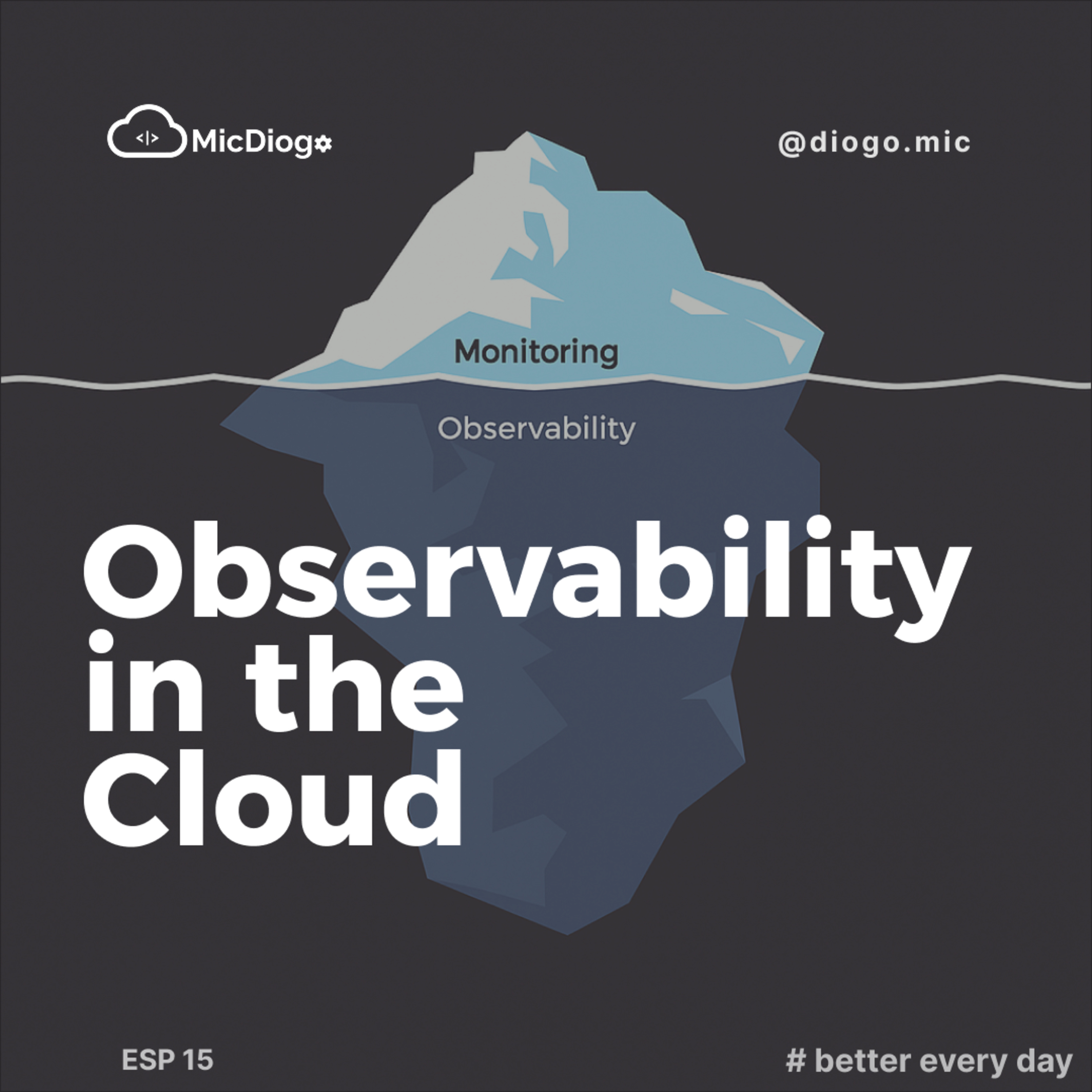
    Understanding Observability in the Cloud

    In today’s cloud-driven world, monitoring alone is no longer enough to ensure the health, performance, and security of modern applications and infrastructure. Observability goes beyond simply detecting issues, it empowers IT teams to understand why problems occur, pinpoint root causes faster, and take proactive steps to prevent future incidents. By leveraging metrics, logs, traces, and events supported by tools like AWS CloudWatch organizations can achieve deep visibility across complex, distributed systems. This not only reduces downtime and improves user experience but also fuels innovation, operational agility, and business resilience. In short, observability isn’t just a technical capability it’s a strategic advantage in the cloud era. Need a team to migrate workloads to the cloud, secure your infrastructure, automate your processes, and train your team for optimal adoption, email: contact@diogomic.me to start your transformation today. Let’s make your operations and workloads more optimize and more secured.

  • S1 · E14
    Aug 1, 2025 · 25 min

    Deep Dive into AWS Security, Identity and Compliance

    AWS is built from the ground up to be the most secure and resilient global cloud infrastructure, making it an ideal platform for developing, migrating, and managing applications and workloads at any scale. With a comprehensive suite of Security, Identity, and Compliance services, AWS enables you to embed robust security controls to safeguard your application architecture helping you protect sensitive data, manage user access, detect threats, and maintain regulatory compliance. In this episode, we explore the wide range of AWS security tools and best practices that can help you strengthen your cloud security posture. From services like AWS Identity and Access Management (IAM), AWS Shield, AWS Cognito and AWS WAF, to logging and monitoring solutions such as AWS CloudTrail and Amazon GuardDuty, we’ll show you how to leverage these tools to build layered defenses and ensure the integrity, confidentiality, and availability of your workloads in the cloud.

  • S1 · E13
    Jun 15, 2025 · 22 min

    AWS Compute Options

    In this episode of The Cloud Engineer’s Playbook, we unpack the full landscape of compute services in AWS from traditional virtual machines to serverless functions, containers, and edge computing. We discussed about: Amazon EC2: Flexible VMs for any workload AWS Lambda: Serverless functions that scale effortlessly ECS, EKS & Fargate: Container services with the level of control you need Trainium & Inferentia: Specialized compute for AI/ML workloads Outposts & Wavelength: Hybrid and edge compute made simple Elastic Beanstalk, App Runner, Lightsail: Fully managed deployment options Savings Plans, Spot Instances & Compute Optimizer: Cut costs while staying performant Whether you’re a developer, architect, or cloud enthusiast, this episode is packed with insights on how to choose the right compute service for your application workload.

  • S1 · E12
    Jun 15, 2025 · 17 min

    AWS Database Options

    🎙️ Episode 12 is here! Title: Exploring Database Services in AWS The Right Tool for the Right Job In this episode of The Cloud Engineer’s Playbook, we dive into the wide range of database offerings from AWS from traditional relational databases to purpose-built solutions for modern applications. Tune in to learn about: Amazon RDS: Simplified relational database management Amazon DynamoDB: Fully managed NoSQL powerhouse Amazon Redshift: Fast, scalable data warehousing Amazon Neptune: Managed graph database for connected data Amazon DocumentDB, Keyspaces, and more… Whether you’re optimizing your app’s performance or designing scalable, cloud-native solutions in this episode will help you choose the right database for the job.

  • S1 · E11
    Jun 10, 2025 · 25 min

    AWS Storage Options

    In this episode, we dive deep into the storage services you can access in AWS, from File Storage Services to Object Storage Services. AWS Backup: A fully managed, policy-based service that centralizes and automates data protection across various AWS services, simplifying backup management at scale. Amazon Elastic Block Store (Amazon EBS): Persistent block storage volumes for use with Amazon EC2 instances, automatically replicated within an Availability Zone for high availability and durability. AWS Elastic Disaster Recovery (Elastic Disaster Recovery): A service that minimizes downtime and data loss by enabling fast, reliable recovery of on-premises and cloud-based applications through continuous data replication and point-in-time recovery. Amazon Elastic File System (Amazon EFS): A simple, scalable, elastic file system for Linux-based workloads, offering massively parallel shared access, automatic scaling, and high availability across Availability Zones. Amazon EFS Archive: A cost-effective storage class within Amazon EFS for long-lived, rarely accessed data, supporting intelligent tiering. Amazon FSx for Lustre: A fully managed file system optimized for compute-intensive workloads like HPC and machine learning, offering high throughput and low latency, with seamless integration with Amazon S3. Amazon FSx for NetApp ONTAP: A fully managed NetApp file system in the cloud, allowing easy migration or extension of existing applications to AWS with familiar NetApp features, performance, and protocols (NFS, SMB, iSCSI). Amazon FSx for OpenZFS: A fully managed file storage service built on the open-source OpenZFS file system, designed for migrating on-premises file servers and building new high-performance, data-driven applications in the cloud. Amazon FSx for Windows File Server: A fully managed native Microsoft Windows file system providing shared file storage with full support for SMB protocol, Windows NTFS, and Active Directory integration, ideal for Windows-based applications. Amazon Simple Storage Service (Amazon S3): An object storage service known for industry-leading scalability, data availability, security, and performance, used for a wide range of use cases including websites, mobile applications, backup, and analytics. S3 Intelligent-Tiering: An Amazon S3 storage class that automatically moves data between access tiers based on changing access patterns to optimize costs. S3 Standard: An Amazon S3 storage class designed for frequently accessed data. S3 Express One Zone: An Amazon S3 storage class for the most frequently accessed data, optimized for single-zone storage. S3 Standard-Infrequent Access (S3 Standard-IA): An Amazon S3 storage class for less frequently accessed data that requires rapid access when needed. S3 One Zone-Infrequent Access (S3 One Zone-IA): An Amazon S3 storage class for less frequently accessed data stored in a single Availability Zone for lower cost. S3 Glacier Instant Retrieval: An Amazon S3 storage class for archive data that needs immediate access. S3 Glacier Flexible Retrieval (formerly S3 Glacier): An Amazon S3 storage class for rarely accessed long-term data that does not require immediate access, with flexible retrieval times. Amazon S3 Glacier Deep Archive (S3 Glacier Deep Archive): The lowest-cost Amazon S3 storage class for long-term archive and digital preservation, with retrieval in hours. S3 Outposts: An Amazon S3 storage class that allows S3 data to be stored on premises to meet data residency requirements. S3 Object Lock: An Amazon S3 feature that helps prevent objects from being deleted or overwritten for a fixed amount of time or indefinitely, supporting WORM (write-once-read-many) requirements. AWS Storage Gateway: A hybrid storage service that connects on-premises applications to AWS cloud storage using standard protocols, facilitating backup, archiving, disaster recovery, and cloud data processing.

  • S1 · E10
    Jun 9, 2025 · 20 min

    Linux, The Operating System Of The Cloud

    In this episode, we discussed the Linux Operating System, which is widely used in Cloud Computing. Some basic commands to start your Linux adventure, commands like: ls - list items in the current directory cd - change directory pwd - show current directory path mkdir - create a directory touch - create a file rm - remove a file rmdir - remve a directory cat - displays a file in read state head - is used to display the first part of a file tail - is used to display the last part of a file grep - used to search for text patterns within files or output curl - transfer data from or to a server vim and nano (editors) - used to edit chmod - change file mode (read, write, execute) chown - change ownership echo - displays a line of text or variable in the terminal

  • S1 · E9
    May 31, 2025 · 18 min

    What is Amazon Elastic Compute Cloud ?

    In this episode of The Cloud Engineer’s Playbook, we zoom in on one of the most fundamental AWS services: Amazon EC2 (Elastic Compute Cloud). In this episode, we discuss: What is EC2, and why it’s a cornerstone of cloud computing Powerful features of EC2 like scalability, pay-as-you-go pricing, and elasticity The different types of EC2 instances and how to select the right one Real-world examples and how EC2 helps teams move fast and reduce hardware costs Here is a Cloud Formation template to spin up an Ubuntu OS in EC2. If you’re building in the cloud, EC2 is mission-critical knowledge. Tune in and level up!

  • S1 · E8
    May 27, 2025 · 12 min

    AWS Cloud Account Best Practices for Beginners and Beyond

    This episode emphasizes a multi-layered approach to AWS account security and management, focusing on: Strong Authentication and User Management: Moving beyond the root user for daily operations. Cost Monitoring and Control: Proactively managing expenses in the cloud. Resource Organization and Identification: Utilizing metadata for visibility and control. Activity Logging and Auditing: Gaining insights into account actions for security and compliance.

Showing 1–20 of 20 episodes