Skip to content
Artwork for Classic Ghost Stories
FictionDramaScience Fiction

Classic Ghost Stories

Tony Walker

A weekly fiction podcast bringing you classic ghost stories, horror stories, and weird tales in audio form.

Most episodes feature classic stories from the masters of the supernatural: cosy Edwardian ghost stories (E. F. Benson, Walter de la Mare), Victorian supernatural mysteries (M. R. James, Elizabeth Gaskell, Bram Stoker, Charles Dickens), and 20th‑century Weird Tales (Robert Aickman, Fritz Leiber, Clark Ashton Smith, H. P. Lovecraft), wandering from the Gothic to the Odd, even to the Literary, and back again.

Occasionally, we feature living authors – but the majority are dead. Some, perhaps, are undead.

Each story is followed by Tony’s commentary on the tale, its author, themes, and literary context – which can be especially useful for students and anyone curious about the history of ghost stories.

Play
  • 27 episodes
  • weekly
  • Avg 1 hr 1 min
  • English
Counted on this page — what you have heard stays on this device, so it is not something the list can be paged by.
  • Thursday · 1 hr 26 min

    All Souls by Edith Wharton

    We call it Halloween. Its older name is All Souls' Eve — a night in the old calendar when the membrane between the living and the dead grows thin. Edith Wharton knew this night well. Every All Souls' Eve she sat alone by the fire and named her dead, one by one, until the room felt less empty. In her last story, written six months before her own death, she imagined what that night might look like from the other side. A woman alone in a large house. The servants gone. The telephone silent. The snow piling up outside. And somewhere in the lane, a figure who should not be there. "All Souls'" is not quite a ghost story. It is something quieter, and harder to shake. "All Souls'" was first published in Ghosts (D. Appleton-Century Company, New York, 1937), the only story in that collection to have had no prior magazine publication. It was Wharton's last completed work of fiction. Edith Wharton (1862–1937) was an American novelist and short story writer, the first woman to win the Pulitzer Prize for Fiction, awarded for The Age of Innocence in 1921. She remains one of the finest practitioners of the ghost story in the American tradition. Ad Free Stories! Become A Patreon ! https://patreon.com/barcud
  • October 1 · 1 hr 32 min

    The Residence at Whitminster by M R James

    Thanks to Hayley Smith for sponsoring this episode! The prebendal residence at Whitminster stands in the shadow of its great collegiate church, solid, respectable, and comfortable. A young Irish lord came to lodge there once, in the 1730s, and his guardian noted his odd habits with mild concern. He grew more concerned as time went on. By the time he understood what the boy had been doing in the garden at night, it was already too late. M. R. James tells this story the way a scholar reconstructs a cold case: from letters, diaries, servant's gossip, and family memory preserved at two removes. The witnesses contradict each other. The documents are partial. The truth, such as it is, arrives a century late. There is a glass that has absorbed what it once witnessed and will show it again, to the right viewer. There is a room that was sealed for reasons only partially explained. There is a press that has not been opened, and a note from a long-dead man advising that it should stay that way. "The Residence at Whitminster" was first published in 1919 as the lead story of A Thin Ghost and Others, James's third collection, published by Edward Arnold. The collection takes its title from a line within this story. Montague Rhodes James (1862–1936) was a medieval scholar, palaeographer, and Provost first of King's College Cambridge and then of Eton College. He is widely regarded as the finest writer of ghost stories in the English language. By the way the print edition of my Sherlock Holmes puzzle story: The Cumberland Kidnapping is available now on Payhip The Case of the Cumberland Kidnapping

  • September 24 · 1 hr 5 min

    The Wind in the Rose-Bush by Mary E Wilkins Freeman

    An unmarried schoolteacher crosses a river by ferry to collect her dead sister's daughter from the girl's stepmother, a woman with china-blue eyes and a smile that is hiding something. Nobody in Ford Village will say anything. And then there's the rose-bush that flutters when there is no wind. Mary E. Wilkins Freeman, better known for her hard-eyed portraits of small-town New England households, turns that same unsparing eye on a relationship that prizes respectability over truth. What starts as an ordinary of family obligation becomes something closer to a tragedy, and we never see it coming. 📚 Buy my paperbacks here: https://books.by/tony-walker-books 🎙️ Buy my ebooks and audiobooks here: payhip.com/TheClassicGhostStoriesPodcast

  • September 18 · 1 hr 7 min

    The Mummy's Foot by Theophile Gautier

    In a quiet curiosity shop in Paris, a shelf holds a collection of objects from another time. Our protagonist notices a small object that at first appears to be the broken foot of a Greek statue. The antiques dealer, however, explains that it is the mummified foot of a pharaoh’s daughter. The absurdity of a once royal foot now serving as a paperweight strikes them both. The dealer warns that the old pharaoh will not be pleased. First published in 1840 as "Le Pied de momie" in Le Chroniqueur de Paris, The Mummy’s Foot is one of the earliest examples of French fantastic fiction. Théophile Gautier (1811–1872), a poet, novelist, and critic, was a leading figure of French Romanticism. Known for his belief in “art for art’s sake,” he helped define the fantastic and Gothic tale as a lasting literary form. 📚 Buy my paperbacks here: https://books.by/tony-walker-books 🎙️ Buy my ebooks and audiobooks here: payhip.com/TheClassicGhostStoriesPodcast

  • September 11 · 47 min

    Lost in a Pyramid, or The Mummy's Curse by Lousia May Alcot

    A young woman sits for a portrait, turning over a small gold box while her fiancé paints. Inside: three scarlet seeds, brought back from a place he'd rather forget. He warns her the story behind them will haunt her. She only laughs — she likes weird tales, and they never trouble her. But something was disturbed in that pyramid, something bound by an old promise to whoever broke her rest. The seeds are waiting. So is the curse. Lost in a Pyramid; or, The Mummy's Curse first appeared in Frank Leslie's *The New World* on 16 January 1869, published under initials rather than a name. It vanished for over a century before being rediscovered in the 1990s as one of the earliest true "mummy's curse" stories. Its author was Louisa May Alcott, best known to the world as the creator of *Little Women*. Behind that respectable reputation, she spent years writing anonymous, blood-soaked thrillers — and this was one of the last. 📚 Buy my paperbacks here: https://books.by/tony-walker-books 🎙️ Buy my ebooks and audiobooks here: payhip.com/TheClassicGhostStoriesPodcast

  • September 4 · 1 hr 52 min

    Lot 249 by Arthur Conan Doyle

    This was a request, but fitted in with my current interest in mummies. Read my full notes on the history of the Egyptian Mummy in Horror here: https://www.classicghost.com/blog/the-egyptian-mummy-in-horror/ Old College, Oxford, in the last years of the nineteenth century. A young medical student named Abercrombie Smith shares a stair with a fellow he barely knows — a brilliant scholar of Eastern languages, whose rooms are crowded with the relics of a dead civilisation, and whose company he has been quietly warned against. Something is wrong with the sound that comes through the wall at night: a low, monotonous muttering, the same words over and over, in no language Smith can place. Enemies begin to suffer, one by one, in ways that leave no mark and no explanation. And in the corner of that cluttered room stands a thing purchased at auction, numbered like an item in a catalogue, upright, ancient, and — Smith is almost certain — not quite as still as it should be. "Lot No. 249" was written by Arthur Conan Doyle and first published in Harper's Magazine in September 1892. Doyle is best remembered as the creator of Sherlock Holmes, but he wrote extensively in the supernatural and horror genres throughout his career. He died in 1930, having remained a committed spiritualist to the end of his life. 📚 Buy my paperbacks here: https://books.by/tony-walker-books 🎙️ Buy my ebooks and audiobooks here: payhip.com/TheClassicGhostStoriesPodcast Lot 249

  • August 21 · 56 min

    The Haunted Dolls House by M R James

    Kindly commissioned and sponsored by Gavin Critchley for his friend Victoria, a lover of dolls' houses... A collector buys a Gothic dolls' house for sixty guineas — a museum piece, the dealer calls it, and means it more than he says. Six feet of Strawberry Hill in miniature: a chapel, a stable block, a drawer of tiny embroidered clothes. He spends a happy evening setting its rooms in order, delighted with his find. There's no clock within earshot — none on the stair, none in the stable, none in the distant church tower. And yet, at one in the morning, a bell tolls once. "The Haunted Dolls' House" was first published in the Empire Review in February 1923, and later collected in M. R. James's A Warning to the Curious. M. R. James (1862–1936) was Provost of Eton and King's College, Cambridge, and a distinguished medieval scholar — antiquarian interests that shaped his ghost stories as much as his day job. Go to get the full notes here:

  • August 14 · 1 hr 6 min

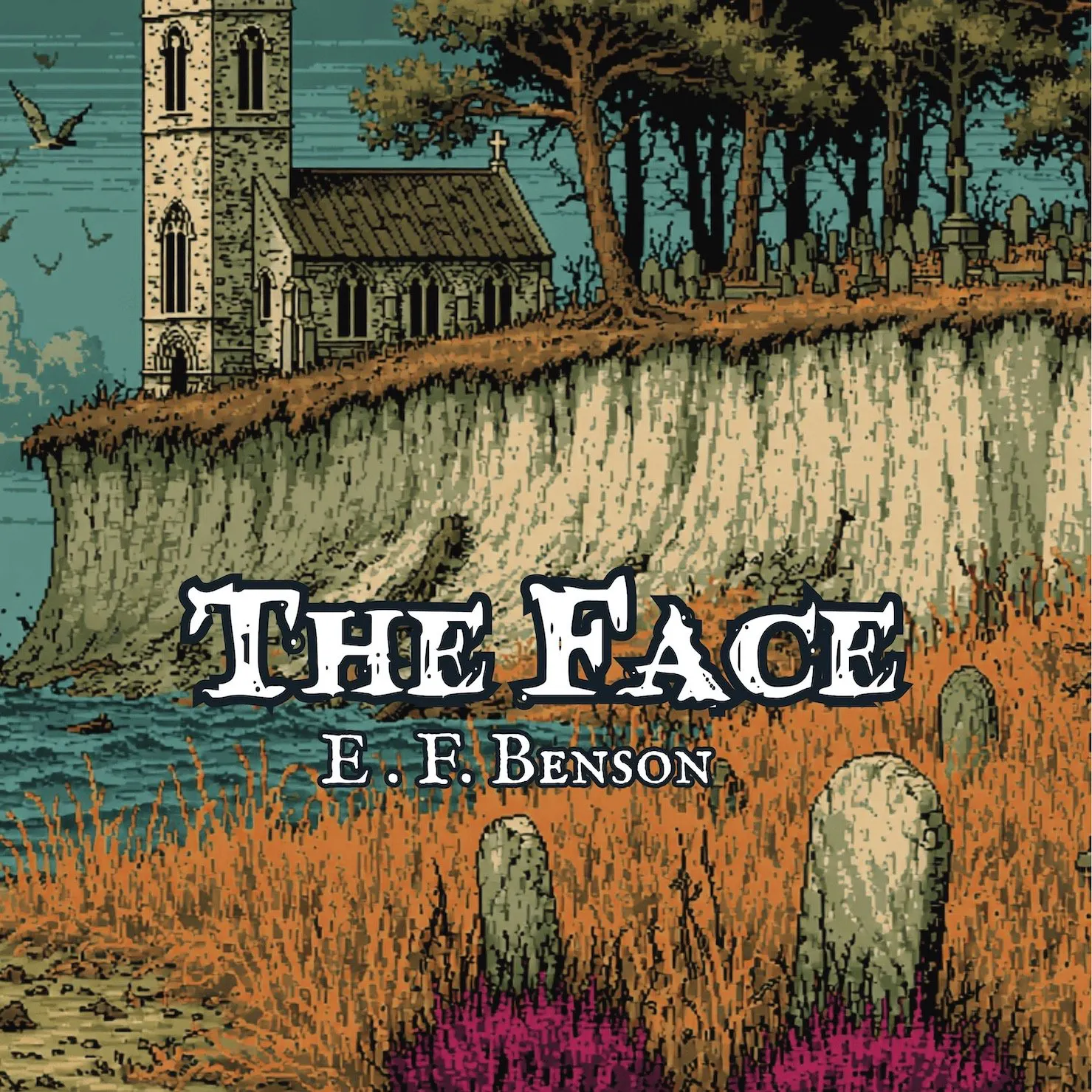
    The Face by E F Benson

    London, in the full weight of a June heatwave. The kind of golden, breathless afternoon that makes a fortunate woman feel especially fortunate. And Hester Ward is fortunate. She knows it. A husband she adores, two children, a house that runs exactly as it should — she has never had cause to wish for anything else, and she is grateful for it, in the quiet, unshowy way of someone who has never really been tested. Until something from very long ago reaches forward and taps her on the shoulder. Something she had put away so completely she'd almost convinced herself it was never real. A half-remembered thing from childhood, stirring now in the middle of the night. She stops sleeping. She starts watching the dark corners of rooms. Her doctor is kind, practical, entirely unworried. Nerves, he tells her — the heat, nothing more. What she needs is rest, and quiet, and a change of scene. A little village on the East Anglian coast, away from London, away for a while even from her husband. Somewhere she can put it all behind her. She goes because she means to get well. E.F. Benson's The Face. *Publication: "The Face" first appeared in Hutchinson's Magazine in February 1924, and was collected four years later in E.F. Benson's Spook Stories* (Hutchinson & Co., 1928). *About the author: Edward Frederic Benson (1867–1940) was an English novelist best known for his comic Mapp and Lucia series, but across four decades he also wrote dozens of ghost stories — his own term for them was "spook stories" — placed regularly in magazines like Pearson's and The Illustrated London News*. I now have an archive where you can find stories more easily. https://www.classicghost.com/the-archive/ Find Stories More Easily

  • August 7 · 1 hr 16 min

    A Professor of Egyptology by Guy Boothby

    Cairo, in the winter season, when the wealthy of Europe come for the warmth and the ruins. A young woman falls under the spell of a scholar unlike any other — a man treated with strange deference by those who know him best, a man whose knowledge of the dead seems to run deeper than any book could teach. She will walk beside him through moonlit halls where the pharaohs sleep in glass cases, "A Professor of Egyptology" first appeared in The Graphic on 10 December 1904, and was collected that same year in Guy Boothby's volume The Lady of the Island. Boothby was an Australian-born novelist best known for his Dr Nikola thrillers, a writer of ferocious productivity who dictated up to six thousand words a day. He died suddenly in 1905, only months after this story appeared, at the age of thirty-seven. Search the archive here www.classicghost.com

  • July 31 · 55 min

    The Dead Man of Varley Grange by Anonymous

    A young officer receives a Christmas invitation to an old country house in Westernshire. His friend, hearing the name, begs him not to go. He goes anyway. There are things in that house that have been seen before, by people who did not speak easily of what they saw. Something on the stairs. Something in the gallery, after dark, when the fire burns low and the talk runs out. Those who see it together are marked by it, in ways that take a year to come due. This is the story of what a house remembers, and what it does to those who are told to stay away, and don't. Published anonymously in 1878, later reprinted with the tag "by the author of Freda." Modern editors tentatively attribute it to novelist Elizabeth Anna Hart, though the evidence remains circumstantial. Elizabeth Anna Hart (1822–1890) was a London-born novelist and poet, cousin to Lewis Carroll, best remembered for her children's classic The Runaway and the novel Mrs Jerningham's Journal. ⭐ Join my Patreon ⭐ https://patreon.com/barcud Go here for a library of ad-free stories, a monthly members only story and early access to the regular stories I put out. You can choose to have ghost stories only, or detective stories or classic literature, or all of them for either $5 or $10 a month. Many hundreds of hours of stories. Who needs Audible? Or, if you'd just like to make a one-off gesture of thanks for my work https://buymeacoffee.com/10mn8sk

  • July 24 · 1 hr 29 min

    The House Surgeon by Rudyard Kipling

    A bright, modern house in the south of England. No history of violence. No death on the premises. And yet something lives in it — not a ghost, not a presence you could name, but a weight that settles over everyone who stays there. A grief that belongs to no one in the house. A judgement passed somewhere else, by someone else, for reasons the walls should know nothing about. The question is not what haunts the house. The question is what was done to the dead. "The House Surgeon" was first published in Harper's Magazine in September 1909 and collected in Actions and Reactions later that year. Rudyard Kipling was born in Bombay in 1865, awarded the Nobel Prize for Literature in 1907, and remains one of the most widely read English writers of the late nineteenth and early twentieth centuries. ⭐ Join my Patreon ⭐ https://patreon.com/barcud Go here for a library of ad-free stories, a monthly members only story and early access to the regular stories I put out. You can choose to have ghost stories only, or detective stories or classic literature, or all of them for either $5 or $10 a month. Many hundreds of hours of stories. Who needs Audible? Or, if you'd just like to make a one-off gesture of thanks for my work https://buymeacoffee.com/10mn8sk

  • July 16 · 54 min

    The Werewolf Howls by Clifford Ball

    In the vineyards of the Château Doré, something has been moving at night. The workers whisper of a wolf — enormous, grey, and wantonly destructive — and Monsieur Etienne Delacroix, master of the estate, has heard enough. He is a rational man. He does not believe in werewolves. He has moulded the silver bullets himself, in the cellar, as a concession to superstition — nothing more. Tonight his sons will go out into the moonlight and put an end to it. But there is something in the way he says goodbye to Pierre. Something in the way he asks after the crucifix. Something in the reason he will not be going with them. The Werewolf Howls was first published in Weird Tales, November 1941. It is the final story Clifford Ball published before enlisting in the United States Army Air Corps. Ball was born in New York City in 1908 and wrote just six stories, all for Weird Tales, between 1937 and 1941. He drowned accidentally in Baltimore in January 1947, aged thirty-eight.

  • July 9 · 30 min

    Gabriel Ernest by Saki

    Something is wrong in the woods. The artist notices him first — and says almost nothing. One remark, on the way to the station, barely above a murmur. Then the train comes, and he is gone. It falls to Van Cheele to find out what his friend meant. What he discovers, by the pool in the oak coppice, is a boy with light brown eyes that hold something tigerish in them, lying in the sun with an ease that belongs to no child he has ever met. The aunt will find him charming. The dog will not stay in the house. Saki understood that the old country — the country before the parishes and the property lines — was never entirely tamed. The animals there talk. "Gabriel-Ernest" was first published in 1909 in the Westminster Gazette, and later collected in Reginald in Russia and Other Sketches (1910). Saki was the pen name of Hector Hugh Munro (1870–1916), a writer of savage wit and supernatural unease. He was killed on the Western Front in the closing months of the Somme campaign. 📚 Buy my paperbacks here: https://books.by/tony-walker-books 🎙️ Buy my ebooks and audiobooks here: payhip.com/TheClassicGhostStoriesPodcast The Classic Ghost Stories Newsletter — short essays on the genre, odd discoveries, and recommendations. Free, fortnightly. Subscribe: https://www.classicghost.com/#/portal To. buy my paperback books: https://books.by/tony-walker-books To buy my ebooks and audiobooks: payhip.com/TheClassicGhostStoriesPodcast Or, if you'd just like to make a one-off gesture of thanks for my work https://buymeacoffee.com/10mn8sk *Intro and Outro Music by The Heartwood Institute* 🎼 https://bit.ly/somecomeback *Intro Movie by The Playground* https://www.instagram.com/theplayground.powder

  • July 3 · 1 hr 11 min

    The Devotee of Evil by Clark Ashton Smith

    There is a house in Auburn, California, with a tragic history and a new tenant. Jean Averaud has come from New Orleans with money, with books, with a beautiful mute woman who watches him with eyes full of something between devotion and dread. He has come with a theory about evil — not the Devil, not sin, not the ordinary darkness of human nature, but evil as a cosmic force, a radiation from a black sun somewhere in the depths of space. And he has come with a purpose. In the old Larcom house, with its history of sorrow and disaster, he has found exactly the conditions he needs. His neighbour, a novelist, finds himself drawn into Averaud's orbit. Clark Ashton Smith's *The Devotee of Evil* is a quiet story. It does not rush. It thinks. And what it thinks about has been troubling philosophers and theologians for two thousand years. *The Devotee of Evil* was first published in Smith's self-produced chapbook *The Double Shadow and Other Fantasies* in 1933, after failing to find a commercial publisher. It reappeared in *Stirring Science Stories* in February 1941. Clark Ashton Smith (1893–1961) was a California poet, painter, sculptor and writer of weird fiction, one of the central figures of the *Weird Tales* circle alongside H.P. Lovecraft and Robert E. Howard, with whom he maintained a long correspondence. The Classic Ghost Stories Newsletter — short essays on the genre, odd discoveries, and recommendations. Free, fortnightly. Subscribe: https://www.classicghost.com/#/portal To. buy my paperback books: https://books.by/tony-walker-books To buy my ebooks and audiobooks: payhip.com/TheClassicGhostStoriesPodcast Or, if you'd just like to make a one-off gesture of thanks for my work https://buymeacoffee.com/10mn8sk *Intro and Outro Music by The Heartwood Institute* 🎼 https://bit.ly/somecomeback *Intro Movie by The Playground* https://www.instagram.com/theplayground.powder

  • July 1 · 1 hr 43 min

    A Ghost of the Sea by Francis Prevost

    On the Cornish coast, a man is dying by the sea. He has chosen to be there, and he knows why, and he is willing — with one exception — to let the world draw its own conclusions. The exception is a story he has told no one: a woman he met in Cairo, a wrong he did her, and something that has followed him across the water ever since. Not threatening. Not reproachful. Simply there, at the edge of the known world, in a light that has no name in any spectrum the living can account for. Prevost's 1893 story asks, without sentimentality and without resolution, what we leave behind us when we refuse an honest encounter — and whether what we leave behind stays left. A Ghost of the Sea was first published in 1893 in Prevost's collection Rust of Gold, issued by Ward and Lock, London. Francis Prevost was the pen name of Harry Francis Prevost Battersby (1862–1949), soldier, war correspondent, novelist, and lifelong investigator of psychical phenomena. Get the London Fae for $5! https://payhip.com/b/ryqKP The Classic Ghost Stories Newsletter — short essays on the genre, odd discoveries, and recommendations. Free, fortnightly. Subscribe: https://www.classicghost.com/#/portal To. buy my paperback books: https://books.by/tony-walker-books To buy my ebooks and audiobooks: payhip.com/TheClassicGhostStoriesPodcast Or, if you'd just like to make a one-off gesture of thanks for my work https://buymeacoffee.com/10mn8sk *Intro and Outro Music by The Heartwood Institute* 🎼 https://bit.ly/somecomeback *Intro Movie by The Playground* https://www.instagram.com/theplayground.powder

  • July 1 · 35 min

    Hertford O'Donnells Warning by Charlotte Riddell

    Gerard Street, Soho. A winter's night. A surgeon sits alone by his fire, a practical man — a man who has cut through flesh and bone without flinching, who has long since made his peace with whatever comes after death. And then something comes through the darkness. Not a dream. Not imagination. Something older than London, older than reason, that has followed him across the water. Charlotte Riddell's "Hertford O'Donnell's Warning" is a ghost story rooted not in haunted houses or rattling chains, but in the things a man carries with him — across years, across a sea, across a life lived deliberately in the wrong direction. *"Hertford O'Donnell's Warning"* was first published in Charlotte Riddell's 1873 collection *Weird Stories*, alongside five other tales of the uncanny and supernatural. Charlotte Riddell (1832–1906) was an Irish-born novelist who supported herself entirely by her writing for most of her adult life — producing over forty novels as well as some of the finest ghost stories of the Victorian era. The Classic Ghost Stories Newsletter — short essays on the genre, odd discoveries, and recommendations. Free, fortnightly. Subscribe: https://www.classicghost.com/#/portal To. buy my paperback books: https://books.by/tony-walker-books To buy my ebooks and audiobooks: payhip.com/TheClassicGhostStoriesPodcast Or, if you'd just like to make a one-off gesture of thanks for my work https://buymeacoffee.com/10mn8sk *Intro and Outro Music by The Heartwood Institute* 🎼 https://bit.ly/somecomeback *Intro Movie by The Playground* https://www.instagram.com/theplayground.powder

  • July 1 · 28 min

    The Truth, the Whole Truth and Nothing but the Truth by Rhoda Broughton

    There is a house in Mayfair. Charming, freshly decorated, inexplicably cheap. The landlord asks no questions. The neighbours say nothing. But the grocer at the corner of the street has noticed something — he has noticed it for four years, and he does not like to say it aloud. What happens inside that house comes to us through letters. Two women writing to each other in the warm, confiding way of close friends — about curtains, about dinner guests, about the peculiar mercy of a low rent in a good street. Something is in that house. It has been seen. And the ones who have seen it cannot say what it was. They cannot say anything at all, after. Rhoda Broughton published this story in 1873. It has barely aged a day. Publication details: "The Truth, the Whole Truth, and Nothing but the Truth" was first published in Belgravia: A London Magazine, Volume 21, 1873, and later collected in Broughton's Tales for Christmas Eve (1873), subsequently reissued as Twilight Stories (1879). Author biography: Rhoda Broughton (1840–1920) was a Welsh-born novelist whose frank, witty fiction made her one of the most widely read and controversial writers of the Victorian era. She outlived her own scandalous reputation, remarking late in life that she had begun as Zola and ended as Miss Yonge. The Classic Ghost Stories Newsletter — short essays on the genre, odd discoveries, and recommendations. Free, fortnightly. Subscribe: https://www.classicghost.com/#/portal To. buy my paperback books: https://books.by/tony-walker-books To buy my ebooks and audiobooks: payhip.com/TheClassicGhostStoriesPodcast Or, if you'd just like to make a one-off gesture of thanks for my work https://buymeacoffee.com/10mn8sk *Intro and Outro Music by The Heartwood Institute* 🎼 https://bit.ly/somecomeback *Intro Movie by The Playground* https://www.instagram.com/theplayground.powder

  • July 1 · 9 min

    The Mystery of the Semi Detached by Edith Nesbit

    A young man waits in a suburban lane for his sweetheart. She doesn't come. Walking home past her house, he finds the front door standing open, the windows dark. He goes in. He goes upstairs. He strikes a match. The next morning she is perfectly well, and the room he entered was locked all night, the key in her pocket. But the almanack on the mantelpiece read the 21st of October. And it was May. --- *"The Mystery of the Semi-Detached"* was first published in Edith Nesbit's collection *Grim Tales* in 1893. Edith Nesbit (1858–1924) is best remembered today as the author of *The Railway Children* and *Five Children and It*, but she was also a prolific and accomplished writer of supernatural fiction, whose ghost stories combine suburban ordinariness with genuine dread to unsettling effect. The Classic Ghost Stories Newsletter — short essays on the genre, odd discoveries, and recommendations. Free, fortnightly. Subscribe: https://www.classicghost.com/#/portal To. buy my paperback books: https://books.by/tony-walker-books To buy my ebooks and audiobooks: payhip.com/TheClassicGhostStoriesPodcast Or, if you'd just like to make a one-off gesture of thanks for my work https://buymeacoffee.com/10mn8sk *Intro and Outro Music by The Heartwood Institute* 🎼 https://bit.ly/somecomeback *Intro Movie by The Playground* https://www.instagram.com/theplayground.powder

  • July 1 · 31 min

    To Be Taken with a Grain of Salt by Charles Dickens

    A man reads about a murder in his morning paper over breakfast in his Piccadilly rooms. That should be the end of it. But something follows him from that reading — something that refuses to stay on the page. And when fate places him in the jury box at the murder trial itself, he begins to count his fellow jurymen, there there should be twelve, he counts thirteen... Dickens wrote this story with a title that is itself a warning. Whether you take that warning as a comment on the narrator, on the law, or on the nature of what follows, is a question the story leaves carefully unanswered. *"To Be Taken with a Grain of Salt"* was first published in the Christmas 1865 edition of *All the Year Round*, Dickens's own literary journal, as part of a collection entitled *Doctor Marigold's Prescriptions*. It was later republished under the titles *The Trial for Murder* and *The Thirteenth Man*. Charles Dickens (1812–1870) was born in Portsmouth and is widely regarded as the greatest English novelist of the Victorian era. He was also one of the finest writers of ghost stories in the language, and this story was considered the definitive English ghost story for decades, before M.R. James arrived to claim that title. The Classic Ghost Stories Newsletter — short essays on the genre, odd discoveries, and recommendations. Free, fortnightly. Subscribe: https://www.classicghost.com/#/portal To. buy my paperback books: https://books.by/tony-walker-books To buy my ebooks and audiobooks: payhip.com/TheClassicGhostStoriesPodcast Or, if you'd just like to make a one-off gesture of thanks for my work https://buymeacoffee.com/10mn8sk *Intro and Outro Music by The Heartwood Institute* 🎼 https://bit.ly/somecomeback *Intro Movie by The Playground* https://www.instagram.com/theplayground.powder

  • July 1 · 1 hr 7 min

    A Walk in the Park by William Bundy

    There is a park at the edge of a sleeping city. A man walks through it at night — tall, cloaked, unhurried — as if he has walked this way before, many times, across many years. A boy watches from a window. Dreams come. And something waits outside in the moonlight, patient as stone, returning with every full moon whether it is wanted or not. William Bundy's *A Walk in the Park* is a story about inheritance — the kind you don't choose. *A Walk in the Park* is published on William Bundy's Substack at redsaidwrites.substack.com, where you'll find more of his writing in the same vein. William Bundy is a UK-based writer of dark and supernatural fiction whose work spans short stories, essays, and film. Find his writing at www.williambundy.com, Substack at redsaidwrites.substack.com, his film work on Instagram at www.instagram.com/redsaidfilms, and all his links gathered in one place at www.linktr.ee/williambundy. The Classic Ghost Stories Newsletter — short essays on the genre, odd discoveries, and recommendations. Free, fortnightly. Subscribe: https://www.classicghost.com/#/portal To. buy my paperback books: https://books.by/tony-walker-books To buy my ebooks and audiobooks: payhip.com/TheClassicGhostStoriesPodcast Or, if you'd just like to make a one-off gesture of thanks for my work https://buymeacoffee.com/10mn8sk *Intro and Outro Music by The Heartwood Institute* 🎼 https://bit.ly/somecomeback *Intro Movie by The Playground* https://www.instagram.com/theplayground.powder

Showing 1–20 of 27 episodes