Skip to content
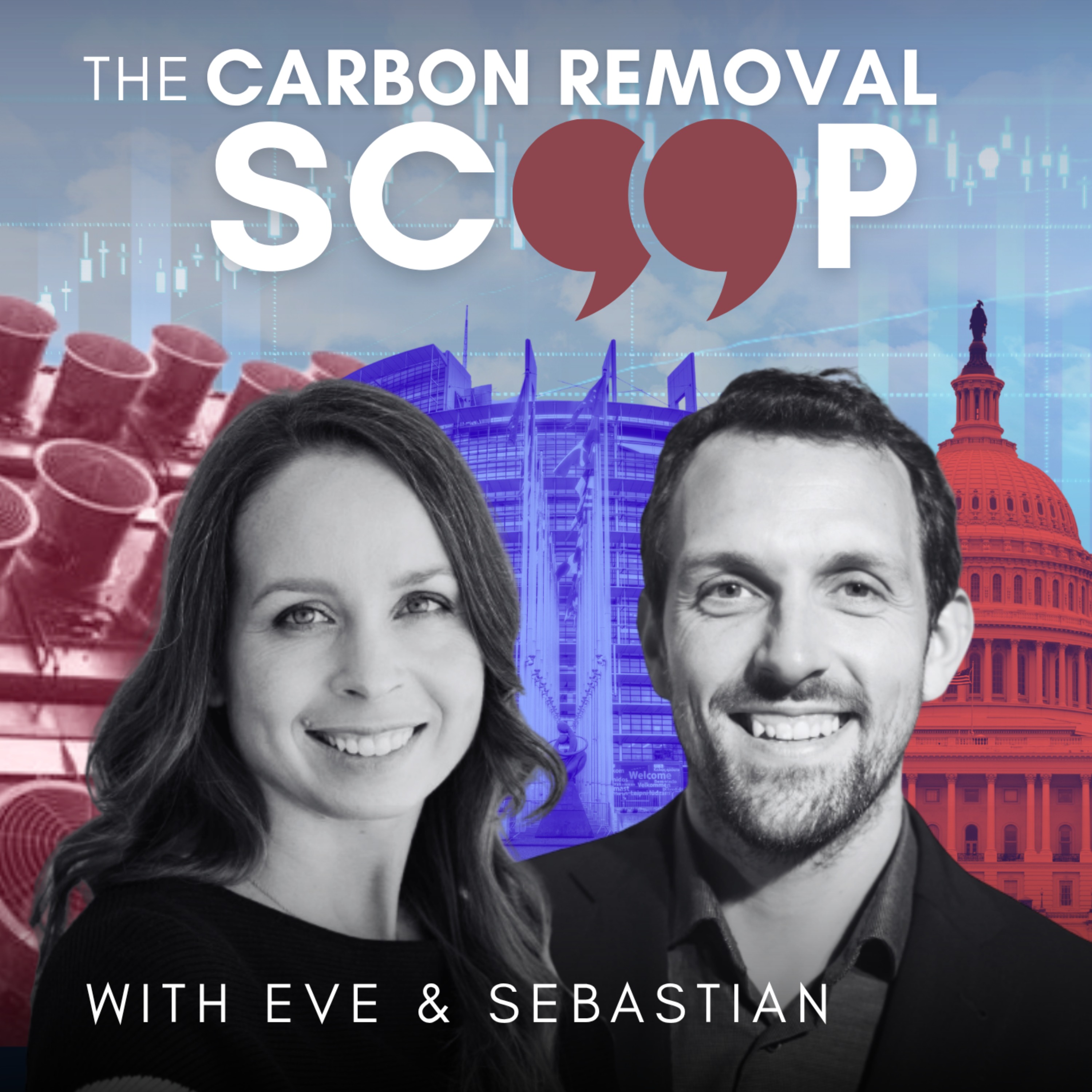
Artwork for The Carbon Removal Scoop
GovernmentTechnologyScienceEarth Sciences

The Carbon Removal Scoop

Eve Tamme and Sebastian Manhart

Get the Scoop on the latest carbon removal developments across policy, markets, and tech with Eve Tamme and Sebastian Manhart.


Punchy, unfiltered, to the point discussions on all the hottest developments in the sector.


Listen in to go several levels deeper and beyond the analysis that you won't find anywhere else. Enjoy.


Hosted on Acast. See acast.com/privacy for more information.

Play
  • 28 episodes
  • weekly
  • Avg 33 min
  • English
Counted on this page — what you have heard stays on this device, so it is not something the list can be paged by.
  • S1 · E101
    Sunday · 27 min

    Quarterly catch up: ETS Review, Buyers Coalition, and current VCM Dynamics

    In this quarterly catch up, Eve Tamme and Sebastian Manhart swap the guest chair for each other and look back at three busy months in carbon removal policy, with a few disagreements along the way. They start with the EU ETS review and the joint statement from Europe's five CDR associations, which Sebastian helped coordinate. He shares some of the background scoop on where the associations lined up and where they didn't, from biochar and the link to the Carbon Removal Certification Framework to whether international credits belong in the ETS at all. Eve draws on her experience of the last time international credits entered the system, and Sebastian previews his first academic paper on what a credible international credit portfolio might actually cost. Then comes the bigger question: is Europe putting all its eggs in the BioCCS basket, or is it six baskets? Sebastian worries that newer and potentially cheaper approaches are being left behind, while Eve makes the case for backing the projects that can deliver at scale now, and pushes back on the idea that all of Europe's CO2 is heading to the North Sea. They close with a reality check on the EU buyers coalition, where the usual optimist and sceptic swap roles, slow progress on durable removals under Article 6.4, and why the headlines out of New York Climate Week may not tell the whole story for carbon removal finance. LINKS: Eve Tamme: LinkedIn and Website Sebastian Manhart: LinkedIn and Website Joint statement from five CDR associations on the EU ETS review Mapping conflicts in carbon removal narratives (Prütz et al., Nature portfolio) MEP Emma Wiesner: Let EU ETS Operators buy CDR Directly Sebastian's preprint on international credit portfolios Hosted on Acast. See acast.com/privacy for more information.

  • S1 · E100
    Wednesday · 30 min

    The Minister Betting Big on Biochar - with Minister Chi-ming Peng

    In this episode of The Carbon Removal Scoop, Eve Tamme and Sebastian Manhart sit down with Chi-ming Peng, Taiwan's Minister of Environment, shortly after he set a target that put Taiwan on the carbon removal map: one million tons of biochar carbon removal by 2030. A meteorologist and entrepreneur before he entered government, Minister Peng explains where the target came from, starting with a simple question to his team about who was responsible for biochar, and the discovery that nobody had yet submitted a carbon credit methodology for it. The pressure behind the target is hard to miss. Taiwan sits at the centre of the global AI supply chain, and its semiconductor giants will need carbon credits at a scale that expensive engineered removals cannot yet supply. With a carbon fee already in place and an emissions trading system on the way, Minister Peng makes the case that biochar is the pathway Taiwan can move on now, and explains why he is looking so closely at Europe's CRCF, the Buyers' Club and the EU ETS. Eve and Sebastian press him on the hard parts. Where will the feedstock come from, given five million tons of agricultural waste a year that mostly heads to incinerators? Why is importing more such a tough sell, with public resistance and the Basel Convention in the way? And how does a country that cannot attend COP as a party still plan to trade carbon credits under Article 6.2, with Paraguay first in line? They close on the next six to twelve months: the machines, the money, and the methodology still to be locked down before Taiwan's number can move from ambition to actual credits. Whether biochar becomes part of Taiwan's answer to a semiconductor industry's carbon problem, or another target that outruns the paperwork, is the question worth watching from here. LINKS Eve Tamme: LinkedIn and Website Sebastian Manhart: LinkedIn and Website Minister Chi-ming Peng: LinkedIn and Facebook Ministry of Environment, Taiwan Taiwan and Paraguay sign MOU on carbon credit cooperation under the Paris Agreement Hosted on Acast. See acast.com/privacy for more information.

  • S1 · E99
    September 29 · 30 min

    MEP Emma Wiesner: Let EU ETS Operators buy CDR Directly

    In this episode of The CDR Policy Scoop, Eve Tamme and Sebastian Manhart sit down with Emma Wiesner, Renew Europe's shadow rapporteur on the EU ETS review, as she finalises her amendments to the Commission's proposal to bring carbon removals into the EU Emissions Trading System. Emma is an energy systems engineer who sits on the European Parliament's ENVI and ITRE committees and substitutes in AGRI committee. She pushed for a market for negative emissions in the last ETS revision, and says seeing it finally proposed gave her goosebumps. Her biggest ask is that the Commission should not be the only buyer. Emma wants ETS installations to be able to buy removals directly instead of allowances, with those purchases counted within the overall 250 megaton cap, creating a business to business market she argues would be far more dynamic than waiting on a central purchasing facility. Eve and Sebastian test the idea against Peter Liese's scepticism, the cost gap between removals and EU allowances, and whether every installation should get the same access. On quality, Emma is firm: the CRCF separated permanent from temporary removals for a reason, and the ETS should build on it. Biochar is not ready today, she says, though the door should stay open. On international credits she is openly reluctant, pointing to Sweden's e-scooters in Ghana as a cautionary tale and making a moral case for Europe doing its homework at home. The conversation closes on what should happen to unused CDR allowances, when purchasing should start, and the childhood landfill visit that sparked Emma's passion for combined heat and power and BECCS. LINKS Eve Tamme: LinkedIn and Website Sebastian Manhart: LinkedIn and Website Emma Wiesner: LinkedIn and European Parliament profile EU ETS revision proposal MEP Peter Liese: the Rapporteur's take on removals in the EU ETS Hosted on Acast. See acast.com/privacy for more information.

  • S1 · E98
    September 16 · 29 min

    Live From Brussels: The Carbon Removal Policy Summit - with Rodica Avornic

    In this episode of The CDR Policy Scoop, Eve Tamme and Sebastian Manhart record live from Brussels across two days at Carbon Gap's first Carbon Removal Policy Summit, sitting down partway through with Rodica Avornic, Policy Director at Carbon Gap and one of the summit's organisers. Eve and Sebastian open by previewing a programme built around four levels of governance: international, EU, national, and local. They come away most struck by Carbon Gap's own contributions, a policy levers library cataloguing more than 165 tools and a forthcoming book, The Foundations of Carbon Removal. They also dig into the EU Buyers Club's rebrand as the EU Buyers Coalition and the ambition to use it as a test ground for a future ETS purchasing facility. Rodica joins to reflect on the summit's turnout before turning to what worries her about the post-2030 landscape. She notes that the ETS covers only 40 percent of EU emissions, leaving the other 60 percent an open question, and argues that the EU's ten year policy cycles push carbon removal thinking toward short term wins. She also calls for stronger guardrails, given that the CRCF was designed for the voluntary market rather than a compliance scheme. The episode closes with Eve and Sebastian's own summary of the day: a recurring tension over whether standards should match across governance levels, the unresolved gap between national inventories and CRCF issued credits, and Achim Steiner's warning that carbon removal remains concentrated in too few countries, buyers, and technologies. LINKS Eve Tamme: LinkedIn and Website Sebastian Manhart: LinkedIn and Website Rodica Avornic: LinkedIn Carbon Gap: Policy Levers Library Carbon Gap: Foundations of Carbon Removal. A practical reference for policy, markets and implementation Eve Tamme and Paul Zakkour: Will the Carbon Removal Certification Framework count in the race to climate neutrality? Hosted on Acast. See acast.com/privacy for more information.

  • S1 · E97
    September 8 · 28 min

    MEP Peter Liese: the Rapporteur's take on removals in the EU ETS

    In this episode of The CDR Policy Scoop, Eve Tamme and Sebastian Manhart sit down with Dr. Peter Liese, the German MEP steering Parliament's response to the Commission's July 2026 proposal to revise the EU ETS, and the show's first sitting MEP guest. Liese kept the pen on the file just days earlier, when the ENVI committee rejected a bid to remove him as rapporteur, and this conversation lands in the window before his own draft report becomes public on 11 September, two days after this episode releases. Liese argues Parliament should go further than the Commission's text on almost every count. He wants no ceiling on how many removals the scheme can buy, reasoning that if costs keep falling the way they did for solar, an artificial cap makes little sense, and he wants biochar added alongside the currently eligible DACCS and BECCS, likely capped near a fifth of the volume so most support still flows to the two technologies already in the text. On the price gap flagged by third party estimates, including one suggesting scaling removals could cost tens of billions of euros more than the Commission expects, Liese's answer is to add more allowances rather than let the target slip, and he is candid that a falling carbon price driven by cheap removals would be something to celebrate, not fear. He previews sharper numbers for the linear reduction factor than the Commission proposed, and sets out why he backs an indirect route for international credits while pushing for more predictability than the current review clause offers. He closes on the bigger picture: once the policy scaffolding is in place, he wants the market and the engineers to do the rest, confident that carbon removals can follow the same cost curve that made solar the cheapest form of electricity. With his own report due within days, this is the clearest picture yet of where Parliament's negotiating position is headed. LINKS Eve Tamme: LinkedIn and Website Sebastian Manhart: LinkedIn and Website Peter Liese: European Parliament profile and Website EU ETS revision proposal, European Commission, July 2026 Hosted on Acast. See acast.com/privacy for more information.

  • S1 · E96
    September 1 · 29 min

    What is really happening to DAC Hubs? - with Grant Faber

    Grant Faber, Head of Standards at Absolute Climate, joins Eve Tamme and Sebastian Manhart. Grant previously served as Director Capture Hubs program manager at the Department of Energy's Office of Fossil Energy and Carbon Management, and the conversation picks up on the widely circulated article he published mapping out exactly where the US DAC Hubs program stands today. Grant walks through why disbursement has stalled at roughly two and a half percent of the original three and a half billion dollars in funding. Much of the delay traces back to the lengthy contract negotiation process that follows every award announcement: milestones, budgets, environmental compliance, and cybersecurity plans all have to be finalized before a dollar moves, a process that consumed nearly his entire tenure at DOE before the change in administration froze everything. The conversation turns candid on the terminations that followed. Grant explains why the cancellations fell disproportionately along party lines, and reveals that DOE itself admitted in court that projects were chosen for termination on a purely political basis. He also recounts his own experience of being caught up in the so called Valentine's Day massacre, locked out of his systems weeks after the inauguration. Grant closes by breaking down what remains: a billion dollars reprogrammed to nuclear funding and one point three billion still sitting unobligated, and offers his sharpest advice for policymakers elsewhere, move quickly, build coalitions across the political spectrum, and design funding to land in every state, not just the ones that already agree with you. Links: Eve Tamme: LinkedIn and Website Sebastian Manhart: LinkedIn and Website Grant Faber: LinkedIn Absolute Climate The Status of DOE's $3.5 Billion Regional Direct Air Capture Hubs Program DOE Alumni Network Grant's directory, A list of every direct air capture company in the world Grant's directory, A list of every carbon dioxide removal company in the world: USA Spending, the federal spending database referenced for DAC Hubs obligation and outlay data: Hosted on Acast. See acast.com/privacy for more information.

  • S1 · E95
    August 23 · 37 min

    What Does CDR Actually Cost in Europe? - with Hansjörg Lerchenmüller and Eadbhard Pernot

    In this episode of The CDR Policy Scoop, Eve Tamme and Sebastian Manhart dig into the cost assumptions behind the European Commission's EU Emissions Trading System review proposal, a month after the impact assessment first set out what BioCCS, DACCS, and biochar carbon removal are actually expected to cost between now and 2040. Sebastian has spent the past weeks tracing where those numbers come from, and brings in Hansjorg Lerchenmuller, Chairman of Biochar Europe, and Eadbhard Pernot, Executive Director of Carbon Management Europe, to stress test the modelling against real project economics. The picture that emerges is one of a forecast built on remarkably thin foundations. All the Commission's numbers trace back to just four sources, and because the medium scenario is simply an average of a low and a high estimate, a single shaky assumption can drag the whole range off course. For BioCCS, that means a low cost calibrated against an unverifiable 2022 conference remark and a transport and storage figure of just 38 euros a ton that barely holds up against real infrastructure costs. DACCS fares little better, with the entire range resting on a single McKinsey report whose underlying assumptions were never published. Biochar gets the most detailed correction. Hansjorg lays out where the European industry actually stands, more than 235 plants and a real scalable price closer to 175 to 200 euros a ton, well above what the Commission's own modelling implies. The conversation closes on a shared plea: better data, more transparency about assumptions, and more developers willing to submit real transaction numbers before the next round of forecasts gets built. Links: Eve Tamme: LinkedIn and Website Sebastian Manhart: LinkedIn and Website Hansjorg Lerchenmuller: LinkedIn Eadbhard Pernot: LinkedIn and Carbon Management Europe Sebastian Manharts’ Why the BioCCS costs in the ETS proposal simply don't add up McKinsey’s Carbon removals: How to scale a new gigaton industry European Biochar Market Report, 5th edition CDR.fyi Hosted on Acast. See acast.com/privacy for more information.

  • S1 · E94
    August 17 · 27 min

    Article 6 Letters of Authorisation Explained - with Lisa DeMarco

    In this episode of The CDR Policy Scoop, Eve Tamme and Sebastian Manhart sit down with Lisa DeMarco to unpack the legal machinery behind Article 6 of the Paris Agreement. A letter of authorization is an enforceable contract by which a host government permits a project to export a piece of its own climate progress. Lisa explains that it only counts as genuine under Article 6 if it conforms exactly to the minimum requirements set out in Article 6.2 or 6.4. She warns that letters of approval, acknowledgement, or no objection are routinely confused in the market, and points listeners to the model LOA forms she helped develop with the World Bank. The conversation turns to the KOKO cookstove project in Kenya, where two government entities each argued they lacked the authority to issue the LOA, leaving no party accountable when the project collapsed. Lisa breaks down the three part diligence host governments should complete before signing an LOA: confirming which branch of the state actually holds authority, checking the export will not take the country off track from its NDC, and reviewing domestic constitutional questions around trading natural resources. Lisa and the hosts also dig into revocation, distinguishing between a government's right to revoke a bad actor's authorization and the far more consequential question of retroactively cancelling units that have already changed hands, something she compares to printing a dollar bill and tearing it up. On corresponding adjustments, she lays out exactly when they are legally required by law and when not. However, even when projects don’t require corresponding adjustment, arranging a letter of acknowledgement from the government is crucial. They close by sizing up the market: roughly thirty five Article 6 projects have been authorized since the start of 2025, worth about one hundred million credits combined, against a European Union that alone could need hundreds of millions of credits by 2040. LINKS Eve Tamme: LinkedIn and Website Sebastian Manhart: LinkedIn and Website Lisa DeMarco: LinkedIn and Resilient LLP World Bank: Letter of Authorization and Acknowledgement (incl templates) IETA Article 6 Project Directory Paris Agreement Article 6 Implementation Partnership Hosted on Acast. See acast.com/privacy for more information.

  • S1 · E93
    August 9 · 38 min

    Is Enhanced Rock Weathering Ready for Scale? - with Dirk Paessler and Mel Murphy

    In this episode of The CDR Policy Scoop, Sebastian Manhart and Eve Tamme are joined by Mel Murphy, an independent geochemistry consultant, and Dirk Paessler, founder and CEO of Carbon Drawdown Initiative and Vice President of the Negative Emissions Platform, for a very special episode on how anyone actually knows enhanced rock weathering is working. Mel explains the two dominant measurement approaches, solid phase and aqueous pore water, and why they often tell different stories about the same field. Dirk brings the view from Carbon Drawdown Initiative's own experiments: a field trial with no measurable signal, buried buckets that still show nothing after 1400 days, and a greenhouse programme now running hundreds of soil and rock combinations. The pattern that keeps surfacing is that results depend on the specific rock, soil, and method used. That uncertainty has not stopped the market. Over 20,000 credits have been certified across Brazil, the US, and India, even as Vera has declined to build a methodology, citing immature science. Mel unpacks Carbon Plan's critique of credits from the US company Lithos, where an implied dissolution rate came out roughly ten times higher than a new peer reviewed estimate, and how registries like Isometric are adjusting requirements accordingly. The conversation closes on cost. Measurement now eats up 56 percent of enhanced rock weathering's budget, the highest share of any removal method. Dirk and Mel discuss whether machine learning trained on greenhouse data and satellite based field mapping can bring that down, and why neither will commit to a timeline for readiness under something like the EU ETS. Show notes: Eve Tamme: LinkedIn and Website Sebastian Manhart: LinkedIn and Website Mel Murphy: LinkedIn Dirk Paessler: LinkedIn and Carbon Drawdown Initiative Questions about Lithos’ first ERW credit issuance An Ecosystem of Carbon Dioxide Removal Reviews – Part 3: Enhanced Weathering MRV Proxies for EW? A Guided Tour Through Our Data From Our Two-Year Greenhouse Experiment Portfolio Spotlight: AEROC — Giving Enhanced Rock Weathering Its Eyes Where does the CO₂-removal potential of enhanced weathering actually go? Hosted on Acast. See acast.com/privacy for more information.

  • S1 · E92
    August 2 · 28 min

    Inside the Framework for Residual Emissions - with Injy Johnstone

    In this episode of The CDR Policy Scoop, Eve Tamme and Sebastian Manhart sit down with Dr. Injy Johnstone, Senior Research Fellow at the Max Planck Net Zero Lab, to unpack her new report, What Are Residual Emissions, which tries to bring clarity to one of climate policy's most used and least defined terms. Johnstone explains why, more than a decade after the term entered use, there is still no shared definition. The IPCC modeling community that coined it works from different inputs than a corporate net zero team, and the timeline question, today's technology versus a 2050 horizon, changes the answer. She also draws a distinction the sector often blurs: hard to abate describes a technological limit, while residual emissions is a broader, more normative category shaped by choices about demand reduction and regulation. The conversation turns practical as Johnstone breaks residual emissions into near, medium and long term buckets that corporates and governments can plan against. Sebastian presses on the middle bucket, where overly optimistic assumptions about future technology can quietly reduce carbon removal investment today. Johnstone and Eve also test the new SBTi and ISO standards released since the report's publication. They close on equity: who decides an industry keeps its social license to keep emitting, and who absorbs the trade offs within a finite carbon budget. Johnstone argues these normative choices are already being made, whether admitted or not, and surfacing them is the first step toward distributing that cost fairly. Links: Eve Tamme: LinkedIn and Website Sebastian Manhart: LinkedIn and Website Injy Johnstone: LinkedIn "What Are Residual Emissions” Report Hosted on Acast. See acast.com/privacy for more information.

  • S1 · E91
    July 27 · 26 min

    The EU ETS Proposal: the Scoop’s Debrief

    In this episode of The CDR Policy Scoop, Eve Tamme and Sebastian Manhart follow up on their interview with Mette Quinn to hash out their own read of Brussels' proposal to fold carbon removals into the EU ETS, and they don't agree on much. Is this really a "compliance market," or a purchasing programme that happens to sit on the ETS cap? Eve and Sebastian take opposing sides, and the answer matters more than semantics: it shapes how the whole mechanism should be judged. The cost assumptions get the roughest treatment. Sebastian has spent the past week stress-testing the BioCCS and DAC numbers behind the impact assessment, and he's not convinced. The transport and storage figures look wildly optimistic against what he's hearing from Europe's biggest BioCCS developers off the record. Biochar comes off worse still: favourably discussed in the impact assessment, then dropped entirely from the actual proposal, with nature-based solutions getting an explicit review clause that biochar never received. Timing is the other flashpoint. A 250 million ton removals commitment sounds decisive, until you line it up against a 48 million ton auctioning target for 2039 and realise the years don't match. Add in unresolved questions about who eats the risk on non-delivered offtakes or a shifting carbon price, and the "who pays" question stops being hypothetical. They close on supply: will a demand signal alone be enough to pull removals out of the Global South, or will an undersupplied market let developers simply triage toward whoever pays most? Robert Höglund's observation that this may be the first major EU proposal to treat permanent removals as functionally equivalent to reductions gets a nod too, a precedent Eve and Sebastian both think could ripple well beyond the ETS. Show notes: Eve Tamme: LinkedIn and Website Sebastian Manhart: LinkedIn and Website Removals Enters the EU ETS — with Mette Quinn EU ETS revision proposal Hosted on Acast. See acast.com/privacy for more information.

  • S1 · E90
    July 22 · 26 min

    Removals Enter the EU ETS: What Brussels Actually Proposes - with Mette Quinn

    In this episode of The CDR Policy Scoop, Eve Tamme and Sebastian Manhart sit down with Mette Quinn, Deputy Director for Carbon Markets and Clean Mobility at the European Commission, days after Brussels published its proposal to fold carbon removals into the EU Emissions Trading System. Quinn confirms the number the sector has been debating since Friday: a commitment to buy 250 million tons of permanent, domestically produced removals through BioCCS and direct air capture, funded by auctioning matching allowances plus a top up reserve, with a review clause for 2034 if the volumes do not materialize. Eve and Sebastian press Quinn on the mechanics behind that figure, from the price gap between today's BioCCS costs and the EU allowance price, to whether national subsidies were built into the Commission's cost modeling, which Quinn confirms they were not. They also test the supply pipeline: Quinn's own estimate of close to 48 million tons by 2040 sits close to Eve's independent projection, though still short of the full 250 million target. The conversation covers how the scheme will work for project developers, including the paid on delivery model Quinn says the Commission is exploring softening through prepayment and Innovation and Modernization Fund financing, and the proposal's heavy reliance on BioCCS while direct air capture remains less cost competitive. Quinn is candid that no other technology pathway is currently envisaged, though the Carbon Removal Certification Framework leaves room for that to change. Quinn closes by drawing a sharp line between domestic removals, where funding is committed now with a 2034 review, and international credits, where a 2033 assessment will decide whether purchases continue at all, a distinction she ties to environmental integrity and the Commission's confidence in each pathway. Links Eve Tamme: LinkedIn and Website Sebastian Manhart: LinkedIn and Website Mette Quinn: LinkedIn EU ETS revision proposal Hosted on Acast. See acast.com/privacy for more information.

  • S1 · E89
    July 15 · 31 min

    Inside the Fight to Save $600 Million for DAC - with Vikrum Aiyer

    In this episode of The CDR Policy Scoop, Sebastian Manhart sits down solo with Vikrum Aiyer, Head of Global Energy and Policy and Climate Policy and External Affairs at Heirloom, to trace the last eighteen months of US carbon removal policy. It starts with a survival story: Heirloom and partner Climeworks were awarded roughly 600 million dollars for a Louisiana direct air capture hub under the bipartisan infrastructure law, funding that looked shaky the moment the Trump administration began reviewing Biden era spending. Vikrum explains how a coalition of economic development groups, workforce organizations, and elected officials kept the project alive by leading with jobs, exports, and energy security rather than climate targets. The conversation turns to 45Q, the tax credit that pays up to 180 dollars per ton for durable removal. Vikrum details how a shift in EPA greenhouse gas reporting policy left the credit's verification framework in a temporary gap, with a Treasury safe harbor expiring and a new reporting structure still being negotiated alongside the Carbon Capture Coalition and industry peers. He credits the One Big Beautiful Bill Act with not just protecting 45Q but expanding its reach across more carbon management pathways. Sebastian and Vikrum close on California, where the state's cap and trade extension folded in an 85 million dollar annual pot for decarbonization technologies, including CDR, and wrote CDR integration into statute for the first time. Vikrum lays out the live debate over whether emitters should invest directly in removal project capex or whether those dollars should flow to communities instead, and argues the market needs both credit purchases and direct investment to hit the scale carbon removal requires. Links Sebastian Manhart: LinkedIn and Website Vikrum Aiyer: LinkedIn Heirloom: Website Hosted on Acast. See acast.com/privacy for more information.

  • S1 · E88
    July 12 · 28 min

    Buffer Pools Aren't Enough: The Case for Contracted Durability - with Luke Pritchard

    In this episode, Eve Tamme digs into contracted durability with Luke Pritchard, Director at Beyond Alliance, a coalition of major carbon dioxide removal buyers. Last month, Beyond Alliance published a white paper with RMI and the American Forest Foundation, developed with input from both engineered and nature based CDR developers, setting out what contracted durability could look like and how it fits into the wider policy landscape. The conversation opens on why durability has stayed unresolved for so long. Luke explains that setting the threshold too low leaves open questions about who holds liability after the monitoring period ends, while setting it too high, without a mechanism like a permanence trust or horizontal stacking, locks nature based solutions out of the market entirely. Buffer pools and insurance, he argues, were never built to guarantee the long duration outcomes that durability requires on their own. Eve and Luke get into what a permanence trust would actually cost, with Luke citing anecdotal buyer estimates of around 15 percent on top of the credit price, and the tension this creates: cheaper nature based credits paired with contracted durability could pull demand away from engineered removals unless separate price support policy exists. They also map contracted durability against the live policy moments where it could land next, from the Paris Agreement Crediting Mechanism and California's SB 905 process to the EU, SBTi's Net Zero Standard, and ICVCM's continuous improvement work. The episode closes with a premortem: Luke's biggest worry is undercapitalization, a permanence trust that takes in too little up front, misjudges reversal risk, and runs out of money when it is needed most. Links Eve Tamme: LinkedIn and Website Luke Pritchard: LinkedIn Contracted Durability: A Framework for Performance Based Carbon Removal by Beyond Alliance, RMI, and American Forest Foundation. Hosted on Acast. See acast.com/privacy for more information.

  • S1 · E87
    July 6 · 29 min

    Getting CDR Right in the EU ETS: What's at Stake - with Francesca Battersby and Louis Uzor

    In this episode, Eve Tamme sits down with Carbon Gap’s ETS experts, Francesca Battesby and Louis Uzor ahead of the European Commission’s ETS proposal, expected on 17 July. CDR is about to gain access to the world’s biggest compliance market for carbon, and this conversation lays out what is actually at stake. The discussion opens on the integration model: a public authority managing CDR procurement, or covered entities acting on their own. Francesca and Louis explain why a public authority could bring mandate and long term credibility, and they unpack the open question of credit vintage, including whether pre-2031 activity could be grandfathered in. From there the conversation turns to where CDR sits relative to the ETS cap, and why Carbon Gap favours staying below the cap for now. They also tackle the price gap between DAC and BioCCS and EU allowances, pointing to the UK’s combined CfD and ETS model as a possible blueprint. The episode closes on the numbers that will decide whether integration is meaningful: the Commission’s 75 megaton estimate for 2040, Isometric’s higher 100 megaton suggestion, and Carbon Gap’s own analysis of CDR’s share of ETS emissions. Francesca and Louis flag what to watch for on 17 July, from biochar and enhanced weathering to the EU’s 90 percent domestic reduction ambition. Links: Eve Tamme: LinkedIn and Website Francesca Battersby: LinkedIn Louis Uzor: LinkedIn Carbon Gap, “Integrating CDR into the EU ETS” (June 2025) Carbon Gap, “Divide to Deliver” The State of Carbon Dioxide Removal, 3rd Edition (2026) UK Government consultation, “Extending the UK ETS cap beyond 2030” Hosted on Acast. See acast.com/privacy for more information.

  • S1 · E86
    July 5 · 28 min

    Quarterly Catch Up: National CDR Targets, ETS Integration, and Who Pays for Removals

    In this episode of The CDR Policy Scoop, Sebastian Manhart and Eve Tamme sit down for their second quarterly, unscripted catch-up of the year, working through what is actually moving in CDR policy right now with no guest in the mix, just two co-hosts comparing notes. The conversation opens on the member state CDR targets expected by the end of the year and why a patchwork of twenty seven national targets could be a net positive for the sector, forcing a wider range of technologies and approaches into play rather than funneling everyone toward the EU ETS. From there they turn to the ETS integration itself, unpacking a Potsdam Institute modeling exercise on how CDR volumes between forty and eighty megatons a year by twenty forty could stabilize carbon prices, and Sebastian previews a new peer reviewed paper on using ETS revenue to front load investment into removals through European Investment Bank bonds. They then dig into aviation, a sector Sebastian and Eve agree the CDR community has been too quiet on. The ReFuelEU Aviation review looks unlikely to open the door to removals, and the two make the case for a coordinated push before the window closes. That leads into CORSIA, where enforcement turns out to be far weaker and far more geographically uneven than either expected, and where Sebastian argues the real opportunity may lie with nature based removals rather than durable ones. The episode closes on Article 6.4 as the presumed foundation for future international credit quality criteria despite still-undefined removal methodologies, and on Norway's new NOACCS auction scheme, a sizable but narrowly targeted funding mechanism that raises questions about how well governments are learning from each other's programs. Links Eve Tamme: LinkedIn and Website Sebastian Manhart: LinkedIn and Website Ariadne dossier (Potsdam Institute) on CDR integration into the EU ETS How Frontloaded ETS Revenues Can Close Europe’s Durable CDR Gap NOACCS, a competitive auction scheme consultation on the scheme is now open until August 6th Hosted on Acast. See acast.com/privacy for more information.

  • S1 · E85
    June 30 · 27 min

    ISO, SBTi, and the LCAW Verdict on Corporate Net Zero - with Kaya Axelsson

    In this episode of The CDR Policy Scoop, Sebastian Manhart and Eve Tamme are joined by Kaya Axelsson, Research and Policy Fellow at Oxford Net Zero, just days after what she describes as the most anticipated Monday of her year: June 22, when both the ISO Net Zero Standard and the SBTi Corporate Net Zero Standard launched at London Climate Action Week. Kaya spent three years inside both standard-setting processes, and the conversation captures what this convergence moment actually means for companies, for carbon markets, and for carbon removal. The episode opens on what Kaya calls the single global playbook. Her case: the two standards don't fundamentally contradict each other. ISO is wider in scope, internationally governed via WTO-compatible processes, and a natural tool for trade policy, green public procurement, and claims legislation, particularly in markets across Africa and Asia that SBTi has yet to reach. SBTi brings detailed near-term implementation guidance and the momentum of eleven thousand companies already signed up. Kaya explains how she sees companies using them together and what each does better than the other. But she is not without concerns. The episode surfaces a significant one: a potential communication error in the SBTi standard that risks allowing companies to claim net zero alignment without ever setting a long-term net zero target. For CDR, the implications are direct. SBTi's decision not to require removals purchases before 2035 is, in Kaya's view, a cost-based rather than science-based call, and a missed opportunity to start scaling the supply of what companies will eventually need. ISO, by contrast, requires five-year removal milestones from the outset. The conversation closes on what comes next: the governance of commodity certificates such as green steel, SAF, cement, which both standards now actively encourage companies to purchase. Kaya predicts this will be the defining debate at the next London Climate Action Week, and explains why getting the governance architecture right matters as much as the demand signal itself. Links Eve Tamme: LinkedIn and Website Sebastian Manhart: LinkedIn and Website Kaya Axelsson: LinkedIn and Website ISO Net Zero Standard SBTi Corporate Net Zero Standard Robert Höglund & Claire Wigg’s: Exponential Roadmap InitiativeBuild the world your net zero target assumes Hosted on Acast. See acast.com/privacy for more information.

  • S1 · E84
    June 18 · 30 min

    Inside the ISO Net Zero Standard - with Delia Meth-Cohn

    In this episode of The CDR Policy Scoop, Sebastian Manhart sits down with Delia Meth-Cohn, Co-founder of Rethinking Removals, who has been part of the ISO Net Zero Aligned Organization Standard working group from its very first meeting, two years ago. The conversation opens on why Delia got involved, recruited by the British Standards Institute to make sure removals expertise was in the room from the start. She explains what makes ISO structurally different from SBTi: where SBTi is a voluntary framework for leading, self-selecting companies, ISO is built to be globally applicable, rooted in national standards bodies and the WTO framework, and designed to accommodate countries with different net zero end dates, from Europe’s 2050 to China’s 2060 and Saudi Arabia’s 2070. The discussion gets to the heart of what the standard actually does on removals: it makes the implicit removals target in net zero frameworks explicit. Companies setting a long-term reduction target must treat whatever remains as their “anticipated residual emissions”, and that figure becomes a removal target they are required to plan toward, with a validated first milestone within five years. Delia is clear that flexibility is intentional: the strategy can involve a portfolio of credits, removals within operations, or value chain approaches, so long as the trajectory is defensible and verified. Sebastian pushes on the question of ambition and comparability: can two companies with very different removal strategies both receive the same ISO certification? Delia acknowledges the tension and closes on a call to action: the standard is currently in public consultation, comments feed through national standards bodies into the final draft, and this is the CDR community’s real window to push back on anything that falls short. The final standard is expected by mid-2027. Links Sebastian Manhart: LinkedIn and Website Delia Meth-Cohn: LinkedIn and Rethinking Removals ISO Net Zero Aligned Organization Standard (public consultation) Hosted on Acast. See acast.com/privacy for more information.

  • S1 · E83
    June 17 · 29 min

    Green-Hushing, Safe Harbors, and Who Actually Owns a Carbon Credit - with Dr Ruth Dagan

    In this episode of The CDR Policy Scoop, Sebastian Manhart sits down with Dr. Ruth Dagan, Senior Partner and Head of Environment & Climate Change at Herzog Law, and Co-Chair of the IETA Legal Working Group, to cover two legal challenges that are quietly suppressing corporate demand for carbon credits. The first is litigation risk. Since 2022, climate washing claims have increased by seventy percent globally, with around 160 cases on the books and fifty-four relating specifically to carbon credit offsets. Apple's carbon neutral Watch campaign was lost in Germany and only tentatively won in the US. The upshot is that many companies are choosing to say nothing about their climate action at all. Ruth calls this green-hushing, and argues it is actively draining demand from the voluntary carbon market. The conversation covers the two regulatory responses now taking shape: the EU Empowering Consumers Directive, coming into force in September, which blacklists product-level carbon neutrality claims outright, and California's AB 1911, which proposes the opposite, a safe harbor that would actively protect companies using high-integrity credits. Ruth outlines the work being led by IETA and the Coalition to Grow Carbon Markets, now backed by eleven governments. The second challenge is more fundamental: most carbon credit registries, including PACM, include explicit disclaimers that they make no legal statement about who actually owns the credits in an account. Ruth explains how this came to be, what it means for institutional investment, and how the Unidroit project, due to conclude in early 2027, offers a route to resolution. Links Sebastian Manhart: LinkedIn and Website Dr. Ruth Dagan: LinkedIn and Profile Empowering Consumers Directive California AB 1911 Coalition to Grow Carbon Markets / IETA safe harbor report Grantham Institute Global Trends in Climate Change Litigation Hosted on Acast. See acast.com/privacy for more information.

  • S1 · E82
    June 14 · 25 min

    SBTi 2.0 Net Zero Standard: What It Actually Means for CDR - with Robert Höglund

    Guest: Robert Höglund, writer of Marginal Carbon, climate strategist at Milkywire, and co-founder of CDI FYI The Science Based Targets initiative has released its long-awaited Net Zero Standard, and Sebastian Manhart and Eve Tamme wasted no time pulling Robert Höglund, climate strategist at Milkywire, and co-founder of CDR.FYI back onto the show to work through what it actually means for CDR. The three begin with a verdict: mostly neutral. Better than the previous draft, some of the more damaging provisions are gone, but the standard falls short of what the CDR community had hoped for. With the key requirement for carbon removal pegged to 2035, the central question is whether anything meaningful happens in the nine years between now and then. The conversation works through the specific wins and losses. Corresponding adjustments are no longer a hard requirement, now encouraged and reported, which Robert and Eve both consider a workable compromise. The "like for like" principle survived. Scope 3 was included, which significantly raises the ceiling on potential CDR demand. But the standard leaves key questions unanswered: what emissions are companies actually supposed to counterbalance with CDR, their physical inventory or their residual after market measures? The answer, Robert notes, could be "quite controversial." The episode closes on what comes next: the call for evidence on short-lived removals, the incoming ISO standard, and a probable 2031 timeline for the next full version of the standard, leaving the industry to watch carefully what happens in the interim guidance documents that can still reshape how the standard is applied in practice. Links Eve Tamme: LinkedIn and Website Sebastian Manhart: LinkedIn and Website Robert Höglund: LinkedIn, Website and Substack SBTi Net Zero Standard Hosted on Acast. See acast.com/privacy for more information.

Showing 1–20 of 28 episodes