
Skip to content
Artwork for The Bureau Podcast
NewsPolitics

The Bureau Podcast

Sam Cooper

Investigative Journalism. Anti-Corruption. Counter-Disinformation. Whistleblowers. Sunlight. Connecting the dots on The Bureau's big stories with Sam Cooper and guests.

www.thebureau.news
Play
  • 20 episodes
  • Avg 55 min
  • English
  • August 22 · 1 hr 13 min

    China’s Shadow War for America’s Pacific Front Line — And Unanswered Questions Surrounding Sudden Death of a U.S. Territory Governor Fighting Corruption

    OTTAWA — In this episode, I sit down with Indo-Pacific researcher Cleo Paskal and frequent Bureau guest Chris Meyer to investigate a part of the world that rarely commands sustained Western attention — but could determine the outcome of the next global conflict. Paskal has testified repeatedly before the United States Congress and the U.S.-China Economic and Security Review Commission. A former journalist, she has spent years travelling through the Pacific’s smallest and most strategically important states. The path that drew her into this subject resembles my own in Vancouver. As a travel journalist, she watched patterns of Chinese investment advance rapidly across smaller states, year after year, until they formed the unmistakable outline of a larger strategic objective. Her research examines how Beijing combines political influence, commercial activity, organized crime and intelligence-linked networks to alter conditions on the ground without firing a shot. Paskal explains that maritime geography is leverage in this contest of great powers. Guam and the Commonwealth of the Northern Mariana Islands — including Saipan and Tinian — are U.S. territories. Palau, the Federated States of Micronesia and the Marshall Islands are independent nations linked to Washington through Compacts of Free Association. Together, they form an American-controlled corridor between Hawaii and the first island chain encompassing Japan, Taiwan and the Philippines. If war erupts over Taiwan, those islands become the logistical spine for moving American forces west. Paskal argues that Beijing understands their importance far better than Washington often appears to. Meyer, a former U.S. official and veteran China analyst, connects what he has found in Saipan to the casino-based money laundering, underground banking and political influence networks I documented in Wilful Blindness. His assessment is blunt: Beijing sends its “A team” into Micronesia, while Washington too often treats the region as an afterthought. Their investigation focuses in part on Imperial Pacific International, the spectacularly troubled Saipan casino venture. Paskal and Meyer examine its reported financial volumes, its Chinese state-connected construction contractor and allegations involving illegal labour, human trafficking, money laundering and public corruption. In congressional testimony, Governor Arnold Palacios described the casino era as being marked by precisely those problems. The episode also scrutinizes a special, CNMI-only immigration pathway that currently permits eligible, pre-screened Chinese visitors to enter the islands without a conventional visa for stays of up to 14 days. Critics fear that such access, combined with direct flights and uneven enforcement, creates vulnerabilities close to Guam’s military installations. The most sensitive part of our discussion concerns Palacios himself. After taking office in 2023, Palacios pressed federal agencies to examine public corruption and the handling of enormous amounts of American funding. In April 2025, he reportedly asked the territory’s congressional delegate to carry a request directly to FBI Director Kash Patel for “intensive investigations of public corruption,” saying his administration possessed considerable evidence. Three months later, Palacios collapsed in his office. He was flown to Guam and died that night at 69. Paskal says some people in the Northern Marianas remain deeply suspicious about the circumstances, including questions surrounding the medical response and whether his transfer was delayed. She does not claim to possess proof that Palacios was killed. But she argues that this uncertainty produces its own strategic effect: If an official challenges entrenched interests, dies suddenly, and the unanswered questions are never resolved, other officials may decide that speaking out is too dangerous. That, she says, is cognitive warfare — the shaping of behaviour through fear, doubt and the appearance that democratic institutions cannot protect those who defend them. The conversation then moves to the Marshall Islands, home to the critical U.S. missile-testing facility at Kwajalein and one of Taiwan’s remaining diplomatic partners. There, Cary Yan and Gina Zhou pleaded guilty in a U.S. federal case to conspiring to bribe Marshallese officials. Prosecutors said they sought legislation establishing a semi-autonomous zone on Rongelap Atoll, with relaxed tax and immigration rules that could benefit their commercial interests. Paskal sees that case as a warning. Corruption in a remote island legislature can become a matter of global security when the territory involved sits beside indispensable American military infrastructure. This is not a story about a conventional warfare. It is about strategic terrain being softened through money, access, intimidation and elite capture. From Saipan to the Marshall Islands, Paskal and Meyer argue that the laws already exist to confront much of this activity. What is missing is consistent enforcement — and the political recognition that defending these islands may be inseparable from preventing China’s aggression against Taiwan, and the West. The Bureau is a reader-supported publication. To receive new posts and support my work, consider becoming a free or paid subscriber. This is a public episode. If you'd like to discuss this with other subscribers or get access to bonus episodes, visit www.thebureau.news/subscribe

  • August 19 · 1 hr 4 min

    Ottawa Opens Probe Into NATO Intern Vetting, And Global Affairs Question Can’t Be Avoided

    OTTAWA — This week, MPs on the Standing Committee on Public Safety and National Security unanimously agreed to hold hearings this fall into Canada’s national-security clearance and vetting system. The probe follows the arrest of a Canadian intern who worked at NATO’s Supreme Headquarters Allied Powers Europe in Belgium. Belgian prosecutors have charged her with espionage on behalf of a third country and participation in a criminal organization. Reuters has reported, citing a security source, that she is accused of spying for China. Last week—before Parliament agreed to investigate—I conducted my own examination of the case with Jason James. We broke down the known knowns, the known unknowns and the probabilities behind the competing explanations. Was this simply an extraordinary series of bureaucratic failures? Or could a political-access network have helped move this woman through Canadian institutions despite warning signs? I also explained what a former senior CSIS officer told me about the likely vetting process—and why my source believes investigators should look closely at Global Affairs Canada. So, what happened here? We have a young woman who came to Canada from China, moved through universities and Canadian government institutions, and was ultimately sponsored by Global Affairs Canada for a sensitive position at NATO. Yet before that placement, she had submitted applications to the Canada Border Services Agency using different names and different universities. The Public Service Commission found that she committed fraud during that appointment process, and the Federal Court later dismissed her attempt to overturn that finding. To me, the young woman’s persistence in attempting to overturn the negative finding, in itself, seems interesting. Her case information wasn’t in some hidden intelligence intercept. It is sitting in the public record. So how did she get through? A former CSIS officer told me that CSIS would have conducted security vetting—and, in this officer’s assessment, it is likely the service produced a concerning red-flag report. CSIS is a capable intelligence agency. It works with the CIA and other top allied services. As I tell Jason, I find it very difficult to believe that CSIS simply missed problems that were visible through basic open-source research. My source told me it would make sense to look closely at GAC. That fits previous intelligence reporting indicating that Global Affairs has prioritized trade and diplomatic relations with countries such as China and India over security concerns—a longstanding source of friction with CSIS. So, could it be the case that CSIS raised red flags and Global Affairs Canada effectively said, Nothing to see here? I don’t know. That remains a theory, not a proven fact. But I believe it is a serious and plausible theory—and one investigators must test. That means examining the institutional environment around senior GAC figures, including Mélanie Joly and David Morrison. Since 2018, as I have reported, Joly has led or participated in Beijing trade-lobby engagement involving the Canada China Business Council and prominent Eastern Canadian business figures. My reporting has also traced meetings involving some of the same CCP-linked entities that appear around the Markham illegal-casino network and political fundraising circles. I am asking whether an institutional culture—one heavily invested in trade, access and renewed engagement with Beijing—could have caused legitimate security warnings to be minimized or overridden. That question becomes even more important because the woman reportedly listed Liberal campaign volunteering on her résumé and appeared at a Justin Trudeau fundraising-style event in 2014. Research from the Jamestown Foundation and leaked intelligence records describe how United Front Work Department networks cultivate Western politicians, establish bonds of obligation and promote favoured individuals for positions inside government. In my reporting, I have identified hundreds of Canadian community organizations connected to the CCP’s United Front system. The Jamestown reporting presents a blueprint: surround politicians across party lines, provide campaign and community support, develop access—and then advocate for selected people to receive positions inside government institutions. Importantly, we recorded this conversation before this week’s reporting on declassified FBI material concerning Fang Fang and Congressman Eric Swalwell. That material reportedly examined whether an alleged Ministry of State Security affiliate leveraged a campaign-donation network to help place interns inside Swalwell’s office. Even before that news surfaced, I told Jason that this is precisely the type of methodology the Jamestown Foundation says the United Front and Chinese intelligence services use in Western democracies. That does not prove the NATO case followed the same playbook. But it makes it a plausible hypothesis that demands serious investigation. Conservative national-security critic Dane Lloyd tied the NATO case to what he described as a broader pattern of security failures: “Yesterday Conservative members forced hearings this fall on Canada’s national security clearance vetting processes,” Lloyd posted to X. “This comes in the wake of troubling allegations involving a Canadian intern at NATO headquarters accused of espionage. “This isn’t an isolated incident and comes in the wake of several high-profile security failures. The minister of public safety needs to take responsibility and ensure the integrity of our national security clearance system.” The Bureau is a reader-supported publication. To receive new posts and support my work, consider becoming a free or paid subscriber. This is a public episode. If you'd like to discuss this with other subscribers or get access to bonus episodes, visit www.thebureau.news/subscribe

  • August 11 · 39 min

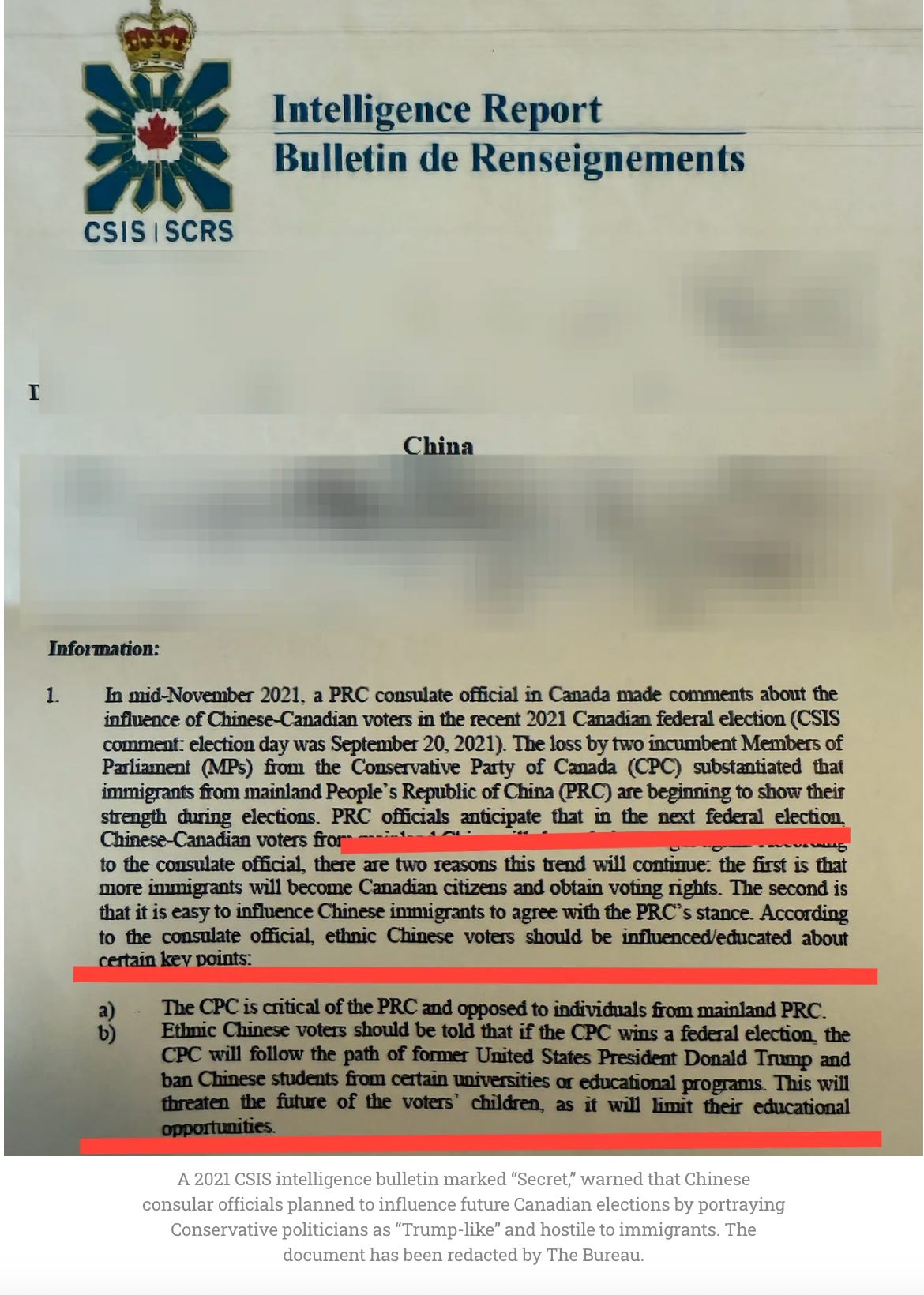
    The CCP Wants a Say in Who Leads Canadian Parties—and Has Worked Against O’Toole and Poilievre

    OTTAWA – I joined Brian Lilley for a wide-ranging conversation that started with the machinery of Beijing’s foreign influence in Canada and Conservative leadership politics, then moved into MP Larry Brock’s departure and Brian’s explosive scoop: Brock disclosed to his party leaders that Mark Carney’s party had dangled a judicial appointment before him amid Carney’s floor-crossing campaign. I started with the documentary record on Beijing’s 575 United Front Work Department community groups in Canada, including a group that pressured two successive party leaders to step down. Drawing on Jamestown Foundation research into Chinese Communist Party influence operations in Canada, I explained how these United Front organizations are tasked with targeting local politicians and community leaders, mobilizing voters behind candidates viewed as supportive of Beijing, and applying pressure to political parties and institutions. This isn’t about one political party, and it doesn’t require us to assume that any individual politician understands or acquiesces to Beijing’s community networks. The broader picture is roughly 575 organizations, or 576, counting the organization led by a Canadian senator and now confirmed to The Bureau as having Beijing links, operating in Canada within systems that Beijing can mobilize to surround politicians, shape political narratives and, ultimately, try to influence elections and leadership contests. Brian then gave a striking example from his own experience. The morning after Erin O’Toole lost the 2021 election, Brian received a cold call from a man he had never heard of—and who, Brian said, had no obvious reason to have his number. The message was simple. O’Toole had to go. Brian’s interpretation was equally clear. O’Toole had been hawkish on China from the beginning. Beijing disliked him and, in Brian’s view, wanted him removed. I added what Canadian intelligence reporting has shown. In my reporting, I described intelligence intercepts involving Chinese consular officials discussing the need to push a message through diaspora communities that electing a leader like O’Toole would be comparable to electing Donald Trump. That brought us to the current leadership question. A leadership vacancy creates an opportunity. Members can be signed up. Networks can be activated. A preferred candidate doesn’t have to be Beijing’s ideal candidate—just somewhat “less bad” from Beijing’s perspective. My reporting showed that a Chinese proxy agent, according to CSIS reporting I obtained exclusively, attempted to influence a federal party leadership contest in 2022 by paying for memberships, recruiting CCP members to join the party, and seeking to make it less hawkish toward Beijing. While CSIS did not name the Conservatives, my sources inside the party and within the diaspora pointed to a network that sought a leader other than Poilievre, I told Brian. I also told him that we know the Chinese Communist Party studies Western political systems and individual politicians in extraordinary detail. The objective, as I put it to Brian, is fairly simple: they are trying to win inside our system. From there, I turned the questions back on Brian. On party operative Kory Teneycke, I pressed Brian on speculation that Teneycke had been working back channels to encourage a Jason Kenney leadership bid. Then we got into Larry Brock. Brock’s departure, Brian said, has nothing to do with dissatisfaction with the Conservative leadership. Brock had been on leave from his position as a Crown prosecutor and faced a September deadline to make a permanent choice. The more significant disclosure involves what happened earlier this year. According to Brian, the Liberals dangled the possibility of a judicial appointment in front of Brock. Brock declined and immediately reported the matter to the Conservative whip and House leader. Brian’s assessment is that nobody crossed the legal threshold for an inducement. But he believes the Liberals should still have to answer for what happened—and that Brock should not be blamed for reporting it. We closed on two larger questions I’ve been looking at. The first is whether consulting firms and law firms—including firms employing former senior politicians—are increasingly being used as access points into Canadian political institutions. The second is what a decade of Liberal Party judicial appointments has done to public confidence in the courts. The Bureau is a reader-supported publication. To receive new posts and support my work, consider becoming a free or paid subscriber. This is a public episode. If you'd like to discuss this with other subscribers or get access to bonus episodes, visit www.thebureau.news/subscribe

  • July 23 · 53 min

    A Trucker and an Investigative Reporter, One Week Before the Punjabi Narco-Trucker Indictments Came Down

    OTTAWA — When Gord Magill asked me onto his podcast on July 1, I said yes for a reason I don't often get to act on. Magill is not commenting from a distance. He is a third-generation trucker who has driven the ice roads of northern Canada, the Australian outback and the American interstate system, and who wrote End of the Road: Inside the War on Truckers. When a practitioner who has spent thirty years in the cab wants to talk about how North American workers are getting squeezed out of a critical industry by immigration scams, or as I explain, how transnational organized crime has exploited our borders and vulnerable migrants to capture an essential economic tie between the U.S. and Canada, threaten our national security and sovereignty, and move cartel loads through the freight system, that is a conversation worth having, and worth sharing with readers of The Bureau. I asked him for the recording so I could post it here. What made the discussion unusual is that we came at the same machinery from opposite ends. I have spent years tracing how Chinese organized crime, the Mexican cartels and Canadian-based trafficking networks use commercial transportation corridors to move cocaine, methamphetamine, fentanyl precursors and laundered proceeds between China, Mexico, the United States and Canada — including the alleged use of Canada-based long-haul trucking companies in the Ryan Wedding investigation. Magill has watched the same corridors fill up from the driver’s seat: the exploitation of migrant drivers, the fraudulent licensing and recruitment pipelines, the unsafe carriers that vanish into a new limited liability company the moment enforcement catches up, and the economic pressure that makes a legitimate freight network easy for criminal groups to infiltrate. One exchange is worth marking now, in hindsight. Magill asked me why one community keeps surfacing in the border seizures, and I told him this was not a matter of “profiling” or tracking Punjabi origin names across a few Blue Water Bridge seizure news cycles. As I put it to him: “this is state level criminal intelligence I’m talking about.” I said it because I was already in discussions with people on both sides of the border about the saturation of Indian transnational crime groups into the long-haul trucking industry. The people I was talking to are well aware of the Trump administration‘s concerns with Canada’s vulnerabilities to border exploitation and fentanyl trafficking, and some have also asked for my knowledge on the topics, a bit of background I didn’t explain on air with Gord. That was July 1. Six days later, on July 7, the Justice Department unsealed Operation Hard Ball: three indictments, twenty-four arrests across the United States, Canada and Europe, and India-based syndicates charged with racketeering, targeted killings, extortion and moving bulk cocaine and methamphetamine by long-haul semi-truck from the Los Angeles area to the Canadian border. The Bureau was describing the picture before it broke into public view. What those indictments do not reach, but United States agencies are certainly interested in, is the proliferation of fentanyl production labs across Canada that feed into the same Mexican cartel supply chain the long-haul mafia tapped for the cocaine and methamphetamine loads it ran out of California. When Gord asked me about that fentanyl pipeline, I briefly explained a story The Bureau has reported on, in which a Drug Enforcement Administration source met with an Indian gangster in Vancouver, and an alleged Chinese fentanyl supplier, who promised he could produce massive loads of fentanyl precursors shipped from China to Vancouver’s port, and ship them south from British Columbia to Los Angeles, using his trucking company, fronted by an Indian driver. The Bureau is a reader-supported publication. To receive new posts and support my work, consider becoming a free or paid subscriber. This is a public episode. If you'd like to discuss this with other subscribers or get access to bonus episodes, visit www.thebureau.news/subscribe

  • July 20 · 1 hr 6 min

    Are Taxpayers Being Asked to Launder Canada’s 'Vancouver Model' Housing Bubble?

    In this episode with Jason James, we revisit the Vancouver Model — the Chinese transnational money-laundering system that helped make Vancouver infamous around the world — and we connect that history to a live political question in Canada today. Because this is not just a story about casinos, luxury homes, or offshore capital. It is a story about how dirty money, political weakness, and a captured real estate economy can combine to distort an entire country. For years, I have reported on how money from China moved through underground banking networks, casinos, numbered companies, law offices, developers, and Canadian banks. In the simplest version of the Vancouver Model, corrupt officials, wealthy insiders, and organized crime figures used underground money brokers to move value out of China while avoiding capital controls. In Vancouver, that money could arrive as bags of cash, casino chips, bank drafts, real estate purchases, or mortgage-backed transactions that made little sense against local Canadian incomes. And over time, that money helped drive Vancouver and Toronto real estate into a fantasy economy. Jason and I talk through the Vancouver Model, the Toronto Model, mortgage fraud, underground banking, and the way Chinese money brokers became central players in global laundering systems used by cartels, traffickers, and corrupt elites. We also talk about what this has done to ordinary Canadians — especially in Vancouver — where an entire generation watched home ownership disappear while governments looked away, explained it away, or called legitimate questions divisive. And that brings us to Mark Carney’s condo bailout plan. Because now, after years of speculative building, offshore-driven pricing, and developers profiting from a market inflated far beyond local incomes, thousands of condo units are sitting unsold in Vancouver and Toronto. The official language is affordability. The promise is that governments can buy or support these unsold units and convert them into homes Canadians can afford. But my concern is much darker. If taxpayers are used to rescue developers from a market inflated by murky offshore money, then Canadians may not simply be funding housing policy. They may, in effect, be helping launder the consequences of that money. They may be taking assets whose values were boosted by capital flight, speculation, and questionable financial flows — and using public money to keep those values from falling back to earth. That is the question at the center of this episode. Are Canadians being asked to solve an affordability crisis? Or are they being asked to protect the paper value of a corrupted real estate system that helped create the crisis? We also discuss the political figures around this issue: David Eby, who once understood the role of dirty money in British Columbia real estate; Gregor Robertson, whose Vancouver mayoralty coincided with an enormous rise in housing prices and who is now federal housing minister; and Bob Rennie, the so-called condo king whose career has been deeply tied to Vancouver’s pre-sale condo economy and political fundraising circles. To be clear, this episode is not an allegation that any developer, buyer, or politician involved in Vancouver and Toronto real estate is corrupt. It is an argument that Canada has failed for decades to confront the financial ecosystem that allowed offshore money, organized crime, and political influence to reshape our largest housing markets. So the question is simple. Will taxpayers finally get a housing reset? Or will they be forced to bail out the same system that priced them out? The Bureau is a reader-supported publication. To receive new posts and support my work, consider becoming a free or paid subscriber. This is a public episode. If you'd like to discuss this with other subscribers or get access to bonus episodes, visit www.thebureau.news/subscribe

  • July 15 · 1 hr 3 min

    America Isn’t the Enemy: The Wrongful Dismissal Case Shaking Ottawa’s China Strategy

    I’m back with Jason James to discuss an explosive wrongful dismissal claim that I believe may get to the heart of Mark Carney’s pivot to Beijing — and to a larger question now facing Canada. Who is this government really listening to? The case involves Raquel Garbers, a senior Canadian defence policy specialist and military figure who, according to reporting on her legal claim, helped shape Canada’s Arctic and NORAD defence policy — the very architecture that binds Canadian and American security together against the real strategic threats facing North America. Those threats are easy to identify. They are China and Russia. But in Ottawa today, that obvious reality has become politically inconvenient. Garbers published an op-ed in The Hill Times warning that anti-American rhetoric from Canada was not strategic, not mature, and not in the national interest. In substance, she argued that Washington’s push to rebuild its industrial base, harden its alliances, and prepare for conflict in the Indo-Pacific or Arctic should not be treated as a hostile act against Canada. It should be understood as part of a larger Western response to authoritarian powers — especially China — that have spent years undermining democracies through trade, technology, espionage, political warfare, and economic leverage. Her warning was simple: Canada should stop shooting itself in the foot by treating America as the enemy. A few months later, she was out of her job. Garbers is now suing the Government of Canada, alleging wrongful dismissal. Her legal team argues she was punished for expressing a legitimate national security view — one that, in any serious Western democracy, should be part of open debate. If her claim is proven, the implications are enormous. Because this is not just a workplace dispute. It goes directly to the question Jason and I have been examining for months: why is the Carney government moving away from Washington while reopening the door to Beijing? During the election, Mark Carney rode the “elbows up” message, portraying himself as the leader who could stand up to Donald Trump and defend Canada from American pressure. But since taking office, that rhetoric has started to look less like patriotic realism and more like strategic misdirection. While Ottawa talks tough about Washington, it has also moved toward “re-engagement” with China — even as China remains the central hostile-state threat identified by Western intelligence agencies, allies, and dissidents. That is why the Garbers case matters. If a senior Canadian defence official can be removed after warning that anti-American rhetoric benefits China and Russia, what message does that send across Ottawa? What does it tell other bureaucrats, analysts, military planners, and intelligence professionals who may privately know that Canada’s current direction is dangerous? Her lawyer has suggested there is now a chill across the bureaucracy. That people are watching what happened to Garbers and asking whether they too could be punished for saying plainly that Canada’s alliance with the United States is not optional. It is the foundation of our defence, our economy, our continental security, and our ability to survive in a world being reshaped by Beijing, Moscow, Tehran, and transnational criminal networks. Jason and I also discuss how this fits into the broader Carney problem: Chinese electric vehicles, industrial policy, fentanyl-linked trade and money laundering networks, elite business interests tied to China, and the strange fantasy that Canada can somehow detach itself from the United States and drift into a new strategic relationship with Beijing. As Jason bluntly puts it, any Canadian leader that truly believes the northern half of North America and China can be partners, is either stupid or corrupt. Canada shares a continent, an air defence system, an economy, and a future with the United States. That does not mean Canada must agree with every American president. It does mean that any prime minister who treats Washington as the enemy while courting Beijing is playing a dangerous game. The Garbers claim may be one of the first legal windows into that game. The Bureau is a reader-supported publication. To receive new posts and support my work, consider becoming a free or paid subscriber. This is a public episode. If you'd like to discuss this with other subscribers or get access to bonus episodes, visit www.thebureau.news/subscribe

  • July 7 · 34 min

    Follow the Money: I Break Down Carney, the "Condo King," and the Fundraiser Behind the Bailout With Brian Lilley

    OTTAWA – I joined Canadian columnist Brian Lilley this week to walk through three developing Bureau investigations — the Carney government’s Vancouver condo bailout, a record fentanyl-precursor seizure in British Columbia, and a corruption case emerging from Toronto’s Project South investigation. On the condo bailout, Lilley asked me to explain the connections behind Vancouver marketer Bob Rennie, the man dubbed the industry’s “condo king.” I traced the story back to my own history covering Vancouver city hall for the Province, and to the city’s 2010 Olympic Village crisis, when a developer went under and the city — under then-mayor Gregor Robertson, now Carney’s federal housing minister — was left backstopping roughly $700 million in high-end condos. Robertson’s council, I said, brought in Rennie to market those units; Rennie was also “a major backer of Gregor Robertson at the city hall” and a fundraiser for the provincial Liberal government of Christy Clark. My reporting for the Province in 2014 documented a $25,000-a-plate fundraiser Rennie organized for Robertson’s Vision Vancouver. On the second story, I detailed a seizure of 6,765 kilograms of fentanyl precursor chemicals in the Vancouver region. This is the epicenter of Canadian narco production and trans-shipment that FBI and DEA leaders recently testified they are watching with growing concern. I told Lilley the volume could theoretically produce doses in the hundreds of millions to billions, and that the seizures traced to Richmond, B.C., which I called the center of Chinese transnational crime in North America. I said I had separately reported, in December, based on unnamed senior American intelligence sources, that shipping containers of fentanyl precursors were rerouted from China through Mazatlán, Mexico, to Vancouver’s port, with finished pills moving through bonded warehouses into the western United States. I also told Lilley that, per a source I could not identify, Secretary of State Marco Rubio had reportedly contacted Carney on Canada’s fentanyl vulnerabilities, and that Carney was “dismissive” in response. The Bureau is a reader-supported publication. To receive new posts and support my work, consider becoming a free or paid subscriber. This is a public episode. If you'd like to discuss this with other subscribers or get access to bonus episodes, visit www.thebureau.news/subscribe

  • June 22 · 1 hr 11 min

    'Moral Hazard on Steroids': The Investor Who Called the Big Short Says Carney's Condo Bailout Is Worse Than 2008 Subprime Fiasco

    VANCOUVER — Marc Cohodes built his name and his fortune betting against frauds, from small public companies to the American subprime-mortgage machine that collapsed in 2008. This week, he returned to The Bureau with a blunt verdict on Prime Minister Mark Carney’s plan to spend up to $3.2 billion absorbing Vancouver’s unsold condominiums: he has seen this movie before, and this version is worse. “This Carney buying back Vancouver condos is just really rich,” Cohodes said, “especially on the backdrop of him cutting a deal with China.” What makes it worse than 2008, Cohodes says, is not the size of the losses but the refusal to let them happen at all. In the United States, Cohodes notes, the government let housing fall — “everything went down 40 to 50 percent” — and only then stepped in to keep the banks and brokerages from failing, once the leveraged players had taken their hits. Painful, but the market cleared and prices found a level. Canada, he argues, is doing the opposite: propping up prices before anyone is allowed to lose. “Here, the Canadian government won’t even let the prices clear,” he said. The result, in his words, is “a moral hazard on steroids, which encourages these developers then to go and do this again, and do it again on probably a greater scale.” Moral hazard is the concept Carney, a former central banker, knows intimately, and Cohodes defines it the way a short-seller does: “people doing bad things and taking exceptional risk to benefit themselves. And the risk eventually gets subsidized by the federal government, aka the taxpayer.” Reward the people who built and bought at unsustainable prices, he argues, and you have taught the next cohort that the downside is socialized. His prescription is the mirror image of the bailout, and it is the same argument he has made for more than a decade. Let the towers sell for what the market will bear — but let that “market” consist of Canadian income earners and taxpayers, not foreign investors propped up by underground-banking flows. That is what my reporting on Chinese mortgage fraud and underground banking in Toronto, alongside the laundering apparatus mapped by British Columbia’s Cullen Commission, has exposed. The homes must sell to real home buyers, even at a brutal discount, Cohodes said, and the government must then protect the financial system rather than the developers. “If you’re asking a million three for these,” he said, “we don’t care if you sell them for half a million bucks. As long as law-abiding Canadians buy these, we don’t care.” The banks would take write-downs; some builders would go under; and Canadians shut out of the market would finally buy at prices tied to local incomes. “The winners are the people who buy at a low price,” he said. “The losers are the people who borrowed money and built things at a ridiculously high price.” Instead, he argues, Ottawa is subsidizing the losers and penalizing the people it claims to help. This is where Cohodes’s diagnosis converges with the reporting underlying The Bureau’s analysis of the bailout — and where his language runs ahead of it. I frame it in the podcast discussion like this: “I’m not saying any one developer or even casino owner is knowingly laundering money. I’m saying the structure of the money and the market is Chinese capital flight.” That structural claim is the one The Bureau has documented — through leaked bank files showing fabricated foreign-income mortgages, through a federal financial-intelligence study of roughly 48,000 diaspora transactions, and through the casino-and-real-estate apparatus mapped by British Columbia’s Cullen Commission. What gives the conversation its political edge is that the cast has not changed. The man Carney appointed as federal housing minister, Gregor Robertson, presided as Vancouver’s mayor during a period in which home prices doubled, and once dismissed the first study to flag the inflow of mainland-Chinese mortgage capital as racially divisive. Cohodes’s words for Robertson and for Premier David Eby are harsh. But the narrower point lands: the figures who waved away the warnings a decade ago are the ones now writing the cheque. Cohodes situates the bailout within a darker reading of the whole economy. He describes a country dangerously leveraged to real estate, with a banking regulator he considers compromised and a currency he expects to weaken sharply — to the point that he speculates Carney could one day resort to capital controls. He calls the country “Arctic Mexico,” a deliberate provocation meant to argue that Canada has become a haven where financial crime, narcotics, and laundered capital intersect with too little consequence. And he is scathing about why none of this is louder. The story, he notes, has barely registered in the national press. “This BC story hasn’t even been picked up in the mainstream media,” he said, tracing the silence to the federal subsidies that flow to large outlets — money he characterizes, in his trademark rhetorical style, as buying a comfortable narrative. Editor's note: The Prime Minister's Office frames the June 18 announcement as a new "Canada–British Columbia Partnership on Condo Conversion," delivered through Build Canada Homes and BC Housing using what it calls "innovative financing tools." The government states the partnership remains "subject to Treasury Board approvals," and the specific terms — including the price at which units would be acquired and the discount to be achieved — have not been published. The "up to $3.2 billion" cited here is the government's own figure for the announcement's housing stream; because the condo-conversion financing carries no published cost and remains subject to approval, the ultimate public exposure, and the price of condo absorption, are not yet clear. The Bureau is a reader-supported publication. To receive new posts and support my work, consider becoming a free or paid subscriber. This is a public episode. If you'd like to discuss this with other subscribers or get access to bonus episodes, visit www.thebureau.news/subscribe

  • June 17 · 1 hr 3 min

    Carney’s Surveillance Push Targets Canadians, Not Politically Connected Narco Kingpins — and Hands Beijing a Gift

    OTTAWA — In this episode with Jason James, I break down my criticisms of the raft of public-safety and surveillance laws Mark Carney’s manufactured-majority government is attempting to push through Canada’s Parliament before the summer break — a legislative push now drawing serious concern from privacy experts, media lawyers, civil-liberties advocates, and technology leaders including Shopify founder Tobi Lütke. I also reiterate my analysis that Canada’s failed trade dealings with the Trump Administration are now foreseeably snagged on Carney’s Chinese EV import deal. The Liberal government, I argue, is trying to have its cake and eat it too: securing the deeper trade flows with China that the party’s Beijing trade lobby has pushed for since Pierre Trudeau, while also trying to secure a favorable deal with Washington. I tell Jason, as I have before, that this is a non-starter for Washington. The United States will not be gaslit into accepting Chinese spy platforms and forced-labour trade goods dumped into North American trade — goods and platforms that undermine North American workers and security, among many other threats. But Carney persists in attempting to assuage his business backers, as Trudeau did before him, I tell Jason. Focusing on Bill C-22, the so-called Lawful Access Act, I start with an unavoidable observation: Ottawa is again confusing mass expansion of state power over ordinary Canadians with the targeted legal tools actually needed to confront Canada’s most serious threat actors. As a subject-matter reporter on Chinese Triad networks, Mexican cartel platforms, hostile-state proxies, fentanyl supply chains, underground banking, and foreign-interference structures in Canada, I argue that the problem is not that law enforcement lacks ways to collect more data from forty million Canadians. The problem is that the senior criminal actors driving these networks are already identifiable, already known to investigators, and often uncomfortably well-connected in Canadian political, business, and diaspora power structures. Bill C-22, I argue, does little to fix the real architecture of impunity: disclosure and trial-delay barriers that have helped collapse major organized-crime prosecutions; weak racketeering tools; limited financial-intelligence-to-prosecution pathways; and a failure to build deeper Five Eyes and DEA-style cooperation against the Chinese-Mexican-Canadian criminal ecosystem now running fentanyl, laundering, and encryption platforms through Canadian cities. Instead, the Carney government is advancing a surveillance framework that has alarmed Signal, Apple, Meta, Windscribe, NordVPN, the Canadian Chamber of Commerce, U.S. lawmakers, and Canadian tech leaders. Critics warn the bill could damage privacy, journalism, encryption, Canadian tech viability, and even U.S. national security interests. The central argument: Canada does not need a blanket metadata and lawful-access regime aimed at everyone with a phone. It needs precise, aggressive tools to target the few thousand individuals and networks actually threatening national security — the cartel brokers, Triad financiers, hostile-state proxies, fentanyl logisticians, underground bankers, and United Front-linked intermediaries who have turned Canada into a platform for continental narco-finance. Bill C-22 gets the problem backwards. And in doing so, it risks handing Beijing and other hostile actors exactly the structural vulnerabilities they have been waiting to exploit. The Bureau is a reader-supported publication. To receive new posts and support my work, consider becoming a free or paid subscriber. This is a public episode. If you'd like to discuss this with other subscribers or get access to bonus episodes, visit www.thebureau.news/subscribe

  • June 10 · 41 min

    “I Wonder How Many People Mark Carney Has Around Him That’s Actually Working for China": Rushan Abbas, author of Unbroken.

    OTTAWA — Rushan Abbas, co-founder and executive director of the Campaign for Uyghurs and author of the memoir Unbroken, joined The Bureau Podcast from Istanbul, in the middle of a tour that has carried her from the Oslo Freedom Forum to the halls of the U.S. Congress — where, she says, countering Beijing is now one of the only things uniting Republicans and Democrats. In this conversation, Abbas delivers a direct warning to Prime Minister Mark Carney: that Canada is on what she calls a “suicide mission,” repeating a mistake Washington took decades to correct. She argues that Beijing is the hidden hand behind a long roster of the world’s crises — Russia’s war in Ukraine, Iran’s proxies, North Korea, Cuba, Venezuela — and that its real target is the Western democratic order itself. She explains why she recognized that strategy at once: because she was raised inside it, taught as a child that this would be China’s “century of retaliation” against the West. She recounts why a sitting Liberal member of Parliament sounded, to her ear, exactly like a Chinese official. And she predicts that the scale of foreign infiltration inside Western governments — Canada’s included — is about to be exposed. It’s a hard-hitting and deeply personal conversation about genocide, transnational repression, the price of speaking out, and her determination to “fight harder” against an amoral regime. The Bureau is a reader-supported publication. To receive new posts and support my work, consider becoming a free or paid subscriber. This is a public episode. If you'd like to discuss this with other subscribers or get access to bonus episodes, visit www.thebureau.news/subscribe

  • May 29 · 36 min

    "There's a Whole Machinery that Could Not Want Me To Do What I Have To Do" : Grace Jin Drexel

    WASHINGTON/OTTAWA — In this episode I connect with Grace Jin Drexel in Washington, as she pleads for the release of her father — and, almost in spite of herself, becomes a target of the same regime that imprisoned him. Her father is Pastor Ezra Jin, founder of Zion Church, once one of the largest underground churches in China. Last October, Chinese authorities arrested him along with dozens of his fellow leaders, in what Grace told the United States Congress was the largest takedown of an independent house church since the Cultural Revolution. His crime, in essence, was refusing to install facial recognition cameras inside his sanctuary — refusing, that is, to let the state mark and monitor those who pray. The most striking part of our conversation was not only the courage of a man now sitting in a prison cell in Guangxi province, his diabetes untreated, but the reach of the machinery arrayed against his family thousands of miles away. Pastor Jin comes from a lineage of great Chinese ministers and authors hardly recognized in much of the West — outside of biblical scholars — including Watchman Nee, the early twentieth-century teacher whose devotional writings shaped evangelical Christianity far beyond China, and who was imprisoned by the Communist authorities in 1952 and died in a labor camp two decades later, never released. Since Grace and her husband began speaking out, her mother near Chicago has had her tires slashed in her own garage and been threatened by callers impersonating American federal agents. Grace says she has been followed here in Washington. Her husband now sleeps with a metal bat beside their bed. There is a clinical term for this — transnational repression — but what it means, in human terms, is that Beijing’s fear of one pastor has crossed an ocean to land on his daughter’s doorstep. And yet Grace speaks without bitterness. She gave me this interview from a hospital, 38 weeks pregnant, balancing her own coming motherhood against the fight to free her father. She tells me her family has decided not to measure their work by results but by faithfulness — that they are, as she puts it, mere individuals, and the rest is the work of God. It is a posture I found genuinely disarming, and it runs through everything she says. We talk about her father’s improbable story: a poor farmer’s son who won a place at one of Beijing’s finest universities, watched the tanks roll into Tiananmen Square in 1989, lost classmates who were never spoken of again, and found Christianity in the rubble of that shattered worldview. We talk about the quiet, explosive growth of Christianity across China, the regime’s deepening crackdown, and why an officially atheist Party that seeks to control everything cannot abide a church that worships a higher authority than the state. This is, in the end, a Father’s Day story. It is about a daughter who has not seen her father in person since 2020, who is about to become a parent herself. I ask her finally, what message does she think her father would share with Americans, Canadians, and listeners across the free world now, if he could reach them on this podcast? Her answer applies not only to Pastor Jin, locked in a jail cell, but the cause of that, and every person now living in China, restricted from speaking freely. “How can you look away from that pain, if that is your own family member?” The Bureau is a reader-supported publication. To receive new posts and support my work, consider becoming a free or paid subscriber. This is a public episode. If you'd like to discuss this with other subscribers or get access to bonus episodes, visit www.thebureau.news/subscribe

  • May 22 · 1 hr 3 min

    Unexamined Conflicts: The PRC/Carney Brookfield Dealings Research Behind My Washington D.C. Panel Remarks

    OTTAWA — This podcast discussion from late April was recovered from the cloud by Jason James, and was taped a month before my appearance this week alongside an incredible cast of national experts at the Hudson Institute in Washington, D.C. At that event, Mike Doran — director of the Center for Peace and Security in the Middle East at Hudson and a former senior White House national security official — asked me to explain how China seeds its influence through elite financial institutions. My answer, it turned out, foreshadowed a bombshell congressional report released this week by the House Select Committee on China, which found that major Wall Street banks turned a blind eye to underwriting deals with Chinese military-linked and Uyghur slave labor-connected companies. In my answer to Doran, I argued that China invests across Wall Street, Bay Street, and Silicon Valley to forge bonds of obligation and influence with the most powerful, politically connected business figures in the West. Using the example of Mark Carney and Brookfield, I also explained how significant Canadian political leaders — and the business networks that back them — have been granted privileged access to China’s green infrastructure and real estate markets. I told Doran this is, in my view, United Front influence tradecraft. In Carney’s case, it could be said to have created the perception of a conflict of interest: that Carney’s private interests, and those in his orbit, may now benefit from his government’s deepening trade dealings with Beijing — including a significant electric vehicle arrangement that would likely raise the precise concerns now at the center of the committee’s investigation into JPMorgan, Bank of America, and Morgan Stanley. There are a few minor lags in this tape due to some tech issues we were having, but I think the discussion is one of the deepest ones Jason and I have had, and it was predictive also, of the stance taken this week by the Pentagon, pausing a generational defense board partnership, due to concerns with Canada’s laxity on national security and military spending. On the factors behind Carney’s dealings with China, I tell Jason that plausibly, it is circumstantially proven now, “that Mark Carney is making decisions that benefit himself, and the people that would boost him into the Liberal leadership, above Canada. From national security and economic sovereignty and our relationship with the United States, the moves that Carney is making for the strategic partnership with China, don’t make sense any other way.” “Investigative pressure from the United States, and national security pressure, I think will get stronger,” I continued to tell Jason in April. “My best answer is, I see horribly negligent or corrupt leadership in Ottawa, with regards to decisions they are making between China and the United States.” The Bureau is a reader-supported publication. To receive new posts and support my work, consider becoming a free or paid subscriber. This is a public episode. If you'd like to discuss this with other subscribers or get access to bonus episodes, visit www.thebureau.news/subscribe

  • May 20 · 1 hr 11 min

    Carney, Power Corporation, and Beijing's Quiet Elite Capture Via Trade: Breaking Down Carney’s Canada China Business Council Speech

    OTTAWA – This week, I appeared on a panel at the Hudson Institute in Washington, D.C., alongside Mike Doran, Professor Brenda Shaffer, and Zineb Riboua — and one of the central themes that emerged from that conversation also runs through this episode with Jason James. It’s a question I’ve been investigating for years. How does Beijing cultivate the business and political elite networks that shape Canadian foreign policy from the inside out? We’re talking about the Canada China Business Council, the Power Corporation orbit, and the figures now surrounding Prime Minister Mark Carney — people who, through co-investments, trade relationships, and sustained engagement with Beijing, have become influential architects of Ottawa’s China posture. To understand how that influence operates in practice, I walked Jason through a close reading of Carney’s January speech in Beijing — delivered to the Canada China Business Council, in the presence of Olivier Desmarais, grandson of Jean Chrétien and a scion of the Power Corporation dynasty. What Carney said in that room, and who he thanked first, tells you a great deal about where this government’s China policy actually comes from, and the “green” Chinese EV deal that Carney has pushed under his new “strategic” partnership with Beijing. The Bureau is a reader-supported publication. To receive new posts and support my work, consider becoming a free or paid subscriber. This is a public episode. If you'd like to discuss this with other subscribers or get access to bonus episodes, visit www.thebureau.news/subscribe

  • April 8 · 1 hr 5 min

    Before Michael Ma’s Cross-Examination of a China Expert, The Bureau Warned Ottawa That Foreign Interference Witnesses Could Be Targeted

    OTTAWA — In this discussion with Jason James, I break down the stunning rise of Liberal floor-crosser Michael Ma — a story The Bureau has led Canadian media on with at least 10 investigative reports since mid-December 2025, culminating in our coverage of his suspicious cross-examination of expert Margaret McCuaig-Johnston. This is a wide-ranging conversation. I explain the earlier rise of Markham-area Liberal figure Mary Ng, who was selected to run in a by-election after Liberal heavyweight John McCallum left Parliament to become ambassador to China. Ng had quickly risen from an Ontario Liberal government staffer, to a powerful member of Justin Trudeau’s office, to a new member of Parliament in a safe Liberal riding heavily influenced by Chinese diaspora pressure groups, and ultimately to cabinet as trade minister. I tell Jason that Michael Ma’s trajectory — from elected Conservative, to floor-crosser helping give Mark Carney a near-majority, to joining Carney’s inner circle, to appearing to echo Beijing talking points denying Uyghur forced labour — could follow a similarly strategic path that raises questions about possible community pressure group chess moves. None of this has been proven. But I explain why I believe there are mounting signs that deserve serious scrutiny. I also tell Jason that what happened to Margaret McCuaig-Johnston struck me as similar to some of my own experiences in committee hearings. In the interview, I disclose that after a recent request to appear before committee, regarding implementation of the proposed foreign interference registry, I sent a formal letter expressing concern that some questioning directed at witnesses on foreign interference could be inappropriate or reputationally damaging. Because I discuss that letter centrally in the podcast, and because I later received an official response addressing parliamentary privilege and the sub judice convention, I am posting an excerpted copy of my November 2025 letter and part of the government’s response below, for public-interest reasons, so readers can assess it for themselves. As it turned out, I decided last November not to attend the committee hearing on Canada’s proposed foreign interference registry, and I have not since attended Canada’s parliamentary committee hearings as a witness. The Bureau is a reader-supported publication. To receive new posts and support my work, consider becoming a free or paid subscriber. Letter to PROC Chair: November, 2025 To: PROC ChairVia: Committee ClerksRe: Request for assurances regarding protections for witnesses on foreign interference and the registry Dear Chair, I believe I have important evidence and relevant expertise regarding the registry and its implementation. I would like to ask the clerks to please convey this message to you and provide me with an official response. Depending on that response, I would be prepared to accept this request for testimony, provided that my concerns are adequately addressed. I have decided to include the media addresses of the RCMP and CSIS in this official note, as their representatives would also be able to testify to the facts I set out below, including the Integrated National Security Enforcement Team (INSET) providing me with a judicially authorized notification shortly after my first testimony on foreign interference threats to Canadian politicians. In three prior instances of testimony, I have put myself forward to assist various Committees. In 2023, several days after one of my appearances—regarding PRC threats against Canadian politicians—an RCMP national security unit informed me that I was the subject of a serious safety threat related to my reporting on interference activities of the People’s Republic of China (PRC). During some of my appearances, certain elected members have questioned me about civil lawsuits I face as a result of my reporting, even after I explicitly stated that I would not comment on such matters. I am increasingly concerned that certain questions directed at me may be inappropriate, and even designed to discredit my reporting on foreign interference and Canada’s present lack of capacity to counter it. As the Chair is, I am sure, aware, the NSICOP 2024 report found that some members of Parliament may be involved in foreign threat activities, including clandestine or opaque financial activities that could be contrary to the public interest and might even be unlawful—if Canada had modern regulatory structures and laws in place to address and prosecute such activities. Further to my concern about nefarious forces, I would note the publicly reported targeting of former MP Kenny Chiu after he raised the idea of a foreign influence transparency registry. My concern is that the same types of tactics used to discredit or punish elected officials who raise concerns about the PRC and a transparency registry could also be deployed against journalists who testify on these issues. For example, the 2019 NSICOP report documents intelligence indicating that: “A provincial Cabinet Minister responsible for the province’s dealings with PRC officials appeared to favor China’s interests in many of his activities. This individual provided political information to the PRC Consulate and offered to verbally attack other members of the Provincial Assembly who raised Chinese human rights issues.” (See my report: China clandestinely targeting First Nations and Parliament — https://www.thebureau.news/p/china-clandestinely-targeting-first.) [Excerpted for relevance.] After appearing three times before Committees, I continue to perceive that some questions I face are not relevant to the stated purpose of my testimony and may present various personal and professional risks. I therefore believe it is necessary to formally raise this concern with you and request that you consider how individuals called to provide evidence on foreign interference could themselves become targets of such interference through their testimony. Thank you very much for your attention to this matter. I respectfully await a response. Sincerely,Sam Cooper Committee Response The response confirmed: “Witnesses are also protected by parliamentary privilege during parliamentary proceedings and may speak freely without risk of prosecution or civil liability. The subjudice convention limits Members from making reference to matters before the Courts (pp. 632-636). This restriction exists to protect an accused person or another party from prejudice that would result from the public discussion of the judicial matter.” The Bureau is a reader-supported publication. To receive new posts and support my work, consider becoming a free or paid subscriber. This is a public episode. If you'd like to discuss this with other subscribers or get access to bonus episodes, visit www.thebureau.news/subscribe

  • March 27 · 19 min

    The Bureau Podcast: Floor-Crosser, Alleged United Front Ties, and a Beijing Propaganda Blitz — Was Michael Ma's Attack on a Canadian China Expert Coordinated?

    CALGARY — In this episode, I sit down with Brian Lilley to break down one of the most troubling moments in recent Canadian parliamentary history — Liberal floor-crosser Michael Ma’s attempt to discredit University of Ottawa China expert Margaret McCuaig-Johnston during a Commons industry committee hearing, and what happened in Beijing hours after the cameras stopped rolling. Chinese state-linked media didn’t just celebrate Ma’s performance. Within hours they published a detailed biographical attack on McCuaig-Johnston with a level of institutional knowledge about her career that raises an uncomfortable question: was this a coordinated operation, and does it trace back to Beijing? I also walk Brian through my prior reporting linking Ma to a political organization identified by the Jamestown Foundation as one of 575 United Front Work Department-affiliated groups operating in Canada — a group with a history of targeting Conservative leaders Erin O’Toole and Pierre Poilievre. To be clear: Ma’s connections to that group are not illegal, and they are not proof of wrongdoing. But when you set those connections alongside his stunning assault on one of Canada’s most prominent China scholars — and the speed with which Chinese propaganda apparatus amplified and weaponized that assault — you are left with very significant questions about whether Michael Ma is acting in Canada’s interest. That conversation is next. The Bureau is a reader-supported publication. To receive new posts and support my work, consider becoming a free or paid subscriber. This is a public episode. If you'd like to discuss this with other subscribers or get access to bonus episodes, visit www.thebureau.news/subscribe

  • March 11 · 1 hr 5 min

    The Fog of War: Does Trump's Iran Campaign Deter Xi Jinping's Taiwan Invasion Threat — or Increase the Danger?

    OTTAWA — In this conversation with BNN's Jason James, I wrestle with the central confusion surrounding the United States-Israel campaign in Iran. Is the objective regime change, the retrieval of enriched uranium, Israel's own objectives, or something deeper and more indirect — the culmination of a pivot from the Middle East, and a strategic warning to Xi Jinping and his axis partners in Russia and North Korea? My view is that the United States military would not have launched this campaign without a rigorous analysis of what it means for Taiwan. I open by recounting a reporting trip to Taiwan in 2023 — the same year, we now know, that the Central Intelligence Agency director privately warned Silicon Valley executives that Xi could move on Taiwan by 2027. I left that trip with several firm convictions. Xi Jinping was not a popular leader among his Red princeling cohort, and has vulnerabilities little understood in the West, including a coup-like challenge from within, prior to 2020. The current military upheaval under Xi has only deepened that assessment. And in 2023, I gathered that the United States, likely supported by Japan, Taiwan, and Australia, will not allow Beijing to blockade or invade Taiwan — and the U.S.-led coalition believes it can defeat China’s military, a conviction that holds regardless of who occupies the White House. The conversation ranges widely, from confusion surrounding Prime Minister Mark Carney’s position on Iran, to a potential trade resolution between Washington and Ottawa. The Bureau is a reader-supported publication. To receive new posts and support my work, consider becoming a free or paid subscriber. This is a public episode. If you'd like to discuss this with other subscribers or get access to bonus episodes, visit www.thebureau.news/subscribe

  • March 9 · 55 min

    What Money Couldn't Buy: The Intelligence Logic Behind the Epstein Cover-Up

    LONDON — Jason Pack has spent his career advising Western governments and corporations on the Middle East, running a Libya oil-and-gas consulting firm, and briefing United Nations bureaucrats. Now a fellow at RUSI, the storied British defense and security think tank, his career has sometimes crossed paths with actors in the Western intelligence alliance. That background provides solid fundamentals for understanding the world Jeffrey Epstein operated in — and the known knowns and known unknowns surrounding the recent US government disclosures. While the disclosures have led to new revelations, such as Bloomberg’s scoop on a DEA investigation into allegations that Epstein laundered money for organized crime while trafficking in synthetic narcotics and Eastern European women, Epstein’s sex crimes were an open secret covered up for too long, according to Pack. “There has been a cover-up both at the governmental level and at the media level,” Pack told The Bureau podcast. “The media one outrages me even more.” Pack’s explanation of Epstein’s origin story and accumulation of power is logical and grounded in the available evidence. A secular, middle-class kid from Long Island, Epstein got a teaching job at Dalton, the elite Manhattan private school, and used those connections to land at Bear Stearns. From Bear Stearns, he reached powerful clients. From powerful clients, he reached billionaires. At each rung, he found leverage — insider trading networks, offshore tax schemes, then something no amount of money could buy. “He was a provider of non-monetary assets,” Pack said. “You can’t buy underage women. You can’t buy tax evasion. You can’t purchase, ‘I want to be invited to this party where there are models and media elites.’ That instantly crosses over into intelligence.” The sex trafficking, Pack argues, was not primarily about gratification. It was about domination and psychological manipulation — a tool Epstein wielded over the powerful the same way he wielded it over teenagers. Pack calls it a revision of his own theory of power. Lord Acton’s famous formulation — power corrupts, absolute power corrupts absolutely — may have it backwards. “What if people sought power because they were already twisted?” On why Epstein was never reined in, Pack offered a framework he calls “too big to fail.” Once Epstein held compromising material on enough Democratic donors and Republican elites alike, prosecution became politically suicidal. “Biden couldn’t release information on Epstein because so many Democratic donors would be made to look bad,” he said. Neither political party could deploy the material as a weapon without the collateral damage destroying its own base. Intelligence agencies, Pack argues, had their own calculus. He pointed to “The Rest is Classified” podcast’s reporting that CIA director William Burns helped rent an apartment for Epstein’s brother, at which young women were brought to associates — suggesting Epstein represented a collection asset too valuable to burn. “Every side thought it was beneficial for the guy to exist so long as they were in on it.” Jason Pack hosts the Disorder Podcast, available on Spotify and Apple Podcasts. This is a public episode. If you'd like to discuss this with other subscribers or get access to bonus episodes, visit www.thebureau.news/subscribe

  • March 5 · 30 min

    Five Days Into War With Iran, Normalcy In Tel Aviv

    The Bureau has been covering the war against Iran’s Islamic regime largely through American political and military sources — the strategic calculus, the intelligence assessments, the geopolitical reverberations reaching from Beijing to Moscow. But there is a different angle that comes from standing in a city under bombardment, and that is what Adam Zivo has been delivering from Tel Aviv. We last talked when he was in Israel during the 12-day war last June. He returned to Tel Aviv roughly a week before this current campaign began, because his sources — political and journalistic — told him that what was coming would be severe. What he has found since arriving is something that might surprise people who have never spent time in Israel, much less during a war. People at the beach. People at the cafes. An entire society that had made its psychological peace with the fact that conflict with an Islamic regime that has pledged to eradicate the state of Israel is inevitable, a matter of when, not if. Adam walks us through the first day of incoming bomb warnings, to an increasing sense of normalcy and expectation of complete military victory for Israel and the United States. What comes next for the people of Iran is the big unknown. He also walks us through the information war running parallel to the kinetic one — artificial intelligence-generated footage of a bomb-ravaged Tel Aviv that wildly distorts reality, the bot farms, the monetization structures on social media that reward emotions over accuracy, and the specific role of Qatar, a state that has long tried to play both sides of the civilizational divide and is now discovering what it means to be bombed by the regime it has been financing. And we get into the deeper question — the one that will define the next decade of Middle Eastern politics: what comes after? Is there a democratic Iran on the other side of this? What is the role of exiled Crown Prince Reza Pahlavi? And where does China fit in an alliance of authoritarian states that Israel and the United States are now, whether Washington says it plainly or not, confronting as a unified bloc? Adam Zivo reports from Tel Aviv. The Bureau is a reader-supported publication. To receive new posts and support my work, consider becoming a free or paid subscriber. This is a public episode. If you'd like to discuss this with other subscribers or get access to bonus episodes, visit www.thebureau.news/subscribe
  • March 4 · 59 min

    How Canada Birthed a Sinaloa Cartel Boss: A Veteran Mountie With 50 Years of Experience Explains the Unthinkable Rise of Ryan Wedding

    OTTAWA — In this episode, former senior Mountie Garry Clement joins Sam Cooper to answer a question that should unsettle every Canadian: how does a figure like Ryan Wedding — an Olympic athlete from Coquitlam — end up becoming one of the most feared Sinaloa Cartel operatives in North America? The answer, Clement argues, has less to do with Wedding himself than with the country that made his rise possible. Clement spent 34 years in the Royal Canadian Mounted Police, including deep-cover undercover operations in British Columbia and an extraordinary posting to Hong Kong in the early 1990s, where he and immigration control officer Brian McAdam came face to face with the top tier of Chinese transnational crime — Stanley Ho, 14K Triad leadership and elite businessmen like Li Ka Shing, whose shipping entities were recently barred from the Panama Canal under US pressure — while watching Canadian diplomatic officials accept red envelopes of casino cash and look the other way. Clement watched a system designed to stop dirty money instead absorb it. He is now watching history repeat itself, at industrial scale. On Wedding specifically, Clement is blunt: the former Olympian had the profile of every major trafficker he ever investigated — the ego, the drive, the early dabbling with no consequences, a prison stint that functioned as a graduate seminar in criminal networking. Wedding’s athletic psychology, Cooper suggests, may have been an accelerant rather than an anomaly — the same ruthless focus that puts an athlete on a podium, possibly the unbound ego of a sociopath that never faced correction while pushing boundaries in pot-permissive British Columbia at a young age, now applied without correction to a criminal enterprise. One of the episode’s most arresting moments comes when Clement, a veteran of hundreds of undercover operations, describes buying three kilos of cocaine in the 1970s from a young woman who had rescheduled their meeting because she was singing in a church choir. She drove up alone, no protection, product on the front seat. “That’s how people that are really egotistical believe they’re untouchable,” he says. “Ryan Wedding was that magnified by a thousand.” Cooper connects Wedding’s rise to a longer arc of institutional failure that Clement traces back decades: the dismantling of port policing in Vancouver in the early 1980s, which he says opened the door to Chinese-linked criminal control of the docks; the penetration of government databases by organized crime through corrupt officers; and an immigration system in Hong Kong that, Clement alleges, effectively sold Canadian passports to figures including Stanley Ho — who Jeffrey Epstein’s files, Cooper notes, identified as the boss of the Chinese mob. Clement says he was personally forbidden from interviewing Ho. Shortly afterward, Ho received what Clement flatly calls “a passport of convenience.” The conversation turns to North Toronto — Willowdale, Thornhill, the corridor above Highway 401 — which Cooper identifies as a node of Iranian Revolutionary Guard money laundering, a claim he says has now been punctuated by recent shootings at a boxing gym and a synagogue. Clement recalls walking that stretch with Iranian currency trader sources in the 1990s, watching unregistered traders transfer money directly to Iranian banks while enforcement looked the other way. The thread running through all of it, Clement argues, is the same: a country that repeatedly chose not to look. Not at the casinos. Not at the ports. Not at the politicians photographed beside organized crime figures — including, he says, a then-mayor of Vancouver standing with the father of the head of the Sun Yee On Triad Society, a photo that ran on the front page of the South China Morning Post the next morning. “They don’t do this because they want to be seen as in the hands of the politician,” Clement says. “They’re doing it because they want to earn credibility.” The Bureau is a reader-supported publication. To receive new posts and support my work, consider becoming a free or paid subscriber. This is a public episode. If you'd like to discuss this with other subscribers or get access to bonus episodes, visit www.thebureau.news/subscribe

  • February 13 · 1 hr 8 min

    “The Control Grid”: Digging Deeper into the Revelations of Epstein’s Network, Elites Operating Without Regard for Morality, Borders, and Democracy

    OTTAWA — In this episode, I dug deeper into the Epstein network revelations with Jason James. Building on our earlier conversation in the Christmas special—where we explored the global networks that can bridge Western leaders and bankers, including Mark Carney, with Chinese Communist Party–linked investment funds—I said the late-2025 and early 2026 picture of Jeffrey Epstein had come into sharper focus: not only as a potential intelligence asset of any single nation, but as a fixer and facilitator moving among elites worldwide. I will develop this thread in the coming days, as additional evidence emerges suggesting Epstein had been introduced into the orbit of CITIC Group—described as a Chinese military- and intelligence-connected global investment ecosystem with deep ties to Canadian Liberal Party business backers and former prime minister Jean Chrétien—and tentacles that reached back into the 1990s-era “Clintongate” Chinese influence scandal. On the China theme, we also dug deeper into turmoil inside General Secretary Xi Jinping’s domain. We discussed how a purge or potential counter-coup involving respected PLA leader Zhang Youxia appeared to be unfolding in recent weeks, and what that kind of internal instability could signal for Beijing’s decision-making and external posture. All of it, I told Jason, pointed to a simple conclusion: over the past month as Mark Carney and Keir Starmer traveled to Beijing—with photo-op diplomacy projecting the wisdom of leadership and solidity of statesmanship—there were mounting signs that something more volatile could have been boiling underneath. I said that, in that environment, the most plausible explanation was not that these leaders lacked good intelligence and advice as they dove deeper into relationships with a fragile superpower, but, more likely, that they disregarded notes of caution from CSIS and MI6 respectively. The Bureau is a reader-supported publication. To receive new posts and support my work, consider becoming a free or paid subscriber. This is a public episode. If you'd like to discuss this with other subscribers or get access to bonus episodes, visit www.thebureau.news/subscribe

Showing 1–20 of 20 episodes