Skip to content
Artwork for The Action Research Podcast
EducationBusinessNon-ProfitScienceSocial SciencesExplicit

The Action Research Podcast

Adam Stieglitz & Joe Levitan

In the first podcast dedicated solely to Action Research, Adam and Joe do a deep dive into the lives, experiences, philosophies, and - of course - investigations of the most well respected action researchers in the field. Throughout our four seasons, come hear about successes and challenges, and learn about what makes Action Research unique. If you are passionate about social change, engage in research, or are a budding scholar, then this is the perfect podcast for you.

The Action Research Podcast aims to offer unique and valuable insights for the field through accessible and engaging conversations about the “what” “why” and “how” of Action Research.

The Action Research Team:
Adam Stieglitz, Co-host
Joe Levitan, Co-host
Shikha Diwakar, Production manager/Co-host
Cory Legassic, Co-producer/Co-host
Vanessa Gold, Sound technician and voice-over specialist

Play
  • 20 episodes
  • fortnightly
  • Avg 40 min
  • English
  • S5 · E8
    August 1 · 49 min

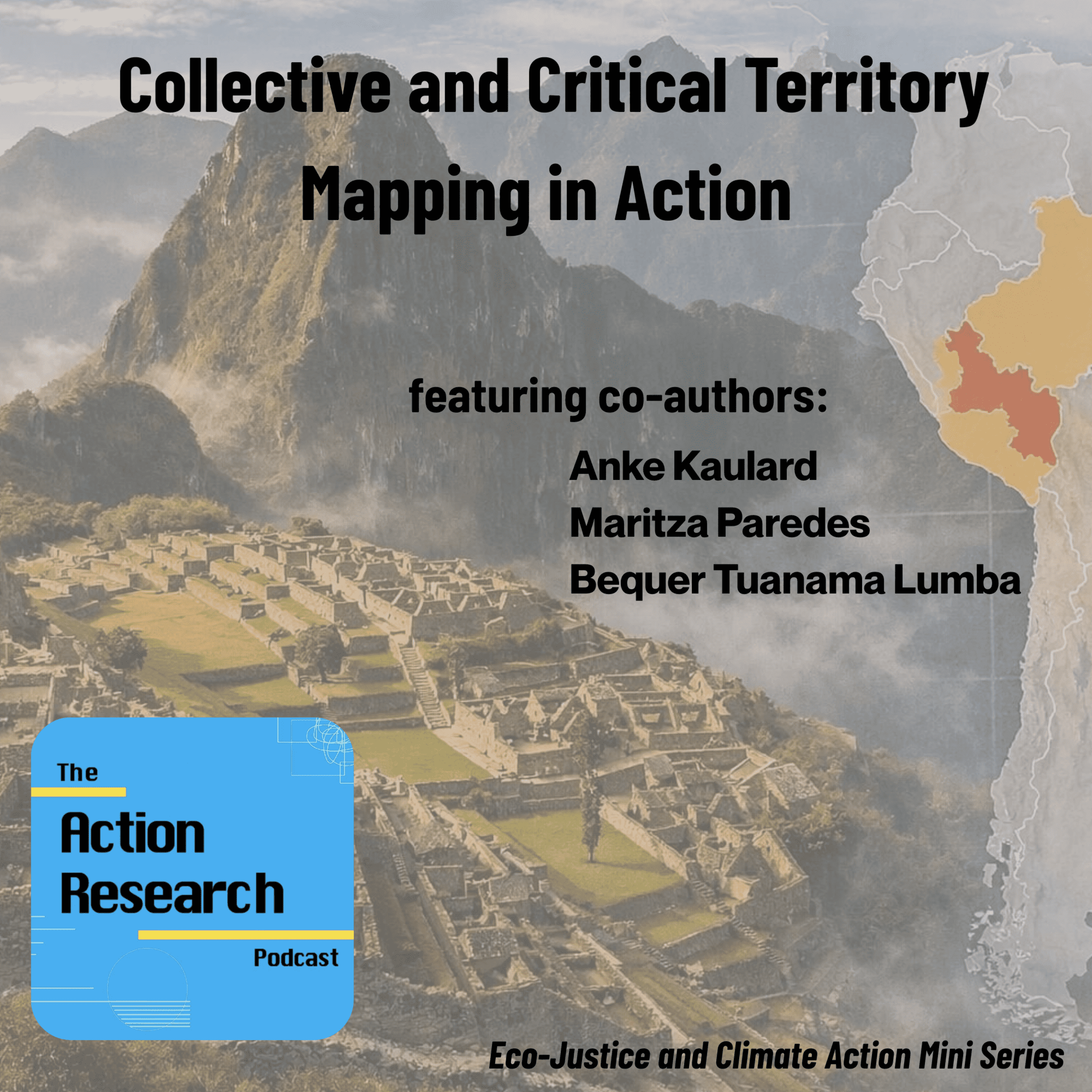
    Collective and Critical Territory Mapping in Action

    Be sure to check out the grand finale of our Eco-Justice and Climate Action Mini Series! Throughout the last few months, we’ve explored everything from outdoor education in Canada, to a global storytelling initiative, to resilience building in coastal island communities, and more. Today, Joe and Blane explore the story behind “Crystallizing Territorial Visions and Claims: Critical Mapping with Amazonian Kichwa Communities in Climate Change. We are joined by authors Anke and Maritza, and co-investigator, Bequer Tuanama, from San Martin, Peru. The interview is bilingual, Spanish and English, with translations. The episode is full of meaningful reflections, candid anecdotes about the process, and a deeper look at their research project. Enjoy! The team begins by tracing how the partnership with Kichwa communities in San Martin, Peru came into being, and was built from existing relationships [3:13]. This leads into a discussion of critical mapping itself, and how a participatory research tool gradually became something more [5:57], providing a space for collective reflection, negotiation, and the reimagining of territorial claims in the face of state-led conservation efforts. The power dynamics involved and their negotiations are very insightful [10:32]. Afterwards, the team walks us through what the mapping process actually looked like, and the connection between mapping territory and climate action, using stories, timelines, and imagery of non-human beings which were included, beyond geographic boundaries [14:00]. The team then shares some of emergent practises from collaborating with a diverse group of collaborators on the project, including different layers of knowledge on map, as well as a vision for the territory in the future, along with practical challenges of the logistics of budgeting, transportation, bringing in elders and women, and providing an intercultural approach to the work [22:56]. The episode closes with learning and outcomes from the project, from the universities changing their approach to action research and impact, how mapping is an important tool of dialogue and collaboration across different sectors, bringing women’s voice to the forefront, and engaging different levels, particularly for communicating with the state [35:04]. Thank you Anke, Maritza, and Bequer for sharing your work with us in this episode. Thank you to our listeners for tuning in to this episode of the Action Research Podcast, created by Joe Levitan, Adam Stieglitz, Shikha Diwakar, Cory Legassic, and Vanessa Gold. Produced by Shikha Diwakar and Vanja Lugonjic. Subscribe to our podcast on most major podcast distribution platforms, including Spotify and Apple Podcasts. How have you found yourself in the world of action research? Want to be interviewed or share one of your projects? Get in touch with us. Photo Credit: https://www.machu-picchu.org/location/ Resources: Exhibition Blog Post Maps Atlas of Critical Mapping in Latin America Biographies: Anke Kaulard holds a PhD in sociology and teaches in the Department of Social Sciences at the Pontificia Universidad Católica del Perú (PUCP) and currently at the University of Cologne. She is a former fellow of the trAndeS program (PUCP/FU Berlin) with a focus on inequalities and sustainable development in the Andean region, interested in political economy and ecology. She is a researcher in the action-research project: “Indigenous Visions for Climate Justice” (PUCP/University Diego Portales/TNC, funded by IDRC) and in the project: “Beyond Certification. From voluntary sustainability standards to sector transformation” (PUCP/University of Melbourne). Since 2003 she has been working in action-research, previously in development cooperation projects in the Andean region, Mozambique and Jordan. She works with producer associations and Indigenous Peoples of the Amazon to make visible their demands for climate, economic and social justice. Maritza Paredes is a Full Professor, and Researcher in the Department of Social Sciences, Sociology Section, at the Pontifical Catholic University of Peru. Her expertise lies in political sociology and environmental sociology. Paredes has extensively studied the impacts of extractive industries on the institutions and environmental justice of local communities and indigenous peoples, as well as the effects of climate policies at the local level, particularly among indigenous communities in the Amazon. She obtained her PhD in International Development from the University of Oxford in the UK and a Master's Degree from Columbia University in the USA. Bequer Tuanama Lumba is a Kichwa leader from the community of Kawana Sisa in San Martin, Peru. He served as apu of his community in 2008 and later contributed to the creation of the Kichwa Huallaga Dorado Federation (FEKIHD), which he chaired from two terms starting in 2016. Certified as a professional technician in 2023, he worked as a territorial researcher in the project: "Indigenous Visions for Climate Justice" and made significant contributions to the co-creation of the "Buen Mapeo" process in San Martin. -- This episode is part of our Eco-justice and Climate Action Series. Authors from journal articles in a Special Issue of the Canadian Journal for Action Research hop behind the mic and share the inspirations, process, and findings from their projects. Join Joe Levitan, Shikha Diwakar and special guest host Blane Harvey, as they interview an inspiring group of researchers, educators, organizers, and more, navigating the process of action research.
  • S5 · E7
    July 13 · 56 min

    Fostering Solidarity Through Storytelling

    Buckle up for a podcast episode—about podcasting. This time, co-host Blane Harvey switches roles, and is the interviewee alongside Jon Langdon and Sheena Cameron, authors of the The Storytelling Initiative: Community Podcasting at the Frontlines of Climate and Environmental Crises. Joe and Shikha take on co-hosting to unpack storytelling, community podcasting, and the wonderful connections to action research. The episode begins with the team tracing how the project grew out of a research grant to collaborate with Community Radio in Ghana and Student Social Justice Radio in St. Francis Xavier University. The team starts by explaining the deep emphasis on relationship building, then moves onto the what and how of community radio, storytelling, and action research. Joe asks how, in their view, stories are a form of action [15:04], opening into describing the framework for Stories to Change Systems. During the discussion, Jon calls for a broader view of how we view action [25:20]. We explore together how in their research, storytelling was action research, beyond knowledge mobilization, as the scaffolded design for initiatives involved for podcast episodes created meaningful action and learning opportunities. Departing from sanitised and linear conventions of academic work, Shikha asks the team about behind-the-scenes of the Storytelling Initiative. Sheena, Blane, and Jon share the messiness behind the process, from language and time zone barriers, to inequitable funding mechanisms, to the technical difficulties, and the vulnerability of asking people to share their stories [29:09]. Shikha prompts the group to reflect on how the teams were able to connect seven community groups across vastly different contexts, and the team describes a recurring David versus Goliath dynamic, and moments of trans-local solidarity that emerged when people saw their own struggle reflected in someone else's story [41:29]. Lastly, as a continuation of this work, Blane shares the importance of investigating Canadian universities’ approaches to ethics and funding to better support grassroot initiatives across the world, and Jon and Sheena reflect on their work in bringing podcasting into classrooms and research methodologies [48:26]. Thank you Sheena, Jon, and Blane for sharing your work with us in this episode. Thank you to our listeners for tuning in to this episode of the Action Research Podcast, created by Joe Levitan, Adam Stieglitz, Shikha Diwakar, Cory Legassic, and Vanessa Gold. Produced by Shikha Diwakar and Vanja Lugonjic. Subscribe to our podcast on most major podcast distribution platforms, including Spotify and Apple Podcasts. How have you found yourself in the world of action research? Want to be interviewed or share one of your projects? Get in touch with us. Resources: Listen to the available episodes of The Storytelling Initiative here! The Storytelling Initiative: Community Podcasting at the Frontlines of Climate and Environmental Crises Stories to Change Systems Biographies: Jonathan Langdon is a Professor and the Canada Research Chair for Sustainability and Social Change Leadership at St Francis Xavier University, in Mi’kma’ki or Nova Scotia, Canada. For the past 20 years, he has been working with social movements in Ghana to document and deepen their learning in, through and to struggle. More recently, this work sparked a partnership network amongst social movements in Ghana, South Africa, Guatemala and Canada that focuses on how movements can learn from each other from one locale to another, or translocally. Langdon’s writing has been published in leading international and Canadian development, participatory action research and adult education journals. He is also the author of African Social Movement Learning (Brill, 2020), and editor of Indigenous Knowledges, Development and Education (Sense, 2009). Blane Harvey is an Associate Professor and William Dawson Scholar in the Department of Integrated Studies in Education at McGill University (Canada), where he leads the Leadership and Learning for Sustainability Lab. He is an interdisciplinary scholar whose work spans across the social and natural sciences on the themes of learning, collaboration, environmental change and education for sustainable development. Dr. Harvey’s research investigates how climate change knowledge is produced, validated and communicated, and how facilitated learning and knowledge sharing can support action on climate change, especially within communities most vulnerable to its impacts. He serves as an Associate Editor for the journal Climate and Development. Sheena Cameron is a PhD Candidate (ABD) in the Social Justice Education program at OISE, University of Toronto and teaches part-time with the Development Studies Program at St. Francis Xavier University. She holds a Master's in Communication and Social Justice from the University of Windsor ('13) and has 20 years of experience in community development and experiential learning. Areas of current research include transformative adult learning in the climate/environmental justice movement, Indigenous/settler relations, and podcasting for social change. -- This episode is part of our Eco-justice and Climate Action Series. Authors from journal articles in a Special Issue of the Canadian Journal for Action Research hop behind the mic and share the inspirations, process, and findings from their projects. Join Joe Levitan, Shikha Diwakar and special guest host Blane Harvey, as they interview an inspiring group of researchers, educators, organizers, and more, navigating the process of action research.

  • S5 · E6
    July 1 · 46 min

    Critical Hope is an Action

    In this episode we explore the inspiring concept of Critical Hope with Tara Mahoney. Co-authored with Kari Grain, their article “Not All Hope is Created Equal: Climate Action Research as a Source of Critical Hope” is a rich resource for how to find your way when dealing with complexity in climate work and action research. Joe and Blane first introduce Tara and begin by asking her to define critical hope, and how it departs from optimism, including a walkthrough of the seven principles Kari Grain developed in her previous work [2:26]. The conversation then turns to the role of emotion in climate action research, and specifically the role of community in processing anger and grief [08:12]. How does critical hope then translate when working in a research context, which typically asks researchers to be emotionally removed? Tara shares how the Community Engaged Research Initiative grapples with balancing emotional and logical lenses within a research project [12:52]. These kinds of collaborations take time, and Tara reflects on the importance of trust and true relationship building [20:22]. Joe then probes how different research paradigms, like Two-Eyed Seeing, can be used in these more critical and participatory engaged research processes, especially in contexts collaborators may hold completely opposite worldviews [21:55]. Tara then describes the case of the Climate Disaster Project, which illustrates how media can be a powerful tool for bridging some of these worldviews and opening up dialogue. Running through the conversation is the positioning of researchers as community organizers. To conclude, Tara reflects on the example of co-creating the Climate Resilience Roadmap in Vancouver's Downtown Eastside [32:27] and wonderful outcomes of leading with practical community needs, instead of theory [37:06]. Closing off the episode, critical hope is shared as an undercurrent and practice for individuals and communities facing some of our most complex societal ailments. Resources Community Engaged Research Initiative Reimagining the Public University in the Poly Crisis: Critical Hope by Kari Grain Climate Resilience Roadmap for Non-Profits: From Crisis to Collective Power Bibliographies Tara Mahoney has over 15 years of experience in community organizing and a PhD in Communication from Simon Fraser University. Tara has been at the forefront of innovative projects that bridge the gap between academic research and community-driven solutions. As Research and Engagement Manager at SFU’s Community-Engaged Research Initiative (SFU CERi), she oversees the creation and production of SFU CERi's publications and programs. Her research focuses on emerging forms of public engagement and has been published in Continuum: Journal of Media and Cultural Studies, the European Journal of Cultural Studies and she won the CRTC Prize for Excellence in Policy Research in 2019. Kari Grain is a practitioner-scholar at the intersection of higher education, social justice, and community engagement. She earned her PhD in Education at UBC as a Vanier scholar, where her research focused on local community impacts of international service-learning in Uganda. For the past five years, she has worked as an educational consultant, focusing on experiential education, community-engaged research, and the scholarship of teaching and learning. Her research has been published in the Journal of Experiential Education, the Michigan Journal of Community Service Learning, and the Canadian Journal of Studies in Adult Education. Thank you Tara for sharing your work with us. Thank you to our listeners for tuning in to this episode of the Action Research Podcast, created by Adam Stieglitz, Joe Levitan, Shikha Diwakar, Cory Legassic, and Vanessa Gold. Produced by Shikha Diwakar and Vanja Lugonjic. Subscribe to our podcast on most major podcast distribution platforms, including Spotify and Apple Podcasts. How have you found yourself in the world of action research? Want to be interviewed or share one of your projects? Get in touch with us. -- This episode is part of our Eco-justice and Climate Action Series. Authors from journal articles in a Special Issue of the Canadian Journal for Action Research hop behind the mic and share the inspirations, process, and findings from their projects. Join Joe Levitan, Shikha Diwakar and special guest host Blane Harvey, as they interview an inspiring group of researchers, educators, organizers, and more, navigating the process of action research.
  • S5 · E5
    June 15 · 42 min

    “Superpowers” and Student-Led Action Research

    Today we sat down with Cher Hill and Neva Winters, authors of the article “I Hate the Global Warming Factory! Caring for Tadpoles During the Climate Emergency.” This article is also co-written with Ching-Chiu Lin who could not join us for the recording. The three authors are all researchers at Simon Fraser University. As part of the Eco-Justice and Climate Action mini-series, we explored the role of elementary school students in British Columbia as eco-action heroes and leaders of learning and research. Dive into the insights, perspectives, and surprises that students get into in a pond during a lunchtime program. Learn what children can teach us about love, courage, and climate action. Joe and Blane introduce guests Cher and Neva to discuss the article that brought them together, leading into the origin story, sharing their collaboration with Elder Rick Bailey on the salmon crisis on Coast Salish territories [2:21]. The conversation then follows how an encounter with tadpoles amidst a heat wave and a shrinking pond led to the students springing action, forming an outdoor learning club, a community film festival, and a fundraiser [5:13]. From there, Cher and Neva reflect on teaching kinship with the more-than-human world, the pedagogy of "superpowers" of different species and tadpoles, social-emotional learning, and a shared orientation toward learning as an act of love, inspired by Elder Rick [14:41]. This opens into a candid discussion of the action research methodology: indeterminate PAR cycles, ethics and permissions challenges, and how community synergies continuously reshaped the project's direction [22:08]. The episode closes with future directions, including a new school pollinator garden, and a reminder of the magic that happens when students lead the learning and research [34:47]. Thank you Cher and Neva for sharing your work with us. Thank you to our listeners for tuning in to this episode of the Action Research Podcast, created by Adam Stieglitz, Joe Levitan, Shikha Diwakar, Cory Legassic, and Vanessa Gold. Produced by Shikha Diwakar and Vanja Lugonjic. Subscribe to our podcast on most major podcast distribution platforms, including Spotify and Apple Podcasts. How have you found yourself in the world of action research? Want to be interviewed or share one of your projects? Get in touch with us. Biographies Cher Hill is an Assistant Professor and teacher educator in the Faculty of Education at Simon Fraser University. She is deeply invested in researching educative experiences that contribute to more connected, thriving, and just communities. Cher is a passionate supporter of relational, participatory, outdoor, and community-based educative initiatives. Neva Whintors is a doctoral student at Simon Fraser University, and an elementary school teacher with over 20 years of experience, having taught kindergarten through Grade 7. Her areas of expertise include outdoor pedagogies, social emotional learning, and action research. Resources: Learn more here: https://www.sfu.ca/research/research-impact/performance-excellence/scholarly-impact-of-the-week/scholarly-impact-stories/2026/the-ripple-effect_sfu-educators-schoolchildren-inspire-care-for-the-environment/ Artists to Check Out: Ryan Hughs: https://www.instagram.com/ryansalishart/ Brandon Gabriel: https://www.instagram.com/brandongabrielart/ Photo Credit: https://www.natucate.com/en/blog/travel-guide/canada-british-columbia -- This episode is part of our Eco-justice and Climate Action Series. Authors from journal articles in a Special Issue of the Canadian Journal for Action Research hop behind the mic and share the inspirations, process, and findings from their projects. Join Joe Levitan, Shikha Diwakar and special guest host Blane Harvey, as they interview an inspiring group of researchers, educators, organizers, and more, navigating the process of action research.
  • S5 · E4
    June 1 · 45 min

    Radical Incrementalism in Action

    In this episode, we invite authors from the Centre for Sustainability Transitions, Stellenbosch university and collaborators from McGill university to discuss their article “Radical Incrementalism in Action Through Institutional Work: Case Studies of Embedded Research in South Africa”. As part of our special Eco-Justice and Climate Action series, the authors explore the complexities of navigating changemaking from within institutions. Listen in to discover secrets to radical change through slow and steady processes! In this episode, our co-hosts Joe and Blane introduce the team and the article at the center of today’s discussion. They begin by grounding listeners in the broader context of South Africa for those who may be less familiar with its history and contemporary dynamics [2:20], before moving into the deeper motivations and relationships behind their collaboration and the development of the concept of radical incrementalism [4:15]. What does this term mean, and how is it done? Our own curiosity increased as we continued our conversation.– What gave rise to this feeling that they needed another way to think about how to pursue change? Some critical scholars might challenge the idea that incrementalism can actually be radical, perhaps the idea represents an abandonment of the drastic and immediate “change we need” concept? So, we ask the authors to respond to this critique [5:15]. The episode then explores how radical incrementalism is actually done, and the messiness and complexity behind this way of working, including questions of embeddedness, role conflicts, ethical dilemmas, and the importance of political literacy [26:27]. Finally, the conversation closes with reflections on how these ideas are shaping daily practice, and what kinds of changes the guests have observed as a result [37:40]. Thank you Mark, Alboricah, Mlondi, Priscilla, Mapula, and Elaine for sharing your work with us in this episode. Thank you to our listeners for tuning in to this episode of the Action Research Podcast, created by Adam Stieglitz, Joe Levitan, Shikha Diwakar, Cory Legassic, and Vanessa Gold. Produced by Shikha Diwakar and Vanja Lugonjic. Subscribe to our podcast on most major podcast distribution platforms, including Spotify and Apple Podcasts. How have you found yourself in the world of action research? Want to be interviewed or share one of your projects? Get in touch with us. Biographies: Mark Swilling is a Distinguished Professor and a former Co-Director of the Centre for Sustainability Transitions at Stellenbosch University, South Africa. He is an international expert in sustainable development, with over thirty years of experience in ‘societal transitions’ (with special reference to urban systems), initially focusing on democratisation and governance during the Apartheid era in South Africa. The primary research focus of his career can be defined as ‘societal transitions,’ more recently within the broader discipline of sustainability science and governance at the global level. His published research was coupled to major institution-building collaborations. This achievement was recognised in 2010 when he was awarded the Aspen Faculty Pioneer Award for success in introducing sustainability into leadership education. Dr. Elaine Huang is currently a Research Associate at the Faculty of Education, McGill University. Her research examines how the social sciences can contribute to just and sustainable futures by advancing ethical collaboration, institutional transformation, and collective learning. She is particularly interested in how researchers engage with the politics, evolving normativity, and uncertainties inherent in real-world change processes to serve the public good. Grounded in reflexive and relational approaches, her work reimagines knowledge production as a generative space for ethical engagement, systemic thinking, and transformative practice—both within and beyond academic institutions. Alboricah Rathupetsane is a PhD Candidate and Junior Researcher at the Centre for Sustainability Transitions in Stellenbosch University, South Africa. Her research sits at the intersection of industrial policy, decarbonisation and infrastructure development within the country’s just transition agenda. Her doctoral work examines the role of infrastructure megaprojects in catalysing industrial revival, specifically focusing on strengthening the participation of local steel firms in South Africa's electricity grid expansion programme. Mlondi Ndovela is a PhD candidate at the Centre for Sustainability Transitions, Stellenbosch University, South Africa. His work focuses on co-developing and applying a non-equilibrium model to understand the broader macroeconomic implications of the energy transition in South Africa. This work draws its influences from systems dynamics/non-linear dynamics, stock-flow consistent approach, complexity economics and laws of thermodynamics. Priscilla Jezi is a part-time PhD Candidate with the Centre for Sustainability Transitions at Stellenbosch University in South Africa. She was a full-time employee at an Energy state-owned enterprise as a specialist in development finance with more than 20 years of experience in energy and finance. Responsible for Sustainable Financing, a lead in sourcing funding for Just Energy Transition Projects. She is Head of Treasury Bank Funding for a state- owned Development Bank. An embedded researcher; her current PhD work focus on the emerging Transition Finance approach, which enables and accelerates energy transitions. Mapula Tshangela is a part-time PhD Candidate with the Centre for Sustainability Transitions at Stellenbosch University in South Africa. She is a full-time senior government official with over 28 years of experience in climate change, green economy, sustainable development, environmental management, and chemistry work. Her research interests include transformative research, sustainability transitions, policy regime shifts, inclusive innovation, and science-policy interface. Her published research includes academic articles and book chapters. -- This episode is part of our Eco-justice and Climate Action Series. Authors from journal articles in a Special Issue of the Canadian Journal for Action Research hop behind the mic and share the inspirations, process, and findings from their projects. Join Joe Levitan, Shikha Diwakar and special guest host Blane Harvey, as they interview an inspiring group of researchers, educators, organizers, and more, navigating the process of action research.
  • S5 · E3
    May 15 · 43 min

    Learning from the Land: Action Research and Climate Education in the North

    In this episode in the Eco-Justice and Climate Action Mini Series, we sat down with four members of the Climate Education and Teacher Education (CETE) team, which is based at the University of Northern British Columbia. Authors of “Mapping Climate Change Education: Reflections from an Education Design-Based Research Project from Northern British Columbia, Canada,” the CETE team created this project in response to the 2022 Association of Canadian Deans of Education report titled "Accord on Education for a Sustainable Future," which underscored urgency for climate change education. Join us for another great episode exploring the stories behind this collaborative and exciting action research project! To begin, our hosts Joe and Blane introduce the CETE team and the article that brought them together [00:00]. This leads into the origin story of the initiative and discussion of their team dynamics, which lead to a shared commitment to curriculum reform and a signature pedagogy built around people, place, and land [1:57]. The conversation then explores the co-creation process at the heart of the project, from building a national design team to running iterative workshop series across northern British Columbia, reflecting on how listening to teachers and communities continuously reshaped the project's direction [7:50]. From there, the team reflects on the iterative, cyclic nature of their design-based research, and the challenges of working within research frameworks that don't always honour more-than-human species and Indigenous ways of knowing [17:03]. We move to a discussion about the tension between theory and action, and between local focus and global relevance, focusing on how grounding the work in northern land, language, and Indigenous knowledge has proven to be both their most impactful contribution and a transferable model for others [22:23]. The team closes by sharing where the project stands today, and our hosts wrap up by honouring the messiness of action research as a defining strength of the journey, not a flaw [34:04]. Thank you Hartley, Christine, Alexander and Glen for sharing your time and work with us. Thank you to our listeners for tuning in to this episode of the Action Research Podcast, created by Adam Stieglitz, Joe Levitan, Shikha Diwakar, Cory Legassic, and Vanessa Gold. Produced by Shikha Diwakar and Vanja Lugonjic. Subscribe to our podcast on most major podcast distribution platforms, including Spotify and Apple Podcasts. How have you found yourself in the world of action research? Want to be interviewed or share one of your projects? Get in touch with us. Resources: CETE Research Page Biographies: Hartley Banack, University of Northern British Columbia Dr. Hartley Banack is an Associate Professor in the School of Education at UNBC and Principal Investigator for the CETE research program since 2022. Banack is a curriculum theorist, qualitative researcher, and teacher. He has years of experience as an outdoor environmental educator and scholar. His scholarship appears in Teachers and Teaching (Banack and Tembrevilla, 2024), Children’s Geographies (Banack and Berger, 2020), and Critical Education (Banack, 2018). Banack holds a Ph.D., M.A., and B.Ed. in environmental education, all from Simon Fraser University, along with a B.Sc. from Trent University. Christine Ho Younghusband, University of Northern British Columbia Dr. Christine Ho Younghusband is an Assistant Professor in the School of Education at UNBC. Dr. Ho Younghusband is a founding CETE Co-Investigator. Her research focuses on teacher professional learning, identity development, and mathematics education. She has published on e-portfolios and identity (Younghusband, 2021) and out-of-field teaching (Younghusband, 2017). Dr. Ho Younghusband holds an Ed.D. and M.Ed. from Simon Fraser University, and B.Ed. and B.Sc. from the University of British Columbia. Alexander Lautensach, University of Northern British Columbia Dr. Alexander Lautensach is an Adjunct Professor in the School of Education at UNBC. Lautensach is a founding CETE Co-Investigator. He holds five degrees in the areas of biology, science education, and philosophy, including a doctorate in environmental ethics education from the University of Otago, New Zealand. Lautensach has written two books on sustainability education and climate change and co-published the first open-access textbook on human security. Glen Thielmann, University of Northern British Columbia Glen Thielmann is a Lecturer in the UNBC School of Education. He is a founding member of the CETE Research Team. He is a master Social Studies teacher with leadership in curriculum, instruction, and professional & resource development in B.C. K-12 schools. In 2017, Glen received a Governor General’s History Award for excellence in Teaching. In 2022, Glen received a Teacher Educator Award from the Association of BC Deans of Education. -- This episode is part of our Eco-justice and Climate Action Series. Authors from journal articles in a Special Issue of the Canadian Journal for Action Research hop behind the mic and share the inspirations, process, and findings from their projects. Join Joe Levitan, Shikha Diwakar and special guest host Blane Harvey, as they interview an inspiring group of researchers, educators, organizers, and more, navigating the process of action research.

  • S5 · E2
    May 1 · 35 min

    Rethinking Resilience: Climate Justice and Community Action Across Borders with Céleste Pepin

    Welcome to the second interview in our special mini series, Eco-Justice and Climate Action. Today our guest, Céleste Pepin, graduate of the Gender and Social Justice Studies Honours program at McGill University, joins Blane and Joe, to share their work: “Politics of Resilience-Building: Explorations of Community-Based Interventions in Trinidad and Tobago”. An inspiring researcher, Queen Elizabeth Scholar (2023) and student, Celeste shares their insights from working and living in a new environment, the impact of research “trends” like resilience on project planning, and the intersections of action research and feminist methodologies. Join us for an exciting conversation traversing the many aspects of action research and beyond. Céleste first shares how the opportunity to engage in action research came to be during their undergraduate degree, as well as the project beginnings [01:00]. This led to exploring the preparation and challenges of working in an unfamiliar environment [6:57], along with the tensions they encountered between international agency funding and local realities on the ground in Trinidad and Tobago [10:11]. Céleste also reflects on the role of the university and how institutional context shapes the way research is designed and conducted [17:16]. Together, we explore the surprising parallels between climate resiliency efforts in Montreal and Trinidad and Tobago [20:53], leading to a rich discussion about the responsibility of the Global North to learn climate adaptation strategies from the Global South [24:00]. This connects to a broader conversation about the links between feminist popular education and action research as complementary frameworks [26:31], before closing with key takeaways and lessons Céleste is carrying forward [29:41]. Thank you Celeste for sharing your time and work with us. Thank you to our listeners for tuning in to this episode of the Action Research Podcast, created by Adam Stieglitz, Joe Levitan, Shikha Diwakar, Cory Legassic, and Vanessa Gold. Produced by Shikha Diwakar and Vanja Lugonjic. Subscribe to our podcast on most major podcast distribution platforms, including Spotify and Apple Podcasts. How have you found yourself in the world of action research? Want to be interviewed or share one of your projects? Get in touch with us. Biography: Céleste Pepin is a graduating Gender and Social Justice Studies Honours student at McGill University. Their research focuses on the use of feminist imperial foreign policies within international armed conflicts and uses decolonial feminist perspectives to analyze the gendered dynamics of war and the legitimization strategies employed by Western states during military interventions in the Global South. By foregrounding decolonial feminist perspectives, they challenge conventional narratives and highlight the complexities of power relations in contemporary geopolitics. Resources: Environmental Organizations in Trinidad and Tobago Green T&T: an NGO working in ecotourism CANARI: Ensuring that people whose livelihoods depend on the environment have a say in its protection and management Fondes Amandes, reforestation project ERIC, community-based approach to reef management and protection -- This episode is part of our Eco-justice and Climate Action Series. Authors from journal articles in a Special Issue of the Canadian Journal for Action Research hop behind the mic and share the inspirations, process, and findings from their projects. Join Joe Levitan, Shikha Diwakar and special guest host Blane Harvey, as they interview an inspiring group of researchers, educators, organizers, and more, navigating the process of action research.

  • S5 · E1
    April 15 · 37 min

    Little Architects, Big Ideas: Climate Action Through Design-Based Learning

    Welcome to the first author interview in our mini series, Eco-Justice and Climate Action, where we aim to explore inspiring projects at the intersection of climate justice and action research. This series highlights work featured in the 2025 special issue of the Canadian Journal for Action Research, guest edited by Dr. Blane Harvey. We are excited to share these thought-provoking contributions with you. In today’s episode, our co-hosts Joe and Shikha are joined by Ipek Türeli, Nathalie Malhamé, and Sarah Nabi who co-authored “Little Architects, Big Ideas: Climate Action Through Design-Based Learning, where big ideas meet small (but mighty) designers. Together, they reflect on their creative and inspiring collaboration in Montreal, Quebec, connecting Ipek’s work at the Peter Guo-hua Fu School of Architecture at McGill University, with Nathalie and Sarah’s fourth grade classes in Royal Vale School. They share their motivations behind the collaboration, surprise findings along the way, and the gratifying experience of exhibiting the students’ work at both institutions. The conversation begins with introductions and the story of how the project came to life [2:00]. This led to exploring deeper connections between architecture, environmental justice, and experiential education [8:09] along with challenges and complexities that our guests Nathalie, Sarah and Ipek encountered and navigated in their project [13:18]. They then reflect on the role and importance of the undergraduate architecture students for the success of the collaboration [17:43]. We ask about the young designer’s work and what it may reveal about different understandings of climate justice. Through these examples, we explore the surprises and tensions that emerged in the final designs [20:37], leading into a rich discussion about why exhibitions became such a powerful space for sharing this work and supporting student learning [25: 08]. For such a rich and impactful project, we were keen to learn the lasting impacts [30:11] before closing with final reflection and even a mic-drop moment! Thank you Ipek, Nathalie, and Sarah for sharing your time and work with us. And thanks for tuning in to this episode of the Action Research Podcast, created by Joe Levitan, Shikha Diwakar, Cory Legassic, Vanessa Gold, and Adam Stieglitz. Produced by Shikha Diwakar and Vanja Lugonjic. Subscribe to our podcast on most major podcast distribution platforms, including Spotify and Apple Podcasts. How have you found yourself in the world of action research? Want to be interviewed or share one of your projects? Get in touch with us. Biographies: Ipek Türeli, PhD, holds the Canada Research Chair in Architectures of Spatial Justice at McGill University, where she is appointed as Associate Professor at the Peter Guo-hua Fu School of Architecture. She is the creative director of Architecture Playshop, a web-based curricular resource to teach critical literacy to young children about climate action through design. This project began as an invited contribution to the Korean Pavilion on the theme of “Future School” at the 2020 Venice Architecture Biennale. In 2023, at the triennial “Golden Cube Awards”, Architecture Playshop was recognized with an Honourable Mention in the AudioVisual Media Category. Dr. Türeli has published a reflective piece about the curriculum development in the open-access architecture publication Platform. Sarah Nabi is an elementary school teacher at Royal Vale School in Montreal, Quebec, with over 20 years of experience. A graduate of Vanier College, Concordia University, and McGill University, she specialized in psychology, art, and special education. She fosters inclusive, culture-rich classrooms through differentiation and project-based learning, leads committees and extracurriculars, and is committed to every student’s success. In Winter 2023, she partnered with McGill’s Architecture Department to implement the Playshop Project at RVS. Nathalie Malhamé is a French teacher and New Teacher Mentor at Royal Vale School in Montreal, where she has taught for over 12 years. She received the Evelyn Eaton Award for her project Global Citizens of Kindness. Active on several school committees, including Governing Board, Staff Council and Truth and Reconciliation, she recently completed a certificate in educational leadership. She holds B.A. and M.A. degrees in sociology and a B.Ed.; She collaborated with the McGill’s Architecture Playshop team in 2023. -- This episode is part of our Eco-justice and Climate Action Series. Authors from journal articles in a Special Issue of the Canadian Journal for Action Research hop behind the mic and share the inspirations, process, and findings from their projects. Join Joe Levitan, Shikha Diwakar and special guest host Blane Harvey, as they interview an inspiring group of researchers, educators, organizers, and more, navigating the process of action research.

  • April 1 · 24 min

    Season 5: From Crisis To Collaboration: Introducing the Special Series

    What does it look like when research doesn't just study a crisis, but actively works to respond to it? To answer this question, Action Research Podcast hosts Joe Levitan and Shikha Diwakar invite Blane Harvey to be a special co-host for this exciting mini-series on Eco-Justice and Climate Action, growing out of a 2-part special issue of the Canadian Journal of Action Research (2025), which Blane guest edited. In this first episode, Blane joins Joe and Shikha to unpack the "what," "why," and "how" behind the special issue. This exciting collection brings together researchers, educators, and community collaborators across the globe who use action research to confront climate change and eco-injustice to share and reflect on their work. A thread that runs through all of the articles is that action research is rarely neat. It's iterative, relational, and full of unexpected turns. This series features eight different stories, unpacking that messiness—and the good, bad, and uncertain that comes out of it—from a variety of contexts and perspectives. Expect fun stories, deep reflections, and an expansion of ideas about how action research can be used to work towards climate justice. We invite you to listen in and share the special series with anyone in your network interested in eco-justice and sustainability, action research, or just want to hear from the humans behind collaborative research projects on your way to work or cleaning your kitchen. The introduction opens with how this special double issue came to life, before diving into the core threads and commitments that connect its many contributions [02:10]. Blane shares how the editorial process was shaped by the very values action research is built on [05:11], and makes the case for why action research may be uniquely necessary in responding to the climate crisis [10:40]. The group reflects on the tension between global challenges and local action [13:45], closing with what Blane hopes both readers and listeners carry forward from this collection [17:36]. Thank you Blane for kicking off this series, and thank you to our listeners for tuning in to this episode of the Action Research Podcast. The Action Research Podcast was co-created by Joe Levitan, Shikha Diwakar, Cory Legassic, Vanessa Gold, and Adam Stieglitz. Produced by Shikha Diwakar and Vanja Lugonjic. Subscribe to our podcast on most major podcast distribution platforms, including Spotify and Apple Podcasts. How have you found yourself in the world of action research? Want to be interviewed or share one of your projects? Get in touch with us. Resources: CJAR Special Issue Part 1 CJAR Special Issue Part 2 Check out the Leadership and Learning for Sustainability Lab: Website Linkedin Biographies: Dr. Blane Harvey is an Associate Professor and William Dawson Scholar in the Department of Integrated Studies in Education at McGill University (Canada), where he leads the Leadership and Learning for Sustainability Lab. He is an interdisciplinary scholar whose work spans across the social and natural sciences on the themes of learning, collaboration, environmental change and education for sustainable development. Dr. Harvey’s research investigates how climate change knowledge is produced, validated and communicated, and how facilitated learning and knowledge sharing can advance climate justice and support action on climate change, especially within communities most vulnerable to its impacts. He serves as an Associate Editor for the journal Climate and Development and Subject Editor for the journal FACETS. Dr. Joseph Levitan is an Associate Professor and William Dawson Scholar in the Department of Integrated Studies in Education at McGill University. His work focuses on community-based participatory methodologies to address community-defined challenges in education and development. Sitting at the intersection of policy and leadership studies, his work focuses on developing processes and evaluating impacts of collaborative work with youth, adults, and community leaders. Dr. Levitan works with communities to identify context-specific challenges, culturally grounded methods to address those challenges, and processes to put those methods into action. Through this work he has co-developed methods such as Culturally Grounded Curriculum Development, the Student Voice Research Framework, and Accidental Ethnography. He currently holds multiple grants to engage in this work in Peru, Panama, India, and Canada. Dr. Shikha Diwakar is a Dalit feminist scholar, educator, and policy analyst working at the intersections of caste equity, anti-colonial pedagogy, and transnational education justice. With over a decade of experience across two continents, she has worked in teaching, higher education research, university administration, and policy advocacy. Her work centers the lived experiences of first-generation Dalit women, using community-based participatory research grounded in relational accountability and Indigenous ethics. Shikha is also the long-time producer of the Action Research Podcast.

  • S4 · E8
    Sep 30, 2024 · 55 min

    Restorative Community Solutions and participatory action research, with Earl Simms, Kezia “Zia” Martinis and Couper Orona

    Join us for this inspiring and thought-provoking discussion. Adam and Joe sit down with three members of the Restorative Community Solutions (RCS) team based in San Francisco: Earl Simms (executive director), Kezia "Zia" Martinis (community engagement lead) and Couper Orona (community engagement operations). RCS is a nonprofit founded in 2022, led by a group of dedicated professionals with a deep history of direct service, dedicated to “support[ing] those experiencing the transition back into society from institutional settings, homelessness, prison, jails, and treatment facilities” through peer support. [00:02:27] We first learn about each guest and how their life experiences inform their work as well as [00:05:16] learn more about Restorative Community Solutions’s (RCS) mandate. [00:08:35] Adam asks our guests to describe the challenges of doing peer support in a non-profit context. Zia discusses the challenges of representation of all community voices. Earl talks about dynamics of contracting with government agencies in San Francisco with extractive approaches and the risks of policy violence—when policy makers are “10, 000 feet above the problem” they can’t “see the nuances and the different intricacies that are happening on the ground.” Couper ties it back to the importance of a trauma-responsive peer support approach. Our hosts ask the team to reflect on their work through the angle of action research. They discuss the importance first of bringing that qualitative part that humanizes and works toward accountability, [00:20:02] “mak[ing] sure that people’s solutions are grounded in reality.” RCS’s action research question asks, “What is one thing that San Francisco can do to change your life?” [00:23:34] Earl reflects on how participatory action research came into the methodology of their work, and they describe how co-researchers co-create survey questions, help with focus groups, use different tools to synthesize data, and then formulate recommendations to different organizations. [00:28:47] As Couper argues, there needs to be “more guts” in city government and the way things are done because “there's so much uncaring… so much distance between folks.” [00:30:51] Earl discusses balancing different hats and [00:32:20] Zia emphasizes the importance of paying people a living wage and giving folks the agency to vote on policies that directly affect them: “The stipend that I received was more than I had pretty much made in my lifetime” and “I never knew three years ago that I'd be voting on a commission where I have a say in allocating all that proxy money.” [00:35:48] Adam asks the RCS guests “Where can you take this movement? How can you get involved with policy in such a way where your day to day grind is going to be what gets it there?” Jump into this episode to benefit from the nuances of their important insights and the rich variety of concrete examples they share from their research experiences. [00:52:10] Finally the team plugs a few things which we cite below. [00:54:26] RCS is looking for volunteers, “anybody that wants to be boots on the ground or has any kind of compassion towards this work we've done to help support that.” They are looking for lawyers, as well as any students. Just reach out to them! Or, as Couper throws in [00:54:49], “if you have a million dollars laying around or something, that'd be great.” Thanks Earl, Zia and Couper for sharing your work with us. You can subscribe to our podcast on most major podcast distribution platforms, including Spotify and Apple Podcasts. Thanks for tuning in to this episode of the Action Research Podcast, created by Adam Stieglitz, Joe Levitan, Shikha De Walker, Cory Legasic, and Vanessa Gold. How have you found yourself in the world of action research? Want to be interviewed or share one of your projects? Get in touch with us. To support the work of RSC, please contribute here. Here are citations related to this discussion: Foley, N. (Director). (2019). Couper was here. [Video recording]. Nicole Foley / Intersect. https://www.couperwashere.com Hoskins, D. (n.d.). Safety and Justice Challenge. Safety and Justice Challenge. Retrieved September 15, 2024, from https://safetyandjusticechallenge.org/ Restorative Community Solutions |Life Coaching & Legal Services | California. (n.d.). Mysite. Retrieved September 14, 2024, from https://www.restorativebayarea.org

  • S4 · E7
    Jul 29, 2024 · 38 min

    [Reprise] Reflexivity in Action Research, with Dr. Lisa Starr

    Guess what? It’s summer, July 2024, and the team is distracted doing summer things. So we are taking a little break this month before we sit down and get back into recording conversations with our upcoming guests for the episodes ahead. We also realized that we are in our fourth season, and we can now do what seasoned podcasters do: look back and share with you one of our team’s favorite past episodes. With more than 30 episodes under our belt, this episode stands out to us from our first season that we recorded back on November 5th, 2020, during the height of the pandemic lockdown. And summer is a great time for reflection. With that, we give you, once again, Adam and Joe in Season 1 Episode 6’s discussion on “Reflexivity in Action Research with Dr. Lisa Starr”. Thanks for tuning in, and now, onto our hosts. —--------------------------------------- In this episode reprise, Adam and Joe have a conversation with Dr. Lisa Starr about the role of reflexivity in action research. To understand this complex topic, they discuss two chapters Lisa wrote using reflexive and autoethnographic methods. It just so happens (or was it more than a coincidence?) that Adam is working on the chapter in his dissertation in which he reflexively discusses his positionality, so he asks Lisa to share her expertise (12:34) on how to approach reflexivity in Action Research (15:51). Later in the episode, Joe asks Lisa about the frameworks to reflexively understand one's identity in her chapters (25:11). If you are interested in the chapters mentioned in our podcast citations are below: Starr, L.J. & Mitchell C. (2020, accepted for Publication). Traveling in Circles Along Roads Less Traveled in Awe of Open Spaces. In Mitchell, C, Giritli Nygren, K, Moletsane, R. (eds.) Where am I in the Picture? Researcher Positionality in Rural Studies. Toronto, ON: University of Toronto Press Starr, L.J. (2019). Locating who (I am) in what (I) do: An autoethnography encounter with relational curriculum. In T. Strong-Wilson, C. Ehret, D. Lewkowich & S. Chang Kredl (Eds.), Making/Unmaking Curriculum through Provoking Curriculum Encounters (pp. 103-115). William Pinar/Routledge for the Studies in Curriculum Theory series. New York, NY: Routledge.

  • S4 · E6
    Jun 30, 2024 · 38 min

    Culturally grounded forest conservation and action research, with Drs. Catherine Potvin and Joseph Levitan

    In this episode, Adam and Cory co-host while Joe joins as our guest alongside Dr. Catherine Potvin. We learn about Catherine’s career as a biologist working on climate issues in solidarity with Indigenous communities. Together, Catherine and Joe explore their collaboration doing action research in both culturally grounded health care and education. First, [2:50] Catherine and Joe center relationship-building with the Emberá community at the heart of their collaborations in Panama: it’s about persistence and long time presence. [5:02] Catherine shares an overview of her history working with Indigenous communities along with the deep shifts and re-orientations in her career: [6:24] “I realized I had everything wrong, like completely everything wrong. [...] I understood that if you want to keep the forest, you need to care for the people.” Adam and Cory ask [7:50] about the contexts that inform the focus on reforestation and community empowerment and [11:27] the role of social scientists in working alongside biologists in these collaborations. [12:02] Dr. Potvin talks about the notion of reflexivity as “a total social science thing” and the importance of researchers positioning themselves in the work they do. She also talks about how important it has been to look at reforestation from an economics and training perspective, what Joe calls “learning for capacity building”. Their collaboration also helped support [16:20] a community-based collective decision-making process, and Joe names a few examples of its outcomes. At this point, Joe [19:56] spends some time walking us through an understanding of culturally-grounded education and healthcare: It’s a “phenomenological pragmatist perspective” that asks [20:53] “How do we start from who we are and our experience, and then identify what matters to us?” Potvin [23:02] shares a few anecdotes from her experiences over the years of learning to approach climate science from a more culturally grounded approach, and some of the colonial systemic barriers that students and community members face. Adam’s last big question [29:45] asks our guests: “To what extent are you identifying or acknowledging economic empowerment for the communities that you're working with in Panama as a way to conserve and preserve the community's Indigenous lifestyles and knowledge?” Potvin discusses [33:37] the need to “find a number of different economical pathways for women, for men, for youth, for elders that will allow them to live a decent life.” Joe brings the reality of “using resources from outside of the community, but also thinking about how to do that in a way that's circular and self-directed.” They both offer examples of projects from recent years. Wrapping up, Cory and Adam share some takeaways and use the final moments to congratulate (and challenge) Potvin’s upcoming retirement. To which she responds, and we wanted to quote at length… “You know, in ecology, when a tree falls, that's where the diversity of a forest gets recreated, right? Because there's all these new trees that will take the space of the old big tree, because the old big tree sucks up a lot of resources. And when it disappears, it creates opportunity for new trees, more adapted to the new reality to grow. So I think I see retirement that way, it's supporting and creating opportunities to go further than where I've been.” Thank you both for sharing your work with us, and congratulations Dr. Potvin on your retirement!. You can subscribe to our podcast on most major podcast distribution platforms, including Spotify and Apple Podcasts. Thanks for tuning in to this episode of the Action Research Podcast, created by Adam Stieglitz, Joe Levitan, Shikha Diwakar, Cory Legassic, and Vanessa Gold. How have you found yourself in the world of action research? Want to be interviewed or share one of your projects? Get in touch with us. Biographies Dr. Catherine Potvin is a tropical forest ecologist and professor at McGill University in the Department of Biology. Her scientific research studies climate change, carbon cycling, and biodiversity in tropical rainforests with an additional focus on community empowerment and climate change policy. She was the first woman to receive the Miroslaw Romanowski Medal from the Royal Society of Canada, in recognition of her "significant contributions to the resolution of scientific aspects of environmental problems". In addition to her scientific research, she works on sustainable development with indigenous communities in Panama and on policy as a former UN climate change negotiator for Panama and leads climate change initiatives in Canada. Dr. Joseph Levitan is an associate professor in the Department of Integrated Studies in Education at McGill University. His work focuses on community-based participatory methodologies to address community-defined challenges in education and development. Sitting at the intersection of policy and leadership studies, his work focuses on developing processes and evaluating impacts of collaborative work with youth, adults, and community leaders. Dr. Levitan works with communities throughout the Americas to identify context-specific challenges, culturally grounded methods to address those challenges, and processes to put those methods into action. Through this work he has co-developed methods such as the Student Voice Research Framework, Culturally Grounded Curriculum Development, and Accidental Ethnography. He currently holds multiple grants to engage in this work in Peru, Canada, Panama and the United States.

  • S4 · E5
    May 31, 2024 · 32 min

    Poverty-induced trauma, literacy and action research, with Dr. Lisa Levinger

    Adam and Joe sit down with Dr. Lisa Levinger, an educator with over 30 years of experience at all instructional levels. She also completed her PhD at Northeastern University in May of 2023 doing action research around poverty-induced trauma (PIT) and literacy. She is currently acting as the Dean of Literacy at a Diversity by Design charter school in Queens, New York. To start, Adam and Joe spend some time getting to know Lisa [02:38] in our lightning round. We learn about a hidden talent, her connection to Adam, her recipe for good action research, and some quick advice for emerging grad action researchers. Next [07:42], Adam and Joe dive into learning about poverty-induced trauma and how Lisa approaches literacy and action research: the contexts, the challenges and the insights. A key question that drives her work [13:37] is, “How do I teach teachers about poverty-induced trauma?” She describes what collaboration and co-creation looked like during the height of Covid and walks us through the shifts and iterative cycles [16:14] of her research. Levinger’s research focuses on helping teachers grapple with important questions that emerged in the action research process [16:47]: How do I think about poverty-induced trauma when I'm doing lesson plans? How do I select books that mirror the stories of the students in front of me? How do I plan for what I call pit stops—moments of reflection that ask, what's happening right now in your body? Have you ever felt this way before? Adam [17:35] asks Lisa to outline in more detail her action research design process. She describes the methods in each cycle [18:29] as “an iterative process just like an onion that kept getting peeled away [...] and at the same time, there were all these beautiful layers that just kept being added…” Lisa elaborates her TallTales framework [19:40]—Trauma Aware Literacy Lessons, Teaching and Learning for Equity and Success—and [21:15] how she brought this work into her position as Dean. She follows up by sharing [22:56] the two major findings from this ongoing work: (1) how important it is to engage teachers in learning about PIT, and (2) how to define the TallTale framework specifications. Finally, Joe [27:20] asks Lisa about the role of reflection and positionality in her research. She offers more advice: “If you're not in the kind of program that's asking you to reflect on your positionality for every course, just grab a journal and do it yourself, and think about who am I in this space, and what am I bringing to this story, and who are the people I'm selecting.” Lisa also circles back to earlier advice on how to keep the momentum going in your research and writing. She has the help of her [30:38] doctoral divas who cheerlead and check in on each other. Thanks Dr. Levinger for sharing your work with us. You can subscribe to our podcast on most major podcast distribution platforms, including Spotify and Apple Podcasts. Thanks for tuning in to this episode of the Action Research Podcast, created by Adam Stieglitz, Joe Levitan, Shikha Diwakar, Cory Legassic, and Vanessa Gold. How have you found yourself in the world of action research? Want to be interviewed or share one of your projects? Get in touch with us. Here are citations related to this discussion: Levinger, L. (2023). For Teachers by Teachers: Cocreating a Literacy Framework with Educators to Serve Students with Poverty-Induced Trauma (Doctoral dissertation, Northeastern University).

  • S4 · E4
    Apr 29, 2024 · 38 min

    Information Science and Community-Based Participatory Action Research, with Dr. Joseph Winberry

    Adam and Joe sit down with Dr. Joseph Winberry to talk about information sciences and community-based participatory action research (CBPAR). Dr. Winberry is an Assistant Professor at the University of North Carolina at Chapel Hill School of Information and Library Science. Much of his teaching and research revolves around critical librarianship, information marginalization, and older adults. Jumping into our lightning round, [00:45] Dr. Winberry walks us through the choices and experiences that led him to the crossroads of studying CBPAR and older adults.[04:33] Winberry tells us about the important work around “information marginalization” (Gibson & Martin, 2019) that guides his research and [07:22] what action research looks like more broadly in his context. At this point, our hosts dig in deeper into his dissertation study: a CBPAR project with LGBT older adults that was [09:02] “led by the community and addressing issues that they believe are important.” First, [09:11] he shares insights on what is critical to success in an action research investigation: time, relationships and flexibility. [10:35] He then offers advice to graduate students who are considering action research as their methodology for their thesis or dissertation. Joe asks Winberry to [12:54] tell us more about what brought him to community-based participatory action research, specifically. We get to hear about how his experience with community organizing and his role at the Office on Aging informed his passion for information sciences and action-oriented research. [20:02] Winberry shares some of the key scholars that shaped his work, and we share some of those references below. [21:33] Like many action research researcher-practitioners, Winberry also [21:30] faced some pushback about doing action research as part of a dissertation and walks us through his responses to those challenges. Any listeners interested in CBPAR will want to listen [23:29] to Winberry describe the methods and steps of his CBPAR process. The work led to the development of [25:33] a strategic plan, a series of community consultations to validate that plan, and then the establishment of a committee to follow up on that plan—called the Aging Rainbow Coalition or ARC. [31:19] Winberry spends some time sharing how he handled the hurdles of working with the Institutional Review Boards (IRB) for ethics approval and the important role of informal data collection. As a final discussion, our hosts prompt Winberry to talk about [33:01] positionality and reflexivity in CBPAR. For Winberry, “how I approached the study and how it ultimately looked” was absolutely shaped by his background. What are Winberry’s parting words of encouragement to future action researchers? “Don't be afraid to take risks and don't be afraid to engage the community.” And more. Thanks Dr. Winberry for reaching out to us and sharing your work. How have you found yourself in the world of action research? Want to be interviewed or share one of your projects? Get in touch with us. Here are citations related to this discussion: Bharat Mehra. Mehra, B. (2021). Social justice design and implementation: Innovative pedagogies to transform LIS education. Journal of Education for Library and Information Science, 62(4), 460-476. Kitzie, V. L., Wagner, T. L., & Vera, A. N. (2020, March). “In the beginning, it was little whispers… now, we’re almost a roar”: Conceptualizing a model for community and self in LGBTQ+ health information practices. In International Conference on Information (pp. 15-31). Cham: Springer International Publishing. Winberry, J. (2018). Shades of Silver. The International Journal of Information, Diversity, & Inclusion, 2(4), 52-71. Winberry, J., & Bishop, B. W. (2021). Documenting social justice in library and information science research: A literature review. Journal of Documentation, 77(3), 743-754. Here are other relevant websites: josephwinberry.org Aging Rainbow Coalition – Office on Aging

  • S4 · E3
    Mar 29, 2024 · 44 min

    Youth Participatory Action Research and Art (Part 2), with Drs. Kristen Goessling, Dana Wright, Amanda Wager, and Marit Dewhurst

    In the exciting second part of our discussion on YPAR and arts-based methods, new grad student co-hosts Shikha and Cory continue their conversation with Dr Kristen Goessling, Dr Dana Wright, Dr Amanda Wager and Dr. Marit Dewhurst, researchers and editors of Engaging youth in critical arts pedagogies and creative research for social justice: Opportunities and challenges of arts-based work and research with young people that came out in 2021. First, in our lightning round, we continue learning about our guests as we ask them about their pet peeves in collaboration–which are quite funny and enlightening! [1:15]. We also talk about an outline of common stages or phases in a YPAR project [2:16]. Some highlights include a discussion on relationship building as a design process [6:40] and building group dynamics [9:20] through participatory arts-based methods, like mapping and collage. In their projects, we can really see “PAR as a verb” in terms of supporting adults who work with young people as “PAR-ing” [11:48]. Throughout, our guests emphasize the pedagogical dimensions of YPAR because YPAR insists on sharing and learning skills together and democratizing knowledge production. For example, Amanda draws on theatre-based activities like the ”hot seat” to rehearse data collection methods like interviewing. YPAR challenges adultism with its “misconceptions about young people” and pushes adults to take youth seriously [15:25]. At its heart, “PAR is essentially doing two research projects at once: You are engaging in a process that you are studying because you are studying the praxis and so that you can hone it, refine it, and make it more effective; and you are studying the subject at hand” [18:48]. While navigating these layers, our YPAR guests explore navigating power dynamics [20:35] and participants shifting energies and motivations with and among youth [24:09]. Finally, [31:57] our guests offer advice to novice YPAR researchers on how to push the bar on meaningful participation in working with youth. They each share some encouragement and remind us that, ultimately, “anyone [who] has any designs on working with young people should be prepared that [young people] are the smartest people in the room and they will know if you are authentic or if you are trustworthy […] so it's best to bring your authentic self” [39:37]. Here is the citation for their book on YPAR and arts-based methods: Goessling, K. P., Wright, D. E., Wager, A. C., & Dewhurst, Marit. (2021). Engaging youth in critical arts pedagogies and creative research for social justice opportunities and challenges of arts-based work and research with young people. Routledge; WorldCat.org. http://public.eblib.com/choice/PublicFullRecord.aspx?p=6469802 Here are the YPAR handbooks mentioned in our conversation Community Futures, Community Lore: Learn to use youth participatory action research (YPAR), community mapping, public data and cultural organizing to generate solutions for our collective future. Berkeley YPAR hub: This hub features expansive curriculum and resources to enrich YPAR projects. Here are other publications by our guests: Goessling, K. P., Wright, D., Wager, A. C., & Dewhurst, M. (2020). A critical mixtape for the movement: Reflecting on creative and critical youth practices in research. International Journal of Qualitative Studies in Education, 33(1), 1-7. Goessling, K. P., Wright, D. E., Wager, A. C., & Dewhurst, M. (2021). Introduction: A Playlist for a Praxis of Possibilities: Reflecting on Creative and Critical Research with Young People. In Engaging Youth in Critical Arts Pedagogies and Creative Research for Social Justice (pp. 3-18). New York, NY: Routledge. Goessling, K. P. (2024). Learning from feminist participatory action research: A framework for responsive and generative research practices with young people. Action Research, 0(0). https://doi-org.ezaccess.libraries.psu.edu/10.1177/14767503241228502 Goessling, K. P. & Wager, A. C. (2021). Places of possibility: Youth research as creative liberatory praxis. Journal of Youth Studies, 24(6), 746-764, DOI: 10.1080/13676261.2020.1764920 Goessling (2020) Youth participatory action research, trauma, and the arts: designing youthspaces for equity and healing. International Journal of Qualitative Studies in Education, 33(1), 12-31, DOI: 10.1080/09518398.2019.1678783 Goessling, K.P. Increasing the Depth of Field: Critical Race Theory and Photovoice as Counter Storytelling Praxis. Urban Review, 50, 648–674 (2018). https://doi-org.ezaccess.libraries.psu.edu/10.1007/s11256-018-0460-2 Wright, D. E. (2020). Imagining a more just world: Critical arts pedagogy and youth participatory action research. International Journal of Qualitative Studies in Education, 33(1), 32-49. Wright, D. E. (2015). Active learning: Social justice education and participatory action research. New York, NY: Routledge. Other publications that might interest you: Brasof, M., & Levitan, J. (Eds.). (2022). Student voice research: Theory, methods, and innovations from the field. Teachers College Press. https://www.tcpress.com/student-voice-research-9780807767122 Guest bios: Dr. Dana E. Wright is a Professor of Education at Mills College at Northeastern University. Professor Wright's areas of research and scholarship examine critical youth participatory action research (Critical PAR), schooling in urban contexts, critical youth studies, organizational transformation, curriculum studies, youth organizing, critical arts pedagogies, and educational leadership, equity and policy. She is the author of Active Learning: Social Justice Education and Participatory Action Research, which examines innovative curriculum and teaching approaches and discusses implications for curriculum and pedagogy, school transformation and educational policy. Her recently published co-edited book is entitled, Engaging Youth in Critical Arts Pedagogies and Creative Research for Social Justice: Opportunities and Challenges of Arts-based Work and Research with Young People. Dr. Kristen Goessling is the Director of Participatory Research at the Penn State Center—Philadelphia. Kristen is an interdisciplinary engaged scholar whose work aligns to create spaces of belonging where people build meaningful relationships, construct knowledge, and take action toward social change. She uses participatory action research to investigate personal experiences of public policies with youth, students, and community members as co-researchers. Dr. Goessling’s scholarship spans the fields of critical participatory action research, organizing for education justice, social justice youth development, and community-university partnerships and coalitions.

  • S4 · E2
    Feb 27, 2024 · 35 min

    Youth Participatory Action Research and Art (Part 1), with Drs. Kristen Goessling, Dana Wright, Amanda Wager, and Marit Dewhurst

    In the first episode led by our new co-hosts(!) Cory and Shikha sit down with Dr Kristen Goessling, Dr Dana Wright, Dr Amanda Wager, and Dr. Marit Dewhurst, researchers and editors of Engaging youth in critical arts pedagogies and creative research for social justice: Opportunities and challenges of arts-based work and research with young people, which came out in 2021. This special two-part series begins with our lightning round to get to know our guests. They give us lots of interesting soundbites for defining Youth Participatory Action Research (YPAR)! Highlights from our discussions in PART 1 include: common assumptions about art-based research rigor and subjectivity; the continuum of arts-based methods; the importance of power-sharing, building trust and centering youth perspectives. The guests emphasize process over product, democratizing research through art, tapping different ways of knowing, and art as freedom for imagination and social change. The heart of their work involves further examining subjective dimensions of research, assessing arts-based methods, and implementing creative techniques to build relationships and share power with youth researchers. It was super interesting, and as co-hosts we learned a lot, so tune in! Our guests have a lot of important ideas to share, so after listening to this episode, join us in our next episode “Part 2 with Dana, Kristen, Amanda and Marit” where we dig into more of the “what and why” of YPAR. Here is the citation for their book on YPAR and arts-based methods: Goessling, K. P., Wright, D. E., Wager, A. C., & Dewhurst, Marit. (2021). Engaging youth in critical arts pedagogies and creative research for social justice opportunities and challenges of arts-based work and research with young people. Routledge; WorldCat.org. http://public.eblib.com/choice/PublicFullRecord.aspx?p=6469802

  • S4 · E1
    Jan 30, 2024 · 28 min

    Welcome to Season 4 with Some Big News!

    Welcome to Season 4 of the Action Research Podcast. In this launch episode for Season 4, we find out what the team has been up to during their fall pause. (Hint, it was some time to consider new goals and orientations for our podcast, and bring in more voices!) Join Joe and Adam who welcome Shikha and Cory to the table as new co-hosts alongside their roles as producers. Now that Adam is exploring life after completing a PhD, Shikha and Cory take on the role of grad students helping ask the questions.[2:06] In this episode, we get to know a bit more about them, and then they turn the tables on Joe and Adam by putting them into the hot seat with questions. During this conversation, the 4 co-host discuss the role of podcasting in the world of action research. For example, one of the issues with academic publications is that they are well polished descriptions of research designs. While that leads to valuable discussion and analysis, it may not always offer the information that budding researchers and practitioners need and want. So, through this podcast we have the opportunity to lean into the messiness of action research that makes each of our guests relatable and the opportunity to dig into the stories of what doesn’t always make it into published findings. [12:27] As an example, Shikha and Cory also ask Joe and Adam to describe how they have responded to emerging messiness in their own work–a discussion with surprises! [24:40] Tune in for this and more as Adam and Joe also offer some advice on what they have learned about hosting a podcast. [26:20] Then, listen to the team share what to expect in the rest of the season and, most importantly, we hope you take our invitation at the end to get involved with our team. How have you found yourself in the world of action research? Want to be interviewed or share one of your projects? Get in touch with us at ActionResearchPod@gmail.com.

  • S3 · E9
    Jul 28, 2023 · 33 min

    Debrief: The Action Research Podcast

    In this episode, our team of hosts and producers debrief Season 3 of the Action Research Podcast. (2:33) Co-producers Shikha and Cory introduce themselves as students in different stages of their PhD work while working on this podcast and (5:09) discuss lessons from the podcast influencing their research—especially when it comes to the productive messiness of the AR process. (9:47) Adam and Joe reflect on the evolution of the podcast since Season 1 and the various formats the team has been developing. From basic introductions to key concepts, to guest hosts sharing the nuanced details of diverse AR projects, to the struggles of developing “Voices from the Field” segments, the podcast is an emerging process much like AR. Adam looks forward to “creating more formats and pushing the limits of how an academic podcast can be considered empirical work.” Joe talks about the importance of students working on air and behind the scenes “so that our podcast stays relevant.” (16:10) Shikha reflects on how important discussions on the podcast, such as the importance of relationship building in AR, are mirroring developing conversations in the field. (17:09) The debrief turns to a discussion of the role of podcasts in literature reviews and ways that podcasts can be recognized as legitimate academic media. In a “publish or perish type environment,” Joe discusses a “hierarchy of knowledge,” the gold standard of double-blind peer-viewed articles and the potential role of podcasts in contributing to much needed procedural knowledge. [22:55] “Podcasts are an excellent space for thinking through method, and [they] add to the pantheon of what it means to engage in knowledge construction.” So for Season 4, building on Season 3’s theme of communication and action research, with an eye to increase engagement with podcast audiences, [29:27] Cory and Shikha suggest bringing on more students as guest hosts to engage with practitioners and scholars in the field, to dig in deeper to the messiness of AR cycles. A shout out to Vanessa Gold who was missing in this conversation, but whose hard work and insights have been invaluable to the growth of the podcast. Vanessa also set the bar for being a great student-host in Season 2 Episode 3 “Student Voice and Action Research with Marc I. Brasof”.

  • S3 · E8
    Jun 27, 2023 · 44 min

    More on Systemic Action Research with Dr. Danny Burns and Dr. Marina Apgar

    In this episode, our team follows up with Dr. Danny Burns and Dr. Marina Apgar who first joined us in Episode 4 to discuss systemic action research. Danny Burns is a Professorial Research Fellow at the Institute for Development Studies (IDS) a think tank affiliated with the University of Sussex in England. He has directed more than 25 action research projects and programmes. His work focuses on participatory learning for social change with a strong emphasis on systems thinking and complexity. Marina Apgar is Research Fellow in the Participation, Inclusion and Social Change cluster at IDS. She is a human ecologist with 20 years experience working in the research-practice divide with marginalized communities in international development supporting learning and change in complex systems. [02:38] Marina reminds listeners about their large-scale system-changing project called Child Labour: Action-Research-Innovation in South and South-Eastern Asia [CLARISSA]. Started in 2016, CLARISSA has a team of more than 150 members. In this episode, [06:13] Joe asks our guests to update on developments and any changes in light of shifts in pandemic policies. Danny and Marina describe in further depth the first phase of their work with children in the worst forms of child labor. They share experience of the team working with stakeholders in the adult entertainment sector in Nepal and leather supply chain in Bangladesh (such as the employers of the children, business owners, parents and guardians). For Marina and Danny, action research can be an implementation modality that can help co-researchers respond to complex problems such as these. Our guests describe some of the ways the project went about understanding issues based on the lived experience of the children—starting with an extensive life story collection and analysis project. Through this process “the children actually themselves do a causal analysis of their experience, building a systemic picture of the issue of child labor. And then they decide what the intervention points are in the system.” [09:44] Danny describes children’s involvement in mapping the streets and identifying where the businesses were, through a process called A Day in the Life. This work provided an important “evidential base” because it allowed them to challenge a lot of assumptions which proved to be critical to the starting point of 13 action research groups. In fact, [17:45] this process evidenced “ how children actually reflecting on an issue from their own experience can create a different narrative.” [20:19] Reflecting on procedural knowledge, Marina discusses how the work in this first phase is also providing evidence for other important and central questions in this program: How is trust built? How does participation work, and how can it be sustained? [25:57] Danny offers some thoughts on safeguarding and relevance, and [29:29] Marina reflects on the evolution of expected outputs in the process of this research. [32:37] Danny picks up on these points and talks about policy work, in the context of generalizable vs transferable knowledge. [35:17] Marina is thankful that “even in the evaluation community, we're moving much more to transferability as being a core criteria. And action research, like a lot of qualitative and case-based kind of methods, is really well placed to do that.” Towards the end of the podcast, [37:19] Danny and Marina reflect on the need for a participatory management to go with any large-scale participatory process. After some discussion among the podcast team, we were curious to follow up on some of the ethics approval process and finer details in some of the methods used in the Clarissa project. We look forward to continuing our discussion with Danny and Marina, and we encourage you to keep an eye on further resources we hope to add below. **If you have your own questions about Action Research or want to share any feedback, contact us at ActionResearchPod@gmail.com. References Apgar, J. M., Allen, W., Albert, J., Douthwaite, B., Paz Ybarnegaray, R., & Lunda, J. (2017). Getting beneath the surface in program planning, monitoring and evaluation: Learning from use of participatory action research and theory of change in the CGIAR Research Program on Aquatic Agricultural Systems. Action Research, 15(1), 15–34. https://doi.org/10.1177/1476750316673879 Zimowski, P. F., Perry, D., Bales, D. K., Davis, D. T., Mattar, D. M. Y., Burrows, H., Moore, H., Ochen, V., Christopher, E., Jewell, S., Smiragina-Ingelström, P., Cockayne, D. J., Setter, C., Ariyo, D., Kumar, V., Otiende, S., Trodd, D. Z., McQuade, D. A., Greer, B. T., … Liwanga, R.-C. (2021). Child Labour Special Edition: JOURNAL OF MODERN SLAVERY A multidisciplinary exploration of human trafficking solutions. Publisher: SlaveFree Today. 6(4), 152. Other links https://clarissa.global/ https://clarissa.global/resource/designing-a-participatory-programme-at-scale/ https://clarissa.global/resource/how-does-participatory-action-research-generate-innovation-findings-from-a-rapid-realist-review/

  • S3 · E7
    May 26, 2023 · 34 min

    The What and Why of Research in Action Research with Alfredo Ortiz Aragon (Part 2)

    Part 2 of this two part episode concludes the conversation between Adam, Joe and our guest Alfredo about the “what?” and “why?” of research in action research. Dr Alfredo Ortiz Aragón is an Action-Researcher and Associate Professor in the PhD Program at the Dreeben School of Education at the University of the Incarnate Word in San Antonio, Texas, and co-author of Action Research (Fifth Edition) with Ernie Stringer. In the last episode, Part 1, the conversation turned toward the ways theories bridge research and practice. In this episode, Part 2, Adam, Joe and Alfredo pick up the conversation by reflecting on the place of writing and reading in their own projects. We jump back in here with Adam who’s reflecting on the audience of action research. Adam recently finished his dissertation and is thinking about his work outside of the context of PhD research. [03:03] Alfredo looks at how theorizing in some of his projects helps him appreciate the influence of storytelling and story-based knowledge outside of publishing research. [06:09] Joe situates the work of research and the role of theorizing in the contexts of procedural and declarative knowledge and begins making the case for the value of action research in generating procedural knowledge. [08:23] Alfredo agrees and, through reflecting on his experience editing journals and sharing more projects he’s worked on, see this orientation toward procedural knowledge as an area of growth for action research: “Honoring people's expert knowledge, but turning it into a form that other people can see the expertise in it.” At this point, [13:33] Adam questions the role of the literature review in action research. [16:12] Alfredo makes the familiar case that literature reviews can be useful to action research projects, but argues that literature, and theories, should be at the service of the problems in “the real world,” and not the other way around. [20:04] Joe backs this up with his experiences doing action research with teachers in Peru. But… when do practitioners have time to do lit reviews? [23:50] Perhaps the controversial part of this episode, Joe and Alfredo explore division of labor, roles, and the suggestion that academics can provide a “knowledge service,” where “we come in, and help to document more of local practitioner knowledge, community knowledge literally as a service.” Wrapping up, [30:14] Alfredo insists that action research does really challenge dominant notions of research: “Research is working with people on the ground, hearing their stories, creating avenues for that processing, finding ways to turn them into creative visual form, turning stories into evidence… spending time with people.” If you are interested in Alfredo’s work here are a few citations and links: Stringer, E. T., & Aragón, A. O. (2021). Action research (Fifth edition). Sage publications. Community-engaged participatory action research (PAR): Rewriting the script for equitable healthcare https://www.partners4healthequity.com/resource-library/community-engaged-participatory-action-research-par-rewriting-script-equitable **If you have your own questions about Action Research or want to share any feedback, contact us at ActionResearchPod@gmail.com.**

Showing 1–20 of 20 episodes