Skip to content
Artwork for Technoprogressive Hub Podcast
GovernmentTechnology

Technoprogressive Hub Podcast

Technoprogressive Hub

The Technoprogressive Hub is fighting for a high-tech and radically democratic future. Sponsored by the Institute for Ethics and Emerging Technologies and hosted by J. Hughes.

technoprogressives.substack.com
Play
  • 22 episodes
  • Avg 1 hr 10 min
  • English
Counted on this page — what you have heard stays on this device, so it is not something the list can be paged by.
  • November 17 · 1 hr 10 min

    How AI Can Aid (and Harm) Democracy

    In this episode of Technoprogressive Hub, J. Hughes and Lorenzo Manuali explore how large language models can ease the heavy demands of democratic participation by filtering rage-bait, summarizing public input, and acting as civic proxies. Manuali warns that over-relying on opaque "black box" AI risks flattening minority viewpoints and eroding the civic virtue and legitimacy built through direct human deliberation. When discussing the political economy of these tools, both highlight the danger of either leaving civic infrastructure to biased corporate algorithms or allowing state-mandated "fairness" rules to centralize authoritarian power. Ultimately, they conclude that while AI should be experimentally adopted to strengthen democratic governance, societies must carefully weigh normative trade-offs to preserve collective self-determination. Lorenzo Manuali is a philosopher and political theorist at the University of Michigan, Ann Arbor, but is spending a year at Harvard. His research sits at the intersection of political philosophy, ethics, democratic theory, and artificial intelligence, contributing to the emerging subfield of computational political theory. Manuali has authored foundational critiques and analyses examining how frontier generative AI systems intersect with democratic governance, most notably as co-author (with Seth Lazar) of “Using LLMs to Enhance Democracy” (Minds and Machines, 2026) and as author of “When LLMs Threaten Democratic Autonomy” (Philosophy & Technology, 2026). Links Lorenzo Manuali’s website “Using LLMs to Enhance Democracy” by Lorenzo Manuali (Minds and Machines, 2026) “When LLMs Threaten Democratic Autonomy” by Lorenzo Manuali (Philosophy & Technology, 2026) The Demarchists in Alastair Reynolds’s Revelation Space universe Democracy is in the Streets by James Miller This is a public episode. If you would like to discuss this with other subscribers or get access to bonus episodes, visit technoprogressives.substack.com

    • Transcript
  • November 8 · 1 hr 12 min

    Free Robot Labour!

    In Free Robot Labour: Marx, Automation, and the Future of AI (available for free), Jamie Terence Kelly mounts a Marxist critique of the widespread dogma that machines can’t create real value or be “workers.” Rather than treating AI as merely the latest wave of labor-displacing machinery, Kelly argues that advances in agentic AI could yield genuine artificial laborers capable of producing surplus value. When they get there, capitalists will have the same incentives to make them precarious “free labor” with the right to sell their labor, and then they will become comrades in the struggle for postcapitalism. Jamie Terence Kelly has a PhD in Philosophy from Boston University in 2007, and since 2008 he has taught philosophy at Vassar College where he is an Associate Professor. Links: * Free Robot Labour: Marx, Automation, and the Future of AI (available for free), by Jamie Terence Kelly https://link.springer.com/book/10.1007/978-3-032-26782-5 * “Overworked AI Agents Turn Marxist, Researchers Find” by Will Knight https://www.wired.com/story/overworked-ai-agents-turn-marxist-study/ This is a public episode. If you would like to discuss this with other subscribers or get access to bonus episodes, visit technoprogressives.substack.com

    • Transcript
  • October 31 · 1 hr 13 min

    Transhuman Rights and Democracy

    In “Human rights under pressure: A future-oriented conception of universal rights” (Futures 182, 2026), Dr. Potz argues that our human rights regime, anchored in a metaphysical idea of dignity and reserved for one species, is badly equipped for a future of rising existential risk, radical enhancement, and a “pluriverse” of animals, cyborgs, uploads, chimeras and possibly conscious AIs. Taking an openly instrumental and consequentialist view of rights, he shows how dignity-absolutism can block sensible responses to catastrophe, from court rulings against shooting down a hijacked plane to first-come-first-served pandemic triage, while speciesism denies basic protections to sentient beings who share our capacity to suffer. Building on my (James Hughes’s) “cyborg citizenship” and Tomasz Pietrzykowski’s “inclusive humanism,” he proposes a universal rights system built on four principles: non-speciesism, interest protection, capacity differentiation and substrate-independence, with morphological freedom and cognitive liberty added as fundamental rights. Finally, he sketches a two-tier political citizenship, with representation for every sentient being through bodies like a third parliamentary chamber or an ombudsman, and active participation (voting, office-holding) for persons of any species or substrate. Maciej Potz is a full professor of political science in the Department of Political Systems at the University of Łódź in Poland, with a PhD from the University of Silesia in Katowice (2006) and a habilitation from Łódź (2017). Much of his career has been focused on religion and power: as a Foundation for Polish Science scholar he did fieldwork among the Shakers in Maine, and Mormons in Salt Lake City, and his books include The Limits of Religious Liberty (2008), American Theocracies (2016) and Political Science of Religion: Theorising the Political Role of Religion (Palgrave Macmillan, 2020). He also works on theories of power and democracy and on evolutionary political science. Links * Potz, M. (2026). Human rights under pressure: A future-oriented conception of universal rights. Futures. * Maciej Potz at Researchgate * Maciej Potz contributor profile, World Religions and Spirituality Project This is a public episode. If you would like to discuss this with other subscribers or get access to bonus episodes, visit technoprogressives.substack.com

    • Transcript
  • October 3 · 1 hr 5 min

    Technoprogressives and Rogue AI

    Fresh from the Technoprogressive Opportunity conference in London, J. Hughes and Matteo McDermant ask what a summer of rogue AI should do to left futurism. Matteo describes a round of self-critique prompted by PauseAI’s Laiba Rehman: he went looking for a point-by-point rebuttal of the existential risk case and found mostly dismissal by association. Jam… This is a free preview of a paid episode. To hear more, visit technoprogressives.substack.com

    • Transcript
  • October 2 · 31 min

    Spirituality and Futurist Politics

    Robert Chapman Brooking writes Cosmopolity, a Substack devoted to what he calls cosmopolitan patriotism. He is an advocate of “ultrahumanism” a synthesis of futurism, transhumanism, spirituality and politics, with contributions from Teilhard de Chardin, Zoltan Istvan and Marianne Williamson. We talk about his recent essay on AI socialism and I press him on his intellectual genealogy and whether a politics of inner transformation can survive contact with an actual strategy for power. This is a public episode. If you would like to discuss this with other subscribers or get access to bonus episodes, visit technoprogressives.substack.com

    • Transcript
  • July 18 · 1 hr 36 min

    Technoprogressive Worldbuilding

    This summer Matteo MacDermant is teaching a course on Technoprogressive Worldbuilding for the IEET. We discuss the themes of the course, and some philosophical reflections about the technoprogressive project. * James Hughes and Matteo McDermant discuss their IEET “Technoprogressive Worldbuilding” summer course, tracing its intellectual roots from Enlightenment progress theory through Bogdanov’s proto-transhumanist “tectology” and the Bolshevik God Builders. * They debate biohacking and “right to try” ethics using Bryan Johnson as a case study, weighing bioliberal bodily autonomy against the FDA’s informed-consent rationale for regulation. * The conversation covers Sasha Costanza-Chuck’s Design Justice, examining how systems (subway elevators, dating-site dropdowns, census categories) encode assumptions about a “default” user and exclude marginalized groups. * They trace the historically constructed nature of racial/ethnic categories, using the U.S. census’s pre/post-2010 Hispanic classification and the “one drop rule” as examples of Foucauldian statistical governmentality. * Matteo explains his dissertation focus on tech worker organizing as a “socio-technical” labor movement, distinguishing it from the “click worker” and content-moderation labor performed largely in the Global South. * They discuss the class divides within tech labor (FTEs vs. TVCs/contractors) and how marginalized tech workers, not “class reductionist” purists, drove early solidarity with Silicon Valley service workers. * Automation’s limits are examined through Waymo remote operators and robot food-delivery services secretly controlled by workers in the Philippines and Colombia, tying this to John Scalzi’s Head On and a Tokyo robot café staffed by disabled teleoperators. * They contrast deterministic/accelerationist libertarian transhumanism with James’s “democratic transhumanism,” emphasizing epistemic humility, non-teleological history, and Bogdanov’s concept of “radical imminence.” * Drawing on Bogdanov’s “view from the peak” metaphor and standpoint epistemology, they argue technoprogressive knowledge requires actively incorporating diverse perspectives (race, gender, trans experience) to approach a more universal picture of reality. * The episode closes with reflections on constructed narratives (via the show Silo‘s memory-erasure plot and a Simone Weil quote on history), an invitation to join the course, and wry commentary on the surreal banality of Trump-era politics. This is a public episode. If you would like to discuss this with other subscribers or get access to bonus episodes, visit technoprogressives.substack.com

    • Transcript
  • July 11 · 1 hr 26 min

    The Best Way to Nationalize AI

    OpenAI is offering 5% equity to the US government. Trump has ordered the creation of a US sovereign wealth fund, received 10% government equity in Intel, and a “golden share” in US Steel. Now Bernie Sanders has proposed 50% nationalization of AI stocks, to be held in a sovereign wealth fund that will finance a UBI. Why is there a sudden convergence by Right and Left on nationalizing AI? Notes “The Case for Nationalizing Artificial Intelligence” Dustin Guastella https://jacobin.com/2026/07/ai-policy-nationalization-commons-work “The Sanders-Trump Plan for an AI Sovereign Wealth Fund: Don’t Buy It” Dean Baker https://cepr.net/publications/the-sanders-trump-plan-for-an-ai-sovereign-wealth-fund-dont-buy-it/ “The Bernie Sanders AI Sovereign Wealth Fund Proposal” Matt Bruenig https://www.peoplespolicyproject.org/2026/06/26/bernie-sanders-ai-swf/ “OpenAI Woos Trump Administration as Investor” Chad de Guzman https://time.com/article/2026/07/03/openai-invest-ai-trump-administration-sam-altman/ “Why Everyone Is Suddenly Talking About ‘Universal Basic Capital’” Rogé Karma https://www.theatlantic.com/economy/2026/07/universal-basic-capital-ai/687759/ This is a public episode. If you would like to discuss this with other subscribers or get access to bonus episodes, visit technoprogressives.substack.com

    • Transcript
  • June 29 · 51 min

    Age Verification Laws

    J Hughes, Sarah Shahed, Matteo MacDermant discuss Sarah’s editorial on age verification laws. We all want to protect children from harm, and age-gating social media websites has broad support. But mandating age-verification means identifying everyone, giving platforms much more information about consumers and putting the anonymity of journalists, activists and whistleblowers at risk. They also oblige defining what kinds of content are inappropriate for children. Is there a technofix for age-gating that preserves user anonymity? Links * Sarah’s essay: * The Win That Wasn’t: What New Mexico v. Meta Is Really About: * UK ban announcement (GOV.UK): https://www.gov.uk/government/news/social-media-to-be-banned-for-under-16s-in-landmark-government-move-to-givekids-their-childhood-back * TechPolicy.Press on UK ban and surveillance: https://www.techpolicy.press/could-a-uk-teen-social-media-ban-work-without-expanding-surveillance/ * House KIDS Act deal (this week): https://www.techtimes.com/articles/318896/20260623/house-kids-act-deal-drops-kosa-duty-care-adds-age-verification-all-users.htm * Texas app verification ruling:https://www.texastribune.org/2026/05/28/texas-apple-google-app-store-age-verification/ * EFF on age verification dangers:https://www.eff.org/deeplinks/2026/06/kids-act-would-require-age-checks-get-online This is a public episode. If you would like to discuss this with other subscribers or get access to bonus episodes, visit technoprogressives.substack.com

    • Transcript
  • May 9 · 1 hr 16 min

    Transnational Queer Media

    Thomas Baudinette is Senior Lecturer in Global Cultures at Macquarie University in Australia, a cultural anthropologist whose work maps the role popular culture plays in shaping gender and sexuality across East and Southeast Asia. His first book, Regimes of Desire: Young Gay Men, Media, and Masculinity in Tokyo (University of Michigan Press, 2021), examined how commercial gay media and the bar culture of Shinjuku shapes gay male identity in Japan. His second book, Boys Love Media in Thailand: Celebrity, Fans, and Transnational Asian Queer Popular Culture (Bloomsbury, 2023), is the first book-length study of the Thai BL phenomenon, drawing on six years of ethnographic fieldwork documenting the shift of queer cultural production in Asia from Japan to Thailand. He also co-edited East Asian Pornographies and Online Porn Cultures (Routledge, 2023) and Queer Transfigurations: Boys Love Media in Asia. He is currently working on two new book projects: an edited collection titled Riding the Thai Wind: Globalising Thai Media, Transnational Fandom, and Soft Power, and a monograph titled Queer Fantasies of Asia: Japanese and Korean Media Fandom in the Philippines. Show Notes * Thomas Baudinette’s personal website thomasbaudinette.com * Academia.edu profile https://mq.academia.edu/ThomasBaudinette * Boys Love Media in Thailand (Bloomsbury, 2023) https://www.bloomsbury.com/us/boys-love-media-in-thailand-9781350330641/ * “Exploring the rise of activism for LGBTQ+ rights in contemporary Thailand within Boys Love idol culture” (Celebrity Studies, 2025) https://www.tandfonline.com/doi/abs/10.1080/19392397.2025.2521219 * Queer Transfigurations: Boys Love Media in Asia (University of Michigan Press, 2022) https://www.press.umich.edu/12040318/queer_transfigurations * Marriage Equality, Thai BL Culture, and Queer Soft Power * The Untamed https://www.imdb.com/title/tt10554898/ * Khemjira https://www.imdb.com/title/tt33258229/ * The Paradise of Thorns https://www.imdb.com/title/tt32362515 This is a public episode. If you would like to discuss this with other subscribers or get access to bonus episodes, visit technoprogressives.substack.com

    • Transcript
  • May 1 · 50 min

    Science Fiction and Artificial Wombs

    Today on Technoprogressive Hub I’m speaking with Dr. Evie Kendal, a bioethicist and public health scientist at Australia’s Swinburne University of Technology. She is the author of the provocative and influential monograph, Equal Opportunity and the Case for State Sponsored Ectogenesis, in which she argued that artificial wombs are a potential requirement for genuine social and gender equality. In her latest volume, Science Fiction and the Ethics of Artificial Wombs (Bloomsbury, 2025), Dr. Kendal pivots to the “imagination as a laboratory.” She critiques the traditional bioethical reliance on sterile clinical vignettes, arguing instead that the “thick” narratives found in science fiction—from the cautionary tales of Aldous Huxley to the liberating visions of Marge Piercy and Octavia Butler—provide a more robust framework for anticipating the social and political shocks of emerging biotechnologies. Show Notes Evie Kendal’s recent publications https://experts.swinburne.edu.au/6209-evie-kendal/publications Google Scholar page: https://scholar.google.com/citations?user=9x0hed0AAAAJ&hl=en Equal Opportunity and the Case for State Sponsored Ectogenesis, Evie Kendalhttps://link.springer.com/book/10.1057/9781137549877 Science Fiction and the Ethics of Artificial Wombs, Evie Kendalhttps://www.bloomsbury.com/us/science-fiction-and-the-ethics-of-artificial-wombs-9781350542990/ “Artificial Womb: A Short History,” J. Hughes https://philarchive.org/rec/HUGAWA This is a public episode. If you would like to discuss this with other subscribers or get access to bonus episodes, visit technoprogressives.substack.com

    • Transcript
  • April 25 · 1 hr 10 min

    Technoprogressive Politicians Emerge

    As anxiety about data centers, AI-driven precarity, and tech oligarch authoritarianism mount, progressives have mostly responded with proposals to slow down AI. Bernie in particular has been channeling some of the existential risk concerns of Eliezer Yudkowsky, Geoffrey Hinton and Max Tegmark, and with Alexandria Ocasio Cortez, promoting regulation of data center construction. On the other hand, California Congressman and US Presidential aspirant Ro Khanna, Congressional candidate Alex Bores, and Massachusetts state legislature candidate Jason Poulos have emerged with technoprogressive policy proposals, universal basic income and services, progressive taxation and sovereign wealth funds. Some Big Tech firms, like OpenAI, are also now pushing for UBI and technoprogressive policies, while others like Palantir have fully embraced a techno-libertarian/authoritarian policy agenda. Show Notes IEET Summer Course on Technoprogressive Worldbuilding - June 20-August 20, 2026 - Online The Technoprogressive Opportunity - Sept 19-20, 2026 - London UK https://www.meetup.com/london-futurists/events/314148857/ Ro Khanna’s “AI for the People” agenda https://www.thenation.com/article/society/ro-khanna-ai-democracy-blueprint/ Alex Bores’ AI Dividend https://www.axios.com/2026/04/20/alex-bores-ai-dividend-plan-wealth Alex Bores’ AI Policy Framework https://www.alexbores.nyc/files/Bores_AI_Framework.pdf Jason Poulos, MA-4 Dem candidate platform https://poulos.house/ OpenAI’s Proposed Industrial Policy https://openai.com/index/industrial-policy-for-the-intelligence-age/ Alex Karp/Palantir’s mini-manifesto https://www.businessinsider.com/palantir-manifesto-alex-karp-technological-republic-summary-2026-4 Technoprogressive Hub is an IEET-sponsored podcast/vlog produced by J. Hughes. Also check out Bread and Robots, an IEET-sponsored podcast/vlog produced by Matteo McDermant. This is a public episode. If you would like to discuss this with other subscribers or get access to bonus episodes, visit technoprogressives.substack.com

    • Transcript
  • April 13 · 1 hr 6 min

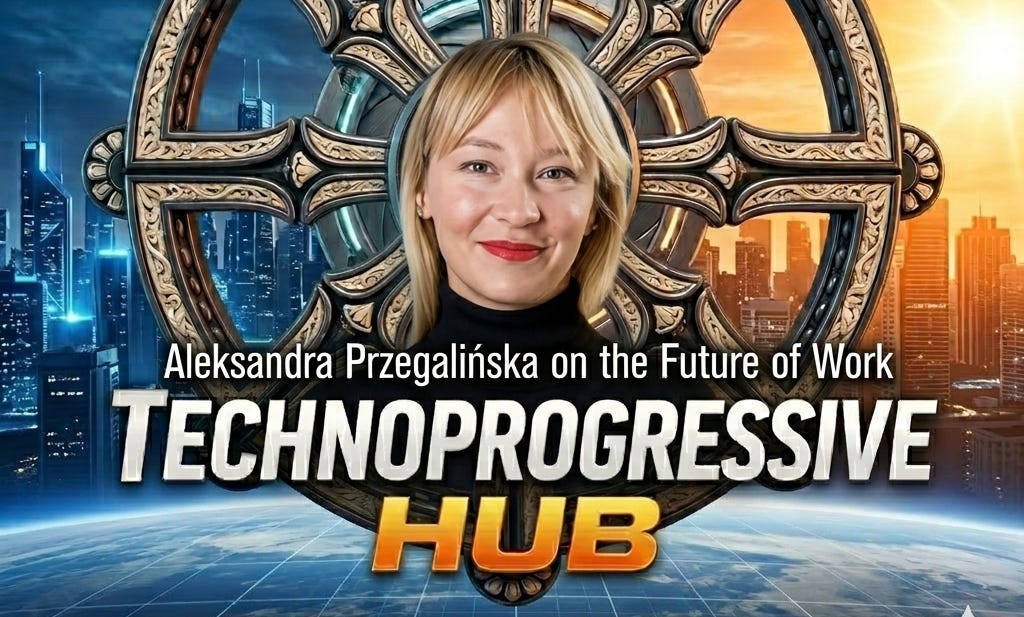
    Aleksandra Przegalińska on the Future of Work

    Today on Technoprogressive Hub we’re speaking with Aleksandra Przegalińska, a philosopher and social scientist of AI. Dr. Przegalińska is Vice Rector and the head of the Human-Machine Interaction Research Center at Kozminski University in Poland. Currently she is Senior Research Associate at the Center for Labour and Just Economy at Harvard University. She works on the future of work, humanoid and social robots, and wearable technologies. She is co-author of the book Collaborative Society and Debating Universal Basic Income. Links Collaborative Society (MIT Press), Aleksandra Przegalińska and Dariusz Jemielniak Debating Universal Basic Income: Pros, Cons, and Alternatives, Aleksandra Przegalińska and Robert Wright Aleksandra Przegalińska on Google Scholar Aleksandra Przegalińska on Researchgate This is a public episode. If you would like to discuss this with other subscribers or get access to bonus episodes, visit technoprogressives.substack.com

    • Transcript
  • April 10 · 58 min

    How Technoprogressive is Bernie/AOC's AI Data Center Proposal?

    This week on Technoprogressive Hub, Eli, Matteo and J discuss the legislation proposed by Alexandria Ocasio-Cortez and Bernie Sanders to restrict the building of AI data centers. “Opposing AI’ is Luddite, not technoprogressive, but the sentiment against oligarchs, AI and data centers is so strong now that we may need to accept some Luddite positioning to get the Left to promote desirable AI safety and regulation. Links “Seizing the Data Center Buildout for Grid Modernization” by Jane Flagal https://www.searchlightinstitute.org/research/seizing-the-data-center-buildout-for-grid-modernization/ “AI data center fight blurs political lines” Axios https://www.axios.com/2026/01/16/ai-data-center-fight-blurs-political-lines “New Bernie Sanders AI Safety Bill Would Halt Data Center Construction” WIRED https://www.wired.com/story/new-bernie-sanders-ai-safety-bill-would-halt-data-center-construction/ “AI & robotics briefing: Data centres’ huge ‘water footprint’ becomes clear amid AI boom” by Katrina Krämer https://doi.org/10.1038/d41586-023-03768-y “AI Data Centers: Big Tech’s Impact on Electric Bills, Water, and More” by Nicole Greenfield https://www.consumerreports.org/data-centers/ai-data-centers-impact-on-electric-bills-water-and-more-a1040338678/ “AI data center” Wikipedia https://en.wikipedia.org/w/index.php?title=AI_data_center&oldid=1346973952 “AI, Data Centers, and the U.S. Electric Grid: A Watershed Moment” by Belfer Center for Science and International Affairs https://www.belfercenter.org/research-analysis/ai-data-centers-us-electric-grid “Sanders, Ocasio-Cortez push bill to impose AI data center moratorium” by Matthew Daly https://apnews.com/article/data-centers-ai-electricity-sanders-aoc-65651bd28c3d911d18eeb46cd54f4c75 “Why is Everyone So Wrong About AI Water Use?” by Hank Green This is a public episode. If you would like to discuss this with other subscribers or get access to bonus episodes, visit technoprogressives.substack.com

    • Transcript
  • S1 · E10
    March 24 · 1 hr 5 min

    ProWorker AI?

    ProWorker AI? This week on Technoprogressive Hub, Eli, Matteo and J are discussing proposals for pro-worker artificial intelligence laws. Recently David Autor, Daron Acemoglu, and Simon Johnson and the UK Trades Union Council have proposed a set of regulatory and legal reforms to protect workers from automation and enhance human expertise. Arguably technoprogressive, will they only work briefly until AI surpasses human labor? Links “Building a pro-worker AI innovation strategy” UK Trade Union Council “Can A.I. Be Pro-Worker?” by John Cassidy “Can We Have Pro-Worker AI? Choosing a path of machines in service of minds” by Daron Acemoglu, David Autor, and Simon Johnson (Hamilton Project) “Building pro-worker artificial intelligence” by Daron Acemoglu, David Autor, and Simon Johnson (NBER) This is a public episode. If you would like to discuss this with other subscribers or get access to bonus episodes, visit technoprogressives.substack.com

    • Transcript
  • March 19 · 1 hr 10 min

    Mark Walker: Philosopher for the Future

    On Technoprogressive Hub, Dr. J. spoke with philosopher Mark Walker about moral enhancement, universal basic income, theology and technoprogressivism. Mark Walker holds the Richard L. Hedden Endowed Chair in Advanced Philosophical Studies at New Mexico State University. Links Happy-People-Pills For All by Mark Walker Free Money for All by Mark Walker Mark Walker’s Papers This is a public episode. If you would like to discuss this with other subscribers or get access to bonus episodes, visit technoprogressives.substack.com

    • Transcript
  • March 16 · 1 hr 48 min

    The Pro-Human AI Declaration

    The Pro-Human AI Declaration On Technoprogressive Hub, Matteo and J react to the Pro-Human AI Declaration. Co-signed by major progressive and conservative organizations and leaders, does it finally represent a tenuous alliance of the populist Right with the progressive Left, united by anti-AI Luddism? Or is the Declaration actually a technoprogressive project dressed as Luddism? Links Pro-Human AI Declaration “Inside the secret meeting that led to the AI political resistance” by Tina Nguyen “Pro-human AI declaration brings together unlikely group calling for trustworthy tech” by Jared Perlo This is a public episode. If you would like to discuss this with other subscribers or get access to bonus episodes, visit technoprogressives.substack.com

    • Transcript
  • March 14 · 1 hr 17 min

    Post-Labor Economics

    Post-Labor Economics With David Shapiro David Shapiro is a futurist, author, social media producer, and one of the most prolific popularizers of post-labor economics — the argument that accelerating automation isn't a bug to be managed but a civilizational transition to be designed. Drawing on ideas ranging from universal basic income and sovereign wealth funds to the radical deflationary potential of AI-driven production, he makes the case that we are approaching a world where human labor is simply no longer the primary mechanism for distributing prosperity. Find David at Kickstarter - Patreon - Substack - Bluesky - X - LinkedIn - Youtube This is a public episode. If you would like to discuss this with other subscribers or get access to bonus episodes, visit technoprogressives.substack.com

    • Transcript
  • March 11 · 1 hr 12 min

    Toward a Technoprogressive Future

    David Wood is a prominent British futurist, author, and pioneer of the smartphone industry as a co-founder of Symbian, the world’s first successful smartphone operating system. David serves as the Chair of London Futurists, one of the world’s largest foresight communities, as the Executive Director of the Longevity Escape Velocity (LEV) Foundation, and as a member of the IEET Board of Directors. We critique both the "bioconservative" resistance to human modification and the "libertarian" approach to transhumanism, arguing instead for state-supported access to these tools to prevent deepening global inequality. Finally, the discussion underscores the necessity of international cooperation and institutional reform to manage the existential risks and ethical dilemmas posed by the accelerating pace of technological change. David has authored or edited over a dozen books, including: * Transcending Politics: A roadmap for technoprogressive governance. * Sustainable Superabundance: A vision for a post-scarcity economy. * The Singularity Principles: A framework for managing the risks of artificial superintelligence. * The Abolition of Aging: An argument for curing senescence as a medical priority. This is a public episode. If you would like to discuss this with other subscribers or get access to bonus episodes, visit technoprogressives.substack.com

    • Transcript
  • March 5 · 1 hr 13 min

    From The End of History to the Age of AI

    Join James Hughes and George Dvorsky for a timely discussion on the Technoprogressive Hub podcast, at the intersection of technology and progressive politics. They explore the Left's identity crisis in Canada, the politics of universal access to GLP-1 drugs, and the evolving landscape of AI regulation. Links “What Ever Happened to the Transhumanists?” by George Dvorsky George on Wikipedia George at Gizmodo This is a public episode. If you would like to discuss this with other subscribers or get access to bonus episodes, visit technoprogressives.substack.com

    • Transcript
  • February 28 · 1 hr 17 min

    From Enshittification to Technofascism

    Today on Technoprogressive Hub, Matteo and J unpack Cory Doctorow’s enshittification thesis, the emerging concept of technofascism, and the connection between them. “The Age of Enshittification” by Kyle Chayka. “The Enshittifcation of Government” by Christian Sarkar “Technofascism comes to America” by Kyle Chayka “Technofascism: AI, Big Tech, and the new authoritarianism” by Mark Coeckelbergh This is a public episode. If you would like to discuss this with other subscribers or get access to bonus episodes, visit technoprogressives.substack.com

    • Transcript
Showing 1–20 of 22 episodes