Skip to content
Artwork for Sudoku Encyclopedia Podcast
LeisureEducation

Sudoku Encyclopedia Podcast

Calvin Sterling

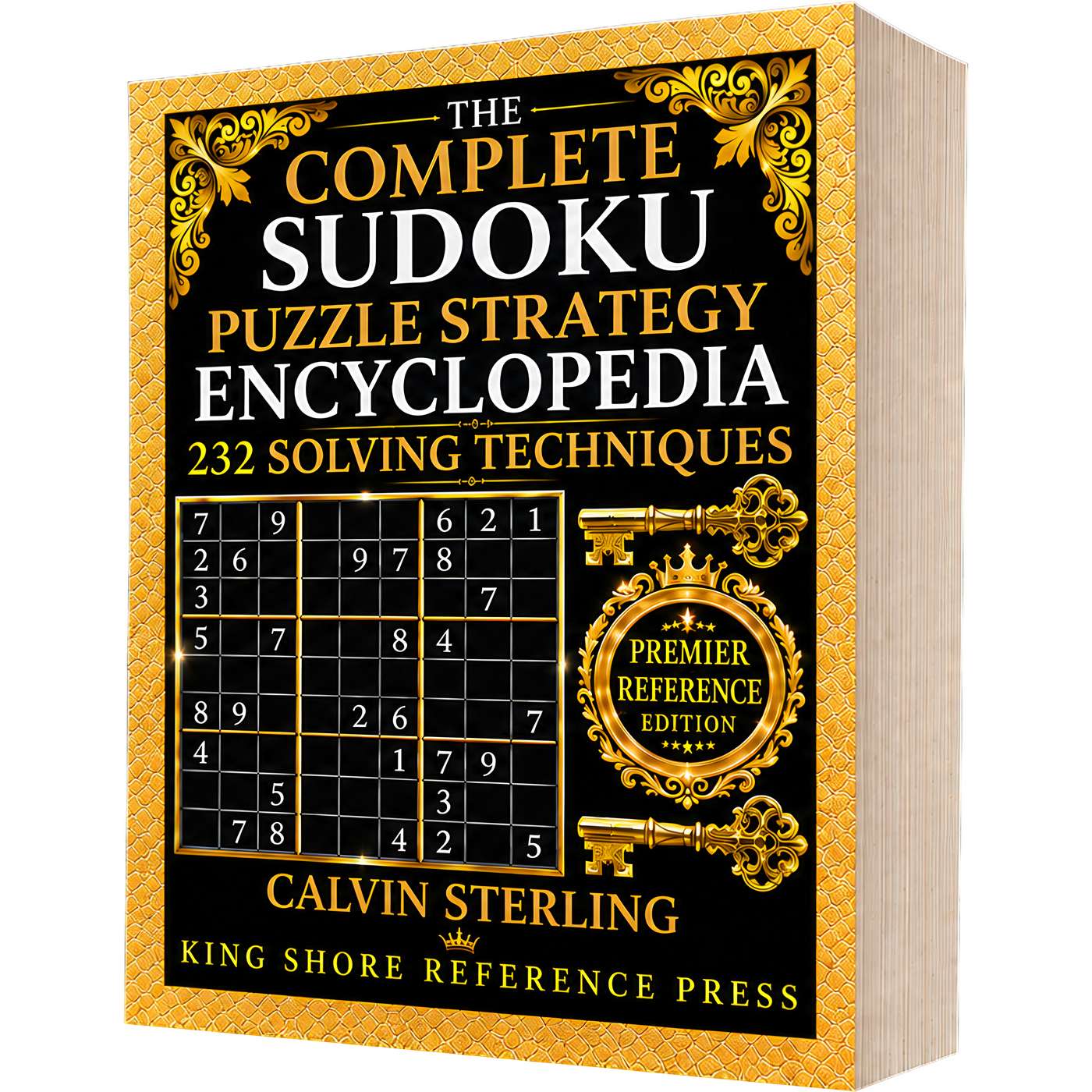
Welcome to The Sudoku Encyclopedia Podcast, the show where we take Sudoku solving strategies one at a time and break them down in plain language, so you can use them in your very next puzzle.

Sudoku strategies covered in the podcast episodes:

Category 1: Foundations, Singles, Intersections & Subsets [14 Solving Techniques]: Full House / Last Digit, Naked Single, Hidden Single, Locked Candidates Type 1, Locked Candidates Type 2, Naked Pair, Hidden Pair, Naked Triple, Hidden Triple, Naked Quad, Hidden Quad, Locked Pair, Locked Triple, Almost Locked Candidates

Category 2: Basic Fish & Single-Digit Geometry [24 Solving Techniques]: X-Wing, Swordfish, Jellyfish, Squirmbag, Whale, Leviathan, Finned X-Wing, Finned Swordfish, Finned Jellyfish, Finned Squirmbag, Finned Whale, Finned Leviathan, Sashimi X-Wing, Sashimi Swordfish, Sashimi Jellyfish, Sashimi Squirmbag, Sashimi Whale, Sashimi Leviathan, Skyscraper, Two-String Kite, Crane, Empty Rectangle, Rectangle Elimination, Extended Rectangle Elimination

Category 3: Advanced Fish & Hybrid Single-Digit Patterns [17 Solving Techniques]: Endo-Finned Fish, Cannibalistic Fish, Siamese Fish, Franken Fish, Finned Franken Fish, Sashimi Franken Fish, Mutant Fish, Finned Mutant Fish, Sashimi Mutant Fish, Kraken X-Wing, Kraken Swordfish, Kraken Jellyfish, Kraken Franken Fish, Kraken Mutant Fish, Multi-Fish, Grouped Fish, Almost Fish

Category 4: Wings, Bent Sets & Short Bivalue Patterns [24 Solving Techniques]: XY-Wing, XYZ-Wing, W-Wing, M-Wing, S-Wing, L-Wing, H-Wing, T-Wing, ER-Wing, WXYZ-Wing, WXYZ-Wing Type 2, VWXYZ-Wing, UVWXYZ-Wing, TUVWXYZ-Wing, Remote Pairs, Almost Remote Pair, Remote Triplet, Chute Remote Pairs, XY-Chain, XY-Cycle, Twinned XY-Chains, Fireworks, Triple Firework, Quadruple Firework

Category 5: Coloring, X-Chains & Candidate Networks [14 Solving Techniques]: Simple Coloring, Multi-Colors, Weak Colors, X-Colors, 3D Medusa, Equivalence Marks, Graded Equivalence Marks, X-Chain, Grouped X-Chain, X-Cycle, Grouped X-Cycle, Broken Wing, Oddagon Forcing Chain, Single Implication Network

Category 6: Uniqueness & Deadly-Pattern Logic [28 Solving Techniques]: Unique Rectangle Type 1, Unique Rectangle Type 2, Unique Rectangle Type 2B, Unique Rectangle Type 2D, Unique Rectangle Type 3, Unique Rectangle Type 3B, Unique Rectangle Type 4, Unique Rectangle Type 4B, Unique Rectangle Type 5, Hidden Unique Rectangle Type 1, Hidden Unique Rectangle Type 2, Hidden Unique Rectangle Type 2B, Extended Unique Rectangle, Unique Rectangle with Missing Candidates, Avoidable Rectangle, Higher-Order Avoidable Rectangle, Unique Loop, Unique Polygon Type 1, Unique Polygon Type 2, BUG+1, BUG+2, BUG+3, BUG+4, BUG Lite, Reverse BUG, Reverse BUG Lite, Uniqueness Clue Cover, Gurth's Symmetrical Placement

Category 7: AICs, Nice Loops & General Chains [20 Solving Techniques]: Alternating Inference Chain, Grouped AIC, AIC with ALS Nodes, AIC with Unique-Rectangle Links, AIC with Exotic Links, Continuous Nice Loop, Discontinuous Nice Loop, Grouped Nice Loop, Double Implication Chain, xyt-Chain, xyz-Chain, xyzt-Chain, Hidden xyt-Chain, Hidden xyz-Chain, Hidden xyzt-Chain, NRC-Chain, NRCT-Chain, NRCZ-Chain, NRCZT-Chain, Bivalue Chain

Category 8: ALS, Set-Link & Exclusion Logic [27 Solving Techniques]: ALS-XZ, ALS-XZ Double Link, ALS-XY-Wing, ALS-XY-Chain, ALS-W-Wing, ALS Chain, Death Blossom, Almost Locked Pair, Almost Locked Triple, Almost ALS, Combined Overlapping ALS Rule, Almost Hidden Set, Almost Naked Set, Bent Almost Restricted Naked Set, Multi-Sector Locked Set, Multi-Sector Naked Set, Multi-Sector Hidden Set, Disjointed Distributed Subset, Almost Disjointed Distributed Subset, Quantum Naked Set, Pseudo-Naked Set, Sue de Coq, Aligned Pair Exclusion, Aligned Triple Exclusion, Subset Exclusion, Subset Counting, Constraint Subsets

Category 9: Exotic Static Patterns, Templates & Exocets [21 Solving Techniques]: Pattern Overlay Method, Braid Analysis, N-Rope, N-Braid, Z-Rope, Z-Braid, SK Loop, Tridagon, Exocet, Junior Exocet, Senior Exocet, Double Exocet, Generic / Generalized Exocet, Almost Generic Exocet, Generalized Exocet with Aligned Targets, Phistomefel Ring, Set Equivalence Theory, Set Link Graphs, Domino Loop, Virus Loop, Incompatible Quads

Category 10: Forcing, Enumeration & Formal Resolution Systems [43 Solving Techniques]: Nishio Forcing Chain, Digit Forcing Chain, Cell Forcing Chain, Dual Cell Forcing Chain, Triple Cell Forcing Chain, Quad Cell Forcing Chain, Unit / Region Forcing Chain, Contradiction Forcing Chain, Dynamic Forcing Chain, Double Forcing Chain, Multiple Forcing Chain, Forcing Net, Cell Forcing Net, Region Forcing Net, Dynamic Forcing Net, Nested Forcing Chain, Nested Forcing Net, Bowman's Bingo, Tabling, Trial and Error, Bifurcation, Backtracking, Brute Force, Z-Chain, t-Whip, Whip, Braid, Generalized Bivalue Chain, Generalized Whip, Generalized Braid, Forcing Whip, Forcing Generalized Whip, Forcing Braid, Forcing Generalized Braid, W-Whip, B-Braid, Technique of Tracks, Triangular Matrix, Block Triangular Matrix, Mixed Block Matrix, Pigeonhole Matrix, Forbidding Matrix, Symmetric Pigeonhole Matrix
Play
  • 7 episodes
  • daily
  • Avg 9 min
  • English
  • #7
    Yesterday · 10 min

    Sudoku Strategy 7 (The Hidden Pair)

    Go to https://mybook.to/SudokuEncyclopedia to learn all 232 Sudoku strategies perfectly with this Sudoku encyclopedia. This is Strategy 7 of 232 from The Complete Sudoku Puzzle Strategy Encyclopedia: the Hidden Pair. WHAT IT IS A Hidden Pair is two digits that can appear in only the same two cells of one house (a row, a column, or a 3x3 box). Those two cells may still hold other candidates, which is exactly why the pair is so easy to miss. HOW TO SPOT IT Step 1: Pick one house. Step 2: For each missing digit, find every cell where it can still go. Step 3: If two digits share exactly the same two cells, and no other cell in that house, you have found a Hidden Pair. THE EXAMPLE IN THIS VIDEO In row 3, the digit 4 fits only in r3c2 and r3c5 (columns 2 and 5). The digit 7 fits only in those same two cells. Row 3 needs both a 4 and a 7, so those two cells must hold 4 and 7 in some order. That makes every other candidate in them impossible: remove the 8 from r3c2 and the 3 from r3c5. WHY IT IS CALLED HIDDEN The pair is buried inside bigger candidate sets. A Naked Pair shows only its two digits in both cells. A Hidden Pair hides among the extras. Memory aid: a Hidden Pair tracks digit positions. A Naked Pair tracks cell contents. COMMON MISTAKE Two cells that share two candidates are not automatically a Hidden Pair. Scan the whole house. If either digit has a third possible spot, it does not count. QUICK CHECK Two digits, two shared cells, one house. Keep the pair, remove the extras, then recheck those cells' columns and boxes for new moves. Follow for more Sudoku strategies, and save this for your next puzzle. Want all 232? The Complete Sudoku Puzzle Strategy Encyclopedia by Calvin Sterling is a full reference to 232 solving techniques, logic chains, and grid patterns, with beginner, intermediate, expert, and grandmaster examples.

    • Transcript
  • #6
    Friday · 9 min

    Sudoku Strategy 6 (The Naked Pair)

    Go to https://mybook.to/SudokuEncyclopedia to learn all 232 Sudoku strategies perfectly with this Sudoku encyclopedia. Sudoku Strategy 6: The Naked Pair Two cells. Two digits. Instant eliminations. This is Sudoku Strategy 6: the Naked Pair, one of the first subset techniques every solver should master. WHAT IT MEANS A Naked Pair is two unsolved cells in the same house (a row, column, or 3x3 box) whose candidates are the exact same two digits. Those two digits must fill those two cells in some order, so neither digit can appear anywhere else in that house. HOW TO SPOT IT 1. Find two cells in one house whose complete candidate lists match exactly and contain only two digits. 2. Scan every other unsolved cell in that house for either pair digit. THE EXAMPLE FROM THE BOOK In Figure 6.1, rows 5 and 7 of column 2 both hold exactly {5, 9}. One must be 5 and the other must be 9. Either way, both digits are reserved for those two cells. So the 5 comes out of row 2 {1, 5, 6} and the 9 comes out of row 4 {1, 6, 9}. Both cells drop to {1, 6}. One pattern, two eliminations. WHY IT IS CALLED NAKED The pair sits in plain sight. Both cells openly show the same two-candidate set, with nothing hidden. COMMON MISTAKE A third candidate in either cell means it is not a Naked Pair. {5, 9} and {5, 7, 9} do not match, so the pair rule does not apply. QUICK CHECK Same house, same two-candidate set: remove those digits from the rest of the house. Then rescan the nearby houses that cross it for new restrictions. Save this for your next puzzle, and follow for more Sudoku strategies explained step by step. Want every technique in one place? Get The Complete Sudoku Puzzle Strategy Encyclopedia by Calvin Sterling. It teaches all 232 solving techniques, with logic chains, grid patterns, and beginner, intermediate, expert, and grandmaster examples. It runs from Naked Singles and X-Wings to Swordfish, XY-Wings, ALS chains, Exocets, and forcing chains. Every method and puzzle grid was carefully verified.

    • Transcript
  • #5
    Thursday · 8 min

    Sudoku Strategy 5: Claiming (Locked Candidates Type 2) Explained

    Go to https://mybook.to/SudokuEncyclopedia to learn all 232 Sudoku strategies perfectly with this Sudoku encyclopedia. One row can clear a digit from the rest of a box. That's Claiming, Sudoku Strategy 5, also called Locked Candidates Type 2. WHAT IT MEANS Claiming starts from a row or column. If every spot for one digit on that line sits inside a single 3×3 box, that box has to get the digit from that line. So you can erase the digit from the box's other cells. HOW TO SPOT IT 1. Pick a row or column and follow one candidate along it. 2. Are all of its spots inside one box? Check the rest of that box for the same candidate. 3. Remove it from the box cells outside the line. Leave every other candidate alone. THE EXAMPLE IN THE VIDEO (FIGURE 5.1) Row 2 can place a 2 only in r2c1, r2c2 or r2c3. All three are in box 1, so box 1's 2 must be in row 2. That means r1c3 can't be 2, and its candidates drop from {2,3,6,9} to {3,6,9}. WHY IT WORKS Row 2 has to put its 2 somewhere. Every option sits in box 1, and a box holds only one 2, so no other cell in box 1 can be a 2. PAIR OR TRIPLE? Three source cells make a claiming triple. Two source cells in one box make a claiming pair. The logic is the same. VERIFY BEFORE YOU ERASE The digit appears nowhere else on the line Every source cell is inside the same box You only remove it from box cells outside the line COMMON MISTAKE Claiming starts from a line and eliminates in the box. Pointing (Strategy #4) starts from a box and eliminates on the line. Don't reverse them. Quick check: Claiming locks on a line, then eliminates in the box. Save this for your next tough puzzle. Have you used Claiming before? Tell me in the comments. Follow for more Sudoku strategies, one technique at a time. Want all 232? The Complete Sudoku Puzzle Strategy Encyclopedia covers 232 solving techniques, logic chains and grid patterns, with beginner to grandmaster examples. Get your copy through the link in the bio.

    • Transcript
  • #4
    Wednesday · 8 min

    Sudoku Strategy 4: Pointing (Locked Candidates Type 1) Explained

    Go to https://mybook.to/SudokuEncyclopedia to learn all 232 Sudoku strategies perfectly with this Sudoku encyclopedia. Strategy 4 of 232: Locked Candidates Type 1, also called Pointing. It's the next move to learn after Full House, Naked Single and Hidden Single. THE RULE Pick one 3x3 box and one digit. If every spot for that digit inside the box lines up on a single row or column, the digit must go on that line inside the box. So you can erase it from the same line outside the box. HOW TO SPOT IT Scan one box for one digit. If its candidates all sit in one row or column, follow that line out of the box and look for the same candidate there. THE EXAMPLE (small digits are candidates; r5c3 = row 5, column 3) 1. Pick box 5, the center box, and look for candidate 5. 2. Check every open cell in the box. Only r5c4 and r5c5 can hold a 5. 3. Both sit in row 5, so the 5 is locked to that row. The box "points" along it. 4. Follow row 5 outside the box. r5c3 still has a 5. That's the target. 5. Erase it. r5c3 goes from {1,5,7,9} to {1,7,9}. WHY IT WORKS Box 5 needs a 5, and only r5c4 or r5c5 can take it. Either way, row 5 gets its 5 inside the box, so r5c3 can't be 5. HOW TO VERIFY • The digit appears nowhere else in the box • The target sits outside the box, on the shared row or column • You erase only that same digit, nothing else PAIR OR TRIPLE Two aligned cells make a pointing pair. Three make a pointing triple. The logic is the same. COMMON MISTAKE The source cells don't need matching candidates. Track only the one digit. But if that digit shows up anywhere else in the box, there's no deduction. Did you already know this one? Tell me in the comments. Save this for your next puzzle, and follow for more Sudoku strategies.

    • Transcript
  • #3
    Tuesday · 9 min

    Sudoku Strategy 3 - Hidden Single

    Go to https://mybook.to/SudokuEncyclopedia to learn all 232 Sudoku strategies perfectly with this Sudoku encyclopedia. Hidden Single: When a digit has only one legal spot in a row, column, or box, it must go there, even if that cell still shows other candidates. How to spot it: 1. Choose one house (a row, column, or box) 2. Follow one missing digit through every unsolved cell 3. If it fits in only one cell, that cell gets it In this example, box 2 still needs a 2, and only one cell can take it. Common mistake: stopping at a candidate that looks isolated. Check every unsolved cell in the house. Follow for more Sudoku strategies. Get all 232 strategies in The Complete Sudoku Puzzle Strategy Encyclopedia.

    • Transcript
  • #2
    Monday · 10 min

    Sudoku Strategy 2 - Naked Single

    Go to https://mybook.to/SudokuEncyclopedia to learn all 232 Sudoku strategies perfectly with this Sudoku encyclopedia. A Naked Single is an empty cell that has exactly one candidate left. Every other digit has been ruled out, usually because it already appears somewhere among that cell's peers. When only one digit survives, that digit has to go in the cell. It's called naked because nothing is hiding it. Look at the cell itself, and the answer is sitting right there in plain view. You may also hear it called a sole candidate. If you know Strategy 1, the Full House, this might sound familiar. A Full House happens when a row, column, or box has just one empty cell left. The Naked Single goes further, because it doesn't need any house to be nearly full. The cell's row might still have five empty cells, its column six, and its box four. That doesn't matter. What matters is that the row, the column, and the box together contain eight different digits. Each house contributes a few eliminations, and when you add them up, only one digit is left standing.

    • Transcript
  • #1
    November 22 · 10 min

    Sudoku Strategy 1 - Full House

    Go to https://mybook.to/SudokuEncyclopedia to learn all 232 Sudoku strategies perfectly with this Sudoku encyclopedia. A Full House happens when a house has exactly one empty cell left. The other eight cells are already filled, so eight of the nine digits are already accounted for. That leaves one missing digit and one open cell to hold it. The missing digit goes in that last cell, and that's the whole strategy. It's called Last Digit for the same reason: you're placing the last digit a house needs to be complete. Why does this work every single time? Because of the one rule that defines Sudoku. Every row, every column, and every box must contain each digit from one to nine exactly once. If eight digits are already in a house, putting anything other than the missing digit in that last cell would repeat a digit that's already there and leave the missing digit with nowhere to go. Either way, the rule breaks. So this placement isn't a guess or a hunch. It's forced. That idea of a forced placement is worth holding onto, because it's the heart of logical solving. Every strategy in the encyclopedia, from this one to the most advanced patterns, works the same way. You prove that a digit must go in a cell, or can't go in a cell, before you write anything down. The Full House is simply the clearest example of that kind of proof, which makes it the perfect place to build the habit.

    • Transcript
Showing 1–7 of 7 episodes