Skip to content
Artwork for Stewart Squared
TechnologyBusinessEntrepreneurship

Stewart Squared

Stewart Alsop II, Stewart Alsop III

Stewart Alsop III reviews a broad range of topics with his father Stewart Alsop II, who started his career in the personal computer industry and is still actively involved in investing in startup technology companies. Stewart Alsop III is fascinated by what his father was doing as SAIII was growing up in the Golden Age of Silicon Valley. Topics include:

- How the personal computing revolution led to the internet, which led to the mobile revolution
- Now we are covering the future of the internet and computing
- How AI ties the personal computer, the smartphone and the internet together

Play
  • 23 episodes
  • weekly
  • Avg 54 min
  • English
Counted on this page — what you have heard stays on this device, so it is not something the list can be paged by.
  • #104
    Thursday · 1 hr 8 min

    Episode #104: 36,000 Companies, One Metric: What DPI Did to Private Equity

    In this episode of the Stewart Squared podcast, host Stewart Alsop sits down with his father Stewart Alsop II to unpack how private equity, venture capital, and growth equity have evolved—and possibly converged—since the 2008 financial crisis. They explore how massive liquidity injections in 2020 fueled a PE buying spree, why the distinctions between investment categories are blurring as everyone gets measured by the same metrics (DPI—distributions per investment), and whether the whole system is starting to break down. The conversation touches on everything from SPACs making a comeback to Elon Musk's SpaceX IPO, the financialization of restaurants, and how even the meaning of terms like "bank" and "cash" are shifting in real time. In the final segment, they bring on surprise guest Tommy Yu, CEO and founder of TurnOn Technologies, to discuss closed-loop payment systems, stored value, and why traditional finance people struggle to see beyond Visa and Mastercard logos even when companies like Starbucks are sitting on $2 billion in unredeemed gift card float. Timestamps 00:00 Introduction and experimental format with a surprise guest, discussing private equity shifts from 2008 through 2023 and massive liquidity changes fueling PE buyouts 05:00 Historical perspective on venture capital evolution starting from the seventies, pension fund rule changes allowing risky investments, and the emergence of hedge funds and private equity differentiation 10:00 Growth equity versus private equity distinctions, SPACs making a comeback after previous failures, and the shrinking number of public companies from 7000 to 4000 15:00 The fundamentals of capitalism and time value of money, government money printing increasing liquidity, and how pension funds now invest heavily in alternative assets 20:00 DPI measurement becoming universal across all investment types, distinguishing between realized and unrealized gains, and how capital calling works in venture funds 25:00 Limited partnerships structure in venture capital, restaurant investments as different from tech startups, and Main Street versus Silicon Valley business models 30:00 Pension funds controlling massive percentages of national assets, asset allocation strategies across different investment vehicles, and everything being measured the same way now 35:00 How institutional definitions are breaking down, terms losing their original meanings, banks becoming something entirely different, and companies essentially functioning as banks themselves 40:00 Chinese centralized system appearing more effective than Western capitalism currently, enlightened dictatorship efficiency, and how professional attention demands are increasing dramatically 45:00 Vibe coding distinctions and keeping up with changing terminology, inviting guest Tommy Yu to discuss his fintech company TurnOn Technologies and stored value systems 50:00 Liberty Mutual's restaurant investment treating food as tradable assets, closed loop versus open loop systems like Starbucks' 8 billion dollar gift card float earning interest 55:00 Regulation falling behind fintech innovation, crypto remaining largely unregulated, and how intelligent investors can differentiate when everyone's doing the same thing 60:00 TurnOn Technologies creating universal stored value systems beyond single companies, neobanks as digital tellers, and younger generations caring more about user experience than traditional banking Key Insights 1. The venture capital and private equity landscape has fundamentally transformed since the seventies when pension funds were first allowed to invest in risky alternative assets. What began as distinct categories with different purposes and metrics has now blurred together, with all investment types being measured by the same standard called DPI or distributions per investment dollar. This measures how quickly investors get their capital back in cash, and the problem is that venture capital now takes fifteen plus years to return capital compared to the historical five to ten years, making it less attractive when banks offer five percent and public markets offer ten percent returns. 2. Private equity has exploded to encompass over thirty six thousand companies in the United States, far exceeding the roughly four thousand public companies that exist today, down from seven thousand in nineteen ninety six. This represents a massive shift where the ownership layer has moved increasingly into private hands, with companies staying private longer and accessing capital through growth equity and private equity rather than going public. The lines between venture capital, growth equity, and private equity have become so blurred that even experienced investors struggle to articulate meaningful differences between these categories. 3. The financial system is becoming increasingly opaque and unregulated despite the perception that finance is highly regulated. New categories like private credit have emerged as what some consider cesspools of activity that regulators cannot keep pace with or even understand. The regulatory framework has fallen so far behind the actual innovations in fintech, crypto, and alternative investments that there is effectively no meaningful oversight in many areas, creating opportunities for both innovation and potential abuse that would have been impossible in previous eras. 4. The fundamental terms and definitions that underpin capitalism are changing so rapidly that experienced investors and business people can no longer rely on historical understanding. What constitutes a bank, what money actually means, what liquidity represents, and even what a company is have all shifted dramatically. Cash itself has become metaphorical rather than physical, and businesses are increasingly functioning as their own banks by holding stored value and earning interest on customer deposits, as demonstrated by Starbucks running eight billion dollars through gift cards with two billion in unredeemed float. 5. The Chinese communist system under Xi Jinping is currently working better for its people than the capitalist system is working for citizens of capitalist countries, creating an existential challenge to the assumption that capitalism is the superior economic model. This represents a historic shift where an enlightened dictatorship with strategic central planning is outperforming the chaotic and unpredictable leadership in capitalist democracies. The comparison suggests that the ideological certainty about capitalism's superiority may need to be reconsidered in light of actual results for ordinary citizens. 6. The democratization of investing through new structures like SPACs and the accessibility of markets has created a situation where the distinction between legitimate investment vehicles and pyramid schemes has become uncomfortably narrow. The entire system increasingly relies on later investors buying out earlier investors at higher valuations, with the public markets serving as the final exit for private investors to realize gains. This raises uncomfortable questions about whether the fundamental structure of modern capitalism differs meaningfully from the Bernie Madoff scheme that collapsed fifteen years ago. 7. The restaurant industry and Main Street businesses represent a parallel economy that operates on completely different principles than Silicon Valley startups, yet investment vehicles are increasingly trying to treat them as comparable assets. Liberty Mutual investing three hundred twenty million dollars in restaurant food credits represents the financialization of everything, where even meals become tradable assets divorced from the underlying business reality. This demonstrates how the investment world is desperately seeking returns in increasingly exotic and risky categories as traditional distinctions break down an...

  • #103
    August 20 · 1 hr 1 min

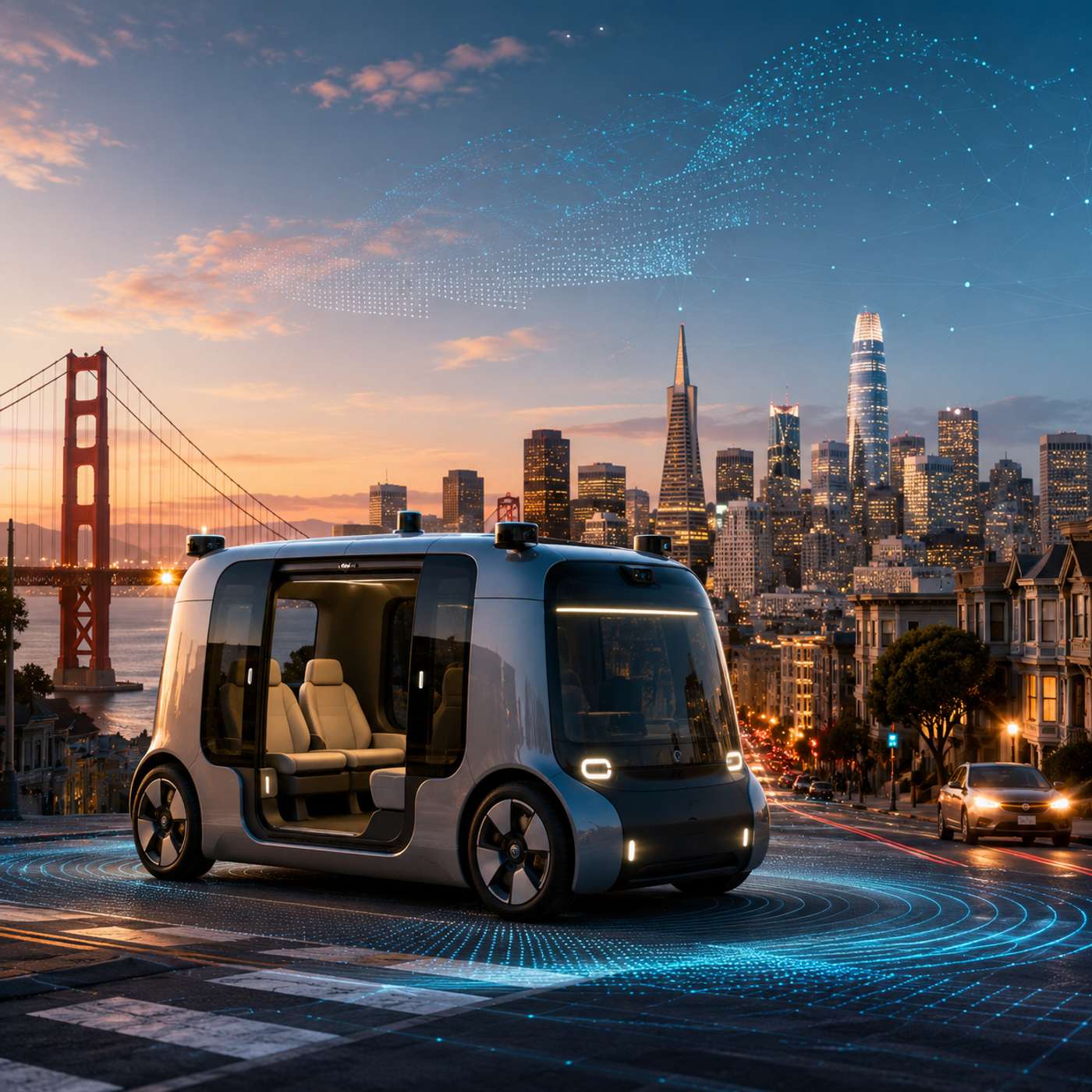
    Episode #103: Scarce to Itself: NVIDIA, Apple, a Driverless Zoox, and the Real Fight Over the Future of Cars

    In this episode of Stewart Squared, Stewart Alsop III and Stewart Alsop II dig into the fast-moving world of self-driving cars — from Cruise's rocky history and Waymo's expansion to Zoox's driverless design and NVIDIA's growing role as the go-to OEM partner for automakers building software- and AI-defined vehicles — before the conversation branches into dual-use tech lessons from Ukraine, the US-China race in autonomy and semiconductors, the DRAM memory shortage squeezing Apple and the gaming industry, Slate's stripped-down electric truck, and a closing riff on performance-based, subscription-driven podcasting. Timestamps 00:00 — Self-driving cars and the fallout from Cruise’s collapse; where AVs are operating now, plus the role of NVIDIA in autonomous vehicles. 00:05 — Software-defined cars, Level 4 autonomy, and why Waymo and Zoox matter; how regulation and city-by-city permits shape rollout. 00:10 — Dual-use autonomy in war zones, liability, and the shift from consumer adoption to fleet adoption; NVIDIA’s place as a supplier, not a prime. 00:15 — Why NVIDIA is strategically positioned across chips, software, and cars; comparisons with Tesla, Rivian, Ford, and GM. 00:20 — China’s open-source AI push, RISC-V, control vs openness, and the tension between state control and innovation. 00:25 — The rise of neo-primes like Anduril, how the Pentagon buys systems, and why the U. S. defense market favors trust and scale. 00:30 — A broader debate on capitalism vs communism, China’s economic strain, and whether the future looks more centralized or decentralized. 00:35 — The memory crisis: DRAM, GPUs, Apple, and video games getting squeezed as AI demand drives prices up. 00:40 — Cheap EV disruption with Slate, new form factors, and how car design may split between utility-first and premium autonomous vehicles. 00:45 — The city itself changing: AVs, urban planning, flying-car ideas, and how autonomy could reshape Los Angeles and beyond. 00:50 — Pricing scarce compute, NVIDIA’s leverage, and the idea that some companies become scarce to themselves. 00:55 — A long-range view: centralized vs decentralized tech cycles, RISC-V, and the possibility of open hardware reshaping everything. Key Insights Autonomous vehicles are consolidating around a small set of platform players. Waymo, Tesla, Zoox, and Rivian lead the US market, while China's fleet is dominated by companies like Geely-backed operations. Regulation moves city by city, so scale depends as much on winning local approval as on the technology itself. NVIDIA has built a stealth position as the OEM backbone of autonomous vehicles. Rather than compete with carmakers, NVIDIA supplies the compute platform nearly every manufacturer relies on, letting it profit from the industry's growth without taking on liability or betting on any single winner. Liability, not technology, is the biggest brake on driverless fleets. Once a car has no human driver, responsibility shifts entirely to the fleet owner. Zoox's steering-wheel-free design in San Francisco is the clearest test case for how that liability question gets resolved. The DRAM shortage is a downstream effect of the AI buildout. Massive GPU demand for LLM training soaked up memory supply, driving up DRAM prices for everyone else — squeezing Apple, gaming consoles, and now the auto industry, which needs growing amounts of compute per vehicle. China's dominance in EVs coexists with deep structural weakness. A shrinking, aging population, price wars that erase margins in sectors like solar, and a government that reins in entrepreneurs when they get too powerful (DeepSeek's blocked IPO) complicate the narrative of unstoppable Chinese industrial growth. "Scarce to itself" describes a new kind of market power. Companies like NVIDIA and Apple aren't scarce because of demand tricks — they're supply-constrained on their own hardware, which lets them set pricing on their own terms rather than compete on it. Podcasting may be shifting from ads to direct subscription models. Inspired by ideas like Trump's paid early-access posts, Stewart Alsop and Stewart Alsop II are testing "performance podcasting" — charging listeners directly for real-time access instead of relying on sponsorships.

  • #102
    August 13 · 51 min

    Episode #102: AI Is Eating the World’s Memory

    In this episode of Stewart Squared, Stewart Alsop III and Stewart Alsop II sit into the shifting ground beneath the AI boom, starting with the strange saga of Leopold Aschenbrenner's hedge fund and the memory chip shortage that's rippling through everything from Apple's product line to the gaming industry, before moving into how OpenAI and Sam Altman's data center spending is reshaping global compute demand, the widening gap between American and international tech ecosystems, China's uneasy relationship with open source AI, and a look at Mira Murati's new venture Thinking Machines Lab and its fine-tuning tool Tinker, wrapping up with some thoughts on what a live, interactive version of the show could look like. Timestamps 00:00 AI bubble and the Leopold Aschenbrunner hedge-fund story; debt, margin pressure, and why memory stocks surged 00:05 memory becomes the bottleneck as AI data centers expand; Apple, Micron, and rising RAM prices 00:10 Korea takes a hit from memory-market swings; contrast with Japan, manufacturing, and the karetsu model 00:15 Live translation tech, Google’s new API, and a side discussion of robotics and Japanese PC history 00:20 Japan’s early PC ecosystem, NTT, Microsoft, Windows, and why standards won the market 00:25 Back to finance: equity vs debt, leverage, Glass-Steagall, and how banking got reorganized 00:30 AI hedge funds, risk, Citadel, margin calls, and the distinction between lending and investing 00:35 Capitalism by starting companies vs buying companies; why money is partly a metaphor 00:40 AI agents, Chrome, and the difference between distributed and federated systems 00:45 Matrix and Nostr, open-source messaging, and the internet’s new borders 00:50 Live audience questions, interactive publishing, and the business potential of real-time conversation Key Insights The AI boom is straining a memory chip supply that can't scale fast enough. Massive spending on AI data centers by companies like OpenAI has driven demand for DRAM through the roof, and because memory factories take years to build, prices have roughly tripled in six months — squeezing everyone from Apple (which is struggling to ship products like the Mac mini) to the broader computer gaming industry. Leverage is what turned a smart bet into a crisis. Leopold Aschenbrenner's "Situational Awareness" hedge fund quadrupled investor money early on by going heavy into AI, but borrowing tens of billions against volatile chip and memory stocks left him exposed when prices tanked — prime brokers like Bank of America, Goldman Sachs, and JPMorgan Chase issued margin calls, and Citadel ultimately bought the distressed assets at a steep discount. Korea's economy is deeply entangled with the memory business. Companies like SK Hynix built Korea into a manufacturing powerhouse for chips, and that same concentration made its stock market especially vulnerable — the market reportedly fell more than 33% in July, a decline worse than the crashes of 1997 and 2015. Deregulation reshaped modern finance in ways still being felt today. The conversation traces a line from Glass-Steagall's separation of commercial and investment banking, through its effective rollback via the Gramm-Leach-Bliley Act, to today's financial holding companies (like JPMorgan owning both Chase and an investment bank) — blurring risk in ways that echo the AI/memory borrowing spiral. National tech ecosystems don't automatically follow American patterns. Japan's PC industry, dominated by NTT, never fully converged on the IBM-clone standard the U.S. market did, and Korea's cultural relationship to gaming and digital life (partly shaped by heavy state investment in nationwide internet infrastructure) diverged sharply from its neighbors, despite a shared heritage. China's relationship with open-source AI is shifting. Having initially embraced open source partly because it seemed easier to control than proprietary Western tech, China now appears increasingly concerned about having lost that control and is working to reassert it. Distributed, interoperable messaging protocols are having a moment. Tools like Matrix and Nostr (open-source alternatives gaining traction partly in response to Meta's restrictions) revive a decades-old dream of software systems messaging each other freely, distinguishing distributed "pub-sub" models from federated ones where all participants must cooperate.

  • #101
    August 6 · 54 min

    Episode #101: Apple's AI Is Finally Here. Why Does It Still Feel Broken?

    In this episode of the Stewart Squared podcast, hosts Stewart Alsop and Stewart Alsop II dig into Apple's rocky iOS 27 rollout and the Apple Intelligence features that still don't quite work, before spiraling into Apple's org chart and headcount, the lost art of building apps, chip design and the Apple 100, open source versus closed source (MLX, the Linux kernel, GitHub vs. GitLab), Claude Code and why Anthropic's terminal-first approach might be winning the AI race, the commoditization debate around Chinese open source models, Adobe's fall from grace and the Postscript-to-Flash saga with Steve Jobs, real-time publishing and the Ben Thompson model for podcasting, and manufacturing hardware from PCBs to Sonos speakers. Timestamps 00:00 — iOS 27 rollout and buggy Apple Intelligence features frustrate both hosts. 05:00 — Debating Apple's headcount, retail vs. corporate split, and designers fleeing to OpenAI. 10:00 — The Apple 100, the blurry line between research and development, and Xerox PARC. 15:00 — Apple's custom chips, open source roots like the Linux kernel and MLX. 20:00 — GitHub origins, Microsoft's enterprise mentality, and life since MS-DOS. 25:00 — Claude Code, Boris Cherny, and why terminal agents are reshaping coding. 30:00 — AI's text-based limits, Chinese open source models, and a coming robotics interview in Japan. 35:00 — GitLab vs. GitHub, what a workbench and compiling actually mean, and Mac performance gripes. 40:00 — Postscript vs. TypeScript, the Courier font, and early PageMaker newsletters. 45:00 — Hot type, the printing press, and why neither host went into industrial robotics. 50:00 — Editing Marine Business magazine and watching Japan and China take over manufacturing. 55:00 — Building PCBs, lessons from Sonos, and pitching a pay-to-listen real-time model. Key Insights Apple's biggest weakness isn't hardware or chips—it's software. Despite two years of hype, Apple Intelligence still creates duplicate calendar events and can't recognize things already scheduled, revealing a company that excels at silicon and operating systems but consistently ships mediocre apps, a gap the hosts trace back to Tim Cook's leadership. Apple's culture runs on a quiet meritocracy called the "Apple 100," a Steve Jobs-era concept where influence isn't tied to title—a junior engineer can be as pivotal as an executive, which explains how the company sustains innovation despite a bloated headcount of roughly 166,000, nearly half of it in retail. Anthropic's edge may not be model quality alone but its decision to build Claude Code around the terminal, treating programming as just another form of text prediction. This bet, credited largely to Boris Cherny, let Anthropic reach developers directly rather than waiting for polished consumer products. The commoditization narrative around AI cuts both ways. As Chinese open-source models close the gap with American closed-source ones, it either means nobody can maintain a lasting lead, or—as one host argues—the opposite: that leaders become nearly impossible to catch once compounding advantages set in. Adobe's arc from a lean systems company to what one host calls a fallen giant shows what happens when a company loses its performance-driven roots. Built on Postscript and page-description technology for the LaserWriter, Adobe eventually prioritized cross-platform reach over speed, echoing Apple's own struggles with app quality. Real-time publishing is emerging as a business model, not just a technical curiosity. Drawing on Ben Thompson's subscription-driven podcast network, the hosts float charging listeners for live access, turning the current ten-day publishing delay from a limitation into a monetizable feature. Manufacturing know-how doesn't transfer easily across domains. Lessons from Sonos scaling hardware in China, and earlier stories from Mercury Marine's engine factories, show that going from prototype to mass production—especially with physical components like PCBs and speakers—demands specialized expertise that even seasoned tech investors admit they lack.

  • #100
    July 30 · 1 hr 4 min

    Episode #100: From Apple's iOS 27 to Anduril's Defense Tech: Where AI's Advantage Really Lies

    In this episode of Stewart Squared, Stewart Alsop III sits down with his father and co-host Stewart Alsop II for a wide-ranging conversation that jumps from Apple's iOS 27 preview beta and the long road to Apple Intelligence, to the trust gap between Anthropic and OpenAI and the rise of digital-twin apps like Sentience, before pivoting into venture capital territory with a candid look at Andoril, Palmer Luckey, and the defense-tech boom reshaping how the primes do business; from there the two work through the surveillance creep of modern police tech, China's near-peer standing against the U.S. and its own reusable-rocket ambitions, and finally land on the state of fintech trust, the SpaceX IPO, and how thirty years of early-stage deal-making stack up against today's AI-driven venture landscape. Timestamps 00:05:00 — Apple Intelligence and the iOS 27 beta merge AI with hardware for an always-on assistant vision. 00:10:00 — Anthropic vs. OpenAI trust, Mira Murati's open-source push, and the Sentience digital-twin app. 00:15:00 — Apple's on-device security compared against Google and Microsoft. 00:20:00 — Tech billionaire philanthropy and legacy: Gates, Zuckerberg, and Jobs. 00:25:00 — Andoril and the personal story of investing alongside Palmer Luckey. 00:30:00 — History of defense-tech venture capital and Andoril's government ties. 00:35:00 — Palantir expanding into Argentina and the rise of predictive policing. 00:40:00 — Data, information, and wisdom in AI-driven knowledge management. 00:45:00 — Token minimizing strategy for running Claude and Codex coding agents. 00:50:00 — Fintech trust: Stripe, Venmo, PayPal, and the Panama Papers. 00:55:00 — SpaceX's IPO and public market valuation reflections. 01:00:00 — Reflexivity, Soros, and LLM token economics shaping VC decisions. Key Insights Apple's iOS 27 beta shows the company finally following through on the Apple Intelligence promise it botched two years ago, and its real advantage isn't the AI itself but that it's fused to hardware holding a user's calendar, messages, and contacts, letting it answer deeply personal questions Google can't match outside its own Pixel devices. Anthropic's positioning as "the Apple of AI" reflects a market increasingly sorting by trust rather than raw capability, with younger users drifting toward open-source alternatives like Mira Murati's newly funded startup, suggesting safety-focused branding alone won't hold loyalty across generations. Apps like Sentience, which build a "digital twin" by ingesting years of email, messages, and calendar history, hint at where personal AI is headed, but the gap between their mobile and desktop functionality shows this category is still early and unevenly built. Venture capital has quietly become the primary funder of military innovation, with firms like Founders Fund turning early bets on companies such as Andoril and Palantir into a broader industry rush toward defense and dual-use technology after decades of stagnant, cost-plus contracting among the traditional prime contractors. Predictive policing tools are reinforcing existing patterns rather than improving outcomes, since they're trained on historical data that sends more patrols into already over-policed neighborhoods, raising questions about transparency as governments adopt surveillance faster than citizens can question it. The venture capital game has shifted dramatically from early-stage bets to massive growth-equity checks, with average valuations jumping roughly ninetyfold over a decade as AI and defense deals now routinely reach into the billions, leaving classic early-stage investors feeling sidelined by their own industry. As AI agents multiply, the real competitive edge is shifting from model performance to token efficiency, with a "token minimizing" approach using multiple coding agents in parallel emerging as a practical way to build software at scale without hitting rate limits or runaway costs.

  • #99
    July 23 · 37 min

    Episode #99: Can Money Buy Meta a Comeback in AI?

    In this episode of the Stewart Squared podcast, host Stewart Alsop and guest Stewart Alsop II dive into Meta's latest AI model releases and their broader issues with user addiction, touching on the European Commission's warnings about addictive features and massive fines totaling $1.4 trillion from US state attorney generals. The conversation ranges from Meta's Meta Super Intelligence Lab and their attempts to catch up to OpenAI and Anthropic, to the impossibility of governments controlling AI development as countries rush to build sovereign models. They discuss NVIDIA's open source robotics models, debate the future of humanoid versus non-humanoid robots, and compare the business approaches of Mark Zuckerberg and Elon Musk. The episode also covers Trump's floating ideas about restricting state-of-the-art AI models to US citizens, China's similar restrictions, SpaceX's recent IPO performance, and the concept of shareholder capitalism as applied to government investments in tech companies like Intel and potentially OpenAI. Timestamps 00:00 Meta releases new AI model and thought-reading technology while facing trillion-dollar fines from state attorneys general for social media harm, particularly to young people 05:00 Discussion of Meta's superintelligence lab attempting to catch up with OpenAI and Anthropic, while their cash-harvesting social media business funds AI development despite past VR failures 10:00 Government inability to regulate fast-moving AI technology, with Trump and China floating ideas about restricting state-of-the-art models to citizens only 15:00 Examining how AI's addictive nature combined with existential fears creates political volatility, plus NVIDIA's open-source robotics models becoming viable alternatives 20:00 Debate over humanoid versus non-humanoid robots, discussing industrial applications and questioning whether humanoid design makes practical sense for factories or homes 25:00 Comparing Elon Musk's technical accomplishments at Tesla and SpaceX with Zuckerberg's social media empire, noting Facebook's real-time scaling innovation happened decades ago 30:00 SpaceX AI IPO analysis predicting failure if stock drops below offering price, plus discussion of shareholder capitalism and Trump's government investment strategy 35:00 Reflecting on information overload in the AI age making it impossible to understand complexity, with neither Trump nor technological developments being predictable anymore Key Insights 1. Meta faces massive legal liability for its addictive social media practices, with state attorney generals demanding approximately 1.4 trillion dollars in total penalties, including a New Mexico jury awarding 375 million dollars in civil penalties and the state separately seeking 2.7 billion dollars in abatement costs. The European Commission has warned Meta about continued use of addictive features, though any meaningful fine would need to be extraordinarily large given Meta's 2 trillion dollar valuation and substantial cash flow. Despite these legal challenges, Meta continues to harvest cash at an astonishing rate from Instagram, Facebook, and Threads by addicting users without regard for their wellbeing, using that revenue to fund their artificial intelligence initiatives after wasting money on virtual reality. 2. Meta's artificial intelligence efforts through their Meta Super Intelligence Lab have been mixed, with their initial LAMA 4 model considered a disaster, but some internal evaluations suggest their upcoming release could potentially help them catch up to OpenAI and Anthropic, possibly even displacing Google as the third accepted foundation model. The key difference between Meta and competitors like OpenAI and Anthropic is that Meta has enormous cash flow from their social media properties to support their AI development, allowing them to spend freely even if they waste money, whereas OpenAI and Anthropic only generate revenue from their AI products. However, there remains skepticism about whether Meta can truly catch up once having fallen behind in the competitive landscape of artificial intelligence development. 3. Governments are fundamentally irrelevant in controlling artificial intelligence development because technology moves too fast for governmental bodies to understand or regulate effectively. Both Trump and China have floated ideas about restricting state-of-the-art AI models to their respective citizens, but these efforts cannot succeed because AI models are infinitely copyable and open source models are becoming increasingly powerful. The reality is that Pandora's box is already open with AI technology, and as countries realize they don't want dependence on China or the United States, they will develop their own sovereign models, creating a mushroom effect that makes control impossible regardless of what governments attempt to mandate or regulate. 4. NVIDIA is becoming increasingly important in the open source AI model space, particularly for robotics applications, as they develop small open source models that can run inside robots without requiring NVIDIA to monetize the models directly since they profit from hardware sales. Jensen Huang has publicly stated that robotics represents the next major innovation, leading NVIDIA to focus on developing CPUs alongside GPUs and integrated systems with small models for physical AI applications. This represents a significant shift where developers no longer need to rely solely on Chinese models, as NVIDIA's open source offerings are becoming genuinely competitive and useful for specialized applications like machine learning cameras and embedded robotics systems. 5. The definition and future of robotics remains highly contested, with significant debate between those advocating for humanoid robots versus non-humanoid specialized robots, and the Wall Street Journal recently published analysis suggesting humanoid robots may not be the optimal path forward. Tesla has been successful partly because they integrated industrial robots from the beginning rather than hand-building cars, reducing production costs substantially, though their humanoid robot demonstrations have not yet resulted in actual factory deployment despite ambitious forecasts. The challenge with humanoid robots includes safety concerns like a hundred-pound robot potentially killing a child if it falls, and the complexity of replicating human capabilities like hands, though companies like Neo recently claimed to have developed hands that work better than humans. 6. The comparison between Mark Zuckerberg and Elon Musk reveals stark differences in technical accomplishment, with Zuckerberg's primary innovation being real-time scaling for billions of users achieved around 2007, after which Facebook has largely exploited that technology to extract money without meaningful additional innovation. In contrast, Elon Musk has accomplished multiple extraordinary technical achievements simultaneously including getting people to buy Teslas, building factories for cars and batteries, changing the distribution system to bypass dealers, building an electric charging network, and creating SpaceX and Starlink. While Musk may be crazy and hard to like, he has genuinely accomplished substantial technical innovations across multiple domains, whereas Zuckerberg has primarily focused on corrupting youth and harvesting data for the past sixteen years. 7. The SpaceX AI initial public offering illustrates important dynamics about public market trust and company valuation, with shares issued at 135 dollars now trading around 145 dollars after initially rising but falling back near the offering price, and predictions suggest it may fall below the offering price before lockup periods expire. The float representing publicly traded shares is only about five percent of total shares, and when more shares become available ...

  • #98
    July 16 · 57 min

    Episode #98: What Apple Gets That the Rest of Tech Doesn't: Trust Scales

    In this episode of the Stewart Squared podcast, host Stewart Alsop sits down with his father, guest Stewart Alsop II, to tackle a wide range of tech topics from AI chip design to cybersecurity vulnerabilities. The conversation covers OpenAI's Jalapeno chip (trained by AI in just nine months), the emerging etched.com platform, and Cloudflare's recent power move against Google, while Stewart shares his experience building real-time games on video calls and experimenting with ESP32 hardware for robotic projects. The discussion also dives into Meta's controversial KYC (know your customer) requirements that got Stewart kicked off Facebook and Instagram, Apple's evolution from hardware company to trusted computing partner under Tim Cook's leadership, the security implications of Chinese-manufactured ESP32 chips, and why hardware-focused companies struggle to adopt AI-driven development practices like using LLMs to eliminate software bugs—all wrapped up with an AI fact-check of their previous episode's claims. Timestamps 00:00 Stewart welcomes listeners and mentions his father's return from travels while he's been enjoying winter in Buenos Aires, setting up discussion topics including etched.com, OpenAI's Jalapeno chip training, and Cloudflare's competitive moves against Google 05:00 Discussion shifts to Meta's controversial KYC implementation and Supreme Court decisions allowing Facebook to require identity verification, with Stewart expressing strong opposition to Meta's practices and considering abandoning their platforms except WhatsApp 10:00 Conversation explores Mark Zuckerberg's personality and Meta's toxic culture, comparing their approach to Apple's user-protective stance and examining how tech companies handle personal data and privacy differently across their platforms 15:00 Deep dive into Apple's historical positioning as user-friendly company under Steve Jobs and Tim Cook, discussing their discipline in product management and how they've maintained consumer trust through consistent privacy protection over decades 20:00 Exploration of hardware complexity and software challenges, including Stewart's robotics workshop using ESP32 microcontrollers where even experienced engineers struggled with basic connectivity issues highlighting system complexity 25:00 Analysis of why hardware companies struggle adopting AI solutions, discussing Apple's bug management approach and questioning why they don't leverage tools like Anthropic's Mythos for eliminating persistent software bugs systematically 30:00 Security architecture discussion focusing on Apple's Unix-based kernel foundation inherited from NeXT, explaining how Avie Tevanian built security into macOS from the beginning making Apple relatively breach-free compared to competitors 35:00 Linux and Unix history explored, examining open source security models and discussing ESP32 operating systems, revealing that FreeRTOS provides embedded operating system functionality for these Chinese-manufactured development boards 40:00 Chinese semiconductor company Espressif discussion, examining potential vulnerabilities in using Chinese hardware while distinguishing between chip-level security and application-layer data access risks in connected devices 45:00 Device Authority company case study about remote device validation and firmware updates, connecting to historical cyberattacks like Stuxnet virus that physically infected Iranian centrifuges without internet connectivity 50:00 Cybersecurity industry overview mentioning Israeli company Check Point as pioneering firm, emphasizing importance of hiring specialized security experts rather than attempting DIY cybersecurity for critical business applications 55:00 Fact-checking segment reviewing previous episode claims about Dario Amodei's credentials, NVIDIA founding dates, software patents, OpenAI's Jalapeno chip timeline, and Waymo's highway incidents with minor corrections noted throughout discussion Key Insights 1. Apple has maintained user trust through a fundamental alignment with individual privacy rather than corporate interests. Unlike companies such as Meta and Microsoft, Apple has built its brand on protecting user data and maintaining security at the operating system level. This cultural commitment, formalized under Tim Cook but rooted in Steve Jobs' vision, has given Apple a distinct competitive advantage with over 2.5 billion users who feel the company is genuinely on their side rather than exploiting them for advertising revenue or data harvesting. 2. Meta is conducting controversial Know Your Customer verification processes that may represent a troubling expansion of identification requirements for social media platforms. Following what appears to be a 2025 Supreme Court decision, Facebook and Instagram are implementing KYC protocols previously reserved for financial institutions, potentially to legally collect identifying information for AI model training. This practice has driven some users to abandon Meta platforms entirely, viewing it as an unacceptable intrusion that violates the original spirit of personal computing. 3. Hardware-focused companies struggle to adopt AI coding tools because their engineering culture emphasizes control and deterministic systems. Companies like Apple, despite their technical sophistication, remain slow to implement AI solutions for tasks like bug elimination because their hardware-oriented workforce consists of control-oriented engineers uncomfortable with the probabilistic nature of AI systems. This cultural resistance prevents them from fully leveraging tools that could theoretically eliminate persistent software bugs that have plagued their ecosystem for years. 4. Security architecture fundamentally differs between operating systems, with Unix-based systems maintaining inherent advantages. Apple's security strength derives from the Unix kernel inherited from NeXT in 1997, which was designed with security as a core principle. This foundation underlies all Apple operating systems today, from macOS to iOS. In contrast, Microsoft's Windows has never achieved comparable security, making it constantly vulnerable to exploitation despite being the standard for government systems, which represents a significant ongoing risk. 5. The Chinese technology ecosystem, particularly in embedded systems and semiconductors, presents complex security considerations that are more political than technical. Companies like Espressif, which manufactures the ESP32 microcontroller chips, are headquartered in Shanghai and dominate the affordable IoT device market. However, because much of this technology uses open source software like Linux, the actual security risks are less about the hardware itself and more about higher-level software implementations that could potentially access personal data, making concerns somewhat overblown outside of China's Great Firewall. 6. The transition from traditional software development to AI-assisted coding is democratizing hardware prototyping in unprecedented ways. Non-engineers can now successfully program microcontrollers and build functional robotic systems using AI coding assistants, while ironically, experienced electrical and software engineers sometimes struggle with the same tasks due to their ingrained approaches. This represents a fundamental shift in who can participate in hardware development, though it also introduces new considerations around security and trustworthiness of the resulting systems. 7. Modern cybersecurity remains a constant race between attackers and defenders who possess equivalent knowledge and capabilities. The distinction between white hat and black hat hackers is merely one of intention rather than skill, as both groups operate with the same information simultaneously. Historical examples like the Stuxnet attack on Iranian centrifuges demonstrate tha...

  • #97
    July 9 · 1 hr 3 min

    Episode #97: How AI Is Rewriting the Rules of Computing

    Stewart Alsop sits down with his father, Stewart Alsop II, to unpack what chip design even means anymore, starting with OpenAI's Jalapeno chip and the wild claim that it was designed in nine months using their own LLM. They trace the CPU from its personal computer origins through GPUs, FPGAs, and the strange new world where anyone might vibe code a chip, then swing into digital projection and showrunner systems at TeamLab and Meow Wolf, autonomous vehicles and the LiDAR fight between Tesla and Waymo, Gaussian splats and world models, a detour into 3D printing and a failed IRL collectibles startup, and a closing stretch on patents, IP trolls, and whether China's open source AI push means the US proprietary model is losing ground. Timestamps 00:00 Apple chips, CPU vs GPU and why chip design feels virtualized now. 05:00 GPUs for video games, why productivity ignored graphics, and how the CPU became a bundle of multiple cores. 10:00 Team Lab and Meow Wolf as digital-projection worlds: projectors, microcontrollers, and the showrunner idea. 15:00 Interactive exhibits as “everything at once,” then a shift into Anthropic, biotech, and the pace of AI innovation. 20:00 Real-time systems, lipsync, world models, and why LLMs struggle with space-time. 25:00 Autonomous vehicles: Cruise, Waymo, LIDAR, Tesla’s camera-only approach, and the debate over edge cases. 30:00 More on Waymo vs Tesla, safety incidents, and whether Gaussian splats matter for robotics. 35:00 Chip design, OpenAI’s “jalapeño” chip, firmware, memory shortages, and why Apple memory costs are rising. 40:00 Patents, software IP, LLMs, and how China and the US diverge on open source versus proprietary AI. Key Insights The CPU has quietly become plural. What used to be a single processing unit is now many cores managing memory, disk, and networking all at once — the concept of "central processing" has essentially been virtualized from the inside out. Chip design may no longer require deep technical expertise. OpenAI's Jalapeno chip, reportedly designed in nine months using their own LLM, suggests that designing silicon is becoming something closer to "vibe coding" than a specialized engineering discipline. Digital projection systems like TeamLab and Meow Wolf run on lightweight computing, not heavy processing power. The magic comes from networked microcontrollers and a "showrunner" system, a concept borrowed from television, that keeps hundreds of projected events in sync without conflict. Tesla and Waymo represent two opposing bets on autonomy. Tesla relies purely on cameras and processing power, while Waymo loads its cars with LiDAR, radar, and video. Both approaches still hit real-world edge cases, from Waymo pulling cars off freeways after construction-zone incidents to a fatal Tesla crash with no clear explanation. World models are trying to give machines a sense of space and time. Gaussian splats, used by companies like Marble and Niantic, create detailed spatial reconstructions, but they're not yet real-time, which limits how directly they can be applied to something like robotic driving. Intellectual property often only reveals its value after failure. A collectibles startup pairing physical figurines with digital twins collapsed alongside the NFT market, but the conversation underscores how "IP trolls" and specialists like Nathan Myhrvold later mine failed patents for value nobody recognized the first time around. China's AI progress is closing the gap through an open source strategy the US mostly abandoned. Coupled with Anthropic's accusation that Alibaba scraped its codebase millions of times, the episode frames China's non-profit-driven, open approach as a real competitive threat to America's proprietary model.

  • #96
    July 2 · 46 min

    Episode #96: From Steve Jobs to AI: The Stories That Never Became Data

    In this episode of Stewart Squared, Stewart Alsop III sits down with his father, Stewart Alsop II, for a wide-ranging conversation that moves from a heartfelt tribute to the late Brent Schlender — legendary tech journalist and author of Becoming Steve Jobs — through the history and philosophy of journalism, the concept of the fourth estate, and what it meant to cover Silicon Valley's biggest names up close. The two also dig into Cold War history, Russia's ambiguous relationship with the West, the Alsop family's own journalism legacy, and how AI is reshaping the way we think about memory, personal data, and the historical record. For more on Brent Schlender's work, check out his book Becoming Steve Jobs and Stewart Alsop II's Substack obituary for Brent, where he also shared the iconic Fortune magazine cover featuring Steve Jobs and Bill Gates together. Timestamps 0:00 Brent’s memorial and the jet lag opening, then into who Brent was and his role in tech journalism 5:00 Brent’s journalism background, friendship with major tech figures, and the idea of the three Steves in Steve Jobs’ story 10:00 Why journalists usually stay objective, what the fourth estate means, and how the press acts as a check on power 15:00 The press, patriotism, Cold War context, CIA tensions, and how journalists like Stuart and his uncle navigated American loyalty 20:00 McCarthyism, fear, false accusations, and how brave reporting protected people and challenged demagoguery 25:00 Russia as part West / East, Christianity, borders of identity, and the discussion shifting into Russian history 30:00 Soviet-era travel, tech speeches, old-school publishing, and the problem of reconstructing the past without a digital trail 35:00 History vs. journalism, archives, memory, and why preserving records matters for telling the story later 40:00 Brent’s memorial memories, the Steve Jobs book, and how Brent’s work shaped the industry through insight and relationships Key Insights Brent Schlender stood apart from most journalists because he became genuinely close friends with the people he covered — Steve Jobs, Bill Gates, Larry Ellison — and that access gave him a depth of understanding that produced what many consider the definitive Jobs biography, Becoming Steve Jobs. The fourth estate originated during the French Revolution as a check on the clergy, nobility, and commoners, and evolved in America into a press that sits outside the three branches of government — a concept that only became formalized after the 1920s, largely sparked by Upton Sinclair's exposé of the meatpacking industry. The Alsop brothers — Stewart's grandfather and great-uncle — built their journalistic credibility by taking on Joe McCarthy at the height of his power, which gave them enough reputational armor to withstand the later revelation that they had been informally debriefing the CIA after foreign trips. Russia is neither fully Western nor Eastern — it spans eleven time zones, was shaped by Mongol rule, replaced the Tsar with communism, and at one point sent quiet diplomatic signals about wanting to join NATO, not as a junior member but as a great power on par with the US and China. AI can only build a picture of you from the digital trail you've left behind — and for anyone whose active years predate Gmail, that trail barely exists, making tools like the digital twin app Sentience far less useful for older generations. Journalism and history are fundamentally different disciplines: journalists capture the present moment, while historians piece together the past from whatever fragmentary records survived — a challenge that becomes vivid when trying to reconstruct what Stewart Alsop II actually said in a speech he gave in Soviet-era Moscow. The rationalist movement around figures like Eliezer Yudkowsky, which helped seed effective altruism and shapes thinking at places like Anthropic, may be strong on the technical mechanics of AI but weak on understanding how AI will actually play out in a human world — because humans are not, and have never been, purely rational actors.

  • #95
    June 25 · 59 min

    Episode #95: Schrodinger's Bubble: Nobody's Keeping Up, And That's Okay

    In this episode of the Stewart Squared podcast, host Stewart Alsop sits down with his father, guest Stewart Alsop II, to tackle corrections from last week's show before diving into the rapid pace of AI development and whether anyone can truly keep up. They explore Brian Chesky's new AI lab venture, Anthropic's controversial Fable release and subsequent restrictions by the US government, and Stewart's increasingly frustrating relationship with what he calls an "abusive superintelligence." The conversation shifts to immersive art experiences as Stewart Alsop II reports from Japan, comparing his visit to TeamLab's digital projection exhibits with his investment in Meow Wolf's physical installations. They discuss the business models behind immersive entertainment, the limits of current AI capabilities (spoiler: AGI definitely isn't here yet), and why FFMPEG might be the unsung hero of modern video software. The episode wraps with reflections on Japan's art island Naoshima and the future of live streaming the podcast. Timestamps 00:00 Welcome and experiment announcement: Stewart introduces a new fact-checking approach for the podcast, explaining how they'll correct previous episodes while maintaining their improvisational conversation style. 05:00 Correcting last week's record: The hosts address three mistakes from the previous episode regarding Brian Chesky staying as Airbnb CEO, Anthropic's revenue numbers, and NVIDIA's history with Apple's Mac computers. 10:00 The impossibility of catching up: Discussion of Stewart II's newsletter concept about falling behind in the AI race, examining Meta and XAI's struggles to compete with leading AI companies despite massive investments. 15:00 Schrodinger's bubble theory: Stewart explores whether we're experiencing a tech bubble, comparing current AI acceleration to past technological shifts and discussing uncertainty around market valuations. 20:00 Abusive superintelligence relationship: Stewart describes his frustrating experience with Anthropic's constant changes, quality degradations, and trust issues while building applications dependent on their AI models. 25:00 Enterprise focus and philosophical concerns: Analysis of Anthropic's shift toward enterprise customers, their cult-like hiring practices, and concerns about effective altruism ideology influencing AI alignment decisions. 30:00 Geographic restrictions and sovereignty: Discussion of Fable's sudden unavailability to non-US citizens, prompting exploration of Chinese AI models as alternatives for maintaining independence. 35:00 Immersive entertainment comparison: Stewart II shares impressions from visiting TeamLab in Tokyo, comparing their digital projection-based experiences with Meow Wolf's physical installations and business models. 40:00 TeamLab versus Meow Wolf analysis: Detailed comparison of how TeamLab uses programmable projections for repeatability while Meow Wolf builds physical environments, discussing advantages and challenges of each approach. 45:00 Business model differences: Exploration of capital costs, repeat visitors, and sustainability challenges between TeamLab's digital flexibility and Meow Wolf's expensive physical build-outs in multiple cities. 50:00 Live streaming ambitions: Stewart reveals plans to livestream future episodes using FFMPEG technology, discussing the technical challenges and open-source philosophy behind modern video streaming infrastructure. 55:00 Japan's art island experience: Stewart II describes visiting Naoshima, an island dedicated entirely to art installations including works by David Hockney and Yayoi Kusama's famous pumpkin sculptures. Key Insights 1. The podcast experimented with a new format of correcting factual errors from previous episodes, including clarifications about Brian Chesky remaining as Airbnb CEO while building a separate AI lab, corrections to Anthropic revenue figures, and historical facts about NVIDIA providing GPUs to Apple products until around 2012-2013. This represents an effort to maintain journalistic accuracy despite the improvised nature of their conversations. 2. A central thesis emerged around the impossibility of catching up in the AI race once a company falls behind. Examples include Meta's struggles despite aggressive researcher hiring and expensive talent acquisition, and XAI renting out unused data center capacity to competitors like Anthropic and Google for billions per quarter, suggesting their product is not achieving comparable usage to competitors despite massive infrastructure investment. 3. The concept of Schrodinger's bubble was introduced to describe the current technological moment, where we exist in an uncertain state between revolutionary transformation and speculative excess. Unlike previous acceleration periods in the 1980s-2000s with personal computers or social media's emergence, this acceleration with AI appears unrelenting, and determining whether we are in a bubble is impossible until the bubble either continues or bursts, creating anxiety and excitement simultaneously. 4. Anthropic faces criticism for degrading service quality and implementing paternalistic guardrails on their Fable model, including downgrading performance in certain domains like biotech and cybersecurity, sometimes without user notification. This approach to AI alignment, rooted in effective altruism philosophy, is viewed as potentially deluded and cult-like, prioritizing enterprise customers over individual users while destroying trust through policies like restricting non-US citizens from accessing certain features. 5. The comparison between immersive entertainment experiences TeamLab in Japan and Meow Wolf reveals fundamentally different business models, with TeamLab using digital projection that can be easily reprogrammed versus Meow Wolf's expensive physical builds. TeamLab likely achieves more repeat business through constantly changing digital experiences, while Meow Wolf struggles with high capital costs and limited reasons for visitors to return, suggesting future convergence between these approaches. 6. Current AI capabilities fall short of artificial general intelligence, as demonstrated by persistent failures to solve complex technical problems like real-time video lip syncing despite access to advanced models like Anthropic's Fable. While AI excels at deterministic software tasks with automated tests, it cannot handle subjective domains requiring taste like video production or immersive experiences, revealing fundamental limitations in current large language models. 7. Open source technology like FFMPEG demonstrates how fundamental video and audio processing capabilities remain available to everyone on a level playing field, with major platforms like YouTube, Netflix, and Rumble all using the same underlying tools. This represents a successful counter-model to proprietary complexity from the 1990s, suggesting opportunities for new competitors to build sophisticated streaming and video capabilities without requiring the resources of established tech giants.

  • #94
    June 18 · 51 min

    Episode #94: ARM Wrestling: NVIDIA's Quiet Coup Against Intel

    In this episode of the Stewart Squared podcast, host Stewart Alsop speaks with his father Stewart Alsop II, who joins from Tokyo while Stewart broadcasts from Buenos Aires at 5 AM his time. The conversation covers NVIDIA's new Spark chip announcement and its partnership with Microsoft to bring ARM-based processors to Windows PCs, finally allowing Windows to compete with Apple's performance gains from five years ago when they switched to their own ARM-based M-series and A-series chips. They discuss the competitive dynamics between chip manufacturers, the token apocalypse affecting AI coding assistants like Claude and Codex, and how companies like Anthropic are struggling with inference costs while renting data center capacity from SpaceX's underutilized X AI facilities. The discussion also touches on the rise of small models for on-device AI, the dominance of Chinese models in developing markets, SoftBank's ownership of ARM and history of big bets, and how attention and access to insider deals have shaped the AI investment landscape. For more context on Microsoft's strategy, Stewart Alsop II references a Ben Thompson Stratechery interview with Microsoft CEO Satya Nadella that helped clarify how Windows now runs on ARM architecture. Timestamps 00:00 Stewart Alsop welcomes listeners, explains recording at 5 AM his time, 5 PM in Tokyo Japan, discusses NVIDIA's new announcement about processors and chips for Windows computers 05:00 Discussion of ARM architecture versus Intel chips, Apple's competitive advantage using ARM-based M-series processors, how Windows has fallen behind Macintosh in performance capabilities 10:00 NVIDIA positioning new chip as AI-focused but actually ARM-based architecture, Microsoft modifying Windows to run on ARM, multiple manufacturers producing laptops with NVIDIA chips instead of Intel 15:00 Deep dive into ARM licensing model, SoftBank ownership of ARM, how NVIDIA's CPU competes with Intel while Microsoft adapts Windows for ARM architecture 20:00 Intel's competitive position, Microsoft's alliance with NVIDIA, discussion of GPU versus CPU functions, how graphics processing naturally supports training large language models 25:00 Token apocalypse experience with Claude and Codex, rate limiting issues, moving between coding assistants, quality regressions and improvements in different AI coding tools 30:00 Anthropic efficiency improvements with Opus 4.8, competitive dynamics between Claude Code and Codex, strategy of using multiple subscriptions to avoid rate limiting 35:00 Chinese models as workhorses for global users who cannot afford expensive subscriptions, frontier models limited to Google Anthropic and OpenAI, affordability challenges internationally 40:00 Small models running on devices versus cloud-based large models, Apple's WWDC expectations for integrating models on iPhone, personal computing productivity shifts 45:00 SoftBank history with Masayoshi Son making big bets, ARM acquisition rationale, attention-based access to insider deals, comparison to celebrity entrepreneurs gaining investment access 50:00 Historical perspective on insider access to deals and IPOs, closing remarks about continuing conversation from Japan Key Insights 1. Microsoft and NVIDIA announced a new ARM-based processor called Spark that will run Windows, marking a significant shift in the PC market. This represents Microsoft finally moving away from its dependence on Intel chips, similar to what Apple did five years ago when it introduced its M-series chips for Macintosh computers and A-series for iPhones. The development is positioned as an AI chip for marketing purposes, but the real significance lies in the ARM architecture, which NVIDIA has licensed. This alliance between Microsoft and NVIDIA directly challenges Intel's dominance in the PC processor market and could make Windows machines more competitive with Apple's Macintosh in terms of performance and efficiency. 2. The competitive landscape in AI coding assistants has dramatically shifted, with Anthropic's Claude Code releasing version 4.8 that significantly improved code quality and token efficiency. After experiencing severe rate limiting issues in May due to inference capacity constraints, Anthropic made their coding model much more efficient at the token level, allowing users to accomplish more within existing subscription tiers. Meanwhile, OpenAI responded with Codex to compete with Claude Code's success from last December. This competition has created a situation where programmers are now splitting subscriptions between multiple services, paying for both Codex and Claude Code while using Chinese open-source models as fallback options when they hit rate limits. 3. The token apocalypse revealed fundamental business challenges for AI companies as they struggle to balance inference capacity with growing demand. Anthropic had to make difficult decisions to prioritize enterprise customers over individual users, causing noticeable degradation in their chatbot product quality. The company was spending enormous amounts of inference capacity on making conversations feel natural and philosophically relevant, which proved financially unsustainable. Companies like Uber reportedly burned through their entire token budgets in just three months, highlighting how the rush to maximize token usage became a poor metric for actual productivity, falling victim to Goodhart's Law where a measure that becomes a target ceases to be a good measure. 4. The revenue growth projections for Anthropic demonstrate the explosive commercial potential of large language models. The company expected to end 2025 with 9 billion dollars in revenue, but by the second quarter had revised expectations to 50 billion dollars. This astonishing growth comes from companies paying substantial enterprise budgets for AI services. Meanwhile, SpaceX's X AI data center, built rapidly but underutilized due to poor adoption, has been rented out to both Anthropic and Google for approximately 2 billion dollars per month collectively, showing how infrastructure built for one purpose can be repurposed when the original business model fails to generate sufficient demand. 5. SoftBank's strategic bet on ARM five years ago positioned the company at the center of the current processor revolution. Founded by Masayoshi Son, SoftBank has a history of making large, bold investments over four decades, including early deals with Microsoft for software distribution in Japan. The company took ARM private and then public again, with SoftBank retaining majority ownership. This investment proved prescient as ARM's licensing model became increasingly valuable, especially as Apple, NVIDIA, and others adopted ARM architecture for their processors, making it the de facto standard for CPU design across multiple device categories from smartphones to personal computers. 6. The future of AI appears to be splitting between small models running on devices and large frontier models in the cloud. Apple is expected to announce at WWDC its integration of Google models on the iPhone, utilizing small models that can run locally on the device for personal productivity tasks like calendar and email management, while connecting to cloud-based large language models for more complex operations like programming. This hybrid approach addresses both privacy concerns and cost efficiency, as running everything through cloud-based large language models proves financially unsustainable for everyday personal computing tasks. The industry consensus currently recognizes only three companies as leaders in frontier models: Anthropic, OpenAI, and Google. 7. Chinese AI models are emerging as the workhorses for global markets due to a...

  • #93
    June 11 · 53 min

    Episode #93: Too Big to Question: SpaceX, Wall Street, and the End of Accountability

    In this episode of the Stewart Squared podcast, host Stewart Alsop and guest Stewart Alsop II tackle the explosive SpaceX IPO, conflict of interest in politics and finance, and whether we're heading toward economic collapse or the singularity. The conversation kicks off with them acknowledging they had to restart recording after getting into a heated argument about whether Trump's stock trading and Nancy Pelosi's husband's trades fall into the same category of insider dealing—though neither technically qualifies as illegal insider trading. From there, they dig into the mechanics of the SpaceX IPO, questioning how Elon Musk convinced major banks like Goldman Sachs and Morgan Stanley to support a staggering $1.75 trillion valuation despite the company reporting nearly $5 billion in losses against $18.7 billion in revenue. Stewart II, who actually read the 300-page S-1 prospectus (unlike most people), explains how this IPO could fail and compares it to the infamous WeWork collapse. They explore the manual process still involved in IPOs, the role of stock exchanges from the Dow to NASDAQ to the new Texas Stock Exchange, and how Trump has concentrated executive power in ways that echo—and pervert—Teddy Roosevelt's use of executive orders. The discussion touches on reserve currencies, Argentina's economic history, cryptocurrency's death as a decentralized ideal, and whether the singularity is real or just conspiracy fantasy embraced by wealthy tech elites. Timestamps 00:00 Stewart Squared podcast begins with revealing an argument about Trump and Nancy Pelosi both doing insider trading though it's not technically illegal insider trading 05:00 Discussion shifts to insider trading history from the Great Depression era and how current rules no longer work effectively with both politicians stretching ethical boundaries thin 10:00 SpaceX IPO prospectus analysis begins with focus on Elon Musk's control and conflicts of interest as banks go along with questionable trillion dollar valuation for massive fees 15:00 Investment banking history explored from boutique banks in seventies taking startups public to Internet bubble abuses and evolution through social media crypto and AI eras 20:00 Stock exchanges worldwide discussed including NASDAQ origins in 1971, New York Stock Exchange history, and newer Texas stock exchange where Elon sells shares with fewer reporting rules 25:00 Chevron principle explanation showing how Trump gathered executive power while claiming to fight deep state creating ironic situation of doing more executive overreach not less 30:00 US dollar reserve currency status threatened by massive national debt and interest payments now consuming thirty percent of federal budget with neither party willing to balance accounts 35:00 IPO mechanics and pricing discussed with SpaceX seeking up to two trillion valuation though market expects between one trillion and 1.6 trillion based on Polymarket betting 40:00 Risk factors in SpaceX prospectus examined including losses of 4.9 billion against 18.7 billion revenue creating outrageous 300x price to sales ratio with Elon controlling 85 percent voting 45:00 Argentina economic crisis comparison drawn from 1960s through 2001 Corralito when peso devalued from one-to-one with dollar to one-to-four overnight destroying savings 50:00 Singularity discussion concludes episode calling it conspiracy fantasy while drawing parallels between Theodore Roosevelt's executive orders for public good versus Trump's for personal profit Key Insights 1. The discussion reveals a fundamental transformation in how stock markets and Initial Public Offerings function compared to historical norms. The SpaceX IPO represents an extreme example of this shift, with Elon Musk essentially controlling the entire process including valuation, pricing, and disclosure while investment banks like Goldman Sachs, Morgan Stanley, and JPMorgan simply comply because of the massive fees involved. The IPO aims to raise seventy-five billion dollars at a valuation approaching one point eight trillion dollars, despite the company reporting losses of four point nine billion dollars against eighteen point seven billion in revenue, creating a price-to-sales ratio around three hundred times, which defies traditional financial metrics that would normally support such a valuation. 2. The conversation illuminates how conflicts of interest have become normalized at the highest levels of American finance and government. Trump is described as one of the most active stock market investors while serving as president, with correlations noted between his trades and policy announcements, yet this occurs in an environment where regulatory mechanisms no longer effectively constrain such behavior. The traditional checks and balances that prevented insider trading and conflicts of interest have been stretched so thin that nobody can agree on what constitutes inappropriate behavior anymore, creating a system where all rules have become negotiable for those with sufficient power and influence. 3. The decline of traditional IPO processes reflects broader systemic changes in American capitalism. In the nineteen seventies and eighties, boutique investment banks would take startup companies public when they had thirty to fifty million in revenue at reasonable valuations, providing opportunities for companies to access public markets relatively quickly. That system was abused during the Internet bubble of the nineties, leading to companies going public and then declaring bankruptcy within months. Since then, the market has experienced successive bubbles in social media, crypto, and AI, with each cycle becoming progressively more detached from fundamental business metrics and increasingly difficult to distinguish sustainable businesses from speculative ventures. 4. The role of stock exchanges has evolved significantly, with the NASDAQ emerging in 1971 specifically to serve technology companies while the New York Stock Exchange dates back to the 1890s. The conversation reveals that SpaceX is being included in the Dow Jones index immediately upon going public, rather than waiting the typical six months, and that Musk is also selling shares on the newly created Texas Stock Exchange where regulations are less stringent. This fragmentation of markets and willingness to bend traditional rules for high-profile offerings demonstrates how institutional guardrails have weakened, with exchanges competing for prestigious listings by offering more favorable terms rather than maintaining consistent standards. 5. The discussion of reserve currency status reveals existential risks facing the American economy. The United States has maintained the dollar as the global reserve currency, which allows the country to borrow its way out of trouble because all other currencies are indexed to it. However, this system is being abused through massive national debt where interest payments now consume roughly thirty percent of the federal budget. Neither Republicans nor Democrats are willing to bring operating accounts back into balance, and there are now situations where countries trade currencies without reference to the dollar. If the United States loses reserve currency status, the country would face an Argentina-like scenario of economic collapse. 6. The comparison between current conditions and historical economic crashes provides important context for understanding present risks. The speakers identify that the 2008 crash was triggered by real estate, the 2001 crash by the Internet bubble, and 2020 by the pandemic, but the trigger for the next crash cannot be predicted in advance. What makes the current situation particularly concerning is that multiple sectors appear overvalued simultaneously, with unsustainable practices across technology, finance, and government spending. The feeling expresse...

  • #92
    June 4 · 24 min

    Episode #92: The $1.75 Trillion Bet: What WeWork Taught Us About the SpaceX IPO

    On this episode of the Stewart Squared podcast, host Stewart Alsop speaks with his father Stewart Alsop II about the SpaceX IPO and whether such a massive public offering could actually fail. Stewart Alsop II published his analysis just fifteen minutes before recording at sallsop.substack.com, questioning the logic behind the $1.75 trillion valuation and $75 billion raise, especially given that the company loses nearly $5 billion annually. The conversation ranges from the mechanics of IPOs and the SEC approval process to the only recent failed IPO (WeWork), SPACs versus traditional public offerings, the iron triangle of regulators and business interests, and comparisons between political figures' investment track records. Stewart Alsop II draws on his experience living through decades of Bay Area politics and business while analyzing whether institutions will actually buy into what he describes as a bet on Elon Musk rather than traditional fundamentals. Timestamps 00:00 Stewart introduces the episode topic returning to SpaceX IPO discussion and what he learned writing his article about IPO failures 05:00 Discussion of how IPO conspiracy works between SEC regulators bankers and entrepreneurs creating iron triangle relationships that rarely result in failures 10:00 WeWork becomes example of rare IPO failure when institutions refused to buy shares despite SEC approval and banker support 15:00 Examination of Trump's public transparency about money-making versus traditional banana republic secrecy and oligarch networks 20:00 Debate over World Liberty Financial investments and whether Trump family portfolio signals SpaceX IPO success potential 25:00 Heated disagreement about Nancy Pelosi's husband's stock trading and conspiracy theories before ending the episode Key Insights 1. An IPO can fail after the S-1 filing is published, though it has only happened once in recent memory with WeWork. When Adam Neumann pushed bankers to file WeWork's S-1, institutional investors reviewed the disclosed information and refused to buy the stock, preventing the company from going public through the traditional IPO process. This demonstrates that while the SEC, bankers, and company founders may all approve of an offering, the ultimate gatekeepers are the institutional investors who actually purchase the shares. 2. The SpaceX IPO represents an unusual situation where the company seeks a valuation of approximately 1.75 trillion dollars while only raising 75 billion dollars, representing roughly 2% of the company. This creates a challenging situation for potential investors because the upside is limited—for investors to make significant returns, SpaceX would need to become worth more than Apple, Google, or NVIDIA, all of which have twenty-year histories as public companies. This raises serious questions about the rational investment case for institutional buyers. 3. Investment bankers have strong financial incentives to push IPOs through to completion, as they receive approximately 6% of the proceeds. In the SpaceX case, this would amount to 6% of 75 billion dollars. This creates a structural problem in the IPO process where bankers may not adequately filter out questionable offerings, relying instead on the SEC approval process and institutional investor appetite to serve as quality controls. 4. Elon Musk has consolidated multiple companies into SpaceX before proposing to go public, including X AI and the company formerly known as Twitter, in addition to the core SpaceX rocket business and Starlink. While SpaceX itself generates about 4.5 billion in revenue and Starlink generates 11.5 billion in revenue growing at 50% annually, the company is currently losing almost 5 billion dollars per year. This makes the offering a bet on much more than just the space business, and Musk will control 85% of voting shares. 5. SPACs, or Special Purpose Acquisition Companies, represent an alternative path to going public that bypasses the traditional IPO process. These shell companies go public at 10 dollars per share without having an actual operating business, then search for a private company to merge with. WeWork eventually went public through a SPAC after its traditional IPO failed, though the company later went bankrupt. Most SPACs, approximately 95%, trade below their original value, making them generally problematic investment vehicles. 6. Elon Musk has successfully transformed two major industries through Tesla and SpaceX, which distinguishes him from other entrepreneurs like Adam Neumann who had not proven themselves before WeWork. Tesla proved the viability of electric cars, challenged dealer rules to sell directly to customers, built charging networks, and manufactured batteries at unprecedented scale. Similarly, SpaceX developed the reusable Falcon 9 rocket and built Starlink into a business three times larger than the rocket business itself, though Musk nearly went bankrupt three times in the process. 7. The traditional IPO process involves an iron triangle between the SEC regulators, investment bankers, and company founders, with institutional investors serving as the final check on whether an offering succeeds. Approximately 98% of IPO shares are purchased by institutions rather than individual investors. The SEC requires companies to publish an S-1 disclosure document revealing all company details, and if this document passes SEC review, bankers then attempt to sell shares to institutional investors who make the ultimate decision about whether to participate.

  • #91
    May 28 · 46 min

    Episode #91: The $1.5 Trillion Question: Why SpaceX's IPO Math Doesn't Add Up

    In this episode of the Stewart Squared podcast, host Stewart Alsop and his father Stewart Alsop II dig into the major AI and tech IPOs hitting the market, with SpaceX leading the charge at a controversial $1.5 trillion valuation despite just $20 billion in revenue. They break down how SpaceX's massive S-1 filing (so big it crashed Claude's context window) reveals a company now bundling together Starlink, rocket launches, X (Twitter), and the struggling xAI/Grok business—with key researchers having already jumped ship after getting their SpaceX stock. The conversation covers Anthropic's explosive revenue growth (projecting $10 billion in Q2 alone) and their smart move renting Musk's underutilized data center for $1.25 billion, OpenAI's pending IPO, Apple's quiet but strategic AI approach using on-device models and partnering with Gemini instead of OpenAI, and why the institutional investors might balk at SpaceX's aggressive pricing when the IPO drops on June 12th. Stewart II shares his contrarian take: he'd never touch SpaceX stock at this valuation but is seriously considering Anthropic, while explaining the arcane details of revenue recognition, vesting schedules, and why Elon Musk's singular track record lets him operate by different rules than any other CEO. Timestamps 00:00 Welcome and SpaceX IPO discussion begins, exploring the $20 billion valuation and mathematical implications of the massive offering 05:00 Anthropic renting Musk's data center for over a billion monthly while Grok struggles, researchers leaving xAI after receiving SpaceX stock 10:00 Institutional investors may decline SpaceX shares at ridiculous valuation compared to Apple's $400 billion revenue and NVIDIA's profitability 15:00 Apple's on-device AI strategy with small models and Gemini integration while Musk fails in foundation models 20:00 Revenue recognition differences between companies, Anthropic projecting $10 billion quarterly revenue with conservative accounting practices 25:00 SpaceX revenue breakdown showing Starlink at $11 billion dominating over rocket business, Twitter and xAI tucked into valuation 30:00 Comparing SpaceX's $20 billion revenue to Apple's $400 billion while discussing material disclosure requirements in IPO filings 35:00 Musk's singular achievement changing space and car industries, earning unprecedented valuation despite rational market concerns 40:00 Argentine politics and Milei's challenges, parallels to Trump's midterm influence and Peter Thiel's strategic positioning 45:00 Final thoughts on IPO opportunities, avoiding SpaceX at current valuation while considering Anthropic's rapid growth potential Key Insights 1. SpaceX is going public at a 1.5 trillion dollar valuation while generating only 20 billion in revenue, creating significant concerns about whether the IPO will succeed. The company is attempting an unusually fast timeline from S-1 filing on May 20th to going public on June 12th, bypassing the typical two month roadshow process. There is a real possibility the offering could fail because institutional investors who must buy 70% of the shares may decline at this valuation, seeing no path for the stock to appreciate further. 2. The valuation appears disconnected from fundamentals when compared to companies like Apple with 400 billion in revenue worth 4 trillion or NVIDIA with 85 billion in revenue worth 5 trillion. SpaceX would need to grow revenue from 20 billion to potentially 100 billion and achieve profitability to justify even being in the multi-trillion dollar valuation range. The aggressive pricing likely comes from Musk himself rather than the investment banks, as he controls the process with his ownership structure. 3. Anthropic is experiencing explosive revenue growth, jumping from 4 billion in one quarter to a projected 10 billion in the second quarter, putting them on track for 40 to 50 billion in annualized revenue. Most remarkably, they claim they will be profitable in the second quarter, which would be unprecedented for a foundation model company. Their strategic deal to rent Musk's underutilized data center for 1.25 billion monthly solved their infrastructure problems while giving Musk revenue to cover his failed Grok investment. 4. Elon Musk consolidated multiple companies including Twitter, xAI, SpaceX and Starlink into one entity still called SpaceX, creating a complex conglomerate that will be difficult for investors to evaluate. The xAI portion has essentially failed as a foundation model competitor, with dozens of researchers leaving after the merger gave them valuable SpaceX stock as an exit. Twitter contributes roughly 2 billion in revenue, the rocket business does 4 billion, but Starlink is the real driver at 11 billion and growing rapidly. 5. Apple has been quietly working on small on-device AI models embedded in their operating systems rather than pursuing foundation models, and they will likely deliver on their 2024 promises using Google's Gemini instead of OpenAI. This strategic approach of focusing on practical on-device capabilities while partnering for cloud capabilities may prove more successful than trying to build their own foundation model. The company avoided the mistake of announcing capabilities before they were ready, then pragmatically adjusted their approach. 6. Once you fall behind in the foundation model race, you cannot catch up, which explains why both Musk with Grok and Zuckerberg with Meta have struggled despite massive investments. The leaders like Anthropic and OpenAI have such strong momentum and embedded positions that competitors cannot overcome the gap. This dynamic is similar to how Palantir embedded itself so deeply in government and commercial customers before LLMs that they remain entrenched despite new AI capabilities. 7. The simultaneous IPOs of SpaceX, OpenAI and Anthropic represent different investment propositions, with SpaceX being personality and potential driven, OpenAI having revenue recognition questions, and Anthropic showing the strongest fundamentals with explosive growth and a path to profitability. All three will have founder-controlled voting structures similar to Meta where Zuckerberg has 60% control, allowing these leaders to pursue long-term visions regardless of public market pressures. The timing is largely coincidental rather than coordinated, driven by each company's specific capital needs and market conditions.

  • #90
    May 21 · 52 min

    Episode #90: Nobody Knows What Software Is Worth Anymore

    In this episode of the Stewart Squared podcast, host Stewart Alsop II connects from Tangier, Morocco while his son Stewart Alsop III digs deep into the technical challenges of building video conferencing software, specifically tackling the notorious lip sync problem that's consumed his last two months. The conversation moves from mutation testing and DevOps to exploring the future of software consulting, examining why Silicon Valley has long held a visceral distrust of consultants while contractors thrive, and what AI-powered development means for how software gets built and sold in the coming years. Stewart III shares his journey from "vibe coding" to implementing scientific methods in his development process, while his father draws on decades of experience as both a journalist and investor to contextualize the shifting landscape of enterprise software, touching on everything from the rise of SaaS to why companies like Riverside raised $80 million while Stewart III builds competing technology solo in his head. Timestamps 00:00 Welcome from Morocco, Stewart Senior joins from Tangier with Middle Eastern backdrop, Stewart Junior deep in AI development learning mutation testing, integration tests, unit tests, red to green testing 05:00 Discussion of vibe coding evolution to scientific method coding, working on lip sync white whale problem for two months, building pipeline from recording to post-production using FFMPEG diagnostics 10:00 Explanation of how recording works with separate audio and video streams, discovery that browser clocks using tiny crystals don't keep accurate time, learning about MediaRecorder API versus WebCodecs advantages 15:00 Debate about competing with Riverside's 80 million dollar funding, discussion of building specialized software versus SaaS products, exploring turnkey podcasting solutions and business models 20:00 Deep dive into consultancy business model, Stewart Senior's visceral hatred of consultants, discussion of business school graduates becoming consultants or bankers, Microsoft's deliberately small consulting practice 25:00 Exploration of conflict of interest in journalism and investing, disclosure requirements, comparison to New York Times OpenAI lawsuit, discussion of father's unpaid consulting role in DC power centers 30:00 History of consultancies like Arthur Andersen and PricewaterhouseCoopers, role in mergers and acquisitions, example of David Ellison buying Paramount and pursuing Warner Brothers Discovery 35:00 Difference between contractors and consultants, discussion of outsourcing to India, Cloud Factory in Nepal, Ronald Coase economics, Infosys as first big software engineering consultancy 40:00 Stewart Junior's ability to understand code concepts without reading code, using scientific method and chaos monkey development, Netflix streaming techniques, debugging through sufficient motivation 45:00 Sales challenges and negotiation skills in family, working with mentor Zavant on sales frameworks, generosity versus transactional relationships, Turkish bazaar negotiation culture comparison 50:00 Discussion of value creation and belief in sellability, the 80/20 rule of product completion, Adam Neumann and Travis Kalanick examples, Elon Musk as builder not salesman creating entire systems Key Insights 1. The challenge of solving technical problems reveals the importance of understanding methodologies over mastering code itself. Stewart Alsop III spent two months wrestling with a lip sync problem in his video recording system, learning about mutation testing, integration tests, and DevOps along the way. The key insight is that he does not need to read or write code directly anymore. Instead, he needs only a conceptual understanding of frameworks like the scientific method or chaos engineering to direct AI systems to solve complex technical problems. This represents a fundamental shift where domain knowledge and problem articulation matter more than programming expertise. 2. Modern video conferencing systems create synchronization challenges because different computers use tiny crystals to keep time, but these crystals do not maintain perfect accuracy, especially when network conditions fluctuate. The problem is not simply about recording separate audio and video streams and reassembling them. Instead, systems create containers with audio and video together while also recording separate audio tracks, and all these different clocks drift apart from each other. This explains why lip sync issues plague even well funded platforms like Riverside, and why solving this problem requires sophisticated diagnostic systems and conversion pipelines using tools like FFMPEG. 3. The evolution of software business models reflects changing technological constraints and market conditions. In the 1990s and early 2000s, software was sold as one time purchases, often on physical media like cartridges or floppy disks. The shift to Software as a Service in the 2010s happened because it was considered better for customers who did not have to pay large upfront fees and because cloud infrastructure made it feasible. Now, with AI enabling individuals to build complex software themselves, we may be entering another transition period where the SaaS model itself becomes obsolete, though what will replace it remains unclear. 4. Programming represents the first domain where artificial general intelligence has effectively arrived because programming consists entirely of text. Unlike domains involving physical manipulation or subjective judgment, code can be completely represented in language, and decades of open source code provide massive training datasets. This explains why tools like Claude have become so powerful so quickly in programming contexts, and why Anthropic claims that most of its models are now generated by AI systems themselves. The recursive nature of AI writing code to improve AI represents a fundamental breakthrough that does not yet exist in other domains. 5. Consultancies emerged to solve problems that companies could not efficiently solve themselves, but their value proposition is eroding. Large consulting firms like the Big Seven accounting firms grew powerful by integrating complex enterprise software and managing mergers and acquisitions. However, as software becomes easier to build and modify through AI, and as the difficulty of integration decreases, the justification for expensive consultancies diminishes. The antipathy toward consultants in Silicon Valley stems from a belief that they represent companies paying others to think for them rather than developing internal capabilities, and this critique becomes more valid as technical barriers fall. 6. The distinction between contractors and consultants matters for understanding business models and value creation. Contractors are individuals or small teams hired for specific projects who sell their labor directly. Consultancies are businesses built around winning large contracts and then deploying teams to execute them, often with substantial markup. The emergence of platforms like Upwork and the phenomenon of outsourcing to places like India, Nepal, and Kenya created hybrid models where individual profiles often mask small consultant operations. Understanding these distinctions helps clarify what kind of business model makes sense for someone developing new technical capabilities. 7. Believing in the value of what you create is a prerequisite for being able to sell it, and products must be truly finished before they have sellable value. The last twenty percent of any project, whether writing, programming, or product development, represents the hardest work because it involves transforming something functional into something polished and complete. Until the lip sync problem is definitively solved, the video recording system remains a prototype rather ...

  • #89
    May 14 · 1 hr 7 min

    Episode #89: Vibe Engineer Meets Venture Capitalist: A Father-Son Dispute About the Future

    In this episode of Stewart Squared, host Stewart Alsop sits down with his father, Stewart Alsop II, for a wide-ranging conversation that moves from the technical to the historical to the financial. The two kick things off with Stewart's self-proclaimed evolution from "vibe coder" to "vibe engineer," as he tackles the tricky challenge of audio and visual sync in his own custom podcast recording software, positioning it as a direct competitor to platforms like Riverside.fm and Squadcast. From there, they get into a business breakdown of OpenAI and Anthropic, debating whether Claude's recent stumbles are a blip or a sign of deeper trouble, and what an IPO would actually mean for both companies as they look to compete with the big players. The conversation winds through a rich history of personal computing — from Mosaic and Netscape to PageMaker and the LaserWriter, desktop publishing, the browser wars, and how Windows 95 and the early internet reshaped everything — before landing on the turbulent state of the airline industry, the fallout from the Strait of Hormuz blockade, and what the collapse of Spirit Airlines says about fragile business models. Timestamps 00:00 - Stewart introduces vibe engineering, tackling audio-visual sync problems while others debate AI coding tools. 05:00 - Deterministic vs probabilistic software discussed, with Stewart building real engineering skills through coding challenges. 10:00 - Browser history explored, from Mosaic origins at University of Illinois to Netscape's proprietary commercialization. 15:00 - Adobe Flash wars with Steve Jobs examined, leading into desktop publishing revolution with PageMaker and LaserWriter. 20:00 - PostScript origins at Xerox PARC discussed, Adobe founders transforming page composition from compositors to editors. 25:00 - Kinkos, Windows vaporware, and personal computing evolution from 1985 through Windows 95 emergence. 30:00 - Information Superhighway era examined, Netscape on Windows 95 driving personal computer mainstream adoption. 35:00 - Claude versus Codex battle analyzed, Anthropic's trust erosion among engineers and Silicon Valley insider bubble. 40:00 - OpenAI versus Anthropic growth metrics compared, IPO strategies and public market ambitions dissected. 45:00 - Stock fundamentals explained through Tesla versus traditional automakers, quarterly earnings disclosure requirements. 50:00 - Airline complexity breakdown, Spirit Airlines collapse tied to jet fuel hedging failures post-Iran blockade. 55:00 - New capitalism emerging through AI, IPO mechanics enabling OpenAI and Anthropic to compete with tech giants. 01:00:00 - Meta, Apple, Microsoft AI strategies compared, Chinese model competition driving Anthropic's existential decisions. 01:05:00 - Surveillance states, sovereign nations, and India versus small countries as future nonaligned powers debated. Key Insights 1. There is a meaningful distinction emerging between types of AI-assisted builders. Actual engineers use AI tools to boost productivity while still understanding code. Vibe coders use prompt engineering to build things without formal training. And then there are people who have no interest in building software at all because they simply do not need to. 2. Deterministic software is fundamentally different from probabilistic AI outputs. While the current hype around AI agents and markdown-based workflows is real, the underlying products are often insecure and unreliable. Building deterministic software first and layering in AI agents later is a more stable and trustworthy approach. 3. Desktop publishing in the mid-1980s was a landmark moment in personal computing. The combination of the Apple Macintosh, PageMaker, and the LaserWriter printer transferred control of page composition from professional compositors to individual editors and writers, democratizing the ability to produce print materials. 4. The browser wars of the 1990s, particularly Netscape running on Windows 95, marked the moment when the personal computer became meaningful to ordinary people. Before that, roughly a decade passed where developers and companies were still figuring out how operating systems, platforms, and application development were supposed to work together. 5. The MediaRecorder API is a significant but underappreciated limitation in modern browser development. Because Safari does not support it in the same standardized way as Chrome and Chromium-based browsers, many podcast and recording platforms are effectively locked to Chrome, creating an opening for alternative technical approaches. 6. Going public through an IPO gives companies like OpenAI and Anthropic access to capital at a scale that private fundraising cannot easily match. It also imposes mandatory quarterly financial disclosures, which means the public will finally be able to see actual revenue, spending, and growth figures rather than relying on perception and valuation claims. 7. Airlines represent one of the most operationally complex businesses in existence, involving gate leases, dynamic ticket pricing, fuel costs, crew logistics, and massive debt structures. The sudden spike in jet fuel prices following the US blockade of the Strait of Hormuz exposed airlines that had not hedged their fuel costs, contributing directly to Spirit Airlines going out of business.

  • #88
    May 7 · 54 min

    Episode #88: Conspiracy Factist vs. Practical Capitalist: The Alsop Debate

    In this episode of the Stewart Squared podcast, host Stewart Alsop III and his father Stewart Alsop II tackle the state of Silicon Valley, questioning whether it's been captured by corporate interests and discussing how they can maintain an independent voice in technology commentary. Stewart presents a manifesto for building the show in public while avoiding the pitfalls of podcasts like All In and the Technology Brothers Podcast Network (which was recently acquired by OpenAI). The conversation explores the friction between Stewart's millennial conspiracy-factist perspective and Stewart II's boomer practical capitalist viewpoint, covering everything from journalistic integrity and the Extropians movement to AI companies like Anthropic and OpenAI. They debate whether Silicon Valley operates as a conspiracy or simply reflects individual actors pursuing their own interests, discuss the degradation of Claude's performance and shrinkflation in AI services, and examine Apple's secretive corporate culture. Stewart III announces his move toward open source Chinese models and building his own "digital castle" independent of captured institutions, while Stewart II reflects on his fifty years observing the tech industry and maintaining an observer's stance that identifies with consumers rather than companies. Show notes mentioned: - Episode with Jim Ward about TK Media (his father's fund) - Crazy Wisdom interview with SpaceTime DB about real-time data infrastructure Timestamps 00:00 Stewart introduces new podcast format focused on building in public and explains TK Media fund background 05:00 Discussion of Silicon Valley's capture and corruption, comparing independent voices versus bought podcasts like All In and Technology Brothers 10:00 Stewart argues for maintaining journalistic integrity and restraint that differentiates them from paid influencers in tech 15:00 Debate on conspiracy versus corruption in Silicon Valley, with generational perspectives on technology industry evolution 20:00 Stewart's father shares concerns about inability to agree on national purpose and economic anxieties about wealth preservation 25:00 Deep dive into Extropians movement and its influence on modern AI research culture through Less Wrong community 30:00 Analysis of Anthropic versus OpenAI business models and public benefit corporation status discussion 35:00 Security trust levels across tech companies including Amazon, Apple, Microsoft and Google infrastructure comparison 40:00 Product strategy challenges in AI space and Elon Musk's conditional Cursor acquisition deal analysis 45:00 Stewart's migration strategy from Claude to open source Chinese models due to quality degradation and cost sensitivity 50:00 Small models discussion preview and Apple Intelligence approach, planning future episodes on real time technology Key Insights 1. The podcast is establishing itself as an independent voice in technology media at a time when many major tech podcasts have been captured by corporate interests. The hosts point out that Technology Brothers Podcast Network was recently purchased by OpenAI and reports to their political operative, while other prominent shows like All In and Acquired have become platforms where hosts primarily talk their book. This creates a landscape where genuinely independent critical analysis of the technology industry has become rare, making the show's commitment to journalistic integrity and restraint particularly valuable for listeners seeking unbiased perspectives. 2. The generational friction between the hosts creates a unique analytical framework for understanding Silicon Valley. The boomer perspective brings decades of experience observing the evolution of transformative technology since the PC era and the internet, while the millennial viewpoint offers contemporary insights into current technological developments and their social implications. This dynamic produces what they call creative tension, where disagreements about conspiracy theories versus practical capitalism lead to deeper explorations of industry trends. The absence of Generation X and Generation Z voices is noted but the existing dynamic provides sufficient diversity of thought to challenge assumptions and avoid echo chamber effects. 3. Anthropic has distinguished itself from OpenAI through disciplined business practices and consistent strategic execution. As a public benefit corporation, Anthropic must report on public benefit alongside financial results, which creates accountability beyond pure profit motive. The company demonstrated this commitment by withholding the release of their Mythos model initially to allow organizations time to fortify their security, a decision some interpreted as conspiratorial but which actually reflected responsible AI safety practices. In secondary markets, Anthropic shares are valued higher than OpenAI despite smaller funding rounds, suggesting investor confidence in their path to profitability and their methodical approach to expanding functionality for enterprise customers. 4. The AI industry is experiencing significant product management challenges and rapid shifts in business models. Claude made what the hosts describe as a legendary fumble in early March when service quality degraded significantly while the company initially denied problems, leading many users to lose trust and consider switching to open source alternatives. OpenAI responded to competitive pressure from Anthropic by introducing Codex, and the industry is moving away from unlimited usage models toward consumption-based pricing. This transition is forcing users to make economic decisions about which platforms to use, with corporate customers and well-funded startups likely staying with premium services while individual developers and smaller operations migrate toward open source Chinese models. 5. Apple continues to operate with extraordinary secrecy that could be characterized as conspiratorial, though this reflects consistent strategic discipline rather than malicious intent. The vast majority of Apple's employees, estimated at around one hundred sixty-six thousand with most in retail, have never accessed the Apple campus where core product development occurs. The recent leadership transition where Tim Cook becomes executive chairman while focusing on global relationships, particularly with China, suggests Apple is managing complex geopolitical arrangements that require high-level diplomatic engagement. The company's market share in China has increased dramatically recently, indicating these strategies are producing results despite the opaque nature of the arrangements. 6. The hosts identify a fundamental crisis in trust and shared purpose across American society that extends beyond technology into economic and governmental institutions. There is widespread inability to agree on basic facts or institutional reliability, creating anxiety about financial security and the stability of stored wealth. This represents not a coordinated conspiracy but rather an accumulation of incremental changes since World War Two that have led to confusion about governmental responsibility and social organization. The challenge of operating in this environment requires developing frameworks for evaluating which institutions deserve trust, with infrastructure providers like Amazon and Apple generally demonstrating better security practices than companies like Microsoft whose architecture requires security to be applied rather than built in fundamentally. 7. The future of AI development will likely center on small on-device models rather than exclusively cloud-based large language models. Appl...

  • #87
    April 30 · 1 hr

    Episode #87: Tighter Than Microsoft, Smarter Than Apple: Anthropic's Blueprint to Own the AI Stack

    In this episode of the Stewart Squared podcast, host Stewart Alsop is joined by his father, Stewart Alsop II, to talk through a wide range of topics stemming from their shared obsession with AI and technology. The conversation kicks off with Stewart's frustrations around recent changes to Claude that have disrupted his morning workflow of building his own coding and planning agents, leading into a broader discussion about Anthropic's business strategy versus OpenAI's, the Apple-versus-Microsoft analogy for how AI companies are positioning themselves, and why Dario Amodei keeps making bold claims about AGI while struggling to serve existing customers. From there, the two branch out into how large enterprises — from banks to airlines — are using AI to replace legacy systems like COBOL, the historical parallels between today's AI disruption and the industrial revolution, the nature of large organizations and whether they're even a permanent feature of human civilization, and finally, Stewart Alsop II's own career arc from journalist to venture capitalist, including near-misses with Elon Musk's x.com and reflections on what separates great investors like Mike Moritz and John Doerr from the rest of the pack. Stewart Alsop II also mentions his newsletter, where readers can find his takes on figures like Sam Altman, and recommends the book about the founding of Benchmark Capital for anyone interested in what makes a great investment partnership. Timestamps 00:00 - Stewart describes his morning flow state routine, copying and pasting between planning and coding agents while removing SaaS dependencies using Claude. 02:00 - Claude's recent model downgrade sparks frustration, as Anthropic quietly reduces reasoning quality to manage server capacity for new users. 04:00 - OpenAI versus Anthropic contrasted through Sam Altman's business-only approach versus Dario Amodei's strategic geek leadership and company vision. 07:00 - Anthropic's enterprise strategy revealed as enabling internal software developers to build applications faster, replacing outside SaaS vendors entirely. 09:00 - The Claude Code harness and agents.md standardization debate shows Anthropic deliberately rejecting open standards to build proprietary infrastructure. 13:00 - Microsoft and Apple analogies debated, concluding Anthropic resembles Apple's hardware-software integration model rather than Microsoft's vendor lock-in approach. 18:00 - Large company IT departments explored, examining how AI transforms legacy infrastructure management across enterprises with thousands of employees. 22:00 - COBOL replacement emerges as Claude's killer enterprise use case, allowing companies to modernize decades-old systems without breaking operations. 27:00 - Decentralization and democratization of AI discussed alongside Anthropic gatekeeping new models from consumers while slowly releasing them to enterprises. 31:00 - Industrial revolution parallels drawn to current AI disruption, questioning whether large organizations are eternal or merely industrial-age phenomena. 39:00 - Job displacement fears examined through historical disruption patterns, concluding predictions about white-collar job losses remain fundamentally unknowable. 44:00 - Stewart Sr. explains his career shift from journalism to venture capital, driven by financial incentives and timescale differences between reporting and investing. 49:00 - Hall of fame investors compared, revealing no consistent pattern among legends like Draper, Moritz, and Doerr beyond individual instinct and partnership dynamics. 55:00 - Partnerships examined as the core unit of venture capital success, with Andreessen Horowitz and Benchmark cited as rare examples of scalable partnership models. Key Insights 1. Anthropic has shifted its business strategy away from serving individual power users and toward enterprise clients. The company has moved to block third-party harnesses and push all users toward API pricing, signaling a deliberate pivot to lock in large corporate customers who use AI to modernize internal software infrastructure. 2. The difference between OpenAI and Anthropic comes down to strategic consistency. Dario Amodei set a clear direction when Anthropic was founded and has stuck to it, while Sam Altman has bounced between acquisitions and announcements without a coherent throughline. Great companies, as observed historically, define a strategy and follow it. 3. Claude's recent model changes represent a deliberate downgrade in reasoning quality to manage server capacity. The version jump from 4.6 to 4.7 was a number change, not a capability upgrade, and existing users are experiencing degraded relevance realization as Anthropic accommodates a larger user base on the same infrastructure. 4. The most transformative use case for AI in large companies is replacing legacy systems like COBOL with modern applications. AI can analyze decades-old code, identify vulnerabilities, and rebuild infrastructure without disrupting operations, potentially allowing companies to shrink large developer teams dramatically while improving performance. 5. The future of large organizations is not elimination but greater efficiency. Large companies will always exist to manage scaled operations like airlines or manufacturing, but AI fundamentally changes how many people are needed to maintain and develop the software that runs them. 6. Every major disruption in history has produced fear of widespread job loss, yet outcomes have generally been better afterward. Predictions from figures like Dario Amodei about mass unemployment are speculation dressed as logic, and the actual future remains unknowable until it becomes the present. 7. Successful venture capital partnerships have no single replicable formula. Hall of fame investors like Draper, Moritz, and Doerr each use entirely different decision frameworks, and the health of a partnership depends more on how the specific partners interact with each other than on any universal system or methodology.

  • #86
    April 23 · 55 min

    Episode #86: The Orchestration Layer: One Indie Builder's War Against Platform Lock-In

    In this episode of Stewart Squared, host Stewart Alsop sits down with his father, Stewart Alsop II, for a wide-ranging conversation that kicks off with Stewart's frustrations around Anthropic's shifting subscription and API access policies for Claude, including the jump to a $200/month plan and what he sees as a quiet degradation in service quality. From there, the two cover the competitive landscape between Anthropic, OpenAI, and Google's Gemini, touching on the OpenClaw orchestration framework controversy that got developer Peter Steinberger temporarily locked out, Anthropic's strategic positioning with its Mythos model, and the broader geopolitics of AI. They also get into the history of open source software — from Eric S. Raymond's "The Cathedral and the Bazaar" to Red Hat's rise and IBM acquisition — alongside discussions of Linux, Apple's vertically integrated approach with macOS and the new MacBook Air, Microsoft's enterprise legacy rooted in DOS, and how tools like OpenCode and OpenRouter factor into Stewart's plan to reduce his dependency on any single AI provider. Timestamps 00:00 - Stewart describes losing reliable Claude access at the $200/month tier as Anthropic scales aggressively, creating a structural dependency crisis. 05:00 - Anthropic separates API access from subscription plans, pushing power users toward token-based billing while restricting orchestration frameworks like OpenClaw. 10:00 - Peter Steinberger gets locked out of OpenClaw after joining OpenAI, exposing the political tensions between Anthropic and competitors over framework access. 15:00 - Claude Code architecture leaks publicly, benefiting OpenCode competitors while Stewart explores OpenRouter and multi-model API strategies to reduce single-vendor dependency. 20:00 - Open source history surfaces through Eric Raymond, SMTP, Red Hat, and how Linux quietly became enterprise infrastructure through server adoption. 25:00 - Gmail unique identifier quirks lead into metadata surveillance, personal versus Workspace privacy distinctions, and corporate data monetization. 30:00 - France abandons Windows for Linux government systems, raising questions about MacOS legitimacy, Mistral adoption, and how Microsoft inherited DOS vulnerabilities. 35:00 - Apple's vertical integration through Linux kernel, MacBook Neo's iPhone processor, and the $600 laptop threatening Windows market dominance. 43:00 - Anthropic's Mythos security tool sparks skepticism versus credibility debate, with George Hotz challenging claims while banks and treasury officials validate findings. 49:00 - Apple's on-device small model strategy positions it as the personal AI company while Anthropic targets enterprise and OpenAI loses customer identity focus. Key Insights 1. Anthropic has shifted its pricing model in a way that disrupts power users who believed they had purchased an all-you-can-eat plan. The host signed up for a $200 per month subscription expecting full access to Claude, including Claude Code, but found that Anthropic now wants heavy users to move to API-based access and pay separately. This change was made without clear communication and has left users feeling misled, even if the company is technically within its terms of service. 2. The crackdown on orchestration frameworks like OpenClaw reflects Anthropic's effort to control costs as usage scales rapidly. When users build automated agents that run continuously and consume large volumes of tokens, the economics of a flat subscription model break down. Even prominent developers like Peter Steinberger were locked out, signaling that Anthropic is drawing firm lines around what its subscription tier covers. 3. Anthropic is widely seen as the more credible and focused business compared to OpenAI right now. While OpenAI has hundreds of millions of users and keeps shifting strategy, Anthropic has maintained a consistent focus on safety and enterprise customers. This has earned it deep integration across US government and defense infrastructure, making it very difficult for OpenAI to displace it in those environments. 4. The release of Mythos represents a major strategic positioning move for Anthropic. By announcing a model so capable it can find previously undiscovered software vulnerabilities, and by giving enterprise partners early access to harden their systems before public release, Anthropic signaled it operates at a level of responsibility and technical seriousness that no competitor currently matches. 5. Apple's long-term strategy of owning the full vertical stack, from chips to operating systems to devices, is now paying off in the AI era. The new MacBook Neo runs on iPhone-class processors with only eight gigabytes of memory yet performs well enough to run small on-device models. This positions Apple as the company best suited to deliver personal AI that runs locally, without depending on cloud services. 6. The history of open source software, from Linux and Red Hat to Google's Kubernetes, shows that open source succeeds when adoption is broad and the infrastructure layer is deep enough that commercial services can be built on top. Meta's strategy of open-sourcing its Llama models has not worked as intended because being open source does not compensate for falling behind on quality and capability. 7. The competitive landscape of AI mirrors earlier technology battles where controlling a critical infrastructure layer led to enormous financial and political power. Just as Microsoft dominated by owning the operating system and Google disrupted it through cloud and open standards, the AI companies fighting today are really fighting over who becomes the default infrastructure layer for the next generation of computing, with billions of dollars and geopolitical influence at stake.

  • #85
    April 16 · 54 min

    Episode #85: The Conspiracy Theory That Isn't: When Silicon Valley Quietly Changes the Deal

    In this episode of Stewart Squared, host Stewart Alsop is joined by his father Stewart Alsop II to cover a wide range of topics sparked by a growing frustration with Anthropic's recent changes to their subscription model, which leads into a broader conversation about trust in Silicon Valley and the historical patterns of companies like Microsoft, Meta, and OpenAI either earning or burning customer loyalty. The two also get into the competitive dynamics between Apple, Google, and Anthropic in the LLM space, LinkedIn's "Browsergate" controversy, the role of IT departments in an AI-driven world, the RISC-V open-source instruction set architecture and its implications for the US-China tech rivalry, the ongoing transformation of the auto industry around EVs and Chinese competition, and whether the growth imperative still holds for the new wave of AI-enabled one- or two-person businesses. Timestamps 00:00 - Stewart feels suckered by Anthropic's pricing shift, moving from $20 to $200 subscription only to face new usage limits and unexpected charges. 05:00 - Anthropic versus OpenAI trust comparison, with OpenAI buying a podcast signaling lack of strategy while Anthropic remains focused on its original mission. 10:00 - Microsoft's historical distrust traced to MS-DOS licensing deal with IBM, Bill Gates' purely transactional mercantile approach alienating consumers permanently. 15:00 - Apple positioning itself as neutral LLM platform, partnering with Google Gemini embedded at system level while letting users choose their AI. 20:00 - Anthropic compared to early Microsoft serving programmers, while OpenAI risks everything on ego-driven moves despite massive funding rounds. 25:00 - RISC-V open source instruction set architecture origins at Berkeley, China's strategic acquisition of it through Switzerland, semiconductor choke points examined. 30:00 - Microsoft's three CEO eras analyzed, Nadella making IT departments king while Apple cultivated direct consumer trust through Jobs and Cook. 35:00 - Cloud storage and API automation replacing traditional IT gatekeepers, COBOL legacy systems being translated by Claude into modern languages overnight. 40:00 - One-person GLP-1 drug company doing 1.8 billion revenue challenges growth imperative assumptions about venture capital and company scaling. 45:00 - Tesla's lack of model years creating customer engagement problems, Chinese EV dominance threatening legacy automakers still building on gas platforms. 50:00 - Ford rebuilding EV manufacturing from ground up, autonomous vehicles facing real-world infrastructure limitations beyond urban environments. Key Insights 1. Anthropic has built genuine trust among its users compared to competitors like OpenAI and Meta, but that trust is now being tested. The host feels deceived after being upsold to a $200 monthly subscription, only to find usage limits tightening unexpectedly. This sense of betrayal is significant because trust is the foundation of Anthropic's brand identity and competitive advantage. 2. Trust is the single most important strategic asset a technology company can hold. Companies like Microsoft and OpenAI have historically undermined user trust through mercantile or erratic behavior, while Apple consciously built trust into its culture under Tim Cook, turning it into a durable business advantage that competitors have struggled to replicate. 3. Microsoft has never genuinely earned consumer trust, dating back to its early DOS licensing moves. Its core customer has always been the enterprise IT department, not the end user, which is why consumer-facing products like its digital wallet failed and why users have long resented being subordinated to IT gatekeepers who prioritize control over usability. 4. Apple's emerging strategy positions it as a neutral, trusted platform layer for AI, potentially allowing users to choose their own large language model the way they choose a browser. By partnering with Google on Gemini at the system level while remaining open to other providers, Apple avoids the capital cost of training its own foundation models while leveraging its deep consumer trust. 5. Anthropic's greatest contribution may be enabling ordinary people to write software without technical backgrounds. By focusing on programmers first and then making programming accessible to non-programmers, Anthropic shifted the entire conversation around who can build technology and effectively democratized software development. 6. Legacy enterprise IT departments face an existential threat from AI. The traditional bottleneck of having IT mediate between business needs and technical implementation is dissolving as non-technical employees can now build their own applications. Companies that fail to adapt their internal structures around this reality risk falling behind competitors who embrace AI-driven agility. 7. The electric vehicle industry mirrors the broader technology landscape in that companies built from the ground up around a new paradigm outperform those retrofitting old infrastructure. China and companies like Rivian, which designed EVs without legacy constraints, have structural advantages over traditional automakers who tried to electrify existing gas-car platforms.

Showing 1–20 of 23 episodes