Skip to content
Artwork for Simons Foundation Lectures
ScienceMathematicsEducation

Simons Foundation Lectures

Simons Foundation

The Simons Foundation’s mission is to advance the frontiers of research in mathematics and the basic sciences.

Co-founded in New York City by Jim and Marilyn Simons, the foundation exists to support basic — or discovery-driven — scientific research undertaken in the pursuit of understanding the phenomena of our world.

The Simons Foundation’s support of science takes two forms: We support research by making grants to individual investigators and their projects through academic institutions, and, with the launch of the Flatiron Institute in 2016, we now conduct scientific research in-house, supporting teams of top computational scientists.

Links:
Simons Foundation: https://www.simonsfoundation.org
Flatiron Institute: https://www.simonsfoundation.org/flatiron/
Simons Foundation Facebook: https://www.facebook.com/SimonsFoundation
Flatiron Institute Facebook: https://www.facebook.com/FlatironInstitute/
Simons Foundation Twitter: https://twitter.com/simonsfdn
Flatiron Institute Twitter: https://twitter.com/flatironinst
Play
  • 306 episodes
  • daily
  • Avg 53 min
  • English
Counted on this page — what you have heard stays on this device, so it is not something the list can be paged by.
  • Yesterday · 9 min

    Mathematical Impressions: Attesting to Atoms

    Can you combine simple observations and mathematical thinking to show that atoms exist? Uploaded 22-05-14 http://www.simonsfoundation.org/multimedia/attesting-to-atoms/ Learn more about your ad choices. Visit megaphone.fm/adchoices

  • Yesterday · 1 hr 1 min

    Katelin Schutz - Searching for the invisible: how dark forces shape our Universe (March 5, 2020)

    How different would our Universe look with the addition of extra particles and forces beyond what we know? We already have ample gravitational evidence for at least one invisible new particle that has properties unlike any particle we have previously discovered. It is possible that this dark matter is made of many different kinds of particles that experience forces unlike the ones we are familiar with in day-to-day life. If these forces only act on dark particles, it may be difficult to discover them and learn more about what is happening in this dark sector. However, dark matter and visible matter do interact gravitationally at the very minimum, and this fact alone might be a good reason not to lose hope. If there are dark forces affecting the distribution of dark matter in our Universe, then that distribution will gravitationally affect the visible matter that we can see. I will discuss how the gravitational portal between dark and visible matter can constrain dark matter theories where dark matter can dissipate energy, can scatter with itself (elastically or inelastically), or can be born non-thermally in the moments after the Big Bang. I will demonstrate this constraining power by harnessing synergies between astrophysical systems including stars, the local Milky Way, nearby dwarf galaxies, galaxy clusters, and large-scale cosmological structures. More details: https://www.simonsfoundation.org/event/cca-special-seminar-katelin-schulz/ Uploaded 13-03-20 Learn more about your ad choices. Visit megaphone.fm/adchoices

  • Yesterday · 45 min

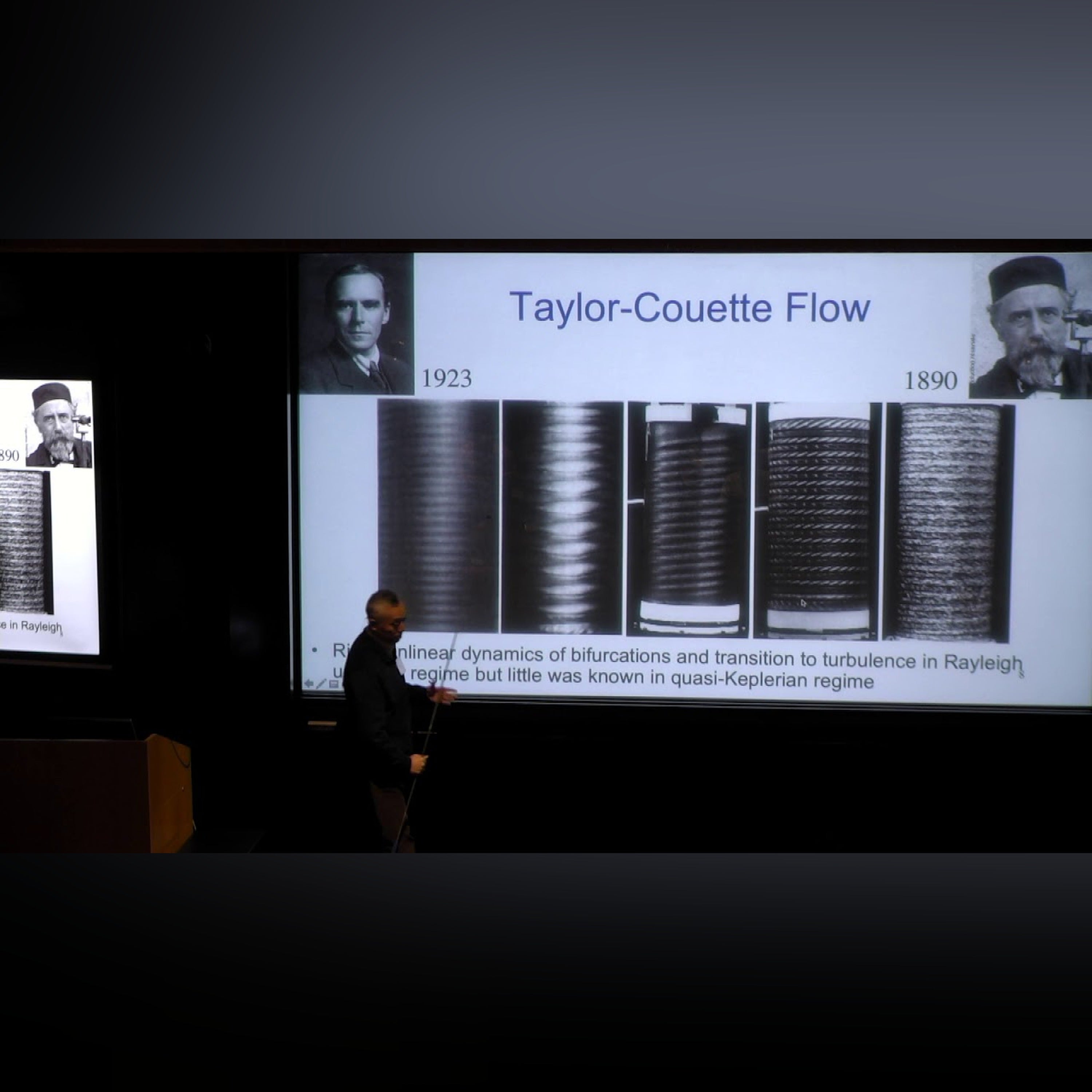
    ICM 2026 Invited Section Lecture - Laure Zanna

    Towards Bridging The Gap Between Data-Driven and Theoretical Turbulence Closures in Stratified Flows Developing turbulence closures remains one of the most challenging problems in fluid dynamics. Turbulence closure models are essential for solving the equations of motion in realistic systems, where fully resolving all relevant scales of motion is computationally infeasible. The Navier–Stokes equations, when filtered to isolate large-scale motions, introduce new terms representing the influence of subgrid-scale turbulent stresses. These terms, which can only be computed directly by resolving the turbulence itself, therefore lead to the closure problem: we must add new equations or introduce assumptions to relate the unresolved scales of motions to the resolved flow. Here we consider the closure problem for oceanic flows, i.e., stratified, Boussinesq, incompressible on a rotating frame of reference. In particular, we focus on a closure for ocean mesoscale eddies, which have horizontal scales of 10-100km and are key to the redistribution of momentum, energy, and tracers in the ocean. In particular, mesoscale eddies can reinject energy and momentum into the large-scale flow through an inverse energy cascade. Specifically, we will explore a range of ocean mesoscale closures - theoretical and data-driven - and explore their connection using analysis and data-driven methods. This talk aims to bridge the gap between novel methods in AI and machine learning and theoretical fluid dynamics to address significant challenges in the physics of turbulence. Uploaded 05-10-26 Learn more about your ad choices. Visit megaphone.fm/adchoices

  • Yesterday · 59 min

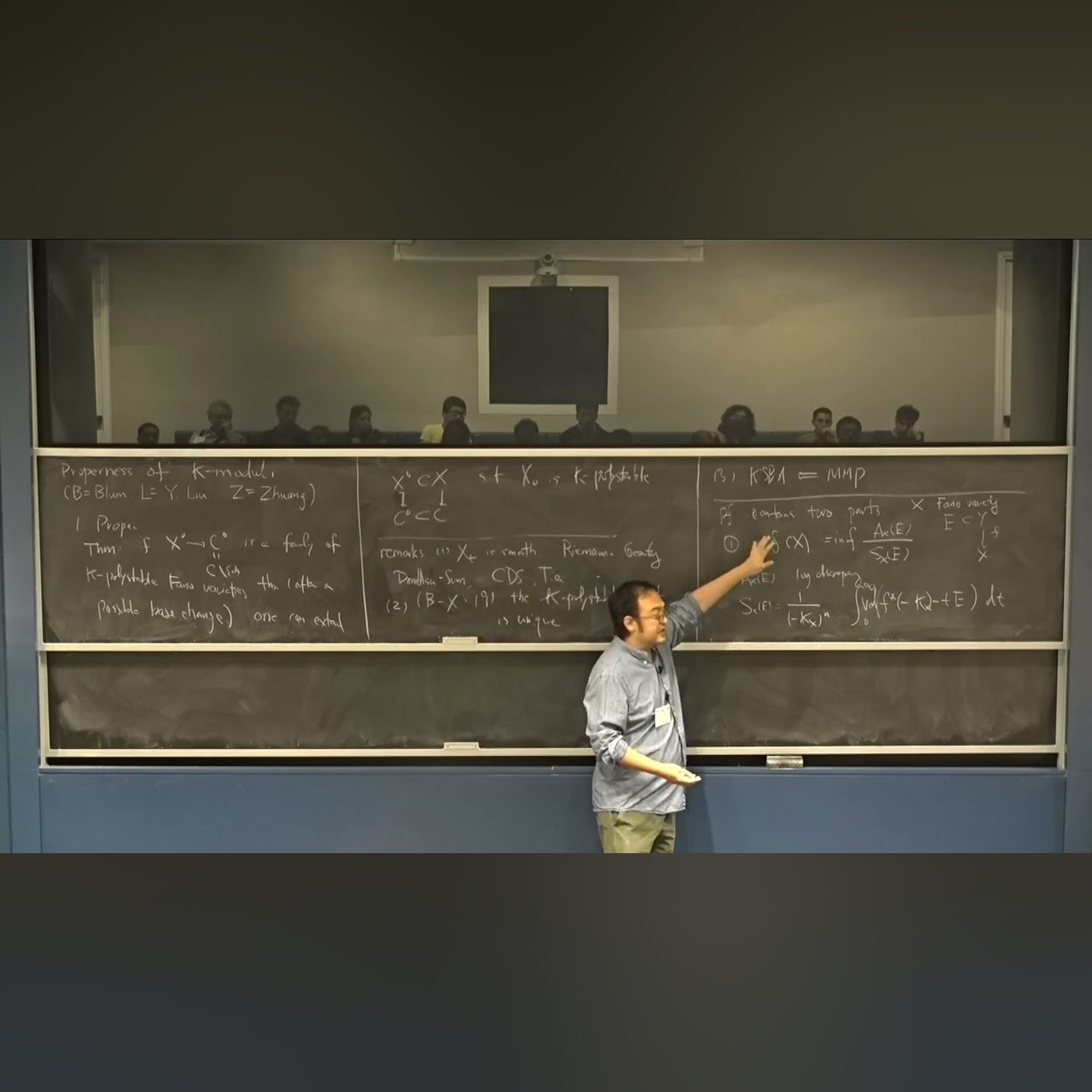
    Chenyang Xu— Properness of K-moduli (Oct. 3, 2025)

    https://www.simonsfoundation.org/event/simons-collaboration-on-moduli-of-varieties-annual-meeting-2025/ 2025 Annual Meeting of the Simons Collaboration on Moduli of Varieties Simons Foundation October 2-3, 2025 Uploaded 27-10-25 Learn more about your ad choices. Visit megaphone.fm/adchoices

  • Yesterday · 1 hr 1 min

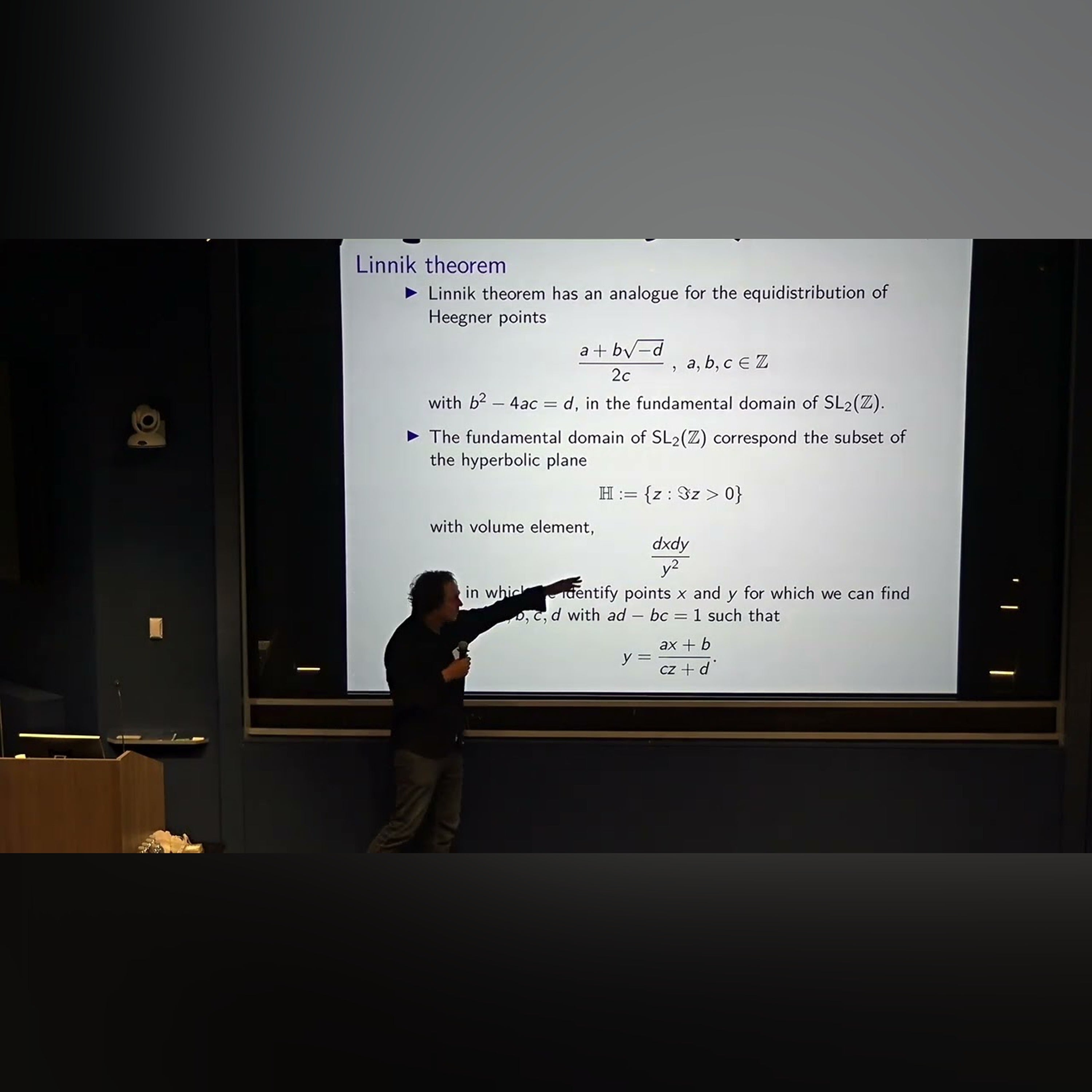
    Maksym Radziwill: Joint Linnik Problems and Siegel Zeros (September 11, 2025)

    We prove the simultaneous equidistribution conjecture of Michel and Venkatesh for the embedding of a torus into two distinct inner forms of PGL_2 assuming a o(1) strengthening of the non-existence of Siegel zeros for quadratic characters. Uploaded 25-09-25 Since the number of such exceptional characters is essentially O(1) per dyadic interval, our approach improves the previous analytic approach of Blomer–Brumley and the ergodic Aka–Einsiedler–Shapira approach, which covers at best 99% discriminants in [X, 2X] due to a double splitting condition. The relevance of this topic to the workshop is that an essential tool in the proof are bounds for fractional moments of L-functions; in fact, we uncover a non-trivial intersection with the work of Harper on random multiplicative functions, but we end up not needing it at the end of the day for our specific application (although it would be needed for certain generalizations of our result). For more information go here: https://www.simonsfoundation.org/event/mps-conference-on-universal-statistics-in-number-theory/ Learn more about your ad choices. Visit megaphone.fm/adchoices

  • Yesterday · 1 hr 8 min

    Lilia Boeri: Designing Next-Generation Superconductors through Pressure Quenching

    In this Presidential Lecture, Lilia Boeri will present cutting-edge research related to superconductivity. Eremets’ discovery of near room-temperature superconductivity in high-pressure hydrides marked a major turning point in the history of superconductivity, demonstrating that extreme pressure can stabilize phases with unprecedented properties that are unthinkable at ambient conditions. Ten years after the discovery of hydrogen sulfide superconductors, pressure quenching is emerging as a practical strategy to retain high-temperature phases at ambient pressure by preserving structures formed under extreme conditions. Uploaded 20-10-25 For more information go here: https://www.simonsfoundation.org/event/designing-next-generation-superconductors-through-pressure-quenching/ Learn more about your ad choices. Visit megaphone.fm/adchoices

  • Yesterday · 1 hr 8 min

    Masha Baryakhtar - Searching for New Particles with Black Holes and Grav Waves (February 27, 2020)

    I will discuss how black holes can become nature's laboratories for new ultralight particles and ongoing observations of gravitational waves can inform models of particle physics. When a particle's Compton wavelength is comparable to the horizon size of a black hole, energy and angular momentum from the black hole are converted into exponentially growing clouds of bosons, creating a gravitational atom in the sky. Theories beyond the Standard Model often include new, light, feebly interacting particles -- including the QCD axion -- whose discovery requires novel observations and search strategies. I will show how previously open parameter space of axions which interact only gravitationally can be constrained by observations of rapidly spinning black holes. I will also show how such `gravitational atoms' may source up to thousands of monochromatic gravitational wave signals, and discuss my ongoing work to search for these signals in current data, enabling LIGO to discover or exclude new particles. More details: https://www.simonsfoundation.org/event/cca-special-seminar-masha-baryakhtar/ Uploaded 13-03-20 Learn more about your ad choices. Visit megaphone.fm/adchoices

  • Yesterday · 58 min

    Ivan Cheltsov— Finite Simple Subgroups of Real Cremona Groups (Oct. 3, 2025)

    https://www.simonsfoundation.org/event/simons-collaboration-on-moduli-of-varieties-annual-meeting-2025/ 2025 Annual Meeting of the Simons Collaboration on Moduli of Varieties Simons Foundation October 2-3, 2025 Uploaded 27-10-25 Learn more about your ad choices. Visit megaphone.fm/adchoices

  • Yesterday · 1 hr 6 min

    Jonathan Keating: Joint Moments (September 11, 2025)

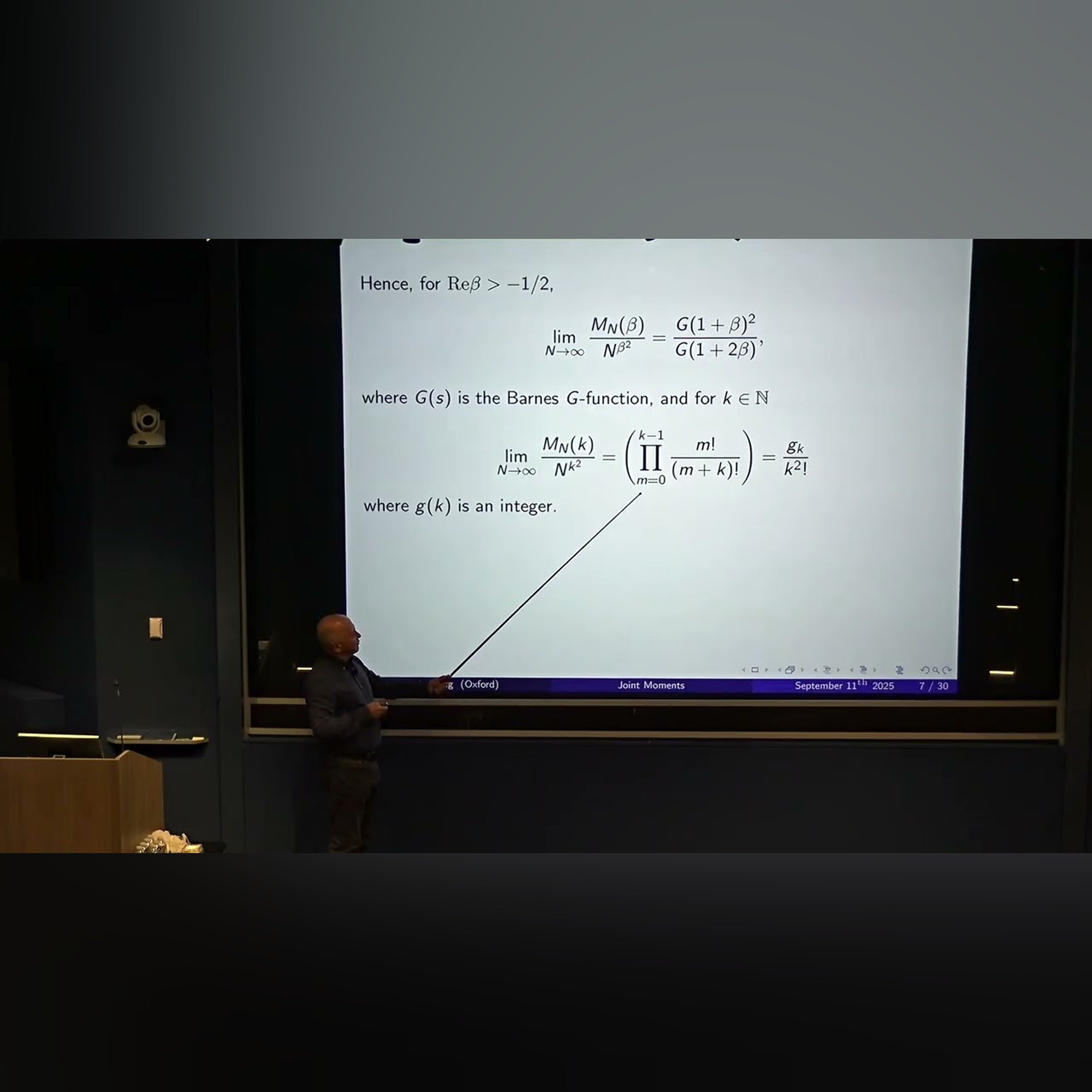
    Jonathan Keating will discuss the evaluation of the joint moments of the characteristic polynomials of random unitary matrices and their derivatives, and in this context the joint moments of the Riemann zeta-function and its derivates, on the critical line. I also hope to discuss extensions to other symmetry classes. Uploaded 25-09-25 For more information go here: https://www.simonsfoundation.org/event/mps-conference-on-universal-statistics-in-number-theory/ Learn more about your ad choices. Visit megaphone.fm/adchoices

  • Yesterday · 39 min

    Cryo-EM Workshop - Roy Lederman (August 9, 2019)

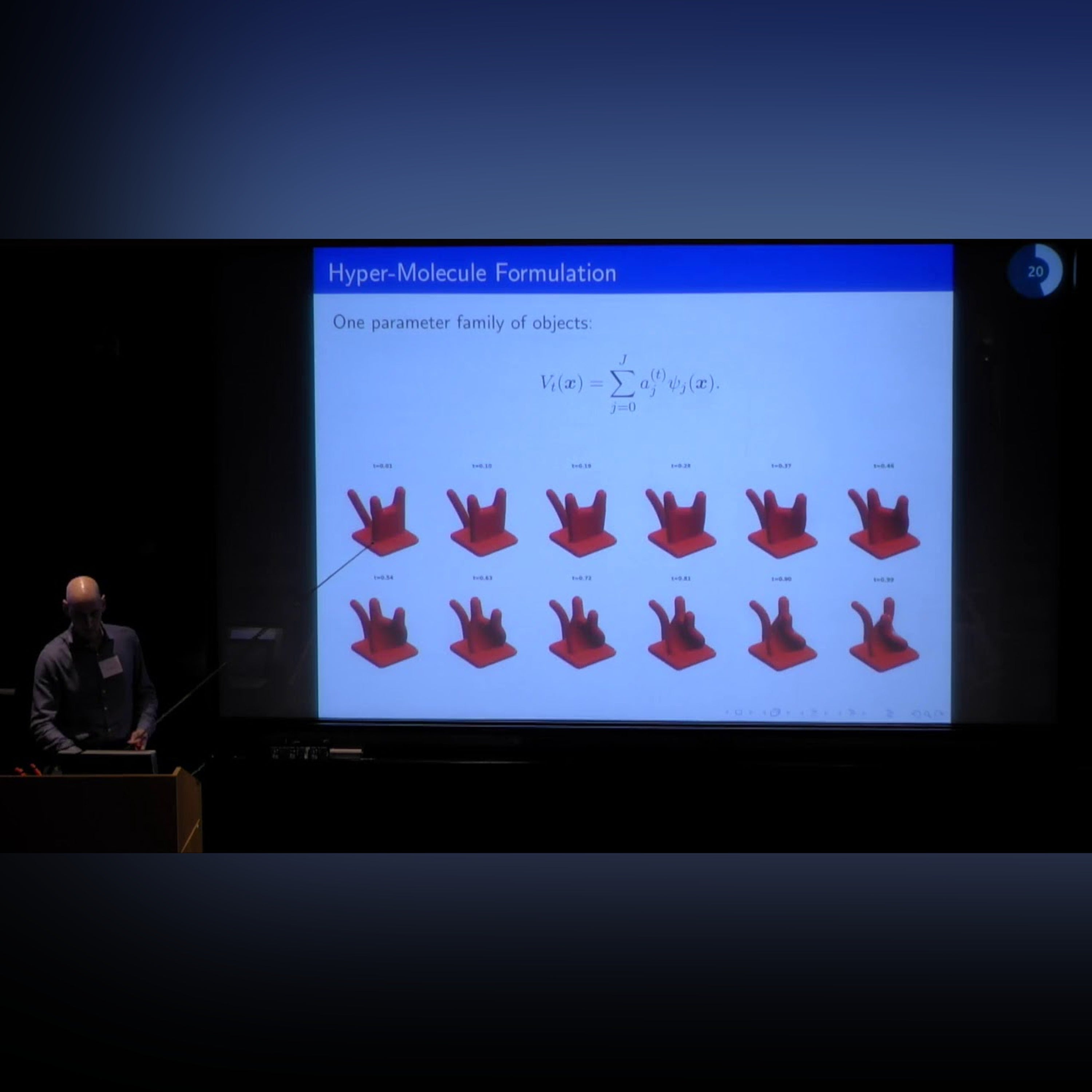
    More details: https://www.simonsfoundation.org/event/nyc-computational-cryo-em-summer-workshop/ Uploaded 26-08-19 Learn more about your ad choices. Visit megaphone.fm/adchoices

  • Yesterday · 1 hr 2 min

    Adrian Price-Whelan - Mapping dark matter with stellar streams (February 25, 2020)

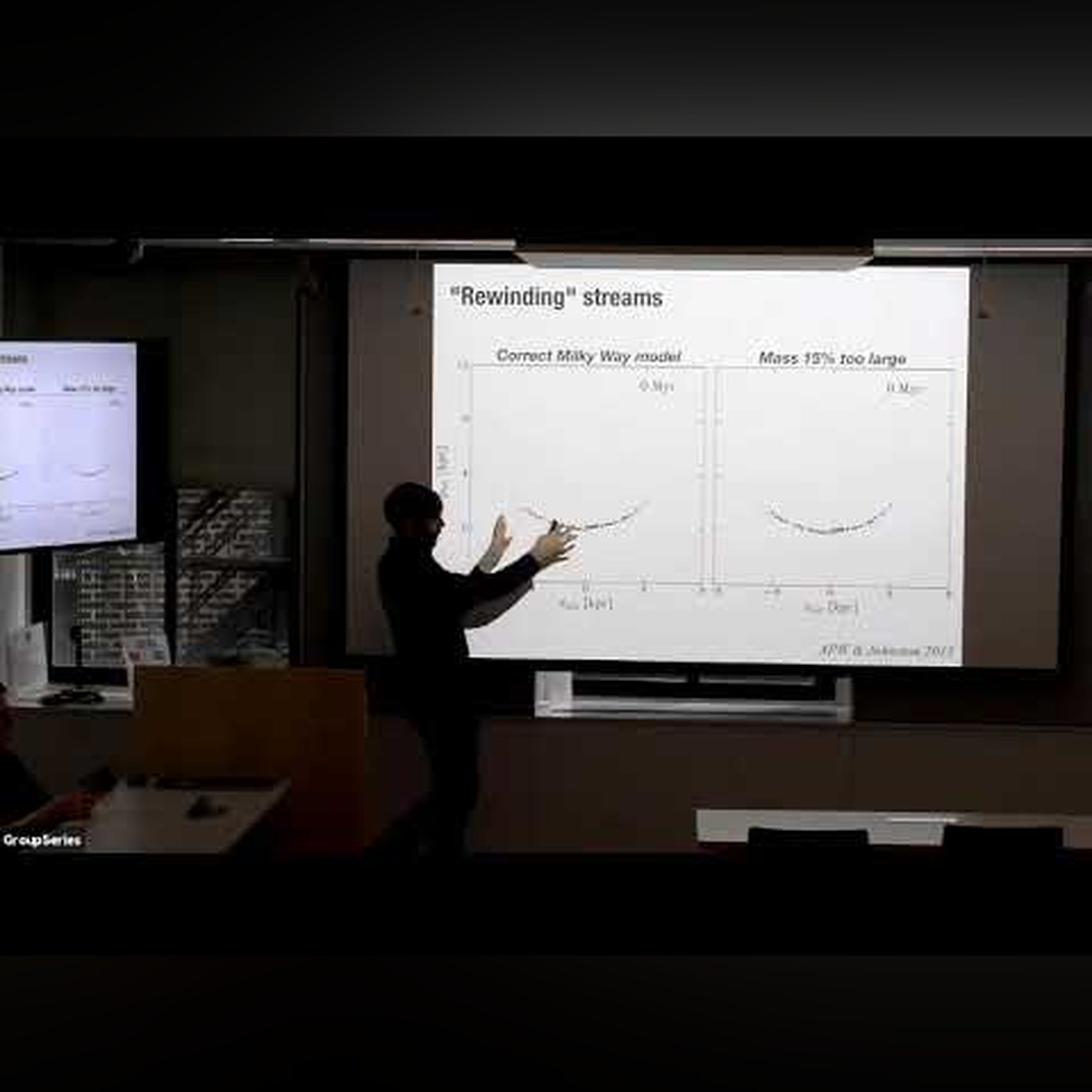
    As they orbit within a host galaxy like the Milky Way, tidally-disrupting satellite galaxies and star clusters produce streams of stars that nearly trace out the orbit of their progenitor system. These resulting stellar streams therefore provide otherwise unobservable information about the galactic force field and are one of the most promising tools for measuring the sub-galaxy-scale properties of dark matter. However, streams that form in more realistic galactic environments also record many other interesting dynamical phenomena, such as time-dependent perturbations from the Galactic bar and the gravitational influence of the Magellanic Clouds. I will show recent work on a few of the most prominent streams in the Milky Way that demonstrate that streams not only have the capacity to deliver precise constraints on the nature of dark matter, but are also sensitive to the physical processes at work during the assembly and evolution of our Galaxy. I will argue that, in order to deliver accurate and meaningful constraints on dark matter in either of these contexts, we must understand how these other complex–but interesting–effects may bias our inferences and conclusions from modeling individual streams. More details: https://www.simonsfoundation.org/event/cca-special-seminar-adrian-price-whelan/ Uploaded 13-03-20 Learn more about your ad choices. Visit megaphone.fm/adchoices

  • Yesterday · 1 hr 8 min

    Adam Harper: The Square of the Riemann Zeta Function Gives Rise...(September 11, 2025)

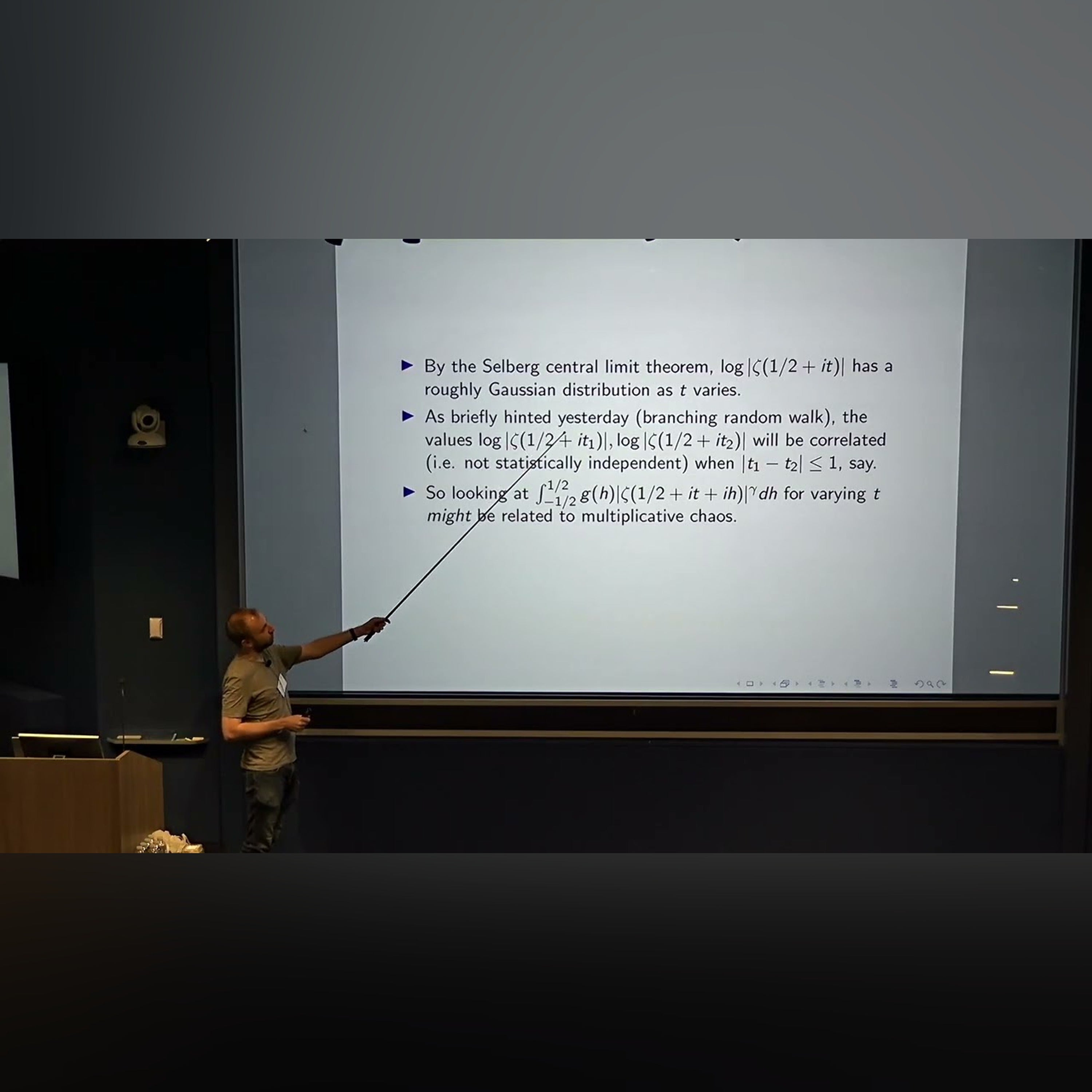
    The Square of the Riemann Zeta Function Gives Rise to Critical Multiplicative Chaos ~ Multiplicative chaos is a class of random measures that have recently been found to have strong connections with number theoretic objects like L-functions and character sums and the phenomenon of “better than square-root cancellation.” Saksman and Webb have conjectured that integrating test functions against absolute powers of the Riemann zeta function should give rise to these measures. The square of the zeta function is particularly interesting, since this should correspond to the so-called critical chaos. Adam Harper will report on joint work (in preparation) with Saksman and Webb, which proves their conjecture for zeta squared. Harper will try to give a gentle introduction to these problems, and indicate some of the main proof ideas, which may be of independent interest. Uploaded 25-09-25 For more information go here: https://www.simonsfoundation.org/event/mps-conference-on-universal-statistics-in-number-theory/ Learn more about your ad choices. Visit megaphone.fm/adchoices

  • Yesterday · 59 min

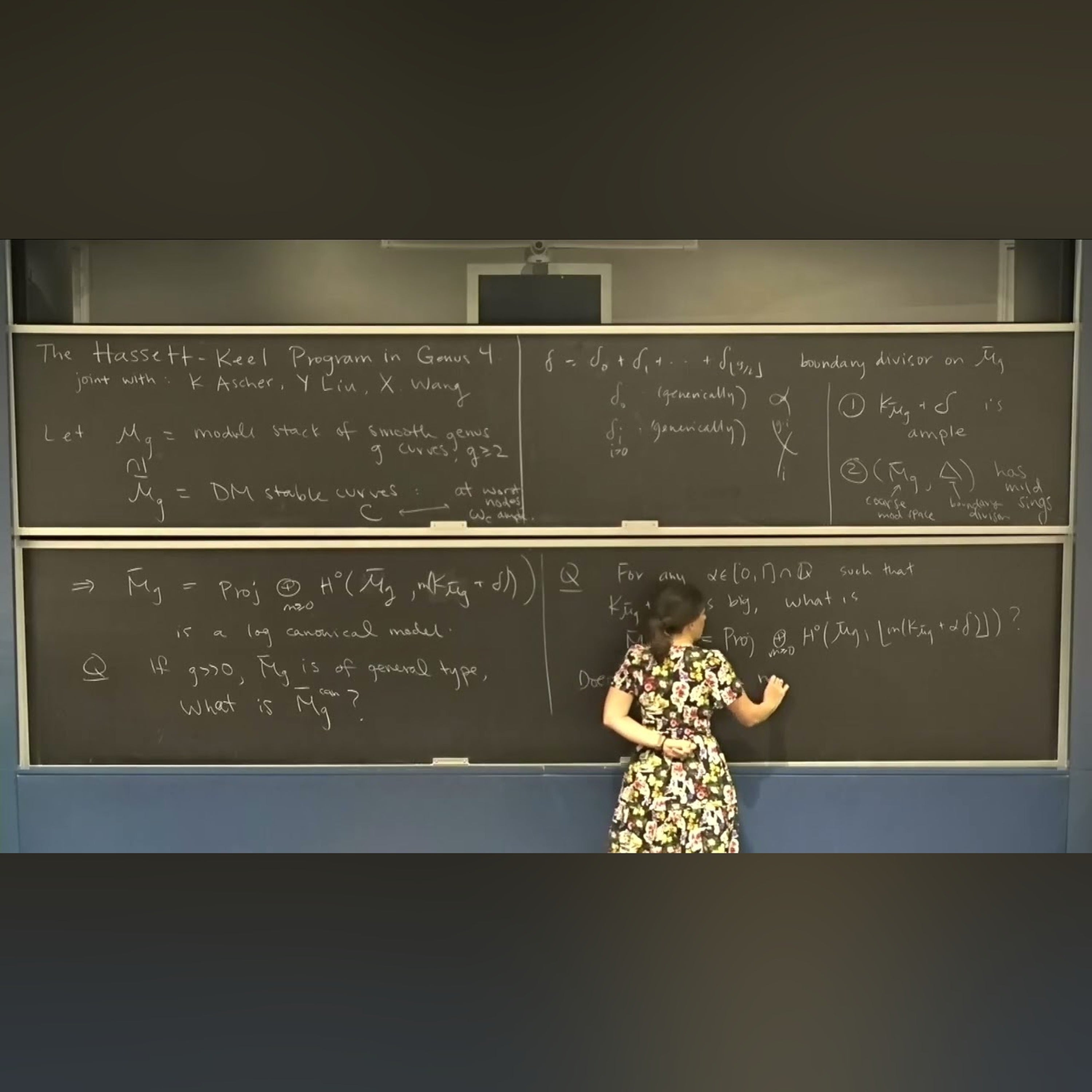
    Kristin DeVleming— The Hassett-Keel Program in Genus 4 (Oct. 2, 2025)

    https://www.simonsfoundation.org/event/simons-collaboration-on-moduli-of-varieties-annual-meeting-2025/ 2025 Annual Meeting of the Simons Collaboration on Moduli of Varieties Simons Foundation October 2-3, 2025 Uploaded 27-10-25 Learn more about your ad choices. Visit megaphone.fm/adchoices

Showing 61–80 of 306 episodes