Skip to content
Artwork for Rowling Studies The Hogwarts Professor Podcast
FictionArtsBooks

Rowling Studies The Hogwarts Professor Podcast

John Granger

The Artistry and Meaning of J. K. Rowling and Other Greats

hogwartsprofessor.substack.com
Play
  • 22 episodes
  • fortnightly
  • Avg 1 hr 36 min
  • English
Counted on this page — what you have heard stays on this device, so it is not something the list can be paged by.
  • Thursday · 1 hr 50 min

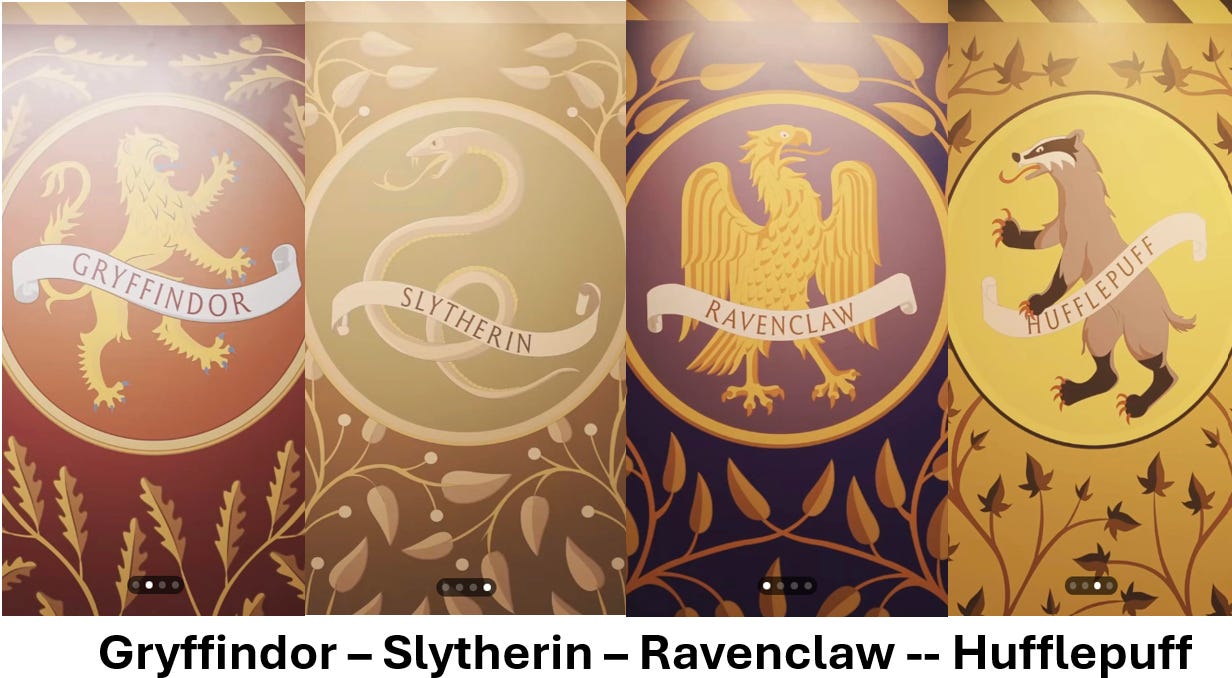
    HBO+ Harry Potter Roll-Out is Heavy with Traditional Symbolism

    Nick and John get together to discuss three HogwartsProfessor posts about the All New Hogwarts House Emblems and Rowling’s commentary via three emojis about the recent trailer for the Bronte Studios adaptation of Harry Potter and the Philosopher’s Stone. You can read those posts via these links: The HBO+ Potter Trailer: The Meaning of Rowling’s Heart, Owl, and Lightning Bolt HBO’s Harry Potter and the Alchemical Symbols The New Hogwarts House Emblems and Their Alchemical and Plant Symbolism Or you can just jump right into the conversation via the questions, notes and links below! Hogwarts Professor is a reader-supported publication. To receive new posts and support my work, consider becoming a free or paid subscriber. The Ten Questions Guiding this Conversation: Nick in Red, John in Blue 1. G’day, John! Great to see you, your chin, and hairline again! You posted a short piece over at the HogwartsProfessor weblog this week about a seemingly meaningless Rowling tweet that shared a new trailer for the HBO+ adaptation of Harry Potter and the Philosopher’s Stone. She only ‘wrote’ three emojis, but, even though you wrote was only several paragraphs long, it said a lot. Why do such a deep-dive into these perhaps offhand fan-servicing signals? * All the signals or emojis are traditional symbols, so, offhand or not, they're markers of the choice a serious reader has to make about understanding Rowling's work properly; * Is it literary sacred art as her Shed tool choices suggest or just creative personal expressions for our diversion and entertainment? * Rowling is signaling us, as you say, that it is the former with these three emojis. * T. S. Eliot, ‘The Dry Salvages’ (InterNet Poem) We had the experience but missed the meaning And approach to the meaning restores the experience in a different form 2. Let’s take a closer look, then! The Heart, the Owl, and the Lightning Bolt -- what does the Rowling fan, from “ten years old to seventy,” see right away before they stretch for the traditional meaning? * Heart – Rowling is pleased; we should be, too; heart as sentiment, love token. * Owl – Hedwig in Stone, important message being delivered, ‘pet’ project of Rowling’s. * Lightning Bolt – The Boy Who Lived’s signature mark, news out of the blue or ‘news flash’ 3. And there’s more? What traditional meanings do these emojis have? * The Heart to Rowling is a lot more than a token of sentiment. It is a Golden Thread in her work that the Heart is a pulsing symbol of the human spiritual capacity. Only the Eye does as much heavy freight of meaning lifting in her work and I think the Heart surpasses the Eye ultimately in importance except insomuch as she elides their meaning. Read The Heart is Not About Emotions and Affection but the Human Spiritual Center for discussion of the symbolism and the Golden Thread. * The Owl, too, is an ancient and dynamic symbol, the reason frankly there is a Hedwig rather than Hedwig being the meaning of the token. Rowling clearly draws on her experience of owls in Greek mythology (and reading of C. S. Lewis’ Narniad drawing on the same source) in making the owl the vessel of communication and supernatural perception in her Wizarding World. None of the letters written by her witches and wizards need to be addressed because an owl is so attuned to everyone and everything that it is able effortlessly to understand where it needs to go, God’s own GPS. What is usually described as a symbol of Wisdom is clearly much more a revelation of a mind able to grasp the great interconnectedness of things which in turns takes us back to the Eye and the Heart — and what Rowling is trying to bring to readers in her transformative literature. (Contrast this Greek mythology symbolism with what owls represent in Christian scripture; quite the gulf between Athens and Jerusalem there!) * But the wisdom piece is there, too! Rowling is writing at four levels of story that correspond with the four ways of human knowing, of which the last and most important is gnosis or wisdom, the so-called anagogical layer of meaning that no less a light than Flannery O’Connor said was the whole point of writing and reading. If you’re writing for the Heart or to illumine the Eye of the Heart, the goal is transformative imaginative experience fostering wisdom. * And the Lightning Bolt? The forehead scar, the mark of Orestes, the Greek hero who avenged his father’s betrayal and murder, is another polyvalent and profoundly spiritual cipher as a lightning bolt. In it simultaneously the reader experiences simultaneously as we do in a thunder storm albeit imaginatively (1) sudden illumination or enlightenment, (2) from above, the heavens, the super-conscious realm, and, most important, (3) a reorientating shock, a cathartic shaking, the jolting moment that jars us out of our psychological rut and cage to see the world afresh with our ‘eye of the heart.’ * Rowling’s three emojis on her tweet about the fun trailer below can be read as fan servicing variations on the ‘thumbs up’ and ‘hand-clapping’ using tokens associated with the books. No doubt about that reading. * I think it as important to note, however, the possibility that Mrs Murray is signaling to the HBO+ audience as well as the international of readers that this adaptation is about trying to reproduce as much as is possible in an iconoclastic medium some replica of the imaginative and transformative experience to be had in the books. The Heart, the Owl, and the Lightning Bolt all point to that experience and depth of meaning. 4. Which segues nicely to your brief post, Nick, on the HBO+ adaptations and its choices in how to represent the four Hogwarts Houses: Gryffindor, Ravenclaw, Hufflepuff, and Slytherin. (”Nitwit, Blubber, Oddment, Tweek,” anyone?) Can you review what the books say are the proper representations, the heraldic glyphs most appropriate to each house? 5. Has Rowling added content or context for why she chose those specific representations? [Anelli-Spartz Interview discussion of four elements] JKR: But they’re not all — don’t think I don’t take your point, but — we, the reader, and I as the writer, because I’m leading you all there — you are seeing Slytherin house always from the perspective of Death Eaters’ children. They are a small fraction of the total Slytherin population. I’m not saying all the other Slytherins are adorable, but they’re certainly not Draco, they’re certainly not, you know, Crabbe and Goyle. They’re not all like that, that would be too brutal for words, wouldn’t it? ES: But there aren’t a lot of Death Eater children in the other houses, are there? JKR: You will have people connected with Death Eaters in the other houses, yeah, absolutely. ES: Just in lesser numbers. JKR: Probably. I hear you. It is the tradition to have four houses, but in this case, I wanted them to correspond roughly to the four elements. So Gryffindor is fire, Ravenclaw is air, Hufflepuff is earth, and Slytherin is water, hence the fact that their common room is under the lake. So again, it was this idea of harmony and balance, that you had four necessary components and by integrating them you would make a very strong place. But they remain fragmented, as we know. More on Elements and Humours at HogwartsProfessor: * Ben Jonson’s Every Man and His Humor * The Crimes of Grindelwald Group Portrait: A Study in Temperaments 6. Where did the Warner Brothers film adaptations depart from and stick to the page-and-interview House heraldry? * The animal representations as often as not are facing in the wrong direction, sinister rather than dexter and vice versa; AND * The Ravenclaw eagle of the books became a raven and their House colors become dark and light shades of blue rather than blue and copper. 7. But those corrections aren't the most interesting changes or corrections in these new House shields, are they? What are the extras we're given that weren't suggested in the original texts but implicit in the interview material? [Hat Tip to Sad-Ad-9273 at r/HarryPotteratHBO for these screen catches!] * Note the vegetation in the Banners and the Emblems: the acorns in the Gryffindor mean the Oak tree is its symbol; the white berries in Slytherin suggest holly, per Sandra Miesel Kopec, the laurel tree seems a match for Ravenclaw and ivy for Hufflepuff; * Check out a website devoted to these things, ‘What Do Leaves Represent on a Coat of Arms,’ for the meaning of these plant associations with each house or share your own ideas in the comment boxes below! 8. What is with the ornamentation on those triangles? The Slytherin circle, the sideways line and paleolithic horse on Gryffindor, the Ravenclaw ‘V,’ and the Hufflepuff cup and ‘V’? Are these Founder’s treasure tokens that become Horcruxes? If so, are there traditional meanings as well as plot points, e.g., Tarot Card qualities? [Hat Tip to LightAngel452 at r/HarryPotteratHBO for the brilliant graphic! LightAngel also picked up on the alchemical symbols.] * The Emblems material that gets heady involves the melange of symbols and signs in their respective headboards; * Slytherin has an easily discerned ‘S,’ the suggestion of the House’s signature serpent, and the Horcrux locket of Salazar Slytherin; * Ravenclaw’s header with a little head turning and squinting has an ‘R,’ the V inserted looks like a diadem, and simultaneously it has what looks like an eagle in flight from a distance; * Gryffindor does not seem to include the ‘G’ we’d expect, but the Sword of Gryffindor, and the paleolithic horse a Medieval knight be riding are evident; * Hufflepuff gets the best of the lot, though, with its distractingly obvious cup obscuring how the ‘V’ within the inverted triangle and its bisecting line yields both the stripes of a badger and Helga Hufflepuff’s initials! * That’s great stuff, Nick, but the real catch, I think, was what you shared in your post about the alchemical symbols for the Four Elements, the triangles illustrated in the Wikipedia page for such things and in The Book of Alchemy (Chapter 9, ‘The Four Elements,’ pp 111-128 [pdf numbering]; Air triangle 119, Water, Fire, Star of David 115, Earth “no predetermined figure” 113-114) * The meaning of those triangles, especially their direction and the bisecting lines in the symbols for Earth and Air, can be found in Titus Burckhardt’s Alchemy: Science of the Cosmos, Science of the Soul, a book we can be pretty sure Rowling read because the Penguin paperback available when she was a Comprehensive student featured Rubeus Hagrid, hermaphroditic giant, with a dragon, both astride a Golden Snitch, on its cover: * Burckhardt explains that the symbols are understood correctly in their harmonious combination or elision as the Seal of Solomon (‘Star of David’) [pp 74-75]; * The bisecting lines of the Earth and Air symbols is from the base lines of the triangle in the Seal that brings the whole into balance; * Which representations align perfectly with Rowling’s attempt to explain the Four Houses as the Four Elements and how the goal or telos of each is its harmonious integration with the others, i.e., the Seal of Solomon; * We may not be able to say that Rowling told Bronte Studios to use these symbols on their respective Hogwarts House emblems, but its undeniable I think that the HBO+ adaptations are going to be risibly rich in traditional symbolism that most readers may or may not notice but which they will not ‘get’ without some serious study. 9. And, John, you’re putting up a post later today about the New Potter Mania and how it will look like the old Potter Mania and still be qualitatively different. We’ll probably do a whole show to talk about that but what are the highlights? * Not today, but very soon! 10. And I see you’re putting up material for the Paid Subscribers on just that subject? * Paid Subscribers will be receiving chapters from the Perennialist PhD thesis draft I wrote that Dimitra Fimi rescued from the fireplace; * I’m meeting with an online course platform owner today that I’m all but certain will be hosting the Wizard Reading Formula classes I gave in 2017 which will be free to Paid Subscribers; * And which will serve as a run-up to and acid test for our ten week week ‘Lake, Shed, Golden Thread’ course that will launch in 2027, maybe even at Christmas time 2026 for folks to give themselves their friends and family as presents * Stay tuned! Hogwarts Professor is a reader-supported publication. To receive new posts and support my work, consider becoming a free or paid subscriber. This is a public episode. If you'd like to discuss this with other subscribers or get access to bonus episodes, visit hogwartsprofessor.substack.com/subscribe
  • August 26 · 1 hr 44 min

    A Conversation about the Symbolism of the Letter 'G' in 'Hallmarked Man'

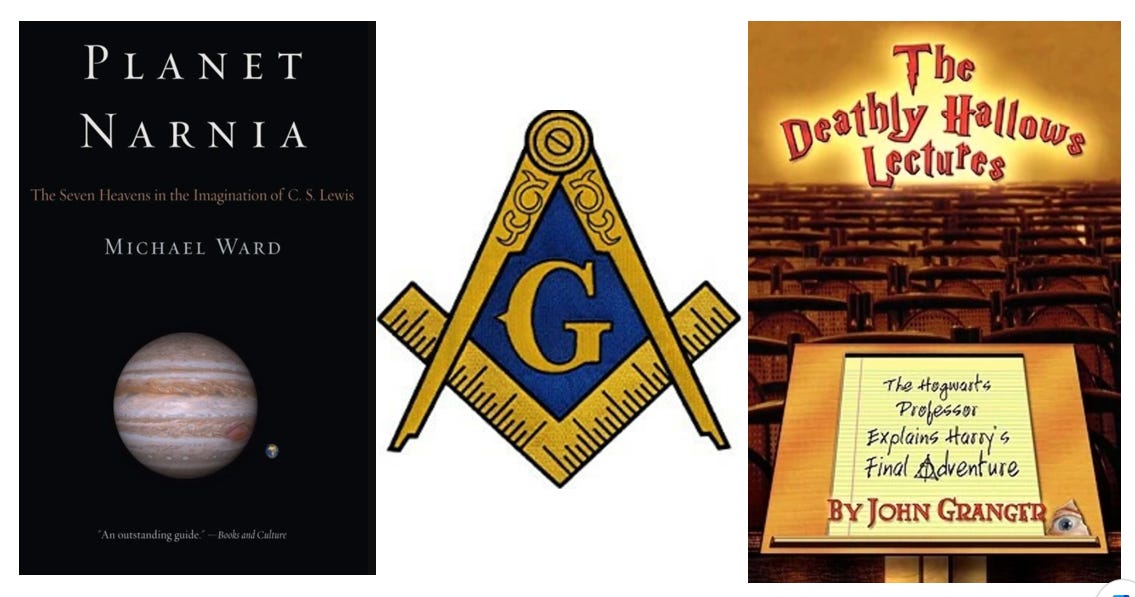
    Nick Jeffery and freshly Shorn & Clean Shaven John Granger sit down to discuss John’s two posts about the symbolism of the Letter ‘G’ in Strike 8. Part One of the series did the necessary work of demonstrating that, yes, the letter ‘G’ is all over Hallmarked Man, from the online guess that the murderer carved that initial into ‘William Wright’s back to the Witness G echoing with Green-jacked Gorilla-bearing man and a bit of calligraphic terrorism on the Agency door at street-level. The first also covered the accepted Masonic interpretations of why the ‘G’ is featured in the Compass and Square symbolism of their fraternity. Part Two was a deep dive into more esoteric meanings given to the ‘G’ by Freemasons and by Rene Guenon, notable Perennialist, and into what associations Rowling-Galbraith tried to make between the seventh letter and the key hallmark of the book. It concluded with three answers to “So What?” including some fun speculation about a possible shape for the series, a shape highlighted in Strike 8, and with a discussion of whether Rowling-Galbraith’s subliminal artistry with ‘G’ worked or failed. Perhaps the biggest take-away of this series of posts was to introduce subliminal coloration as the common denominator of Rowling-Galbraith’s signature seven Shed tools. Nick and John open their conversation about the letter ‘G’ with that subject and everything they discuss in the end folds back into that covert artistry. As always, the Dynamic Duo covet your comments and feedback as the best follow-up to their conversation. Please jump right in! Hogwarts Professor is a reader-supported publication. To receive new posts and support my work, consider becoming a free or paid subscriber. The Ten Questions and Relevant Links 1. Okay, John, let’s talk coloration. You mentioned some examples in famous authors’ work in Part One of your deep dive into Letter G Symbolism in Hallmarked Man; do we have coloration in Harry Potter? Another Strike novel? * ‘Donegality’ in Planet Narnia, Michael Ward, the subliminal artistry of C. S. Lewis’ Narniad; * From ‘Literary Alchemy: Sacred Science, Sacred Art, and the Alembic of Story’ C. S. Lewis, according to Michael Ward, author of Planet Narnia, also felt appreciating the “manner of the author,” his “various special tricks,” especially those connected to creating atmosphere, were critical to understanding the style of the Greats. Again and again, in defending works of romance, Lewis argues that it is the quality or tone of the whole story that is its main attraction. The invented world of romance is conceived with this kind of qualitative richness because romancers feel the real world itself to be ‘cryptic, significant, full of voices, and the mystery of life.’ Lovers of romances go ‘back to fruit tree for its taste; to an air for… what? For itself; to a region for its whole atmosphere – to Donegal for its Donegality and London for its Londonness’ (Ward, 16). Donegal was one of Lewis’favorite vacation spots as a child in Northern Ireland. Ward defined Lewis’ stylistic atmosphere as his ‘Donegality:’ By donegality we mean to denote the spiritual essence or quiddity of a work of art as intended by the artist and inhabited unconsciously by the reader. The donegality of the story is its peculiar and deliberated atmosphere or quality; its pervasive and purposed integral tone or flavor; its tutelary but tacit spirit, a spirit that that the author consciously sought to conjure, but which was designed to remain implicit in the matter of the text… the more influentially to inform the work and so affect the reader (Ward 75). Ward’s concern is especially with Lewis’ character Aslan, in whom this donegality is “concentrated and consummated” as a “Christologically representative character” (Idem), but the thesis of Planet Narnia is that the “kappa-element,”[xiv] Lewis’ phrase for the informing, hidden “tutelary but tacit” style of a work, is astrological symbolism, each of the Narnia chronicles representing one of the seven traditional planets. Ward argues that Lewis’ subliminal artistry, the “inner weave” or style of his work in Nabokovian language, is the embedded mythological and astral metaphors to be found beneath the surface of each story. Twain is supposed to have said, “”If you would have your fiction live forever, you must neither overtly preach nor overtly teach, but you must covertly preach and covertly teach.” Lewis, believing as he did that “an influence which cannot evade our consciousness will not go very deep” (Lewis no date), wrote in astrological glyphs to reach covertly his reader’s unconscious depths or noetic heights. * ‘The Eyes of Deathly Hallows’ in The Deathly Hallows Lectures, John Granger, and, briefly, here, and 2010 lecture at New York Public Library; and * ‘The Cross Symbolism of Troubled Blood,’ John Granger 2. You list those eyes and crosses and I confess it didn’t strike me on my first and repeated readings that there were so many of those. What made you notice all the ‘G’s in Strike 8? * I confess that I didn’t make anything of the letter ‘G’s repeated appearances in Hallmarked Man until I saw that Rene Guenon, the most famous and profoundly metaphysical of the first 20th Century Perennialists, had written a brief essay in his youth, ‘The Letter G and the Swastika.’ I made that discovery inadvertently when looking for something else in Fundamental Symbols, a posthumous collection of his writing (downloadable as pdf here). 3. Let’s play ‘Name a G passage;’ I’ll start with the G supposedly carved into William Wright’s back and you name another until we’re both out of examples... Robin’s research into the death of ‘William Wright’ in the Ramsey Silver shop vault begins with an online observer saying out of the blue that a ‘G’ was carved into the victim’s back and that this was tied to the Secret Word of Freemasonry and the legend of Hiram Abiff’s martyrdom. Rowling-Galbraith has Robin mention this to Murphy at their first unofficial briefing on the case and Murphy all but explodes; he denies it was a ‘G’ and says he heard it was a “hallmark” instead. The letter is associated with Freemasonry as their symbolic center (GAOTU) via a telephone message and in Strike’s meeting with ‘Hiram’ Hardacre. We learn after Robin’s being attacked in Harrow’s that she was ‘Witness G’ in her rapist’s trial, the letter being to her something like a secret identity. Strike not long thereafter finds a blood Red Letter ‘G’ painted on the street level door to the Agency which he hopes is a Masonic terrorist marker rather than the pointed suggestion that the Angel of Death is coming for Witness G. I’d add that the Gorilla mask and doll of the Green jacket man that haunt Robin have some of their subliminal effect on her and the reader because of the initial guttoral sound of ‘Gorilla’ and ‘Green.’ 4. The Freemason connection is the most interesting one even though the Masonic G isn’t carved into Powell’s back (it’s a Salem Cross and the only other twice played symbol is the orb and cross pendant Strike buys for the charm bracelet Christmas present). Who knew that the capital ‘G’ was such a big deal in Masonry? 5. At the end of Part One, I thought you’d pretty much covered the symbolism and were going to close in Part Two with what God and Geometry are about in Hallmarked Man, hence the coloration. Instead you wrote that the G being a one-letter acronym wasn’t enough. Why not? * not Masonic -- no edges! * not ancient Greek, Hebrew, or Sanskrit, * not tied to craft symbolism, * not a symbol!, * the catechism answer “By letters four and science five, this G aright doth stand in due art and proportion’.” 6. So was Guenon’s essay the key to Rowling’s use of the letter ‘G’? * Yes and no! * His Symbolism of the Cross, Lord of the World, and The Great Triad chapters help a lot but from ‘The Letter G and the Swastika’ we learn that * yod is God is gamma, * catechism answer means four gammas or four yodhs which both yield swastikas (gammadion cross), * GAOTUmeans Christ the keystone/cornerstone, * the sequence of jumps from letter ‘G’ to Murphy’s Salem Cross... 7. Who backed Guenon up on this connection so you weren’t using the Perennialist hammer to drive in a screw or fasten a bolt? * Cockburn, Crypto Curry, Albert Pike (via Tamara/Tamspells!) 8. If I accept the preponderance of ‘G’s in Hallmarked Man as coloration/Donegality (I do) and the meaning of the symbolism per your readers (I’m withholding skeptical judgement), what effect was this supposed to have on me the reader so I can tell you if it worked or not? If it was supposed to confuse me, boffo job! * Nabokovian potustoronost, * numinous quality in the air, * Robin as ‘Witness G, ‘ * Strike channeling Tyler Powell at finish in Ironbridge 9. Will we see Freemasonry and its symbolism in Strikes 9 and 10? Maybe! [Rowling-Galbraith] certainly has made us long for a big pay-off with respect to ‘G;’ see Sarah Keeler’s idea that it may be a pointer to Gillespie reappearing in Strike 9. I love that possibility and it certainly is in keeping with the HogwartsProfessor working thesis that Hallmarked Man is what it is to set up the next two books. If we’re going to see characters and themes bleed between the first book of the last three and its successors, why not its symbolism? If I had to bet money on it, though, I think we probably won’t see more Freemasonry or Big ‘G’ payoffs. It kills me to say that given the investment I’ve made in books about the Masons (they’re on a shelf beneath the dust-collecting little library on Mormon history and scriptures I collected while writing about Stephenie Meyers’ Twilight books). I just cannot see her weaving the Mason characters from Hallmarked Man into story lines that give us resolution with respect to Charlotte’s and Leda’s supposed suicides twenty some years apart, Shanker’s family history, and the mysteries around Strike’s time with the military police, especially the IED that nearly killed him. 10. I thought you promised not to get into the Strike Series Shape Sweepstakes? You’ve already said you think it’s a seven part ring with a triangle-trilogy addendum and in Part Two you give us a Harry Potter shape for the decalogy structure -- or is it Christmas Pig? This is a public episode. If you'd like to discuss this with other subscribers or get access to bonus episodes, visit hogwartsprofessor.substack.com/subscribe

  • July 29 · 1 hr 37 min

    Shanker's 'Old Man,' Leda Strike's Tattoo, Her First Husband's Real Name, and The Dress

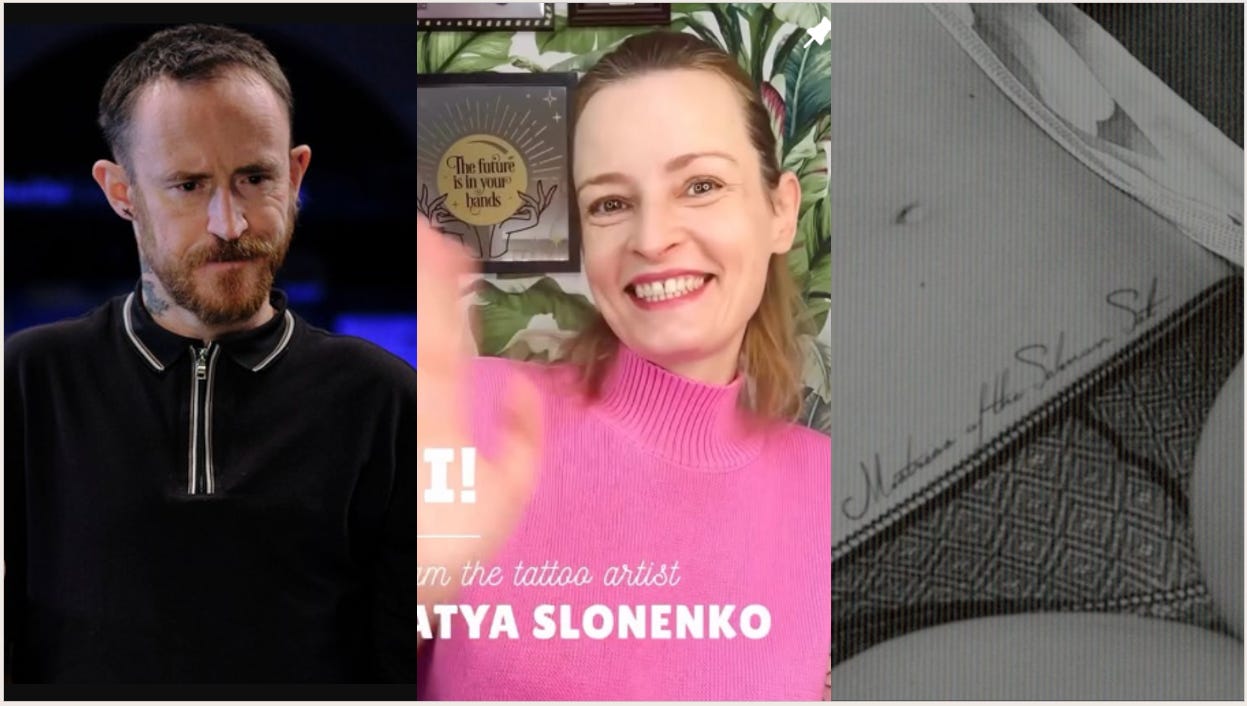
    Late last month, John shared two theories about the Cormoran Strike series of novels, both from Katya Slonenko, a member of the Reddit r/CormoranStrike online fandom: Dementia, Jewelry, and a Nine Inch Cock: The Mystery of Shanker’s ‘Old Man,’ His Given Name, and Why He’s Never Killed Jeff Whittaker and Katya Slonenko: Leda Strike's 'Mistress of the Salmon Salts' Pudenda Tattoo. John corresponded with Katya while preparing those posts and invited her to join him and Nick for a discussion of her ideas, of life as a Redditor, and her thoughts about Rowling’s artistry and meaning. She accepted the invitation but said she wouldn’t be free until July to talk. Hence the wait! As expected, though, speaking with her about her own journey to expertise in Rowling Studies, her ideas about the clues Rowling has embedded so carefully within the first eight books and especially in Hallmarked Man, and the Reddit posts of which she thinks Hogwarts Professor readers need to be aware was well worth the wait. You’ll want to read those posts from June before listening to get the most out of this conversation, but, regardless of your preparation, John and Nick believe that every Serious Striker and Rowling Reader will be charmed and challenged by Katya’s remarkable insights, generous spirit, and winsome personality. The conversation includes three other Reddit community posts — about Leda’s ‘Carnival’ dress (Arachulia), about the real name of her first husband, and about the Harry Potter tattoo Rowling-Galbraith hid on a Strike novel character’s shoulder — which took the discussion above and beyond the two Katya theories in the June posts. Nick and John close the conversation by inviting her back and they hope readers here will share the questions they want us to be sure to ask her on her return visit in the comment thread below. Or just ask her yourself! As she demonstrated on the threads beneath the June posts, she is generous with her time in responding to other Strike fans. Can’t wait for more Katya Slonenko? Follow her at r/CormoranStrike, on Instagram (Tattoos!), on FaceBook, and check our her older, longer posts on Medium… The Ten Plus Questions with Links 1. Welcome, Katya, and thank you for joining us! The serious readers at Hogwarts Professor have been buzzing about your Shanker and Leda r/Cormoran Strike Reddit posts and we’re thrilled to be able to talk with you about those ideas. First, though, tell us about your first Rowling reading experiences and how you started posting on Reddit about the Strike series. 2. I’m guessing that Reddit Strike fandom may be as unfamiliar to Hogwarts Professor readers as it was to me. What is it about the Pelican_Girl and TopRequirement670 moderated posts and that international community that you love the most? 3. Shanker! I confess -- I hadn’t given him a thought really beyond a doppelganger twin for Strike before Fiona from Adelaide introduced me to the ideas that he had to be involved in the death of Leda Strike and that the Riccis were also somehow party to it. Ed Shardlow shared your Reddit post on the subject and my mind was blown; you made a compelling case soon after the publication of Hallmarked Man last year that Shanker is a Ricci, the illegitimate son of Nico ‘Muccy’ Ricci, but to avenge Leda Strike’s death he has become a Met or MI5 informer. Let’s start with the four pointers that Shanker gave Strike in one conversation that he is a Ricci-by-blood and what made you think of that connection: * Shanker’s statement that his father had dementia or was senile; * Shanker’s report that his dad taught that jewelry was the way to a woman’s heart; * Shanker’s claim that his ‘old man’ was said to have a “nine inch cock;” and * Shanker’s saying that his begetter “‘ad kids wiv abou’ ten diff’rent women.” 4. I see the trigger now that you’ve detailed it but you dug and made four more connections that were buried in the texts of the series’ other books: * Shanker’s knowledge of the Ricci clan, especially Mucky, * his Strike-witnessed working with Mucky in drug deals, * “he deals cocaine and is good with a knife;” and, best of all, * the reaction Robin had to both Shanker and Luca at their first meeting, the fun-house mirror upside-down reflection of the attraction half-siblings feel for another intuitively. Robin is viscerally repulsed and afraid of the half-sibling Ricci boys. We cannot not see these connections after you point them out, but they’re nigh on invisible until they’re pointed out! Why do you think you saw them when we missed them -- and why do you think Rowling has taken such care to make them invisible in plain sight? 5. And Shanker is an MI5 informant? Where does that come from? 5.5 Let’s not forget that you also make an intelligent guess, the first one I’ve heard, about what Shanker’s given name really is, one based on the names of Nico Ricci’s two children out of ten for whom we have names. * Katya shared not only her reasoning about why Shanker’s name is John or an Italian variant of the Evangelist’s name but also her theory about the parentage and name of the other remaining character in the series who also remains nameless: the mysterious ‘Strike’ with whom Leda ran away from Cornwall! (Be sure to read the comment thread for Redditor conversation about other possible Ricci children…) 6. Your thoughts about Shanker all feed into theories about Leda Strike and her mysterious death in the end, which brings us to another aspect of her life and death about which you’ve brought an important and unique perspective. I’m talking about the Mistress of the Salmon Salt tattoo. Did you know anything about tattoos, Katya, before writing this piece? 7. As a tattoo artist yourself, what do you make of Leda’s tattoo placement? 8. Tattoos are meaningful, powerful reflections or revelations of the person’s interior life or self-understanding (see the post about Katya’s ‘Salmon Salt Tattoo’ theory for much more on this). What do you think this tattoo communicates about Leda? Is it another example of Rowling’s text-within-the-text or a variant of her using cryptonyms to signal important information about a character’s inner life? What Tattoos Mean in Cormoran Strike and a Catalog of Examples * From Katya’s 2023 ‘Mistress of the Salmon Salt Revisited:’ I hear you asking - why can’t Leda’s be just a tattoo, without any deeper meaning to it? That’s because all the other tattoos in the Strike books have meaning and provide a clue to their wearers’ characters. Here are some examples: * Kelsey Pratt’s One Direction tattoo is an obvious link to her being a One Direction fan. (How Leda’s tattoo is different? She chose the name of the particular song, not the more generic name of the band, to be tattooed on her) * Laing’s rose pierced with a dagger bluntly means violence to women. Rose is a woman in the language of symbols, while the dagger is… well, a dagger. * Polworth’s St Piran’s cross means he’s a Cornish patriot. I’ll be surprised if it also doesn’t mark him as The Hanged Man (a symbolic bearer of a cross) * Portia Bayliss’s trident refers to her Caribbean roots * Edie had a small black heart on the knuckles because she was the creator of ‘The Ink Black Heart’ cartoon. * Zoe’s tattoos are of ‘The Ink Black Heart’ characters she identifies with. * Pez Pierce has The Beatles quote around his neck - Strawberry Fields was (is?) a place in Liverpool. * Union Jack, a skull, and a Nordic “Chaos” rune give a good impression of what the Turisaz character will be about (all tattooed on visible spots like head or neck - he wears them proudly!); * Same with Algiz and Uruz, sans the Union Jack and the skull. * Noli Seymour’s tattoo stands for “Golden Prophet”. It denotes her connection to the Universal Humanitarian Church and her status there as the current Golden Prophet. * An ace of spades was inked onto his left cheek, and a tattooed tiger covered his throat. - Jordan Reaney’s tattoos are pretty telling, too. * Not a character, but still - JK herself has a tattoo, “Solve et Coagula”, which means - “I’m a writer of an alchemical detective series!” :D So you see, all these tattoos are chosen to reflect their owners’ personal histories. That’s generally a feature of Rowling’s writing: if she describes a character, every little detail works for the portrait she wants to paint. There are no details put there “just because” - everything is important. How the characters dress and speak, what they eat and drink, what music they listen to, and what tattoos they have tell us something about the character. What does Leda’s tattoo contribute to her portrait? Nothing! In Career of Evil, when we learn of its existence, the tattoo adds literally nothing to Leda’s portrait. Why is it mentioned in the story to which it makes zero contribution, except for serving as a plot device enabling the killer’s obsession? Because it will be important later. * Katya shared in her answer her theory from experience that Rowling-Galbraith had secretly marked a character as a Harry Potter fan by giving her a shoulder tattoo that Potter-heads would recognize! 9. Rowling’s Solve et Coagula tattoo: what do you think she is telling the world about herself? Is there a correspondence or tie between the author’s tattoo and its placement and Leda’s? 10. Whittaker quotes a line from the Salmon Salt song by the Blue Oyster Cult — “She was the Quicklime Girl” — while testifying at his trial on murder charges; what do you think that tells us about her death? Does it suggest it was suicide or murder? Do you think Whittaker did it? 11. And another one to make eleven! You thought at one point because of the meaning of ‘Mistress of the Salmon Salt’ that we had to take seriously the possibility that Leda herself was a serial killer. But you’ve changed your mind. Why is that? * In addition to her own thinking on this subject, Katya shared yet another Redditor theory, this one from Arachulia about The New Dress that Aunt Joan said was the real reason that Leda had left her Nancarrow home in Cornwall with the mysterious ‘Strike.’ Enjoy! This is a public episode. If you'd like to discuss this with other subscribers or get access to bonus episodes, visit hogwartsprofessor.substack.com/subscribe

  • July 19 · 1 hr 42 min

    A Pen to Change the World: Conversation with Solomon Schmidt, Rowling-Galbraith Biographer (Part Two)

    (Credit: Telegraph article, June 2017, J.K. Rowling at the Raisa Gorbachev Foundation party in 2007, wearing a floral diamond necklace and matching earrings, cf., Christmas Pig) Solomon Schmidt, author of A Pen to Change the World: The Life of J. K. Rowling (Skyhorse, June 2026), sat down with us again to discuss what challenges he faced in collating and synthesizing almost thirty years of interviews for his biography. He also shares the three questions he’d ask The Presence if she’d consent to an interview, questions that he thinks she might answer; Solomon turned the tables on his interviewers who had to improv questions they’d ask without being told their interview with Rowling was over. The necessary links to the book’s Amazon page and to the two Hogwarts Professor reviews are here: * A Pen to Change the World: The Life of J.K. Rowling (Amazon.com) * A Pen to Change the World: The Life of J.K. Rowling (Amazon.co.uk) Uk Edition * A Pen to Change the World – the Biography of J. K. Rowling by Solomon Schmidt (Nick Jeffery) * Book Review: A Pen to Change the World - The Life of J. K. Rowling (John Granger) Five Questions for Solomon Schmidt, Author of A Pen to Change the World: 5. I said you didn’t get to interview Rowling, which is true, but you did have access to all her interviews that she has done 1997 to the present as well as the interviews and articles with her family, friends, fans, and business associates. How did you find, assemble, and sift through those interviews?6. If you had been allowed inside the gates of Fortress Rowling and you were only allowed three questions, what would you ask her? (This is a game John and I regularly play, and usually John’s questions would get him thrown out of an interview!)7. What discoveries that you made in your research were the most exciting to you?8. Rowling has said repeatedly through the years that the critical negative events of her life that reshaped her thinking and her work were the death of her mother and the abusive relationship she had with her first husband. Agree or disagree? What do you think were the most important positive turns in her life?9. Very few people I meet don’t have a fixed opinion about Rowling; the world seems to love and hate her in equal measure with little grey area between the two: adoring fans and political allies on the one hand and those that despise her work, her political efforts, or both. Where do you fall in that divide and how hard was it to represent the other point of view in your biography?10. I assume you’ve started researching your next biography though you’ll be neck deep in this book’s launch for a few months. What will you be working on next? This is a public episode. If you'd like to discuss this with other subscribers or get access to bonus episodes, visit hogwartsprofessor.substack.com/subscribe
  • July 9 · 1 hr 47 min

    A Pen to Change the World: Conversation with Solomon Schmidt, Rowling-Galbraith Biographer (Part One)

    (Credit: Neil Wilder, Edinburgh 1999, now in National Portrait Galley) Solomon Schmidt, author of A Pen to Change the World: The Life of J. K. Rowling (Skyhorse, June 2026), sat down with us this week to discuss what moved him to write a Rowling biography at the height of her radioactivity as a supposed “transphobe” and the obstacles that Rowling, Inc., puts in the way of unauthorized biographers. He also shares the kindness and circumspection of the people who did agree to speak with him, to include Neil Blair and Jorge Arantes. The necessary links to the book’s Amazon page and to the two Hogwarts Professor reviews are here: * A Pen to Change the World: The Life of J.K. Rowling (Amazon.com) * A Pen to Change the World: The Life of J.K. Rowling (Amazon.co.uk) Uk Edition * A Pen to Change the World – the Biography of J. K. Rowling by Solomon Schmidt (Nick Jeffery) * Book Review: A Pen to Change the World - The Life of J. K. Rowling (John Granger) The second part of our conversation with Mr Schmidt will be posted next week. The first five questions he answered were: 1. What moved you to start this project? You've already written a biography of Alan Dershowitz and many more in the History Bites series; what made J. K. Rowling an inviting subject to you? What made it different from the other biographies you've written?2. You wrote in the acknowledgements at book's end that you didn't write the biography as a work of "literary criticism," but you do discuss everything she has written or collaborated on, Philosopher's Stone to Ink Black Heart. What would you have included in those discussions if you had been writing "literary criticism"?3. This is an "Unauthorized" biography which means you were researching and writing outside the gates of Team Rowling, simultaneously shut off from Rowling and her circle of friends and, one would hope, outside her ability to shape the narrative you put together of her life. You did, though, get some push-back from Rowling, Inc.'s legal arm at one point; what was that about?4. You weren't able to interview Rowling, her sister, her husband, her father, her daughter Jessica, Sean Harris, the Sisters of Swing, Michael the boyfriend, Lucy Shepherd, Pearl Biddle, or 'Starsky and Cox.' You did find and scored interviews with Jorge Arantes, Barry Cunningham (the publisher who signed J. K. Rowling to Bloomsbury), Steve Eddy (one of Rowling’s English teachers), Neil Blair (sort of!), and her American cousins, Ben and Bryony Rowling. How did you find these sources and what was it like sitting down to speak with them?5. I said you didn't get to interview Rowling, which is true, but you did have access to all her interviews that she has done 1997 to the present as well as the interviews and articles with her family, friends, fans, and business associates. How did you find, assemble, and sift through those interviews? Please share your thoughts below as well as follow-up questions you wish we had asked! Part Two will be up in a week… This is a public episode. If you'd like to discuss this with other subscribers or get access to bonus episodes, visit hogwartsprofessor.substack.com/subscribe
  • June 19 · 1 hr

    The Mysterious Suicides of Leda Strike and Charlotte Campbell Revisited Post Hallmarked Man

    ‘Fiona F’ is a Hogwarts Professor subscriber in Adelaide, Australia, the truly down under capitol of the South Pacific island-continent. She works as an environmental scientist on the days she isn’t combing through the Cormoran Strike novels of Rowling-Galbraith in search of answers to the over-arching mysteries of that series. The Hogwarts Professor Talking Heads duo invited her to a discussion of her potential solutions to two of the unresolved questions that have to be answered before the epilogue of Strike 10, namely, ‘What really happened in the ruled-a-suicide deaths of Leda Strike and Charlotte Campbell?’ Fiona seems to have broken both cases using information dropped as asides in Hallmarked Man. The Ten Questions that guided their conversation are below with the promised links and Fiona’s time-lines and comments on the Moderator Backchannel they discuss. In brief, about Leda’s death Fiona notes that we learn in Strike 8 that Shanker is familiar with ‘Barnaby’s, the preferred body-disposal business used by the London under-world, to include the Ricci Crime Syndicate. She connects that dot with (1) Strike’s memory of making a drug delivery for Shanker to the Ricci Godfather way back in the day when the two shared a flat and (2) Shanker’s near panicked warnings to Strike not to investigate the Riccis in Troubled Blood. Fiona’s theory? Means, motive, and opportunity point to the possibility that Leda’s heroin overdose was a Ricci ‘message’ to Shanker that he had better not cross them in a drug deal. Readers have missed this possibility because Shanker loved Leda like a mother, which love unfortunately made her a perfect target for the gangsters to ‘get at’ Strike’s adopted brother. And Charlotte’s death? Fiona, unlike much of Strike fandom, accepts the Jeffery hypothesis (see here, here, and here) that Ms Campbell-Ross did not kill herself but was murdered in a staged-suicide (a la Leda Strike, Lula Landry, Jasper Chiswell, and Kevin Pirbright). After a close reading of Hallmarked Man, Fiona realized that Dino Longcaster, whom Tara Campbell married after she had divorced Charlotte’s supposed biological father, may have been, based on his fathering Rupert Fleetwood in an adulterous relationship, Milady Bezerko’s real sperm-donor daddy (and at home molester). Which possible parentage would have made Charlotte and Valentine Longcaster half-siblings. Fiona theorizes from there that the baby Charlotte says was Strike’s was Valentine’s (a la Rupert and Decima’s Lion), that Jago Ross’ children might have been Valentine’s, or both. Valentine, Jago, and Tara shoot to the top of the ‘Charlotte Murder’ suspect list, with Sasha, Rupert, and Amelia as Tara’s agents all possibilities. Fiona, Nick, and John discuss the various Rowling Golden Threads in play with each of these theories — incest, pregnancy traps, staged suicides — and how both Fiona’s Ricci-Shanker and Secret Charlotte theories are textbook illustrations of Rowling misdirection while planting clues in plain sight. John and Nick are grateful to Fiona for getting up as early as she did to chat with them and for sharing her theories here with the Serious Strikers at Hogwarts Professor. Hats doffed with a bow from the waist in admiration and gratitude! The Ten Questions With Links and Notes 1. Fiona, you, Nick, and I have been chatting on the moderator back channels since May and we’ve shared your Daddy Dino theory in which Charlotte was another Longcaster child conceived in adultery and Valentine was her incestuous lover and abuser. Nick and I discussed that idea on our ‘Incest Golden Thread’ program. But none of us know who you are really and I just learned you’re living in Central Australia. Tell us about Fiona, a Welsh name?, and what brought you to Serious Striker land? 12 April Fiona Comments on Moderator Backchannel: In response to a post by Cheryl Rose Orrocks on 17 Feb 2026, my current theory is that Dino Longcaster is Charlotte’s father and that his son, Valentine Longcaster, will be revealed as her abuser and the possible biological father of Charlotte’s children. Hence the 2nd incest storyline will also involve the Langcaster family. This could be why Charlotte’s mother, Tara, despised Charlotte so much. If Jago Ross is somehow linked to the matter of the DNA test involving Bijou and Strike, it may be because he had Charlotte’s birth children DNA tested to confirm parentage. Maybe Jago discovers he is not the biological father and assumes Strike is, hence the reason he wants to obtain Strike’s DNA results. 2. Nick was telling me the other day that he has been re-reading the series and it’s changed his thinking about how he would rank the books, especially in light of Hallmarked Man. I hope he’ll clarify what he means by that – and that you’ll share, Fiona, where Strike 8 is on your list of best to worst Strike novels and if or how it changed your thoughts about the first seven. 3. By the time this conversation is posted, I hope to have put up a short summary of your Birthday Party Theory, Fiona, or else it will be the text beneath this conversation. In brief, you lay out the calendar dates after Sacha Legard’s birthday party with respect to Charlotte’s death. Can you tell us why you thought that party had something to do with her death and how you went about setting up the time-line? May 6 Fiona note on Moderator Backchannels: In this video, your comments regarding Rupert Fleetwood and Charlotte’s murder (1:00:17) got me thinking. If Charlotte was murdered, her murderer was likely present at Sacha Legard’s birthday party. After checking out several sources (books (physical copies) 7 TRG and 8 THM, Strike Fans, the Farting Faculty Lounge and Hogwarts Professor) I put together a rough timeline to assemble my thoughts. * Saturday 21 May 2016: Sacha Legard’s birthday. Valentine and Cosima Longcaster are at the party. Rupert Fleetwood gatecrashes and he and Valentine have some kind of confrontation (refer THM Chapter. 36, pages 291 and 292). I presume Charlotte and Amelia would have been at the party as they are Sacha’s half siblings, however I have no evidence to support this. * Friday, 27 May 2016: Strike listens to Charlotte’s voicemail messages. (TRG, Chapter 55, pages 421 and 423). * Tuesday, 14 June 2016: Charlotte is arrested for assault on Landon Dormer (TRG, Chapter 59). * Thursday, 23 June 2016: Strike deletes three voicemails from Charlotte before heading up to his attic flat (Chapter 61). Charlotte Campbell dies (commits suicide?). * Friday, 23 December 2016: When Strike goes to the National Theatre to interview Sacha Legard (THM, Chapter 36, pg. 289). Sacha says he ‘was shooting a film in Mexico (Conquest?) when all this business with him [Rupert] and Dessie happened.’ I’m unsure when Sacha was in Mexico (before and/or after his birthday party on 21 May 2016). If he was filming in Mexico after his birthday then he may not have been in London when Charlotte died. If filming in Mexico finished before his birthday, he would have to be on the short-list of murder suspects. As Charlotte loved tension, conflict, and rows, she may have overheard the confrontation between Rupert and Valentine. Presuming the confrontation was about DNA testing and Dino Longcaster being Rupert’s biological father, maybe the DNA results also contained information about other unknown (and related) people with a similar DNA profile to Rupert and the Longcaster’s (Dino, Valentine, Decima and Cosima) and Rupert threatened Valentine with this information. Valentine is scared of his father, Dino, and wouldn’t want the DNA paternity information to reach Dino. If Valentine Longcaster (as possible Charlotte abuser), finds out he is the biological father of Charlotte’s children and realises that Charlotte has found this out, that could be a strong motive for murder, particularly as he was appalled by the incest between Decima and Rupert. It will be interesting to see if Rupert makes an appearance in Book 9. * See Louise Freeman Davis’ Strike and Ellacott Timelines at The Farting Sofa Faculty Lounge. 4. Your conclusion is a mind-blower as I’ve written in my notes you to invite you to wake up early down under to talk about it. To skip to the Big Reveal, you think, if Charlotte was at the birthday party or learned from Cosima or Valentine about the Dino-Decima-Rupert genetic conjunction, that Valentine Longcaster has to jump to the top of the Campbell-Ross ‘assisted suicide’ list. How so? 5. This is fascinating theorizing, Fiona, and it highlights what Nick has said that the complexity and crowdedness of Hallmarked is a marker of Rowling crafting a “target rich” environment for Books 9 and 10 possibilities. You wrote on 4 June that what if, instead of being molested at home by Trevik, her supposed biological father, she had been abused by a schoolteacher. Why did you think that was possible and how would it color your thinking about her life and death? 4 June Fiona Comment Have you considered the possibility that Leda Strike (Peggy Nancarrow) was molested by a school teacher, rather than a victim of incest. Both scenarios are obviously awful. I have been pondering this because Leda/Peggy packed up and moved so often and Cormoran and Lucy never stayed in the same school for very long. 6. On 10 June you sent your magnum opus, the Leda Strike life timeline and a ‘Means Before Motive’ examination of her death. Again, why bother and how did you track down the dates? 7. What did the data reveal about Leda that you hadn’t seen before? 10 June Fiona Timeline for Leda Strike I have been systematically going back through the Strike books using the JKR finder in an attempt to work out who killed Leda Strike. I am relying on Rowling playing fair and that the answer to the question of Leda’s death and the evidence to support this has already been given to us in the books. My attempt at Leda’s timeline and my murder theory are attached. There are gaps in Leda’s timeline and changing dates in the books. I mostly focused on Leda’s childhood, then the last few years of her life in London. I’d be interested in your thoughts. Constructing Leda’s timeline was also about reaching a conclusion on whether Cormoran Strike was the product of incest. At this stage, I don’t think he was. The timeline doesn’t support the incest theory and I suspect Leda was away from St Mawes from when she married at 18 and left Strike Snr two weeks later until she returned to give birth to Cormoran at Truro hospital at age 20. Too many parties and gigs to go to! I’d be interested in your thoughts. Leda Strike Timeline Peggy (Leda) born in 1954. Ted and Peggy (Leda) mother died when Ted 16 and Peggy (Leda) 2. Peggy (Leda) forcible separation from Ted at the age of two. Peggy (Leda) lived with her paternal grandmother. Ted stayed with their father, Trevik. Ted leaves home for National Service (age 18?) Ted returns from National Service after Trevik dies. (age 25?) Married Joan. Peggy (Leda) (age 11?) Peggy (Leda), at age 18, escapes her paternal grandmother, and runs away with a youth who’d come to Truro with the fair. Changed her name to Leda. Ted (32 years old). Leda married youth from the fair when she was 18 years old. She had run out on her husband after only two weeks and that her sole motivation in marrying Strike Snr. (who, according to Aunt Joan, had arrived in St. Mawes with the fair) had been a new dress, and a change of name. “Leda had never stayed still long enough to present a stable target. Often her children remained in a school for mere weeks before a new enthusiasm seized her, and off they went, to a new city, a new squat, crashing on her friends’ floors or, occasionally, renting. The only people who knew what was going on, and who might have contacted social services, were Ted and Joan.” 1990? Leda brought Shanker (age 16), who had been stabbed, home to their squat. 1991 Leda Strike met Jeff Whittaker. 1992 Nick Herbert and Strike had a joint eighteenth birthday party at the Bell pub in Whitechapel. 1992 Leda had fallen pregnant in Strike’s eighteenth year, while he was applying for university. Leda married Jeff Whittaker in 1992. Switch born in December 1992. Leda died in 1994, (age 40?), when Lucy (age 19?) and Strike (age 20?) 8. Okay, now that we have Leda’s life in a mental picture, walk us through your Means Before Motive breakdown of the most likely suspects. Fiona’s Theory about Leda’s death: Means before motive * Means: Three Suspects 1. Member(s) of Ricci family or Ricci gang member. 2. Jeff Whittaker. 3. Shanker. All had access to drugs. * Motive 1. Unpaid drug debt (Whittaker) and Ricci’s killed Leda as a warning, or 2. Rival gang to Shanker’s cousin’s takes revenge (knowing Shanker is close to Leda) and kill Leda as a warning, or 3. Drug induced murder by Whittaker. Shanker’s knowledge of organised crime in London is peerless. He knows what happened, blames Whittaker, but has never said anything to Strike. (Refer Troubled Blood, chapter 27, where Strike recalls helping Shanker make a ‘delivery’ in ‘92 or ’93 and Shanker’s reaction to Strike’s recall of that). Maybe Leda was suffocated while she slept (similar to Margot Bamborough’s death), then injected with heroin by her killer. * Opportunity · Jeff Whittaker (lived at squat; a drug user). · Shanker (frequently visited the squat; was close to Leda). · Member(s) of Ricci family or Ricci gang member (local drug dealers) making a delivery. 9. So Shanker is both a suspect and a person of knowledge; he either did it or knew who did it? How important is Strike’s memory of the Ricci drug deal delivery for Shanker in all this? 10. The beauty of this theory is that it’s been so well set up; who has Shanker who revered Leda on their suspect list when she revered her so – and yet it was just that relationship that would have made her so vulnerable to targeting by the Riccis if Shanker stiffed them… Hence his warning Strike off the Riccis with such care in Troubled Blood and obscuring how he knows about Barnaby is Hallmarked? John Notes 10 June I’m intrigued by the Ricci-Shanker connection. Shanker knows about Barnaby’s and that Knowles was dispatched there; Strike sees Marco Ricci later in the story making a delivery to Barnaby’s. If I’m following your notes, Shanker’s panic about Strike investigating the Riccis in Troubled Blood isn’t out of concern for his adopted brother but from the fear that Cormoran will learn of his relationship with the family -- and, as you speculate, that Leda was killed by them as a message to young Shanker not to cross them. Shanker testified against Whittaker to scapegoat him and perhaps because he knew the Riccis would kill him if he told the truth. * Great plot twist and one that explains the whole Knowles plot line in Hallmarked Man and the police interest in Strike’s source of information; Shanker is being presented as a dangerous criminal to readers who are blind (as are Strike and Robin) to the possibility that he was the natural suspect in Leda’s death because of his proximity to nihilist forces. The delivery Strike made for Shanker to Ricci and Shanker’s response to Strike’s memory is a critical catch in all this; well spotted! I don’t think your timeline precludes either Ted being Strike’s father or Trevik molesting Leda as a young woman -- or another possibility. Her birth years and years after Ted’s suggests that Trevik was not her father, that her mother’s death wasn’t natural, and that Ted may have been Leda’s father via an incestuous relationship with his mum, both victims of Trevik’s abuse. Leda’s adoption by her grandmother after her mother died may have been to protect her from Trevik or her simply being cast out by him. Incest is a live issue, I think, in the Cornwall household. This is a public episode. If you'd like to discuss this with other subscribers or get access to bonus episodes, visit hogwartsprofessor.substack.com/subscribe
  • June 5 · 1 hr 20 min

    The First Seven Strike Novels Paralleled Their Seven Harry Potter Equivalents; What Rowling Work Did The Hallmarked Man Parallel?

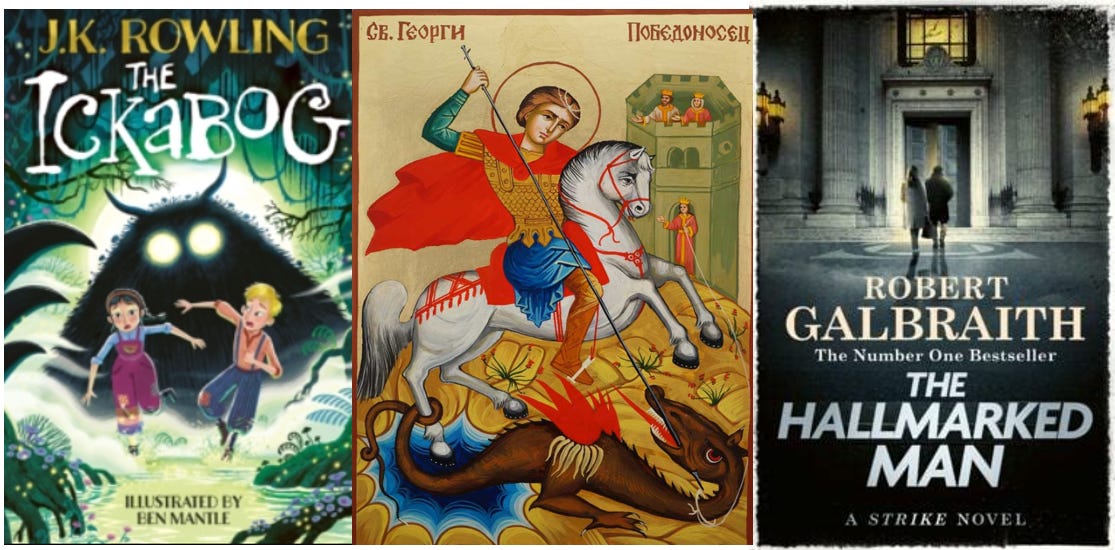
    Last week Ed Shardlow posted his thoughts about The Hallmarked Man being written in playful but meaningful parallel with Rowling’s “political fairy tale,” ‘The Hallmarked Man Meets The Ickabog.’ Nick Jeffery and John Granger called him up both to congratulate him on Arsenal winning the Premier League Cup — Go, Gunners! — and to learn as much as they could about the parallels he noted. After acknowledging the correspondences with Casual Vacancy, the trio explored Ed’s argument about the Ickabog echoing just beneath the surface of Hallmarked Man, straight up and in inversion. The Ten Questions, Links, and Helpful Notes 1. Nick, can you provide some context for this conversation? How did we get to the point that we expected Hallmarked Man to echo in characters, plot points, and themes either Casual Vacancy or The Ickabog? No one thought that was in the cards when Rowling-Galbraith and her publishers locked down the series at ten books. * ‘Parallels Series Idea’ Pillar Post * Evan Willis’ Tetractys Theory: Part 1, Part 2, Part 3 2. Open subject for the triumvirate to discuss here: there are a bunch of Casual Vacancy parallels in Strike 8 that have to be acknowledged. Name your favorites; I’ll start this ball Rowling… * Ironbridge and Pagford seemed to be sister cities * each book ‘begins’ with the sudden and tragic death of a man who haunts the rest of the novel, Barry Obama Fairbrother and Tyler Powell * The peanut allergy that Tyler and Andrew Price have; and * The incest secret in the Longcaster and Wall families 3. Having noted those, Ed, why are you so sure that it’s The Ickabog which is the parallel text with Hallmarked Man? Is the quantity of the parallels you and others have found, their quality, or the overarching feel of the works? * Ed’s Post: ‘The Hallmarked Man Meets The Ickabog’ 4. I was surprised by your sheep parallel. I know my Ickabog memories are not fresh, but were there a lot of lambs and ewes in Strike 8? * Ed’s Post: ‘The Hallmarked Man Meets The Ickabog’ 5. And the fish? * Ed’s Post: ‘The Hallmarked Man Meets The Ickabog’ 6. Is there something akin to the Freemasonry of Hallmarked Man in The Ickabog? * Inversion of ‘Political Fairy Tale’ with modern touches and gritty detective novel and Medieval coloration via Freemasonry symbolism and ritual 7. Sandy Hope, our partner in the Group Adventure of charting Hallmarked Man, had a bunch of parallels that she shared in the comment thread to your post: * One of my favorite parallels you mention is the Old Forge and the Ickabog’s cave, in which both Robin and the Ickabog tell tragic stories of birth. The Old Forge also reminds me of the transformation of the dungeon once Mrs. Beamish gets a stove installed and starts baking and feeding the prisoners. Mr. Dovetail’s broken mind is restored by Mrs. Beamish helping him remember better times, and Robin’s own brokenness is soothed by Strike’s transformation from a self-serving, manipulative jerk to a selfless, compassionate listener and genuine friend. In both stories the fire is warm and purifying. Comment Url * One of my favorite parallels was “sticking to the game plan,” the ill-fated idea shared by Strike via Uncle Ted and also Lord Spittleworth. RFM reminds me of Ma Grunter, trying to appear sober when they’re actually drinking on the sly. Dangerous Dick de Lion is not unlike King Fred the Fearless, who both have to learn about being contrite. Robin’s bracelet is rather like Daisy’s bandalore: both gifts are initially a hit but end up secretly hidden or stolen. Comment Url 8. My favorite parallels were between the incest and ectopic pregnancy in Hallmarked Man and the Ickabog’s manner of conceiving children and birthing them. Did you laugh out loud when you figured that out? I did when I read your post -- but it bears some explaining -- * Ed’s Post: ‘The Hallmarked Man Meets The Ickabog’ 9. Let’s go around the table again and talk about the connection between the two books we haven’t talked about yet -- * Avenging Ghost of Beamish and Powell * Eslanda/Jolanda * Sandy Hope’s Footprint Clue * Image of St George * The monster’s cave, the Old Forge on Sark, and an ectopic pregnancy * Woman talking monster into returning to human society * Ed’s brilliant parallel Character list 10. You discuss in your post that you went through two stages before arriving at your conviction that The Ickabog was the model: first the overarching story and then on re-reading The Ickabog for specific detailed parallels. Do you think we should do a re-read of Casual Vacancy -- Nick is always ready for a trip to Pagford -- to see if there aren’t specifics there, too? This is a public episode. If you'd like to discuss this with other subscribers or get access to bonus episodes, visit hogwartsprofessor.substack.com/subscribe
  • May 22 · 53 min

    The Hidden Narratives and Interpretive Ciphers Beneath the Surface Story of Hallmarked Man

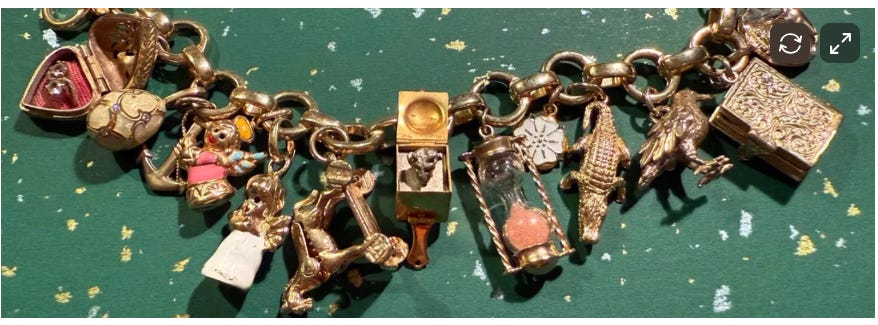
    In yesterday’s Hallmarked Man Notes: The Christmas Charm Bracelet Decoded, Tod Jameson and the Ectopic Pregnancy, and Venetian Blinds, Ed Shardlow explained three sub-texts within Strike 8 that, though invisible on first and second reading, pop up during structural analysis and in light of other Rowling-Galbraith notes. * The Christmas gift charm bracelet that Strike gives to Robin, for example, appears to be a ring and a key to Hallmarked Man, a meaning that occurred to Ed in light of Rowling’s own bracelet gift to fandom last year as a key to Sleep Tight, Evangeline; * John Granger’s posts about Strike 8’s cryptonyms similarly encouraged Ed to think about the meaning of ‘Todd Jameson’ and how the “egg-shaped” man had several names and seemed to be stuck on the Tube; and * Ed’s efforts to finish his charting of each Part of Hallmarked Man brought up the theme of Robin’s blindness and mental struggles in Part Three’s chapter correspondences. In conversation with Nick and John explore these ideas as well as the potential importance of A. H. Murdoch, a historical figure that Rowling-Galbraith invented whole-cloth, the meaning of his name (‘Alexander Hughson’), and the passages from his book, Secrets of the Craft, which of course are also Rowling-written. Below are relevant links to the subjects the trio discuss and copies of the ten questions John and Nick asked Ed. Enjoy! Links to Conversation Subjects * Hallmarked Man Notes: The Christmas Charm Bracelet Decoded, Tod Jameson and the Ectopic Pregnancy, and Venetian Blinds Charm Bracelets * The Christmas Charm Bracelet of Strike 9 Clues (Part One) * The Christmas Charm Bracelet of Strike 9 Clues (Part Two) * 'Sleep Tight, Evangeline,' Miniature Psalters, and the Head of Persephone: A Conversation with Dimitra Fimi Cryptonyms of Hallmarked Man * The Allegorical Cryptonyms of The Hallmarked Man, Part One * What do Tyler Powell, Rupert Fleetwood, Jolanda Lindvall, and Lady Jensen Have in Common? * The Allegorical Cryptonyms of The Hallmarked Man, Part Two * Wet Squibs, Islamic Cub Names, the Seven Strike Series Structure Theories, and How a Human Being Reads a Story * The Lost Child Golden Thread in the Work of J. K. Rowling (Kanreki) * The Pre Natal Infanticide Theory Explaining the Lost Child Golden Thread (Kanreki) Rowling as Sacred Artist: A Perennialist Reading * Ray Livingston's 'The Traditional Theory of Literature' (Chapter 1: Preface and Prologue) * Ray Livingston's 'The Traditional Theory of Literature' (Chapter 2: Man, Society, Art ) * Ray Livingston's 'The Traditional Theory of Literature' (Chapter 3: The Creative Process) * Martin Lings’ The Sacred Art of Shakespeare * J. K. Rowling’s ‘G-Spot’ and ‘Triple Play:’ The Lake & Shed Secret of Her Success The Ring Readings of Rowling’s Hallmarked Man Chapter Sets * Index to the Group Adventure of Charting Hallmarked Man (scroll to bottom) * Ed Shardlow’s ring notes for Part Three A. H. Murdoch’s Secrets of the Craft Excerpt in Hallmarked Man: [Strike skim read the entry under Degree Thirty Two.] The Sublime Prince of the Royal Secret becomes with the degree’s endowment none other than a Christian Knight, the spiritual and legitimate successor of the Knights Templar… When she elevates and illuminates, a pure and chaste woman is as silver, or the moon. The […] Freemason is sure never to mistake base lead for the nobler metal, else he may find himself forever entombed in the dungeons of lust and lasciviousness. (ch 53, pp 400-401) The parenthetic ellipsis is in text, presumably there because “Murdoch’s book hadn’t been properly formatted, but scanned into digital form, so that the occasional word was illegible.” The Ten Questions 1. We have a special guest today, Ed Shardlow, the author of a commissioned post that went up this week, one we begged him to write up. It’s a weird post erven for a site that embraces the exotic, weird in the sense that it’s actually three posts rolled into one. What’s up with that, Ed? 2. So the three topics are: * The charms on the Christmas gift bracelet Strike gives to Robin; * The meaning of Todd Jameson’s name; and * Robin’s sight and memory issues, ‘Venetian Blinds’ Is there a thread running through these ideas? 3. Tell us your charm bracelet idea and the meaning you think each charm has -- 4. And it’s a ring, right? What a hoot. -- 5. I loved the charm bracelet piece, not only because you read it as a ring and showed that the charms together and separately act as something of a cipher for the book, but because you linked it with Rowling’s Strike 9 charm bracelet. Do you think per Shanker’s advice that Rowling-Galbraith is giving us jewelry as a gift, one that acts as a key to the work in Hallmarked and before Evangeline, because she wants to make up with us for the hardship readers are having with the book? 6. True confession, though I was laughing out loud and delighted with your breaking the Todd Jameson cryptonym, I was also pretty disappointed; that name was number 1 on my not-yet-written third cryptonym post. What consoles me is that I doubt I would have picked up on what you saw, which is mind-blowing. Tell us how you figured it out as well as what you found -- 7. Now this is a new variant of Rowling-Galbraith inserting a text within the text. This ectopic sub-story isn’t a written text, a fairy tale, an epigraph, a song playing in the background, an illustration based on a mad detective’s Tarot card throws, or the story the bad guy is selling that we have to unwind and re-write; we’ve seen those books-inside-the-book before. This is Rowling concealing a narrative inside the narrative with really only the name to act as the cipher for the coded message. Hence her talking up the importance of names in this book (e.g. Jolanda -- violets)? 8. You make a fascinating connection with Harry Potter, the Boy Who Lived, and Todd Jameson, the Son Who Killed His Mother (?). Do you think she finally wrote in a Chosen One echo in the Strike series via Jameson? 9. I want to leave the board here because I know you have to run -- thank you for joining us on such short notice! -- and talk about something you’ve been sharing on the Moderator’s Back Channels, namely, A. H. Murdock. His Secrets of the Craft is another text within a text, right? Have you thought about his name or why Rowling gave his book that title? 10. When will you be done with The Ickabog project? Inquiring minds want to know! This is a public episode. If you'd like to discuss this with other subscribers or get access to bonus episodes, visit hogwartsprofessor.substack.com/subscribe
  • May 14 · 1 hr 21 min

    A Conversation about Cormoran Strike, Literary Alchemy, and Structural Models for the Ten Book Series

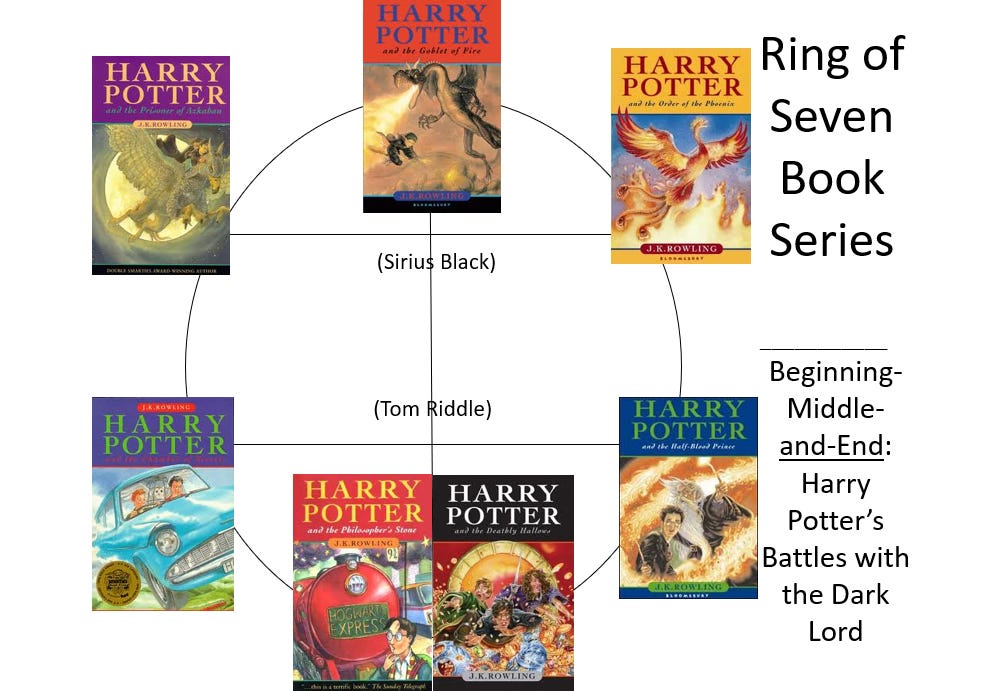
    Nick Jeffery and John Granger sat down last weekend to discuss John’s post, The Literary Alchemy of Hallmarked Man: What Do the Structural Models Tell Us? They’d talked about this subject briefly before John had written it up and he came to rather different conclusions in the process of writing and preparing slides for the post, all of which are rolled out in this inquisition. The questions Nick asked are below after the links in the post in case you want to follow up on what is said above about literary alchemy, the sequence of colors and symbols, and about the structural models for understanding the Strike series, especially Extended Play and Tetractys Theory. Enjoy! Links for Follow-Up and Easy Reference: Strike Alchemy * Literary Alchemy – A Primer for Those Interested in J. K. Rowling’s Artistry * ‘Literary Alchemy’ Pillar Post * Metallurgical, Literary, and Psychological Alchemy: Is Jung a Good Guide for Understanding J. K. Rowling’s Artistry and Meaning? * The Literary Alchemy of Hallmarked Man: What Do the Structural Models Tell Us? * , ‘The Connection of Ring Composition and Literary Alchemy in the Layout of the Seven Book Harry Potter Series.’ (William Sprague) * ‘Parallel Series Idea’ Pillar Post * Robin Ellacott and Reverse Alchemy: Transformation Through the First Three Strike Texts (Louise Freeman) * ‘Troubled Blood: Strike’s Transformation’ * ‘Water, water everywhere: Baptism, baths, rivers, rain and showers as unifying themes in The Running Grave’ (Louise Freeman) Seven Structural Theories for Strike Ten Book Series * (1) straight up Decalogy, no structural connection between books; * (2) Big Ring Composition, Double Wedding Band (Louise Freeman); * (3) Seven book series with Trilogy finale (Nick Jeffery, John Granger); * (4) Extended Play theory (John Granger per ‘Kathleen’), * (5) Sonnet Corona Form (Robyn Gomillion); * (6) Tetractys theory (Evan Willis with back-up explanations here, follow-up from Evan here); and * (7) Celtic Cross (John Granger) scroll down to bottom). Tetractys Theory in Depth: * Alastair Fowler’s Triumphal Forms * Why the Cormoran Strike Novels are a Ten Book Series: Mythological Clues and Tetractys Parallelism with a Touch of Tarot Reveal the Strike Series Structural Echoes with Rowling’s First Ten Book Set [Evan Willis, 10 July 2023] * Is Tetractys Theory the Best Explanation of Why the Cormoran Strike Series is Ten Books in Length? First Thoughts on Evan Willis’ Numerological Exegesis of Rowling’s Two Ten Novel Series and the Meaning of This Structure [John Granger, 18 July 2023] * Evan Willis: Running Grave Review In which the Tetractis theory is revisited in light of Strike 7 and the Theory is Updated [Evan Willis, 30 September 2023] * See The Literary Alchemy of Hallmarked Man: What Do the Structural Models Tell Us? for excerpts from and discussion of each. * The Tetraktys Tarot Card Spread! The Charts! The Ten Questions and John’s Answers (notes!) 1. So, John, you finally got the alchemy post you promised an age ago; what was the hold-up? · Tried to put too much into the posts… · Changed my mind several times as I was writing them! · had to relearn Tetractys ideas! 2. You start off this Alchemy of Hallmarked Man discussion with a review of the literary alchemy of the first three Harry Potter novels; why did you have to reach that far back? · Because of the Parallel Series Idea, not alchemy at all, oddly enough. · Rowling seems to be writing Strike decalogy in parallel with Potter to include its alchemical sequences so I reviewed the ‘Reverse Alchemy’ theory, how that worked for Strikes 1-3 but broke down at 6 and 7 · To get Hallmarked Man‘s alchemical stage right, I wanted to figure out why Ink Black Heart and Running Grave weren’t the alchemical stages we’d expect 3. Some of our listeners may not have the literary alchemy three stages firmly in mind; can you go over what they are and why they’re important in Rowling Studies? · Black, White, Red stages: what each represents in metallurgical and literary alchemy; · Rowling’s one interview comment about alchemy, her PotterMore notes about colors; · Rowling’s use in Harry Potter‘s last three books, fourth book, and first three books; · Galbraith’s use in Strike series’ first three books, fifth book, and six and seven; · Ward on astrology in CSL’s Narniad (’Donegality’); similar use of alchemy in Rowling-Galbraith 4. So the alchemical parallelism seemed to stop at Ink Black Heart but the other correspondences continued? · That’s right, the first seven books paralleled their Harry Potter apposite numbers in structure, plot points, and some symbolism but the last two broke from the alchemical pattern; · I decided that the best place to look for a way that the new pattern could be explained would be looking at the seven theories about the Strike-Ellacott series structure; · If a specific structure had a very clear idea about the alchemical stage sequencing in the books, then I’d have a real head-start in what to look for in Hallmarked Man. 5. The Seven theories -- last time we talked it was six! Remind me what they are and what each says about the alchemy... · No structure, Big Ring/Double Wedding Band, Septology and trilogy combo, Extended Play, Corona Sonnet, Tetractys, and Celtic Cross (see links above!); · Only Extended Play and Tetractys theories had clear theories about the alchemy; and · Oddly enough, they both explained why Hallmarked Man had to be considered an albedo or white novel even though they disagreed about what Ink Black Heart and Running Grave were... 6. We’ve got slides here that help make what seems hopelessly nerdy something you can see. We’ll start way back with the ring structure of The Harry Potter series and work our way toward Evan Willis’ Tetractys ideas. · Harry Potter series, Sprague/Thacker ‘Reverse Alchemy:’ Slides 1 and 2 (see above) 7. And via the Parallel Series Idea we should see those same relationships that were found in the Potter books in the Strike series? · Extended Play idea: Slides 3 and 4 (see above) · Where it breaks down -- Running Grave like Troubled Blood an “aquatic Nigredo“ 8. And you think the Tetractys idea is better. We really need to have Evan on the show to talk about where he learned about this figure, its use in English literature prior to Rowling, and why he thinks Rowling is writing her second ten book series. Can you summarize his two Hogwarts Professor posts on this subject and why Rowling Readers will benefit from learning about this ancient ten point peg board model? · See Tetractys pyramid slides above; · Four levels: meaning of monad, dyad, triad, quaternity symbolism; (first Evan Willis post above) · Pyramid to climb, something akin to four levels of reading and knowledge; [Fowler, Triumphal Forms] · Benefit to Rowling Readers: Willis thinks the second Quaternion parallels Rowling’s first -- and the differences explain the alchemical stage of Running Grave; · It also was used to predict three things about Hallmarked Man: it was all about silver, it would be an albedo or White stage novel, and it would parallel The Ickabog 9. Three bullseyes with a special merit badge for figuring out the silver part before the title was announced. Let’s go to the Tetractys slides for the Potter and Strike series: · All above! 10. Both the Extended Play and Tetractys theories, then, have Hallmarked Man as an albedo. How will that influence your examination of Strike 8 for its alchemical symbols and sequences as well as your interpretation of them? · I’ll be looking for the alchemical signatures of the second stage, leukosis or the ‘whitening,’ · I’ll be looking for evidence that contradicts the albedo dyad idea, and · I’ll be researching if alchemical ideas, as in, say, incest, ‘Jason and the Medea,’ and ‘dog and b***h,’ are best read as white stage tokens This is a public episode. If you'd like to discuss this with other subscribers or get access to bonus episodes, visit hogwartsprofessor.substack.com/subscribe
  • May 12 · 1 hr 56 min

    Wet Squibs, Islamic Cub Names, the Seven Strike Series Structure Theories, and How a Human Being Reads a Story

    Nick Jeffery and John Granger sat down to discuss four Hogwarts Professor posts. Here are links to those posts with an excerpt from each and the most relevant urls embedded in them. Enjoy! What is a Squib, Really? And Where Would Rowling Have Met the Word? (John Granger, 27 April 2026) I confess that I assumed the word for barely magical witches and wizards born into magical families in J. K. Rowling’s Wizarding World, the folk she calls ‘Squibs,’ were given that name because of its onomatopoeic source in fireworks; per the Harry Potter Lexicon invaluable online resource, a squib is English idiom for “a dud firework that will not ignite properly.” It sounds like its meaning (as does “dud”) and a reader can feel in it the disappointment of magical parents when their child turns out not to have the gift that will make them full members of their community. I learned this morning, however, that a squib is not a dud firework, or wasn’t originally though it may have that meaning today, and that it is mentioned more than once in one of Rowling’s known literary influences. * ‘Squibbing’ at the Bridgewater Carnival Fireworks Festival (YouTube video) * Toyohashi Tengu: Japanese Quidditch Team (Harry Potter Lexicon) * Tengu — Japanese Fantastic Beast not in Newt Scamander’s textbook (Wikipedia) * Toyohashi Tezutsu fireworks 2022 (Tezutsu-hanabi — Wikipedia) * Dimitra Fimi’s ‘A Kind of Elvish Craft’ Substack site * The Fireworks of Gandalf: in which ‘squibs’ are discussed (not duds!) * ‘The Slow Lord of the Rings Re-Read’ Prof Fimi’s Tolkien Reading Day Introduction * Reading Rowling as Myth Maker and Myth Re-Writer: A Conversation with Dr Dimitra Fimi * ‘Sleep Tight, Evangeline,’ Miniature Psalters, and the Head of Persephone: A Conversation with Dimitra Fimi Hogwarts Professor is a reader-supported publication. To receive new posts and support my work, consider becoming a free or paid subscriber. Ray Livingston's 'The Traditional Theory of Literature:’ Chapter 2: Man, Society, Art (John Granger, 30 April 2026) In brief, the Perennialist reading of literature begins with a different idea of what a human being is, which reflects the social environment or society and culture that best fosters his achievement of his end or telos, which reflects what role art in general and story specifically plays in his best life. The human being as primarily spiritual, his end as profound communion with what is most Real, and story as non-liturgical sacred art (not necessarily or even usually ‘religious’) which supports him in his vocation to that end are the premises of the traditional or theocentric understanding of man, society, and art. Which is the title of Livingston’s second chapter and a description of its organization as well as of its contents. It’s not easy reading; the subject matter is quite dense and he covers an enormous amount of ground relatively quickly so he can get to the ‘literature’ in the remaining chapters of the work. Without setting out the premises of the Perennialist understanding with respect to what it means to be human, how a community is designed to make a fully human life possible, and how the art of everyday objects as well as set pieces for appreciation or entertainment — there being no meaningful difference in the value of practical and fine arts here — bring that polity to fruition, discussion of literature from the traditional view would be a waste of time. The Allegorical Cryptonyms of Hallmarked Man, Part 2: Ten More Cratylic Character Names and Best Guesses about their Embedded Meanings (John Granger, 1 May 2026) This is the second part of at least a three part series of articles with supplementary video discussion in which I take a long look at Rowling-Galbraith’s choices for character names in the eighth Strike-Ellacott novel, The Hallmarked Man. For the first posts in this series, in which I explain why this is a worthwhile effort, one critical to Rowling’s intentional artistry and complementary to her other Shed tools, see ‘The Allegorical Cryptonyms of The Hallmarked Man, Part One’ and my conversation with Nick Jeffery about it ‘What do Tyler Powell, Rupert Fleetwood, Jolanda Lindvall, and Lady Jensen Have in Common?’ Almost half of today’s ten posts are about characters named ‘Lion’ or variants on the leonine theme. I think the number of lions prowling through Hallmarked Man, not to mention the dogs from Hell and the bears benign and grizzly, deserve their own post, especially to contrast it with the predominant swan symbolism of the first seven books. Or are they conjoined in Jonny Rokeby, whose middle name is the lionesque ‘Leonard’ and who plays the part of a Jovian swan in the Leda mating that produced Cormoran Strike (we think?). [Be sure to check out Ed Shardlow’s full catalogue of the lions afoot in the pages of Hallmarked Man!] * ‘I’m an Essex Girl’ (YouTube video) The Literary Alchemy of Hallmarked Man: What Do the Structural Models Tell Us? Seeking Pointers to the Hermetic Meaning of Strike 8 within (a) the Extended Play and Tetractys Ten Book Series Pictures and (b) the Parallel Series and Reverse Alchemy Ideas (John Granger, 8 May 2026) There are currently seven theories that I have read about of how best to think of the Strike-Ellacott series structure: * (1) straight up Decalogy, no structural connection between books; * (2) Big Ring Composition, Double Wedding Band (Louise Freeman); * (3) Seven book series with Trilogy finale (Nick Jeffery, John Granger); * (4) Extended Play theory (John Granger per ‘Kathleen’), * (5) Sonnet Corona Form (Robyn Gomillion); * (6) Tetractys theory (Evan Willis with back-up explanations here, follow-up from Evan here); and * (7) Celtic Cross (John Granger) scroll down to bottom). The first idea is that there isn’t a series structure worth noting, which is the default position of the great majority of readers. They (we?) enjoy each book and appreciate the over-arching story parts and conflicts without wondering about the author’s intentional narrative scaffolding. Rowling has repeatedly said that special sauce secret of her success is structure but as story organization artistry is very rarely discussed today in English classrooms even Literature wonks neglect it. The other six ideas have their advocates and rather than review each I’ve embedded links above to these proponents’ online arguments in favor of their best guesses. All of these structure theories have advantages and support from previous work we and others have done in the field of Rowling Studies; all of it, however, it must be remembered is laughably speculative guesswork – we’re not going to grasp the series structure with any certainty until it’s done or Rowling actually answers questions about it or shares the information gratis (neither of which is likely given her history). Those of us who give any time to this, not to name those who are pre-occupied with it, are hunting phantom fandom garlands (as well as having a lot of fun). There actually is, however, a reason beyond personal insecurities and a search for redemption for thinking about how the ten book series is organized before all the books are out. If you’re trying to figure out the alchemical quality or stage of a book already in print, understanding the sequence of books should theoretically reveal the sequence of stages (and vice versa). As explained above, Rowling seems to be writing the Strike series in parallel with her Harry Potter seven books. Until we got to the sixth book in Robin and Cormoran’s adventures, those parallels included the alchemical coloration or stage the Potter numerical equivalent had. Other correspondences between the series continued, most notably, the seven book ring structure and playful plot point parallels (see my conclusions post Running Grave here, here, and here). The alchemy did not. In terms of alchemy, the most compelling ideas I think are Extended Play (EP) and Evan Willis’ four-three-two-one pyramid, the Tetractys figure of the ancients, the ‘Great Quaternion.’ Let’s look at each. * Why the Cormoran Strike Novels are a Ten Book Series: Mythological Clues and Tetractys Parallelism with a Touch of Tarot Reveal the Strike Series Structural Echoes with Rowling’s First Ten Book Set [Evan Willis, 10 July 2023] * Is Tetractys Theory the Best Explanation of Why the Cormoran Strike Series is Ten Books in Length? First Thoughts on Evan Willis’ Numerological Exegesis of Rowling’s Two Ten Novel Series and the Meaning of This Structure [John Granger, 18 July 2023] * Evan Willis: Running Grave Review In which the Tetractis theory is revisited in light of Strike 7 and the Theory is Updated [Evan Willis, 30 September 2023] * Literary Alchemy – A Primer for Those Interested in J. K. Rowling’s Artistry * Metallurgical, Literary, and Psychological Alchemy: Is Jung a Good Guide for Understanding J. K. Rowling’s Artistry and Meaning? The Ten Questions! Introduction: It’s been a busy week, John, with posts on traditional reading, cryptonyms, and literary alchemy. I’ve got a bunch of questions about each subject so let’s jump right in -- with some thoughts about Squibs in Bridgewater and Toyohashi, Japan! 1. Ray Livingston: You’re sending out a chapter of The Traditional Theory of Literature every week to our Paid Subscribers which I think everyone has access to, at least for one or two chapters. It’s no small effort to type up this public domain book that isn’t available anywhere on the internet, especially with the embedded links to the obscure references in the footnotes; why are you bothering? 2. Ray Livingston: The first chapter you sent out went to everyone and included the glossary of terms as well as the Table of Contents, preface, and prologue (chapter one). I’m guessing this is more than throat-clearing and publisher’s data; why does a literary theory text, for example, need a glossary? 3. Ray Livingston: The second chapter, ‘Man Society, and Art,’ was a dense read, I confess. Am I right in thinking this was Livingston’s attempt to introduce the Perennialist ‘Theory of Everything’ in one short chapter to lay the foundation for the literature chapters? 4. Cryptonyms 2: It’s been a minute since Part One of the Cryptonyms series, why the hold-up? 5. Cryptonyms 2: [John] And part of my cryptonym-hesitancy was how much of this post was UK specific, as in the Branfoot = Branson idea and the Essex Girl bit, all of which was new to me. As a Brit living in Wales, should I have resisted the urge to speculate on those subjects? And is the anti-Semitism part of my Hafsa Mohamed interpretation just looking backward from current events? 6. Cryptonyms 2: Do we have a Cryptonyms, Part 3, in queue? [Ottolie, ‘Jim Todd’ (‘Jim Philpott,’ Todd Jameson), Calvin ‘Oz’ Osgood, Sofia Medina, Gretchen Schiff, Sapphire Neagle, Susan Iverson, Kim Cochran, Trevik Nancarrow, Peggy (Margaret ‘Leda’) Nancarrow,, Carmen Ellacott (Dirk Ellacott, Barnaby Ellacott), Ralph Lawrence/ John Auclair – Open Invitation to readers to make name-deciphering requests in the comments; there are more than 150 names in Hallmarked Man so tell me the ones you want to hear more about] 7. Alchemy (Series) We’ve been writing and talking about ‘how to understand literary alchemy best,’ i.e., by taking a Jungian or a Perennialist perspective on how Rowling uses it, but this latest piece on the Literary Alchemy of Hallmarked Man is much more straight-reading or interpretation, no? And it starts out with how to understand Strike 8 in light of the series sequence of alchemical stages; what’s the struggle with this kind of reading that we’re only getting to this six months after the book came out? 8. Alchemy (Hallmarked): How does your reading of specific alchemical images in Hallmarked Man differ from how you read them in, say, Troubled Blood? 9. Alchemy (Hallmarked): There were quite a few finds in the ten images you found in Abraham’s Dictionary that resonated with subjects we’ve been talking about -- the mythological backdrop to the story, to incest, to Lions and Masonry. What are we to make of this? Do you think it’s a coincidence that Rowling-Galbraith’s plot points and other artistry reflects these alchemical glyphs or is the hermetic symbolism driving the other elements? 10. Coming Week: So what can we expect in the coming week, John? Lots and lots! Please send in your cryptonym deciphering requests — and your ideas for Hogwarts Professor merchandise (AI generated logo designs welcome)! Hogwarts Professor is a reader-supported publication. To receive new posts and support my work, consider becoming a free or paid subscriber. This is a public episode. If you'd like to discuss this with other subscribers or get access to bonus episodes, visit hogwartsprofessor.substack.com/subscribe
  • April 29 · 1 hr 41 min

    Is Rowling's Incest 'Golden Thread' the Key to Her Cormoran Strike Finale?

    Golden Threads Last July, Nick Jeffery and I put together a month long review of Rowling’s work in celebration of her 60th birthday, a Kanreki party. Every day we posted conversations about each of Rowling’s works with Nick discussing a ‘Lake’ point, something biographical or bibliographical, and me talking about a ‘Shed’ quality of the work, the author’s traditional tools, artistry, and meaning. That worked great for about twenty days. Then we ran out of books. What to do for the remaining days of the month? We decided to talk about Golden Threads, the plot points, themes, and twists that run through everything Rowling has written. We started out with a survey of the fifteen-plus already identified by Rowling Re-readers and Fourth Generation types (see here and here) and then with more in depth looks at the ones that were controversial or more difficult to see. We closed off the month with the ‘Lost Child’ Golden Thread and the possibility that Rowling’s inspiration for the Harry Potter series was the trauma of pre-natal infanticide (‘abortion’). As disturbing as that Golden Thread was to many Rowling fans and Feminist Gate Keepers, there was another third-rail string we didn’t discuss, namely, the plot point of incest that readers encounter again and again in the Potter and Strike series as well as the stand-alone stories. Incest as Golden Thread Nick and I discuss the Incest Golden Thread on the fly in the conversation above about Strike-Ellacott fandom theories about Sleep Tight, Evangeline and the series finale. Here are some written references if you want to review them by looking at the books in question on your shelf. * Harry Potter The foundation crime of the Hogwarts Saga is the abuse of Merope Gaunt by her father Marvolo and her brother Morfin. The abuse in question in this children’s book series is not explicitly sexual. As with the abuse of Ariana Dumbledore by the Muggle boys, however, that Merope’s father and brother violated her is there between the lines; her trauma is so great that she loses her capacity for magic (as she does after her Riddle lover leaves her) and the family does not send her to Hogwarts lest their shameful secret be revealed. No broken Merope, no Lord Voldemort, no Potter family murder and orphan Harry — no series. Though the Saga’s foundation crime, the Gaunt family’s abuse of its only young woman, is not revealed until Order of the Phoenix, it is the tragedy on which all the core conflicts of the septology are built. * Casual Vacancy Stuart ‘Fats’ Wall is the adopted son of Tessa and Colin Wall. A teenager in Vacancy, he and Krystall Wheedon are the star-crossed lovers around whose choices and behaviors the ensemble drama largely turn. Fats at the end of the book claims responsibility for all the Ghost of Barry Fairbrother posts by means of which the secrets of Padford citizens are spilled. In the climax of the Wall family drama after Robbie’s drowning and Krystall’s suicide, Tessa reveals to Fats his personal history. His biological mother was only fourteen when he was born, an age that sadly means it is possible-to-likely that he is the fruit of incest. Tessa, a diabetic woman unlikely to carry a baby to term successfully, compelled her unwilling husband to agree to the adoption despite his mental fragility. Again, the foundation crime of this very involved story is incest, the abuse of a young woman by her family. * Lethal White In the first of only two Rowling books in which every epigraph was taken from a single work, the fourth Strike novel takes all of its headings from Henrik Ibsen’s Rosmersholm, a play in which suicide and incest go hand in hand, especially in the White Horse finale. The novel parallels its epigraph source in astonishing ways. The Chiswell family has its secrets. The Minister of Culture hires Strike’s agency to find ‘dirt’ on Jimmy Knight and Geraint Winn that can used as counter “bargaining chips” to end their capacity to blackmail him. He shares neither what information they have that they are holding over his head to extort money and revenge nor what Billy Knight witnessed years ago. If Jasper or Izzy Chiswell had told Strike this information in the beginning, it is likely the pater familias would not have been murdered. The biggest secrets, of course, are about the sexual relationship between Raphael and his step-mother and the step-son’s plans to murder father and eventually Kinvarra in order to be free to spend the millions he’ll make from sale of the Stubbs. Not quite incest, a step-mother in bed with her step-son, but something like it. Rosmersholm‘s family secrets are if anything more disturbing. Kroll reveals to Rebecca that Dr. West, her adoptive father, was very likely her biological father as well. It is implied heavily that after her mother’s death Rebecca’s relationship with Dr. West changed from filial to sexual; Kroll’s revelation about this is something of an Oedipus Rex moment. Rebecca realizes that she had been sleeping with her father and the incest taboo crushes her ability to accept Rosmer’s overdue marriage proposal, a proposal for which she had convinced the ailing Mrs Rosmer to commit suicide. * Troubled Blood The psychopathic murderer and torturer of children that the police and public believe killed Margot Bamborough is Dennis Creed. We learn in chapter 8 of Strike 5 via the Peg-Legged PI reading The Demon of Paradise Park that Creed was the incestuous rape off-spring of Agnes Waite and her step-father Awdry, a man who wanted to kill the child at birth but which the mother prevented (to her eventual regret). Awdry abused the boy all through his childhood, especially after Agnes’ escape as a young woman (reminiscent of Peggy Nancarrow’s flight from St Mawes). Troubled Blood is haunted by the victims of Creed’s madness, all of whose deaths can be traced back to Awdry’s violent sexual violation of his step-daughter. * Hallmarked Man The mystery Cormoran Strike agrees with no little hesitation to try to solve is ‘What happened to Rupert Fleetwood?’ Decima Longcaster Mullins, mother of Fleetwood’s son Lion, believes her baby-daddy was the unidentifiable murdered man in the Ramsey Silver Vault. We learn before that victim’s identity is revealed that Fleetwood fled the UK after he learned that the woman he loved was his half-sister and his son the product of unwitting incest. Rowling-Galbraith reveals only in the epilogue that Ian Griffiths murdered Tyler Powell because the young man was determined to rescue the young woman living with Griffith as his daughter who was pregnant with his child. Once again, the foundation crimes of a Rowling work turn on the intentional sexual abuse of a girl by a father-figure, here compounded by an Oedipus Rex like incest-in-ignorance episode. Incest Notes * Fantastic Beasts As in the Harry Potter novels, there are no explicitly incestuous relationships in the Fantastic Beasts screenplays. The conception of Leta Lestrange, however, checks the ‘rape,’ ‘power abuse,’ and ‘inter-family’ boxes of father-daughter incest nightmare. Her mother, Laurena Kama, was desired by Corvus Lestrange III even though she was married to Mustafa and the mother of Yusof. Corvus compelled her by the Imperius Curse to join him and, while she was under his control, which is to say ‘unable to consent or resist his will,’ conceived Leta, who took his name as if her mother had been his wife. Leta unknowingly avenges the Kama family by her switching her younger half-brother Corvus IV with the Dumbledore baby that results in his death by drowning. * Ickabog Nick Jeffery points out in our conversation that there can be no more incestuous means of conceiving a child than the Ickabog species’ parthenogenic reproduction. If one accepts that as incest, the Ickabog’s death after delivery and the imprinted character of the Ickaboggle by its first contact post partum have to be read allegorically. * Cuckoo’s Calling There is no mention made in the first Strike novel of John Bristow’s having sexually abused his younger also-adopted sibling-sister, Lula Landry. I’m going to include it in these ‘Incest Notes’ because I think it possible that the man who killed his brother Charlie and envied his sister Lula ‘played’ with her cruelly, which fostered her mental instability. I think this is more than imaginative free association head-canon because of Lula’s successful search for and planned meeting her real sibling brother Jonah Agyeman the night of her death. Bristow-Agyeman, the false and true brothers, are figures of erotic and anterotic love in her life, so much that I don’t think incest is a stretch for John Bristow, the unloved chick in the nest. Hogwarts Professor is a reader-supported publication. To receive new posts and support my work, consider becoming a free or paid subscriber. So what? There has been a real up-tick in speculation about how the Strike series will finish in its last two books with the guess work largely turning on how the Big Unresolved Mysteries will play out. The reason I’ve written up these thumbnail etchings of incest occurrences through Rowling’s work is because several of the theories Nick and I are seeing in the comment boxes here and on the YouTube HogwartsProfessor channel are incest driven. To get that, a Serious Striker, beyond grasping that incest is a ‘thing’ to expect in a Rowling piece like Bad Dad, Divine Mother, Violence Against Women, and at least one Lost Child, has to have in sight at all times three ideas that act as premises: * Closing Trilogy Theory: Hallmarked Man the first of a three book finale which introduces the main characters; There’s a real split in Strike fandom about what to think of Hallmarked Man. The great mass of readers on Reddit I’m told and at least one Substack Sage believe it is “the worst book of the series,” a real stinker. Nick and I — and most of the Hogwarts Professor readers who comment on our posts and conversations — in contrast think it is a brilliant book, one that may eventually be considered one of the best in the Strellacott decalogy. The difference is that the one group reads Strike 8 as if it were just like the first seven books in the series, i.e., a stand alone mystery whose cast of characters will in large part disappear from the stage before the next book begins. That working assumption makes the extraordinarily large cast of players in Hallmarked Man and the five different story-lines just with respect to whom the silver vault corpse might be, not to mention the Strike-Ellacott romance and over arching mysteries clues seem a confusing pile-up of plot points and people, few of which made this book fun-to-read. The author seems like she just lost control of the story and threw everything that occurred to her into the story and cut none of it out. Our working theory disagrees with that Just-Like-All-the-Others assumption and finds the possibility that Rowling has just lost her way very unlikely. Having just finished charting each of Strike 8’s chapter sets or ‘Parts’ and found that each is an intricate ring, as well as those Parts working as a ring, too, believing that the author is asleep at the wheel seems borderline preposterous. We think that the first seven books, each written playfully on the model of its Harry Potter numeric counterpart, are a closed set — and that the last three books in the ten book series are being written as a trilogy in which the Great Mysteries introduced in the first seven will be resolved. Hallmarked Man, as the first book in this three part series, is burdened with introducing all the principal players of this extended finale inside a book whose mystery allows their appearance and character reveal without pointing too obviously to their part in the upcoming drama. Hence Tara, Dino, Valentine, Ralph Lawrence, Sacha, and at long last Rokeby playing the roles they do in this book. * Trilogy will resolve at last the Leda Margaret, Charlotte, and Strike/Ellacott story line mysteries; The end of Strike 10 seems to be a hard stop according to Rowling. She is obliged, consequently, in the next two books to give her readers satisfaction on the many hanging threads in the series, most notably: * The story of Strike’s conception, the IED explosion, and his SIB medal; * Peggy Nancarrow, a.k.a., Leda Strike, why she left St Mawes as she did, why she raised her children as she did, and all the circumstances of her seeming suicide (Where’s Switch?); and * Charlotte Campbell-Ross, sometimes referred to as the Honorable Milady Bezerko, and the baby she claims to have conceived with Strike, her backstage efforts to upend Strike’s relationship with Robin, her break-up with the hotelier billionaire, her suicide note, and, echoing Leda, the circumstances of her seeming suicide. That’s the shortest of lists obviously with nothing about Murphy or Robin or the host of other key players in the series. Given the ending of Hallmarked Man, I’m very much inclined to think that Sleep Tight, Evangeline’s mystery will turn on where Robin went after Strike’s proposal on the stairs which will necessarily involve Murphy, and, forgive me, many of the players from Strike 8 as Rowling-Galbraith begins rolling out the stunning twists hidden beneath the surface of Strike 8. All those fun confrontations with Charlotte’s bizarro family, from Emilia at the end of Grave to Tara, Dino, Valentine, and Sacha? My bet is we’ll learn in the next books how much Strike and Ellacott missed in their meetings with each. * Serious Strikers think incest is at the heart of the Strike, Nancarrow, and Campbell mysteries. Leda’s Conception * Ted’s Daughter with an Unknown Women A real stretch, I know, but Ted, per the invaluable Cormoran Strike Timeline, was fourteen years older than his younger sister Peggy. If you think it inconceivable that Ted was Leda’s father, you either imagine that just-barely-teenage boys cannot sire children (see George Hamilton’s life for his sexcapades at age twelve with his stepmother) or you make nothing of the fact that Trevik gave up his daughter for his mother’s upbringing when his wife died. Perhaps the cause of the Nancarrow house nightmare and Ted’s departure for the Army “lest murder be done” was because, a la Hamilton, Leda’s mother was not a young lass with whom Ted met outside The Victory but Trevik’s abused wife, Ted’s own mother. Which is to say he was both Leda’s brother and biological father. Hence the otherwise almost inexplicable relationship of Ted, his barren wife, and Peggy-Leda. Just sayin’! Strike’s conception: * Son of Leda and Ted; Leda is 23, give or take a year, at Strike’s conception early in 1974 and her older brother is 37 and married to Joan who cannot have children. It’s possible that Ted is Cormoran’s dad, just as Joan is delighted to hear Strike say he is in Troubled Blood, the only barrier being our being told repeatedly that Ted was a “proper man.” Perhaps that repeated telling is a marker that he wasn’t always that proper but did his best to set his sister (daughter?) up well with the Rokeby paternity evidence. See ‘Uncle Ted It’ for more speculation along these lines. * Son of Leda and Trevik Nancarrow; I’m thinking that if Rowling is pointing to an incest relationship in the Nancarrow family it isn’t with “proper man” Ted, the long-suffering and ever vigilant older brother but to the “pure terror” and “hard-drinking” man despised by sister and brother. You’ll forgive for thinking that anything to which Rowling-Galbraith is clearly hopeful her readers will believe is not the surprise ending of her ten book series. * Rokeby deception If Strike’s or Leda’s conception was incestuous, especially if Ted was the father of either, then Rokeby was deceived about his parentage, I presume with Ted’s SIB-driven assistance. The best motivation I have read about why Leda was murdered and her death staged as a seeming suicide, beyond even the Mad Guillespie theories, is that she tired of this deception, hence her refusal to accept Rokeby’s child support, and intended to tell Cormoran who his father really was. So Ted killed her. Charlotte Conception and Abuse by Father, Relations with Half-Brother: * Tara and Dino’s Daughter Fiona wrote to me privately to share her theory that Dino is not only the father of Valentine, Cosima, Decima, and Rupert, but also of Charlotte: In response to a post by Cheryl Rose Orrocks on 17 Feb 2026, my current theory is that Dino Longcaster is Charlotte’s father and that his son, Valentine Longcaster, will be revealed as her abuser and the possible biological father of Charlotte’s children. Hence the 2nd incest storyline will also involve the Longcaster family. This could be why Charlotte’s mother, Tara, despised Charlotte so much. If Jago Ross is somehow linked to the matter of the DNA test involving Bijou and Strike, it may be because he had Charlotte’s birth children DNA tested to confirm parentage. Maybe Jago discovers he is not the biological father and assumes Strike is, hence the reason he wants to obtain Strike’s DNA results. This would need a whole longish post to unfurl but the high points of Fiona’s idea is that, just as with the Fleetwoods, Dino impregnated Campbell’s wife Tara unknown to the father. When the Campbells divorced (he doesn’t seem to have found out?), Dino then became Charlotte’s stepfather in addition to being her biological father. And maybe even the father of her children that she claimed were Cormoran’s and Jago’s? Whew. * Dino’s Sexual Abuse Rubes posted her theory on a thread here on 3 March that Dino Longcaster abused Charlotte his step-daughter after his marriage to her then mother, Tara Campbell Longcaster: I think Charlotte got involved with Dino as a teenager (whether willingly or not). That is why she ran away and attempted to kill herself. She told her mother who disbelieved her or knew and it is the source of their conflict. Dino was also maybe the stepfather that tried to have her committed. Dino and his daughter [Cosima] gave me Ivanka and Donald Trump vibes. Maybe he sublimated that incestuous desire with young Charlotte. He is also obsessed with looks and perfection and we know Charlotte as Venus is the epitome of beauty I think Charlotte either extorted him all these years or else continued the on-and-off affair so he would help support her lifestyle. He might even be the father of the twins. It would support both the false paternity and incest themes in THM. We also have multiple examples of (step)fathers grooming/abusing their stepdaughters throughout the series. * Valentine or Sacha relations; Strike child, Ross twins Both the ‘Dino Did Her’ theories suggest in turn that, a la the Brockbank twins Noel and Holly, the Longcaster and Legard half-siblings Valentine and Sacha had sexual relationships with their beloved swinging sis Charlotte. Either man could be the father of the mystery baby she told Strike was theirs and either one could also be the baby daddy of Jago Ross’ supposed twins. As Fiona suggests, if the results of Bijou’s DNA testing of Strike winds up in Ross’ hands — perhaps Rowling makes the whole effort Ross-inspired after he discovers the twins are not his? — he is the one who reveals to Strike that neither of them was the father of Charlotte’s only children. If so, I look forward to reading how Rowling has Strike or Robin connect the dots with the incestuous Campbell-Legard-Longcaster family love-pit. Conclusions Does incest tie up all the loose threads in this series? No way. I suppose incest or at least cousin-marriage is a way of life in Afghanistan but I don’t see how incest explains for us all the questions surrounding the IED blast. But with respect to the several conception questions we’ve been straddled with, incest definitely throws up some fascinating possibilities (and ‘throws up’ reflects the nausea inducing aspects of this viscerally felt taboo). If you accept the Finishing Trilogy Idea and its corollary that all the mysteries will be resolved in the last three books and that Hallmarked Man has given us our cast of characters, then the possibility that the soft-incest of Decima and Rupert with its sort of happy ending in Strike 8 was an introit to an inbreeding heavy finish in the last two books. Please share your thoughts in the comment boxes below about these theories and about my conversation with Nick in the video above! Hogwarts Professor is a reader-supported publication. To receive new posts and support my work, consider becoming a free or paid subscriber. This is a public episode. If you'd like to discuss this with other subscribers or get access to bonus episodes, visit hogwartsprofessor.substack.com/subscribe
  • April 19 · 1 hr 47 min

    A Spirited Conversation about Rowling-Galbraith's Cormoran Strike Series and C. S. Lewis' 'Till We Have Faces'

    [Apologies but the recording is quite poor at the start, but improves. Please bear with it - Nick] John Granger shared privately with Nick Jeffery that he thought it would be a good idea to read C. S. Lewis’ Till We Have Faces, a re-telling of the Cupid and Psyche myth, to get a better grip on Rowling-Galbraith’s re-imagining of the same myth in her Cormoran Strike series. Nick, as is his wont, promptly read the book, wrote up the possible connections between the chapters of Till We Have Faces and the books in the Strike series — C. S. Lewis’ ‘Till We Have Faces’ and Rowling-Galbraith’s Cormoran Strike Series (Part One) — which ‘Part One’ constituted a challenge to John to write up his contrarian notes as ‘Part Two,’ which he did yesterday. Today? They talk about CSL’s Till We Have Faces, what it tells us (and doesn’t tell us) about JKR’s Strike series, and the reasons why a Serious Striker or ‘every thoughtful reader’ really should read Lewis’ last novel, one he and Tolkien thought was his best. Hogwarts Professor is a reader-supported publication. To receive new posts and support my work, consider becoming a free or paid subscriber. Links to everything they discuss can be found in their respective write-ups: C. S. Lewis’ ‘Till We Have Faces’ and Rowling-Galbraith’s Cormoran Strike Series (Part One) by Nick and C. S. Lewis’ ‘Till We Have Faces’ and Rowling-Galbraith’s Cormoran Strike Series (Part Two) from John. Here is a copy of the ten questions that kept their conversation — for the most part! — between the guard rails. Enjoy! CSL and JKR Tackle ‘Cupid and Psyche:’ The Ten Questions 1. (Nick) So, why, John, are we talking about a book Rowling has never mentioned, in a genre she has never attempted, by an author from whom she has tried to distance herself, and which has no obvious connection to what Rowling is writing today? [See the first paragraphs of John’s Part Two.] 2. (John) Can you give our listeners a quick review of the book’s history, Nick, that is, the story behind the story? [Nick discusses information here not in either of their posts!] 3. (Nick) Which is all very interesting from the Lake side of the reading, but it’s the story itself that is the connection to Rowling. Give us the plot points, structure highlights, and spoil the ending, too, won’t you, John? [John reads Nick’s plot summary from his Part One (below). Another summary can be found on the Faces wikipedia page.] Till We Have Faces: A Myth Retold by C.S. Lewis is a first-person retelling of the Cupid and Psyche myth, narrated by Orual, the eldest daughter of the King of Glome (a fictional barbarian kingdom). Orual frames Part One as a bitter complaint or accusation against the gods, particularly Ungit (a cruel fertility goddess akin to Aphrodite/Venus, represented by a black stone) and her son, the god of the Grey Mountain (the “Shadowbrute” or Brute). She writes in old age as queen, claiming the gods have wronged her, especially by taking her beloved half-sister Istra (whom she calls Psyche). The novel is divided into two parts. Part One (the bulk of the book, spanning 21 chapters) recounts events from Orual’s perspective as she experiences them, portraying her actions as justified love and the gods as unjust. Part Two (a short addendum of about 4 chapter) is written later, as Orual nears death. Here, she gains new insight through dreams, visions, and self-reflection, realizing how her “love” was often possessive, jealous, and devouring—much like Ungit’s. The veil she wears becomes a central symbol: initially to hide her ugliness, later as a barrier to truth and self-knowledge. “Till we have faces” suggests that true self-revelation and honest relationship (with gods or others) require facing reality without masks or illusions. 4. (John) We know for sure that CSL was re-telling the Cupid and Psyche myth here; Lewis and the text make that undeniable. I argued from the text five years ago that Rowling-Galbraith was doing something similar and she suggested strongly by tweet this was the case. In your post, Nick, you swung for the fences to explore the possibility that Till We Have Faces was a model of sorts for the Strike series. Did you establish or eliminate that possibility -- and what were the most interesting connections you found? [See Part One!] 5. (Nick) You’ve recently re-read this, too, John; were you struck by story echoes in Strike from Faces? [John discusses CSL’s wonderful cryptonyms, several of which have alchemical notes, a point he didn’t write up in Part Two, and then talks about the allusion to Psyche as “Artemis and Aphrodite combined” in Faces, the importance of ‘The Real’ in Lewis and Rowling, and the importance of “the riddle” to Lewis and a “debate” to Rowling, all in Part Two.] 6. (John) The key connection, though, of course, is in the use of the myth and how the modern and postmodern authors parallel the original version and depart from it. Care to compare and contrast the two adaptations, Nick? [Nick answers this with some references to Part One and John offers a Planet Narnia inspired opinion.] 7. (Nick) You brought up in our alchemy conversation earlier in the month, John, and in your Faces post that Rowling seems to want to foster a “debate” within and among her readers about how to best understand her work, specifically between a psychological or spiritual interpretation. That seems to be on Lewis’ agenda, too, no, in Faces? [Part Two, Point #4] 8. (John) As fascinating as that parallel is, Nick, the structural one is better, I think. What do you make of Faces’ two Parts and our conversations about how the ten book series seems to be playing out? [Part Two, Point #5] 9. (Nick) You’ve played with the names a bit, John; what do you think is the meaning of the title? There’s a specific passage in which Till We Have Faces is spoken as dialogue and we know Lewis’ preferred title was Bareface, but what do you think Lewis was after with the Faces idea -- and does it have any relevance to Strike? [Part Two, Point #6] 10. (John) So, let’s do another tally of CSL/JKR correspondences. And what are the differences between Lewis and Rowling? List: Ten Points of Correspondence 1. Christian symbolism, 2. kappa atmosphere artistry, 3. literary alchemy, 4. psychomachia, 5. ring composition, 6. the debate/riddle about God 7. Mythic retelling 8. Genre blending 9. Narrative misdirection, big twist 10. Most famous for magical world behind portal Differences: * Violence against women! * Old White Man; Old White Woman * [Fill In Your Best Contrast between CSL and JKR] Hogwarts Professor is a reader-supported publication. To receive new posts and support my work, consider becoming a free or paid subscriber. This is a public episode. If you'd like to discuss this with other subscribers or get access to bonus episodes, visit hogwartsprofessor.substack.com/subscribe
  • April 2 · 1 hr 44 min

    Metallurgical, Literary, and Psychological Alchemy: Is Jung a Good Guide for Understanding J. K. Rowling's Artistry and Meaning?

    This is the second of a series of posts about the literary alchemy of J. K. Rowling, a discussion jumpstarted by a post by ‘Iris’ at a Strike fan website, an article that championed a Jungian perspective on this subject. The first post in this series, Literary Alchemy – A Primer for Those Interested in J. K. Rowling’s Artistry, both explained what the ‘Iris’ post asserted and reviewed much of the critical literature that the brevity of the S&E Files article prevented her from discussing. See that post for links to this material. The conversation between Nick Jeffery and John Granger above was recorded in the same spirit as the first post was written, namely, simultaneously a welcome to Strike fans and Rowling readers who have learned about literary alchemy only recently and an introduction to the work of the last twenty five years on this subject. Upcoming posts in the series will include a counter-point discussion in the debate Rowling is fostering about whether a psychological or spiritual perspective is better for understanding art and life and a review of the alchemical signatures that crowd Rowling-Galbraith’s Hallmarked Man. This post is largely links to sources for points Nick and John discuss in their naturally enthusiastic and contrarian conversation, question by question. Enjoy! 1. Welcome to the Conversation! (Nick) I just sent out an article about literary alchemy, John, in response to an article written by ‘Iris’ and posted on the Strike-Ellacott Files website, a piece titled ‘What is Literary Alchemy? Spotting symbols that map Strike and Robin’s growth.’ What advice or guidance would you give to, say, Cormoran Strike readers who are brand new to the subject? * There are three types of alchemy and it is important to understand the common ground they share and the differences between them; * The first type is alchemy proper, which is to say ‘metallurgical alchemy,’ the sacred science of purifying metals and the adept’s soul via the creation of a Philosopher’s Stone that will transform lead to gold and exude an elixir of life, the drinking of which will bestow immortality; * The second and third types of alchemy derive from interpretations of metallurgical alchemy’s aims and the symbolic texts detailing the work in the hermetic laboratory; * Literary alchemy is the use of metallurgical alchemy’s language, colors, sequences, and symbols in plays, poetry, and story to foster an edifying and transformative experience in the artist’s theater or reading audience; * Psychological alchemy is Carl Jung’s use of metallurgical alchemy’s texts during and after WWII to illustrate his ideas of the integration of the conscious and unconscious aspects of the human mind; * Metallurgical alchemy was practiced in China, the Levant, India, and Europe within the revealed religious traditions of Hinduism, Buddhism, Judaism, Islam, and Christianity until its degeneration in the late Medieval period and eventual evolution into the strictly materialist chemistry we know today; * Literary alchemy has been a continuous stream in literature from Dante, Chaucer, Shakespeare, and the Metaphysical poets through to Dickens, Yeats, the Inklings, Joyce, Nabokov, and J. K. Rowling; * The academic study of “alchemy in literature” was the province of Baconian and allegorical readings of Shakespeare (cf., Beryl Pogson, Peter Dawkins, Martin Lings) until the late 20th Century and the advent of academic specialists in ‘Hermetic Studies,’ e.g., Stanton Linden, Lyndy Abraham, and Charles Nicholl (cf., Cauda Pavonis: A Journal of Hermetic Studies, 1982-2000). * Jung and his followers used their psychological interpretations of metallurgical alchemy as allegories of the soul to interpret mythology (cf., Erich Neumann, Marie-Louise Von Franz, Robert Johnson); * Jungian analysis of story using Jung’s ideas of subconscious archetypes within a collective unconscious was popularized by Joseph Campbell in his guides to Joyce’s Ulysses and his more well known works on mythology (e.g., The Hero With a Thousand Faces); * ‘Isis’ in her S&E Files article, ‘What is Literary Alchemy?,’ suggests that Rowling-Galbraith is writing an allegory of soul transformation in the Cormoran Strike series using metallurgical alchemy’s symbols and sequences as understood by Carl Jung and his disciples rather than as used by English writers since the 13th Century; * It’s a challenging theory, the depth of which is hard to grasp without an appreciation of the types of alchemy, what they have in common, and their differences in approach and subject matter. 2. The Lake: (John) What I found most fascinating in your post, Nick, was your best guesses about where Rowling would have learned about literary alchemy. She claimed in 1998 that she’d read a lot of alchemical texts from which she set the “magical parameters” of the Hogwarts Saga; if you had only three chances to name one of those books, what would you choose? * Charles Nicholl’s The Chemical Theatre; * Titus Burckhardt’s Alchemy: Science of the Cosmos, Science of the Soul (or Mirror of the Intellect: Essays on Traditional Acience and Sacred Art); * Lyndy Abraham Summerhaze’s Marvell and Alchemy or her Dictionary of Alchemical Imagery; * Martin Lings’ The Secret of Shakespeare 3. Carl Jung, Alchemy: (Nick) I see you’re chafing at the bit, John, with book titles I haven’t mentioned so let me name-drop the author not on my list because, as you pointed out, he wasn’t really a literary alchemist so much as a psychologist who discussed alchemy as a means of illustrating his own ideas about the ‘Great Work.’ You’ve written, though, that literary alchemy as with metallurgical alchemy is a subset of soul-allegories or Psychomachia. Don’t Jung’s ideas jibe with that? * Yes and no! * Jung’s ideas of the soul and archetypes (or archetypal forms) are based on late 19th Century Volkischer German ideas, which is to say, modern and materialist (some say ‘vitalist’) premises. His hostility to Christianity and Judaism was grounded in his acceptance of Darwinian evolution and derived philosophically from Nietzsche (see Richard Noll’s The Jung Cult and The Aryan Christ). * He conflates the spiritual with the psychological, consequently, and embraces integrated individual psychological health as the telos of human existence, none of which is consistent with traditional metallurgical or literary alchemy (see Titus Burckhardt’s Mirror of the Intellect, Philip Sherrard’s ‘An Introduction to the Religious Thought of C. G. Jung,’ and Harry Oldmeadow’s ‘C.G. Jung & Mircea Eliade: ‘Priests without Surplices’? Reflections on the Place of Myth, Religion and Science in Their Work.’ * Psychological alchemy, insomuch as it is ‘Jungian,’ is well removed from the other two types of alchemy. Which is not to say that Rowling is not a Jungian and hence a Jungian psychological alchemist. 4. Back into the Lake: (John) You covered in your article, though, Nick, the several reasons to think it possible, even probable that the evidence from Rowling’s life suggests she is using Jungian ideas in her literary alchemy. Iris over at S&E Files obviously thinks that is the case. What are the for and against ideas with respect to Rowling being a Jungian? There’s Plenty of Evidence That Rowling IS a Jungian Writer: John Granger’s discussion in Troubled Blood: A Jungian Reading * Robin’s name-dropping Jung in conversation about astrology; * The Jungian notes sounded throughout Strike 5: Archetypes, Synchronicity, Persona; * The connection between Jung’s illustrated ‘New Book’ and Talbot’s ‘True Book;’ and * Pointers to Cupid-Psyche myth as understood by Jungians (see below) The Advent of Prudence Dunleavy, Jungian Psychologist, in Ink Black Heart * Hard to imagine a more sympathetic portrait of a Jungian than half-sister Prudence! * She clearly was the genius behind the Rokeby reconciliation in Hallmarked Man The Cupid and Psyche myth underpinning the Strike series * A Mythological Key to Cormoran Strike? The Myth of Eros, Psyche, and Venus (note the discussion here of the Jungian understanding of this specific myth) * Ink Black Heart: Strike as Zeus to Robin’s Leda and as Cupid to Mads’ Psyche * ‘Rowling Points to Myth of Cupid and Psyche in order to Console Strike Fans Disappointed with Hallmarked Man‘ * The Hallmarked Man‘s Mythological Template (Nick Jeffery, John Granger) Anything Else? Oh, yeah — * Rowling studied mythology in her ‘Classical Studies’ program at UExeter and almost certainly encountered Jungian interpretation of myths there (e.g. the work of Neumann, Johnson, Campbell). * Rowling told Val McDermid if she had not become a successful writer she would have sought training and certification as a psychologist. * Her work reflects a broad reading in psychology (cf., Louise Freeman Davis’ ‘J. K. Rowling and the Phantoms in the Brain,’ ‘Cormoran Strike and the Itch that Cannot Be Scratched’) and it is likely that she has read her fair share of Jung and Jungian authors during her studies. * Rowling benefited from psychological therapy and exercises herself when suffering from depression, the experience of and recovery from which she depicted in story via the Azkaban Dementors and Robin Ellacott’s treatment for PTSD in Lethal White. And There is Plenty of Evidence That Rowling Is NOT a Jungian Writer: * Rowling has never been asked or revealed how she learned about literary alchemy; this includes, of course, any reference to Carl Jung, whose work was not focused on literary alchemy per se but a psychological interpretation or explanation of metallurgical alchemy’s symbolism. * All that Rowling has revealed about her experiences as a patient seeking help with depression are about Cognitive Behavior Therapy (CBT), which treatment modality owes nothing to Jung or to Jung’s students. * It is possible that Rowling encountered esoteric metallurgical alchemy, the precursor to literary alchemy, in her study of astrology, the complementary traditional sacred science to alchemy, a skill-set with which we know she was accomplished. That route to alchemy would have led her to Perennialist interpretations of alchemy, most notably Titus Burckhardt‘s Alchemy, Science of the Cosmos, Science of the Soul; the paperback cover of the Penguin Metaphysical Library edition of that book (1974) features an androgynous giant named REBIS standing on a dragon and a winged golden sphere (i.e., Rubeus, Norbert, Snitch). * As mentioned above, it is more likely that she encountered literary alchemy in her study of Shakespeare. The year she was studying for her A Levels, she traveled to see a production of King Lear which has prompted the idea that it was on her list of texts to prepare for her tests. The most challenging interpretation of Lear then in print was Charles Nicholl’s The Chemical Theatre (1980), a book that explains almost every scene in perhaps Shakespeare’s greatest tragedy as a parallel step in the Great Work of alchemy. If the budding astrologer was fascinated by this allegorical interpretation of the Bard, the most popular work in print at that time that championed reading Shakespeare as the author of soul allegories was Perennialist Martin Lings‘ The Secret of Shakespeare (1984). * Literary Alchemy is a tool set employed not only by Shakespeare but by a host of Rowling favorite authors to include Dickens, Nabokov, Lewis, and Tolkien. This view of alchemy, that is, as an allegorical depiction of the soul’s transformation that affects that same cathartic experience in its theater or reading audiences, is the one found in Rowling’s work, which is well removed from psychological alchemy, an analytic art which, though it springs from metallurgical alchemical texts, does not aim at the transformation at work in the sacred art or the science of traditional alchemy. * Rowling’s use of chiastic structures and psychomachian allegory, tools that complement literary alchemy in spiritual perspective and aim, make a Jungian rather than a literary and Perennialist view of alchemy seem unlikely. * Alchemy: Jung, Burckhardt, or Maclean? John Granger, April 2007 * Rowling’s Soul Triptych Psychomachia: Is It From Shakespeare’s ‘Macbeth’? John Granger, September 2024 5. The Debate at King’s Cross: (Nick) So, John, you’ve mentioned Jung quite a few times in your posts about the Mythological framework of the Strike series and even written about the Jungian ideas of animus and anima with respect to Cormoran and Robin’s relationship. You seem fairly confident, though, that Rowling is writing from the traditional esoteric ideas of alchemy a la Shakespeare rather than Jung’s. Why is that? * Everything you just said! * As noted, Jung’s ideas are modern and psychological while the stream of literary alchemy in English Literature is almost exclusively more Medieval and pointedly spiritual; * The Most Notable Exception: Angela Carter’s The Passion of the New Eve (1977), that reads like a Jungian ‘Red Book’ slide-show (think Bombyx Mori) or a transgender Odyssey written for feminists. Rowling has never mentioned her to my knowledge but it would be surprising if she hadn’t read this book more than once. What Alana Bolton Cooke wrote about Carter’s Passion could be said about Rowling’s literary alchemy if she is a Jungian writer (or about Galbraith’s fictional Elizabeth Tassel?): Angela Carter in The Passion of New Eve (1977) uses the exoteric phases of alchemy and Carl G. Jung's theory of esoteric alchemy as a means of demonstrating allegorically the idea ofrebirth and renewal. The purpose of this allegorical method is to produce an 'alchemical' change of thought in the reader about sexuality and gender associated with women's repression and liberation. In the novel Carter develops themes and ideas explored in her essay, The Sadeian Woman: An Exercise in Cultural History (1979), an analysis of the Marquis de Sade's pornography and its affect on the roles of men and women in society. The clash of opposites involved in combining alchemical symbolism, feminism and pornography within the fiction can be seen as representative of the state of chaos present in alchemy before the beginning of change. The circular narrative and alchemical structure of the fiction creates a literary version of the alchemical process as it brings together opposites involved in chaos, represented by events and characterisation that the protagonist, Evelyn/Eve, experiences, until, in the manner of alchemy, harmony is reached. The harmony created represents women's empowerment. Carter uses Evelyn's individuation process to encourage growth within the reader by altering patterns of thought to bring about change through self-confrontation and self-knowledge. The structure of Carter's fiction, thus, corresponds to the process of esoteric alchemy contained within the structure, imagery and symbolism of exoteric alchemy. The fiction is designed to stimulate the unconscious of the reader and make conscious hitherto unknown and repressed thoughts about gender and sexuality to bring about change in the lives of men and women. * I think what Rowling said she was trying to do with Harry Potter’s meeting with Dumbledore at the dream-like King’s Cross strongly suggests she is aware of the two approaches and wants readers to discuss them – but that she has made her own choice, however conflicted she may be. * In her 2008 interview with Adeel Amini, Rowling said that her hope for Harry’s post-mortem conversation with Dumbledore at King’s Cross was to stimulate “a debate” among readers about whether it was a psychological moment, that is, a fantasy in which Harry understands what he’s been missing all along, or a spiritual event in which he is actually speaking with the late Headmaster: Enough Potter-plot, I think. Moving on to a slightly more contentious issue, Rowling has categorically said that she does believe in a higher power, a statement reinforced by her childhood church-going (“Till I was 17,” she clarifies). It must be difficult to reconcile her religious beliefs with those that denounce Harry Potter as anti-Christian, I wonder aloud. Rowling’s expression does not change a fraction. “There was a Christian commentator who said, which I thought was very interesting, that Harry Potter had been the Christian church’s biggest missed opportunity. And I thought, there’s someone who actually has their eyes open. “I think he said it before the publication of the seventh book, and with the publication of the seventh book I think that clarified a lot of people’s view on where I was standing. But I should emphasise that I am not pushing a specifically Christian agenda, and indeed till the very last moment in book seven, one can interpret what happens to Harry after he presents himself with death as him going into an unconscious state in which his subconscious reveals to him what he already knew.” I hum in faux-comprehension of what she’s referring to; luckily my clued-in companion is nodding wildly. Proceed. “Any re-reading of Chapter 35 will show you that there’s nothing that the Dumbledore he sees tells him that he couldn’t have guessed for himself or already realised, and of course there’s a key piece of information that Dumbledore doesn’t articulate that Harry has realised. So you can deliberately interpret it that way, or you can say that he did go into a state of limbo beyond which there was another life, and that idea was expressed repeatedly, and most explicitly at the end of book five, Order of the Phoenix, where Harry understands that there is an ‘on’, that you do go on. “I wanted there to be a debate there, so of my three main characters - when they come into the room which examines death at the Ministry of Magic - Hermione, the ultimate sceptic and a hyperrational person, hears nothing behind the veil and is scared of it. Ron is just uneasy; Ron is someone who does not grapple with anything deeper than beer, if he can avoid it. Harry’s drawn to it, and therein lies Harry’s slightly reckless, almost morbid streak, because Harry does have a hint of that dangerous adolescent trait which is the attraction to death.” Heavy. Obviously with this ambiguity, you do get a fair degree of misinterpretation as well; there is a certain section that does dislike Harry Potter intensely. “Oh, vehemently,” says Rowling, before muttering under her breath “…and they send death threats.” * I think that “debate” she’s trying to foster is between the psychological, call it ‘Jungian’ “just inside your head” subconscious perspective, and the authentically spiritual view of her work (well, of art and human existence, too, of course). And that this debate is one she has had for most of her life. Check out her comments about the “greatest missed opportunity” and explain to me how that doesn’t line up with her preferring the spiritual, albeit “not explicitly Christian,” to the psychological and humanist. 7. Jungian Readings of Rowling’s Work: (Nick) John, you’re familiar with what has been written by Potter Pundits because of your PhD critical literature surveys; what are the better ones about Rowling and Jungian psychology and what do they emphasize? Here are seven off the top of my head (and Thesis ‘Works Cited’ drafts): * Grynbaum, G.A. (2000). The Secrets of Harry Potter. The San Francisco Jung Institute Library Journal: Reviews From a Jungian Perspective of Books, Films and Culture, [online] 19 (4) pp. 17-48 * Patrick, Christopher and Sarah (2007), ‘Exploring the Dark Side: Harry Potter and the Psychology of Evil,’ in Mulholland (ed.), The Psychology of Harry Potter, BenBella Books, pp 221-232 * Gerhold, C. (2011). The Hero’s Journey Through Adolescence: A Jungian Archetypal Analysis of “Harry Potter.” PsyD. The Chicago School of Professional Psychology. * Rectenwald, Bob (2019). ‘Carl Jung’s Impact on the Work of J. K. Rowling’ * Skipper, Alicia and Kate Fulton (2021) ‘Out from the Shadows into the Light: Persona and Shadow in Harry Potter‘ in Anne Mamary (ed.) The Alchemical Harry Potter: Essays on Transfiguration in J. K. Rowling’s Novels, McFarland, Jefferson, NC, 2021, pp 79-96 * The Unfolding Journey, Jung’s Shadow Self in Harry Potter: Confronting the Darkness Within (YouTube video) * My own Troubled Blood: A Jungian Reading Bob Rectenwald’s piece is the best of the six I didn’t write but it shares the several faults all the Jungian pieces make: * the first failing of even the best Jungian readers is the assumption that Rowling is a Jungian, which is an open question; * the next is that Jung’s ideas (and Joseph Campbell’s) are indisputably true; and * the last is, when alchemy is mentioned, the critics do not clarify either the commonalities of or the differences between literary alchemy, psychological alchemy, and Jungian analytic psychology. * Note, though, that Rowling, while aware of such Jungian tropes as the Hero’s Journey, tweeks it shamelessly, adding a symbol of Christ and resurrection scene in every Potter story (cf., How Harry Cast His Spell, ‘The Harry’s Journey,’ pp 21-28). * Read her brief PotterMore piece on alchemy and note that it is written in such a way that it can be read as confirmation of either a psychological or spiritual perspective on alchemy and art: One interpretation of the ‘instructions’ left by the alchemists is that they are symbolic of a spiritual journey, leading the alchemist from ignorance (base metal) to enlightenment (gold). There seems to have been a mystical element to the work the alchemist was engaged upon, which set it apart from chemistry (of which it was undoubtedly both an offshoot and forerunner). This “original writing” by Rowling, especially the words “spiritual” and “mystical,” suggests that she is a Perennialist rather than a Jungian, at least with respect to her understanding of alchemy. But the debate is still possible with Jungians who read those words as cyphers for the subsconscious contact they hold we have with archetypes. 8. Back to the Alchemy: (John) I think the real question of whether Rowling’s literary alchemy is predominantly literary and spiritual or psychological in orientation comes down to the postmodern confusion about the immaterial aspects of the human person, which is to say, the soul (or mind, psyche) and the spirit. Rowling’s recent work may seem prosaic or secular to a casual reader who compares it to the relatively otherworldly and “obviously” symbolic Potter books, but she loads each Strike book with Shakespearean romance of soul and spirit, i.e., alchemical dramas, and hermetic tropes. I’m writing a piece now about the lions, dogs, incest, and the red man and white woman in Hallmarked Man, each of which are touchstones of alchemy. I think, though, that your work with Rowling’s favorite books and her epigraph sources, Nick, point to a strong spiritual rather than psychological foundation in Rowling’s work — * Louisa May Alcott, Little Women * Dodie Smith, I Capture the Castle * The Victorian Women Poets in Running Grave * Elizabeth Barrett Browning, Aurora Leigh * Robert Browning, The Ring and the Book * The Jungian love of the I Ching, Running Grave’s epigraph source 9. Jung in Running Grave: (Nick) Rowling’s favorite writers, from Shakespeare and Nabokov to C. S. Lewis and Victorian Women poets, all clearly believe in a world-transcending spiritual realm. Given the quantity of the Jungian scholarship in Rowling Studies that Iris referred to and you’ve mentioned, it’s curious -- if Rowling is aware of it and is resistant to it -- that she doesn’t push back against it explicitly in her work. Can you think of a character that seems something like Jung in the books, someone as bad as Prudence Dunleavey is good? I can think of three: * United Humanitarian Church’s guru Jonathan Wace in Running Grave: his “psychologizing of religion,” the comparative religion avenue to denial of any true faith, the psychological critical analysis of a patient using mythological tropes (”Artemis”), the cult leader, and the abuser of women and children -- he’s a ringer for Jung! * Paul Satchwell, one-eyed serpent with a one-track mind, in Leamington Spa, a true Jungian artist working psycho-sexual motifs graphically on canvas: Naked figures twisted and cavorted in scenes from Greek mythology. Persephone struggled in the arms of Hades as he carried her down into the underworld; Andromeda strained against chains binding her to rock as a dragonish creature rose from the waves to devour her; Leda lay supine in bulrushes as Zeus, in the form of a swan, impregnated her. Two lines of Joni Mitchell floated back to Robin as she looked at the paintings: “When I first saw your gallery, I liked the ones of ladies…” Except that Robin wasn’t sure she liked the paintings. The female figures were all black-haired, olive-skinned, heavy-breasted and partially or entirely naked. The paintings were accomplished, but Robin found them slightly lascivious. Each of the women wore a similar expression of vacant abandon, and Satchwell seemed to have a definite preference for those myths that featured bondage, rape or abduction. (Troubled Blood, 542) * And then there are the Masons, kind of an old school Jungian cult in Hallmarked Man. Like the UHC and “harmless” fraternal and charitable group with Christian touches but which doesn’t change a man or human nature per Hardacre (and which harbors the rich and powerful like Lord Branfoot). * Coupled with Prudence, the Front of Jungian Beliefs, we get the front and back of Jung in Rowling’s work, a characteristic touch of Rowling nuance as she did with Islam in Hallmarked Man. 10. Conclusion: (John) I’m obviously not a Jung fan and I don’t think Rowling is writing Jungian psychomachia in alchemical symbols a la Angela Carter, but I see how people would come to a contrary conclusion; Rowling’s ‘spiritual not religious’ public statements and political positions with respect to Same Sex Attraction and abortion line up much more easily with New Age and Jungian types than with any kind of orthodox Christianity. The great thing about essays like Isis’ at S&E Files is that it brings more people into the conversation of what literary alchemy is and the various approaches to it. You’ve been reading about literary alchemy for several years now, Nick; what do you think the person whose first encounter with the subject was the S&E Files article do to hone their alchemy detection skills? * “Read your books and online talks, John!” * How Metallurgical Alchemy Worked and How it Became Literary Alchemy (from Deathly Hallows Lectures, Chapter 1): Alchemy, in a nutshell, was the science for the perfection or sanctification of the alchemist’s soul. This heroic venture I need to say straight off is all but impossible today because the way we look at reality, at ‘things’ per se makes the Great Work itself almost an absurdity. Unlike the medieval alchemists, we moderns and postmoderns see things with a clear subject/object distinction, that is, we believe that you and I and that table are entirely different things and between them is there is no connection or relation. The knowing subject is one thing and the observed object is completely ‘other.’ To the alchemist that is not the case. His efforts in changing lead to gold are based on the premise that he as the subject will go through the same types of changes and purifications as the materials he is working with. In sympathy with these metallurgical transitions and resolutions of contraries, his soul will be purified in correspondence as long as he is working in a prayerful state within the Mysteries (sacraments) of his revealed tradition. Now, historically there was an Arabic alchemy, a Chinese alchemy, a Kabbalistic, as well as a Christian alchemy; each differs superficially with respect to their spiritual traditions but in every one, the alchemist was working with a sacred natural science or physics to advance his spiritual purification. This was only possible because he looked at the metal he was working with as something with which he was not ‘other’ but with which he was in relationship, artifex and artifact in sacred art imitating and accelerating the work of the Creator creating a bridge, so that, as lead changes to gold or material perfection, his soul was going through similar transformations and purifications. The common ground is the logos in every created thing, to include persons (cf. John 1:9), which are all continuous with the Logos fabric of reality. As much as the alchemist identifies with this metaphysical ground, purifying himself of the ‘old man’ or ego-driven individual and identifying himself with the spiritual Heart or light within him, that light will become his dominant quality, hence his “illumination” or “enlightenment”. And lead or solid darkness turning into gold, hard light. How does this edifying magic become the scaffolding for Harry’s adventures? Largely through the genius of William Shakespeare. Hermetic wisdom and alchemical efforts were such commonplaces in Elizabethan England that Shakespeare and his contemporaries recognized, I think. that the magic of staged drama is essentially alchemical. If we groundlings are all watching what’s going on up on the stage and everything is working the way it’s supposed to, the subject-object distinction dissolves inasmuch as we identify with the characters and their agonies through our logos-imaginations. As they go through their changes, like the metals in a crucible, we identify with them and pass through the same cathartic moment. As the great dramatists of that period realized, “if what we’re doing is alchemical, why don’t we use alchemical imagery and language, too?” And, voila, literary alchemy is born. This stream of English literature in which narrator or characters and the reader or audience in correspondence pass through the stages of the alchemical work, the black the white and the red (basically dissolution, purification, and then perfection) runs through the next five centuries of poetry, stage work, stories and novels. You may not have recognized it, but its a big part of things you have read. * Literary Alchemy: Sacred Science, Sacred Art, and ‘The Alembic of Story’:A Perennialist Explanation of J. K. Rowling’s Signature Hermetic Symbolism This is a public episode. If you'd like to discuss this with other subscribers or get access to bonus episodes, visit hogwartsprofessor.substack.com/subscribe
  • March 2 · 1 hr 27 min

    What do Tyler Powell, Rupert Fleetwood, Jolanda Lindvall, and Lady Jensen Have in Common?

    Nick Jeffery and John Granger met up last Sunday — St David’s Day in Wales and the Sunday of the Triumph of Orthodoxy — to talk about John’s first Hallmarked Man names post, ‘The Allegorical Cryptonyms of The Hallmarked Man, Part One: Ten Cratylic Character Names and their Embedded Meanings.’ In addition to reviewing the high points of that post, Nick offered his insights about the first names John tried to decipher and John added context to the ‘Name Game’ Rowling Readers globally have been playing for 29 years now, Saturn return. Seven high spots of their rollicking conversation: * Nick shared his belief that Rowling creates the character names she does as much for herself as a writer as for her readers. If the character matches the name, as he sees it, then she has a constant reminder of what that imaginary man or woman does, says, or won’t do or say; * John pushed back on that, first because we’ve been told she changed character names while writing them, but more because of what a name is, namely, an image or icon through which the reader experiences the archetypal reference to which Rowling is referring. He thought this was complementary to Rowling’s other Shed tools (alchemy, mythology, ring writing, Christian symbolism, etc.) and argued that, as with the other anagogical artistry, our work in consciously excavating the hidden meaning of names was in keeping with the Hogwarts Professor corrective mission (Eliot’s "We had the experience but missed the meaning" challenge in The Dry Salvages); * Nick through light into John’s American blind spots with respect to Rupert (Army jargon! and a comic strip bear), Jensen (a posh car in the 60’s that had maintenance issues), and the Welsh undercurrents of Tyler, Griffiths, Ian (Ianto!), and Powell. And the River Fleet, a now invisible tributary channel flowing through the heart of London to the Thames! * John supplemented what he wrote in the post about the mythological backdrop to the Lindvall, Powell, and Griffiths names with what he thinks now are Christian symbolism, too, especially with respect to the love Tyler shows to Jolanda/Chloe; * John expanded, too, on Names being another Rowling method of “exteriorization,” a subject he covered at length in his ‘The Christmas Pig: A Quadrigal Reading’ in that epic post’s anagogical section, and the importance of that artistry in working the magic of transformation readers experience in her work; * Nick put John’s mind at ease about ‘Ian Griffiths,’ the name of Hallmarked Man’s sex trafficking, short, psychopathic rape-murderer, being a cipher for ‘John Granger;’ and * The two agree in conclusion, after an intense back and forth about the Peter-John Rule in Rowling Studies as applied to Strike 8, that the first ten names that John discussed in his post seem to confirm the Hogwarts Professor working-hypothesis that the last three books will be a trilogy involving many of the same characters to resolve unresolved questions and mysteries of the first seven book ring-set. John and Nick both referenced the work of Professor Beatrice Groves: check out her exegetical work on the name of The Silkworm’s ‘Owen Quine’ here, her post about Rowling’s connections with the ‘Never Forget’ Campbell clan, and her chapter on Cratylic Names in Literary Allusion in Harry Potter. Nick is working on another ‘Rowling Reading’ segment about a Hallmarked Man epigraph source, Matthew Arnold’s Merope: A Tragedy, John has more Strike 8 names in queue to decipher, most notably Danny DeLeon and Oliver Branfoot, John and Nick are both charting Part Nine of Hallmarked in which the meaning of names plays a critical role, and Nick is writing the itinerary for a bonus trip to Rowling’s home town that will be a bonus in the Hogwarts Professor online class in preparation. As always, thank you for your subscription to Hogwarts Professor as well as thanks in advance for sharing your thoughts in the comment boxes below. Stay tuned! Hogwarts Professor is a reader-supported publication. To receive new posts and support my work, consider becoming a free or paid subscriber. This is a public episode. If you'd like to discuss this with other subscribers or get access to bonus episodes, visit hogwartsprofessor.substack.com/subscribe
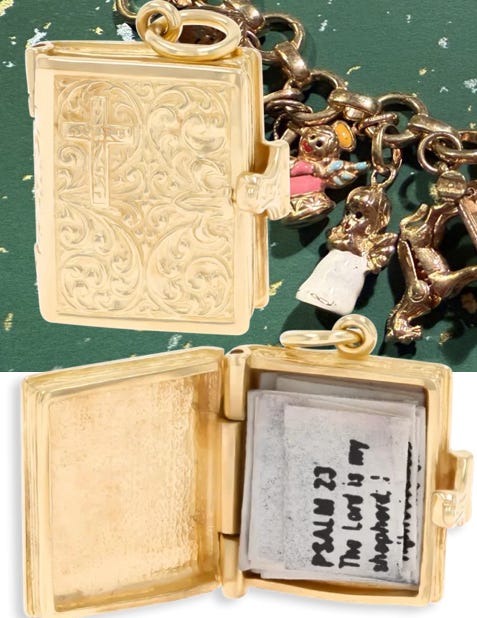
  • February 22 · 1 hr 37 min

    What the Hallmarked Man Epigraphs Reveal About Rowling-Galbraith's Artistry and Meaning

    Nick Jeffery read Robert Browning’s The Ring and the Book, a Victorian epic poem about a murder mystery in 17th Century Italy, to test a theory. John Granger’s best guess after surveying the chapter headings of Hallmarked Man last September was that, of all 77 sources for the 139 epigraphs in Strike8, Browning’s poem was the most likely to hold a secret message or special meaning inside it. John had said something similar about another Browning poem and Ink Black Heart, Elizabeth Barrett Browning’s Aurora Leigh, and Nick had confirmed that through his own reading and confirmation by Rowling herself. He thought John’s track record of spotting important epigraph sources merited a test reading .He published his findings on Friday in a post titled ‘The Ring and The Book – A Rowling Reading.’ In brief, the murder in Browning’s poem is a point-to-point model for the Ironbridge murder mystery in Hallmarked Man with characters in Rowling-Galbraith’s book — most notably, Chloe Griffiths, Tyler Powell, and Ian Griffiths — having their astonishing equivalents in Ring. The less obvious but more important links between the two are in their implicit feminism and other messages: Both works critique abusive relationships and patriarchal power: Guido’s control of Pompilia and Dino Longcaster’s control of Decima Mullins. The legal system (Books 8–9 especially) is satirized as formalistic, pedantic, and often blind to moral reality. True justice requires personal moral intuition beyond mere evidence or procedure. The Pope’s monologue (Book 10) weighs this tension most profoundly. In The Hallmarked Man the police are slow to act on new information gained by Strike and Robin and Farah Navabi manages to hoodwink the courts into escaping punishment for her part in Patterson’s crimes. The Ring and The Book dramatizes the eternal struggle between good and evil. Pompilia embodies instinctive purity, sacrificial love, and spiritual insight despite her suffering. Guido represents sophisticated, calculating evil that twists morality to justify cruelty. Browning affirms that evil exists but that good can somehow arise from or shine through evil’s consequences. In The Hallmarked Man evil is real, monstrous, and often cloaked in normalcy or power structures, but it can be exposed and defeated through persistence, intuition, and moral courage. Nick also discusses in this article the chiastic structure of Ring (!) and the ‘conversation’ he heard between Robert Browning in this poem with Aurora Leigh, the masterpiece by his late wife. His ‘Rowling Reading’ of Ring and the Book, consequently, will soon be a touchstone piece not only in Rowling Studies but Browning Studies as well (#ArmstrongBrowningLibraryAndMuseum @ Baylor). As they have done before with Nick’s ‘Rowling Reading’ articles. the Hogwarts Professor team recorded their conversation about the piece (listen to their discussions of I Capture the Castle and Aurora Leigh). Seven High Points of that Ring and the Book epigraph conversation include: * Nick’s review of why Serious Strikers and Rowling Readers should read The Ring and the Book along with the story of his immersion in it; * John’s explanation of why he was so confident that Browning’s poem was a template of some kind for Hallmarked Man even though only six of Strike8’s 139 epigraphs were taken from it; * Their survey of Rowling’s previous work with epigraphs — Deathly Hallows and Casual Vacancy all the way to Running Grave and Hallmarked Man — for works with similar embedded-in-the-epigraph texts and those without one (or in which it hasn’t yet been discovered); * Nick’s discussion of Rowling’s previous comments about epigraphs and her answer to the question, ‘Which Came First, the Epigraph or the Story?’; * John’s best guess pre-publication about the text that will be the epigraph source in Sleep Tight, Evangeline and which Strike text it will most resemble with its Whiskey Shambles title; * Nick’s commitment to exploring Blue Oyster Cult epigraphs in Career of Evil to see if one of that band’s albums, all of which supposedly had sci-fi themes and story continuity, served as a text-within-the-text for Strike3; and * John’s suggestion that the relationship of Elizabeth Barrett Browning and Robert Browning, a great love with a shared vocation, might be a point of reflection for Serious Strikers as a template for understanding the Strike-Ellacott partnership. Nick and John will be recording their group charting of Hallmarked Man’s Part Eight this week with Sandy Hope and Ed Shardlow (and Presvytera Lois?), a survey of readers is in the works, and the long-awaited close look at the Strike series in light of the Cupid and Psyche myth draws ever nearer. Stay tuned! The Ten Questions, Epigraph Charting, and Links to Previous Epigraph Discussions Here and Elsewhere: The Ring and The Book – A Rowling Reading, Nick Jeffery, February 2026 Intro to Epigraphs 101, John Granger, September 2022 The Heart is Not About Emotions and Affection but the Human Spiritual Center, John Granger, October 2022 A Rowling Reading of Aurora Leigh, Nick Jeffery, November 2025 Beatrice Grove’s Pillar Post Page at HogwartsProfessor.com * Scroll down for Prof Groves’ posts about epigraphs and literary allusion in Cuckoo’s Calling, The Silkworm, Troubled Blood, and Ink Black Heart Lethal White: Ibsen’s ‘Rosmersholm’, John Granger, December 2018 Rowling, Dylan Thomas, and the I Ching: Three Thoughts on Strike7’s Epigraphs, John Granger, April 2023 ‘Deathly Hallows’ and Penn’s ‘Fruits of Solitude,’ John Granger, October 2008 The Aeschylus Epigraph in ‘Deathly Hallows,’ John Granger, October 2008 Maid of the Silver Sea Epigraphs: Louise Freeman Davis’ Collected Posts, 2025 The Faerie Queene Epigraphs in Troubled Blood * Scroll down the Troubled Blood Pillar Post for the Faerie Queene commentary by Beatrice Groves, Elizabeth Baird-Hardy and John Granger Robert-Galbraith.com Posts about the Epigraphs in Each Book * Hallmarked Man’s Epigraphs: The Poetry * Hallmarked Man’s Epigraphs: The Prose * Scroll Down the site’s ‘Features’ Page for all the other Epigraph Posts Agents of Fortune: The Blue Oyster Cult Story, Martin Popoff, May 2016 Pompilia: A Feminist Reading Of Robert Browning’S The Ring And The Book, Anne Brady, May 1988 Roman Murder Mystery: The True Story of Pompilia, Derek Parker, January 2001 Sleep Tight, Evangeline: Nick Jeffery and John Granger talk with Dimitra Fimi Hallmarked Man Epigraphs: The Tally Sheet Matthew Arnold: 17 poems, 25 epigraphs, 6 from Merope: A Tragedy * 3, 17, 52, 103, 108, 110 (Merope), 21, 33, 68, 38, 97, 41, 45, 59, 58, 69, 73, 76, 80, 86, 96, 106, 119, 122, 124 Robert Browning: 26 poems, 38 epigraphs including frontispiece, 6 from The Ring and the Book * 44, 75, 62, 64, 102, 118 (Ring and Book), frontispiece, 2, 9, 11, 107, 13, 16, 20, 26, 28, 32, 35, 37, 114, 39, 42, 93, 44, 75, 47, 51, 62, 64, 67, 116, 71, 77, 79, 84, 87, 120, 90, 91, 100, 102, 109, 118, 126 A. E. Housman: 5 works, 25 poems, 28 epigraphs, 10 from Last Poems * 1, 5, 7, 53, 19, 92, 56, 65, 74, 105 (Last Poems), 23, 30, 34, 36, 40, 43, 46, 49, 57, 63, 78, 82, 89, 94, 98, 112, 115, 125 John Oxenham: 1 work, 26 epigraphs * Parts 1-10, Epilogue, 15, 18, 22, 25, 27, 55, 60, 66, 83, 85, 88, 95, 111, 113, 127 (Maid of the Silver Sea) Albert Pike: 3 works (?), 22 epigraphs, 16 from Morals and Dogma * 4, 16, 12, 121 (Liturgy), 8, 10, 14, 29, 31, 48, 50, 54, 61, 70, 81, 99, 101 (Morals and Dogma), 24, 72 (Ancient and Accepted Rite?) Most epigraphs: Robert Browning Frontispiece: Robert Browning Most from one poem: Tie, Robert Browning 6 Ring and Book, Matthew Arnold 6 Merope: A Tragedy Most from one novel: John Oxenham 26 Maid of the Silver Sea Most from one didactic or discursive argument: Albert Pike 22 (24?) Morals and Dogma Conclusions: Ring and Book your best bet as template, Re-read Maid of the Silver Sea, read Merope: A Tragedy Tally Sheet of Epigraphs for Ink Black Heart: Poet: epigraph numbers, (total) * Christina Rossetti: 8, 14, 22, 24, 25, 35, 38, 50, 52, 54, 56, 84, 86, 90, 98, 103, 105, 107 (18) * Elizabeth Barrett Browning: 12, 21, 33, 39, 42, 45, 47, 58, 67, 71, 72, 82, 96, 101, 102, 104 (16; all but #s 21 and 58 from ‘Aurora Leigh’) * Mary Elizabeth Coleridge: Book, 1, 18, 20, 49, 79, 81, 91, 93, 94, 106 (11) * Emily Dickinson: 11, 31, 53, 58, 59, 65, 70, 76, 99 (8) * Charlotte Mew: 16, 17, 40, 55, 66, 92, 95 (7) * Felicia Hemans: 6, 10, 15, 63, 100 (5) * Amy Levy: 7, 23, 32, 80, 85 (5) * Jean Ingelow: 9, 27, 29, 37, 64 (5) * LEL!: 62, 68, 69, 83 (4); see also Rossetti 52 ‘LEL’) * Mary Tighe: 36 (Psyche), 43, 60, 88 (4) * Helen Hunt Jackson: 4, 87, 89 (3) * Joanna Baillie: 13, 21, 34 (3) * Augusta Webster: 44, 48, 51 (3) * Emily Pfeiffer: 3, 75 (2) * Charlotte Bronte: 19, 74 (2) * Adah Isaacs Menken: 30, 57 (2) * Constance Naden: 41, 46 (2) * Mathilda Blind: 61, 97 (2) * Mary Kendall: 73, 77 (2) * Martha Jane Jewsbury: 2 (‘To My Own Heart’) * Anne Evans: 28 * ‘Michael Field’ (Katherine Bradley and Edith Cooper): 78 The Heart and Vision epigraphs in Ink Black Heart by chapter number: * Heart: 20, 106 (MEC); 21, 67; 52, 107; 68, 85; 2; 63, 80, 85; 17, 40, 55, 95 (Mew); 19, 74; 27; 30; 36, 60; 87 (23) * Vision: Frontispiece, 1, 49, 81 (MEC); 22, 25, 38, 90, 98 (CR); 59; 3; 34; 95; 57; 88; 48; 46 (17) Tally Sheet of Epigraphs for Cuckoo’s Calling: * Frontispiece: Rossetti -- A Dirge * Prologue: Lucius Accius, Telephus * Part One: Boethius, The Consolation of Philosophy * Part Two: Virgil, Aeneid * Part Three: Virgil, Aeneid * Part Four: Pliny the Elder, Historia Naturalis * Part Five: Virgil, Georgics * Epilogue: Horace, Odes * [Closing Poem: Tennyson, Ulysses] Brackets/Latch: 19th Century English poets (see Groves) Most epigraphs: Virgil (3); no other author has more than one Most frequently referenced work: Aeneid (2), shades in Ulysses Center of Chiasmus: Aeneid (true if ring has 5, 8, or 9 parts) Turtleback lines: Not evident in authors list, perhaps in meanings of specific epigraphs Conclusions: * Read Aeneid to look for Cuckoo’s parallels; * Study epigraphs to look for parallels Online Literature Review for ‘Epigraphs of Cuckoo’s Calling:‘ https://robert-galbraith.com/epigraphs-of-the-cuckoos-calling/ * 2025 connecting the dots between epigraphs and chapter set to follow (generic) * No mention of Strike as Aeneas https://strikefans.com/the-cuckoos-calling-epigraphs/ * Reprinting of epigraphs without commentary * No mention of Strike as Aeneas https://thesefilespod.com/blog/the-cuckoos-calling-epigraphs/ * Includes a very helpful link to The Rowling Library and an article there about the ‘real world’ crime serving as a template for the Landry murder * No mention of Strike as Aeneas https://mugglenet.wpenginepowered.com/2017/09/literary-allusion-cuckoos-calling-part-1-christina-rossettis-dirge/ * Brilliant discussion of the Rossetti poem but curiously without reference to resurrection meaning * No mention of Strike as Aeneas https://mugglenet.wpenginepowered.com/2017/09/literary-allusion-cuckoos-calling-part-2-tennysons-ulysses/ * Brilliant discussion of Strike as Ulysses * No mention of Strike as Aeneas, curious becauseh Virgil models Aeneas on Ulysses The Ten Questions of This Conversation (Sort Of!) 1, (Nick) So, John, I finally wrote up my findings about The Ring and the Book as the story template for Hallmarked Man’s murder mystery and, as we did with my posts about Aurora Leigh and I Capture the Castle, let’s talk about it, expanding on the correspondences between the Browning poem and Strike 8. The natural place to begin is with your guess about Ring and the Book being a template based on your tally of the Hallmarked Man epigraphs, a theory you shared on our first show post-publication. Can you explain your process and what made you so confident about Ring and the Book? 2. (John) Looking at that tally, then, Arnold’s Merope and Oxenham’s Maid of the Silver Sea are quantitatively more likely equivalents to Aurora Leigh in Ink Black Heart, but the Browning frontispiece, number of his epigraphs, the hidden quality of the Ring and Book poem titles, and the relationship with Barrett Browning made it seem the most likely. That the poem is considered one of the great feminist tracts written by a man didn’t hurt. I still want to go back to the Arnold poem, though, because of the centrality of his epigraphs in the center Parts and Oxenham deserves a re-read, too, or just a trip to Louise Freeman Davis site, the home of Oxenham Studies online. What struck me while reading your post, Nick, was in the correspondences you found between Ring and the Book and Hallmarked Man. Can you give us the highlights of that? 3. (Nick) The Ironbridge murder mystery, then, is largely lifted from the death of Pompilia. Which is unusual isn’t it? Has Rowling-Galbraith ever used her epigraphs to point to the template of her story? 4. (John) I think, then, that at least four of the previous Strike novels give us the embedded template, per Beatrice Groves The White Divel and The Revenger’s Tragedy (and even Hamlet) gives us important clues about The Silkworm crime, Rosmersholm and its incestuous backdrop inform the murder of Lethal White, the Janus deceiver in Faerie Queene should have been a give-away about the poisoner in Troubled Blood, and, as Rowling confirmed and you demonstrated Nick, Aurora Leigh is the working model for Ink Black Heart. I think the closest Rowling epigraph suggestions to story template was in the Rossetti poem that opens Cuckoo’s Calling and the Aeschylus epigraph in Deathly Hallows. What has Rowling said, though, about her epigraph sources? Do they precede the novels or follow the writing? 5. (Nick) So it’s not one or the other, I think, that is, she has a template in mind and if the source doesn’t have sufficient quotable pieces to serve a epigraphs for the whole book, she uses other sources from the genre in play or that highlight her central theme (cf., the Gray’s Anatomy heart epigraphs in tandem with the hearty women Victorian poets in Ink Black). What I’m struck by here, though, is the shift in importance of epigraphs to Rowling-Galbraith. The numbers are startling, no, between Cuckoo and Hallmarked? 6. (John) Not only do we see a jump from eight or nine epigraphs in Strike1 to 139 in Stike8, but Team Rowling is pushing readers to think more seriously about them by posting reviews of the epigraphs in each book, drawing the dot-to-dot correspondences. I confess the Strike novel whose epigraphs are not like the others, Nick, is Career of Evil and its Blue Oyster Cult lyrics. You’ve been reading a book about Blue Oyster Cult so I’ll defer to you in this despite my great fondness for heavy metal groups with sci-fi themed lyrics... 7. (Nick) What about the book we haven’t got in hand, John: Sleep Tight, Evangeline? We have been told -- sort of! -- the title is from a 2014 song from an American blues band called ‘The Whiskey Shambles.’ Which of the previous epigraph models Rowling has used, from Deathly Hallows to Hallmarked Man, do you think we’ll be seeing in Strike9? What are your thoughts on that, especially as the best link we have for Sleep Tight, Evangeline is from a rock and blues band? 8. (John) So I hope that we’re going to see another Running Grave type epigraph experience in Evangeline, though Grave was unique among Rowling novels and their epigraphs in not having a story-book, poem, or play as its primary source. The I Ching, cannot be a story-template per se because it is a divination tool or means to reflection. Unless you think Pike’s Morals and Dogmas Freemasonry encyclopedia qualifies as an equivalent of sorts to the I Ching? That’s another outlier, isn’t it? 9. (Nick) To put a Fourth Generation focus on this, John, we should be looking for a technique that Serious Readers can use for Sleep Tight, Evangeline to hunt for the embedded source if its hidden as were Aurora Leigh and The Ring and the Book. You’ve found the ones no one else noticed in Ink Black Heart and Hallmarked Man, how did you do that and do you think the same method will work for Cuckoo and Career as well as Evangeline? 10. (John) So, yes, I found them but you had the first confirmed by Mrs Murray and then connected the dots between the Browning poems and Rowling’s work. If this method is going to work on Cuckoo, Career, and Evangeline it will have to involve a spotter and a shooter, though they can be the same person. The spotter technique is nothing but grunt work; chart the epigraphs used and spot the author most frequently referenced and the work of theirs most frequently cited. The shooter work is actually a lot more involved and interesting; tell us about your experiences with the two Browning’s’ epic poems, that thrill of discovering correspondences. Do you think that excitement is something Rowling is offering her readers a a treasure hunt or as a point of reflection in terms of meaning? This is a public episode. If you'd like to discuss this with other subscribers or get access to bonus episodes, visit hogwartsprofessor.substack.com/subscribe
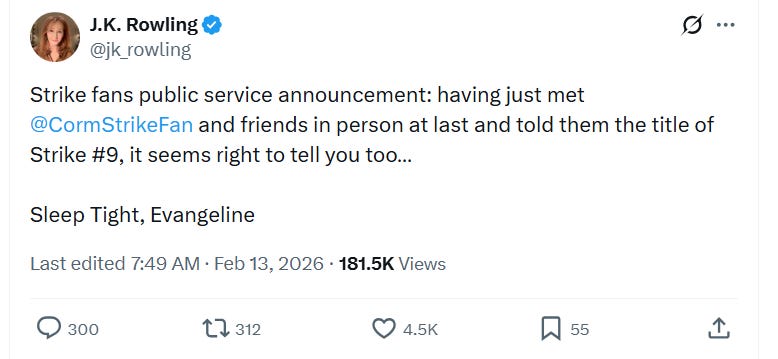
  • February 17 · 1 hr 22 min

    'Sleep Tight, Evangeline,' Miniature Psalters, and the Head of Persephone: A Conversation with Dimitra Fimi

    Last November Nick and John introduced Dimitra Fimi, the magnificent maven of Tolkien Studies and Professor of Fantasy and Children's Literature at the University of Glasgow, to students of J. K. Rowling’s work. In that discussion, ‘Reading Rowling as Myth Maker and Myth Re-Writer: A Conversation with Dr Dimitra Fimi,’ she shared her thoughts about Rowling’s creative use of mythology in Harry Potter but especially in the Cormoran Strike series. The Hogwarts Professor team asked her to join us again because of Rowling’s yuletide charm bracelet gift to Strike fandom and the recent announcement of the Strike 9 title, Sleep Tight, Evangeline. Her insights about the Longfellow poem as a possible even likely source of the next book’s epigraphs are engaging, but it is her expertise in the arcane area of miniature books as well as mythology and the light each shines on the two items attached to the last link of the charm bracelet that open up exciting possibilities . Her idea is that the Psalter on the ninth link of the charm bracelet may actually be, unlike the other tokens on the bracelet’s nine links, an object that will play a part in the story, a miniature book. It turns out that one inch high books were something of an industry as curios in the 19th and early 20th century, a means of demonstrating technological mastery. Dr Fimi discussed several projects she has been a part of in conjunctions with nano-technologists and the librarians at the University of Glasgow’s special collections division. The one that has the most obvious link to English literature is the ‘Tiny Alice project,’ a contemporary effort to minituarize Lewis Carroll’s Alice stories to unfathomable minuteness: The Tiny Alice Project has produced one of the world’s smallest books: a tiny reproduction of Lewis Carroll’s children’s classic Alice’s Adventures in Wonderland (1865). All 78 pages and 26,764 words of the story have been transposed on to a tiny silicon chip, with each page just the width of a human hair (60 microns). Each individual letter is just two microns high, and made from pure gold! Click on the icons below to find out more about the project, the technology behind it, and Lewis Carroll and his interest in the minuscule. Via the tabs above you can also discover the long tradition of miniature books, and teaching resources. Clip: Twixter link to tweet above You can read Dr Fimi’s write-up of ‘Tiny Alice’ and the Miniature Book exhibition she curated at the University of Glasgow to highlight their special collection of these treasures at her 2019 blog post about them. Pictures that include annotated miniature books — copies in which their owners made notes in the miniscule margins of the printed pages — can be seen here. Later this week, Nick will be sharing his thoughts on Robert Browning’s The Ring and the Book as the Ironbridge Murder story’s template within Hallmarked Man, John, Nick, Sandy Hope, and Ed Shardlow will be parsing the ring within Strike8’s Part Seven, and more about Longfellow’s Evangeline — stay tuned! The Ten Questions Guiding Today’s Conversation with Dr Fimi with the Necessary Links for Fun Follow-Up: (Intro) So everything Serious Strikers are thinking and talking about this month made me think of you, Dimitra, and to write you hat-in-hand with an invitation for your return to HogwartsProfessor to share your perspective, knowledge, and first impressions. Thank you for making time to join us! 1. (John) Jumping right in, then, two of the charms on the Strike9 or ‘Evangeline’ bracelet are Fimi areas of unique expertise: the Psalter and the Head of Persephone. I had urged readers to read your Miniature Books in Children’s Fantasy at A Kind of Elvish Craft: The Dimitra Fimi Substack Site in the links after our conversation here last November but I confess to being surprised still when you asked for the dimensions of the Psalter charm after Nick and I posted our thoughts on the subject. For those who haven’t read your ‘Miniature Books’ post, please share how one of the world authorities on the writing of J. R. R. Tolkien became interested in the smallest of texts, the ‘Little Books’ of 19th century printing. 2. (Nick) So you asked for the dimensions of the Psalter, you weren’t thinking as we were that the Psalter charms would be a box holding a folded up paper with a psalm, maybe two, inside it. You’re thinking it might actually be a complete Coverdale Psalter? Is that possible? 3. (John) What Nick and I hope to contribute to the nascent field of Rowling Studies, as you know, is a refocusing of the scholarship and the serious reader attention about her work on to her Lake Springs -- the biographical part of story inspiration -- her Shed Tools or intentional artistry, and the Golden Threads, the plot points and themes that run throughout her work, i.e., to bring Rowling Studies more in line with all literary scholarship about notable authors, living and dead. One of the Golden Threads we talked about in our Kanreki series last summer was the ‘Embedded Text,’ the books inside a book topos that is in almost every book Rowling writes (Kanreki Golden Thread posts one and two). Detective fiction is always about an embedded text, the narrative ‘written’ by the criminal to prevent the detective from reading the real story of what happened and Rowling-Galbraith often makes this narrative an actual book (Dumbledore Chocolate Frog Card, Tales of Beedle the Bard, Bombyx Mori, Talbot’s ‘True Book,’ The Predictions of Tycho Dodonus, etc.). How do you think a Psalter miniaturized book would appear in a Strike novel? 4. (Nick) Has an author used a miniaturized book before in this way? Were there 19th Century Psalters that people wore as talismans or carried as the original Pocket Books? 5. (John) And what about the Head of Persephone charm on that bracelet? It’s on the ninth and last link, paired with that Psalter. You shared your first thought about the Persephone charm, a hopeful note, on the comment thread here. As our go-to authority on Greek mythology, I’m dying to know more of your thinking about (a) the specific charm and its relation to the Cupid and Psyche myth-template to the Strike series, (b) its pairing with the Psalter, and (c) its position as the last charm on the bracelet. Do you still think it’s a sign that Robin will survive Sleep Tight, Evangeline? 6. (Nick) As someone immersed in mythological studies and more than familiar with Rowling’s use of myth, do you think the Jungian interpretation of that myth as the ‘actualization of feminine identity’ is a better lens through which to read that embedded text or is the Spenserian lens of Eros/Anteros, False Cupid and Cupid more helpful? Or is this not a case of Either/Or but Both/And? Valentines Day Special 7. (John) Rowling is a close reader and admirer of J. R. R. Tolkien, though that is more evident in the clear pointers to his work in her own work than from her interviews. How does her use of myth contrast with that of Tolkien and Lewis? (See John’s 2008 post about Rowling’s debts to Tolkien and the two part podcast with Tolkien scholars and Rowling Readers Dr Amy H Sturgis and Dr Sara Brown here and here for more on that influence.) 8. (Nick) In an in-person meeting with UK Serious Strikers last week, Rowling shared with them and later via X with everyone the title of the ninth Strike novel, Sleep Tight, Evangeline. We’re pretty sure that title refers to a song by an American Blues group called ‘The Whiskey Shambles’ (story of the hunt, why Whiskey Shambles is a good bet). There is a famous poem, though, by Henry Wadsworth Longfellow called ‘Evangeline,’ one perhaps not as famous as ‘Aurora Leigh’ or ‘The Ring and the Book,’ other texts Rowling may have used as back-drops to her novels, but still another poem very famous in its own time akin to those epics. Is its subject matter as good a match-up with the possible direction of Sleep Tight as the Victorian poetry back-drop is with other Rowling models? 9. (John) You’re a native Greek speaker; what does ‘Evangeline’ mean in Greek? Is it a common name in Greece or is it a ‘Virtue Name’ in the Puritan tradition of grace-filled names (cf., Credence Barebone is probably a reference to an Englishman named “Praise-God Barebone, whose son Nicholas may have been given the name If-Jesus-Christ-had-not-died-for-thee-thou-hadst-been-damned[3]“). 10. (Nick) Don’t leave before trying to tie together the pieces of this conversation! Is there a thread joining the Psalter, the Head of Persephone, miniaturized books, and the title Sleep Tight, Evangeline? Dimitra Fimi is Professor of Fantasy and Children’s Literature at the University of Glasgow and Co-Director of the Centre for Fantasy and the Fantastic. Her Tolkien, Race and Cultural History won the Mythopoeic Scholarship Award for Inklings Studies and she co-edited the critical edition of A Secret Vice: Tolkien on Invented Languages which won the Tolkien Society Award for Best Book. Her Celtic Myth in Contemporary Children’s Fantasy won the Mythopoeic Scholarship Award in Myth and Fantasy Studies. Other work includes co-editing Sub-creating Arda: World-building in J.R.R. Tolkien’s Work, its Precursors and its Legacies and Imagining the Celtic Past in Modern Fantasy. She has contributed articles for the TLS and The Conversation, and has appeared on numerous radio and TV programs. When the rightly famous and beloved ‘The Great Courses’ series decided to offer a Lord of the Rings entry for their catalog of the very best in scholarship for adult-learners, they asked Dimitra Fimi to create ‘The World of J. R. R. Tolkien,’ one of their most popular courses and one you can enjoy in an Audible edition. Links Promised in Conversation: A Kind of Elvish Craft: The Dimitra Fimi Substack Site * Miniature Books in Children’s Fantasy * Parabasis: A Tribute to Dionysis Stavvopoulos * On Tolkien’s Letter 131 (4): “Romance” vs. Science Dimitra Fimi articles at ‘The Conversation’ * After 150 years, we still haven’t solved the puzzle of Alice in Wonderland (2015) This is a public episode. If you'd like to discuss this with other subscribers or get access to bonus episodes, visit hogwartsprofessor.substack.com/subscribe
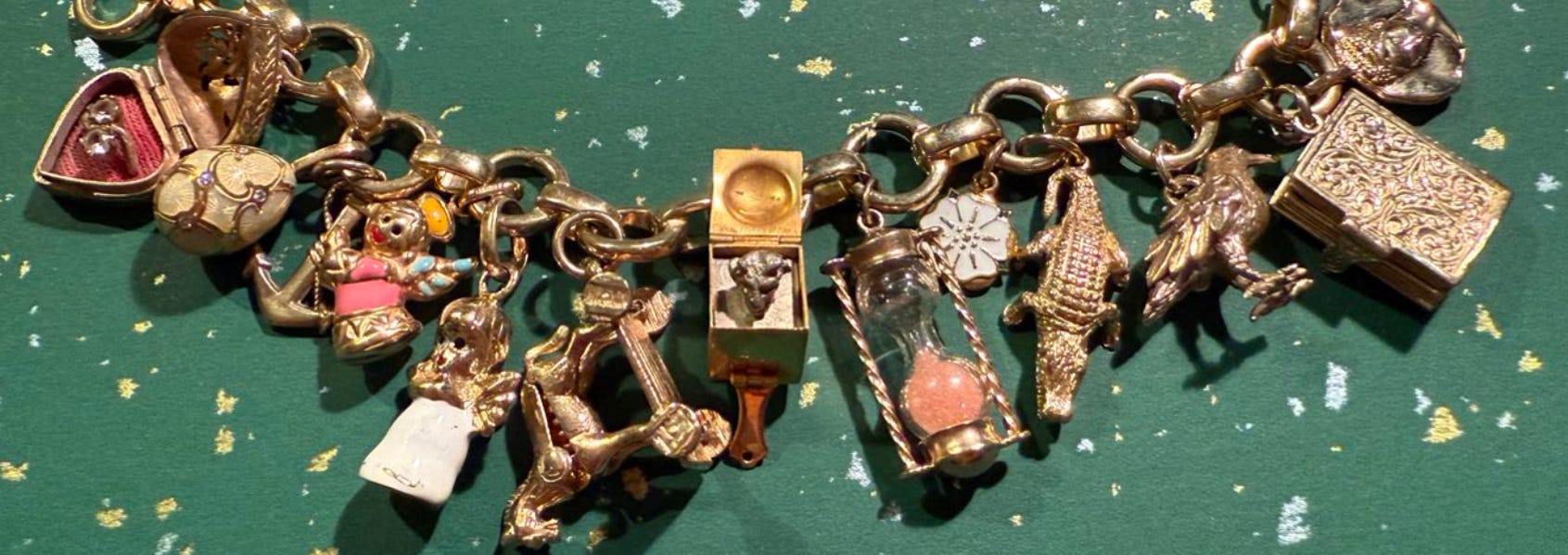
  • February 14 · 1 hr 58 min

    Valentine's Day Special: The Cupid and Psyche Myth within the Cormoran Strike Series

    Happy Valentine’s Day! Mrs Murray met the UK StrikeFans.com contingent and Badly WiredLamp (“and friends”) on Thursday to talk about the Cormoran Strike novels. Yesterday, Friday the 13th, Rowling tweeted about the secret she had told them — the title of Strike9: Nick Jeffery found the most likely source of the title Sleep Tight, Evangeline, assuming it is not an anagram, in six minutes: BadlyWiredLamp who was at the Rowling meeting congratulated Nick on twixter seven minutes later: “Well done for finding it Nick!” with a hand salute emoji. Which semi-confirmation from a witness suggests he is spot on. Even more impressive, Nick wrote up a flash post about The Whiskey Shambles and other ‘Evangeline’ possibilities at the HogwartsProfessor weblog, ‘Sleep Tight, Evangeline – Title Release for Strike 9.’ Nick and John will be discussing this news as well as the Psalter and Head of Persephone charms with miniature book, Tolkien, and mythology expert Dimitra Fimi this weekend for a post here next week. See her ‘Miniature Books in Children’s Fantasy’ to prepare for that conversation. Stay tuned! But it’s Valentine’s Day! John and Nick celebrate this Hallmark Holiday with a journey through the Cormoran Strike novels’ V-Day celebrations and a discussion of the various Valentines and Cupid’s in the story, with special emphasis on the Cupid and Psyche myth that Rowling has suggested is the series story template. That suggestion came the week after Hallmarked Man’s publication in the first of her Public Service Announcements to “Robin and Strike fans:” This image came as a surprise even to Hogwarts Professor subscribers because, though we have been writing and talking about the Cupid and Psyche myth as one of the mythological templates behind the Strike series since early 2021, it was the first time Rowling had acknowledged this publicly. Since the September revelation of this connection by the author and the appearance of the head of Persephone at the end of her Strike9 clues Christmas Charm bracelet, Strike fandom is now on board with the idea. Which on-boarding Nick and John celebrate with this Hearts and Flowers conversation, in which: * Nick reviews the Valentines Day events in the Strike series, the importance of which makes 14 February to Serious Strikers what Halloween is to Harry Potter fans; * John discusses the post American Bar office scene in Troubled Blood that let the cat out of the bag about the Cupid and Psyche myth just beneath the Strellacott romance; * Nick updates that with Rowling’s PSAs and charm pointers to the Trials of Psyche in Robin’s story; * John lays out how and where Hallmarked Man features Valentine Longcaster, the character with the Cupid name, and a Valentine’s Day conflict with dogs to Guard the Gates of Hell (from charting Parts Five and Six); * Nick journeys back to Cuckoo’s Calling and explains how Lula Landry’s death and Robin’s first meeting with Strike are twist on Cupid and Psyche with Venus, Psyche, and Cupid, Hephaestus, and Ares all with their equivalents in Charlotte, Robin, and Cormoran; * John ups the ante of the conversation by bringing in Edmund Spenser and C. S. Lewis, two writers Rowling loves, both of whom wrote stories that turn on Cupid and Psyche, and suggesting that Galbraith, in using the Eros-Anteros distinction of those writers in the Strike series is answering allegorically the core question of human life: whether to focus the soul on the ephemeral body and its desires or on the noetic faculty of soul, the Heart, logos within us; * Nick and John then discuss Robin and Strike’s individual relationships Cuckoo to Hallmarked in light of Cupid-False Cupid and taking turns going through the Strike novels with a look at the principal murder victim and murderer and their respective relationships; * John shares the Jungian interpretation of Cupid and Psyche as the mythic representation of feminine actualization, the chrysalis of female identity; * And more! Below are the links to posts on this subject mentioned in their back and forth and to a translation of the original myth. Happy Valentines Day — and stand by for more discussion of Sleep Tight, Evangeline, the Psalter and Persephone Charms, and all things Strike and Mythology with Dimitra Fimi. Links Mentioned in the Valentines Day Celebration Conversation: Rowling Points to Myth of Cupid and Psyche in order to Console Strike Fans Disappointed with Hallmarked Man (8 September 2025, Nick Jeffery) Nick shares the context of Rowling’s tweet (fan disappointment!) and the background information about the illustration she chose for it. The Most Pleasant and Delectable Tale of the Marriage of Cupid and Psyche (Apuleius) A translation of the Silver Age Latin tale from Apuleius’ Golden Ass. A Mythological Key to Cormoran Strike? The Myth of Eros, Psyche, and Venus (22 April 2021, John Granger) The first post to discuss Rowling’s use of this specific myth within Cormoran Strike, it is essential reading and comes in four parts: * a discussion of Rowling’s stated beliefs about the soul and how it is the focus of her story-telling, * a review of her psychological artistry in Potter and the post Potter novels and screenplays, * a synopsis of the Eros and Psyche myth, and * a point to point look at the parallels in the story thus far with speculation about novels to come. Robin’s Two Perfumes: The Meaning of Philosychos and Narciso (9 June 2021, John Granger) The names of Robin’s baseline perfume, Philosychos, and the one she and Strike choose at story’s end, Narciso, both point less to the bedroom than to Robin’s allegorical, psychological, and mythological role as Psyche in the series. Erich Neumann in his Amor and Psyche: The Psychic Development of the Feminine describes this discipline as a “prohibition against pity” which “signifies Psyche’s struggle against the feminine nature.” … Psyche’s last trial involves her having to confront death, a “marriage” to which she was condemned as a sacrifice at the story’s start, a meeting she can only survive by transcending her feminine qualities of nurturing and pity. She must become, if only temporarily, a narcissist to pass through Hades and return to the world of the Sun and to Cupid. The myth, in Jungian lights, is about her transcending the accidental self, here her feminine and sexual relation to Eros or Cupid, for “ego-stability” leading to “individuation,” ascent to the greater, immortal Self. Robin as resident psychologist and loving soul is the Psyche-cipher of the Strike mysteries. She differs from the relatively passive Human Beauty of the myth in her active and determined “struggle against the feminine nature,” her “What. I. Do!” She not only wrestles with her desires for domesticity and maternity in her thinking but stands up to Strike-Cupid in their Valentine’s Day Street Fight and demands his respect or at least more considerate behavior. But she is still struggling with her difficulty to be the narcissist rather than the Great Mother when circumstances and her heroine’s journey of psychological individuation demand that. Reading Rowling as Myth Maker and Myth Re-Writer: A Conversation with Dr Dimitra Fimi Nick Jeffery and John Granger converse with Dr Dimitra Fimi about Harry Potter, Cormoran Strike, Tolkien, Jane Eyre, and the Mythological Artistry of J. K. Rowling, Hogwarts Saga to Hallmarked Man The Hallmarked Man’s Mythological Template ‘Cupid and Psyche’s importance for grasping the depths of Strike 8, from the “necessity” of the Silver Vault and the three men in Robin’s life, to spaghetti carbonara and ‘Maid of the Silver Sea’ Ink Black Heart: The Mythic Backdrop (10 September 2022, John Granger) What Rowling is depicting in Robin’s journey through the events and mystery of Ink Black Heart include a trap set by Venus, one that takes Robin to a personal and professional underworld or hell, her survival and endurance of every temptation by her determination to be steely rather than empathetic, especially with respect to a certain “lame fellow” (!), and her re-surfacing from hell a changed person, one worthy of begrudging Venereal approval (or Zeus’ intervention — Rokeby!). Ink Black Heart: Strike as Zeus to Robin’s Leda and Cupid to Mads’ Psyche (10 November 2022, John Granger) These traditional portrayals of the every person’s human and divine aspects, soul and spirit as man and woman in dynamic, cathartic relationship — think Romeo and Juliet, Redcrosse Knight and Una, Cupid and Psyche — are perhaps, with her alchemical symbolism, sequencing, and coloring, Rowling’s greatest literary ‘reach’ and achievement in the Strike series, albeit one largely lost on her her vast reading audience. The deliberate conjunction-melange of archetypal psychology, mythology, and spiritual allegory in these novels is, especially in combination with her hermetic artistry, intertextual playfulness (Aurora Leigh!), and chiastic structures, testimony to the author being one of the most accomplished and challenging writers of the age in addition to the most popular (and least well understood, even by her fans). Hallmarked Man: Freemasonry and J. K. Rowling (7 February 2024, Nick Jeffery) The Royal Arch degree is unique in England for including the ceremony of “Passing the Veils” symbolising the path to enlightenment that a mason undergoes as he progresses in the craft. Given Peter Rowling’s upward social mobility from working class apprentice to engineer and moving from the Bristol suburbs to middle class Tutshill, it isn’t beyond reason to wonder if Peter might have been tempted by the social and career advantages that freemasonry might have offered him and exposed a young Joanne to some of the symbolism. Edinburgh, as well as being the home of the Grand Lodge of Scotland, is also home to if not the oldest lodge in the world, then at least the one with the oldest records. Lodge of Edinburgh (Mary’s Chapel) No. 1 has minutes of meetings from 31st July 1599. There have long been arguments between this Lodge and the one in Kilwinning on the other coast of Scotland as to which is the oldest. (see IVº of the Rite of Baldwyn above) J. K. Rowling’s ‘G-Spot’ and ‘Triple Play:’ The Lake & Shed Secret of Her Success (21 September 2024, John Granger) I want to try tonight to explain as succinctly — and as provocatively — as possible why I think Rowling’s ‘Lake and Shed’ metaphorical explanation of how she writes offers a compelling reason for both why she writes and why readers around the world love her novels the way they do. I call this her ‘G-Spot’ and ‘Triple Play’ because it is her point of singular genius, the defining quality that separates her from contemporary story-tellers, which involves ‘Shed’ artistry of three particular literary tools, all subliminal, which work together to achieve her aims. The Hallmarked Man’s Flood of Names, Characters, and Plots (22 September 2025, John Granger) Rowling’s seven Shed tools — psychomachia, literary alchemy, ring composition, misdirection towards defamiliarization, Christian symbolism, mythology, and inter-intratextuality (writing about reading and writing) — are all about the transformation of the human soul by cathartic experience in the imaginative heart, i.e., our spiritual reorientation. These traditional tools alone don’t do it, of course; her capacity for creating archetypal characters that we care about in profound fashion is what gives the tools their grip on the heart. But, if a writer uses these tools in his or her Shed, the game being played and its stakes are not in question. Everything Rowling has written to date, with greater or lesser success (largely dependent on her control of the final product, cough*Warner Brothers*cough), shares this aim. Her global popularity testifies that much more often than not she hits her target to the delight of her readers. I assume this was her aim in Hallmarked Man. It’s early days on the full exegesis of Strike8 in light of Rowling’s Shed tools, Lake springs, and Golden Threads, but there are encouraging signs. My third reading of the book included my first ‘Aha!’ moments with respect to the mythological template of the series, the Shed tool Rowling was openly urging her readers to think about in her recent Cupid and Psyche tweet. Jungian Interpretations of ‘Cupid and Psyche:’ * Erich Neumann: Amor and Psyche: The Psychic Development of the Feminine (A Commentary on the Tale by Apuleius) * Paul Diel: Symbolism in Greek Mythology: Human Desire and Its Transformations (A “psychological study of the symbols condensed in the fate of the mythological hero”) * Robert A. Johnson: SHE: Understanding Feminine Psychology (An interpretation based on the myth of Amor and Psyche and based on Jungian mythological principles) * Marie-Louise von Franz: Golden Ass of Apuleius: The Liberation of the Feminine in Man (originally A Psychological Interpretation of The Golden Ass of Apuleius) ‘Tamspells’ Point to Point Correspondence List of Events in the Strike-Ellacott Novels and the Myth of Cupid and Psyche The list ‘Tamspells’ made will be Nick and John’s starting point in their upcoming conversation with her about how to see the myth beneath the surface of the story Cupid and Psyche Myth Highlights to Look for in Your Review at Home of the Strike Series: * Jealousy of Venus * Psyche’s Wedding/Funeral March to Mountain Crag * Psyche Rescued by Cupid, stuck with his own arrow * Retreat to Hidden Castle, Love in Darkness * The Two Sisters * The Confrontation with Lamp and Knife * Psyche’s Return Home; Death of Sisters (Pan cameo) * Psyche’s Search for Cupid/Venus: Ceres Interview * Brought to Venus (Worry and Sadness) * First Trial: Seeds and Grains (Ant) * Second Trial: Wool from Golden Sheep (Reed) * Third Trial: Crystal glass for Black Stygian water (Zeus, Eagle) * Persephone Odyssey: Box for Beauty (Tower instructions) * Barley Cakes for Cerberus and Two Coins for Charon * Must ignore: “a lame man driving a mule loaded with sticks, a dead man swimming in the river that separates the world of the living from the world of the dead, and old women weaving.” * Meal in Underworld with Persephone * Return Trip, Falling to Temptation * Cupid intervention; intersession and deal with Zeus * Olympian Court Date * Marriage of Cupid and Psyche post Ambrosia, birth of Pleasure Strike Novel Victim Eros Anteros Murderer Eros Anteros Cuckoo’s Calling Lula Landry Evan Duffield Marlene Higson,Yvette Bristow, Guy Some, Jonah Agyuman John Bristow Alison Creswell Yvette Bristow The Silkworm Owen Quine Kathryn Kent Leonora/Orlando Elizabeth Tassel Michael Fancourt Owen Quine? Career of Evil Kelsey Platt Rock Band Leader Ray Williams, (Hazel Furley) Donny Laing Rhona Bunyan, hostage women Agnes Waite Lethal White Jasper Chiswell Ornella Seraphin, Kinvara Patricia Fleetwood Raphael Chiswell Kinvara Hanratty Ornella Seraphin Troubled Blood Margot Bamborough Paul Satchwell Roy/Anna Phipps Una Janice Beattie Steven Douthwaite/Diamond Dead Mother Dennis Creed Louise Tucker Agnes Waite Ink Black Heart Edie Ledwell Philip Ormond? Joshua Blay, Grant Heather Ledwell Gus Upcott Anomie/Paperwhite, Vikas BhardwajMorehouse Katya Upcott The Running Grave Daiyu Wace, Kevin Pirbright (Jacob) Louise Pirbright Abigail Glover Patrick, Baz Jennifer Wace The Hallmarked Man Tyler Powell Anne-Marie Morgan Chloe Griffiths/Jolanda Lindvall Ian Griffith Jolanda/Sapphire Rita Lindvall? This is a public episode. If you'd like to discuss this with other subscribers or get access to bonus episodes, visit hogwartsprofessor.substack.com/subscribe
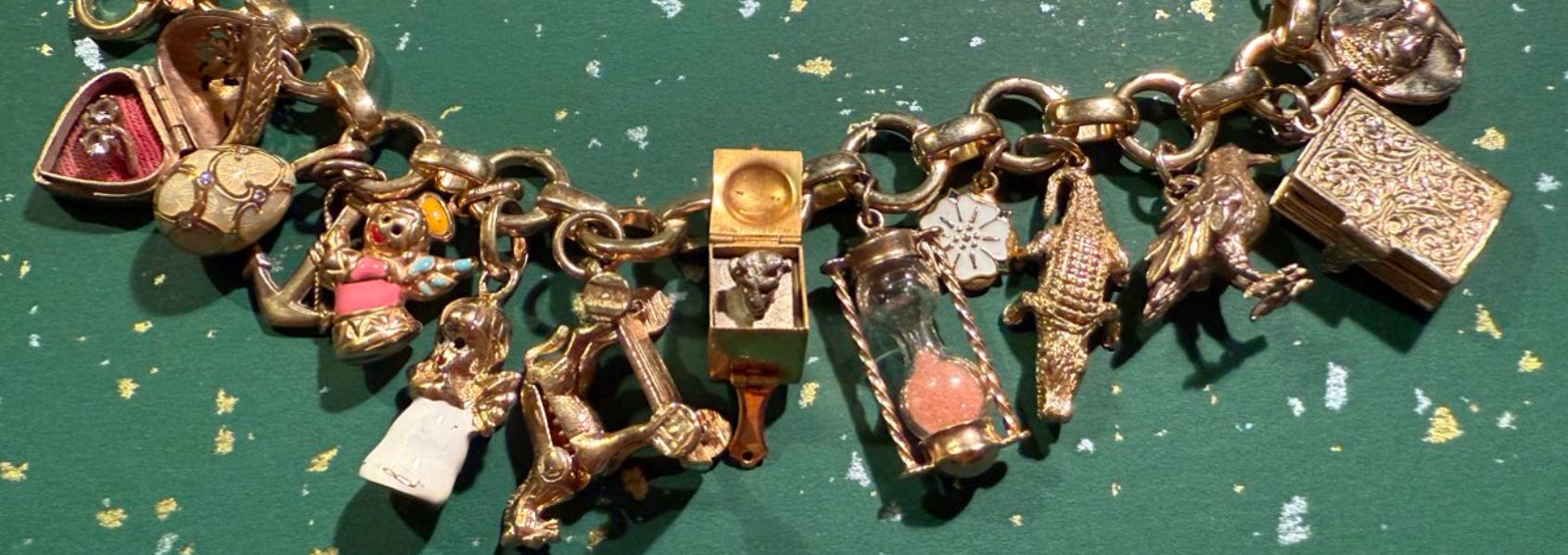
  • February 6 · 1 hr 10 min

    The Christmas Charm Bracelet of Strike 9 Clues (Part Two)

    Elizabeth Baird Hardy, Deputy Headmistress of Hogwarts Professor, the genius behind AppalachianInkling.com, Hunger Games expert, and author of Milton, Spenser and the Chronicles of Narnia: Literary Sources for the C.S. Lewis Novels, joined Nick and John to discuss the Charm Bracelet that J. K. Rowling posted on her Twixter home page as a Christmas gift to her readers. She said that that the thirteen charms on nine links were a set of clues about the next Strike novel, the ninth in a ten book series. In the first Part of Elizabeth, Nick, and John’s conversation, they discussed Rowling’s charm bracelet history, speculated about why she posted this picture when she did, decided to look at each charm on the bracelet for its stand-alone meaning and its place in the nine link set, and to read the whole series as if it were a ring composition, one reflecting a nine Part structure in Strike 9. They then made deep dives into the details of each charm: the heart shaped box containing a ‘You and Me’ engagement ring, a golden diamond-laden egg, a foul anchor, two angels, and a Trojan horse. In this second Part of that conversation, the trio of Serious Strikers continue with the remaining charms on the bracelet, namely, a Jack-in-the-box, an Hourglass, a White Rose and Crocodile, a Corvid head, and a Psalter paired on the last link with the Head of Persephone. They share their thoughts, too, about the bracelet as a symbolic integer and its ring meaning. The notes below are in support of references they make mid-flight and to other resources of interest to Magic Charm Decoders! Enjoy. Thank you to all our subscribers with special gratitude and appreciations for our paid subscribers; you are the wind in our sails, the heat from our vents… Serious Strikers are reading Browning’s The Ring and the Book, charting Hallmarked Man Part Six, and reviewing the Myth of Cupid and Psyche to look for parallels in the Strike-Ellacott series. See you soon! Jack-in-the-Box Charm * Rowling claims this as her favorite charm (Nick and John in the conversation mistakenly attribute this preference to the Psalter charm): * Badly Wired Lamp ID’d it * Is it a devil — or a Racoon? * The jack in the box toy, the 'Jack' being a devil, was invented in Germany in the 16th century as a mockery of the Roman Catholic doctrine of the Real Presence of Christ in the Eucharist. * The shape of this charm, the golden circular center in the inside of the open box top, represents the transcendent spiritual realm and the square bottom with its four directions, the fallen world. The ‘jack’ devil lives in the latter but is from the former. * The charm is the third latched object in the chain, the heart box and Trojan horse preceding it and the psalter at chain’s end following it — which means the ring latch and center are latched objects with surprises inside. The two interior objects at center have deadly surprises and the beginning and end eternal life interiors. The symbolism here is of the human being and its capacity via choice for either spiritual perfection in sacrificial love (anteros) or consumption by individual desires (eros). The thing hidden inside, man’s spiritual capacity or heart, is either light or darkness, the inside bigger than the outside. (John) * What is the Strike 9 connection, the analogue to the demonic Jack in the box? Is it RFM? Uncle Ted? Ilsa’s husband Nick? Polworth? * The Jack’s position is at the center of the bracelet and between the hourglass and the Trojan horse. So it’s placed between cleverness and craftiness and things that we can control and bad surprises, but also time, because we can’t control time. (Elizabeth) Hourglass Charm * tempus fugit ‘like sand in an hourglass’ * memento mori * infinite symbol * The Strike series may be a collection of mystery-story genres, each one illustrating a unique type of story, different from all the others while keeping the same core of characters and overarching narrative (cf., Rowling’s note in The Running Grave acknowledgements that that book was her “cult” book). The hourglass, then, may be Rowling’s pointer to Strike9 being a suspense drama in which the good guys not only have a challenging mission (find and rescue the missing Robin, Strike, Lucy, Pat, whomever) but have to do it before a literal deadline arrives. The Ticking Clock plot device. * If the Jack at link five is the center of the bracelet ring of nine links, how does the hourglass mirror the Trojan horse? It’s two parts? The deadline aspect? “Reveal the crazies inside before the hourglass empties”? White Rose Charm * White Rose of Yorkshire * The interior of the flower charm is a literal Turtleback or ring composition diagram. * White Rose of Dante: Paradiso Cantos XXXI and XXXII The true home of all the blessed is with God in the Empyrean, a heaven of pure light beyond time and space. Dante sees the blessed systematically arranged in an immense white rose: like a hologram, a three-dimensional image, the rose is formed from a ray of light reflected off the outer surface of the Primum Mobile (30.106-17). The queen of this white rose is the Virgin Mary, traditionally represented as a rose herself (see Par. 23.73-4). This celestial rose recalls large rose windows of Gothic cathedrals, many of which are dedicated to Mary. The image of the rose, often red, is also used to represent Christ or, in other contexts, earthly love. The white rose is symmetrically structured according to various criteria, including belief, age, and gender. One half of the rose, already full, holds those who, according to Christian tradition, believed in Christ to come (the blessed of the Hebrew Bible); the other half, with only a few seats still unoccupied, contains those who believed in Christ already come (saved Christians). Two gendered rows mark this division of the rose in two halves. In the row below Mary appear women of the Hebrew Bible (Eve, Rachel, Sarah, Rebecca, Judith, Ruth, and unnamed others); Beatrice is seated next to Rachel, on the third row from the top. Opposite Mary, John the Baptist heads a row of men containing Francis, Benedict, Augustine, and other Christian fathers. Mary is flanked by Adam (first man) and Moses on one side, and Peter (first pope) and John the Evangelist on the other. John the Baptist is flanked by Lucy on one side and Anna, the mother of Mary, on the other. While only adults are seated in the upper section of the rose, below a certain line the rose contains souls of blessed children, their precise location based not on their own merits (since they lacked the power of free will) but on predestination. As physical laws do not apply in the Empyrean, Dante's ability to see these figures is not diminished by distance (30.118-23; 31.76-8). * White Rose of Mockingjay (Hunger Games finale) The prevailing symbol of Catching Fire and the most meaningful token the Christ figure of the series gives Katniss is a pearl, the solid-light symbolism of which we’ve discussed before. I think Commander Paylor’s name may be our last Madge-Pearl-Mags name reference in being a “pale orb.” That gold and pearls have a similar translucency and metaphysical correspondence with the ‘Light of the World’ make the twin possibilities that much more rich — and Commander Paylor’s ascending to Panem’s Presidency that much more meaningful and appropriate. Katniss steps into the Garden with the Pearl’s blessing (“on my authority”) and discovers roses of every possible color. There are red, of course, and “lush pink, sunset orange, and even pale blue.” She knows what she wants, though; the rose colored like light, the white rose, Dante’s symbolic prelude to the beatific vision and transcendence. Just as she cuts the “magnificent white bud just about to open” “from the top of a slender bush” (ibid, p. 355), the manacled, “pale, sickly green” President Snow, our snake in the Garden, speaks. “The colors, are lovely, of course, but nothing says perfection like white.” Our story Satan, you recall, left her a white rose in District 12 in chapter 1 and dropped roses with the bunker buster bombs in Part 1 to terrify Katniss. Now we know why. He was taunting her with her end, that as a seeker’s soul he knew her goal was perfection in Christ and taunted her with it, especially when he held Peeta-Christ and understood the cartharsis and chrysalis she would have to pass through to claim it herself. Now that she is in the inner sanctuary, the High Place, he tells her the truth she could not hear anywhere else, the final, ugly truth about the cause for which Katniss had sacrificed everything. Snow reveals, just as Peeta had told her at the story’s start, that she was deceived by those she trusted. President Coin killed Primrose with a weapon designed by Gale. Having been to the Absolute center, the world navel, and taken away the beatific vision as a white rose, Katniss is no longer a seeker but the resolution of contraries, an androgyn of justice and mercy. She is above right and wrong now as the phoenix-mockingjay and hears the voice of the “murderer” on the Hanging Tree at last. She deceives President Coin at the Victors Meeting as something of an avenging angel; she becomes a murderer herself by assassinating President Coin. Peeta-Christ comes down from the tree as her savior once again and prevents her suicide via Nightlock by his out-of-nowhere intervention. * Why does the White Rose share the seventh bracelet link with a crocodile? Faerie Queene! Crocodile Charm * The Crocodile in Shed, crocodile skin handbags (Hallmarked Man) “Maybe the4 crocodile or whatever they’re keeping in the shed’s chewed its way out,” said Strike. “ (Chapter 22, p 176; center chapter of Part 2) * Crocodile entry, Cirlot’s Dictionary of Symbolism Crocodile Two basically different aspects of the crocodile are blended in its symbolic meaning, representing the influence upon the animal of two of the four Elements. In the first place, because of it viciousness and destructive power, the crocodile came to signify fury and evil in Egyptian hieroglyphics (19); in the second place, since it inhabits a realm intermediate between earth and water, and is associated with mud and vegetation, it came to be thought of as an emblem of fecundity and power (50). In the opinion of Mertens Stienon there is a third aspct, deriving from its resemblance to the dragon and the serpent, as a symbol of knowledge. In Egypt, the dead used to be portrayed transformed into crocodiles of knowledge, an idea which is linked with that of the zodiacal sign of Capricorn. Blavatsky compares the crocodile with the Kumara of India (40). Then, finally, come the symbols of Inversion proper and of rebirth. (67) * Lyndy Abraham’s Dictionary of Alchemical Imagery entry for ‘Crocodile:’ Crocodile The mercurial *serpent or transforming arcanum in its initial chthonic aspect during the dark, destructive opening of the opus alchymicum. Like the *bee, the crocodile was classified as a serpent in te bestiaries of the sixteenth and seventeenth centuries. The amphibious nature of the crocodile made it an apt symbol for the dual-natured *Mercurius. When Lepidus in Shakespeare’s Antony and Cleopatra says, ‘Your serpent of Egypt is bred of your mud by the operation of your sun; so is your crocodile’ (2.7.26-7), he is referring to the generation of gold in the earth, and the generation of the mercurial serpent through the heat of the secret *fire or ‘sun’. With the phrase ‘operation of your sun’ Lepidus also alludes to the final law of the alchemical Emerald Table: ‘That which I had to say about the operation of the Sun is completed’ (48) * Sandy Hope on Crocodile symbolism Isis Church crocodile in Faerie Queene: Book 5, Canto VII Book V Canto vii. The speaker praises the virtue of justice and cites Osyris as an example of the just man. His wife, Isis, represented equity and to the Temple of Isis Britomart and Talus come to spend the night. Talus, however, is not allowed into the temple. Britomart enters and sees a statue of Isis with her foot on a crocodile. The temple is also full of the priests of Isis who are not allowed to drink wine as it leads to rebellion. Britomart sleeps under the statue of Isis and dreams that the crocodile comes alive and threatens the Goddess. The Goddess subdues the crocodile and it becomes meek and then impregnates the Goddess. She gives birth to a lion which conquers all other beats. Britomart awakes and tells her troubling dream to a priest. He tells her that the crocodile represents Arthegall, Isis represents Britomart, and the lion their son whom they will conceive. Grateful for the interpretation, Britomart leaves and comes to Radigund’s castle. Radigund and Britomart battle, Britomart is wounded in the shoulder, and finally Britomart beheads Radigund. Talus enters the castle and wreaks carnage on the Amazon women inside. Britomart finds Arthegall dressed, like other, in women’s clothing. she is shamed by the sight, and it is not quite clear whether her suspicions that Arthegall has been unfaithful are confirmed or refuted. She finds Arthegall some armour, arms him, and the rest in the castle. during this time Britomart rules as a princess and reforms the Amazon society so that women are restored to proper subjection to men. Finally, Arthegall leaves to complete his quest against Grantorto. Britomart lets him leave because she knows that his success in this quest is important to restore his ego. After residing further at the Amazon castle she finally leaves to help keep her mind off the absent Arthegall. * The Spenser Encyclopedia entry for ‘Church of Isis:’ (408) Clifford Davidson When Britomart spends the night in the temple, she sees a ‘wondrous vision’ in which she participates first as a votary of Isis and then as the goddess herself. Her devotion to the statue causes her to become Isis in her dream: she is serving at the altar when she sees herself transformed into Isis but wearing the royal robe. The crocodile awakens, devours the flames which threaten to destroy the temple, and threatens to eat Isis/Britomart until it is driven back by her rod. Then it seeks her ‘grace and love,’ she yields, it impregnates her, and from their union she gives birth to a lion. As the Priest explains, the crocodile is Osiris (the Egyptian god of Justice) who sleeps under the feet of Isis ‘To shew that clemence oft in things amis,/ Restraines those sterne behests, and cruell doomes of his’ (22), and who shows thereby the proper relation of justice and judgment to equity. The Priest also explains to Britomart that the crocodile is Artegall, ‘The righteous Knight,’ who will settle the storms and ‘raging flames, that many foes shall reare’ and restore to her the heritage of her throne, and who will give her a ‘Lion like’ son (23), the new British monarchy of the Tudors. The crocodile is a symbol both of guile and of a regeneration that will affect future history. As guile, its relation to Isis is reminiscent of Vice figures under the feet of triumphing Virtues in medieval art. An iconographic association between the crocodile in its demonic aspect and medieval saints’ legends derives ultimately – significantly for Spenser – from the classical figure of Britomartis (Miskimin 1978). In Plutarch’s Isis and Osiris 50, it is linked to Typhon, the enemy of justice and order, while in Renaissance iconographic tradition it is often symbolic of the need for prudence (for one must be prudent to avoid the wily crocodile). Cesare Ripa’s Iconologia (sv Lussuria) shows the nude Luxury (or Lechery) seated upon a crocodile, an interesting analogy to its phallic sexuality in Britomart’s dream. Yet along with these primarily negative associations, there are also positive ones in the crocodile’s identification with Osiris/Artegall/Justice and in the implication that Isis/Britomart/Equity is incomplete without her partner. The image contains its own contradiction, unresolved by the Priest. * Troubled Blood and Faerie Queene: Where Britobart and Artegall are used as stand-ins for Robin and Cormoran: Troubled Blood features several embedded texts, the most important of which is never mentioned in the book: Edmund Spenser’s Faerie Queen. Serious Strikers enjoyed the luxury of not one but two scholars of Edmund Spenser who checked in on the relevance and meaning of Rowling’s choice of the greatest English epic poem for her epigraphs, not to mention the host of correspondences between Strike 5 and Queen. Elizabeth Baird-Hardy did a part by part exegesis of the Troubled Blood-Faerie Queen conjunctions and Beatrice Groves shared her first thoughts on the connections as well. Just as Lethal White’s meaning and artistry is relatively unappreciated without a close reading of Ibsen’s Rosmersholm, so with Strike 5 and Faerie Queen. Elizabeth Baird-Hardy * Day One, Part One: The Spenserian Epigraphs of the Pre-Released Troubled Blood Chapters * Day Two, Part Two: The Spenserian Epigraphs of Troubled Blood Chapters Eight to Fourteen * Day Three, Part Three: The Spenserian Epigraphs of Troubled Blood Chapters Fifteen to Thirty * Day Four, Part Four: The Spenserian Epigraphs of Troubled Blood Chapters Thirty One to Forty Eight * Day Five, Part Five: The Spenserian Epigraphs of Troubled Blood Chapters Forty Nine to Fifty Nine * Part Six: The Spenserian Epigraphs of Troubled Blood Chapters Sixty to Seventy One * Spenser and Strike Part Seven: Changes for the Better Beatrice Groves * Trouble in Faerie Land (Part 1): Spenserian Clues in Troubled Blood Epigraphs * Trouble in Faerie Land (Part 2): Shipping Robin and Strike in the Epigraphs of Troubled Blood * Trouble in Faerie Land (Part 3): Searching for Duessa in Troubled Blood John Granger: * How Spenser Uses Cupid in Faerie Queen and Its Relevance for Understanding Troubled Blood * Reading Troubled Blood as a Medieval Morality Play Corvid Charm * Rowling Twixter headers: 12 January 2016, 9 April 2017 (Nick) * Fantastic Beasts reference? The Lestrange Family Motto features a crow and the ‘Lost Child’ of that series is named ‘Corvus’ * Crow Symbolism per Cirlot, Dictionary of Symbols: Crow Because of its black colour, the crow is associated with the idea of beginning (as expressed in such symbols as the maternal night, primigenial darkness, the fertilizing earth). Because it is also associated with the atmosphere, it is a symbol for creative, demiurgic power and for spiritual strength. Because of its flight, it is considered a messenger. And, in sum, the crow has been invested by many primitive peoples with far-reaching cosmic significance. Indeed, for the Red Indians of North America it is the great civilizer and the creator of the visible world. It has a similar meaning for the Celts and the Germanic tribes, as well as in Siberia (35). In the classical cultures it no longer possesses such wide implications, but it does still retain certain mystic powers and in particular the ability to foresee the future; hence its claw played a special part in rites of divination (8). In Christian symbolism it is an allegory of solitude. Amongst the alchemists it recovers some of the original characteristics ascribed to it by the primitives, standing in particular for nigredo, or the initial state which is both the inherent characteristic of prime matter and the condition produced by separating out the Elements (putrefactio) … In Beaumont’s view, the crow in itself signifies the isolation of him who lives on a superior plane (5), this being the symbolism in general of all solitary birds. (71-72) * Lyndy Abraham’s Dictionary of Alchemical Imagery entry for ‘Crow:’ (49) Crow, crow’s head, crow’s bill A symbol of the *putrefaction and *black nigredo which is the first stge of the opus alchymicum. The old body of the metal or matter for the Stone is dissolved and putrefied into the first matter of *creation, the *prima materia, so that it may be regenerated and cast into a new form. The Hermetis Trismegisti Tractatus Aureus said of this initial stage of death and dissolution in the work: ‘The First is the Corvus, the Crow or Raven, which from its blackness is said to be the beginning of the Art’ (bk. 2, 235). In his Aurora, Paracelsus wrote that when the matter has been placed in the gentle heat of the secret fire it passes through corruption and grows black: ‘This operation they call putrefaction, and the blackness they name the head of the Crow’ (55). Thomas Charnock likewise wrote of the putrefaction: ‘The Crowes head began to appere as black as Jett’ (TCB, 296). In Zoroaster’s Cave the matter produced during this stage is identified with the name of the process: ‘When the matter has stood for the space of forty dayes in a moderate heat, there will begin to appear above, a blacknesse like to pitch, which is the Caput Corvi of the Philosophers, and the wise men’s Mercury’ (80). According to Ripley the terms ‘crows head’ and ‘crows bill’ are synonymous: ‘The hede of the Crow that tokeyn call we,/And sum men call hyt the Crows byll’ (TCB, 134) (see ashes). In A Fig for Momus Thomas Lodge listed the crow’s head amongst other alchemical enigmas: ‘Then of the crowes-head, tell they weighty things’ (Works, 3:69). When Face in Jonson’s The Alchemist says that the matter of the Stone has become ‘ground black’, Mammon enquires of him, ‘That’s your crowes-head? And Subtle replies, ‘No, ‘tis not perfect, would it were the crow’ (2.3.67-8). Psalter Charm * In ‘Charms, Psalms & Golden Clues: A brace(let) of clues for Strike 9,’ Prof Groves discusses the psalm as charm: Charm first meant the incantation itself, and then the amulet that carried that incantation to protect the wearer and then – from the 19th century – the small ornamental trinkets, fastened to girdles, watch-chains and bracelets, that resembled those original, talismanic charms. This means that Rowling’s clue-charm of a Psalm book (which can actually carry a sacred text) circles back beautifully to the original meaning of the word – in which a charm was an amulet carrying a holy text. These charms do not always hold texts but Rowling has confirmed that this one does: ‘The book is a psalm book and holds real, miniature psalms’ I think this protective hinterland of charms make it likely that the specific psalm that such a psalm-book charm would carry would be the most comforting and talismanic of psalms – Psalm 23. This psalm famously describes the Lord’s love as protective, even unto the valley of the shadow of death * John argues that, in addition to the 23rd Psalm, Psalm 90 (91 in Masoretic or KJV reckoning), the so-called ‘Soldier’s Psalm’ is at least as likely as an insert for this charm, which is to say, as a talisman a soldier might give a woman about to enter Hades to beg a gift from Persephone… The Head of Persephone Charm * Rowling’s clarifying picture * Psyche’s Last Task from Venus: One final task is then given to Psyche, one in which Psyche is commanded to bring back a bit of Persephone’s beauty from the Underworld. In Greek mythology no living soul is meant to be able to enter the Underworld, let alone leave it, and so Aphrodite felt that she would be rid of Psyche once and for all. Indeed, it seemed that Aphrodite would be proved right, for Psyche’s only idea about entering the Underworld was to kill herself. Before Psyche can commit suicide a voice whispers to her instructions about how to complete the task. Thus Psyche finds an entrance to the Underworld and is soon crossing the Acheron upon the skiff of Charon, and the princess even manages to gain an audience with Persephone. Persephone on the surface appears to be sympathetic to the quest of Psyche, but Psyche has been warned about accepting food or a seat in the palace of Hades, for both would bind her to the Underworld for all time. But eventually, Persephone gives Psyche a golden box, said to contain some of the goddess’ beauty. * The Head of Persephone charm is paired with the Psalter on the ninth and last link; again, if the Psalm is 22 (23) or 90 (91), then the connection is an invocational prayer for help traveling through the “valley of death,” for protection from the “asp and basilisk,” the “lion and dragon.” * As above, note that the beginning, middle, and end of the bracelet feature clasped objects, with the Psalter being a codex that opens and Psyche’s journey to Persephone is in pursuit of a “golden box” containing the means to otherworldly beauty. This is a public episode. If you'd like to discuss this with other subscribers or get access to bonus episodes, visit hogwartsprofessor.substack.com/subscribe
  • February 4 · 1 hr 22 min

    The Christmas Charm Bracelet of Strike 9 Clues (Part One)

    On 23 December last year, Rowling changed her Twixter home page header and cameo with this tweeted explanation: The Charm Bracelet header features thirteen charms on nine links: Rowling tweeted an addendum about the Psalter and Jack in the Box charms: Nick Jeffery dropped an explanatory post two days later at the Hogwarts Professor weblog: J. K. Rowling Drops All the Strike 9 Clues for Christmas! It remains the only complete survey of the pieces and compendium of what Serious Strikers around the world have discovered about them. Beatrice Groves, author of Literary Allusion in Harry Potter, wrote up her charm bracelet thoughts at ‘The Strike Ellacott Files’ a month later. In ‘Charms, Psalms & Golden Clues: A brace(let) of clues for Strike 9,’ Prof Groves discusses the magical quality of charms as talismans and even incantational song: Rowling points out in this 2013 piece the link between the name given to charm bracelets and the magical world: ‘Why do we call those little masterpieces “charms” if not in allusion to their talismanic properties?… they are personal amulets.’ To charm someone is also to slightly to bewitch them, something Rowling plays with when Riddle exerts his charm on Ginny and literally possesses her: ‘If I say it myself, Harry, I’ve always been able to charm the people I needed.’ Witch Weekly’s Most-Charming-Smile Award is given to a smile that is both literally, as well as metaphorically, bewitching. The word ‘charm’ comes, through French, from the Latin ‘carmen’ which means ‘song, verse, oracular response, incantation.’ Its first meaning in English, therefore, was the magical one: ‘the chanting or recitation of a verse supposed to possess magic power or occult influence; incantation, enchantment; hence, any action, process, verse, sentence, word, or material thing, credited with such properties; a magic spell; a talisman, etc.’ (Oxford English Dictionary). From the sixteenth century onwards, ‘charm’ meant ‘anything worn about the person to avert evil or ensure prosperity’ because such amulets might contain the text of such a charm. And thinking about this made me aware for the first time of how in the most important charms in Harry Potter – the Fidelius Charm and the Patronus Charm – the word is not simply a synonym for spell but encodes this original, protective meaning. These magical ‘Charms’ like the charms on charm bracelets encode what Rowling calls ‘talismanic properties.’ Nick and John invited Elizabeth Baird Hardy, Deputy Headmistress of Hogwarts Professor, the genius behind AppalachianInkling.com, Hunger Games expert, and author of Milton, Spenser and the Chronicles of Narnia: Literary Sources for the C.S. Lewis Novels to talk about these charms, especially about what she had written briefly on the subject. The goals of this conversation? * To introduce the subject to everyone not familiar with the Christmas tweets and bracelet-header, * to discuss the ‘Why?’ of this present to Strike fans everywhere, * to speculate about the meaning of the bracelet pieces individually and in a series, and * to brainstorm their qualities as clues for Strike9, the penultimate novel in the decalogy. Which is a lot! The good news is that the conversation never flagged and the revelations and possible meanings of the charms, thirteen in total on nine links, reward anyone listening in. Nick starts off the conversation with a review of the six charm bracelets in Rowling’s life and writing, one of which was a long forgotten piece in the margins of a Rowling web site: [You can read about those internet ‘Easter Eggs’ in ‘Hidden Photos at Rowling’s Website’ here, here, here, and here.] Nick offered as a guiding idea for our conversation the likelihood that the nine links in the bracelet were meaningful, i.e., that they reflected the structure of the book for which the bracelet is meant to be a clue. There are thirteen charms, he noted, but certainly Rowling-Galbraith could have had a thirteen link chain made if she hadn’t thought the nine links more than sufficient, even a pointer to Strike 9 being a nine Part mystery. Since, as Nick noted, she has trouble even passing up a shop selling charms, it seems likely she has been collecting the pieces for this one for some time. Perhaps this bracelet is a “target” toward which she has been writing with these books. It is certainly not something she just threw together for a header photo shoot. The trio elected to read the circular collection of charms, consequently, as pieces with individual meaning — as magical talismans of sorts per Prof Groves — and as a ring composition, with both aspects indicating the place and meaning of the piece in the book. After a brief discussion of why Rowling, Inc., would release this set of clues now, with another Strike novel or Bronte Studios television adaptation in the distant future — John offered the possibility that this bit of fan servicing was meant as a touch of appeasement qua Christmas gift to the many fans disappointed with Hallmarked Man — Elizabeth, John, and Nick tackled the thirteen charms on nine links. In Part One of their conversation, they talk about * the heart shaped engagement ring box; * the golden diamond-laden egg; * the anchor; * the two angels; and * the Trojan horse. Their preliminary conclusions at the half-way point? Mrs. Murray in her Nativity gift to her readers offers them clues not only to the next Strike-Ellacott novel but to the meaning of human life. Each of these five charms is a symbol with obvious and not so obvious Christian meaning. John reconsidered his answer to the ‘Why now?’ in light of this avalanche of symbolism; instead of it being fan servicing to rescue the brand, he thinks it may be Rowling’s attempt — on the most celebrated remnant Christian holiday in a post-Christian world — to reset her serious readers’ understanding of what she is about as a writer, what sort of transformation she is trying to create via story within her readers. Part two of this interpretative deep dive into Rowling’s artistry in metallurgical symbolism, her “charm work” literary alchemy, will follow shortly. There are five links with seven charms to come — Jack in the Box, Hourglass, White Rose, Crocodile, Corvid, Psalter, and the Head of Persephone — all as rich in meaning as the first four links. Below are links to subjects mentioned in this first conversation and additions not discussed but discovered after the fact, all shared for your consideration and comments! Thank you as always from the Hogwarts Professor team for your joining us with special appreciation to our paid subscribers! Subjects that Elizabeth, Nick, and John Discussed: The Heart Shaped Engagement Ring Charm: * The first, fourth, fifth, and ninth links are clasped objects with surprises inside, * Ink Black Heart and Deathly Hallows: The Heart is Not About Emotions and Affection but the Human Spiritual Center (John, October 2022) * Hallmarked Man, Part Five: The Center of Strike 8 is about “Inner Light” (Ed Shardlow) * Gold as “solid light” and diamonds as “inner light,” both reflecting in nature the Light of God’s Word or Logos that is found with in every man (cf., John 1:9 and Rowling’s comments about Casual Vacancy being “all about” her belief that “the light of God shines in every soul”); * The consequent symbolism of a golden wedding/engagement band with two diamonds; * The human being as a ‘heart in a box’ either enlightened ‘gold and diamonds’ or a dark ‘jack in the box’ devil * The two-stone ring, as Nick notes, is a “me and you” ring, alluding to a certain theme song. Also, Elizabeth notes, Robin is faced with a choice between two very different types of proposals, so the duality of the ring in the box connects to that conundrum, and since that is apparently where 9 will begin, it gives us a good idea that we are right in “reading” the bracelet starting with this one The Gold Diamond-Laden Egg Charm: * Assuming it is an ‘Easter Egg,’ the two meanings of that phrase; * Again, ‘gold and diamonds,’ as above; * Paschal meaning of Eggs: The custom of exchanging colored eggs entered the life of the Church. The symbolic meaning of the egg as the beginning of a new life was known even earlier. Christians saw in this symbol confirmation of their faith in the coming general resurrection. The Easter egg’s red color symbolized the all-conquering Divine Love, which alone could destroy hell! The Foul-Anchor Charm: * ‘Strike 9 to Heads to Portsmouth!’ (Nick, September 2025) * Foul Anchor (Wikipedia); * Eagle, Globe, and Anchor (Wikipedia); * Meaning of ‘Hector’ in Homeric Greek is ‘Holding Fast,’ and, by interpretation, ‘anchor;’ * The Greek word for ‘Anchor’ found in the New Testament is ἄγκυρα, pronounced ‘ang-chor-a;’ * Hebrews 6:19: 13 For when God made promise to Abraham, because he could swear by no greater, he sware by himself, 14 Saying, Surely blessing I will bless thee, and multiplying I will multiply thee. 15 And so, after he had patiently endured, he obtained the promise. 16 For men verily swear by the greater: and an oath for confirmation is to them an end of all strife. 17 Wherein God, willing more abundantly to shew unto the heirs of promise the immutability of his counsel, confirmed it by an oath: 18 That by two immutable things, in which it was impossible for God to lie, we might have a strong consolation, who have fled for refuge to lay hold upon the hope set before us: 19 Which hope we have as an anchor of the soul, both sure and stedfast, and which entereth into that within the veil; 20 Whither the forerunner is for us entered, even Jesus, made an high priest for ever after the order of Melchisedec. * Meaning of "Anchor of the Soul" in Hebrews 6:19? The Immediate Context of Hebrews 6:13-20 The writer reassures wavering Jewish Christians by citing God’s oath to Abraham (Genesis 22:16-17). Two “unchangeable things” (God’s promise and His oath, v. 18) make it “impossible for God to lie.” The “hope set before us” (v. 18) functions as an anchor that has already “entered … behind the curtain” (v. 19), where Jesus, our High Priest, intercedes (v. 20; cf. 4:14-16). Anchor as Hope: Theological Significance 1. Objective, not subjective: “hope” (ἐλπίς) is grounded in the historical, bodily resurrection of Jesus (1 Corinthians 15:17-20). 2. Already-but-not-yet: the anchor is cast forward into the heavenly holy of holies, securing believers’ future inheritance (1 Peter 1:3-4) while exerting a present stabilizing pull. 3. Firm and secure: βεβαία (reliable) and ἀσφαλής (incapable of slipping). The compound assures permanence beyond circumstantial change (Malachi 3:6). Christ Our Forerunner Behind the Veil The anchor “enters” (εἰσερχόμενον, pres. tense) the inner sanctuary “behind the curtain,” alluding to the Day of Atonement (Leviticus 16). Jesus is πρόδρομος (“forerunner,” v. 20), implying that others will follow where He has gone (John 14:2-3). The anchor-rope is His indestructible life (Hebrews 7:16), tethering the believer to God’s throne of grace. * Hence its use as a symbol within Christianity: Christ having defeated death is an anchor to those members of His Mystical Body which anchors them to life after death, “beyond the veil;” * The pairing of the anchor charm with the golden egg on the second link of the bracelet reinforces this Paschal symbolism; * Charles Williams’ “Co-inherence” ideas: “Who Saved Draco’s Soul?” Co-Inherence in Harry Potter The Two Angels Charms (paired on Link three) * Cupid and Psyche? Maybe! * Angels? Ghosts? * Orlando drawings! A Silkworm flash-back to the Monkey-Bag with the essential clue inside… The Trojan Horse Charm * Trojan Horse (Wikipedia) In Greek mythology, the Trojan Horse (Greek: δούρειος ίππος, romanized: doureios hippos, lit. ‘wooden horse’) was a wooden horse said to have been used by the Greeks during the Trojan War to enter the city of Troy and win the war. The Trojan Horse is not mentioned in Homer’s Iliad, with the poem ending before the war is concluded, and it is only briefly mentioned in the Odyssey. It is described at length in the Aeneid, in which Virgil recounts how, after a fruitless ten-year siege, the Greeks constructed a huge wooden horse at the behest of Odysseus, and hid a select force of men inside, including Odysseus himself. The Greeks pretended to sail away, and the Trojans pulled the horse into their city as a victory trophy. That night, the Greek force crept out of the horse and opened the gates for the rest of the Greek army, which had sailed back under the cover of darkness. The Greeks entered and destroyed the city, ending the war. Metaphorically, a “Trojan horse” has come to mean any trick or stratagem that causes a target to invite a foe into a securely protected bastion or place. A malicious computer program that tricks users into willingly running it is also called a “Trojan horse“ or simply a “Trojan”. * Could the Strike Series be a Re-telling of Virgil’s Aeneid? (John, July 2017) If Cormoran Strike’s story is Rowling’s postmodern re-telling of the Aeneid, then the Fates theme is more than apt. It is all about, after all, the hero’s destiny or fate to recreate Troy in Italy as Rome, a fate which it is pointless for Aeneas to resist. The refugee from Troy, son of the goddess of beauty, is forced ever onward, often over-riding his preferences and pledges, to his destiny to found Rome as the New Troy. A soldier in an eastern country ‘coming home,’ Aeneas is a wounded man, haunted by his divine mother, a man of destiny forced to leave a beautiful, powerful woman who curses him at his departure. Sound familiar? The Aeneid is a reverse reflection and re-telling of Homer’s Iliad and Odyssey in that it’s first six books are about the Trojan’s travels and the last six relate his battles with the local tribes in Latium. It seems possible that Rowling might be trying to do with the Aeneid what she did with the Weird Sisters of Macbeth, namely, present what seems to be a tale of inevitability or fate, something prophesied or otherwise seemingly inescapable, as a function really of character choice. In the Peg-Legged PI’s story that could mean Rowling’s revisiting fate vs choice vis a vis whether he is able to choose to take-or-leave an investigation of Leda’s death (and face the dangers inherent in threatening his biological father, Jonny Rokeby) or whether he feels doomed to follow it to its end, whatever the costs to him and to those he loves. * The Trojan Horse is the wisdom of Athene as given to Odysseus, her favorite. This is a public episode. If you'd like to discuss this with other subscribers or get access to bonus episodes, visit hogwartsprofessor.substack.com/subscribe

  • January 22 · 2 hr 10 min

    Robin Ellacott's Imminent Death and Its Out of This World Effect on Strike

    Running Grave, book Seven of the ten novel Cormoran Strike murder mystery series by Joanne Murray (‘J. K. Rowling’) writing as ‘Robert Galbraith,’ is what the author described as her “cult novel.” The cult in question is the Universal Humanitarian Church led by Jonathan Wace; the Strike-Ellacott Agency is hired by a father to rescue his youngest son who has disappeared into the UHC’s Chapman Farm property. Robin Ellacott successfully infiltrates the compound and she and the young man escape. Soon after Robin’s near-thing deliverance and return to London, Strike attends a UHC rally in that city with hopes that he will be spotted by Wace and invited to meet back-stage. ‘Papa J’ takes the bait and he and Strike square off in the cult leader’s dressing room. Strike reveals much of what Robin and he have learned about the UHC’s criminal past and present in that verbal confrontation. Strike exits only after delivering a warning; stay away from his partner or “I will burn your church to the f*****g ground” (Part 8, chapter 112, 808; italics in original). In the midst of this tense back-and-forth between private detective and religious guru, Strike thrice mentions a book published in 1930, Who Moved the Stone?, a relatively short work of popular Christian apologetics: ‘I see you’re one of those who prides themselves on disrespecting rites, mysteries, and religious observance,’ said Wace, smiling again. ‘I shall pray for you, Cormoran. I mean that sincerely.’ ‘I’ll tell you one book I’ve read, that’s right up your street,’ said Strike. ‘Came across it in a Christian mission where I was spending a night, just outside Nairobi. This was when I was still in the army. I’d drunk too much coffee, and there were only two books in the room, and it was late, and I didn’t think I’d be able to make much of a dent in the Bible, so I went for Who Moved the Stone? by Frank Morison. Have you read it?’ ‘I’ve heard of it,’ said Wace, sitting back in his chair, still smiling. ‘We recognise Jesus Christ as an important emissary of the Blessed Divinity, though, of course, he’s not the only one.’ ‘Oh, he had nothing on you, obviously,’ said Strike. ‘Anyway, Morison was a non-believer who set out to prove the resurrection never happened. He did an in-depth investigation into the events surrounding Jesus’ death, drawing on as many historical sources as he could find, and as a direct result, was converted to Christianity. You see what I’m driving at?’ ‘I’m afraid not,’ said Wace. ‘What questions d’you think Morison would’ve wanted answered, if he set out to disprove the legend of the Drowned Prophet?’ (805) This calling into question of the UHC’s historical claim to other-worldly power causes those of Wace’s inner-circle minions to chafe and counter with traditional Oriental wisdom about wrestling with pigs. Strike again alludes to Morison’s book: ‘Is that from the I Ching?’ asked Strike, looking from Zhou to Mazu. ‘Funnily enough, I’ve got a few questions on the subject of degradation, if you’d rather hear those? No?’ he said, when nobody answered. ‘Back to what I was saying, then.’ ‘Let’s suppose I fancy writing the new Who Moved the Stone? – working title, “Why Paddle in the North Sea at Five a.m.?” As a sceptical investigator of the miraculous ascension into heaven of Daiyu, I think I’d start with how Cherie knew Jordan Reaney would oversleep that morning. Then I’d be finding out why Daiyu was wearing a dress that made her as visible as possible in the dark, why she drowned off exactly the same stretch of beach as your first wife and – parallels with Who Moved the Stone? here – I’d want to know where the body went. But unlike Morison, I might include a chapter on Birmingham’ (805-806). John Granger and Nick Jeffery, as part of their Kanreki celebration of Rowling-Galbraith’s 60th birthday last July, discussed Texts-Within-the-Text as a Golden Thread that runs through all of the author’s work. Most of those embedded texts, though, are of Rowling’s invention, e.g., Dumbledore’s Chocolate Frog Card, Tales of Beedle the Bard, Bombyx Mori, The Predictions of Tycho Dodonus, Wace’s The Answer, etc. It’s fairly rare for Rowling-Galbraith to drop a reference to a real world book even in the relatively non-magical Strike series. In addition to the I Ching, however, Running Grave has Prudence Donleavy recommend two psychology texts to Robin (Lifton’s Thought Reform and the Psychology of Totalism: A Study of Brain Washing in China and Hassan’s Combatting Cult Mind Control: Protection, Rescue, and Recovery from Destructive Cults) in addition to Strike’s weaponization of Morison’s Who Moved the Stone? John and Nick chose to discuss Who Moved the Stone? this week rather than an embedded text that works as a template (cf., Aurora Leigh) or a Rowling favorite-book that shaped her perspective (e.g., I Capture the Castle) or a real-world book tied to the plot of Hallmarked Man (Bridge to Light, Pike’s Morals and Dogma) because it seemed to connect the dots of several recent Rowling revelations: * the “God-shaped vacuum” tweet; * the unforced admission that she suffers from VWD, a blood-clotting disorder; * the search for the coming Big Twist in the final books of the Strike series; * the Psalter charm on the Strike9 Christmas gift bracelet-of-clues; * the Church of St Giles in the Fields’ existence and its incredible absence from the first eight Strike books despite its overshadowing Denmark Street; and * the absence of Strike-series parallels to the Christian content and meaning of the Potter series, especially with respect to the Struggle to Believe in Deathly Hallows. For reasons the two discuss, all the above are pointers to possible Christian content of Strike books nine and ten, even that this content will be a substantial part of the mind-bending surprise finish to the series, namely, Strike’s transformation from a skeptic with respect to all things religious to believer. What bigger clue has Rowling presented in the series for that possibility than Strike’s confronting a religious “fraud and hypocrite” (799) with a book by an English skeptic about the evidence for belief in Christ’s Resurrection from the dead? Nick and John discuss both Who Moved the Stone? itself, its use in Running Grave in the Strike-Wace confrontation, and its possible meaning as a pointer to revelations and transformations to come: 1. Why is a Rowling Reader interested in Frank Morison’s Who Moved the Stone? ? 2. Who was ‘Frank Morison‘? What is the story behind the writing of Who Moved the Stone? ? What place does it have, if any, in UK Christian apologetics? 3. Do you think there are echoes of ‘Morison’s conclusions in the Passion parts of Dorothy Sayers’ Man Born to be King series for the BBC (1941)? 4. Chesterton per Wikipedia wrote in his review of Stone that he had been “under the impression it was a detective story” when he picked it up; how much does it read like a murder mystery, something akin to how Strike might sift through the evidence of a case? 5. Five instances of deductive insights Ross-Morison offers by reasoning that even most Christian believers would have considered — 6. A compare-and-contrast exercise of different perspectives -- John, believer, familiar with passion gospels; Nick, seeker, not so much -- how did their reading experiences differ? 7. Why would Rowling-Galbraith have Strike mention this book, one that fosters conversions to Christian faith, in his face-to-face meeting with a religious charlatan? Shouldn’t he be belittling faith at that point? 8. If there is a single ‘keyword’ in Stone, John believes it is “vacancy.” Nick and John discuss (1) the possibility that Rowling may have read this book as a young person and been struck by the God-shaped “vacancy” or “Vacuum” in her own life and (2) whether it could have been an influence on the Casual Vacancy title. They review Rowling comments about “the light of God shining from every soul” in her Vacancy interviews. 9 - John expresses his bewilderment that Robin and Cormoran have never discussed their faith backgrounds or lack of one in the course of their relationship, especially in light of their UHC cult experiences and Talbot’s True Book with its occult and Christian content. Nick explains the fall out of the English Civil War to John. 10. Could Strike’s familiarity with and seeming sympathy with the arguments of Stone a place-marker for future conversations about faith, not to mention revelations of why both Strike and Robin are so casual about the vacancy of a spiritual dimension in their lives? The remarkable take-away from this conversation was a discussion of the possibility that Rowling’s tweeted ‘Psyche Ascendant’ suggests the imminent death of Robin Ellacott in Strike 9 with Strike 10 being fallout of that death in the life of Cormoran Strike. ‘Fall out’ meaning Strike will learn the truth about all the questions to which he mistakenly thought he knew the answers — the suicides of his mother and Charlotte Campbell-Ross, the character of Jonny Rokeby, Ryan Murphy’s real motivation for pursuing Robin Ellacott, Cormoran’s relationships with his half-sister Lucy and “oldest mate” Dave Polworth — as well as ‘Who Killed the Better Half of the Strike Ellacott Detective Agency?’ John thinks the revelations coupled with Strike’s grief may drive him to his knees in St Giles in the Fields Church, a ‘Digging Dobby’s Grave on Easter morning’ parallel. Make your case in the comment boxes below if you think that he has lost his mind somewhere on the drive east from Oklahoma to the Carolinas. The Granger family is now well settled in their South Carolina bungalow and Hogwarts Professor will be posting with regularity. Nick and John thank you for your patience and for your support! Links to Sources and Subjects Mentioned in Conversation: ‘A Ring Reading of Running Grave, Part Eight’ (John Granger) Who Moved the Stone? by Frank Morison (Amazon) ‘Albert Henry Ross’ aka ‘Frank Morison’ (Wikipedia) ‘Frank Morison and Who Moved the Stone? Advertiser, Novelist, Apologist, Spy’ (Philip Johnson, Lecturer, Morling College, New South Wales, 2018) * Most of the information that Nick and John shared about Ross/Morison and his book Who Moved the Stone? came from this carefully researched paper. ‘Philip Johnson’ UC Berkeley Law Professor, author Darwin on Trial (Wikipedia) Darwin Retried: An Appeal to Reason (Norman MacBeth) Dorothy Sayers' Man Born to be King series for the BBC (1941)? G. K. Chesterton review of Who Moved the Stone? in The Illustrated London News (5 April 1930) ‘Reading Troubled Blood as a Medieval Moral Play and Allegory:’ Roy Phipps the “bloody bleeder” as King Philip of Spain (John Granger) ‘Justin Martyr and the Fourth Gospel’ (Fr John Romanides, 1958, on the relationship of the Synoptic Gospels and the Gospel According to St John) An examination of the Biblical sources reveals the fact that underlying the New Testament is the catechetical principle that one is able to discern the will and acts of God only according to the measure and degree in which he has been liberated from demonic influences and by spiritual exercise learns to distinguish between divine and satanic energies. This liberation is accomplished in Christ by the power of the Spirit but its effect on man is not automatic. Where it does begin its process is generally gradual as is evident in the tardy way in which the Apostles came to a full understanding of the way the kingdom of God had come upon them. Failure to understand and partake of the mysteries of the kingdom is attributed to continuance in the ways of Satan (e.g., Mtth. 13, 1-23; Mk. 4, 1-20; Lk. 8, 4-15; II Cor. 4, 3-4). Before a person was admitted to baptism, he had to be instructed in the old Testament revelations of the divine activities as well as in the ways of satan. Otherwise, he would continue being blinded by the devil and would be in danger of confounding divine and satanic activities as happened in the case of the Jews who went so far as to say that Jesus cast out demons by the power of Belzebub (Mtth. 12, 22-37; Mk. 3, 22-30; Lk. 11, 14-23). This is the blasphemy against the Spirit which cannot be forgiven. Those who are not able to recognize the energies of God are those who by hearing hear but do not understand and seeing see but do not discern (Is. 6, 9; Mtth. 13, 14; Mk. 4,12; Lk. 8, 10; John 12, 40; Acts 28, 26 ff.). The fourth gospel is a continuous play on the divinity of Christ as witnessed to by the divine activities which He shares in common with the Father and the Spirit and which are eventually understood by those who are defeating the devil but continuously misunderstood by those blinded by the prince of darkness. The fourth gospel is understood only by those who have been previously exercised in the discernment of the saving and sanctifying acts of God in both the Old Testament and Synoptic tradition, apart from whose soteriological presuppositions it is totally meaningless. Contemporary Case for Religious Belief in General: Believe: Why Everyone Should Be Religious Advice to the Serious Seeker Why Religion Matters: The Fate of the Human Spirit in an Age of Disbelief The Last Superstition: A Refutation of the New Atheism Atheist Delusions: The Christian Revolution and Its Fashionable Enemies Seven Christian Apologetics Classics The Case for Christ (Movie version!) Evidence that Demands a Verdict: Life Changing Truth for a Skeptical World Mere Christianity (C. S. Lewis) Handbook of Christian Apologetics Exposing Myths about Christianity Did the Resurrection Happen? Elements of Faith: An Introduction to Orthodox Theology Hogwarts Professor is a reader-supported publication. To receive new posts and support my work, consider becoming a free or paid subscriber. This is a public episode. If you'd like to discuss this with other subscribers or get access to bonus episodes, visit hogwartsprofessor.substack.com/subscribe

Showing 1–20 of 22 episodes