How Robots Learned to Walk: From Hand-Engineered Control to Reinforcement Learning
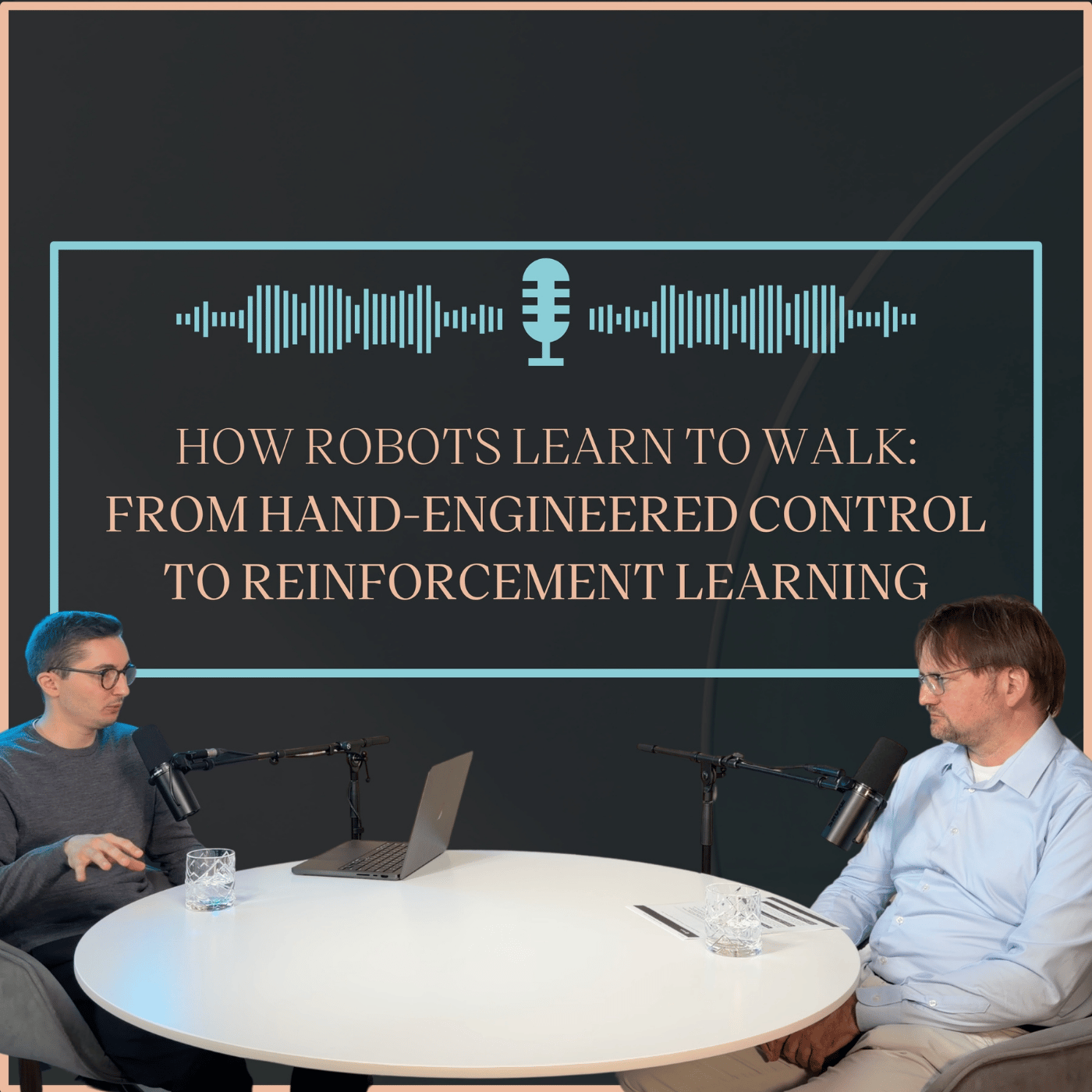
Is legged locomotion actually a solved problem? In this episode of RobTalk, Felix Frank from our Robot Intelligence team explains how legged robots learn to walk, and why going from an impressive stage demo to a reliable real-world deployment is still one of the hardest open problems in robotics. You'll gain insights into: Why footstep planning used to mean months of hand-engineered optimization How GPU-parallelized simulation and domain randomization changed the entire approach What retargeting means, and why human motion data now trains robot policies The difference between imitation learning and adversarial motion priors Why legged robots face real safety and power challenges that fixed robots don't What is still unsolved: combining blind whole-body control with real terrain understanding More about RobCo: Website: https://www.rob.co LinkedIn: https://www.linkedin.com/company/robco-therobotcompany/ Instagram: https://www.instagram.com/robco_therobotcompany/ 01:14 – Rob Talk intro & welcoming Felix Frank 01:49 – Felix's background 02:38 – Breakout projects at VW (e.g., compressed air control) 03:45 – Move into humanoid robotics (US startup, whole-body control) 04:23 – The classical engineering approach: footstep planning & online optimization 06:33 – Sensor fusion: IMUs, contact sensors & Kalman filtering 08:39 – What is a kinematic tree? 10:08 – Limits of the classical approach (door opening, manipulation) 12:19 – The optimization problem: cost functions & constraints 14:40 – Boston Dynamics' Atlas & the limits of hand-engineering 17:18 – The paradigm shift: GPU-parallel simulation & the Unitree G1 18:11 – Reinforcement learning explained: reward functions & domain randomization 23:50 – Domain randomization in depth 25:26 – Building robustness through external perturbations in training 26:23 – Motion imitation: mocap, retargeting & DeepMimic (2018) 30:57 – The data-centric approach: large-scale datasets & NVIDIA Sonic 33:39 – Why the humanoid form makes sense (locomotion vs. manipulation) 34:54 – Blind locomotion: how far can you get without perception? 36:35 – Terrain awareness & planner components 39:20 – Legged vs. wheeled robots: safety & fail-safe behavior
- Transcript