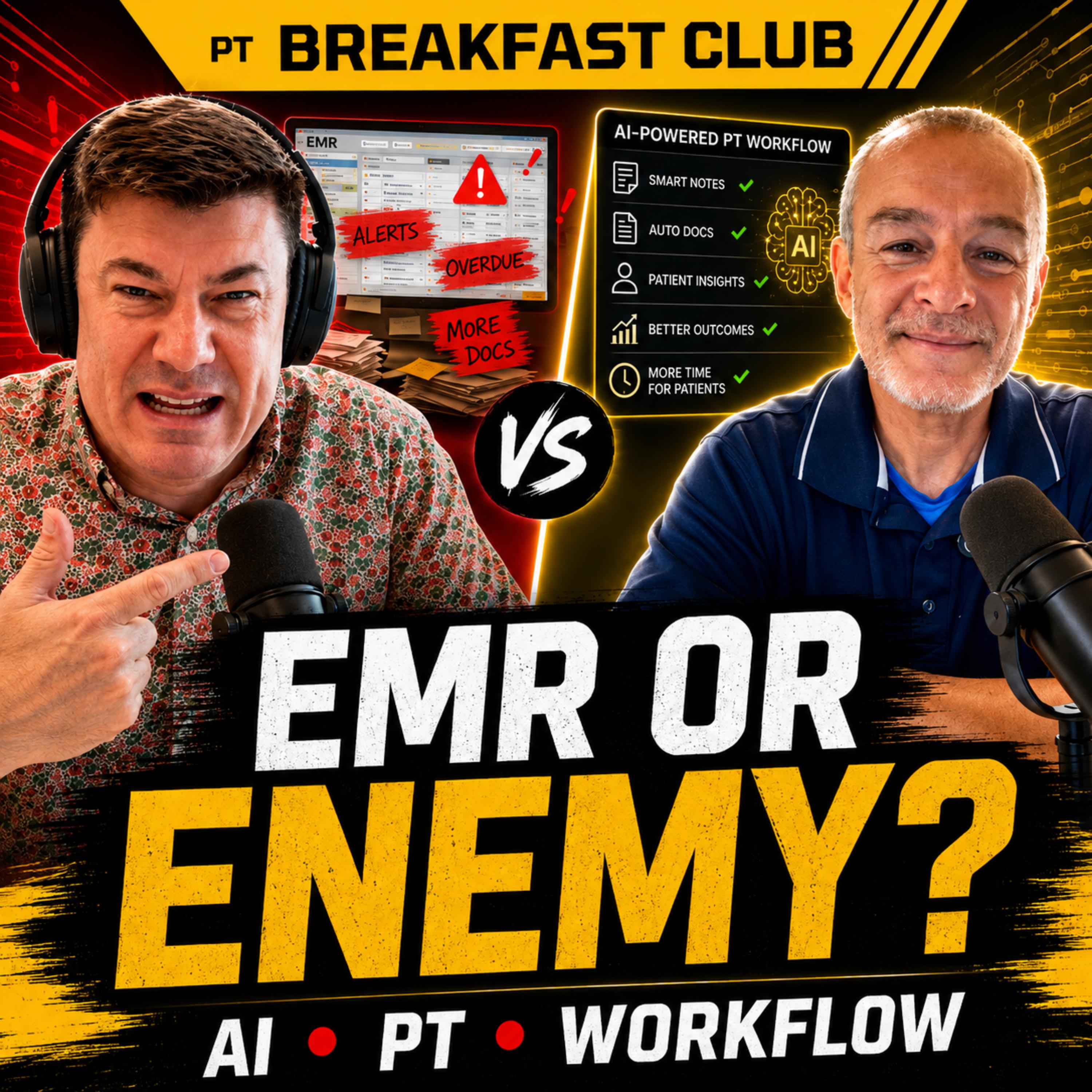
Stop Making the EMR Suck Less
transcript
show notes
This episode of PT Breakfast Club starts with a simple question:
What should an EMR actually do?
Tony Maritato and Jimmy McKay discuss the divide between the clinical and administrative sides of EMRs, why AI should be more than ambient documentation, and how the future of physical therapy technology should make clinicians better instead of turning them into data-entry horses with name badges.
Jimmy introduces the idea of the centaur vs reverse centaur: good technology combines human reasoning with machine horsepower. Bad technology makes the human serve the machine.
From there, the conversation expands into wearable data, RTM, patient apps, Peloton, video games, hospitality, software, and why PT may need to steal ideas from outside healthcare to build something patients and clinicians actually want to use.
The crew also talks about Sean Pastuch and Active Life, the space between physical therapy and fitness, trainers “stepping on toes,” UnitedHealthcare reimbursement, the reality of $60 visits, price anchoring, and why Dick’s Sporting Goods may have a better patient engagement lesson than most healthcare conferences.
The final message:
Understand what game you’re playing.
In This Episode- What EMRs should do in an AI world
- Why clinical and administrative workflows are two sides of the same coin
- The “centaur vs reverse centaur” model for AI and clinicians
- Why wearable data needs synthesis, not just capture
- Why RTM often feels like homework
- What PT can learn from video games, Peloton, software, and hotels
- Why Active Life found the space between PT and fitness
- Scope creep, trainers, and PT defensiveness
- The UnitedHealthcare $60 visit problem
- Why some clinics can make low reimbursement work and others can’t
- Price anchoring and the PACE BIKES shoe example
- What clinics can learn from Dick’s Sporting Goods
- Why attention leads to trust and trust leads to action
“The EMR should work for me. I shouldn’t work for the EMR.”
“We want to be centaurs, not reverse centaurs.”
“We don’t need more data. We need useful data at the moment of care.”
“RTM fails when it feels like homework.”
“We keep trying to make the EMR incrementally suck less.”
“The answer is not coming from inside healthcare.”
“Are you mad they’re doing it, or are you mad they’re doing it better than you?”
“Attention leads to trust. Trust leads to action.”
“Understand what game you’re playing.”