Skip to content
Artwork for Psychedelics Today
ScienceLife SciencesHealth & FitnessMedicine

Psychedelics Today

Psychedelics Today

Psychedelics Today is the planetary leader in psychedelic education, media, and advocacy. Covering up-to-the-minute developments and diving deep into crucial topics bridging the scientific, academic, philosophical, societal, and cultural, Psychedelics Today is leading the discussion in this rapidly evolving ecosystem.

Play
  • 22 episodes
  • Avg 1 hr 15 min
  • English
Counted on this page — what you have heard stays on this device, so it is not something the list can be paged by.
  • #640
    Nov 25, 2025 · 1 hr 24 min

    PT 640 - Alexander Beiner - Psychedelics, Culture, and the Games We Play

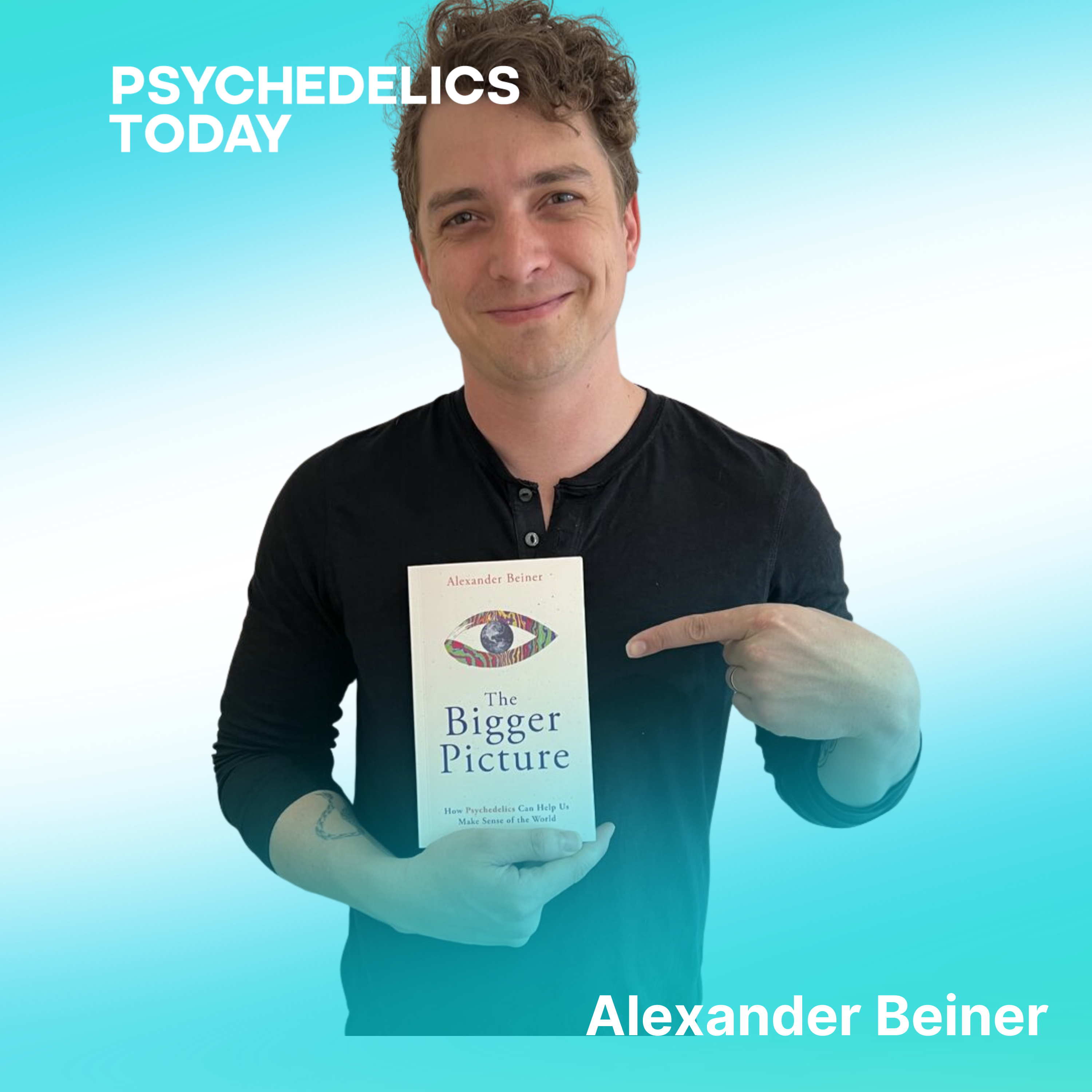
    Alexander Beiner joins Psychedelics Today to explore how psychedelics, culture, and power shape each other. A writer, facilitator, and co founder of the conference Breaking Convention and the media platform KAINOS, he has spent years thinking about how psychedelic experiences ripple into politics, economics, conflict, and community. In this episode, he and Joe trace the path from early internet forums to today's psychedelic renaissance, and ask what it would mean to bring a truly psychedelic perspective into our institutions. Beiner is less interested in psychedelics as a niche medical tool and more interested in how they can help us see through destructive cultural "games," reconnect to our bodies, and relate across deep divides. Early themes with Alexander Beiner The conversation starts with Beiner's origin story. He describes formative psychedelic experiences as a teenager, and how early access to thinkers like Terence McKenna, Timothy Leary, and the Shulgins led him onto the Grow Report forum and its associated podcasts. From there he launched his own visionary art podcast and eventually co founded Rebel Wisdom, where he focused more broadly on culture, systems, and meaning rather than only on psychedelics. He explains that most of his writing has not been about psychedelic substances, but about a "psychedelic approach" to reality. That means paying attention to complexity, paradox, and relationship, and asking what a psychedelic form of education, politics, or media might look like. He also touches on his documentary "Leviathan," which looks at breakdowns of trust, disembodiment, and the social forces that pull us away from what is real and relational. Core insights from this conversation In the middle of the episode, the discussion moves into concrete tensions in the current psychedelic resurgence. Topics include: How medicalization can both help and constrain access Cognitive liberty and the right to alter one's own consciousness Psychedelic capitalism and the "Moloch" problem of destructive competitive games The risks and potential of psychedelic religions and new spiritual communities Beiner highlights work on ayahuasca circles for Israelis and Palestinians, noting how "we are all one" language can sometimes block necessary truth telling about power and harm. He returns often to embodiment as a key corrective. When people slow down, feel their bodies, and notice what is actually happening in their nervous systems, they can hold disagreement without dehumanizing each other. He also points to emerging work on psychedelics for creativity and problem solving, including stories where psychedelic insights contributed to breakthroughs in science and complex systems thinking. For him, this is one of the most exciting frontiers, because it shifts the story from "fixing a deficit" to "creating something new." Later discussion and takeaways with Alexander Beiner Later in the episode, Alexander Beiner and Joe talk about cult dynamics, religious freedom, and the need for better checks and balances in emerging psychedelic communities. Beiner stresses that humans are naturally drawn into strong groups and narratives, so the key is not to eliminate "cults" but to spot harmful patterns early and build better accountability. They explore how double binds and mixed messages can create mental distress, and how psychedelics can sometimes resolve these binds by adding new context and perspectives. From there, the conversation turns to third spaces, communitas, and the urgent need for more embodied, in person culture beyond screens, work, and home. Practical takeaways include: Work with psychedelics in ways that reconnect you to your body, not just your ideas Treat medicalization as one path among many, not the only legitimate route Pay attention to group dynamics, power, and accountability in any psychedelic setting Look for ways to bring "psychedelic virtues" like flexibility, curiosity, and compassion into your workplace, family, and community Frequently Asked Questions Who is Alexander Beiner? Alexander Beiner is a writer, facilitator, and co founder of the psychedelic conference Breaking Convention and the media platform Kinos. His work focuses on culture, systems, and how psychedelic perspectives can reshape society. What is Alexander Beiner's book about? His recent book (discussed in this episode) looks at how psychedelics interact with politics, capitalism, and culture, and asks whether they can help us navigate multiple crises without getting captured by the same destructive games. How does Alexander Beiner view psychedelic medicalization? He sees medicalization as useful but limited. He supports access for people who need it, but worries that a purely medical frame reinforces class divides and hands too much power to psychiatry, instead of centering cognitive liberty and community based use. What is Leviathan in Alexander Beiner's work? "Leviathan" is his documentary on the breakdown of trust, disembodiment, and large scale systems that pull us away from what is real and relational. It connects mythic images, embodiment, and modern crises of meaning. What is Kinos and how does it relate to Alexander Beiner? KAINOS is Beiner's Substack based media platform, focused on surfacing novel perspectives and stories about culture, psychedelics, and the future. It extends many of the themes explored in this episode. This episode places Alexander Beiner within the wider psychedelic resurgence as a voice linking inner work to outer systems. For clinicians, researchers, and community members, it offers a rich invitation to think beyond individual healing and ask how psychedelic perspectives might help us transform the cultural games we are playing. KAINOS The Bigger Picture Breaking Convention

  • #639
    Nov 21, 2025 · 1 hr 6 min

    PT 639 - Evelyn Eddy Shoop PMHNP-BC: Lived Experience, Qualitative Data, and the Future of Psychedelic Care

    Overview Evelyn Eddy Shoop PMHNP-BC joins Psychedelics Today to share her journey from Division I athlete to psychiatric mental health nurse practitioner and psilocybin research participant. In this conversation, she explains how sports injuries, OCD, and intensive treatment led her into psychiatry and eventually into a psilocybin clinical trial at Yale. Her story weaves together lived experience, clinical training, and a call for more humane systems of care and better qualitative data in psychedelic science. Early Themes: Injury, OCD, and Choosing Psychiatry Early in the episode, Evelyn Eddy Shoop PMHNP-BC describes how multiple season ending injuries in college and serious mental health stressors in her family pushed her to rethink her life path. Originally pre vet, she stepped away from veterinary medicine after realizing she could not tolerate that environment. During a semester off for surgery and mental health, she completed intensive outpatient treatment and family therapy. That time showed her how powerful psychological work could be. It also reawakened a long standing curiosity about the brain, consciousness, and human experience. This led her to switch her major to psychology and later pursue psychiatric mental health nurse practitioner training at the University of Pennsylvania. At Penn, she felt supported academically and personally. Her interest in psychedelics grew as she realized that standard OCD treatments and high dose SSRIs were not giving her the level of functioning or happiness she knew was possible. Core Insights: Psilocybin Trials, Qualitative Data, and Clinical Skepticism In the middle of the episode, Eddy shares the story of finding a psilocybin trial on ClinicalTrials.gov just as she was about to start ketamine therapy. She received placebo first, then open label psilocybin, and describes the dosing day as one of the hardest days of her life, with benefits that emerged slowly over months through integration. She uses her experience to highlight why qualitative data matters. Numbers alone cannot capture the depth of a psychedelic journey or the slow unfolding of meaning over time. She argues that subjective stories, even difficult ones, are essential for clinicians, researchers, and policymakers. Key themes include: The central role of integration support in turning a crisis level session into lasting growth How trial environments on inpatient psychiatric units can feel like prison instead of healing spaces The limits of double blind placebo trials when participants become desperate for active treatment The need for more nuanced language around psychosis and psychedelic harms Eddy also addresses skepticism in psychiatry. Many providers fear substance induced psychosis and feel uneasy with medicines whose mechanisms are not fully understood. She suggests that more lived experience stories and careful education can help bridge that gap. Later Discussion and Takeaways In the later part of the episode, Eddy and Joe discuss harm reduction, ketamine risks, and how poorly designed systems can create harm even when the medicine itself is helpful. Eddy describes being treated as "just another psych patient" once the research team left for the day, including being denied basic comforts like headache relief after an emotionally intense session. She calls for: More humane hospital and research environments Required psychedelic education in psychiatric training Honest, nonjudgmental conversations about substance use with patients Stronger public education for students and festival communities Eddy also invites listeners in Wilmington, Delaware and nearby regions to connect if they need a psychiatric mental health nurse practitioner for psychedelic related research. She hopes to bring her lived experience and clinical skills into the emerging field as psilocybin and other treatments move toward approval. Frequently Asked Questions Who is Evelyn Eddy Shoop PMHNP-BC? She is a psychiatric mental health nurse practitioner trained at the University of Pennsylvania, a former Division I athlete, and a psilocybin trial participant who now advocates for more humane and data informed psychedelic care. What did Eddy learn from her psilocybin clinical trial experience? She learned that the hardest sessions can lead to deep change when integration support is strong and when there is time to unpack insights, rather than rushing to rate symptoms on a scale. Why does she care so much about qualitative data in psychedelic research? Eddy believes that numbers cannot capture the full human impact of psychedelic therapy. Stories show how people actually live with their disorders and integrate change, which is vital for ethical practice and policy. How does she view psychedelic harms and psychosis risk? She acknowledges real risks, especially for people with certain histories, but also notes that some psychotic experiences are not distressing. She calls for more precise language, better containers, and honest harm reduction education. What role does a psychiatric nurse practitioner like Evelyn play in psychedelic care? Practitioners like Evelyn can assess risk, prescribe within legal frameworks, provide preparation and integration, and help bridge the gap between traditional psychiatry and emerging psychedelic therapies. Psychedelic care is evolving fast, and this episode shows why voices like Evelyn Eddy Shoop PMHNP-BC are essential in the current psychedelic resurgence. Her blend of lived experience, clinical training, and critical thinking points toward a future where data and story, safety and possibility, can finally grow together.

Showing 21–22 of 22 episodes