Skip to content
Artwork for Prolonged Field Care Podcast

Prolonged Field Care Podcast

Dennis

Become a Paid Subscriber: https://creators.spotify.com/pod/show/dennis3211/subscribe This podcast and website is dedicated to the healthcare professional who needs to provide high quality care in a very austere location. For more content: www.prolongedfieldcare.org Consider supporting us on: patreon.com/ProlongedFieldCareCollective
Play
  • 33 episodes
  • a few times a week
  • Avg 43 min
  • English
Counted on this page — what you have heard stays on this device, so it is not something the list can be paged by.
  • Yesterday · 1 hr 19 min

    300: What Are We Missing? SOF Medics on Veteran Suicide

    17.7 veterans die by suicide every single day. Almost everyone listening knows someone. Episode 300 of the PFC Podcast puts three retired special operations medics in the room to talk about why the people who looked fine still did it, and what the rest of us can actually do. Justin is a retired Special Forces medic who went back to school and now practices as a clinical social worker. Mike spent just under 27 years as a special operations medic and has been a contractor at the special operations medical training facility on Fort Bragg for more than a decade. Rick Hines is a retired Special Forces medic with 29 years in the Army who has taught at the Joint Special Operations Medical Training Center for the last ten. They start with the impossible question. Desperate thoughts are common when someone is in a bad stretch — PTSD, depression, a life that just blew up, even a bad flu. Having the thought is not the same as having a plan. The job is to stay calm, ask directly if you can ask, and not spiral the person further by panicking. Practical moves that come up repeatedly: stop the drinking for the time being, and reduce access to lethal means while the crisis is hot. Those two things are fast and high-yield. This is not a clinical protocol. It is four people who have lost people trying to be useful to the next person who notices something. PFC Podcast · ⁠prolongedfieldcare.org⁠ · @prolonged_field_care Takeaways Ask the direct question if you have the relationship to ask it. “Are you thinking about killing yourself?” is not a trick. It has to come from someone the person trusts, and it has to be followed by staying, not by panic. Desperate thoughts are common in a bad stretch. PTSD, depression, a collapsed life, or even severe illness can produce them. Normalize the conversation without minimizing it. Do not tell someone other people have had it worse. Two fast moves: stop the alcohol and reduce access to lethal means. Both are high-yield while the person is in crisis. Functional does not mean fine. The answer “I’m good” does not clear the person. Keep an index of suspicion when life has just blown up. Watch sleep, isolation, and the period right after a hospital discharge — that window is high-risk and the team has to stay close. Match the help to the tribe when you can. Generic civilian programs can feel wrong to operators. Aftercare is a road, not an urgent-care visit. Chapters 00:21 Justin, Mike, and Rick introduce themselves 02:08 The VA statistic and the impossible question 05:04 Rethinking Suicide by Dr. Craig Bryan and the STRIVE program 06:29 Should you just ask the direct question? 07:08 Desperate thoughts, burden, and not making it worse 10:09 Stop the drinking. Then talk about lethal means. 11:09 Trust and keeping an index of suspicion 12:10 How to bring it up when life is falling apart 14:02 Recognizing the vulnerable person matters more than a perfect answer 16:09 Ask other questions first 20:03 Sleep and why short-acting sleep meds can backfire 28:03 A personal loss and the guilt that follows 32:06 Stabilizing someone who is still unstable 36:07 How the narrative gets used by other people 40:09 You do not have to smile. You do have to continue. 44:01 Did I do what I could do? 48:00 It is still another human being 52:01 Other causes of death that sit next to this one 56:01 First responders and the same stressors 01:00:04 Teammates calling it when someone is off 01:04:03 Sleep, alcohol, and thinking more clearly 01:06:19 What counts as problem drinking in this culture 01:08:04 Programs built for the tribe, and the authorization problem 01:10:02 Post-hospitalization risk and hunkering down 01:10:50 Defining problem drinking when the person still functions 01:12:19 Binge patterns that do not fit civilian models 01:15:35 Resources: 988, crisis lines, Military OneSource 01:18:20 Military OneSource stays off command radar unless harm is discussed
  • Thursday · 1 hr 5 min

    When does Nursing Care start?

    Kevin is a nurse anesthetist with more than a decade of bedside nursing. Dennis brings him on to talk about the part of prolonged field care that the CPG describes but does not time: nursing care. The conversation starts with a practical definition. Life-saving interventions finish, and the patient is stabilized. That is when nursing begins. In a hospital, this is the handoff to the floor, PACU, or ICU. In the field, it is the moment after the tourniquet is converted, the amputation is complete, or the chest tube is in, and you are no longer chasing the next immediate threat. From there, Kevin walks through what nurses actually do: continuous assessment and vital signs, documentation that keeps the provider from flying blind, pulmonary toileting, turning, skin care, dressing changes, medication administration, and monitoring every tube and line that has been placed. All of it is time-consuming. Training advice is blunt. Mannequins do not show you the standard. Weekend ICU shifts do. You need to know what right looks like before the field degrades it. Evacuation remains the primary plan. Prolonged field care is the emergency option in the PACE plan, not the default. Kevin points to Desperate Surgery in the South Pacific and the simple observation that every platform that brought troops forward also brought them back. History already solved versions of the time problem. The risk is treating patients as expectant who are not, then letting the absence of basic nursing care finish them before they reach a surgeon. PFC Podcast · prolongedfieldcare.org · @prolonged_field_care Takeaways Nursing starts when life-saving stops. Once the patient is stabilized and you are no longer performing immediate interventions, nursing care begins. That is the practical handoff point in the field. Data gathering is the foundation. Assessment, vital signs, neuro checks, and documentation of every tube, dressing, and intervention are what let a provider manage the patient. Without it the provider is blind. The majority of prolonged field care is nursing. Turning, pulmonary toileting, skin care, dressing changes, medication administration, and line care are the work. They are also the first things dropped when patient numbers rise. Train against a known standard. Weekend ICU shifts show you what right looks like. Mannequins do not. You will degrade in the field; you need to know what you are degrading from. Evacuation is still the primary plan. Treat prolonged field care as the E in the PACE plan. History (South Pacific, WWII) already solved versions of the time problem. Do not label patients expectant and withhold basic nursing care unless the injury is clearly unsurvivable. Chapters 02:10 When does prolonged field care nursing start? 03:59 After life-saving interventions: the handoff point 04:29 What nurses actually do: assessment and data gathering 06:47 Interventions: turning, pulmonary toileting, skin care, lines 07:30 How to train it: know the standard before the field degrades it 08:17 Weekend ICU shifts beat mannequins 10:48 Prioritizing when you are solo 12:00 Assessment frequency and catching change early 24:00 Sedation, movement, and the unstable patient 28:00 IV and line care in the field 32:00 Cleaning and dressing sites with limited supplies 40:00 Calling the provider and the cost of interruptions 44:00 Perfusion and the trauma patient 54:40 Evacuation as the P in the PACE plan 55:08 The time math: one ICU nurse versus twenty patients 57:00 Prolonged field care as the emergency option 58:20 GWOT spoiled us on rapid evacuation 59:12 Desperate Surgery in the South Pacific 01:00:01 How they moved casualties without air superiority 01:02:35 Expectant category and not withholding nursing care 01:04:15 Low-titer whole blood and learning from history

  • October 19 · 56 min

    299 - TCCC Analgesia: After the Opioids Left

    We covered the new analgesia guidelines from TCCC, now lets talk about how to get it done. Ryan Knight — emergency physician and Deep, Army anesthesiologist now at UNC, walk the new battlefield analgesia list. Ryan’s views are his. Not the committee’s What is on the card: acetaminophen, meloxicam, suzetrigine, ketamine, S-ketamine. Can you treat a combat wound with that? Both say yes — because ketamine is versatile and APAP plus a COX-2 actually work on traumatic pain. Suzetrigine is the unknown. Published data is bunionectomies and abdominoplasties. Onset is about two hours. Nobody in this room has used it on the X. Ketamine is the bridge. Dennis asks the medic question: ketamine is almost harmless, so why not just repeat 25 mg IV or 100 mg IM until the pain stops? Deep’s answer is toxicology. The dose makes the toxin. Escalate and you lose the airway reflexes that made ketamine feel safe. Secretions plus an irritant is the laryngospasm pathway. Ketamine is a direct myocardial depressant; catechol-depleted, bleeding, hypoxic patients do not get the usual bump. Shock liver and hypothermia mean you metabolize less and clear norketamine slower — same milligrams, longer and harder effect. A stable high-pain patient may need stacked doses. A wrecked one may need 5–10 mg at a time. Guidelines try to arm you at the edge of your skill and still survive a draw-up error. Training reps and real clinical time build better guardrails than a thinner formulary. Top 5 takeaways You can run analgesia on the new card — ketamine does the real work. APAP + a COX-2 cover some traumatic pain. Suzetrigine is unproven in combat and slow (~2 hours, elective-surgery data). Do not plan the first 30 minutes around it. Ketamine is not a free refill. 25 mg IV / 100 mg IM is a start. Stacking in a stable, high-pain patient is expected. The same printed dose in hemorrhage, hypoxia, hypothermia, or shock lasts longer and hits harder. High-dose ketamine loses the features that made it “safe.” Airway reflexes blunt. Secretions rise. Laryngospasm is uncommon, not imaginary. Direct myocardial depression shows up when catechol reserve is gone. Dysphoria used to have midazolam. That tool is off the guideline. Opioids left more because of the market than a vote. OTFC and Dsuvia/sufentanil products went away. A lozenge is hard to 4×. A syringe is not. They remain the literature’s breakthrough-pain standard. Acute addiction is the director’s problem; respiratory depression is the medic’s. Best care and safest care are both the job. Directors backstop with logistics (1 mg vs 5 mg hydromorphone) and fight for calendar time. Senior medics own reps. Deep: high-fidelity / real clinical time builds better guardrails than a protocol written by people who no longer push the drug. Chapters 01:59 New analgesia card: suzetrigine, S-ketamine, more removed than added 02:46 Can you treat a combat wound with APAP, meloxicam, suzetrigine, ketamine, S-ketamine? 03:38 Suzetrigine: bunion/abdominoplasty data, ~2-hour onset 04:10 Deep: untested drugs, ketamine side-effect kit, midazolam gone 05:13 Opioids as context-specific adjunct, one-iteration concern 06:06 French prehospital RCT — ketamine non-inferior to morphine, less nausea 09:15 Stable high-pain vs bleeding/hypoxic — same printed dose, different patient 11:04 Norketamine, shock liver, hypothermia — same milligrams, longer hit 12:04 Ryan: the catastrophic effects are rare — context still matters 44:11 Breakthrough pain in the literature is still an opioid 45:18 Is addiction the medic’s problem on the X? 47:14 Side effects and hemodynamics, not just addiction 47:38 The market removed OTFC and Dsuvia 49:34 Are guidelines best care or safest care? 51:06 Ryan as 75th / XVIII Airborne medical director — arm them, backstop the mistake 53:21 Training reps beyond Table VIII / SOCM / 18D refreshers 54:33 Deep: guardrails come from training and real clinical time

  • October 15 · 30 min

    SOMA '26 - Lessons Learned: Humanitarian Field Hospitals in Syria and Gaza

    Recorded live at SOMA 26 Dr. Sam, an orthopedic and surgical oncologist, shares hard-won lessons from humanitarian deployments in Syria, Ukraine, and Gaza. Operating in underground basements under airstrikes, he describes mass-casualty events that overwhelm capacity (hundreds arriving at once, patients dying on the doorstep), the deliberate targeting of marked hospitals and medical personnel, and the practical realities of war surgery when blood, space, evacuation, and supplies are exhausted. Core messages include leaving high-energy extremity wounds open, the decisive role of blood logistics over pure surgical skill, the impossibility of saving everyone in true MASCALs, and the long-term weight of moral injury for both patients and providers. Sponsored by the Special Operations Medical Association. Takeaways Marked medical facilities and personnel are targets. Hospitals in Syria were driven underground; killing a medic or destroying an ambulance removes a community’s capacity for hope and future care. Leave war wounds open. High-energy blast and missile injuries continue to declare dead muscle for days; closing too early traps infection. Wait for a cleaner environment before definitive closure. Logistics (especially blood) save more lives than technical skill alone. Arbitrary quotas, unreliable cold chains, and no ability to escalate care render even correct triage useless. True MASCALs (dozens to a hundred patients) force binary decisions: choosing one patient means another dies. You cannot save everyone; the goal is to train so you do it wrong less often. War surgery is technically straightforward (debridement, amputation, fasciotomy, crash thoracotomy) but operationally and psychologically extreme: hostile environment, no gloves/gowns/evacuation, 20-hour days, and constant moral injury. Psychological resilience has no universal protocol. Many providers function while deployed and struggle afterward; moral injury (watching children die, body-bagging patients in cartoon pajamas, colleagues losing entire families) requires deliberate preparation and recovery. Chapters 00:00 – Introduction and controlled vs. humanitarian environments 01:50 – Purpose of the talk: war does not discriminate 02:30 – Medical facilities as targets (Syria, Ukraine, Gaza) 04:00 – Underground hospitals and mass-casualty realities in East Aleppo 06:40 – War surgery is technically simple; the environment and psychology make it hard 07:10 – Leave war wounds open: case progression and rationale 08:30 – You cannot save everyone: triage under extreme resource limits 09:10 – Chaos of body bags and declaring the dead 10:00 – Blood protocols, logistics, and the limits of escalation 20:50 – Case examples: blood quotas, open fractures, and failed resuscitations 22:00 – Moral injury in the OR and among local staff 23:00 – Starvation, maggots, compartment syndrome, and unhealable psychic scars 24:30 – Providers as casualties: double-taps and personal losses 25:20 – Scenes from Gaza: resource decisions and morgue realities 27:20 – Final take-home points and psychological resilience 29:00 – Why the work matters and closing remarks Listen / follow: podcast → prolongedfieldcare.org → @prolonged_field_care

  • October 12 · 51 min

    -40 Changes MARCH: Arctic TCCC

    A healthy person lying in the snow at -30 or -40 dies of hypothermia. Add a gunshot wound, wet clothes, and twenty minutes on the X while the team finishes the fight, and the cold competes with the bleeding. Thomas spent nine years as a Danish Special Forces operator and medic. His view is that TCCC still applies, but the sequence does not survive contact with that climate unchanged. Stripping a chest or abdomen to “do MARCH” on the snow makes the patient colder, more coagulopathic, and more acidotic. Massive hemorrhage still gets a tourniquet, over the clothing, because it is fast. Airway obstruction gets a roll to prone. Everything else waits for a semi-controlled heated shelter. That shelter is not a rock. It is a tent, a stove, and enough security to put both up. Clothing changes the tools. A CAT may not reach a thigh under five layers. Mittens make the windlass clumsy, and taking them off at these temperatures is a frostbite problem in minutes. Train with the gloves you will wear. Inside the tent, two multi-fuel burners on a stable platform, a vapor barrier, and active heat come before a full secondary survey. Drugs he keeps close: ketamine, morphine, prefilled syringes rather than ampules, and an IV antibiotic. Plastic IV bags leak and contaminate when they thaw. Crystalloid and albumin in glass survive better. Blood products are still plastic. Freeze-dried plasma can work, but it needs fluid and time. PFC Podcast · prolongedfieldcare.org · @prolonged_field_care Takeaways Hypothermia is a whole-team threat, and it outruns a lot of procedures. At these temperatures a down patient, especially a bleeding one, does not have a normal MARCH window on open snow. Tourniquet over the clothing. Then get to heat. Do not strip chest or abdomen on the X. Airway obstruction gets prone positioning. Tactical field care starts in a heated, semi-controlled shelter, not behind a rock. Gloves stay on. Test the tourniquet on the real clothing. Layer bulk can force a second tourniquet. Bare hands at minus forty are a frostbite injury in minutes. Practice the application you will actually do. Cold kills the kit. Batteries die. Plastic IV bags leak when they thaw. Prefer glass vials and glass crystalloid. Freeze-dried plasma is possible if you have fluid and minutes. Prefilled syringes beat ampules with numb fingers. The first shelter is a planning problem, not a terrain feature. You need time and security to pitch a tent and light a stove. Ten minutes down at minus twenty-five was enough to drop consciousness in a non-trauma patient. Wool, a stove you can start in mittens, and a tent you can pitch fast are medical equipment. Chapters 00:19 Thomas — Danish SOF medic, anesthesiologist, Brightbird, Greenland 03:03 How extreme cold changes TCCC 06:08 Hypothermia plus injury, frozen fluids, dead batteries 06:43 Treatment on the snow makes him colder, coagulopathic, acidotic 07:55 Hypothermia is patient care and a team threat 08:16 Tactical field care waits for a heated shelter 08:48 MARCH on the X: hemorrhage first, clothing in the way 12:03 Do not start full MARCH until the environment is semi-controlled 14:01 Tourniquet over the clothing, prone if the airway is obstructed 22:00 Vapor barrier first, stop further heat loss 24:00 Tent up, stove running, then the secondary work 28:00 Warming drugs against the body 32:00 Cold drugs and product degradation 36:00 What cold does to the kit outside 37:27 Ketamine, morphine, prefilled syringes, IV antibiotics 38:11 Plastic IV bags leak on thaw. Glass crystalloid. Blood is still plastic. 38:46 Freeze-dried plasma: possible, needs fluid and time 39:26 How far to the first shelter 41:21 A tent needs security. Thirty minutes is already long. 43:07 Greenland expedition: ten minutes down, consciousness dropping, no new injury 45:39 Wool, tested gear, stoves you can light in gloves 49:11 Warm at all costs. Hemorrhage because it is fast. 49:38 Afghanistan heat versus minus forty

  • October 5 · 44 min

    When is When: Withdrawing Interventions in PFC

    Medics add interventions easily. Prolonged field care is where those interventions start charging rent. Dave walks the unwind. A cut endotracheal tube used as a cric can come out if the patient no longer needs it. Unhook the bag. Moving air through the tube, following commands, and a normal breathing pattern are good signs. Cuff down: if he cannot breathe around it, edema or a flap may be waiting, and pulling can lose the airway. Suction above the cuff first. Dress the site after. Do not pull the bookmark on a partial responder still in shock just to save narcotic. Uncomfortable and awake beats a lost airway. Chest-tube logic is the same. Serous output and stable oxygen are a pull conversation. Blood, pus, or a leak plus climbing crepitus means the tube stays. Heimlich is enough for many. Suction, if used, is about 20 cm of water — a straw, not wall suction. No underwater seal is a sucking chest wound you created. A chest wall you cannot seal is bagged. A prophylactic fasciotomy without wound-care capacity can bleed and fluid-shift the patient you were trying to save. PFC Podcast · prolongedfieldcare.org · @prolonged_field_care Takeaways A cric can come out if the patient no longer needs it. Positive pressure off, breathing through the tube, follows commands, normal pattern, cuff down and air moving around the tube. Fail that last test and you may be looking at edema or a flap. Suction before you drop the cuff. Dress after you pull. Whatever is sitting on the balloon goes into the lungs. Occlude the site for cough and speech. If he obstructs again, adjuncts first, then back in. Do not trade the airway bookmark for narcotic savings in a partial responder. Shock patients who drop their GCS after you pull are a different problem than the isolated femur you over-sedated. Uncomfortable and awake beats lost airway. Chest tube suction is 20 cm of water, not wall suction. Heimlich is enough for many. Serous and stable oxygen is a pull conversation. Blood, pus, or a kazoo plus climbing crepitus means the tube stays. No seal equals a sucking chest wound you created. Some interventions you should not start if you cannot finish them. An unsealable chest wall is bagged, not endlessly patched. A continuous leak with crepitus is surgical. A prophylactic fasciotomy without wound-care capacity can bleed and fluid-shift a patient you were trying to save. Chapters 01:17 Adding interventions is easy. Unwinding them is the PFC problem. 02:17 The oversedated femur: ketamine, narcotic, snoring, cric 03:46 Same patient in a trauma bay — RSI, then do they still need the tube? 05:19 Yes, you can pull a cric — if the airway is not the problem you are about to recreate 06:29 Off the bag, follows commands, breathing pattern 07:10 Cuff down: can he breathe around it? 09:01 Suction above the cuff before you deflate 09:42 Ketamine no-man’s-land between analgesia and sedation 10:41 Fentanyl for the cuff, not another snow 14:05 If the airway is quiet, leave it until everything else is mitigated 14:16 Do not pull the bookmark in a partial responder 28:07 What is coming out — serous vs blood vs pus 28:30 Empyema tubes that stay for months 28:33 Air leak on a Heimlich: kazoo is fine, crepitus is not 29:02 SpO2, mental status, oxygen need before a pull 29:37 Heimlich vs three-bottle suction 30:51 Improvised single-bottle underwater seal 31:16 No seal, and you just made a sucking chest wound 33:34 Chest wall you cannot seal: positive pressure, or a cric 35:41 Finger thor converts tension to open. The tube is a valve and a measuring cup. 37:36 Continuous air leak and climbing crepitus — second tube, surgical problem 39:25 Sudden crepitus with an advanced airway: dislodged cric vs tracheobronchial injury 42:11 Fasciotomy: indication vs the wound you cannot dress

  • October 1 · 41 min

    298 - Starting a VA Disability Claim After the Service

    The internet will tell you how to “win” a VA claim. Almost none of it is how the exam is actually written. Will spent 11 years Navy EOD, 9 as a SOF medic, and now sits as a National Guard battalion PA. In the middle he worked the other side of the table: third-party C&P exams. Meet the veteran. Fill the cookie-cutter form. Ship it to the VA actuaries. He never got Genesis. He got whatever dump the system decided was fit to send — problem lists, notes, radiology reports, and every PHA where you checked “no” to stay deployable. What the examiner is hunting: a diagnosis, a nexus event, and a physical that matches the story. Range of motion. Special tests. Flare-ups. Work. ADLs. If they only asked questions and never touched you, that exam is incomplete. Say so. SOF and aviation make this worse on purpose. Pipelines punish honesty. Team medics hand out diclofenac and toradol and skip the note so the guy keeps special duty pay. That is loyalty on Friday and a missing nexus on the way out. Will’s practical kit: be honest on the late-career PHA. Print the DD-214s, V-device awards, schools, and the pages that prove exposure — because the current MOS on the screen may say PA while the tinnitus came from being an 18D. You have 10–15 minutes per condition. Do not make them scroll 2,000 pages. Read 38 U.S.C. § 1155. Use VA.gov. Ask the teammates who already finished the process. prolongedfieldcare.org | @prolonged_field_care | PFC Podcast Top 5 takeaways The examiner is not in your EHR. They get a curated PDF. If the note, x-ray report, or PHA is not in that dump, it does not exist that day unless you hand it to them. Late-career PHAs are evidence. Battalion medicine may ignore them. The VA file does not. Stop auto-checking “no.” Nexus plus diagnosis plus a matching physical. No in-service diagnosis makes the hill steeper. “Audio has to match the video” — a perfect straight-leg raise after a “debilitating” claim is a problem. SOF culture writes the denial years early. Off-book gel and ketorolac keep people on the team and delete the paper trail. The C&P form cannot rate what was never documented. Run the exam like a 15-minute hit. Tab DD-214s, awards, schools, and the pages for this appointment. Current MOS can hide prior blast and gunship time. C&P staff are QTC/Leidos contractors, not VA raters. Chapters 00:21 Will: EOD, SOF medic, Guard battalion PA 01:03 Third-party VA examiner — what the job actually was 02:05 38 U.S.C. § 1155, Reddit, do the homework 03:03 Active duty TAP vs Guard/Reserve fog 03:33 Guard can file after first enlistment — and drill at 100% with offset 04:13 What the evaluator actually reads 04:40 No Genesis. You get the dump they send. 05:17 Those “no” PHAs are in the file 05:52 Cookie-cutter exams, history, nexus, physical 06:45 If they never laid hands on you, the exam is incomplete 07:30 Be your own advocate — diagnosis first 08:18 SOF and pilots under-report to stay in the pipeline 09:11 Off-book team medicine: gel, toradol, no note 10:00 Confirm the injury, grade the injury 10:34 Audio has to match the video 31:07 “I’m fine” is not the same as pre-service baseline 31:51 Examiner is not your enemy and not your lawyer 32:17 10–15 minutes per condition — they will leave value on the table 33:06 1,500–3,000 page PDF. Awards and 214s get buried. 33:44 Build the packet: 214s, V-device awards, schools, EIB 34:54 Print the pages for this exam so they stop scrolling 35:56 Current MOS can hide prior SOF noise and blast 37:27 Where to go: the Code, VA.gov — who to skip: paid mills 39:16 C&P is QTC / Leidos. They cannot reach into a record you do not bring. 40:45 Close: it matters for the family Listen before you walk into the C&P This is education from one former examiner, not legal advice and not a how-to for inflating a claim. Use VA.gov and a VSO for the filing itself.

  • September 28 · 58 min

    Blood Sweep, Deep Breath, Pulse Check: Point-of-Injury Triage

    Most of us were taught START, the sieve, RAMP, DIME, P1–P3. Andrew — EM physician on a small surgical team out of Fort Liberty — used none of it the night a helicopter went down with 22 people on board. The rest of his medical team could not walk. Dust, firelight, yelling. Thirty-to-sixty seconds per patient on a linear algorithm is ten minutes before you reach number ten. People die of massive hemorrhage and lost airway in that window. So he ran a binary pass: dying now or not. Blood sweep. “Take a deep breath.” Pulse. Ten to fifteen seconds. Keep a mental list of who leaves first. He got through about twelve before other medics arrived. He never reached the massive bleeder — a non-medic first responder did. That is the point. Rick Hines puts the doctrine next to the wreckage. Triage is continuous, not a one-and-done sort. The most senior medical person is often the worst person to own the sort if they should be operating. Algorithms used after the first pass are training tools — studies put accuracy around or under 50 percent. Training has to match that. Four casualties before twenty-two. Global endpoints, not a perfect score on every manikin. Delayed birds. Command decisions. Unit buy-in, not a tourniquet-and-check-the-block. No perfect MASCAL. You were already behind when it started. Listen: PFC Podcast · prolongedfieldcare.org · @prolonged_field_care Top 5 takeaways First contact is binary. Dying now / not dying now. Blood sweep, air movement, pulse. 10–15 seconds. Do not spend a minute running START on patient one while patient ten bleeds out. Then deliberate triage. After LSIs and a move to the CCP: urgent / priority / routine (what TCCC/CoTCCC are leaning toward). Expectant exists when resources force it — not on the first pass. Move, treat, transport. Rush’s three verbs beat a four-color card at the wreck. Get off the X, stop hemorrhage and airway loss, get them to the next level. The senior clinician should not automatically own the sort. If they are the surgeon, someone else runs triage. Non-medic first responders are part of the system — Andrew never reached the massive hemorrhage; someone else did. Train the real constraints. Nail four before you role-play twenty-two. Score the lane on whether life threats were found, blood got to shock, accountability held, and evac was prioritized — not whether every individual critical-action list was perfect. Delay the bird. Make the commander choose. Chapters 00:00 Disclaimer and welcome 00:20 Andrew Shafrina intro — EM, small surgical team, Fort Liberty 01:23 Why most of us never actually practiced triage 02:14 Categories: START, sieve, NATO — four bins plus expectant 04:10 Why linear algorithms are too slow at the point of injury 04:32 The crash: 22 onboard, medical team down, one provider 05:39 The 10–15 second pass — blood sweep, deep breath, pulse 06:09 Rush, Shackelford, Remley, Hines — binary is what people actually do 06:50 Move, treat, transport 08:07 What “stable” meant that night — not P1/P2/P3 08:51 Twelve patients in five minutes — and he still missed the bleeder 10:01 Triage is continuous, not one-and-done 10:36 Do not burn the surgeon on the sort 11:11 MASCAL means you are already overwhelmed 12:06 Put non-medics to work 12:43 Evac categories vs who actually needs an OR 13:45 First-pass binary, then UPR at the CCP 14:14 Algorithms as training tools — accuracy ~50% or worse 47:06 Train to global endpoints, not perfect individual checklists 48:08 Can you handle four? Then scale. 49:09 Rick: six dead, seventeen wounded, no bird, they drove them out 52:23 King for a day: two-phase triage + basics 53:50 There is no right way — only best with what you have 54:18 Put MASCAL inside unit drills, not isolated medic lanes 55:22 Scare the staff honestly — risk, delayed evac, command decisions

  • September 24 · 1 hr 40 min

    Don’t Wait for Hypotension: Resuscitation Decision-Making

    Dennis sits down with Max to walk through hemorrhagic shock the way it actually behaves in young, healthy military-age casualties—not the tidy textbook ladder of Class I–IV. They start with the only split that matters: compensated versus uncompensated. Class I–II means the body is still delivering oxygen to organs. Class III–IV means it is not, and the damage is no longer a simple volume problem. Max breaks compensation into “gears”: venous reserve first (no vital-sign change), then heart rate, pulse-pressure narrowing from arterial squeeze, contractility, and work of breathing. He stresses why a 40-year-old operator with a resting HR of 50 who hits 80 is already tachycardic, why a diastolic climbing toward 100 is a warning, and why scene blood volume—“How much blood was on the ground?”—is often the most important sentence in the handoff. They cover why fit casualties can look like Class II, then skip Class III and drop into unconscious Class IV in minutes (Ranger Campbell and similar “walking dead” cases). Decision-making is reduced to two tenets: Is bleeding stopped? What is the trend? Guidelines that wait for SBP <100 will be late in this population. Short pearls close the episode on peds (small volumes, parental mental-status baseline), pregnant patients (left-side IVC, massive reserve then sudden collapse), and elderly (they follow the book but cannot tolerate Class III). Top 5 takeaways Draw the line between compensated and uncompensated, not between the four classes. Once end-organ perfusion fails, you are not just replacing lost volume—you are treating ischemia, cytokines, electrolyte leak, and reperfusion. Trauma tachycardia is hemorrhage until proven otherwise. Pain, exertion, and combat stress are real, but you do not get to invoke them until you have ruled out bleeding. Pulse pressure and diastolic BP are early windows into how hard the patient is squeezing. A young casualty at 120/100 with a climbing HR and changing affect is already near the cliff even if SBP is still “fine.” Fit operators can stay in Class II on exam until they have lost a lethal volume, then skip Class III. Reassess constantly. Scene blood volume and expanding hematomas matter more than a single SBP number. Two questions drive transfusion in resource-limited care: Do I have hemorrhage control? Is the patient trending the wrong way on two or more data points (HR, pulse pressure, breathing quality, mental status, hematoma size)? One number on a guideline is not a plan. Chapters 00:00 — Intro and disclaimer 00:20 — What we’re covering: hemorrhagic shock and when to resuscitate 01:12 — Traditional Class I–IV and why textbooks fail in the field 03:00 — Compensated vs uncompensated: the only line that matters 04:50 — Class I: venous reserve, no vital-sign change 08:30 — How much blood was on scene? The handoff question that predicts danger 11:15 — Tennis-score memory aid (15 / 30 / 40) and Class I exam 16:20 — Operator baselines: HR 80 can already be tachycardia 20:00 — Golden rule: trauma tachycardia is bleeding until proven otherwise 22:00 — Pulse locations as a crude MAP map (carotid / femoral / radial) 27:00 — Why SBP stays normal in compensated shock 29:00 — Pulse pressure explained: diastolic rise, not “falling BP” 36:00 — Compensation gears: reserve → HR → squeeze → contractility → breathing 39:00 — Orthostasis, cap refill, urine output, and mental status as red flags 47:00 — Altered mental status: “drunk” from blood loss until proven otherwise 51:00 — Class II: all gears on, BP still held 59:00 — Class III–IV and why healthy patients blast through Class III 1:06:50 — Ranger Campbell and other “walking dead” cases 1:11:48 — When to give blood if SBP is still over 100 1:13:50 — Tenet 1: Is bleeding stopped? Five spaces that hide volume 1:20:40 — Tenet 2: Trend, not a single trigger 1:27:50 — Don’t hang a life on one guideline number 1:32:40 — Pearls: pediatrics, pregnancy (left side / IVC), elderly

  • September 21 · 46 min

    297 -Train The Trainer In The Jungle TCCC For A Resistance Force

    Ben walks Dennis through a six-month plan that became a jungle course for about 200 unpaid resistance volunteers. Vic built the curriculum from TCCC, the Ranger Medic Handbook, and what that force actually needed — then wrote it to their education level, culture, and organization. Supplies moved through the existing network. The first four days were not student training. They were instructor train-up. Then the locals taught. Interpreters shrank. Force multiplication went up. Chiefs owned the schedule because they knew the logistics better than the foreigners. The five-day basic block — Ranger First Responder flavor, ~150 students, three languages — ran cleaner than the ten-day advanced course. Around day six, the instructors sat in a hut wondering if anyone could action the material. The FTX answered it: recovery mission, collect, treat, triage, evacuate. When words failed, Ben inserted himself into the lane. Watch me. Do as I do. Then the punchline he brought home to NATO partners in four and a half days: stop making this more complicated than the environment allows. Basics save lives. Teaching is a hard skill and a soft skill. Ego gets you ignored — or worse. Likability moves supplies. Medics still have to influence commanders so casualties do not bog down the assault. Listen, then steal the method. Not the ego. ⁠prolongedfieldcare.org⁠ | ⁠@prolonged_field_care⁠ | PFC Podcast Top 5 takeaways: Build a local instructor cadre first. Four days of train-the-trainer, then hand the blocks to them. Less interpreter drag. Real force multiplication. Write the course to the force in front of you. TCCC + Ranger Medic Handbook as the spine. Education level, culture, and org constraints as the cut line. Chiefs own the schedule. Basics scale. Abstraction does not. The 5-day / 150-student / 3-language block worked because it was see-do-act. The 10-day advanced block created the “do they actually get this?” crisis. When comprehension is in doubt, stop talking and enter the lane. Insert yourself. Narrate while you do the work. Show shock. Do not lecture shock. Teaching is an act of love plus influence. Humble competence beats the alpha brief. Medics still owe commanders a clear recommendation — even if the answer is “we’re doing it anyway, figure it out.” Chapters: 00:00 Cold open + why this trip 01:08 Six months of planning — you do not show up on a whim 01:59 Vic Nigo’s curriculum: TCCC, Ranger Medic Handbook, culture, org 02:51 Supply network for ~200 students 03:20 Plan vs jungle reality 04:01 Four-day instructor train-up and handing the class off 04:56 Volunteers, buy-in, and a culture that does not like quitters 06:24 Motivation that costs a patch and a thumbs-up 07:29 Ukraine militia hunger vs professional-military spoiling 08:26 Why train-the-trainer beats you plus an interpreter 09:00 What actually broke: hours, land nav, competing requirements 09:54 5-day basic / ~150 / 3 languages — the block that worked 10:53 10-day advanced — day 6 doubt in the hut 11:41 The FTX: recover, collect, treat, triage, evacuate 12:30 Teaching tactic: insert yourself, watch me, do as I do 13:14 Show them shock. Do not define it. 14:13 SOCM lesson: you do not know the job until you see the job 34:54 The course continues — Vic takes it deeper / SOCM Light 35:37 The West overcomplicates TCCC 36:10 Basics save lives 37:11 NATO partners in 4.5 days: trenches, physical exam, pain, cheat cards 39:17 Advice for the first overseas class 40:06 Know the audience — products change with the culture 40:39 Ego is a teaching failure and a survival failure 41:24 All teaching is an act of love 42:03 Likability as a core attribute 43:09 The medic as SME: influence, battlefield clearance, buy-in 44:56 Be ready for the unexpected — and try to enjoy it

  • September 17 · 38 min

    Pack to the Vessel: Hemorrhage Control Is Not a Mind-less Skill

    Mike Weisman — 25 years as a Navy Corpsman and SARC, 27 years on a busy Vegas fire department, now clinical education at Celox — does not sell magic dust. He sells a hydraulic problem. A femoral-rate bleed can dump on the order of 500 mL a minute. The clotting cascade is a 14-step masterpiece built for arterioles, not that jet. Early platelet plug gets blown off the vessel wall unless something holds equal pressure against it. Tourniquet, packed gauze, or packed hemostatic gauze: all of them are pressure tools. The chemistry is the advantage on top. Two families, two jobs. Kaolin (Combat Gauze class) is a clay mineral that lights up Factor XII and accelerates your cascade — which means it still needs time and a body that can clot. Chitosan / cellulose dressings work off the cascade. They absorb fluid, grab red cells by charge, and build a viscous mucoadhesive plug. Granules and sprays exist. Mike’s line stays the same: if you do not back them with pressure, you bought a show booth. Then the part schoolhouses skip. The product has to touch the bleeding vessel, not the pool in the hole. Three to six minutes of hold time on a kaolin dressing feels short on the pouch and endless on a screaming casualty. Hemorrhage control is not a monkey skill. Blood programs without packing reps are the cart in front of the horse. Read mechanisms, not company PDFs. Deployed Medicine and independent retrospectives beat the booth. Listen, then pack something that bleeds. prolongedfieldcare.org | @prolonged_field_care | PFC Podcast Top 5 takeaways It is a hydraulic problem. Fight pressure with pressure. Chemistry cannot replace a packed tract or a tourniquet. Know the two mechanisms. Kaolin accelerates Factor XII / your cascade. Chitosan-type polysaccharides work independently and form a mucoadhesive plug. Contact the vessel or you wasted the dressing. Clot in a basin of blood is not hemostasis. Anatomy and packing skill are the product. Hold the clock. Kaolin-class products typically need on the order of 3–6 minutes of continuous pressure. The pouch lie is that this is short. Unconscious competence beats the brand. Schoolhouse reps expire. Blood on the truck does not save the casualty if the medic cannot pack. Understand the mechanism, then pick what your system will actually issue. Chapters 00:00 Cold open 00:19 Dennis + Mike (SARC, Vegas FD, Celox education) 01:25 Why not just pressure and plain gauze? 02:16 Hydraulic problem: cascade vs femoral-rate bleed 03:42 What a hemostatic actually adds 03:54 Kaolin: Factor XII, still gauze, still pressure 04:54 Chitosan / cellulose: cascade-independent mucoadhesive plug 06:03 Charge, RBCs, dual action with the gauze 07:07 Granules, sprays, “hummus” pastes — still need pressure 08:20 No good hemorrhage control without pressure. Period. 08:47 Does it have to touch the vessel? Yes. 09:34 Anatomy, packing method, skill — not the brand 10:07 Why the 3–5 minute hold feels like an hour 10:42 Kaolin activation window (~3–6 min) 28:57 Know every item in the bag the way you know a drug 29:26 You can spot a professional by the pouch 30:11 Hemorrhage control is not a monkey skill 31:04 Unconscious competence: pack it blind 31:56 Blood programs without packing reps 33:04 Schoolhouse months do not last a career 34:32 How to read studies that are not the company PDF 35:37 Deployed Medicine, JTS workload, mechanisms over marketing 37:48 Close: keep getting the reps

  • September 14 · 39 min

    296 - Mission Capable Pain Control: The TCCC Analgesia Update Explained

    OTFC is gone. That was not a small supply hiccup. It punched a hole in the old TCCC pain plan. George Barbee, a PA and co-author of TCCC Guideline Change 25-03, walks Dennis through why the committee rebuilt battlefield analgesia instead of patching the old triple-option chart. They screened 56 analgesics. They built an objective matrix. They landed on suzetrigine: non-opioid, mentation-sparing, slow onset, long duration — a drug that can keep a still-fighting casualty in the fight and then carry them into prolonged care. The bigger shift is the fork in the road. Not “mild / moderate / severe” as four overlapping options. Can they stay in the fight, or not? Functioning casualties get a non-sedating pack. Non-functioning casualties get a shock-agnostic pathway so you are not stacking drugs blindly down the continuum. Ketamine is still the drug you reach for when you have almost no information. Nystagmus is not the goal. It is the “you gave too much, back off” line. Option 4 sedation is being pulled out of TCCC and written into PCC, where it belongs. If you still teach OTFC, still dose to shaking eyes, or still treat every casualty like they need a narcotic, this episode is the update. Read the change paper @ ⁠www.prolongedfieldcare.org⁠ or ⁠https://jsomonline.org/⁠ Follow @prolonged_field_care Top 5 takeaways The change was forced. OTFC disappeared, GWOT safety data said the old plan was too loose, and LSCO needs mission-capable pain control plus a safer path for people who cannot stay in the fight. Suzetrigine is the new stay-in-the-fight drug. Non-opioid. Cognition and blood pressure mostly spared. About a 2-hour onset, long duration. Pair it with meloxicam and acetaminophen for the functioning casualty. Muscle spasm in 1–10% is not a seizure and does not get benzos. Stop using four overlapping “options.” Define pain with the Defense and Veterans Pain Rating Scale. Rough cut: 1–6 can often still function and self-declare. 9–10, polytrauma, multi-amp — they are out of the fight. Medics already know this on sight. The guideline finally says it. Ketamine stays, but the endpoint is not nystagmus. If you have almost no information, ketamine is still the safest narcotic start. Reduction of pain means the casualty and the medic can both manage the situation. Nystagmus means you crossed the line. Fixed-dose ketamine in a bleeding patient can get weird as volume drops — not usually lethal, still a problem. Option 4 is leaving TCCC. Heavy sedation and procedural endpoints are being moved into the PCC update. TCCC keeps the systematic, stack-aware, evidence-based path so the next provider is not surprised by what you already gave. Chapters 00:00 — Disclaimer and open 00:23 — Dennis and George: who wrote the change 02:10 — If it ain’t broke, why touch analgesia? 02:56 — We lost OTFC 03:11 — Safety, LSCO, and early pain vs PTSD 04:27 — Mission-capable control and a shock-agnostic path 05:48 — How suzetrigine beat 56 other drugs 09:38 — Why this non-opioid survived the matrix 11:33 — Spasm vs seizure: do not reach for benzos 13:33 — Stay in the fight vs cannot 14:20 — The old “triple option” was actually four 15:06 — Defining pain with the DVPRS 16:10 — The stay-in-the-fight pack: suzetrigine, meloxicam, Tylenol 17:20 — What “reduction of pain” actually means 18:15 — Esketamine: more analgesia, fewer side effects 27:38 — If you only get one narcotic, start ketamine 28:56 — Esketamine, IN 28 mg, and the 4PANE study 30:15 — IV, IO, IM, IN: why they kept the nose 33:07 — Pain control vs nystagmus 35:26 — Option 4 is moving to PCC 36:41 — Chest tubes, crics, and the sedation gap 37:54 — Next: backing the PCC analgesia update 38:48 — Read JSOM Change 25-03 and close

  • September 10 · 26 min

    SOMA 26' - Ultrasound-Augmented Triage A Proposal To Refine Field Decision Making In Tactical Combat Casualty Care

    Recorded live at SOMA 26 In a near-peer MASCAL, one medic and one junior medic may face twenty penetrating torso casualties, one unit of blood, and no time to empirically needle or finger-decompress every chest. This SOMA presentation argues that formal triage algorithms are already giving way to intuitive, intervention-first decisions—and that point-of-care ultrasound can make that second pass objective. The proposed two-pass model keeps MARCH as a fast first pass (urgent vs non-urgent), then uses a three-view POCUS exam—parasternal or subxiphoid cardiac motion, pericardial effusion, and bilateral lung apices—completed in under 30 seconds to decide who gets blood, who needs targeted decompression, who needs a surgical airway to thoracotomy or pericardiocentesis, and who is unsurvivable cardiac standstill. Speakers review trauma-arrest survival data, needle-decompression overuse, SOF medic training at Henry Ford (RUSH exam and the abbreviated 30-second protocol), and civilian paramedic programs showing that short courses can produce usable scans that change management. Sponsored by the Special Operations Medical Association. Key Takeaways Empiric bilateral chest decompression and “treat everybody” TCCC habits will not scale in large MASCALs when blood, time, and procedural capacity are scarce. Formal algorithms are often unused in real events; medics already default to intuitive triage. The missing piece is an objective tool that separates salvageable from unsurvivable casualties. Published decompression data show low response rates, high practice variation, and procedures performed on patients who did not meet criteria—driven by subjective breath sounds. Cardiac motion on ultrasound is the strongest practical field marker of salvageability in pulseless trauma; standstill without tamponade is associated with essentially no survival and should conserve blood and procedures. A three-view exam (cardiac motion, pericardial effusion, pneumothorax) can be completed in ~25–30 seconds. SOF medics approached expert performance after focused training; civilian paramedics have shown usable accuracy after 4–8 hour courses. Positive findings should drive action: motion → consider blood; effusion + access to thoracotomy/pericardiocentesis → prioritize evacuation/intervention; no lung slide → targeted decompression rather than bilateral empiric procedures. Chapters 00:00 – Introduction, disclosures, and the MASCAL problem01:00 – Case: 20 casualties, one unit of blood, empiric procedures02:40 – Intuitive triage vs formal algorithms03:20 – Why empiric needle/finger decompression falls short05:10 – Scarce blood and the need for a modified LSCO triage approach05:50 – Two-pass model: MARCH first, POCUS second07:20 – Three-view exam: motion, tamponade, pneumothorax08:00 – Pulseless trauma survival: civilian and military data11:00 – Cardiac views and what “salvageable” looks like15:20 – Field case: ultrasound guiding thoracotomy and blood use16:00 – Can medics do this? SOF RUSH pathway since 201717:30 – Abbreviated 30-second protocol: retrospective and prospective times19:30 – Civilian 4-hour training and New Orleans scan performance22:40 – Putting it together in MASCAL: salvage the survivable24:00 – Resource rules: motion vs standstill vs tamponade25:30 – Questions and close Listen / follow: podcast → ⁠prolongedfieldcare.org⁠ → ⁠@prolonged_field_care⁠

  • September 7 · 35 min

    295- Logistics For LSCO: Why SOF Med Supplies Fail When The War Changes

    Medical logistics was an afterthought for a lot of us in GWOT. You submitted a request, something showed up, and everyone joked that the warehouse never read the order. That model does not survive large-scale combat operations. In this episode, Dennis sits down with Jesse Bashel, a medical logistician and acquisitionist, to walk through how SOF medical supply is supposed to work—pre-deployment, on deployment, and after the first 15 days. They cover NSNs versus product names, automatic in-lieu substitutions, Theater Lead Agents for Medical Materiel (T-LAM), the shift from OCO “easy button” money to MFP-2 vs MFP-11 rules, statements of requirement, and why most medical items are service-common (GCC problem) while a tiny slice of SOF-peculiar items stay on MFP-11. The conversation then turns practical: MedLog personnel usually have zero clinical training. How do you teach them why a 6.0 tube matters for a surgical airway instead of an 8.5 ET tube? How do you get logisticians into Ridge Healer, unit training, and field exercises so they stop treating the property book as the mission? And why, in LSCO, logistics itself starts looking like a combat MOS—because the side that can feed, fuel, and bandage longer usually wins. If you are an 18 Delta, flight medic, battalion PA, group surgeon, this one is for you. Key takeaways Order by NSN (or full product name + manufacturer), not the nickname you use in the aid bag. Vendors should put NSN placards on tables at SOMA. The system will auto-accept “in-lieu” substitutes unless the logistician blocks it. That is how you get Halo chest seals when you wanted HyFin. SOF units are required to deploy with 15 days of supply. After that, the Geographic Combatant Command (usually MFP-2 / service-common) is supposed to resource the rest; SOCOM MFP-11 covers only SOF-peculiar items (certain CASVAC sets, freeze-dried plasma in some cases, specific antivenoms, etc.). A Statement of Requirements (class I–IX) should be built jointly by the team and the TSOC 180–270 days out when possible, validated by surgeon + J4, then sent to the GCC for a service lead to resource. Most medical products are MFP-2. Do not default everything to “SOCOM will pay.” Close the gap: five-minute education sessions when medics hit the cage, bring logisticians forward on training events, and treat enablers like part of the team instead of a battle squire. In LSCO, supply lines will be targeted. Logistics personnel need to be trained and treated as if they will be on the battlefield—not just in an office. Visit prolongedfieldcare.org, follow @prolonged_field_care, and subscribe so you stay on the bleeding edge of combat medicine. Chapters 02:02 – Pre-deployment ordering done right: NSNs vs product names and why you get the wrong chest seal 04:24 – In-lieu / substitute items and how to stop the system from auto-accepting them 05:24 – Theater Lead Agent for Medical Materiel (T-LAM) catalogs and how they get built 07:09 – MFP-2 (service common / common user) vs MFP-11 (SOF peculiar) 08:27 – Joint pub requirement: SOF deploys with 15 days of supply 10:07 – Who pays for days 16–60? GCC vs US SOCOM headquarters 12:10 – Statement of Requirements process: team + TSOC + GCC J4 validation 15:58 – MedLog has no medical training—how to educate them before they send the wrong tube 21:17 – Closing the operator–logistician distance; policy is not always law 26:00 – Retaining SOF-enabler talent instead of rotating everyone back to conventional force 28:22 – SUBACUS lessons and why enablers must not be a liability forward 30:29 – Two LSCO paradigm shifts: SOF as supporting force + logistics as a combat MOS 32:08 – Positional warfare, endurance, and targeting supply lines (bullets, batteries, bandages) 32:50 – Where to do the work: put a logistician on the DTS for Ridge Healer and big exercises 34:25 – Flip side: teach operators the fiscal and appropriation reality so they can advocate overseas

  • September 3 · 21 min

    SOMA 26' - Role 1.5: Fighting Tourniquet Syndrome at the Forefront

    Ukrainian orthopedic and reconstructive surgeon describes what prolonged field care actually looks like when evacuation from the front line to Role 2 takes three to four days, and sometimes longer. After years of Role 1, Role 2, and evacuation-stage work, he focuses on a problem that now drives limb outcomes: tourniquet syndrome. TCCC made rapid tourniquet application routine; the neglected next step is conversion, replacement, and complication prevention when the casualty remains in the field for hours to days. He shares a three-week Role 1 case series, frontline protocols for resuscitation, antibiotics, and multimodal analgesia, and why communication between echelons is no longer optional. Sponsored by the Special Operations Medical Association. Key Takeaways Combat has outpaced doctrine: drones, delayed evacuation, and shifting surgical capability forward mean medics now make high-stakes decisions that used to wait for the hospital. In summer–autumn 2025, movement from the front line to Role 2 commonly took three to four days. Complications of prolonged tourniquet time develop during that window, not after arrival. Forces have become highly proficient at rapid tourniquet application for hemorrhage control. Far less attention has been paid to when, how, and under what conditions to convert or remove a tourniquet during extended delayed evacuation. Incorrect application, delayed conversion, and early reperfusion errors at Role 1 create complications that later echelons often cannot fully reverse. Prevention at the first capable point is easier than correction later. Over three weeks at one Role 1, the team reviewed 27 tourniquet cases: 18 already removed before arrival, 5 converted on site, 4 replaced, and 8 presenting with established tourniquet syndrome. A tourniquet left on too long can function as a venous tourniquet. In one ~12-hour case, conversion and wound care were possible; the patient still spent a full day at Role 1 because evacuation remained unsafe. Role 1 care in this environment combines hemostatic resuscitation, Ukrainian MoH / JTS-aligned antibiotic prophylaxis, and multimodal analgesia to reduce opioid dependence while waiting for movement. Drones, shelling, and remote mining remain constant threats to both casualties and medical teams. High-quality Role 1 care still depends on continuous risk assessment and tactical awareness. Continuous case review, data capture, and closed-loop communication from prehospital to hospital are essential so frontline observations can change tactics in real time. Chapters 00:00 – Introduction and speaker background 01:50 – Evolving war, prolonged field care, and higher medic responsibility 04:10 – Why tourniquet syndrome now dominates limb outcomes 05:30 – TCCC taught application; the neglected next step is conversion 06:20 – Drones, delayed evacuation, and care shifting pre-evacuation 07:40 – 3–4 day timelines from front line to Role 2 in 2025 08:30 – Role 1 errors that later hospitals cannot fully fix 09:10 – Role 1.5 mission: assess, convert, prevent, stabilize 11:50 – Resuscitation, antibiotic, and multimodal analgesia approach 13:10 – Three-week tourniquet case series (27 TQs, 8 syndromes) 15:00 – Case example: 12-hour venous-effect tourniquet conversion 16:20 – When conversion is no longer possible 17:40 – Ongoing battlefield threats to evacuation and medics 18:30 – Continuous learning and echelon-to-echelon feedback For more content, go to ⁠⁠⁠⁠⁠⁠⁠⁠⁠⁠⁠⁠⁠⁠⁠⁠⁠⁠⁠⁠⁠⁠⁠⁠⁠⁠⁠⁠⁠⁠⁠⁠⁠⁠⁠⁠⁠⁠⁠⁠⁠⁠⁠⁠⁠⁠⁠⁠⁠⁠⁠⁠⁠⁠⁠⁠⁠⁠⁠⁠⁠⁠⁠⁠⁠⁠⁠⁠⁠⁠⁠⁠⁠⁠⁠⁠⁠⁠⁠⁠⁠⁠⁠⁠⁠⁠www.prolongedfieldcare.org⁠⁠⁠⁠⁠⁠⁠⁠⁠⁠⁠⁠⁠⁠⁠⁠⁠⁠⁠⁠⁠⁠⁠⁠⁠⁠⁠⁠⁠⁠⁠⁠⁠⁠⁠⁠⁠⁠⁠⁠⁠⁠⁠⁠⁠⁠⁠⁠⁠⁠⁠⁠⁠⁠⁠⁠⁠⁠⁠⁠⁠⁠⁠⁠⁠⁠⁠⁠⁠⁠⁠⁠⁠⁠⁠⁠⁠⁠⁠⁠⁠⁠⁠

  • August 31 · 36 min

    294 - Do Antibiotics Really Reduce Mortality in Trauma? Wound Care First in Prolonged Field Care

    Antibiotics are not magic. In this episode of the PFC Podcast, Dennis sits down with Ryan to cut through the common myth that “I’ve given antibiotics, so the wound is protected.” They unpack why vigorous wound care—irrigation, debridement of dead tissue, clean dressings, and early surgical washout—remains the foundation of infection prevention in combat and prolonged field care, while antibiotics only shift the probabilities after the basics are done. Drawing on historical military medicine (pre-antibiotic eras through GWOT), observational data from the TIDOS study, sepsis timing principles, and real-world experience from Ukraine’s prolonged timelines, Ryan explains why mortality is a limited endpoint, why more broad-spectrum antibiotics are not the answer in high-resistance environments, and how medics and corpsmen at the point of injury make the biggest difference. Key Takeaways Antibiotics help only after good wound care; they never replace irrigation, debridement, and clean dressings. Dead or grossly contaminated tissue will not respond to antibiotics no matter how many doses you give. Mortality is a blunt and uncommon endpoint in modern combat trauma—look instead at reduced wound infections, osteomyelitis, reoperations, and amputations. Practical timing for prophylaxis: ideally within 1 hour, at least within 3 hours (extrapolated from sepsis data). Superficial wounds may need wound care alone; deeper or contaminated wounds benefit from antibiotics once cleaned. Shorter courses (roughly 3–5 days) are often sufficient in stable patients without established infection—stop when the benefit is exhausted. In prolonged or delayed-evacuation settings (Ukraine lessons), vigorous bedside wound care outperforms escalating antimicrobials amid rising resistance. Guidelines often assume basic wound care knowledge; that assumption may need to be made more explicit. The medic or corpsman at the point of injury is the decisive factor; higher-echelon care is supportive. Go to ⁠www.prolongedfieldcare.org⁠ for more austere and prolonged field care resources. Follow @prolonged_field_care on Instagram, subscribe on your preferred platform, and stay on the bleeding edge of combat medicine. Chapters 00:00 – Intro & Disclaimer00:21 – Welcome and the Core Question: Do Antibiotics Actually Matter?01:18 – “Antibiotics Aren’t Magic” – Historical Context and the Penicillin Era02:17 – What Antibiotics Actually Do (and Don’t Do) in Infected Wounds03:14 – Wound Care Has the Bigger Impact04:00 – Pre-Antibiotic Military Medicine Lessons05:04 – Why Guidelines Don’t Emphasize Wound Care Explicitly06:49 – Fungal Prophylaxis Debate and “Hot Lights and Cold Steel”09:02 – Combat Medicine as Its Own Specialty and the Loss of Institutional Memory13:17 – Why We Don’t Have Clear Mortality Data on Prophylactic Antibiotics16:21 – What Antibiotics Actually Prevent (Complications, Not Early Death)18:48 – TIDOS Study, Observational Evidence, and Current Guidelines21:39 – Ukraine Lessons: Prolonged Care, Resistance, and Wound Care Priority24:31 – King for a Day: Would You Change Prehospital Teaching?27:42 – Timing of Antibiotics: 1-Hour Ideal, 3-Hour Reasonable Window30:03 – When Antibiotics Are (and Aren’t) Needed – Superficial vs Deep Wounds32:29 – Withdrawing Antibiotics in the Field – Duration Principles34:16 – Final Thoughts: Wound Care First, Antibiotics Second

  • August 27 · 28 min

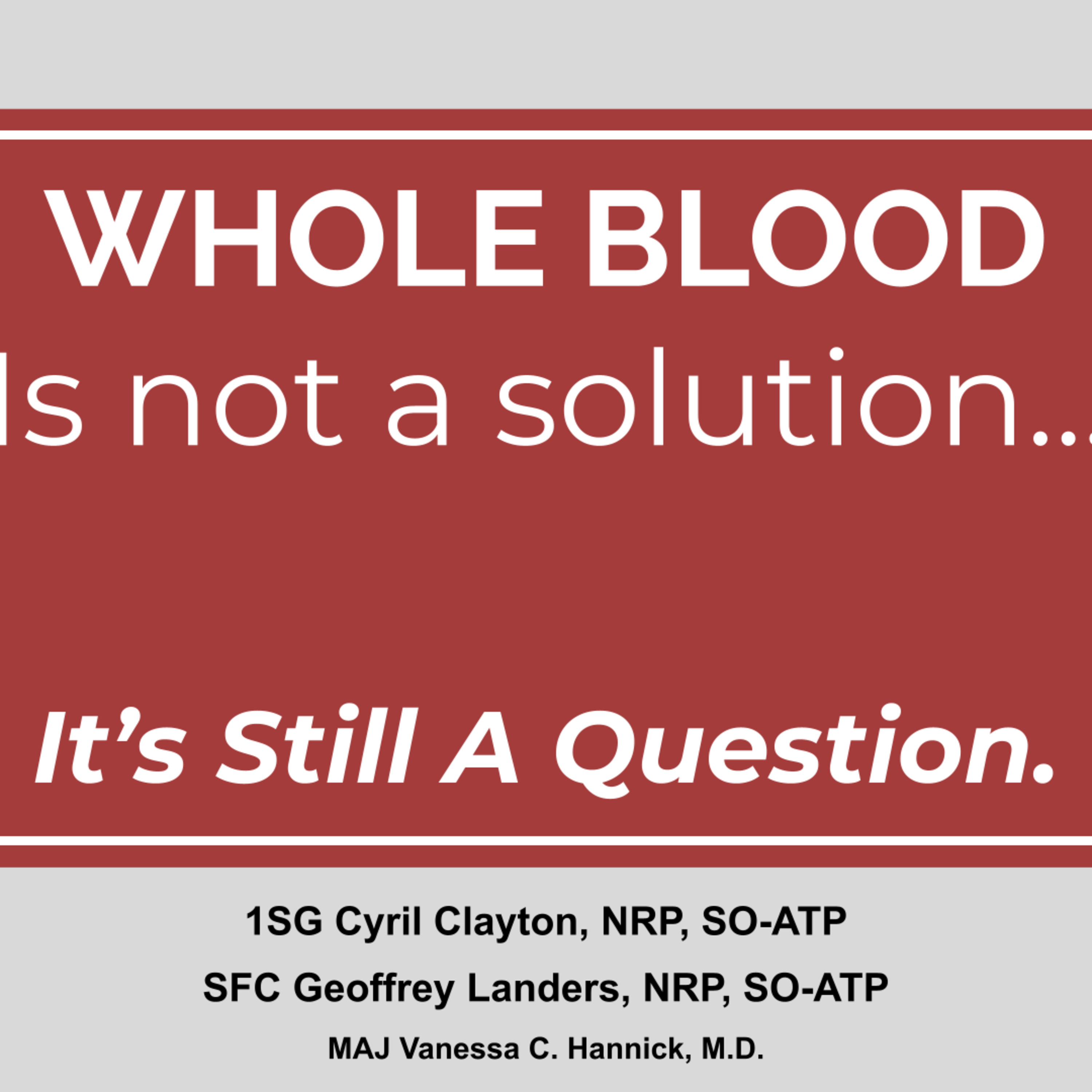
    SOMA 26' - Fresh Whole Blood is Not The Answer: It's Still a Question

    Whole Blood Is Not a Solution (Until Conventional Forces Can Deliver It) Recorded live at SOMA 26 Dr. Vanessa Hanick (emergency physician, former active-duty Army, now National Guard) and 1SG Cy Clayton (Ranger Regiment veteran, currently a conventional Role 2 first sergeant) deliver a blunt assessment of a critical readiness gap: while whole blood is the agreed standard of care for damage control resuscitation, conventional forces remain largely unprepared to provide it in support of SOF or any large-scale operations. Drawing on recent deployment experience, unit surveys, and Joint Trauma System training observations, they outline three lethal capability gaps—planning, logistics, and training—and call for proactive SOF-conventional collaboration, institutional reform, and immediate use of available Joint Trauma System mobile training teams. Sponsored by the Special Operations Medical Association. Key Takeaways The 2021 Joint Trauma System / Defense Committee on Trauma position statement establishes whole blood as the resuscitative fluid of choice that must be available at every echelon and on every evacuation platform within 30 minutes of injury. This is an operational standard, not an aspiration. Conventional forces currently fail this standard across three critical gaps: failure to plan (MASCAL and walking blood bank plans are incomplete, unilateral, or nonexistent), logistical incompetence (unreliable cold chain, storage, transport, and warming), and inadequate training (high failure rates on whole blood transfusion even among medics who pass TCCC recertification). Survey data from conventional brigade-sized elements show near-zero SOPs for walking blood banks, minimal storage capacity, zero transport or warming capability in many units, and cold-chain training limited to vaccines rather than blood. SOF leaders and medics cannot assume conventional support will materialize when needed. Early, deliberate linking with conventional Role 1/2 counterparts—sharing knowledge, training together, and validating capabilities—is essential. Joint Trauma System mobile training teams (including the Blood Whole Blood Training Program) already exist and can travel to conventional units to build pre-hospital, Role 2, and Role 3 whole blood and walking blood bank competency. These resources should be used now. In future large-scale combat operations the problem only intensifies; the time to close the gap is before the emergency, not during it. Chapters00:00 – Introduction and disclosures 01:30 – Why SOF–conventional collaboration matters now 03:40 – The 2021 JTS whole blood standard and its implications 05:50 – Three critical capability gaps in conventional forces 06:50 – Gap 1: Failure to plan (Kuwait MASCAL and walking blood bank case study) 11:20 – Gap 2: Logistical incompetence (cold-chain failures on deployment) 13:20 – Gap 3: Training shortfalls (high failure rates on whole blood transfusion) 15:40 – Survey data from conventional units: near-zero capabilities 19:20 – Institutional, organizational, and individual solutions 21:40 – SOF responsibility: link early, train together, validate capabilities 24:40 – Joint Trauma System resources and call to action 28:00 – Closing remarks

  • August 24 · 49 min

    293 - Dead Tissue Kills in Prolonged Field Care: 4 C’s, Early Debridement & Delayed Primary Closure Lessons from the Field

    In this episode of the PFC Podcast, Dennis sits down with missionary surgeon Jason to cut through the noise on real-world wound care in austere and unconventional warfare environments. From the bridge two miles from the front to resource-scarce guerrilla settings, Jason shares hard-won lessons on getting tourniquets off, aggressive debridement, and keeping patients from dying of infection weeks later. You’ll hear why most tourniquets can (and should) come off early, how to use the 4 C’s (Color, Consistency, Contractility, Capillary bleeding) to decide what stays and what goes, why inactivity is harm, and how daily dressing changes plus early cleaning beat the classic “leave it alone for 5 days” approach in many field conditions. Jason also covers practical logistics, antibiotic reality checks, pain management during dressing changes, and when a wound is actually ready for delayed primary closure. Key takeaways: Get the tourniquet completely off and look—most wounds do not need it left on. Dead tissue, dirt, and debris are the real infection risk; antibiotics cannot fix what you leave behind. The 4 C’s give medics a clear, actionable decision tool for debridement. Aggressive early cleaning usually means fewer later trips to the OR, less pain, and better long-term outcomes. In prolonged or definitive field care, the medic who stays with the patient for weeks must own the wound—not just the initial hemorrhage control. Beefy red granulation without cellulitis is the green light for closure decisions; high-tension or complex wounds may still do better left open. Practical, no-nonsense guidance for anyone who may have to manage wounds far beyond the golden hour. Chapters 00:00 – Intro & welcome 00:20 – Guest intro: missionary surgeon in UW environments 01:04 – Tourniquet still on + nasty wound: what actually improves outcome? 01:19 – Get the tourniquet off as soon as possible 01:40 – Data point: ~70% of tourniquets not needed 03:11 – Why taking tourniquets off feels so scary 04:14 – Don’t lower slowly—get past venous pressure fast 05:00 – Simple method: fully loosen, look, reapply only if needed 07:17 – Risk of a brief look is low; most bleeding is manageable 09:07 – Care under fire vs. tactical field care / PFC mindset 12:25 – System solutions for large-scale conflict (push capability forward) 14:46 – Optimizing the patient after hemorrhage control15:03 – Minimal tools needed + goal of removing barriers to healing 16:18 – The 4 C’s of viable tissue (Color, Consistency, Contractility, Capillary bleeding) 17:15 – Lean aggressive: dead tissue + debris kills more than a little extra muscle 19:05 – Fungal/opportunistic infections and why clean tissue matters 22:13 – Early and repeated debridement until only living tissue remains 24:00 – How far to go: check compartments, cut questionable tissue 30:33 – Dressing strategy after initial debridement 30:38 – Copeland method vs. daily (or more frequent) changes 33:12 – Checking the wound the next day in austere settings 34:34 – Pain control and watching the patient’s face during dressing changes 37:01 – What the dressing and wound bed should tell you 37:35 – Antibiotics: best antibiotic is good debridement 40:27 – Logistics in UW: travel light, use partner supplies, stay off the radar 42:47 – When is the wound ready for delayed primary closure? 45:45 – What Jason wishes more medics would internalize For more content, go to ⁠⁠⁠⁠⁠⁠⁠⁠⁠⁠⁠⁠⁠⁠⁠⁠⁠⁠⁠⁠⁠⁠⁠⁠⁠⁠⁠⁠⁠⁠⁠⁠⁠⁠⁠⁠⁠⁠⁠⁠⁠⁠⁠⁠⁠⁠⁠⁠⁠⁠⁠⁠⁠⁠⁠⁠⁠⁠⁠⁠⁠⁠⁠⁠⁠⁠⁠⁠⁠⁠⁠⁠⁠⁠⁠⁠⁠⁠⁠⁠⁠⁠⁠⁠www.prolongedfieldcare.org⁠⁠⁠⁠⁠⁠⁠⁠⁠⁠⁠⁠⁠⁠⁠⁠⁠⁠⁠⁠⁠⁠⁠⁠⁠⁠⁠⁠⁠⁠⁠⁠⁠⁠⁠⁠⁠⁠⁠⁠⁠⁠⁠⁠⁠⁠⁠⁠⁠⁠⁠⁠⁠⁠⁠⁠⁠⁠⁠⁠⁠⁠⁠⁠⁠⁠⁠⁠⁠⁠⁠⁠⁠⁠⁠⁠⁠⁠⁠⁠⁠⁠⁠

  • August 20 · 31 min

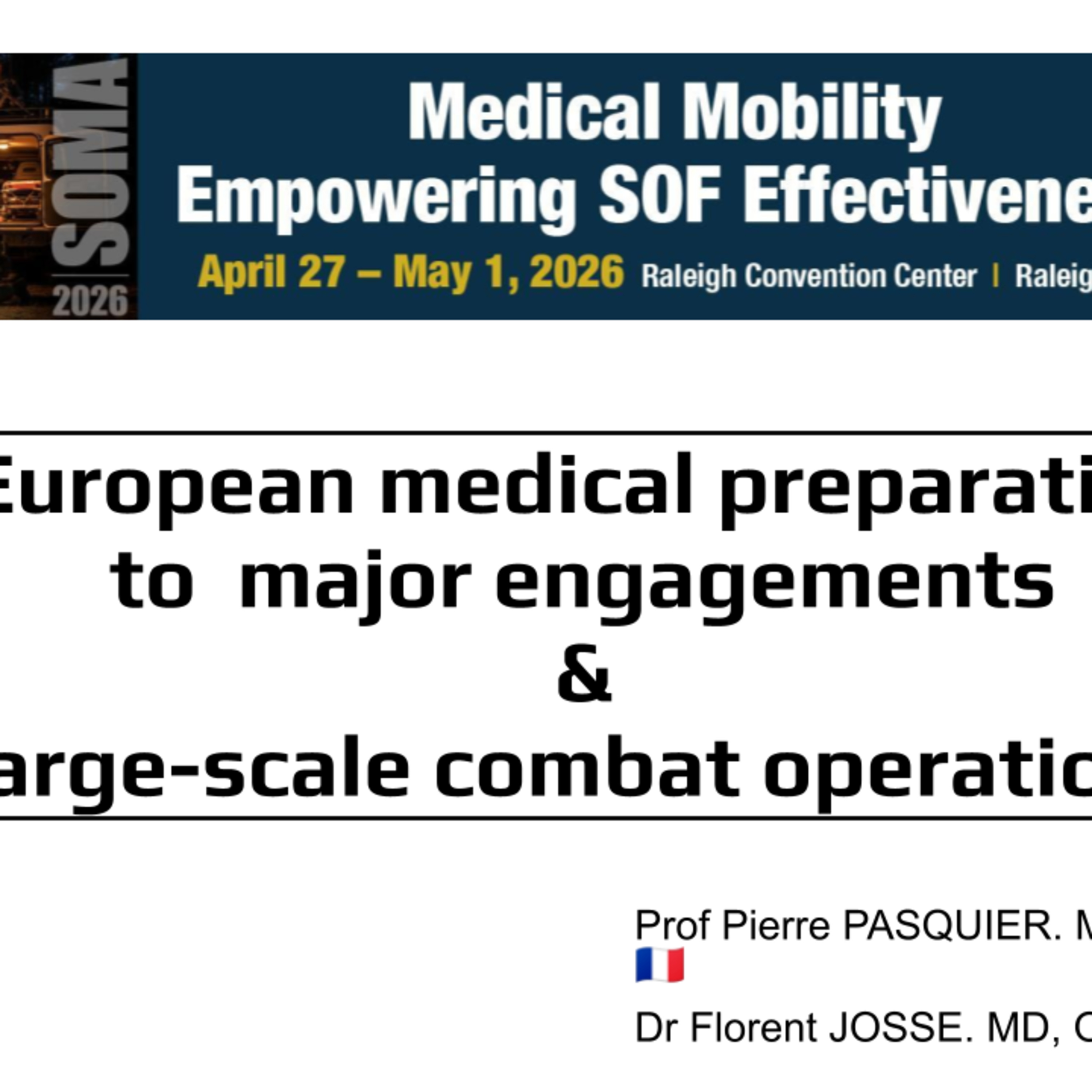
    SOMA 26' - European Medical Preparations for Major Engagements and Large-Scale Combat Operations

    Recorded live at SOMA 26 Pierre Pasquier (France) and his German counterpart deliver a clear-eyed assessment of how European military medical systems are preparing for large-scale combat operations and major engagements, drawing heavily on lessons from Ukraine. They examine the scale of expected casualties, the return of mass-casualty and prolonged-care realities, the threat of multi-drug-resistant organisms, the vulnerability of medical treatment facilities to deliberate attacks, and the urgent need for true multinational interoperability. The discussion covers doctrine updates, shared training, data collaboration, civilian-military integration, and the strategic value of medical readiness as a deterrent. Sponsored by the Special Operations Medical Association. Key Takeaways Ukraine has demonstrated casualty rates of several hundred per day—orders of magnitude higher than Iraq/Afghanistan—requiring European medical systems to plan for mass casualties, prolonged field care at scale, and significant disease/non-battle injury burdens, including older soldiers with chronic conditions. Multi-drug-resistant bacteria are already arriving in European hospitals via Ukrainian patients; mass-casualty flows will amplify this biosecurity challenge and demand coordinated infection-control strategies. Systematic attacks on healthcare facilities necessitate a shift to flexible, mobile, low-signature medical treatment facilities that can hide and defend themselves—something current large Role 1–3 structures are not yet optimized for. Lessons from long-evacuation environments (e.g., Sahel) must now be scaled from a handful of patients to dozens or hundreds simultaneously; prolonged care is no longer an exception but a planning assumption. True interoperability requires shared language, clear capability definitions across nations, joint data collection and analysis, and training that moves beyond parallel national exercises to actual patient and team cross-flow. Germany is positioned as a key NATO medical hub for strategic evacuation; France is actively building civilian-military pathways so that civilian systems can absorb returning casualties while military teams remain forward. Medical superiority and demonstrated preparedness function as a strategic deterrent; “stronger together” through SOMA, CMC, shared science, and multinational training is essential. Chapters 00:00 – Introduction and European context01:50 – Ukraine as the current laboratory and weekly French/German learning process03:10 – NATO Eastern Front realities and multinational medical challenges05:00 – Casualty rate comparisons: WWII → Ukraine and implications for doctrine07:00 – Disease, non-battle injury, and the multi-drug-resistant bacteria threat09:50 – Attacks on healthcare facilities and the need for mobile, low-signature MTFs12:20 – Lessons from the Sahel: prolonged care scaled for LSCO14:50 – Interoperability experience and the value of shared data and science17:40 – Changing mindsets, nomenclature, and national doctrines (French Sauvetage au Combat update)21:40 – Training together: Vigorous Warrior and the next steps for joint exercises23:10 – Strategic MEDEVAC, Germany as hub, and civilian-military integration25:10 – Take-home messages: new/old challenges, medical superiority as deterrent, stronger together27:20 – Q&A: hospital capacity concerns and integrating U.S. physician assistants

Showing 1–20 of 33 episodes