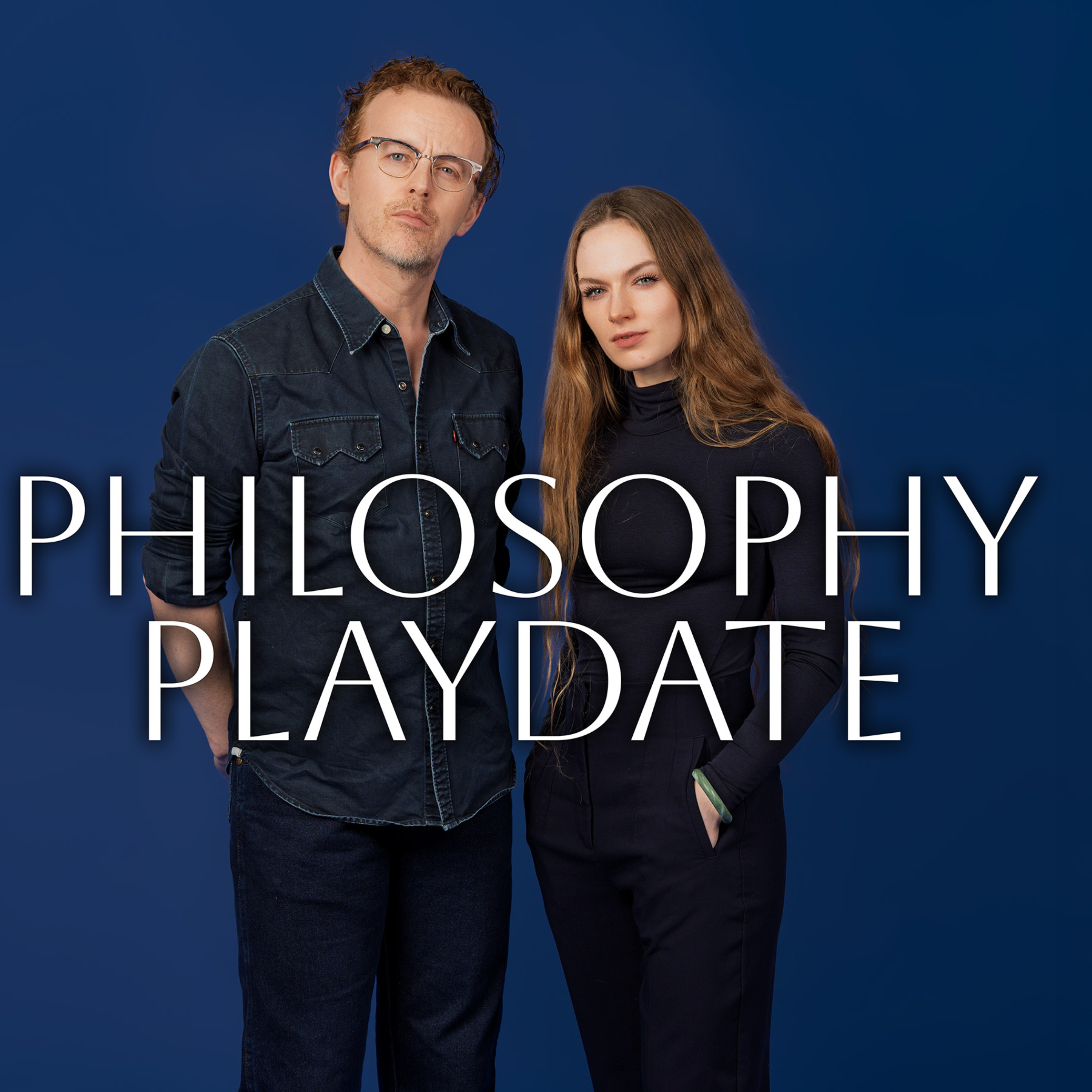
Artwork for Philosophy Playdate
Society & Culture

Philosophy Playdate

Clever Make Funny Productions Ltd

Children's impossible questions addressed by the greatest minds in philosophy. With jokes.

Hosted by philosopher Christabel Cane and comedian Steve Cross.

  • 23 episodes
  • Updated Today

Episodes23

  • March 16 · 1 hr 5 min

    Episode 3 - "How long is a minute?"

    This week, Steve and Christabel try their best to avoid suffering the fate of John William Dunne, who was laughed out of metaphysics circles for proposing that time is an infinite layer cake. In fact, in answering this week’s question, “How long is a minute?”, both hosts are clear on one thing; that you cannot have your cake and eat (all of the temporal parts of) it too. In fact, Christabel argues that the project of destroying a whole cake is just as problematic as that of travelling back in time to kill your grandfather. But time travel isn’t found to be completely paradoxical, and the possibility of travelling back to your favourite minute of a Weird Al Yankovich concert is found to be broadly unobjectionable (at least as concerns logical consistency). Christabel introduces us to distinctions between ecstatic, historical, personal, external, absolute and proper times, and makes the case for perdurantism; the theory that all objects that persist through time are four-dimensional spacetime worms, and that only small slices of these worms exist at any given time. Steve is more convinced by this view than the presentist’s denial of the existence of the past and future, which he likens to the philosophical commitments shared by babies and Beach Boys. 
 Read Christabel’s paper about time, as mentioned in the episode: 
https://discovery.ucl.ac.uk/id/eprint/10217604/1/10.1515_krt-2025-0022%20%281%29.pdf
 Email us the impossible questions children ask you at philosophyplaydate@gmail.com Find Steve at https://drstevecross.squarespace.com/ Philosophy Playdate theme by Piers Cane

  • March 12 · 51 min

    Episode 2 - "What's the best favourite colour to have?"

    This week Christabel is on a mission to convince us that navy blue is the objectively best colour. In her efforts to do this, she enlists the help of Immanuel Kant, and his distinction between things that are capital B Beautiful, and the merely agreeable. Kant relegates wine to the latter category, and Steve argues that the same is true of Queen (but makes a reasonable exception for Freddie Mercury). Christabel takes issue with both, drawing on Shen-Yi Liao’s characterisation of nostalgic food as art to argue that we have good reasons for widening our understanding of what counts as both Beautiful and high art. We are then introduced to Samantha Matherne’s Kant scholarship, to which Christabel appeals in order to make the claim that if we squint at the Critique of Judgement in the right light, Kant might give us what we need to make the argument that individual shades and tones, when appreciated in a sufficiently abstract way, might be taken to count as the kinds of things about which proper aesthetic judgements can be made. We are invited to conclude that there may be a universally correct answer to this week’s question “What’s the best favourite colour to have?” (and that the answer is navy blue). Email us the impossible questions children ask you at philosophyplaydate@gmail.com Find Steve at https://drstevecross.squarespace.com/ Philosophy Playdate theme by Piers Cane

  • March 9 · 48 min

    Ep 1 - The Dog/Baby Switch

    For the very first episode of Philosophy Playdate, Steve and Christabel tackle a fresh new take on the trolley problem, provided by a 7-year-old nascent ethicist. Her question was: “If there was a switch that turned all dogs into human babies, and another switch that turned all human babies into dogs, and you had to push one, which would you push?” This ethical dilemma prompts a discussion of animal sentience and the problems we face when tasked with ranking different kinds of human and non-human consciousness, and whether such a ranking could ever justify the ‘speciesist’ conclusion that some lives are worth more than others. Christabel extolls the virtues of care ethics over the utilitarian aggregative calculus, and Steve extolls the virtues of vasectomies. Both oscillate between the two poles of pro- and antinatalism, considering the environmental, social and hedonistic factors that bear on the question as to when - if ever - it is morally permissible to bring life into the world. As a rare treat for this inaugural episode, both hosts come to a definitive answer on this week’s question (though in a characteristically philosophical turn of events, they fail to meet an agreement). Email us the impossible questions children ask you at philosophyplaydate@gmail.com Find Steve at https://drstevecross.squarespace.com/ Philosophy Playdate theme by Piers Cane