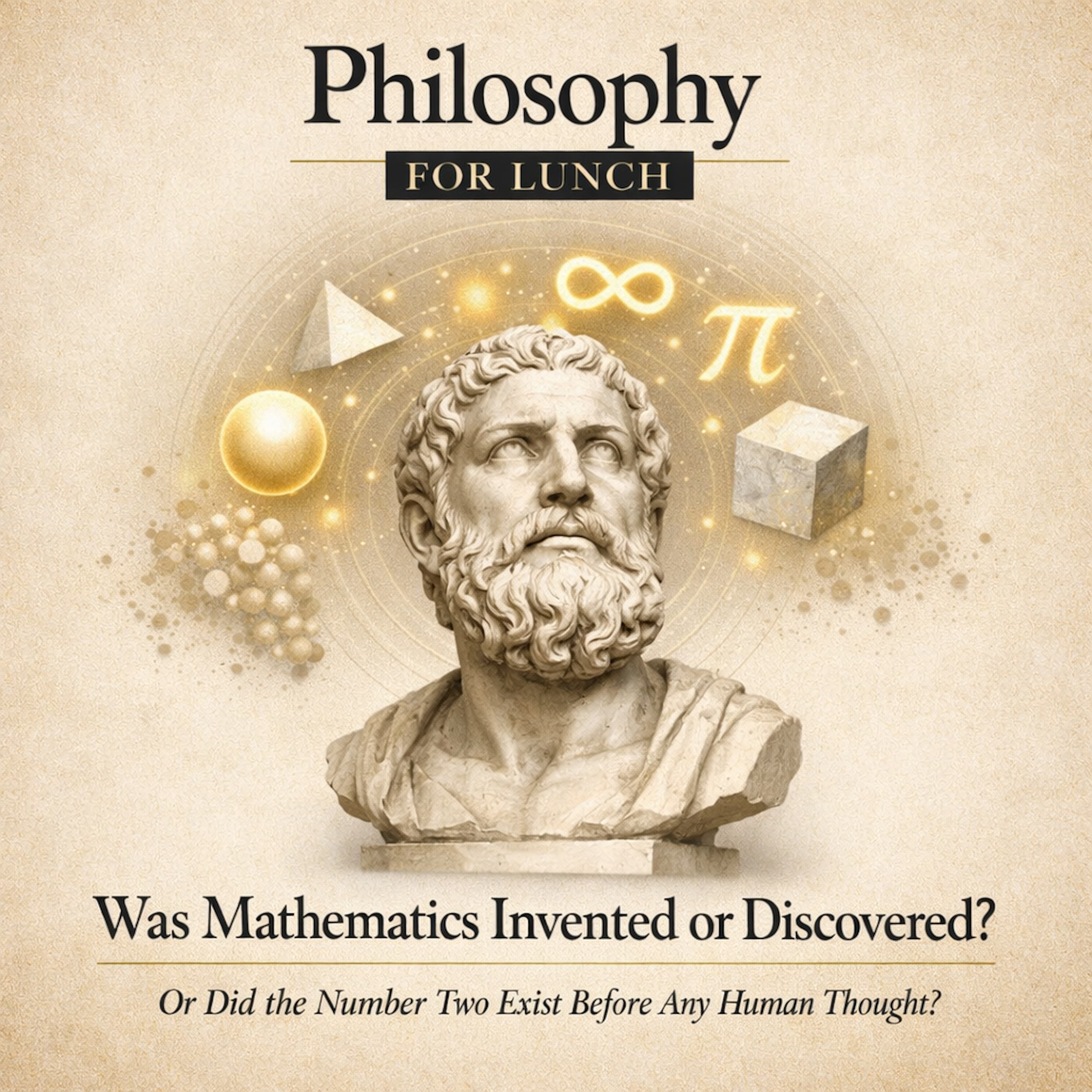
Episode #020 - Was Mathematics Invented or Discovered?
Here is a question that sounds like it should have an obvious answer. Was mathematics invented or discovered? Did humans create the number two the way we created the word for it? Or did the number two exist before any human thought about it — a feature of reality we stumbled upon rather than constructed? The obvious answer is that mathematics was invented. Humans made it up. The alternative sounds mystical: abstract objects existing in some Platonic realm, waiting to be found. But the obvious answer runs into a problem almost immediately. If mathematics is a human invention — a useful fiction we constructed for our own purposes — then why does it describe the physical world with such uncanny precision? Why does mathematics developed to solve purely theoretical problems turn out, decades or centuries later, to be exactly what physicists need to describe reality? In nineteen sixty, the physicist Eugene Wigner called this the unreasonable effectiveness of mathematics. It is not what you would expect from a game we simply made up. In this episode, Shawn and Claire work through the main philosophical positions: Platonism, which holds that mathematical objects exist independently of human minds and are discovered rather than invented; nominalism, which denies abstract objects entirely; structuralism, which argues that mathematics describes patterns rather than things; and intuitionism, which holds that mathematical objects are mental constructions and only exist insofar as they are constructible. None of these positions is without serious difficulty. The question has remained genuinely open for two and a half thousand years — not because philosophers have been careless, but because it sits at the intersection of ontology, epistemology, the philosophy of mind, and the foundations of science. The episode also addresses what the mathematician G.H. Hardy called the experience of mathematical beauty — why the best proofs feel found rather than made, and what it means that aesthetic judgment reliably guides mathematicians toward mathematical truth. This is the episode for anyone who has ever taken mathematics for granted. After this one, you will not. Shawn and Claire together. No prior mathematics required. SHOW NOTES Primary Sources & Key Texts Plato. (1997). Republic (G. M. A. Grube, Trans., rev. C. D. C. Reeve). In J. M. Cooper (Ed.), Plato: Complete Works. Hackett Publishing. Frege, G. (1980). The Foundations of Arithmetic (J. L. Austin, Trans., 2nd ed.). Northwestern University Press. (Original work published 1884) Hardy, G. H. (2012). A Mathematician's Apology. Cambridge University Press. (Original work published 1940) Works Referenced in This Episode Wigner, E. P. (1960). The unreasonable effectiveness of mathematics in the natural sciences. Communications on Pure and Applied Mathematics, 13(1), 1–14. Benacerraf, P. (1973). Mathematical truth. Journal of Philosophy, 70(19), 661–679. Field, H. (1980). Science Without Numbers: A Defence of Nominalism. Princeton University Press. Shapiro, S. (1997). Philosophy of Mathematics: Structure and Ontology. Oxford University Press. Accessible Starting Points Livio, M. (2009). Is God a Mathematician? Simon & Schuster. Balaguer, M. (1998). Platonism and Anti-Platonism in Mathematics. Oxford University Press. Stewart, I. (2011). The Mathematics of Life. Basic Books. New episodes every Monday. Philosophy for Lunch · Big ideas. Human conversations.
- Transcript