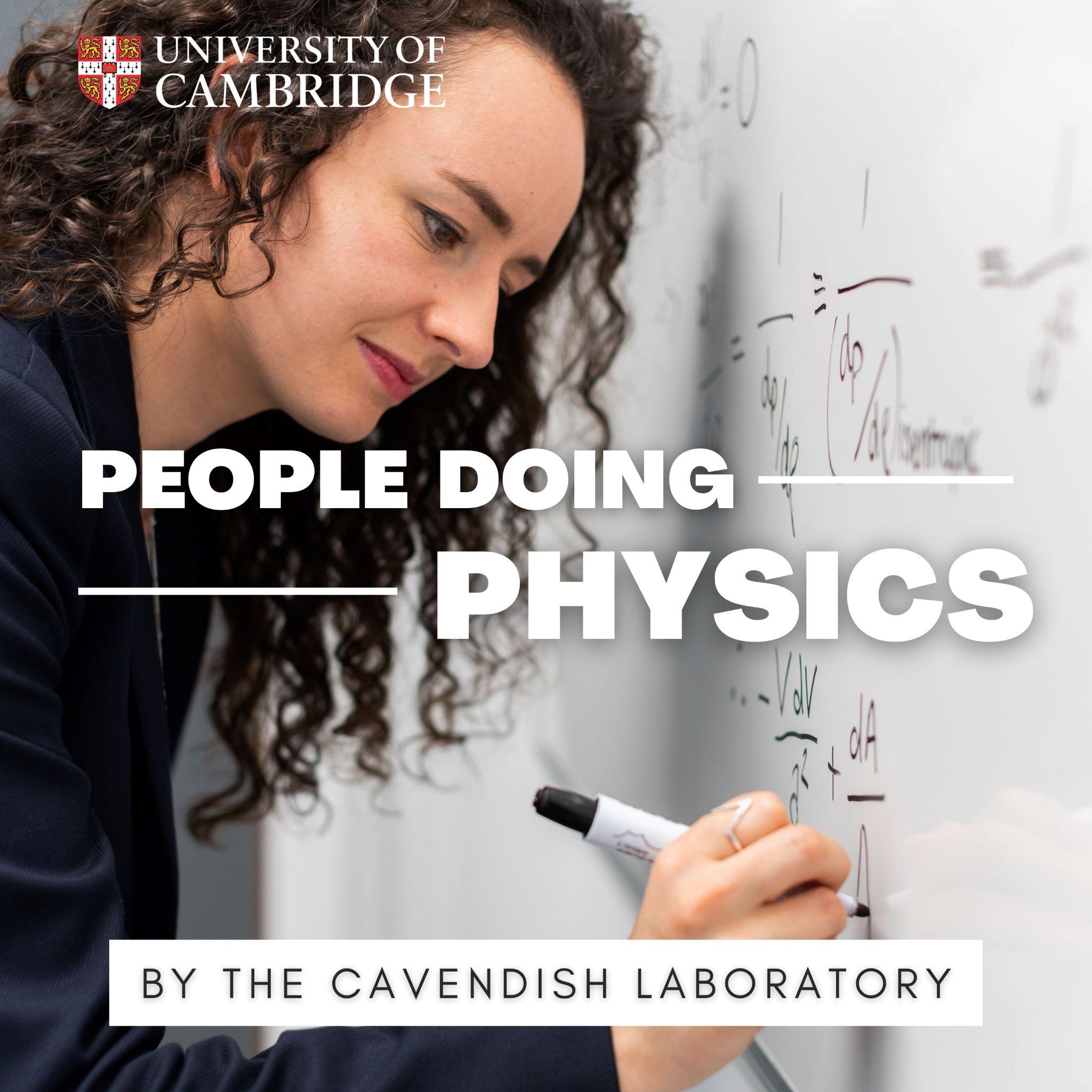
Artwork for People doing Physics
Science

People doing Physics

Cavendish Laboratory

As fascinating as physics can be, it can also seem very abstract, but behind each experiment and discovery stands a real person trying to understand the universe. Join us at the Cavendish Laboratory on the first Thursday of every month as we get up close and personal with the researchers, technicians, students, teachers, and people that are the beating heart of Cambridge University’s Physics department. If you want to know what goes on behind the doors of a Physics department, are curious to know how people get into physics, or simply wonder what physicists think and dream about, listen in!
Join us on Twitter @DeptofPhysics using the hashtag #PeopleDoingPhysics.

This podcast uses the following third-party services for analysis:

OP3 - https://op3.dev/privacy

  • 46 episodes
  • Updated June 4

Episodes46

  • Jun 2, 2022 · 40 min

    Stuart MacPherson

    This month, our guest is Stuart Macpherson, Post-doctoral researcher in experimental opto-electronics in the Stranks Lab at the Department of Physics. Stuart’s research focuses on understanding the physics of solar photovoltaics based on perovskite compound, one of the fastest advancing solar technologies of today. Stuart is also the founder of Sustain/Ed, a non-profit organisation that aims to provide sustainability resources to young students. One of their activities is the energy mapping challenge, aimed at primary school students(9-11 year olds). Through hands-on measurements and data logging, students increase their awareness about climate change and learn how to critically approach scientific problems and apply the knowledge gained to solve real world problems. The project has already been piloted at 6 schools across the country, and is now scaling up further. Another activity that he has launched with Sustain/Ed is the Sustain/Ed learning module, an educational package which augments the KS2 curriculum in the UK by offering activities which reinforce awareness of sustainability and climate action while maintaining core learning outcomes. For his projects with Sustain/Ed, in 2021 Stuart was recognised with the Vice Chancellor’s Social Impact Award. But how did his journey in sustainability start? And how does it relate to the technologies he has been developing? We will ask him this and more in our interview. Stay with us… Please help us get better by taking our quick survey! Your feedback will help us understand how we can improve in the future. Thank you for your time. Jump into the conversation: [00:33] - Guest's intro [02:13] – Background and how did he end up choosing physics? [04:31] – Teacher’s influence in studying physics [06:45] – Experience studying physics at St. Andrews [8:40] – Starting St. Andrews Engineering Group [10:06] – Weather balloon project to measure some interesting atmospheric properties [12:07] – Building a RADAR device during Masters [14:25] – Reason behind the PhD decision [17:40] – Interesting PhD hiring process at Cambridge [19:56] – Research at Cambridge is on compounds called perovskites that are useful in solar panels [22:30] – Defects and problems associated with perovskite [24:43] – In the news this month: Existing copper network cables of UK can support faster internet speeds only to a limit. Researchers say that additional investment is urgently needed if the government is serious about its commitment to making high-speed internet available to all. [26:20] – Involvement with Sustain/Ed, a non-profit organisation providing sustainability resources to young students [27:50] – Idea of Energy Mapping Challenge [30:51] – Small grant to scale up the idea [33:21] –Worked closely with the University of Cambridge primary school, designed an actual learning module – Sustain/Ed learning module [34:17] – Novel inventions and innovation, what people are doing to tackle the climate crisis [35:27] – Summing Sustain/Ed – teaching next generation science to the next generation [35:48] – Goals and Future Endeavours - Sustain/Ed [38:14] – Personal Goals, 5 years from now [39:45] – Outro --- Useful links: • Visit the Optoelectronic Materials and Device Spectroscopy Group (StranksLab) Website to learn more about their research. • Read the article on this month's news - Existing infrastructure will be unable to support demand for high-speed internet • Journal Article link of the news release - Investigating the upper bound of high-frequency electromagnetic waves on unshielded twisted copper pairs | Nature Communications • If you want to know more about Sustain/Ed, visit their website at - sustaineducation.org • To learn more about the Cavendish Laboratory, or if you are interested in joining us of studying with us, go to www.phy.cam.ac.uk Share and join the conversation: • If you like this episode, don’t forget to rate it and leave a review on your favourite podcast. • Any comment about the podcast or question you would like to ask our physicists, email us at podcast@phy.cam.ac.uk or join the conversation on Twitter using the hashtag #PeopleDoingPhysics. Episode credits: Hosts: Paolo Molignini and Jacob Butler News presenters: Simone Eizagirre Barker Producer: Chris Brock This podcast uses the following third-party services for analysis: OP3 - https://op3.dev/privacy

  • May 5, 2022 · 39 min

    Tom Sharp

    This month our guest is Tom Sharp, group technician for the Optoelectronics research group here at the Department of Physics, where his day to day involves working closely with scientists to maintain and troubleshoot equipment and ensure a smooth running of the laboratories and facilities. Tom was always drawn to mechanical work growing up, and joined the Cavendish through an apprenticeship 10 years ago. In that time his role has changed, evolving from working in the mechanical workshop to being in charge of producing and maintaining a whole group’s equipment. As someone who has to solve problems on a daily basis, Tom works with the mindset that you can’t get brought down with failures - sometimes your first solution won’t work as you hoped, but it’s all about learning, improving and adapting to new situations and challenges. But how does one learn to work in such a fast-paced and unpredictable environment? And what’s it like to work so closely with researchers and play a crucial part in setting up the experiments that lead to ground-breaking discoveries? Stay tuned as we ask Tom all about this and more… A bit of jargon busting: OE: Optoelectronics SP: Semiconductor Physics ME: Microelectronics Please help us get better by taking our quick survey! Your feedback will help us understand how we can improve in the future.Thank you for your time. Jump into the conversation: [00:33] - Guests intro [12:18] – In the news this month: Meet June Broomhead (Lindsey), the woman who contributed to the discovery of DNA's double-helix [38:58] - Outro Useful links: Visit the Optoelectronics research group website to learn more about their research. Read the original article about June Broomhead (Lindsey) this month’s news are based on (including the black & white photograph of the 1947 Researchers and Students group) Tom Sharp talked about his apprenticeship at the Cavendish in this video. To learn more about the Cavendish Laboratory, or if you are interested in joining us of studying with us, go to www.phy.cam.ac.uk Share and join the conversation: If you like this episode, don’t forget to rate it and leave a review on your favourite podcast. Any comment about the podcast or question you would like to ask our physicists, email us at podcast@phy.cam.ac.uk or join the conversation on Twitter using the hashtag #PeopleDoingPhysics. Episode credits: Hosts: Simone Eizagirre Barker and Jacob Butler News presenters: Vanessa Bismuth and Paolo Molignini Producer: Chris Brock This podcast uses the following third-party services for analysis: OP3 - https://op3.dev/privacy

  • Apr 7, 2022 · 39 min

    Suchitra Sebastian and Logan Dandridge

    We’re doing things a bit differently this month, welcoming not one but two guests in this episode. Suchitra Sebastian is a professor of Physics at the Cavendish, but like cats, she had more than a few lives before becoming a world-class scientist. And like cats, she moves gracefully between very different worlds. It took time and a few twists and turns before a career in research became a conscious choice and ever since, she’s been finding ways to keep it interesting, fresh and fun for her. Since 2016, she’s the director of Cavendish Arts Science, a programme that seeks to question and explore material and immaterial universes through a dialogue between the arts and sciences. Last autumn, the programme appointed the artist Logan Dandridge, our second guest today, as the First Cavendish Arts Science Fellow. Logan grew up in Richmond, Virginia in the 90s to become a filmmaker whose work explores race, memory, and time through sound and the moving image. Last January, Logan traveled all the way from Syracuse University in the State of New York (USA), where he teaches films, to spend six months in Cambridge. Here, he’s creating encounters with Cavendish physicists to create new work that grapples with questions of memory, and re-imagined futures. With Logan and Suchitra, we talk about personal awakenings, messing around and finding out things by chance, and seeking out intersections between worlds that don’t necessarily collide. Jump into the conversation: [00:30] - Guests intro [02:10] – When Physics is not an obvious choice, one takes detours [05:20] – A fringe physicist venturing into the borderlands of condensed matters [09:18] – Physics alone will not do – exploring different forms of expression to know the world and be in it [13:40] – Pushing the boundaries of arts and science to create a dialogue and provocation between the two [17:15] – Crossing the line between Arts and Science and vice versa. [21:05] – In the news this month: Two-dimensional material could store quantum information at room temperature [25:05] – Who are you, Logan Dandridge? [26:50] – The beauty of the moving images, “sculpture and painting happening at the same time” [28:35] – Why engaging with scientists now? [29:40] – Expectations v. reality [30:40] – ‘Oh, I’m looking!’ [32:20] – What to expect from Cavendish Arts Science [37:07] – How many black futures will end before they begin… [38:48] - Outro --- Useful links: For more information about Cavendish Arts Science, visit cavendish-artscience.org.uk If you would like to explore some of Logan Dandridge’s previous works: BlackContinuum 01 Here,yesterday (136) Untitled(Foremothers) Logan and Suchitra will be at the Cambridge Festival 2022 for an Artist’s film screening and Q&A on Saturday 9th April at 3.30pm. Book your free ticket in advance. Read the full news story about the two-dimensional material that could store quantum information at room temperature on our website. To learn more about the Cavendish Laboratory, or if you are interested in joining us of studying with us, go to www.phy.cam.ac.uk Share and join the conversation: If you like this episode, don’t forget to rate it and leave a review on your favourite podcast app. Any comment about the podcast or question you would like to ask our physicists? Email us at podcast@phy.cam.ac.uk or join the conversation on Twitter using the hashtag #PeopleDoingPhysics. Episode credits: Hosts: Vanessa Bismuth and Jacob Butler News presenters: Simone Eizagirre Barker and Paolo Molignini Producer: Chris Brock This podcast uses the following third-party services for analysis: OP3 - https://op3.dev/privacy

  • Mar 3, 2022 · 43 min

    Tina Potter

    Our guest this month is Tina Potter, Professor of High Energy Physics at the Cavendish and expert in the particle physics Beyond the Standard Model. Tina developed a passion for physics at a young age and has always been drawn to big, fundamental questions about the nature of our reality: what is the universe made of? How do its constituents behave? How can we detect them? Her doctorate was when the world of CERN – the world-famous particle accelerator facility located at the border between Switzerland and France – opened up to her. She lived through the groundbreaking discovery of the Higgs boson at the Large Hadron Collider, a discovery that completed the Standard Model of particle physics and for its importance was awarded the Nobel prize in physics in 2013. Today, she is working on new theories Beyond the Standard Model that could explain phenomena that still remain a mystery while also teaching the next generation of physicists and raising her two children. Tina certainly likes a challenge, but how does one forge their own path into science when there is no family scientific connection or role-model? And how is it to work on larger-than-life research projects with huge datasets and hundreds of collaborators across the world? We’re ask her this and more in this new episode. Jump into the conversation: [00:00] - Guest intro [02:00] – First encounter with physics [02:45] – The world of particle physics and its open, unexplored big questions [05:00] – “I would like to know what Dark Matter is” [07:20] – The wonderful world of CERN and its unique research culture [10:15] – Getting over nerves and shyness - a quick strategy [11:55] – What a time to be alive! Living through the Higgs boson discovery [15:25] – Finally, my parents could understand - How the Higgs Boson discovery raised the profile of particle physics [17:30] - In the news this month – Mutating Quantum Particles set in motion [21:50] – Managing work-life balance in an academic environment [25:09] – Grasping every opportunity to survive the research career pyramid [27:00] – How to forge your own path when there’s no academic role model in your life? [30:25] – Approaching science with children and expanding their views on who can be a scientist [31:46] – Finding evidence of particles beyond the Standard Model with supersymmetry [37:15] – The beauty and challenges of cathedral projects [42:56] - Outro --- Useful links: Read the full news story about mutating quantum particles set in motion on our website. To learn more about Tina Potter and her work, visit High Energy Physics | (cam.ac.uk) Curious about CERN? Home | CERN To learn more about what’s been discussed in this episode, or why not, join us or study with us at the Cavendish, go to www.phy.cam.ac.uk Share and join the conversation If you like this episode, don’t forget to rate it and leave a review on your favourite podcast. Any comment about the podcast or question you would like to ask our physicists, email us at podcast@phy.cam.ac.uk or join the conversation on Twitter using the hashtag #PeopleDoingPhysics. Episode credits: Hosts: Simone Eizagirre Barker and Paolo Molignini News presenters: Vanessa Bismuth and Jacob Butler Producer: Chris Brock This podcast uses the following third-party services for analysis: OP3 - https://op3.dev/privacy

  • Feb 3, 2022 · 30 min

    Louise Hirst

    Our guest this month is LOUISE HIRST, Assistant Professor of Physics, and specialist of the development of advanced, high efficiency photovoltaics for space applications like powering satellites and exploring space. As a teenager and young adult, she contemplated a dual career in music and science, but knew she could not do both so finally decided to push her physics studies, with the idea she could get into finance or banking. Today, she’s not working in the City but continues to play the trumpet and piano when she’s not manipulating materials in the lab. She spent several years at the U.S. Naval Research Laboratory in Washington DC, where she did her postdoc. The lab brings together civilians and military staff, an environment she found both intellectually stimulating and challenging. Louise Hirst is not easily impressionable, andcertainly not easily discouraged. But is it a natural trait or did she have to build her confidence the hard way? We’re asking her and more in this episode. Jump into the conversation: [00:00] - Guest intro [01:50] - How did it all start? [02:56] - Music or physics? Finance or research? [05:15] - It’s all about photovoltaics [09:58] - Working with military staff in the U.S. [13:13] - In the news this month - 3D printed nanomagnets unveil a world of patterns in the magnetic field [15:10] - Being a woman in science and sticking up for oneself [20:50] – Interdisciplinary and translational themes at the University of Cambridge [23:50] – Is physics changing? [28:00] – Where next? [29:28] - Outro Useful links: Read the full news story about 3D printed nanomagnets on our website. To learn more about Louise Hirst, visit Space Photovoltaics (cam.ac.uk). Find her on Twitter @LouiseHirstUCam For more details about research and teaching at the Cavendish, or why not to join us or study with us, go to www.phy.cam.ac.uk Share and join the conversation: If you like this episode, don’t forget to rate it and leave a review on your favourite podcast app. Any comment about the podcast or question you would like to ask our physicists? Email us at podcast@phy.cam.ac.uk or join the conversation on Twitter using the hashtag #PeopleDoingPhysics. Episode credits: Hosts: Vanessa Bismuth and Paolo Molignini News presenters: Jacob Butler and Simone Eizagirre Barker Producer: Chris Brock This podcast uses the following third-party services for analysis: OP3 - https://op3.dev/privacy

  • Jan 26, 2022 · 1 min

    Introducing People doing Physics

    People Doing Physics is a new podcast from the Cavendish Laboratory (at the University of Cambridge) exploring the personal side of physics. Our first episode launches on 3rd February 2022. Listen and subscribe wherever you get your podcasts! Follow and connect with the show on Twitter using the hashtag #PeopleDoingPhysics. For more details and episodes notes, visit phy.cam.ac.uk/podcast This podcast uses the following third-party services for analysis: OP3 - https://op3.dev/privacy