Skip to content
Artwork for Part-Maven Part-Maverick
TechnologyBusiness

Part-Maven Part-Maverick

Hosted by Ritavan

Podcasts with brilliant authors, thinkers and experts - sharing ideas and challenging assumptions through useful contrarian perspectives.

mavenmaverick.substack.com
Play
  • 20 episodes
  • fortnightly
  • Avg 1 hr 5 min
  • English
  • Thursday · 43 min

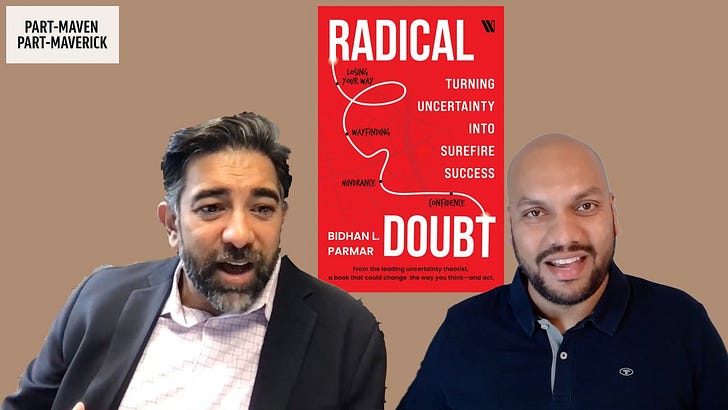
    Bidhan Parmar — Radical Doubt: Why Doubt is the Skill AI Can’t Copy

    Uncertainty is about unknown probabilities. Doubt is about interpretation: two people can face the same facts and reach different conclusions because context, experience, and identity shape what the facts mean. That distinction matters because most systems train people to treat not knowing as weakness. School rewards fast right answers. Work rewards confidence and speed. But real judgment requires something else: sit with ambiguity, generate options, test assumptions, revise. Intuition belongs in that process, but only as a hypothesis. Good decision-makers do not stop at their first instinct. They ask: what would change my mind? where could this fail? what evidence is missing? The practical rule from the episode: slow down early to move faster later. Testing, feedback, and extra discussion are not overhead; they prevent expensive mistakes. The firefighter equipment example made this concrete: technically sound gear failed in use because nobody tested it under real conditions. The AI takeaway is similar. Automate formalized work. Keep human judgment where the problem is ambiguous, cross-functional, or strategic. Speed only helps if you’re doing the right thing. The hardest challenge is scale: how do you preserve personalized judgment and feedback across many students or employees? Bidhan’s shift toward oral exams instead of hackable papers shows one answer: design for real understanding, not just output. Mental model: use structure for routine work, doubt for ambiguous work, and intuition as a starting point, not as a verdict. The System Gambit is a rigorous guide to the one strategic move that most investors and operators never make: Thanks for reading Part-Maven Part-Maverick! Subscribe for free to receive new posts. This is a public episode. If you would like to discuss this with other subscribers or get access to bonus episodes, visit mavenmaverick.substack.com
  • August 27 · 54 min

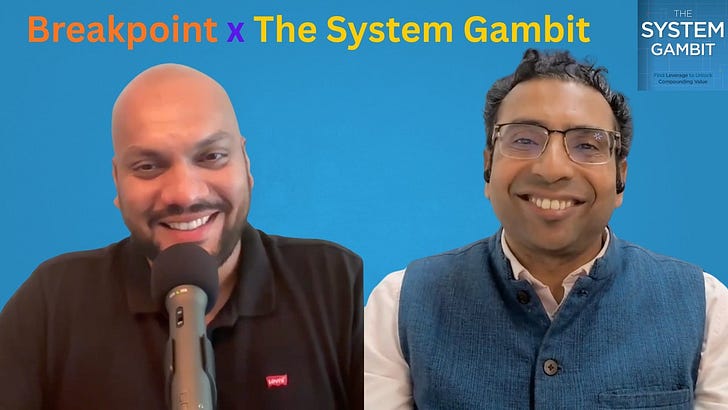
    The System Gambit x Breakpoint

    The System Anti-Gambit When paradigms break, the biggest threat to an investor or operator is their own most sensible instinct. How to tell a real structural move from a panic reflex? When India liberalised in 1991, it made the sensible bet. Decades of Nehruvian investment had left the country with graduates, so India sold their brainpower to the world through IT and knowledge services: hire a young graduate for a couple of thousand dollars a year, give him a month of standardised training on a campus in Mysore or Chennai, bill his time to a Fortune 500 company, and keep a twenty to twenty-five per cent operating margin. It worked for three decades and earned three or four hundred billion dollars of foreign exchange. It was a system gambit, and it paid off for a generation. AI is close to purpose-built to take it apart. When Saurabh Mukherjea came on my podcast to discuss his book Breakpoint, this was the case he kept returning to. The Fortune 500 client no longer cares how many people you deploy. It names a fixed price for a CRM system and leaves the method to you, and the method that wins now is two senior people and AI rather than a floor of graduates billed by the hour. Smaller Indian IT firms have already started to shut down. The move that built the industry is now the move dismantling it. In The System Gambit I call the winning move a system gambit and its shadow the system anti-gambit. The system anti-gambit is what you do when the ground shifts and you answer by doing more of what used to work. It is the most rational-feeling response available, and that is what makes it dangerous. The party most exposed to the system anti-gambit is the one currently winning. Sit at the top of a paradigm and your entire apparatus, your training, your hiring, your metrics, your instinct for what good looks like, is tuned to that paradigm, so when it shifts your immune response is to intensify the very thing that put you on top. Germany won the World Cup in 2014 by doing the classical things well. Find the children early. Drill them. Make them fit and disciplined. Then Germany kept doing exactly that while France, Spain and Morocco moved to fluid roles, fluid formations, and, in Morocco’s case, a platform model that pulled world-class players from its diaspora toward one clear mission. Watching Germany play France today, Saurabh said, is like watching teams from different planets. The 2014 title was the setup for the decline that followed. India produces eight to nine million graduates a year, close to the population of Germany every decade. Graduate unemployment runs between thirty and forty per cent, while the rate for non-graduates is around three. The degree now predicts unemployment. The old script, study hard, earn the degree, work hard, land the job, arrive at a middle-class life, has inverted. And the sensible-sounding instruction, send more young people to university, is the system anti-gambit at national scale. Arguing against university feels wrong. That feeling is the trap. AI sharpens all of this through one property. The transforming technologies of the past forced a firm to change how it operated before it could use them at all, and that friction is exactly what made them worth capturing. AI runs the other way. It bolts onto whatever you already do, which means the gains from bolting it on are available to anyone with a credit card and an API key, and anything available to everyone earns nothing that lasts. This is why the most common reaction I meet, the senior executive who asks me how to learn prompting, is the system anti-gambit in a new form. It carries an industrial-era instinct, learn a defined new skill, tick the box, feel safe, into a situation where the field itself has changed. Sangeet Paul Choudary makes the point in Reshuffle, because the game has changed underneath you, and learning to dribble faster is no help once the court has become a rink. If the standardised skill is losing its value, where the value flows next depends on what a system actually does. In the book I separate four modes of controlling any system, and they stack into a ladder. The lowest is regulation, the thermostat that holds a variable inside a band. Above it is coordination, the traffic light that keeps the flows from colliding without telling anyone where to go. Above that is orchestration, the conductor who plays no instrument yet makes a written score sound like music. At the top is governance, the captain of a ship who, with a storm ahead and no way to know the outcome, decides whether to stop, turn, reroute, or sail straight through. AI is already good at the thermostat, and it is climbing into the traffic light and the scored parts of the orchestra. What it cannot do is the captain’s judgement under genuine uncertainty. So value drains out of the lower rungs and pools at governance. That ladder explains the value migrations Saurabh tracks as an investor. Index funds turned asset management, the discretionary stock-picking that Saurabh and I both do for a living, into something close to a regulated utility, and the market answered by paying far higher multiples for wealth managers, whose real job is the ungovernable part, sitting with a frightened client and talking them out of selling at the bottom. The same logic is draining broadcast and print into YouTube and OTT, where what survives is the customised and the emotionally specific rather than the templated segment. Anything that is cut, paste, and repeat is being repriced towards zero, while anything that turns on reading a particular person in a particular moment is gaining. Saurabh reframes it as three fluidities: * whether a person’s skills are fluid or fixed, * whether their role is fluid or fixed, and * whether the organisation around them is rigid or fluid. The industrial revolution, from Adam Smith’s pin factory to Ford’s line at River Rouge, made all three as static as it could, deliberately. The coming years will hurt mainly because most firms are still built that way while the world has started paying for the opposite. None of this tells you which specific move to make, and it should not, because there is no formula that guarantees the result. But you can test a candidate move before the market passes its verdict. There are three checks. The first check is whether the move builds a self-improving loop. If each turn of the wheel makes the next turn better, you own something that compounds. If it does not, you have swapped an old asset for a newer one, and a newer asset is not a position. The second check is path dependence. A real structural position cannot be reached by a richer competitor writing a cheque, because that competitor would have to run the loop from the start rather than buy their way to your thousandth iteration. This is what makes Bajaj Finance so hard to copy. Bajaj has collected granular data on Indian borrowers at the point of sale, down to whether a doctor is a cardiologist or a dentist, trained at AIIMS or an ordinary college, practising in an elite Mumbai suburb or the boondocks, and that data lets it price risk for doctors better than anyone and hold the largest medical loan book in the country. If Saurabh and I raised money tomorrow to rebuild that dataset, we could not, because the signal was gathered over years at the core bottleneck by an agent standing at the checkout. That is a moat. A skill anyone can buy with an API key never becomes one. The third check is the one people skip, and the one I rate highest. I call it management-logic antagonism. It means doing the new thing in a way that runs against the logic of the old system, so the incumbent cannot copy you without dismantling itself. Ukraine is the best illustration. On paper, a country attacked by a neighbour with ten times its economy and the largest nuclear arsenal in the world should fold in days. Ukraine survived by refusing to fight the industrial war Russia had prepared for, the war of feeding more recruits into the line, and inverting it. Cheap drones improved through fast learning loops. A cost asymmetry in which a few hundred dollars destroys a tank. Strikes aimed at the binding constraint, the oil refineries deep inside Russia that fund the state, rather than at the trench. For Russia to answer in kind, it would have to abandon a doctrine it has run on since Stalingrad, and institutions do not abandon the thing that once made them win. That reluctance is the antagonism, and the antagonism is the moat. This essay is based on my new book The System Gambit: For an investor, the three checks are how you improve the odds without pretending to certainty. You are hunting for operators who have rethought their own system gambit again and again as the ground moved, and who keep their skills, their roles, and their structures fluid on purpose. Bajaj Finance rotates its people through departments so that nobody’s thinking calcifies. The discipline is unglamorous: see the system for what it is rather than what the last decade trained you to see. Notice the reflex to double down before you act on it. Think two or three levels below the surface narrative. Durable value compounds in the places money cannot buy its way into and judgement cannot be standardised out of. And the one thing standing between an operator and those places is, almost always, their own most sensible instinct. This is a public episode. If you would like to discuss this with other subscribers or get access to bonus episodes, visit mavenmaverick.substack.com
  • August 13 · 35 min

    Matthew Stafford — Find Your 9others: The questions to ask yourself as you start up and scale up

    Matthew Stafford is a VC and the co-author of “Find Your 9others: The questions to ask yourself as you start up and scale up” and co-founded 9others. You can follow him here on LinkedIn. In this episode, Matthew Stafford shares how defining your intellectual challenge can help overcome envy and focus on personal puzzles to solve, leading to greater fulfillment and success.Key Topics:The concept of intellectual challenge as a puzzle to solveHow envy distracts from personal goalsStrategies for focusing on your own puzzleThe importance of clarity in personal growthMaintaining motivation through puzzle-solvingTakeaways:Identifying your intellectual challenge helps you stay focused.Envy often distracts from personal progress.Focusing on your own puzzle leads to fulfillment.Clarity about your challenge boosts motivation.Consistently solving your puzzle builds success. Thanks for reading Part-Maven Part-Maverick! Subscribe for free to receive new posts and support my work. The launch discount of my book The System Gambit will expire today, so grab your copy right away: If these insights resonate with you, feel free to share the post: To know what comes next on Part-Maven Part-Maverick: * Subscribe here for early access to future episodes * For more of my thoughts, follow me on LinkedIn * Get my book The System Gambit about how to find leverage to unlock compounding value * Get my book Data Impact for a pragmatic take on data-driven value creation This is a public episode. If you would like to discuss this with other subscribers or get access to bonus episodes, visit mavenmaverick.substack.com
  • July 30 · 2 hr 8 min

    SPECIAL: Learning as an Adventure with Kathrin Höckel

    Most of our education systems are designed for a different era: built on fear, conformity, and a focus on standardized metrics. But what if true learning isn’t about fitting into a box, but about daring to step out of it? Kathrin Höckel’s extraordinary journey from classical dressage to Arctic expeditions reveals the secret sauce: learning as an adventure rooted in responsibility, freedom, and mastery. My new book The System Gambit shows how you can compound your career or business: In Brief: Learn why education rooted in fear fosters passivity and how embracing responsibility and adventure can unlock true learning. Discover the importance of environments, mastery, and lifelong curiosity in shaping resilient, responsible humans ready for the complexities of tomorrow. Learning as an Adventure Inspired by Extreme Situations Have you ever wondered why the education system feels disconnected from real life? Why do students often emerge from school ill-prepared for actual challenges? These questions are at the core of a profound conversation with Kathrin Herkel, an educator and explorer who believes that true learning happens when we leave the familiar and confront the unknown. In this post, we’ll explore how education can evolve from a fear-driven, conservative system into a dynamic, adventure-based journey that fosters responsibility, curiosity, and resilience, qualities essential for thriving in a rapidly changing world. The Root of Education’s Failures: Fear and Conservatism Education today is often perceived as broken, primarily because it clings to traditional structures rooted in fear. Kathrin Herkel points out that at every level, from policymakers to teachers, fear of making mistakes hampers innovation. Schools and teachers are wary of experimenting, fearing that deviations might threaten their jobs or reputation. Parents, similarly, prefer to play it safe, resisting change that might temporarily lower performance metrics or disrupt routines.This inertia results in an education system that prioritizes standardization and predictability. As Kathrin emphasizes, “The system is conservative by nature, and that inertia feeds into its resistance to change.” Consequently, students are rarely challenged to explore their identity, take responsibility, or develop the resilience needed to navigate the uncertainties of life. Instead, they are often passive recipients of knowledge, rather than active participants in their growth. Learning as an Adventure: Lessons from Extreme Situations Kathrin’s unique perspective is shaped by her extraordinary adventures, biking across the US and Russia, trail running in Kenya, and experiencing the Arctic in a hut above the North Pole. She underscores that these extreme experiences strip away comfort and force individuals to confront their limits, revealing their true character.She introduces the concept of “learning from an adventure,” where stepping into unfamiliar, even dangerous situations, is the best teacher of resilience, responsibility, and decision-making. For example, in the Arctic, she learned that “in a place where nobody can hide their character, authenticity shines through.” These environments demand that one acts with responsibility, calmness under pressure, and adaptability, traits that are often absent in traditional education settings. The Power of Responsibility and Freedom in Education A recurring theme in Kathrin’s philosophy is the vital link between responsibility and freedom. Her schooling experience, especially at a Steiner school, allowed her to choose her own learning path at 15. This approach instilled a deep sense of ownership and intrinsic motivation. She argues that responsibility fosters freedom because it teaches individuals to own their choices and outcomes.She advocates for an educational paradigm that reintroduces responsibility early, encouraging students to make decisions, face consequences, and develop self-awareness. The metaphor of the Mustang is instructive: “You’re born wild and free, then tamed and broken, and once you understand discipline, you are truly free.” Only through this cycle, free exploration, controlled challenge, and responsible ownership, can learners truly thrive. The Role of a Master: Learning from Those Who Have Walked the Path Kathrin’s journey highlights the importance of learning from masters, mentors who embody mastery, responsibility, and authenticity. Whether in dressage or extreme expeditions, working with a master involves surrendering ego and aspiring toward an ideal. These relationships demand humility, patience, and a willingness to learn from someone who is a step ahead.She underscores that these models of mastery are present in many cultures, think of the sensei in Japan, gurus in India, or classical trainers in Europe. The profound value lies in observing how masters live and act, internalizing their principles, and ultimately evolving into masters ourselves. Aesthetic and Spiritual Dimensions A striking insight from Kathrin involves the environment’s aesthetics and spiritual undercurrents. She describes her school as a space of beauty, coherence, and purpose, an environment that reflects and nurtures the spirit of learning. Conversely, many conventional schools resemble prisons or military camps, sterile, ugly, and utilitarian.This aesthetic dimension affects students’ emotional states and their willingness to engage. “If environments are beautiful and aligned with values like harmony and responsibility, they inspire pride and responsibility,” she notes. Her school’s focus on integral education, covering physical, emotional, mental, and spiritual aspects, demonstrates that education is about more than acquiring facts. It’s about cultivating human flourishing. From Formal Pedagogy to Authentic Learning Kathrin criticizes mainstream pedagogy for its transactional, bureaucratic nature, target-driven, algorithmic, and dogmatic. She argues for a shift from “dog school” training that enforces compliance to an approach that values intensity, responsibility, and authentic mastery.She emphasizes that real learning involves self-awareness, deliberate practice, and relationship with mentors. The emphasis should be on fostering curiosity, judgment, and the ability to operate above the algorithm, skills that AI is unlikely to replace. The Continuous Journey: Learning as a Lifelong Adventure Education, in Kathrin’s view, does not end at graduation. We are all lifelong learners, especially as AI and changing technologies reshape work and society. She advocates for “learning from an adventure,” where each experience deepens our self-knowledge and broadens our horizon.She introduces the idea of “operating above the algorithm,” being a human who combines mastery, curiosity, and responsibility to navigate a world of automation. The goal is to be not just a passive user of technology but an active shaper of our future. Thanks for reading Part-Maven Part-Maverick! Subscribe for free to receive new posts. This is a public episode. If you would like to discuss this with other subscribers or get access to bonus episodes, visit mavenmaverick.substack.com
  • July 16 · 1 hr 6 min

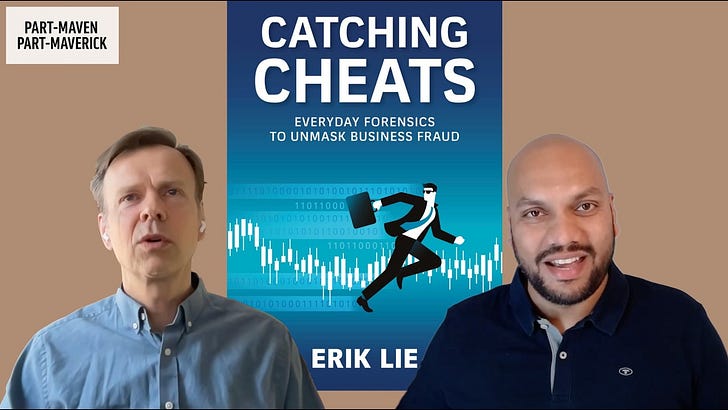
    Erik Lie — Catching Cheats: Useful Forensics to Unmask Business Fraud and Reduce Investment Losses

    Erik Lie is the author of “Catching Cheats: Everyday Forensics to Unmask Business Fraud”. You can follow him here on LinkedIn. Erik uncovering financial fraud patterns, insider trading, and the importance of forensic analysis in detecting deception in markets and corporate behavior. This episode will help you stay alert, apply basic forensic analysis to your investments and help you protect your portfolio from fraud and losses.Key TopicsPatterns in stock price movements before and after corporate eventsThe role of insider trading and its detectionThe impact of regulations like Sarbanes-Oxley on fraud preventionTechniques for forensic analysis of financial dataBehavioural insights into why executives commit fraud Thanks for reading Part-Maven Part-Maverick! Subscribe for free to receive new posts. My new book The System Gambit just launched: If these insights resonate with you, feel free to share the post: To know what comes next on Part-Maven Part-Maverick: * Subscribe here for early access to future episodes * For more of my thoughts, follow me on LinkedIn * Get my book The System Gambit about how to find leverage to unlock compounding value * Get my book Data Impact for a pragmatic take on data-driven value creation This is a public episode. If you would like to discuss this with other subscribers or get access to bonus episodes, visit mavenmaverick.substack.com
  • June 18 · 2 hr 23 min

    SPECIAL: Impact Banker Alexander Hoare — The Wide Gate and the Narrow One

    In this insightful interview, Alexander Hoare shares the secrets behind the 350-year-old family bank's success, emphasizing the importance of purpose, simplicity, and long-term thinking. Discover how their contrarian approach to growth, technology, and relationships creates a resilient and enduring business model.Key Topics Long-term family business successContrarian approach to growth and technologyRole of unlimited liability in decision-makingImportance of relationships over transactionsSimplicity and diseconomies of scale in banking Long-term stewardship and legacyThe concept of obliquity and its application in businessBuilding and maintaining trust and reputationImpact investing and societal contributionThe importance of culture and values in bankingChapters00:00 The Unconventional Success of C. Hoare & Co.11:40 Contrarian Approaches in Banking16:33 The Legacy and Governance of C. Hoare & Co.21:20 The Role of Partners and Succession Planning31:22 Unlimited Liability: A Unique Perspective39:21 Consequences of Limited Liability44:19 Simplicity vs. Complexity in Business49:19 Building Relationships Over Transactions57:47 The Power of Word of Mouth01:14:54 The Banker's Banker: Trust and Reputation01:21:20 Investing in Meaningful Impact01:28:45 Trust as an Uncommoditizable Asset01:33:14 Making Your Own Luck: The Role of Judgment01:38:49 The Importance of Staff and Culture01:43:12 Quality Over Quantity: The Data Dilemma01:48:24 The Value of a Large Family Network01:52:49 Navigating Wealth: Parenting and Money01:57:40 Environmental Stewardship: The Seagrass Initiative02:04:51 Faith, Family, and the Inner Life02:19:22 The Emotional Aspects of Money and Philanthropy My new book The System Gambit has C. Hoare & Co. as a case study: In 2008, as the world’s largest banks collapsed or were nationalised, one smaller bank on Fleet Street had the opposite problem: too much money was arriving at its door. C. Hoare & Co., founded in 1672 and older than both the Bank of England and the United States, came through the crisis with barely a scratch, its deposits swelling as frightened money looked for somewhere run by prudent people with a clean balance sheet. For decades the bank had been doing the very things every consultant and textbook had told its eleventh-generation partner not to do. As Alexander Hoare recalls in Impact Banker, “many people told me we were mad to carry on in the modern litigious world with unlimited liability, but in 2008 when the Great Financial Crash hit, people looked around for honest bankers with a clean and conservative balance sheet, and the deposits piled up.” In the year conventional wisdom was put to the ultimate test, the man who had ignored it for decades was suddenly the most sought after. Alexander Hoare is a nonconformist, and a cheerful one. “It has pleased me,” he writes, “to do many things wrong from a conventional point of view.” He kept unlimited liability when the whole City fled to limited liability. He keeps his bank deliberately small while everyone worships scale. He turns away profitable customers, has “never aimed to maximize profits,” and once sold a good, growing business in order to become smaller. He quips that his job “is to keep the family poor.” And he states his conviction clearly: “I see maximizing short term profits as the wide gate to failure.” The word nonconformist is apt. In England a nonconformist was someone who declined to worship at the established church, not from revolt but from conviction, and many of Britain’s most durable enterprises were built by people of that temperament. Alexander calmly declines the established church of contemporary finance: scale at all costs, short-term shareholder-value maximisation, limited liability, and the eternal myopia about the next quarter. It would be easy to dismiss this as nostalgia. But examined closely, nearly every one of his tenets is the same structural principle: he re-couples a feedback loop the industry has, for short-term greed, deliberately decoupled. * Action to consequence. * Price to value. * The firm to its community and society. * The present to the future. Decoupling those reinforcing feedback loops window-dresses the numbers in the short-term but re-coupling them is better for the business, and over three and a half centuries, have shown it is also what better-for-the-world looks like. 1st tenet: actions have consequences Begin with the nonconformity that sounds most reckless. Every partner of C. Hoare & Co. stands to lose everything they own if the bank fails: homes, savings, including their children’s inheritance. To most financiers this is complete lunacy; the entire architecture of the limited-liability corporation exists to prevent it. Alexander inverts the frame. The natural order is for actions to have consequences; it is in fact the contemporary arrangement that is the aberration from historical pattern. Until Big Bang in the late 1980s nearly every City firm traded on unlimited liability, and “my word is my bond” was an enforcement mechanism, not just a slogan. What followed its abolition was an era in which executives could half-bankrupt a country and walk away unscathed. Unlimited liability, by contrast, “focusses the family on a culture of excellence, not scale.” Through a first principles systems thinking lens the argument is obvious. Any successful system needs feedback: consequences must return to the actor and shape the next action. Limited liability severs that loop, capping the decision-maker’s downside at zero while leaving the upside unbounded. A diversified shareholder optimises the ensemble average across many companies; while a partner with unlimited liability and a more than 350-year time horizon must optimise the time average, the single path of history where ruin is permanent. A bet with a glorious expected value and a small chance of ruin is excellent for the ensemble and fatal for whoever gets ruined. This is why the book’s risk philosophy is so unfashionably simple: “banking is quite straight-forward if you merely avoid the mad and the bad.” 2nd tenet: perpetuate, do not maximise The mission statement the older partners first mocked is seven words long: “to perpetuate a profitable family business.” It “does not say anything about conquering or winning,” and its ambition is bounded: “we want to survive as a family business for perpetuity. This means being just big enough, not vast.” To the modern mind this is a category error: surely the purpose of an enterprise is to grow? Here Alexander deploys the most counterintuitive finding of his forty years, borrowed from John Kay’s notion of obliquity: “We have never aimed to maximize profits or to grow dramatically, and it turned out that not aiming at these things can be very effective at delivering them.” Kay’s cautionary tale is ICI, which adopted shareholder-value maximisation as its explicit goal and destroyed itself pursuing it. Aim at excellent banking and profit arrives as a by-product; aim at profit directly and you strip the institution that produces it. Donella Meadows identified the goal of a system as one of its highest leverage points: change the goal and everything downstream follows. Set it to maximise short-term profits and the system rationally destroys its future to grow the current quarter; set it to perpetuate and any gain that imperils survival is no gain, because the future is the whole point. Extraction generates large early terms in a series that is then truncated. This is best illustrated by the average lifespan of an S&P 250 company falling from 60 years in the past to just 15 years now. The perpetuator generates decent terms forever, and a series that never terminates beats any short burst that does. Eric Ries, in Incorruptible, names the force this resists: financial gravity, the pull on every company exposed to the capital markets toward short-term extraction at the expense of mission and survival. 3rd tenet: small is beautiful, & KISS principle Early on, Alexander adopted “two handy mantras: first, ‘small is beautiful’, and secondly ‘KISS’ (Keep It Simple Stupid).” He concedes the apparent absurdity: “Academically this is faintly ridiculous – a small bank should not out-compete, or even survive, against much larger competitors.” Yet it does, because the textbooks model only half the phenomenon, “the diseconomies of scale: the back-stabbing as executives climb the greasy ladder... and many, many other dysfunctions of large organisations.” Complexity behaves like entropy: generated spontaneously, bottom-up, by every well-meaning patch and product, and never decreasing on its own. The ideas Alexander refused “would have made us more money, but they would have built in a complexity premium further down the line.” Because complexity is born decentralised, only the top-down can reduce it, by someone with the authority and the stake to overrule a thousand local optimisers. That is what “stick to the knitting” really is: top-down work against organisational entropy. Here the tenets interlock. Keep the bank small enough for an owner to truly understand, and they can hold it in their head, take responsibility for it, and hand it on intact. Let it outgrow comprehension and two failures follow: the next generation sells the incomprehensible behemoth, and the owners demand limited liability, because no one accepts unlimited responsibility for something they cannot even fathom. Scale destroys comprehension; lost comprehension severs feedback loops; severed feedback ensures the eventual blow-up. Smallness is not an aesthetic preference but the load-bearing condition that keeps every other loop closed with high signal quality. The clearest proof is that a decade ago the bank sold its profitable, growing wealth-management arm and shrank headcount by roughly a fifth, concentrating IT, compliance and the partners’ scarce attention on the one business they understand best. And then former rivals, no longer threatened, began referring their banking clients to it again. A short-term subtraction created a permanent, self-reinforcing inflow, a deliberate sacrifice of present performance to buy a structural condition that compounds. Alexander calls it common sense, which honestly goes to show how rare common sense is becoming. Subscribe for free to receive new posts. 4th tenet: relationships, not transactions One of the most powerful sentences in Impact Banker is this: “We embody a culture whereby we reject profitable transactions – we want relationships not transactions.” A bank that declines profit, on purpose, as a matter of identity. The asymmetry is stated with perfect symmetry: “We do not aim to compete with larger banks on transactions, but they cannot compete with us on humanity and empathy.” A big bank can copy any product Hoare’s bank offers; what it cannot do is serve deep relationships at industrial scale, because the economics that make it big are the very economics that block the depth. The market polarises, as Alexander puts it, into fine dining and McDonald’s, and the giants are structurally barred from the fine-dining side of their own industry. This is counter-positioning in its purest form: a position rivals will not take because taking it would destroy their model. What the relationship is made of is trust: “our success is built on our reputation, and the trust customers place in us, both of which are developed over generations, but can be lost in a matter of days.” In an age when anything copyable is copied at near-zero cost by anyone with a large language model, the slow, un-copyable, compounding asset is the only durable one. The same tenet explains his deep insight about data & AI: “JP Morgan has over 1000 data scientists whereas we have just a handful. However, our data scientists know what data we collected in what systems for what purpose. I rather pity JP Morgan’s.” Decision quality is bounded not by the volume of data you hold but by the quality of the signal where the decision is made. A thousand data scientists atop an ocean of aggregated data, several steps from the customer, produce precise forecasts of the wrong thing; a handful who know the customer produce the right thing. 5th tenet: good bankers and good citizens The purpose Alexander gives the bank precedes the mission statement: “to be good bankers and good citizens.” He notes the rarity of this: “there are at any time some good bankers, and there are good citizens, but there are very few trying explicitly to be both.” A systems thinker will once more notice a compounding feedback loop. The bank donates ten percent of profits through its charitable trust and has given “going back 300 years,” and the result is reciprocal: “We look after our community, and it seems our community looks after us.” Schools, hospitals and hospices funded by good banking generate the trust, standing, goodwill and good customers that make the next century of good banking possible. This is an old principle and he admits, “lifted straight out of the Bible”: “treat others as you would wish to be treated.” The golden rule is itself a feedback device, forcing the actor to simulate the consequence from the other side before acting, the very loop that limited liability and too-big-to-fail were built to disconnect. When a global bank pays a nine-figure fine, its the shareholders who actually pay the fine, and the executives book it as a cost of doing business; at Hoare’s bank a fine “would come straight out of our own pockets,” which, Alexander notes, may be why there has never been one. 6th tenet: stewardship, & the discipline of enough Beneath everything sits the word he believes capitalism has lost: enough. “I sometimes quip that my job is to keep the family poor.” Why would the steward of a banking fortune want that? Because they have run a multi-generational experiment. The seventh generation of Hoares, inheriting great wealth, “lost several stately homes, 15,000 acres, art... and a brewery with 25% market share of London porter.” His verdict is: “This wealth destruction is sobering, but may have been a good thing.” It re-taught the family to work. This is the deepest re-coupling of all, the present to the future. Alexander frames his role not as ownership but stewardship; partners are chosen “not... for their private equity skills with a view to flipping the bank in seven years, but for a long-term stewardship mindset.” The Economist put the principle beautifully: “a family business is not inherited from your parents; it is borrowed from your children.” The heir, looking back, is tempted to spend; the steward, looking forward, must leave the soil richer than he found it. Hence wealth passing to the most capable rather than the eldest; hence the deliberate hunger; hence his proudest boast about three and a half centuries of change being its continuity: “everything has changed in terms of processes, and nothing has changed in the essence of the business.” Subscribe for free to receive new posts. The engine: why only a closed loop compounds Step back, because the general principle is the crux. A decoupled loop is an open loop, and open loops do not compound; they only leak. Each cycle, value escapes: to the regulator as a fine, via the churned customer, to the depleted reservoir of trust, to the successor who inherits the deferred problem. Extraction is just the steady-state behaviour of an open loop, so its series is arithmetic at best and decaying at worst. Re-coupling changes the topology. Once consequence returns to the actor the loop closes, and a closed loop with positive gain is, by definition, a compounding process: its output becomes its own input. But closing a loop is not sufficient. A closed loop on a commodity input is competed away at once, because every rival runs the same loop and the advantage mean-reverts to zero. For the compounding to stay yours, the loop must run on a proprietary input rivals cannot acquire without dismantling their own business. That is counter-positioning, and it converts a temporary edge into a structural position. This is what Alexander’s tenets are: not possessions but loops, each running on an input that is non-fungible, slow to build and impossible to buy. Because no rival can tap the same flywheel, the gap widens every cycle, the signature of a structural position rather than a passing edge. By re-coupling onto un-copyable inputs, Alexander runs a unique self-improving system. The nonconformist is not merely the more humane operator. He is the better strategist. The narrow gate Set the tenets side by side and the pattern is evident and unmistakable: * Unlimited liability re-couples action and consequence. * “Perpetuate, don’t maximise” re-couples the goal and the system’s survival. * Small-is-beautiful re-couples the owner’s comprehension and his responsibility. * Relationships re-couple price and value. * Good-bankers-and-good-citizens re-couples the firm and its society. * Stewardship re-couples the present and the future. Each is a node contemporary finance unplugged in pursuit of a better-looking quarter; and a system with its loops unplugged is exactly what blows up (remember 2008?) and hollows out its large companies in 15 years. The status quo calls such a man a contrarian and treats it as a quirk, a penchant for swimming against the tide. Alexander Hoare is not swimming against the current for sport; he has noticed that the current runs over a waterfall. His nonconformity is not a rejection of good economics but of an ergodic world that doesn’t exist. It is good economics for a non-ergodic world, run on the time average instead of the ensemble average, on the untruncated series instead of the truncated one with big early term, on the closed loop instead of the open one. Culture eats strategy for breakfast, as the Drucker line he loves has it, because culture is the loop that keeps running when the strategy document is put back on its shelf. “I see maximizing short term profits as the wide gate to failure,” he writes. The allusion is almost biblical, and deeply true. The wide gate is wide because it is crowded; the drift carries you through it effortlessly, in busy company, and over the edge. The narrow gate demands a toll: a liability you would rather not carry, a customer you would rather not refuse, a business you would rather not shrink, a fortune you would rather not decline to maximise. Almost no one pays it. Those who do are still standing in 1672, and in 2008, and, if the soil is tended, in 2372. That is the system gambit. Alexander Hoare has played it for forty years without ever calling it that, guided by faith and principles successful enough that the rest of the world would do well to see them a scripture for deep thought and reflection. My new book The System Gambit has C. Hoare & Co. as a case study: This is a public episode. If you would like to discuss this with other subscribers or get access to bonus episodes, visit mavenmaverick.substack.com
  • June 4 · 1 hr 9 min

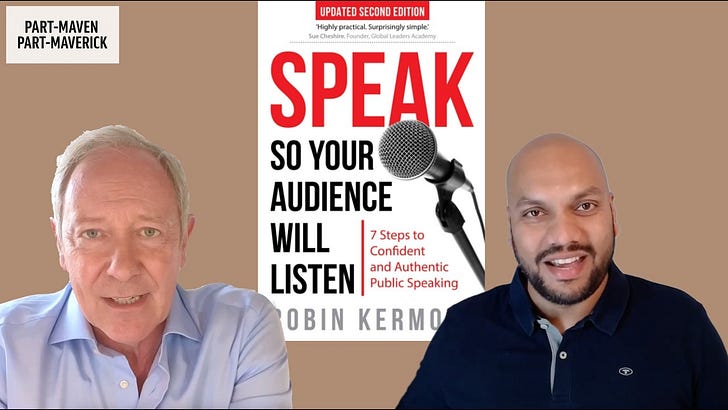
    Robin Kermode — Speak So Your Audience Will Listen: Useful Techniques for Effective Speaking

    Robin Kermode, is a top executive communication coach and a veteran actor, he is also the author of “Speak: So Your Audience Will Listen - 7 Steps to Confident and Successful Public Speaking”. You can follow him here on LinkedIn. Robin Kermode shares expert insights on effective communication, overcoming nerves, and engaging audiences. Discover practical techniques for public speaking, body language, voice modulation, and crafting simple, impactful messages.Key Topics:The importance of authenticity and simplicity in speechTechniques to manage nerves and anxietyThe role of body language and voice modulationCrafting messages with clear intention and empathyThe importance of emotional connection and storytellingRobin Kermode:https://robinkermode.comhttps://en.wikipedia.org/wiki/Robin_K...https://www.imdb.com/de/name/nm0449418/https://www.amazon.com/Robin-Kermode-...Ritavan: https://www.amazon.com/dp/B0GY8J23SKhttps://www.amazon.com/Data-Impact-bu...https://ritavan.com/ If these insights resonate with you, feel free to share the post: Share To know what comes next on Part-Maven Part-Maverick: Subscribe here for free for early access to future episodes For more of my thoughts, follow me on LinkedIn Get my book The System Gambit for finding leverage to unlock compounding value This is a public episode. If you would like to discuss this with other subscribers or get access to bonus episodes, visit mavenmaverick.substack.com
  • May 21 · 44 min

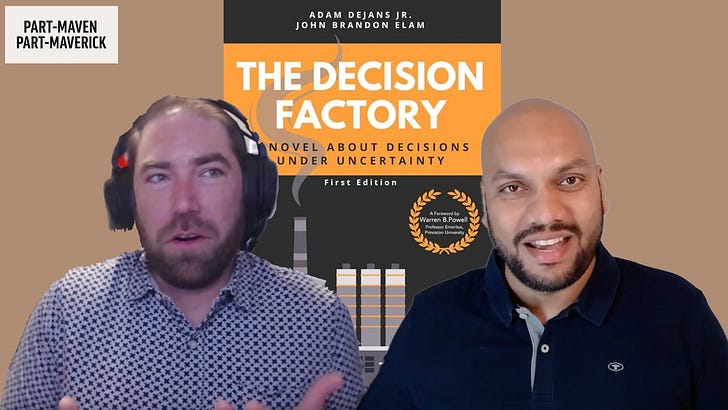
    John Brandon Elam - The Decision Factory: Business Decisions Under Uncertainty

    John Brandon Elam with Adam DeJans Jr., is the bestselling author of “The Decision Factory: A Novel about Decisions Under Uncertainty”. You can follow him here on LinkedIn. In this insightful interview, John Brandon Elam discusses the importance of decision-making in organizations, the limitations of traditional planning, and how to leverage decision systems and policies for better business outcomes. Drawing from his book and influences like Warren Powell and the Phoenix Project, he offers practical frameworks for understanding and improving decision quality.Takeaways:Decisions as the core of enterprise controlLimitations of traditional planning and forecastingDecision systems and policies in organisationsMeasuring decision quality and trade-offsInfluences from Warren Powell and the Phoenix Project If these insights resonate with you, feel free to share the post: Share To know what comes next on Part-Maven Part-Maverick: Subscribe here for early access to future episodes For more of my thoughts, follow me on LinkedIn Get my book Data Impact for a pragmatic take on data-driven value creation This is a public episode. If you would like to discuss this with other subscribers or get access to bonus episodes, visit mavenmaverick.substack.com
  • May 8 · 53 min

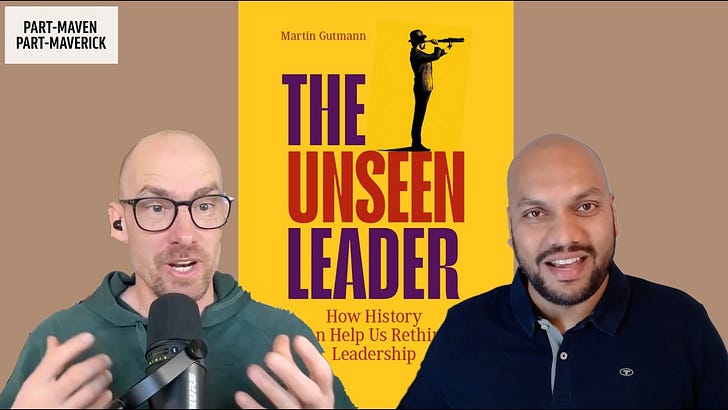
    Martin Gutmann — The Unseen Leader: Why Effective Leadership Matters More Than Ever

    Martin Gutmann is the bestselling author of “The Unseen Leader: How History Can Help Us Rethink Leadership”. You can follow him here on LinkedIn. Martin Gutmann explores the true nature of leadership by analyzing historical examples, challenging the action fallacy, and emphasizing deliberate, outcome-oriented leadership. Discover insights from Shackleton, Amundsen, Gertrude Bell, Toussaint Louverture, Churchill, and more.Key Topics:The action fallacy and its pitfallsHistorical examples of effective leadershipThe importance of deliberate, outcome-focused leadershipThe role of restraint and reflection in leadershipThe impact of unseen, behind-the-scenes leadership If these insights resonate with you, feel free to share the post: Share To know what comes next on Part-Maven Part-Maverick: Subscribe here for early access to future episodes For more of my thoughts, follow me on LinkedIn Get my book Data Impact for a pragmatic take on data-driven value creation This is a public episode. If you would like to discuss this with other subscribers or get access to bonus episodes, visit mavenmaverick.substack.com
  • April 16 · 1 hr 3 min

    Daryl Fairweather — Hate the Game: Economic Cheat Codes for Life, Love, and Work

    Daryl Fairweather is the bestselling author of “Hate the Game: Economic Cheat Codes for Life, Love, and Work”. You can follow her here on LinkedIn. Daryl Fairweather shares insights from her book and personal experiences on navigating a rigged system, leveraging agency, and making strategic life decisions. The conversation covers topics like systemic unfairness, the importance of outside options, and how to play the game of life and career effectively.Key Topics:Systemic unfairness and privilege in the economyThe concept of agency and playing the rigged gameThe importance of outside options in negotiation and careerPersonal stories of overcoming systemic barriersStrategies for making long-term decisions in life and finance If these insights resonate with you, feel free to share the post: Share To know what comes next on Part-Maven Part-Maverick: Subscribe here for early access to future episodes For more of my thoughts, follow me on LinkedIn Get my book Data Impact for a pragmatic take on data-driven value creation This is a public episode. If you would like to discuss this with other subscribers or get access to bonus episodes, visit mavenmaverick.substack.com

  • April 3 · 1 hr 6 min

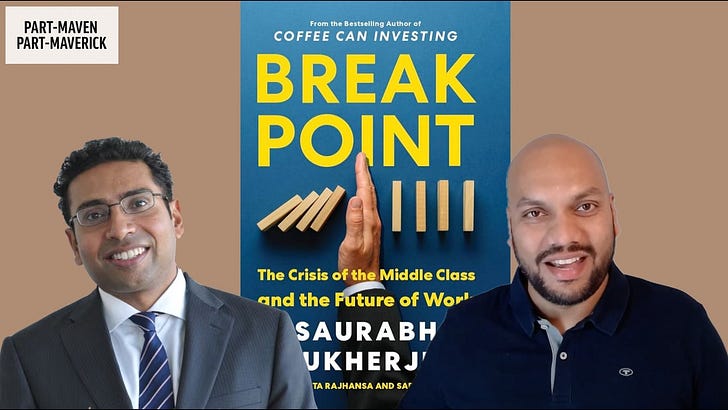
    Saurabh Mukherjea — Breakpoint: The Crisis of the Middle Class and the Future of Work

    Saurabh Mukherjea is the bestselling author of “Breakpoint: The Crisis of the Middle Class and the Future of Work”. You can follow him here on LinkedIn. In this episode, Saurabh Mukherjea and Ritavan explore Saurabh's new book "Breakpoint" and India's unique growth dynamics, its strengths, challenges, and its strategic importance for global investors. Saurabh discusses how India’s demographic, technological, and social shifts are shaping its economic future and what the world can learn from these patterns.Takeaways:Why India matters for global investors and its comparative growth with China and the WestThe transformative power of India's demographic and social reformsRegional disparities within India and their implications for stabilityThe role of women in driving economic growthThe impact of AI and automation on Indian employment and consumptionThe parallels and differences between India’s rise and Western paradigmsThe future of the Indian “Dream” amid technological disruptionsCross-country insights: Europe, Germany, and the global landscape To know what comes next on Part-Maven Part-Maverick: Subscribe here for early access to future episodes For more of my thoughts, follow me on LinkedIn Get my book Data Impact for a pragmatic take on data-driven value creation This is a public episode. If you would like to discuss this with other subscribers or get access to bonus episodes, visit mavenmaverick.substack.com
  • March 19 · 1 hr 7 min

    Ruby Ryba — How To Stop Scrolling: Take Back Control of Your Phone

    Ruby Ryba is the author of How To Stop Scrolling. You can follow her here on LinkedIn. In this practical conversation, Ruby Ryba discusses the pervasive issue of phone use and its impact on our lives and how to fix it. She shares her personal journey of writing a book that challenges the status quo of digital addiction and emphasizes the importance of being present. Ruby provides insights into the economics of attention, the dangers of short-form content, and the need for authenticity in a digital age. The discussion also covers practical strategies for combating phone addiction and fostering intentional living. Chapters:00:00 Introduction to Phone Use and Values02:55 The Impact of Phone Use on Presence05:57 Ruby's Journey and Challenging the Status Quo11:59 The Writing Process and Overcoming Doubts15:02 Attention as Currency in the Digital Age20:51 Strategies for Mindful Phone Use29:45 Understanding the Economics of Attention34:21 The Impact of Phone Presence on Focus35:58 Counterfactual Thinking and Its Effects38:51 Knowledge as Power: Understanding Phone Use39:59 The Evolution of Communication: From Landlines to Smartphones41:48 Reframing Our Relationship with Phones50:59 Strategies for Intentional Phone Use54:46 The Importance of Long-Form Engagement01:00:39 The Dangers of Outsourcing Thought and Experience01:07:40 Authenticity in the Age of Algorithms If these insights resonate with you, feel free to share the post: Next on Part-Maven Part-Maverick, we will speak with venture capitalist Matthew Stafford about 9others. * Subscribe here for early access to future episodes * For more of my thoughts, follow me on LinkedIn * Get my book Data Impact for a pragmatic take on data-driven value creation for businesses in traditional sectors This is a public episode. If you would like to discuss this with other subscribers or get access to bonus episodes, visit mavenmaverick.substack.com

  • March 5 · 1 hr 12 min

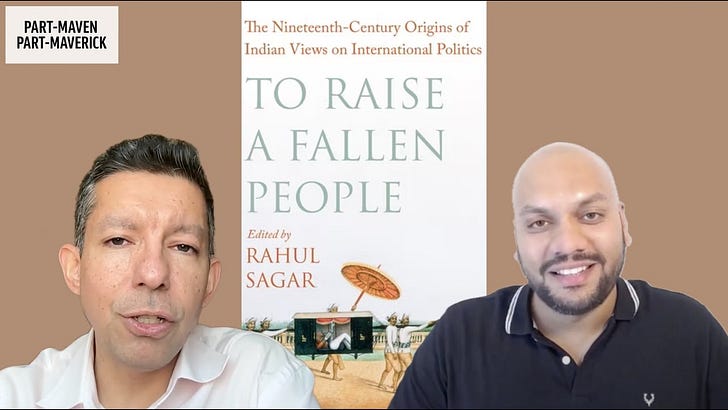
    Rahul Sagar — To Raise A Fallen People: Sources of Indian Governance and Foreign Policy

    Rahul Sagar is the author of To Raise A Fallen People and a Global Network Associate Professor of Political Science at NYU Abu Dhabi. You can follow him here. Ritavan speaks with Prof. Rahul Sagar, author of 'To Raise the Fallen People'. The discussion starts with an overview of Rahul's work, which discovers primary sources and historical texts of Indian writings prior to 1947, emphasizing the deep and sustained debates among Indians about modernity, self-government, and self-rule dating back to the early 1800s. Rahul shares his journey of discovering primary sources scattered globally, which collectively show a vibrant pre-independence Indian public sphere. The conversation then explores a variety of topics including India's scientific legacy, the impact of British colonial economic policies, the significance of the Indian diaspora, and the enduring relevance of these historical discussions today. Rahul argues that India's conservative approach to governance, with its focus on local resilience and non-interference, offers valuable lessons for the modern world. If these insights resonate with you, share the post: * Subscribe here for early access to future episodes * For more of my thoughts, follow me on LinkedIn * Get my Award-Winning Book Data Impact for a pragmatic take on data-driven value creation for businesses in traditional sectors This is a public episode. If you would like to discuss this with other subscribers or get access to bonus episodes, visit mavenmaverick.substack.com
  • February 19 · 44 min

    Chris Borroni-Bird — Sustainable and Affordable Mobility for All: Converging Trends

    Christopher Borroni-Bird is the author of Sustainable and Affordable Mobility for All and a former executive of Waymo, Qualcomm and GM. You can follow him here on LinkedIn. In this conversation, Chris Borroni-Bird discusses the future of mobility, emphasizing the need for affordable and sustainable transportation solutions. He highlights the challenges faced by the automotive industry, including rising costs and the need for innovation in vehicle design. Chris shares his journey through the automotive sector, his insights on solar-powered mobility for developing regions, and the importance of local manufacturing. He also addresses the role of government and the need for alignment among stakeholders to achieve a sustainable future for transportation.Takeaways:Sustainability and affordability in mobility can be aligned.The automotive industry is facing significant challenges.Vehicle design must evolve to meet future needs.Local governments play a crucial role in mobility solutions.Solar-powered vehicles can provide solutions for developing regions.Autonomous vehicles are approaching reality but face hurdles.The importance of local manufacturing for sustainable mobility.Stakeholder alignment is essential for progress in transportation.Government support is critical for the transition to electric vehicles.The future of transport should focus on local solutions. If these insights resonate with you, share the post: * Subscribe here for early access to future episodes * For more of my thoughts, follow me on LinkedIn * Get my book Data Impact for a pragmatic take on data-driven value creation for businesses in traditional sectors This is a public episode. If you would like to discuss this with other subscribers or get access to bonus episodes, visit mavenmaverick.substack.com

  • February 5 · 48 min

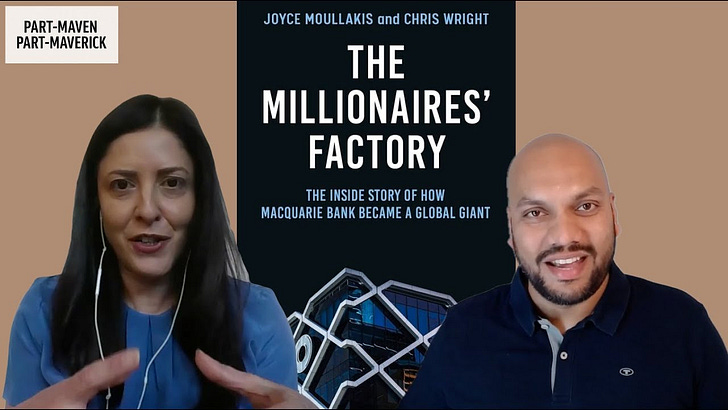
    Joyce Moullakis — The Millionaires' Factory: Macquarie's Story of Global Domination

    Joyce Moullakis is the co-author of The Millionaires’ Factory, the seminal book about Macquarie Bank, and is an Associate Editor at The Australian Financial Review. You can follow her here on LinkedIn. In this conversation, Joyce Moullakis discusses her book on Macquarie, exploring the bank’s unique position in the global financial landscape, its entrepreneurial spirit, and the importance of risk management. Joyce shares her journey as a journalist, the rationale behind writing the book, and insights into Macquarie’s operations, compensation structures, and commitment to sustainability. The discussion highlights key takeaways for business leaders and the broader implications of Macquarie’s success in the financial industry. Takeaways:Joyce Moullakis has over 20 years of experience covering Macquarie.The book was written during the 2021 lockdown as a unique opportunity.Macquarie’s global earnings are significantly derived from outside Australia.The bank’s entrepreneurial spirit has been key to its success.Risk management is central to Macquarie’s operations.The compensation structure at Macquarie incentivizes talent retention.Macquarie’s approach to learning involves accepting initial failures.The bank has successfully navigated the digital banking landscape.Macquarie’s commitment to sustainability is genuine and impactful.The conversation highlights valuable lessons for business leaders. If these insights resonate with you, share the post: * Subscribe here for early access to future episodes * For more of my thoughts, follow me on LinkedIn * Get my book Data Impact for a pragmatic take on data-driven value creation for businesses in traditional sectors This is a public episode. If you would like to discuss this with other subscribers or get access to bonus episodes, visit mavenmaverick.substack.com
  • January 22 · 58 min

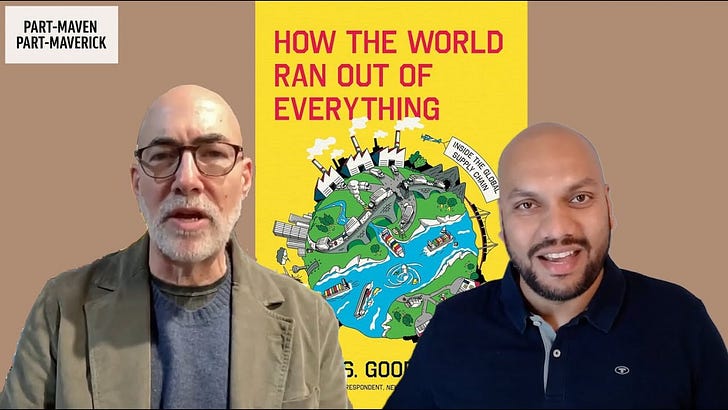
    Peter Goodman — How the World Ran Out of Everything: Inside Global Supply Chains

    Peter Goodman is the author of How the World Ran Out of Everything and the Global Economic Correspondent at The New York Times. You can follow him here on LinkedIn. In this conversation, Peter Goodman, a global economic correspondent for the New York Times, discusses the profound impact of the COVID-19 pandemic on global supply chains and the underlying economic structures that contributed to the crisis. He reflects on his journey as a journalist, the importance of storytelling in understanding complex economic issues, and critiques the lean manufacturing model and its consequences. Goodman emphasizes the need for a balanced approach between government regulation and business innovation, advocating for a more humane treatment of workers and a reevaluation of consumer responsibility in the face of economic inequality. If these insights resonate with you, share the post: * Subscribe here for early access to future episodes * For more of my thoughts, follow me on LinkedIn * Get my book Data Impact for a pragmatic take on data-driven value creation for businesses in traditional sectors This is a public episode. If you would like to discuss this with other subscribers or get access to bonus episodes, visit mavenmaverick.substack.com
  • January 7 · 1 hr 9 min

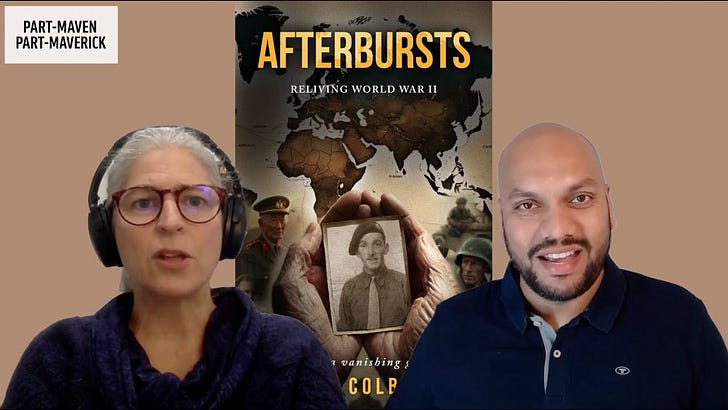
    Lucy Colback — Afterbursts: Voices of WW2

    Lucy Colback is the author of Afterbursts and is a writer on AI, technology and energy. You can follow her here on LinkedIn. In this conversation, Lucy Colback discusses her book 'Afterbursts', which explores the impact of World War II through the voices of veterans and survivors. She emphasizes the importance of oral history in understanding the trauma and experiences of those who lived through the war. The discussion delves into the complexities of historical narratives, the role of propaganda, and the necessity of compassion in human interactions. Lucy shares her journey of writing the book, the challenges of interviewing veterans, and the lessons learned about resilience and understanding in the face of conflict. If these insights resonate with you, feel free to share the post: Next on Part-Maven Part-Maverick, we will speak with Peter Goodman about global supply chains. * Subscribe here for early access to future episodes * For more of my thoughts, follow me on LinkedIn * Get my book Data Impact for a pragmatic take on data-driven value creation for businesses in traditional sectors Thanks for reading Part-Maven Part-Maverick! Subscribe for free to receive new posts and support my work. This is a public episode. If you would like to discuss this with other subscribers or get access to bonus episodes, visit mavenmaverick.substack.com
  • Dec 18, 2025 · 1 hr

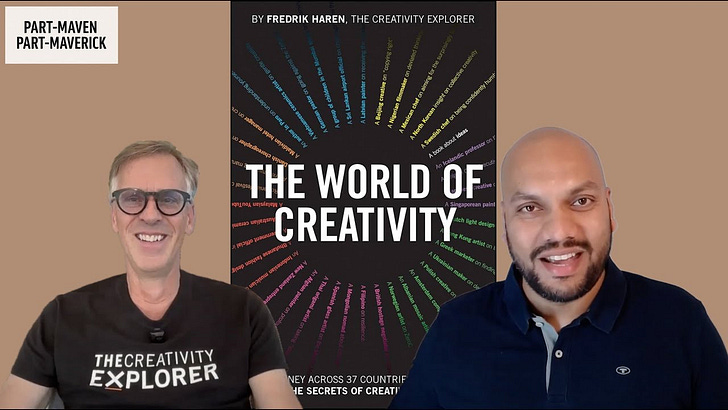
    Fredrik Härén — The World of Creativity: Facets of Human Creativity

    Fredrik Härén is a global keynote speaker and the author of The World of Creativity. You can follow him here on LinkedIn. In this episode, we dive deep into the concept of creativity with our guest, who has traveled to over 37 countries to gain profound insights. We discuss the importance of understanding the creative process to become more creative, the impact of cultural perspectives on creativity, and the balance between curiosity and focus. Fredrik shares personal stories and lessons learned from global experiences, including encounters with creatives in unexpected places like North Korea. We explore the role of authenticity and the unique processes that drive individual creativity. Join us on this fascinating journey of self-discovery and global exploration of creativity. You can pre-order the book across most markets. USA: https://a.co/d/g1dw9x4 UK: https://www.amazon.co.uk/dp/1907312897 US: https://www.amazon.com/dp/1907312897 Sweden: https://www.bokus.com/bok/9781907312892/world-of-creativity/ Germany: https://www.amazon.de/dp/1907312897 Australia: https://www.amazon.com.au/dp/1907312897 Singapore: https://singapore.kinokuniya.com/bw/9781907312892 If these insights resonate with you, feel free to share the post: Next on Part-Maven Part-Maverick, we will speak with Peter Goodman about How The World Ran Out of Everything. * Subscribe here for early access to future episodes * For more of my thoughts, follow me on LinkedIn * Get my book Data Impact for a pragmatic take on data-driven value creation for businesses in traditional sectors This is a public episode. If you would like to discuss this with other subscribers or get access to bonus episodes, visit mavenmaverick.substack.com
  • Dec 4, 2025 · 1 hr 7 min

    Bogumil Baranowski — Money, Life, Family: Infinite Investing & Forgotten Money

    Bogumil Baranowski is the host of the Talking Billions podcast and author of Money, Life, Family, Outsmarting the Crowd and other books and an investment advisor to wealthy families and individuals. You can follow him here on LinkedIn. In this episode, Bogumil Baranowski shares his journey from growing up in communist Poland to becoming a successful investor in New York. He discusses the impact of his upbringing on his perspective on wealth, the importance of curiosity and exploration, and the role of women in family fortunes. Bogumil also reflects on the lessons learned from his grandparents, the significance of service, and the concept of ‘forgotten money.’ The conversation delves into the challenges of managing wealth, the value of crises, and the pursuit of purpose beyond financial success. Takeaways: * Seeing the world differently can open your eyes to new opportunities. * Investing is about long-term ownership of businesses, not gambling. * Understanding the people behind portfolios is crucial in wealth management. * Curiosity and exploration drive personal and professional growth. * Women have played a significant role in maintaining family fortunes. * Service to others is a key component of a fulfilling life. * ‘Forgotten money’ is capital that can be invested long-term without immediate need. * Crises can be opportunities for growth and renewal. * True wealth encompasses mindset, process, relationships, and legacy. * Purpose in life can be found in small, meaningful actions. If these insights resonate with you, feel free to share the post: Next on Part-Maven Part-Maverick, we will speak with Fredrik Härén about The World of Creativity. * Subscribe here for early access to future episodes * For more of my thoughts, follow me on LinkedIn * Get my book Data Impact for a pragmatic take on data-driven value creation for businesses in traditional sectors Thanks for reading Part-Maven Part-Maverick! Subscribe for free to receive new posts and support my work. This is a public episode. If you would like to discuss this with other subscribers or get access to bonus episodes, visit mavenmaverick.substack.com
  • Nov 20, 2025 · 46 min

    Brett Gardner — Buffett's Early Investments: 10 Companies

    Brett Gardner is the author of Buffett’s Early Investments and an investment analyst. You can follow him here on LinkedIn. In this episode of Part-Maven Part-Maverick, we dive into the world of Warren Buffett’s early investments with Brett Gardner the insightful author of a well-researched book on the topic. The discussion covers Brett’s motivation for writing the book, his meticulous research process, and the valuable lessons learned from studying Buffett’s investment strategies. We also explore the challenges of writing, the influence of role models like Charlie Munger, and the evolution of investing philosophies over time. Brett shares personal anecdotes, including his educational journey and career in investment, shedding light on the importance of judgment, character, and trust in the world of value investing. This episode is a treasure trove for anyone interested in investment strategies, financial history, and the personal development of legendary investors. If these insights resonate with you, feel free to share the post: Next on Part-Maven Part-Maverick, we will speak with Bogumil Baranowski about Wealth and Life. * Subscribe here for early access to future episodes * For more of my thoughts, follow me on LinkedIn * Get my book Data Impact for a pragmatic take on data-driven value creation for businesses in traditional sectors This is a public episode. If you would like to discuss this with other subscribers or get access to bonus episodes, visit mavenmaverick.substack.com
Showing 1–20 of 20 episodes