Skip to content
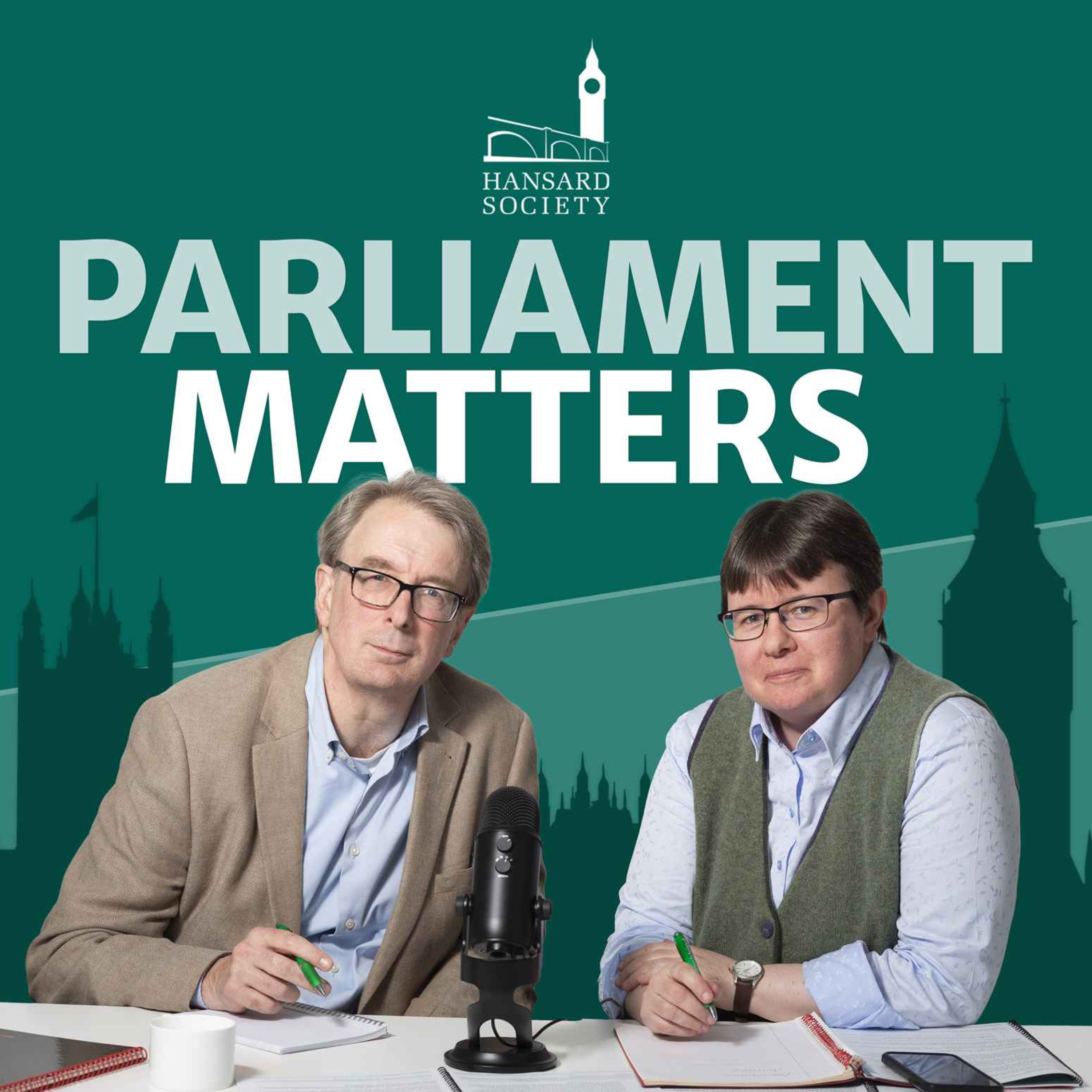
Artwork for Parliament Matters
GovernmentNewsPolitics

Parliament Matters

Hansard Society

Join two of the UK's leading parliamentary experts, Mark D'Arcy and Ruth Fox, as they guide you through the often mysterious ways our politicians do business and explore the running controversies about the way Parliament works. Each week they will analyse how laws are made and ministers held accountable by the people we send to Westminster. They will be debating the topical issues of the day, looking back at key historical events and discussing the latest research on democracy and Parliament. Why? Because whether it's the taxes you pay, or the laws you've got to obey... Parliament matters!


Mark D'Arcy was the BBC's parliamentary correspondent for two decades. Ruth Fox is the Director of the parliamentary think-tank the Hansard Society.


Parliament Matters is a Hansard Society production supported by the Joseph Rowntree Charitable Trust Founding producer Luke Boga Mitchell; episode producer Richard Townsend.


Hosted on Acast. See acast.com/privacy for more information.

Play
  • 25 episodes
  • weekly
  • Avg 57 min
  • English
Counted on this page — what you have heard stays on this device, so it is not something the list can be paged by.
  • S1 · E156
    September 11 · 53 min

    MPs reject the assisted dying bill: What happened, and what next?

    MPs have rejected the assisted dying bill – but why did a proposal they had previously supported lose this time, and what happens now? Andrew Lewin MP, a supporter of the bill, hot-foots it from the Chamber to give us his immediate reaction. He describes the atmosphere when the result was announced, offers his explanation for the bill’s defeat and considers whether and how the campaign to change the law might continue. Back in the studio, Hansard Society researcher Matthew England joins us to crunch the numbers. Turnout proved crucial to the final result: was the bill defeated because MPs changed their minds, or because previous supporters stayed away? We explore why support has slowly ebbed in the Commons and examine the substantive and procedural problems that confronted the bill. Could there now be a backlash against the House of Lords over the role Peers played in derailing the legislation? Might the Commons seek to curb the Upper House’s powers or was the Lords simply doing its job by scrutinising a deeply consequential and technically complex bill? And with this latest proposal defeated, is assisted dying now off Parliament’s agenda for the foreseeable future? Plus, Nigel Farage told Reform UK’s conference that he would declare a “national emergency” over the small boats crisis. But would such a declaration actually give a Prime Minister any additional legislative powers? And Lee Anderson accused MPs of being lazy and suggested that, under a Reform government, Parliament would sit seven days a week to force through its legislative programme. What would that mean in practice for the management – and, more importantly, the scrutiny – of parliamentary business? Would MPs, officials and the wider parliamentary machinery be able to sustain it? And even if legislation were driven rapidly through the Commons, what would happen when it reached the House of Lords? ______ 🎓 Learn more using our resources for the issues mentioned in this episode. ❓ Send us your questions about Parliament: ✅ Subscribe to our newsletter. 📱 Follow us across social media @HansardSociety / @hansardsociety.bsky.social £ - Support the Hansard Society and this podcast by making a donation today. Parliament Matters is a Hansard Society production supported by the Joseph Rowntree Charitable Trust. Presenters: Mark D’Arcy and Ruth Fox Producer: Richard Townsend Hosted on Acast. See acast.com/privacy for more information.

  • S1 · E155
    September 3 · 56 min

    Andy Burnham’s rewired state: Can Parliament provide the circuit breaker?

    Andy Burnham made his despatch box debut as Prime Minister in the House of Commons this week with one of the longest ministerial statements on record and a promise to strengthen the Prime Minister’s grip on Whitehall while transferring power and resources away from it. We examine the new Office of the Prime Minister and Cabinet and No. 10 North. Are they instruments of genuine decentralisation or a more powerful prime-ministerial centre with a Manchester outpost? If Burnham wants Parliament to become the country’s “circuit breaker”, what powers, information and resources will MPs need to do the job? We also ask whether “Parliament, not the courts” means clearer ministerial responsibility or executive power that is harder to challenge and what it all might mean for the future of judicial review. And will devolution without stronger scrutiny simply create powerful mayors and council leaders with weak legislative checks? Plus: Keir Starmer leaves Parliament, Labour MPs contest three select committee chairships, and more than 6,000 written parliamentary questions land after the summer recess. At an estimated £219 each, why are a handful of MPs generating such a large bill and is it time for a recess cap? _____ 🎓 Learn more using our resources for the issues mentioned in this episode. ❓ Send us your questions about Parliament: ✅ Subscribe to our newsletter. 📱 Follow us across social media @HansardSociety / @hansardsociety.bsky.social £ - Support the Hansard Society and this podcast by making a donation today. Parliament Matters is a Hansard Society production supported by the Joseph Rowntree Charitable Trust. Presenters: Mark D’Arcy and Ruth Fox Producer: Richard Townsend Hosted on Acast. See acast.com/privacy for more information.

  • S1 · E154
    August 20 · 41 min

    Joanna Cherry: The SNP, Westminster, and a decade of political battles

    Joanna Cherry joins us this week to discuss her newly published memoir, in which she looks back on some of the most contentious battles in British and Scottish politics in the last two decades. She arrived at Westminster in 2015 as one of 56 SNP MPs elected in a historic landslide that transformed Scottish politics and made the SNP the third-largest party in the House of Commons. She describes the excitement – and occasional hostility – that greeted the new contingent and explains why her experience at Westminster left her believing that the Scottish Parliament could learn a lot from the Commons, particularly when it comes to cross-party working, debate, dissent, and committee scrutiny. One of the central arguments of Cherry’s memoir is that the SNP repeatedly failed to exploit moments of political leverage and that it pursued the wrong strategy for securing another Scottish independence referendum after the loss in 2014. She sets out what she thinks the party could have done differently and why she believes support for independence has now become increasingly detached from support for the SNP itself. Her national profile grew dramatically during the Brexit years. As a constitutional lawyer, Cherry became the lead petitioner in the Scottish legal challenge to Boris Johnson’s 2019 prorogation of Parliament. She explains why the case was brought in Scotland, why she believed the challengers would ultimately win, and what it felt like when the Supreme Court unanimously ruled the prorogation unlawful. The conversation also turns to the bitter internal disputes that marked Cherry’s later years in the SNP. She discusses her relationship with Nicola Sturgeon, her concerns about the SNP’s governance and finances, the treatment of her former mentor Alex Salmond, and the fierce arguments over reform of Scotland’s gender recognition laws. Having lost her seat at Westminster in 2024 and subsequently left the SNP, is Joanna Cherry finished with frontline politics? Perhaps not. She doesn’t rule out a return under a new party leader and a new culture of independent thinking. 🎓 Learn more using our resources for the issues mentioned in this episode. ❓ Send us your questions about Parliament: ✅ Subscribe to our newsletter. 📱 Follow us across social media @HansardSociety / @hansardsociety.bsky.social £ - Support the Hansard Society and this podcast by making a donation today. Parliament Matters is a Hansard Society production supported by the Joseph Rowntree Charitable Trust. Presenters: Mark D’Arcy and Ruth Fox Producer: Richard Townsend Hosted on Acast. See acast.com/privacy for more information.

  • S1 · E147
    June 19 · 1 hr 6 min

    Andy Burnham’s March on Westminster: How Could He Become Prime Minister?

    Three by-elections delivered three very different results this week. To discuss the implications, we are joined by Professor Philip Cowley, a leading expert on MPs, party discipline and the realities of parliamentary power. The Conservatives secured their first Scottish by-election victory since 1967, taking Aberdeen South from the SNP. Meanwhile, the SNP held on in Arbroath and Broughty Ferry, limiting the damage from what could have been a bruising night. But it is Andy Burnham’s Labour victory in Makerfield that could have the biggest long-term consequences for British politics. We examine the political and parliamentary choreography required as Burnham begins his march back to Westminster, and we assess whether a carefully managed transition from Keir Starmer is possible, or even desirable. Are we witnessing the opening moves in a political dance of death between a sitting Prime Minister and the man many now see as his likely successor? And if Labour’s leadership question is approaching a decisive moment, which historical precedent is most relevant? Will it resemble the swift but dignified end of Margaret Thatcher’s premiership; the chaotic collapse of Boris Johnson’s government; or the slower, more managed departure of Theresa May? We explore the strategic arguments for and against a full Labour leadership contest. Would a competitive election strengthen Burnham’s authority and legitimacy, or expose divisions within the party at precisely the wrong moment? How much influence will Labour’s members, affiliates, and MPs have over the process? And would Burnham be better served by assuming the leadership quickly, or by using a managed transition to develop a governing programme and build a team around him? We also discuss the challenges Burnham could face if he does reach Number 10. Despite his prominence, relatively little is known about how he would govern nationally. What difficulties might he encounter in managing the parliamentary party? And what would a change in leadership mean for the wider workings of Parliament, from ministerial reshuffles to the balance of power across the select committee corridor? Finally, attention turns to Parliament’s agenda. The priority order for Private Members’ Bills in both the Commons and Lords is now clear. MPs will return to the assisted dying bill on 11 September, but it enters the new session only second in the queue rather than first. What difference could that make to the parliamentary tactics surrounding the legislation? And which other Private Members’ Bills deserve close attention in the months ahead? _______________ 🎓 Learn more using our resources for the issues mentioned in this episode. ❓ Send us your questions about Parliament: ✅ Subscribe to our newsletter. 📱 Follow us across social media @HansardSociety / @hansardsociety.bsky.social £ - Support the Hansard Society and this podcast by making a donation today. Parliament Matters is a Hansard Society production supported by the Joseph Rowntree Charitable Trust. Presenters: Mark D’Arcy and Ruth Fox Producer: Richard Townsend Hosted on Acast. See acast.com/privacy for more information.

  • S1 · E142
    May 15 · 1 hr 13 min

    Labour’s leadership tangle: What does it mean for Parliament?

    A battle for Downing Street touched off by a ministerial resignation, a chunky new King’s Speech, and an increasingly unpredictable political environment provide plenty for us to discuss with our special guest, Professor Meg Russell, the former Director of the Constitution Unit. We begin with the Labour leadership contest, which was unfolding in real time as the podcast was recorded. With Labour Party rules, parliamentary rules and election law tangling together in the intricate battle to be Prime Minister, we explore how Labour’s rulebook could shape the outcome and the prospects for the Mayor of Greater Manchester, Andy Burnham to win a by-election, return to Westminster and enter the leadership race. Meg Russell asks a broader question: in an era of devolved politics, should parties make it easier for big figures such as metro mayors to stand for the leadership without the upheaval of first fighting a by-election? We also cast a preliminary eye over the legislation unveiled in the King’s Speech. Could the NHS Reform Bill give Wes Streeting a parliamentary platform to strengthen his credentials as a future Prime Minister? How will the new bill to remove peerages navigate the difference between a seat in the House of lords and a peerage? Should the Representation of the People Bill be amended to impose penalties on councillors who resign within hours of being elected? And Meg – a former advisor to Blair-era Leader of the House of Commons, Robin Cook MP – describes how governments assemble a legislative programme behind the scenes. Finally, with Britain entering an era of fragmented five, or even six-party politics, the discussion turns to the future of the constitution itself. Do Westminster parties now share an interest in recasting parliamentary rules and strengthening constitutional safeguards? Meg Russell, stepping down after a decade leading the Constitution Unit, argues that the unpredictability of the electoral situation means any party could emerge dominant, diminished or anywhere in between, after the next election. If that is the case, she suggests, it is now in the interests of all the parties to update the rules of our parliamentary system so that it treats all parties fairly. Some of these issues, including how parties select their leaders and the way legislation is developed, will be discussed next month (24-25 June) at the Constitution Unit's annual online conference, The Constitution under Labour. You need to sign up to get the online link to watch each of the sessions. Parliament Matters will be represented as Ruth will be speaking on a panel with Lord Falconer about developing policy and legislating for difficult issues. ____ 🎓 Learn more using our resources for the issues mentioned in this episode. ❓ Send us your questions about Parliament: ✅ Subscribe to our newsletter. 📱 Follow us across social media @HansardSociety / @hansardsociety.bsky.social £ - Support the Hansard Society and this podcast by making a donation today. Parliament Matters is a Hansard Society production supported by the Joseph Rowntree Charitable Trust. Presenters: Mark D’Arcy and Ruth Fox Producer: Gareth Jones Hosted on Acast. See acast.com/privacy for more information.

  • S1 · E140
    April 24 · 1 hr 11 min

    Keir Starmer’s week of parliamentary torture over Mandelson appointment

    Keir Starmer has faced “ordeal by Parliament” this week. A tense statement in the House of Commons over his handling of Peter Mandleson’s nomination as Ambassador to the United States was followed by an emergency debate and then an awkward session of PMQs. Meanwhile the Foreign Affairs Committee held a series of hearings to pick over the PM’s account of what he knew about Mandelson’s security vetting, and when he knew it. We are joined this week by veteran parliamentary lobby journalist Tony Grew (the founder of @PARLYapp on Twitter/X) to dissect a rapidly unfolding political drama that’s beginning to resemble a full-blown parliamentary crisis. We examine Starmer’s account, the Foreign Affairs Committee’s performance, and the testimony of its key witness, recently sacked Foreign Office Permanent Secretary Sir Ollie Robins, alongside the growing unease among Labour MPs. With prorogation looming, questions remain over timing. Could the suspension of Parliament be used to sidestep another PMQs on Wednesday 29 March? Will the Opposition try to prolong proceedings on remaining legislation to force Starmer back to the Despatch Box. Or might they prefer to be able to accuse him of being “frit.” And as the first session of the 2024 Parliament draws to a close, we discuss the emerging personalities shaping the Commons. Spoiler: one of them is a dog! ____ 🎓 Learn more using our resources for the issues mentioned in this episode. ❓ Send us your questions about Parliament: ✅ Subscribe to our newsletter. 📱 Follow us across social media @HansardSociety / @hansardsociety.bsky.social £ - Support the Hansard Society and this podcast by making a donation today. Parliament Matters is a Hansard Society production supported by the Joseph Rowntree Charitable Trust. Presenters: Mark D’Arcy and Ruth Fox Producer: Richard Townsend Hosted on Acast. See acast.com/privacy for more information.
Showing 1–20 of 25 episodes