Skip to content
Artwork for New Books in Russian and Eurasian Studies

New Books in Russian and Eurasian Studies

New Books Network

This podcast is a channel on the New Books Network. The New Books Network is an academic audio library dedicated to public education. In each episode you will hear scholars discuss their recently published research with another expert in their field.

Discover our 150+ channels and browse our 28,000+ episodes on our website: ⁠newbooksnetwork.com⁠

Subscribe to our free weekly Substack newsletter to get informative, engaging content straight to your inbox: ⁠https://newbooksnetwork.substack.com/⁠

Follow us on Instagram and Bluesky to learn about more our latest interviews: @newbooksnetwork
Support our show by becoming a premium member! https://newbooksnetwork.supportingcast.fm/russian-studies

Play
  • 27 episodes
  • Avg 56 min
  • English
Counted on this page — what you have heard stays on this device, so it is not something the list can be paged by.
  • #2023
    Today · 46 min

    Tamara Hundorova, "Transit Culture and Postcolonial Trauma" (Academic Studies Press, 2026)

    Transit Culture and Postcolonial Trauma (Academic Studies Press, 2026) explores transitional post-Soviet cultural consciousness in Ukraine at the beginning of the twenty-first century. The main themes in the book are postcolonial traumas in relation to past empires and old historiographical narratives; post-totalitarian consciousness, which is characterized by sociocultural ruptures, postcolonial resentment, and intergenerational crises; and post-memory as a means of overcoming historical and fa

  • #1040
    Wednesday · 55 min

    David L Hoffmann, "Women, Gender, and Socialist Ideology in Soviet Russia" (Routledge, 2026)

    Women, Gender, and Socialist Ideology in Soviet Russia (Routledge, 2026) examines the place of women in Soviet Russia from the 1917 Revolution through the post-World War II period, discussing how the Soviet construction of gender perpetuated inequality even as it dramatically expanded women’s roles in society. Chapters of this book explore Bolshevik activists’ ideals of women’s liberation and their failure to realize these ideals; the significance of women’s labor to the Soviet economy, along

  • #1039
    September 4 · 34 min

    Nikhil Kalyanpur, "Legal Weapons of the Wealthy: The Offshoring of Elite Conflict in Emerging Markets" (Cornell UP, 2026)

    In Legal Weapons of the Wealthy: The Offshoring of Elite Conflict in Emerging Markets (Cornell University Press, 2026), Dr. Nikhil Kalyanpur examines a striking feature of today's global legal order: the use of foreign courts by elites to settle domestic disputes. On the surface, the "outsourcing" of disputes by elites from countries with fragile judiciaries looks like a search for fair treatment unavailable at home. Yet extraterritorial dispute resolution varies across such countries. Rus

  • #1038
    August 30 · 1 hr 6 min

    Tom Trier, "Blue Sea, Black Gold, Red Banner: The South Caucasus and Scandinavia, 1880s–1920s" (Northern Illinois UP, 2026)

    Blue Sea, Black Gold, Red Banner: The South Caucasus and Scandinavia, 1880s–1920s (Northern Illinois University Press, 2026) tells the story of the historical connections between two geographically distant and culturally distinct regions on the edges of Europe: Scandinavia and the South Caucasus. From the late nineteenth century, maritime trade fostered new commercial links and consular relations. Scandinavian merchants, particularly in Batumi and Baku, played key roles. The discovery of o

  • #1037
    August 29 · 1 hr

    Reinhold Kramer and Tom Mitchell, "'PS: Burn after Reading': The Kellock-Taschereau Commission and Soviet Espionage" (U Toronto Press, 2026)

    After Soviet cipher clerk Igor Gouzenko defected in 1945, Canada was shocked by the revelation that its own citizens were engaged in espionage for the Soviet Union. "P.S. Burn after Reading": The Kellock-Taschereau Commission and Soviet Espionage in Canada (University of Toronto Press, 2026) explores how the Canadian government used the controversial Kellock-Taschereau Commission—sometimes judiciously, sometimes not—to uncover and thwart domestic spies during the early days of the Cold W

  • #1036
    August 27 · 48 min

    Ukrainian Men Fleeing Conscription: A Discussion with Writer Dan Storyev

    Our conversation focuses on a groundbreaking article by Dan Storyev recently published in The Nation: “Millions of Ukrainian Men Are Fleeing a Cruel Conscription System.” Storyev was on the ground in Odesa to report firsthand for this piece, drawing on encounters with Ukrainian men in flight from the officers of the Ukrainian state agency, known as TCR, in charge of mobilizing fighting-age men for the war in Ukraine against Russia’s invading army. It’s an important story, yet one, as he told me,

  • #1035
    August 25 · 51 min

    After Putin: A Discussion with Political Scientist Julian G. Waller
    Russian leader Vladimir Putin, at 73 years old, is still very much alive, yet the “After Putin” conversation is an active one inside and outside of Russia. What could come next and how to think about that question? My guest is Julian G. Waller, a political scientist at George Washington University and author of a recent Foreign Affairs article “After Putin: Russia’s Coming Succession Crisis.” In our discussion, Waller anchors the “After Putin” question in historical context, as to how succession

  • #1034
    August 13 · 54 min

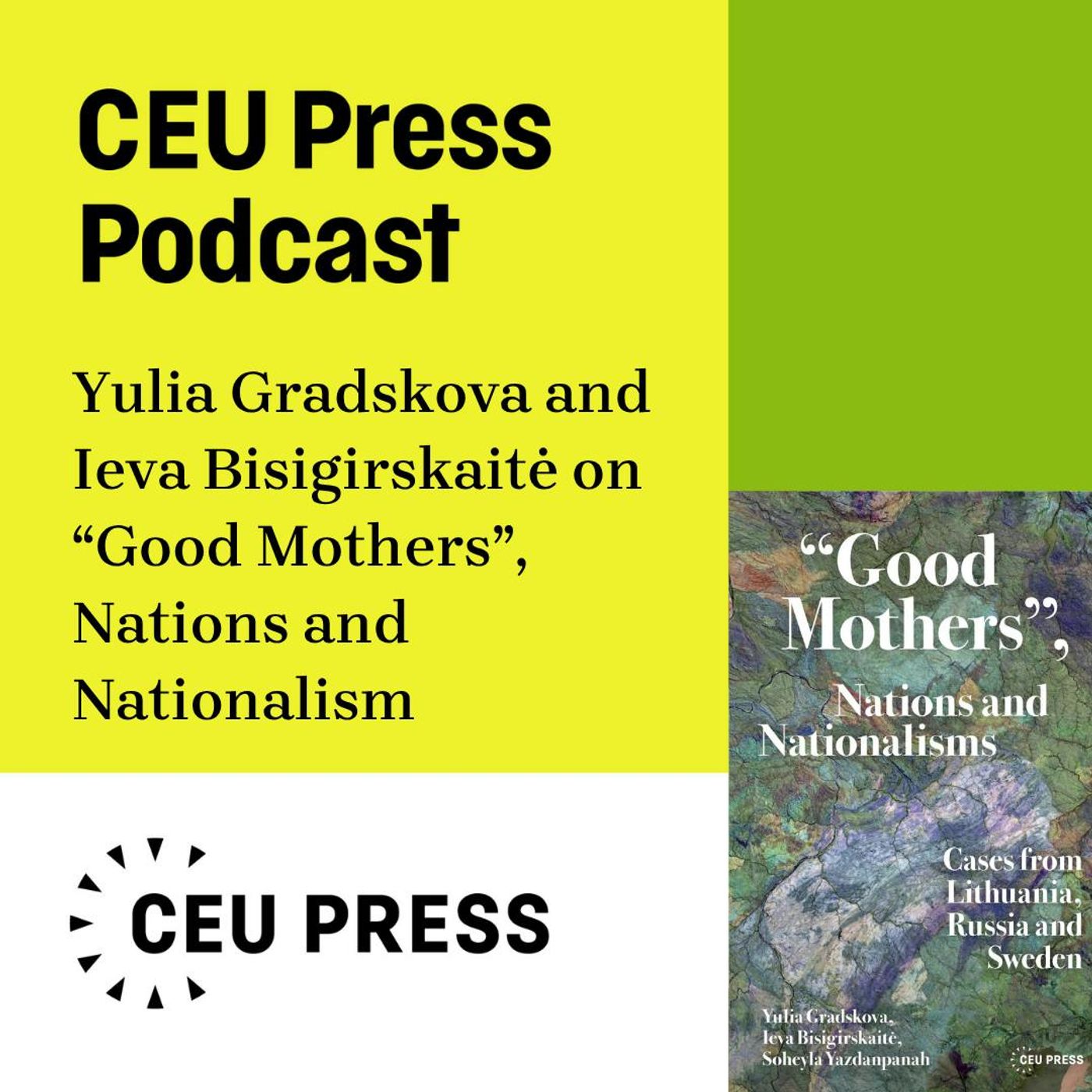
    Yulia Gradskova et al., "Good Mothers, Nations and Nationalisms: Cases from Lithuania, Russia and Sweden" (CEU Press, 2026)

    In this episode, host Andrea Talabér (CEU Press, 2026) talks with Yulia Gradskova and Ieva Bisigirskaitė, two of the three authors behind Good Mothers, Nations and Nationalisms: Cases from Lithuania, Russia and Sweden. Together with Soheyla Yazdanpanah, they explore what nationalists mean by "good mothers," demographic anxiety, and maternal activism in Lithuania, Russia and Sweden. You can purchase a copy here. The CEU Press Podcast delves into various aspects of the publishing process: from c

  • #1033
    August 9 · 58 min

    Marisa Karyl Franz, "Near and Desired Things: Shamanism in Late Imperial Local Siberian Museums" (Cornell UP, 2026)

    Near and Desired Things: Shamanism in Late Imperial Local Siberian Museums (Cornell University Press, 2026) reveals nineteenth-century Siberian museums, built on Indigenous land and increasingly populated by political exiles, as active sites of ethnographic knowledge-making and centers of scientific research, regional identity, and colonial authority. Rather than collecting from distant colonies, these institutions concentrated on surrounding communities, their tools, beliefs, and everyday lives

  • #1031
    August 8 · 57 min

    Russia’s Jews in World War I

    When World War I began, the Russian Empire was home to more than 5.7 million Jews, the most densely settled Jewish population in the world. Thirty years later, by 1945, only remnants of this civilization remained. The years of World War I, from 1914 to 1918, launched nearly all the forces that led to this epic destruction. In A Nation of Refugees: Russia's Jews in World War I, Polly Zavadivker tells how Jewish civilians experienced that war and its epicenter of violence on the Eastern Front. Wo

  • #1032
    August 8 · 1 hr 1 min

    Yana Skorobogatov, "Fate in My Hands: The Death Penalty in the Soviet Union" (U Chicago Press, 2026)

    In this episode, Alisa interviews Dr. Yana Skorobogatov about her book, Fate in My Hands: The Death Penalty in the Soviet Union (University of Chicago Press, 2026). From 1954 to 1991 in the Soviet Union, nearly 40,000 citizens were executed after the death penalty was reinstated as a punishment for homicide. Fate in My Hands introduces readers to the many citizens in this period—women and men of all ages and backgrounds—who found themselves on death row and tried to escape it in the only w

  • #1030
    August 2 · 1 hr 2 min

    Luca Anceschi, "Pandemic Politics in Central Asia: Authoritarian Contagion" (Routledge, 2026)

    Pandemic Politics in Central Asia: Authoritarian Contagion (Routledge, 2026) examines how the authoritarian regimes of Kazakhstan, Turkmenistan, and Uzbekistan exploited the Covid-19 pandemic to consolidate their political control over Central Asia. Through restrictive policies and strategic manipulation, these governments reshaped the region's politics and societies during 2020-2022. This volume offers readers an insight into three key areas where Central Asia's pandemic power grab was most vi

  • #1029
    August 1 · 56 min

    Magdalena E. Stawkowski, "Atomic Collective: Radioactive Life in Kazakhstan" (U Toronto Press, 2025)

    In the aftermath of the Soviet Union's collapse, Kazakhstan inherited the remnants of one of the world's most contaminated landscapes: the Semipalatinsk Test Site, known locally as the Polygon. Resigned to dispossession, residents have chosen to remain on the abandoned nuclear test site, despite the isolation and the radioactive environment, rather than face marginalization or the rigors of a neoliberal world. Atomic Collective: Radioactive Life in Kazakhstan (University of Toronto Press, 2025)

  • #1028
    July 31 · 42 min

    Anthony J. Barbieri-Low, "Parallel Journeys: Eurasian History Through Travelers’ Eyes (400 BCE–1936 CE)" (Cambria, 2025)

    Parallel Journeys: Eurasian History through Travelers’ Eyes (Cambria Press, 2026) is a comparative history of Eurasia told through travel writing and cross-cultural encounters. In this anthology, Anthony Barbieri pairs accounts from twenty-eight travelers across different historical periods, placing side-by-side travelers looking or going East with those looking or going West. Spanning from 400 BCE through to 1936, the anthology brings together ambassadors, monks, missionaries, merchants, and jo

  • #1026
    July 28 · 21 min

    Anna Lively, "Revolutionary Connections: Russia and Ireland, 1905-1923" (Oxford UP, 2026)

    Anna Lively is a historian of modern Ireland, Britain, and Russia. Awarded her PhD in History from the University of Edinburgh in 2022, she is currently a Leverhulme Early Career Fellow in History at the University of Strathclyde. Prior to this she held the Roy Foster Irish Government Research Fellowship in the History and Culture of Ireland at Hertford College, University of Oxford, and was a Teaching Fellow in Modern History at the University of Aberdeen. She has published in multiple journals

  • #1027
    July 28 · 59 min

    On Who Blew Up Nord Stream: A Conversation with Author Bojan Pancevski

    The September, 2022 attack on the Nord Stream pipelines transporting Russian gas to Germany was perhaps the greatest single act of sabotage in modern history. In The Nord Stream Conspiracy: The Inside Story of the Explosions that Shook the World (Henry Holt, 2026), Bojan Pancevski makes a compelling case that the culprit was an intrepid team of Ukrainian intelligence agents, military personnel and civilian divers. In our conversation, he explains how he came to this conclusion. And we touch on t

  • #1025
    July 26 · 1 hr 6 min

    Victoria Donovan, "Life in Spite of Everything: Tales from the Ukrainian East" (Daunt Books, 2025)

    Life in Spite of Everything: Tales from the Ukrainian East (Daunt Books Publishing, 2025) is a unique reflection on the much-mythologised Donetsk and Luhansk regions of the Ukrainian east, the old and recent history of the region as seen by an esteemed academic multi-disciplinary scholar Victoria Donovan in her numerous travels to the region prior to the full-scale invasion. Seen through a deeply empathetic lens of conversations with local curators, historians, museum workers, and artists,

  • #1024
    July 25 · 40 min

    Galina Bogatova, "Casting War As Love: Russian Colonialism in Familial Terms" (Palgrave Macmillan, 2026)

    Casting War As Love: Russian Colonialism in Familial Terms (Palgrave Macillan, 2026) by Dr. Galina Bogatova unpacks the hidden imperial logic behind Russia’s dominance over its neighbors, revealing how the Kremlin weaponizes "familial system" myths to justify control, including its full-scale invasion of Ukraine. From the Tsarist empire to Putin’s digital propaganda, Dr. Bogatova examines how Russia portrays itself as a disciplining “father,” a self-sacrificing “mother,” or an “elder brot

  • #1023
    July 22 · 1 hr 18 min

    Martin Shaw, "The New Age of Genocide: Intellectual and Political Challenges After Gaza" (Agenda Publishing, 2025)

    The Israeli destruction of Gaza has returned the idea of genocide to the center of world politics, with sharp conflicts between the protesters and lawyers who invoke it and the governments and media that deny it. The New Age of Genocide: Intellectual and Political Challenges After Gaza (Agenda Publishing, 2025), by the foremost sociological theorist of genocide, Martin Shaw, defends the idea against thinkers who have questioned it, and argues that it is essential to the understanding of m

  • #1021
    July 11 · 1 hr 2 min

    Diana T. Kudaibergen, "What Does It Mean to Be Kazakhstani?: Power, Identity and Nation-Building" (Oxford UP, 2024)

    In early 2022, protests rocked Kazakhstan. Initially peaceful demonstrations turned violent after brutal government crackdowns, leaving at least 238 dead during "Bloody January." Many feared the unrest might fracture the country along ethno-linguistic lines—yet ethnicity played little role. It was deep socio-economic grievances and anti-regime sentiment that brought people onto the streets. In What Does It Mean to Be Kazakhstani?: Nation-Building in Post-Soviet Central Asia (Oxford University Pr

Showing 1–20 of 27 episodes