Skip to content
Artwork for Medieval Death Trip
ArtsBooksSociety & CultureEducation

Medieval Death Trip

Medieval Death Trip

A podcast exploring the wit and weirdness of medieval texts

Play
  • 20 episodes
  • monthly
  • Avg 52 min
  • English
  • #124
    August 16 · 1 hr 16 min

    Kormak's Saga (Part 1)

    We inaugurate our first "Saga Summer" a bit late this year, but starting with an early poet's saga, a tale of love and betrayal, duels and magic. This is Part 1 (of 4) of Kormak's Saga. Today's Texts: The Life and Death of Cormac the Skald. Translated by W.G. Collingwood and J. Stefansson. Viking Club Translation Series, no. 1., Wm Holmes, Ltd., 1902. Google Books. Kormáks saga. Icelandic Saga Database, edited by Sveinbjorn Thordarson, 2007. https://www.sagadb.org/kormaks_saga.is. Egil's Saga. Translated by W.C. Green, 1893. Internet Sacred Texts Archive. Egil's Saga. Translated by Hermann Pálsson and Paul Edwards, Penguin, 1976. Egil's Saga. Translated by Bernard Skudder, The Sagas of Icelanders: A Selection, Penguin, 2001, pp. 3-184. Chapters 00:00:00 Enclosure Academy Course Promo 00:00:49 Introduction 00:02:31 About sagas 00:06:31 Poets' sagas 00:12:15 Skaldic verse 00:22:07 Translating skaldic verse: Egil's Saga, verse 4 00:31:15 Immigration 00:33:42 Whales and sausages 00:35:28 Notes on the translation 00:38:18 Text: Kormak's Saga, ch. 1-6, translated by Collingwood & Stefánsson 00:59:22 Commentary 01:09:50 Skald: A Game of Viking Verse-Making 01:12:12 Riddle 01:15:37 Outro

    • Chapters
  • #123
    July 3 · 54 min

    Concerning a Voyage to India via the Strait of Hormuz

    As vacation season kicks off, we revisit 14th-century traveler Friar Odoric at the very start of his journey, as he crosses from the Black Sea to the Persian Gulf, passes through the Strait of Hormuz, and makes shore in India. Today's Texts: Odoric of Friuli. "The Eastern Parts of the World Described, By Friar Odoric the Bohemian, of Friuli, in the Province of Saint Anthony." In Cathay and the Way Thither, edited by Henry Yule, vol. 1, Hakluyt Society, 1866. Google Books. "Viaggio del Beato Frate Odorico di Porto Maggiore Del Friuli." Edited by Ramusio, Delle Navigationi et Viaggi, vol. 2, Venice, Giunti, 1583. pp. 253-257. Google Books. Chapters 00:00:00 Introduction 00:19:25 Text: "The Journey of Friar Odoric" Ch. 1-5 00:33:42 Commentary 00:49:36 Mystery Word: méscola 00:53:08 Outro

    • Chapters
  • #122
    June 7 · 1 hr 6 min

    Concerning Seizure and Possession (Part 2): Medieval Methods

    We complete our look at epilepsy in the Middle Ages by considering how religion and medicine intersect in surviving medical texts and how classical learning was reintroduced by looking at the example of John of Gaddesden, possibly the model for Chaucer's Doctour of Phisik. Today's Texts: John of Gaddesden. "John of Gaddesden on Epilepsy." Edited by William G. Lennox, translated by Adrian P. English, Annals of Medical History, vol. 1, no. 3, May 1939, pp. 283-307. Semantic Scholar. Origen. Commentary on the Gospel of Matthew, translated by John Patrick, in Ante-Nicene Fathers, vol. 9, edited by Allan Menzies, Christian Literature Publishing Co., 1896. New Advent, revised and edited by Kevin Knight, www.newadvent.org/fathers/1016.htm Herbarium. In Leechdoms, Wortcunning, and Starcraft of Early England, translated by Thomas Cockayne, vol. 1, Longman, Green, Longman, Roberts, and Green, 1864, pp. 1-325. Archive.org. Leech Book. Leechdoms, Wortcunning, and Starcraft of Early England, translated by Thomas Cockayne, vol. 2, Longman, Green, Longman, Roberts, and Green, 1864. Archive.org. "Life of St. Winefred." Lives of the Cambro British Saints, of the Fifth and Immediate Succeeding Centuries, from Ancient Welsh & Latin MSS. in the British Museum and Elsewhere, with English Translations, an Explanatory Notes, edited and translated by W. J. Rees, Welsh MSS. Society, 1853, pp. 515-529. Google Books. Chapters 00:00:00 Introduction 00:02:34 Text: Gospel of Mark (NIV), Ch. 9:14-29 00:04:36 Commentary 00:10:12 Text: Origen, Commentary on Matthew 00:11:44 Commentary 00:13:58 Flashback to Life and Miracles of St. Winefred 00:14:41 Commentary 00:18:33 Text: Bald's Leechbook 00:19:44 Commentary 00:22:17 Text: Anglo-Saxon Herbarium, "On Asterion" 00:23:11 Commentary 00:24:03 Text: Anglo-Saxon Herbarium, "On Artemisia" 00:25:05 Commentary 00:34:28 Text: John of Gaddesden, Rosa Medicinae 00:56:59 Commentary 01:00:42 PSA: Seizure First Aid 01:04:03 Riddle 01:04:39 Outro

    • Chapters
  • #121
    April 30 · 1 hr 1 min

    Concerning Seizure and Possession (Part 1): The Greek Tradition

    This episode we begin a two-part exploration into the understanding and treatment of epilepsy in the middle ages. But to get to the medieval, we have to start with its ancient antecedents, so here in Part 1, we look at texts produced by the Hippocratic school and its later followers. Today's Texts: Lucretius. On the Nature of Things. Translated by John Selby Watson and John Mason Good, George Bell & Sons, 1893. Internet Archive. Wilson, J.V. Kinnier, and E. H. Reynolds, translators. "Translation and Analysis of a Cuneiform Text Forming Part of a Babylonian Treatise on Epilepsy," Medical History, vol. 34, 1990, pp. 185-198. National Center for Biotechnical Information, www.ncbi.nlm.nih.gov/pmc/articles/PMC1036070/ Hippocrates. "On the Sacred Disease." The Genuine Works of Hippocrates, vol. 2, translated by Francis Adams, Sydenham Society, 1849, pp. 831-858. Google Books. Galen. "Advice for an Epileptic Boy." Translated by Owsei Temkin, Texts and Documents, reprinted from Bulletin of the Institute of the History of Medicine, vol. 2, no. 3, May 1934, pp. 179-189. Archive.org. Paulus Ægineta. The Medical Works of Paulus Ægineta, the Greek Physician. Vol. 1, edited and translated by Francis Adams, J. Welsh, 1834. Google Books. Image Credits: Babylonian tablet on epilepsy (British Museum, Tablet 47753, obverse, CC BY-NC-SA 4.0). Papyrus fragment of Hippocratic oath (Wellcome Collection, via Wikimedia Commons, CC-BY 4.0). Printed engraving depicting Galen, Avicenna, and Hippocrates from a 16th-century medical book (Wikimedia Commons). 00:00:00 Introduction 00:13:53 Text: from the Babylonian Sakikku 00:15:26 Commentary 00:23:21 Text: from Hippocrates, "On the Sacred Disease" 00:34:21 Commentary 00:41:09 Text: from Galen, "Advice for an Epileptic Boy" 00:45:57 Commentary 00:50:23 Text: from Paulus Ægineta, Medical Compendium in Seven Book, Book 3 00:57:36 Commentary 00:59:06 Mystery Word: λαπακτικός 01:00:04 Outro

    • Chapters
  • #120
    April 2 · 58 min

    Concerning the Life and Miracles of St. Winefred

    As a follow-up to our 2025 saint's-life generating Advent Calendar game, we hear an actual medieval saint's life and discuss how we get some of our saintly terminology. You'll also find out where you can get a downloadable version of the Advent Calendar game! Today's Texts: "Life of St. Winefred." Lives of the Cambro British Saints, of the Fifth and Immediate Succeeding Centuries, from Ancient Welsh & Latin MSS. in the British Museum and Elsewhere, with English Translations, an Explanatory Notes, edited and translated by W. J. Rees, Welsh MSS. Society, 1853, pp. 515-529. Google Books. "The Miracles of St. Winifred's Well." The British Medical Journal, vol. 2, no. 1762, 13 Oct. 1894, p. 829. JSTOR, www.jstor.org/stable/20230146 The Rule of St. Benedict. Translated by D. Oswald Hunter Blair, 2nd ed., Sands & Co,m 1907. Google Books. Music credit: "Ton y botel (Ebenezer)." Performed by the Wilkes-Barre Quartet, Victor, 1922. United States Library of Congress. 00:00:00 Introduction 00:18:01 Text: The Life and Miracles of St. Winefred 00:47:36 Commentary 00:53:55 Riddle 00:54:52 Journaling Game Now Downloadable 00:57:23 Outro

    • Chapters
  • #119
    February 14 · 23 min

    Appendix to Ep. 120: Some Sts. Valentines' Lives

    In this prelude appendix to our episode on saint's lives, we hear versions of the life of St. Valentine from three different medieval sources. Today's Texts: First English edition of the Nuremberg chronicle: being the Liber chronicarum of Dr. Hartmann Schedel. Edited and translated by Kosta Hadavas, U of Wisconsin-Madison Libraries, 2023, https://digital.library.wisc.edu/1711.dl/3SXNV3NHBQLFQ8J [used under a Creative Commons Attribution-NonCommercial 4.0 International License.] Jacobus de Voragine. "Life of S. Valentine." In The Golden Legend, or Lives of the Saints. Translated by William Caxton, edited by F.S. Ellis, vol. 3, J.M. Dent, 1900, pp. 42-45. Google Books. Bede. Martyrologium de Natalitiis Sanctorum. In Patrologia Latina, edited by J.-P. Migne, vol. 94, col. 840A-842B, 1862. Google Books. Chapters 00:00:00 Introduction 00:07:34 The Nuremberg Chronicle's account of the 8th Persecution 00:13:57 Commentary 00:15:28 "St. Valentine" from Caxton's Translation of the Golden Legend 00:19:02 Commentary 00:19:59 from Bede's Martyrology 00:21:20 Commentary 00:23:37 Outro

    • Chapters
  • #756
    Dec 13, 2025 · 1 hr 5 min

    Concerning Hinzelmann the Kobold

    As we enter the season of elves and Christmas spirits, we follow up on our fairy theme from last episode with a look at the famous 16th-century German hausgeist, Hinzelmann the Kobold -- but don't call him that to his face! Today's Texts: Keightley, Thomas. The Fairy Mythology. E.G. Bohn, 1850. Google Books. Der vielförmige Hintzelmann oder umbständliche und merckwürdige Erzehlung von einem Geist, so sich auf dem Hause Hudemühlen, und hernach zu Estrup im Lande Lüneburg unter vielfältigen Gestalten. Leipzig, 1704. Niedersächsische Staats- und Universitätsbibliothek Göttingen. Grimm, Jacob, and Wilhelm Grimm. Deutsche Sagen. Berlin, 1816. Google Books. 00:00:00 Introduction 00:13:22 "Hinzelmann," translated by Thomas Keightley from the Brothers Grimm 00:48:03 Commentary 00:57:23 Mystery Word: kalamâr 00:58:52 2025 MDT Advent Calendar 01:02:33 Outro

    • Chapters
  • #118
    Nov 23, 2025 · 1 hr 14 min

    Concerning Redcaps

    For our eleventh anniversary episode, we follow the fairy path of the redcap, from recent cinema through tabletop gaming, into Victorian folklorists and Romantic balladeers, and finally hunting up their ancestry in medieval manuscripts. Today's Texts: "Redcap." Monster Manual III, edited by Greg Collins, John D. Rateliff, and Gary Sarli. Wizards of the Coast, 2004. Internet Archive, https://archive.org/details/monster-manual-iii/page/n137/mode/2up Henderson, William. Notes on the Folk-Lore of the Northern Counties of England and the Borders. W. Satchell, Peyton, & Co., 1879. Internet Archive. Leyden, John. "Lord Soulis." Minstrelsy of the Scottish Border, vol. 2, edited by Walter Scott, James Ballantyne, 1803, pp. 353-388. Google Books. Leland, Charles Godfrey. "Etrusco-Roman Remains in Modern Tuscan Tradition." Congrès International des Traditions Populaires, Première Session, Paris 1889, Société d'Èditions Scientifiques, 1891. Google Books. Gervase of Tilbury. Otia imperialia: Recreation for an Emperor. Edited and translated by S.E. Banks and J.W. Binns. Clarendon Press, 2002. Thomas of Walsingham. Historia Anglicana. Edited by Henry Thomas Riley, vol. 1, Longman, Green, Longman, Roberts, and Green, 1863. Google Books. Croker, Thomas Crofton. Fairy Legends and Traditions of the South of Ireland. 2nd ed., John Murray, 1838. Google Books.

    • Chapters
  • #117
    Oct 14, 2025 · 45 min

    Concerning More 8th-Century Visions of Hell

    This episode we continue further with Bede as he relates two more afterlife visions of a more infernal nature, and then we hear Gregory the Great answer some questions about the nature of Hell. Today's Texts: Bede. Ecclesiastical History. In The Complete Works of Venerable Bede. Edited and translated by J.A. Giles, vols. II & III, Whittaker and Co., 1843. Google Books. Gregory the Great. Dialogues. Translated by P.W. (1608), edited by Edmund G. Gardner, Philip G. Warner, 1911. Digital transcription and additional editing by Roger Pearse, 2004, https://www.tertullian.org/fathers/index.htm#Gregory_Dialogues Chapters 00:00:00 Introduction 00:02:34 Text: Bede's Historia Ecclesiastica, Ch. 13-14 00:10:53 Commentary 00:32:11 Text: from the Dialogues of Gregory the Great, Bk 4, Ch. 41-44 00:40:04 Commentary. cont. 00:40:35 Mystery Word: Jeffrey's-day 00:43:07 Outro

    • Chapters
  • #114
    Aug 30, 2025 · 1 hr 3 min

    Concerning the Near-Death Visions of Fursa and Dryhthelm

    This episode we explore two glimpses of the afterlife presented by the Venerable Bede and consider how they relate to the modern conception of the near death experience. Today's Text: Bede. Ecclesiastical History. In The Complete Works of Venerable Bede. Edited and translated by J.A. Giles, vols. II & III, Whittaker and Co., 1843. Google Books. Chapters 00:00:00 Introduction 00:12:37 Text: The Visions of Fursa from Bede's Historia Ecclesiastica 00:24:05 Commentary 00:29:59 Text: The Vision of Dryhthelm from Bede's Historia Ecclesiastica 00:43:34 Commentary. cont. 01:00:35 Riddle 01:02:09 Outro

    • Chapters
  • #115
    Jun 26, 2025 · 41 min

    The Voyage of the Uí Corra (Part 2)

    This episode we finally enter the open ocean with the Uí Corra and their fellow pilgrims as they explore strange new lands, seek out new afterlives and new sects, and boldly go where many other saints and heroes of Irish legend have gone before. Today's Texts "The Voyage of the Hui Corra." Translated by Whitley Stokes. Revue Celtique, vol. 14, 1893, pp. 22-69. Internet Archive. References Breatnach, Caoimhín. "The Transmission and Structure of Immram Curaig Ua Corra." Ériu, vol. 53, 2003, pp. 91-107. JSTOR, www.jstor.org/stable/30008353 Dumville, David. "Echtrae and Immram: Some Problems of Definition." Ériu, vol. 27, 1976, pp. 73-94). JSTOR, www.jstor.org/stable/30007669

    • Chapters
  • #114
    May 3, 2025 · 35 min

    The Voyage of the Uí Corra (Part 1)

    In this episode, we embark on another Irish adventure with the first part (of two) of "The Voyage of the Uí Corra," in which we don't actually set sail until final paragraph. Today's Texts "The Voyage of the Hui Corra." Translated by Whitley Stokes. Revue Celtique, vol. 14, 1893, pp. 22-69. Internet Archive. References "Book of Fermoy." Royal Irish Academy, www.ria.ie/collections/manuscripts/irish-language-manuscripts/book-of-fermoy/ Breatnach, Caoimhín. "The Transmission and Structure of Immram Curaig Ua Corra." Ériu, vol. 53, 2003, pp. 91-107. JSTOR, www.jstor.org/stable/30008353 Dumville, David. "Echtrae and Immram: Some Problems of Definition." Ériu, vol. 27, 1976, pp. 73-94). JSTOR, www.jstor.org/stable/30007669 McInerney, Luke. "Conchubhar Mac an Oirchinnigh and the Gaelic scribal tradition of County Clare." The Other Clare: Annual journal of The Shannon Archaeological & Historical Society, vol. 41, 2017, pp. 60-67. Clare Libraries. Shaw, John. "What Alexander Carmichael Did Not Print: The 'Cliar Sheanchain', 'Clanranald's Fool' and Related Traditions." Béaloideas, Iml. 70, 2002, pp. 99-126. JSTOR, www.jstor.org/stable/20520795 Thompson, Chris, and Isolde Carmody. "Rowing Around Immráma 03: Immrám Uí Corra." Story Archaeology: Conversations on Irish Mythology, 5 July 2014, storyarchaeology.com/rowing-around-immrama-03-immram-ui-corra/

    • Chapters
  • #112
    Mar 17, 2025 · 26 min

    St. Patrick's Letter to Coroticus

    For this St. Patrick's Day, we finally present the last canonical text written by St. Patrick, his letter to Coroticus, completing the series we began in Episode 68 with the first half of Patrick's Confessio. Today's Texts Patrick. Epistola ad Coroticum. St. Patrick: His Writings and Life, edited and translated by Newport J.D. White, Macmillan, 1920, pp. 52-60. Google Books. References Kelly, David. "St Patrick's Writings: Confessio and Epistola." Saint Patrick's Confessio, Royal Irish Academy, 2011, www.confessio.ie/more/article_kelly#. Audio Credit: Father Ted, "The Old Grey Whistle Theft," season 2, episode 4, written by Graham Linehan and Arthur Matthews, 29 March 1996. Chapters 00:00:00 Introduction 00:08:10 Text: Patrick, Epistola ad Coroticum 00:21:00 Commentary 00:24:07 Mystery Word: húrla-hárla 00:25:11 Outro

    • Chapters
  • #112
    Feb 10, 2025 · 46 min

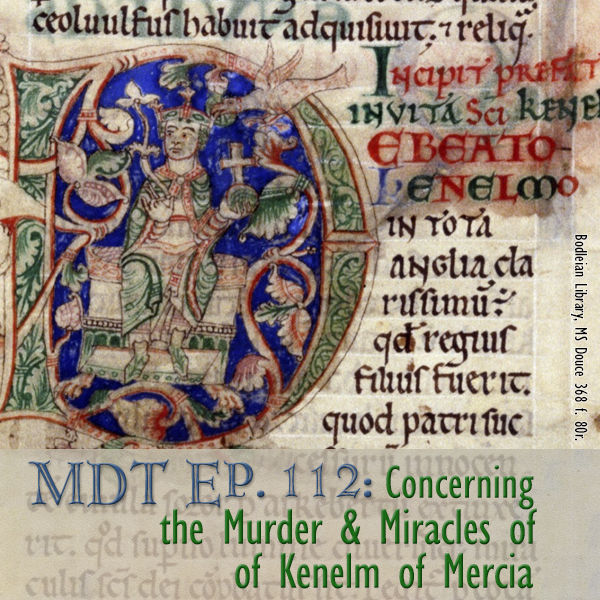
    Concerning the Murder and Miracles of Kenelm of Mercia

    This episode, we go into more depth with the legend of St. Kenelm (Cynehelm) and his jealous sister Quendrida (Cwenthryth). We also learn what it means to "crab the parson." Today's Text - "The Legend of St. Kenelm." Translated by John Amphlett in A Short History of Clent, Parker and Co., 1890, pp. 177-193. Google Books. References - Brand, John. Observations on the Popular Antiquities of Great Britain: Chiefly Illustrating the Origin of Our Vulgar and Provincial Customs, Ceremonies, and Superstitions, edited, revised, and expanded by Henry Ellis, vol 1, Henry G. Bohn, 1859. Google Books. - Cross, Tom Peete. "Witchcraft in North Carolina." Studies in Philology, vol. 16, no. 3, Jul. 1919, pp. 217-287. Google Books. - Rollason, D. W. "The Cults of Murdered Royal Saints in Anglo-Saxon England." Anglo-Saxon England, vol. 11, 1983, pp. 1-22. JSTOR, www.jstor.org/stable/44510759 - Weiskott, Eric. "Saint Kenelm, Illustrated." Erikweiskott.com, 21 Nov. 2016, ericweiskott.com/2016/11/21/saint-kenelm-illustrated/ - Whitelock, Dorothy, editor and translator. "From the Report of the Legates to Pope Hadrian (786)." English Historical Documents: ca. 500-1042, vol. 1, Eyre and Spottiswoode, 1955, pp. 770-774. Archive.org. Image Credit: Detail of Kenelm with a bird at his ear from Bodleian Library, MS Douce 368 f. 80r (12th cent.). Audio Credit: "6 Morceaux, Op. 85 - 3. Cavatina." Composed by Joachim Raff, performed by Benjamin Intartaglia. Musopen. Used under CC-BY 3.0 license. Chapters 00:00:00: Introduction 00:09:01: Text: The Legend of St. Kenelm 00:24:03: Commentary 00:36:43: Brand and Ellis on "Crabbing the Parson" (1859) 00:42:21: Commentary 00:43:40: Riddle 00:44:53: Outro

    • Chapters
  • #111
    Dec 15, 2024 · 56 min

    Concerning Conjoined Twins, Some Incorruptibles, and Royal Murders

    We continue on from last episode's look at the Green Children of Woolpit with a further consideration of what it meant to wonder at a marvel in the middle ages, with additional illustration of some wondrous things from William of Malmesbury. Today's Texts - Gervase of Tilbury. Otia Imperialia. Edited and translated by S.E. Banks and J.W. Binns, Clarendon Press, 2002. - Isidore of Seville. The Etymologies of Isidore of Seville. Translated by Stephen A. Barney, W.J. Lewis, J.A. Beach, and Oliver Berghof with Muriel Hall, Cambridge UP, 2006. - William of Malmesbury. Chronicle of the Kings of England. Edited by J.A. Giles, translated by John Sharpe and J.A. Giles, George Bell & Sons, 1895. Google Books. Chapters 00:00:00: Introduction 00:09:48: Text: from Gervase of Tilbury's Otia Imperialia 00:13:29: Commentary 00:16:23: Text: from Isidore of Seville's Etymologies 00:21:02: Commentary 00:23:05: Text: from William of Malmesbury's Gesta Regum Anglorum 00:39:32: Commentary 00:43:23: Text: from Caroline Walker Bynum's "Wonder" 00:48:08: Commentary 00:48:26: Mystery Word: glop 00:54:15: Outro

    • Chapters
  • #110
    Nov 1, 2024 · 1 hr 3 min

    Concerning the Green Children of Woolpit and Other Prodigies

    This Halloween marks our 10th anniversary, and we observe it by hearing the earliest written accounts of one of the most well-known pieces of medieval weird history: the Green Children of Woolpit -- and also hear the other less famous prodigies their story was originally presented alongside. Today's Texts: Radulphi de Coggeshall. Chronicon Anglicanum. Edited by Joseph Stevenson, Longman & Co., 1875. Google Books. William of Newburgh. The History of William of Newburgh. The Church Historians of England, vol. IV, part II, translated by Joseph Stevenson, Seeleys, 1856, pp. 395–670. Google Books. Chapters 00:00:00: Introduction 00:06:32: Text: from Ralph of Coggeshall's Chronicon Anglicanum 00:15:36: Commentary 00:24:31: Text: Ch. 27 & 28 from William of Newburgh's Historia rerum Anglicarum 00:35:10: Commentary 00:58:25: Riddle 01:01:13: Outro

    • Chapters
  • #109
    Oct 20, 2024 · 53 min

    Concerning the Miseries of the Flesh according to Pope Innocent III

    In this episode, we explore the tradition of contemptus mundi with a text all about how horrible it is to be a human being, On the Misery of the Human Condition, written by Pope Innocent III (when he was but Cardinal Lotario di Segni). Today's Texts: Lotario dei Contie di Segni [Pope Innocent III]. De miseria condicionis humane. The Latin Library, https://www.thelatinlibrary.com/innocent1.html References: Lothario Dei Segni [Pope Innocent III]. On the Misery of the Human Condition. Edited by Donald R. Howard, translated by Margaret Mary Dietz. Bobbs-Merrill Company, 1969. Archive.org. Moore, John C. "Innocent III's De Miseria Humanae Conditionis: A Speculum Curiae?" The Catholic Historical Review, vol. 67, no. 4, Oct. 1981, pp. 553-564. JSTOR. Chapters 00:00:00: Introduction 00:17:00: Text: from Book I of De miseria condicionis humane by Lotario di Segni 00:17:01: Preface 00:18:05: 1. On the Miseries of Humanity 00:20:48: 2. On the Vileness of Our Matter 00:22:42: 3. On the Manner of Conception 00:26:19: 4. On the Food by which the Fetus is Nourished in the Womb 00:27:22: 5. On the Weakness of the Infant 00:28:37: 8. What Fruit Does a Person Produce? 00:29:43: 9. On the Inconvenience of Old Age 00:31:58: 12. On the Various Pursuits of Human Beings 00:34:07: 13. On Various Anxieties 00:34:56: 14. On the Misery of the Poor and the Rich 00:36:55: 15. On the Misery of Servants and Masters 00:38:53: 22. On the Proximity of Death 00:40:11: 27. On the Various Types of Tortures 00:41:26: Commentary 00:47:13: Mystery Word: furcifer 00:51:35: Outro

    • Chapters
  • #108
    Sep 19, 2024 · 41 min

    MDT Ep. 108: Concerning the End of the Interdict and a Vexatious Prophet

    We continue from our last episode into the years 1212-1214 in the Melrose Chronicle, where we come to the end of the interdict, and perhaps the prophesized end of King John's true sovereignty. Along the way, we also cover some of the more common ecclesiastical offices and check the accuracy of the chronicle's battlefield accounting. Today's Texts: The Chronicle of Melrose. Edited and translated by Joseph Stevenson, The Church Historians of England, vol. 4, part 1, Seeley’s, 1856, pp. 79-242. Google Books. Ranulf Higden. Polychronicon. Vol. 8. Edited by Joseph Rawson Lumby, translated by John Trevisa, Longman and Co., 1882. Google Books. Roger of Wendover. Flowers of History. Vol. 2. Translated by J.A. Giles, Henry G. Bohn, 1849. Google Books.

    • Chapters
  • #106
    Aug 17, 2024 · 42 min

    MDT Ep. 107: Concerning Portents, an Interdiction, Persecutions, Heresy, and a Year of Bloodshed

    We return to the Melrose Chronicle with a notably nasty run of years from 1205 to 1211. We also consider why people -- medieval and modern -- are so captivated by bad news. Today's Texts: The Chronicle of Melrose. Edited and translated by Joseph Stevenson, The Church Historians of England, vol. 4, part 1, Seeley’s, 1856, pp. 79-242. Google Books.

    • Chapters
  • #106
    May 12, 2024 · 42 min

    MDT Ep. 106: Concerning the Hard Work of a Housewife

    For Mother's Day, we look at a 15th-century tale of a plowman who thinks that -- in terms of daily labor -- his wife has it too easy, and how he learns otherwise. Today's Text "Ballad of a Tyrannical Husband." Reliquiae Antiquae: Scraps From Ancient Manuscripts, Illustrating Chiefly Early English Literature and the English Language, edited by Thomas Wright and James Orchard Halliwell, vol. 2, John Russell Smith, 1845, pp. 196-99. Google Books. Accessed 8 Oct. 2018. "Ballad of a Tyrannical Husband." Edited by Eve Salisbury, TEAMS Middle English Texts Series, d.lib.rochester.edu/teams/text/salisbury-trials-and-joys-ballad-of-a-tyrannical-husband#f4. Originally published in The trials and Joys of Marriage, 2002. Accessed 8 Oct. 2018. Chetham's MS Mun.A.6.31. Chetham's Library, Manchester, UK, https://luna.manchester.ac.uk/luna/servlet/detail/Man4MedievalVC~4~4~507616~116868:On-a-tyrannical-husband "The Old Man Who Lived in the Woods." Traditional, transcribed by Sandy Paton, "Origins: More Work in a Day / Father Grumble," The Mudcat Cafe, 7 Dec. 2001, 9:41 p.m., mudcat.org/thread.cfm?threadid=41847 Audio Credit: Fiddle tune, "Frosty Morning" performed by Henry Reed (1966), from the Library of Congress.

    • Chapters
Showing 1–20 of 20 episodes