Skip to content
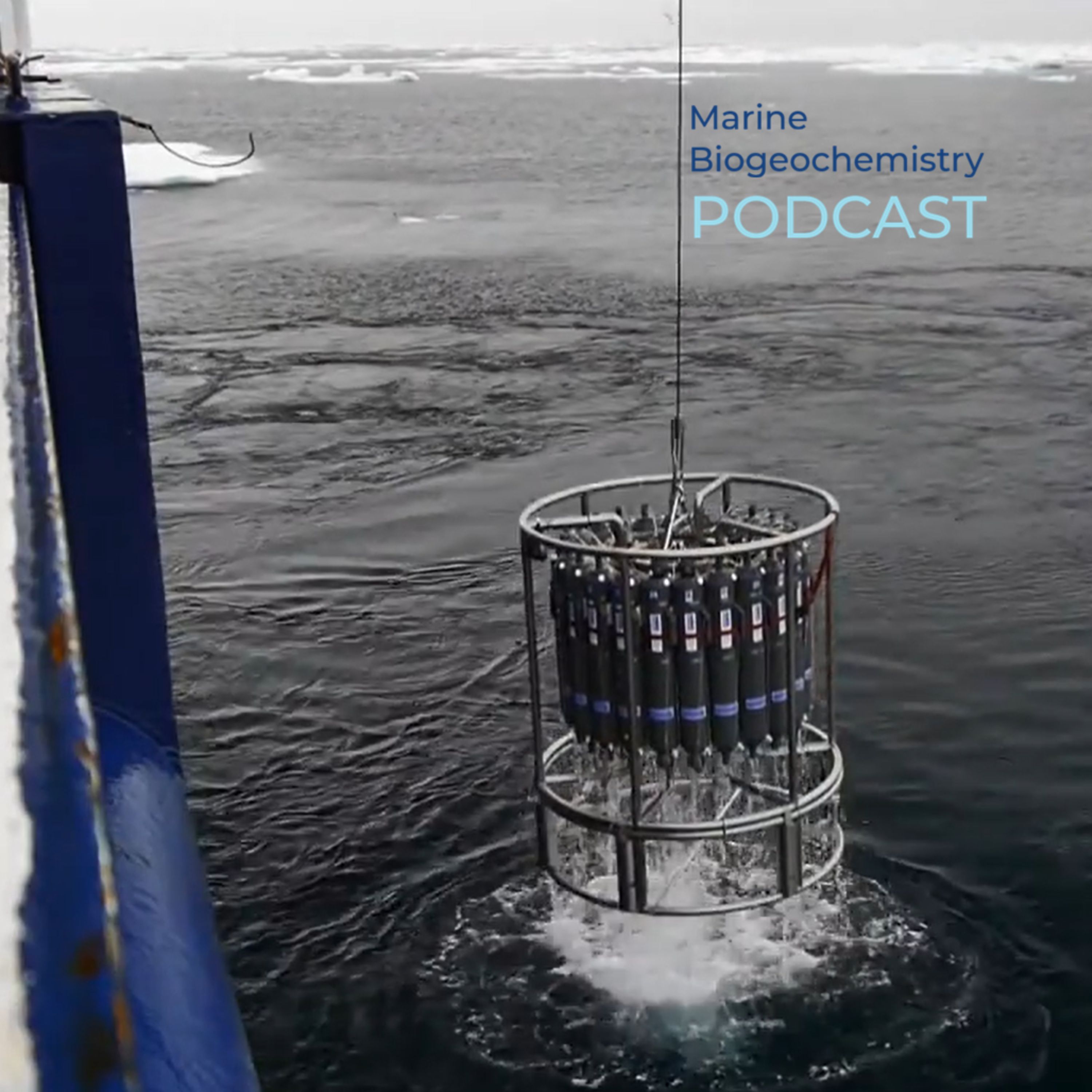
Artwork for Marine Biogeochemistry Podcast
ScienceEarth SciencesEducation

Marine Biogeochemistry Podcast

Lennart T. Bach

Marine biogeochemistry studies how elements like carbon and phosphorus move through the ocean. In this podcast, we explore the processes that drive this cycling. I’m Lennart Bach from the Institute for Marine and Antarctic Studies at the University of Tasmania, and I invite marine biogeochemists to discuss different elements and the roles they play, from well-known to less studied. Each episode focuses on one element and a specific topic, aimed at researchers and students.

Play
  • 8 episodes
  • Avg 34 min
  • English
  • S1 · E7
    November 20 · 11 min

    Carbon III - An introduction to the biological carbon pump - Ivy Frenger

    The biological carbon pump is more than organic carbon flux to depth. In this (very short) episode, I asked Dr. Ivy Frenger to introduce many biogeochemist's favourite child, the biological carbon pump. We discuss how the biologically mediated partitioning of CO2 between the ocean and the atmosphere is the balance between in and outputs. This is based on the explainer Ivy and her team published recently (https://onlinelibrary.wiley.com/doi/full/10.1111/gcb.17124). And, of course, this is highly consistent with Volk and Hoffert's first definition of the process from 1985 (https://agupubs.onlinelibrary.wiley.com/doi/10.1029/GM032p0099). I expect more episodes on this topic, hence this introduction to it.
  • S1 · E7
    October 29 · 36 min

    Nickel I - Nickel as a micronutrient - Seth John

    Nickel is this weirdly (un)important micronutrient that we'd probably talk about after the third beer when there is not much more to say about iron or manganese: "Yeah mate, but what about nickel?!?" Thanks to programmes like GEOTRACES and scientists like Seth John we know quite a bit about this element by now. In this episode I talk with Seth about the the marine nickel cycle, specifically about its role as a micronutrient.

  • S1 · E5
    October 2 · 35 min

    Silicon I - Reverse Weathering - Sonja Geilert

    Why is is reverse weathering called reverse weathering? And, why is reverse weathering the most annoying term when you have to say it repeatedly on a podcast? While the second question remains unanswered, Sonja Geilert from Utrecht University provided the explanation for the first one. Sonja illustrates how authigenic clay formation (i.e. ~reverse weathering) works, what it needs, and why we should study this process much more than we currently do.

  • S1 · E5
    September 3 · 1 hr 1 min

    Carbon II - Understanding alkalinity - Andrew Dickson

    Understanding alkalinity is one of the "eight-thousanders" in marine biogeochemistry. Luckily, we have Prof. Andrew Dickson, who has mapped this dangerous territory like few others have before. In this episode, I asked Andrew to go on a trip with a steep learning curve. We navigated acid-base equilibria, organic alkalinity, the future of Certified Reference Materials and could just get around a disastrous debate on pH scales. This was the first episode I ever recorded. So, climbing Mount Everest with zero experience. What could possibly go wrong?!

  • S1 · E4
    August 20 · 37 min

    Phosphorus I - Phosphorus cycling in sediments - Caroline Slomp

    The number of scientists studying marine phosphorus cycling may align to the Redfield ratio. For every 106 scientists studying carbon, there is one studying phosphorus. This is at least the approximation made by Prof. Caroline Slomp, one of our world's experts on the marine P cycle. In this episode, I ask questions how P cycles through marine sediments. The challenge is that understanding the P cycle also requires understanding of how iron, sulfur and other elements interact. It is a complex topic, yet getting an idea of what is going on within seafloor sediments feels very rewarding.

  • S1 · E3
    August 6 · 37 min

    Carbon I - air-sea CO2 exchange - David Ho

    When CO2 enters the ocean it has to cross the air-sea interface. This is surprisingly slow! And, thankfully reasonably well understood due to scientists like Prof. David Ho. In this episode, I talk with David about the flux of CO2 between the atmosphere and the ocean. David assumed this would be a podcast about marine CO2 removal, which is why he uses its abbreviation "marine CDR" occasionally (sorry for the insufficient briefing David!) I had a minor sound carfuffle at the beginning and I had to cut a small part of the intro. We therefore start quite abruptly.

  • S1 · E1
    July 30 · 3 min

    Introduction // Materials & Methods

    Welcome to the marine biogeochemistry podcast. In this brief trailer I introduce myself, how this podcast is structured, who it is intended for, and what it aims to achieve. Please share your recommendations for guests, topics, or conversations you believe should be featured. This conversation was recorded on the 2nd of April, 2026. More updates on this podcast can be found at www.marine-biogeochemistry.org/podcast Cheers, Lennart

  • S1 · E2
    July 22 · 54 min

    Nitrogen I - the who's who in N2 fixation - Mar Benavides

    All life, and certainly this podcast, critically depends on nitrogen (N). It all starts with the fixation of N2 gas to make it available for life, so I reached out to Dr. Mar Benavides from National Oceanography Centre in the UK to ask a lot of dumb, and some extremely sophisticated questions on the matter. Thanks Mar for being the Guinea pig on this podcast! This conversation was recorded on the 10th of April, 2026. More updates on this podcast can be found at www.marine-biogeochemistry.org/podcast

Showing 1–8 of 8 episodes