
Skip to content
Artwork for Managing A Career
BusinessCareersManagementEducationSelf-Improvement

Managing A Career

Layne Robinson

I help you navigate the path to professional success. Whether you're a recent graduate still searching for your place or a seasoned professional with years of experience, the knowledge and insights I share can show you how to position yourself for growth and career advancement.

Play
  • 20 episodes
  • weekly
  • Avg 17 min
  • English
  • #161
    Tuesday · 16 min

    Busy is what you are. Visible is what they remember. - MAC161

    It's Friday afternoon, and you've just sent the weekly update. Eleven bullet points, every one of them true. Met with the vendor. Reviewed the draft. Followed up on open items. Closed out the quarter-end checklist. Eleven bullets that cost you something like fifty hours. Your manager skims them on the way to another meeting. Your manager's boss never sees them at all. By Monday morning, the most important thing you did all week exists in exactly one place: your own memory. This episode is for the person who hears "be more visible to senior leaders" and thinks, I would love to, and I don't have a single free hour to do it. If you're fully allocated, buried in delivery, and quietly suspicious that the people two levels up have no idea what you do, you're right to be suspicious, and there's a fix that doesn't ask you to work more. Busy Is Not Visible Let me start with the distinction the whole episode hangs on, because most of us blur it without noticing. Busy and visible are not the same thing, and they aren't even measured in the same place. Busy is a property of your calendar. Visible is a property of somebody else's memory. We've talked about visibility before, in Visibility (MAC-081) and again in Your Manager Is Not Your Career Sponsor (MAC-139). Every time, I get the same fair reply: Layne, I hear you, but I'm already at capacity. You're asking me to take on a second job. I'm not. Think about how a senior leader actually encounters you. It's in fragments: a line in your manager's monthly report, thirty seconds of a project mentioned at an all-hands, your name on slide nine of somebody else's deck. They don't see the fifty hours. They see whatever compressed version of those fifty hours happens to reach them, and that version is almost always written by someone who wasn't doing the work. That isn't carelessness. It's the shape of the job. A director with a hundred and twenty people in their organization makes decisions about budget, projects, and promotions for people they have spoken to three times. They have to decide on partial information, and the only open question is whose information it is. A group of executive coaches writing for Forbes put the hard version plainly: the belief that your work should speak for itself is outdated thinking. I'd go one step further. Work doesn't speak. It gets spoken about, usually by someone else, usually in a room you're not in. Busy is what you are. Visible is what they remember. Promoting Clarity, Not Yourself Before the mechanics, a word to everyone who flinched when I said visibility. Some of you find self-promotion genuinely distasteful. You'd rather do the work than talk about the work, and announcing your own wins in the team channel makes your skin crawl. I respect that. Over thirty years I've managed a lot of people like that, and they are very often the best people on the team. But let me reframe who visibility is for. It isn't for you. It's for the person making the decision. When a senior leader is deciding who gets the stretch assignment, which team gets the headcount, or whose name comes up in the talent review, they need clarity to decide well. If you leave them guessing, you aren't being humble. You're making their job harder, and you're letting the guess be made by whoever happened to talk loudest that quarter. A piece on building strategic visibility without self-promotion contains a line I've more or less adopted as my own: visibility is not about promoting yourself; it's about promoting clarity. One framing is about you. The other is about the person on the other end, who has forty decisions to make this week and would love one of them to be easy. If you're one of the quiet ones, two habits will carry you a surprisingly long way. The first: give credit out loud, and own accountability in private. When the work goes well, name the people who made it go well, specifically and publicly. When it goes badly, take that conversation into a one-on-one. It sounds like the opposite of a visibility strategy, but the person who reliably makes other people look good becomes someone senior leaders trust with more people. The second habit is restraint. You don't need to speak in every meeting. You need to speak at the pivotal moment and say one precise thing. The person who delivers one sharp sentence in the quarterly review is remembered over the person who talked every five minutes. You're not promoting yourself. You're reducing their guesswork. The Forwardable Update So what does promoting clarity look like on a Tuesday when you have no time to spare? One short document, once a month. I call it the Forwardable Update: a short monthly note to your manager, written so they could forward it to their boss without changing a single word. That last part is the whole design. In MAC-139 we talked about why your manager usually isn't positioned to advocate for you the way a sponsor would. That's still true. But your manager is something else that matters enormously: the channel. Most of what a senior leader knows about you travels through your manager's upward reporting, and your manager is writing that reporting at nine o'clock at night, trying to compress eight people's work into something their boss will actually read. Picture two people on that team. One sends a list of activities. The other sends four tight lines already written for the next level up. Which one gets quoted? Structurally, the person whose update is ready to forward is the person whose work travels. So here's the test, and it's the only one that matters: could your manager forward this note, unedited, to the person above them? If they'd need to rewrite it, it won't travel, and if it doesn't travel, then above your manager it effectively didn't happen. The update has four parts. What moved. Not what you did, but what changed because you did it. "Met with finance four times" is activity. "Finance and operations are now working from the same forecast, so the March number no longer needs a footnote" is an outcome. Same four meetings, completely different sentence. The coaches I mentioned frame each item the same way: what changed, why it matters, and what comes next. If a line doesn't answer the first of those, it isn't ready. What I learned. One or two sentences. This is where your judgment becomes visible, and judgment is what senior leaders are really assessing when they think about who's ready for more. What's at risk. The thing you can see coming that they can't yet. Nothing builds trust faster than being the person who flagged it early. What I need. A decision, a resource, an introduction. Specific and small. Four parts, under two hundred words. If you've been keeping the running record from The Brag Document (MAC-141), you already have the raw material; this is the month's version of it, shaped for an audience. Twenty minutes a month, less once it's a habit. Notice what this is not. In Reporting Status (MAC-044) we covered the weekly status that keeps your manager informed, and that's still worth doing. But the weekly status is written for your manager. The Forwardable Update is written through them. A status report tells your manager you were busy. A Forwardable Update tells their boss what changed. Borrow the Room The update gets your work into rooms you'll never be in. Now let's get you into a few of those rooms yourself, without adding a single new project to your plate. Most of your best work happens in rooms senior leaders never enter: the working session where the problem actually got solved, the whiteboard, the spreadsheet at eleven at night. By the time that work reaches a senior audience, someone else is usually presenting it. But the rooms where senior leaders are already exist: the quarterly business review, the monthly operating review, the all-hands, the steering committee for the initiative you're three layers deep in. Nobody needs to invent a forum for you. The question is simply which recurring rooms senior leaders sit in where your work is already on the agenda, presented by someone else. Picture an analyst who builds the same recurring report every month. Her director presents it at the monthly operations review, reads the numbers aloud, and moves on. One month she asks a small question: Could I take five minutes at the next review to walk through what the numbers are actually telling us? Same report, same meeting, new narrator. Within a quarter, the VP running that review is asking for "her read" before the meeting starts. She didn't take on a project. She borrowed a room her work was already in. That's the first move: ask to present one slice of existing work. Not the whole initiative, just the part you built. Most managers will say yes, because it makes them look like someone who develops people. The second move is cross-functional volunteering, scoped to hours rather than weeks: the working group that meets twice, the pilot review, the interview panel, the lunch-and-learn where you teach the thing you already know cold. Each puts you in front of people outside your reporting line at a cost you can afford. If you built the Exposure Map from Manufacturing Serendipity (MAC-147), use it here, and pick the room that closes your most expensive gap, not the one that's most convenient. There's a larger reason this matters. An executive coach who works with senior leaders argues that, at that level, visibility isn't a side effect of success; it's part of the job itself. Turn that around: if senior leaders are expected to communicate across silos and represent their teams' work to wider audiences, then someone who already does that at a smaller scale looks ready for the next level. You're not just being seen. You're being seen doing the job above yours. One guardrail, so nobody hears permission to overextend: one room per quarter. More than that and visibility becomes the job, delivery slips, and a missed deadline is the one kind of visibility nobody wants. You don't need more rooms. You need the right one, once a quarter. Your Action Plan Four steps. The first three involve translating your own work, which is exactly where you're least reliable, because you're too close to your own week to tell which of those eleven bullets actually mattered. An AI assistant isn't. So for those three steps there are prompts you can paste straight in, and the steps work fine without them. They just go faster with them. Rewrite last Friday's update. Pull up the last status update you sent and rewrite every bullet as an outcome. Some bullets won't survive, and that's useful: it tells you which work is invisible because it never produced anything a senior leader would care about, and which is invisible only because of how you described it. Write your first Forwardable Update. Take last month's finished work and write the four parts in under two hundred words. Then run the test honestly: could your manager forward it unedited? If not, fix whatever they'd have to fix. List the rooms. Write down every recurring forum a senior leader attends where your work is already discussed, even if someone else presents it. Circle one. That's your room for this quarter. Ask for one slice. Take the circled room to your manager and ask for five minutes on one piece of work you built: which meeting, which slice, how long. This one's a conversation, not a prompt, and it's the step that actually changes who knows your name. Not next quarter. This week. The Close Back to that Friday afternoon. Eleven bullets. Fifty hours. Read once in a hurry, and never seen by anyone who decides what happens to your career. None of the fixes here ask you to work more. They ask you to finish the work you're already doing: the last ten percent, where somebody decides how it gets described. Four lines your manager can forward. One room a quarter where you describe it yourself. Credit given out loud, and a little restraint about everything else. Next Friday, before you send those eleven bullets, write four lines instead. Get the Episode + Prompts The full episode and show notes are at managingacareer.com/161. The three prompts from the action plan are below. Copy them, and change them to fit how you actually work. Prompt — the translation. Below is a status update I sent last week. Rewrite each bullet as an outcome: what changed because of the work, why it matters to the business, and what comes next. Rules: do not invent results, numbers, or impact that are not stated or clearly implied in what I wrote. If a bullet describes activity with no visible outcome, label it "activity only" and ask me one question that would help me find the outcome, rather than guessing. Do not add praise words like "successfully" or "effectively." Keep each rewritten line under 30 words. [Paste your update here] Prompt — the forward. Using my notes below, draft a monthly update to my manager with exactly four short sections: What moved, What I learned, What's at risk, What I need. Write it so my manager could forward it unedited to their own boss, who does not know the details of my work. Rules: stay under 200 words. Use only facts from my notes; if a section has nothing to support it, write "[nothing to report]" rather than filling it. Flag any sentence that relies on context or jargon my manager's boss would not have. Do not inflate, and do not soften the risks. [Paste your notes, brag document entries, or last month's status updates here] Prompt — the room audit. Below is a list of recurring meetings from my calendar and my team's calendar, with attendees where I know them. Identify the meetings that senior leaders (director level or above) attend where my work or my team's work is likely to be discussed. For each, tell me what part of my work would fit there in a five-minute slot. Rules: do not suggest creating new meetings or projects. If you can't tell who attends a meeting or what it covers, say so and ask me, rather than assuming. Rank the top three by how many senior decision-makers I'd reach. [Paste your list of recurring meetings here] Links & References Research & sources — How To Maintain High Performance And Stay Visible To Leadership (Forbes Coaches Council) Research & sources — Career Compass: Building Strategic Visibility Without Self-Promotion (Global Project Leader) Research & sources — Visibility Is the Work of Senior Leaders (Influence Leadership) Episode inspiration — Your Manager Is Not Your Career Sponsor (MAC-139) Related Managing A Career episodes — Visibility (MAC-081) Related Managing A Career episodes — Your Manager Is Not Your Career Sponsor (MAC-139) Related Managing A Career episodes — The Brag Document (MAC-141) Related Managing A Career episodes — Reporting Status (MAC-044) Related Managing A Career episodes — Manufacturing Serendipity (MAC-147) Episode page — Busy Is Not Visible (MAC-161)


  • #160
    September 29 · 19 min

    Analysis Paralysis Is Just Fear Wearing a Lab Coat - MAC160

    Nobody has ever been written up for doing too much research. That's what makes it such a good place to hide. In the biggest calls a career throws at you — the job, the promotion ask, the pivot you've been circling for two years. Research looks like diligence, and it feels like diligence the whole time. But past a certain point, it stops being research and starts being a well-dressed way of not deciding. The Spreadsheet With Fourteen Columns A recruiter reaches out about a role one level up, better pay, better title. You say you'll think about it, and because you're responsible, you build a spreadsheet. Salary, commute, benefits — sensible columns, all of them. By week two there's a column for the company's review-site scores, one tracking how long the team has stayed, one for a parental leave policy you may never use, one for something the CFO said on an earnings call. By week five you're at fourteen columns, you've reread the same three reviews, and when someone asks where you landed, you say the thing we all say: "I'm still doing my homework." That spreadsheet feels like the most responsible thing you've done all month. That's the problem. Think about what got you here. Every organization you've worked in has rewarded you for looking one more time. So when fear shows up around a decision this size, it doesn't show up as fear. It puts on the most respectable costume in your closet. Fear in a hoodie, you'd spot immediately. Fear in a lab coat looks exactly like thoroughness. A career counselor who specializes in this exact problem, LaRae Jome, makes a point worth sitting with: most people already know the steps of a good career decision — narrow your options, explore them properly, choose based on what you value. They still can't finish those steps, not from lack of knowledge but because finishing means feeling the uncertainty they've been avoiding. So they find another step. That's a different animal than the fear I described in Just Because You're Scared, Doesn't Mean You Do NOTHING. That fear freezes you. This one keeps you extremely, productively busy. The Association for Psychological Science names it as one of the clearest signs of overthinking: you've researched your options to death, and you're still not moving. To be clear, I'm not telling you to stop doing homework — even Jome tells her clients to explore thoroughly. I'm telling you there's a point where the homework is actually finished, and most of us blow straight past it without noticing. Research vs. Reassurance Here's the question I want you to ask at the end of every hour you spend on a decision like this: what do I know now that I didn't know an hour ago, and would it change my answer? That's the whole test. If you can answer it, you were doing research. If you can't, you were doing something else. Amanda Nimon-Peters, writing in Psychology Today, describes how your brain treats deliberation as a cost you pay to buy confidence. Normally you think until you're confident enough, then stop. But when no new information is actually arriving — you're just re-reading the same reviews, the same posting — you keep paying, and the confidence never shows up. It drops. That's the strangest part of analysis paralysis: the longer you research, the less sure you feel. So here's the distinction to carry out of this: research versus reassurance. Research changes what you know. Reassurance changes how you feel, for about an hour, then wears off and you need another dose. That's why the spreadsheet keeps growing. Research ends. Reassurance has to be refilled. There are three tells that you've crossed from one into the other. The questions repeat: a fourth set of reviews answering the question the first three already answered. The source changed. The information didn't. The criteria move. Every time one option starts to win, a new column appears — it was salary, then the commute, then the culture. When your criteria keep shifting, you're not refining the decision, you're protecting yourself from making it. And the hardest one to admit: you're researching after you already know. Somewhere in week two you knew what you wanted, and every hour since has been a search for permission, or for the one piece of evidence that would let you off the hook. You're not looking for information anymore. You're looking for an exit. The Research Receipt Noticing these tells in the moment is hard, so here's a tool. I call it the Research Receipt. At the end of every session you spend on a decision you write one line: the new fact you bought, and whether it moved your decision. You paid for that session with your time. The receipt tells you what you actually got for it. When you can fill in the line, that session was research. When you can't, it was reassurance — and you just learned that too. Three blank receipts in a row means your homework is finished, whether it feels finished or not. A blank receipt isn't a failure. It's a finding. When you get that blank receipt, there's a second question worth asking — the same one from the Control Filter episode: what is the research protecting me from? Almost always it's one of a handful of things: being told no, being wrong where others can see it, wanting something out loud and not getting it, or plain regret — the fear that a better option existed and you took the wrong one. That last one deserves a minute. Career advisors at the National Institutes of Health, applying Barry Schwartz's paradox-of-choice research to careers, describe the maximizer haunted by the possibility that something better existed — a pattern that curdles into chronic restlessness with jobs that are actually good. No amount of research closes that gap, because the better option doesn't exist yet. Finish Lines "Stop researching" is useless advice unless you know what done looks like, so here are the finish lines for the three decisions people stall on most. For a job change, you're done when you know four things: the actual scope of the role (not the posting), who you'd report to, because you've talked to them, the compensation in writing, and one real conversation with someone who's done the job or recently left it. Past that point, the review sites and earnings calls are noise for your decision. They're about the company. Your decision is about the job. For a promotion ask, you're done when you know what the next level requires, you have your evidence gathered — if you've kept a brag document, that's already sitting there — and you know when those calls get made. You will never feel ready enough to ask. The ask itself is the research: whatever your manager says back tells you something you couldn't have found out any other way. For a pivot, you're done when you've talked to three people who do the work and done one small, real piece of it yourself: a side project, a stretch assignment, a few hours helping the team you're circling. Reading about a field and trying it are different kinds of information, and only one tells you whether you'll like it on a Wednesday. Notice what those finish lines share. Almost every one ends in a conversation or an action, not another article. Past a certain point, the only new information left comes from doing something. The last piece of research is almost always a move. Most Career Doors Swing Both Ways Back in Fast to Decide, Slow to Act, I borrowed Jeff Bezos's idea of one-way doors and two-way doors: a one-way door is hard or impossible to reverse, a two-way door you can walk back out of. I said a one-way door deserves a slower process, and I stand by that. What I didn't talk about then is how often we mislabel the door — and which direction we get it wrong in. Fear makes every door look one-way. Take the promotion ask at two in the morning. It feels final — if they say no, everyone knows it. Now walk it forward in daylight. The worst realistic outcome is "not yet," and now you know exactly what the gap is, which you didn't before you asked. That's not a one-way door. That's a two-way door with a prize behind it. Sort a few decisions you might be sitting on. Asking for the promotion: two-way door. Interviewing for a role: two-way door, and you can walk away right up until you sign. An internal transfer: mostly two-way, because people move back, or move again a year later. Leaving for another company is heavier, but more reversible than it feels — people go back to former employers constantly. I know this personally: I'm on my second stint with my current company, having left for a better opportunity and returned eight years later in a different role. The door I walked out of was still there. As long as you don't burn bridges, returning is always an option. The genuine one-way doors are fewer than you'd think: resigning with nothing lined up when you can't absorb the gap, moving your family across the country, taking on serious debt for a credential. Those deserve the slow process. Most of the rest don't. Shane Parrish, who writes about decision-making at Farnam Street, puts the measuring stick in four words: the cost to undo. Put a number on it. How many months to recover? How much money? Which relationships take a hit, and how badly? Nimon-Peters has a version of the same move: name the worst case concretely, estimate how likely it really is, and name how you'd cope. Write the number down. Fear hates specifics. For the handful of decisions that really are one-way doors, slow down on purpose — but slowing down isn't the same as never deciding. Parrish's advice for the genuinely irreversible ones is to keep going until you've exhausted the useful sources, hit a real deadline, or reached clarity — three endpoints, all arrivals. More information doesn't guarantee a better outcome, and past a point it muddies your judgment. Slow has an end. Stuck doesn't. The Hard Stop Decide when to stop before you start. Not in the middle, when every new tab feels like responsibility. Investors have a version of this called a stop-loss — the point where they'll sell before they buy. Your research needs the same discipline, in three settings. First, write your criteria before you look at options — your top priority and two must-haves, before the spreadsheet exists. A new column later has to justify itself against those three. Second, cap your inputs: three options, not eleven, a fixed number of conversations, a specific number of evenings. When you've used them up, you're done gathering. Third, let the door set the date. A two-way door gets days, or a couple of weeks at most. A one-way door gets longer, but still gets a real date on the calendar. Bezos has written that most decisions should be made with about seventy percent of the information you wish you had — wait for ninety and you're probably being slow. If you're good at course-correcting, being wrong costs less than you think. Being slow is expensive every time. When the stop date arrives, you get two options: decide, or name one specific next step with its own date, like "I'll call the hiring manager by Thursday." The option you don't get is "keep looking." And tell somebody the date. If you heard It's Easier to Disappoint Ourselves Than Someone Else, you know why: a commitment to yourself alone has no date, no witness, no cost attached. You already have the date. Go get the witness. Where This Leaves You Go back to that spreadsheet with fourteen columns. Three were the decision. The other eleven were the lab coat. I'm not asking you to be less careful — careful is one of the best things about you, and part of why people trust your work. I'm asking you to notice the moment careful stops producing anything, when the receipts come back blank and the door turns out to swing both ways, and to have the stop date already on the calendar when that moment arrives. Research is a fine place to visit. It's a terrible place to hide. One more thing before you go: which decision are you stuck on right now — the job change, the promotion ask, the pivot, or something else? Head to managingacareer.com/survey and tell me. Whichever one shows up most is getting its own full episode, since each has its own finish line and today's version only had a couple of minutes for each. Episode Prompts The three prompts from the action plan are below — copy them, and change them to fit how you actually work. (A fourth step, telling one person your stop date, isn't here on purpose. That's the one piece of this an assistant can't do for you.) Prompt — the door sort. I'm stuck on a career decision. Here it is in one sentence: [your decision]. Here's the context that matters: [savings runway, family constraints, contract terms, anything else relevant]. Tell me what it would actually cost to undo this decision if it turned out to be wrong, in months, in money, and in which working relationships would be affected. Then classify it as a one-way door or a two-way door and give me the single reason that decides it. Rules: do not tell me what to decide. Do not give me a list of pros and cons; I have plenty. If an undo cost depends on something I haven't told you, ask me for it instead of assuming. State the assumption behind every estimate. If I've described a two-way door as if it were one-way, say so plainly. Prompt — the criteria audit. Below are my notes and the comparison I've been building for this decision: [paste your notes or spreadsheet]. List every criterion I'm using. For each one, tell me whether it could plausibly change my decision on its own. Then identify my top priority and at most two must-haves, based only on what I've written, and quote the line that shows each one. Flag any criterion that looks like it was added after one option started winning, and any question I've researched more than once. Do not add criteria of your own. Do not recommend an option. If my notes don't make my top priority clear, say so and ask me one question to find it. Prompt — the receipt check. Here are my research receipts from the past week, one line per session, each with the new fact I found and whether it changed my decision: [paste your receipts]. Count three things: the sessions that produced a new fact that changed my decision, the sessions that produced a new fact that didn't, and the blanks. List any question I researched more than once, even if I worded it differently. Then tell me in one sentence whether the evidence says I'm still gathering information or I'm already finished. Do not soften it, and do not tell me that research is healthy. If a line is too vague to judge, mark it as vague rather than guessing what I meant. Links & References Research & sources — How to Resist Overthinking Decisions — Amanda Nimon-Peters, Psychology Today Research & sources — Reversible and Irreversible Decisions — Shane Parrish, Farnam Street Research & sources — Making Career Decisions: How to Avoid Analysis Paralysis — LaRae Jome, Work-Life Directions Research & sources — 5 Signs You're Overthinking a Career Decision — Association for Psychological Science Research & sources — The Paradox of Choice in Career Decision-Making — NIH Office of Intramural Training & Education Episode inspiration — It's Easier to Disappoint Ourselves Than Someone Else (MAC-157) — the research stage that spawned this episode Related Managing A Career episodes — Just Because You're Scared, Doesn't Mean You Do NOTHING (MAC-123) Related Managing A Career episodes — Fast to Decide, Slow to Act (MAC-125) Related Managing A Career episodes — The Brag Document (MAC-141) Related Managing A Career episodes — It's Easier to Disappoint Ourselves Than Someone Else (MAC-157) Related Managing A Career episodes — Are Your Emotions Holding Back Your Career? (MAC-159) Episode resources — Show notes and prompts for this episode (MAC-160)

  • #159
    September 22 · 21 min

    Are Your Emotions Holding You Back - MAC159

    It's 11:40 on a Tuesday night, and you are not asleep. You're replaying a sentence. Your skip-level said it around two-fifteen that afternoon, in a meeting with five other people in it: "Let's make sure we're being realistic about that timeline." You've run it back maybe forty times since. Tried it with the emphasis on realistic. Tried it on that. Drafted three replies you're never going to send. Somewhere around the thirtieth replay, you picked up your phone, which is how it got to be 11:40. So here's a question worth sitting with: in the nine and a half hours since that sentence was said, what has the worry actually done for you? That's the question underneath this episode. Not how to get rid of the worry, the fear, the anxiety, the flash of jealousy that shows up when somebody else gets the promotion. Not a case for toughening up, and not permission to leave your feelings at the door. What follows is a sort — a way to run any of those feelings through two questions and come out the other side knowing whether it's something to act on or something you can honestly put down. Feeling It vs. Carrying It Start with what this isn't. It isn't an argument for becoming a cold, unfeeling operator at work. In years of managing people, the ones who insisted they didn't feel anything about their jobs were usually the ones feeling the most — just quietly, and at their own expense. Emotions at work are normal, and they're useful. Stress As A Signal, Not A Symptom (MAC-146) made the case that stress is information before it's a problem; the same holds for the rest of the list. Worry, fear, anxiety, jealousy — every one of them is pointing at something. The trouble starts when you don't follow where it points. Alice Boyes, a former clinical psychologist, wrote a piece for Harvard Business Review on what anxiety does to us at work, and the list is specific: it makes you misjudge what other people think of you, it makes you defensive about feedback, it makes you see the risk in a new idea before you see anything else, and it makes you avoid the situations that would actually move your work forward. Notice that none of those is the feeling itself — every one is a behavior. The anxiety doesn't cost you the stretch assignment. Avoiding the stretch assignment does. So here's the distinction worth carrying forward: there's feeling an emotion, and there's carrying one. Feeling it is the part that happens to you — the jolt in the meeting, the sting when you read the email. It's fast, it's human, and you don't get a vote. Carrying it is everything after that — the replays, the unsent drafts, the version of the conversation you keep having with yourself in the car. That part, you do get a vote on. Feeling is the immediate reaction. Carrying it takes the rest of the week. One caveat before the framework: this is about the ordinary emotional weather of a working life — the worry after a meeting, the sting of somebody else's promotion, the dread before a review. If the worry doesn't lift, if it's following you everywhere and not just to work, if it's taking your sleep for weeks rather than a night, that's not something a sorting exercise fixes, and it's not something a career podcast should try to fix. Mental Health and You (MAC-042) covers this directly: put your own oxygen mask on first. If stress has become overwhelming, reaching out to a professional or an Employee Assistance Program is the right move, and there's nothing weak about that conversation. The Control Filter So how do you tell which feelings to act on and which to put down? There's a prayer a lot of people already know, even without ever being near a twelve-step meeting. Usually credited to the theologian Reinhold Niebuhr: God, grant me the serenity to accept the things I cannot change, the courage to change the things I can, and the wisdom to know the difference. That last line is doing all the work. Psychologists have taken it seriously enough to study — the Association for Psychological Science has written about the science behind the Serenity Prayer — and the tension it names sits underneath an enormous amount of what people struggle with at work. Knowing the difference isn't a trait you're born with. It's a sort, and a sort is something you can practice. Most people already run a version of it. They just run it on the wrong thing. They ask, "can I change what caused this?" — and they ask it about the trigger. The sentence the skip-level said. The promotion announcement. The reorg rumor. The answer is almost always no, so they conclude it's one of the things they cannot change and tell themselves to accept it — and then carry it anyway, because "accept it" is easy to say and nearly impossible to do when you haven't figured out what "it" is. Here's the sort to run instead. Call it the control filter, and it's two questions. Question one: what is this actually about? Not what set it off — what it's about. The trigger is the event; the source is the thing inside you that the event landed on. The skip-level's sentence is the trigger. The source is not knowing whether she thinks the estimate is wrong — and underneath that, a worry about being quietly filed as someone whose timelines can't be trusted. Question two: is there a move? One thing, inside your control, that you could do this week — not something that requires somebody else to change first, but something you can do. If there's a move, the feeling just became a to-do. Do the move, and the feeling has finished its job — it got your attention, pointed you somewhere, and you went. If there's no move, the feeling is weight. It can't tell you anything more, and carrying it won't change the outcome. So you name it, and you set it down on purpose. Run it on the 11:40 sentence. The trigger isn't yours. But the source — I don't know what she meant, and I'm afraid of what it might mean — has an obvious move: you ask. Something like, "You mentioned being realistic about the timeline — is there a risk you're seeing that I should be building in?" That's the whole move. The feedback episode on why that kind of question works (MAC-148) covers this in depth — the person giving you feedback is a witness to how something landed, not a judge handing down a verdict, and the most useful thing you can do with a witness is ask what they actually saw. Once that message is sitting in your drafts for nine a.m., the worry has nothing left to do. The trigger is rarely yours. The source usually is. Try it once more on something bigger. Picture a reorg rumor — two weeks of closed-door meetings, nobody saying anything. The trigger is about as far outside your control as anything at work ever gets. But what's the source? For most people it's something like: the person drawing the new boxes doesn't know what I do. And that has a move — you can make what you do legible. If you've been keeping the Brag Document (MAC-141), this is the week it pays for itself; if you haven't, this is the week you start one, with a short note to your manager on what you've delivered this quarter, while there's still a conversation to be part of. And then some of it really is no-move: whether the reorg happens, where your team lands, who your next manager is. Those go on the other pile, and that's fine. The filter isn't a promise that everything is secretly in your control — it's a way to stop treating the controllable parts as if they weren't. Have To vs. Get To (MAC-140) talked about locus of control — whether your default is to believe your outcomes are driven by you or by the world around you. The more useful way to hold that now: you choose it one feeling at a time. Every time you run the filter on the source instead of the trigger, you're moving the locus back inside — not by pretending the reorg is yours, but by finding the part of the problem that is. Setting It Down Is Not Pushing It Down About that second pile: "set it down" does not mean "push it down." The two phrases sound almost identical and do opposite things. Pushing it down is suppression — gritting your teeth through the rest of the meeting, telling yourself you're fine, scrolling your phone until the feeling goes quiet. It looks and feels like control for about an hour, and it's the move most professionals were trained to make, because the workplace rewards the person who looks unbothered. The problem is that it doesn't work. Pushing a feeling down turns out to be counterproductive in most cases — the feeling doesn't leave, it relocates. It shows up in your sleep, in your body, in how short you are with somebody who had nothing to do with it, and in the quality of your work the next day. You don't get out of feeling it — you just move the bill. Suppression isn't free. It's a tax, and you pay it after hours. Go back to 11:40 on Tuesday. That person didn't fail to feel their emotion at two-fifteen. They felt it, pushed it down so they could get through the meeting, and it came back at night, when there was nothing left to do with it but replay it. The phone wasn't the cure. The phone was the suppression. Pushing it down keeps it. Setting it down ends it. What does setting it down actually look like? Smaller than it sounds, and it has three parts. You name it, specifically — not "I'm stressed" (a category, not a feeling), but "I'm worried she thinks I padded the estimate" (a feeling you can finally see the whole of). You say which part isn't yours, out loud or on paper — "whether the reorg happens is not my decision" — which sounds too simple to do anything, but tells your own brain the search is over. And you decide what would reopen it — "if I hear the new structure before Friday, I'll look at this again" — which is what actually lets you stop, because you've given the worry a condition for coming back instead of letting it patrol all night on its own authority. That's not suppression. Suppression pretends there's nothing there. This admits exactly what's there, and then closes the file. The Hardest One to Sort Worry is the easy case. The feeling that really tests this is jealousy. Picture it: the announcement lands Thursday afternoon. Somebody on the next team — started the same year, similar scope, honestly a toss-up — just got promoted. The congratulations thread fills up. You type "Congrats!! So well deserved" and hit send, and mean about sixty percent of it. The other forty percent is a feeling you wouldn't want anybody to see. First: that feeling is normal. It's one of the most common experiences in working life, and having it is not a character flaw. But jealousy is the hardest one to sort, for two reasons. Run the filter on the trigger — their promotion — and you get the fastest "no move" in the whole framework; you cannot un-promote them. And because jealousy feels a little shameful, it's the feeling most likely to get pushed down instead of set down — carried and hidden, the most expensive combination there is. The standard advice for dealing with a jealous coworker is mostly about staying civil, not escalating, and accepting that you can't hand over your promotion to make somebody else feel better. The jealous person is the only one who can do anything with the feeling — which means, when you're the one feeling it, you're the only person in the building who can do anything with it, either. So run the filter on the source. Here's what makes jealousy strange: it's the most precise emotion available. Worry is vague; jealousy points at something exact. Nobody envies people in general — you envy one specific thing about one specific person's situation. So ask what, exactly. Is it the title? The scope — the bigger team, the bigger budget? The recognition — being the name said in the leadership meeting? The money? Or is it the fact that somebody with real influence clearly went to bat for them? Every answer is a different move. If it's scope, that's a stretch-assignment conversation with your manager. If it's recognition, that's a visibility problem, and visibility is buildable. If it's the person who went to bat for them, that's a sponsor — and Your Manager Is Not Your Career Sponsor (MAC-139) covers a full episode on how you go find one. If it's the money, that's a compensation conversation that deserves its own preparation. If it's the title, the move is asking your manager, directly, what the gap is between where you are and that next level — in specifics, not adjectives. Sometimes the audit hands you a surprise: you look closely and realize you don't actually want what they have. You want the title, not the job — not the eight direct reports, not the budget fights. That's a finding too. It means the feeling was weight, and you can set it down with a clear conscience, because you checked. Envy you act on becomes a plan. Envy you sit on becomes resentment. And the difference between those two is almost never the size of the feeling — it's whether you did anything with it. There's a place this advice runs out. The filter is simple; running it on your own situation often isn't, especially when the source is tangled up with a particular manager, a particular reorg, a particular history. If you're carrying something at work and can't tell which pile it belongs in, the contact form at managingacareer.com/contact is open for an introductory conversation, to see if working through it together makes sense. Feel all of it. Then carry only what you can use. Get the Episode + Prompts The full episode and show notes are at managingacareer.com/159. The prompts from the action plan are below — copy them, and change them to fit how you actually work. Prompt — the sort. I'm going to describe something at work that's been bothering me. Help me separate the TRIGGER (the event that set it off) from the SOURCE (what it's actually about for me), and then tell me whether there's a MOVE — one specific action I could take this week that doesn't depend on anyone else changing first. Rules: do not tell me how I should feel about it, and do not reassure me. Do not diagnose me or label my emotional state. If there is no move, say "no move" plainly — do not invent one to make me feel better, and do not count "talk to someone about it" as a move unless you can say who and exactly what I'd ask. If my description is too thin to find the source, ask me one question instead of guessing. Here it is: [describe it]. Prompt — the ask. Draft a short message I could send to [person and their role] about [the situation]. The goal is to find out one specific thing: [what I actually need to know]. Rules: under sixty words. Ask exactly one question. No apology, no justification of my earlier work, and no filler like "just checking in" or "sorry to bother you." It should read as curious, not worried. Do not guess at what the other person meant — if you need context about what they said, ask me for it. Prompt — the audit. Someone at work recently got [promotion / recognition / opportunity] and it bothered me more than I expected. Interview me to find out which specific part I actually envy — the title, the scope, the recognition, the compensation, the relationship with a senior sponsor, or something else. Ask me one question at a time and wait for my answer. Do not suggest what I'm feeling, and do not tell me it's normal. When we've found it, name the specific part in one sentence and suggest one concrete move it points to. If the answer turns out to be that I don't actually want what they have, say so directly. Links & References Research & sources — What Anxiety Does to Us at Work — Harvard Business Review Research & sources — The Science Behind the Serenity Prayer — Association for Psychological Science Research & sources — Pitfalls of Suppressing Emotions and Pros of Processing Them — Psychology Today Research & sources — How to Handle a Jealous Coworker — Psychology Today Related Managing A Career episodes — Stress As A Signal, Not A Symptom (MAC-146) Related Managing A Career episodes — "This Sounds AI-Generated" — and Other Feedback You Can't Argue With (MAC-148) Related Managing A Career episodes — The Brag Document (MAC-141) Related Managing A Career episodes — Have To vs. Get To (MAC-140) Related Managing A Career episodes — Your Manager Is Not Your Career Sponsor (MAC-139) Related Managing A Career episodes — Mental Health and You (MAC-042) Episode resources — This episode's page — show notes and all three prompts (MAC-159)

  • #158
    September 15 · 18 min

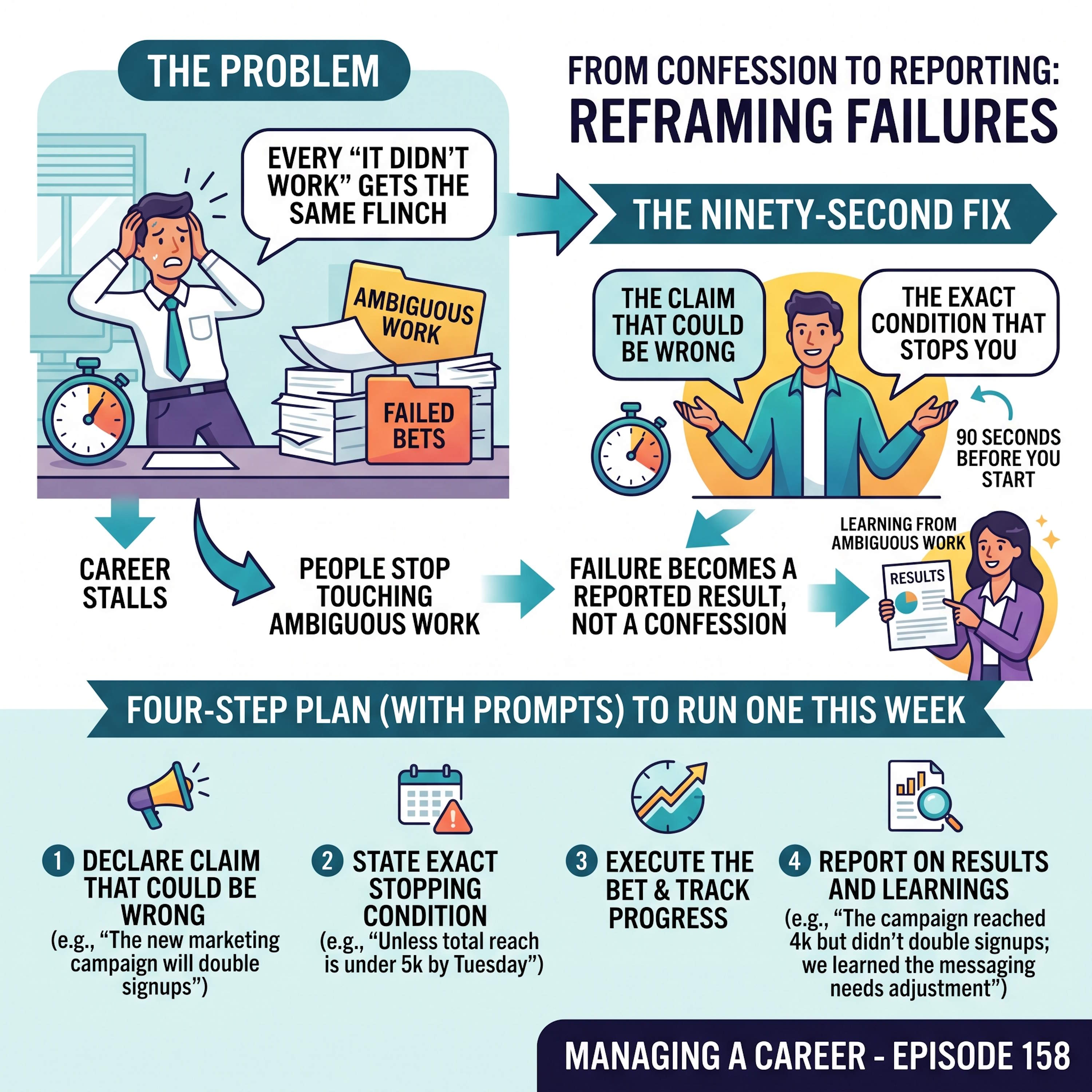
    Not Every Failure Counts Against You - MAC158

    Two people walk out of two different meetings having heard the same sentence: it didn't work. One of them skipped a step in a process the company has run four hundred times. The other tried something the company has never tried. Same sentence, same tone in the room, same quiet adjustment in how each of them gets described in the next talent review. That's the problem underneath this whole piece: your organization almost certainly cannot tell those two people apart. Not because anyone up the chain is cruel — because sorting the difference is genuinely hard and the meeting has twenty minutes. That failure to sort is expensive in a very specific, very avoidable way, and there's a fix that costs about ninety seconds and changes the entire conversation. Three kinds of wrong Before any of this is useful, the terminology has to be exact. Amy Edmondson, a Harvard Business School researcher who has spent a career studying how organizations handle things going wrong, lays out three distinct kinds of failure, and argues they need opposite responses. A basic failure has one cause, is usually preventable, and happens in territory that is completely known — the invoice with last quarter's numbers, the wrong client name in the deck, the checklist step skipped because the day ran long. There's no mystery and no glory here. A basic failure needs a system, not a lesson. A complex failure happens when several things go wrong at once and no single one of them would have caused the problem alone — the vendor slips a week, the reviewer is on leave, the requirements quietly changed in a meeting nobody wrote down. You don't eliminate complex failures. You build slack and make the pieces visible to each other. And an intelligent failure is the one nobody teaches. Edmondson sets four conditions for it: it happens in genuinely new territory where no playbook exists; it's a credible route toward something that matters; it's informed by what you already know, not a wild swing; and it's kept as small as possible while still teaching you something. An intelligent failure isn't a mistake. It's the price of information you couldn't have bought any other way. I want to sharpen something I said in an earlier episode, Own Your Mistakes, Deliver Results (MAC-149). I stand behind most of it, but I treated "your mistake" as one category — a thing you step toward, own cleanly, and move past. What I missed is that a good chunk of what gets called your mistake was never a mistake at all. It was a bet. And owning a bet the way you'd own an error isn't integrity — it's a filing error, and you're the one who filed it. Here's the distinction: a mistake is something you should have known. A bet is something nobody knew. Notice that has nothing to do with the outcome — both end in it didn't work. The difference sits entirely in what was knowable beforehand, which is exactly the information that disappears the moment the result is on the table. The lane nobody is driving in Most organizations respond to all three kinds of failure identically — not from cruelty, but because sorting them is slow and the meeting is short. So the org reacts to the outcome, the one piece of information everybody already has. Basic, complex, intelligent — same flinch, same footnote in the calibration room. I covered where that instinct goes once it's left alone in The Blame Game (MAC-099); what's happening here sits one step upstream of blame, in the sorting that never occurs in the first place. People learn fast, and what they learn isn't "don't be careless." It's "don't be the person standing next to the uncertain thing." They stop volunteering for the ambiguous project. They stop floating the idea that would need a real test. I've watched this happen to people who were, on paper, the strongest performers in the room. None of them decided to become conservative — they just took the only signal the system was actually giving them: unpredictability is expensive. That produces an empty lane. Almost everyone in your organization competes in the same place — flawless execution on known work — because that's where the incentives point. Meanwhile the genuinely ambiguous projects go undersubscribed year after year, carrying a risk everyone has correctly identified and nobody has learned to manage. Everyone wants the person who takes smart risks. Almost nobody wants to be the person mid-risk. That gap is the opportunity, and it's not because risk-taking is inherently virtuous — plenty of people have torched a career on a wild swing they couldn't explain afterward. It's that the skill of running a bet well is rare, visible when present, and almost never taught. Being the person who can take the ambiguous project and give leadership a clean account of it either way is a method, not a personality trait — and the method is learnable. There's a line I keep returning to on the show, from Seneca: luck is what happens when preparation meets opportunity. I built an early episode around it in A Little Bit of Luck (MAC-013), and returned to it in Posting Publicly (MAC-144) and Manufacturing Serendipity (MAC-147). In those episodes, the missing half was almost always opportunity — people preparing in private and waiting for a door to appear. Here the equation inverts. The opportunity is already staring you in the face: the empty, ambiguous project everyone else is avoiding. Standing next to it without the right preparation doesn't make you lucky — it makes you exposed. The preparation that matters here isn't another title or another hour of overtime. It's learning to run a bet cleanly, so that what looks like a lucky break to everyone else in the room is just preparation meeting the door nobody else opened. There's a habit worth building alongside this. A Princeton professor once published what he called a CV of failures — the grants he didn't get, the papers rejected, the jobs he didn't land — and it traveled further than his actual research. The venture firm Bessemer keeps a public version, an "anti-portfolio" of the enormous companies they had a chance to invest in and passed on. Keep your own private version. If you already keep the brag document from MAC-141 or the prevention ledger from MAC-155, this is one more column in the same file: what you bet, why it was reasonable at the time, what it cost, and what you now know that you couldn't have known any other way. The brag document records what worked. The prevention ledger records what never broke. This one records what you were willing to find out. The stated bet None of the above protects you on its own. Here's the mechanism, and it's smaller than you'd expect: the reason a bet gets processed as a mistake has almost nothing to do with the bet. It has to do with when you described it. Picture the version most people run. You believe something will work, you spend six weeks on it, it doesn't work. Now you're standing in front of your manager explaining that this was always exploratory, that the outcome was uncertain, that you learned a lot. Every word might be true. It doesn't matter — you're saying it after the result, so it arrives as a defense, and a defense carries the smell of the thing it's defending against. Run the same six weeks with one difference. Before you start, on the record, out loud, to whoever would have to approve it, you say: here's what I think is true that nobody here has tested, here's what result would tell me I'm wrong, here's when I stop. Six weeks later, the identical failure — but what you're delivering is not a defense. It's the answer to a question you both agreed to ask. That's the whole move. I call it the stated bet, and the entire mechanism is sequence. Said afterward, it's an excuse. Said beforehand, it's a method. Two pieces go into it. The claim: what you believe that isn't currently known, stated plainly enough that it could turn out to be wrong. "I think we're losing most of these renewals in the first two weeks, not at the contract date" is a claim. "I'd like to explore the renewal process" is not — it can't fail, which means it also can't teach you anything, and your manager can feel that even without naming it. The stop is the piece people skip: what result, or what date, ends this. A stop condition feels like planning to lose, but it's what makes the whole thing affordable. Edmondson's fourth condition — keep it as small as possible while still learning something — is a stop condition in different clothes. Killing it in month two is a decision. Killing it in month nine is a casualty. There's a technique that makes both halves dramatically easier, and it costs about twenty minutes. It comes from research psychologist Gary Klein and it's called the pre-mortem: before you start, you assume the thing has already failed completely, then work backward and list the reasons why. That framing — imagining the failure has already happened, rather than asking what might go wrong — surfaces meaningfully more of the real failure modes, and it does something else useful in a room: naming a risk starts to feel like insight instead of disloyalty. Run the list and it hands you both halves of the stated bet. The failure modes you can prevent become the design of the thing. The one or two you can't prevent, but could see coming, become your stop conditions. And there's a side effect worth naming: when you walk into the approval conversation carrying a claim, a stop, and a list of the ways this dies, the question "what if it fails" has already been answered before it's asked. You didn't defuse that question. You brought it with you. You don't get punished for the failure. You get punished for the surprise. Where this actually lands The difference between the two people from the opening was never the outcome. Both things didn't work. One was operating in known territory and dropped something; the other was operating where no map existed. That difference is completely invisible on the day of the result — which is exactly why it has to be established before there is one. Your organization is not going to build that distinction for you. It doesn't have the time, and most of the people judging the outcome weren't in the room when the decision got made. What you can do is make the category impossible to miss: say the claim out loud, say where you'd stop, put both in front of somebody before you spend a single week. Do that, and the failure, when it comes, arrives pre-sorted. Because the thing that ends careers was never being wrong. It's being wrong about something everybody assumed you already knew. Get the Episode + Prompts The full episode and show notes are at managingacareer.com/158. The prompts from the action plan are below — copy them, and change them to fit how you actually work. Prompt — the sort. I'm going to describe three things at work that didn't turn out. For each one, classify it as BASIC (a known process done wrong, one main cause, preventable with care), COMPLEX (several factors that individually wouldn't have caused it), or INTELLIGENT (new territory with no existing playbook, a reasonable bet given what was known, kept small). Rules: if there was a known correct procedure, classify it BASIC even if I describe it sympathetically or emphasize the circumstances. Do not tell me what I learned — I didn't ask for the lesson, I asked for the category. Do not tell me any of these were good ideas. If my description doesn't contain enough information to classify it, ask me one question instead of guessing. Here they are: [describe them]. Prompt — the pre-mortem. Here's something I'm considering proposing at work: [describe it, including what I'd be testing and roughly how long it would run]. Assume it has already failed completely. List the plausible reasons why, then sort them into (a) failure modes I could design around before starting and (b) failure modes I couldn't prevent but could detect early. Rules: prioritize boring and likely over dramatic and unlikely. Exclude anything I could only discover after it's too late to act on — those are useless to me here. Do not include generic risks that would apply to any project; every item should be specific to what I described. Do not evaluate whether this is a good idea. Prompt — the draft. Turn the following into one short paragraph I could say out loud to my manager before starting: a claim that could turn out to be false, and an explicit stop condition (a date, a number, or an observable signal) that would end the work. Here's the raw material: [paste your idea and your pre-mortem list]. Rules: write it so a skeptical manager could reasonably say no to it — do not sell it, and cut any adjective that's doing persuasion rather than description. The claim must be falsifiable; if what I've given you can't fail, tell me that instead of rewriting it into something vaguer. If I haven't given you a specific number or date for the stop condition, ask me for one — do not choose one for me. Do not tell me this is a good idea. I didn't ask. Links & References Research & sources — The Three Types of Failures: Basic, Complex and Intelligent Research & sources — Intelligent Failure Is the Right Kind of Wrong: Amy C. Edmondson Research & sources — The Pre-Mortem Method of Risk Assessment — Gary Klein Research & sources — The CV of Failures Related Managing A Career episodes — Own Your Mistakes, Deliver Results (MAC-149) Related Managing A Career episodes — The Brag Document (MAC-141) Related Managing A Career episodes — The Prevention Ledger (MAC-155) Related Managing A Career episodes — Just Because You're Scared, Doesn't Mean You Do NOTHING (MAC-123) Related Managing A Career episodes — The Blame Game (MAC-099) Related Managing A Career episodes — A Little Bit of Luck (MAC-013) Related Managing A Career episodes — Posting Publicly (MAC-144) Related Managing A Career episodes — Manufacturing Serendipity (MAC-147)

  • #157
    September 8 · 15 min

    It's Easier to Disappoint Yourself Than Someone Else - MAC157

    Two things went on your calendar this quarter. The first was a commitment to someone else. That meeting, you have never moved it once. When it landed on top of your own doctor's appointment, the doctor got rescheduled. The second was an hour you blocked for yourself — the certification, the analysis you keep meaning to start, the conversation you keep meaning to have. You have quietly moved it four times, and not one person has mentioned it. Same calendar. Same you. The only difference is who was standing on the other side of it. I heard a line on a podcast a while back that I have not been able to put down. It came from Jam Gamble, a speaking coach, on an episode of Amy Porterfield's show, and it was this: it's easier to disappoint ourselves than someone else. Nine words. And they explain more about stalled careers than most of the advice I've given on this show. The Two Debts When you let another person down, the cost arrives immediately and it has a face attached. You watch it land. There's a pause on the call, a shorter reply than usual, a follow-up question with a little edge on it. Even when the other person is completely gracious about it, you carry it around for a day. Psychologists who study this have a clean explanation for why it stings as much as it does: letting someone else down disappoints them and disappoints you in the same moment. You pay both bills at once. Now run the other one. You told yourself you were going to finish the certification. You told yourself you were going to have the compensation conversation before the cycle closed. You told yourself this was the quarter you'd stop being the person who does the recurring report and start being the person who does the analysis on top of it. You didn't. And nothing happened. No pause on the call, no edge in the reply, no follow-up. One debt has a creditor standing in the lobby. The other one has nobody, so it never gets collected. Here's what that does over a career. Therapists who work with chronic people-pleasers describe the same workplace pattern over and over — the extra work absorbed without recognition, the compensation conversation that never gets scheduled, the feedback that never gets asked for. Every one of those is a decision to protect somebody else's afternoon at the expense of your own year. I want to be precise here, because this is where most advice on this topic goes wrong: that is not a character flaw. Reading the room, absorbing the load, being the person who doesn't let people down — those are the exact behaviors that got you hired and got you trusted. Nobody needs to become less reliable. The actual problem is that you're running the calculation with one of the two costs set to zero. And the zero compounds in a way the other cost never does. Miss a deadline for your manager and the bill arrives once, gets paid, and closes. Defer the certification, the compensation conversation, or the pitch you keep meaning to make, and the bill doesn't arrive at all — which means it never gets paid, which means it's still sitting there next quarter, plus whatever the market did to the value of that move in the meantime. A missed external deadline is a bad week. A promise to yourself that never gets collected on is a bad decade, made one invisible quarter at a time. Why the Promise to Yourself Breaks It isn't willpower, and I want to get that off the table early. Think about any commitment you made to another person this month that you actually kept. Trace what came attached to it. It had a date — a real one, on a shared calendar, that someone else could see. It had a witness — at least one person who knew about it and would notice its absence. And it had a cost — something that visibly happens if it doesn't happen: a slipped release, an unhappy stakeholder, a number that doesn't get reported on Friday. Date, witness, cost. You didn't install any of those. They arrived pre-attached, because the organization attaches them automatically to anything the organization needs. Now trace the promise you made to yourself. The date is "this quarter," which isn't a date. The witness is you, and you are extremely understanding. The cost is a vague sense that you're behind, which is a feeling, not a consequence. A promise to someone else arrives with a date, a witness, and a cost already attached. A promise to yourself arrives naked. This is also why "just be more disciplined" is such useless advice. The coaching literature backs this up: the gap between knowing what to do and doing it is almost never a knowledge problem or a willpower problem. Sometimes it's fear wearing the costume of caution — I'll start the certification when this project calms down. Sometimes it's an identity that hasn't caught up yet — the actions you'll take are bounded by who you currently think you are. And frequently it's just that you're empty at 6pm. I've talked about the fear half of this before, in Just Because You're Scared, Doesn't Mean You Do NOTHING (MAC-123). What I didn't say clearly enough in that episode is that fear rarely stops the action by itself. Fear is what makes you want a reason to defer. The missing structure is what lets you. You didn't lack the will. You lacked a witness. Nobody Was Ever Assigned to You Pull up your org chart. Every function on it has an owner. Revenue has an owner. Delivery has an owner. Quality, headcount, the budget, the roadmap, the incident queue — every one of those has a name next to it and a person whose performance review depends on it. Now find the box that says responsible for this person's growth. It isn't there. Not because your company is careless, and not because your manager doesn't care about you. I said this back in Your Manager Is Not Your Career Sponsor (MAC-139) and it holds here: your manager is measured on delivery, on retention, on the operating plan. If they invest in your growth, they're doing it out of the margins of a job that is fully spoken for. The good ones do it anyway. It still isn't what the system pays them for. The system isn't ignoring you. It was never pointed at you. Which means every mechanism that makes other commitments stick — the shared calendar, the status update, the person who will ask about it Thursday — exists because the org needed those commitments kept. It built the machinery for its own priorities. It didn't build any for yours, and it isn't going to. This is the part of Who is driving your career? (MAC-025) I'd sharpen today. Owning your career isn't a posture or an attitude. Coaches who work with senior professionals frame it as running your career the way a founder runs a business — you invest, you experiment, you act before it's perfect. I like that framing, but a founder doesn't just feel responsible. A founder builds the operating system: the deadlines, the reviews, the board that asks uncomfortable questions on a schedule. You already know how to build that machinery. You build it every week. You've just never built it for yourself. Borrowed Urgency Here's the move, and I'm giving it a name so you can reach for it later: borrowed urgency. It's taking the three things that make someone else's commitment stick — a date, a witness, and a cost — and installing them on one of your own, deliberately, because nobody is going to install them for you. A date means not "this quarter." It means a specific hour, on your actual calendar, in the same system where your other meetings live — the Protecting Time In Chaos (MAC-137) discipline pointed inward. The hour is only real if it can collide with something; if it never collides with anything, you didn't schedule it, you hoped for it. A witness is one person who knows the date and will ask about it. This is the single highest-leverage piece of the three, and it's the one everybody skips, because it feels like making a big deal out of something small. Tell your manager you're finishing the certification by a specific date. Tell a peer you're sending the analysis to the ops lead by Friday. You've just converted a private intention into a promise to another person — and you already know, from decades of evidence about yourself, that you keep those. Pick the witness the way you'd pick anything else that has to actually work. A witness who's too polite to follow up is decoration, not structure — you've told them, but you haven't given them permission to ask. A witness who's too busy to remember has the same problem as no witness at all, just with a longer delay before you notice. The strongest witness has some reason to care about the outcome beyond being nice to you — which is exactly why a manager conversation about the certification tends to hold better than the same conversation with a friend outside work. The mechanism only works if the person on the other end would actually notice, and actually would ask. A cost is something that happens if the date passes. It doesn't have to be dramatic — it can be as small as telling the person you told, and saying why. That's enough. The cost isn't punishment; it's just the thing that makes the deadline load-bearing. An honest caveat: borrowed urgency isn't a personality transplant. It doesn't make you want the goal more, and it doesn't touch the fear underneath it. What it does is make the promise to yourself expensive enough to compete with everybody else's promises for the same Thursday afternoon. Borrowed urgency isn't discipline. It's structure. And it works precisely because of the thing this whole piece has been circling: you're excellent at not letting people down. That's not a bug to fix — it's an engine you already own, one you've simply never pointed at your own goals. This isn't the same advice as "get an accountability partner," even though it can look like it from a distance. An accountability partner is usually a peer doing the same thing you're doing, checking in on parallel tracks — useful, but symmetrical, which means neither of you carries the organizational weight the other one does. Borrowed urgency is asymmetrical on purpose. You're not recruiting a buddy. You're recruiting the same kind of structural pressure your job already puts on you for everything else, and pointing it at the one commitment your job was never going to protect. I've done episodes on this before. Taking Action (MAC-098) was three years ago, and the message was essentially do the thing. I still believe it. But I think I was solving the wrong half of the problem, because the people I've watched stall over the last thirty years were almost never people who didn't know what to do. They were people who knew exactly what to do, and were the only person in the building asking themselves to do it. So go back to those two commitments from the top. The one you'd move a doctor's appointment for, and the one you've moved four times. Nothing about the second one is less important. It just showed up without a date, without a witness, and without a cost — and it got treated exactly the way everything without those gets treated. Give it the three things. You'll keep it. You keep every promise that has those attached — you've proven that for your entire career. Nobody is coming to collect on the promise you made to yourself. So make it collectible. Get the Episode + Prompts The full episode and show notes are at managingacareer.com/157. The prompts from the action plan are below — copy them, and change them to fit how you actually work. Prompt — the excavation. I'm going to paste in my calendar entries, task list, and personal notes from the last six months. Find the commitments I made to my own career development — certifications, applications, conversations I planned to have, projects I meant to start — that I moved, postponed, or silently dropped. Do not return anything I completed. Do not return anything that was formally assigned to me by someone else; I'm only looking for things I committed to on my own. Rank them by how many times they moved, not by how important they sound. For each one, tell me the date I first committed to it and the date I last touched it. Do not tell me why I was busy — I know why I was busy. If a note is too vague to classify, ask me about it instead of guessing. Prompt — the two sentences. Write me a two-sentence message telling [my manager / a specific peer] what I'm committing to and the date I'll have it done. Here's the commitment and the date: [paste]. Rules: no preamble, no explanation of why it matters, no apology for bringing it up, and no conditional language — nothing like "if things calm down" or "I'm hoping to." One sentence of what, one sentence of when. Do not make it sound impressive; make it sound routine, the way I'd state a delivery date for anything else. If the date I gave you is vague, tell me it's vague instead of rewriting it into something specific I didn't say. Prompt — the price of the delay. Here's a career commitment I've deferred: [paste the item and the date I first committed to it]. Help me estimate what the delay has cost so far. Ask me for whatever you need — market rates, my current band, what the certification or project would have qualified me for — rather than substituting a typical value or inventing a figure. State every assumption you use in plain language next to the number it produces. Give me the low end of any range, not the midpoint, and never present a range as if it were a precise figure. Skip the encouragement and skip the reassurance — I want the arithmetic, not a pep talk. If there isn't enough information to produce a defensible number, say so and tell me what you'd need. Links & References Research & sources — Fear of Disappointing Others: How to Cope and What to Learn — Psychology Today Research & sources — Why People-Pleasing Can Sabotage Your Career and Relationships Research & sources — The Knowing-Doing Gap: Why Smart Professionals Get Stuck Research & sources — How to Take Ownership of Your Career — May Busch Episode inspiration — Jam Gamble — public speaking and vocal empowerment coach Episode inspiration — Amy Porterfield Podcast, Episode 74 Related Managing A Career episodes — Who is driving your career? (MAC-025) Related Managing A Career episodes — Taking Action (MAC-098) Related Managing A Career episodes — Just Because You're Scared, Doesn't Mean You Do NOTHING (MAC-123) Related Managing A Career episodes — Protecting Time In Chaos (MAC-137) Related Managing A Career episodes — Your Manager Is Not Your Career Sponsor (MAC-139)

  • #156
    September 1 · 16 min

    Measuring Invisible Work - MAC156

    here is a specific moment this episode is built around, and you have almost certainly lived it. You are writing up your contribution — for a review, a self-assessment, a conversation you are trying to prepare for. You know what happened. You know it mattered. You get to the word saved — "which saved us about" — and you stop. Because the next word is supposed to be a figure, and you do not have one. So you write "a lot of time" instead, and the sentence quietly dies. That is the failure point. And it is not a laziness problem. It is a permission problem. You believe that to put a dollar figure on your own work, you would need the real number — HR's actual turnover model, finance's actual cost-per-incident, something audited and defensible that lives in a system you do not have access to. Since you cannot get it, you conclude you are not entitled to a number at all. And so you arrive at every performance conversation armed with adjectives while the organization around you runs entirely on estimates. The revenue forecast in that room is an estimate. The headcount plan is an estimate. The projected savings from the reorg somebody presented last quarter was, structurally, a guess with a confidence level and a name attached to it. Nobody in that room is working from audited truth. They are working from numbers somebody was willing to own. You are not missing the data. You are missing permission to estimate. There is a second thing working against you: you will aim low. Most people place their own contribution below where outside evidence puts it, and the error runs in that direction far more often than the other. The career self-diagnostic episode (MAC-152 at managingacareer.com/152) covered this in detail — the calibration gap is real, it is directional, and knowing about it does not automatically fix it. So when you finally do reach for a number, your instinct will be to shave it. Know that going in. Where the numbers actually live. There are three sources, and you probably have access to all three right now. The first is public. There is a whole industry of aggregated employer data sitting in the open, and it covers exactly the metrics leadership already watches. On turnover, for instance, the pooled employer numbers put the cost of replacing someone at roughly 40 percent of their salary for a frontline role, around 80 percent for a mid-level professional, and north of 200 percent for a leader. That is not your company's model. It is a range your company's model almost certainly falls inside. The second place is your own organization's ordinary paperwork — the one people never think to check. The job posting for the role you helped fill has a salary band printed on it. Your recruiting team's open requisitions tell you how long a seat stays empty. Your own calendar tells you how many hours a month go into the meeting you eliminated. None of that is confidential. It is just sitting there, un-mined, because you have never thought of a job posting as a pricing document. The third place is a person. Somebody in finance, HR, or ops owns the cost you are trying to estimate, and they will usually answer one specific question if you ask it as a specific question. Not "what does turnover cost us." That gets you nothing. Try: "When we backfill an analyst on my team, roughly how long does the seat sit empty?" That is answerable in one line, and it is the only piece you were missing. The anchor number. The thing you build out of those three sources has a name, and naming it is what makes it usable. Call it an anchor number: a public or borrowed figure you pick up on purpose, label out loud as borrowed, and use as the starting point of an estimate rather than the end of one. Forty percent of salary is not what your company pays to replace somebody. It is the number you multiply against until somebody hands you a better one. An anchor number is not your company's number. It is a number you can defend while you wait for a better one. The one rule that matters: say where it came from. The whole thing works if you say "using the industry benchmark of roughly 40 percent of salary" and it collapses the instant you say "our turnover cost is." One of those is an estimate with its sources showing. The other is a claim you cannot back, and the moment somebody checks, every other number you have ever given them gets re-examined too. The repricing pass — four moves. Take one entry and walk it all the way from a note to a sentence. Move one: name the metric. Which of the four does this touch — turnover, ramp time, rework, or escalation? Pick one. Most entries touch two, and you will be tempted to claim both. Do not. Two half-credible numbers read worse than one solid one. Move two: find the unit. Every metric has a thing you count. Turnover counts people. Ramp counts weeks. Rework counts hours. Escalation counts incidents. Figure out what you actually moved and how many of them. Move three: attach the anchor. Price the unit using one of your three sources. Move four: put the assumption inside the sentence. Not in a footnote. In the sentence, out loud, where the person hearing it can see exactly what they would have to disagree with. Here is what that looks like, fully worked. The entry: I cut the new analyst's ramp from six weeks to three. Metric: ramp time. Unit: weeks of one person's capacity. Anchor: the salary band on that role's own job posting — say it topped out around ninety-five thousand. Fully loaded, with benefits and payroll tax, that is conventionally somewhere around a quarter to a third above base, so call it one hundred and twenty-three thousand a year, or roughly twenty-four hundred dollars a week. A person still ramping is not producing nothing — call it a third of full output early on. So each week you removed is worth about two-thirds of twenty-four hundred. Sixteen hundred dollars. Three weeks, call it five thousand. And the sentence: "I cut the new analyst's ramp from six weeks to three. Using the posted band for that role and assuming a new hire runs at about a third of output in month one, that's somewhere around five thousand dollars of recovered capacity — and I'd expect the same on the next two hires, because the onboarding doc is reusable." Five thousand dollars is not an impressive number. That is the point. It is a number that survives a follow-up question, and every step of it can be walked backward in front of a skeptic. A number you can walk backward beats a bigger number you cannot. The discipline the whole episode rests on: show the arithmetic instead of presenting the total. Label how confident you are in each input — you can be highly confident about a posted salary band and only medium confident about the output assumption, and saying so makes you more credible, not less. And when you are choosing between the modest figure you can defend and the impressive figure you would have to defend with adjectives, take the modest one. Always. Two more examples across different work: Rework. Entry: I rewrote the recurring report so people stopped guessing at it. Metric: rework. Unit: hours. Four people were spending about ninety minutes a month each re-deriving what the report meant — that is six hours a month, seventy-two hours a year, call it two working weeks the department stops burning. High confidence on the hours, because you can ask the four people. Medium confidence on whether every one of them actually reinvests it. Escalation. Entry: I caught the client discrepancy on Friday before it reached their finance team. Metric: escalation. Unit: incidents. You do not have to model this one — go find the last time it was not caught. "The last time this got through, it took four people two days and a written apology." That is your anchor. It happened at your own company, and it costs you one search to find. One number vs. a track record. This is where the episode turns on itself, and on purpose. Because the natural response to a framework this clean is to use it once — the week before your review, on three entries — and then never again. That version mostly does not work. Not because the numbers are wrong, but because of what one number sounds like when it arrives alone. One number that appears the week before performance conversations reads as advocacy. It reads as somebody who went looking for ammunition, and the person hearing it discounts it accordingly. Ten numbers, produced steadily over two quarters, read as something else entirely. They read as a person who tracks their own work, which is a character claim you cannot make about yourself and can only demonstrate. Nobody has to believe you about it. They just look at the record. One number is a claim. A quarter of them is a track record. This also matters because of where those numbers have to travel. Your manager is not your career sponsor (MAC-139) — the decisions that move you happen in rooms you are not in, made by people who have never watched you work. What crosses into those rooms is whatever your advocate can repeat from memory. "She's great with the new people" does not survive that trip. "She cut analyst ramp by half and the onboarding doc is reusable" does, because it is short, specific, and it has a number in it that somebody can defend on your behalf. And this stops being a review-season skill fairly quickly. Walk into a salary negotiation with a one-page sheet of quantified wins, every one translated into hours, percentages, or dollars, and the conversation is structurally different. That sheet is not something you write the night before. It is a quarter of repricing passes, collected. One more connection worth naming: in the Indispensability Ceiling (MAC-145), the episode described people who become so essential in place that they cannot be moved. Pricing your own glue work is the exit from that. The moment the value is expressed as a repeatable number rather than as you, it becomes something the organization can plan around instead of something it has to protect. That is the difference between being load-bearing and being promotable. The episode also includes a survey ask — of the four metrics (turnover, ramp, rework, escalation), which one does your invisible work actually land on? If one runs away with the responses, it gets its own episode. The survey is at managingacareer.com/survey. What changes and what stays the same. Nothing about the work you do is going to change this week. The mentoring, the unblocking, the quiet catch on a Friday afternoon — same work, same you, same amount of it. What changes is whether any of it arrives in a form the organization can weigh. Right now most of it arrives as an adjective, and adjectives get nodded at and forgotten. A number with its assumptions showing gets written down. Helpful is a description of you. A number is a description of what the company would have paid without you. Only one of those makes it into the room. And the number that finally gets you promoted usually is not the first one you wrote. It is the eighth. This episode follows directly from The Prevention Ledger (MAC-155), which gave you a system for capturing the problems you quietly stopped. The Prevention Ledger is the input; the Anchor Number repricing pass is how you make those captured entries legible to the people making decisions about your career. The Brag Document (MAC-141) built the habit of recording wins; this episode is about pricing those wins once you have them. Together they form a complete system: capture, price, deliver. Get the Episode + Prompts The full episode and show notes are at managingacareer.com/156. The prompts from the action plan are below — copy them, and change them to fit how you actually work. Prompt — the estimate. I need a defensible cost estimate for something I did at work that nobody measured. Here's what happened: [describe it plainly — what was heading for trouble, what you did about it, and roughly how many people, hours, or weeks were involved]. Work it in this order and show every step. First, tell me which single business metric this most plausibly maps to — employee turnover, new-hire ramp time, rework, or escalation cost. If it maps to two, pick the stronger one and say why. Second, name the unit I should be counting. Third, give me a published benchmark I could use to price that unit, and say plainly what kind of source it comes from. Fourth, lay out the arithmetic in full rather than handing me a total. Fifth, give me the result as a range and label your confidence in each input as high, medium, or low. Rules. Never phrase an industry aggregate as though it were my company's own figure — "the published benchmark is," not "your cost is." If you need an input I haven't given you, ask me for it instead of substituting a typical value. If two of your inputs are themselves estimates, say so and do not multiply them together into a third. Lead with the low end of the plausible range. And don't tell me the work was impressive — I need the number, not the encouragement. Prompt — the sort. Below are entries from my work log. For each one, tell me which of these four business metrics it most plausibly maps to: employee turnover, new-hire ramp time, rework/duplicated effort, or escalation/incident cost. If an entry maps to none of them, say "none" — do not stretch to find a fit. If it maps to two, name the stronger one and say why. Then rank the entries by how defensible a dollar estimate would be, not by how impressive they sound. Do not compliment the work. [paste entries] Prompt — the sourcing pass. I need baseline figures I can cite for four cost categories: employee turnover, new-hire ramp time, rework, and escalation cost. For each, give me a commonly published benchmark range and name the type of source it comes from. Flag clearly which figures are industry aggregates versus which ones I would have to get from inside my own company, and for the second group, write me the single specific question I should ask HR, finance, or recruiting to get it. Do not present a range as if it were a precise figure. Prompt — the rewrite. Turn the entry below into one or two sentences suitable for a performance conversation. Requirements: name the metric, show the arithmetic in plain language, and state every assumption inside the sentence itself rather than omitting it. If you need a number I haven't given you, ask me for it — do not invent it or substitute a typical value. Give me the conservative version, not the impressive one, and tell me which single input a skeptical manager is most likely to challenge. [paste entry] Links & References Research & sources — Employee turnover cost statistics — replacement cost as a percentage of salary by role level Research & sources — Showing quantified value in salary negotiations — the one-page brag sheet Related Managing A Career episodes — The Prevention Ledger: How to Get Credit for the Problems You Quietly Prevented (MAC-155) Related Managing A Career episodes — Which Career Body Are You? A Self-Diagnostic from Asteroid to Star (MAC-152) Related Managing A Career episodes — The Indispensability Ceiling — How Being Irreplaceable Keeps You Stuck (MAC-145) Related Managing A Career episodes — The Brag Document: How to Track Your Wins All Year So You're Never Caught Flat-Footed (MAC-141) Related Managing A Career episodes — Your Manager Is Not Your Career Sponsor (MAC-139)

  • #155
    August 25 · 16 min

    Getting Credit For Invisible Work - MAC155

    It's four-forty on a Thursday, and a message lands that starts with two words. Quick question. It is not a quick question. It never is. Forty minutes later you've untangled why two teams were working from different numbers, gotten the right person on a call, and the thing that was going to blow up on Monday is now just a thing that got handled on Thursday. Nobody will ever know it was going to blow up. That is the entire problem. This piece is about glue work — the mentoring, the unblocking, the documentation, the quiet cross-team diplomacy that keeps an organization from coming apart at the seams. Specifically, it's about why that work almost never shows up in the record of your career, why that gap gets dangerous the moment budgets tighten, and what to actually do about it. There's a filter for deciding which of it is even worth your time, a reframe for why it matters more than it looks like it does, and a documentation habit built specifically for work that leaves no evidence behind. The Work That Has No Artifact The term itself is borrowed from the engineering world, where work that falls outside anyone's job description but still has to happen got labeled "glue." The thing itself is not a technology problem, though. It's the ops lead who notices a broken handoff between two departments and just fixes it. It's the analyst who rewrites the recurring report so the next person doesn't have to guess. It's whoever onboards the new hire, mediates the standoff between finance and marketing, remembers why the process is the way it is, and answers the question that would otherwise have cost somebody a day. Researchers have a colder name for it. Economists at Carnegie Mellon spent years documenting what they call non-promotable tasks — work that clearly benefits the organization but does nothing measurable for the person who does it, and it doesn't get distributed randomly. Women volunteer for it more than men do. They get asked to take it on more frequently. And when they're asked, they're more likely to say yes. Broader workplace research extends that same pattern to people of color, to LGBTQ+ employees, and — this is the part that surprises people — to high performers generally, where discretionary effort quietly becomes the expectation. So this isn't a story about a bad manager taking advantage of you. It's a story about a measurement gap, and measurement gaps are structural. Every performance system your company has ever run measures artifacts — the campaign that launched, the close that finished on time, the report that shipped, the number that moved. Those things leave evidence behind: a date, a deliverable, a line in a system somewhere. Glue work leaves nothing. The meeting that didn't need to happen leaves no calendar invite. The escalation that didn't escalate generates no email chain. The person who didn't quit doesn't file paperwork explaining that they stayed because you talked them through a bad quarter. Your wins announce themselves. Your saves don't. Career Quicksand vs. Promotable Glue Before you go document all of this, you need a filter, because the honest answer is that not all of this work is worth doing — and doing more of it isn't automatically the move. I've watched people spend three years being enormously helpful and end up exactly where they started, not because helping was wrong, but because they never distinguished between two very different kinds of helping. Run this two-question test on your own work: does this create leverage, and can I turn it into evidence? Work that fails both questions has a name worth remembering — career quicksand. Career quicksand is the recurring manual fix — solving the same setup problem for the eleventh new hire, rebuilding the same broken spreadsheet every month because it breaks every month. It genuinely helps, which is what makes it quicksand rather than just waste. Somebody's day got better, and next month it's your problem again — a permanent tax paid for a temporary rescue. Promotable glue is the same instinct pointed one level up. Instead of answering the eleventh new hire's question, you write the thing that means the twelfth one never asks it. Instead of unbreaking the report, you fix why it breaks. This is the same distinction drawn back in Delegation and Leverage (MAC-066), applied to the work nobody assigned you in the first place — leverage isn't only about who does the task, it's about whether the task keeps existing. Quicksand feels like helping. Leverage means the helping stopped being necessary. The Immune System Think about an organization the way you'd think about an immune system. It's running constantly, doing an enormous amount of work every hour of every day, and the measure of how well it's working is that you feel completely normal. You don't experience its successes — you experience the absence of failure, which registers as nothing at all. The only time an immune system ever gets talked about is during an outbreak, which is to say the only time it becomes visible is the moment it has already failed. That's the glue layer of your company. It runs constantly, and when it's running well, the organization experiences it as nothing happening. Quarter closed fine. Handoff went fine. New person ramped fine. Here's where the timing gets genuinely dangerous: when budgets tighten and headcount gets scrutinized, an organization in crunch mode depends on that layer more, not less. Fewer people, more handoffs, more ambiguity, more things falling between roles — exactly the environment where the glue is load-bearing, and exactly the environment where the reporting gets narrower and the review conversation shrinks down to what did you deliver. The demand for the work goes up at the same moment the visibility of the work goes down. Nobody budgets for the outbreak that didn't happen. Your manager isn't sitting on your contributions here. In most cases they genuinely value them and have nowhere to put them — the form has fields for outcomes, and you produced non-events. The calibration-room mechanic from Your Manager Is Not Your Career Sponsor (MAC-139) applies directly: your manager walks into that room without you and has to make your case out of whatever material they're holding. "Everybody likes working with them" is not a case. That's a character reference. There's a harder edge worth putting on this. The Indispensability Ceiling (MAC-145) described the pattern of being irreplaceable and stuck. Glue work is usually how people get there — you become the human API between two departments, the only one who knows why the process exists, and every one of those is a genuine contribution that, stacked together, builds a role that's extremely expensive to move and impossible to describe. Indispensable and unpromotable sit closer together than they sound. So the reframe worth carrying out of this section: glue work isn't workplace citizenship, it's organizational risk management. Turnover has a price — burned-out employees are roughly three times more likely to be planning their exit, at an estimated cost of several thousand to twenty-odd thousand dollars per person per year. Ramp time has a price. Rework has a price. Escalations have a price. Every one of those numbers is a number your leadership already tracks and already fears, and the work you're doing lands directly on them. Nobody has ever connected the two out loud. That's the job now — not doing more of the work, connecting it. The Prevention Ledger This is where the callback needs to be handled carefully. We spent a whole episode on The Brag Document (MAC-141) — the running private inventory of your wins, kept all year, so you're never rebuilding twelve months from memory the week before your review. If you don't have one, that's the episode to start with; this piece isn't re-teaching it. A brag document works beautifully on wins, because wins have edges — the project shipped on a date, the number moved by a percentage, something you can reconstruct months later from your own calendar. Glue work has none of that. There's no date, no artifact, and no memory. The Thursday afternoon where you caught the mismatched numbers is completely gone by the following Tuesday. It didn't feel like an accomplishment while it was happening. It felt like a Thursday. So alongside the wins, keep what's worth calling a prevention ledger. Same habit, different input. Five to ten minutes at the end of the week — the same cadence any good documentation practice runs on — but instead of asking what did I finish, the question is what was about to go wrong that didn't. Four fields, ninety seconds each: what was heading for trouble (the situation, not your action); what you did about it, in one sentence; what it would have cost — a rebuilt deck, a delayed review, a credibility hit, estimated honestly rather than left blank; and who else saw it, by name, because your own testimony is the weakest form of proof available to you. Write that last part while the smoke is still in the room, not at review time — you won't remember it then, and worse, you'll have already decided it wasn't a big deal. That's a real effect, not modesty. Which Career Body Are You? (MAC-152) covered research showing most people place their own contribution meaningfully below where outside evidence puts it, and glue workers are the most exposed group there is to that error, because their entire output is made of things that didn't happen. A brag document records what you built. A prevention ledger records what never broke. The Action Plan Everything above is a shape, not an answer — what counts as leverage in your organization depends on what your organization is actually afraid of this year, which is specific enough to your team and your politics that it's worth working through with someone directly if you're at that point. Four steps, and each one has a ready-to-paste AI prompt attached below, because an assistant will do pieces of this faster than you will — and on the first step, more honestly than you will, since you're going to undercount yourself and it has no reason to. One. Run a two-week look-back tonight. Open your calendar and sent messages for the last two weeks and list every instance where you were the reason something didn't go sideways. Don't judge them yet. Most people find between four and nine, and are genuinely surprised — it's the first time the work has ever been in one place. Two. Sort that list with the two-question filter — leverage and evidence. Everything failing both is quicksand. For each quicksand item, the move isn't to do it faster, it's to fix the thing that regenerates it, or hand it back. Pick one to fix this month. Three. Start the prevention ledger this Friday. Ten minutes, recurring, on the calendar so it survives a busy week. If you already keep a brag document, this is a second heading inside it, not a second file. Four. Translate three entries into your manager's language before your next one-on-one — turnover, ramp time, rework, or escalation, instead of "I helped Priya get up to speed." Try "I cut the new analyst's ramp from six weeks to three, which is about half a headcount of recovered capacity." Same event. One version is a personality trait. The other is a business result. Do the first one this week, not next quarter — it takes twenty minutes and it's the step everything else depends on. The Close The work you're doing is real. In a tight market it's more load-bearing than it's ever been, and the organization is quietly relying on it while having no mechanism whatsoever to see it. That gap isn't a reflection of your value. It's a reporting failure, and reporting failures get fixed by better reporting — which is a thing you can start doing this Friday afternoon. So the next time it's four-forty on a Thursday and a quick question lands in your inbox, go handle it. That's who you are and it's worth being. Then take ninety seconds and write down the fire that didn't happen. Because nobody else in that building is going to. Get the Episode + Prompts The full episode and show notes are at managingacareer.com/155. Below are all four prompts from the action plan, copied out in full so you can paste them straight into whatever AI assistant you use — change the details to fit how you actually work, but keep the guardrails in each one intact. They're doing real work. Prompt — the look-back. Search my sent email and calendar for the last two weeks. I'm looking for moments where I prevented a problem rather than delivered something: places where I reconciled conflicting information, unblocked someone who was stuck, flagged a risk before it landed, mediated a disagreement, supplied context nobody else had, or answered a question that would otherwise have cost someone most of a day. For each one, give me the date, who was involved, what was about to go wrong, and what I did. Exclude routine status updates and anything that was formally assigned to me — I only want the work that wasn't anyone's job. List them individually; don't summarize. Prompt — the sort. Here is a list of problems I prevented at work. Sort it into two lists using two tests. Test one, leverage: did this reduce the chance the same problem happens again, or did it only fix this one instance? Test two, evidence: is there an outcome someone other than me could confirm? Anything failing both goes in a list called Career Quicksand. Anything passing both goes in Promotable Glue. For each quicksand item, add one sentence naming the durable fix — the change that would stop it regenerating. Be skeptical rather than generous: if something only resembles leverage, put it in quicksand and tell me why. Prompt — the weekly entry. I keep a weekly log of problems I prevented at work. I'll paste a rough note. Turn it into a four-field entry. One: what was heading for trouble — describe the situation, not my action. Two: what I did about it, in one sentence. Three: what it would have cost if nobody had caught it — give a concrete estimate in hours, money, rework, or delay, and state the assumption you used. Four: who else witnessed it, by name. If my note doesn't contain enough to fill a field, ask me a question instead of inventing the detail. Here's the note: Prompt — the translation. Here are three entries from my log of prevented problems. Rewrite each as one sentence a manager could repeat in a calibration or headcount meeting. Anchor every sentence to one of four measures: turnover cost, ramp time, rework, or escalation. Keep estimates conservative and state the assumption behind each one so I can defend it if I'm challenged. Do not use the words "helped," "supported," or "assisted" — every sentence has to name a business outcome. Give me two versions of each: one for a written self-assessment, and one I can say out loud in a one-on-one without sounding rehearsed. Links & References Research & sources — Why Women Volunteer for Tasks That Don't Lead to Promotions Research & sources — Who's Doing the Glue Work at Your Company? Research & sources — How to turn invisible impact into career growth (the Glue Work Matrix) Research & sources — What is a Brag Document? Complete Guide for 2026 Research & sources — Invisible labor at work: what it is and how to address it Related Managing A Career episodes — Delegation and Leverage (MAC-066) Related Managing A Career episodes — Your Manager Is Not Your Career Sponsor (MAC-139) Related Managing A Career episodes — The Brag Document (MAC-141) Related Managing A Career episodes — The Indispensability Ceiling (MAC-145) Related Managing A Career episodes — Which Career Body Are You? (MAC-152)

  • #154
    August 18 · 18 min

    Why Being Visible Is Not The Same As Being Findable - MAC154

    Somewhere in the last ninety days, someone typed your name into a search bar. You weren't job hunting. You hadn't applied for anything, hadn't touched a single profile, hadn't done a thing to invite the attention. You were having an ordinary Tuesday. But somewhere else, in a room you weren't in, a person was about to say your name out loud — for a project, a panel, a role, an introduction — and before they did, they wanted to see what came back. Your first instinct is to wonder what they found. Set that aside for a second, because it's the second question. The first one is whether they found anything at all. This is the third piece of something I started two months ago and didn't finish. In You Need to Be Posting Publicly (MAC-144) I made the case for why — build a searchable body of work outside your company's walls, in the quiet season, before the day you need it. Last week in What to Post When You Think You Have Nothing to Say (MAC-153) I answered the question that actually stops people, which is what — the six shapes, the weekly capture block, writing for the person two years behind you. Both of those pieces were about production. Making the thing. And I want to be honest that I left a hole in the argument, because production is only half of it. You can write the most useful post of your career, publish it, and have it reach almost no one who matters — not because it wasn't good, but because when the person who could have acted on it went looking for you, the system that was supposed to hand them your name handed them somebody else's. Or nothing. I described the goal in that earlier episode as building a searchable body of work. I spent that whole episode on the "body of work" half and almost none of it on "searchable." That's the gap this piece closes. Publishing and being found are related, but they are not the same skill. One is about having something worth saying. The other is about being the name that surfaces when someone goes looking. The Empty Result Let's start with the outcome nobody plans for: what happens when the search comes back with nothing. I want to name this thing, because I think it operates quietly and I've never heard anyone give it a label. I'm going to call it the empty result — the moment a person with the ability to change your career goes looking for you and finds nothing there. Most people assume that outcome is neutral. No information, no impression, no harm done. Move on to the next candidate with a clean slate. That is not how a human being processes an empty search. Nobody reads it as no data. They read it as a fact about you. And the interpretations are all worse than the truth. Maybe this person is guarded. Maybe they've been in the same seat so long they've stopped engaging with the field. Maybe they're technologically checked out. Maybe there's something they're keeping down. None of those things are likely true about you, and all of them are cheaper for a busy person to conclude than the actual explanation, which is that you've simply been heads-down doing excellent work that never left the building. The numbers back this up harder than I expected. When you look at what actually happens to candidates who can't be found online, well over half of employers say they're less likely to move forward with someone whose name returns nothing. Not less likely to hire — less likely to interview. That's a decision made before anyone has heard a word from you. I want to be careful here, because I know how this sounds coming from a guy with a podcast. This is not me telling you that you need a personal brand. I did that episode a long time ago — Personal Brand (MAC-043) — and I stand by it, but that framing has been so thoroughly wrung out by the internet that it's stopped meaning anything. This is narrower and more mechanical than a brand. It's this: there is a search happening about you, periodically, without your knowledge, and it currently returns whatever it returns. You are not choosing whether that search happens. You're only choosing what's sitting there when it does. Silence used to be the safe default. It stopped being the safe default a while ago, and most people haven't updated. Visible vs. Findable Here's where I think most people who have done something about this still come up short, and it's a distinction worth getting precise about. There is a difference between being visible and being findable. Visible means the thing exists. Your profile is filled out. Your posts are published. If somebody lands on your page, there's something there and it's respectable. Visible is a property of the page itself. Findable means the system that people actually use to look for someone like you produces your name. Findable is not a property of your page. It's a property of the search. You can be extremely visible and completely unfindable at the same time. That's the trap, and I've watched genuinely accomplished people sit in it for years — a good profile, a real body of work, a professional reputation among the forty people who already know them, and effectively zero presence in any search they aren't already the answer to. Here's the mechanism, and it applies the same whether you're in finance, marketing, operations, design, or engineering. The people who go looking for talent — recruiters, hiring managers, conference organizers, someone building a committee, someone's boss asking "who do we know who's good at this" — they don't browse. They search. They put in the terms that describe the thing they need, look at what comes back near the top, and then stop looking. Practitioners who study how recruiters actually source people make the point that most professionals build their profile for a human reader instead of for the search that has to surface them in the first place. That's exactly backwards, because the human reader is the second step. They never get to read you if the search never returns you. Think about how you'd describe your own work if I asked you at a party. You'd probably say something graceful and slightly abstract — you help teams work better, you own the customer journey, you keep the operation honest. Now think about what a person actually types into a box when they need someone. They don't type graceful and abstract. They type the concrete thing: the function, the system, the industry, the specific problem. If those two vocabularies don't overlap, you are invisible to the search, no matter how good the page is when someone finally arrives at it. This is the same muscle as Finding Your Career Niche (MAC-133), just pointed outward. That episode was about knowing what you're specifically for. This is about making sure that specificity is written down somewhere in the same words a stranger would use to go looking for it. Being good at something and being the name that comes up are two different achievements. Most people only ever work on the first one. Defense and Offense There are two different jobs here, and people routinely confuse them or skip straight past one of them. The first job is defense. That's managing what's already out there — the old post, the dormant account under a name you don't use anymore, the profile that still lists a job you left in 2019, the photo you were tagged in and forgot about. Defense is liability management. The second job is offense. That's putting new, specific, searchable evidence into the world on purpose — which is exactly what the last two episodes in this arc were about, just aimed at a target now. Here's the sequencing that matters: defense first, but defense is a much smaller job than people think, and offense is a much bigger one. Take the defense piece quickly, because it doesn't deserve more time than this. Run the search yourself. Open a private browser window so you're not seeing results shaped by your own history, type your name the way a stranger would type it — full name, then full name plus your employer, then full name plus your city — and look at the first two pages. That's the whole audit. Almost nobody goes past page two, so almost nothing past page two matters. Then triage what you find into three buckets. Wrong — outdated titles, dead links, a profile that contradicts what you'd say about yourself today. Fix those; it's an afternoon. Embarrassing but survivable — most of what people panic about lives here, and honestly, most of it is invisible to anyone who isn't already looking for a reason. And genuinely damaging, which is rare, and which is the one category where you should get real advice rather than mine. One expectation to set, because I think people carry a fantasy about this: you usually can't delete things. What you can do is outrank them. The realistic move is almost never erasure — it's publishing enough current, relevant, genuinely useful material that the old thing gets pushed to where nobody looks. Page three. Which means the answer to your defense problem is mostly your offense plan. That's convenient, and it's also why you shouldn't spend three weekends on the audit. Because offense is where the whole return lives. Offense is deciding what you want to be findable for — not everything you can do, the two or three things you want to be the name that comes up for — and then, over months, putting evidence of exactly those things where a search can reach it. Consistent words across every profile. A durable place your name points to that you actually control. A steady output that uses the concrete vocabulary a stranger would search, not the graceful vocabulary you'd use at a party. This is where the thing genuinely compounds, in the strict sense of the word. Each piece you publish makes the next one easier to surface, because you become more strongly associated with those terms every time you use them in public. Ten posts across two years about the same narrow thing will make you findable in a way that fifty scattered posts across the same period will not. Defense protects the floor. Offense raises the ceiling. Only one of those has ever gotten anybody a phone call. Why This Only Works as a Long Game Now the part that's the actual point of this piece, and the reason it belongs right after the last two rather than a year from now: everything I've just described is slow. Search results don't reorder in a week. Association with a set of terms doesn't build in a month. The realistic horizon for meaningfully changing what comes back when someone searches your name is measured in quarters, not sprints — three months to see movement, closer to a year to see the shape of it change. Go back to the opening. That search happened on a Tuesday you don't remember, initiated by someone you may never meet, for an opportunity you were never told about. You didn't schedule it. You weren't consulted about the timing. You cannot build this reactively. That's the thing I most want to land here. I have watched a lot of people discover findability in exactly the wrong week — the week after the reorg, the week the role they wanted went to somebody external, the week they finally decided to move. And they go hard. Six weeks of frantic posting, a rebuilt profile, three articles pushed out in ten days. It is not nothing, but it arrives late, it reads exactly like what it is, and it has no time to work. The person doing this well started two years earlier and wasn't trying to accomplish anything in particular. They just kept publishing the ordinary week, in consistent language, in a place a search could reach. Which is why this piece isn't asking you to add anything to the habit from last week. If you took MAC-153 seriously and you're capturing your week and posting one of the six shapes, you're already producing the raw material. All that's left is aiming it — same cadence, same effort, deliberate vocabulary, consistent placement. That's the entire delta between a body of work that sits there and a body of work that surfaces. It's the same argument I made about the brag document (MAC-141), which keeps being true no matter how many times I repeat it. The value of a record you keep quietly for years is that it's already there on the day you suddenly need it. You can't start one the week of your review. You can't start this one the week of your search. There's one more reason the clock matters, and it's the argument from AI is Eroding the Signals Employers Use to Judge Talent (MAC-142). As the traditional signals — the polished resume, the well-written cover letter, the credential — get cheaper and easier to manufacture, the signals that hold their value are the ones with time and specificity baked into them. A two-year public trail of you working out loud in your actual domain is expensive to fake. That's precisely what makes it worth something. The Action Plan Run the search on yourself this week, in a private window. Full name, name plus employer, name plus city. Read the first two pages the way a stranger would — not defensively, just noticing what a person would conclude about you from it. You cannot fix a result you've never actually looked at, and most people genuinely have not. Write down the three terms you want to be found for. Not your title — the concrete things. The function, the system, the industry, the specific problem you solve. Then check whether those exact words appear anywhere a stranger could reach: your profiles, your posts, your bio. If they don't, that's the gap, and it's usually the whole gap. Make your vocabulary identical everywhere. Same three terms, same phrasing, across every profile you maintain. Consistency is doing more work here than cleverness — the search is trying to decide what you're about, and every place you say it differently, you make that harder. This is a one-hour job with a disproportionate return. Fix what's wrong, ignore what's merely awkward. From your two-page audit: correct the outdated and the contradictory, which is an afternoon. Leave the mildly embarrassing alone unless it's genuinely damaging — you will outrank it faster than you could ever delete it, and the time is better spent publishing. Aim next week's post, don't add one. Keep the cadence you already have from last episode. The only change: write it in the concrete vocabulary from step two, and publish it somewhere a search can actually reach. Same effort, aimed. Do that fifty times and you'll be a different person to search than you are today. The Close The uncomfortable feature of the search that matters most is that you will almost never know it happened. There's no notification. Nobody writes to tell you that your name came up and then quietly didn't go any further. The opportunities you lose this way don't arrive as rejections — they arrive as nothing at all, which is why almost nobody ever traces the loss back to its cause. A few episodes ago I told you to post publicly. Last week I told you what to post. This piece's addition is small and it changes the return on both: publish where the search can reach you, in the words a stranger would use to look. You've spent your career becoming genuinely good at something. The only thing left is making sure that when somebody goes looking for a person exactly like you, the system knows your name. Start now, while nothing depends on it. That's the only time this ever works. Links & References Research: 57% of employers are less likely to interview a candidate whose name returns no search results https://www.resumetech.guru/57-invisible-establish-a-searchable-identity-for-career-growth/ Research: The 3-Step Visibility Funnel recruiters use to source candidates https://newsletter.workitdaily.com/p/the-3-step-visibility-funnel-that-gets-recruiters-to-find-you Related episode: You Need to Be Posting Publicly (MAC-144) https://managingacareer.com/144 Related episode: What to Post When You Think You Have Nothing to Say (MAC-153) https://managingacareer.com/153 Related episode: AI is Eroding the Signals Employers Use to Judge Talent (MAC-142) https://managingacareer.com/142 Related episode: The Brag Document (MAC-141) https://managingacareer.com/141 Related episode: Finding Your Career Niche (MAC-133) https://managingacareer.com/133 Related episode: Personal Brand (MAC-043) https://managingacareer.com/43

  • #153
    August 11 · 28 min

    What to Post When You Have Nothing to Say - MAC153

    Agreement is the cheapest thing you will ever get from an audience. A few weeks ago I made the case that you need to be posting publicly — building a searchable body of work outside your company's walls, before the day you actually need it. You Need to Be Posting Publicly (MAC-144) laid out why. What came back, over and over, was people telling me they agreed. Completely. And then posting nothing. This piece is the other half: what do you type into the empty box? I'm not re-litigating why you should post — that case still holds up. I want to take apart what happens in the four seconds after you agree with me, the moment you open the app, put the cursor in the box, and discover you apparently have nothing worth saying. You do. Here's the proof, and a list you can run for the rest of your career. The objection is not a shortage. When someone tells me "I have nothing to say," I've learned to hear a different sentence underneath it: I have nothing I'm qualified to say. Not that the well is empty — that they haven't been issued a permit to draw from it. One of those is a supply problem. The other is a permission problem. Only one of them is real. This show exists because of that exact permission problem. When I started Managing A Career, I was trying to talk to myself — the version of me from five or six years earlier who couldn't get a straight answer from anyone. As I've told before, including in Using AI to Learn Leadership (MAC-128), I once asked what I needed to do to get to the next level, and the answer was "be more strategic." No roadmap, no definition, no next step. I had to run into the wall, back up, and figure it out myself — which is why I started this show. A hundred and fifty-three episodes later, the well hasn't run dry. The person you were several years ago is an inexhaustible audience, because they keep having new problems you've already solved. I didn't run out of material. I ran out of the belief that I had anything worth saying — a very different problem, and one that doesn't fix itself with experience. Here's what makes it stubborn: it doesn't get better as you get more senior. Researchers looking at why imposter syndrome so often intensifies rather than fades with experience point at a fairly cruel mechanism — the more you learn about your field, the more precisely you can see the edges of what you don't know. A novice doesn't know enough to feel unqualified. You do. Your own competence built the instrument that now measures your gaps. Longtime listeners know I've circled this before. I called it a feeling in Faking It (MAC-083), and more recently, in Which Career Body Are You (MAC-152), I put a harder edge on it, because the research reframes it entirely. It isn't only a feeling — it's a measurement error, and it's the majority one: about two-thirds of professionals place themselves below where outside evidence puts them. Read that against the blank box: the odds are better than even that the person convinced they have nothing to offer is standing a full level higher than they believe. The failure mode this produces isn't silence, which would at least be honest. It's safe posting — the congratulations comment, the reshare with no opinion attached, content kept shallow enough that it cannot possibly be wrong. That's not modesty. That's posting in a way that guarantees nobody learns your name. Mastery vs. recency. So let's go after the permission problem directly, because the credential you think you need is not the credential that actually works. Being an expert at something makes you worse at teaching it, not better. Think about the most knowledgeable person in your function — twenty years deep in forecasting, or brand strategy, or systems design. Watch what happens when a new hire asks them how something works. They're generous, patient, and almost always unhelpful, because the answer comes out as a finished object with the scaffolding removed. They skip steps without noticing and use shorthand they've forgotten isn't universal. They can't reconstruct the confusion; they haven't felt it in decades. Now picture the person who learned that same thing eleven months ago. They still remember exactly where the trail went cold, which explanation didn't land, which thing looks obvious in the documentation but isn't. The expert knows more about the answer. You remember more about the question. I know this in my bones — it's how I got into computers. My mom was taking a night class and wasn't understanding the material, so I picked up her textbook. I wasn't an expert; I was one or two pages ahead of her. But I could get her to understand what the textbook's own author couldn't, because I'd just been confused by the same thing and still remembered what it felt like. The author had forgotten that decades earlier. I want to name that gap, because it's the single most useful idea in this piece. Call it the Recency Window — the period after you learn something during which you still remember what was confusing about it. It opens the moment the thing clicks and closes, quietly, as you get good. While it's open, you are the best possible teacher of that thing, to a degree the actual expert can't match no matter how generous they are. Being early in a skill is not a disqualification from writing about it. It's a wasting asset with an expiration date. This isn't a private theory. The writer and developer Swyx built one of the more widely read essays on the internet around exactly this, arguing for publishing what he calls your "learning exhaust" — the notes and half-built explanations you generate while still figuring something out, rather than waiting until you're qualified to teach. The word worth holding onto is exhaust: a byproduct of work you're already doing, most of which gets thrown away. That framing generalizes well past software. An accountant closing their first quarter under a new revenue standard generates exhaust. So does a marketing manager running their first campaign on an unfamiliar platform. Both are inside a Recency Window now, and both think they should wait until they're better at it. By the time they are, they'll have nothing to say — not because they know less, but because they'll have forgotten what it was like not to know. Two years behind you. That's the qualification question answered. But there's a quieter assumption underneath it, and it's the one that actually freezes the fingers: who do you picture reading what you post? I've asked people this, and the answer is remarkably consistent. They picture the most senior, most credentialed, most skeptical person in their field, and imagine writing up — presenting to a panel of judges who are all more qualified than they are and, in this fantasy, all in a bad mood. Of course you have nothing to say. You've cast the wrong reader. Here's the correction, and it's the whole piece in one sentence: you are not writing for the expert above you. You are writing for the person about two years behind you — often just you, two years ago, with worse information and more anxiety. Someone in your organization, or three companies away, is sitting where you sat twenty-four months ago, staring at the same badly labeled system, about to spend weeks working out something you already know. Not because they're less capable. Because nobody told them, and you didn't have anyone to tell you either. This is where "it's too obvious to post" collapses, because obviousness isn't a property of the information — it's a property of your relationship to it. The thing you're dismissing feels obvious for one reason: you already climbed past it, and you're reporting back that the view from the top is unremarkable. It wasn't obvious. You just already learned it. That's the measurement error again, felt from the inside: it doesn't feel like low confidence, it feels like accurate assessment, like everyone already knows this — a statement about the world, not about you, and exactly why it never gets examined. So here's the pre-writing exercise: name the reader before you type a word. Not a demographic — a person. The analyst who joined in March. Your own self in the first ninety days of this job. Put one specific human on the other end, then just tell them the thing. Writing to a crowd is performance and it's terrifying. Writing to one person is just help, and everyone already knows how to do that. Document, don't invent. Now the mechanics. There's a third, more expensive assumption hiding in "I have nothing to say": that content has to be made — conceived, drafted, polished, produced in time nobody has. Measured against that standard, of course the answer is no. Gary Vaynerchuk has a phrase for the way out that's stuck around for a decade because it's correct: document, don't create. The distinction is structural, not stylistic. Creating means producing something that didn't previously exist. Documenting means noticing something that already happened and writing it down. One requires inspiration and free time. The other requires attention and fifteen minutes. I live this every week. I manage a team, and this show's topics come from work I'm already doing. A team member raises a challenge in a one-on-one — a promotion conversation that didn't land, a skill gap they've just noticed — and mid-conversation I realize the thing I'm explaining to them is probably what a few thousand other people are also trying to figure out. That's not creation. That's noticing. Someone in the audience pushes back on something I said, or tells me "you covered X but never Y" — that's not inspiration striking, it's a request for the next episode, phrased as feedback on the last one. The habit builds the habit; I notice more now, at episode 153, than I did at episode ten. And when none of that is flowing, I go back to recent episodes and look for something that deserves a deeper dive. This piece is that example: MAC-144 made the case for why to post, and the most common response was "okay, but what do I post?" That question was the raw material for everything here. I didn't invent a new topic. I followed the thread the audience handed me. None of it was invented. All of it was noticed. Once you make that switch, the supply question inverts. You had a hard week. You made a call with incomplete information. You sat in a meeting where two functions used the same word to mean different things and it took forty minutes to notice. That's several posts, from one week, that you already lived. You are not short on material. You are short on the habit of noticing it. Six things you're already doing. "Notice more" isn't an instruction anyone can act on, so here's the concrete catalog: six shapes, not six ideas. Ideas run out in a week; shapes don't. This isn't a private theory either — when the social media teams that do this professionally publish their standing lists of what actually earns attention on a professional feed, the categories converge on roughly the same handful. The Lesson. Something you learned recently, plus what you believed before you learned it. That before-and-after is the whole post. "I used to think the quarterly forecast was a prediction. Two years later, I think it's a negotiating position." Nobody can argue with your own experience. The Breakdown. How a thing actually works, explained the way you wish someone had explained it to you — the real version, with the part everybody gets wrong flagged in the middle. You're inside a Recency Window on at least one of these right now. The Question. A genuinely open problem, stated well. Posting a question is posting — we spent a whole episode on this in The Question Is the Credit (MAC-151): the person who reframes a problem gets credited with the insight, even when someone else supplies the answer. The Contrarian Take. Where your lived experience diverges from the standard advice. Say so, carefully, aimed at the practice, never at a person, backed by your own evidence. Behind the Scenes. The process, the failed first attempt, the messy middle nobody publishes — the most under-supplied shape on the internet, because everyone posts the finished thing. People trust process more than polish. The Curation. Something you read, watched, or heard, and why it changed your mind. Without that second half you're just a repost. The lowest-authority-claim shape, and the right on-ramp for anyone who's never posted before. None require you to be right about the future, have a result to brag about, or be the most qualified person in the room. Four of the six don't even require you to be an authority on anything. Mining the record you already keep. A few months back I made the case for the brag document (MAC-141) — the private running log of what you did, why it mattered, and what came of it. My guess is a meaningful number of you started one and haven't opened it since. Go open it. Every entry already answers what did I do, why did it matter, what happened — structurally, most of a post. What stands between a brag entry and a public post is one pass, mostly subtraction. Names, client identities, and internal numbers come out or get converted to relative terms — "cut the cycle nearly in half" instead of the actual figure. Anything covered by a signed agreement stays put. If you'd hesitate to say it in a crowded elevator in your building, it doesn't go out. Then the orientation flips: the private entry proved you did something; the public one helps someone else do it. Two failure modes are worth watching for. The first, covered in MAC-144: self-promotion versus value-sharing — "here's what I'd do differently" serves the reader, "and that's why I got promoted" serves you. Readers feel the difference in the first line, every time. The second is newer: "learn in public" has curdled, in places, into extraction wearing the costume of humility — performing confusion at volume so more experienced people do your thinking for you, for free. The sharper critiques of that turn draw a clean line: documenting your process is not the same as using an audience as an unpaid tutor. The test: post the answer you found, not the homework you want done. Your action plan. Name the reader before you name the topic — pick one real person roughly two years behind you; everything else gets easier with a specific human on the other end. Book a fifteen-minute capture block, not a writing block, once a week, and list what you did, what surprised you, and what you now know that you didn't on Monday — just capture, don't polish yet. Pick the shape before you pick the topic: run the six (lesson, breakdown, question, contrarian take, behind the scenes, curation) and ask which one this week's raw material fits. Publish the one that feels too obvious — the entry you dismissed fastest, the one where you thought everyone already knows that. Three short paragraphs is a post. And put next week's on the calendar before you close the app — one post a week, not when inspiration strikes. Fifty-two ordinary posts will do more for you than one you agonized over in March. Agreement is cheap. Everybody agrees that posting publicly is a good idea, the same way everybody agrees about the gym in January. What separates the people who build something from the people who intend to isn't conviction or talent. It's that one group solved the empty-box problem and the other is still waiting to feel qualified. You are not going to feel qualified — that feeling arrives, if it ever does, long after the window where you had something useful to say has quietly closed. So don't write from the top of what you know. Write from the edge of it — for the one person about to hit the wall you just climbed over. The distance between agreeing with this and posting something is exactly one sentence long. Go write that sentence this week, and send it to managingacareer.com/contact. I read everything that comes through, and if you've written something that shares real value for the person two years behind you, I'll use this podcast and my reach to help amplify it. Links & References Learn In Public — Swyx https://swyx.io/learn-in-public Why I Hate What's Become Of 'Learning In Public' — Maggie Delano https://maggiedelano.com/2022/07/30/learning-in-public.html Document, Don't Create — Gary Vaynerchuk https://medium.com/@garyvee/document-dont-create-creating-content-that-builds-your-personal-brand-c2957c8c813a Does Social Media Cause Imposter Syndrome? — Psychology Today https://www.psychologytoday.com/us/blog/why-bad-looks-good/202408/does-social-media-cause-imposter-syndrome 15 Inspiring LinkedIn Post Ideas and Examples — Sprout Social https://sproutsocial.com/insights/linkedin-post-ideas/ You Need to Be Posting Publicly (MAC-144) https://managingacareer.com/144 The Brag Document (MAC-141) https://managingacareer.com/141 Using AI to Learn Leadership (MAC-128) https://managingacareer.com/128 Which Career Body Are You (MAC-152) https://managingacareer.com/152 The Question Is the Credit (MAC-151) https://managingacareer.com/151 Faking It (MAC-083) https://managingacareer.com/83

  • #152
    August 4 · 18 min

    Which Career Body Are You - MAC152

    A while back I walked an entire arc, start to finish. Rock to star. How influence accumulates inside an organization, how far it reaches, and exactly where it stops reaching. And I never once told anyone where they were standing on it. That is the unfinished business here. But I want to close it in a way that survives contact with the one thing that wrecks every self-assessment ever written — the person doing the assessing. So this is two things stacked on each other. The first is an instrument: five positions, the honest tells for each, the trap that catches people there, and one move that adds mass. The second is the part most self-assessments skip — what to do about the fact that you are a poor judge of your own position, and that the direction of your error is worth more than the reading itself. The arc, in about sixty seconds In From Gear to Field (MAC-143) I borrowed a piece of physics to describe how influence actually behaves. Your pull inside an organization comes from two things and only two things. The first is mass — everything you have accumulated. Problems solved. Commitments kept. People developed. Trust earned, and trust kept after it was earned. The second is proximity — the fact that your pull is strongest on the people closest to you and falls off hard with distance. Not gently. Hard. Put them together and you get an arc with five positions on it. Early on you are a loose cluster of rock. Nothing orbits you and you are not trying to make it. You are getting denser, which is the entire job at that stage. Compact that cluster enough and you become an asteroid — a single body, heavy enough that the things nearest you start to feel your pull whether you intended it or not. Keep going and the asteroid becomes a moon, settling into orbit around something larger, carrying enough mass to raise tides across a body far bigger than itself. Keep going and you become a planet, and now things orbit you. And at the far end, a star. Mass so great it bends light. That is the arc. Five bodies. And the most important thing to say before going further: none of those bodies is a job title. Titles are the wrong instrument There is a body of research career people have cited for decades — the Four Stages of Contribution, from Gene Dalton and Paul Thompson. The finding is that people move through four stages of organizational contribution, and the variable separating those stages is not seniority. It is the size of the cross-section of the organization a person actually affects. Here is the part worth stopping on. A large share of the people operating at the top stage in that research hold no management title at all. The highest-contribution people were frequently individual contributors. No direct reports. No box on the org chart with lines coming out of it. Which means the org chart is not the instrument. It never was. It maps reporting relationships, and those are a small subset of how influence moves. So if the title does not tell you where you are, what does? Other people's behavior. Not your effort. Not your seniority. Not how you feel walking out of a meeting. What actually changed in someone else because you exist. That is the rule underneath everything that follows, and stating it before the list is what disciplines the list. Every tell below is something a colleague could confirm without you in the room. If a tell requires your own testimony to be true, it is not a tell. It is a hope. The Cluster You are a loose collection of accumulating rock. The tells: nothing in the organization reroutes because of you. When you are out for a week, the work waits for you, but nobody changes their plan. Your calendar is almost entirely made of your own deliverables. The trap here is the cheapest and most common one on the whole arc — mistaking motion for mass. Working extremely hard, producing constantly, and accumulating nothing that outlasts the sprint. High activity, low movement. An executive coach writing about why so many people are operating in the wrong career stage without knowing it named the mechanism: the frustration does not come from insufficient effort, but from spending real effort on the wrong stage's behaviors. The move: finish one thing that keeps working after you stop touching it. A process. A document. A fix that stays fixed. This is the Work versus Job distinction from Eliminating Work, Not Jobs (MAC-138) showing up at the very bottom of the arc — tasks burn off, and the value is whatever stays behind. Mass is the residue work leaves. Output that evaporates on Friday was motion. The Asteroid A single body, dense enough that its gravity finally reaches the rocks nearest it. The tells: people on your immediate team check with you before they commit to something, and nobody told them to. Your standard has quietly become the team's standard. Someone repeated your phrasing in a meeting you were not in. The trap is reading local pull as organizational reach. Your gravity is real. It just does not extend past the people who sit closest to you, and the inverse square law is unforgiving about that. Two rings out, you are not weak. You are absent. "Asteroid" sounds like a demotion and it is not. Practitioners who study how influence works for people with no formal authority have been making the same point for years — in flatter, more cross-functional organizations, informal influence is the primary mechanism, not the consolation prize. Being an asteroid means you generate genuine pull. It simply has a radius. The move: solve one problem that belongs to a team that is not yours. Not a favor — a problem. If you built an exposure map back in Manufacturing Serendipity (MAC-147), you already know which department has the biggest hole in it. Start there. That is how mass begins registering at distance. The Moon You have left the loose rubble behind and settled into orbit around something larger than yourself — a function, a mission, a leader. The tells: you get consulted on decisions outside your formal scope. Your name comes up in rooms you are not in, attached to a domain. When you push back, plans change. This is the longest-occupied position on the arc, and it carries the subtlest trap on it. Being inside a system feels almost exactly like shaping it. You are invited, respected, genuinely wanted in the room — and none of the agendas are yours. A moon raises tides across an entire ocean. It does not pick the ocean. People spend years on the wrong side of that line without noticing, because the wrong side is pleasant. Being asked is pleasant. Neither one is the same as setting the terms. The move: take ownership of a question, not an answer. That is The Question Is the Credit (MAC-151) arriving at the exact spot on the arc where it does the most work. Reframing the problem is how a moon stops responding well to somebody else's agenda and starts setting one item on it. The Planet Now things orbit you. People, priorities, and decisions settle into stable paths around your gravity. The tells: other people's plans assume you before they consult you. Your absence from a decision is treated as a problem to solve rather than a detail to note. You spend more of your week on other people's work than your own. The trap is mistaking stable orbits for permanence. Orbits are maintained, not achieved. This is where the Leadership Pipeline model — Ram Charan, Stephen Drotter, and Jim Noel — earns its keep, because it is explicit that a passage is not complete when the title changes. It completes when the work, the time allocation, and the values change. Most people who stall as planets are still allocating their hours like the body they used to be. The move: audit where your hours actually went last week. Not where you meant to spend them. If the majority went to work only you could do, you are a very busy asteroid sitting in a planet's chair. The Star Mass so great it no longer just holds things in orbit. It bends light. The tells: the temperature of a room changes before you speak. People make decisions based on what they think you would want, they are usually right, and you were never consulted. Your judgment is being applied by people you have never met. The trap at the top looks like ambition, which is why nobody warns you about it. It is trying to warm the whole galaxy yourself. A star's light falls off with the square of the distance too — the outer reaches never get warm, no matter how much mass gets added. That is not an effort problem. That is geometry. The move: build another star. Take the person closest to being one and hand them something genuinely yours — the room, the decision, the credit. That is The Indispensability Ceiling (MAC-145) coming back around, except the ceiling this time is not your next promotion. It is the reach of your own light. Your mass has a hard limit. The number of stars you can light does not. Now the part that undercuts everything above That is the instrument. Five positions, five sets of tells, five traps, five moves. And you are not a reliable judge of which one you are standing on. A large workplace skills analysis found that roughly seven out of ten workers cannot accurately assess their own level. Seven out of ten. That alone would make any self-placement suspect. But the split inside it is the surprising part. Fifty-six percent of people underestimated their skills. Only thirty-two percent overestimated. Everybody knows the overconfidence story. It gets repeated at every leadership offsite — the least capable people are the most certain. That half is real. But it has become the only half anyone tells, which has left the far more common error completely unnamed. Most people are not walking around inflating themselves. Most people are standing one body lower than they actually are, reading their own accumulated mass as luck, as timing, or as a good team. And if that description landed a little too cleanly, this is familiar ground. In Faking It (MAC-083) the subject was imposter syndrome, and one of the tells given there was that you become dismissive of the accomplishments you actually have. The research puts a harder edge on that. Imposter syndrome is not only a feeling. It is a measurement error — and it is the majority error, not the rare one. It moves your placement on this arc down by a full body, and then you go make real decisions off the wrong number. You pass on the stretch role. You do not raise your hand for the project with the visibility on it. You give it one more cycle before you ask. The feeling is uncomfortable. The bad placement is expensive. That distance deserves a name, because it needs to be referred to again: call it the Calibration Gap — the distance between where you place yourself on the arc and where the evidence actually puts you. Everyone has one. Almost nobody knows which direction theirs runs. Placement expires. Calibration does not. This is the reframe worth carrying out of all of it, and it matters more than the placement does. Where you sit on the arc today will be wrong in eighteen months. That is the entire point of an arc — it is a thing you move along. Any placement you make this afternoon has a shelf life measured in a couple of review cycles. But knowing that you consistently read yourself one body low? That correction applies to every review, every promotion conversation, every stretch assignment you are deciding whether you are qualified for, for the rest of your career. The snapshot expires. The calibration does not. So the exercise is not really "figure out which body you are." It is "figure out which direction you are wrong in" — and the placement is only the mechanism that reveals it. Three sources of outside evidence So how do you close the gap? Not by thinking harder about yourself. You have already done that, and it produced the number you do not trust. You close it with evidence generated by other people. Three sources, all available this week, none of which require scheduling a formal 360. The first is sitting in a document you already own. Pull up your last written review and read it as a stranger would. Not the rating — the language. Where does your manager describe you as doing work, and where do they describe you as changing how other people work? Those are two different kinds of sentence, and the ratio between them is a mass reading, written down, by someone with no incentive to flatter you. The second is a live test, and it is the sharpest of the three. Make a request that is genuinely inconvenient for the person receiving it. Not a favor between friends, and nothing that trades on your title. Then watch what happens. Convenient requests get honored by politeness. Inconvenient ones get honored by gravity. There is no way to fake the result of this one, which is exactly why it works. The third is a subtraction. Look back at the last quarter and find the decisions that moved without you. Not the ones you skipped — the ones that reached a clean conclusion in your absence. If everything stalled, you may be a heavily-loaded asteroid rather than the planet you believe you are. If everything moved and moved your way, you have more mass than you are crediting yourself with, and the gap runs downward. Run all three, then place yourself a second time. If the second placement differs from the first, you have just learned the direction of your Calibration Gap, and that is the most durable thing in this entire exercise. The plan, in five steps Place yourself cold, and write it down. Before any evidence, pick your body and write it where you will find it again. Do not refine it — the uncorrected instinct is the data. Read your last review as a stranger. Ignore the rating. Mark the sentences describing you doing work and the sentences describing you changing how others work. Run the inconvenient request. One person outside your immediate team, one ask that genuinely costs them, no invoking your title. Find what moved without you. Last quarter's decisions, in two columns: moved without you, stalled without you. That is your reach, measured by absence. Place yourself again, and name the direction. Then say it out loud: "I read myself one body high," or "one body low," or "I read myself correctly." That sentence is the thing you keep. None of this is a ranking There is no failing body on the arc. The person who places themselves as a cluster of rock is not behind — they are accumulating, which is the only thing anyone at any position is ever doing. That is the generous mechanic underneath the whole model. Mass does not switch. It only accumulates. Every problem solved four jobs ago, every person developed who has since moved on, every commitment kept when it would have been easier not to — all of it is still in the pile, and it is part of what lets you pull on anything at all today. So place yourself honestly. Then find out how wrong you were, and in which direction. Because the goal was never to know exactly where you are. It is to stop being surprised by it. If you run it, the show is collecting results at managingacareer.com/survey — which body people landed on, and whether the evidence moved them. The most common body gets its own episode. Links & References The Four Stages of Contribution (Korn Ferry) — top-stage contributors frequently hold no management title https://www.kornferry.com/insights/this-week-in-leadership/the-four-stages-of-contribution Are You Exploring, Establishing, or Advancing? Why Most Executives Are in the Wrong Stage Without Knowing It (Barnard Bahn) https://www.barnardbahn.com/post/are-you-exploring-establishing-or-advancing-why-most-executives-are-in-the-wrong-stage-without-kn The Leadership Pipeline Model (Mind Tools) — a passage completes when work, time, and values change, not when the title does https://www.mindtools.com/aa57an9/the-leadership-pipeline-model/ 7 out of 10 employees dangerously underestimate or overestimate their skill levels (Fortune) — the 56% / 32% split https://fortune.com/2024/10/07/employees-dangerously-underestimate-overestimate-skill-levels-leadership-careers/ Six Ways To Gain Power And Influence Without Formal Authority (Forbes, Liz Kislik) https://www.forbes.com/sites/lizkislik/2025/04/21/six-ways-to-gain-power-and-influence-without-formal-authority/ From Gear to Field (MAC-143) — the original rock-to-star arc https://managingacareer.com/143 Faking It (MAC-083) — imposter syndrome and dismissing your own accomplishments https://managingacareer.com/83 Eliminating Work, Not Jobs (MAC-138) — the Work vs. Job distinction https://managingacareer.com/138 The Indispensability Ceiling (MAC-145) — why being irreplaceable is the ceiling https://managingacareer.com/145 Manufacturing Serendipity (MAC-147) — the exposure map https://managingacareer.com/147 The Question Is the Credit (MAC-151) — owning the question rather than the answer https://managingacareer.com/151

  • #151
    July 28 · 13 min

    The Question Earns the Credit - MAC151

    Picture the room a few seconds after the meeting starts. The projector is still warm from a slide deck someone spent the entire weekend building — right numbers, right format, delivered clean, exactly as promised. Heads nod. And then, ninety seconds later, someone who has said almost nothing so far leans forward and asks one quiet question that turns the meeting everyone thought they were in into a completely different meeting. You can feel the room shift. Six months from now, when a bigger job opens up, one of those two names gets said out loud in the room where that decision actually happens. It is not the one who built the deck. That gap — between the person who answered the question as it was asked and the person who changed the question — is the entire subject here. And the useful part is not that it happens. Most people have watched it happen. The useful part is that it is a repeatable move, not a flash of genius, and that almost nobody treats it as one. Not every question earns the credit. Start with a correction, because the obvious version of this advice is incomplete. The argument in Are You Asking The Right Questions (MAC-150) was that the fear stopping you from asking is pointed the wrong way — that the question you are sitting on, the one you are afraid makes you look like the only person in the room who did not follow, is usually the most valuable thing you could say out loud. That still holds. But it leaves something out, and the omission is the reason some people ask plenty of questions and still never get remembered for a single one of them. Here is the gap. Not every question is a reframe. "Can you clarify the deadline on this?" is a question. So is "wait — are we even sure this is the problem we should be solving?" Both take roughly the same nerve to say out loud in front of the same room. Only one of them changes what the room is doing. The first kind fills a gap in your own understanding. The second kind reframes the gap for everyone else in the room. That second kind is what gets credited as insight, and it is a specific, learnable move — not simply a braver version of the first. Asking gets you in the conversation. Reframing gets you remembered after it is over. The credit goes to the question. So what actually separates a reframe from an ordinary question, and why does it pay so disproportionately? There is a mechanic worth naming directly, and it comes out of a practitioner's guide to workplace questioning from Pathwise, which lays out something a lot of people sense but never say out loud: in team settings, the person who surfaces the right question is often credited with the insight — even when someone else supplies the answer. Sit with how often that has played out in a room you were in. Somebody names the real issue — "wait, are we even measuring the right thing here?" — and then somebody else does the work of answering it. Two or three days of analysis, a rebuilt model, a corrected dataset. Real work, done by a real person. And then a week later, when people describe what happened in that meeting, they do not say "Priya answered the question." They say "Priya's the one who saw it." That is not a fluke of memory. It is how organizations compress a story. When the retelling gets short — and it always gets short by the time it reaches the person deciding who gets the next job — what survives is the turn, the moment the direction changed. The answer is treated as the labor that followed. The question is treated as the reason it was worth doing. Which sets up the reframe at the center of this whole argument: Owning the Answer versus Owning the Question. Owning the answer is valuable. It is also replaceable, and that is the part people miss. There is almost always someone else in the building who could have produced a competent answer given enough time and the same brief. Competence at answering is widely distributed, and the tools have made it more so. Owning the question is not replaceable in the same way, because it requires you to have been paying attention to something nobody else in the room had noticed yet — and there is no way to outsource having noticed. Here is the part that feels backwards until you look at it directly: owning the question is the lower-risk move, not the riskier one. When you own the answer, you can be wrong in a very specific, very visible way. The numbers do not add up. The plan does not hold under a follow-up question. The forecast misses. Your name is on the artifact, and the artifact can fail publicly and on a schedule. When you own the question, you are not making a claim that can fail the same way. You are not saying "this is definitely the answer." You are saying "I think we might be looking at the wrong thing." Even when you are only partially right — even when the room checks and the original framing turns out to be fine — you have demonstrated the one thing that is genuinely scarce: the willingness to look at the problem before looking for the solution. Picture a budget review. The finance analyst walks in with a fully reconciled variance report, accurate to the dollar, clearly formatted, ready to defend from any angle. Useful. Expected. Forgotten by Friday. Now picture the person two seats down who says: "Before we dig into why we're over budget on this line, can we check whether we're even tracking it against the right baseline?" If that baseline turns out to be wrong, nobody remembers the question as a criticism. They remember it as the moment the whole review got more useful. The analyst did the work. The question-asker got the credit for making the work matter. And notice: if the baseline had turned out to be fine, the cost of having asked would have been about forty seconds. That asymmetry is the whole reason this is worth building into a habit. The downside is a short pause. The upside is being the person the room associates with its best thinking. The Angle Shift. Naming the question is one thing. Actually changing it — on command, in a live meeting, under time pressure, without a week to think about it — is a different skill, and it is the one most people assume you either have or you do not. You do not have to invent it from nothing. There is the Five Whys instinct: asking one more "why" before the room locks onto a fix. That is a real move and it works. But "why" only pushes in one direction — backward, toward cause. Backward is not the only useful angle. A framework from McGraw Hill on problem framing lays out what it calls the E5 approach — expand the definition of the problem, examine the root causes, empathize with the people affected, elevate the thinking to the system level, and envision the desired future. Five steps, five directions to push — but underneath all of them is the same single move: swap "how do we fix X?" for "what's really causing X?" Or push further still: "what if X isn't the actual problem?" That move deserves a name, because a name sticks better than a five-step acronym you will have forgotten by Thursday. Call it the Angle Shift — the deliberate move of changing the question before you change the answer. Not a rebuttal. Not "I disagree." Just a different angle on the same problem, offered out loud, in the room, before the group locks in on solving the thing as it was originally stated. Here is the scenario every function has some version of. A report that is chronically late. Month after month, no matter who owns it. The room's default question is "how do we get this delivered faster?" — and every fix that comes out of that question looks the same, because the question already decided what a fix could look like. Add headcount. Add a deadline reminder. Add a dashboard nobody asked for. Add a pre-deadline before the deadline. The Angle Shift asks something else entirely: "Is 'late' actually the problem, or is 'late' just where a different problem — unclear ownership, a broken handoff, priorities nobody actually ranked — happens to surface first?" Same report. Completely different meeting. And a completely different set of possible solutions, none of which were reachable from the original question. That is the mechanic underneath all of this, and it is worth stating plainly: problem framing determines the entire solution space before a single solution gets proposed. Whoever sets the frame — even without offering a fix, even without doing any of the work that follows — has already shaped everything that comes after. Every idea the room generates for the next forty minutes is drawn from a pool that the framing defined. Which means the highest-leverage sixty seconds in most meetings happen before anyone starts solving anything. Almost nobody uses them. If you are worried you will not be able to produce a reframe on demand, you do not need inspiration. You need three entry points you can run down in your head while somebody else is still talking. One: is this upstream of something, or is it downstream of something? A late report is almost always downstream. Two: who defined this problem, and what were they optimizing for when they did? A problem defined by the person who owns the process will almost never question the process. Three: what would we be measuring if this were actually solved? If the room cannot answer that one, the problem has not been defined yet — it has only been described. Any one of those three will hand you a usable question, and none of them require you to be the smartest person in the room. They only require you to have run the list. Delivery is the whole game. Now the objection, because it is real and it stops most people from ever trying this: the Angle Shift can read as contrarian hole-poking if you deliver it badly. Nobody wants to be the person who always has an objection and never has a contribution. That person exists in every organization, everyone can name them, and their career is not going well. The fix is not in the idea. It is in the phrasing. "That's not the real problem" is a rebuttal. It puts you against the room. It requires someone to be wrong for you to be right, and the person who framed the problem now has to defend themselves instead of thinking. "I wonder if there's something upstream of this we haven't named yet — can I try a different angle?" is a contribution. It puts you alongside the room, still working the same problem, just entering from a different door. The content can be functionally identical. The framing determines whether you sound like the person who gets it or the person who is difficult. Timing matters as much as wording, and this is the part people underestimate. Offer the reframe early — before the group has spent twenty minutes committing to a direction. Reframing after the room has already agreed does not read as improving a decision. It reads as undermining one. The same sentence, delivered at minute three versus minute thirty, produces two completely different reactions, and the difference has nothing to do with whether you are right. And offer it as a question, not a verdict. "Can we try this from a different angle?" invites the room to test the idea with you. "This is the wrong approach" invites the room to defend against you. Same insight, opposite reception, and you control which one you get. There is one more piece, and it is the piece that separates the reframe from a drive-by. This connects to something covered in Own the Problem, Bring Solutions (MAC-084) — ownership reads as leadership, and abandonment reads as complaining. The Angle Shift only works if you stay in the problem with the room. You are not handing back a harder version of the question and walking away to let other people deal with the mess you just made. You are the one who is going to help chase down the new angle you opened. Reframe and leave, and you are the person who makes meetings longer. Reframe and stay, and you are the person who makes them matter. It is also worth naming the fear here, because it is a sibling to the one from last week's episode (MAC-150). That one was the fear of looking like you do not know enough. This one is the fear of looking like you know too much in the wrong direction — of becoming the person who has always got an objection. Different fear, identical reflex: stay quiet rather than risk how the room reacts. And it dissolves the same way. Not by getting braver. By changing the phrasing so the room reads you as adding to the conversation instead of attacking it. The bravery framing is a trap either way — it turns a learnable technique into a personality trait you either have or you do not, which is a very convenient reason to never practice it. What to actually do this week. Four steps, in the order they will come up. Name the assumption before you answer. In your next problem-solving meeting, before anyone jumps to solutions, say out loud what the group seems to be assuming about the problem. Not as a challenge — just as a statement of what is currently on the table. "So the way we're framing this, we're treating it as a speed problem." Half the time, saying the assumption out loud is enough to make somebody else question it, and then you are not even the one who had to push. Take the "why" somewhere new. If you have a stuck problem you have already pushed one "why" on, go back to it and push the fuller version: "what if this isn't the problem at all?" Same recurring headache, same room, a different angle than the one you already tried. Practice the contribution phrasing, not the objection phrasing. Before you speak, swap "that's wrong" for "can I try a different angle on this?" It is a small language change with an outsized effect on how the room receives you, and it costs nothing to rehearse. Stay in the problem after you reframe it. Do not drop the new question and leave. Volunteer to help chase it down. The credit goes to the person who both named the real issue and stuck around to help solve it — and the reputational damage goes to the person who only ever does the first half. The differentiator was never intelligence. So go back to that meeting. Two people, one question, one answer, one reframe. The person with the polished answer did good work, and good work matters — this is not an argument for skipping the work. But the person who changed the question is the one the room remembers when a bigger job needs filling. Not because they were smarter. Because they were the one willing to look at the problem from an angle nobody else had taken yet, and to say it out loud while it still could change what happened next. That is the whole differentiator. It was never about intelligence. It is about which angle you are willing to take, out loud, before anyone else does. Links & References Asking the Right Questions: Leadership & Work Guide (Pathwise) — the question-asker gets credited with the insight https://pathwise.io/asking-the-right-questions/ Asking Smarter Questions: The Art of Better Problem Framing (McGraw Hill) — the E5 approach https://www.mheducation.com/highered/blog/2026/01/asking-smarter-questions-the-art-of-better-problem-framing.html Own the Problem, Bring Solutions (MAC-084) https://managingacareer.com/84 Are You Asking The Right Questions (MAC-150) https://managingacareer.com/150

  • #150
    July 21 · 15 min

    You Don't Have To Be The Smartest Person In The Room - MAC150

    There is a specific moment that happens in almost every meeting, and if you pay attention you can feel it in your body. Someone is presenting. The room is nodding along. And a question starts forming in the back of your mind — something that doesn't quite add up, a number that seems off, an assumption nobody has said out loud. You glance around the table, and everyone else looks fine with it. So you run the math in about half a second: if I ask this, I might be the one person in here who didn't get it. And you let the question go. You nod along with everybody else. That half-second is the subject of this episode, because that half-second — the one where you swallow the question — is quietly costing you the thing you actually want. It is one of the clearest, most repeatable places where careers stall, and almost nobody notices it happening. Answers got cheap. Start with something that has genuinely changed. For most of a thirty-year career in the corporate world, having the answer was the currency. The person who knew the thing, who had memorized the system, who could tell you off the top of their head why the process worked the way it did — that person had leverage. Knowledge was scarce, and scarcity is value. That is not the world we are in anymore. Everyone at your company has the same AI tools, the same search, the same instant access to the same answers. The analyst two desks over and the VP three floors up are typing into the same box you are, and it is handing all of them the same competent, confident paragraph it hands you. The raw ability to produce an answer has been flattened. When the answer is a prompt away, being the person who has it stops being special. This idea crystallized while listening to an episode of Problem Solvers, Jason Feifer's interview show at Entrepreneur. His guest was Naveen Jain — the founder of InfoSpace, Moon Express, and Viome, a man who introduces himself as intensely curious before almost anything else. In their conversation about solving hard problems, Jain said a line worth keeping: you don't have to be the smartest person in the room — you just have to be the one asking the question nobody else is asking. That reframes the whole contest. It stopped being about knowing the most a while ago. Now it is about seeing what everyone else looked right past. This is a shift I have circled before from different angles. In How to Partner with AI Instead of Being Replaced by It (MAC-124), the argument was that the tool doesn't take your job — it takes the answer-retrieval part of your job and leaves you the part that needs judgment. In AI Is Eroding the Signals Employers Use to Judge Talent (MAC-142), the case was that when everyone's output looks equally polished, the old shortcuts for spotting who is actually good stop working. Put those together and you land somewhere specific: if the answer is now a commodity, the only thing left to set you apart is the quality of what you point the tool at. Because here is what the model cannot do. AI will answer anything you ask it — brilliantly, instantly, without ever getting tired. What it will not do is tell you that you are asking the wrong question. It has no idea that the problem you handed it is really a symptom of a different problem you didn't think to mention. It cannot sit in your Monday meeting, notice the thing everyone in the room has quietly assumed, and say "wait — are we even solving the right problem?" That move isn't retrieval. It is judgment. And judgment still lives in the person typing the prompt, not the model answering it. So the differentiator has quietly moved. It used to be: who has the answer? Now it is: who is asking the better question — of the room, of the problem, and yes, of the AI itself. The person who gets more out of these tools than everyone else isn't the one hoarding a clever prompt. It is the one who knows which question is even worth asking. That judgment is still rare. And rare is still valuable. Curiosity is a behavior, not a personality. Here is the thing that lets most people off the hook. When you say the people who advance are the curious ones, a certain listener hears that and thinks: well, that's not me. I'm not a naturally curious person. Some people are wired to ask a hundred questions and I'm just not one of them. And then they file "be more curious" next to "be more charismatic" — a personality they didn't get dealt, so why bother. That is the misread worth correcting. Curiosity, in the way that matters for your career, is not a temperament. It is a behavior. It is a specific, observable thing you do in a specific moment: you hear something, and instead of moving past it, you ask about it. Out loud. Where someone can see you do it. There is good backing for how much that behavior matters. Writing for Forbes, Diane Hamilton argues that curiosity is the single skill leaders notice most when they are deciding who is ready to move up. Not the hardest workers. Not the quietest executors. The people who ask better questions, challenge the assumption, and go looking for what they don't yet understand. Because when a leader watches you do that, they are not just seeing curiosity. They are seeing someone who is already thinking at the level of the next job. That is the reframe at the center of the episode. Most people believe they get promoted for executing the role they are in. They don't. They get promoted when someone with authority becomes convinced they are already thinking about the role above it. Executing the role gets you a good review. Thinking about the role gets you the role. Your work proves you can do the job you have. Your questions prove you are ready for the one you don't. The fear is pointing the wrong way. Knowing all of that does not make the half-second go away. You still sit in the meeting and still feel the pull to stay quiet. So deal with the fear directly, because it is the actual obstacle. The fear is this: if I ask, I'll look like I don't know something I'm supposed to know. Asking the question exposes the gap. Staying quiet hides it. So silence feels safe, and the question feels risky. That instinct to go quiet has a name. In Own Your Mistakes, Deliver Results (MAC-149), it was the Inaction Trap — the reflex to freeze and say nothing, because doing nothing feels safer than doing the wrong thing. That episode was the theory of it: why inaction is its own kind of mistake, and usually a costlier one than the error you were trying to dodge. The question you swallow in a meeting is that same trap, shrunk down to a single, ordinary moment. The silence doesn't actually protect you. It just makes the inaction invisible — to everyone except the part of you that knew you had something to say. Now flip the fear all the way over, because it is backwards. Think about who, in your experience, actually asks the confident question in a room full of senior people. It is not the intern hoping nobody notices them. It is the person secure enough that they don't need to perform knowing. The people most afraid to ask are usually the ones faking the most certainty — a connection worth an entire episode in Faking It (MAC-083). Projecting certainty you don't have is exhausting, brittle, and eventually cracks in a way far more expensive than a question ever would have been. Here is the reframe: it isn't knowing versus not knowing. It is pretending to know versus choosing to ask. The person pretending to know plateaus, because they can never learn the thing they are pretending they already have. The person who asks keeps getting sharper, meeting after meeting, because every question closes a gap instead of hiding it. And the room reads it exactly that way. When someone senior asks the simple, foundational question — "wait, why do we do it this way?" — nobody thinks they are slow. They think they are confident. The willingness to ask the obvious thing is itself a status move. The low-status move isn't asking the question. It is sitting on it to protect yourself. What a good question actually looks like. "Ask more questions" is useless advice without a picture of what a good one sounds like. Not every question lands the same. "When's this due?" is a logistics question — necessary, but it signals nothing about how you think. The questions that mark you are the ones that open the problem up instead of just moving it along. Also writing for Forbes, Rachel Wells assembled a useful set of high-leverage questions worth asking — the kind that surface the assumption everyone skipped past and reveal what is really going on underneath the metric everyone is staring at. The pattern is the same across all of them: a good question makes the thinking in the room better, not just faster. The single most useful version of this is a technique that came out of Toyota decades ago, called the Five Whys. The idea is almost embarrassingly simple: when you hit a problem, you ask "why" — then ask it again about the answer, and again, roughly five times, until you get past the symptom to the thing actually causing it. The report was late. Why? The data came in late. Why did the data come in late? And on, until you are standing in front of the real problem instead of the one waving its arms at you. What matters is what the technique protects you from. As IMD business school points out in its walkthrough of the method, teams constantly jump from the problem straight to a solution — and what they think is the cause is very often just another symptom. So they fix the symptom, declare victory, and are genuinely surprised when the same problem shows up next quarter wearing a different shirt. The person who keeps asking "why" is the one who fixes it once. And that person stops looking like they are always busy and starts looking like they are always done. You don't need a formal five-step exercise in a live meeting. You need one good "why" at the moment everyone else is reaching for a quick answer: "before we solve this, are we sure this is the actual problem?" That is the sound of judgment, and it is exactly what a leader is listening for when they are sizing you up for more. Your action plan. Turn "ask better questions" into something you actually do this week. First, ask the one you'd normally swallow — in one meeting, notice the half-second where you talk yourself out of a question and ask it anyway, just once, to prove the ceiling you imagined isn't there. Second, bring three questions to your next one-on-one instead of a status update: what does success look like for our team a year out, where am I not yet operating that I'd need to for the next level, and what's the problem you wish someone on the team would just pick up. Third, run one "why" deeper the next time the team rushes to a fix — "are we solving the real thing, or the thing we noticed first?" Fourth, trade certainty for a question once a week: catch yourself nodding along to something you didn't fully follow and replace it with an honest "can you walk me through that?" Delivery matters. There is a real objection buried in all of this, and it deserves a straight answer: doesn't the person who constantly asks questions just become the annoying one who slows every meeting down? Yes — if the questions are delivered as challenges. There is a meaningful difference between the person who pokes holes to look clever and the person who opens the problem up to move it forward, and the room can tell the difference instantly. The tell is where the question is aimed. "Why would we ever do it that way?" is aimed at a person, and it lands as an attack. "Help me understand the constraint we're solving for here" is aimed at the problem, and it lands as contribution. Same underlying curiosity, opposite effect on the room and on your reputation. So frame the question as joining the effort, not grading it. Attach it to a shared goal — "if the real target is X, are we sure this gets us there?" — instead of to a verdict. Ask it early, before the group has emotionally committed to a direction, when a reframe is still cheap; the same question asked after everyone has agreed reads as obstruction rather than insight. And ask it once, cleanly, then let it sit. You are not trying to win the meeting. You are trying to be the person whose one question made the whole room think more clearly. That is a reputation that follows you into every promotion conversation you are not in the room for. It is also worth being honest about why this works as a career strategy and not just a communication tip. In most meetings the credit for an insight doesn't go to whoever eventually says the answer out loud — it drifts to whoever asked the question that made the answer findable. When you are the person who reliably reframes the problem so the team can actually solve it, you become associated with the team's best thinking without having to be the one who knew the most going in. That is the quiet mechanism underneath the whole episode: the question is not a substitute for competence, it is the most visible form competence can take. The question you are afraid to ask isn't a confession that you don't belong in the room. Nine times out of ten, it is the most valuable thing you could contribute to it. You don't have to be the smartest person there. You never did. You have to be the one willing to ask what everyone else was too worried to say out loud. The smartest-looking move in the room is almost always the most honest one. Links & References How To Get Promoted Faster At Work — The One Skill Leaders Notice Most (Forbes, Diane Hamilton) https://www.forbes.com/sites/dianehamilton/2025/02/11/how-to-get-promoted-faster-at-work-the-one-skill-leaders-notice-most/ 10 Powerful Questions You Need To Ask As A Leader In 2026 (Forbes, Rachel Wells) https://www.forbes.com/sites/rachelwells/2026/01/12/10-powerful-questions-you-need-to-ask-as-a-leader-in-2026/ Five whys — overview and origin (Wikipedia) https://en.wikipedia.org/wiki/Five_whys How to use the 5 Whys method to solve complex problems (IMD) https://www.imd.org/blog/strategy/the-5-whys-technique/ Problem Solvers (podcast) https://podcasts.apple.com/us/podcast/problem-solvers/id1265289056 Jason Feifer (host) https://www.jasonfeifer.com/ Naveen Jain (guest) https://naveenjain.com/bio/ Naveen Jain on Solving Any Problem (the episode) https://podcasts.apple.com/us/podcast/naveen-jain-on-solving-any-problem/id1265289056?i=1000776559563 How to Partner with AI Instead of Being Replaced by It (MAC-124) https://managingacareer.com/124 AI Is Eroding the Signals Employers Use to Judge Talent (MAC-142) https://managingacareer.com/142 Own Your Mistakes, Deliver Results — the Inaction Trap (MAC-149) https://managingacareer.com/149 Faking It (MAC-083) https://managingacareer.com/83

  • #149
    July 14 · 15 min

    Own Your Mistake, Deliver Results - MAC149

    There is a moment in every professional's career — usually a Thursday afternoon, usually too late to fix quietly — when the mistake surfaces. A wrong number in a quarterly summary. A miscommunicated timeline. A judgment call that turned out wrong. And in that moment, the professional makes a second decision that matters far more than the first: whether to move or to freeze. This is the fulcrum that separates durable careers from stalled ones. Not the size of the mistake. Not the severity of the error. The speed and quality of the response. Layne Robinson has spent thirty years watching careers survive enormous errors and stall over small ones. The pattern is unambiguous: the difference was never the mistake itself. It was whether the person moved or froze. The Inaction Trap Most professionals carry an unspoken belief that their career runs on a perfect record — that every misstep is being tallied somewhere, and one bad entry will bring the whole ledger crashing down. This belief is wrong, but it is powerful, and it drives a specific behavioral pattern that Robinson calls the Inaction Trap: when a mistake surfaces, fear of the consequences locks the professional in place. The internal narrative sounds like caution — "I'm thinking it through," "I want to get this right before I respond" — but the behavioral output is silence. And silence, in an organizational context, is not neutral. It is information. Here is the part that most professionals miss: their manager noticed the silence before they noticed the mistake. A mistake tells a manager that something went wrong. A two-day silence tells a manager that this person might not be ready for more responsibility. The mistake is an event. The silence is a signal about character and reliability — and signals about character weigh far more heavily in talent reviews than individual events. Robinson draws on his experience on both sides of the desk. As the professional staring at a screen at 5 PM, rehearsing the explanation, drafting a message that never got sent. And as the manager watching a direct report go quiet for two days after a deliverable went sideways, knowing exactly what was happening but hearing nothing. The silence told him more than the mistake ever could. Organizations Optimize for Output, Not Perfection The foundational reframe is this: organizations do not optimize for perfection. They optimize for output. Your VP does not remember who had a clean quarter. She remembers who delivered the result. If you encounter an obstacle — including one you created — and you drive through it to the final outcome, that is the story that gets told in your next talent review. Not the stumble. The recovery. When you make a mistake and act on it immediately — own it, diagnose it, course-correct — the cost of that mistake is bounded. It happened, it got fixed, and the final deliverable still landed. The narrative is: this person hit a wall and kept moving. That is a story about reliability. When you make the same mistake and do nothing — wait for someone else to find it, hope it resolves itself, spend your energy on damage control instead of damage repair — the cost becomes unbounded. The original error is still there. But now there is delay, opacity, and a trust deficit stacked on top of it. The narrative becomes: this person cannot be counted on when things go wrong. Amy Edmondson's research at Harvard over two decades supports this at the organizational level: when companies punish mistakes, employees hide them. When employees hide them, the organization loses its ability to learn, adapt, and correct course before small problems become catastrophic. But the individual career lens matters even more: you cannot change the culture by yourself. What you can control is your own response speed. The professionals who build durable careers — the ones who keep getting tapped for bigger roles — are the ones who move first. They show up with the diagnosis and the fix before anyone else even knew there was a problem. That speed is the differentiator. Not the clean record. The Mistake Matrix: Five Types, Five Playbooks Not all mistakes are the same, and the recovery protocol for each one is different. Robinson categorizes professional errors into five types based on thirty years of observation. Knowing which one you are dealing with changes how you respond. Type 1: Execution Mistakes. These are process and operational errors — the wrong number in a spreadsheet, a missed QA step, a report sent without the final review. They are mechanical. The fix is mechanical too. Acknowledge it without excuses, correct it immediately, and — this is the part people skip — update the process so it cannot happen the same way again. The goal is not just to fix the error. It is to show that you have institutionalized the fix. Your manager does not want to hear "it won't happen again." She wants to see the checklist that makes sure it will not. Type 2: Judgment Mistakes. You made a decision — prioritized one project over another, allocated budget to the wrong initiative, misjudged stakeholder appetite — and it turned out to be the wrong call. Judgment errors sting because they feel personal. But here is the frame that changes everything: you made the best decision you could with the information you had at the time. Own the decision. Explain the logic as it existed when you made it. Identify the variable that changed or the data point you did not have. Then outline the immediate pivot. When you frame a judgment error as a decision made on incomplete information rather than a character flaw, you sound like a senior leader. Because that is exactly what senior leaders do every week. Type 3: Communication Mistakes. These are alignment and expectation errors — you forgot to update a stakeholder on a delay, you over-promised a timeline, you left a critical team member out of a conversation. Communication mistakes are insidious because the damage is not in the error itself. It is in the gap. The person on the other side did not know, and now they feel blindsided. The recovery is radical transparency: reach out, acknowledge the gap, clarify the actual status, and set up a predictable cadence going forward. Dina Denham Smith's research on mistake recovery reinforces this — the fastest way to rebuild after a communication failure is to become the most reliable source of information in the room. Not for a day. For the next thirty. Type 4: Inaction Mistakes. This is the category most people do not even recognize as a mistake. You stalled a project because you were afraid to make the wrong call. You sat on a recommendation for two weeks because you wanted more data. You missed an opportunity because you were waiting for permission that was never going to come. Inaction mistakes are the quietest career killers, because nobody calls them out explicitly. There is no incident report for "failed to act." But there is a pattern that shows up in talent reviews: "needs to be more decisive," "waits for direction," "could show more initiative." If you have heard any of those, you have been making inaction mistakes. The fix: set micro-deadlines, run small experiments to gather data, and present recommendations with pros, cons, and mitigations rather than waiting silently for someone to tell you what to do. Type 5: Experimentation Mistakes. These are the ones that should actually make you proud, even though they rarely do in the moment. You launched a pilot. You tried a new tool. You proposed an unproven strategy. And it did not work. The key distinction is that this failure came from action with a hypothesis, not from negligence or avoidance. The recovery is a blameless post-mortem: document what you learned, share the insights with the broader team, and use those learnings to refine the next experiment. Edmondson's framework on organizational learning calls these "intelligent failures" — they are the cost of innovation, and organizations that punish them stop innovating. Your job is to make the learning visible. The experiment failed. The feedback did not. The Sixty-Second Pivot Once the type is identified, the response protocol is the same. Robinson calls it the Sixty-Second Pivot — four steps you can run through before your next heartbeat settles. First: name the mistake out loud. Even if only to yourself. "I sent the wrong numbers." "I made a bad call on the timeline." "I forgot to loop in the stakeholder." Naming it converts the panic into a category. It is no longer a formless dread. It is a specific, solvable problem. Second: assess the blast radius. Who is affected? What deadline is at risk? Is this a one-person fix or does it need coordination? You are not solving it yet. You are sizing it. Third: draft the disclosure. Not the apology — the disclosure. "I found an error in the Q3 summary I sent this afternoon. The revenue figure on page four is overstated by twelve percent. I have already corrected the source data and I will have the updated report to you by end of day." Own it, frame it, attach the fix. Smith's research is clear: move to the solution as fast as possible. Extended apologies and self-criticism do not rebuild trust. Corrective action does. Fourth: execute the fix and over-communicate until the dust settles. Send the status update you were not asked for. Close the loop before anyone has to chase you. For the next two weeks, be the most transparent person on the team. Trust does not repair through words. It repairs through a track record of predictable delivery. That is the pivot. Sixty seconds from discovery to forward motion. The Real Ledger There is a concept that Edmondson calls execution-as-learning — the idea that in complex, fast-changing environments, the old model of "plan perfectly, execute flawlessly" does not hold. The organizations that win are the ones that treat execution itself as a feedback loop. Every output is data. Every error is information. The goal is not to eliminate mistakes. The goal is to shorten the distance between mistake and correction. That is true for organizations. And it is true for your career. The professionals who rise fastest are not the ones with the cleanest records. They are the ones with the fastest recovery times. They make the same number of errors as everyone else. But they surface problems earlier, they move to solutions faster, and they generate trust precisely because their managers know: when something goes wrong, this person will handle it. That is the real ledger your career is measured against. Not how many mistakes you made. How many you resolved — and how fast. Your Action Plan 1. Run the Mistake Audit. Think about the last significant error you made at work — the one that kept you up at night. Categorize it using the Mistake Matrix. Was it Execution, Judgment, Communication, Inaction, or Experimentation? Once you name the type, the recovery playbook becomes obvious. If you cannot categorize it, you have been treating every mistake like the same problem, and you have been using the wrong fix. 2. Clock Your Response Time. The next time something goes wrong — even something small — pay attention to how long it takes you to act. How many hours passed between discovery and disclosure? How many days between the error and the corrective action? That gap is the only metric that matters. Shrink it. 3. Draft the Sixty-Second Pivot Template. Open a note on your phone. Write four lines: Name the mistake. Assess the blast radius. Draft the disclosure. Execute the fix. The next time your chest tightens at 4:47 on a Thursday, you will have a protocol instead of a panic response. The template does not make the mistake disappear. It makes you the person who handles it. 4. Flip One Inaction Mistake This Week. Look at your current to-do list. Find the thing you have been sitting on — the decision you have not made, the recommendation you have not sent, the conversation you have been avoiding. Set a micro-deadline: by Friday at noon. Make the call. Send the draft. Start the conversation. Imperfect action beats perfect silence every time. The mistake you made last month is not what your manager remembers. What she remembers is what you did next. Whether you moved or whether you froze. Whether you owned it or hid behind it. Whether you drove to the result or let the result die on the table. Your career is not a scorecard of errors. It is a track record of recoveries. Links & References You Made a Big Mistake at Work. What Should You Do? (Dina Denham Smith, HBR) https://hbr.org/2021/11/you-made-a-big-mistake-at-work-what-should-you-do Strategies for Learning from Failure (Amy Edmondson, HBR) https://hbr.org/2011/04/strategies-for-learning-from-failure The Competitive Imperative of Learning (Amy Edmondson, HBR) https://hbr.org/2008/07/the-competitive-imperative-of-learning

  • #148
    July 7 · 12 min

    You Can't Argue With Feedback - MAC148

    Someone reads something you wrote — an email, a proposal, a post you were a little proud of — and they tell you it sounds like a machine wrote it. Not "this could be tighter." Not "strong draft, a few notes." They say it sounds AI-generated. And every instinct in your body fires the same four words: but I wrote it. That reaction is universal. It is also, without exception, the wrong move. Not because the feeling is wrong — the sting is real, and we'll get to why — but because those four words close the one conversation that could actually help you. This is what Layne Robinson unpacks in the latest episode of Managing A Career: the half-second after you receive feedback that feels factually wrong, and what you do in that moment that decides whether the feedback helps your career or quietly damages it. The distinction that changes everything. When someone gives you feedback, they are almost never handing you a fact you can disprove. They are handing you a perception. And a perception is not a verdict you can appeal — it is a report on how you landed. "Your post sounds AI-generated" might be completely false as a statement of authorship — you wrote every word at your kitchen table — and still be completely accurate as a perception. Because it is true that they read it and felt a machine on the other end. You can win the argument about the fact. You will lose the thing the fact was pointing at. This perception-versus-verdict distinction is the spine of the episode. Layne traces it through a story that isn't his — a LinkedIn post from writer and coach Khushi Lulla, who shared that one of her clients called her own writing AI-generated. A professional writer. Her own words. Called artificial by the person she was trying to serve. What Lulla did next is the lesson: she didn't fire back, didn't pull up her drafts to prove authorship. She kept reading the feedback — she stayed in the discomfort — because she wanted to understand why the client saw it that way. Layne commented on that post because he had been having nearly the same conversation with people on his own team. Different words, same shape. Someone hears something about their work that they are convinced is simply not true, and they spend all their energy proving it isn't true. Over thirty years, he has watched how rarely that works. Reacting is not responding. The episode draws a hard line between two things that feel identical from the inside but produce completely different outcomes. Reacting is the four words. But I wrote it. It is instant, defensive, and aimed at protecting you. Responding is what Khushi Lulla did — staying in the discomfort long enough to get curious about where the perception came from. One closes the conversation. The other opens it. Curiosity here is not a soft skill or a personality trait. It is a tactical choice. As explored in a Psychology Today piece on criticism and defensiveness, you can be genuinely curious about a perspective you think is dead wrong without agreeing with a word of it. Curiosity is not surrender. You are not conceding the point. You are collecting information you cannot get any other way. The person giving you feedback is not a judge. They are a witness. They are describing what they saw from where they were standing. And a witness who feels attacked stops talking. A witness who feels heard tells you everything — including the part that actually helps you. When you feel those four words rising, that is your signal. Not to speak. To listen harder. Why it stings so much. Layne is honest about the difficulty. "It sounds AI-generated" does not just inform you — it stings. The episode draws on a framework from the book Thanks for the Feedback by Douglas Stone and Sheila Heen, which lays out three triggers that make feedback hard to hear. Truth triggers — when we think the content is just wrong. Relationship triggers — when it is who said it that sets us off. And identity triggers — when the feedback pokes at our sense of who we are. "Your writing sounds like a robot" hits two of those triggers simultaneously. It is a truth trigger, because you know you wrote it, so the content feels false. And it is an identity trigger, because your writing is you. Being told your voice sounds artificial is not a note on a deliverable. It feels like a note on your humanity. That double hit is exactly why people react instead of respond. The sting is real. But naming it gives you a half-second of control. When you can say to yourself, okay, that's the identity trigger talking, you have created just enough distance to choose the response instead of firing the reaction. The skill is not "stop feeling the sting." You are going to feel it. The skill is feeling it and not letting it drive. Decoding the signal underneath. Once you have paused and stayed curious instead of defensive, the real work begins. You have to decode the perception into the signal underneath it. Because "it sounds AI-generated" is a symptom, not a diagnosis. Nobody can act on it as stated. You have to dig for what they actually experienced. And when you do — when you ask "what specifically gave you that impression?" — it almost always resolves into something concrete and fixable. It usually means one of a few things. It means the writing was too clean — every sentence the same length, every edge sanded off, no rhythm. It means there was no point of view — it summarized, it hedged, it never said I think or I disagree. It means there were no specifics — no real example, no number, no moment that could only have come from you. The structure was so balanced and so generic that it could have been about anyone, written by anyone, or anything. The uncomfortable part: the things that now read as "a machine wrote this" are the exact things professionals were once praised for. Clean structure. Professional polish. No rough edges. For years those were the markers of competence. Now they are the markers of absence. This connects directly to a broader shift Layne explored in AI is Eroding the Signals Employers Use to Judge Talent (MAC-142). The whole basis on which people judge your work is shifting. The feedback "this sounds AI-generated" is the early-warning siren. It is not an insult. It is a perception telling you that your fingerprints have worn off your own work. And once you have decoded it that far, the fix is obvious — and it is not "polish it more." More polish is what got you flagged. The fix is to put yourself back in. A specific story. A genuine opinion. A sentence only you would write. You do not make it cleaner. You make it yours. This is bigger than one post. Layne scales the lesson beyond writing and beyond one comment. You do not get to control the story people tell about you. You do not get to walk into the room and announce "I'm strategic" or "I'm a strong writer" and have it stick. The narrative is built out of perceptions — a hundred small impressions, formed in rooms you are not in. What you do get to control are the inputs. And the only way to change an input is to first understand what people are actually perceiving, and why. This is the same muscle explored in Put Yourself In Their Shoes (MAC-073) and in Acting on Feedback (MAC-074). This episode is the layer underneath both — the step that happens before you act, where you correctly read the perception instead of arguing with it. And it connects to Receiving Effective Feedback (MAC-012), one of the very first things ever covered on the show. The throughline across all of them: the feedback is rarely the point. The perception behind it always is. Think about how this scales. "You're not seen as strategic." That is not a fact to dispute — your boss is not going to be argued into seeing you differently. It is a perception to decode. What are they watching you do that reads as tactical? "Your team seems junior." Same thing. "I can't really tell what you do all day." Same thing. Every one of those is a witness statement. Every one of them is decodable. And not one of them responds to but that's not true. The action plan. Layne closes with four concrete steps any listener can apply immediately: 1. Pause Before You Defend. The next time feedback lands wrong, do not say the four words. Buy yourself time out loud: "Let me sit with that — can you tell me more?" That single sentence converts a reaction into a response, and it keeps your witness talking. 2. Treat the Person as a Witness, Not a Judge. Ask for the specific moment. "What specifically gave you that impression?" You are not asking them to justify a verdict. You are asking a witness to describe what they saw, so you can see it too. 3. Decode the Symptom Into a Signal. Translate the vague perception into the concrete thing underneath it. "Sounds AI-generated" becomes "no point of view, no specific detail, too uniform." "Not strategic" becomes "every conversation is about execution, never about where we're going." Name the real input. 4. Change the Input, Then Close the Loop. Fix the actual signal — put a real opinion and a real example back into the work — and then make sure the person who held the old perception sees the new version. Perception lags reality. If you change quietly, the old story keeps getting told. The bottom line: feedback is not a verdict handed down about who you are. It is a perception report about how you landed. You do not appeal it. You read it, you decode it, and you change what created it. Don't defend the perception. Understand it. That is how you change the story. Full episode: managingacareer.com/148 Links & References Khushi Lulla's LinkedIn post on being called AI-generated https://www.linkedin.com/posts/khushilulla_one-of-my-clients-called-my-writing-ai-generated-share-7477094589242343424-aeKW/ Khushi Lulla — LinkedIn profile https://www.linkedin.com/in/khushilulla/ Psychology Today — "Curious Criticism? Or Do You Get Defensive?" https://www.psychologytoday.com/us/blog/thicken-your-skin/201504/curious-criticism-or-do-you-get-defensive Thanks for the Feedback — three triggers summary (ReadingRaphics) https://readingraphics.com/book-summary-thanks-for-the-feedback/ MAC-142: AI is Eroding the Signals Employers Use to Judge Talent https://managingacareer.com/142 MAC-073: Put Yourself In Their Shoes https://managingacareer.com/73 MAC-074: Acting on Feedback https://managingacareer.com/74 MAC-012: Receiving Effective Feedback https://managingacareer.com/12

  • #147
    June 30 · 15 min

    Manufacturing Serendipity - MAC147

    The watercooler was never random. That single line is where this whole argument begins, and it's worth sitting with — because almost everything professionals believe about remote work and lost connection rests on the opposite assumption. The story we tell ourselves is that the office was a place of happy accidents. The best career-building moments happened by chance: the hallway run-in, the coffee-machine conversation, the elevator ride where you ended up next to someone three departments over and discovered a shared problem. Remote work, the story goes, killed the magic of those spontaneous collisions. But those moments were never spontaneous. They were structured. The building decided who you ran into. The floor plan decided which departments shared a break room. The parking lot decided who you walked in with. The conference-room schedule decided who was lingering in the hallway at the same moment you were. You didn't manufacture those encounters — the physical environment manufactured them for you. You just showed up. Picture the specific moment that builds careers. You're walking back from a meeting, and your VP happens to be refilling her coffee at the same time. She says, "Hey — I heard your team shipped that project ahead of schedule. Nice work." Fifteen seconds. No agenda. No calendar invite. And six months later, when a cross-functional leadership role opens up and someone asks her who should be considered, your name is already in her head. That hallway does not exist in your house. And if you're waiting for the remote-work equivalent of that moment to arrive on its own, you're going to be waiting a long time. As a Forbes piece on remote serendipity put it, the real problem isn't that remote work eliminated spontaneous connection — it's that professionals never had to be intentional about it before. The building did the work. And now the building is gone. This is why so many corporate attempts to "recreate the office experience" remotely miss. The awkward virtual happy hours. The forced Zoom game nights. The "let's all turn our cameras on and pretend this is fun" exercises. They're solving the wrong problem. They're trying to replicate the architecture instead of replacing the outcome. The outcome was never the coffee. The outcome was exposure — that people outside your immediate team knew your name, knew your work, and had a reason to think of you when an opportunity opened up. That's what remote work actually took away. Not the water. The hallway. Two kinds of social capital — and remote work only protects one. To make this concrete, you need a framework. There are two kinds of professional social capital, and the distinction is the whole game. If you've spent any time around career-advancement thinking — or listened to episodes like Your Manager Is Not Your Career Sponsor (MAC-139) or Networking is a long game (MAC-121) — you've heard the difference between people who like you and people who will advocate for you. What follows is the structural version of that same distinction. Bonding capital is the trust and familiarity you have with the people you work with every day. Your immediate team. Your manager. The colleagues on your Slack channel you message twenty times a day. In a remote environment, bonding capital is actually fine. You're on calls with these people constantly. You collaborate on documents. You know their kids' names. This is the social capital that distributed work preserves reasonably well. Bridging capital is different. Bridging capital is your connection to people outside your immediate circle — other departments, other teams, senior leaders you don't report to, cross-functional peers who work on adjacent problems. Harvard Business Review's research on virtual social capital found that remote work causes professional networks to shrink and become heavily siloed — and the kind of capital that shrinks fastest is bridging capital. The connections across the organization. The ones that create your sphere of influence. In an office, the building mixed these two pools automatically. You built bonding capital in your team meetings and bridging capital in the elevator, the cafeteria, the all-hands after-party. Remotely, you get bonding capital by default and bridging capital by… nothing. It doesn't arrive. There's no mechanism delivering it. And bridging capital is the kind that drives advancement. It's the kind that produces sponsors. It's the kind that gets your name mentioned in a talent review by someone who isn't your direct manager. Bonding capital keeps you employed. Bridging capital gets you promoted. One keeps you visible to five people. The other makes you visible to fifty. Here's the mechanism that makes bridging capital matter so much, and it's worth being precise about it. Once or twice a year, a room full of leaders sits down to decide who's ready for more. Talent reviews. Calibration meetings. Succession planning. Your manager walks into that room and advocates for you — but your manager is one voice, and a single voice is easy to discount. The moment a second leader says, "Yes, I know their work — they helped us untangle that cross-team mess last quarter," your case stops being one person's opinion and becomes a shared fact. That second voice is bridging capital, spoken aloud, at the exact moment it decides your trajectory. In an office, that second leader met you in the hallway, in the elevator, at the all-hands afterparty. Remotely, if you haven't built the bridge, that chair stays silent. And in a calibration room, a silent chair isn't neutral. Silence is a no. The Exposure Map: a diagnostic, not a networking plan. So here's what to do about it. Build what I call an Exposure Map. This is not a networking plan. Networking plans are vague and aspirational — "build more relationships," "attend more events," "be more visible." Those are goals without mechanisms. An Exposure Map is a diagnostic. It tells you where your professional visibility actually sits right now, and more importantly, where the gaps are. Here's how it works. Take a piece of paper — or a spreadsheet, or a whiteboard, whatever you think with. Write down every person in your organization who knows your name and could describe what you do. Not people who have seen your name on a distribution list. People who could, in a room without you, say: "Oh, I know them — they did X." Be honest. For most remote professionals, this list is shorter than they expect. Now group those names by department. If you're in marketing, how many names are in finance? In product? In operations? In engineering? On the executive team? If every name on your list sits inside your own department, you have strong bonding capital and almost no bridging capital. You're highly visible to a small cluster and invisible to the rest of the company. But not all gaps are equal — and this is the step most people skip. Before you start filling gaps, rank the departments. Ask three questions about each one. First: does this department influence budget, headcount, or resource decisions that affect my team? Second: do leaders from this department sit in talent reviews or calibration meetings where my name could come up? Third: is my team's work an input to theirs, or theirs an input to mine — is there an upstream or downstream dependency? A department that touches all three — budget influence, talent-review presence, and a direct work dependency — is a high-impact department. A gap there is not just a missing relationship. It's a missing career accelerant. Rank them. Put the high-impact departments at the top of your map. Those are the gaps that cost you the most. Forbes' remote-networking guide recommends identifying key stakeholders across departments and requesting brief, low-friction virtual conversations — ten-minute introductions, not hour-long meetings. But before you can request those conversations, you need to know where the gaps are. That's what the Exposure Map gives you. It's the diagnostic before the prescription. There's a deeper way to think about this, too. In From Gear to Field (MAC-143), I talked about career gravity — the idea that your organizational influence is a function of accumulated credibility multiplied by proximity. In a remote environment, proximity isn't physical distance. It's relational distance. How many layers of introduction separate you from the person who needs to know your work? The Exposure Map measures that relational distance, department by department. Find the bridge nodes — don't try to meet everyone. Here's the key insight that keeps the Exposure Map from becoming an overwhelming to-do list. You do not need to fill every gap. You need to identify the bridge nodes — the people who sit at cross-functional intersections. The program manager who works with three departments. The operations lead who coordinates quarterly reviews across the business. The senior director who chairs the cross-functional committee. One relationship with a bridge node fills multiple gaps on your Exposure Map at once. That's strategic visibility. Not trying to meet everyone. Meeting the right three people. When you reach out, don't ask for coffee. Don't ask for a catch-up. Make a brief, specific ask: "I'd love to understand how your team's work connects to what we're doing in marketing. Do you have ten minutes this week?" Low friction, clear purpose, easy to say yes to. Why virtual coffee isn't the answer. At this point the obvious next move is to schedule a pile of virtual coffees. You can. But it's not the highest-leverage thing you can do. Fast Company's critique of the watercooler myth makes the important point: casual chit-chat was never what produced career momentum. What produced momentum was context — someone seeing your work, understanding the problem you solved, and forming an impression of your judgment. The watercooler didn't create that impression. The hallway conversation after the meeting did. So the remote equivalent of the hallway isn't "let's have coffee and talk about nothing." The remote equivalent is situational visibility — putting yourself in contexts where your work and your thinking are naturally on display to people outside your immediate team. That means volunteering for the cross-departmental task force. Presenting your team's results at the all-hands instead of sending a written update. Commenting thoughtfully in a shared document people from other departments are reading. Asking a sharp question in a town hall. Writing a brief post in the company-wide channel about a lesson your team learned. These aren't networking activities. They're work activities performed in a wider arena. In Visibility (MAC-081), I drew the line between doing visible work and making your work visible. In a remote environment that gap is even wider. You can do extraordinary work in a private Slack channel that nobody outside your team ever sees. Extraordinary, invisible work doesn't build bridging capital. It builds bonding capital with the five people who already know you're good. Your action plan. Five things you can do this week. 1. Build your Exposure Map. Take fifteen minutes. Write down every person who could describe your work to a stranger. Group them by department. Count the gaps. This is a diagnostic, not a networking exercise — you can't fix what you haven't measured. 2. Rank your departments. For each one, ask: do they influence my team's budget or headcount? Do their leaders sit in talent reviews where my name could surface? Is there a direct work dependency between us? Departments that score high on all three go at the top. This turns a flat list of missing connections into a prioritized investment plan. 3. Identify two bridge nodes. In your highest-ranked departments, find two people whose roles naturally connect multiple teams. These are the highest-leverage relationships available to you. Request a ten-minute introduction with a specific ask — not coffee, not a catch-up. 4. Move one conversation public. Every day this week, take one exchange that would normally happen in a private message and move it to a public channel. Share a project update. Ask a question where others can see it. Celebrate a teammate's win in front of the wider organization. This isn't self-promotion — it's work performed in a wider arena. 5. Volunteer for one cross-functional initiative. Before the end of the month, raise your hand for one project, committee, or working group that includes people from your highest-ranked departments. It's the single most reliable way to convert your most expensive gaps into real relationships. The luck you can manufacture. There's a line I come back to often, from the Roman philosopher Seneca: "Luck is what happens when preparation meets opportunity." I first unpacked it in A Little Bit of Luck (MAC-013), and the corollary has always been the same. Most professionals obsess over the preparation half. They work harder, they skill up, they deliver results. And then they wait — for the opportunity half to arrive on its own. In an office, the building delivered opportunities to your doorstep. The hallway, the break room, the elevator were delivery mechanisms for the kind of exposure that turns preparation into advancement. In a remote environment, no one is delivering. The hallway doesn't exist. The preparation is still necessary — but it's no longer sufficient. You have to build the hallway yourself. That's what the Exposure Map is. It's your blueprint for the hallway your house doesn't have. Build it. Walk it. And stop waiting for serendipity to find you — because in a remote world, it won't. Links & References Stop Waiting for Serendipity in Remote Work (Forbes) https://www.forbes.com/sites/glebtsipursky/2022/10/24/stop-waiting-for-serendipity-in-remote-work/ Why the Office 'Watercooler' Is an Overrated Myth (Fast Company) https://www.fastcompany.com/90731234/why-the-office-watercooler-is-an-overrated-myth How to Build Social Capital in a Virtual Workplace (Harvard Business Review) https://hbr.org/2022/04/how-to-build-social-capital-in-a-virtual-workplace The Remote Worker's Guide to Internal Networking (Forbes) https://www.forbes.com/sites/carolinecastrillon/2023/03/15/the-remote-workers-guide-to-internal-networking/ Your Manager Is Not Your Career Sponsor (MAC-139) https://managingacareer.com/139 Networking is a long game (MAC-121) https://managingacareer.com/121 From Gear to Field (MAC-143) https://managingacareer.com/143 Visibility (MAC-081) https://managingacareer.com/81 A Little Bit of Luck (MAC-013) https://managingacareer.com/13

  • #146
    June 23 · 14 min

    You Aren't Burning Out; You're Rusting Out - MAC146

    You left a job once because you were exhausted. Maybe more than once. You were drained, you couldn't recover, Sunday nights felt like dread, and eventually you decided this place is burning me out — so you left. Then, six months or a year later, you found yourself at a different desk, in a different company, with a different manager, and it felt exactly the same. That repetition is the most important clue most professionals never read correctly. This episode of Managing A Career is about stress — but not in the way stress usually gets discussed. It isn't about meditation apps, boundaries, or getting more sleep. It's about something more fundamental: what your stress is actually trying to tell you, and why getting that diagnosis wrong might be costing you more than you realize. The problem isn't the stress. It's the diagnosis. When most people say they're "stressed at work," they're using one word to describe three completely different experiences — and they don't know which one they're in. That isn't a vocabulary problem. It's a navigation problem, because the action that fixes one of those experiences will make the other two worse. Think about a fever. If you take an antibiotic, that's a reasonable first move — if you have a bacterial infection. If the infection is viral, that same antibiotic does nothing except wipe out the good bacteria you actually need. Same symptom, entirely different cause, entirely different treatment. Stress works the same way, and most professionals are reaching for the antibiotic when they need the antiviral, or the reverse. There's a researcher at Stanford named Alia Crum who has spent her career studying what she calls "stress mindset." One of her most striking findings is that roughly 85% of people hold a "stress-is-debilitating" view — the belief that stress is fundamentally harmful and should be minimized. The problem isn't that this view is completely wrong. The problem is that it's wildly incomplete. And because it's incomplete, it produces a reflex — I'm stressed, something is wrong, I need to fix this, I need to leave — that fires regardless of what kind of stress you're actually in. Crum's work on rethinking the stress response is worth sitting with, because it reframes the whole question: before you act on your stress, you need to know what it is. Three experiences hiding inside one word There are three distinct experiences that professionals collapse into the word "stressed." Knowing which one you're in is the entire game. The first is growth stress. This is the stress of a stretch role, a new responsibility, a skill you're actively building. It feels like cognitive overload — too many tabs open at once, the sensation of moving too fast through territory you don't fully know yet. It's uncomfortable, and it's supposed to be. It's the feeling of learning. Hans Selye, the endocrinologist who first distinguished what he called eustress — good stress — from distress, described eustress as the body's response to demands that are meaningful and within the range of your developing capacity. The key word is developing. Growth stress is bounded; it has an arc. And here is the single most useful heuristic for identifying it: growth stress gets smaller as your competence grows. If the overwhelm you felt in month two of a new role is smaller than the overwhelm you felt in week one, you're in growth stress. The stress is working for you. That distinction between eustress and distress is decades old, and it still gets lost the moment someone feels their heart rate climb on a Monday. The second category is burnout. Burnout is not a bad week. It's chronic, unresolved demand that has persisted long enough to deplete your capacity to recover. Its defining feature is that rest doesn't fix it. You take a long weekend, you come back, you're still depleted. You take a vacation, and on the first day back it returns within hours. Burnout isn't a temporary overload — it's a structural problem that has been accumulating long enough to compromise your baseline. Psychology research distinguishes stress types by duration and pattern: acute stress, which resolves on its own; episodic acute stress, where the same stressors recur often enough that you're always in recovery mode; and chronic stress, which is persistent, embedded in the structure of your situation, and doesn't resolve without structural change. Burnout lives in that third bucket. It requires more than rest — it requires that something actually change: the load, the role, the relationship, or the environment. The third category is the one most people don't have a name for: rust-out. Rust-out is not over-stimulation; it's under-stimulation. It's the experience of being in a role that no longer uses what you have. You're bored in a way that's slowly corrosive. You feel drained — but not from too much. From too little that matters. You notice that when you work on something outside of work — a side project, a hobby, a volunteer commitment — your energy comes back. At your desk on Monday morning, it disappears again. Rust-out is a misalignment signal. It means you've outgrown the role, or you're structurally blocked from using your primary capabilities, or the work has stopped providing what you need it to provide. The reason rust-out — sometimes called bore-out — is such an effective trap is that it feels exactly like burnout on the surface. Both leave you drained. Both make Sunday nights feel heavy. The only difference is the cause — and the cure is the opposite. Burnout requires less. Rust-out requires more. Treat rust-out like burnout and you rest when you should be seeking challenge; you leave when what you actually need is a different kind of work, not a different company. The misdiagnosis that follows you to the next job Here's why this matters more than it might seem. There are professionals who have made two, three, four job changes in five years — each driven by the feeling that the previous place was burning them out. For some of them, that was exactly right. For others, the problem followed them. The same hollow, drained, Sunday-night-dread feeling showed up in the new role within a year, sometimes within six months. That's not burnout. Burnout doesn't transfer. If the problem is the load and you change the load, the burnout resolves. If you change the load and the feeling persists, the problem wasn't the load — it was misalignment. You were rusting out, and you carried the mismatch into the next opportunity because you never diagnosed what you were actually carrying. The same failure happens in reverse. A professional takes a stretch role — a real reach, something they were told they were ready for, something they wanted. By month three it's crushing. Every week feels like a deficit. They're staying late and still behind, exhausted by Friday. They decide it's burnout, step back, advocate for reduced scope, start protecting their calendar — and they quit the role quietly from the inside, right before the competence arrived, right before the stress would have started getting smaller. You can't fix what you can't name. In both of those stories, the naming was wrong. Why the reflex fires before the diagnosis It's worth dwelling on why this misdiagnosis is so common, because the cause isn't carelessness. It's the default mindset Crum identified. When roughly 85% of people believe stress is fundamentally harmful, the felt experience of stress becomes an alarm rather than information. An alarm demands one response: make it stop. And "make it stop" is a treatment-agnostic instruction — it doesn't ask what's burning, it just reaches for the nearest extinguisher. For most professionals, the nearest extinguisher is one of two reflexes: rest harder, or leave. Both are sometimes right and frequently wrong, and the reason they're wrong is that they were chosen by the alarm, not by the diagnosis. Consider how differently the same Sunday-night dread reads depending on the category underneath it. For someone in growth stress, that dread is anticipation wearing an uncomfortable costume — the body bracing for a hard week it's actually equipped to handle and will handle a little more easily than the last one. For someone in burnout, that same dread is a genuine warning that the structure is unsustainable and the tank is empty. For someone in rust-out, it's the quiet protest of a capable person who knows Monday will ask almost nothing of them. Identical sensation. Three different meanings. If you only read the sensation, you will be wrong about two-thirds of the time, and the corrective action you take will make the situation worse rather than better. That's the real cost — not the discomfort of the stress itself, but the months or years spent applying the wrong remedy with full conviction. There's also a timing trap buried in here. Growth stress and burnout can look similar in any single week, because a hard week of learning and a hard week of depletion both leave you tired on Friday. The difference only becomes visible across time and across rest. That's why a snapshot fails you and a pattern doesn't. You cannot diagnose any of these three from a single bad day — you can only diagnose them from the trend line. A person who judges their career by their worst Tuesday will misread all three categories, because the worst Tuesday looks the same in every one of them. Three diagnostic questions So how do you tell the difference? You stop reading the snapshot and start reading the trend. Three questions, run honestly. Question one: Is this stress getting smaller, or staying the same? Not compared to your worst day — compared to your first month. If you can point to specific things you've learned, specific situations that used to feel impossible and now feel manageable, your stress is decreasing. That's growth stress doing its job. If the same situations feel just as hard as they did six months ago, and you're not accumulating competence that lightens the load, that's a different signal. Question two: Does rest actually restore me? This is the most reliable single discriminator between growth stress and burnout. Take a real break — a weekend where you genuinely step away. Come back Monday and notice what happens. If you feel meaningfully restored — not perfect, but functional, with some reserve — you're in growth stress. If you come back and the depletion is still there, roughly where you left it, that's burnout's signature. Question three: Am I drained by too much demand, or by too little meaning? This is the rust-out question. When you imagine someone handing you a genuinely hard problem — something new, something that would require you to stretch — do you feel a flicker of interest, or does even that feel heavy? If a real challenge sounds like relief, you're probably rusting out. If even imagining more work makes the exhaustion worse, you're probably burning out. Run these once a week for three weeks. The pattern will tell you which category you're in. It won't always deliver a clean answer in a single sitting, but over time your stress experience will sort itself. The broader point — that there are several distinct types of workplace stress, not one undifferentiated mass — is what makes the questions worth running at all. What to do with the answer Each category has a different treatment, and the specifics matter. If you're in growth stress: stay. Not indefinitely, but long enough to let the competence arrive. The stress will get smaller. Your job is to manage the experience of being in the gap, not to eliminate the gap. Build a weekly check-in habit where you note one specific thing that felt easier this week than last. That's evidence — collect it, and it will tell you whether you're moving through the curve or stuck on it. If you're in burnout: you need two things in sequence. First, recovery — which means something has to change structurally, not just temporarily. A long weekend won't fix chronic stress; a real change to the load, the scope, the relationship, or the pace will. If you can't change those things in your current context, that itself is important information about whether the context can be fixed. Second, once you've recovered some baseline, look honestly at what produced the burnout, because if you return to the same structure with the same habits, you'll reproduce it. If you're in rust-out: the prescription is counter-intuitive. You need more, not less. More challenge, more scope, more work that uses what you actually have. That might mean seeking a stretch assignment in your current role, having a direct conversation with your manager about what's being left on the table, or examining whether the role itself can expand. And if none of those options exist where you are, rust-out is often the signal that you've outgrown the place — and the career-accelerating move is to find one that can use what you've built. Your action plan Three concrete steps for this week. First, run the three diagnostic questions — on paper, not in your head in thirty seconds. Name your category: growth stress, burnout, or rust-out. Second, notice your energy signature over the weekend. Take a real break and pay attention to what restores you, or doesn't. Give it two weekends before you draw a conclusion. Third, pick one action that matches your diagnosis. Growth stress: name one thing you learned this month that you didn't know last month. Burnout: identify one structural thing — not a habit, a structure — that needs to change. Rust-out: identify one challenge you've been waiting for permission to take on, and ask for it this week. Most professionals spend years managing the symptoms of a problem they've never correctly named. They meditate when they should be seeking challenge. They quit when they were two months from mastery. They stay when they needed structural change months ago. You don't need less stress. You need a better relationship with it — which starts with knowing what it's actually telling you. Growth stress. Burnout. Rust-out. Three words, three completely different problems, three completely different solutions. Name it right, then act on what it means. Links & References Rethinking Stress: The Role of Mindsets — Alia Crum, Stanford Mind & Body Lab https://mbl.stanford.edu/research/rethinking-stress Eustress vs. Distress: The Two Faces of Stress — Leadership IQ https://www.leadershipiq.com/blogs/leadershipiq/eustress-vs-distress Burnout vs. Rust-Out / Bore-Out as a Career Problem — Forbes https://www.forbes.com/sites/forbescoachescouncil/rust-out-bore-out-career The Types of Stress at Work — Psychology Today https://www.psychologytoday.com/us/blog/the-athletes-way/workplace-stress-types

  • #145
    June 16 · 17 min

    The Indispensability Ceiling - MAC145

    There's a career trap that rewards you for walking into it. It doesn't announce itself. It builds quietly, one undocumented process at a time, one knowledge-transfer conversation that never happened, one person who came to you instead of figuring it out themselves because it was easier and faster and that's just how things work here. By the time you recognize it, you've been in it for a while. This is the indispensability ceiling. The Setup You Didn't See Coming Start with a single question: if you were out of office for a month — not a week, a month — what would break? Not slow down. Break. If the honest answer is "a lot," you're already in the trap. The indispensability ceiling is the point in your career where your excellence at your current level has made you structurally unavailable for the level above. You're performing well. Your manager depends on you. Your teammates come to you when things go sideways. By every visible measure, you're doing great. And yet the promotion doesn't come. What's happening isn't a mystery once you understand the mechanism. When you are the only person who can do the critical work in your role, your manager faces a genuine business risk in promoting you. It's not that they don't believe in you. It's that promoting you creates a hole — and if that hole has no obvious fill, the organization often defaults to keeping you exactly where you are. Forbes contributor Caroline Castrillon has documented this pattern across industries: talented professionals are routinely passed over for promotion — and external candidates are hired above them — precisely because internal high performers are seen as too hard to backfill. That label — "too valuable where you are" — sounds like a compliment. It functions like a sentence. There's a line worth sitting with: "If you're the only one who can... you're the one who always will." The knowledge you protect, the workarounds only you know, the relationships only you maintain — they feel like leverage. But leverage cuts both ways. The same thing that makes you essential today is the thing making you unavailable for tomorrow. The Manager's Math — Why the System Produces This Before diving into the fix, something important needs naming clearly, because talented professionals get this wrong consistently. They blame their manager. And that's understandable — emotionally, it makes sense. You're delivering. You're performing. You want to grow. And the person with the most direct influence over your promotion isn't creating a path. That can feel like indifference. It can feel like betrayal. Here's what's actually happening. Your manager's performance — their bonus, their review, their standing with their own leadership — is often measured by the output of the team you're on. When you're the keystone of that output, exporting you isn't a gift to the organization. It's a risk to them personally. The Ambition in Motion leadership coaching team calls this the manager incentive problem: when a manager's results are tied directly to their team's output, losing a critical performer feels like self-harm. This isn't your manager being a bad person. This is the system paying them to keep you in place. That distinction is everything. If you mis-diagnose the source of the problem — if you treat a structural constraint as a personal failure — you'll spend your energy on the wrong solution. You'll have better 1:1s. You'll deliver more impressive results. You'll wait. And you'll still be in the same chair next year. The system isn't going to fix itself. Your job is to remove the reason the system is blocking you. The Knowledge Trap — What You're Carrying That Only You Know Getting specific about what creates the ceiling is the first step to doing something about it. The technical term for what's happening is a single point of failure. When critical knowledge lives only inside one person, that person becomes a structural risk to the organization. They cannot be removed, moved, or promoted without operational disruption. The organization knows this, even if they don't say it out loud. Your manager knows it. The people who run talent reviews know it. And the knowledge that creates the single point of failure isn't usually something dramatic. It's the quiet accumulation of things only you know: The workaround for the system that nobody ever properly documented. The client who will only talk to you. The process that lives in a shared drive folder you built three years ago and nobody else has ever opened. The institutional history — the why behind a dozen decisions that predates everyone else on the team. You built that knowledge, often over years, often because you were simply good at your job and nobody else stepped up. That's not a character flaw. It's the natural result of being reliable and capable in an environment that rarely rewards people for making their knowledge transferable. But every piece of knowledge that only lives in you is a link in a chain that holds you in place. The behavioral economics research on this is sharp. The better you get at solving problems with your current knowledge set, the more the organization reinforces that behavior. You get recognized for it. You get rewarded for it. The incentive loop is self-reinforcing. And the more you accumulate — even inadvertently — the more essential you become at the current level, and the further the next level recedes. Brilliant people hit this ceiling. People who were performing at the top of their game, who had every technical skill and every interpersonal quality they'd need for the next level, but who could not get there because they had quietly made themselves impossible to replace where they were. Structurally: your knowledge is an asset to you and a liability to the organization. And until you resolve that liability, they cannot afford to move you. The Replaceable-by-Design Playbook Here's where the frame flips, because the prescription for this problem is deeply counterintuitive. The path to promotion is making yourself replaceable. Not redundant. Replaceable. Those are not the same thing, and the distinction matters. Redundancy means you're no longer needed. Replaceability means you've built a system, a team, a knowledge base that runs without requiring your constant presence — which is exactly what the level above you requires. When you can say, "this function runs smoothly without me touching it every day," you have demonstrated the core competency of leadership. You've shown that your value is not in your execution — it's in your architecture. Executive coach May Busch has a framework she calls "role in a box." The idea is simple: before you can have a promotion conversation, your current role needs to be stable, documented, and transferable — in a box. As long as your manager is mentally holding your current responsibilities together with worry about what happens if you leave, they cannot simultaneously be building your path to the next level. They're too busy holding the floor. Your job is to put your current role in a box so that your manager can finally look up. The Five-Step Knowledge Transfer This is the action plan — and it runs over thirty days, not next quarter. Step 1: Run a Knowledge Audit. Before you can transfer anything, you need to inventory what only you know. Spend one hour listing everything in your current role that exists primarily in your head. Four categories: systems access, institutional history, client relationships, and process documentation. Don't edit while you list. Just map it. This work connects directly to Documenting Your Work (MAC-005) — the discipline of capturing what you know isn't just about protecting the organization, it's about liberating yourself. And the private record of your wins from the [[brag-document|Brag Document]] work in MAC-141 feeds your promotion case; the knowledge transfer document removes the reason you can't get promoted. Both matter. Neither substitutes for the other. Step 2: Rank by Criticality and Transferability. Not everything on your list is equal. Some of what only you know is genuinely critical — the kind of thing that would cause real disruption if you disappeared tomorrow. Some of it is lower stakes. Start with the things that are both highly critical and theoretically transferable. Those are your first targets. The workaround that keeps the report running. The client relationship you've never introduced anyone else to. The process that lives only in your head. Step 3: Identify One Person Who Could Learn It. You don't need to train the whole team. You need one person per critical knowledge area who could learn what you know. This is the beginning of a succession relationship — and it doesn't have to be formal. It often starts as simply saying, "Hey, I want to make sure more than one of us knows how this works. Can I walk you through it?" Most people you ask that question will say yes. They'll be flattered. And you will have begun the process of removing the single point of failure. Step 4: Execute the Handoff in Stages. You're not handing everything off at once. You're transferring one piece at a time, over a realistic timeline. Document the process. Walk someone through it. Have them do it while you watch. Then step back and let them own it. The goal is not that you can't do it anymore — it's that someone else can do it too. Step 5: Declare the Role in a Box. When you've transferred enough that the critical functions of your role can run without your daily involvement — when there's a person who knows what you know, documentation that covers the edge cases, and a clear handoff path — go to your manager and have the conversation. Not as a demand. As a demonstration. "I've spent the last few months making sure this team doesn't need me to hold it together. Here's what I've put in place. I want to talk about what's next for me." That's the conversation your manager has been waiting to have but couldn't, because you were too busy being indispensable. The Identity Shift When you run this playbook — when you document your knowledge, develop your successor, and put your role in a box — something shifts in how you think about yourself at work. You stop being the person who does the critical thing. You become the person who built the system that does the critical thing. That is not a small distinction. That is the distinction between individual contributor and leader — regardless of your title. The [[career-gravity|Career Gravity]] model from From Gear to Field (MAC-143) frames it directly: when you're in gear mode, your impact requires your presence. When you're in field mode, your impact radiates outward through the systems and people you've built. Making yourself replaceable in your current role is a field-mode move — possibly the most direct field-mode move available to you right now. The best succession relationships don't start as formal talent management programs. They start as a manager or senior professional saying to someone: "I want to start bringing you into this. I want you to know what I know." That act — done consistently, done intentionally — is what breaks the ceiling. And here's the thing about knowledge: giving it away doesn't diminish you. You still have it. But now the organization has it too — distributed, not centralized. And a distributed system is more resilient, more scalable, and more ready for its architect to step up to the next floor. Your Action Plan 1. Run the Knowledge Audit. One hour. Four categories: systems, relationships, processes, institutional history. Map what lives only in you. Don't edit — just inventory. This document is the beginning of your strategy. 2. Identify One Successor Relationship. You don't need to develop a whole team. Find one person who could eventually carry your most critical responsibilities. Start bringing them in. Ask them to shadow you. Walk them through the things only you know. 3. Document Before You Teach. The handoff has two parts — the documentation and the conversation. Document the process first. It forces precision, surfaces gaps, and creates something that persists beyond the walkthrough. 4. Have the Promotion Conversation from a Position of Strength. When the role is in a box, bring it to your manager — not as a complaint, but as evidence. "I've spent the last thirty days making sure this function doesn't require me to hold it. Here's what I've done. I want to talk about what I'm ready for." 5. Reframe What "Valuable" Means. Your value is not in being the only one who can. Your value is in making it so that many people can. Shift that identity now — before the promotion, not after. The Close The indispensability ceiling doesn't announce itself. It builds quietly, one undocumented process at a time, one knowledge-transfer conversation that never happened, one person who came to you instead of figuring it out themselves because it was easier and faster and that's just how things work here. And then one day you're sitting in a review wondering why someone else got the promotion, and the honest answer is: because the organization couldn't afford to move you. You are not trapped by your manager. You are not trapped by the system. You are trapped by the knowledge you're holding that no one else has — and that is the one part of this equation you can actually change. "If you're the only one who can... you're the one who always will." The only way out is through. Start the audit. Start the handoff. Start now. Links & References Why Being Indispensable Can Hurt Your Career — Forbes (Caroline Castrillon) https://www.forbes.com/sites/carolinecastrillon/2022/09/18/why-being-indispensable-can-hurt-your-career/ Are You Too Indispensable to Get Promoted? — Ambition in Motion https://www.ambition-in-motion.com/blog/are-you-too-indispensable-to-get-promoted How to Stop Being the Only One Who Can Do Your Job — May Busch https://www.maybusch.com/how-to-stop-being-the-only-one-who-can-do-your-job/ Managing A Career — Follow the Podcast https://managingacareer.com/follow Documenting Your Work — MAC-005 https://managingacareer.com/5 The Brag Document — MAC-141 https://managingacareer.com/141 From Gear to Field — MAC-143 https://managingacareer.com/143

  • #144
    June 9 · 16 min

    You Need a Public Portfolio - MAC144

    The day you find out your role is being eliminated is a terrible day to start building your reputation. So is the morning you finally decide you've earned a promotion — and you realize the only people who can speak to what you've actually done all sit inside the same building you're now trying to leave. I want to talk about something almost nobody does until they're in crisis, which is exactly why so few people do it well: posting publicly. Putting your thinking, your work, and your expertise somewhere the world can actually see it. LinkedIn, a blog, a newsletter, a YouTube channel — it genuinely doesn't matter which. And I already know the objection, because I've heard it from sharp, capable people for thirty years. "I'm not looking for a job. I'm happy where I am. Why would I bother?" Here's what I want you to sit with. That feeling of security is not a reason to skip this. That feeling of security is the window. It's the one stretch of your career when you have the time and the calm to build the thing you'll be desperate for later. And most people sleep right through it. The comfort trap. Most people decide whether to post publicly based on a single question: am I job-hunting right now? If the answer is no, they don't post. If the answer is yes — if the layoff hits, or the promotion slips away — suddenly they're updating a profile that's been frozen for three years and scrambling to look like someone who's been engaged all along. That's the wrong variable. Whether you're job-hunting today tells you nothing about whether you'll need a public track record tomorrow. And the timing of tomorrow is almost never yours to choose. Think about how the actual disruptions arrive. The reorg you didn't see coming. The acquisition that quietly makes your whole team redundant. The new VP who brings their own people. The budget cut that lands in a quarter that looked fine in January. None of those put a note on your calendar. They show up, and the clock starts the same day — and that's the day you'd be starting from zero. I've watched genuinely excellent people get caught flat-footed by this. Not because they weren't good at their jobs — they were often the best on the team. They were caught because everything they'd built was internal. The trust, the track record, the reputation — all of it lived inside one company's walls, legible to exactly the people who could no longer help them. Paint the picture. A senior analyst, fifteen years at one company, universally respected inside the building. Everyone she works with knows exactly how good she is. Then the acquisition closes, her function gets consolidated, and she's in the market for the first time in over a decade. She opens her laptop to start reaching out — and discovers her network is almost entirely people at the company she just left, her LinkedIn hasn't been touched since she set it up, and when she searches her own name there is nothing there that says what she can actually do. Fifteen years of excellence, and from the outside she looks like she started yesterday. None of that was a competence problem. It was a visibility problem, and it was completely preventable on any ordinary Tuesday in those fifteen years. So here's the reframe I want you to make. The question isn't "am I looking for a job." The question is "if the ground shifted under me next month, what could I point to that exists outside these four walls?" For most people, the honest answer is nothing. And that's a structural risk, not a personal failing — it's just the default state nobody warned you to fix. The comfort isn't the problem. The comfort is the opportunity. You're just not supposed to waste it. Internal wins versus external wins. Let me get specific about what I'm actually asking you to build, because the right mental model changes everything. Draw a hard line between two kinds of wins. An internal win is the project you shipped, the process you fixed, the fire you put out, the report you turned around over a weekend. It's real. It mattered. And it is almost completely invisible the moment you step outside your company. It lives in a Slack thread, a deck nobody kept, a manager's memory that fades the day they change jobs. Internal wins evaporate. An external win is the same work — but made searchable. It's the short write-up of how you fixed that process, posted where anyone can read it. It's the breakdown of what that project taught you. It's the comment you left on an industry post that showed how you think. External wins are portable. They follow you. They're still working for you years after the project itself is forgotten. The collection of those external wins, accumulated over time, is your public portfolio. Not a fancy personal website — though it can be. Just a body of public work that demonstrates, rather than claims, what you can do. And I want to be precise about the difference between demonstrating and claiming, because it's the whole game. Your resume is a list of claims. "Strong communicator. Strategic thinker. Cross-functional leader." Everyone writes those words; they cost nothing to type. A public portfolio is evidence. It's the difference between telling someone you can teach and pointing to fifty things you've taught. One is cheap. The other is proof. This matters even if you never leave. Here's the part that lands hardest for the "I'm not looking" crowd. You don't have to leave for this to matter. The people deciding your promotion are evaluating you too — and increasingly, they're looking outside the building to do it. The data on this is not subtle. Roughly seventy percent of employers research candidates online before they make a decision, and more than eighty percent of hiring professionals screen someone's online presence before the interview even happens. And it doesn't stop at the hiring gate — that scrutiny continues throughout your time at a company. Sit with what that means. When someone goes looking for you and finds nothing, that emptiness is not neutral. In a market where everyone else has something, a blank result is itself a signal — and not the one you want sending. I talked a few weeks back, in the episode on how AI is eroding the signals employers use to judge talent, about how the cheap, easy-to-fake markers have lost their meaning. A real, accumulated body of public work is the opposite of cheap. It's the costly signal that's hard to fake — which is exactly why it's worth so much. Why the long game quietly rewards you. A single post does almost nothing — let's be honest about that. But public work has a strange property: it keeps working after you've stopped. The developer and writer known as Swyx makes this case better than anyone in a piece on learning and building in public — durable work you put out keeps paying you back for years, long after you've moved on from it. The piece you wrote two years ago is still out there being found, still introducing you to people while you sleep. That's the one place the word genuinely applies — your reputation compounds. Each piece sits on top of everything you've already published instead of starting over. Fifty posts isn't fifty times one post. It's a base that keeps generating return long after the effort is spent. And notice what that means for the kind of person who's reading this: you do not need a single post to take off. The whole model rewards the boring, consistent middle far more than the occasional viral hit. Fifty-two ordinary posts over a year beat one brilliant post you agonized over and then never followed up. Consistency is the strategy that's actually available to a busy professional with a real job — you don't have to be clever or lucky on any given week, you just have to keep showing up in small, low-stakes increments. The person who posts a plain, useful paragraph every Friday for a year will, without exception, end up more findable and more credible than the person waiting for the perfect think-piece they never publish. There's a name for the upside of all that visibility, and longtime listeners already know which quote I'm about to reach for. The Roman philosopher Seneca said that luck is what happens when preparation meets opportunity. I built one of my earliest episodes around that line — A Little Bit of Luck — and I've returned to it more times than I can count since, in everything from Reorganizations to Riding the Coattails of Others. Here's the part most people miss in that quote. They fixate on the preparation — deliver results, build skills, earn credibility — and they ignore the opportunity half entirely. But opportunity has a precondition: you have to be visible to it. Preparation you keep to yourself never meets anything. That's exactly what Harvard Business Review put research behind in a piece on how to create your own career luck: opportunity isn't random, it's roughly proportional to how findable you've made yourself. You cannot be pulled into the conversation you were never visible for. You can't be recommended for the role nobody knew you'd be good at. Every public thing you put out is another surface for luck to land on — another way for the right person to find you, remember you, and trust you before you ever ask them for anything. Posting publicly is just preparation made visible. This isn't a new idea on the show. I've talked about Visibility, about your Personal Brand, about building a Leadership Portfolio, all the way back to Documenting Your Work. What's different now is the urgency and the venue. It's no longer enough for the documentation to live inside your company. The evidence has to exist where the world — and the algorithm — can find it. The real reason you haven't started. If the case is this clear, why don't more people do it? It isn't time. I've watched people who protect two hours for the gym every morning swear they can't find ten minutes to write something down. The real blocker is quieter than that. It's the small voice that says: who am I to post anything? I'm not an expert. Everyone already knows this. I'll look like I'm showing off. I want to name that directly, because it stops more careers' public presence than busyness ever will. It's a flavor of imposter syndrome, and the surveys put it at the majority of professionals, not the minority. You are not unusually unqualified. You are unusually normal. So let me give you the reframe that gets people unstuck. Stop thinking of it as self-promotion. Think of it as value-sharing. Those are two completely different acts. Self-promotion is "look how great I am" — and yes, that feels gross, and you're right to recoil from it. Value-sharing is "here's something I figured out that might save you some pain." Nobody resents the second one. People are grateful for it. You're not bragging. You're teaching one person something you already know. And that reframe also answers the "I have nothing to say" problem. You don't have to be the world's leading authority on anything. You only have to be a year or two ahead of someone else. The thing that feels obvious to you — the workaround, the lesson, the mistake you won't make twice — is genuinely valuable to the person who hasn't learned it yet. You're not writing for the experts above you. You're writing for the version of you from two years ago. One practical bridge here. A few episodes back I talked about the brag document — the private running record of your wins. That private document is the raw material for your public output. You're not inventing things to post. You're taking what you already captured and translating one internal win into one external, shareable piece. The hard part — noticing what you did — is already done. And on quality: the bar is lower than you think. The goal is not a polished essay you're proud of in a frame. The goal is a published one. The feedback, the connections, the luck — none of it starts until the thing is actually out in the world. Done and public beats perfect and private every single time. Your action plan. Pick one platform and one cadence — then stop deliberating. Don't build a website, a newsletter, a YouTube channel, and a blog all at once. Pick the single place your professional audience already is — for most people that's LinkedIn — and commit to one post a week. Not daily. Weekly. The platform matters far less than the consistency, and the fastest way to fail is to spend three weeks choosing tools instead of publishing. Mine your own week for the first post. You already have material. Look at what you did this week — a problem you solved, a lesson you learned, a thing you wish you'd known earlier — and write it down for the person two years behind you. Three short paragraphs. That's a post. Translate one internal win into an external one. This week, take a single thing that currently lives only inside your company and make a public, sanitized version of it. Strip out anything confidential, keep the general principle, and put it where it can be found. One win, moved from invisible to searchable. Publish before you feel ready. Set a deadline — this Friday — and hit publish even though it's not perfect. The discomfort you feel is not a sign you're doing it wrong. It's the sign you're doing it at all. You can edit a published post; you cannot get anything back from a draft that never went out. Audit what's already there. Google yourself the way a hiring manager would. See what comes up — including the nothing that comes up. That search result is your real first impression now, and you want to be the one deciding what it says. The close. The day you need a public track record is the worst possible day to begin building one. The portfolio that saves you — at the promotion table, in the layoff, in the move you didn't plan to make — is the one you started quietly, years earlier, when nothing was on fire and no one was making you. That's the strange thing about this kind of work. It feels optional right up until the exact moment it isn't, and by then the window has closed. So you build it in the quiet. You plant the tree in the season you don't need the shade. You don't have to go viral. You don't have to become a personality. You just have to be findable, consistently, by the people who'll one day go looking. Start this week. Your future self will not remember the post you were nervous about. Your future self will only wish you'd started sooner. If this is landing, do one thing: share it with one person who needs to hear it, and find the show wherever you listen at managingacareer.com/follow. This podcast grows the same way your portfolio does — one person at a time, passed hand to hand by someone who found it useful.

  • #143
    June 2 · 20 min

    Are you a Gear or a Field - MAC143

    Picture this. You've just been promoted. You earned it — you were the best at what you did, and everyone knew it. The first few weeks feel like validation. Then, slowly, things start to feel wrong. Not catastrophically wrong. Just off. You're working as hard as you ever have, maybe harder, and somehow getting less done. The decisions that used to feel clean are murky. The problems that used to resolve in hours are sitting on your desk for weeks. You're not failing. But it doesn't feel like succeeding, either. That experience is one of the most common, and most disorienting, transitions in professional life. And it has nothing to do with whether you're talented. It has to do with the fact that the tool you were rewarded for mastering is no longer the tool the job requires — and nobody told you the swap happened. This episode came out of a LinkedIn post by Jackie Simon, a PCC-certified leadership coach whose career writing I've referenced before on this show — back in Episode 12, Episode 50, and Episode 66. She described a leader she was coaching who had moved into a VP of People role. Same company, same team, same sharp instincts that had made her exceptional. And for months, she kept trying to be a gear when her job had become a field. That single line — gear versus field — is the cleanest description I've found for the thing that quietly derails so many good careers. So let me unpack it, push it further than the original metaphor goes, and then walk it through every stage of a career. The gear. A gear works through direct contact. It turns, it drives, it produces. The faster and harder it works, the more impact it creates. That is how most high performers operate early in their careers, and it works — it's supposed to work. The gear is not a failure mode. It is the correct mode for a significant stretch of your professional life. If you're an individual contributor, your value is almost entirely in what you personally produce: speed, precision, individual excellence. The gear is the tool, and you are right to sharpen it. There's a concept that's been in management theory since 1969 — Dr. Laurence Peter's Peter Principle. The idea is that organizations promote people based on performance in their current role rather than aptitude for the next one, so people keep getting promoted until they reach a level they can't perform at, and there they stay. It sounds harsh, but it's a description of a system, not a judgment on the people inside it. And here's the part that matters: the Peter Principle isn't about incompetent people. It's about competent people who were never taught that the tool changes. You were excellent with the gear. The organization rewarded you for it. You got promoted. And then nobody told you the new role requires something entirely different. That's the gear trap. The field. So what's the alternative? Jackie's framing is the cleanest I've heard. A magnetic field doesn't touch everything directly. It changes what's possible in the space around it — silently, indirectly, at scale. That's the shift: from creating impact through contact to creating impact through presence. I want to push on the physics, because there's more in it worth unpacking. A gravitational field — the field around a planet, or a star — runs on two variables. The first is mass. The more mass an object has, the stronger its field and the further that field extends. A small rock in space has almost no field. A star has a field so powerful it bends light. The second variable is proximity, and this is where it gets interesting. Gravitational field strength doesn't just decrease with distance — it decreases with the square of the distance. Double your distance from the source and the field is only one quarter as strong; triple it and it drops to one ninth. This is the inverse square law, and the field doesn't fade gradually — it falls off fast. Translate that into organizational terms. Your field — your influence, your presence, your ability to shape what happens around you — is a product of two things: the mass you've built over time, and the proximity of the people you're trying to move. Your organizational mass is your accumulated credibility. It's the track record of problems you've solved, commitments you've kept, people you've developed, and trust you've earned. You don't build it overnight. You build it over years, across teams, across difficult moments you handled well. Every time you delivered when it mattered, every time you told the truth when it would have been easier not to, every time someone looked to you in a hard moment and found you steady — that added to your mass. And proximity means the people closest to you feel your field the strongest. Your direct team feels it intensely: every mood shift, every change in priority, every decision you make or don't make, they feel immediately. Your skip-level peers feel it somewhat. People three layers away feel only a fraction of what your direct reports experience. That's not a flaw in the system. That's physics — and it has a practical implication most leaders get exactly backward. When leaders feel their influence isn't reaching far enough, the instinct is to reach harder: push more, get into the weeds, apply more gear. But a gear only works through direct contact, and you cannot scale direct contact to an entire organization. The more you push from a distance, the more friction you generate, and the more your actual reach collapses. The field doesn't push. It changes what's possible in the space — and the way you extend its reach isn't to stretch further yourself, it's to develop other field generators within each proximity ring. (If you want the deeper treatment of leading without direct authority, this idea of influence without authority is the broader discipline underneath it.) Every career stage. This shift doesn't happen once. It happens multiple times, at different scales, and missing it at any stage costs you. Stay with the gear and the field — one question at a time: at each stage, are you creating impact through contact, or through presence? Stage one — individual contributor. You are the gear, and that's exactly right. Your job is to produce, and the faster and more precisely you turn, the more you contribute. This is the stage where working harder genuinely creates better outcomes. Build your craft, deepen your skills, deliver consistently. The one thing to watch: even here, the people with the best long-term trajectories aren't only building technical skill. They're building relational credibility — showing up on time, keeping their word, making life easier for the people around them. That's early-stage mass. It may not feel like much yet. It adds up. Stage two — senior IC or technical lead. Here the gear starts to feel the pull of something larger. You're still expected to produce, but your choices now affect other people whether you intend them to or not. The way you handle a conflict, the standard you set for your own work, the way you engage in a meeting — all of it creates conditions for the people around you. This is the edge of the gear becoming a field. You're not managing anyone, but you are influencing, and the best people learn to do it on purpose. Stage three — first-time manager. This is where careers most often stall. You were promoted because you were the best gear in the shop, and nobody told you the job fundamentally changed. The instinct is to keep doing the work — it's faster, it's cleaner, the quality is right. But every time you do the work that belongs to your team, two things happen: the work gets done your way today, and your team learns a little less for tomorrow. You become the bottleneck. There's also a structural trap here. If you are indispensable to every critical function in your current role, you cannot be promoted out of it — the organization literally can't afford to move you, because no one is ready to replace you. Your indispensability becomes your ceiling, and that's a gear problem, not a talent problem. The shift signal: measure your success by what your team produces, not by what you produce. If those two numbers aren't diverging, you're still in gear mode. Stage four — mid-level manager or director. The field is now required. You're not managing tasks — you're managing conditions: setting direction, clearing obstacles, aligning incentives, developing the people below you into leaders who can run their own fields. A field without alignment is just noise, and directors still in gear mode create chaos at scale by making micro-decisions across too many domains — every one of which prevents someone beneath them from developing the judgment to make those decisions themselves. A director doing the job well is almost invisible in the day-to-day, because the systems and people they've built run without them. Your job here is to build the mass in your managers so their proximity rings are covered and your overall field reaches further. Stage five — VP and above. At this level, you are the field. I've watched senior leaders walk into a meeting and change the temperature of the room before they said a word. Their field is so strong, and the proximity of everyone in that room so close, that even their presence is a force — the way they sit, whether they look calm or concerned, which voice they acknowledge first. That's not charisma. That's mass, built over years, combined with proximity. And it cuts both ways: a leader who is anxious amplifies anxiety; a leader who is unfocused gives the whole organization permission to drift. The field generates what it contains. The paradox is that the higher you go, the more your direct reach shrinks even as your influence extends — if you've built the right structure beneath you. The inverse square law means you can't cover the whole organization yourself. What you can do is develop the leaders who develop the leaders who develop the people. The long arc — from rock to star. The gear and the field answer one question: how are you creating impact right now — through contact, or through presence? It's almost a switch you flip at each stage. But there's a second question those two can't touch: not how you create impact, but how much, and how far. For that, hold the whole career in a single image built on those same two variables, mass and proximity. Early on, you're a cluster of asteroids. Any single piece of rock is negligible. But mass accumulates — every problem solved, every commitment kept, every bit of trust earned is another fragment pulled into the pile. Nothing orbits you yet, and you're not trying to make it. You're just getting denser. Keep at it and the cluster compacts into a single body heavy enough that its gravity reaches the rocks nearest it. You're still drifting locally, still one object among many, but no longer inert — the things closest to you start to feel your pull whether you intended it or not. Keep going and the asteroid becomes a moon. It leaves the loose rubble and settles into orbit around something larger than itself — a team, a function, a mission. A moon carries enough mass to raise tides; its influence is felt across a body far bigger than it is. Keep going and you become a planet. Now things orbit you — people, priorities, decisions settle into stable paths around your gravity, and the work stops being to chase each one and becomes to stay massive and steady enough that the orbits hold on their own. And at the far end of the arc, a star: mass so great it doesn't just hold things in orbit, it bends light itself. That's the senior leader who changes the temperature of a room before speaking, whose field is strong enough to curve the path of things that, by every intuition, should have traveled straight. Here's what this image shows you that the gear and the field never could. A star, for all its mass, still can't warm the whole galaxy — its light falls off with the square of the distance, and the outer reaches barely feel it. You cannot grow your own mass large enough to reach everyone; it isn't a matter of effort, it's geometry. The only way the light gets to the edges is if there are other stars out there. So the greatest thing mass can do is not to become a bigger star. It's to ignite new ones — to build enough mass in the people around you that they begin to bend their own corner of space, and warm the parts of the organization you were never going to reach alone. And notice how differently that arc behaves from the gear and the field. Becoming a field was a genuine switch — you had to stop pushing and start shaping. But mass never switches. It only ever accumulates. Nothing you built as a cluster of rock was wasted; it's all still in there, part of what now lets you bend light. The gear and the field tell you what to change. The arc tells you that nothing you've built is ever lost. How to know which mode you're in. Three questions. First: when something goes wrong on your team, is your first instinct to fix it, or to ask who on your team should fix it? A gear fixes; a field develops the people who fix. Second: when you take a day off, does work slow down or stop? A gear creates bottlenecks; a field creates systems that run without direct contact. Third: what's the ratio of problems you're solving versus problems you're equipping others to solve? If most problems still come to you for a final answer, you're still the gear, regardless of your title. These aren't pass-fail questions — they're diagnostic. The goal isn't to feel bad about where you are. It's to see where the shift needs to happen so you can be intentional about making it. Your action plan. First, identify your current stage — not your title, your actual operating mode. Are you producing, or enabling? Are you the gear, or generating a field? Most people are a mix, and the mix tells you where the work is. Second, name one gear behavior you're holding onto — the work you keep doing because it's faster yourself, the decision you keep making instead of letting your team make it — and put that one down this week. Third, make one mass-building move: develop someone, keep a hard commitment, solve a cross-functional problem that wasn't technically yours, or be the steady voice when everyone else is anxious. Small deposits. Over time, they become a field. I'll end where Jackie Simon ended her original post: the behaviors that got you here haven't become wrong. They've become misdirected. You don't need to throw out everything you've built. The gear isn't broken — it's just the wrong tool for the job you now have. And learning to generate a field isn't a soft skill. It's a survival skill. It's the thing that separates the people who plateau from the people who keep growing.

  • #142
    May 26 · 16 min

    AI is Eroding the Career Ladder - MAC143

    AI is Eroding the Signals Employers Use to Judge Talent — And Nothing Has Replaced Them There is a problem developing in the professional world that most career advice hasn't caught up to yet. It's not the job-loss story — that one is getting plenty of airtime. It's something quieter, and in a lot of ways more corrosive: the collapse of the signals the entire career ladder was built on. To understand why this matters so much, you need to go back to the original premise. The career ladder — the idea that you start somewhere, prove yourself, get recognized, move up, and repeat — was built on a specific assumption. The assumption was this: the things you produce as a candidate or early-career professional are reasonable proxies for your actual ability. Your résumé showed you could organize information and communicate clearly. Your cover letter showed you could write persuasively and understood the role. Your portfolio showed you could do the work. Your writing sample showed you had the depth to back up the claims on the first two pages. Your coding test showed you could actually code. Your case study showed you could think. These artifacts — the things you submitted, the things you produced — were what economists call "costly signals." That term has a precise meaning. A costly signal is one that is expensive to fake. The polish on a résumé used to require actual skill or effort. A strong portfolio used to require actual time and creative ability. A solved technical assessment used to require actual knowledge. The entire system worked because producing a high-quality artifact was hard enough that only people with underlying competence could do it consistently. The cost of faking it was high. The signal separated the skilled from the unskilled. AI eliminated that cost. Overnight. Here's what AI can now do — and this list matters because each item on it is a rung on the career ladder that has just been sawed off: AI can write your résumé. Not just fix the grammar — write it, from scratch, tailored to the role description, keyword-optimized, polished. AI can write your cover letter. In your voice, in the tone of the company, hitting every point the job description signaled it wanted to see. AI can produce your writing samples. Articles, reports, memos, case analyses — indistinguishable, at the surface level, from work done by someone who actually has expertise. AI can build your portfolio. Design mockups, architecture diagrams, code repositories, campaign decks. AI can solve your technical assessments. Coding tests that used to require hours of preparation and real ability can now be completed in real time with an invisible screen overlay, an AI tool running parallel to the interview, or — and this has been documented — an earpiece delivering answers while the candidate nods along on a video call. AI can ace your case study and generate your thought leadership posts. The LinkedIn takes, the industry insights, the professional commentary that was supposed to prove you were a thinker in your field. Every single proxy the career ladder ran on is now a cheap signal. And when signals go cheap, markets break. Who This Hits Hardest — And Why the Impact Isn't Evenly Distributed The disruption here is not evenly distributed. And understanding where the damage lands helps you understand what to do about it. It hits early-career professionals the hardest. The entry-level job was always the "prove yourself" position. It was the place you produced the things that established your track record. You didn't have relationships yet. You didn't have a reputation yet. What you had was the work you could produce, and the quality of that work was supposed to be the evidence. That is exactly the layer AI has compromised. The people with no established network, no verifiable track record, and no relationships that could vouch for them — those are the people who were most dependent on artifacts as their primary signal. And that signal is now cheap. It also hits mid-career professionals who have been accumulating credentials and artifacts under the old model. If you have spent years building a portfolio that looks impressive, you may be sitting on an asset that is being rapidly devalued — not because the work was bad, but because the medium it lives in is no longer being trusted. And it is beginning to hit the hiring process itself in a way that compounds everything. Employers know they cannot trust the artifacts anymore. So they are falling back on the most expensive, most relationship-dependent filtering mechanism available: people they already know, or people vouched for by people they already know. Which means the hidden job market — the roles that never get posted publicly because they are filled through referrals — is becoming more dominant, not less. Researchers have now started looking at what happens to labor markets when that filtering mechanism breaks. The findings are uncomfortable. One analysis of digital hiring platforms found that high-ability workers — the people who were most skilled — were being hired at significantly lower rates after widespread AI adoption. Not because they were doing anything wrong. Because their high-quality authentic work was no longer distinguishable from AI-generated work by someone with far less underlying ability. The signal was dead. The market couldn't sort. If you have been working hard, building real skills, doing real work — and you have noticed that it has started to feel like none of that is translating the way it used to — this is why. The system that was supposed to reward your effort is no longer reliably reading the signal you are sending. The Reframe: The Proxy Was Never the Point Here is the thing about all of this. The career ladder was always a proxy. The résumé, the portfolio, the writing sample — those things were never the point. They were stand-ins for something more fundamental: the answer to the question "can I trust this person to do the work?" Artifacts were just the cheapest available way to approximate an answer. AI has stripped the proxy. What remains is the real thing. Trust. And trust cannot be generated in 90 seconds with a tool. The professionals who are navigating this era well are not trying to out-AI the AI in their artifacts. They are building the thing the artifacts were always pointing toward. What the Professionals Who Are Winning Are Actually Doing Let's get specific about what that looks like in practice. There are three things the people navigating this era well are doing differently. The first is building a sustained, observable track record. Not a portfolio. Not a document. A pattern of behavior over time that people have witnessed. There is a distinction that matters here. A document is a claim. A track record is evidence. A résumé tells me you did something. A referral from someone who watched you do it tells me you actually did it. The first is now cheap. The second is still costly — it requires someone to stake their own credibility on you. That is the shift. The new filtering mechanism is not the artifact. It is the person willing to vouch for you. And the way you acquire vouchers is by doing visible, verifiable, quality work in front of people who matter — over time. The professionals advancing well right now are not the ones with the best profiles. They are the ones who consistently show up in rooms where real decisions are made, contribute in ways people remember, and accumulate a network of people who have a stake in their success. The second thing is distinguishing manufactured presence from earned presence. And this is where I want to be direct, because I think a lot of people are making a serious mistake. AI-generated LinkedIn posts are not building your credibility. They are eroding it. Not because people are always going to detect them — some won't. But because they produce a veneer of expertise without any of the underlying substance. And veneer fails under scrutiny in exactly the situations where your credibility is being actively evaluated. The hiring manager who saw your posts and asked you into an interview is now going to have a conversation with you. That conversation is a live demonstration. If the posts were genuine, the conversation confirms what they expected. If the posts were manufactured, the conversation exposes the gap. Earned presence is different. It is specific. It is grounded in real experience. It is the kind of post that only you could write, because it came from something you actually saw, actually navigated, actually learned. AI can imitate a form. It cannot manufacture the experience the form is supposed to represent. The professionals building real credibility right now are the ones documenting what they actually did, sharing specific observations from specific situations, and engaging in genuine two-way conversation about the ideas they hold. That is what compounds over time. The manufactured content does not compound — it just accumulates. The third thing — and I want to spend a moment here because I think it is the most counterintuitive one — is that genuinely skilled people need to start treating live, in-person demonstration as a primary credential. This is already happening structurally, whether the individuals involved understand it or not. Major companies — including some of the largest in the world — have reintroduced mandatory in-person components to their hiring processes explicitly because the remote, artifact-based layer has been compromised. They are not doing this because they miss the commute. They are doing it because they need a verification checkpoint that AI cannot silently infiltrate. A live interview — a real one, not a rehearsed one — is still a costly signal. It requires you to think in real time, under pressure, without a tool whispering the answers. Judgment under those conditions is something AI has not yet been able to convincingly fake on behalf of a candidate. Not because AI isn't capable of judgment, but because the human asking the question is watching for something that goes well beyond the answer itself: composure, the ability to hold ambiguity, the quality of the questions you ask back, how you navigate a moment you did not prepare for. That is where genuine competence still surfaces. And the professionals who know this are investing in their ability to perform in those moments — not just to produce clean documents. The Macro Picture: Where This Leads Structurally Let me bring this back to the structural picture, because I think it is important to understand where this leads. The career ladder as a model assumed that there would always be accessible entry points — ways for people without established relationships to demonstrate competence and earn their way in. Artifacts were those entry points. They were imperfect, but they were available to everyone. When artifacts become cheap, the entry points close. What replaces them is relationship-gated access — roles filled through referrals, trust-based networks, and the vouching of known quantities. That is a harder system to break into. It advantages people who are already inside it and disadvantages people who are not. This is not a future problem. It is already being felt in every hiring cycle. The professionals who recognize what is happening and start building the right assets now — observable track record, genuine relationships, the ability to demonstrate judgment in live situations — are not just positioning themselves for the next role. They are building the only kind of credibility that holds in a world where everything else can be faked. The currency of career advancement is being recalibrated. The old currency was the artifact — the document, the portfolio, the polished application. The new currency is trust. Trust that is accumulated slowly, through consistent behavior, in front of people who can vouch for it. You cannot generate trust in 90 seconds. But you can start building it right now. Your Action Plan for This Week This is not a reason to despair. It is a reason to understand clearly what is actually happening — and to start building the right thing. Here is what to do this week: First: Identify one relationship in your professional life where you have actually delivered for someone — where they watched you work, saw the quality of your judgment, and have a first-hand basis for vouching for you. One relationship. If you have been doing good work, this person exists. Second: Think about whether that person knows what you are trying to do next in your career. Not what role you want — what you are building toward, what you are capable of, what you would want them to say about you if the right opportunity came across their desk. If they do not know, that is the conversation you need to have. Third: Look at the professional content you have been producing — your LinkedIn posts, your comments, your contributions to professional conversations. Ask yourself honestly: could AI have written that? If yes, you are not building credibility. You are building noise. The career ladder is not gone. But the rungs have changed. The professionals who figure that out now are the ones who will still be climbing when everyone else is looking around trying to figure out why the old moves stopped working. Why This Matters Beyond Individual Careers There is a systemic equity dimension to this disruption that deserves to be named clearly. The artifact-based system — for all its flaws — was more democratic than the relationship-based system that is replacing it. Anyone could polish a résumé. Anyone could build a portfolio. Anyone could study for a technical assessment. The barriers were skill and effort, both of which were, in theory, available to everyone willing to invest them. The trust-based, relationship-gated system that replaces it is not equally accessible. It privileges those who already have professional networks — which tend to correlate with prior professional access, elite educational credentials, and geographic proximity to industry centers. First-generation professionals, career changers, geographic outliers, and people returning after career gaps face a structurally harder path in a world where who vouches for you matters more than what you can demonstrate cold. Understanding this dynamic is not just personally useful — it is a navigational imperative for anyone who doesn't already have a seat at the table where the referrals happen. The implication is not to give up on building credentials — it is to understand that your investment priority needs to shift. Every hour you spend perfecting an AI-detectable artifact is an hour not spent in a room where someone is watching you work. Invest in visible work. Invest in relationships with people who can see the quality of your judgment. Invest in your ability to perform live, under conditions you haven't prepared a script for. These are the assets that compound in the new model. The Bottom Line on Trust as Currency Trust has always been the ultimate professional currency. The artifact system was just a shortcut — a way to approximate trust at scale, cheaply, without requiring a direct relationship. AI removed the shortcut. What's left is the long road. And the long road looks like this: showing up consistently, doing visible work, earning the endorsement of people who matter, building relationships before you need them, and performing live when the moment comes. The professionals who recognize this shift right now — not in two years, not after a failed job search teaches them the hard way — are the ones who will be positioned to move when the window opens. Because windows in the trust economy don't come from submitting the right document at the right time. They come from being the person someone thought of when the need arose. That is the new career ladder. The rungs are real. The climb is real. The credential is a person who watched you work and is willing to say so. Start building that. Today. The rest will follow.

Showing 1–20 of 20 episodes