Artwork for Machine Learning Street Talk (MLST)
Technology

Machine Learning Street Talk (MLST)

Machine Learning Street Talk (MLST)

Welcome! We engage in fascinating discussions with pre-eminent figures in the AI field. Our flagship show covers current affairs in AI, cognitive science, neuroscience and philosophy of mind with in-depth analysis. Our approach is unrivalled in terms of scope and rigour – we believe in intellectual diversity in AI, and we touch on all of the main ideas in the field with the hype surgically removed. MLST is run by Tim Scarfe, Ph.D (https://www.linkedin.com/in/ecsquizor/) and features regular appearances from MIT Doctor of Philosophy Keith Duggar (https://www.linkedin.com/in/dr-keith-duggar/).

  • 257 episodes
  • Updated Friday

Episodes257

  • Sep 14, 2020 · 1 hr 27 min

    SWaV: Unsupervised Learning of Visual Features by Contrasting Cluster Assignments (Mathilde Caron)

    This week Dr. Tim Scarfe, Yannic Lightspeed Kicher, Sayak Paul and Ayush Takur interview Mathilde Caron from Facebook Research (FAIR). We discuss Mathilde's paper which she wrote with her collaborators "SWaV: Unsupervised Learning of Visual Features by Contrasting Cluster Assignments" @ https://arxiv.org/pdf/2006.09882.pdf This paper is the latest unsupervised contrastive visual representations algorithm and has a new data augmentation strategy and also a new online clustering strategy. Note; Other authors; Ishan Misra, Julien Mairal, Priya Goyal, Piotr Bojanowski, Armand Joulin Sayak Paul - @RisingSayak / https://www.linkedin.com/in/sayak-paul/ Ayush Thakur - @ayushthakur0 / https://www.linkedin.com/in/ayush-thakur-731914149/ The article they wrote; https://app.wandb.ai/authors/swav-tf/reports/Unsupervised-Visual-Representation-Learning-with-SwAV--VmlldzoyMjg3Mzg 00:00:00 Yannic probability challenge (CAN YOU SOLVE IT?) 00:01:29 Intro topic (Tim) 00:08:18 Yannic take 00:09:33 Intro show and guests 00:11:29 SWaV elevator pitch 00:17:31 Clustering approach in general 00:21:17 Sayak and Ayush's article on SWaV 00:23:49 Optional transport problem / Sinkhorn-Knopp algorithm 00:31:43 Is clustering a natural approach for this? 00:44:19 Image augmentations 00:46:20 Priors vs experience (data) 00:48:32 Life at FAIR 00:52:33 Progress of image augmentation 00:56:10 When things do not go to plan with research 01:01:04 Question on architecture 01:01:43 SWaV Results 01:06:26 Reproducing Matilde's code 01:14:51 Do we need the whole dataset to set clustering loss 01:16:40 Self-supervised learning and transfer learning 01:23:25 Link to attention mechanism) 01:24:41 Sayak final thought why unsupervised better 01:25:56 Outro Abstract; "Unsupervised image representations have significantly reduced the gap with supervised pretraining, notably with the recent achievements of contrastive learning methods. These contrastive methods typically work online and rely on a large number of explicit pairwise feature comparisons, which is computationally challenging. In this paper, we propose an online algorithm, SwAV, that takes advantage of contrastive methods without requiring to compute pairwise comparisons. Specifically, our method simultaneously clusters the data while enforcing consistency between cluster assignments produced for different augmentations (or “views”) of the same image, instead of comparing features directly as in contrastive learning. Simply put, we use a “swapped” prediction mechanism where we predict the cluster assignment of a view from the representation of another view. Our method can be trained with large and small batches and can scale to unlimited amounts of data. Compared to previous contrastive methods, our method is more memory efficient since it does not require a large memory bank or a special momentum network. In addition, we also propose a new data augmentation strategy, multi-crop, that uses a mix of views with different resolutions in place of two full-resolution views, without increasing the memory or compute requirements much. We validate our findings by achieving 75.3% top-1 accuracy on ImageNet with ResNet-50, as well as surpassing supervised pretraining on all the considered transfer tasks."

  • Sep 7, 2020 · 1 hr 34 min

    UK Algoshambles, Neuralink, GPT-3 and Intelligence

    This week Dr. Tim Scarfe, Dr. Keith Duggar and Yannic "Lightspeed" Kilcher respond to the "Algoshambles" exam fiasco in the UK where the government were forced to step in to standardise the grades which were grossly inflated by the schools. The schools and teachers are all paid on metrics related to the grades received by students, what could possibly go wrong?! The result is that we end up with grades which have lost all their value and students are coached for the exams and don't actually learn the subject. We also cover the second Francois Chollet interview on the Lex Fridman podcast. We cover GPT-3, Neuralink, and discussion of intelligence. 00:00:00 Algoshambles 00:45:40 Lex Fridman/Chollet: Intro 00:55:21 Lex Fridman/Chollet: Neuralink 01:06:28 Lex Fridman/Chollet: GPT-3 01:23:43 Lex Fridman/Chollet: Intelligence discussion

  • Jul 17, 2020 · 1 hr 36 min

    Sayak Paul

    This week we spoke with Sayak Paul, who is extremely active in the machine learning community. We discussed the AI landscape in India, unsupervised representation learning, data augmentation and contrastive learning, explainability, abstract scene representations and finally pruning and the recent super positions paper. I really enjoyed this conversation and I hope you folks do too! 00:00:00 Intro to Sayak 00:17:50 AI landscape in India 00:24:20 Unsupervised representation learning 00:26:11 DATA AUGMENTATION/Contrastive learning 00:59:20 EXPLAINABILITY 01:12:10 ABSTRACT SCENE REPRESENTATIONS 01:14:50 PRUNING and super position paper

  • Jul 8, 2020 · 1 hr 45 min

    Robert Lange on NN Pruning and Collective Intelligence

    We speak with Robert Lange! Robert is a PhD student at the Technical University Berlin. His research combines Deep Multi-Agent Reinforcement Learning and Cognitive Science to study the learning dynamics of large collectives. He has a brilliant blog where he distils and explains cutting edge ML research. We spoke about his story, economics, multi-agent RL, intelligence and AGI, and his recent article summarising the state of the art in neural network pruning. Robert's article on pruning in NNs https://roberttlange.github.io/posts/2020/06/lottery-ticket-hypothesis/ 00:00:00 Intro 00:04:17 Show start and intro to Robert 00:11:39 Economics background 00:27:20 Intrinsic motivation 00:33:22 Intelligence/consciousness 00:48:16 Lottery ticket/pruning article discussion 01:43:21 Robert's advice for younger self and state of deep learning Robert's LinkedIn: https://www.linkedin.com/in/robert-tjarko-lange-19539a12a/ @RobertTLange #machinelearning #deeplearning

  • Jun 30, 2020 · 1 hr 58 min

    WelcomeAIOverlords (Zak Jost)

    We welcome Zak Jost from the WelcomeAIOverlords channel. Zak is an ML research scientist at Amazon. He has a great blog at http://blog.zakjost.com and also a Discord channel at https://discord.gg/xh2chKX WelcomeAIOverlords: https://www.youtube.com/channel/UCxw9_WYmLqlj5PyXu2AWU_g 00:00:00 INTRO START 00:01:07 MAIN SHOW START 00:01:59 ZAK'S STORY 00:05:06 YOUTUBE DISCUSSION 00:24:12 UNDERSTANDING PAPERS 00:29:53 CONTRASTIVE LEARNING INTRO 00:33:00 BRING YOUR OWN LATENT PAPER 01:03:13 GRAPHS IN ML AND KNOWLEDGE GRAPHS 01:21:36 GRAPH USE CASES - FRAUD 01:30:15 KNOWLEDGE GRAPHS 01:34:22 GRAPHS IN ML 01:38:53 AUTOMATED ML 01:57:32 OUTRO

  • Jun 24, 2020 · 1 hr 2 min

    Facebook Research - Unsupervised Translation of Programming Languages

    In this episode of Machine Learning Street Talk Dr. Tim Scarfe, Yannic Kilcher and Connor Shorten spoke with Marie-Anne Lachaux, Baptiste Roziere and Dr. Guillaume Lample from Facebook Research (FAIR) in Paris. They recently released the paper "Unsupervised Translation of Programming Languages" which was an exciting new approach to learned translation of programming languages (learned transcoder) using an unsupervised encoder trained on individual monolingual corpora i.e. no parallel language data needed. The trick they used what that there is significant token overlap when using word-piece embeddings. It was incredible to talk with this talented group of researchers and I hope you enjoy the conversation too. Yannic's video on this got watched over 120K times! Check it out too https://www.youtube.com/watch?v=xTzFJIknh7E Paper https://arxiv.org/abs/2006.03511; Marie-Anne Lachaux, Baptiste Roziere, Lowik Chanussot, Guillaume Lample Abstract; "A transcompiler, also known as source-to-source translator, is a system that converts source code from a high-level programming language (such as C++ or Python) to another. Transcompilers are primarily used for interoperability, and to port codebases written in an obsolete or deprecated language (e.g. COBOL, Python 2) to a modern one. They typically rely on handcrafted rewrite rules, applied to the source code abstract syntax tree. Unfortunately, the resulting translations often lack readability, fail to respect the target language conventions, and require manual modifications in order to work properly. The overall translation process is timeconsuming and requires expertise in both the source and target languages, making code-translation projects expensive. Although neural models significantly outperform their rule-based counterparts in the context of natural language translation, their applications to transcompilation have been limited due to the scarcity of parallel data in this domain. In this paper, we propose to leverage recent approaches in unsupervised machine translation to train a fully unsupervised neural transcompiler. We train our model on source code from open source GitHub projects, and show that it can translate functions between C++, Java, and Python with high accuracy. Our method relies exclusively on monolingual source code, requires no expertise in the source or target languages, and can easily be generalized to other programming languages. We also build and release a test set composed of 852 parallel functions, along with unit tests to check the correctness of translations. We show that our model outperforms rule-based commercial baselines by a significant margin."

  • Jun 19, 2020 · 2 hr 33 min

    Francois Chollet - On the Measure of Intelligence

    We cover Francois Chollet's recent paper. Abstract; To make deliberate progress towards more intelligent and more human-like artificial systems, we need to be following an appropriate feedback signal: we need to be able to define and evaluate intelligence in a way that enables comparisons between two systems, as well as comparisons with humans. Over the past hundred years, there has been an abundance of attempts to define and measure intelligence, across both the fields of psychology and AI. We summarize and critically assess these definitions and evaluation approaches, while making apparent the two historical conceptions of intelligence that have implicitly guided them. We note that in practice, the contemporary AI community still gravitates towards benchmarking intelligence by comparing the skill exhibited by AIs and humans at specific tasks such as board games and video games. We argue that solely measuring skill at any given task falls short of measuring intelligence, because skill is heavily modulated by prior knowledge and experience: unlimited priors or unlimited training data allow experimenters to "buy" arbitrary levels of skills for a system, in a way that masks the system's own generalization power. We then articulate a new formal definition of intelligence based on Algorithmic Information Theory, describing intelligence as skill-acquisition efficiency and highlighting the concepts of scope, generalization difficulty, priors, and experience. Using this definition, we propose a set of guidelines for what a general AI benchmark should look like. Finally, we present a benchmark closely following these guidelines, the Abstraction and Reasoning Corpus (ARC), built upon an explicit set of priors designed to be as close as possible to innate human priors. We argue that ARC can be used to measure a human-like form of general fluid intelligence and that it enables fair general intelligence comparisons between AI systems and humans.

  • Jun 6, 2020 · 1 hr 51 min

    OpenAI GPT-3: Language Models are Few-Shot Learners

    In this episode of Machine Learning Street Talk, Tim Scarfe, Yannic Kilcher and Connor Shorten discuss their takeaways from OpenAI’s GPT-3 language model. With the help of Microsoft’s ZeRO-2 / DeepSpeed optimiser, OpenAI trained an 175 BILLION parameter autoregressive language model. The paper demonstrates how self-supervised language modelling at this scale can perform many downstream tasks without fine-tuning. 00:00:00 Intro 00:00:54 ZeRO1+2 (model + Data parallelism) (Connor) 00:03:17 Recent history of NLP (Tim) 00:06:04 Yannic "Light-speed" Kilcher's brief overview of GPT-3 00:14:25 Reviewing Yannic's YT comments on his GPT-3 video (Tim) 00:20:26 Main show intro 00:23:03 Is GPT-3 reasoning? 00:28:15 Architecture discussion and autoregressive (GPT*) vs denoising autoencoder (BERT) 00:36:18 Utility of GPT-3 in industry 00:43:03 Can GPT-3 do math? (reasoning/system 1/system 2) 00:51:03 Generalisation 00:56:48 Esoterics of language models 00:58:46 Architectural trade-offs 01:07:37 Memorization machines and intepretability 01:17:16 Nearest neighbour probes / watermarks 01:20:03 YouTube comments on GPT-3 video 01:21:50 GPT-3 news article generation issue 01:27:36 Sampling data for language models / bias / fairness / politics 01:51:12 Outro These paradigms of task adaptation are divided into zero, one, and few shot learning. Zero-shot learning is a very extreme case where we expect a language model to perform a task such as sentiment classification or extractive question answering, without any additional supervision. One and Few-shot learning provide some examples to the model. However, GPT-3s definition of this diverges a bit from the conventional literature. GPT-3 provides one and few-shot examples in the form of “In-Context Learning”. Instead of fine-tuning the model on a few examples, the model has to use the input to infer the downstream task. For example, the GPT-3 transformer has an input sequence of 2048 tokens, so demonstrations of a task such as yelp sentiment reviews, would have to fit in this input sequence as well as the new review. Thanks for watching! Please Subscribe! Paper Links: GPT-3: https://arxiv.org/abs/2005.14165 ZeRO: https://arxiv.org/abs/1910.02054 ZeRO (Blog Post): https://www.microsoft.com/en-us/research/blog/zero-deepspeed-new-system-optimizations-enable-training-models-with-over-100-billion-parameters/ ZeRO-2 (Blog Post): https://www.microsoft.com/en-us/research/blog/zero-2-deepspeed-shattering-barriers-of-deep-learning-speed-scale/?OCID=msr_blog_deepspeed2_build_tw #machinelearning #naturallanguageprocessing #deeplearning #gpt3

  • Jun 3, 2020 · 1 hr 12 min

    Jordan Edwards: ML Engineering and DevOps on AzureML

    This week we had a super insightful conversation with Jordan Edwards, Principal Program Manager for the AzureML team! Jordan is on the coalface of turning machine learning software engineering into a reality for some of Microsoft's largest customers. ML DevOps is all about increasing the velocity of- and orchastrating the non-interactive phase of- software deployments for ML. We cover ML DevOps and Microsoft Azure ML. We discuss model governance, testing, intepretability, tooling. We cover the age-old discussion of the dichotomy between science and engineering and how you can bridge the gap with ML DevOps. We cover Jordan's maturity model for ML DevOps. We also cover off some of the exciting ML announcments from the recent Microsoft Build conference i.e. FairLearn, IntepretML, SEAL, WhiteNoise, OpenAI code generation, OpenAI GPT-3. 00:00:04 Introduction to ML DevOps and Microsoft Build ML Announcements 00:10:29 Main show kick-off 00:11:06 Jordan's story 00:14:36 Typical ML DevOps workflow 00:17:38 Tim's articulation of ML DevOps 00:19:31 Intepretability / Fairness 00:24:31 Testing / Robustness 00:28:10 Using GANs to generate testing data 00:30:26 Gratuitous DL? 00:33:46 Challenges of making an ML DevOps framework / IaaS 00:38:48 Cultural battles in ML DevOps 00:43:04 Maturity Model for Ml DevOps 00:49:19 ML: High interest credit card of technical debt paper 00:50:19 ML Engineering at Microsoft 01:01:20 ML Flow 01:03:05 Company-wide governance 01:08:15 What's coming next 01:12:10 Jordan's hillarious piece of advice for his younger self Super happy with how this turned out, this is not one to miss folks! #deeplearning #machinelearning #devops #mldevops

  • Jun 2, 2020 · 2 hr 28 min

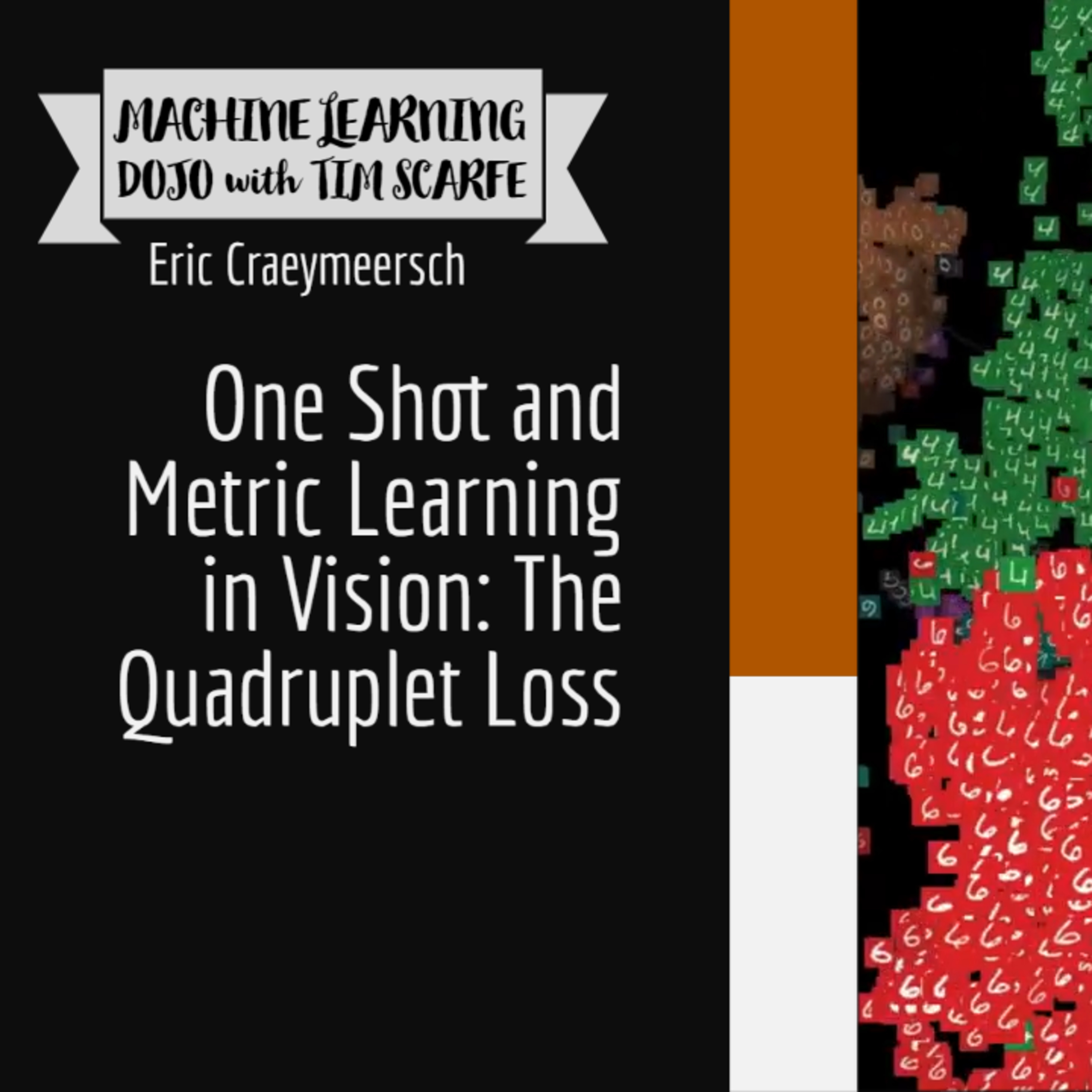
    One Shot and Metric Learning - Quadruplet Loss (Machine Learning Dojo)

    *Note this is an episode from Tim's Machine Learning Dojo YouTube channel. Join Eric Craeymeersch on a wonderful discussion all about ML engineering, computer vision, siamese networks, contrastive loss, one shot learning and metric learning. 00:00:00 Introduction 00:11:47 ML Engineering Discussion 00:35:59 Intro to the main topic 00:42:13 Siamese Networks 00:48:36 Mining strategies 00:51:15 Contrastive Loss 00:57:44 Trip loss paper 01:09:35 Quad loss paper 01:25:49 Eric's Quadloss Medium Article 02:17:32 Metric learning reality check 02:21:06 Engineering discussion II 02:26:22 Outro In our second paper review call, Tess Ferrandez covered off the FaceNet paper from Google which was a one-shot siamese network with the so called triplet loss. It was an interesting change of direction for NN architecture i.e. using a contrastive loss instead of having a fixed number of output classes. Contrastive architectures have been taking over the ML landscape recently i.e. SimCLR, MOCO, BERT. Eric wrote an article about this at the time: https://medium.com/@crimy/one-shot-learning-siamese-networks-and-triplet-loss-with-keras-2885ed022352 He then discovered there was a new approach to one shot learning in vision using a quadruplet loss and metric learning. Eric wrote a new article and several experiments on this @ https://medium.com/@crimy/beyond-triplet-loss-one-shot-learning-experiments-with-quadruplet-loss-16671ed51290?source=friends_link&sk=bf41673664ad8a52e322380f2a456e8b Paper details: Beyond triplet loss: a deep quadruplet network for person re-identification https://arxiv.org/abs/1704.01719 (Chen at al '17) "Person re-identification (ReID) is an important task in wide area video surveillance which focuses on identifying people across different cameras. Recently, deep learning networks with a triplet loss become a common framework for person ReID. However, the triplet loss pays main attentions on obtaining correct orders on the training set. It still suffers from a weaker generalization capability from the training set to the testing set, thus resulting in inferior performance. In this paper, we design a quadruplet loss, which can lead to the model output with a larger inter-class variation and a smaller intra-class variation compared to the triplet loss. As a result, our model has a better generalization ability and can achieve a higher performance on the testing set. In particular, a quadruplet deep network using a margin-based online hard negative mining is proposed based on the quadruplet loss for the person ReID. In extensive experiments, the proposed network outperforms most of the state-of-the-art algorithms on representative datasets which clearly demonstrates the effectiveness of our proposed method." Original facenet paper; https://arxiv.org/abs/1503.03832 #deeplearning #machinelearning

  • May 25, 2020 · 1 hr 38 min

    Harri Valpola: System 2 AI and Planning in Model-Based Reinforcement Learning

    In this episode of Machine Learning Street Talk, Tim Scarfe, Yannic Kilcher and Connor Shorten interviewed Harri Valpola, CEO and Founder of Curious AI. We continued our discussion of System 1 and System 2 thinking in Deep Learning, as well as miscellaneous topics around Model-based Reinforcement Learning. Dr. Valpola describes some of the challenges of modelling industrial control processes such as water sewage filters and paper mills with the use of model-based RL. Dr. Valpola and his collaborators recently published “Regularizing Trajectory Optimization with Denoising Autoencoders” that addresses some of the concerns of planning algorithms that exploit inaccuracies in their world models! 00:00:00 Intro to Harri and Curious AI System1/System 2 00:04:50 Background on model-based RL challenges from Tim 00:06:26 Other interesting research papers on model-based RL from Connor 00:08:36 Intro to Curious AI recent NeurIPS paper on model-based RL and denoising autoencoders from Yannic 00:21:00 Main show kick off, system 1/2 00:31:50 Where does the simulator come from? 00:33:59 Evolutionary priors 00:37:17 Consciousness 00:40:37 How does one build a company like Curious AI? 00:46:42 Deep Q Networks 00:49:04 Planning and Model based RL 00:53:04 Learning good representations 00:55:55 Typical problem Curious AI might solve in industry 01:00:56 Exploration 01:08:00 Their paper - regularizing trajectory optimization with denoising 01:13:47 What is Epistemic uncertainty 01:16:44 How would Curious develop these models 01:18:00 Explainability and simulations 01:22:33 How system 2 works in humans 01:26:11 Planning 01:27:04 Advice for starting an AI company 01:31:31 Real world implementation of planning models 01:33:49 Publishing research and openness We really hope you enjoy this episode, please subscribe! Regularizing Trajectory Optimization with Denoising Autoencoders: https://papers.nips.cc/paper/8552-regularizing-trajectory-optimization-with-denoising-autoencoders.pdf Pulp, Paper & Packaging: A Future Transformed through Deep Learning: https://thecuriousaicompany.com/pulp-paper-packaging-a-future-transformed-through-deep-learning/ Curious AI: https://thecuriousaicompany.com/ Harri Valpola Publications: https://scholar.google.com/citations?user=1uT7-84AAAAJ&hl=en&oi=ao Some interesting papers around Model-Based RL: GameGAN: https://cdn.arstechnica.net/wp-content/uploads/2020/05/Nvidia_GameGAN_Research.pdf Plan2Explore: https://ramanans1.github.io/plan2explore/ World Models: https://worldmodels.github.io/ MuZero: https://arxiv.org/pdf/1911.08265.pdf PlaNet: A Deep Planning Network for RL: https://ai.googleblog.com/2019/02/introducing-planet-deep-planning.html Dreamer: Scalable RL using World Models: https://ai.googleblog.com/2020/03/introducing-dreamer-scalable.html Model Based RL for Atari: https://arxiv.org/pdf/1903.00374.pdf

  • May 22, 2020 · 2 hr 34 min

    ICLR 2020: Yoshua Bengio and the Nature of Consciousness

    In this episode of Machine Learning Street Talk, Tim Scarfe, Connor Shorten and Yannic Kilcher react to Yoshua Bengio’s ICLR 2020 Keynote “Deep Learning Priors Associated with Conscious Processing”. Bengio takes on many future directions for research in Deep Learning such as the role of attention in consciousness, sparse factor graphs and causality, and the study of systematic generalization. Bengio also presents big ideas in Intelligence that border on the line of philosophy and practical machine learning. This includes ideas such as consciousness in machines and System 1 and System 2 thinking, as described in Daniel Kahneman’s book “Thinking Fast and Slow”. Similar to Yann LeCun’s half of the 2020 ICLR keynote, this talk takes on many challenging ideas and hopefully this video helps you get a better understanding of some of them! Thanks for watching! Please Subscribe for more videos! Paper Links: Link to Talk: https://iclr.cc/virtual_2020/speaker_7.html The Consciousness Prior: https://arxiv.org/abs/1709.08568 Thinking Fast and Slow: https://www.amazon.com/Thinking-Fast-Slow-Daniel-Kahneman/dp/0374533555 Systematic Generalization: https://arxiv.org/abs/1811.12889 CLOSURE: Assessing Systematic Generalization of CLEVR Models: https://arxiv.org/abs/1912.05783 Neural Module Networks: https://arxiv.org/abs/1511.02799 Experience Grounds Language: https://arxiv.org/pdf/2004.10151.pdf Benchmarking Graph Neural Networks: https://arxiv.org/pdf/2003.00982.pdf On the Measure of Intelligence: https://arxiv.org/abs/1911.01547 Please check out our individual channels as well! Machine Learning Dojo with Tim Scarfe: https://www.youtube.com/channel/UCXvHuBMbgJw67i5vrMBBobA Yannic Kilcher: https://www.youtube.com/channel/UCZHmQk67mSJgfCCTn7xBfe Henry AI Labs: https://www.youtube.com/channel/UCHB9VepY6kYvZjj0Bgxnpbw 00:00:00 Tim and Yannics takes 00:01:37 Intro to Bengio 00:03:13 System 2, language and Chomsky 00:05:58 Cristof Koch on conciousness 00:07:25 Francois Chollet on intelligence and consciousness 00:09:29 Meditation and Sam Harris on consciousness 00:11:35 Connor Intro 00:13:20 Show Main Intro 00:17:55 Priors associated with Conscious Processing 00:26:25 System 1 / System 2 00:42:47 Implicit and Verbalized Knowledge [DONT MISS THIS!] 01:08:24 Inductive Priors for DL 2.0 01:27:20 Systematic Generalization 01:37:53 Contrast with the Symbolic AI Program 01:54:55 Attention 02:00:25 From Attention to Consciousness 02:05:31 Thoughts, Consciousness, Language 02:06:55 Sparse Factor graph 02:10:52 Sparse Change in Abstract Latent Space 02:15:10 Discovering Cause and Effect 02:20:00 Factorize the joint distribution 02:22:30 RIMS: Modular Computation 02:24:30 Conclusion #machinelearning #deeplearning

  • May 19, 2020 · 2 hr 12 min

    ICLR 2020: Yann LeCun and Energy-Based Models

    This week Connor Shorten, Yannic Kilcher and Tim Scarfe reacted to Yann LeCun's keynote speech at this year's ICLR conference which just passed. ICLR is the number two ML conference and was completely open this year, with all the sessions publicly accessible via the internet. Yann spent most of his talk speaking about self-supervised learning, Energy-based models (EBMs) and manifold learning. Don't worry if you hadn't heard of EBMs before, neither had we! Thanks for watching! Please Subscribe! Paper Links: ICLR 2020 Keynote Talk: https://iclr.cc/virtual_2020/speaker_7.html A Tutorial on Energy-Based Learning: http://yann.lecun.com/exdb/publis/pdf/lecun-06.pdf Concept Learning with Energy-Based Models (Yannic's Explanation): https://www.youtube.com/watch?v=Cs_j-oNwGgg Concept Learning with Energy-Based Models (Paper): https://arxiv.org/pdf/1811.02486.pdf Concept Learning with Energy-Based Models (OpenAI Blog Post): https://openai.com/blog/learning-concepts-with-energy-functions/ #deeplearning #machinelearning #iclr #iclr2020 #yannlecun

  • May 19, 2020 · 1 hr 26 min

    The Lottery Ticket Hypothesis with Jonathan Frankle

    In this episode of Machine Learning Street Talk, we chat with Jonathan Frankle, author of The Lottery Ticket Hypothesis. Frankle has continued researching Sparse Neural Networks, Pruning, and Lottery Tickets leading to some really exciting follow-on papers! This chat discusses some of these papers such as Linear Mode Connectivity, Comparing and Rewinding and Fine-tuning in Neural Network Pruning, and more (full list of papers linked below). We also chat about how Jonathan got into Deep Learning research, his Information Diet, and work on developing Technology Policy for Artificial Intelligence! This was a really fun chat, I hope you enjoy listening to it and learn something from it! Thanks for watching and please subscribe! Huge thanks to everyone on r/MachineLearning who asked questions! Paper Links discussed in the chat: The Lottery Ticket Hypothesis: Finding Sparse, Trainable Neural Networks: https://arxiv.org/abs/1803.03635 Linear Mode Connectivity and the Lottery Ticket Hypothesis: https://arxiv.org/abs/1912.05671 Dissecting Pruned Neural Networks: https://arxiv.org/abs/1907.00262 Training BatchNorm and Only BatchNorm: On the Expressive Power of Random Features in CNNs: https://arxiv.org/abs/2003.00152 What is the State of Neural Network Pruning? https://arxiv.org/abs/2003.03033 The Early Phase of Neural Network Training: https://arxiv.org/abs/2002.10365 Comparing Rewinding and Fine-tuning in Neural Network Pruning: https://arxiv.org/abs/2003.02389 (Also Mentioned) Block-Sparse GPU Kernels: https://openai.com/blog/block-sparse-gpu-kernels/ Balanced Sparsity for Efficient DNN Inference on GPU: https://arxiv.org/pdf/1811.00206.pdf Playing the Lottery with Rewards and Multiple Languages: Lottery Tickets in RL and NLP: https://arxiv.org/pdf/1906.02768.pdf r/MachineLearning question list: https://www.reddit.com/r/MachineLearning/comments/g9jqe0/d_lottery_ticket_hypothesis_ask_the_author_a/ (edited) #machinelearning #deeplearning

  • May 19, 2020 · 1 hr 40 min

    Exploring the Limits of Transfer Learning with a Unified Text-to-Text Transformer

    In this episode of Machine Learning Street Talk, Tim Scarfe, Yannic Kilcher and Connor Shorten chat about Large-scale Transfer Learning in Natural Language Processing. The Text-to-Text Transfer Transformer (T5) model from Google AI does an exhaustive survey of what’s important for Transfer Learning in NLP and what’s not. In this conversation, we go through the key takeaways of the paper, text-to-text input/output format, architecture choice, dataset size and composition, fine-tuning strategy, and how to best use more computation. Beginning with these topics, we diverge into exciting ideas such as embodied cognition, meta-learning, and the measure of intelligence. We are still beginning our podcast journey and really appreciate any feedback from our listeners. Is the chat too technical? Do you prefer group discussions, interviewing experts, or chats between the three of us? Thanks for watching and if you haven’t already, Please Subscribe! Paper Links discussed in the chat: Text-to-Text Transfer Transformer: https://arxiv.org/abs/1910.10683 Experience Grounds Language (relevant to divergent discussion about embodied cognition): https://arxiv.org/pdf/2004.10151.pdf On the Measure of Intelligence: https://arxiv.org/abs/1911.01547 Train Large, Then Compress: https://arxiv.org/pdf/2002.11794.pdf Scaling Laws for Neural Language Models: https://arxiv.org/pdf/2001.08361.pdf The Illustrated Transformer: http://jalammar.github.io/illustrated... ELECTRA: https://arxiv.org/pdf/2003.10555.pdf Transformer-XL: https://arxiv.org/pdf/1901.02860.pdf Reformer: The Efficient Transformer: https://openreview.net/pdf?id=rkgNKkHtvB The Evolved Transformer: https://arxiv.org/pdf/1901.11117.pdf DistilBERT: https://arxiv.org/pdf/1910.01108.pdf How to generate text (HIGHLY RECOMMEND): https://huggingface.co/blog/how-to-ge... Tokenizers: https://blog.floydhub.com/tokenization-nlp/

  • May 2, 2020 · 1 hr 14 min

    CURL: Contrastive Unsupervised Representations for Reinforcement Learning

    According to Yann Le Cun, the next big thing in machine learning is unsupervised learning. Self-supervision has changed the entire game in the last few years in deep learning, first transforming the language world with word2vec and BERT -- but now it's turning computer vision upside down. This week Yannic, Connor and I spoke with one of the authors, Aravind Srinivas who recently co-led the hot-off-the-press CURL: Contrastive Unsupervised Representations for Reinforcement Learning alongside Michael (Misha) Laskin. CURL has had an incredible reception in the ML community in the last month or so. Remember the Deep Mind paper which solved the Atari games using the raw pixels? Aravind's approach uses contrastive unsupervised learning to featurise the pixels before applying RL. CURL is the first image-based algorithm to nearly match the sample-efficiency and performance of methods that use state-based features! This is a huge step forwards in being able to apply RL in the real world. We explore RL and self-supervision for computer vision in detail and find out about how Aravind got into machine learning. Original YouTube Video: https://youtu.be/1MprzvYNpY8 Paper: CURL: Contrastive Unsupervised Representations for Reinforcement Learning Aravind Srinivas, Michael Laskin, Pieter Abbeel https://arxiv.org/pdf/2004.04136.pdf Yannic's analysis video: https://www.youtube.com/watch?v=hg2Q_O5b9w4 #machinelearning #reinforcementlearning #curl #timscarfe #yannickilcher #connorshorten Music credit; https://soundcloud.com/errxrmusic/in-my-mind

  • Apr 24, 2020 · 1 hr 12 min

    Exploring Open-Ended Algorithms: POET

    Three YouTubers; Tim Scarfe - Machine Learning Dojo (https://www.youtube.com/channel/UCXvHuBMbgJw67i5vrMBBobA), Connor Shorten - Henry AI Labs (https://www.youtube.com/channel/UCHB9VepY6kYvZjj0Bgxnpbw) and Yannic Kilcher (https://www.youtube.com/channel/UCZHmQk67mSJgfCCTn7xBfew). We made a new YouTube channel called Machine Learning Street Talk. Every week we will talk about the latest and greatest in AI. Subscribe now! Special guests this week; Dr. Mathew Salvaris (https://www.linkedin.com/in/drmathewsalvaris/), Eric Craeymeersch (https://www.linkedin.com/in/ericcraeymeersch/), Dr. Keith Duggar (https://www.linkedin.com/in/dr-keith-duggar/), Dmitri Soshnikov (https://www.linkedin.com/in/shwars/) We discuss the new concept of an open-ended, or "AI-Generating" algorithm. Open-endedness is a class of algorithms which generate problems and solutions to increasingly complex and diverse tasks. These algorithms create their own curriculum of learning. Complex tasks become tractable because they are now the final stepping stone in a lineage of progressions. In many respects, it's better to trust the machine to develop the learning curriculum, because the best curriculum might be counter-intuitive. These algorithms can generate a radiating tree of evolving challenges and solutions just like natural evolution. Evolution has produced an eternity of diversity and complexity and even produced human intelligence as a side-effect! Could AI-generating algorithms be the next big thing in machine learning? Wang, Rui, et al. "Enhanced POET: Open-Ended Reinforcement Learning through Unbounded Invention of Learning Challenges and their Solutions." arXiv preprint arXiv:2003.08536 (2020). https://arxiv.org/abs/2003.08536 Wang, Rui, et al. "Paired open-ended trailblazer (poet): Endlessly generating increasingly complex and diverse learning environments and their solutions." arXiv preprint arXiv:1901.01753 (2019). https://arxiv.org/abs/1901.01753 Watch Yannic’s video on POET: https://www.youtube.com/watch?v=8wkgDnNxiVs and on the extended POET: https://youtu.be/gbG1X8Xq-T8 Watch Connor’s video https://www.youtube.com/watch?v=jxIkPxkN10U UberAI labs video: https://www.youtube.com/watch?v=RX0sKDRq400 #reinforcementlearning #machinelearning #uber #deeplearning #rl #timscarfe #connorshorten #yannickilcher