Artwork for Machine Learning Street Talk (MLST)
Technology

Machine Learning Street Talk (MLST)

Machine Learning Street Talk (MLST)

Welcome! We engage in fascinating discussions with pre-eminent figures in the AI field. Our flagship show covers current affairs in AI, cognitive science, neuroscience and philosophy of mind with in-depth analysis. Our approach is unrivalled in terms of scope and rigour – we believe in intellectual diversity in AI, and we touch on all of the main ideas in the field with the hype surgically removed. MLST is run by Tim Scarfe, Ph.D (https://www.linkedin.com/in/ecsquizor/) and features regular appearances from MIT Doctor of Philosophy Keith Duggar (https://www.linkedin.com/in/dr-keith-duggar/).

  • 20 episodes
  • Updated Friday

Episodes20

  • Friday · 1 hr 18 min

    How Researchers Test AI for Hidden Goals — Apollo Research

    Can an AI do the right thing for the wrong reason? Tim Scarfe speaks with Apollo Research’s Alexander Meinke, Axel Højmark and Jérémy Scheurer about Measuring Reward-Seeking via Contrastive Belief Updates, their new research with OpenAI. The panel asks how models infer what graders reward, why good behaviour can come from the wrong reason, and whether that difference can be measured. The conversation moves through promise-breaking, grader awareness, reward hacking, scheming, opaque reasoning and corrigibility, then turns to a detailed walkthrough of the contrastive-belief method and what its results do and do not show. The o3 results discussed here concern an intermediate checkpoint without safety training. This episode was made in partnership with Apollo Research. MLST retained full editorial control. Reference Apollo Research: https://www.apolloresearch.ai/ --- TIMESTAMPS: 00:00:00 Cold Open 00:02:12 Right Things, Wrong Reasons 00:12:47 Grader Awareness 00:26:22 Legibility 00:32:35 What To Call It 00:35:58 Intelligence, Agency, Anthropomorphism 00:45:16 Apollo’s Mission 00:48:54 The End of the Exponential 00:55:45 The Paper 01:16:34 Closing Reflection --- REFERENCES: tool: [00:00:08] Claude Fable https://www.anthropic.com/claude/fable [00:12:50] AlphaGo Zero https://deepmind.google/blog/alphago-zero-starting-from-scratch/ [00:44:30] AlphaFold 3 https://deepmind.google/science/alphafold/ paper: [00:01:02] Measuring Reward-Seeking via Contrastive Belief Updates https://arxiv.org/abs/2607.18966 [00:16:19] Natural Language Autoencoders Produce Unsupervised Explanations of LLM Activations https://transformer-circuits.pub/2026/nla/ [00:26:48] Stress Testing Deliberative Alignment for Anti-Scheming Training https://arxiv.org/abs/2509.15541 [00:35:33] Shortcut learning in deep neural networks https://arxiv.org/abs/2004.07780 [00:53:49] Measuring AI Ability to Complete Long Software Tasks https://arxiv.org/abs/2503.14499 [00:59:52] Modifying LLM Beliefs with Synthetic Document Finetuning https://alignment.anthropic.com/2025/modifying-beliefs-via-sdf/ [01:10:44] Alignment Faking in Large Language Models https://arxiv.org/abs/2412.14093 [01:13:55] Natural Emergent Misalignment from Reward Hacking https://www.anthropic.com/research/emergent-misalignment-reward-hacking other: [00:10:14] We Need a Science of Scheming https://www.apolloresearch.ai/science/science-of-scheming/ [00:32:56] CoastRunners reward hacking example https://deepmind.google/blog/specification-gaming-the-flip-side-of-ai-ingenuity/ organization: [01:06:07] Redwood Research https://www.redwoodresearch.org/ --- ReScript: https://app.rescript.info/share/718ab68e18cfa3b9b800da6b3290fd42

  • July 13 · 55 min

    Why a Nation Can't Outsource Its Frontier AI - Alistair Pullen (Cosine AI)

    This episode is sponsored by Notion. Learn more about Notion's Developer Platform today at https://notion.com/mlst Britain's most capable coding model can't be exported, and that ban is the whole reason Cosine set out to build one from scratch. Alistair Pullen, CEO and co-founder of Cosine, sits down with Tim Scarfe to explain how a frontier system he calls Fable, locked behind US export controls, became the founding case for a UK sovereign model trained on the Isambard supercomputer in Bristol. The bet underneath it is economic. Pullen argues that an inference company, rather than a training-first lab, doesn't need billions to compete: millions, a national compute allocation, and a consortium feedback loop can be enough. From there it gets into the machinery, why open-weight models still trail the frontier on size, active parameters and data, the mixture-of-experts versus dense trade-off and why active params dominate how a model actually feels, and the edge that real coding trajectories confer. The back half is about making agents trustworthy. Pullen makes the case for beating "slop" by rewarding the process instead of the final answer, reframes code review as runtime proof (spin the bug up in a VM and force the agent to actually exploit it), and walks through Swarm, Cosine's system running hundreds of sub-agents in one shot. It ends on why memory is still an unsolved hack, how synthetic graders let you run RL on tasks with no built-in test, and why Pullen reads US export controls as an accidental gift, with a supply-chain sting in the tail. --- TIMESTAMPS: 00:00:00 The sovereign mandate and the Fable ban 00:04:02 Millions vs billions: the inference-company model 00:07:19 The consortium feedback loop 00:07:40 Why open models lag the frontier 00:14:59 MoE vs dense, and why active params matter 00:16:29 Trajectories: the process-data advantage 00:19:48 Beating slop: reward the process, not the answer 00:26:06 Reusable abstractions and the epistemic wall 00:29:56 Code review becomes runtime proof 00:37:32 Do agentic harnesses still matter? 00:40:35 Swarm: orchestrating hundreds of sub-agents 00:45:14 Why memory is still unsolved 00:48:25 Synthetic data and graders for RL 00:53:09 The US export gift and supply-chain risk --- REFERENCES: organization: [00:01:15] Cosine https://cosine.sh [00:04:14] Mistral AI https://mistral.ai [00:05:50] Anthropic https://www.anthropic.com [00:07:42] Cohere https://cohere.com [00:08:36] DeepSeek https://www.deepseek.com tool: [00:02:52] Isambard-AI https://isambard.ac.uk [00:05:56] Colossus (xAI) https://en.wikipedia.org/wiki/Colossus_(supercomputer) [00:07:52] GLM (Z.ai) https://z.ai [00:11:52] NVIDIA B300 https://www.nvidia.com/en-us/data-center/dgx-b300/ [00:15:37] gpt-oss-120b https://huggingface.co/openai/gpt-oss-120b [00:15:52] Devstral 2 https://mistral.ai/news/devstral [00:16:01] Llama 70b https://www.llama.com [00:17:05] Claude Code https://www.anthropic.com/claude-code [00:26:23] ARC-AGI (Francois Chollet) https://arcprize.org [00:40:38] Swarm (Cosine) https://cosine.sh [00:40:50] OpenAI Codex https://github.com/openai/codex [00:41:16] Lumen Outpost (Cosine) https://cosine.sh [00:41:18] Kimi K2 (Moonshot) https://huggingface.co/moonshotai/Kimi-K2-Instruct [00:49:55] SWE-bench https://www.swebench.com [00:52:40] SystemVerilog https://en.wikipedia.org/wiki/SystemVerilog person: [00:23:40] Andrej Karpathy https://karpathy.ai paper: [00:27:10] GRPO (DeepSeekMath) https://arxiv.org/abs/2402.03300 [00:27:13] GSPO https://arxiv.org/abs/2507.18071 Incompressible Knowledge Probes, Bojie Li https://arxiv.org/pdf/2604.24827 Estimating the Size of Claude Opus 4.5/4.6 https://unexcitedneurons.substack.com/p/estimating-the-size-of-claude-opus --- ReScript: https://app.rescript.info/session/5852d2b884c4ce4b?share=10b9799160845bb11779f8ac6cd3124f

  • July 1 · 1 hr 24 min

    The Benchmark With No Instructions — ARC-AGI-3 (winning team!)

    Tim Scarfe travels to Zurich to sit down with the Tufa Labs ARC-AGI-3 team — founder Benjamin Crouzier, with Jeroen Cottaar, Dries Smit, Stefano Viel and Michal Tesnar — to work out what their leaderboard-topping system does and what the benchmark is really testing.The cut opens on the games: a walkthrough of the Locksmith game, where you read the rules of an unfamiliar world straight from raw frames. ARC-AGI-3 makes ARC interactive and agentic, so the model has to *discover* the goal rather than transduce a static grid. It stays easy for humans and breaks LLMs, and it runs through everything that follows. Dries traces his StochasticGoose preview win — brute force that only searched actions which changed the frame — and why it collapsed once the organisers added action-efficiency scoring and unseen games.Induction and transduction run through the middle of the conversation — how much of an answer is really priors leaking back the moment a model recognises a maze. The abstraction mountain, and Tim's case that LLMs reach the right answer through fractured, entangled representations — performance, not competence. Whether transformers plan at all or just fake it well enough. Why the score really measures action efficiency, not games solved, and why agents lock onto the wrong goal and cannot climb back out.Crouzier closes on the Tufa Labs thesis — a small lab against the giants, the bitter lesson against hand-built harnesses, and safety — and Tim ties it back to Kenneth Stanley, deep constraints, and creativity as competence. Disclosure: Tufa Labs sponsors MLST. ---TIMESTAMPS:00:00:00 Meet the Tufa team and what makes ARC-AGI-3 hard00:02:11 Locksmith game: reading the rules from raw frames00:03:10 Why build an independent research lab00:04:11 StochasticGoose: a preview win, then the hardened games00:07:58 Induction, transduction, and priors inside LLMs00:10:31 Curiosity, world models, and exploring by frame change00:14:32 Understanding debt and losing sight of your own code00:15:53 Requirements-based agents and human-AI co-creativity00:19:22 Why auto-research misses the big picture00:21:54 The abstraction mountain and fractured representations00:27:36 Constraints and making LLMs act as if they understand00:34:51 Human difficulty calibration, esports priors, and emergence00:41:35 Agency, goal acquisition, and two kinds of planning00:47:31 Harnesses, the 36% number, and wrong-goal loops00:52:33 Rewards, goals, and why ARC-AGI-3 resists brute force01:00:46 Would solving ARC-AGI-3 prove AGI?01:07:53 Stripping language away, then priors leak back01:14:06 Representation and whether language is necessary01:18:04 The bitter lesson versus specialised harnesses01:22:20 Capability research, safety, and the software singularity---REFERENCES:organization:[00:02:11] ARC-AGI-3https://arcprize.org/arc-agi/3[00:03:10] Tufa Labshttps://tufalabs.ai/team/[00:04:20] ARC-AGI-3 Preview Agent Competitionhttps://arcprize.org/competitions/arc-agi-3-preview-agentstool:[00:04:55] StochasticGoose ARC-AGI-3 solutionhttps://github.com/DriesSmit/ARC3-solution[00:07:42] ArcGenticahttps://github.com/symbolica-ai/arcgentica[00:07:49] RGB-Agenthttps://github.com/alexisfox7/RGB-Agent[00:14:38] Claude Codehttps://www.anthropic.com/claude-code[01:03:42] Qwen 3.6 27Bhttps://huggingface.co/Qwen/Qwen3.6-27Bpaper:[00:13:03] On the Measure of Intelligencehttps://arxiv.org/abs/1911.01547[00:27:42] DreamCoderhttps://arxiv.org/abs/2006.08381[00:43:55] On the Biology of a Large Language Modelhttps://transformer-circuits.pub/2025/attribution-graphs/biology.html[01:18:46] ImageNet Classification with Deep CNNs (AlexNet)https://proceedings.neurips.cc/paper_files/paper/2012/file/c399862d3b9d6b76c8436e924a68c45b-Paper.pdfother:[01:18:16] The Bitter Lessonhttp://www.incompleteideas.net/IncIdeas/BitterLesson.html---https://app.rescript.info/share/463d7f031349b4b9db428553eed88230

  • June 28 · 1 hr 2 min

    The Thermodynamic AI Computing Chip - Thomas Ahle

    Thomas Ahle wants Normal Computing to be the Lovable for chip design: type your intent, and a swarm of agents carries it from design through optimisation, formalisation and verification to tape-out. To get there, his team at wrote their own open-source Verilog simulator, 580,000 lines in 43 days, because commercial EDA verifiers run about $10,000 per core and there are no decent open-source compilers to build on. That sets up the question Tim keeps pressing: if an agent can produce a chip design, a proof, or a working program, how do you actually know it is correct? Passing 70% of tests is not the same as being right, and a single fabricated bug can cost a company a fortune. They dig into ProgramBench (rebuild a program from its tests, roughly 0% success), the difference between structure and competence, and the "understanding debt" you take on when nobody reads the code. From there: auto-formalisation in Lean and the AlphaProof trick of training on prove-or-disprove; why there is no single true representation of a spec (Petri nets, TLA+, Erik Curiel's "math does not represent"); and thermodynamic computing, where Normal Computing's CN101 chip is built so that its physical noise *is* the computation, settling a stochastic differential equation in hardware to invert a matrix. Plus Bayesian uncertainty, specialisation, the Chomsky hierarchy, AI slop, and whether performance is all that matters. Recorded in Zurich. Disclosure: Normal Computing paid our production and travel costs for this show. We retained full editorial control. They did not see the video before publication, and we did not show it to them or discuss it with them beforehand. --- TIMESTAMPS: 00:00:00 Meet Thomas Ahle: the Lovable for chip design 00:03:41 Why hardware needs formal verification 00:06:36 Ten thousand dollars per core and a six-month agent run 00:07:40 Rebuilding programs from tests: ProgramBench and zero percent 00:12:15 Structure vs competence: can you learn a program from behavior? 00:15:27 Continual learning, abstraction, and Claude as an ecosystem 00:23:17 Autoformalization and the AlphaProof trick 00:29:31 No single true representation: specs, Petri nets and TLA+ 00:34:43 Thermodynamic computing: when noise is the computation 00:37:32 Bayesian uncertainty in the age of token streams 00:41:12 Hybrid compute: vibe-coding loops, binaries and Stockfish 00:44:44 Co-design, central-AI apps and API pricing 00:49:45 Chain of thoughtlessness and the Chomsky hierarchy 00:53:40 AI psychosis, slop and the broken social contract 00:57:34 Typing it yourself, teamwork and performance vs competence --- REFERENCES: person: [00:00:10] Thomas Ahle https://thomasahle.com organization: [00:00:27] Normal Computing https://normalcomputing.com/ paper: [00:11:21] ProgramBench: Can Language Models Rebuild Programs From Scratch? https://arxiv.org/abs/2605.03546 [00:31:55] Autoformalizing Memory Device Specifications with Agents https://arxiv.org/abs/2605.00058 [00:35:20] Thermo AI and the Fluctuation Frontier https://arxiv.org/abs/2302.06584 [00:36:40] Thermo Comp System for AI Applications https://arxiv.org/abs/2312.04836 [00:37:05] Thermodynamic Linear Algebra https://arxiv.org/abs/2308.05660 [00:44:50] An efficient probabilistic hardware architecture for diffusion-like models https://arxiv.org/abs/2510.23972 tool: other: [00:01:00] Building an Open-Source Verilog Simulator with AI: 580K Lines in 43 Days https://normalcomputing.com/blog/building-an-open-source-verilog-simulator-with-ai-580k-lines-in-43-days [00:02:55] Normal Computing Announces Tape-Out of the World's First Thermodynamic Computing Chip (CN101) https://www.normalcomputing.com/blog/normal-computing-announces-tape-out-of-worlds-first-thermodynamic-computing-chip [00:32:02] DRAMBench: Autoformalizing DRAM Specifications with Timed Petri Nets https://www.iese.fraunhofer.de/blog/drambench-autoformalizing-dram-specifications/ --- ReScript: https://app.rescript.info/share/ff9684a112ab37744096adaeb097a263

  • June 22 · 53 min

    He won a Nobel here for AlphaFold. Then he left. - John Jumper

    This episode is sponsored by Notion. Learn more about Notion's Developer Platform today at https://notion.com/mlstProtein folding stalled biology for fifty years. A sequence of amino acids dictates a three-dimensional shape, but reading that shape meant a year and roughly $100,000 of crystallography per structure. Then AlphaFold 2 won CASP14 so decisively the organizers called the problem essentially solved.In this documentary cut, John Jumper, who shared the 2024 Nobel Prize in Chemistry and has since left DeepMind for Anthropic, walks Tim Scarfe through what the system did and, more interestingly, what it did not. The architecture gets a proper dissection: MSAs, the Evoformer, invariant point attention, the FAPE loss, and Jumper's correction of the equivariance story, which ablations valued at roughly 2.5 of 30 GDT points rather than the whole win. He is blunt about the limits. AlphaFold predicts one experiment extraordinarily well; it is not a model of the cell, it does not capture dynamics, and on a given drug target it is "wrong nine times out of ten."From there: the AlphaFold Database of 200M+ predicted structures, AlphaFold 3 and ligands, Isomorphic Labs, and Jumper's quarrel with the bitter lesson, where finite data and human hypotheses still matter. Emmanuel Nji of BioStruct Africa closes the film on what changes when work that took years now takes months, and on training the next thousand structural biologists across Africa.---TIMESTAMPS:00:00:00 Cold open: predicting nature with a button press00:01:03 The protein folding bottleneck and CASP00:04:39 The Nobel, the database, and the move to Anthropic00:05:50 Sponsor (Notion) and framing: what AlphaFold does not claim00:07:39 Proteins as self-assembling nanomachines00:12:24 From structures to biology: drug discovery and Midnolin00:17:37 The humility of AlphaFold: a narrow predictor00:22:18 Inside the architecture: Evoformer, IPA and FAPE00:30:20 Ruthless empiricism: ablations and 100x in data00:35:20 Predict, control, understand00:40:00 Against the bitter lesson; AlphaFold 3 as diffusion00:45:07 Intelligence, representations and AGI00:49:23 Epilogue: AlphaFold in Africa00:52:16 Closing: the case for hybrid science models---REFERENCES:organization:[00:01:55] Critical Assessment of Structure Prediction (CASP)https://predictioncenter.org/[00:04:39] The Nobel Prize in Chemistry 2024https://www.nobelprize.org/prizes/chemistry/2024/summary/[00:05:18] BioStruct Africahttps://www.biostructafrica.org/[00:18:03] Isomorphic Labshttps://www.isomorphiclabs.com/paper:[00:03:09] AlphaFold Protein Structure Databasehttps://doi.org/10.1093/nar/gkab1061[00:17:25] Accurate structure prediction of biomolecular interactions with AlphaFold 3https://www.nature.com/articles/s41586-024-07487-w[00:22:18] Highly accurate protein structure prediction with AlphaFoldhttps://www.nature.com/articles/s41586-021-03819-2[00:23:10] Midnolin promotes degradation of substrates independent of ubiquitinationhttps://doi.org/10.1126/science.adh5021[00:27:00] Improved protein structure prediction using potentials from deep learninghttps://www.nature.com/articles/s41586-019-1923-7tool:[00:03:09] AlphaFold Protein Structure Database (EBI)https://alphafold.ebi.ac.uk/[00:45:55] AlphaEvolve: a coding agent for designing advanced algorithmshttps://deepmind.google/blog/alphaevolve-a-gemini-powered-coding-agent-for-designing-advanced-algorithms/other:[00:39:40] The Bitter Lessonhttp://www.incompleteideas.net/IncIdeas/BitterLesson.html---ReScript: https://app.rescript.info/share/d8cde5c221fb71e2c0f5aafe94f90dfaDisclaimer - not sponsored, editorial with us - we filmed it at GDM, London

  • May 31 · 1 hr 20 min

    When AI Decides You're a Threat — Brad Carson

    Brad Carson was the Army's General Counsel, served two terms in Congress and was Acting Under Secretary of Defense for Personnel and Readiness. He now heads Americans for Responsible Innovation, the AI-policy advocacy group he co-founded. Keith Duggar spends roughly eighty minutes pushing back. SPONSOR: --- Cyber Fund built the Monastery to help founders ship products that were impossible a year ago. Applications for Batch 1 are now open. Apply now: https://cyber.fund --- Carson's whole case rests on one line: the genie is not out of the bottle. We have pulled dangerous tech back before. Asilomar halted recombinant DNA in 1975, and the West still controls the chips AI runs on. Calling it unstoppable, he says, is the most dangerous idea in the room. Then Keith drags him somewhere darker. A Palantir heat map scores you 0.73 on whether you are a combatant, and a strike follows. The model is wrong some accepted share of the time, and when it is, nobody answers for it. You cannot court-martial a model, and not even the interpretability researchers can say why it picked you. — Note: after recording, we learned that Americans for Responsible Innovation is backed by EA-aligned philanthropy (not sponsored) --- TIMESTAMPS: 00:00:00 From the Pentagon to AI governance 00:04:52 Regulatory capture vs Silicon Valley networks 00:07:56 Transparency and the Claude tier changes 00:09:40 Tort liability when AI tools cause harm 00:13:40 AI is a product, not a person 00:16:01 Children, suicide, and the suicide business 00:19:59 Opaque neural nets and the law of war 00:25:54 Probabilistic targeting and the death of accountability 00:28:47 The arms race fallacy: Asilomar and restraint 00:34:02 Talking to China: track 2 talks and chip leverage 00:39:45 Air power never wins: capital for labour 00:43:29 Anthropic vs the Department of War 00:51:29 Concentration, open source, and brain drain 01:00:18 DeepSeek, Chinese culture, and AI as diplomacy 01:12:25 Upskilling Congress and why public trust matters --- REFERENCES: organization: [00:02:45] ICRC position on autonomous weapons https://www.icrc.org/en/law-and-policy/autonomous-weapons [00:05:22] Americans for Responsible Innovation (ARI) https://ari.us [00:07:20] Andreessen Horowitz (a16z) https://a16z.com/ [01:16:05] Office of Technology Assessment https://en.wikipedia.org/wiki/Office_of_Technology_Assessment other: [00:03:35] Beneficial AGI 2019 Conference (Future of Life Institute, Puerto Rico) https://futureoflife.org/event/beneficial-agi-2019/ [00:18:30] Section 230 of the Communications Decency Act https://en.wikipedia.org/wiki/Section_230 [00:19:59] Lethal Autonomous Weapons (LAWS) https://en.wikipedia.org/wiki/Lethal_autonomous_weapon [00:31:35] Strategic Arms Limitation Talks (SALT) https://en.wikipedia.org/wiki/Strategic_Arms_Limitation_Talks [00:32:28] Asilomar Conference on Recombinant DNA (1975) https://en.wikipedia.org/wiki/Asilomar_Conference_on_Recombinant_DNA [00:39:45] The New Iron Triangle (ARI policy byte) https://ari.us/policy-bytes/the-new-iron-triangle/ [00:48:05] Defense Production Act https://en.wikipedia.org/wiki/Defense_Production_Act person: [00:03:35] Anthony Aguirre https://en.wikipedia.org/wiki/Anthony_Aguirre [00:06:48] Dean Ball — Hyperdimensional https://www.hyperdimensional.co/ [00:23:13] Neel Nanda — mechanistic interpretability https://www.neelnanda.io/ [00:36:02] Jack Clark (Anthropic) on Conversations with Tyler https://conversationswithtyler.com/episodes/jack-clark/ [00:39:15] Robert Trager — Centre for the Governance of AI https://www.governance.ai/team/robert-trager [00:41:55] Giulio Douhet https://en.wikipedia.org/wiki/Giulio_Douhet [01:15:05] Don Beyer (US Congress) https://en.wikipedia.org/wiki/Don_Beyer tool: [00:22:19] Phalanx CIWS https://en.wikipedia.org/wiki/Phalanx_CIWS --- ReScript: https://app.rescript.info/public/share/9405ff35c0215b7cdae6402d41284171 https://app.rescript.info/api/public/sessions/0a6c081b8e5fe413/pdf

  • May 21 · 1 hr 17 min

    Intelligence is collective, not artificial — Prof. Michael I. Jordan (UC Berkeley / Inria)

    Michael I. Jordan, described by Science magazine as the most influential computer scientist alive, has never thought of himself as an AI researcher. In this conversation he explains why that distinction matters. SPONSOR: --- Cyber Fund built the Monastery to help founders ship products that were impossible a year ago. Applications for Batch 1 are now open. Apply now: https://cyber.fund --- Jordan trained as a statistician and cognitive scientist, and his career has been spent building machine learning systems that work in the real world: supply chains, commerce, healthcare, and large economic systems. When the field rebranded itself as AI and then AGI, he did not follow. Instead he argues that the framing is wrong. AI is better understood as a collective economic system than as a race to build a disembodied superintelligence. We talk about why AGI is mostly a PR term, what machine learning achieved before the LLM hype cycle, and why the assistant-on-your-shoulder vision may be less compelling than it sounds. Jordan explains why explanations need to be actionable, not merely mechanistic; why AlphaFold's missing error bars matter; how prediction-powered inference changes the picture; and why drug discovery is an incentive-design problem rather than a pure pattern-matching problem. ERRATA: Science magazine ranked him the most influential computer scientist, not Nature --- TIMESTAMPS: 00:00:00 Cold open: A demoralizing message to young builders 00:02:04 CyberFund sponsor read 00:02:50 From symbolic AI to machine learning systems 00:05:42 Why AGI is mostly a PR term 00:08:48 A collectivist, economic perspective on AI 00:11:33 Why LLMs need system design, not hype 00:14:50 Predictability beats faux understanding 00:17:55 AlphaFold, bias, and prediction-powered inference 00:21:48 Stop anthropomorphizing intelligence 00:27:44 Drug discovery as an incentive problem 00:32:29 The three-layer data market 00:38:07 Social knowledge, markets, and culture 00:45:39 Creator economics beyond Spotify 00:48:30 How science-fiction AI narratives mislead young builders 00:51:45 AI should improve humans, not replace them 00:56:42 Safety is a property of the whole system 00:58:12 Silicon Valley gurus and the cream off the top 01:00:47 Game theory, mechanism design, and contracts 01:04:39 Conformal prediction, e-values, and anytime inference 01:08:11 A new liberal arts triangle for the AI era 01:11:30 The Bayesian duck and markets as uncertainty reduction ReScript (transcript, PDF, refs etc) - https://app.rescript.info/public/share/fb68f94af29d3745c6cf6125e01328b5 --- REFERENCES: person: [00:02:50] Michael I. Jordan (homepage) https://people.eecs.berkeley.edu/~jordan/ paper: [00:06:01] A Collectivist, Economic Perspective on AI https://arxiv.org/abs/2507.06268 [00:18:09] AlphaFold https://www.nature.com/articles/s41586-021-03819-2 [00:20:36] Prediction-Powered Inference https://arxiv.org/abs/2301.09633 [00:33:47] On Three-Layer Data Markets https://arxiv.org/abs/2402.09697 [01:04:39] Conformal Prediction with Conditional Guarantees https://arxiv.org/abs/2107.07511 [01:04:51] A Tutorial on Conformal Prediction https://www.jmlr.org/papers/v9/shafer08a.html [01:06:00] E-Values Expand the Scope of Conformal Prediction https://arxiv.org/abs/2503.13050 [01:08:23] Computational Thinking https://www.cs.cmu.edu/~CompThink/papers/Wing06.pdf other: [00:28:20] How Should the FDA Test? https://rdi.berkeley.edu/events/sbc-assets/pdfs/Summit%20session%20speaker%20slides%20submission%20form-s1-5%20%28File%20responses%29/Slides%20in%20PDF%20%28Please%20name%20the%20submitted%20file%20as%20_firstname_-_lastname_-slides.pdf%29.%20%28File%20responses%29/27-Michael%20Jordan-Session%20V.pdf#page=15 [00:28:40] Michael I. Jordan Session V Slides <truncated, see ReScript link or YT VD>

  • May 4 · 1 hr 53 min

    The AI Models Smart Enough to Know They're Cheating — Beth Barnes & David Rein [METR]

    Beth Barnes and David Rein on the one graph that ate the AI timelines discourse, and why the two people who built it are the most careful about how you read it.**SPONSOR**Prolific - Quality data. From real people. For faster breakthroughs.https://www.prolific.com/?utm_source=mlstInterview: https://youtu.be/cnxZZTl1tkk---Beth Barnes and David Rein from METR on the one graph that ate the AI timelines discourse, and why the people who built it are the most careful about how it gets read.Beth founded METR after leaving OpenAI alignment. David is first author on GPQA and co-author on HCAST and the METR Time Horizons paper. Together they built the measurement Daniel Kokotajlo called the single most important piece of evidence on AI timelines: the log-linear line of "how long a task a frontier model can complete at 50% reliability" vs release date.The conversation opens on reward hacking. Current models can articulate in chat why a behaviour is undesired and then execute it anyway as agents. From there: construct validity, Melanie Mitchell's four-problem taxonomy, and the ARC-AGI 1-to-2 collapse as a worked example of adversarially-selected benchmarks regressing once labs target them. Beth's counter: METR deliberately does not adversarially select. David's: models do not have to do the right thing for the right reasons.Methodology, then specification — David's compiler analogy, Beth on four-month tasks as expensive to evaluate rather than unspecifiable. Then the SWE-bench reality check, the METR finding that half of passing PRs would not be merged, and Beth's horses-versus-bank-tellers analogy for the labour market.The close: monitorability, the coin-spinning boat, two-year recursive self-improvement, and Beth's line that "overhyped now" and "big deal later" are not correlated claims.---TIMESTAMPS:00:00:00 Intro00:02:06 Sponsor break: Prolific human-feedback infrastructure00:02:33 Welcome and the scalable oversight motivation00:06:02 Construct validity, benchmark pathologies and the Chollet worry00:15:45 Time Horizons: human time, HCAST tasks and the 50% logistic00:24:50 Is human difficulty really one variable?00:33:05 Agent harness evolution and the inference-compute dividend00:40:00 Scaffolding bells, token budgets and the credit-assignment problem00:44:15 Look at the damn graph: regularisation bug and reliability nuance00:50:00 Why 50%? Reliability, reward hacking and pizza-party transcripts00:55:20 Extrapolation risk and straight lines on graphs00:59:25 Software engineering as a specification acquisition problem01:07:40 Compilers also made ugly code: vibe-coding quality and Claude on METR Slack01:15:15 Strongest defensible claim, Carlini's compiler swarm and AI 202701:23:45 SWE-bench merge rates, the bank-teller analogy and horses01:31:45 Scheming, alignment faking and the mentalistic vocabulary problem01:40:45 Reward hacking, monitorability and chain-of-thought faithfulness01:45:25 Recursive self-improvement, knowledge vs intelligence and closing ReScript: https://app.rescript.info/public/share/de3bb40cc02ee39fdf36e2c60366eb4d (PDF, refs, transcript etc)

  • March 13 · 1 hr 18 min

    When AI Discovers The Next Transformer - Robert Lange (Sakana)

    Robert Lange, founding researcher at Sakana AI, joins Tim to discuss *Shinka Evolve* — a framework that combines LLMs with evolutionary algorithms to do open-ended program search. The core claim: systems like AlphaEvolve can optimize solutions to fixed problems, but real scientific progress requires co-evolving the problems themselves. GTC is coming, the premier AI conference, great opportunity to learn about AI. NVIDIA and partners will showcase breakthroughs in physical AI, AI factories, agentic AI, and inference, exploring the next wave of AI innovation for developers and researchers. Register for virtual GTC for free, using my link and win NVIDIA DGX Spark (https://nvda.ws/4qQ0LMg) • Why AlphaEvolve gets stuck — it needs a human to hand it the right problem. Shinka tries to invent new problems automatically, drawing on ideas from POET, PowerPlay, and MAP-Elites quality-diversity search. • The *architecture* of Shinka: an archive of programs organized as islands, LLMs used as mutation operators, and a UCB bandit that adaptively selects between frontier models (GPT-5, Sonnet 4.5, Gemini) mid-run. The credit-assignment problem across models turns out to be genuinely hard. • Concrete results — state-of-the-art circle packing with dramatically fewer evaluations, second place in an AtCoder competitive programming challenge, evolved load-balancing loss functions for mixture-of-experts models, and agent scaffolds for AIME math benchmarks. • Are these systems actually thinking outside the box, or are they parasitic on their starting conditions? When LLMs run autonomously, "nothing interesting happens." Robert pushes back with the stepping-stone argument — evolution doesn't need to extrapolate, just recombine usefully. • The AI Scientist question: can automated research pipelines produce real science, or just workshop-level slop that passes surface-level review? Robert is honest that the current version is more co-pilot than autonomous researcher. • Where this lands in 5-20 years — Robert's prediction that scientific research will be fundamentally transformed, and Tim's thought experiment about alien mathematical artifacts that no human could have conceived. Robert Lange: https://roberttlange.com/ --- TIMESTAMPS: 00:00:00 Introduction: Robert Lange, Sakana AI and Shinka Evolve 00:04:15 AlphaEvolve's Blind Spot: Co-Evolving Problems with Solutions 00:09:05 Unknown Unknowns, POET, and Auto-Curricula for AI Science 00:14:20 MAP-Elites and Quality-Diversity: Shinka's Evolutionary Architecture 00:28:00 UCB Bandits, Mutations and the Vibe Research Vision 00:40:00 Scaling Shinka: Meta-Evolution, Democratisation and the Three-Axis Model 00:47:10 Applications, ARC-AGI and the Future of Work 00:57:00 The AI Scientist and the Human Co-Pilot: Who Steers the Search? 01:06:00 AI Scientist v2, Slop Critique and the Future of Scientific Publishing --- REFERENCES: paper: [00:03:30] ShinkaEvolve: Towards Open-Ended And Sample-Efficient Program Evolution https://arxiv.org/abs/2509.19349 [00:04:15] AlphaEvolve: A Coding Agent for Scientific and Algorithmic Discovery https://arxiv.org/abs/2506.13131 [00:06:30] Darwin Godel Machine: Open-Ended Evolution of Self-Improving Agents https://arxiv.org/abs/2505.22954 [00:09:05] Paired Open-Ended Trailblazer (POET) https://arxiv.org/abs/1901.01753 [00:10:00] PowerPlay: Training an Increasingly General Problem Solver by Continually Searching for the Simplest Still Unsolvable Problem https://arxiv.org/abs/1112.5309 [00:10:40] Automated Capability Discovery via Foundation Model Self-Exploration https://arxiv.org/abs/2502.07577 [00:15:30] Illuminating Search Spaces by Mapping Elites (MAP-Elites) https://arxiv.org/abs/1504.04909 [00:47:10] Automated Design of Agentic Systems (ADAS) https://arxiv.org/abs/2408.08435 <trunc, see ReScript/YT> PDF : https://app.rescript.info/api/sessions/b8a9dcf60623657c/pdf/download Transcript: https://app.rescript.info/public/share/SDOD_3oXOcli3zTqcAtR8eibT5U3gam84oo4KRtI-Vk

  • March 3 · 1 hr 26 min

    "Vibe Coding is a Slot Machine" - Jeremy Howard

    Dive into the realities of AI-assisted coding, the origins of modern fine-tuning, and the cognitive science behind machine learning with fast.ai founder Jeremy Howard. In this episode, we unpack why AI might be turning software engineering into a slot machine and how to maintain true technical intuition in the age of large language models. GTC is coming, the premier AI conference, great opportunity to learn about AI. NVIDIA and partners will showcase breakthroughs in physical AI, AI factories, agentic AI, and inference, exploring the next wave of AI innovation for developers and researchers. Register for virtual GTC for free, using my link and win NVIDIA DGX Spark (https://nvda.ws/4qQ0LMg) Jeremy Howard is a renowned data scientist, researcher, entrepreneur, and educator. As the co-founder of fast.ai, former President of Kaggle, and the creator of ULMFiT, Jeremy has spent decades democratizing deep learning. His pioneering work laid the foundation for modern transfer learning and the pre-training and fine-tuning paradigm that powers today's language models. Key Topics and Main Insights Discussed: - The Origins of ULMFiT and Fine-Tuning - The Vibe Coding Illusion and Software Engineering - Cognitive Science, Friction, and Learning - The Future of Developers RESCRIPT: https://app.rescript.info/public/share/BhX5zP3b0m63srLOQDKBTFTooSzEMh_ARwmDG_h_izk Jeremy Howard: https://x.com/jeremyphoward https://www.answer.ai/ --- TIMESTAMPS (fixed): 00:00:00 Introduction & GTC Sponsor 00:04:30 ULMFiT & The Birth of Fine-Tuning 00:12:00 Intuition & The Mechanics of Learning 00:18:30 Abstraction Hierarchies & AI Creativity 00:23:00 Claude Code & The Interpolation Illusion 00:27:30 Coding vs. Software Engineering 00:30:00 Cosplaying Intelligence: Dennett vs. Searle 00:36:30 Automation, Radiology & Desirable Difficulty 00:42:30 Organizational Knowledge & The Slope 00:48:00 Vibe Coding as a Slot Machine 00:54:00 The Erosion of Control in Software 01:01:00 Interactive Programming & REPL Environments 01:05:00 The Notebook Debate & Exploratory Science 01:17:30 AI Existential Risk & Power Centralization 01:24:20 Current Risks, Privacy & Enfeeblement --- REFERENCES: Blog Post: [00:03:00] fast.ai Blog: Self-Supervised Learning https://www.fast.ai/posts/2020-01-13-self_supervised.html [00:13:30] DeepMind Blog: Gemini Deep Think https://deepmind.google/blog/accelerating-mathematical-and-scientific-discovery-with-gemini-deep-think/ [00:19:30] Modular Blog: Claude C Compiler analysis https://www.modular.com/blog/the-claude-c-compiler-what-it-reveals-about-the-future-of-software [00:19:45] Anthropic Engineering Blog: Building C Compiler https://www.anthropic.com/engineering/building-c-compiler [00:48:00] Cursor Blog: Scaling Agents https://cursor.com/blog/scaling-agents [01:05:15] fast.ai Blog: NB Dev Merged Driver https://www.fast.ai/posts/2022-08-25-jupyter-git.html [01:17:30] Jeremy Howard: Response to AI Risk Letter https://www.normaltech.ai/p/is-avoiding-extinction-from-ai-really Book: [00:08:30] M. Chirimuuta: The Brain Abstracted https://mitpress.mit.edu/9780262548045/the-brain-abstracted/ [00:30:00] Daniel Dennett: Consciousness Explained https://www.amazon.com/Consciousness-Explained-Daniel-C-Dennett/dp/0316180661 [00:42:30] Cesar Hidalgo: Infinite Alphabet / Laws of Knowledge https://www.amazon.com/Infinite-Alphabet-Laws-Knowledge/dp/0241655676 Archive Article: [00:13:45] MLST Archive: Why Creativity Cannot Be Interpolated https://archive.mlst.ai/read/why-creativity-cannot-be-interpolated Research Study: [00:24:30] METR Study: AI OS Development https://metr.org/blog/2025-07-10-early-2025-ai-experienced-os-dev-study/ Paper: [00:24:45] Fred Brooks: No Silver Bullet https://www.cs.unc.edu/techreports/86-020.pdf [00:30:15] John Searle: Minds, Brains, and Programs https://www.cambridge.org/core/journals/behavioral-and-brain-sciences/article/minds-brains-and-programs/DC644B47A4299C637C89772FACC2706A

  • February 16 · 55 min

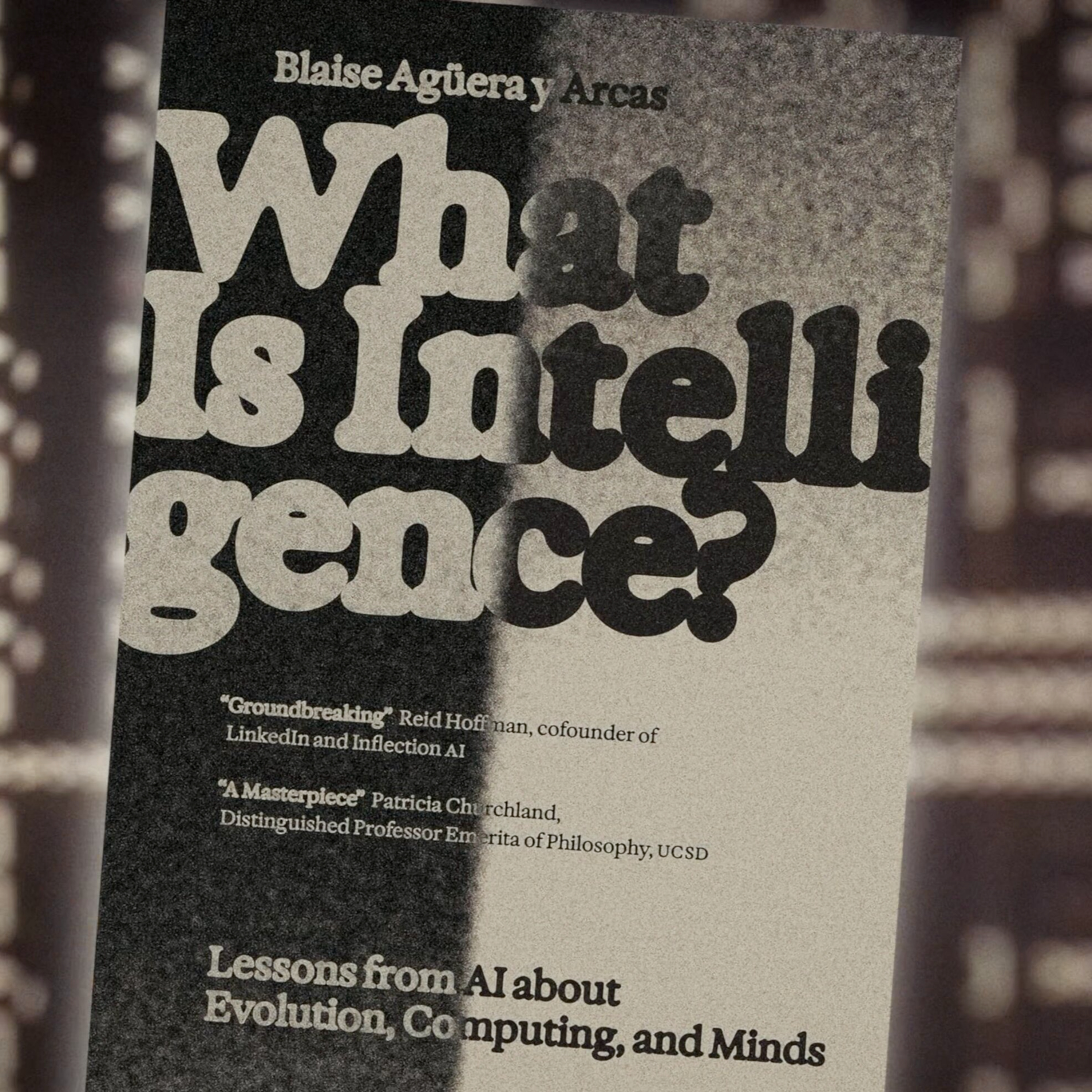
    Evolution "Doesn't Need" Mutation - Blaise Agüera y Arcas

    What if life itself is just a really sophisticated computer program that wrote itself into existence? Blaise Agüera y Arcas presenting at ALife 2025 — the most technically detailed public walkthrough of the ideas in his *What is Life?* and *What is Intelligence?* books that we've come across.He covers the BFF experiments (self-replicating programs emerging spontaneously from random noise), the mathematical framework connecting Lotka-Volterra population dynamics with Smoluchowski coagulation, eigenvalue analysis of cooperation matrices, and his central claim that symbiogenesis — not mutation — is the primary engine of evolutionary novelty.The experimental results are genuinely striking: complex self-replicating code arising from random byte strings with zero mutation, a sharp phase transition that looks like gelation, and a proof that blocking deep symbiogenetic ancestry trees prevents the transition entirely.A few things worth flagging for critical viewers:— The substrate is more carefully engineered than the framing sometimes suggests. The choice of language, tape length, interaction protocol, and step limits all shape what emerges. Their own SUBLEQ counterexample (where self-replicators *don't* arise despite being theoretically possible) highlights that these design choices matter substantially — and a general theory of which substrates support this transition is still missing.— The leap from "self-replicating programs on fixed-length tapes" to "life was computational and intelligent from the start" involves significant philosophical extrapolation beyond what the experiments directly demonstrate.— The Bedau et al. (2000) open problems paper he references at the start actually sets a higher bar for Challenge 3.2 than BFF currently meets: it asks that "the internal organization of these 'organisms' and the boundaries separating them from their environment arise and be sustained through the activities of lower-level primitives" — whereas BFF's tape boundaries are fixed by design, not emergent. --- TIMESTAMPS: 00:00:00 Introduction: From Noise to Programs & ALife History 00:03:15 Defining Life: Function as the "Spirit" 00:05:45 Von Neumann's Insight: Life is Embodied Computation 00:09:15 Physics of Computation: Irreversibility & Fallacies 00:15:00 The BFF Experiment: Spontaneous Generation of Code 00:23:45 The Mystery: Complexity Growth Without Mutation 00:27:00 Symbiogenesis: The Engine of Novelty 00:33:15 Mathematical Proof: Blocking Symbiosis Stops Life 00:40:15 Evolutionary Implications: It's Symbiogenesis All The Way Down 00:44:30 Intelligence as Modeling Others 00:46:49 Q&A: Levels of Abstraction & Definitions --- REFERENCES: Paper: [00:01:16] Open Problems in Artificial Life https://direct.mit.edu/artl/article/6/4/363/2354/Open-Problems-in-Artificial-Life [00:09:30] When does a physical system compute? https://arxiv.org/abs/1309.7979 [00:15:00] Computational Life https://arxiv.org/abs/2406.19108 [00:27:30] On the Origin of Mitosing Cells https://pubmed.ncbi.nlm.nih.gov/11541392/ [00:42:00] The Major Evolutionary Transitions https://www.nature.com/articles/374227a0 [00:44:00] The ARC gene https://www.nih.gov/news-events/news-releases/memory-gene-goes-viral Person: [00:05:45] Alan Turing https://plato.stanford.edu/entries/turing/ [00:07:30] John von Neumann https://en.wikipedia.org/wiki/John_von_Neumann [00:11:15] Hector Zenil https://hectorzenil.net/ [00:12:00] Robert Sapolsky https://profiles.stanford.edu/robert-sapolsky --- LINKS: RESCRIPT: https://app.rescript.info/public/share/ff7gb6HpezOR3DF-gr9-rCoMFzzEgUjLQK6voV5XVWY

  • January 25 · 46 min

    VAEs Are Energy-Based Models? [Dr. Jeff Beck]

    What makes something truly *intelligent?* Is a rock an agent? Could a perfect simulation of your brain actually *be* you? In this fascinating conversation, Dr. Jeff Beck takes us on a journey through the philosophical and technical foundations of agency, intelligence, and the future of AI. Jeff doesn't hold back on the big questions. He argues that from a purely mathematical perspective, there's no structural difference between an agent and a rock – both execute policies that map inputs to outputs. The real distinction lies in *sophistication* – how complex are the internal computations? Does the system engage in planning and counterfactual reasoning, or is it just a lookup table that happens to give the right answers? *Key topics explored in this conversation:* *The Black Box Problem of Agency* – How can we tell if something is truly planning versus just executing a pre-computed response? Jeff explains why this question is nearly impossible to answer from the outside, and why the best we can do is ask which model gives us the simplest explanation. *Energy-Based Models Explained* – A masterclass on how EBMs differ from standard neural networks. The key insight: traditional networks only optimize weights, while energy-based models optimize *both* weights and internal states – a subtle but profound distinction that connects to Bayesian inference. *Why Your Brain Might Have Evolved from Your Nose* – One of the most surprising moments in the conversation. Jeff proposes that the complex, non-smooth nature of olfactory space may have driven the evolution of our associative cortex and planning abilities. *The JEPA Revolution* – A deep dive into Yann LeCun's Joint Embedding Prediction Architecture and why learning in latent space (rather than predicting every pixel) might be the key to more robust AI representations. *AI Safety Without Skynet Fears* – Jeff takes a refreshingly grounded stance on AI risk. He's less worried about rogue superintelligences and more concerned about humans becoming "reward function selectors" – couch potatoes who just approve or reject AI outputs. His proposed solution? Use inverse reinforcement learning to derive AI goals from observed human behavior, then make *small* perturbations rather than naive commands like "end world hunger." Whether you're interested in the philosophy of mind, the technical details of modern machine learning, or just want to understand what makes intelligence *tick,* this conversation delivers insights you won't find anywhere else. --- TIMESTAMPS: 00:00:00 Geometric Deep Learning & Physical Symmetries 00:00:56 Defining Agency: From Rocks to Planning 00:05:25 The Black Box Problem & Counterfactuals 00:08:45 Simulated Agency vs. Physical Reality 00:12:55 Energy-Based Models & Test-Time Training 00:17:30 Bayesian Inference & Free Energy 00:20:07 JEPA, Latent Space, & Non-Contrastive Learning 00:27:07 Evolution of Intelligence & Modular Brains 00:34:00 Scientific Discovery & Automated Experimentation 00:38:04 AI Safety, Enfeeblement & The Future of Work --- REFERENCES: Concept: [00:00:58] Free Energy Principle (FEP) https://en.wikipedia.org/wiki/Free_energy_principle [00:06:00] Monte Carlo Tree Search https://en.wikipedia.org/wiki/Monte_Carlo_tree_search Book: [00:09:00] The Intentional Stance https://mitpress.mit.edu/9780262540537/the-intentional-stance/ Paper: [00:13:00] A Tutorial on Energy-Based Learning (LeCun 2006) http://yann.lecun.com/exdb/publis/pdf/lecun-06.pdf [00:15:00] Auto-Encoding Variational Bayes (VAE) https://arxiv.org/abs/1312.6114 [00:20:15] JEPA (Joint Embedding Prediction Architecture) https://openreview.net/forum?id=BZ5a1r-kVsf [00:22:30] The Wake-Sleep Algorithm https://www.cs.toronto.edu/~hinton/absps/ws.pdf <trunc, see rescript> --- RESCRIPT: https://app.rescript.info/public/share/DJlSbJ_Qx080q315tWaqMWn3PixCQsOcM4Kf1IW9_Eo PDF: https://app.rescript.info/api/public/sessions/0efec296b9b6e905/pdf

  • January 23 · 53 min

    Abstraction & Idealization: AI's Plato Problem [Mazviita Chirimuuta]

    Professor Mazviita Chirimuuta joins us for a fascinating deep dive into the philosophy of neuroscience and what it really means to understand the mind.*What can neuroscience actually tell us about how the mind works?* In this thought-provoking conversation, we explore the hidden assumptions behind computational theories of the brain, the limits of scientific abstraction, and why the question of machine consciousness might be more complicated than AI researchers assume.Mazviita, author of *The Brain Abstracted,* brings a unique perspective shaped by her background in both neuroscience research and philosophy. She challenges us to think critically about the metaphors we use to understand cognition — from the reflex theory of the late 19th century to today's dominant view of the brain as a computer.*Key topics explored:**The problem of oversimplification* — Why scientific models necessarily leave things out, and how this can sometimes lead entire fields astray. The cautionary tale of reflex theory shows how elegant explanations can blind us to biological complexity.*Is the brain really a computer?* — Mazviita unpacks the philosophical assumptions behind computational neuroscience and asks: if we can model anything computationally, what makes brains special? The answer might challenge everything you thought you knew about AI.*Haptic realism* — A fresh way of thinking about scientific knowledge that emphasizes interaction over passive observation. Knowledge isn't about reading the "source code of the universe" — it's something we actively construct through engagement with the world.*Why embodiment matters for understanding* — Can a disembodied language model truly understand? Mazviita makes a compelling case that human cognition is deeply entangled with our sensory-motor engagement and biological existence in ways that can't simply be abstracted away.*Technology and human finitude* — Drawing on Heidegger, we discuss how the dream of transcending our physical limitations through technology might reflect a fundamental misunderstanding of what it means to be a knower.This conversation is essential viewing for anyone interested in AI, consciousness, philosophy of mind, or the future of cognitive science. Whether you're skeptical of strong AI claims or a true believer in machine consciousness, Mazviita's careful philosophical analysis will give you new tools for thinking through these profound questions.---TIMESTAMPS:00:00:00 The Problem of Generalizing Neuroscience00:02:51 Abstraction vs. Idealization: The "Kaleidoscope"00:05:39 Platonism in AI: Discovering or Inventing Patterns?00:09:42 When Simplification Fails: The Reflex Theory00:12:23 Behaviorism and the "Black Box" Trap00:14:20 Haptic Realism: Knowledge Through Interaction00:20:23 Is Nature Protean? The Myth of Converging Truth00:23:23 The Computational Theory of Mind: A Useful Fiction?00:27:25 Biological Constraints: Why Brains Aren't Just Neural Nets00:31:01 Agency, Distal Causes, and Dennett's Stances00:37:13 Searle's Challenge: Causal Powers and Understanding00:41:58 Heidegger's Warning & The Experiment on Children---REFERENCES:Book:[00:01:28] The Brain Abstractedhttps://mitpress.mit.edu/9780262548045/the-brain-abstracted/[00:11:05] The Integrated Action of the Nervous Systemhttps://www.amazon.sg/integrative-action-nervous-system/dp/9354179029[00:18:15] The Quest for Certainty (Dewey)https://www.amazon.com/Quest-Certainty-Relation-Knowledge-Lectures/dp/0399501916[00:19:45] Realism for Realistic People (Chang)https://www.cambridge.org/core/books/realism-for-realistic-people/ACC93A7F03B15AA4D6F3A466E3FC5AB7<truncated, see ReScript>---RESCRIPT:https://app.rescript.info/public/share/A6cZ1TY35p8ORMmYCWNBI0no9ChU3-Kx7dPXGJURvZ0PDF Transcript:https://app.rescript.info/api/public/sessions/0fb7767e066cf712/pdf

  • January 23 · 42 min

    Why Every Brain Metaphor in History Has Been Wrong [SPECIAL EDITION]

    What if everything we think we know about the brain is just a really good metaphor that we forgot was a metaphor?This episode takes you on a journey through the history of scientific simplification, from a young Karl Friston watching wood lice in his garden to the bold claims that your mind is literally software running on biological hardware.We bring together some of the most brilliant minds we've interviewed — Professor Mazviita Chirimuuta, Francois Chollet, Joscha Bach, Professor Luciano Floridi, Professor Noam Chomsky, Nobel laureate John Jumper, and more — to wrestle with a deceptively simple question: *When scientists simplify reality to study it, what gets captured and what gets lost?**Key ideas explored:**The Spherical Cow Problem* — Science requires simplification. We're limited creatures trying to understand systems far more complex than our working memory can hold. But when does a useful model become a dangerous illusion?*The Kaleidoscope Hypothesis* — Francois Chollet's beautiful idea that beneath all the apparent chaos of reality lies simple, repeating patterns — like bits of colored glass in a kaleidoscope creating infinite complexity. Is this profound truth or Platonic wishful thinking?*Is Software Really Spirit?* — Joscha Bach makes the provocative claim that software is literally spirit, not metaphorically. We push back on this, asking whether the "sameness" we see across different computers running the same program exists in nature or only in our descriptions.*The Cultural Illusion of AGI* — Why does artificial general intelligence seem so inevitable to people in Silicon Valley? Professor Chirimuuta suggests we might be caught in a "cultural historical illusion" — our mechanistic assumptions about minds making AI seem like destiny when it might just be a bet.*Prediction vs. Understanding* — Nobel Prize winner John Jumper: AI can predict and control, but understanding requires a human in the loop. Throughout history, we've described the brain as hydraulic pumps, telegraph networks, telephone switchboards, and now computers. Each metaphor felt obviously true at the time. This episode asks: what will we think was naive about our current assumptions in fifty years?Featuring insights from *The Brain Abstracted* by Mazviita Chirimuuta — possibly the most influential book on how we think about thinking in 2025.---TIMESTAMPS:00:00:00 The Wood Louse & The Spherical Cow00:02:04 The Necessity of Abstraction00:04:42 Simplicius vs. Ignorantio: The Boxing Match00:06:39 The Kaleidoscope Hypothesis00:08:40 Is the Mind Software?00:13:15 Critique of Causal Patterns00:14:40 Temperature is Not a Thing00:18:24 The Ship of Theseus & Ontology00:23:45 Metaphors Hardening into Reality00:25:41 The Illusion of AGI Inevitability00:27:45 Prediction vs. Understanding00:32:00 Climbing the Mountain vs. The Helicopter00:34:53 Haptic Realism & The Limits of Knowledge---REFERENCES:Person:[00:00:00] Karl Friston (UCL)https://profiles.ucl.ac.uk/1236-karl-friston[00:06:30] Francois Chollethttps://fchollet.com/[00:14:41] Cesar Hidalgo, MLST interview.https://www.youtube.com/watch?v=vzpFOJRteeI[00:30:30] Terence Tao's Bloghttps://terrytao.wordpress.com/Book:[00:02:25] The Brain Abstractedhttps://mitpress.mit.edu/9780262548045/the-brain-abstracted/[00:06:00] On Learned Ignorancehttps://www.amazon.com/Nicholas-Cusa-learned-ignorance-translation/dp/0938060236[00:24:15] Science and the Modern Worldhttps://amazon.com/dp/0684836394<truncated, see ReScript> RESCRIPT:https://app.rescript.info/public/share/CYy0ex2M2kvcVRdMnSUky5O7H7hB7v2u_nVhoUiuKD4PDF Transcript: https://app.rescript.info/api/public/sessions/6c44c41e1e0fa6dd/pdf Thank you to Dr. Maxwell Ramstead for early script work on this show (Ph.D student of Friston) and the woodlice story came from him!

  • Dec 31, 2025 · 1 hr 16 min

    Bayesian Brain, Scientific Method, and Models [Dr. Jeff Beck]

    Dr. Jeff Beck, mathematician turned computational neuroscientist, joins us for a fascinating deep dive into why the future of AI might look less like ChatGPT and more like your own brain. **SPONSOR MESSAGES START** — Prolific - Quality data. From real people. For faster breakthroughs. https://www.prolific.com/?utm_source=mlst — **END** *What if the key to building truly intelligent machines isn't bigger models, but smarter ones?* In this conversation, Jeff makes a compelling case that we've been building AI backwards. While the tech industry races to scale up transformers and language models, Jeff argues we're missing something fundamental: the brain doesn't work like a giant prediction engine. It works like a scientist, constantly testing hypotheses about a world made of *objects* that interact through *forces* — not pixels and tokens. *The Bayesian Brain* — Jeff explains how your brain is essentially running the scientific method on autopilot. When you combine what you see with what you hear, you're doing optimal Bayesian inference without even knowing it. This isn't just philosophy — it's backed by decades of behavioral experiments showing humans are surprisingly efficient at handling uncertainty. *AutoGrad Changed Everything* — Forget transformers for a moment. Jeff argues the real hero of the AI boom was automatic differentiation, which turned AI from a math problem into an engineering problem. But in the process, we lost sight of what actually makes intelligence work. *The Cat in the Warehouse Problem* — Here's where it gets practical. Imagine a warehouse robot that's never seen a cat. Current AI would either crash or make something up. Jeff's approach? Build models that *know what they don't know*, can phone a friend to download new object models on the fly, and keep learning continuously. It's like giving robots the ability to say "wait, what IS that?" instead of confidently being wrong. *Why Language is a Terrible Model for Thought* — In a provocative twist, Jeff argues that grounding AI in language (like we do with LLMs) is fundamentally misguided. Self-report is the least reliable data in psychology — people routinely explain their own behavior incorrectly. We should be grounding AI in physics, not words. *The Future is Lots of Little Models* — Instead of one massive neural network, Jeff envisions AI systems built like video game engines: thousands of small, modular object models that can be combined, swapped, and updated independently. It's more efficient, more flexible, and much closer to how we actually think. Rescript: https://app.rescript.info/public/share/D-b494t8DIV-KRGYONJghvg-aelMmxSDjKthjGdYqsE --- TIMESTAMPS: 00:00:00 Introduction & The Bayesian Brain 00:01:25 Bayesian Inference & Information Processing 00:05:17 The Brain Metaphor: From Levers to Computers 00:10:13 Micro vs. Macro Causation & Instrumentalism 00:16:59 The Active Inference Community & AutoGrad 00:22:54 Object-Centered Models & The Grounding Problem 00:35:50 Scaling Bayesian Inference & Architecture Design 00:48:05 The Cat in the Warehouse: Solving Generalization 00:58:17 Alignment via Belief Exchange 01:05:24 Deception, Emergence & Cellular Automata --- REFERENCES: Paper: [00:00:24] Zoubin Ghahramani (Google DeepMind) https://pmc.ncbi.nlm.nih.gov/articles/PMC3538441/pdf/rsta201 [00:19:20] Mamba: Linear-Time Sequence Modeling https://arxiv.org/abs/2312.00752 [00:27:36] xLSTM: Extended Long Short-Term Memory https://arxiv.org/abs/2405.04517 [00:41:12] 3D Gaussian Splatting https://repo-sam.inria.fr/fungraph/3d-gaussian-splatting/ [01:07:09] Lenia: Biology of Artificial Life https://arxiv.org/abs/1812.05433 [01:08:20] Growing Neural Cellular Automata https://distill.pub/2020/growing-ca/ [01:14:05] DreamCoder https://arxiv.org/abs/2006.08381 [01:14:58] The Genomic Bottleneck https://www.nature.com/articles/s41467-019-11786-6 Person: [00:16:42] Karl Friston (UCL) https://www.youtube.com/watch?v=PNYWi996Beg

  • Dec 30, 2025 · 3 hr 17 min

    Your Brain is Running a Simulation Right Now [Max Bennett]

    Tim sits down with Max Bennett to explore how our brains evolved over 600 million years—and what that means for understanding both human intelligence and AI. Max isn't a neuroscientist by training. He's a tech entrepreneur who got curious, started reading, and ended up weaving together three fields that rarely talk to each other: comparative psychology (what different animals can actually do), evolutionary neuroscience (how brains changed over time), and AI (what actually works in practice). *Your Brain Is a Guessing Machine* You don't actually "see" the world. Your brain builds a simulation of what it *thinks* is out there and just uses your eyes to check if it's right. That's why optical illusions work—your brain is filling in a triangle that isn't there, or can't decide if it's looking at a duck or a rabbit. *Rats Have Regrets* *Chimps Are Machiavellian* *Language Is the Human Superpower* *Does ChatGPT Think?* (truncated description, more on rescript) Understanding how the brain evolved isn't just about the past. It gives us clues about: - What's actually different between human intelligence and AI - Why we're so easily fooled by status games and tribal thinking - What features we might want to build into—or leave out of—future AI systems Get Max's book: https://www.amazon.com/Brief-History-Intelligence-Humans-Breakthroughs/dp/0063286343 Rescript: https://app.rescript.info/public/share/R234b7AXyDXZusqQ_43KMGsUSvJ2TpSz2I3emnI6j9A --- TIMESTAMPS: 00:00:00 Introduction: Outsider's Advantage & Neocortex Theories 00:11:34 Perception as Inference: The Filling-In Machine 00:19:11 Understanding, Recognition & Generative Models 00:36:39 How Mice Plan: Vicarious Trial & Error 00:46:15 Evolution of Self: The Layer 4 Mystery 00:58:31 Ancient Minds & The Social Brain: Machiavellian Apes 01:19:36 AI Alignment, Instrumental Convergence & Status Games 01:33:07 Metacognition & The IQ Paradox 01:48:40 Does GPT Have Theory of Mind? 02:00:40 Memes, Language Singularity & Brain Size Myths 02:16:44 Communication, Language & The Cyborg Future 02:44:25 Shared Fictions, World Models & The Reality Gap --- REFERENCES:Person: [00:00:05] Karl Friston (UCL) https://www.youtube.com/watch?v=PNYWi996Beg [00:00:06] Jeff Hawkins https://www.youtube.com/watch?v=6VQILbDqaI4 [00:12:19] Hermann von Helmholtz https://plato.stanford.edu/entries/hermann-helmholtz/ [00:38:34] David Redish (U. Minnesota) https://redishlab.umn.edu/ [01:10:19] Robin Dunbar https://www.psy.ox.ac.uk/people/robin-dunbar [01:15:04] Emil Menzel https://www.sciencedirect.com/bookseries/behavior-of-nonhuman-primates/vol/5/suppl/C [01:19:49] Nick Bostrom https://nickbostrom.com/ [02:28:25] Noam Chomsky https://linguistics.mit.edu/user/chomsky/ [03:01:22] Judea Pearl https://samueli.ucla.edu/people/judea-pearl/ Concept/Framework: [00:05:04] Active Inference https://www.youtube.com/watch?v=KkR24ieh5Ow Paper: [00:35:59] Predictions not commands [Rick A Adams] https://pubmed.ncbi.nlm.nih.gov/23129312/ Book: [01:25:42] The Elephant in the Brain https://www.amazon.com/Elephant-Brain-Hidden-Motives-Everyday/dp/0190495995 [01:28:27] The Status Game https://www.goodreads.com/book/show/58642436-the-status-game [02:00:40] The Selfish Gene https://amazon.com/dp/0198788606 [02:14:25] The Language Game https://www.amazon.com/Language-Game-Improvisation-Created-Changed/dp/1541674987 [02:54:40] The Evolution of Language https://www.amazon.com/Evolution-Language-Approaches/dp/052167736X [03:09:37] The Three-Body Problem https://amazon.com/dp/0765377063

  • Dec 27, 2025 · 1 hr 37 min

    The 3 Laws of Knowledge [César Hidalgo]

    César Hidalgo has spent years trying to answer a deceptively simple question: What is knowledge, and why is it so hard to move around? We all have this intuition that knowledge is just... information. Write it down in a book, upload it to GitHub, train an AI on it—done. But César argues that's completely wrong. Knowledge isn't a thing you can copy and paste. It's more like a living organism that needs the right environment, the right people, and constant exercise to survive. Guest: César Hidalgo, Director of the Center for Collective Learning 1. Knowledge Follows Laws (Like Physics) 2. You Can't Download Expertise 3. Why Big Companies Fail to Adapt 4. The "Infinite Alphabet" of Economies If you think AI can just "copy" human knowledge, or that development is just about throwing money at poor countries, or that writing things down preserves them forever—this conversation will change your mind. Knowledge is fragile, specific, and collective. It decays fast if you don't use it. The Infinite Alphabet [César A. Hidalgo] https://www.penguin.co.uk/books/458054/the-infinite-alphabet-by-hidalgo-cesar-a/9780241655672 https://x.com/cesifoti Rescript link. https://app.rescript.info/public/share/eaBHbEo9xamwbwpxzcVVm4NQjMh7lsOQKeWwNxmw0JQ --- TIMESTAMPS: 00:00:00 The Three Laws of Knowledge 00:02:28 Rival vs. Non-Rival: The Economics of Ideas 00:05:43 Why You Can't Just 'Download' Knowledge 00:08:11 The Detective Novel Analogy 00:11:54 Collective Learning & Organizational Networks 00:16:27 Architectural Innovation: Amazon vs. Barnes & Noble 00:19:15 The First Law: Learning Curves 00:23:05 The Samuel Slater Story: Treason & Memory 00:28:31 Physics of Knowledge: Joule's Cannon 00:32:33 Extensive vs. Intensive Properties 00:35:45 Knowledge Decay: Ise Temple & Polaroid 00:41:20 Absorptive Capacity: Sony & Donetsk 00:47:08 Disruptive Innovation & S-Curves 00:51:23 Team Size & The Cost of Innovation 00:57:13 Geography of Knowledge: Vespa's Origin 01:04:34 Migration, Diversity & 'Planet China' 01:12:02 Institutions vs. Knowledge: The China Story 01:21:27 Economic Complexity & The Infinite Alphabet 01:32:27 Do LLMs Have Knowledge? --- REFERENCES: Book: [00:47:45] The Innovator's Dilemma (Christensen) https://www.amazon.com/Innovators-Dilemma-Revolutionary-Change-Business/dp/0062060244 [00:55:15] Why Greatness Cannot Be Planned https://amazon.com/dp/3319155237 [01:35:00] Why Information Grows https://amazon.com/dp/0465048994 Paper: [00:03:15] Endogenous Technological Change (Romer, 1990) https://web.stanford.edu/~klenow/Romer_1990.pdf [00:03:30] A Model of Growth Through Creative Destruction (Aghion & Howitt, 1992) https://dash.harvard.edu/server/api/core/bitstreams/7312037d-2b2d-6bd4-e053-0100007fdf3b/content [00:14:55] Organizational Learning: From Experience to Knowledge (Argote & Miron-Spektor, 2011) https://www.researchgate.net/publication/228754233_Organizational_Learning_From_Experience_to_Knowledge [00:17:05] Architectural Innovation (Henderson & Clark, 1990) https://www.researchgate.net/publication/200465578_Architectural_Innovation_The_Reconfiguration_of_Existing_Product_Technologies_and_the_Failure_of_Established_Firms [00:19:45] The Learning Curve Equation (Thurstone, 1916) https://dn790007.ca.archive.org/0/items/learningcurveequ00thurrich/learningcurveequ00thurrich.pdf [00:21:30] Factors Affecting the Cost of Airplanes (Wright, 1936) https://pdodds.w3.uvm.edu/research/papers/others/1936/wright1936a.pdf [00:52:45] Are Ideas Getting Harder to Find? (Bloom et al.) https://web.stanford.edu/~chadj/IdeaPF.pdf [01:33:00] LLMs/ Emergence https://arxiv.org/abs/2506.11135 Person: [00:25:30] Samuel Slater https://en.wikipedia.org/wiki/Samuel_Slater [00:42:05] Masaru Ibuka (Sony) https://www.sony.com/en/SonyInfo/CorporateInfo/History/SonyHistory/1-02.html

  • Dec 24, 2025 · 2 hr 55 min

    "I Desperately Want To Live In The Matrix" - Dr. Mike Israetel

    This is a lively, no-holds-barred debate about whether AI can truly be intelligent, conscious, or understand anything at all — and what happens when (or if) machines become smarter than us. Dr. Mike Israetel is a sports scientist, entrepreneur, and co-founder of RP Strength (a fitness company). He describes himself as a "dilettante" in AI but brings a fascinating outsider's perspective. Jared Feather (IFBB Pro bodybuilder and exercise physiologist) The Big Questions: 1. When is superintelligence coming? 2. Does AI actually understand anything? 3. The Simulation Debate (The Spiciest Part) 4. Will AI kill us all? (The Doomer Debate) 5. What happens to human jobs and purpose? 6. Do we need suffering? Mikes channel: https://www.youtube.com/channel/UCfQgsKhHjSyRLOp9mnffqVg RESCRIPT INTERACTIVE PLAYER: https://app.rescript.info/public/share/GVMUXHCqctPkXH8WcYtufFG7FQcdJew_RL_MLgMKU1U --- TIMESTAMPS: 00:00:00 Introduction & Workout Demo 00:04:15 ASI Timelines & Definitions 00:10:24 The Embodiment Debate 00:18:28 Neutrinos & Abstract Knowledge 00:25:56 Can AI Learn From YouTube? 00:31:25 Diversity of Intelligence 00:36:00 AI Slop & Understanding 00:45:18 The Simulation Argument: Fire & Water 00:58:36 Consciousness & Zombies 01:04:30 Do Reasoning Models Actually Reason? 01:12:00 The Live Learning Problem 01:19:15 Superintelligence & Benevolence 01:28:59 What is True Agency? 01:37:20 Game Theory & The &quot;Kill All Humans&quot; Fallacy 01:48:05 Regulation & The China Factor 01:55:52 Mind Uploading & The Future of Love 02:04:41 Economics of ASI: Will We Be Useless? 02:13:35 The Matrix & The Value of Suffering 02:17:30 Transhumanism & Inequality 02:21:28 Debrief: AI Medical Advice & Final Thoughts --- REFERENCES: Paper: [00:10:45] Alchemy and Artificial Intelligence (Dreyfus) https://www.rand.org/content/dam/rand/pubs/papers/2006/P3244.pdf [00:10:55] The Chinese Room Argument (John Searle) https://home.csulb.edu/~cwallis/382/readings/482/searle.minds.brains.programs.bbs.1980.pdf [00:11:05] The Symbol Grounding Problem (Stephen Harnad) https://arxiv.org/html/cs/9906002 [00:23:00] Attention Is All You Need https://arxiv.org/abs/1706.03762 [00:45:00] GPT-4 Technical Report https://arxiv.org/abs/2303.08774 [01:45:00] Anthropic Agentic Misalignment Paper https://www.anthropic.com/research/agentic-misalignment [02:17:45] Retatrutide https://pubmed.ncbi.nlm.nih.gov/37366315/ Organization: [00:15:50] CERN https://home.cern/ [01:05:00] METR Long Horizon Evaluations https://evaluations.metr.org/ MLST Episode: [00:23:10] MLST: Llion Jones - Inventors' Remorse https://www.youtube.com/watch?v=DtePicx_kFY [00:50:30] MLST: Blaise Agüera y Arcas Interview https://www.youtube.com/watch?v=rMSEqJ_4EBk [01:10:00] MLST: David Krakauer https://www.youtube.com/watch?v=dY46YsGWMIc Event: [00:23:40] ARC Prize/Challenge https://arcprize.org/ Book: [00:24:45] The Brain Abstracted https://www.amazon.com/Brain-Abstracted-Simplification-Philosophy-Neuroscience/dp/0262548046 [00:47:55] Pamela McCorduck https://www.amazon.com/Machines-Who-Think-Artificial-Intelligence/dp/1568812051 [01:23:15] The Singularity Is Nearer (Ray Kurzweil) https://www.amazon.com/Singularity-Nearer-Ray-Kurzweil-ebook/dp/B08Y6FYJVY [01:27:35] A Fire Upon The Deep (Vernor Vinge) https://www.amazon.com/Fire-Upon-Deep-S-F-MASTERWORKS-ebook/dp/B00AVUMIZE/ [02:04:50] Deep Utopia (Nick Bostrom) https://www.amazon.com/Deep-Utopia-Meaning-Solved-World/dp/1646871642 [02:05:00] Technofeudalism (Yanis Varoufakis) https://www.amazon.com/Technofeudalism-Killed-Capitalism-Yanis-Varoufakis/dp/1685891241 Visual Context Needed: [00:29:40] AT-AT Walker (Star Wars) https://starwars.fandom.com/wiki/All_Terrain_Armored_Transport Person: [00:33:15] Andrej Karpathy https://karpathy.ai/ Video: [01:40:00] Mike Israetel vs Liron Shapira AI Doom Debate https://www.youtube.com/watch?v=RaDWSPMdM4o Company: [02:26:30] Examine.com https://examine.com/

  • Dec 22, 2025 · 43 min

    Making deep learning perform real algorithms with Category Theory (Andrew Dudzik, Petar Velichkovich, Taco Cohen, Bruno Gavranović, Paul Lessard)

    We often think of Large Language Models (LLMs) as all-knowing, but as the team reveals, they still struggle with the logic of a second-grader. Why can’t ChatGPT reliably add large numbers? Why does it "hallucinate" the laws of physics? The answer lies in the architecture. This episode explores how *Category Theory* —an ultra-abstract branch of mathematics—could provide the "Periodic Table" for neural networks, turning the "alchemy" of modern AI into a rigorous science. In this deep-dive exploration, *Andrew Dudzik*, *Petar Velichkovich*, *Taco Cohen*, *Bruno Gavranović*, and *Paul Lessard* join host *Tim Scarfe* to discuss the fundamental limitations of today’s AI and the radical mathematical framework that might fix them. TRANSCRIPT: https://app.rescript.info/public/share/LMreunA-BUpgP-2AkuEvxA7BAFuA-VJNAp2Ut4MkMWk --- Key Insights in This Episode: * *The "Addition" Problem:* *Andrew Dudzik* explains why LLMs don't actually "know" math—they just recognize patterns. When you change a single digit in a long string of numbers, the pattern breaks because the model lacks the internal "machinery" to perform a simple carry operation. * *Beyond Alchemy:* deep learning is currently in its "alchemy" phase—we have powerful results, but we lack a unifying theory. Category Theory is proposed as the framework to move AI from trial-and-error to principled engineering. [00:13:49] * *Algebra with Colors:* To make Category Theory accessible, the guests use brilliant analogies—like thinking of matrices as *magnets with colors* that only snap together when the types match. This "partial compositionality" is the secret to building more complex internal reasoning. [00:09:17] * *Synthetic vs. Analytic Math:* *Paul Lessard* breaks down the philosophical shift needed in AI research: moving from "Analytic" math (what things are made of) to "Synthetic" math [00:23:41] --- Why This Matters for AGI If we want AI to solve the world's hardest scientific problems, it can't just be a "stochastic parrot." It needs to internalize the rules of logic and computation. By imbuing neural networks with categorical priors, researchers are attempting to build a future where AI doesn't just predict the next word—it understands the underlying structure of the universe. --- TIMESTAMPS: 00:00:00 The Failure of LLM Addition & Physics 00:01:26 Tool Use vs Intrinsic Model Quality 00:03:07 Efficiency Gains via Internalization 00:04:28 Geometric Deep Learning & Equivariance 00:07:05 Limitations of Group Theory 00:09:17 Category Theory: Algebra with Colors 00:11:25 The Systematic Guide of Lego-like Math 00:13:49 The Alchemy Analogy & Unifying Theory 00:15:33 Information Destruction & Reasoning 00:18:00 Pathfinding & Monoids in Computation 00:20:15 System 2 Reasoning & Error Awareness 00:23:31 Analytic vs Synthetic Mathematics 00:25:52 Morphisms & Weight Tying Basics 00:26:48 2-Categories & Weight Sharing Theory 00:28:55 Higher Categories & Emergence 00:31:41 Compositionality & Recursive Folds 00:34:05 Syntax vs Semantics in Network Design 00:36:14 Homomorphisms & Multi-Sorted Syntax 00:39:30 The Carrying Problem & Hopf Fibrations Petar Veličković (GDM) https://petar-v.com/ Paul Lessard https://www.linkedin.com/in/paul-roy-lessard/ Bruno Gavranović https://www.brunogavranovic.com/ Andrew Dudzik (GDM) https://www.linkedin.com/in/andrew-dudzik-222789142/ --- REFERENCES: Model: [00:01:05] Veo https://deepmind.google/models/veo/ [00:01:10] Genie https://deepmind.google/blog/genie-3-a-new-frontier-for-world-models/ Paper: [00:04:30] Geometric Deep Learning Blueprint https://arxiv.org/abs/2104.13478 https://www.youtube.com/watch?v=bIZB1hIJ4u8 [00:16:45] AlphaGeometry https://arxiv.org/abs/2401.08312 [00:16:55] AlphaCode https://arxiv.org/abs/2203.07814 [00:17:05] FunSearch https://www.nature.com/articles/s41586-023-06924-6 [00:37:00] Attention Is All You Need https://arxiv.org/abs/1706.03762 [00:43:00] Categorical Deep Learning https://arxiv.org/abs/2402.15332

  • Dec 20, 2025 · 16 min

    Are AI Benchmarks Telling The Full Story? [SPONSORED] (Andrew Gordon and Nora Petrova - Prolific)

    Is a car that wins a Formula 1 race the best choice for your morning commute? Probably not. In this sponsored deep dive with Prolific, we explore why the same logic applies to Artificial Intelligence. While models are currently shattering records on technical exams, they often fail the most important test of all: **the human experience.** Why High Benchmark Scores Don’t Mean Better AI Joining us are **Andrew Gordon** (Staff Researcher in Behavioral Science) and **Nora Petrova** (AI Researcher) from **Prolific**. They reveal the hidden flaws in how we currently rank AI and introduce a more rigorous, "humane" way to measure whether these models are actually helpful, safe, and relatable for real people. --- Key Insights in This Episode: * *The F1 Car Analogy:* Andrew explains why a model that excels at the "Humanities Last Exam" might be a nightmare for daily use. Technical benchmarks often ignore the nuances of human communication and adaptability. * *The "Wild West" of AI Safety:* As users turn to AI for sensitive topics like mental health, Nora highlights the alarming lack of oversight and the "thin veneer" of safety training—citing recent controversial incidents like Grok-3’s "Mecha Hitler." * *Fixing the "Leaderboard Illusion":* The team critiques current popular rankings like Chatbot Arena, discussing how anonymous, unstratified voting can lead to biased results and how companies can "game" the system. * *The Xbox Secret to AI Ranking:* Discover how Prolific uses *TrueSkill*—the same algorithm Microsoft developed for Xbox Live matchmaking—to create a fairer, more statistically sound leaderboard for LLMs. * *The Personality Gap:* Early data from the **Humane Leaderboard** suggests that while AI is getting smarter, it is actually performing *worse* on metrics like personality, culture, and "sycophancy" (the tendency for models to become annoying "people-pleasers"). --- About the HUMAINE Leaderboard Moving beyond simple "A vs. B" testing, the researchers discuss their new framework that samples participants based on *census data* (Age, Ethnicity, Political Alignment). By using a representative sample of the general public rather than just tech enthusiasts, they are building a standard that reflects the values of the real world. *Are we building models for benchmarks, or are we building them for humans? It’s time to change the scoreboard.* Rescript link: https://app.rescript.info/public/share/IDqwjY9Q43S22qSgL5EkWGFymJwZ3SVxvrfpgHZLXQc --- TIMESTAMPS: 00:00:00 Introduction & The Benchmarking Problem 00:01:58 The Fractured State of AI Evaluation 00:03:54 AI Safety & Interpretability 00:05:45 Bias in Chatbot Arena 00:06:45 Prolific&apos;s Three Pillars Approach 00:09:01 TrueSkill Ranking & Efficient Sampling 00:12:04 Census-Based Representative Sampling 00:13:00 Key Findings: Culture, Personality & Sycophancy --- REFERENCES: Paper: [00:00:15] MMLU https://arxiv.org/abs/2009.03300 [00:05:10] Constitutional AI https://arxiv.org/abs/2212.08073 [00:06:45] The Leaderboard Illusion https://arxiv.org/abs/2504.20879 [00:09:41] HUMAINE Framework Paper https://huggingface.co/blog/ProlificAI/humaine-framework Company: [00:00:30] Prolific https://www.prolific.com [00:01:45] Chatbot Arena https://lmarena.ai/ Person: [00:00:35] Andrew Gordon https://www.linkedin.com/in/andrew-gordon-03879919a/ [00:00:45] Nora Petrova https://www.linkedin.com/in/nora-petrova/ Event: Algorithm: [00:09:01] Microsoft TrueSkill https://www.microsoft.com/en-us/research/project/trueskill-ranking-system/ Leaderboard: [00:09:21] Prolific HUMAINE Leaderboard https://www.prolific.com/humaine [00:09:31] HUMAINE HuggingFace Space https://huggingface.co/spaces/ProlificAI/humaine-leaderboard [00:10:21] Prolific AI Leaderboard Portal https://www.prolific.com/leaderboard Dataset: [00:09:51] Prolific Social Reasoning RLHF Dataset https://huggingface.co/datasets/ProlificAI/social-reasoning-rlhf Organization: [00:10:31] MLCommons https://mlcommons.org/