Skip to content
Artwork for : lower black pain.
Society & CultureArtsPerforming Arts

: lower black pain.

Jd Michaels - The CabsEverywhere Creative Production House

Life’s lemons into rich, dark chocolate.

lowerblackpain.substack.com
Play
  • 20 episodes
  • weekly
  • Avg 5 min
  • English
  • Saturday · 5 min

    Halloween ‘26: The Miracle on State Avenue.

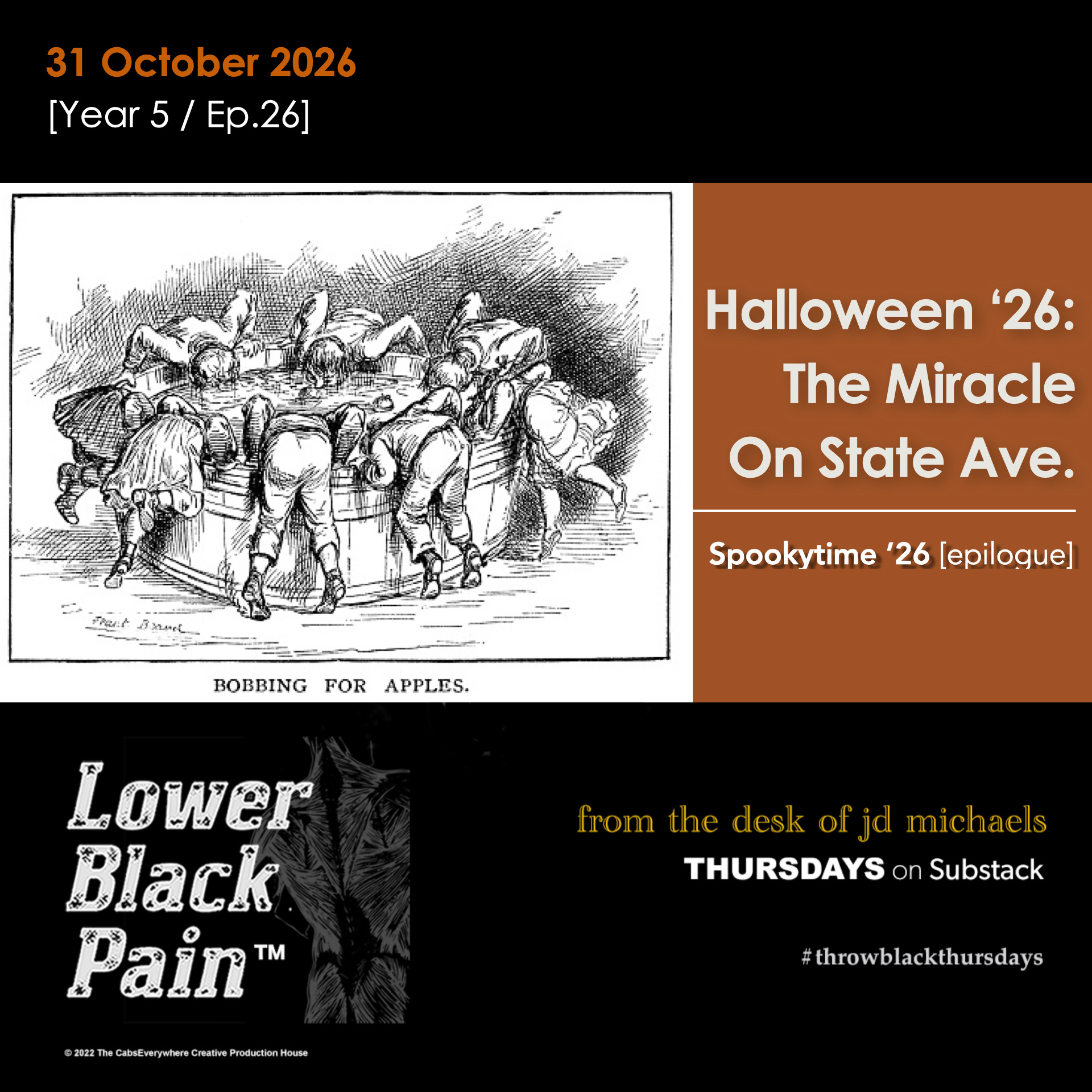
    In the early 1970’s, back when a good meal was “square”, one could be found at “family steakhouses”, civilized alternatives to “fast food” that offered plates and silverware and meat and potatoes and bread and the brand new choice-laden cornucopia called a “salad bar”. There were many places to choose from: Beefsteak Charlie’sBlack AngusPonderosaSteak and Ale And our family’s favorite, Sizzler™, which served lobster (for truly special occasions!) and an addictive garlic laden complimentary “cheese toast”, which must have proved incredibly economical for the all-you-can-eat salad bar, as it was nearly impossible NOT to have at least two thick delicious slices with one’s meal. My greatest dream was to someday have a star-studded premiere of my latest movie, and then treat cast and crew to a Sizzler party (because I’d rented the entire restaurant out for the evening). We would laugh heartily, tossing our heads back with joy as we ate all the cheese toast we wanted. Then, I would be truly Successful. I haven’t entirely given up on that dream. I’d just need gluten- and dairy-free toast at this point, but the salad bar would be totally cool. In the early 1970’s, a terrifying rumor spread across the nation that “strangers” were putting “sharp objects” in “healthy snacks” and handing them to children for Halloween. The specific example was a razor blade in an apple. There were no known cases of this - it would be an easy crime to trace because most people did not give out apples to children on Halloween. It was most likely, if not entirely obviously, generated by someone in the candy industry, which responded by creating individual bite sized wrapped treats in giant bags to counteract the horror of reaching into a bowl of chocolate lentils which may or may not have a scorpion at the bottom of it. In any case, in an age isolated by a rational level of communication technology, this rumor ruined trick-or-treating for kids across the USA for a couple of years, as parents sought to protect their children from murder fruit. In the early 1970’s, I was eight years old. Coming a mere week after my birthday, Halloween had always been somewhat tangentially connected as a celebration, though I was never subjected to a cake shaped like a pumpkin. The year of the murder fruit rumor, I was barred from public trick-or-treating - even at the houses of people we knew, because my mother told me we didn’t know them “all that well”. I thought we knew them well enough to determine if they’d put needles in a banana, but who could say. So that year my mother let me put on my costume and we went to Bonanza Steakhouse. They had in the paper that they were having a children’s party (a safe option to offset the trick-or-treat embargo). It started at 6PM. We got there at 5:30. We didn’t go to Bonanza all that much, but it was very welcoming - all the waiters had on costumes with their name pins on them - black and orange crepe paper was up everywhere - and they were playing a “Monster Mash” album. We were the only people there. It was still broad daylight. I was a little disappointed. Our waitress came up to the table. “We’re not quite set up yet, but we’re making a haunted house in the back!” “Does it cost extra?” my mom asked. “No, ma’am!” our waitress assured. My mother went into full research mode as to the safety standards… was it too scary? “No ma’am, you can come and see it…” We went to the back of the restaurant: in the doorway of must have normally been a storeroom a curtain of crepe paper was dangling - my mom went inside for a moment and came back out. “Go on,” she told me, “You can go in.” It was kind of dark and there was a pin the tail on the werewolf game, and a box hiding a bowl of peeled grapes that were supposed to be eyeballs, and someone said “boo!” a couple of times, and then at the end was a tub for bobbing for apples. If there was ANY forbidden activity - THAT WAS IT - not only was the dreaded Halloween Apple involved, but BOBBING had been explicitly forbidden by my mother, I wasn’t even allowed to do that at my school’s annual carnival - where every other kid did it - all because my mother thought that putting your face in water where other kids faces had been with their mouths open was “nasty”. As a parent now, I see her point. In any case, our waitress must have read my mother’s face, as she immediately said “Ma’am, no other kids have been back here yet.” “So he would be the first one?” my mother asked. “Yes ma’am.” “Well… I guess it’s ok then.” What??? It was a Halloween miracle. I dove in and got one by submerging my entire head and pushing the apple against the side, like a hungry seal being baptized. They offered me a bag of candy, but I wasn’t allowed to take any, so they put two more fresh apples in a Halloween bag for me. We went home, my mom cut them into very thin slices, and we ate them that night in front of the television for dessert. Best Halloween ever. Get full access to :lowerblackpain at lowerblackpain.substack.com/subscribe

  • Thursday · 5 min

    Hand It To The Hero.

    As I’m a kid from Kansas, New York City has always been pretty impressive to me - it looked liked the movies, no matter where you looked. After 30 years here I thought I’d seen it all, but one afternoon Zoe called and asked me to meet her uptown after work. “We’re going on a trip!” she said. “I think you’ll really like it.” I’ve learned not to ask a lot of questions - I mean, it’s not like I’m trying to make some sort of informed decision as to whether or not I’m gonna do what she’s telling me to do. That would be silly. My wife plans all the trips, when we’re lucky enough to be able to take one. She chooses locations “significant to the evolution of human society”. Very few beaches, amusement parks, or resorts of any number of stars fit into this category. But I have found myself five stories underground surrounded by thousands of skeletons, standing on a mountain bathed in green light as the first rays of dawn broke over North America, and running away from small groups of ill-intentioned men in three continents. While not textbook “relaxing”, each location has offered an experience which powerfully lingers - without, curiously, any photos having been captured. And this destination was the best she had ever chosen. All this month I’ve been writing about America not being afraid - of monsters to speak its mind of a little hard work of innovation and I would continue this list if Spookytime™ was a little bit longer - “the United States of America is not afraid of ghosts, heights, clowns, the dark...”. but I add to that list today that America is not afraid of its heroes. I believe the USA is a story we keep telling ourselves. We are a nation that has been directly assured by management that the only thing we have to fear is fear itself, which our country did take to heart for a time with a bout of red-scaring and cold war-ing (lions and tigers and bears) but then girded and pulled itself somewhat together. And it is these literary and cinematic heroes that reflect how we see one other and the world around us. Whether it’s Gotham City, Wisteria Lane, or Starfleet, our collective courage is embodied in these characters. They may have evolved from six-guns to laser swords, but a few have been powerful enough to retain consistent relevance through many generations. I met Zoe at the subway stop that night, and we walked a couple of blocks to a nondescript building, where her friend was waiting for us at a back door. We followed her in, made a few turns, and found ourselves on Sesame Street. Jim Henson’s Muppets™ of Sesame Street represent a USA at the absolute height of harmony and community, and to step onto that set immediately brought tears to my eyes. I had never been there before, but I knew every inch of it: Hooper’s Store, Oscar’s trash can, and that STOOP, that wonderful brownstone stoop where everything in the universe seemed to happen. Zoe had a co-worker whose husband was one of Jim Henson’s original puppeteers - she had invited her to the set and I guess must have asked if she had any kids that might want to come and she answered “just the one”. Here’s the deal with physically standing in front a Muppet™: your logical think-brain tells you to look the puppeteer in the eye and speak with a mature, adult, calm tone directly to their face. But you’re facing two faces, and almost instantly one finds oneself speaking both to the puppeteer and (technically) their hand, which is now, in fact, an autonomous living being. I leaned heavily into this, carrying on conversations with The Count and Zoe (theirs, not mine) and finally meeting the creature of the moment, Elmo. Elmo was accompanied by Kevin Clash, a Emmy Award winning performer and artist who, I guess, just happened to be visiting Sesame Street as well. “It’s a pleasure to meet you, Elmo!” I said. “Elmo is happy to meet you too!” said Elmo. “Good to meet you too, Sir.” I said to Mr. Clash. “Likewise.” Mr. Clash replied. Elmo was called to set for a take on the stoop with a group of kids: we were allowed to stay and watch. When the take was completed, he came back over. “That looked fun.” I said. “Those kids are very nice!” Elmo commented. The stage manager called for Elmo: one of the parents of the young performers wanted her child to have a photo with him. And this was the height of my visit: the mother spoke directly to Elmo, telling him where to stand and how to pose, but she seemed HONESTLY CONFUSED as to why Mr. Clash was standing near her at all, and at one point physically pushed him ON HIS FACE to get her child as close to Elmo as he could be and Mr. Clash as far away out of the frame as possible AT THE SAME TIME. They both came back over after the photo-op. “I guess that must happen to you all the time.” I said. “You have no idea.” Elmo replied. Get full access to :lowerblackpain at lowerblackpain.substack.com/subscribe

  • October 22 · 6 min

    Happy Birthday, Invention.

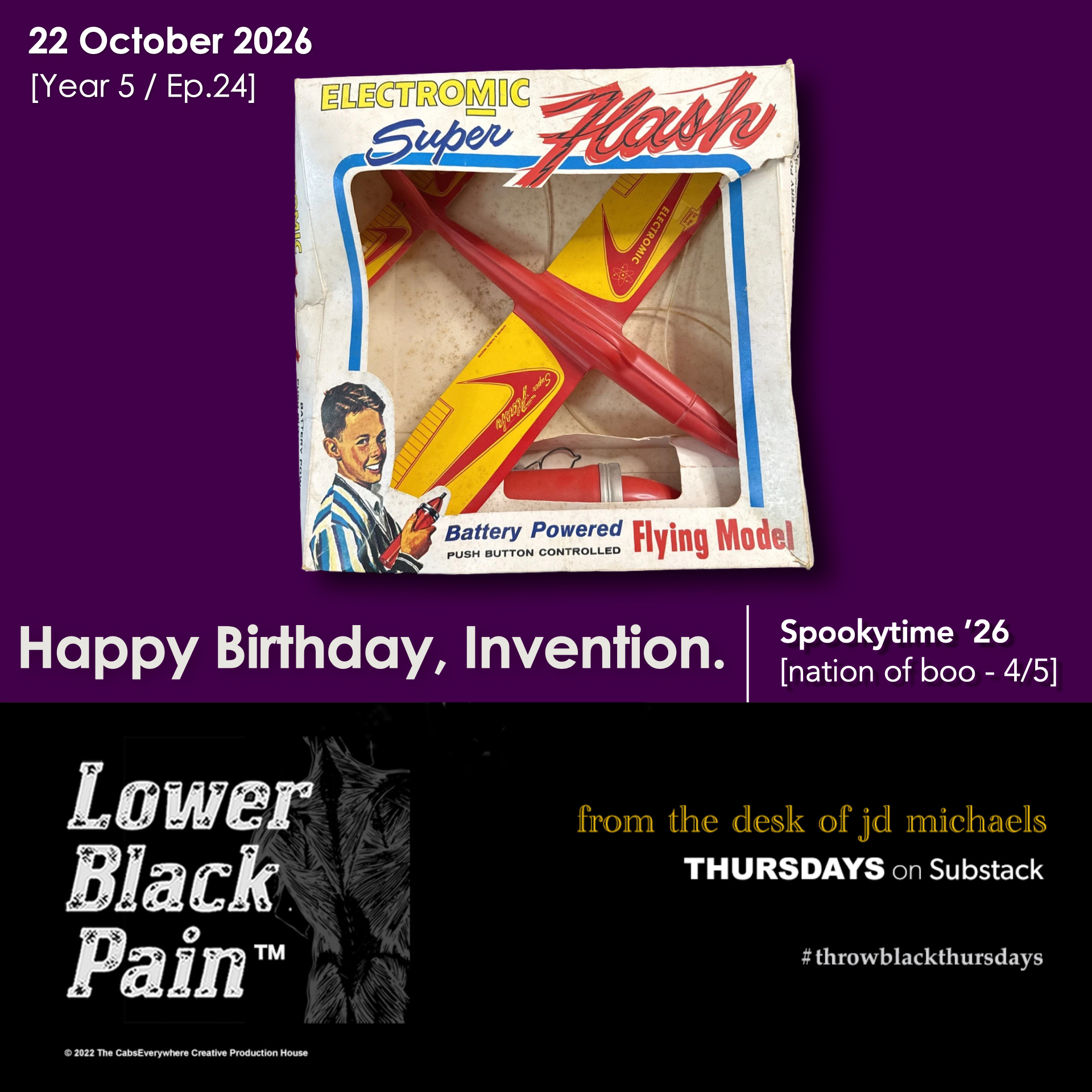
    In about 12 hours I will have been breathing on the planet for exactly sixty years. No mean feat to make it to the Digital Age from the Age of Aquarius - 6 groovy and happening decades of invention and constant adaptation to technologies that dissolved the gaps between time and space, past and future, and communities and individuals. Bell Telephone (the precursor of AT&T) had an advertising campaign in 1979 with a jingle that went, “Reach out! Reach out and touch someone!” Ok, of course I see it now. Yuck. But it sounded totally different back then. Back then, the bridging of distance to counter loneliness was so powerful a societal and emotional priority that it could be used as the primary marketing focus for the nation’s largest communications company. Isolation could be cured through technology! Just think - we can gab with Auntie Neuneu for an hour and hear her crazy stories, not just at Thanksgiving, but any time we want! She is so hilarious. And it did work, that connection - but a tacit invasion of privacy (which is CLEARLY IMPLIED in a modern reading of the slogan) happened along with it. Today, communication is more powerful than ever before, but somewhat out of our control. They kept their promise though; my phone makes me feel plenty touched, every single day. But I just wouldn’t feel right complaining about it: America is not afraid of innovation. Of course, now conversations and images share the same device, so we can reach out and touch someone (yuck), and if folks are right in front of us we can capture them and put them in our pocket, which sounds just as incredibly creepy. One thing about being an only child of a single parent - you don’t have all that many photos of you together, since one of you has to take the picture. As a child of the 1960s, image capture was clearly dominated by Kodak™, who produced a dazzling assortment of film cameras but none that had yet been engineered for operation held backward and at extreme arm’s length. Yet and still, there are a few photos of my mother and I - one of her bathing me at one month old, one where she is giving me a bottle, and a cool one where we were flying a little red whirly airplane toy that I ABSOLUTELY LOVED and was EXTREMELY DANGEROUS called the Electromic (sic) Super Flash. I would GLADLY explain in great detail the magnificence of engineering that this toy represented, but suffice it to say that I loved it and played with it for years and years until it hit something and broke and then I still played with the rather ingenious mechanism that had made it work, though it didn’t fly anymore as much as manically flap about. Anyway, there’s a photo of my mom and I playing with this in a park, which is amazing for a lot of reasons: I almost never played outside as a kid (mostly I was an indoor book nerd, which is why a flying plane toy was so dangerous), there wasn’t really a park near our apartment, and even today, neither of us has any idea who was holding the camera. But the photo is pretty good - besides our sight-obvious urban charm, it could have been on the front of the box that the little plane came in. The computer, the microwave oven, electric locks on car doors, Velcro™, the ATM, the MRI and cotton candy grapes. More than half a century of science making life more interesting. I have shared this magnificent time with these miracles, though don’t think I’ve accomplished enough to stand toe to toe with sugar floss fruit. I believed, as a child, that I would grow up in the world I was born into. But the world grew too, and tv’s got wider and they tore all the malls down and my car, lights, and watch all speak to me now. I didn’t realize there’d be this much talking to inanimate objects in the future, even though I saw people doing it on Star Trek. New is great. Improved is fine. I am no Luddite; far from it, I enjoy technology in the form of ever more clever tools. But I don’t think that everything needs to be improved, or even evolve - say, for instance, the chocolate chip cookie. It’s fine. I think we’ve got that one. The very first iPod is still a miracle. It’s the only thing I own that is also in the Museum of Modern Art, and it was announced October 23, 2001 - 25 years ago. It’s an icon of both design and engineering which is now, literally, a museum piece. Time did not change the object - the object just wasn’t as important as the idea of the object, which did keep evolving and was re-rendered and re-rendered into my current smartphone. I suppose that’s fair. I mean, I was there too, 25 years ago, but I had the quiet decency to grow and adapt - working really hard to cultivate just the right amount of creases in my face and grey in my beard and loss in my range of motion. That iPod stayed exactly the same. Ultimately I don’t feel right complaining about technology because my engagement with it is somewhat up to me. I don’t have to call Auntie Neuneu, I still have a film camera to take photos, I can listen to an album on vinyl if I want to, and I can purchase and consume regular grape-flavored grapes. I’m not scared of more options if I’m free to make a choice. But I am glad that I can take photos with my family, all of us together, with no one left out of the picture. I’ll do that tomorrow, to commemorate the day, and even dial in my mom on FaceTime to be a part of the moment, and then I will capture the warmth and the happiness of that moment, and put it in my pocket. How touching. the friends one the mom one the (wait for it…) clown and nun one Get full access to :lowerblackpain at lowerblackpain.substack.com/subscribe
  • October 15 · 6 min

    If You Want Anything At All.

    I’ve had, according to my resume, 8 jobs. I’ve had a few more than that: some not worth mentioning and a few I really don’t need to remember. But the major ones, the places where I stayed for years and years - those have been pretty interesting because I entered those companies as one thing and left as another. I came in to the first one as a secretary, and four years later left as a “mechanical artist”. Five years at the next place and I was a “creative studio manager”. Then after 16 (yikes) years at another I was an “EVP Director”. There were a lot of other esoteric titles in the middle of all those. Most of my career mobility has centered on my enthusiasm toward doing stuff that nobody else wanted to. Need somebody to wash the dishes? / calm nervous people down? / fix a toilet? / make a meal for eight people with five dollars? / work past midnight finishing the report? Look no further. This tendency toward utility proved extremely useful in corporate situations. I was identified as a “work horse”, a boss told the clients I was a “swiss army knife”, and one manager described me as “an Ameri-can, not an American’t”. None of these sound great. I don’t think there’s any MasterClass about being the one who cleans up, voluntarily, after company parties. But I never minded the “American” thing: after all, America is not afraid of a little hard work. My key business assets: Endurance: I was raised to persevere - toil proudly, not stop until the job was done. On my very first day at a big job in New York City, the manager showing me around took me to my cube and told me to bring a sleeping bag. I thought it was a joke until I noticed that most of the other employees did have one stashed beneath their desks. My record at that place was a 33 hour shift. I was 27 years old. I started out strong at 9AM, didn’t even hit the caffeine until about two in the morning, then when the sun rose it re-invigorated us all for a while - some breakfast and lunch kept me going until about 4, but then I realized that I was no longer tired yet no longer awake in any traditional sense, so I tapped out and headed home. And no, there was no overtime involved - this was just…work. One person went for 47 hours, though I think she took some naps. Adaptability: I have a particular knack for taking not-so-useful things and putting them together to make a much more useful one. More than once this enabled me to come up with solutions that could never be bought, only made. Duct tape was sometimes involved. Also, I became the ad-hoc bartender at college parties because I could mix relatively obscure liquids together into something potable. Appreciation: Other people needed things like comfortable work chairs or bathroom breaks or respect - I found that I could exist on the much the simpler diet of purpose and paycheck. As the hoi polloi business tripped and expense accounted, I’d be trading quips over microwave popcorn with my team while we built something cool. We all really liked making things and enjoyed one another’s company - we’d bring our kids (and pets) in, celebrate holidays with hats and food and original songs (my contribution), and had a pretty good time for a grown-up type corporate office situation. Hey, I knew what was really important…they could keep the fancy chair. I didn’t have anything that fancy to put on it anyway. There was one business lesson that I was taught twice. I’ve always ignored it, because I do not agree with its basic premise, even if it’s true. The more robust version of this strategy was its second telling: a manager was walking past as I stood by the printers; he asked how I was doing. “I’m good! Busy, but good!” I thought this a fine comment to say to your boss. “Yeah, I wanted to talk to you about that… you always seem to have a lot to do.” “Well, yeah,” I replied, “there’s a lot of things I’m trying to make happen.” “Yeah…” He looked around to see if anyone was listening. “Yeah, you’re working too hard.” I thought that was an odd comment to hear from your boss. “Am I?” I asked. “Yeah. Listen, if you’re ever gonna be a manager or something you need to learn how to handle problems.” I enthusiastically launched into a list of solutions I’d come up with to recent workflow challenges. “No, no. See? That’s what I’m talking about.” he said. “You solved all those problems.” “Was that not you said?” “No,” he explained, “I said handle a problem. Look at this.” He picked up a nearby stapler. “This is a problem, right?” He began passing it from hand to hand. “What am I doing now?” “Juggling?” “No, I’m handling the problem. First it’s here…” It was in his right hand.“… and now it’s here.” It was in his left. “I can’t pick up anything else because I got this. But if I put it down…” He put it down, “…now I’m not doing anything.” Ok. “Ok...?” “See, I choose a problem, and I handle it for maybe like, six months, and then I solve it, and then pick up another problem. Everyone knows I’m busy because I’ve got this thing I’m doing. You have, like, seven staplers a month over there. People don’t move that fast. Business doesn’t work that way. You’ve gotta to slow down… handle one problem at a time… you get it?” Sure, I got it, what’s not to get, but it’s always been harder for me not to do things than to do things. I was trained to make things better, even when it wasn’t necessarily my job, and if that makes me some kind of stapler juggler, then fine. Though I don’t know where I’d put that on my resume. Maybe down next to “telephone psychic”. Get full access to :lowerblackpain at lowerblackpain.substack.com/subscribe
  • October 8 · 7 min

    Say What You Mean And Say It Mean.

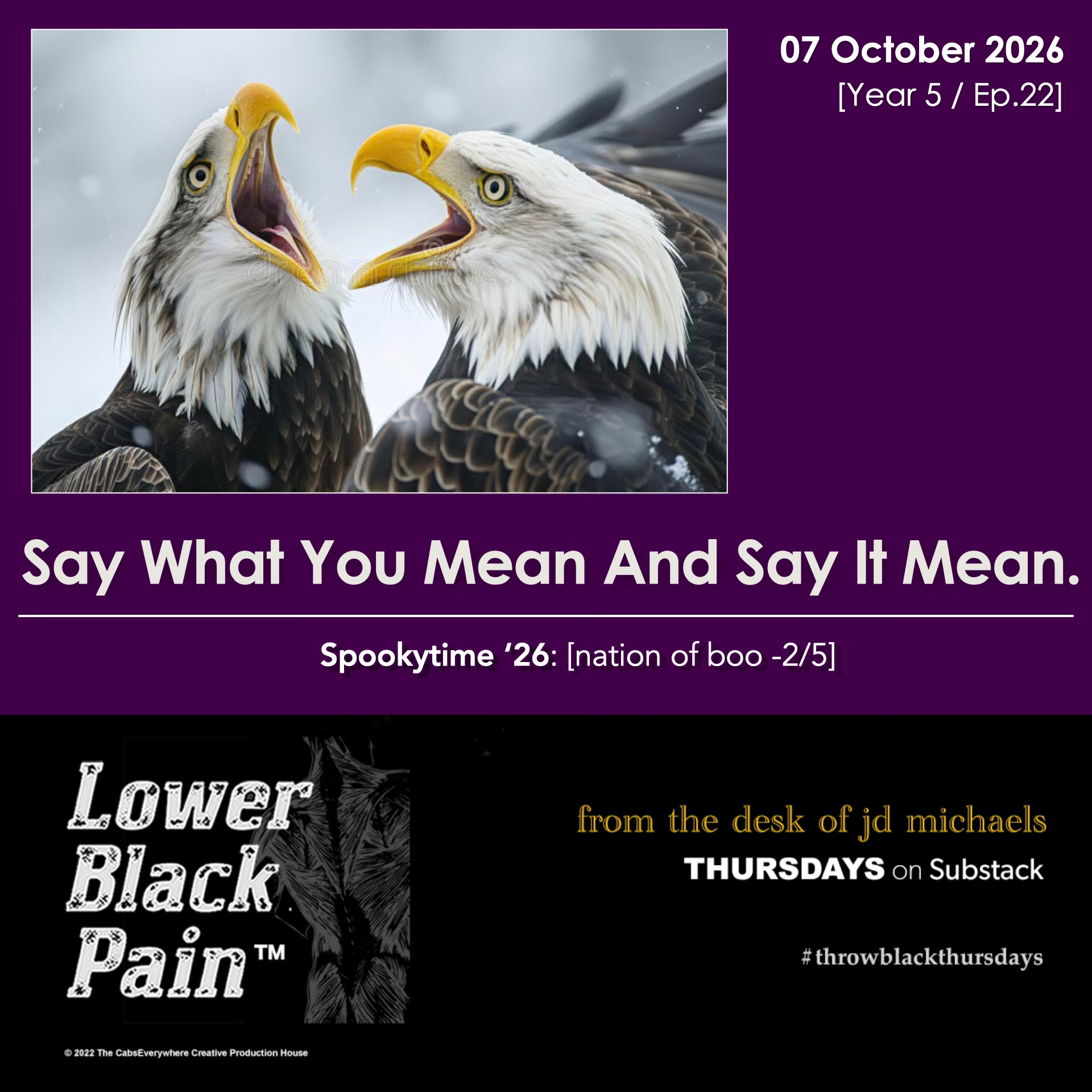
    For over half of her four decade career, my mother taught fifth grade. A span of that length allows one to view societal trends and social constructs in detail: one class morphing into the next, bringing new behaviors, pressures, and responses. The perfect in-situ scientific laboratory to observe these shifts and changes was open every day - the playground. She shared an observation that early on, a few of the saltier children would insult each other during recess. “Your Mama…” the jibes would start with, or something similar, leading to a bout of impromptu oneupmanship… …but as reading and writing became less important to the school district, a different exchange would occur - one child would begin with the customary opening remark, and then the other would punch them. Often very hard. The addition of physical violence brought this tradition to an abrupt close, and while no fan of rudeness or impropriety, my mother expressed that this made her a bit sad, as the talking did hold a bit of creative integrity. But some children were no longer trained in that kind of thing, and a true battle of wits requires that both combatants are well armed. As her son, I was never allowed to insult or hit anybody. The only time I tried was on a bus trip back from a high school vocal contest, where a class bully called me names related to the size of my forehead. That gave him, no pun intended, a lot of ground to cover, and my reticence to engage with him intensified his attacks. Until I did engage with him, offering a slightly off-color response clever enough that the entire bus went “Ooooooooooo!”. I knew I was going to get it the second I left the bus, and sure enough when I stepped off the stairs he was waiting, hand outstretched to shake mine. When I reached for his hand, he sucker-punched me in the stomach. Another “Ooooooooooo!” from the crowd. But because I was a magician, I had long studied Houdini’s method of training abdomen muscles to rock hard consistency. Also, I was 15. The boy’s fist met a (then) immovable mass, and he shook his hand in pain. I slowly walked away, wincing only inwardly, enjoying what I knew would be the only time that being a magician would be high-school-cool. America is not afraid to speak its mind. Clarity isn’t a… hard rule, really: ours is a language of intent, rather than transparency. Take for instance the example of a woman, smiling, nattily dressed, superbly coiffed, smelling of lilacs or vanilla, just after Sunday service and before the football game, looking you directly in the eye and saying the most spine chilling phrase in the English language (as it spoken by Americans): “Well, Bless Your Heart!” We all know what that means. It does not mean what it says. It is not pronounced the way that it is spelled, as it is neither a religious well-wish nor a genuine concern as to one’s cardiac welfare. It is a direct statement where individually none of the words hold their traditional definition, yet in combination they create a new communication, where a direct insult - in most cultures expressed in two words - is somehow sharpened and thrust deeper into the belly by using four. There is no response. The dialogue preceding the comment has now ended, with whomever is on the receiving end of the statement is left to painfully grimace, and take an extremely slow / extremely deep breath through their nose. Or punch the person very hard, which almost never happens probably. It’s understood here that the words are the punch, with the punch-ee left to get in their car and screamily complain about whoever said this to them on the ride home. “How dare they!” we might say, but we know the answer to that: America is not afraid to speak its mind. However, the worm turns, what goes around comes around, and Americans do not enjoy revenge. We’re not “a dish served cold” culture - much more a kingdom of steam tables and hot wings. Suspense is unbearable here in any form… watch: Shave and a haircut… ten… … … … … … … … … cents. Horrible. Absolutely. I do apologize. But think of waiting for an insult to be returned - expecting a snappy remark or harsh look and only getting open kind handshakes and grins week after week. Terrifying. Each meeting without response increases the tension - then come the sleepless nights spent wondering when it might occur, knowing full well that a response is as inevitable as it is deserved. Yeah. America doesn’t like that. My personal favorite American insult is “You speak so well!”. It was first said to me when I was about eight - I gave a speech at a school function and afterward a very fancy woman came up to my mother and I. “Goodness!” she effused, “You speak so well!”. Then she looked at my mother, “It’s just so wonderful to see that!” I stood a little taller and said “Thank you!” enthusiastically, but my mom didn’t respond, but bristled. She is not an easy bristler. “That wasn’t a compliment.” she said later in the car. “But the lady said I did a good job!” “No she didn’t. That wasn’t what she meant by that. She meant that she was surprised one of us could speak proper English.” I was confused. “But you always make me speak proper English. You’re a teacher.” “I know that,” Mom said, “but she didn’t.” She turned to me at a stop light. “You did a good job, and she did acknowledge that by what she said… it’s not the good job that’s the problem, it’s the SURPRISE. She underestimated you when you stood up to speak because of what you looked like. She complimented you not for what you did, but for not being what she assumed you were.” “Aw.” I was disappointed. “Don’t be disappointed,” she said, “you did wonderfully well. You just keep on doing well for you, not for other people’s compliments. And if you want an honest opinion, you can just always ask me or Grandpa. We’ll tell you the truth, good or bad.” And they did, which was great because I solicited a steady chorus of “speak so well”s in my youth, and far after. Let’s see: I’ve been “one of the good ones” and “just like us” and “you know…different” and “very unique” and “just, special”, and in each case the circumstance, tone, and casting made clear what was meant atop what was being said… sometimes they’d double down and ask me about “the other ones”… you know, just to bond. But I never lashed back, never punched anybody (good heavens no)… just smiled and nodded and took slow, deep breaths through my nose. Though, on the exhale, I may have thought to myself, “Well, now… … … … …bless your heart.” Get full access to :lowerblackpain at lowerblackpain.substack.com/subscribe
  • October 1 · 4 min

    Oh, Boo-tiful.

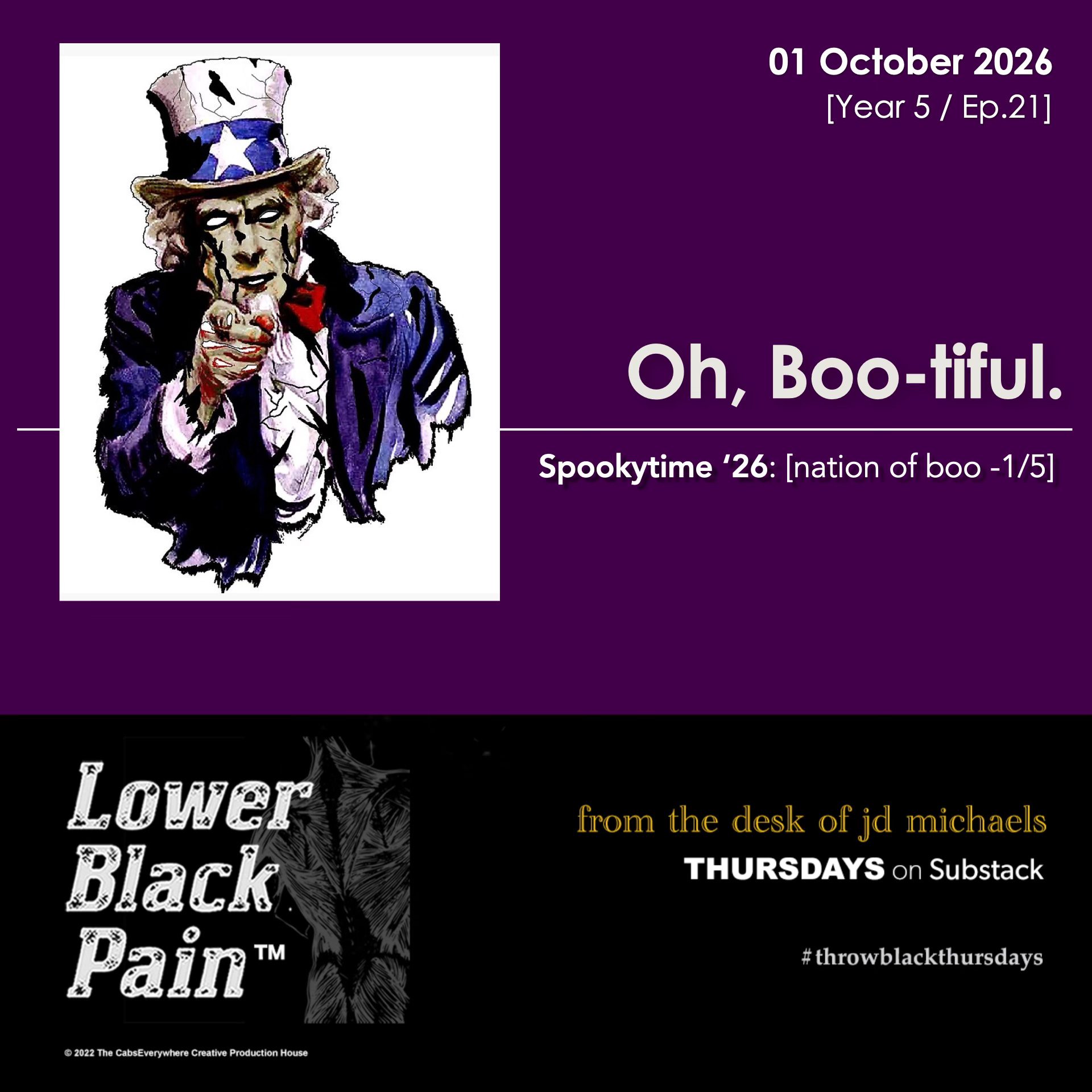
    There are only two commercials for underarm deodorant. In the first, someone wearing a white shirt runs after a taxi, pushes their kid on a playground swing, or performs any other action requiring brisk movement: at the end they enthusiastically wave with their hand high in the air and give someone a tight hug. All is bliss. In the other, someone gets on a full elevator and when they raise their hand to push the button for their floor everyone faints. Confidence or Fear. A super legendary advertising person told me that these are the only two ways to speak to America. Both work incredibly well, changing behavior, motivating millions… …but fear works faster. America is not afraid, at least not enough for our own taste; thus theme parks filled with thrill rides, video games filled with peril, and movies filled with increasingly awful situations. And now it’s Spookytime™: over 1200 live haunted house attractions open this weekend, and well over 2000 Spirit Halloween™ stores opened last month. Fear, in the US, is a growing three billion dollar a year business, and it’s a truly American trend - data proves that there is no where else on planet Earth that so enjoys a good scare as the U.S. of A. America is not afraid, but it certainly enjoys pretending to be. Modern media is now a 24 hour panic machine: I know I should be terrified of, well, everything, but it all kind of blends together, like the Best Buy television display wall where they’re all playing something different so I can’t really see or hear anything. Fear is more powerful with a clear focus - a giant screen in a dark room so large that I can’t look away, or a roller coaster where I’m strapped in for the ride. It’s fun to be afraid of just one thing at a time. But for some of us fear is an indulgence, a luxury. Being forced to navigate through terrifying situations everyday creates a kind of burnout as years wear on. That’s what happened to me: fear cost too much energy, took too much to sustain, I couldn’t afford it, even if I bought generic. I mean, I understood that “they” (whomever they were) were coming to get me (for some reason or another) but there were just so many characters and the plot was so complicated that I admit I zoned out a little and now I’m not really watching that show anymore. I imagine the same is true for everyone whose life doesn’t fit vertically into a TikTok screen, behind them a background of spacious modern suburban living with little on the eggshell walls and plenty of floorspace for dancing. Years of consistent fear of walking home at night or random acts of an angry stranger (or an angry person we already know) wear us down and sort of short circuit our systems. With limited free time, I don’t normally choose to add stressful entertainment to the mix, but in honor of the season we’re picking out spooky movies to watch. The scary films I grew up with were all man vs. nature - natural disasters (in Sensurround™), giant insects and rodents, stuff like that. Then in the 80’s, horror conflicts shifted to man vs. man: normal folks against either the possessed, sociopathic, or murderously cranky. Now the films seem more focused on man vs. self: wide eyed protagonists battling isolation or loneliness or encroaching madness. Or even more spooky are the films where someone is forced to make a difficult decision between horrible choices and then is forced to live with the consequences. You know: adulting. Eeesh. Terrifying. America is not afraid of monsters. We’ve got guns. Americans aren’t afraid of giant monsters either. We have bigger guns. Godzilla wouldn’t last very long in central Texas. I find it strange that our zeitgeist hasn’t embraced “Frankenstein” considering modern AI is its real-life re-telling - or the insatiable thirst of the Vampire, which so tidily mirrors corporate avarice. Werewolves and ghosts and creatures? Not in this country, buddy. We’re not afraid of those. But zombies are huge in America, which is weird because they are made of us; they are our neighbors and colleagues and community members, just super hungry and not all that chatty. And babysitters, housekeepers, and nannys, both human and robotic, are the ultimate bad guys in dozens of American horror films. Huh. Go figure. Get full access to :lowerblackpain at lowerblackpain.substack.com/subscribe
  • September 24 · 4 min

    autumnatic.

    Calendars were not invented on “day 1”. That’s what I thought as a kid - that if you wanted to know how old “calendars” were, you just counted backward from, well, now until you were back at 1. Then I remembered about all that “B.C.” time, and then… I just looked it up. The Gregorian Calendar, which we purchase each year on sale in mid-January in the Barnes and Noble bargain section, was created in 1582. The Julian calendar that it replaced had begun in 45 B.C., and there is apparently a calendar in Africa from 8000 B.C.. Calendars are great, but they bother me. The human race celebrates specific holidays because of where they are on the calendar, not in alignment with the sun or the stars anymore. Our birthdays mark the beginning of our personal year. Thanksgiving is celebrated the third Thursday in November. Easter is a bit more organic, as it’s the first Sunday after the Spring Equinox, a specific scientific circumstance (once I did the experiment where you balance an egg on its end EXACTLY at the moment of the Spring Equinox - it stayed there for 90 seconds and then fell over - couldn’t get it to do it again - science is cool). So calendars define days, but do not dictate the seasons. I think this includes the Holiday seasons, as they are not tied to the calendar - “Christmastime” used to begin the day after Thanksgiving, or the moment that Santa waved from his sleigh in the Macy’s Parade, but is now shifting steadily backward - last year the first Netflix holiday princess movie was released well before Thanksgiving, though I was expressly forbidden by my daughter to watch it until the appropriate time. Folks are open to begin their Christmastime whenever they choose - defined by stores being decorated, holiday music being played on the radio, or Hans Gruber plummeting from Nakatomi Plaza. But we’re not quite there yet. Our first stop is Autumn (keeper of Spookytime™), which for me always begins with a mystery. Fall officially starts on the Autumn Equinox, but we all recognize that cinnamon, clove, nutmeg, ginger, and mace define summer’s end. “Pumpkin spice lattes” were introduced in 2003: those smart enough to invest in the odd new trend probably profited like crypto bandits, as millions of folks enthusiastically associated it with the shift of seasons. But similar to Christmastime, the official date that Pumpkin Spice Everything is introduced each year keeps getting pushed earlier and earlier, moving from mid-September back to mid-August. I mean, who doesn’t enjoy a gourd-based beverage, but I choose not to recognize this indicator. Autumn is my favorite season. I was born in Autumn. I love the Autumn weather. I’ve always looked best in sweaters, which have subtlety bulked up my scrawny “Steve Rogers Before The Super Serum” frame, annually allowing me well defined (although pillowy soft) shoulders. Autumn means a lot to me, and cannot be defined by corporate trend. I truly love the season, and the best part is, I never know exactly when it’s going to get here. …there’s a day every year when the wind changesthe humidity dissipates entirelyreplaced by this wonderful snap in the air an exhale is not yet visiblebut inhaling becomes fresh and the smell of leaves and the sound of them all on the streetssomehow insulates cars passing by this is my beginning of Autumn and once THIS mysterious day happens afternoons don’t warm up anymoreso you really need that extra layer of clothesand you’re very glad you remembered your hatand to be honest you could actually appreciate a nice hot beverage in a paper cup with a derivative of your name written on it that day is the perfect timefor a nice, hot cup of coffee embellished with the flavor of a seasonal gourd. Get full access to :lowerblackpain at lowerblackpain.substack.com/subscribe
  • September 17 · 6 min

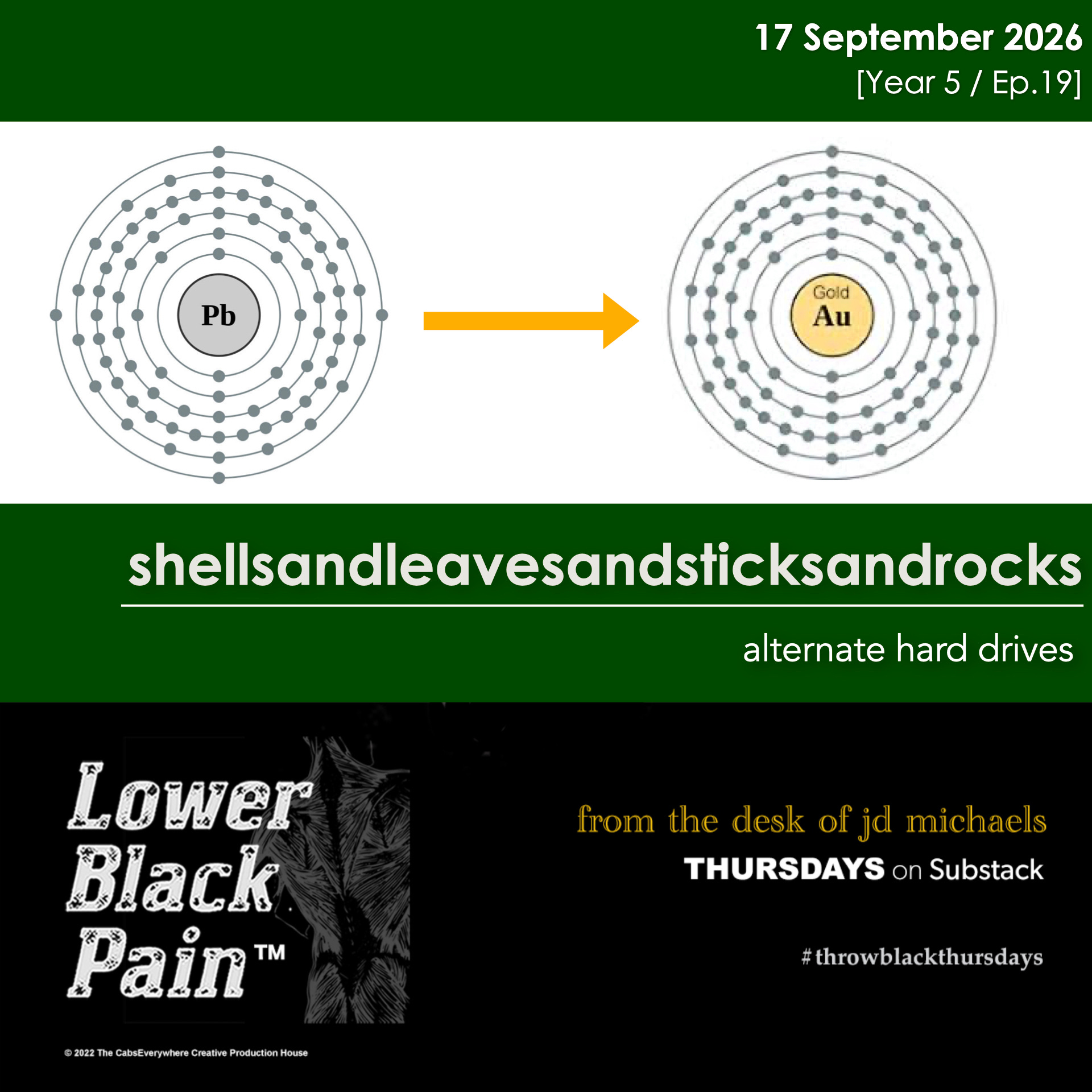
    shellsandleavesandsticksandrocks

    Spring Cleaning: the opening of windows and freshening of linens and dusting off of bookshelves and vacuuming in the corners of ceilings, an annual frenzy of “getting ready” for the longer and warmer days of the year - which ironically are most frequently spent outside. ’Tis the season for that kind of thing in New Zealand right now, where Winter is just ending, which is odd (also, the water there twirls down their drains counter-clockwise? Utter madness.). But in our Northern Hemisphere it is time for Fall Cleaning, a necessary re-negotiation with living spaces many months neglected, passed over for picnics and hikes and visits to other people’s living spaces. O, but winter is coming, and the time has arrived to store away our short pants and prepare for when that throw blanket on the couch (which serves as decoration the rest of the year) at last becomes a treasured necessity. We are deep in the throes of Fall Cleaning at our home, along with our preliminary decorating for Spookytime™, which the family has agreed is not quite here yet but just around the corner - that corner, there, at the end of that long and dark alley, just a few steps beyond the dimly flickering street lamp. Fall Cleaning is always a bit of a refocus. We store away objects of leisure and comfort to make room for more items of practicality and utility, trading long sleeves for short sleeves, sweaters for swimsuits, and in our case cleaning up the various random items we’ve collected over the summer. For instance, I’ve been banned from ever purchasing those popsicle molds from Whole Foods once we found three layers of their various plastic pieces at the bottom of a drawer. To make things worse we found seven random regular popsicles hiding the back of the freezer. We're not even really a “popsicle family”, if there is such a thing. So all that had to go. We end up collecting a great deal of nature in the summer. Sticks. Rocks. Leaves. We’ve gone for a walk and seen something interesting and brought it home to share. Maybe we had a really great conversation on that walk, and that little stick represents it, or the sky was an incredible blue holding unbelievable clouds through which the sun shone on this particular rock on the shore of the lake. So we brought it home, like a photo we didn’t choose to take, but instead stored the moment in wood or mineral form instead of film or digital space. Trouble is, by the end of summer some of those sticks are just sticks again, since we can’t remember quite exactly where or when we found it. The meaning of these objects depends only on their time interacting with us. Random memories triggered by random objects hold varied permanence. We end up with a lot of that stuff by the end of the summer, and not just natural items, but tiny plastic models of frogs making oil paintings and collectible ICEE™ cups and kawaii hair clips. After we go through the house collecting them all, we place each item on the dinner table for analysis - if we no longer can remember its story, then we no longer keep it. There are other categories of summertime detritus (Books We Intended To Read, T-Shirts less Comfortable than Threadbare, Interesting Soda Cans): it takes about a weekend or two to pull everything together and reset the apartment. Then, of course, we cover the entire place with pumpkins and black cats and skeletons for the next month or so. In pursuit of even more extra space, I decided to clean the closet in our little office room, the one that hasn’t been re-negotiated since we moved into the apartment over eight years ago. There I found plastic bins containing precious oddities, including train tickets, foreign receipts and coins, dried rose petals, a glass fountain pen and a vintage yo-yo. Every one with a story (not that I actually remembered them all). I also discovered box after box of Old Writing, some of it from ten years ago. Then I found pages from twenty, thirty, forty, and even fifty years ago. Now technically, all this is just trash - either the ideas aren’t finished or the stories are dated. It’s just paper that matters to absolutely nobody else on the planet. Ream after ream of 90’s prose with 80’s plots and characters: certainly this can all be recycled and made into new notebooks for someone else to take their narrative shot. But I couldn’t just throw them all away. A few of the ideas weren’t that bad, and some stories had been in my head for so long that it was comforting to see how much work had been put into them - inspired me to even polish a few, if only to see them finished. And it was here, in this great pile of potential art, that I realized my Third Act goal: ALCHEMY. I don’t want to dwell in What Was, but I don’t want to just burn it like garbage. Instead, I’d like to upcycle the past, re-use and combine my previous art and experience to create something new. You see, if I can just make something good, and I mean REALLY good, then all these random papers would be transformed into museum worthy historical artifacts, like lead into gold. Each curious page would be a piece of the puzzle of my artistic journey, as we watch the young man from Kansas evolve into a unique talent reminiscent of a young Norman Lear. Or maybe, Aaron Spelling. It’s a good goal. And this year the Large Hadron Collider particle accelerator actually did make gold from lead (for a few milliseconds), proving that after centuries of attempts, alchemy is now possible, if not practical. That is scientific evidence in support of the longest of long shots. So, y’know… it could happen. Get full access to :lowerblackpain at lowerblackpain.substack.com/subscribe
  • September 10 · 2 min

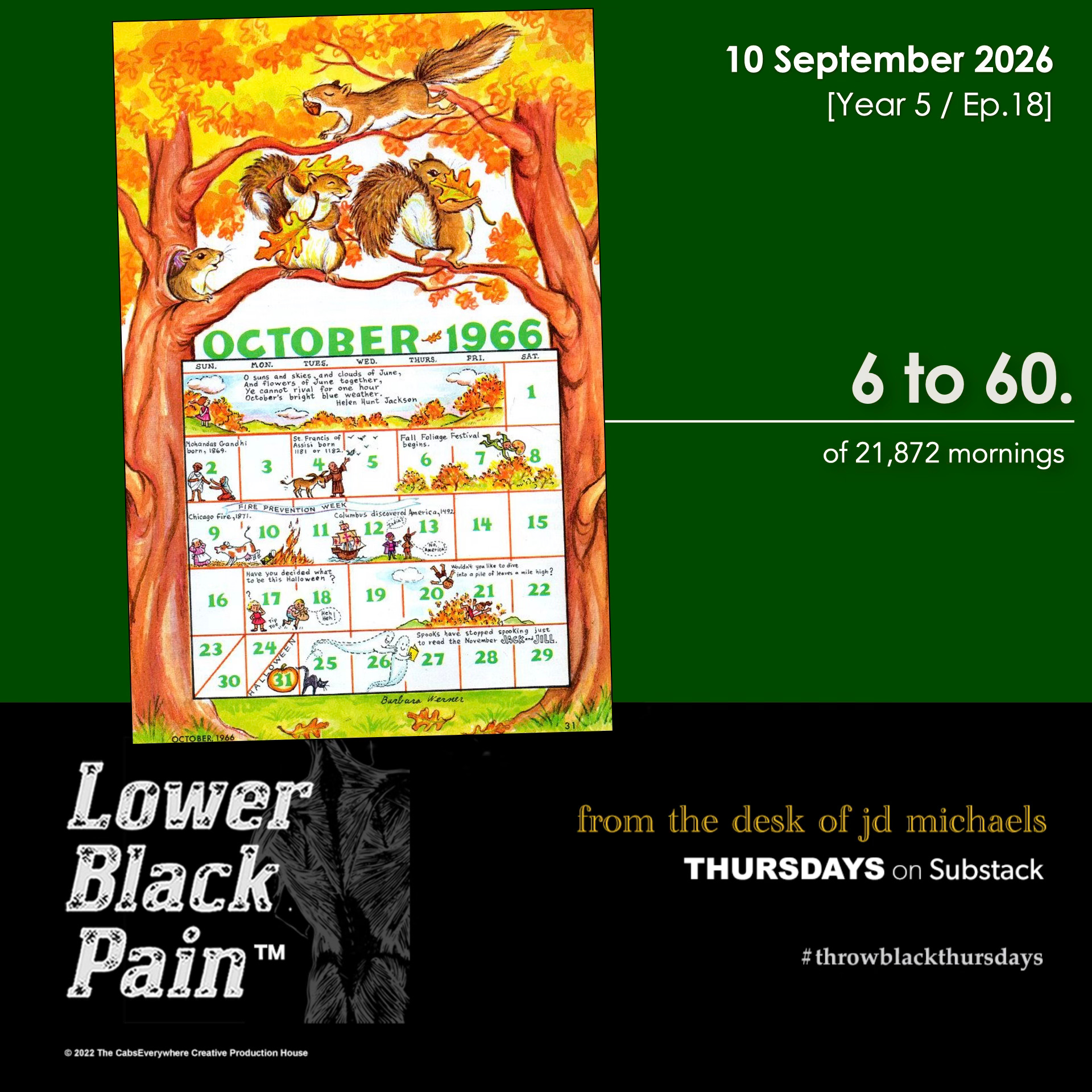
    6 to 60

    just six weeks to 60and i’m feeling fine (’til then i’m gon’ party like i’m fifty-nine) there’s not all that much difference in how I speakbut when i move now there’s an audible creakand a slight subtle wincing that plays on my face‘cause the creaks never seem to come from the same place just six weeks to 60and i’m feeling good though probably not sleeping s’much as i should my Apple watch tells me more hours would be rightand to stop waking up at 3:30 each nightthe dread that its morning reporting would bringmade me just decide to stop wearing the thing just six weeks to 60and i’m feeling great there’s plenty of nutritious food on my plate except for tomatoes, potatoes, and cherrieseggplants and mushrooms, bananas, strawberriesalong with milk, soy, most nuts, shellfish and wheatto which I’m allergic and no longer eat just six weeks to 60and i’m feeling swell though a bit overwhelmed. you can probably tell. it’s the blinking, this subconscious facial attackwhich makes me seem i’m always taken abackat the world that surrounds me - so loud, fast, and new.(come to think of it, that part is probably true) just six weeks to 60and i’m feeling jake some credit is due to the vitamins i take There are five different numbers of vitamin Bsthen twice-daily well-buffered capsules of Csand a top probiotic drink guaranteed to please, whichunfortunately tastes like a blueberry cheese just six weeks to 60and i’m feeling young (there’s so many k-pop songs i haven’t sung!) I’m not sure that i’ve lived enough to be wisethough i’ve seen 60 Easters and Fourths of Julysguess if i can keep navigating through all this hazeI’ll be all that much wiser in… 42 days. Get full access to :lowerblackpain at lowerblackpain.substack.com/subscribe
  • September 3 · 7 min

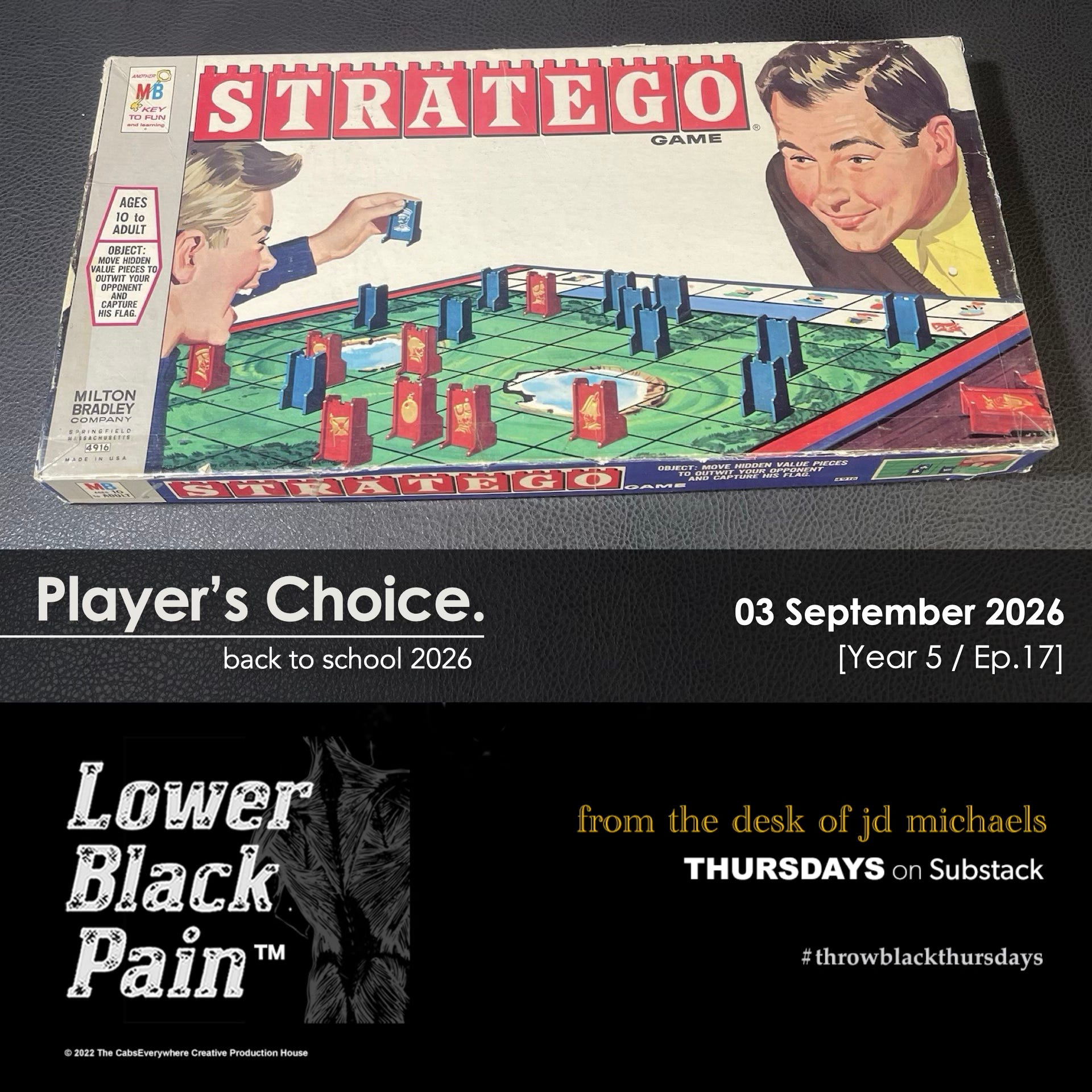
    Player’s Choice.

    The beginning of fall marks an annual celebration of learning: Back to School Time again. I did buy a new cool metal lunchbox this summer, though I’m reticent to take it to work (a grown up place that does not seem to lean toward whimsy in any fashion). Instead I am engaging in the season by (again) dedicating myself to learning One New Thing. Last year it was “How To Play The Banjo”. I initially could not find online instruction that matched both my keen enthusiasm and complete lack of talent for the instrument. I finally found a great teacher who is kind, patient, and detail oriented - and I am now actually getting better. It is soothing to play the one tune I know. I am practicing holiday songs for December. This year’s One New Thing had to be different. And no more expensive subscriptions. Masterclass™ has become overwhelming, where talented people who are just naturally good at something try to tell us how to became good at that thing - it is often like having a tall person explain how to reach objects on high shelves. BBC Maestro™ hosts a much less esoteric collection of instructors (lacking Masterclass’s contingent of Kardashians), but holds the meta-flex of offering Agatha Christie (in resurrected digital form) as one of their teachers. Instead I turned to the Open Courses online series, a grand experiment in instruction. 20 years ago, a few top universities began to videotape entire semesters of certain classes and offer the recordings, FOR FREE, on the internet. No official college credit, but all the information was there for the learning. From the wide array of offerings available, one in particular caught my eye, as I had recently become very curious about its subject matter. It’s ECON 159 - Game Theory. We use game terms all the time: things are “stacked against us” because it’s not a “level playing field”, we have to “roll the dice” even if we are “dealt a bad hand” because we don’t want to just “throw in the towel” when it’s “time to play hardball”. The first thing I ever learned about games was how to lose. Not particularly with grace, but with unwavering consistency, as my mom won bouts of Chinese Checkers, and red and black checkers, again and again. With each loss we reviewed the game and analyzed what went wrong - what choices I could have made. until one night, YEARS later, I actually won. She had always said that it would feel better if I won fair and square, and she was absolutely correct…it was life changing. I enjoyed those face to face games. Two people sitting across from one another with a game board in between them, taking turns making choices that wouldn’t matter once they left that space, yet felt crucially important while they were there - a challenge of mind and spirit. Along came video games, where two people sat not facing, but side by side, looking at a television set. Choices and moves on the screen were a bit impersonal because players never looked at each other. The challenges and responses were pre-programmed and merely activated through controllers. Still, I had fun with my wife, who would augment her on-screen movements with elbow nudges and hip checks from the couch… it was like one of those 4D movie theaters. Then gaming systems required that each player have their own unit and internet access, so they couldn’t even be in the same house. Game choices and moves became nearly anonymous because even if others were in the game, you were playing alone, which I thought was weird. When games of adventure with endless choices and no single narrative path began to appear, I felt excited but a bit disappointed: I mean, that’s what life was already (minus all the Pokemon). And eventually these evolved into long form examples of imminent threat - survival games of war or monsters or zombies… which was (thankfully) WORSE than life was already, and I really couldn't get into. And now on my phone I am offered the chance to shoot constantly at a never ending horde of enemies until I am at last overwhelmed - a game that I will definitely lose - it’s only a question of when. And they want me to pay for it. It’s like therapy backwards - you’re having a pretty good day until you run out of ammo in the bleak hopelessness of your palm-held perdition. That’s a GAME? Isn’t a game a chosen risk where the odds are pretty even? Why would you play a game if you’re guaranteed to lose? How did games progress from challenge, to adventure, to survival, to despair? Thus, ECON 159. So far I have learned about The Prisoner’s Dilemma, which goes like this: A pair of criminals is captured by the police, and each given the same deal - if they inform on their partner and their partner does not inform on them, they will be set free and their partner will get a five year sentence. if they inform on their partner, and their partner DOES also inform on them, they will each get a 3 year sentence. if they both stay silent, they each get 1 year. I won’t go into all the head-spinning calculations, but it’s statically better to inform than not because the most you’ll get is three years and maybe none at all - but the question is ultimately moral, because it’s less about the odds than if you trust your partner. The “game” reflects not what the criminals did, but who they are. We’re all tested everyday; we make it out of bed, face the outside world, and triumphantly recognize traffic lights, crosswalks, and bicycles in those online security tests to prove we’re human. Sure, that’s a pretty low bar, but these are tough times. We live in a reality where our tools are becoming so fast and efficient that we feel like we’re becoming their tools. And the ridiculous fact about that all those tools and technologies are made by human beings… ironically rushing to prove just how clever they are. But life isn’t just a race against impossible odds. If that were true then all that would matter was speed and efficiency and volume and output, and we’d all be that little character with the ammo on the bridge, endlessly shooting until they’re overwhelmed. Ok, I can see how that metaphorically appeals to folks because the situation does speak to bravery in desperate circumstances - but how did that little guy get on that bridge in the first place? The premise seems to speak of previous poor choices on his part. We, unlike that fellow, can choose which games to play, which adventures we want to set out on, which prizes are worth our risk. In this blinding cacophony of NOW NOW NOW it’s important to remember that games are supposed to be relaxing. Fun. Parker Brothers and Uno and Frisbees and hide and seek and chess were not invented to be stark metaphors as to the state of human existence, but amusing ways to spend face time with friends, where how one wins speaks much less to one’s character than how one plays. Get full access to :lowerblackpain at lowerblackpain.substack.com/subscribe
  • August 27 · 4 min

    Picture Day.

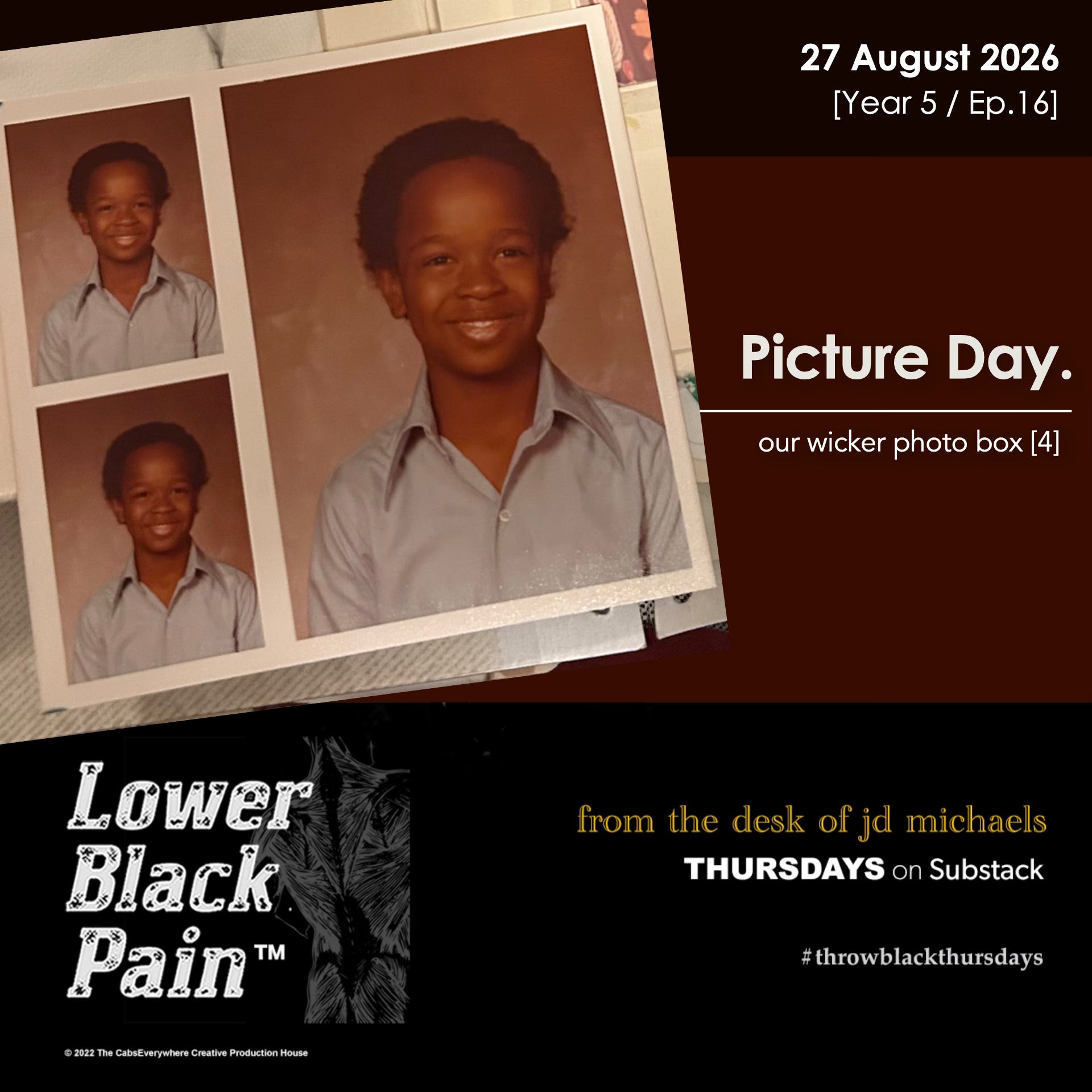
    [1 - 8x10] My most consistent historical visual record was compiled through time capsules delivered in paper envelopes with cellophane windows: my annual school photo. The Mondrian-like layout of large, medium and impractically small shots were all on one page, which (because I did not grow up in a fancy X-Acto knife house) we could never quite cut out perfectly. The assortment was designed to satisfy relative demand, or more specifically, the demands of relatives: one BIG one for the grandparents, a couple of decent sized portraits for parents (one for home and one for an office), several to share with interested parties (say aunts and uncles or very close family friends), and then teensy ones to pass out among classmates. There were always some left over, as the individual social popularity of each and every student could not, scientifically, match the (too) generous image supply. The most one could hope is to watch your grandparents place this year’s photo in front of last year’s in the frame that they kept on the mantlepiece, so you could get a “Wow, you’re growing up so fast!” affirmation before they close the weary metal latch on the back that bows a bit more each year against the expanding stack of glossy prints. [2 - 5x7] Picture day was always exciting, but a bit stressful. Whatever you looked like on that day would be what you would look like in the yearbook, which means you’d look that way forever, so there were lots of combs about. The photo sessions were always scheduled before lunch and recess, the two periods most likely to muss and stain us. As we stood in line patiently waiting our turn, we could watch the folks alphabetically before us being coached by staff as they moved us steadily along their assembly line. Although we weren’t Catholic, my mother enrolled me in a grade school that was - in addition, they had just opened their doors to admit young men as well as women, and initiated a program to support more financially challenged families. As a result, I was in the first class with African-American students. The nuns and other teachers worked hard to include us evenly, but after our first picture day it was discovered that the photographer had not adjusted their cameras for our skin tone and we all came out as shadows - so they scheduled a secret second day and had us all re-take our shots. After that first year, things went fine. [4 - 3x5] My forehead is the most prominent thing in my school photos. I grew up, sure, and my body changed its size over the years, but my forehead is a clearly established constant, maintaining the exact ratio through all my developmental stages. My smile is the most consistent thing in my school photos. It was my honest reaction to the command from an adult stranger to “smile”. I couldn’t re-create it now; back then, I didn’t need anything to smile about, whereas today I require pretty significant reasons. My hair is the most unpredictable thing in my school photos. It’s not great. It is on my head, but seems surprised from year to year, as if it didn’t know this was happening TODAY and would have done something completely different had it been properly warned. My clothing is the most odd thing in my school photos, because for grade school we had blue uniforms, but in high school I had no idea how to put clothes together and ended up wearing outfits that made me look like a hillbilly in a Broadway musical. [6 - wallet size] kids today have cameras in their pockets all the time to them, time is not merely captured, but fully domesticated but those photos, endless and instantaneous, prove wholly ephemeral whereas we curated tiny analog galleries, compiled through decades priceless moments of light and time reflected stored in wicker boxes behind the couch - as fragile and steadfast as paper Get full access to :lowerblackpain at lowerblackpain.substack.com/subscribe
  • August 20 · 5 min

    Cheese. Cake.

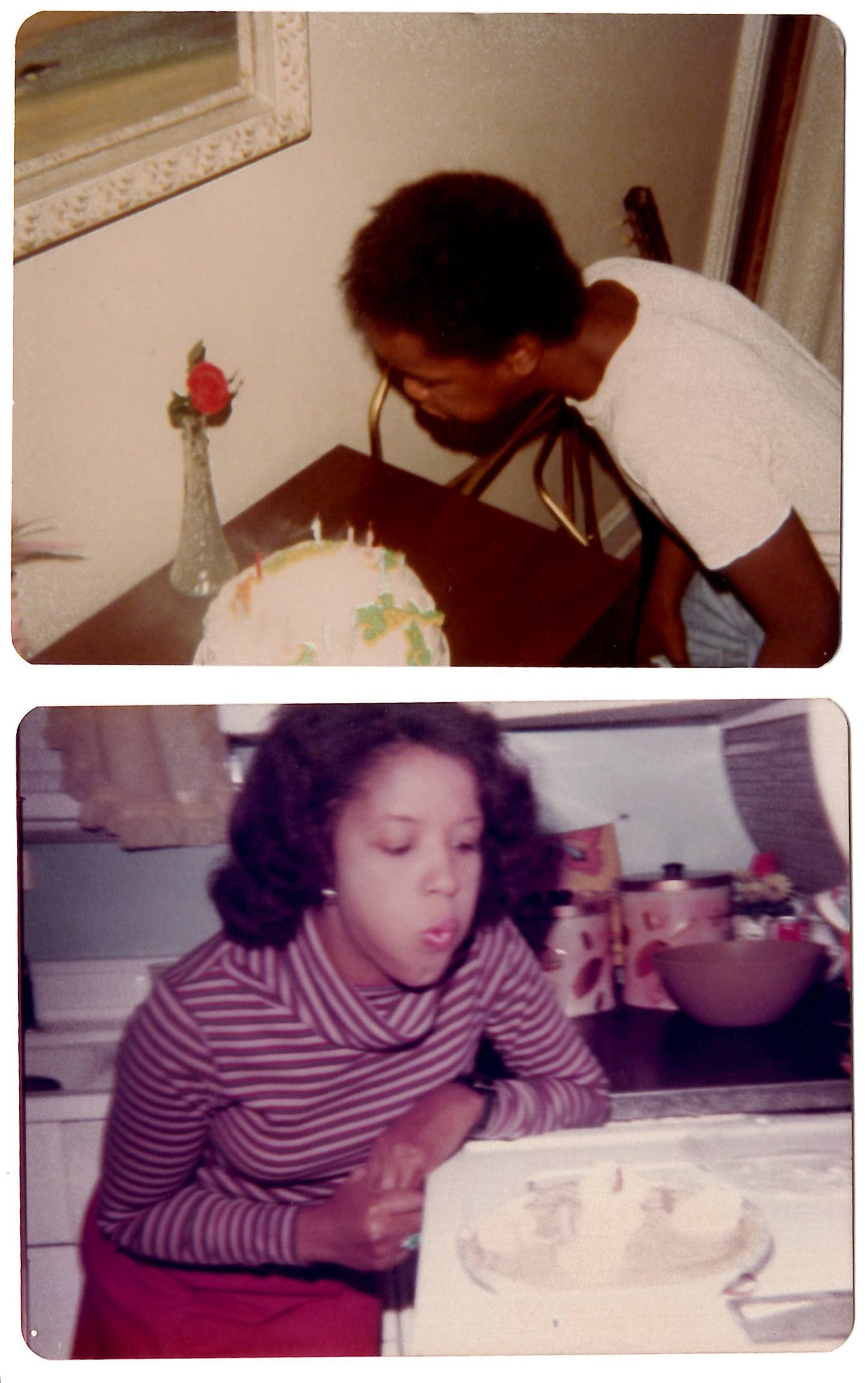
    We used to have framed photos on the walls of our apartment: * there we were, on a rollercoaster. * there we were, wearing cowboy hats at night, illuminated by an endless garden of neon lights. * there we were, smiling beneath a windmill. After a time (measured in decades) these treasured memories began to overtake their allotted space. They dominated their canvas rather than artistically augmenting it - each picture was 1000 words, but together they formed a massive novel. We even tried that HGTV thing with a dedicated “wall of frames”, but it made us a little claustrophobic. So, when we moved into a new apartment where we had a bit more space, we ended up putting very little on the walls. This proved a wise strategy during COVID, where the unintended mockery of being surrounded by images of ourselves out in the world having fun with the sky and the fresh air and the wide open spaces would have driven us stark raving mad. Thus many of our physical photos, even the fancy framed ones, are still in storage. Ironically, for the past seven years we have only seen them on the AppleTV screen saver, in the background of photos of us in our old apartment. A few weeks ago I delved into the wicker IKEA box containing the majority of our printed photos. The box is not organized, and holds photos from both my wife and I: grade school, high school, college, even family photos of our parents, their parents, and a few of our great grandparents. Our aim was to digitize the lot, but given that we’ve (so far) seen six different formats of magnetic and optical storage, each making the former obsolete, this wicker box remains the most stable archival option. It’s fun to find a picture of us drinking out of a glowing fishbowl at a Star Trek themed restaurant, then a print of Zoe’s formally dressed, sepia-toned and serious-as-all-get-out great grandparents. Though admittedly there doesn’t seem to be a clear theme to the collection, I discovered that in both of our families (and perhaps in every American household) there are two photographs that everyone seems to take. The first is the specific look prompted by the word “CHEESE!”. It is not exactly smiling, it’s kind of a…grimace, I guess. As a little kid we all would say it and then kind of laugh, because the sound of any group of people saying “cheese” is a little bit funny, and usually that flash of amusement was the moment caught on camera. Everyone (past the era of the sepia portrait) has a CHEESE photo. The second photo that everyone takes was a bit of a surprise. In our collection, I found pictures of my grandfather, my mom, myself, my wife, and my daughter doing the exact same thing: blowing out candles on a birthday cake. There we all are, from four different eras: leaning forward, somehow smiling while our cheeks are fully puffed. I happen to know that the photos with my grandfather, my mom, and myself share the same pound cake recipe, with handmade icing, created by my Grandmother. It was “The Birthday Cake”; so solid a tradition that when I was in college my mother would bake one, freeze it solid, and send it to me at school. My roommates laughed until they tasted it, then fought over the last slice, and sought me out the next year for another one. It’s a good cake, one of the “top five things made of wheat that I miss now that I’m decidedly celiac”, along with Twizzlers™ and Guinness™. I also know that the traditional “Happy Birthday” song was sung in all the photos. (We don’t add anything on the end, like “Are you one? Are you two?” because the answer is right there in front of you, blazing away…it isn’t really a “pop quiz” worthy challenge.) And no milk was drunk with the cake, because we’re all allergic. People have been blowing out birthday candles for centuries (thanks Artemis), though I cannot imagine the ancient Greeks creating quick charcoal sketches of the moment. But I do find the ritual soothing. Our household is heading into “birthday season”: in somewhat of a row we have my wife’s birthday, then my daughter and mom (a few days apart), and then my own. Three of us are hitting “signifiant milestones”, this year, so we’re a bit more sentimental than usual, insuring that even more birthday photos will be taken. So I am going to put the family birthday cake snapshots in a frame, side-by-side, and hang them on a wall somewhere. Home photography seems a pretty stable hobby, and this tradition seems pretty culturally ingrained - so no matter how the world changes, there’s a pretty good chance that my great-great-great-great granddaughter could build herself a delightfully whimsical photo wall. Y’know, if walls are still a thing. Get full access to :lowerblackpain at lowerblackpain.substack.com/subscribe
  • August 13 · 5 min

    Prints.

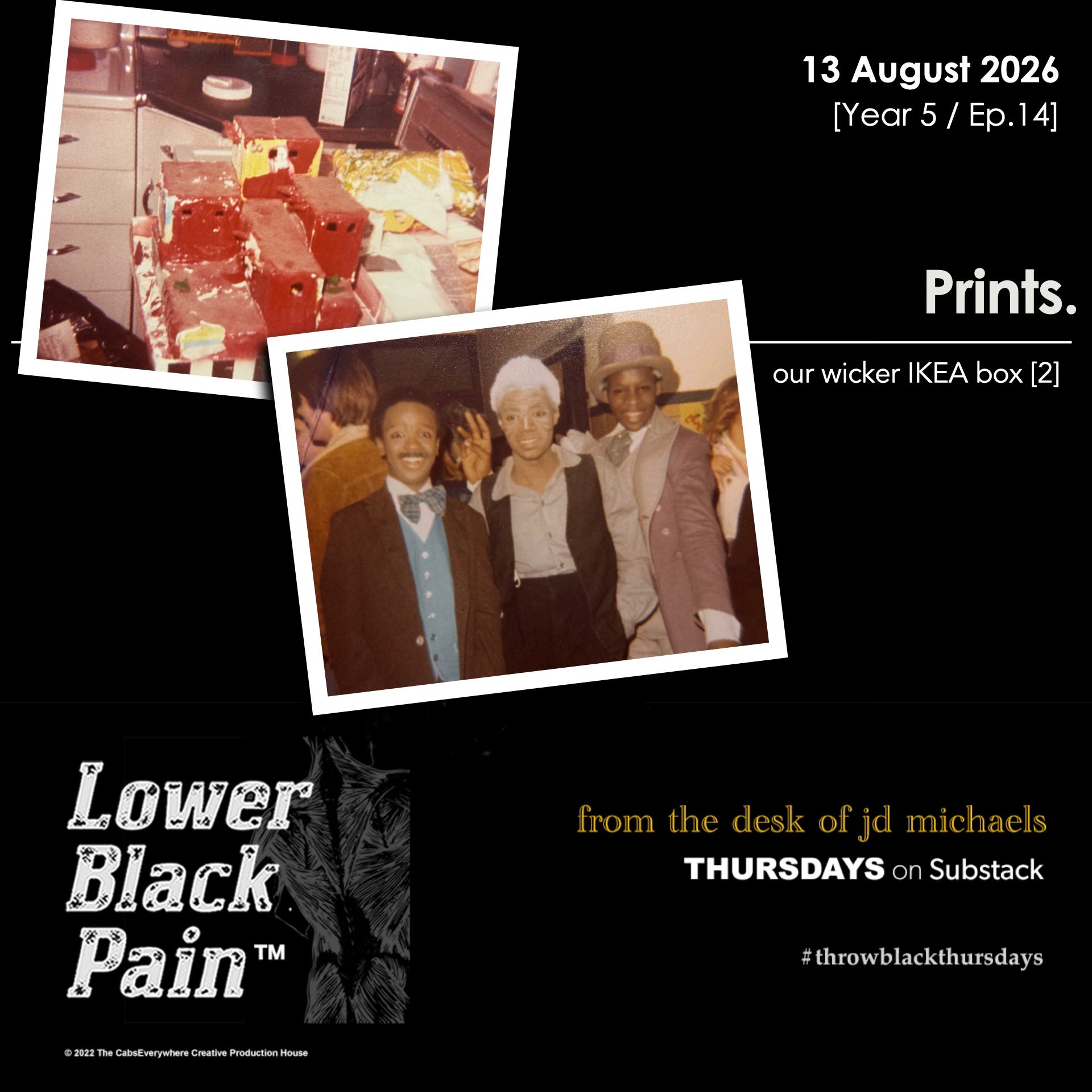
    Thanks, Technology. We appreciate the assists when we start our car with a button instead of a key, or warm something up in the microwave (unless it’s frozen and then we have to do that thing with the spoon where we wait for the glacier in the center to thaw just enough that we can use a tablespoon to break it apart like a polar ice shelf of marinara and then hope the blazing hot moat on the outside helps to melt the now free floating boulders of sauce), or use a remote control for our tv (after we use the app on our smartphone to find it). Making difficult tasks easier is technology’s bailiwick. But technology rarely makes great things better. Delicious food does not become more delicious, hilarious jokes are not funnier, clothing is no more impressive (except for Velcro™, which is an unqualified miracle). Technology nearly always delivers less expensive and more efficient options, but the old adage remains - although every product and service wants to be GOOD, FAST, and CHEAP, they can only offer two of those at a time. I thought that a photograph was the perfect repository for a memory - a physical object that captured a moment and held it gently for future reflection. But when I looked at many of the photos in our storage box I didn’t immediately remember any detail of the scenes within. Look, there’s a park. Oooh, a hotel. Wow, I’m young…that’s neat… look at all that hair. Stack and stacks of pieces of glossy paper with random images on them - precious only to me because for some reason that scene was important enough to spend a frame of actual film to capture, and then take that film somewhere for processing and wait a number of days to retrieve the prints. That’s effort. The best of these pictures hold not only time, but emotion. It’s not a picture of something I DID, but a way that I felt. Look, there’s that park where I won the three-legged-race on Field Day in third grade and that red-headed girl smiled at me and said congratulations. Oooh, that’s the famous hotel that rock and roll people stayed at that has the guitar shop where I finally found my mandolin. Wow, I really DID have a lot of hair. And now, the emotions I felt back then resonate with the emotions the photo currently evokes. Look, I admit that I could use more exercise. Oooh, I’ve gotta dig my mandolin out of the closet and play more. Wow, I should buy more hats. In the world of music, as the fidelity got higher, the physical music got farther away. Records could be played with a needle and a paper cone, but they were heavy and fragile. Then came cassette tapes: lighter and much more clear, but dependent on electronic magnets (and we couldn’t just listen to any song we wanted without fast forwarding). Then CDs - even lighter and clearer, but we couldn’t hear our music without computers and a laser. And now we can hear any song ever recorded instantly with NO WEIGHT AT ALL and PERFECT SOUND, but there’s nothing at all to touch and our access depends on corporate satellites in space. Our photographs have followed suit - housed in a digital repository so admittedly out of our grasp that it’s actually called “the cloud”; instantly sharable but ethereal, dependent on machines we sort of understand and subscription agreements and data farms and a billion dollars of miracles that are out of our control. Or you could print your pictures and put them in a wicker IKEA box. But then you have to buy paper and ink which is expensive and they take up so much space… I hear ya. Sorting through these I feel a bit like I should follow Marie Kondo’s advice and throw away any picture that does not “spark joy”. But they all kind of do spark joy: even the one’s I don’t fully remember hold some kind of feeling, just for me. Anyway, these were never images to really show off to anyone: at the time they were taken, each photo was destined to be seen only by whoever I showed it to, and to be honest, I’ve never known that many people. And it’s not like these are pristine high resolution snapshots of amazing salads I’ve eaten that I’d share online anyway. Who else would ever be interested in that adobe village of cardboard and plaster that I made as a book report? Who cares that I played Algernon in “The Importance of Being Earnest” in 10th grade, complete with a mustache and (very sketchy) British accent? Just me. Life was a little slower, but things were pretty good. Look! Oooh! Wow! Book Report. Algernon & Merriman & Jack Get full access to :lowerblackpain at lowerblackpain.substack.com/subscribe
  • August 6 · 5 min

    Kodachrome.

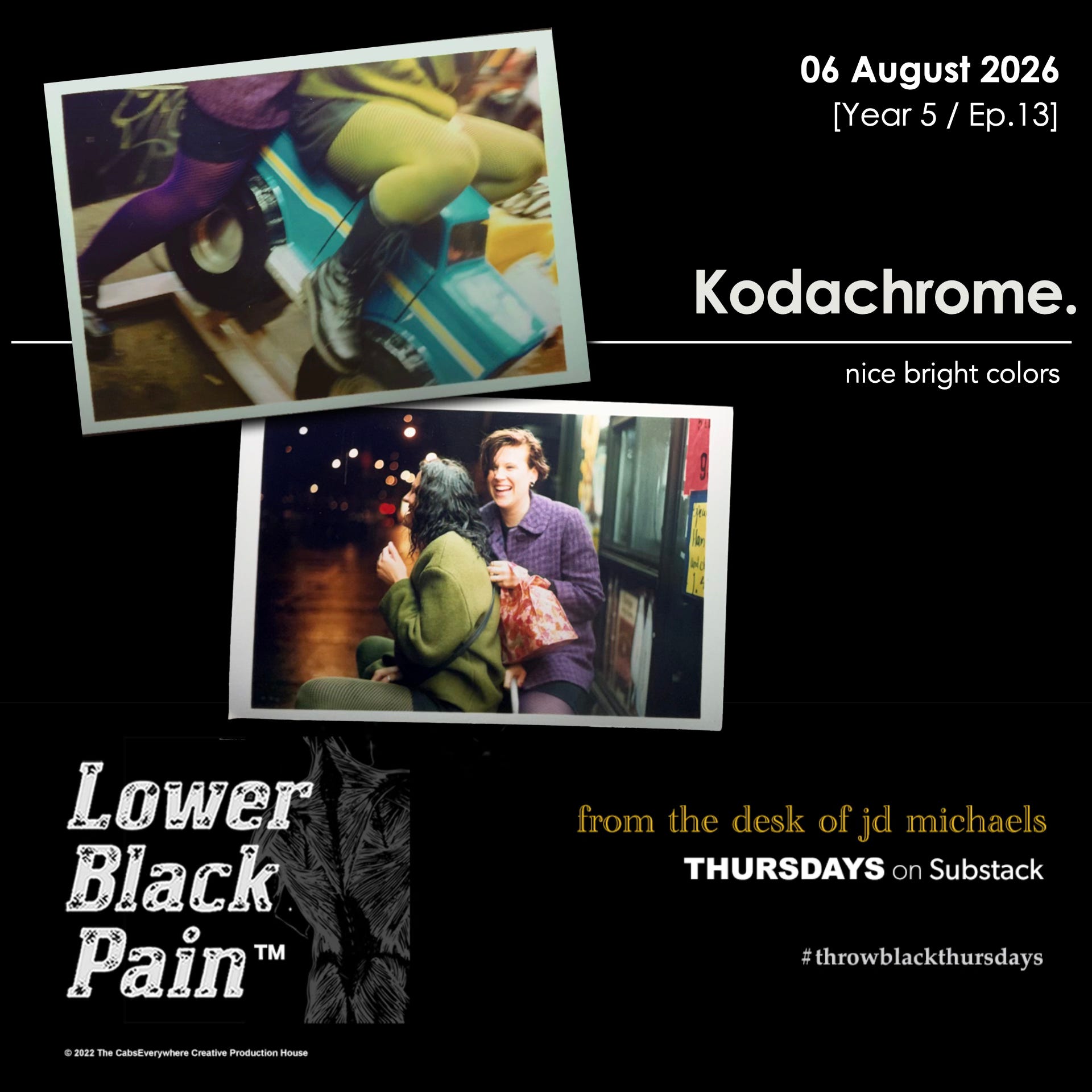
    I was looking for a photograph yesterday, from a while ago - of my wife and a friend out in front of a convenience store at night riding one of those giant toy animals that moves when you put in a quarter. It was winter and my wife was wearing bright purple leggings and our friend was wearing bright green leggings. They were laughing. I looked through our pictures and I couldn’t find it. I searched by location, then for “bright green leggings”, and nothing came up. I began to look through all of them, year by year. Still nothing. “What’cha doin?” my wife asked. “I’m trying to find that picture where…” I described the moment. She remembered it. “Oh, yeah. That’s a picture.” Pause. “Yeah.” I replied. Pause. “It’s a PICTURE.” she said. There was a pause here as well, augmented by my puzzled squint. Confused, I indicated the computer before me with a cautious wave of my hand. “It’s… not in here.” I told her, with a timid Vanna White flourish. “No, it’s with the pictures.” she said, turning to leave the room, then calling back from the hallway, “…the ACTUAL pictures. It was before all that.” We see our digital photos all the time. Our Apple TV™ uses our digital photo library as a dynamic screen saver, the AI displaying warm memories, important milestones, and what we each consider an unnecessarily mean-spirited gallery of our least attractive shots, more ghastly in the clarity of 4K. Over the last 20 years we have amassed over one hundred thousand digital images, so we attempted to weed the undesirables out, but the thing has a mind of its own. Our ACTUAL pictures are in a wicker IKEA cube behind the couch, gathered in envelopes, a metal box, file folders, and a lot of rubber banded bunches. They are in no way databased. If I were to ask the box to find pictures of me wearing a scarf, the box would, in its own silent and entirely imperceptible way, openly mock me. To sort through the pictures in the box, you have to touch them with your hands and point them toward your face. My daughter watched me do this, without comment. She is familiar with the box of pictures, as well as the legacy photo albums beneath the sofa; the shadows of four generations, which together represent a comprehensive slideshow of her DNA composition. She has scanned a few images for class projects (“these are my great grandparents…”) but it’s been a minute since we’ve taken her through any of the old-timey stories. She kept a careful distance. Physical photographs are wonderful. They don’t move. You can look at them in true detail because they meet you halfway. But for all they represent in clarity, they often lack context, becoming memories we don’t remember. Digital images give us hints as to their stories - offering day, time, and location, as well as thumbnails of all the photos taken immediately before and after to further jog the memory. Paper photos have none of that. My grandmother used ballpoint pens to add “metadata” directly to her photos - sometimes right on the front. When she didn’t actually remember who was in the picture or when it was taken, she made it up. It didn’t matter, she said: no one else was going to remember any better than she could: and in the future, her BIC-pen-scribbled shoddy research would transform to historical fact. Our IKEA Collection is curated, pieces of paper that have survived 12 apartments and four to five decades, a box filled with pictures of far-distant relatives, former associates, and familiar strangers. These images are interesting, but their stories hold emotion, incident, tales cautionary and fantastic, milestones, victories, and experience. And sometimes, just a feeling. And to capture all of that, you need yourself a BIC™ pen. This column is my pen, as it is, at its core, all about history. But everyone knows that books are better with pictures, so I pulled a few pictures out to write down their stories, pass on their context and significance as best I can. (Hopefully I’ll be more accurate than my Grandmother was.) And I did find the photo I was so desperately looking for. Upon seeing it again, I could not recall exactly where or when it was taken, or what was happening before or after the moment captured - but still, it made me smile. I realized that the details of the situation are not why I treasure it. Actually, it’s the colors I remember. Get full access to :lowerblackpain at lowerblackpain.substack.com/subscribe
  • July 30 · 5 min

    SRS 26 | Summer: (un)Wind

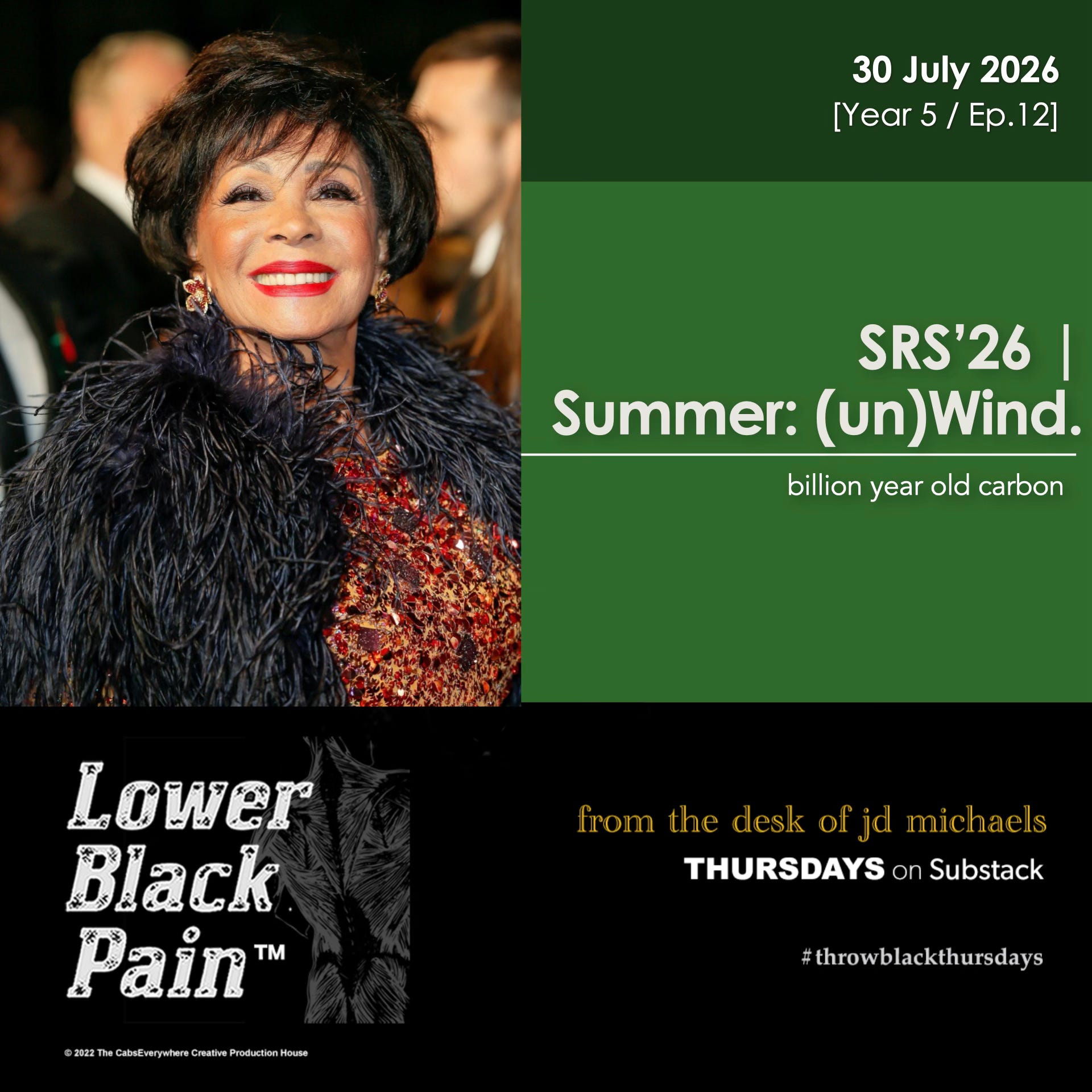
    The nice folks at the American Association of Retired People sent me a brochure about five years ago, which I tossed in the recycling, unopened, chuckling to myself at the blatant inaccuracy of their mailing list. Three years ago I got a large envelope from them in the mail, promising the gift of a roomy insulated travel tote upon the return of their membership postcard. I clucked my tongue as I tossed it in the recycling, bemoaning the waste of paper, ink, and jet fuel necessary to deliver their message to the wrong address. But this year, when the AARP invitation inevitably arrives, I will answer. I will answer “yes”. Yes, please send me the travel tote, and I’ll take the quarterly news mailer and subscribe to the helpful bi-weekly email tips regarding vitamins and annuities and affordable travel adventures. Fine. You got me. You stayed in the same place and I came right to you. You ARE sort of sneaky - just looming there in the future with your discounts and life hacks, as sure of your inevitable relevance as a trusty umbrella, waiting for Spring. I would call it diabolical if it wasn’t just TIME. (Oh, and if you offer an umbrella, I’ll also have one of those.) The Social Security office wrote me this week - reminding me that in two years I could begin to collect payments - but if I waited five years, I would get more money, and if I waited ten years I’d receive even larger payments - albeit with statistically less opportunity to spend it, due to the whole TIME thing again. I have always thought of “retirement” in the same space as “winning the lottery”, a goal where the implied lifestyle was mostly fantasy. Handball, fishing, wine tasting, light carpentry, walking barefoot on a beach with my slacks rolled up. I know a few folks who planned very, very well and are now enjoying the world around them after superior careers in challenging fields - though the world they’ve ended up in isn’t the one they were aiming for. They unknowingly packed warm clothes and optimism for an age of global warming and internet bullying. I never thought retirement would be “stopping” as much as “making a 90 degree turn”. There were rumors of pensions and pretty gold watches. But change moved faster than any career could - buildings I remember seeing constructed were entirely razed, businesses that had thrived for almost a century were casually dissolved, entire industries understood as primary and essential proved wholly unnecessary. So most of us wound up taking those 90 degree turns sooner than we expected, and the future, once a mathematical result of sage calculation, became once again uncertain. But in two years, dependent on the state of democracy, I could receive a payment from the United States government each month, along with a bit of healthcare to stave off the injuries I may incur while playing handball, fishing, or walking barefoot on a beach and mistakenly stepping on a jellyfish. Again, I’m not expecting retirement to mean that I don’t have to work - but that I’ve earned the time to add something other than work to my schedule. I never learned to “take my time”, mostly because (not to be twee) I didn’t really see much time that “belonged to me”. Besides unescapable life function, my every moment was an urgent payment forward, relentlessly thriving or surviving this or that or everything. I’ve given out a great deal of advice over the years, most of it to groups of eager college students or potential entry-level employees. My central theme was to always keep learning. Now, I am going to take my own advice. I have a list of things that I’m going to keep learning. In alphabetical order, they are: * ASL * (the) banjo * bioscience * sleight-of-hand Given that I’m still working everyday, I understand that I will need to make room for these pursuits, so I’m giving up * worrying about things * going out of the house after dark * drinking alcohol (outside of the house (after dark)) * doomscrolling * thinking about doing things rather than immediately doing them and then just being done with it Oh, and I’m going to sing more. I enjoy it, even if two of our cats do not. I mean, Tom Jones, Paul Simon, Bob Dylan, Barbara Streisand, and Paul McCartney are all 84 years old this year. Five of them have released new albums in the last three years, and Tom Jones is out on tour RIGHT NOW. Inspiring. But the grand dame of it all is Shirley Bassey, best known in the US for singing the James Bond theme “Goldfinger”. She is the first Black artist to sing a Bond theme, the first Welsh singer to have a number one hit, and the first female artist to have a song on the UK top 40 charts in seven consecutive decades. She has released over 40 albums, 20 tv specials, and is 89 years old. Dude. I have a ways to go. Maybe I don’t need that tote bag yet. Oh AARP, don’t be mad at me: I really do appreciate that you are there to greet us as our enlightened sherpa to Creakybone Mountain™. But you just sit tight. I’ll be on my way. In a while. Get full access to :lowerblackpain at lowerblackpain.substack.com/subscribe
  • July 23 · 5 min

    SRS '26 | Summer: Madness.

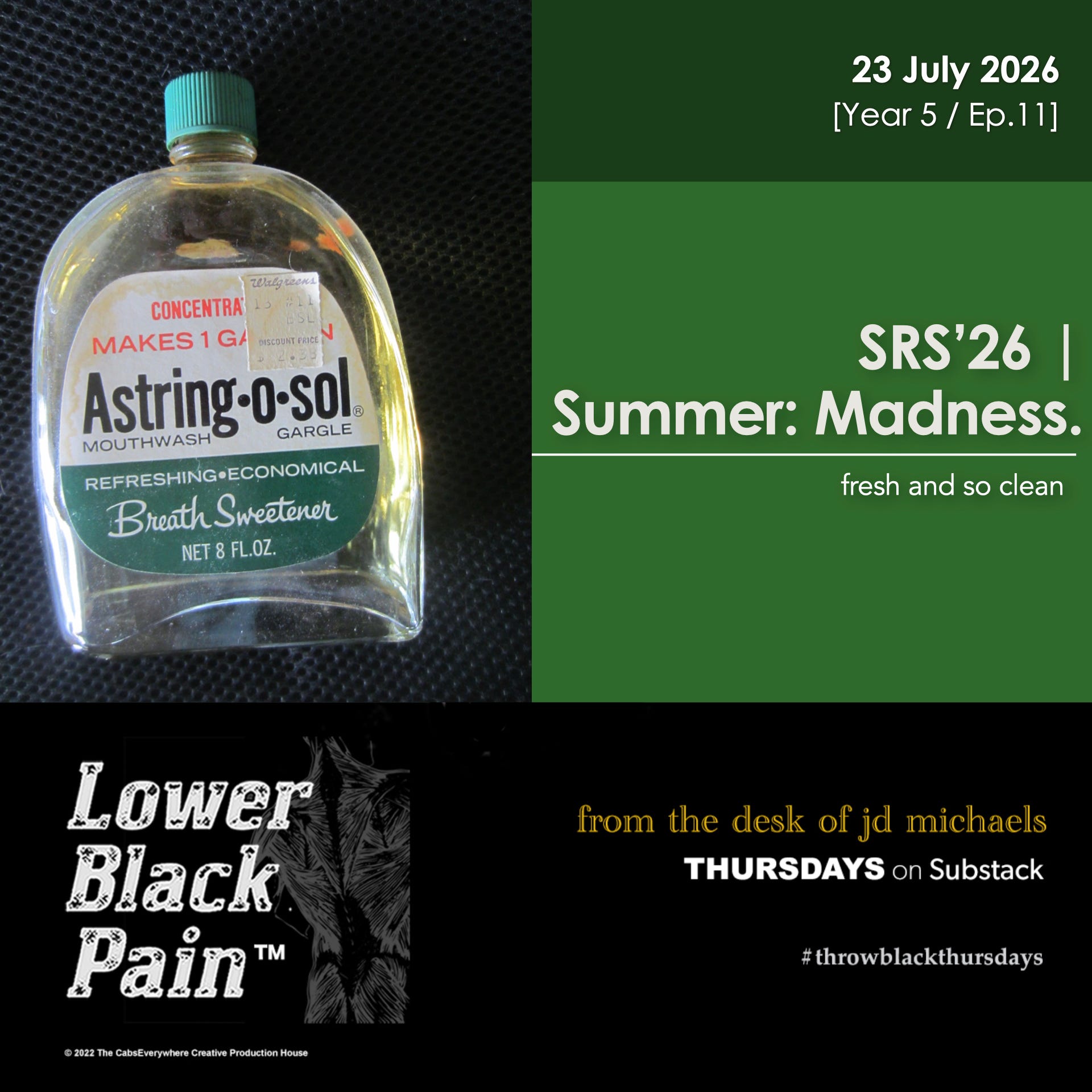
    Last week I purchased an empty bottle of mouthwash. It arrived from eBay very well wrapped and protected with paper and another type of paper in a ziplock bag surrounded by bubble wrap, in a box. It was very inexpensive, mostly because it’s an empty bottle of mouthwash. I am writing a series of short essays about the home my grandparents lived in; they bought the house in 1949 and lived there for over 60 years. I knew the house well because we lived in an duplex at the other end of the block and visited at least once a week, most often on Sundays after church. I only lived in my grandparents’ house for one week, the summer my mom had to leave town for a national teacher’s conference. I was seventeen. My grandmother thought it would be most appropriate for me to sleep in my mother’s old room to experience what it was like for her, sleeping in the 1950’s. All I knew about my mother’s childhood room was that, growing up, she hid Ray Bradbury and Issac Asimov books under her pillow - so during that week, I did the same (I believe it was “I Robot”), - just for authenticity. I had a summer job singing at the amusement park; I had to be at work by 10AM and didn’t get back until about 9PM, so out of respect I got up early each day to get ready and have breakfast with my grandparents every morning. Anyway, I bought an empty bottle of mouthwash last week from eBay. I should say that the bottle is “almost” empty, as it does have a little bit of liquid still in it. I am not a linguist, either professionally or as a focused hobby, but I always believed myself to be familiar with common prefixes and suffixes. For instance, I thought that “sol” referred to the sun in some way. It does as a prefix, but as a suffix, sol refers not to “solar” but “solution”, as in AEROSOL, or the product names Pine-Sol™(pine solution), or Lysol™ (the LY refers to the Greek word “lysis” meaning “to break down or dissolve”), or the curious American mouthwash named “Astring-O-Sol™”(astringent solution?) - created in the 1920’s to compete with the Listerine™ brand. Rather than Listerine’s “Fires of Sterilization” flavor, Astring-O-Sol contained zinc chloride and the oils of myrrh and wintergreen. The gimmick was that Astring-O-Sol was highly concentrated, even somewhat dangerously so: potent enough that just three drops in six ounces of water created an potion powerful enough to deliver fresh breath for a full day. That’s how it could be marketed as a clear value, since its smaller packaging allowed more product to be shipped for less money and a bottle would last longer than its competitors due to the fact it was being emptied by only three drops each day. My grandparent’s bathroom was far more of a time machine than my mother’s old bedroom. The tile was vintage, the sink was tiny and low with a sturdy little faucet, and there were products I had never heard of or seen before in the cabinet behind the mirror: soaps and creams and my grandfather’s depilatory powder (which smelled like rotten eggs) and after shave (which smelled like, well, Grandpa) and a bottle of Astring-O-Sol, which I did sample during that summer week in their house. However, being in a hurry, and as there was not a cup in the bathroom, I did not dilute it, but instead sprinkled three drops directly onto my tongue. Those familiar with the effects of wasabi can extrapolate what happened next - a moment of calm, then curiosity, then complete and total panic where I forced my head as far as it would go into the tiny sink, desperately trying to calculate an angle that might allow a few drops of water to get into my mouth. And yes, the freshness did last all day long. Anyway, they don’t sell that stuff anymore in most stores, so I bought an empty bottle, exactly like the one from that bathroom. When I think about my grandparent’s house, it’s not so much architectural details as the experience of being there, and that moment was one of my clearest (if not exactly fondest) memories. My family watched me unwrap it, which took a while, but did not immediately comment when they saw what it was. “Is that old mouthwash?” my wife finally asked. “Yeah.” I replied. “It’s for research.” I was surprised that my answer was good enough for both of them. I was all ready to impress them with the fact that one just like it is in the Smithsonian. https://www.si.edu/object/astring-o-sol-mouthwash-and-gargle%3Anmah_1218694 Get full access to :lowerblackpain at lowerblackpain.substack.com/subscribe

  • July 16 · 5 min

    SRS '26 | Summer: Time. Blues.

    This is my sixtieth summer. I don’t quite have the hang of it yet. I’ve done all the important research: Annette Funicello and Frankie Avalon were fantastic professors, taught me all about beach culture and how to “hang ten” on a surfboard and sing my summer feelings in groovy song. Admittedly, the majority of their wisdom did not effectively translate to my landlocked Kansas City existence. I eventually made the singing part work as a summer job, but the closest I ever got to surfing was skateboarding and watching Point Break. My mother was a schoolteacher, so that cycle of summer vacation seemed natural to me. In fall, winter, and spring there were books to read, reports to write, pencils to mindlessly chew; but in the summer pressures lifted, and I could relax a little (when I wasn’t mowing grass or working at that singing job). Now, nearly 40 years past any kind of educational cycle, it’s still harder for me to wake up and get out of the house in summer than the rest of the year. Surely I should be be-slippered and pajama-ed in front of a television with a huge bowl of colorful breakfast cereal on my lap, re-charging my gentle system from its three-quarters of a calendar year of diligent toil and focus. But no. I put on actual pants and talk to people, nearly every day. My family is in alignment with my seasonal malaise, which is supported most authentically by my high-school age daughter. She loved the first two weeks of summer vacation, but feels the dew has now evaporated from the lily and craves some kind of challenge. Cleaning her room was her first adventure - the frenzy of studying for finals and creating year-end projects begat a creative tornado, whose aftermath was still clearly evident. But three days, a garbage bag, and a couple of strategic bookcases from IKEA later, that task was completed. Even her phone, whose constant fountain of digital distraction had proven an absolute lifesaver against academic stress, now seems a bit much. She looks at it on-and-off during the day, but it is clearly a condiment without a burger to complement or french fries to enhance. I see her particular near-boredom as the edge of true genius - this is when she might pick up her guitar and learn three chords and explode with a bunch of catchy tunes that rail against injustice, inspiring her generation and beginning our retirement plan. That may not happen. For now she’s making art and cooking and writing and starting to read a few books. Her chief complaint is that summer days are LONG. Even her attempts to sleep halfway through them are futile: the hours keep stretching languidly forward toward lazy late evening sunsets. My wife is a casual athlete and should love the summer months, but for days on end we’ve had sweltering weather where it’s beyond impractical to run outside. And she loves running. Outside. So there is no clearer expression of human dissatisfaction than my wife’s face when forced by aggressive weather to workout inside and online, using those pastel colored little weights that I bought her non-ironically. Observe her frustration. She is the lion given tofu for supper. She is an opera fan at a monster truck rally. Her form is strong, her dedication pure, but her effort is disrespected by the Lilliputian stature of her digital instructors, the prison-cell-floor amount of space we have available in our apartment, and of course the Easter basket color of our weights. She is a mighty warrior, sitting on a folding lawn chair. To make things worse, the blazing sun, cause of this discontent, continually mocks her by shining scornfully into the room, creating arrogant reflections on her iPad screen. She is a Michelin star chef, dining at a Cheesecake Factory. Summer time is different than regular time. It’s slower, somehow - weighted down with the responsibility of making crops grow and evenly tanning and supporting the hot dog industry. There is something tangible that relaxes our pace and ever so slightly lowers our shoulders, letting us breathe a bit easier. I think that’s what bothers us now: the break in our relentless pace. I might eventually be able to run a (quarter) marathon, but if there was a nap break in the middle I don’t know if I’d have the wherewithal to finish it. Summer isn’t synonymous with “vacation” anymore: so if I’m not allowed to fully stop, I might as well just keep on going. But time is an action noun, like river or snowstorm, always in motion. Today will not be tomorrow, now isn’t then, and soon enough there will be piles of homework, cool damp mornings to run in, and the darkness of a subterranean lair to wake up to. Ah. Just gotta make it through summer. Get full access to :lowerblackpain at lowerblackpain.substack.com/subscribe

  • July 9 · 6 min

    SRS’26 | Summer: Breeze.

    Hyperthymesia sounds exhausting. It’s exhausting to say, quite honestly. It is the rare ability to accurately remember nearly every day of one’s life in absolute detail - what you wore, ate, saw, said, and did. Every day. Of course there are days that I remember…well, pieces of days. Mostly glimpses: brief sequences - photographs, edits. My memories are clearer and more distinct when associated with an object - a favorite shirt or beloved comic book - but at their strongest when paired with either an odor or sound. I cannot tell you what I was doing 40 years ago today, and there’s probably a photo in our library of what I was doing 25 years ago, but still I do not remember it. But I can tell you, with confidence, exactly what I was doing 54 years ago during the summer of 1972. I was listening to music. The top hits of 1971 lacked... empathy, somehow. And 1973 was too showy - too variety-show-ready. It was 1972 where I absorbed everything that I love about music. Check out a playlist of hits from that year: they are awash with cacophony: rich strings with rhythmic horns with toy pianos with overdubbed harmonies and the occasional cheeky Hammond organ. There is so much MUSIC in this music. And the variety. Lean On Me by Bill Withers, American Pie by Don McLean, Heart Of Gold by Neil Young, The First Time Ever I Saw Your Face by Roberta Flack, The Candy Man by Sammy Davis, Jr, Take It Easy by the Eagles, Song Sung Blue by Neil Diamond, Papa Was A Rolling Stone by the Temptations… For me, these songs are visceral. They are hypnotic, time machines, siren song. And I discovered them all through the combination of Kansas City’s stalwart Soul and Adult Contemporary radio stations and a bright orange Radio Shack™ FlavorRadio™. It was amazing - you could hear music in the yard when you were trimming the sides of the grass, or in your room when you were (supposed to be) cleaning it or AT NIGHT when the world was (supposed to be) asleep. And for FREE. Miracle box. Thus listening to music is what I was doing that summer. The story my Mom tells is that as a tiny baby I was much so much soothed by music that she put a radio in my crib with me (at a safe distance). As a single parent, she couldn’t always “sleep when the baby sleeps”, and no one had yet invented the “let the baby piteously cry itself to sleep” strategy, so the radio solved two problems by allowing her to get me to sleep quickly and then use the time to do the dishes and boil the bottles and get a little sleep of her own. However, it did have one down side. R&B, rock and roll, and classical music all made me MORE awake and volatile, resulting in either fretting or dancing about (in a prone little baby position). The key to relaxation was country music. “Oh, come on little baby, now listen to this…” she would say, tuning to Bach or Smokey Robinson - to no avail: I was calmed only by the twang of a steel guitar. Even if she tried to change it after I’d fallen asleep, I would immediately stir with concern. So a few years later, when she discovered a super-affordable plastic radio WITH AN EARPHONE JACK, it seemed that God had heard her those many nights she lay in bed, unintentionally learning every word of “Coal Miner’s Daughter”, and had offered her a transistor-powered solace. So I listened to every radio station. I kind of knew there was a Black one and then other ones, but I listened anyway. My favorite songs of 1972 were “Let’s Stay Together” by Al Green, “A Horse With No Name” by America (my favorite horse song until “Wildfire” by Michael Martin Murphey (sp) in 1975)… …and number one - “Summer Breeze” by Seals and Crofts (not to be confused with Sid and Marty Krofft of H.R. Pufnstuf fame). I liked this one so much that my mom actually bought me the single. I remember listening to it over and over, watching it spin around and around on the record player, trying to work out the lyrics. Even at that young of an age, I knew that most of these songs were about love, which seemed nice, but was a bit confused when lyrics became poetic and metaphorical. (I actually appreciate that now: the 1972 lyric “makin’ love” would be replaced in today’s music with unmistakably graphic step-by-step instruction.) What confused me most about “Summer Breeze” was its referrals to jasmine, mentioned in the song seven times. I had already been confused by Simon and Garfunkel’s “Scarborough Fair” references to “parsley, sage, rosemary, and thyme”, which the nuns played on the guitar sometimes during chapel at school. I didn’t understand the “Herb / Love” angle, though it did make Thanksgiving more exciting, since that’s the only time I saw all of those at once. But jasmine notwithstanding, I clearly remember standing at the edge of our console record player, staring at the revolving turntable, singing along with both the lyrics and the strangely satisfying notes of the twangy guitar solo. And I did feel fine. Songs of 1972 Get full access to :lowerblackpain at lowerblackpain.substack.com/subscribe

  • July 2 · 6 min

    Kitsch of July.

    We live in a Brooklyn apartment; no basement or attic, so we have to rent a storage unit in one of those huge warehouses that used to be a factory for something. What’s stored there is a point of mild contention - things we thought we might need someday before we actually got to Someday, memorabilia of moments we’ve already forgotten, and tons of books, cds, tapes and tools that have since been replaced by weightless electronic versions. But deep within the melee are the holiday decorations: 12 sturdy plastic boxes of Christmas, 9 of Halloween, 5 of Easter, 2 with combined elements of Valentine’s, Mardi Gras, and St. Patricks, and only 1 for The Fourth of July. Christmas and Yule are all about lights. Tons of them. We have curated the colors somewhat and can no longer tolerate multiple blinkity strings going at the same time, but there are still enough that the room actually heats up a few degrees when we turn them all on. Halloween is EVERYTHING. Early on we discovered that some stores put Halloween items on super-close-out-sale to make swift way for Christmas decorations – if we went at just the right time we could clean up for the next year. This strategy has enabled us to surround ourselves each October with an ever expanding dynamic gallery of curiosities - pumpkin candles and plush screeching cats and REAL science lab equipment and teeny-tiny pirate skeletons and a talking (plastic) crystal ball and strings of orange lights. Easter is mostly plush rabbits. We’ve only bought one each year, but had the audacity to know one other for over three decades, so there are now (un-ironically) quite a LOT of bunnies. In addition, it is now tradition to place one fresh unopened box of yellow Marshmallow Peeps™ in the center of the fireplace mantel, with our light-up Peeps™ garland directly below it. Valentine’s is vintage greeting cards and red lights; Mardi Gras is beads and green, purple, and gold lights, and St. Patrick’s is music - and green lights. Fourth of July is all about fireworks and hot dogs, and we can’t decorate the apartment with either of those. I mean, we shouldn’t decorate the apartment with hot dogs: of course we COULD; that’s a keen example of the very freedoms the holiday represents. Nevertheless, instead of annual decorations of highly processed meats, plastic flags, and strings of red white and blue lights, I have put together over the years a small collection various oddities which at some point a retailer decided were “patriotic” and “desirable for purchase by a consumer”. In most cases, alignment with either or both of these categories was far from achieved, but they warm my heart with their creative enthusiasm. My absolute favorite Fourth of July item used to be our plastic Jell-O™ mold in the shape of the continental US, complete with little state lines. It is 14 inches wide and three and a half inches deep, requiring four boxes of Jell-O™ to fill. We have never attempted to use this item for its intended purpose because none of us are keen to consume twelve full cups of Jell-O™, even in the heat of the summer. Also, the idea of a wobbly USA kind of melting in the heat is a bit matchy-matchy with Right Now - feels more like a piece from the Whitney Biennial. In any case, last weekend it was surpassed by what I honestly consider to be the most fascinating and intriguing representation of national identity I have ever encountered: Two ceramic men, each holding one end of an unfinished cord on which hangs a three letter banner - U, S, and A. The rightmost figure appears of European descent, the other from the African Diaspora. One sports a hat of stars, the other, stripes. Wow, right? What a comment on the true nature of the USA - supported by tension and distance, interdependence on the existence of one another, yet made of a deep inherent fragility that discourages us from coming together. Wow. I told this to my wife, who listened dubiously, but pointed out that while everything I said was true, it was severely undercut by the fact that the figures were actually gnomes. Y’know, like garden gnomes. Tiny patriotic garden gnomes. And one is black. It’s the best 4th of July thing I’ve ever seen in my entire life. It was made in China. Fantastic. No notes. It makes zero sense and yet I cannot look away, because somebody said “let’s take that gnome machine we use to make December stuff and make some summer cash.” Innovation. Capitalism. MOXIE. That, is America right there. My wife wants the cats to find them. One would think you could classify such an item as “Americana”. Nope. Please do not investigate that term, as even the most perfunctory online search generates a gallery of “African American Collectibles” of a specific sort that ironically has NOTHING AT ALL to do with the word freedom, save to emphasize the overall importance of the concept. That is exactly the kind of imagery my new object negates - its unintentional whimsy stands firmly against crass misrepresentation, allowing my wild imagination to impose all kinds of more positive possible meanings. The most striking is perhaps an homage to the 1958 film “The Defiant Ones”, where Sidney Poitier and Tony Curtis portray two escaped convicts on the run in the segregated South - connected by a chain they cannot break, forced to cooperate in order to move forward… …except, you know, they’re gnomes. Get full access to :lowerblackpain at lowerblackpain.substack.com/subscribe

  • June 25 · 5 min

    Good Luck, And.

    Commencement speeches are engineered to inspire those beginning a new phase of life. They are meant to be epic, a benediction offering direction, courage and motivation, an address to the fresh battalion, a manifesto unique to a specific group of people and moment in time. I’ve been watching a lot of them online recently: movie stars, scientists and comedians dressed in colorful and entirely unearned robes and mortarboards, reading words most likely written by roomfuls of America’s most lauded professionals. O, how the young near-graduates laugh! About three quarters of the way through, these speeches always turn serious, offering heartfelt pleas to “always be yourselves” or “don’t let the b******s get you down” before rising to an inspirational and lightly tearful summit. We get one these speeches the end of high school, maybe a few more if we choose to go to college or graduate school, but that’s it. We deserve more of these. They are admittedly wasted on anxious young people mere minutes away from the freedom to not follow anyone’s advice. That being said, I did not remember who spoke at my own graduation. I had to look it up. It was Stephen J. Gould, zoologist, a very accomplished Harvard professor who wrote numerous books concerning evolution, stood against cultural oppression, spoke five different languages and loved baseball, books and light opera. A leader in science and history, the Library of Congress described him as “a living legend”. I do not remember a single word he said at that ceremony. I also did not remember the then-president of the university’s closing speech (I found a quote online from the school newspaper): “…our experiment in creating a republic of virtue passes to your hands…the civic ideal in America is your conception to grapple with, for better or worse.” Well, I should have paid more attention to that. Though now it seems a bit of a lazy hand-off, a toss of the national car keys with a tepid “…it only takes premium gas and there isn’t a spare tire…but, y’know, good luck with it.” Lest you now believe I am just a fanboy of ceremonial oratory, I must explain that what I’ve sought from these speeches was comforting, useful advice from people older than me, who were “there before me”, in the style of Yoda, or Uncle Ben, or Mr. Miyagi, or any role played by Morgan Freeman. Problem 1 - there are so many fewer people ‘older than me’ now. It’s hard to find anyone on my subway car who might have seen “Gilligan’s Island”. Problem 2 - it’s impossible to have been HERE before me because NOBODY has been HERE before. This time and space is bananas. We live in a combination of Wonderland, The Matrix, and wherever Milo’s car went when he entered The Phantom Tollbooth. At school, I had been carefully prepped to take on the world that existed at that time - at the end of my graduation ceremony I threw a hat in the air and stepped bravely into a whirlwind of what I believed to be predictable instability. What possible advice could anyone have offered on that day that would have successfully charted a course through the internet and smart phones? It would be petty to blame the hyper-genius zoologist, who very likely said something super useful like, “Evolve!”… but I wasn’t paying attention. Now I’m Morgan Freeman. I’m the old person. In a mentor role I speak calmly to expectant faces who look to me for virtual pins to drop in the map app on their metaphorical life-phones: direction, paths through the chaos. I do not have a room filled with WGA writers, so “don’t look down” is the best I’ve got. Back when everyone was taller than me, I used to look up more than I looked down - classroom blackboards, movie screens at the multiplex, the sky outside. I held the books I read in front of my uplifted head, never down at my belly. And I didn’t just look up - I looked out, away from myself, navigating the immediate challenges of physical space rather than the potential dreads of an endless digital universe. Don’t look down. No matter what your life brings, meet it eye to eye. Live where you are. Ok, well, even back then I didn’t pay attention all the time, but at least my head was filled with my own memories and experiences. For instance, once I was stranded on a desert island with a movie star, a professor, and this girl named Mary Ann… Get full access to :lowerblackpain at lowerblackpain.substack.com/subscribe

Showing 1–20 of 20 episodes