Skip to content
Artwork for LISTEN - Global English
EducationLanguage LearningNewsNews Commentary

LISTEN - Global English

Gary

Learn real English through global news, geopolitics, and the biggest stories shaping the world today. This podcast is designed for intermediate and upper-intermediate learners who want to understand how English is actually used in real conversations about power, politics, and global events.

Aprende inglés auténtico a través de las noticias internacionales, la geopolítica y los temas más importantes que marcan el mundo actual. Este podcast está pensado para estudiantes de nivel intermedio y medio-alto que quieran comprender cómo se utiliza realmente el inglés en conversaciones reales sobre el poder, la política y los acontecimientos mundiales.

Each episode breaks down complex topics into clear, natural English, with key vocabulary, phrasal verbs, and expressions explained as you listen—so you don’t just understand English, you start thinking in it.

Cada episodio desglosa temas complejos en un inglés claro y natural, con explicaciones del vocabulario clave, los verbos compuestos y las expresiones mientras escuchas, para que no solo entiendas el inglés, sino que empieces a pensar en él.

If you want to move beyond textbook English and speak with confidence about real-world issues, this is for you.

Play
  • 20 episodes
  • Avg 25 min
  • English
  • August 12 · 6 min

    ROI — What Does “Return on Investment” Really Mean

    Episode Notes — ROI: What Does “Return on Investment” Really Mean? LISTEN: Global English — Property Investment English What does ROI actually mean — and why is it one of the most important expressions to understand when talking about investment? In this short episode, we use Return on Investment (ROI) as the context for learning practical English used in property, finance and everyday business conversations. We look at a simple example: if you invest $100,000 and make an $8,000 profit, your ROI is 8%. ROI measures the return from an investment relative to its cost, although real-estate calculations need to take expenses, rental income and financing into consideration. But the main focus of this episode is the English behind the numbers. English you'll learn ROI — Return on Investment A way of measuring what you gain from an investment compared with what you invested. Put money into something A natural, conversational way of saying invest money. “She's thinking about putting some money into property.” Gross An amount calculated before expenses or deductions. Net What remains after expenses or deductions have been taken out. There's a catch An idiomatic expression meaning that something attractive has a hidden problem, disadvantage or condition. “The apartment looks incredibly cheap, but there's a catch.” What's the catch? A natural question when something sounds almost too good to be true. Pay off A phrasal verb meaning that an investment, decision or effort eventually produces a successful result. “Buying the property was expensive, but eventually it paid off.” We also look at why an advertised return shouldn't automatically be taken at face value. Understanding whether a figure is gross or net, and what expenses have been included, can completely change how attractive an investment appears. This episode is designed for intermediate and upper-intermediate English learners who want to improve their English through real-world subjects such as property, business and finance. LISTEN: Global English — learn the English people actually use. Keywords ROI, Return on Investment, Property Investment, Investment English, Business English, Financial English, Gross and Net, Phrasal Verbs, English Vocabulary, Learn English

    • Transcript
  • July 31 · 40 min

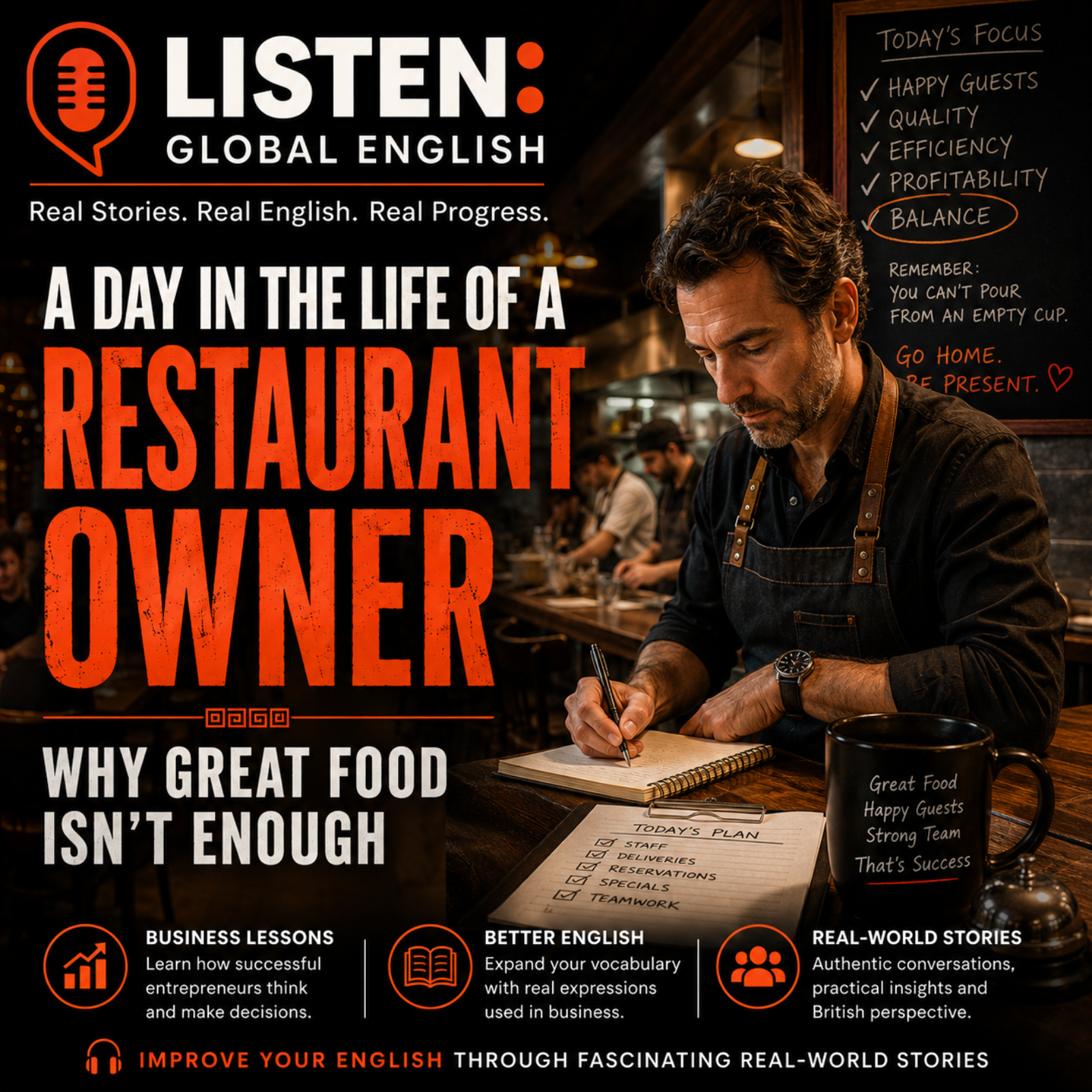
    A Day in the Life of a Restaurant Owner - Learn Real English - Why Great Food Isn't Enough

    A Day in the Life of a Restaurant Owner: Why Great Food Isn't Enough Episode Overview What does it really take to run a successful restaurant? Most people think it's about cooking great food. In reality, it's about much more than that. In this episode, we follow a real restaurant owner through a busy Christmas Eve and discover the business lessons hidden behind everyday decisions. Along the way you'll naturally improve your English while learning the vocabulary, expressions and ways of thinking used by successful entrepreneurs. We'll pause throughout the story to explore the hidden lessons behind what happens, drawing on real business experience from finance and conversations with professionals working in hospitality, healthcare, law and many other industries. Whether you're learning English, running a business or simply curious about how successful people think, this episode is full of practical insights. Based on a real "Day in the Life" transcript of a restaurant owner. In this episode you'll learn: 🍽️ Business English Cost of Goods Sold (COGS) Labour costs Profit margins Brand awareness Revenue Diversification Opportunity cost Delegation Work-life balance Leadership Customer experience 📚 Advanced Vocabulary Mindset Wholesale Distributor Overheads Revenue Morale Sustainable Burnout Contingency planning Downtime Calamity Opportunity cost 💬 Phrasal Verbs turn on pick up break down make do never look back 🇬🇧 Idioms Every penny counts Keep something at bay Strike a balance What you'll discover ✔ Why successful restaurants are built on marketing—not just cooking. ✔ Why small financial decisions can determine whether a business survives. ✔ How experienced managers stay calm when everything appears to be going wrong. ✔ Why diversification can transform a business. ✔ The importance of trust, delegation and leadership. ✔ Why the smartest business decision isn't always working longer hours. ✔ How successful entrepreneurs think differently from everyone else. English Level Upper-Intermediate (B2+) to Advanced (C1) Ideal for learners who want to move beyond textbooks and develop the English used by professionals in real business situations. Recommended Vocabulary Review Try using today's expressions in your own sentences: brand awareness profit margin delegation burnout opportunity cost strike a balance make do keep something at bay

    • Transcript
  • July 17 · 12 min

    Breaking Bad Episode One: When Does Walter Really Break Bad? Part 3

    🎙️ LISTEN: Global English Breaking Bad Episode One: When Does Walter Really Break Bad? Part 3 Walter White has crossed the line. What began as a desperate plan to provide for his family has now become something far more dangerous. In Part 3, we analyse Walter and Jesse's first meth cook in the New Mexico desert, the moment Walter's confidence as a chemist takes over, and the life-or-death decisions that mark the true beginning of his transformation. More importantly, we ask one of the biggest questions in television history: Did Walter White become Heisenberg... or had Heisenberg been there all along? As always, you'll improve your English naturally through storytelling while learning the phrasal verbs, idioms, and vocabulary that native speakers use every day. 📚 Vocabulary You'll Learn chemist methamphetamine laboratory equipment integrity ego recognition survival manipulation transformation morality consequences 🔥 Phrasal Verbs go through with take over apply yourself come up with end up walk away cross the line carry out figure out turn into 💬 Idioms & Expressions point of no return cross the line open a can of worms come to the surface 🎯 In This Episode ✔ Walter and Jesse's first meth cook in the New Mexico desert ✔ Why Walter suddenly becomes confident when chemistry is involved ✔ The importance of pride and perfection in Walter's personality ✔ How Walter uses science to survive an impossible situation ✔ The moment Walter crosses a moral line from which there is no return ✔ Why Breaking Bad is ultimately a story about identity, power, and choice—not just crime ✔ Natural English through authentic phrasal verbs and idioms 🇬🇧 Learn English Naturally Unlike traditional English lessons, LISTEN: Global English teaches English through films, literature, history, current affairs, and real-world stories. Instead of memorising vocabulary lists, you'll learn English the way native speakers actually use it—through meaningful stories, natural conversations, and authentic expressions that stay with you long after the lesson ends. 🎧 Continue the Series In the next episode, we'll continue Walter White's journey as the consequences of his first cook begin to unfold. We'll analyse the next chapter of Breaking Bad while expanding your vocabulary, phrasal verbs, idioms, and listening skills through one of television's greatest stories. 🎧 Subscribe to LISTEN: Global English wherever you get your podcasts. ⭐ If you enjoyed this episode, please leave a review and share it with another English learner. #LearnEnglish #EnglishPodcast #BreakingBad #WalterWhite #Heisenberg #JessePinkman #PhrasalVerbs #EnglishVocabulary #Idioms #LearnEnglishThroughStories #EnglishListening #TVAnalysis #Netflix #AdvancedEnglish #IntermediateEnglish #ESL

    • Transcript
  • July 17 · 12 min

    Breaking Bad Episode One: When Does Walter Really Break Bad? Part 2

    🎙️ LISTEN: Global English Breaking Bad Episode One: When Does Walter Really Break Bad? Part 2 Walter White has received the diagnosis that changes everything. But does cancer transform him into a criminal... or does it simply reveal the person he has been hiding for years? In Part 2, we examine Walter's first major choices after learning he has terminal lung cancer. We analyse his encounter with Jesse Pinkman, the psychological reasons behind his decision to enter the meth business, and the pride and resentment that begin to shape every decision he makes. Along the way, you'll learn natural English exactly as native speakers use it, with a special focus on phrasal verbs that appear in everyday conversation. 📚 Vocabulary You'll Learn terminal illness blackmail resentment humiliation desperation determination confidence opportunity pride self-worth 🔥 Phrasal Verbs come along think something over track someone down come out make up your mind live with carry on go along with put up with hold back 💬 Idioms & Expressions slippery slope enough is enough make up your mind death by a thousand cuts 🎯 In This Episode ✔ Why Walter's cancer diagnosis changes his mindset ✔ The DEA raid that leads Walter to Jesse Pinkman ✔ Why Walter chooses Jesse as his partner ✔ The psychology behind Walter's first criminal decision ✔ Why pride—not money—may be Walter's greatest motivation ✔ How native English speakers naturally use phrasal verbs in real conversations 🇬🇧 Learn English Naturally Unlike traditional English lessons, LISTEN: Global English teaches English through films, history, literature, current affairs, and real-world stories. Instead of memorising vocabulary lists, you'll hear phrasal verbs, idioms, grammar, and vocabulary used naturally in context—helping you understand English the way native speakers actually speak it. 🎧 Subscribe to LISTEN: Global English wherever you get your podcasts. ⭐ If you enjoyed this episode, please leave a review and share it with another English learner. #LearnEnglish #EnglishPodcast #BreakingBad #WalterWhite #JessePinkman #EnglishVocabulary #PhrasalVerbs #Idioms #EnglishListening #Netflix #TVAnalysis #AdvancedEnglish #IntermediateEnglish #ESL #LearnEnglishThroughStories

    • Transcript
  • July 17 · 9 min

    Breaking Bad Episode One: When Does Walter Really Break Bad? Part 1

    🎙️ LISTEN: Global English Breaking Bad Episode One: When Does Walter Really Break Bad? Most people think Walter White "breaks bad" the moment he starts cooking meth. But is that really true? In today's episode, we explore one of television's greatest character transformations and ask a deeper question: When does Walter White actually become Heisenberg? Using the pilot episode of Breaking Bad, we'll examine how years of frustration, humiliation and resentment slowly build up before one life-changing diagnosis removes the fear that had been holding him back. Along the way, you'll improve your English naturally through authentic storytelling while learning some of the most useful phrasal verbs and idioms used by native speakers every day. 📚 Vocabulary You'll Learn resentment humiliation desperation integrity ego chemist methamphetamine terminal illness blackmail confidence recognition pride 🔥 Phrasal Verbs put up with build up go along with hold back pull someone in jump back come along think something over track someone down come out live with carry on go through with take over apply yourself come up with end up walk away 💬 Idioms & Expressions death by a thousand cuts enough is enough slippery slope make up your mind come to the surface cross the line point of no return open a can of worms 🎯 In This Episode ✔ Why Walter White feels powerless long before his cancer diagnosis ✔ The psychological turning point that changes everything ✔ How Breaking Bad slowly transforms an ordinary chemistry teacher into Heisenberg ✔ Why pride may be more important than money in Walter's decisions ✔ How native English speakers naturally use phrasal verbs in everyday conversation 🇬🇧 Learn English Naturally Unlike traditional English lessons, LISTEN: Global English teaches English through history, films, literature, current affairs and real-world stories. Instead of memorising vocabulary lists, you'll hear grammar, vocabulary, phrasal verbs and idioms used naturally in context—just as native speakers use them every day. 🎧 Subscribe to LISTEN: Global English wherever you get your podcasts. ⭐ If you enjoyed this episode, please leave a review and share it with another English learner. #LearnEnglish #EnglishPodcast #BreakingBad #WalterWhite #Heisenberg #PhrasalVerbs #EnglishVocabulary #LearnEnglishThroughStories #AdvancedEnglish #IntermediateEnglish #ESL #EnglishListening #Netflix #TVAnalysis #EnglishTeacher

    • Transcript
  • July 15 · 52 min

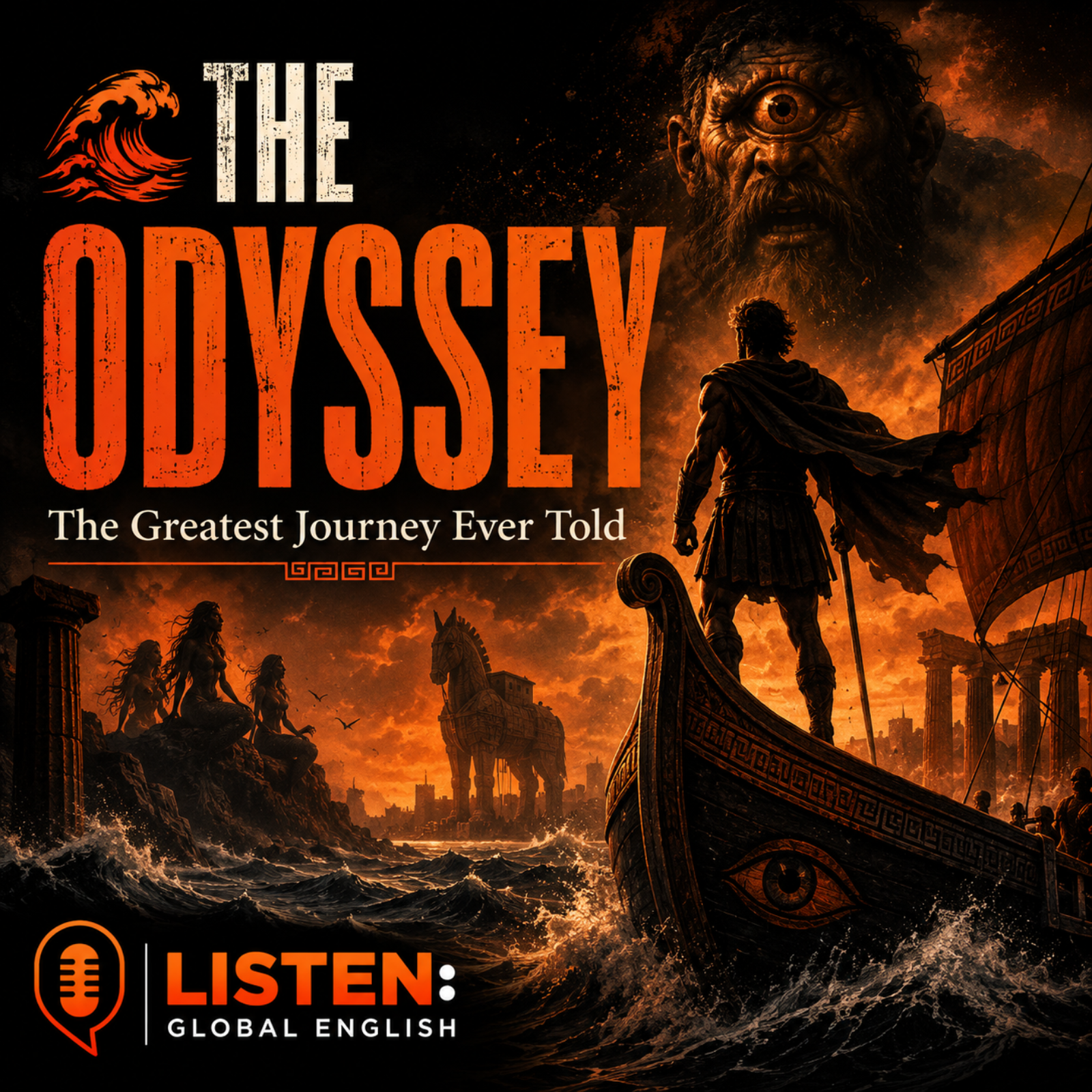
    🌊 The Odyssey: The Greatest Journey Ever Told

    🌊 The Odyssey: The Greatest Journey Ever Told What makes The Odyssey one of the greatest stories ever written? Is it the terrifying Cyclops? The irresistible song of the Sirens? The cleverness of Odysseus? Or is it something much deeper? In this episode of LISTEN: Global English, we travel back almost 3,000 years to Ancient Greece to explore Homer's timeless masterpiece—an epic that has inspired writers, artists, filmmakers and storytellers for centuries. Together we'll discover why The Odyssey is far more than a tale of monsters and adventure. It's a story about leadership, resilience, temptation, intelligence, loss, perseverance and one man's determination to return home after twenty years away. Along the way we'll explore the fascinating world of Greek mythology while naturally improving your English through authentic storytelling. Learn English Naturally As always, you'll improve your English while enjoying the story. Throughout the episode we explain vocabulary, grammar and expressions naturally as they appear in the narrative. Vocabulary cunning resilience temptation hospitality oral tradition scholar gigantic disguise enchantress negotiate grief irresistible longing wisdom legacy Phrasal Verbs set off get away with carry out put off hold out lose sight of think on your feet come to terms with stand out keep track of Idioms & Expressions there's no place like home think outside the box quit while you're ahead pride comes before a fall back against the wall time flies between a rock and a hard place between Scylla and Charybdis lose sight of your goals face your fears cut your losses a man's best friend ignore something at your own peril tie yourself to the mast Grammar Focus During the episode we'll naturally explore: Narrative tenses Past Simple vs Past Perfect Passive Voice Relative Clauses Storytelling techniques used by native English speakers Figurative language and metaphor Advanced descriptive English Why The Odyssey Still Matters More than twenty-eight centuries after it was first told, The Odyssey continues to influence literature, psychology, leadership, politics and modern storytelling. Its monsters are unforgettable... but perhaps its greatest lesson is that the most difficult obstacles aren't always found on distant islands. Sometimes they're pride. Sometimes they're fear. Sometimes they're temptation. And sometimes... the longest journey any of us will ever make is simply finding our way home. Keywords The Odyssey, Homer, Odysseus, Ancient Greece, Greek Mythology, Trojan War, Cyclops, Sirens, Learn English, English Listening Practice

    • Transcript
  • July 7 · 37 min

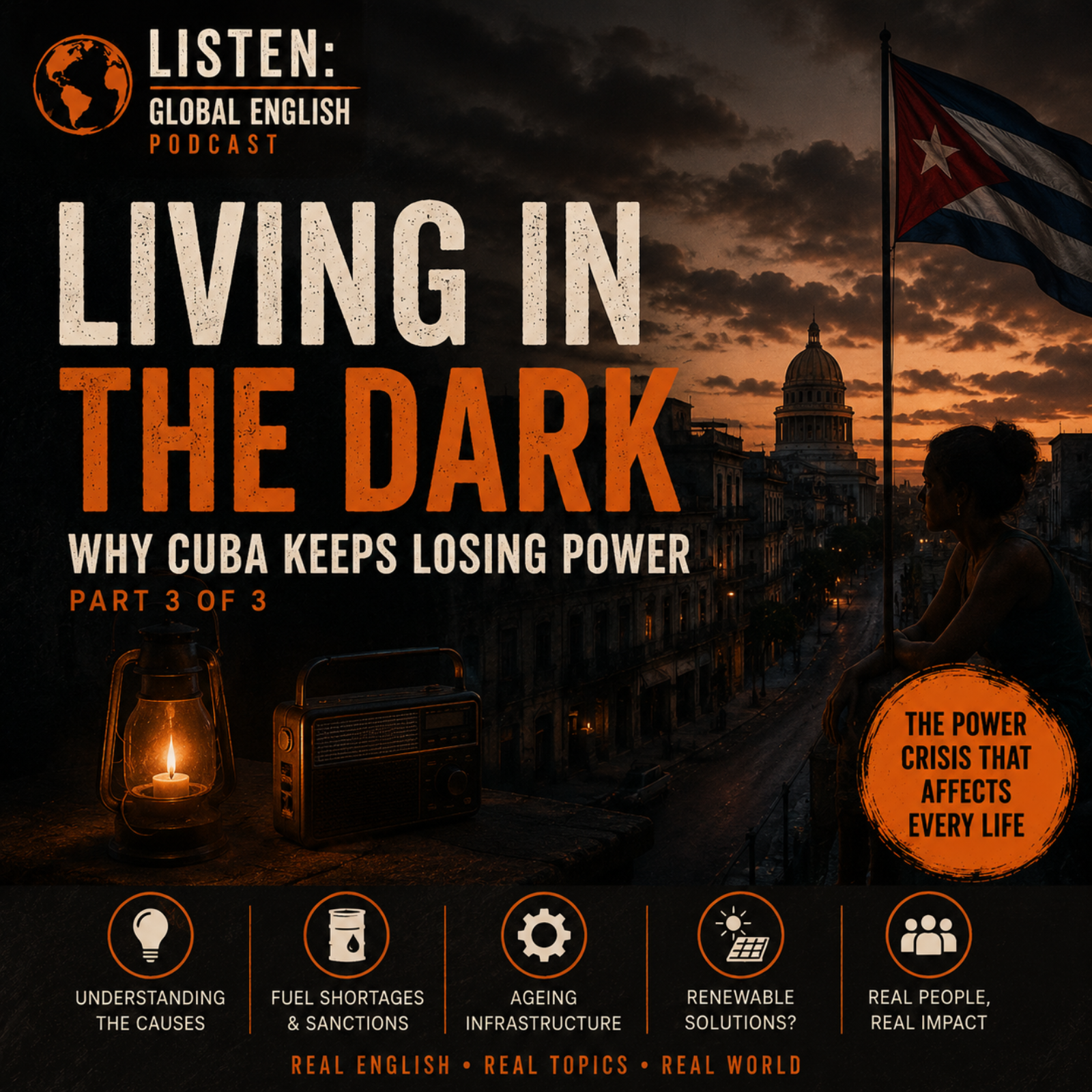
    Living in the Dark – Why Cuba Keeps Losing Power

    Living in the Dark – Why Cuba Keeps Losing Power Millions of Cubans have once again been left without electricity after another nationwide blackout. But why does this keep happening? Is it simply ageing infrastructure, fuel shortages and economic challenges, or is there a much bigger story behind the headlines? In this episode of LISTEN: Global English, we explore the causes of Cuba's ongoing electricity crisis from a balanced British perspective while helping you improve your English naturally through current affairs. You'll learn advanced vocabulary, useful phrasal verbs, common idioms, and key grammar structures exactly as native speakers use them. In this episode you'll learn: What caused Cuba's latest nationwide blackout Why electricity grids can collapse The meaning of key news vocabulary related to energy and infrastructure The difference between Present Perfect and Past Simple How journalists use modal verbs such as may to express uncertainty Useful business and current affairs vocabulary Natural British expressions and pronunciation tips Key Vocabulary blackout electricity grid infrastructure ageing infrastructure generate electricity maintenance fragile fuel shortage supply sanctions embargo resilient renewable energy battery storage substation grid unbearable spoil thaw cascade failure Phrasal Verbs take for granted break down cope with depend on run out of carry on invest in get through bounce back Idioms & Expressions leave someone in the dark at breaking point keep your head above water a stitch in time saves nine Rome wasn't built in a day light at the end of the tunnel keep the lights on Grammar Focus Present Perfect vs Past Simple Present Perfect for ongoing situations Past Simple for completed events "Going to" for expected future situations Modal verbs (may, might) for possibility and uncertainty Whether you're preparing for IELTS, improving your Business English, or simply enjoy learning English through real-world events, this episode will help you build the vocabulary and confidence to understand international news like a native speaker. Thank you for listening to LISTEN: Global English.

    • Transcript
  • July 6 · 13 min

    Breaking Bad – "I Am the One Who Knocks"

    🎙️ LISTEN: Global English Why This Scene Became Iconic Breaking Bad – "I Am the One Who Knocks" One sentence. One conversation. One of the greatest character transformations in television history. In this episode of LISTEN: Global English, we put one of Breaking Bad's most unforgettable scenes under the microscope. Together we'll explore why Walter White's famous declaration became such an iconic moment, what it reveals about confidence, identity and power, and how the scene completely changes the way we see his character. As always, you'll improve your English naturally as we go. We'll examine authentic vocabulary, phrasal verbs, idioms, grammar and pronunciation in context, while also exploring the psychology behind the characters and comparing American and British language and culture. Whether you're a long-time Breaking Bad fan or you've never seen the series, this episode will help you understand why this quiet conversation has become one of the most discussed scenes in modern television. In this episode you'll learn: • Why this scene became one of television's most iconic moments • A spoiler-light introduction to Breaking Bad and its main characters • Natural English vocabulary used to describe fear, confidence and authority • Useful phrasal verbs including push someone around, back down, and stand up to • Idioms such as hold your ground, lose the plot, and the British expression get above yourself • How English speakers use the Present Simple to express identity • British cultural perspectives on confidence, communication and understatement • Discussion questions to help you practise speaking English naturally Join me as we discover how one unforgettable television scene can help you build more natural, confident English. Vocabulary & Expressions Tension Terrified Suspense Intimidating Identity Authority Arrogance Confidence Transformation Underestimate someone Hold your ground Stand up to Push someone around Back down Lose the plot (BrE) Get above yourself (BrE) Discussion Questions Can power change someone's personality? Is confidence always a positive quality? What's the difference between confidence and arrogance? Have you ever underestimated someone? Do people change, or do they simply reveal who they really are? 🎧 LISTEN: Global English Real English through unforgettable stories, iconic scenes, history, psychology, business and culture. Learn naturally. Speak confidently.

    • Transcript
  • July 4 · 1 hr 30 min

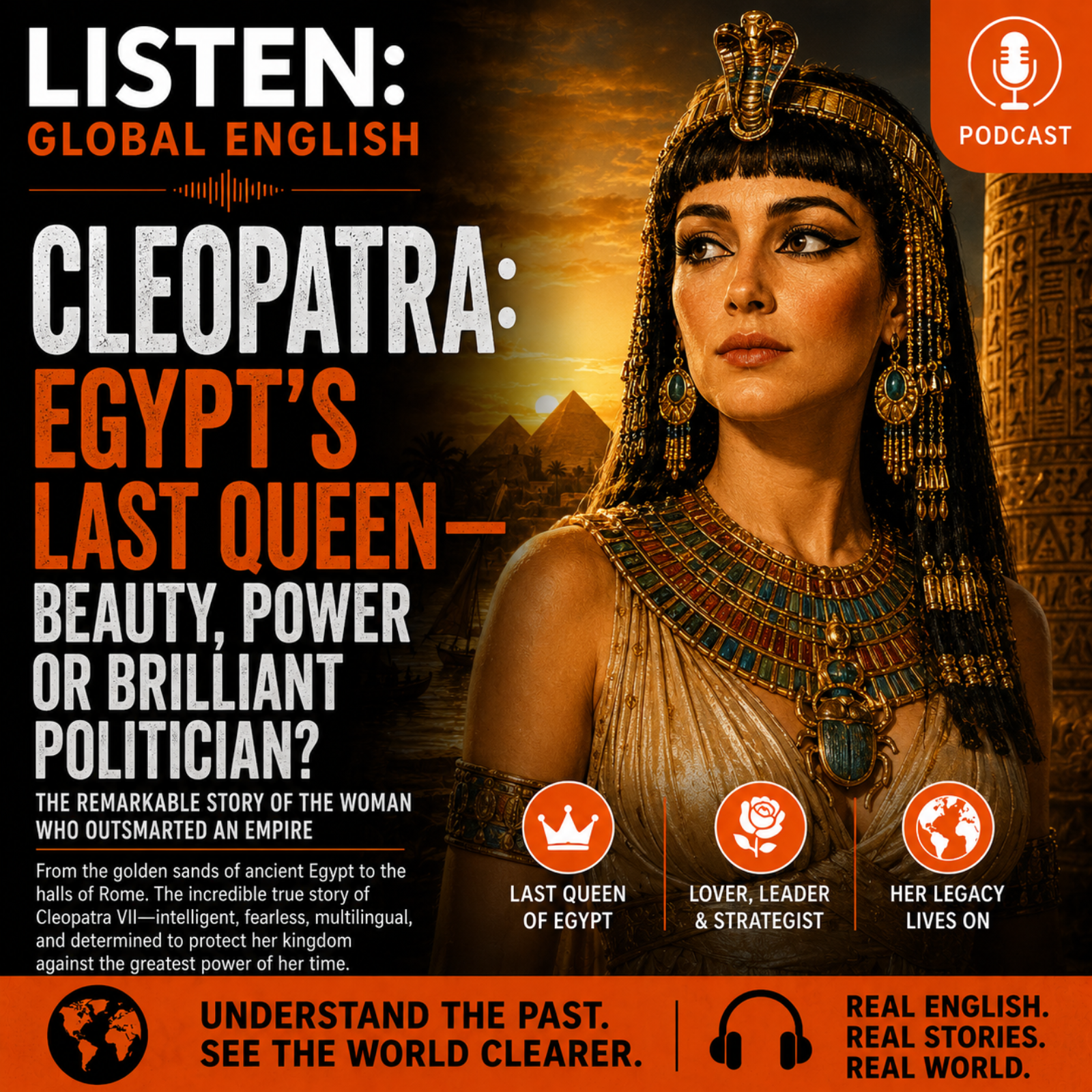
    👑🐍 Cleopatra: Egypt's Last Queen — Beauty, Power or Brilliant Politician?

    Cleopatra: Egypt's Last Queen — Beauty, Power or Brilliant Politician? Was Cleopatra really the irresistible beauty history remembers... or was she one of the greatest political minds of the ancient world? In this episode of LISTEN: Global English, we travel back more than 2,000 years to uncover the extraordinary life of Cleopatra VII, the last ruler of Ancient Egypt. Beyond the myths and Hollywood portrayals, you'll discover the remarkable story of a multilingual queen, skilled diplomat, brilliant strategist, and determined leader who fought to preserve one of the world's oldest civilizations against the unstoppable rise of Rome. We'll explore: The founding of Alexandria by Alexander the Great The rise of the Ptolemaic Dynasty Cleopatra's exceptional education and mastery of languages Ancient Egypt under the growing influence of Rome Her struggle for the throne against her brother Ptolemy XIII Her famous meeting with Julius Caesar The Alexandrian War and her return to power Caesar's assassination and the political chaos that followed Her alliance with Mark Antony The Battle of Actium The fall of Alexandria The truth behind Cleopatra's death How Roman propaganda shaped her legacy for over two millennia But this isn't just a history podcast. As always, you'll improve your English naturally throughout the story by learning: Vocabulary dynasty scholar cosmopolitan propaganda charismatic siege legacy heir stateswoman manipulate diplomacy rhetoric tyranny momentum resilience Phrasal Verbs stand out pick up (a language) carry out turn against hold out jump ship fall apart keep track of shape public opinion take matters into your own hands Idioms & Expressions on the brink of appearances can be deceiving call the shots back against the wall cross the Rubicon keep your cool hold your breath cut your losses history is written by the victors leave your mark a matter of time power tends to corrupt kill two birds with one stone You'll also hear natural explanations of important grammar points, including: Past Perfect Passive Voice Narrative Tenses Relative Clauses Advanced storytelling structures used by native speakers Whether you love ancient history, world politics, leadership, or simply want to develop your English through compelling real-world stories, this episode will help you build vocabulary and listening confidence while uncovering the life of one of history's most fascinating women. Discussion Question Do you think Cleopatra has been remembered fairly by history, or do you believe Roman propaganda shaped the way we see her today? Share your thoughts in the comments—we'd love to hear your opinion! Keywords Cleopatra, Ancient Egypt, Julius Caesar, Mark Antony, Ptolemaic Dynasty, Alexandria, Roman Empire, Learn English, English Listening Practice, History Podcast

    • Transcript
  • July 1 · 52 min

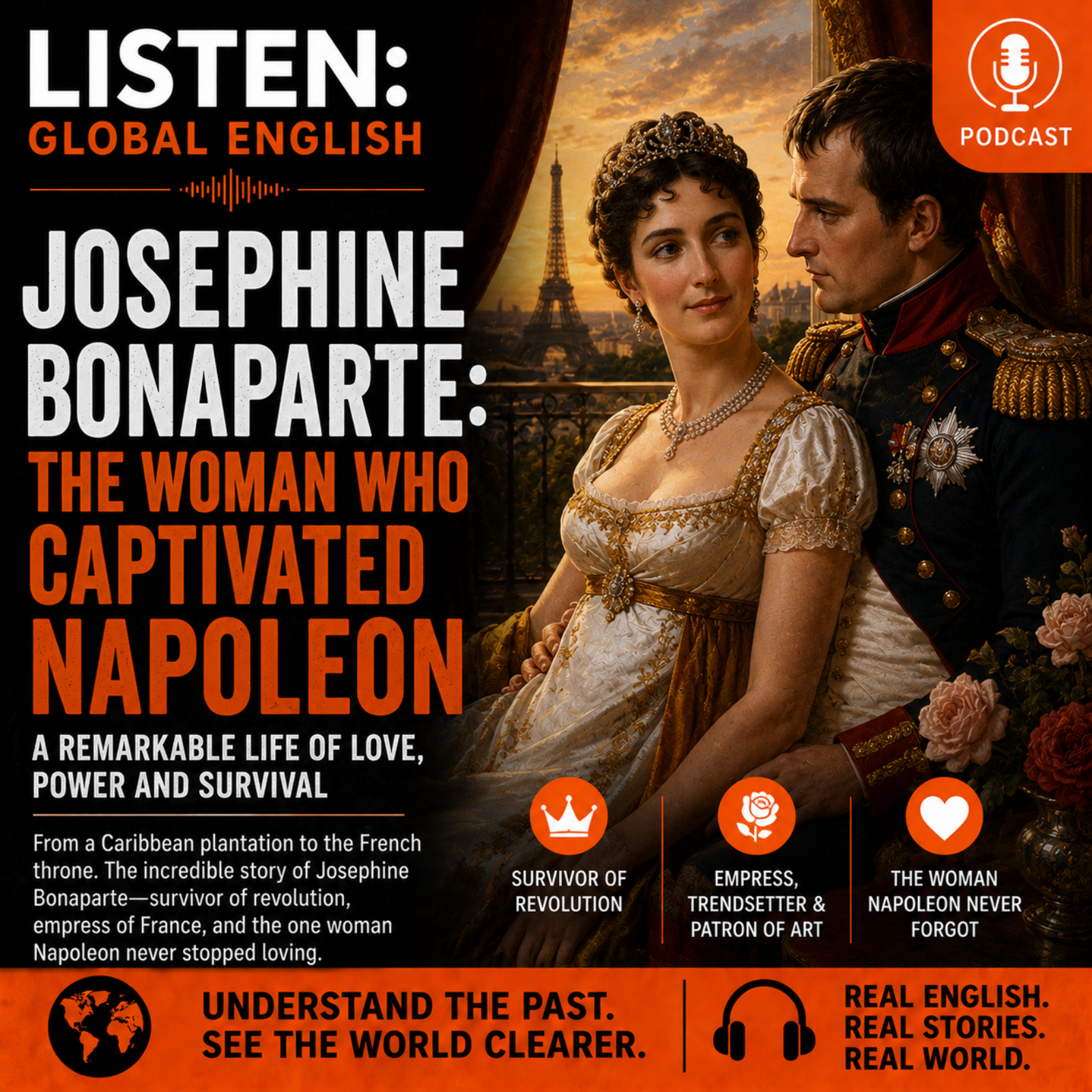
    The Woman Who Captivated Napoleon: The Extraordinary Life of Josephine Bonaparte

    🎙️ LISTEN: Global English The Woman Who Captivated Napoleon: The Extraordinary Life of Josephine Bonaparte Who was the woman who captured the heart of one of history's greatest military leaders? In this episode, we explore the remarkable life of Josephine Bonaparte, from her childhood on a Caribbean sugar plantation to becoming Empress of the French alongside Napoleon Bonaparte. Along the way, we examine the dramatic events of the French Revolution, the Reign of Terror, Napoleon's meteoric rise to power, and the complex relationship that fascinated Europe for decades. But this isn't just a history lesson. Throughout the episode you'll naturally improve your English with: Advanced everyday vocabulary Phrasal verbs in context Common idioms and sayings Grammar explanations including the Passive Voice, Past Perfect and Third Conditional Natural pronunciation practice Historical English used by native speakers You'll learn expressions such as: get by bounce back patch things up drift apart face up to splash out come to terms with the writing was on the wall off to a rocky start revolutions devour their own children make the best of a bad situation stare death in the face opposites attract money burns a hole in your pocket pass away Whether you're interested in history, politics, leadership, or simply want to improve your English through fascinating real-world stories, this episode combines compelling storytelling with practical language learning. What do you think? Did Napoleon and Josephine truly love one another despite their betrayals, affairs and eventual divorce? Or was their relationship built more on ambition, power and mutual advantage? Leave your thoughts in the comments—we'd love to hear your opinion! Keywords Josephine Bonaparte, Napoleon Bonaparte, French Revolution, Reign of Terror, Napoleon History, Learn English, English Listening Practice, Intermediate English, English Podcast, History in English

    • Transcript
  • June 29 · 20 min

    🐺 Dogs and Humans: The Greatest Partnership in History

    🐺 Dogs and Humans: The Greatest Partnership in History How did wolves become dogs? And how did this remarkable relationship help shape human civilization? In this episode of LISTEN: Global English, we explore one of the most fascinating partnerships in history: the alliance between humans and dogs. Scientists now believe that dogs may have domesticated themselves, gradually moving closer to human settlements tens of thousands of years ago. Together, humans and dogs transformed the world. Dogs helped us hunt, protect crops, guard livestock, travel across vast distances, and eventually build civilizations. We'll also examine the latest scientific discoveries about dog domestication, genetic evidence concerning the origins of dogs, and the incredible emotional bond that exists between humans and their canine companions. Along the way, you'll learn a wide range of useful English vocabulary, phrasal verbs, idioms, and grammar structures in context. In this episode, you'll learn: ✅ How wolves gradually evolved into domestic dogs ✅ The latest theories about dog domestication ✅ Why scientists still debate where and when dogs first appeared ✅ How dogs helped humans develop agriculture and civilization ✅ The role of dogs in hunting, herding, transport, and protection ✅ Why dogs are so skilled at understanding human emotions ✅ How therapy and service dogs are changing people's lives today ✅ The science behind the unique emotional connection between humans and dogs Key Vocabulary Domestication Hypersociability Selective breeding Livestock Commensal relationship Divergence Guardian Shepherd Therapy dog Oxytocin PTSD Evolution Companion species Civilization Migration Phrasal Verbs Featured Get along Track down Come into one's own Pull someone out of Figure out Bring up Carry on Lay the foundations Come across Idioms and Expressions Man's best friend Gain an edge Put something into perspective Curiosity killed the cat Lay the foundations An unwritten contract Grammar Focus Past Simple for historical events Present Perfect for ongoing developments and discoveries Past Perfect and Past Perfect Continuous for describing earlier historical processes Time clauses with as, while, and when Dogs have accompanied humanity for tens of thousands of years. They have hunted beside us, protected us, transported us, comforted us, and, in many cases, saved our lives. Perhaps the expression "man's best friend" has never been more appropriate. Subscribe to LISTEN: Global English and continue improving your English through fascinating stories from around the world. #LearnEnglish #EnglishPodcast #Dogs #HistoryOfDogs #DogDomestication #IntermediateEnglish #ESL #EnglishListening #CanineHistory #LISTENGlobalEnglish

    • Transcript
  • June 28 · 43 min

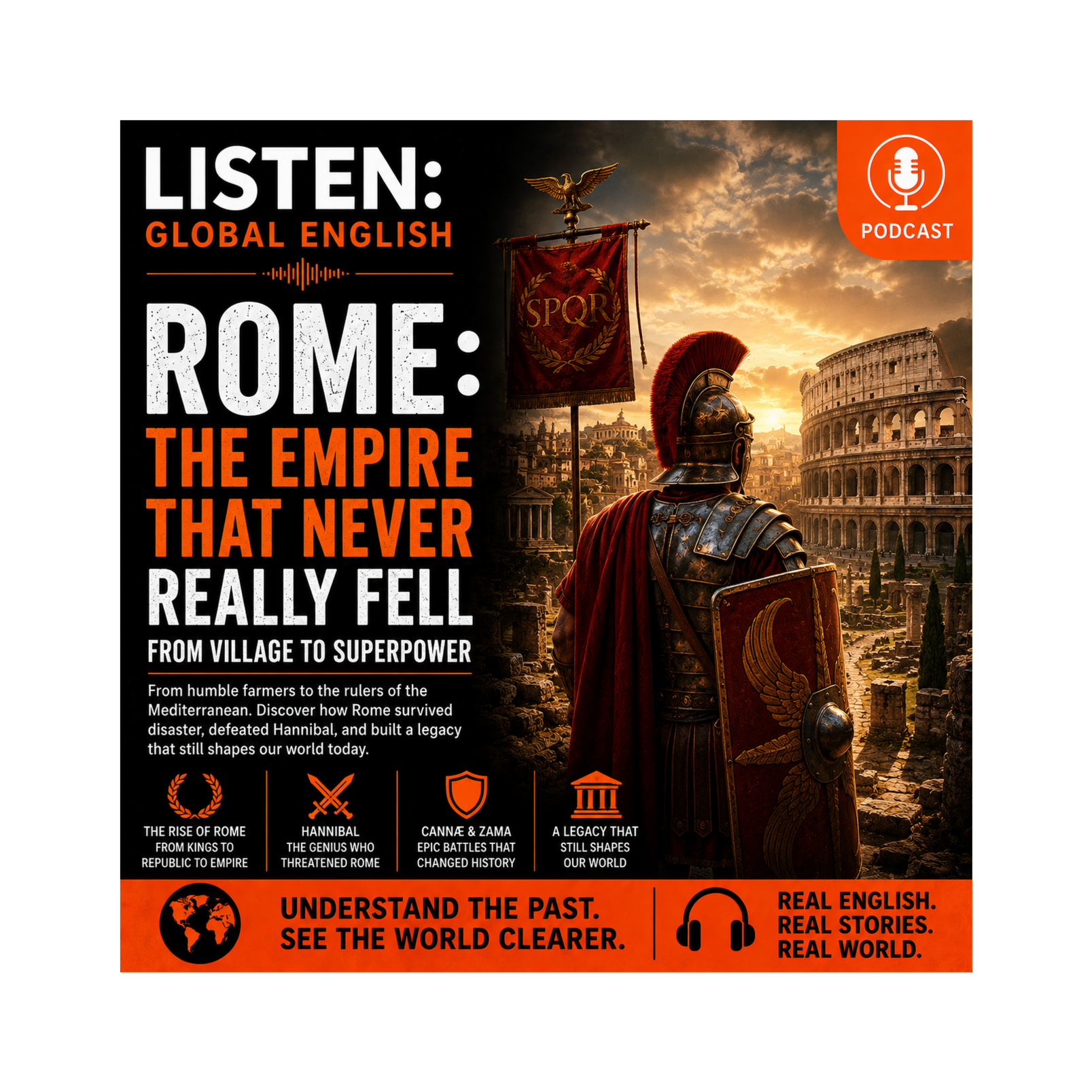
    Rome: The Empire That Never Really Fell

    Rome: The Empire That Never Really Fell LISTEN: Global English In this extended episode of LISTEN: Global English, we travel back more than two thousand years to explore one of history's most influential civilizations: Ancient Rome. Why did Rome become the dominant power of the Mediterranean? How did a small settlement of farmers grow into a vast empire? And did Rome ever truly disappear? We'll examine daily life in the ancient world, where high mortality, hard physical labour and strong family traditions shaped society. We'll discover how Roman values, resilience and military organization helped transform a small Italian city into a superpower. In this episode you'll learn: ✅ What life was really like for ordinary Romans ✅ Why historians believe human nature has changed very little over time ✅ The three major periods of Roman history: Monarchy, Republic and Empire ✅ Why family, ancestors and tradition were central to Roman society ✅ How Rome integrated conquered peoples and turned former enemies into allies ✅ The influence of Ancient Greece and the mysterious Etruscans on Roman civilization ✅ The causes and consequences of the Punic Wars ✅ Why Hannibal remains one of history's greatest military commanders ✅ How the Battle of Cannae nearly destroyed Rome ✅ Why Rome refused to surrender even after devastating defeats ✅ The rise of Scipio Africanus and the defeat of Carthage ✅ How Roman military flexibility helped create an empire ✅ The importance of Alexander the Great and his military innovations ✅ Whether Rome truly fell—or whether its legacy still surrounds us today Key Vocabulary Covered mortality life expectancy legacy monarchy republic empire integration manpower alliance conquest Pyrrhic victory mercenary maritime infantry cavalry adaptability supply lines phalanx citizenship resilience Expressions and Phrasal Verbs bounce back take something on wear somebody down complain about live up to expectations walk into a trap Historical Figures Featured Romulus Augustus Hannibal Barca Scipio Africanus Pyrrhus of Epirus Alexander the Great Philip II of Macedon Polybius Quintus Fabius Maximus Socrates Plato Aristotle Whether you're an English learner, a history enthusiast, or simply curious about how the ancient world continues to shape modern society, this episode offers a fascinating journey through the rise, triumph and enduring legacy of Rome. #AncientRome #RomanEmpire #HistoryPodcast #LearnEnglish #EnglishListening #AncientHistory #Hannibal #AlexanderTheGreat #RomanRepublic #GlobalEnglish

    • Transcript
  • June 23 · 15 min

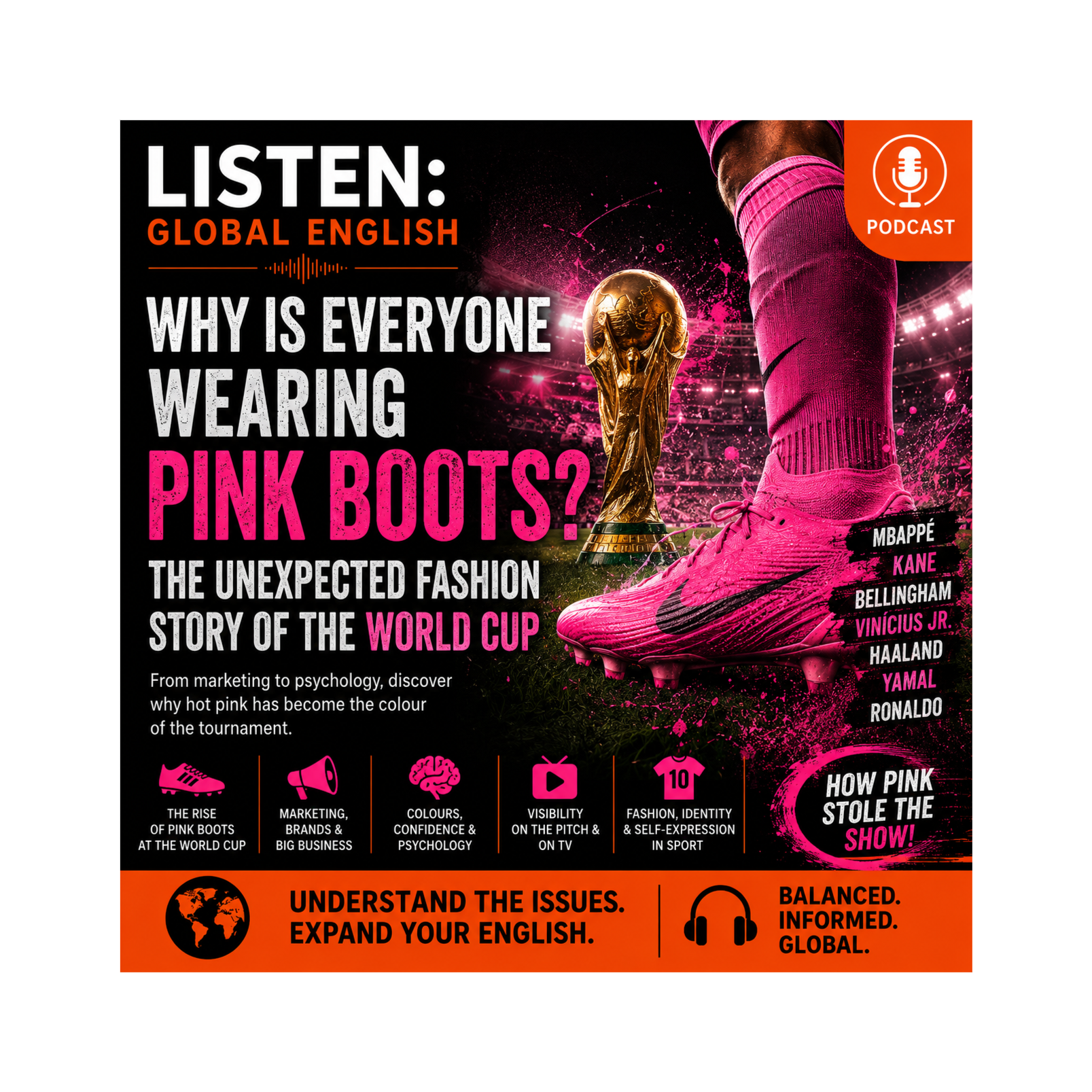
    Why Is Everyone Wearing Pink Boots? The World Cup - a little Andre Agassi and Muhammad Ali.

    Why Is Everyone Wearing Pink Boots? The Unexpected Fashion Story of the World Cup Have you noticed that many of the world's biggest football stars are wearing bright pink boots at the 2026 FIFA World Cup? From Kylian Mbappé and Jude Bellingham to Vinícius Júnior and Harry Kane, hot pink has become one of the tournament's most surprising trends. But why? In this episode, we explore how a simple colour has become a global talking point. We examine the role of major sports brands, athlete psychology, marketing strategies, and the growing connection between sport, fashion, and personal identity. We also look back at history to see how sporting fashion has evolved—from the era of traditional black boots to today's highly commercialized and image-driven world of professional sport. In this episode, you'll learn: ✅ Why so many players are wearing pink boots ✅ How sports brands influence global trends ✅ The psychology behind colour and confidence in sport ✅ How fashion in sport has changed over time ✅ Essential English vocabulary related to sport, marketing, and culture Key Vocabulary 📚 Visibility – how easily something can be seen. 📚 Self-expression – showing your personality, identity, or feelings through your appearance or actions. 📚 Trend – something that becomes fashionable or popular. 📚 Brand – a company name associated with particular products. 📚 Icon – a famous person who strongly represents something. Phrasal Verbs 🔹 stand out – to be easily noticed Example: Pink boots stand out against the green grass. 🔹 catch on – to become popular Example: The pink boot trend quickly caught on among players. 🔹 come out with – to release or introduce a new product Example: Sports companies came out with new pink boot collections before the World Cup. Idioms and Expressions ⚽ steal the show – to attract the most attention 🎉 paint the town red – to celebrate enthusiastically 🚀 change the game – to completely transform a situation Grammar Focus 📖 Present Perfect vs Past Simple Pink boots have become the unofficial colour of the World Cup. Many players have adopted the trend. Sports companies released their new collections earlier this year. Footballers wore mostly black boots for decades. Historical Connections This episode also explores how fashion has influenced sport throughout history, including comparisons with: 🏆 Muhammad Ali and the rise of athlete branding 🎾 Andre Agassi and the colourful fashion revolution in tennis ⚽ The transformation from traditional black football boots to today's vibrant designs Discussion Questions Why do you think pink boots have become so popular? Should professional athletes use fashion to express themselves? Has modern sport become too commercial? Do colourful uniforms make sport more entertaining? Which sporting fashion trends from the past do you remember? 🎧 Improve your English while exploring the world's biggest stories with LISTEN: Global English. #LearnEnglish #EnglishPodcast #WorldCup2026 #Football #Soccer #EnglishVocabulary #ESL #SportsEnglish #LearnEnglishPodcast #FIFAWorldCup

    • Transcript
  • June 22 · 12 min

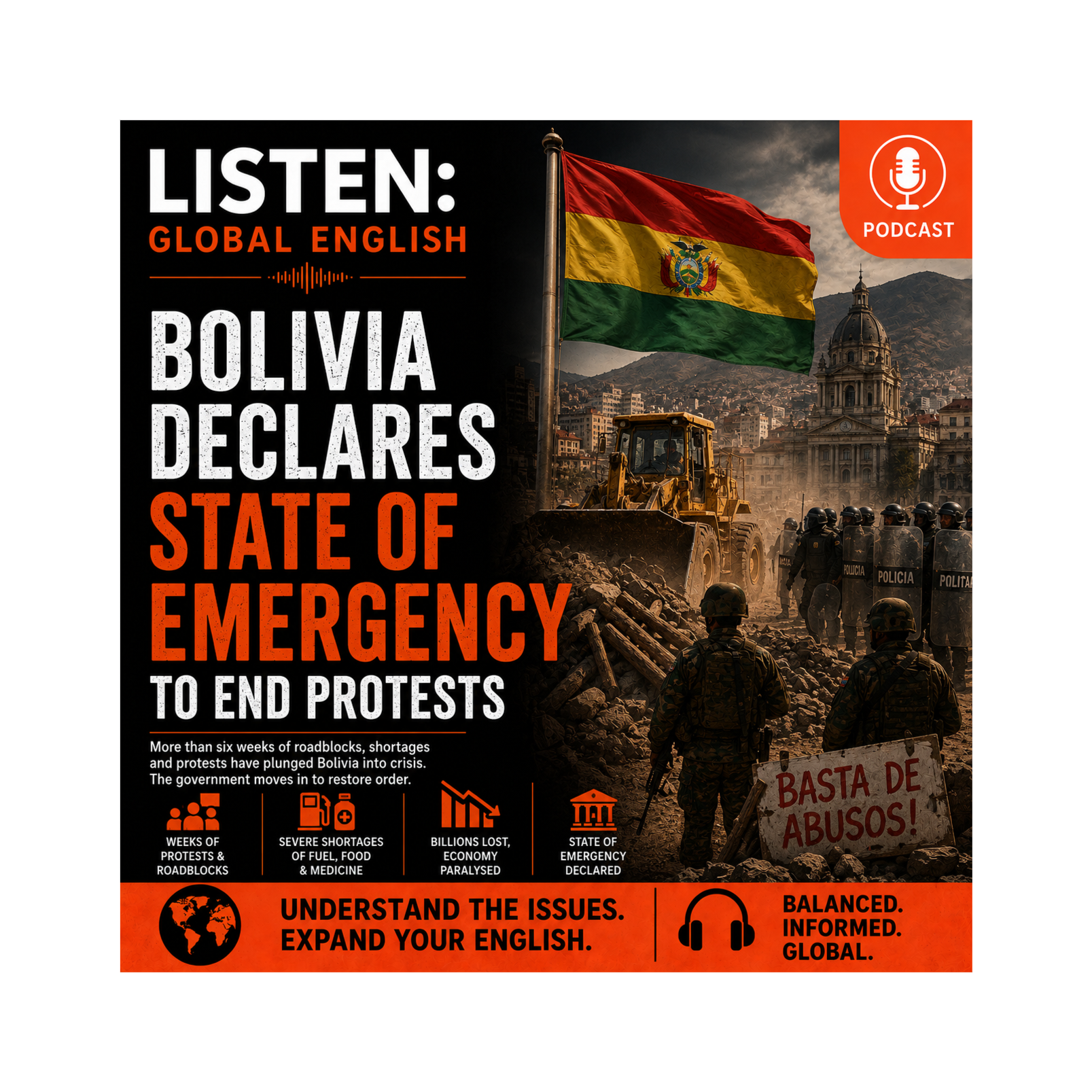
    Bolivia on the Brink? Government Declares State of Emergency as Protests Paralyse the Country.

    Bolivia on the Brink? Government Declares State of Emergency as Protests Paralyse the Country Bolivia is facing one of its most serious political crises in recent years. After more than six weeks of nationwide protests, President Rodrigo Paz has declared a 90-day state of emergency and deployed soldiers and police to clear roadblocks that have disrupted daily life across the country. Unions, Indigenous groups, and coca farmers have been blocking major roads with rubble, logs, and debris in protest against government policies. The demonstrations have caused severe shortages of fuel, food, and medicine, while economists estimate that the unrest has already cost the country billions of dollars. In this episode, we examine the causes of the crisis, the government's response, and the difficult balance between maintaining public order and protecting democratic freedoms. In this episode, you'll learn: ✅ Why protests have spread across Bolivia ✅ What a state of emergency means ✅ How roadblocks are affecting the economy and everyday life ✅ The debate over using the military during domestic protests ✅ Essential English vocabulary related to politics and social unrest Key Vocabulary 📚 State of emergency – a temporary situation in which governments are granted special powers to deal with a crisis. 📚 Roadblock – a barrier placed across a road to stop or restrict movement. 📚 Paralyse – to completely stop or severely disrupt normal activity. 📚 Deploy – to send military or police forces to a particular area. 📚 Curb – to limit or control something. 📚 Shortage – a situation in which there is not enough of something. Phrasal Verbs 🔹 move in – to enter an area in order to take control or begin an operation Example: Soldiers moved in to clear the roadblocks. 🔹 crack down on – to take strong action against illegal or unacceptable behaviour Example: The government promised to crack down on violent protests. 🔹 carry out – to perform or execute an action Example: Security forces carried out operations to reopen highways. Idioms and Expressions ⚖️ the full force of the law – using all available legal powers to punish or stop illegal actions 🚧 bring something to a standstill – to completely stop activity ⚠️ on a knife-edge – a situation that is extremely uncertain or dangerous Grammar Focus 📖 Modal Verbs for Obligation, Permission, and Possibility The government says roads must remain open. The protests may continue for several more weeks. States of emergency can restrict certain rights. Soldiers are allowed to operate domestically during emergencies. Discussion Questions Should governments declare states of emergency during major protests? How important is the right to protest in a democracy? When do protests become too disruptive? Should the military ever be used to control domestic unrest? What is the best way to resolve political crises? 🎧 Improve your English while exploring the world's biggest stories with LISTEN: Global English. #LearnEnglish #EnglishPodcast #Bolivia #CurrentAffairs #GlobalPolitics #ESL #EnglishVocabulary #LatinAmerica #PoliticalCrisis #LearnEnglishPodcast

    • Transcript
  • June 22 · 11 min

    Too Hot to Watch Football? Spain Cancels World Cup Fan Event Amid Extreme Heat.

    Too Hot to Watch Football? Spain Cancels World Cup Fan Event Amid Extreme Heat Football fans in Madrid were left disappointed after authorities cancelled a major public screening of Spain's World Cup match against Saudi Arabia because of extreme heat. The match had been due to be shown on a giant screen in Madrid's famous Plaza de Colón, but officials decided to cancel the event after Spain's national weather agency issued an orange heat warning, forecasting temperatures of up to 40°C. The decision was taken to protect spectators, event staff, emergency personnel, and other workers involved in the event. Supporters were instead encouraged to watch the match indoors in air-conditioned spaces. This episode explores how extreme weather is increasingly affecting everyday life, public events, and even international sport. We also discuss whether heatwaves are becoming the "new normal" and what governments and individuals can do to stay safe. In this episode, you'll learn: ✅ What heat alerts and weather warnings mean ✅ Why authorities cancelled the screening ✅ How climate change may affect future sporting events ✅ The health risks associated with extreme heat ✅ Essential English vocabulary related to weather and climate Key Vocabulary 📚 Heatwave – a prolonged period of unusually hot weather. 📚 Forecast – a prediction about future weather conditions. 📚 Alert / Warning – an official announcement about possible danger. 📚 Prolonged exposure – being exposed to something for a long time. 📚 Vulnerable people – people who are more likely to suffer harm, such as the elderly or those with health conditions. Phrasal Verbs 🔹 call off – to cancel something Example: Officials called off the public screening. 🔹 cool down – to become less hot or reduce body temperature Example: People were advised to stay indoors and cool down. 🔹 look after – to take care of someone Example: Families were asked to look after elderly relatives. Idioms and Expressions 🌡️ beat the heat – avoid suffering from hot weather 🌡️ scorching hot – extremely hot 🌡️ when the mercury rises – when temperatures increase Grammar Focus 📖 Modal Verbs for Advice and Obligation You should drink plenty of water during a heatwave. Authorities say public safety must come first. You shouldn't stay in direct sunlight for long periods. People mustn't ignore symptoms of heat exhaustion. Discussion Questions Was cancelling the screening the right decision? Should governments cancel outdoor events during extreme heat? Have temperatures changed noticeably where you live? How do people in your country cope with heatwaves? Could climate change significantly affect major sporting events in the future? 🎧 Improve your English while exploring the world's biggest stories with LISTEN: Global English. #LearnEnglish #EnglishPodcast #GlobalEnglish #Spain #WorldCup #ClimateChange #Heatwave #ESL #EnglishVocabulary #CurrentAffairs

    • Transcript
  • June 22 · 11 min

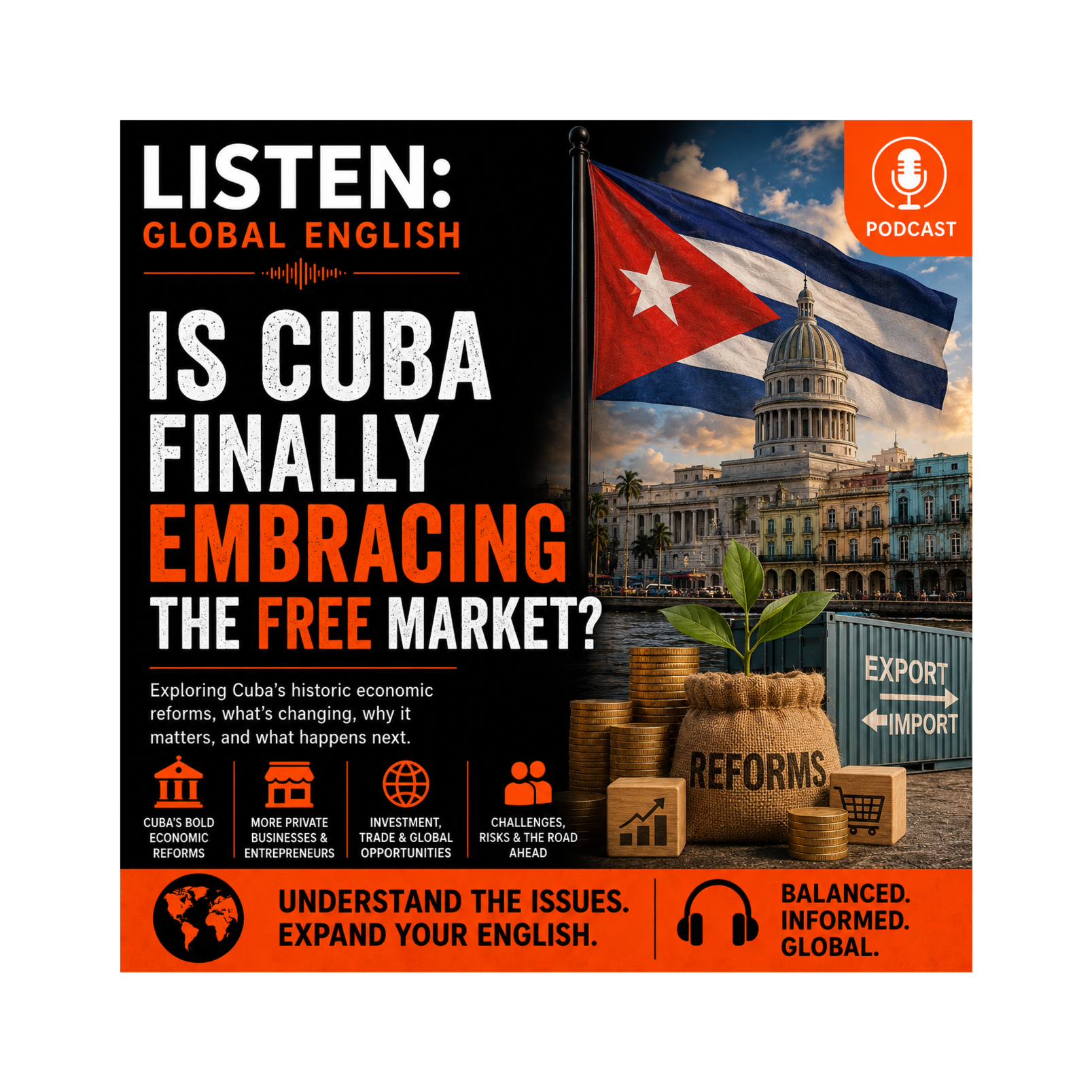
    HEADLINE: A new era for Cuba?

    Cuba's Biggest Economic Reforms in Decades: Is the Island Embracing Capitalism? Cuba has announced what many observers are calling the most significant economic reforms since the 1959 Cuban Revolution. The government has unveiled 176 measures aimed at decentralizing the island's state-run economy and creating more opportunities for private enterprise. In this episode, we examine what these reforms involve, why they are being introduced now, and what they could mean for Cuba's future. We explore key changes including greater freedom for private businesses, direct imports and exports, the possibility of private banks, investment by Cubans living abroad, and even the arrival of international fast-food chains. You'll also learn essential English vocabulary related to economics and politics, including: ✅ economic overhaul ✅ sweeping reforms ✅ decentralize ✅ state-run economy ✅ embargo ✅ allocate resources We also explain useful phrasal verbs and idioms, such as: 🔹 move forward 🔹 open up 🔹 scale up 🔹 a double-edged sword 🔹 a breath of fresh air 🔹 turn a corner Grammar Focus 📚 The Passive Voice Learn how journalists use the passive voice to describe events and policies: The reforms were announced by the government. Private banks may be authorized. Restrictions have been eased in recent years. Discussion Questions Should governments control large parts of the economy? What are the advantages and disadvantages of free-market capitalism? Can a country remain politically socialist while adopting market reforms? Will these reforms improve living standards in Cuba? Would you consider starting a business in Cuba? Useful Vocabulary Economic overhaul – a complete change to an economic system. Sweeping reforms – major, wide-ranging changes. Decentralize – transfer power away from central government. State-run – owned or controlled by the government. Embargo – official restrictions on trade with another country. Allocate – distribute resources for a particular purpose. 🎧 Improve your English while exploring the world's biggest stories with LISTEN: Global English. #LearnEnglish #EnglishPodcast #Cuba #Economics #GlobalNews #BusinessEnglish #ESL #EnglishVocabulary #CurrentAffairs #LearnEnglishPodcast

    • Transcript
  • June 21 · 13 min

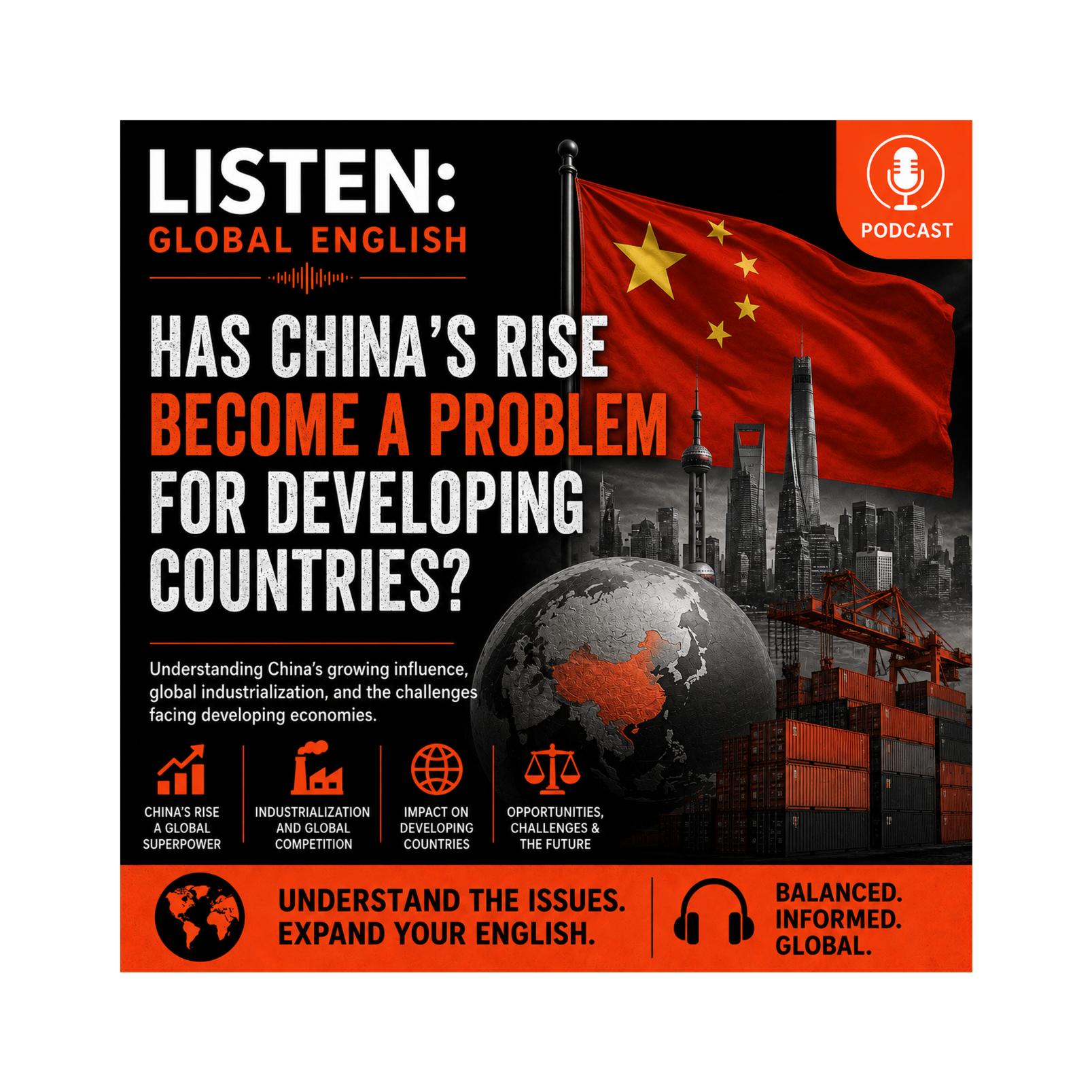
    Has China's rise become a problem for developing countries?

    China's extraordinary economic transformation has been one of the defining stories of the modern world. In just a few decades, China has moved from being a largely poor, developing country to becoming the world's second-largest economy and a major global superpower. But China's rise is raising important questions for the rest of the world. Can developing countries still follow the same path to prosperity that China once followed? Or has China's manufacturing dominance made industrialization more difficult for poorer nations? In this episode of LISTEN: Global English, we explore China's growing global influence, the concept of economic hegemony, and the debate over whether China's success could limit opportunities for other countries to develop. Along the way, you'll improve your English with key vocabulary, phrasal verbs, idioms, and grammar explanations based on authentic global issues. In this episode, you'll learn: ✅ What it means to be a global superpower ✅ The meaning of important terms such as: hegemon industrialization public goods infrastructure supply chain productivity manufacturing capacity ✅ Why some developing countries are concerned about China's economic growth ✅ How China's manufacturing sector affects global trade ✅ The role of infrastructure investment and international development ✅ Useful phrasal verbs including: move up crowd out break into ✅ Idioms such as: a double-edged sword pull up the ladder Grammar Focus This episode explores: Present Perfect China has become a global superpower. China has transformed world trade. Present Perfect Continuous China has been expanding its manufacturing capacity for decades. Economists have been debating this issue for years. Key Vocabulary Hegemon – a dominant global power. Industrialization – the development of industries and manufacturing. Public Goods – benefits provided for the international community, such as secure trade routes or global health initiatives. Supply Chain – the network involved in producing and delivering goods. Infrastructure – essential systems such as roads, railways, ports, and power networks. Productivity – how efficiently goods and services are produced. Discussion Questions Has China's economic rise benefited the world overall? Should developing countries be worried about China's manufacturing strength? Can more than one global superpower exist peacefully? What industries should developing countries focus on in the future? Thank you for listening to LISTEN: Global English. If you enjoyed this episode, please follow, share, and leave a review to help other English learners discover the podcast. #LearnEnglish #EnglishPodcast #GlobalEnglish #China #GlobalEconomy #Industrialization #BusinessEnglish #CurrentAffairs #PresentPerfect #EnglishListening

    • Transcript
  • June 20 · 12 min

    HEADLINE Israel and Hezbollah agree to ceasefire

    Israel and Hezbollah Agree to a Ceasefire: Understanding the Language of Breaking News In this episode, we take a real breaking news report from Reuters and explain it line by line, helping intermediate and upper-intermediate English learners understand how international news is written and reported. You'll learn the meaning behind key expressions used by journalists, diplomats, and government officials, while also improving your understanding of grammar, vocabulary, phrasal verbs, and reporting language commonly found in newspapers and news broadcasts. In this episode, you'll learn: ✅ What a ceasefire is and how journalists report conflict and diplomacy ✅ Why Reuters uses the Present Perfect in phrases like: "Reuters has issued an alert" "Israel and Hezbollah have agreed" ✅ The meaning of common news expressions such as: according to a senior official sources say we understand that on background in effect ✅ Key vocabulary including: ceasefire negotiator deal exchange of fire official developments ✅ Useful phrasal verbs: work out put out break out back down ✅ Alternative ways journalists could report the same story ✅ How news organizations verify and present information during developing events Key Vocabulary Ceasefire – an agreement to stop fighting temporarily. Negotiator – someone who works to reach an agreement between different sides. Deal – an agreement between parties. Exchange of Fire – when opposing sides shoot at each other. Official – a person who holds a position of authority within a government or organization. In Effect – officially active or operating. Developments – new events or changes in a situation. Phrasal Verbs Featured Work Out – to find a solution or reach an agreement. Put Out – to publish or release information. Break Out – to begin suddenly. Back Down – to become less aggressive or withdraw a demand. Useful Reporting Expressions According to officials... Sources say... Reuters reports that... We understand that... Officials have confirmed that... A ceasefire is now in effect. More details are expected shortly. Understanding the language of the news helps you follow international events more confidently while expanding your English vocabulary in a real-world context. Whether you read newspapers, watch television news, or listen to podcasts, these expressions appear every day and are essential for advanced English comprehension. #EnglishLearning #LearnEnglish #BreakingNewsEnglish #NewsVocabulary #EnglishListening #CurrentAffairs #PhrasalVerbs #IntermediateEnglish #AdvancedEnglish #EnglishPodcast

    • Transcript
  • June 18 · 16 min

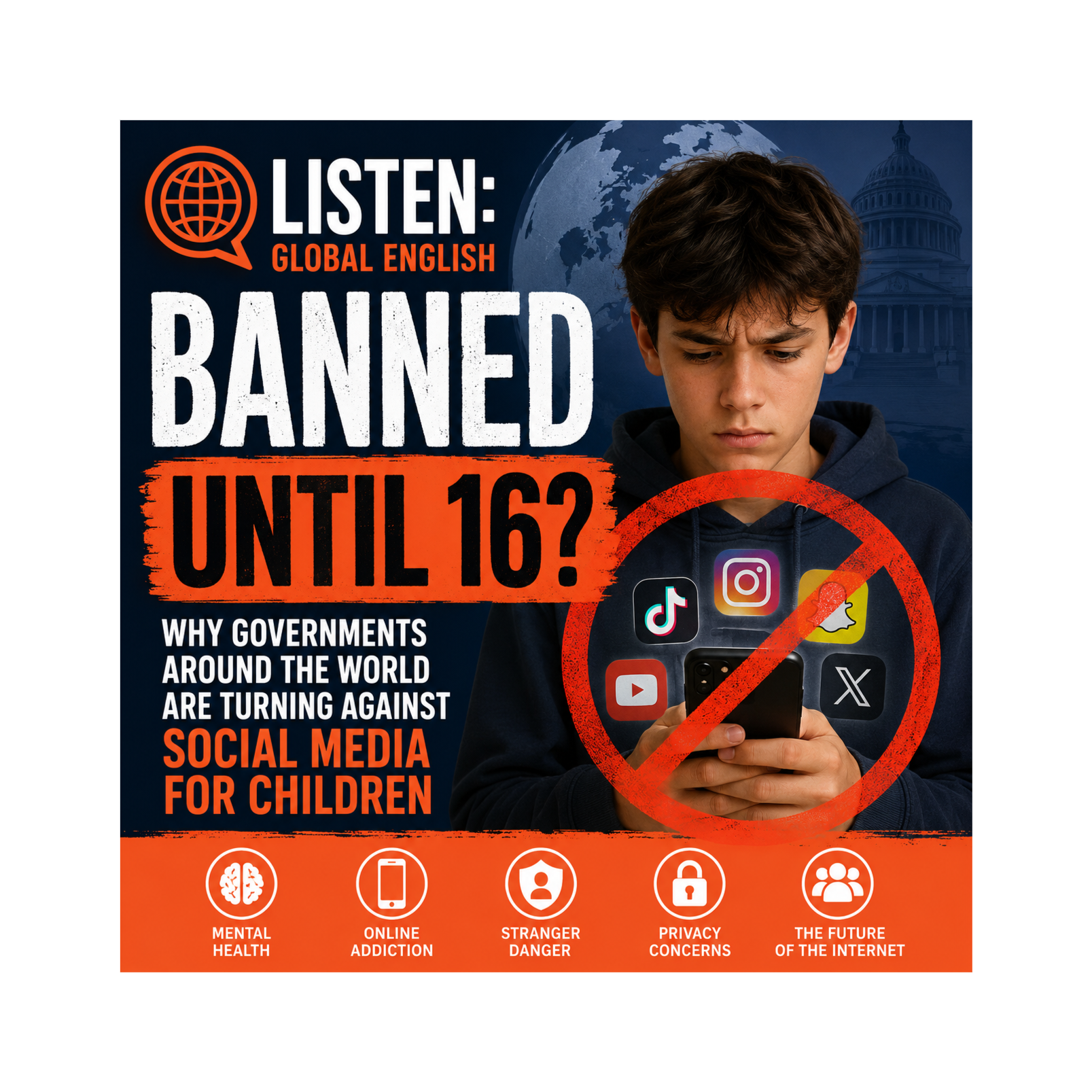
    BANNED UNTIL 16? Why Governments Around the World Are Turning Against Social Media for Children

    BANNED UNTIL 16? Why Governments Around the World Are Turning Against Social Media for Children Should children under 16 be allowed on social media? Around the world, governments are introducing or considering new laws that would restrict access to platforms such as TikTok, Instagram, Snapchat, and other social media services for younger users. Supporters argue that these measures are necessary to protect children from online addiction, mental health problems, cyberbullying, and contact with strangers. Critics, however, question whether bans will work and warn about privacy concerns and the loss of important online communities. In this episode of LISTEN: Global English, we explore one of the most important debates of our time: ✅ Why governments are introducing social media age restrictions ✅ The impact of social media on young people's mental health ✅ Concerns about online addiction and screen time ✅ The risks of cyberbullying, scams, and online predators ✅ The challenges of enforcing age-verification systems ✅ The arguments for and against social media bans ✅ What these changes could mean for the future of the internet Along the way, you'll improve your English with useful vocabulary, phrasal verbs, idioms, and expressions connected to technology, government policy, and modern society. Key Vocabulary Nationwide – affecting an entire country Enforce – to make sure a law or rule is obeyed Engagement – interaction with online content Grooming – when an adult gains a child's trust online for harmful purposes Bypass – to avoid a rule or restriction Balancing act – a situation requiring careful management of competing interests Algorithm – a system used by platforms to decide what content users see Age verification – a process used to confirm a user's age online Phrasal Verbs Featured 🔹 Step in – become involved to solve a problem 🔹 Hook someone on – make someone become dependent on something 🔹 Get around – find a way to avoid a rule 🔹 Cut back on – reduce the amount of something 🔹 Log off – disconnect from an online service Idioms Featured 🔸 Better safe than sorry 🔸 Keep up with the Joneses 🔸 Caught between a rock and a hard place 🔸 A double-edged sword 🔸 Open a can of worms Discussion Question Do you think governments should ban social media for children under 16, or should parents make that decision instead? #SocialMedia #EnglishPodcast #LearnEnglish #GlobalEnglish #Technology #MentalHealth #DigitalSafety #EnglishListening #ESL #OnlineLearning #CurrentAffairs #Vocabulary #PhrasalVerbs #Idioms #Teenagers #SocialMediaBan #EnglishPractice #ListeningSkills #IntermediateEnglish #AdvancedEnglish

    • Transcript
  • June 17 · 15 min

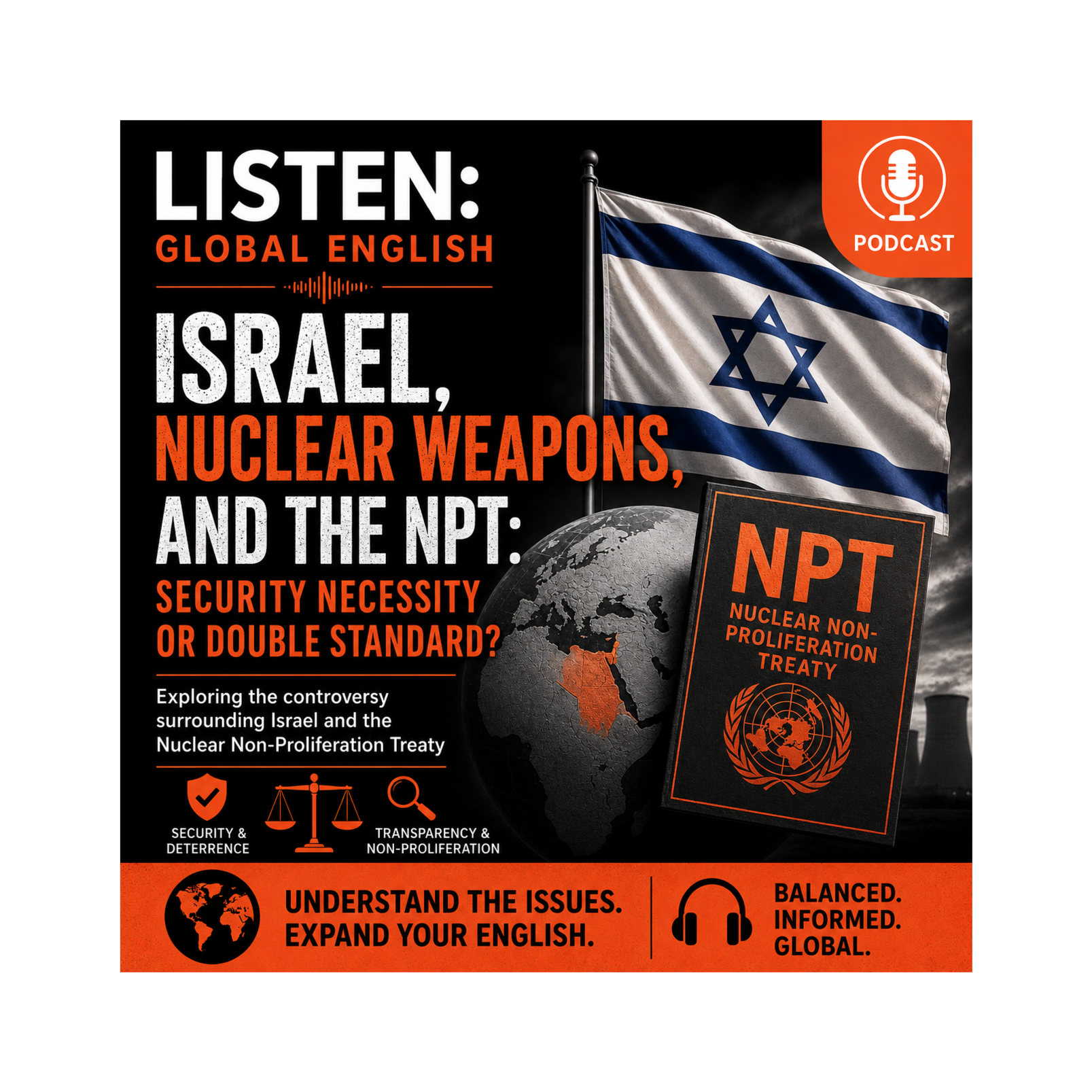
    Israel, Nuclear Weapons, and the NPT: Security Necessity or Double Standard?

    Israel, Nuclear Weapons, and the NPT: Security Necessity or Double Standard? Why has Israel never signed the Nuclear Non-Proliferation Treaty (NPT)? Why is this issue so controversial? And what are the arguments both for and against Israel's long-standing policy of nuclear ambiguity? In this episode of LISTEN: Global English, we take a balanced look at one of the most debated topics in international politics. You'll learn about the origins of the NPT, Israel's unique position outside the treaty, the arguments made by critics who see a double standard in the global nuclear system, and the arguments made by supporters who believe Israel's security concerns justify its current approach. This episode is designed for upper-intermediate and advanced English learners and includes explanations of key vocabulary, useful phrasal verbs, and common idioms related to international relations, diplomacy, security, and geopolitics. In This Episode ✅ What the Nuclear Non-Proliferation Treaty (NPT) is and why it matters ✅ Why Israel has never signed the treaty ✅ The policy of "nuclear ambiguity" or "nuclear opacity" ✅ Arguments from critics who believe Israel should join the NPT ✅ Arguments from supporters who defend Israel's current policy ✅ The role of the International Atomic Energy Agency (IAEA) ✅ The debate over inspections, transparency, and international law ✅ The idea of a Middle East Nuclear-Weapon-Free Zone ✅ Key English vocabulary related to diplomacy and global security Vocabulary You'll Learn Nuclear ambiguity Nuclear opacity Deterrence Safeguards Verification Compliance Disarmament Transparency Adversary Treaty Phrasal Verbs Featured Sign up to – to join or agree to something Example: More than 190 countries have signed up to the NPT. Carry out – to perform or conduct an action Example: The IAEA carries out inspections around the world. Back down – to withdraw from a position after pressure Example: Neither side wanted to back down during negotiations. Idioms Featured Put the cart before the horse – to do things in the wrong order Walk a tightrope – to carefully balance competing pressures or risks A double-edged sword – something that has both advantages and disadvantages Discussion Question Do you think all countries should be subject to the same nuclear rules, or are there situations where special security concerns justify a different approach? Keywords Israel, Nuclear Weapons, NPT, Nuclear Non-Proliferation Treaty, Geopolitics, International Relations, Global Security, English Listening Practice, Advanced English, Nuclear Ambiguity, Diplomacy, Current Affairs, English Vocabulary, World Politics, Middle East Security #LearnEnglish #GlobalEnglish #NPT #Israel #Geopolitics #EnglishListening #AdvancedEnglish #CurrentAffairs #InternationalRelations #WorldPolitics

    • Transcript
Showing 1–20 of 20 episodes