
Skip to content
Artwork for Business Leaving Cert

Business Leaving Cert

Ian O'Herlihy

Welcome to the Business Leaving Cert Podcast, your go-to resource for mastering the Leaving Cert Business course!
Check out our website https://BusinessLeavingCert.com

Leveraging the power of NotebookLM AI, each episode breaks down complex topics, and essential concepts with clarity and structure, making it easier than ever to grasp key ideas.

Insights and notes provided by Ian O'Herlihy, Business teacher at St. Columba’s College, this podcast is designed specifically for students looking to deepen their understanding and stay ahead in their studies.

Play
  • 33 episodes
  • Avg 17 min
  • English
Counted on this page — what you have heard stays on this device, so it is not something the list can be paged by.
  • Wednesday · 19 min

    Business Planning & The Business Model Canvas

    In this episode, we unpack everything you need to know about Chapter 8: Business Planning.📝 Episode DescriptionWhether preparing for the Leaving Cert Business exam or mapping out a real-world enterprise, a business plan serves as the ultimate roadmap for clarity, control, and securing funding. In this episode, we break down the fundamental architecture of business plans and the Business Model Canvas into clear, bite-sized insights: What is a Business Plan? Understanding how a written plan sets benchmark goals, secures loans and investor backing, assesses market potential, and mitigates risks. The 7 Main Sections: A section-by-section walkthrough covering the Executive Summary, Market Analysis, Sales & Marketing Plan, Financial Plan, Production Plan, Operational Plan, and the Business Model Canvas. Planning Across Business Stages: How priorities shift across Start-up (clarifying ideas & attracting funding), Growth (guiding expansion), and Maturity (maintaining operational efficiency). The Business Model Canvas (BMC): A breakdown of the 9 essential building blocks — from Key Partners and Value Propositions to Customer Segments, Channels, and Revenue Streams. Business Models & Digital Drivers: Comparing traditional models (Retail, Manufacturing) with tech-driven models (Subscription, Marketplace, Ad-Supported) using case studies like Netflix and Spotify. Ethics & Sustainability in Planning: Why ESG principles, trust, and ethical campaigns (like Patagonia and Ben & Jerry's) drive long-term profitability and customer loyalty
  • October 25 · 24 min

    Employment Rights and Workplace Relations,

    In this episode on Employment Rights andWorkplace Relations, we dive into everything you need to know about being an informed employee in Ireland. We break down the crucial balance between employeerights and employer responsibilities under key legislation, including the Payment of Wages Act 1991, the Organisation of Working Time Act 1997, the Safety, Health and Welfare at Work Act 2005, and protection against discrimination across the 9 protected grounds. Discover the difference between non-legislativeprotections like internal grievance procedures and formal legislative bodies like the Workplace Relations Commission (WRC) and the Labour Court. We also explore the role of trade unions, types of industrial action, challenges facing workers in the gig economy, and how Government Budget decisions directly affect your take-home pay. Perfect for Leaving Cert revision! Don't forget to visit Business leaving cert.com to access complete notes, one-page revision posters, practice questions, and your personal tutor today!

  • October 25 · 25 min

    Making Informed Financial Decisions

    In this episode of SCC Leaving Cert Business, we break down essential strategies for making smart personal financial choices. We explore the core differences between saving, investing, and borrowing, examining critical factors like Annual Equivalent Rate (AER), inflation, and Return on Investment (ROI). Learn how risk tolerance varies based on age and financial stability, and how consumer protection schemes like the Deposit Guarantee Scheme safeguard your savings up to €100,000. We analyze credit ratings managed by the Central Credit Register (CCR), plus the rise of Fintech, digital banking, and Central Bank Digital Currencies (CBDC) compared to volatile cryptocurrencies. Finally, discover why switching financial providers matters, how the Central Bank of Ireland protects consumers, and practical steps to avoid online fraud like phishing and smishing. Don't forget to visit Business leaving cert.com to access complete notes, one-page revision posters, practice questions, and your personal tutor today!

  • October 25 · 21 min

    The Rationale for Business Planning (New Course)

    In this episode, we explore The Rationale for Business Planning and how organizations successfully navigate both internal and external shifts. We examine why employees resist organizational changes due to anxiety over job security or disrupted routines, and highlight key management strategies to overcome resistance using clear communication, training, and employee empowerment. Next, we break down strategic planning as an ongoing process, moving from mission statements and environmental analysis to strategic, tactical, and operational plans. You will discover how structured planning provides clear direction, optimizes resource efficiency, and secures a competitive advantage. Finally, we analyze critical business tools, including force-field analysis to weigh driving versus restraining forces, alongside contingency planning to protect operations, assets, and reputation during unexpected crises. Don’t forget to visit Businessleavingcert.com for full study notes, one-page revision posters, sample practice questions, and personal tutor resources to ace your Leaving Cert Business exams!

  • October 25 · 16 min

    Leading and Managing (New Course)

    We break down everything you need to know about Leading and Managing an Organization. First, we explore the essential differences between leadership (inspiring vision and guiding people) and management, which focuses on organizing resources, controlling systems, and directing day-to-day operations. We then dive into organizational culture, explaining how strong shared values boost employee wellbeing and drive business innovation.Next, we analyze the three core leadership styles: Autocratic, Democratic, and Laissez-faire, examining when each style is best suited and how they impact intrapreneurship and team morale. Finally, we tackle workplace conflict, exploring common causes such as pay disputes, internal resolution strategies like direct negotiation, and key external methods including mediation, conciliation, and arbitration. Don't forget to check out Business leaving cert.com for notes, revision posters, practice questions, and personal tutoring!

  • October 25 · 25 min

    Managing Risk

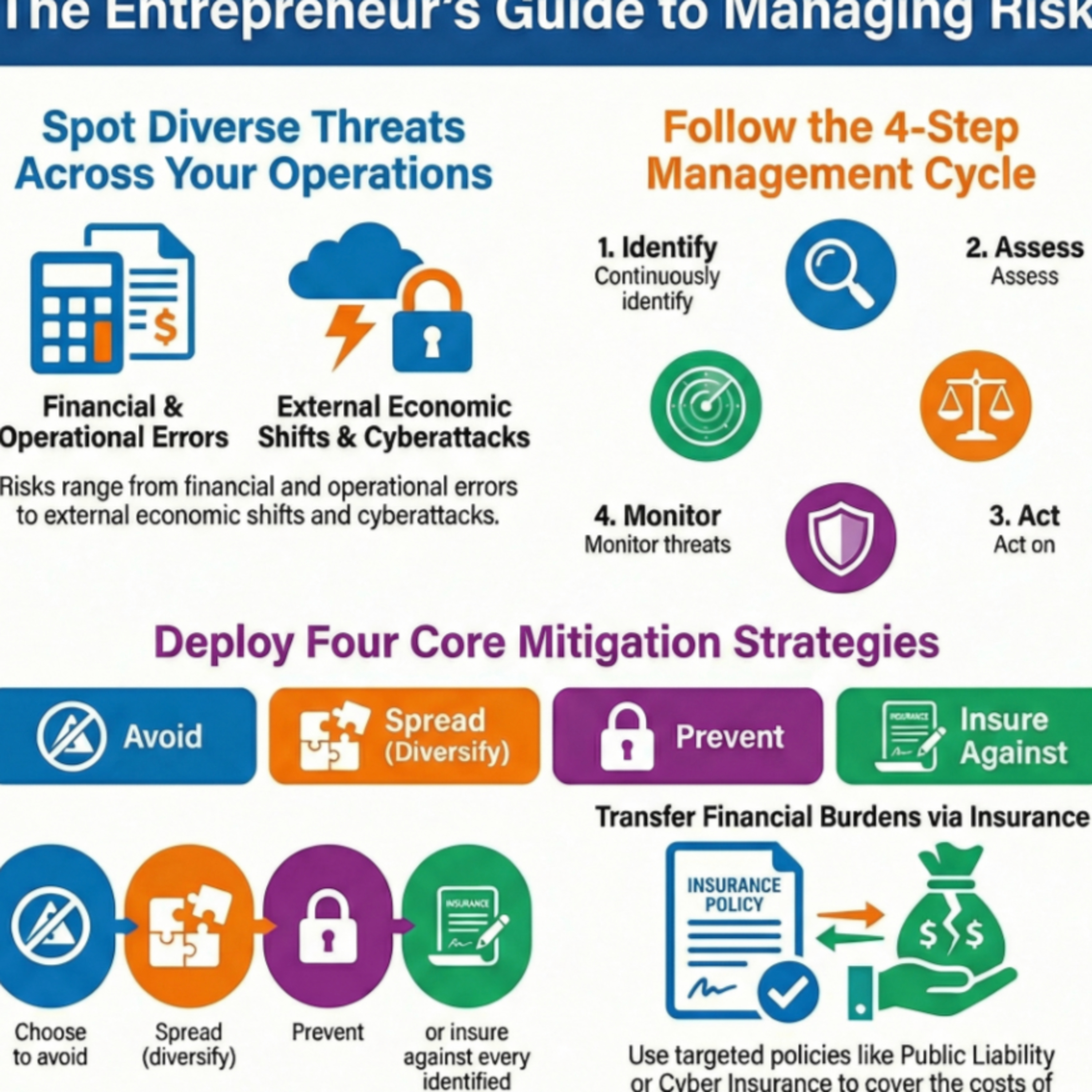
    Today we explore managing risk in business and the specific challenges faced by entrepreneurs who invest their own money, lack guaranteed income, and handle all major decisions. We analyze the core categories of business risk, including personal, financial, operational, economic, compliance, cyber, and competitor risks. Learn how to navigate these threats using the four main risk management strategies: avoidance, spread (diversification), prevention, and insurance. We also break down the four-step risk management process—identifying, assessing, acting upon, and monitoring risks to protect business assets, prevent costly mistakes, and ensure long-term survival. Finally, discover essential business insurance policies, including public liability, employer liability, product liability, cyber, key person, and business interruption insurance. Master these vital concepts to boost your exam confidence! Don't forget to visit Businessleavingcert.com to access our full notes, one-page revision posters, practice questions, and personal tutor.

  • October 25 · 20 min

    Irish Business Globally and Internationally (new course)

    In this comprehensive episode, we unpack Chapter 5: Irish Business Globally and Internationally, offering Leaving Cert Business students an in-depth, exam-focused review of how Ireland’s small, open economy operates on the global stage. We begin by defining key trading blocs—including the EU, USMCA, and Mercosur—and exploring protectionist measures such as tariffs, quotas, and administrative regulations. We then evaluate Ireland’s EU membership across three essential dimensions: the national economy, domestic businesses, and everyday consumers. Master essential Leaving Cert calculations as we clearly contrast the Balance of Trade (visible physical goods) with the Balance of Payments (total visible and invisible trade). We also examine the opportunities and challenges of globalisation, supply chain interdependence, and how digital technology drives e-commerce expansion. Finally, we analyze Foreign Direct Investment (FDI), highlighting how competitive corporation tax rates, IDA Ireland, and a skilled workforce attract major multinationals employing over 300,000 people—while evaluating Ireland's tax reliance risks. Don't forget to check out our new website Businessleavingcert.com, where you can access all of our notes, one-page revision posters, practice questions, and our personal tutor!

  • October 24 · 25 min

    How Government and EU Policy Shapes Business (new course)

    In this episode, we break down Chapter 4: The Influence of National and EU Policy to help you master key concepts for your Leaving Cert exam.We start by clarifying the essential distinction between Government Policy (a plan or guidance setting out government intentions) and Legislation (legally binding laws passed by the Oireachtas).You'll discover how major national policies impact key economic sectors: Climate Action Plan 2024: Grants for low-carbon practices alongside carbon tax impacts in agriculture. Housing for All: Driving construction demand and employment alongside stricter building standards. AI Strategy & National Digital Strategy: Boosting productivity, innovation, and e-commerce across manufacturing and services, while navigating reskilling and compliance costs. Next, we look at how businesses actively influence policy through lobbying, public consultations, and interest groups like IBEC and ISME.At the EU level, we break down the four key decision-making institutions using the CPCE memory aid—Commission (proposes laws), Parliament (represents citizens), Council (represents member governments), and the European Central Bank (monetary policy). Finally, we contrast binding EU Regulations (apply directly, e.g., GDPR), EU Directives (set targets, e.g., Single-Use Plastics Directive), and non-binding Opinions.Whether you are preparing for policy evaluation exam questions or revising core terms, this episode gives you the complete breakdown. Don't forget to check out Businessleavingcert.com to access all of our notes, one-page revision posters, practice questions, and personal tutor resources!

  • October 21 · 24 min

    Stakeholders in Business (New Course)

    Welcome to the SCC Business Podcast! In today's episode, we break down Chapter 1: Business Stakeholders and Relationship Dynamics to help you master this essential chapter for your Leaving Cert exam.What You'll Learn: Internal vs. External Stakeholders: How to identify and compare internal stakeholders (entrepreneurs, managers, employees, and investors) with external stakeholders (consumers, local communities, suppliers, government, and interest/pressure groups). Cooperative vs. Competitive Relationships: The difference between win-win cooperative dynamics and zero-sum competitive friction, such as wage negotiations or profit reinvestment versus dividend demands. Real-World Case Studies: Practical examples to bring your exam answers to life, including the Aer Lingus pilot strike, Patagonia's ethical customer positioning, and AIB rural branch closures. Conflict Avoidance & Resolution: Proactive strategies like Corporate Social Responsibility (CSR) and open communication, alongside formal dispute resolution techniques including direct negotiation, neutral mediation, conciliation, and binding arbitration. Stakeholder Mapping & The Power–Interest Grid: A guide to evaluating stakeholder influence and interest across four quadrants (Manage Closely, Keep Satisfied, Keep Informed, and Monitor), and why businesses rely on this framework to prioritise relationships and protect long-term sustainability.

  • October 13 · 18 min

    ACE The AAC

    Ready to score top marks on your Business Investigative Study? In this episode of SCC Leaving Cert Business, we unpack the project worth 40% (200 marks) of your final grade. We break down the five mandatory report sectionsfrom Introduction to Conclusions and References. We explain exactly how examiners are likely to award marks across each section. Plus, get an essential student checklist covering referencing, AI rules, and evaluation tips to ensure you maximize every mark

  • September 26 · 25 min

    Managing Risk (New Course)

    Today we explore managing risk in business and the specific challenges faced by entrepreneurs who invest their own money, lack guaranteed income, and handle all major decisions. We analyze the core categories of business risk, including personal, financial, operational, economic, compliance, cyber, and competitor risks. Learn how to navigate these threats using the four main risk management strategies: avoidance, spread (diversification), prevention, and insurance. We also break down the four-step risk management process—identifying, assessing, acting upon, and monitoring risks to protect business assets, prevent costly mistakes, and ensure long-term survival. Finally, discover essential business insurance policies, including public liability, employer liability, product liability, cyber, key person, and business interruption insurance. Master these vital concepts to boost your exam confidence! Don't forget to visit Businessleavingcert.com to access our full notes, one-page revision posters, practice questions, and personal tutor.

  • September 15 · 19 min

    Business ideas (New Course)

    Join us as we explore how a business idea develops from an initial concept into a viable business opportunity. In this episode, we examine the internal and external sources of business ideas, including employee creativity, personal experience, market research and customer feedback, and discover how entrepreneurs can identify opportunities for innovation. We’ll explore design thinking and its user-centred approach to developing ideas through prototyping, testing and repeated improvement, while examining the importance of organisational culture and resources in creating an environment where creativity and innovation can flourish. Finally, we look at the feasibility study and how entrepreneurs can assess whether an idea is practical and worth pursuing by considering its financial, legal and environmental viability. Throughout the episode, we follow the journey from initial inspiration to practical implementation, showing how good ideas can be developed, tested and transformed into viable business opportunities.

  • September 15 · 13 min

    Cosumer rights and responsibilities (New Course)

    Join us as we explore the rights and responsibilities of consumers in modern Ireland. In this episode, we examine the Consumer Rights Act 2022 and Consumer Protection Act 2007, and discover how the Competition and Consumer Protection Commission (CCPC) protects consumers, enforces the law and promotes fair competition. We’ll look at consumer redress, including refunds, repairs, replacements, the 14-day cooling-off period, and the Small Claims Procedure, before exploring what it means to be an informed consumer. We’ll also examine the rise of the circular economy and how ethical and sustainable choices can influence consumer behaviour. Finally, we turn to the digital world, exploring GDPR, data protection and consumers’ digital rights, and consider how consumers can take greater control of their personal information. Throughout the episode, we balance the legal protections provided by the state with the responsibilities of consumers to make informed, ethical and sustainable decisions.

  • May 13 · 21 min

    Commuication (New Course)

    In this episode, we dive deep into why effective communication is often described as the "business nervous system." Communication is the vital process of sharing information, ideas, and messages with both employees and external stakeholders to ensure a company's goals are met. We explore the fundamental principles that make or break a message, including the importance of correct timing, accuracy, and providing opportunities for feedback. Whether you are preparing for your exams or looking to understand how successful organizations stay aligned, this episode provides a comprehensive guide to fostering a positive, innovative workplace culture through clear and effective communication.Key Concepts: Principles of Communication, Verbal vs. Non-Verbal Modes, Digital Communication Tools, and Overcoming Communication Barriers.

  • May 11 · 19 min

    Human Capital Management (New Course)

    Today we are diving into Leading and Managing People via Human Capital Management (HCM). Explore how to maximise employee performance through recruitment, training, and motivation. We cover workforce planning, the three stages of recruitment, and the impact of digital technology. We also cover employee appraisals, teamwork, and the importance of a sustainable workplace that prioritises corporate wellness and inclusion

  • March 9 · 23 min

    Consumer Rights and Responsibilities (New Course)

    In this episode, we explore the key consumer rights and protections that exist within Ireland and the European Union. We discuss the important role of the Competition and Consumer Protection Commission (CCPC) in educating consumers and enforcing legislation such as the Consumer Rights Act 2022. The episode outlines the rights consumers have when purchasing goods, services, and digital content, including entitlements to refunds, repairs, or replacements. We also explain how consumers can enforce their rights through processes such as the Small Claims Procedure and how personal data is protected under GDPR. Beyond legal protections, the episode examines the growing importance of ethical and sustainable consumer behaviour, highlighting how purchasing decisions can support responsible businesses and reduce environmental impact. Finally, we look at how digital technology has transformed the way people shop, providing greater convenience and access to information while also creating new risks such as impulse buying, online scams, and data breaches. This episode provides a clear overview of the responsibilities and protections that shape modern consumer decision-making.

  • March 5 · 6 min

    Business or Economics? Make the right choice

    Choosing between Leaving Cert Business and Economics can be challenging. In this episode, we compare the focus of each subject: Business, which explores how companies operate and make decisions, and Economics, which examines how markets and the wider economy work. We look at key topics like entrepreneurship and leadership in Business and supply, demand, and government policy in Economics, as well as the different thinking styles each subject requires. Finally, we explain the practical assessments, including the Business Investigation Project (40%) and the Economics Research Study (20%), helping you decide which subject might suit you best. Created using NotebookLM Ai

  • March 4 · 21 min

    Rationale for Planning (New Course)

    In this episode, we explore The Rationale for Planning for Leaving Certificate Business. We break down the key ideas students need to understand, including why organisations experience change, the reasons employees may resist change, and how businesses can encourage innovation and entrepreneurial thinking. We also examine how managers can overcome resistance to change and why strategic planning is essential for guiding organisations toward long-term success. The episode explains important tools such as force-field analysis, which helps businesses evaluate the forces for and against change, and the role of contingency planning in preparing for unexpected crises. By the end of the episode, students will understand the benefits of strategic planning, the importance of planning for change, and the key factors businesses must consider when developing effective contingency plans. This episode is designed to help Leaving Cert students review the topic in a clear, exam-focused way.

  • February 5 · 16 min

    Growth, Development and Expansion (New Course)

    Today, we break down the business growth journey, from analysing competition and using Porter’s Five Forces to building competitive advantage, adapting strategies, and expanding through technology, mergers, franchising, and global e-commerce. Perfect for students and aspiring entrepreneurs looking to understand how real businesses grow sustainably in competitive markets. Notes and Insight from IOH, Podcast produced Notebook LM AI.

  • February 3 · 16 min

    Managing Risk (New Course)

    Today we explore business risk. The possibility of loss entrepreneurs face from financial, operational, and market challenges. We categorise specific threats such as economic downturns, compliance failures, and cyberattacks. Crucially,we outline a four-step management process (Identify, Assess, Take Action, Monitor) and detail strategies to mitigate harm, including avoidance, diversification, prevention, and specific insurance policies to ensure survival. Notes and insight from IOH, Podcast produced using Notebook LM AI

Showing 1–20 of 33 episodes