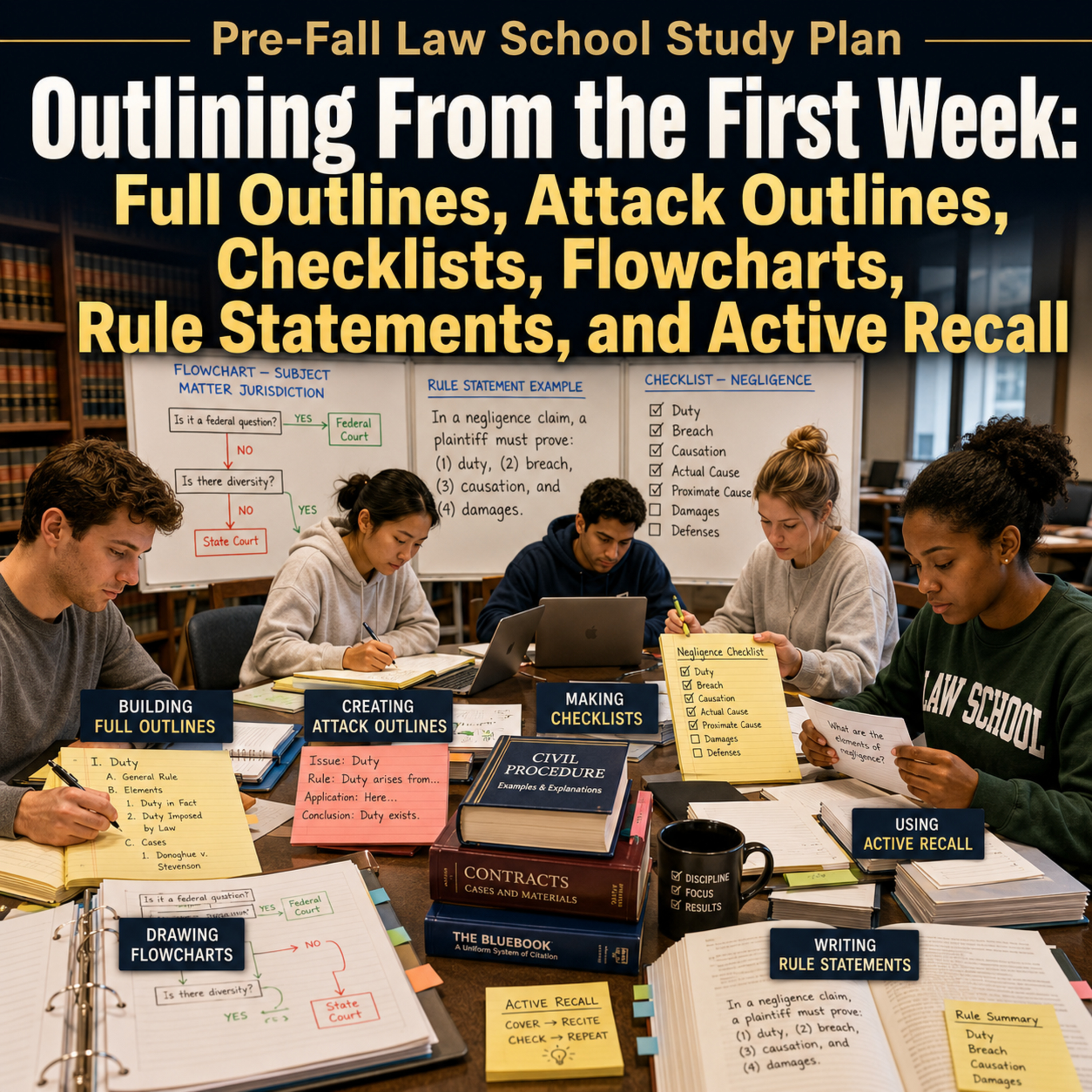
Pre-Fall Law School Study Plan: The Complete Pre-Fall Operating System: Weekly Scheduling, Focus, Health, Professional Development, Bar Integration, and the First Thirty Days
transcript
show notes
📘 FREE COMPANION STUDY GUIDE 📘
👉 CLICK HERE TO OPEN YOUR FREE STUDY GUIDE 👈
Turn this episode into an exam-ready study plan.
🎧 EPISODE SUMMARY 🎧
A successful pre-fall plan integrates reading, class participation, note review, outlining, legal writing, active recall, examination practice, feedback, professional development, health, and personal obligations.
For every course, the student should identify the structure, prepare assigned materials, attend actively, review notes, synthesize rules, update the outline, practice retrieval, apply doctrine, seek feedback, correct errors, and repeat.
The weekly academic cycle includes preparation before class, active engagement during class, review after class, and synthesis at the end of the week.
Time blocking should assign defined tasks rather than vague intentions. The schedule should include class, reading, writing, outlining, practice, employment, family, meals, exercise, sleep, commuting, administration, and buffer time.
Students should track how long recurring tasks actually take. Workload estimates should be revised according to evidence.
Tasks can be classified as immediate and high consequence, important but not immediate, routine maintenance, or optional enrichment. Nonurgent but essential work such as outlining and practice must be protected.
Concentration improves when distractions are controlled. Students should silence notifications, limit phone access, use defined work intervals, choose consistent locations, and avoid multitasking.
Sleep and physical health support memory, attention, emotional regulation, judgment, and reading comprehension. Meals, hydration, movement, medical care, medication, counseling, and support should be included in the plan.
Students should distinguish ordinary academic stress from serious health concerns and know how to access counseling, accommodations, health services, advising, peer support, and emergency assistance.
Employment and family duties must be scheduled honestly. Students may need earlier starts, reduced extracurricular commitments, childcare backup, commuting buffers, and coordination with employers or family members.
Bar integration begins in ordinary coursework. Students should preserve clean outlines, attack outlines, practice results, essay feedback, error logs, rule charts, and professor materials from foundational subjects.
The first thirty days should implement and test the system. Week one establishes basic readiness. Week two adjusts workload and begins practice. Week three emphasizes recall and application. Week four uses assessment and error review to revise the plan.
The central lesson is that the student should enter the semester with a working academic operating system. The plan should be specific, repeatable, realistic, and adjustable. Its purpose is not to make every week perfect. Its purpose is to ensure that preparation, learning, practice, health, and professional growth continue throughout the semester.
ℹ️ INFORMATION, PRIVACY POLICY & TERMS OF USE ℹ️
The Podcast and Website Purpose
The Law School Podcast and 1L Study Aide webpage supplements law-school and Bar Exam study with strategies, condensed rules, quizzes, and flashcards.
Educational Disclaimer
Content is for educational and informational purposes only. It is not legal advice, creates no attorney-client relationship, and does not guarantee law-school or Bar Exam success.
Privacy Policy
- No account or login is required.
- This webpage uses no forms or analytics to collect personal information.
- Quiz and flashcard activity stays in your browser and may clear when local site data is removed.
Terms of Use
By using this Podcast and webpage, you agree to use its content only for lawful, personal, noncommercial educational purposes. It supplements—not replaces—courses, textbooks, official materials, or qualified instruction.