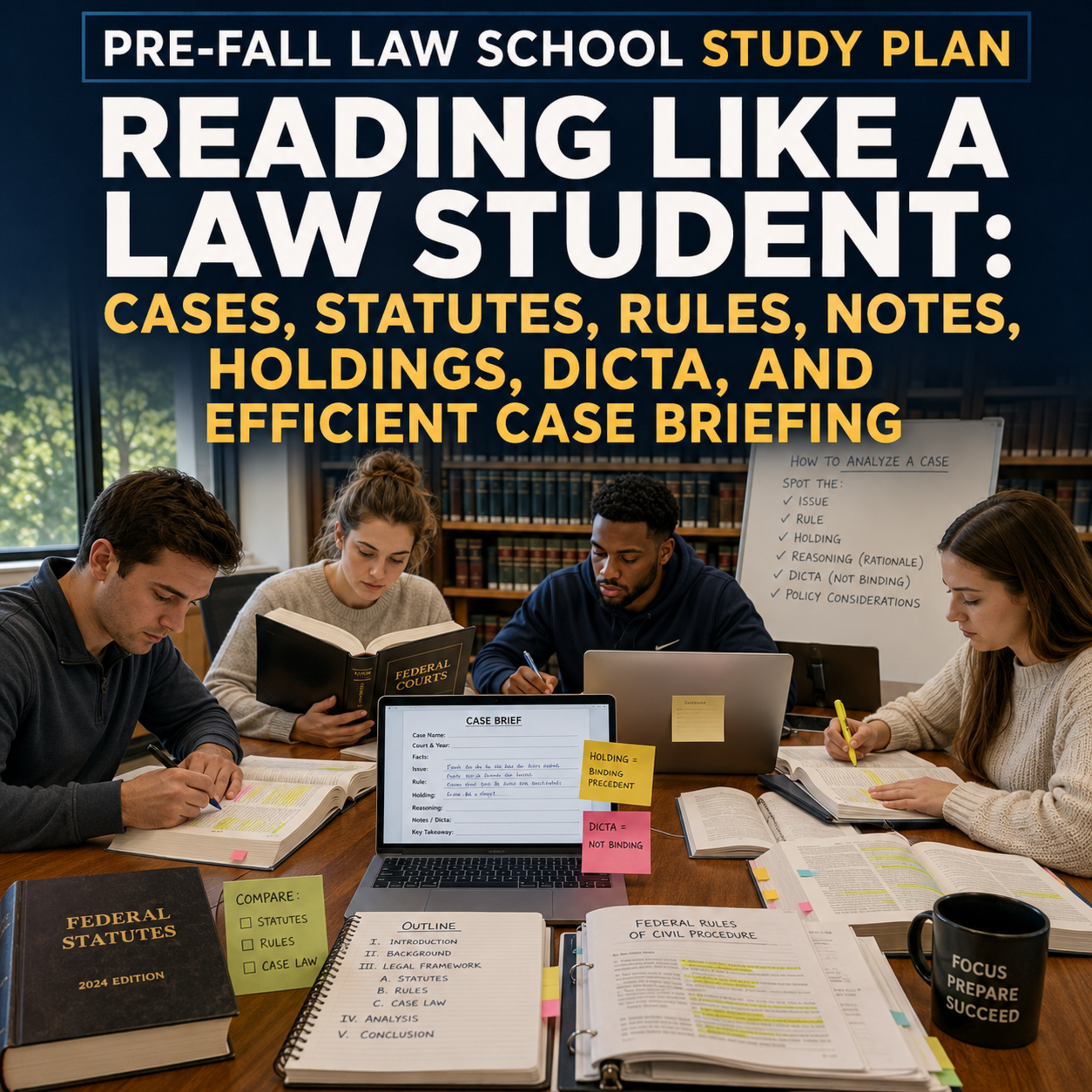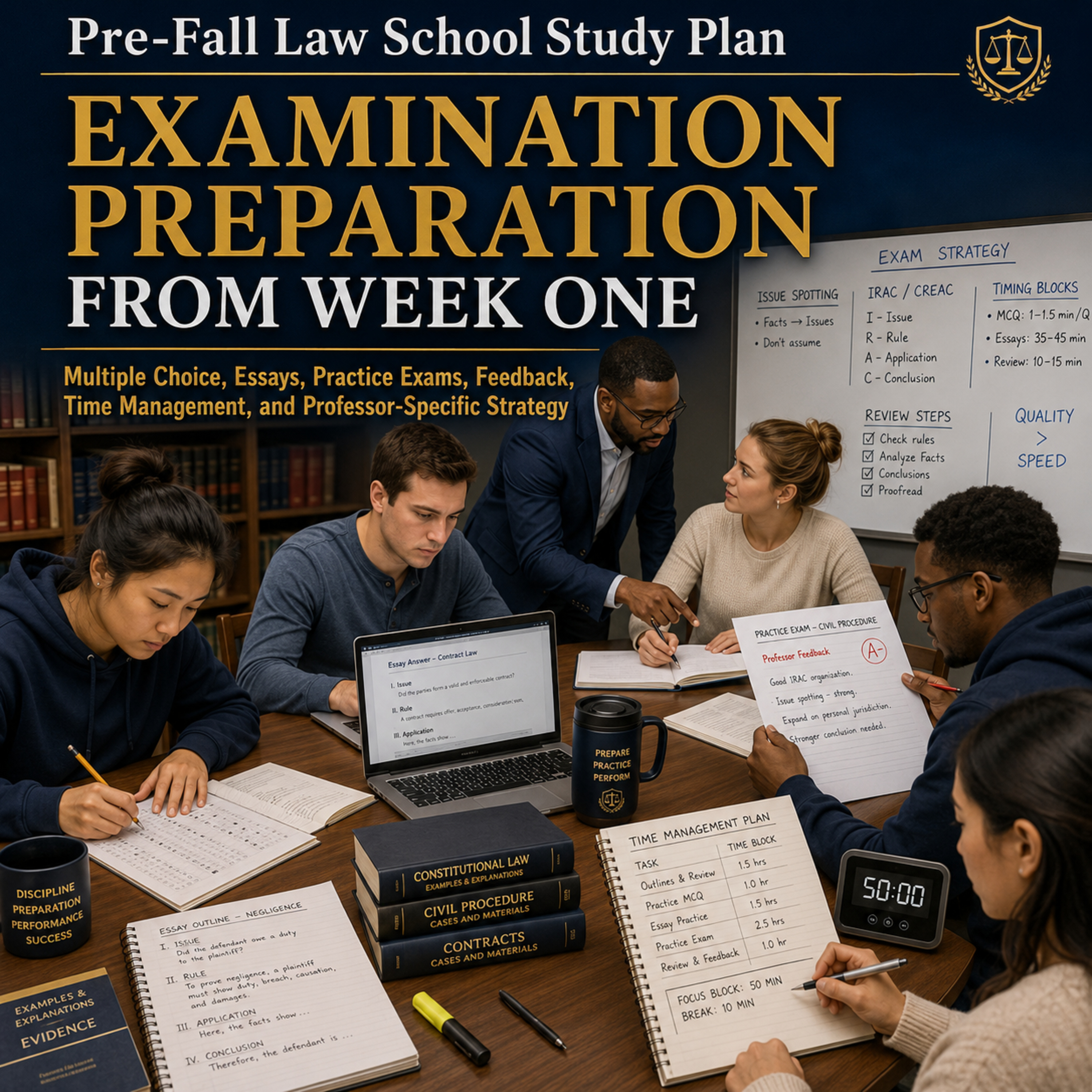
Pre-Fall Law School Study Plan: Examination Preparation From Week One: Multiple Choice, Essays, Practice Exams, Feedback, Time Management, and Professor-Specific Strategy
transcript
show notes
📘 FREE COMPANION STUDY GUIDE 📘
👉 CLICK HERE TO OPEN YOUR FREE STUDY GUIDE 👈
Turn this episode into an exam-ready study plan.
🎧 EPISODE SUMMARY 🎧Examination preparation should begin during the first weeks of the semester. The final should not be the first time a student writes a timed legal analysis or completes a mixed set of questions.
Students should identify the examination format, including essays, multiple choice, open-book or closed-book rules, word limits, time limits, section weights, permitted materials, provided statutes, software, and professor expectations.
Multiple-choice questions test rule knowledge, issue recognition, fact sensitivity, exceptions, procedural posture, and answer-choice discipline. Students should begin untimed and progress to timed sets. Every missed question should be classified according to its actual cause.
Essay preparation should progress from issue listing and rule writing to application paragraphs, untimed answers, timed answers, and full examinations. Strong essays identify issues, state concise rules, apply facts, address counterarguments, and reach supported conclusions.
Every important fact should be connected to an element, factor, defense, timing rule, jurisdictional requirement, or remedy. Facts are evidence, not narrative decoration.
Time should be divided according to point value. Students should use short planning periods, establish stopping times, and avoid sacrificing later questions to perfect earlier answers.
Word limits require direct headings, concise rules, decisive facts, and elimination of repetition.
Open-book examinations still require knowledge and organization. Materials should verify details rather than replace understanding. Closed-book examinations require active recall, rule memorization, attack outlines, timed writing, and spaced review.
Practice examinations should eventually be completed under realistic conditions and reviewed against reliable feedback. The feedback cycle is attempt, review, classify, correct, and practice again.
Midterms should be treated as diagnostics. Lessons regarding missed rules, omitted issues, weak analysis, disorganization, or timing should be incorporated immediately.
Professor-specific strategy should respond to legitimate evidence about policy, case names, minority rules, statutory interpretation, economic reasoning, history, professional judgment, remedies, and other course priorities.
The central lesson is that examination ability develops through repeated performance. Students should practice the work they will be graded on, diagnose mistakes accurately, and use every practice session to improve the next one.
ℹ️ INFORMATION, PRIVACY POLICY & TERMS OF USE ℹ️
The Podcast and Website Purpose
The Law School Podcast and 1L Study Aide webpage supplements law-school and Bar Exam study with strategies, condensed rules, quizzes, and flashcards.
Educational Disclaimer
Content is for educational and informational purposes only. It is not legal advice, creates no attorney-client relationship, and does not guarantee law-school or Bar Exam success.
Privacy Policy
- No account or login is required.
- This webpage uses no forms or analytics to collect personal information.
- Quiz and flashcard activity stays in your browser and may clear when local site data is removed.
Terms of Use
By using this Podcast and webpage, you agree to use its content only for lawful, personal, noncommercial educational purposes. It supplements—not replaces—courses, textbooks, official materials, or qualified instruction.