Skip to content
Artwork for Investing in Startups
InvestingTechnologyEntrepreneurship

Investing in Startups

Joe Magyer

Investing In Startups explores the strategies and stories of leading early-stage venture capitalists. The show is for VCs, LPs, angels, founders, operators, and the startup-curious. Whether you're a seasoned pro or just dipping your toes into startups, this podcast is your guide to navigating this dynamic ecosystem. The show is hosted by Joe Magyer, Founder and Managing Partner of Seaplane Ventures.

Play
  • 21 episodes
  • fortnightly
  • Avg 37 min
  • English
Counted on this page — what you have heard stays on this device, so it is not something the list can be paged by.
  • Yesterday · 29 min

    Data, AI, and Why Venture Firms Need to Act Like Startups with Gopi Sundaramurthy

    Gopinath Sundaramurthy is a Partner at Ensemble VC, where the firm uses data and software to systematically identify promising founders and investment opportunities at the earliest stages. In this conversation, we talked about how AI is changing venture capital, why data may become one of the few durable advantages between firms, and what happens when investors apply the same operating discipline they expect from startups to themselves. Gopi explains how Ensemble uses data to improve sourcing and diligence without trying to replace human judgment. The goal is to automate the work of finding and understanding companies so investors can spend more time building relationships, evaluating founders, and developing conviction. We also discuss how Ensemble evaluates founding teams, why Gopi believes most startup ideas are evolutionary rather than revolutionary, and why following where exceptional talent is moving can be more useful than starting with a fixed investment thesis. Gopi also shares his views on portfolio support, follow-on investing, and why many VC firms have been surprisingly slow to adopt the technologies and processes they encourage their founders to embrace. Investing in Startups is produced by Seaplane Ventures and hosted by Joe Magyer.

  • July 22 · length unknown

    Power Laws, Venture Math, and Changing Your Mind with Abe Othman

    Abe Othman has spent years digging into AngelList’s data to better understand how venture investing actually works, not just how investors say it works. In this episode, Abe joins host Joe Magyer to talk about portfolio construction, check sizes, valuations, and the relationship between price and returns. They discuss how much investors should put into each deal, why owning more of a company isn’t always better, and what the data can (and can’t) tell us about building a strong early-stage portfolio. They also get into contrarian thinking and the importance of changing your mind when the evidence changes. Abe shares some of the beliefs he has reconsidered over the past few years and explains why good investing often means letting go of ideas that once seemed obviously true. It’s a thoughtful, numbers-heavy conversation about making better decisions in an asset class where the outcomes are extreme, the sample sizes are small, and certainty is usually an illusion. Investing in Startups is hosted by Joe Magyer. The show is a Seaplane Ventures production.

  • June 26 · 35 min

    From SaaS to Systems of Work: The Vertical AI Opportunity with Nick Tippmann

    Nick Tippmann is the Founder of TipTop Ventures where he invests in vertical AI and applied AI companies at the earliest stages. In this conversation, we talked about vertical AI, systems of work, and why distribution may matter more than ever in a world where software is getting easier to build. Nick explains why vertical AI is not simply the next version of SaaS. In his view, the unit of value is shifting from time saved to work delivered. That changes the buyer, the budget, the pricing model, and the size of the opportunity. Where traditional vertical software captured a slice of software spend, vertical AI can go after much larger labor and services budgets by doing the work itself. We also discuss what makes vertical AI companies defensible. Nick shares why the best companies are not just thin wrappers on top of foundation models, but systems of work that combine workflow, context, proprietary data, and domain-specific judgment. He explains why OpenAI and Anthropic moving up the stack may actually prove that intelligence alone is not enough. A big theme in the episode is go-to-market. Nick argues that many fundamentals have not changed: trust, domain expertise, tight ICPs, fast time to value, and distribution still matter. But in an AI-native world, pricing is being rewritten, revops and go-to-market engineering are becoming table stakes, and founders need to think earlier about brand, community, and how they stand out in crowded markets. We also talk about Nick’s journey from operator to investor, what he learned as CMO of Greenlight Guru, what he saw early in GC AI, and what VCs and founders often misunderstand about each other. It is a conversation about the future of software, the realities of early-stage investing, and how to separate durable vertical AI businesses from the noise. Investing in Startups is produced by Seaplane Ventures and hosted by Joe Magyer.

  • June 8 · 35 min

    The Rapid Rise of AI with Niki Scevak [Encore Episode]

    This episode originally aired in September 2024 — and it's aged remarkably well. We're bringing it back with fresh context on why Niki's predictions have proven out. Niki Scevak is co-founder and partner at Blackbird, Australia and New Zealand's most prominent venture capital firm. What started with a $29M AUD debut fund and 500 meetings to get 96 people to say yes has grown into a platform with six flagship funds, six portfolio unicorns, and a seed investment in Canva that became one of the greatest venture bets ever made. In this conversation, Niki talks about writing a $250K check into Canva's seed round and investing $270M+ across the company's life. Since we recorded this, Canva has hit $4B in annual revenue and is reported to IPO on the Nasdaq in 2026. We also dig into Niki's views on AI application software — the extraordinary growth rates, the premium pricing power, and the churn problem lurking underneath. Eighteen months later, the data has validated nearly everything he said here. In this episode, we cover: — How Blackbird went from a $20M USD fund to backing multiple unicorns — Why the best companies tend to be successes from the start — The case for investing before product, before revenue, before anything — Blackbird's approach to giving founders honest, specific feedback — Why AI application companies grow faster than anything Niki has ever seen — and why churn is the catch — How Australia's superannuation system became a venture capital superpower — Seed valuations post-COVID and what determines the "right" price — The biggest misconception about the Australian startup ecosystem Investing in Startups is hosted by Joe Magyer and produced by Seaplane Ventures.

  • May 20 · 33 min

    Hot Seed Deals, Quitting, and Liquidity with Peter Walker of Carta

    Peter Walker is Head of Insights at Carta, where he tracks some of the most important data shaping venture right now. In this conversation, we talked about hot seed deals, quitting, liquidity, and what the latest market data really says about valuations, exits, and the changing structure of venture. Peter explains why the most expensive seed deals may be more rational than they look, especially if your goal is to back the tiny handful of companies that could become massive outcomes. But he also makes clear that the real challenge is not just getting into great companies. It is figuring out how those companies actually generate liquidity in a world where IPOs are rarer, secondaries are concentrated in a few names, and many private companies are staying private longer than investors once expected. We also discuss how the venture market is splitting in two. At the very top, consensus companies in the “golden circle” are attracting extraordinary prices and attention. Outside that inner ring, founders are still facing a much tougher environment, where expectations are high and capital is harder to win. Peter shares why common fundraising heuristics like a single ARR benchmark for raising a Series A are often misleading, why growth and momentum matter more than any fixed revenue number, and how AI is making revenue quality harder to judge than it used to be. A big theme in the episode is what venture gets wrong. Peter talks about why some founders probably should quit sooner, why solo founders may deserve more credit than they often get, and why concentration is not the only way to build a great fund. It is a conversation about market structure, incentives, and how investors and founders can think more clearly in a venture environment that is getting more extreme at both ends. Investing in Startups is produced by Seaplane Ventures and hosted by Joe Magyer.

  • April 29 · length unknown

    B2B in the Age of AI and Services as Software with Ariel Winton-Jones

    Ariel Winton-Jones is the founder of The Aligned Fund, where she invests in B2B software companies at the earliest signs of product-market fit. We talked about services as software, what B2B looks like in the age of AI, and why intentional investing can be a real edge. Ariel explains how her thinking evolved from traditional B2B SaaS into what she calls “services as software.” In a world where AI is changing what software can do, she’s most excited by businesses that don’t just give users tools, but actually deliver outcomes that once required human labor. Instead of software as a DIY layer, she argues that the next wave of great B2B companies will solve the problem itself. We also talk about Ariel’s investing style and why she operates with unusual intention in a market that often rewards speed. She shares why she likes to meet founders early, spend real time understanding how they think, and build conviction through deep diligence rather than just pattern matching from a deck. A big part of the conversation is her focus on early product-market fit and why she believes that stage is more knowable than many investors assume. Ariel also breaks down why she remains so committed to B2B software. We discuss why B2B has proven resilient, how AI is expanding the kinds of markets that can support venture-scale outcomes, and why there is no single right way to price or sell software. What matters most, she argues, is fit between the product, the customer, and the value being delivered. Finally, we discuss concentration, reserves, and what venture often gets wrong. Ariel explains why she prefers a low-velocity, high-conviction approach, why she keeps reserves low, and why the best early-stage investing often comes from going much deeper on fewer opportunities. It’s a conversation about software, judgment, and how to invest thoughtfully when both technology and venture are changing fast. Investing in Startups is produced by Seaplane Ventures and hosted by Joe Magyer.

  • April 15 · length unknown

    Future Titans, Authenticity, and Systems Thinking with Daniel Dart

    Daniel Dart is the Founder and General Partner of Rock Yard Ventures. He is also the founder of the Future Titans summit, an amazing event he recently hosted in Austin for emerging managers and the LPs who back them. Daniel is a collaborative, Seed-focused investor focused on backing founders who are refunding core industries. We talked about Future Titans, ambition, authenticity, and the pursuit of Tier One status. We also explored: Why Future Titans exists: Daniel built the Emerging Manager Summit as the room he wished existed—relationship-first, practical, and designed for funds I–III (not a conference-business play). He’s focused on creating the right environment vs. chasing early vanity metrics. Anti-status design (no name tags / no pitch decks): He argues most events incentivize social stack-ranking and transactional behavior; removing those cues forces human-first conversations and lowers the “pitch” energy. Core philosophy: “find believers, don’t convince skeptics.” Trust is his upstream variable for everything—LP relationships, founder support, community building. His “patron/believer” framing is about compounding a small set of true supporters over time. Founder support system (real operator cadence): He shares a concrete post-check rhythm—every-other-week check-ins early, then monthly—aimed at building trust and creating a safe place for founders to think clearly when things get messy. Building “tier-one” access via a “Voltron” network: Rather than pretending he can see everything, he wants a trusted brain-trust where high-signal peers effectively extend his coverage; Future Titans is partly a compounding mechanism for that. Investing in Startups is hosted by Joe Magyer, founder and managing partner of Seaplane Ventures.

  • April 1 · 30 min

    Momentum, Moats, and the New Rules of Pre-Seed with Gaurav Jain

    Gaurav Jain is the Cofounder and Managing Partner of Afore Capital. Afore is one of the OGs of institutional pre-seed investing and runs the largest dedicated pre-seed venture fund in the world. We talked about momentum as a moat, how vibe-coding effects pre-seed investing, and the importance of great product and distribution. Here's a longer breakdown… Gaurav explains why momentum has become more durable than traditional moats, especially in a world where AI is making it easier to build products quickly. Instead of relying on old ideas of defensibility, he argues that the best startups create constant forward motion through product improvement, user pull, and rapid execution. We talk about what Afore Capital looks for at the pre-seed stage, when there may be very little company built and not much data to evaluate. Gaurav shares how he thinks about backing founders early, what signals matter most before traction exists, and why team quality often matters more than a polished market narrative. Gaurav also breaks down how AI is changing startup formation, from reducing the amount of capital needed to build a company to speeding up the path from idea to product and customer feedback. The conversation explores what this means for founders, investors, and the pace of competition in the earliest stages. A big theme in the episode is distribution and founder-led selling. Gaurav talks about why distribution can’t be treated as an afterthought, why technical founders still need to learn how to get in front of customers, and how the best early companies pair strong product instincts with a clear path to demand. Finally, we discuss how pre-seed investing has evolved over the last decade and what Gaurav has learned from helping define the category. He shares lessons on market size, founder selection, and why early-stage investing is often less about predicting categories and more about recognizing the people most capable of creating momentum from nothing. Investing in Startups is produced by Seaplane Ventures and hosted by Joe Magyer.

  • March 18 · 38 min

    AI, Hot Deals, & Ownership: Joe Magyer Reflects on 50 Episodes

    We're celebrating our recent 50th episode with a special conversation between host Joe Magyer and guest host Chris Hill of Money Unplugged. Chris interviews Joe about his lessons learned from the first 50 episodes, how AI is impacting startups and venture capital, what Joe has changed his mind about, and investing in startups, both the craft and the show. Joe and Chris also unpack how AI has reshaped venture in just two years—changing what it costs to start a company, how many people startups need to hire, how quickly they can build product, and why investors are again leaning into the category after a brutal post-2021 reset. They revisit one of venture’s oldest debates: concentrated vs. diversified portfolios. Joe explains why some investors want as many shots on goal as possible, while others prefer to place fewer, higher-conviction bets so they can spend more time with founders and have a better chance of meaningful ownership in the winners. Another core tension in the episode is consensus vs. non-consensus investing. Joe talks through why the hottest deals often get hot for good reasons—great founders, fast growth, strong co-investors—but also why crowded rounds can compress returns and leave investors paying up for certainty that may already be priced in. Finally, Joe also shares how hosting the podcast has changed his own investing style. Hearing other managers explain their frameworks pushed him to rethink rigid reserve strategies, become more flexible about follow-on investing, and focus more on doubling down when real conviction builds through direct founder relationships. Investing in Startups is produced by Seaplane Ventures and (usually) hosted by Joe Magyer.

  • March 4 · length unknown

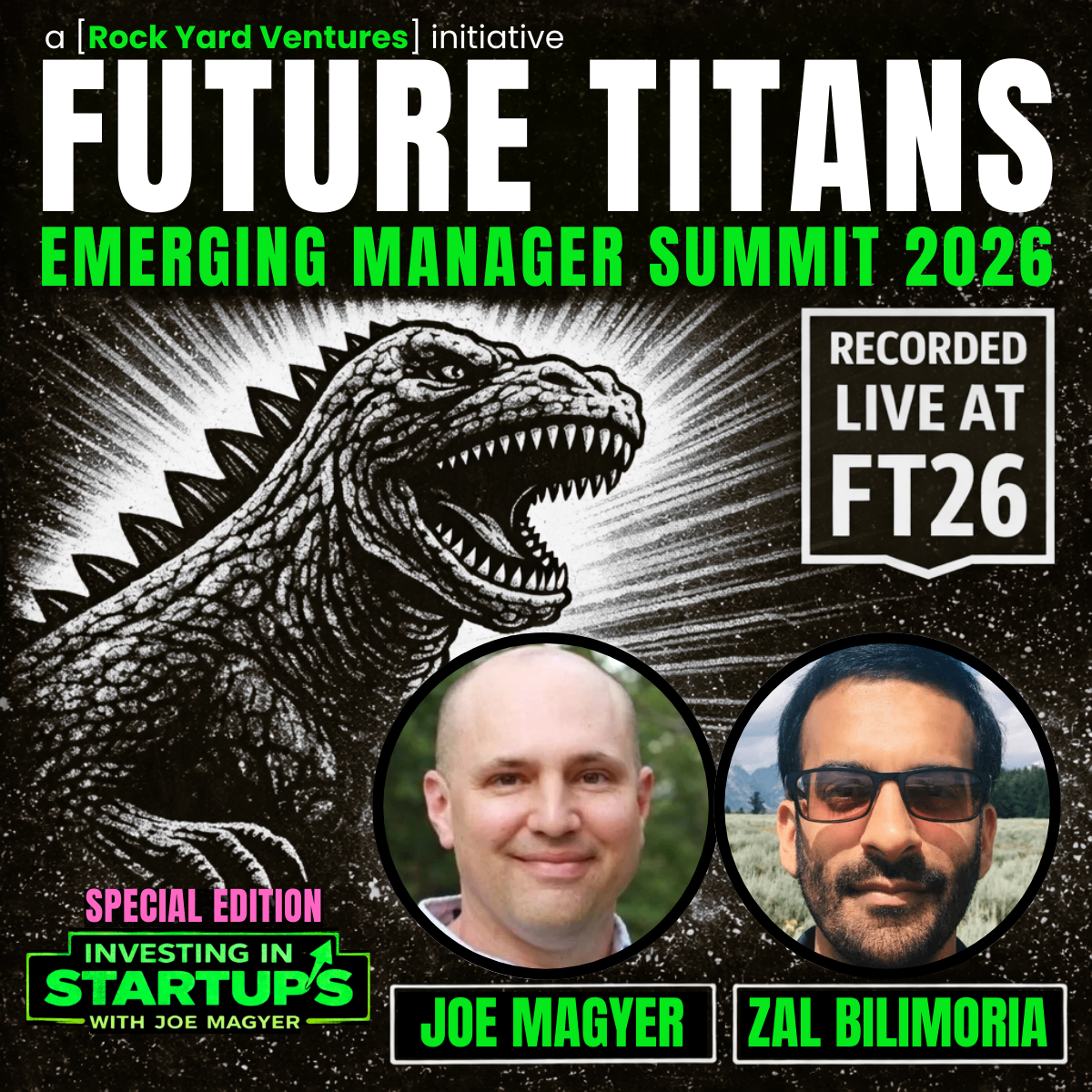
    Live Episode! A Future Titans Collab and Solo GP Life with Zal Bilimoria

    We're excited to share this interview with Zal Bilimoria, founding partner at Refactor Capital, recorded live at the recent Future Titans emerging manager summit. Zal is a high-conviction, hard-tech investor and solo capitalist who manages more than $225 million. He has a fascinating career, from building products at Netflix and LinkedIn to being an early employee at a16z to later forming Refactor. We talked about why Zal is solo, what he learned from a16z, why he invests with conviction, how he built a robust firm without any employees supporting him, and how he managed to lead a Series D round despite his firm being a Seed expert. We also discussed: Why Zal chose the solo GP path (on purpose): after seeing large-firm partnership dynamics at Andreessen Horowitz, he optimized for speed, autonomy, and founder time—especially important at seed where decision velocity matters. Refactor started as a two-GP fund with David Lee (ex–SV Angel), then David retired earlier than expected—forcing Zal to rebuild the LP base and prove the strategy could work with a single decision-maker. A “right-sized” fund strategy as an operating system: Zal explains why he’s stayed around ~$50M per fund, targets ~20 companies per fund, and focuses on ~8–10% ownership at entry to keep the model manageable and return-capable. He actively tracks how many portfolio companies “graduate” (to Series A and beyond) each year so his board/support load stays sustainable without adding headcount. Robustness for LPs (the “hit-by-a-bus” plan): Zal shares a concrete solo-GP risk mitigation tactic—he carries a life insurance policy payable to the management company so LPs have resources to recruit a successor or wind down assets without crushing fund performance. Hard tech example that feels sci-fi (with real traction): Solugen. Zal recounts leading Solugen’s seed ~9 years ago and watching it scale into a large revenue business—then pivoting into a high-demand defense chemistry product with major government pull. How a seed lead ends up leading a Series D: during the 2022 market reset, Zal had an SPV ready (~$20M) to secure pro rata; when no one wanted to “stick their neck out” as lead, he wrote the first term sheet—unlocking the round and attracting co-leads/followers. Reserve strategy shift: he describes moving from ~50% reserves to ~20% reserves—preferring more “shots on goal” at pre-seed/seed, and noting how hard it is to consistently pick Series A winners even when top firms lead the round. Investing in Startups is hosted by Joe Magyer, founder and managing partner of Seaplane Ventures.

  • February 18 · 54 min

    Episode 50! Venture Strategy, Real Work, & The Myth of Overnight Success with Seth Levine

    Seth Levine is a Partner at Foundry Group, a longtime early-stage firm investing in both startups and emerging fund managers. We talked about the art of working with founders, short-term-ism, knowing your own competitive advantage, why AI will create more jobs than it disrupts, and the myth of overnight success. Here's the longer of what we covered: Doing the real work with founders and GPs – Seth explains why his favorite part of Foundry is deep, collaborative problem-solving with CEOs and emerging managers, not formal board meetings, and why he sees himself as “in the influence game,” working for founders rather than controlling them. Fund size is fund strategy – He walks through why Foundry chose not to become a perpetual, multi-generational platform, and how everything from check size to reserves, board work, and follow-on strategy has to flow from the true size and intent of the fund—not from chasing a bigger AUM number. What LPs miss about emerging managers – Drawing on Foundry’s long history backing funds, Seth argues most LPs behave like asset allocators who over-weight pedigree, underwrite theses too superficially, and don’t dig hard enough into a GP’s real edge, philosophy, and personal “why” for running a firm. Under-explored fund models he loves – Seth highlights niche yet powerful strategies: Arthur Ventures’ “under-the-radar” B2B SaaS approach, roll-ups of orphaned 2019–2020 vintage funds, and hybrid revenue-based vehicles that blend debt-style payback with equity upside for founders. If he were starting fresh today – From a pure performance standpoint, he’d run a much more diversified early-stage book with lots of initial positions and minimal follow-ons—Taleb-inspired barbell thinking—and, in a wilder alternate life, maybe build a Series A or growth platform in Saudi Arabia to ride frontier-market upside. Capital Evolution & fixing capitalism, not ditching it – Seth shares the origin story of his new book, his evolving view on when companies should (and shouldn’t) wade into politics, the shift from shareholder primacy toward broader stakeholders, and why medium- to long-term thinking and greater economic dynamism are essential. AI, entrepreneurship, and why venture’s glamor is BS – He’s long-term bullish and short-term cautious on AI, seeing it as a huge unlock for productivity and entrepreneurship far beyond tech—but also a source of disruption that needs thoughtful retraining and policy. Investing in Startups is hosted by Joe Magyer and produced by Seaplane Ventures.

  • February 6 · 31 min

    E49: AI Agents, Unlocking Human Potential, and Not Giving Up with Hyperspell

    Conor Brennan-Burke and Manu Ebert are the co-founders of Hyperspell. Hyperspell provides a memory and context layer to AI agents is one of our portfolio companies at Seaplane Ventures. I (Joe here) was trying to explain to some friends at a BBQ recently Hyperspell what did and learned pretty quickly that most people aren’t familiar yet with AI agents. Given that and the sudden explosion in interest in AI agents, I thought it would be great for listeners to have Conor and Manu to come on to talk about AI agents, the evolution of AI, context, Y Combinator, and how Manu once bought a .AI domain name via fax machine. From chatbots to true agents – Conor breaks down where tools like ChatGPT stop and AI agents begin, and why the key shift is agents taking actions autonomously across your tools, not just answering questions. Why context is the real bottleneck – Manu and Conor share how building their own “chief of staff” agent led them to Hyperspell, a memory and context layer that plugs into tools like Slack, Gmail, and Notion so agents can actually understand your customers, org chart, and tech stack. The three bottlenecks to agent adoption – Manu explains why verification, capability, and context each limit what agents can do today, and why decoupling these layers (rather than relying on a single big lab) gives companies more flexibility and avoids platform lock-in. Why workers aren’t using AI (yet) – Conor reacts to studies showing most desk workers rarely touch AI, and argues that fear, bad framing (“AI will replace you”), and lack of personalized context are holding back adoption despite models already outperforming humans on many benchmarks. AI as global leapfrog, not just US office automation – Manu highlights under-discussed upside: primary care in Africa, McKinsey-grade advice for small businesses, tailored guidance for farmers, and always-on tutors that could reshape opportunity in developing markets. Let machines be the cogs, not people – The pair paint a future where AI agents handle status updates, follow-ups, and information shuffling inside big orgs, freeing humans to do creative, high-leverage work instead of feeling like dehumanized “TPS report” machines. Building SuperMe and all-star AI teams – Conor shares a favorite customer use case: cloning experts (or even yourself) as agents using your own docs, email, and notes, so a solo founder can effectively “hire” an AI team of world-class operators and advisors. YC, rejection, and founder stubbornness – Conor and Manu talk about finally getting into Y Combinator after nine applications between them, why persistence is a superpower for founders, and how YC has shaped Hyperspell’s trajectory. Investing in Startups is hosted by Joe Magyer and produced by Seaplane Ventures.

  • January 28 · length unknown

    E48: Backing Emerging Managers Before They're Brand Names with Courtney McCrea

    Courtney McCrea is the Cofounder and Managing Partner of Recast Capital. Courtney and I dove into the intricacies of investing in emerging managers and building those firms. We talked about why Courtney is so enthusiastic about emerging managers, the challenges emerging managers face and how to overcome them, how LPs can better evaluate emerging managers, and why LPs aren’t racing to adopt AI as fast as their VCs. We also discussed: How LPs really evaluate first-time fund managers: beyond pedigree, what creates conviction in sourcing, selection, and portfolio construction. Fund I fundraising strategy: why “spray-and-pray” outreach fails—and how to identify the right-fit LPs instead of chasing every allocator. Where to start if you’re raising your first venture fund: go “off the beaten path” rather than leading with mega-institutions and public pensions. LP diligence that actually matters: Courtney’s framework for reference calls, risk lists, and finding the “fatal flaw” early. Solo GP vs partnership risk: why “GP divorce” can be a bigger underwriting risk than the classic “hit-by-a-bus” concern. AI in the LP workflow: what Courtney is seeing (and experimenting with) in diligence and decision-making as venture processes modernize. Joe Magyer is the host of Investing in Startups, which is a Seaplane Ventures production.

  • January 14 · length unknown

    E47: Gritty Founders, Weird Markets, and Vertical AI with Dan Teran

    Dan Teran is a Cofounder and Managing Partner of Gutter Capital. Gutter is an early-stage firm based out of New York focused on founders tackling the world’s toughest problems. We talked about why Gutter invests with conviction, why they seek out founders with unique insights rather than Gutter trying to dream up their own, and how AI can solve problems in the real world, not just online. We also dug into: + Gutter’s core focus on vertical AI, vertical SaaS, and marketplaces tackling messy, real-world problems + Why Dan gravitates toward underestimated, “lived-experience” founders over polished, pedigreed profiles + Inside Elbow Grease, Gutter’s AI accelerator: structure, check size, and how they plan to keep backing winners + How Gutter turns talent into a product: embedded head of talent and heavy support on early hiring + The firm’s discipline on valuations, small fund sizes, and staying aligned with founders in a top-heavy market + Why Gutter insists on taking a board seat at seed and how that sets companies up for stronger Series As + Dan’s lessons from selling Managed by Q to WeWork and why founders should build acquirer relationships early + Two contrarian views: second-time founders are overrated, and the best founders do want real help from their investors Investing in Startups is produced by Seaplane Ventures and hosted by Joe Magyer.

  • Dec 31, 2025 · 36 min

    E46: Breaking Rules and Letting Winners Run with David Gardner of The Motley Fool

    Our guest this week is David Gardner, Cofounder of The Motley Fool. David is one of the best stock pickers of his generation. While for many investors a single 100X investment would be a career-defining win, David has earned a 100X return on 6 companies including Nvidia, Tesla, Amazon, and Netflix. We talked about breaking the rules of investing, optionality, valuation, letting winners run, and much more. David is one of the investors I’ve learned the most from over the years, so I really hope you enjoy this one. Investing in Startups is produced by Seaplane Ventures and hosted by Seaplane Managing Partner Joe Magyer.

  • Dec 17, 2025 · 48 min

    E45: Access, Picking VCs, and Tough Love with Superclusters' David Zhou

    David Zhou is an investor in emerging managers, an angel investor, a blogger, and the host of the Superclusters podcast. We talked about how LPs can size up emerging managers, how VCs can stand out, portfolio construction, and which of sourcing, picking, and winning is the most important. We also explored: + Why David thinks that “access beats picking (then winning)” for most emerging managers—and how check size changes that calculus. + Follow-ons: when “all or none” makes sense, how signaling risk compounds past Series B, and why selling by Series C can be clean for seed managers. + LP incentives in the wild: marks scrutiny for new managers vs. “ignorance is bliss” for existing ones—plus how TVPI vs. IRR targets shape decisions. + The tough-love playbook behind “Dear Emerging Manager” and “Dear LP,” and why sloppy valuation methods and survivorship bias mislead GPs. + Differentiation framework: sell the market → the strategy → then you; use “flaws, limitations, restrictions” to confront the elephants in the room. + Fund design realities: reserve strategy, fund size vs. dilution (esp. in hard tech), and why some LP minimums are a built-in constraint. + Context from fresh market data: median seed at ~$20M and AI capturing a huge share of early deals—what those trends mean for formation and pricing. + Plus: Abe Othman’s follow-on finding (funds that never follow on beat always-follow funds 63% of the time) as a jumping-off point for David’s take. Investing in Startups is a Seaplane Ventures production hosted by Joe Magyer.

  • Dec 3, 2025 · 37 min

    E44: Roundtable! Network Effects, Hustle, Raising Money, and More with Colin Gardiner and Sonia Nagar

    We're trying something new with our first roundtable! Our guests are Sonia Nagar from SNAK Venture Partners and Colin Gardiner from Yonder Ventures. Sonia and Colin are both early-stage investors, friends of mine, and experts on marketplaces and network effects. We talked about AI’s role in marketplaces, why network effects aren’t more popular (even though they should be), how to make your own luck, what it’s really like to raise your first venture fund, and more. I hope you enjoy and thanks for listening. Investing in Startups is produced by Seaplane Ventures.

  • Nov 19, 2025 · length unknown

    E43: Trust, Paying Up, & Homebrew Forever with Hunter Walk

    Our guest this week is Hunter Walk, Co-Founder of Homebrew and Screendoor. Hunter has a deep background in product, including from his time at Google and YouTube, but is best known for his investing. Homebrew’s big wins over the years include Chime, Plaid, Gusto, Cruise, and more. We talked about trust and context, product, funnel math, investing life after LPs, and why Hunter isn’t as fussy these days about valuation. Here's a longer rundown of the episode: Homebrew → “Forever.” Why Hunter and Satya moved from an LP-backed seed fund to a self-funded evergreen model—and why they accelerated the shift in 2022. Ditching ownership targets. Early-stage “must-own X%” rules create artificial scarcity for founders; Homebrew now fits their check into whatever round construction serves the company best. Prioritizing alignment with founders and co-investors over leading every round. Valuation: what it really signals. Price matters less as a target and more for what it reveals about the founder’s decision-making, who’s on the cap table, and the path to the next round—especially when you don’t hold reserves. Trust + context > generic advice. Hunter’s operating model with founders: build trust to have honest conversations, and keep real context so advice is specific—not just a blog post link. Meeting math & magnets. You can’t jump into every haystack—so create magnets (writing, references, approachability) to pull the right needles; historically ~1 investment per ~100 inbound companies. Your company is a product. Hiring, comp, and cadence must cohere like a product system; inconsistency is the cultural anti-pattern. Focus areas now. Still heavy B2B dev tools (increasingly AI/ML) and FinTech; comfortable as #2–10 on the cap table alongside specialists, which expands where they can help. Against multi-gen for most firms. Hunter argues many venture franchises lose “fidelity” as AUM and headcount grow—like copies of a mixtape over time. Investing in Startups is produced by Seaplane Ventures. The show is hosted by Joe Magyer.

  • Nov 12, 2025 · length unknown

    E42: From Public Markets to VC, AI, & Winning — Joe Magyer

    Joe Magyer is the host of Investing in Startups, but his real job is running his early-stage boutique, Seaplane Ventures. In this episode, Joe is interviewed by his friend Owen Raszkiewicz, Founder and CIO of Rask Group and host of the Australian Investors Podcast. Joe talked why he made the move from public to private markets, how small firms can compete with big firms, the current venture landscape, putting AI to work as an investor, and why studying up on unit economics is a core part of early-stage investing. Please enjoy.

  • Oct 29, 2025 · length unknown

    E41: Pre/Seed, Control Points, and Frenemies with Jackie DiMonte of Grid Capital

    Jackie DiMonte is the Cofounder and General Partner of Grid Capital. We talked about power laws, investing with conviction, how to help founders in their earliest stages, small funds vs. big funds, and whether pre-seed valuations really are mental. We spoke in depth about: - Why Pre/Seed (not just “pre-seed”). Jackie sees pre/seed as a continuum and optimizes for investing “before it’s obvious”—pre-PMF and before scale playbooks kick in. - Concentrated by conviction. Grid leads rounds so every check matters; “party rounds” left no owner, unclear milestones, and shaky odds—so she backs fewer, deeper and sets explicit experiment plans. - The pre-PMF playbook. Start with a market hypothesis, define the signals that prove or disprove it, and don’t hide from feedback—iterate fast on product, pricing, and business model. - Control points > features. In crowded industrial/logistics AI, she looks for wedge use cases with fast time-to-value and durable leverage; otherwise it devolves into a customer-acquisition bloodbath. - “Frenemies” in supply chains. Competitors often integrate and overlap; Grid underwrites only when the entry point creates credibility to crowd out others—important for a small, high-ownership fund. - Founder archetype. Best fit: builders with industry roots and high-growth tech chops who show real customer empathy; solo vs. teams can both be superpowers. - Marketplaces & vertical AI (reality check). Network effects are unmatched, but in industrials behavior change and trust make embedding hard; Jackie favors either core systems of record or AI-enabled services that deliver outcomes, not middling bolt-ons. - Valuation dispersion & speed. The “power law” now shows up in fundraising: a few rounds price mental and close overnight on relationships, while most processes remain slow and illiquid. - Geo lens. Grid’s industrial thesis maps to Chicago/Austin and the Atlanta-to-NY corridor; LA is emerging in manufacturing—where domain roots meet tech talent. Investing in Startups is a Seaplane Ventures production and hosted by Joe Magyer.

Showing 1–20 of 21 episodes