transcript
show notes
Some oppose a woman’s right to choose, citing God’s law.
I, too, am a believer. I offer a different perspective.
When we brought our firstborn home from the hospital, they wouldn’t sleep unless someone was holding them. We couldn’t hold the baby twenty-four hours a day without taking shifts. So I took the night shift, holding our oldest in my lap and looking at the glowing computer monitor in the dark, trying to figure out what other people do when their baby won’t sleep.
The nurses had taught us in the hospital how to swaddle a baby. They could wrap the blanket tight enough that the baby couldn’t get their arms out. We weren’t that good at it. Once our oldest got their arms out, they were awake.
Then I came across the Velcro swaddle thing. So it’s one in the morning, or whatever time it was, and I’m ordering swaddle blankets with rush shipping. A few days later, they showed up.
When we put our oldest in one, they went to sleep and stayed asleep longer. It was amazing.
My wife would remind me they still didn’t sleep through the night.
Having a baby is a challenging time. One or both parents can be exceptionally sleep deprived. And it’s a beautiful time, because you love your baby. Despite the challenges, your baby is amazing, and you’re going to do everything you can to take care of them.
A woman close to me lost a baby during pregnancy. As it was explained to me, her doctors knew the baby would be stillborn. They recommended a procedure to bring on the birth early, and she chose to have it.
The baby was stillborn. They named their baby and went through the mourning process.
When we talk about government making decisions about pregnancy and life saving medical care for mothers, we need to remember what people go through.
At the October 14 CNN and Jubilee town hall, a Catholic voter challenged James Talarico about abortion. He said the Bible was silent on abortion. She answered, “Thou shalt not kill.” Talarico said he wouldn’t support abortion if he believed it was murder, and pointed to women he said were dying because doctors feared providing care.
That exchange raises a question about the commandments themselves, and another about what public officials owe the people affected by their decisions.
Let’s not sidestep the question.
We start in the beginning. Or, most correctly, a little after the beginning, with the Ten Commandments.
The commandments begin with our obligations to God. Have no other gods. Do not take God’s name in vain. Keep the Sabbath holy. They also tell us how to treat other people.
God gave us the commandments dealing with our relationship with God first. And those are the most important. Why begin there if our relationship with God wasn’t the most important place to start?
You don’t tell your kid what matters most and bury it in the number seven spot. That doesn’t mean we’re ranking all ten commandments. It means our relationship with God is most important and should govern how we treat other people.
The first is pretty straight forward. Only one God. So, love God. Don’t love gold instead.
And then. Do not take God’s name in vain.
A lot of people think that means don’t curse using God’s name. That’s not all. It means: If you swear an oath in God’s name, you shall not make God witness to a lie.
Don’t say you’re going to do something and call on God’s name to make people believe you, then knowingly break that promise.
The Almighty will not tolerate us calling on God’s name to lie or mistreat other people. That applies to people who call on the name of the Almighty to take an oath of office.
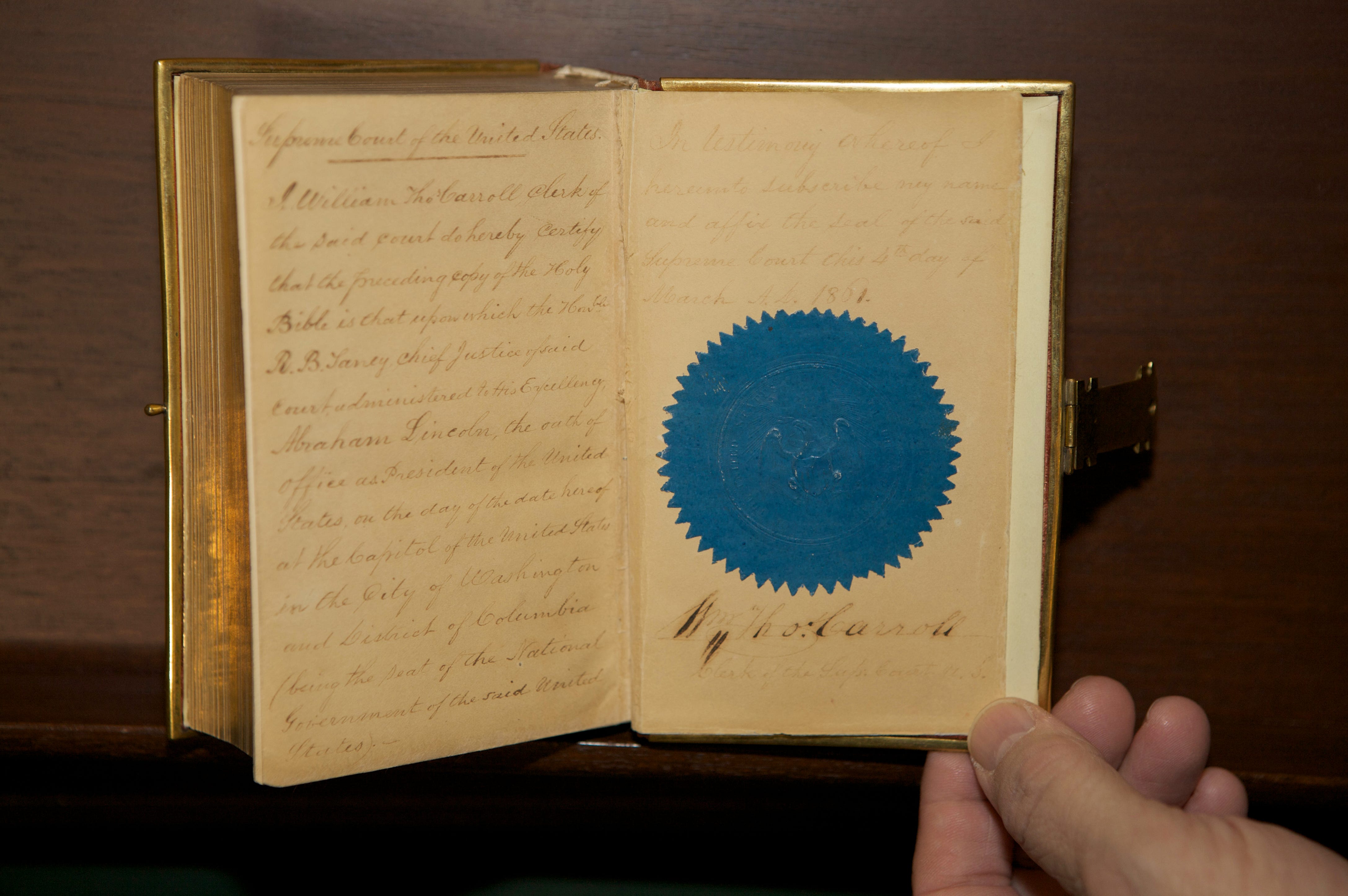
The federal oath changed during the Civil War. Lincoln ordered an expanded oath for executive branch civilian employees in 1861. Congress revised it in 1862, when “So help me God” became part of the statutory oath for nonpresidential federal offices. Later revisions produced the form used today.
The oath requires officials to “support and defend the Constitution of the United States against all enemies, foreign and domestic.” They promise true faith and allegiance, take the obligation freely without mental reservation or purpose of evasion, and promise to carry out their duties well and faithfully.
And then they state, “So help me God.”
Officials can affirm instead. The constitutional obligation applies either way. Those who invoke God also make that promise in God’s name. The vast majority of people choose to swear.
The Constitution’s preamble gives us six national goals: form a more perfect union, establish justice, insure domestic tranquility, provide for the common defense, promote the general welfare, and secure the blessings of liberty.
So, in swearing on the name of the Almighty that they will support and defend the Constitution, they are swearing to support and defend the six national goals, on the name of the Almighty.
People judge their leaders by those national goals, even if they don’t consciously think in those terms. They may never say “domestic tranquility” or “general welfare.” But they know whether their community is safe and orderly, whether government treats them fairly, and whether they can make decisions about their own lives.
A leader won’t achieve everything. People should still be able to see a serious effort toward those goals, understand the decisions, and hold the leader responsible for what happens. Moral leadership requires taking responsibility for the people affected by your decisions.
One of our national goals is to maintain liberty.
Part of liberty is being able to make decisions about your own property. The idea of life, liberty, and property shaped the American founding. You own yourself and your labor. When you mix that labor with what the earth provides, it helps establish your claim to the property.
All the effort you make in your life to own anything begins with your own self. Your self creates the conditions that allow you to gain other property. Your personal self is the preeminent property you own.
And if you don’t have bodily autonomy, then you don’t own yourself.
That applies to a woman. Her body belongs to her. Pregnancy doesn’t change who owns her body.
What does self-ownership mean for a woman’s liberty?
The Fifth and Fourteenth Amendments protect life, liberty, and property against deprivation without due process of law. They don’t prohibit every government restriction. Courts generally address bodily autonomy as liberty, rather than treating the body as an ordinary possession.
We have a responsibility to judge whether government respects liberty.
An unborn child is living. Its life has value. The question is whether that life has preeminent rights over the mother.
And that brings us back to the commandment the voter raised with Talarico: “Thou shalt not kill.”
The word “kill” is central to this discussion.
The Hebrew word used in the original is lo tirtsach, from the verb ratsach. “You shall not murder.” Murder better expresses the commandment here than a rule against every taking of life.
The same Hebrew root also appears in passages about unintentional killing, so it doesn’t fit our modern legal categories perfectly. Biblical law distinguishes intent and circumstances. It doesn’t treat every taking of life as the same act.
Bottom line. The commandment does not say thou shalt not kill. It says thou shalt not murder.
Definitely a different concept. And to highlight the difference, let’s look at another question.
Does God condemn military service?
I served for twenty-one years. You might not hear it said this way often, but the military exists to kill people and break things in defense of the United States. Even if you’re not the one who pulls the trigger, you support that mission.
If “thou shalt not kill” condemns every taking of life, then it would condemn military members for the service they agreed to perform. That is unacceptable.
Do we condemn military members who lawfully kill in combat? No, we do not condemn them.
We recognize that the circumstances and justification matter. We aren’t the Almighty, but automatic condemnation of military service doesn’t follow from this commandment.
David’s armies killed many people. The biblical account doesn’t automatically condemn every soldier for serving. It also takes bloodshed seriously: First Chronicles says David would not build the temple because he had shed so much blood and fought so many wars.
We cannot accept the distinction between killing and murder for military members, then refuse to consider that distinction when we talk about a woman’s ability to make decisions about her own body.
Military service shows why saying taking a life doesn’t finish the argument. If you call it murder, you still have to explain why it is wrongful killing.
So. The act of killing does not necessarily violate God’s law. Every circumstance is different.
The unborn child’s dependence doesn’t give it a superior claim to the mother’s body. Her body remains hers.
Parents have responsibilities to their children. But requiring care for a child and requiring someone to sustain a life inside her body are different obligations.
Other people can feed a child, provide a home, or take over the child’s care. They can’t take over this woman’s pregnancy. The law would require her particular body to sustain it.
A woman’s authority over her own body is foundational to her liberty. Recognizing the unborn child’s life doesn’t require giving it preeminent rights over her. The decision about her pregnancy belongs to her.
Let’s go back to the oath.
An official who swears to support and defend the Constitution accepts an obligation to secure the blessings of liberty. Using government to take away a woman’s authority over her pregnancy violates that obligation.
And if that official invoked God, their commitment to the Almighty is preeminent. You don’t get to disregard a promise made in God’s name because you want to use religion to justify a different decision.
Sincere disagreement about the Constitution doesn’t prove someone lied. But knowingly breaking a promise made in God’s name misuses that name.
Moral leadership requires understanding what your decisions demand of other people. What are you requiring this woman to go through? What happens to her health and her family? Does your decision achieve our national goals, including liberty?
The leader needs to answer those questions. Invoking God doesn’t answer them.
A woman may never describe her pregnancy as a question about our national goals. No matter. A family going through a loss knows whether government helps them get care or makes it harder.
Our leaders take an oath to support and defend the Constitution. We should judge them by whether they work toward our national goals, including a woman’s liberty to make decisions about her own body. And if they swore that oath in God’s name, then they need to keep that promise.
Before we sign off, let’s go through the logic so I didn’t miss anything.
First, if we make a promise using the name of the Almighty, we shall not make God witness to a lie.
Let’s build on that. Second, anyone who swears an oath in God’s name to support and defend someone’s right to liberty, shall not make God witness to violating that persons liberty.
Third, bodily ownership and autonomy are foundational to liberty. You can own no property without your body, therefore your body is property you own and use to secure all other property. Your self is your most valuable property.
Fourth, ownership doesn’t mean unlimited authority. We accept restrictions on how people use their property. But requiring a woman to sustain another life inside her body goes much further than restricting how she uses something she owns. It gives someone else an enforceable claim to the use of her body.
Fifth, parents have responsibilities to their children. But providing care and sustaining a pregnancy are different obligations. Other people can feed a child, provide a home, or take over the child’s care. They cannot take over this woman’s pregnancy. Government would compel her personally to provide that bodily support. The unborn child’s dependence matters, but dependence alone does not establish a right to compel another person’s body to sustain you.
Sixth, a woman’s authority over her own body is foundational to her liberty. The unborn child’s life has value. But that value doesn’t give it preeminent rights over her body. The decision about her pregnancy belongs to her.
Last. This right does not violate God’s law. The commandment prohibits murder. Taking a life does not, by itself, mean murder. We recognize that distinction in military service.
The argument for a woman’s right rests on her authority over her own body. The unborn child’s life has value, but dependence does not give it a superior claim to her body or give government the authority to compel her to sustain it.
In fact, denying her the right to make her own decisions while swearing on the Almighty that you support her right to liberty makes God witness to a lie. And the Almighty states clearly we will not call upon their name to lie.
Sources
The Talarico exchange. CNN’s transcript records the discussion of abortion, the Ten Commandments, and medical care during James Talarico’s October 14, 2026 town hall. CNN. “CNN & Jubilee Town Hall with James Talarico.” October 14, 2026. Transcript.
The commandments and God’s name. Exodus prohibits misuse of God’s name, Leviticus prohibits swearing falsely in God’s name, and Luther’s catechism addresses lying and deception under that commandment. The Holy Bible, Exodus 20:1–17 and Leviticus 19:12; Luther, Martin. “The Ten Commandments.” Small Catechism, 1529. Text.
The oath of office. Congressional histories trace the federal oath through Lincoln’s 1861 action, Congress’s 1862 revision, and subsequent changes, including the incorporation of “So help me God.” United States Senate. “Oath of Office.” History and text; United States House of Representatives, Office of the Historian. “Oath of Office.” History.
National goals and constitutional obligations. The preamble states six national purposes, Article VI requires an oath or affirmation, and the Fifth and Fourteenth Amendments protect life, liberty, and property through due process. United States Constitution. National Archives. Constitution and preamble; Bill of Rights; Amendments 11–27.
Self-ownership and property. Locke connects ownership of one’s person and labor to the acquisition of property, while also discussing duties to preserve life and care for children. Locke, John. Second Treatise of Government, §§ 6, 27, 56, 123–126. Complete text; property excerpt, University of Chicago.
The Supreme Court’s abortion ruling. The Court overturned Roe and Casey and held that the federal Constitution does not confer a right to abortion. Dobbs v. Jackson Women’s Health Organization, 597 U.S. 215 (2022). Opinion and dissents.
Killing, murder, and the Hebrew verb. The Hebrew verb ratsach appears in passages concerning both murder and unintentional killing, with biblical law distinguishing intent and circumstances. Brown, Francis, S. R. Driver, and Charles A. Briggs. A Hebrew and English Lexicon of the Old Testament, entry for רָצַח, Strong’s H7523. Lexicon entry; The Holy Bible, Numbers 35.
David and bloodshed. First Chronicles identifies David’s wars and bloodshed as the reason he would not build the temple. The Holy Bible, 1 Chronicles 22:7–10.
Medical care after stillbirth. Clinical guidance addresses delivery after fetal death, including how timing and method depend on medical circumstances and patient preferences. American College of Obstetricians and Gynecologists and Society for Maternal-Fetal Medicine. “Management of Stillbirth.” Obstetric Care Consensus, no. 10, March 2020. Clinical guidance.
Texas law and pregnancy loss. Texas law excludes removal of a fetus that died from spontaneous pregnancy loss from its definition of abortion and expressly addresses that treatment within reasonable medical judgment. Texas Health and Safety Code, § 245.002 and § 170A.0022.
Get full access to I Believe at joelkdouglas.substack.com/subscribe