transcript
show notes
Early this morning, I was scrolling through social media (more specifically Substack), and I found this quote from the Li Ji, the Confucian book of rites:
“The superior man is respectful and reverent, assiduous in his duties and not going beyond them. Retiring and yielding, thus illustrating the principle of propriety.”
“道德仁義,非禮不成;教訓正俗,非禮不備;分爭辨訟,非禮不決;君臣上下、父子兄弟,非禮不定;宦學事師,非禮不親;班朝治軍,蒞官行法,非禮威嚴不行;禱祠祭祀,供給鬼神,非禮不誠不莊。是以君子恭敬、撙節、退讓以明禮。
This passage is from the ancient Chinese classic Liji (《禮記》, or Book of Rites), specifically from the chapter "Qu Li I" (《曲禮上》). The text was compiled and edited in the 1st century BCE by the Han Dynasty scholar Dai Sheng (戴聖), collecting earlier ritual philosophies from the school of Confucius. The English translation used here is by the British sinologist James Legge (理雅各), originally published in 1885 in The Sacred Books of the East (Vol. 27).
I was scrolling fast, and I actually read property instead of propriety. I started the inquiry with the wrong word. Only later did I realize the confusion, but it had planted a seed for this article. I had not even read the quote properly. My mind took the word somewhere else.
So typical, lol.
Then when I listened to what I was dictating, I realized that I was mixing them up, realizing that the word was propriety, and these kinds of mishaps are what I enjoy so much about my self-inquiry, because propriety, proper, and property are connected through the idea of what belongs to someone or something, what is proper to its nature, and what sits within its rightful place.
The confusion was not itself a mistake, it was one of those intuitive leads that makes the inquiry so rich itself.
I focused on the word “property,” deciding to take it apart. Within the Confucian way of thinking, conduct reveals character. behavior: the 君子 (Jūnzǐ) what we can call the cultivated individual, the sage, the one who knows how to behave, understands his or her position inside a relationship and acts according to its measure. He carries what belongs to him and is also able to recognize the boundary that belongs to the other. Therefore, knowing when his action has reached its proper limit.
Let’s dissect the word “propriety.” Here is the part that made me laugh when I looked it up: propriety and property come from the same Latin root, proprietas, from proprius, which means one’s own. For a long time, the two words were kind of the same thing. Propriety could mean ownership, and property could mean a quality that belongs to a thing. The English language eventually made a difference between them: something that pertains to land or something that pertains to etiquette and behavior. Both still carry the idea of what belongs to someone or something, what is appropriate to its nature, and what sits within its rightful place. Property here becomes part of the boundary that assigns value to the action.
Then there is li, the Chinese word that the English translation turned into propriety. Li is closer to the gesture of something behaving rather than the strict definition of a character: how you bow, who pours the tea first, which seat is yours, the way a family does things because the grandparents did them. It is a form that insinuates and inspires in you a very specific behavior.
Proprius begins with the thing itself, with what is its own, and moves outward from there. We can see that the Jūnzǐ, with this gesture of bowing, is part of a ritual and is acting from the inside.
Obviously, my mind wanted to immediately distill it from the Austrian economics perspective. Mises begins with the acting individual. As an individual chooses and acts, he assumes the consequences. Rothbard takes this structure into property rights, where the question becomes very concrete: what is mine to decide and what is yours to decide, and where is the boundary between us?
I ended up thinking: this phrase,
“Know your place in the relationship. Carry your part fully. Respect the boundary of the other, and know when to advance and when to withdraw.”
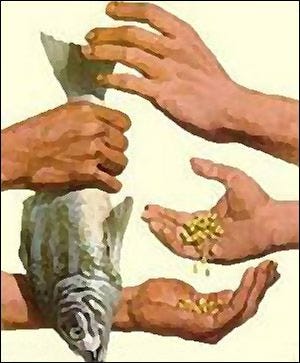
The economic structure within those lines gives action to a boundary, and once this limitation is clear, responsibility arises with it, within it. I can act within what belongs to me, and you can act within what belongs to you. The exchange requires that each person recognizes the other as someone with authority over his or her own domain.
A property is something one owns. A property is also a quality that belongs to something by itself. Its nature, integrity can be a property of character, and discipline can be a property of conduct. A foundation has properties that determine what it can carry or not. Therefore, the final question is: what are the properties of a character capable of recognizing the property of another?
You see here: the character, the person, the noble man, the sage, the person who is awake and conscious, is able to recognize his own actions and take responsibility for them. As that happens simultaneously, he’s also capable of seeing the limitations between himself and another situation, person, or thing (or the properties of this situation, person, or thing) and giving value to that. Therefore, he knows how to act.
Yes, the properties of one character are capable of recognizing the property and limitations of another.
Character is revealed through conduct. Confucian ethics is deeply concerned with the cultivation of a person whose behavior expresses an internal order. The Jūnzǐ develops the capacity to recognize measure, relationship, responsibility, and the proper place of his own action.
If we think of Aristotle’s ethics, character is formed through action and habit. Virtue becomes a disposition, a way of behaving that develops through practice. A person learns how to judge a situation and act according to its particular conditions. Ethics is a practice.
The properties of my character determine how I exercise my own agency. They also determine whether I can recognize the domain of another person.
If I understand my own action, I can assume responsibility for its consequences. If I recognize the properties of the person, situation, object, or relationship in front of me, I can perceive its limits and give those limits value.
A material has properties that determine how it can be used. A structure has properties that determine what it can sustain. A human being also has properties that determine how he or she acts.
Property rights make this visible in economic relationships because they establish a domain. They answer a fundamental question: Who has the authority to decide?
Mises begins with human action because economic life originates in individuals making choices. Rothbard follows the implications of those choices into ownership and property rights. Once I recognize another person as having authority over his own domain, my own action acquires a boundary.
The boundary in itself is not just serving as a limitation that separates, but it actually has so much information.
It imforms me what belongs to me to decide also what belongs to another. It tells me when an exchange requires consent, when responsibility belongs to me, and when the integrity of another person, object, or situation asks me to withdraw.
Then the original Confucian idea of propriety becomes surprisingly close to the question that started all of this for me.
What is proper?
What belongs here?
What belongs to me?
What belongs to another?
And what properties of my own character allow me to recognize the difference?
This is one place where ethics, conduct, and economics agree: in the quality of the person who acts and in his capacity to recognize the limits that give value to action.
I hope you enjoy this short article.
I recently became obsessed with Cameron Winter and his Band Geese 👇 enjoy!
This is a public episode. If you'd like to discuss this with other subscribers or get access to bonus episodes, visit www.monikabravo.blog/subscribe