Skip to content
Artwork for Home Care Hindsight
Health & FitnessBusinessManagement

Home Care Hindsight

David Knack

Welcome to Home Care Hindsight, where we dive deep into the lessons learned and strategies developed by home care providers to build a resilient and dedicated workforce. Powered by Ava, this podcast is your go-to resource for insights on retaining caregivers, reducing turnover, and optimizing your operations. Join us as we share real stories, expert advice, and practical tips that help you keep your caregivers happy and your business thriving.

Play
  • 20 episodes
  • weekly
  • Avg 41 min
  • English
  • #94
    Wednesday · 43 min

    Why I Stopped Trying to Lead Alone – Guy Tommasi

    In this episode of Home Care Hindsight, host David Knack welcomes Guy Tommasi, a seasoned leader in the home care industry with over 25 years of experience. Guy shares his journey from hospital care to pioneering innovative, data-driven strategies in non-medical home care. He takes us to a discussion of the importance of differentiating your agency by aligning with stakeholders' needs, leveraging data to demonstrate outcomes, and the pitfalls of overemphasizing "scaling" as a measure of success. Guy also highlights the transformative power of collaboration, both within teams and with clinical partners, and why home care agencies should seize opportunities in higher-acuity care. Lesson Takeaways: 1. Success is Defined by You: Don't let external benchmarks like "scaling" dictate your agency's success. Focus on what aligns with your goals and values. 2. Speak Your Stakeholders' Language: To stand out in a competitive market, translate your services into outcomes that matter to referral sources, such as reduced hospital readmissions and improved patient satisfaction. 3. Empower Your Team: Leadership isn't about making all the decisions—it's about involving your team, fostering ownership, and trusting them to drive innovation. 4. Don't Assume Clinical Programs Aren't for You: Non-medical home care agencies can play a critical role in value-based care and hospital-at-home programs. Challenge assumptions and explore new revenue streams. Timestamps: 00:00 - Welcome to Home Care Hindsight 02:10 - The competitive landscape of Connecticut's home care market 04:35 - How data became a differentiator for Guy's agency 08:28 - The power of speaking stakeholders' language 12:19 - Overcoming the "private pay" objection with referral sources 16:39 - Guy's "Neuralizer" moment: The 2004 Yankees-Red Sox World Series 19:48 - The big mistake: Trying to lead alone instead of empowering the team 25:00 - A team success story: How a supervisor transformed their data program 29:47 - Why "scaling" is overrated in home care 33:25 - The problem with calling caregivers "unskilled" 36:24 - The mistake of leaving clinical opportunities on the table 42:10 - Guy's proudest moment: Helping an agency join a hospital-at-home program 45:00 - Final plug: Home care's strategic role in the future of healthcare Quotes: Guy Tommasi: "Success is what you feel it is. Don't let the word 'scale' intimidate you or dictate whether you're successful or not." David Knack: "An urgent problem in home care is also an important one, which makes it crucial to respond with emotional maturity." Guy Tommasi: "Don't assume because something is 'clinical' that it's not for you. 80% of health outcomes are non-medical—that's our space." Guy Tommasi: "Leadership isn't about dragging people along—it's about directing their energy and letting them own the results." Resources: 1. Guy Tommasi on LinkedIn: https://www.linkedin.com/in/guy-tommasi-a0a4bb18/ 2. Corcoran Consulting Group LLC: https://www.corcoranconsultants.com/ 3. Corcoran Consulting Group LLC on LinkedIn: https://www.linkedin.com/company/corcoranconsultinggroup-llc/ 4. Connect with David Knack on LinkedIn: https://www.linkedin.com/in/david-knack/ 5. Connect with Zingage on LinkedIn: https://www.linkedin.com/company/zingage/ 6. Powered by Zingage: https://zingage.com/ 7. Watch Episode on Zingage's YouTube: https://www.youtube.com/@Zingage

  • #93
    Wednesday · 44 min

    Why Delegation Is The Key To Growth (What I Wish I Knew) — Jeff Salter

    Jeff Salter, Founder and CEO of Caring Senior Service, joins host David Knack for an unforgettable conversation about leadership, growth, and a cross-country adventure. Jeff shares how a 9,500-mile electric bike journey to celebrate his company's 30th anniversary transformed his perspective on delegation and leadership. Along the way, he raised $170,000 to install grab bars in senior homes, creating a lasting impact. This episode dives deep into Jeff's mindset shift from "doing it all" to empowering his team, the lessons learned from mistakes, and his innovative approach to improving the home care industry with tools like InkyScribe. Packed with stories of perseverance, humility, and progress, this is one you won't want to miss. Lesson Takeaways: 1. Trust your team—delegating unlocks time for bigger goals. 2. Bold milestones, like Jeff's bike ride, can inspire movements and strengthen company culture. 3. Data-driven decision-making should focus on internal metrics, not industry averages. 4. Clear, respectful communication is vital to retaining employees and clients. Timestamps: [00:00:00] [00:00:00] Introduction to Jeff and his career in home care. [00:03:00] The 9,500-mile bike ride: celebrating 30 years and raising $170,000. [00:09:00] Lessons in delegation: what Jeff learned on the road. [00:14:00] Jeff's big mistake: not asking for help earlier in his career. [00:24:00] Why internal data is more valuable than chasing industry stats. [00:31:00] Communication as a key to employee retention. [00:37:00] Delegation and automation tips to kickstart the new year. Quotes: 1. Jeff Salter: "I celebrated 30 years of business by biking 9,500 miles—and I learned I'm not as important as I thought." 2. Jeff Salter: "Anything you think only you can do, someone else can learn and thrive doing." 3. David Knack: "Big change starts with a bold move—Jeff's bike ride is proof." Resources: 1. Connect with Jeff Salter on LinkedIn: https://www.linkedin.com/in/jeff-salter-10871a7/ 2. Caring Senior Service: https://caringseniorservice.com/ 3. Connect with David Knack on LinkedIn: https://www.linkedin.com/in/david-knack/ 4. Connect with Zingage on LinkedIn: https://www.linkedin.com/company/zingage/ 5. Powered by Zingage: https://zingage.com/ 6. Subscribe on Zingage's YouTube:https: //www.youtube.com/@Zingage

  • #92
    Wednesday · 40 min

    Why the Caregiver Shortage is a Myth - Julio Briones

    In this episode of Home Care Hindsight, host David Knack sits down with Julio Briones, CEO of The Briones Group Consulting, to explore his unique journey in the home care industry. From his start in home care at the tender age of 15 to becoming a well-respected consultant, Julio shares valuable lessons learned along the way. The conversation takes a deep dive into the challenges of hiring, the myth of the caregiver shortage, and the importance of proper legal documentation. Julio's story is a mix of humor, hard-won wisdom, and a surprising love for karaoke. This episode is a must-listen for anyone in the home care industry looking to avoid common pitfalls and find innovative solutions to their staffing challenges. Lesson Takeaways: • Always invest in having your service agreements professionally reviewed to protect your intellectual property and avoid costly mistakes. • Relying on one client or one type of service can be risky. Explore additional verticals to ensure business stability. • Whether it's with clients or caregivers, nurturing relationships is crucial for business growth and employee retention. • Make quick decisions based on measurable outcomes and don't be afraid to cut losses when necessary. Timestamps: [00:00:00] Getting to know Julio and his career in home care. [00:01:50] Julio's perspective on hiring stay-at-home moms for flexible roles. [00:06:32] Discussing Julio's biggest mistake in consulting and the lessons learned. [00:12:00] The importance of proper legal documentation in business. [00:17:21] Overrated vs. Underrated: Julio's take on the caregiver shortage myth. [00:30:30] The art of failing quickly: why making quick decisions can save your business. [00:38:40] Julio's latest business ventures and what excites him about the future. Quotes: • Julio Briones: "The best lessons that we learn in life and what creates true wisdom are usually the most painful and most expensive for us to learn." • David Knack: "Learning's always expensive." • Julio Briones: "There's no shortage of caregivers; there's a shortage of agencies that know how to retain them." Resources: 1. Briones Consulting Group: https://bcgclienttools.com/is-our-partnership-the-right-fit 2. Julio Briones on LinkedIn: https://www.linkedin.com/in/julio-briones/ 3. Connect with David Knack on LinkedIn: https://www.linkedin.com/in/david-knack/ 4. Connect with Zingage on LinkedIn: https://www.linkedin.com/company/zingage/ 5. Powered by Zingage: https://zingage.com/ 6. Watch Episode on Zingage's YouTube: https://www.youtube.com/@Zingage

  • #91
    July 7 · 26 min

    SEO, Google Ads, and AI in Home Care — Jeremy Fuller

    Jeremy Fuller, a digital marketing expert with 23 years of experience and founder of Grow Senior Care Marketing, shares actionable insights for home care agencies. In this episode, you'll discover: 1. The ChatGPT Surprise: How a client found their agency through ChatGPT—without it being a marketing goal. 2. The $500 Mistake: Why most home care agencies waste 80% of their Google Ads budget (and how to fix it). 3. Automation Pitfalls: The dangers of over-automating caregiver recruitment and how to strike the right balance. 4. SEO Myths Debunked: Why tracking rankings isn't SEO—and what moves the needle. 5. AI's Double-Edged Sword: How AI changes search behavior and the risks of unvetted AI-generated content. Lesson Takeaways: 1. Stop Choking Ad Spend: A $500/month Google Ads budget is often too small to be effective—either go bigger or pause entirely. 2. Humanize Automation: Use tech to streamline processes (like caregiver nurturing), but keep critical touchpoints personal. 3. Reviews Matter: Agencies with 100+ Google reviews dominate local search—aim higher than the industry average of 40. 4. AI Proof Your Content: Always review AI-generated material for compliance risks (e.g., "fall prevention" vs. "fall assistance"). Timestamps: 00:00 - Introduction 01:20 - Guest Introduction 01:23 - The unexpected ChatGPT client discovery story 02:47 - AHA! Moments, Learnings and Opportunities from Checking Business Processes in Home Care Agencies 03:17 - Jeremy's partnership to launch a home care agency in Tulsa 03:45 - Compliance challenges and automation opportunities in home care 05:00 - The problem with sending caregivers back to Indeed 06:55 - Jeremy's unique approach: Offering prayer during marketing audits 07:45 - The big mistake: Over-automating caregiver communication 09:10 - How to automate wisely (without losing the human touch) 11:06 - The most underrated SEO tactic: Google reviews 12:12 - What SEO actually is (and isn't) 14:27 - Mistakes Home Care Makes: Choking Google Ads Spend 16:43 - Why small Google Ads budgets fail—and how to optimize keywords 18:17 - Jeremy's recent SEO breakthrough (the "quarter pickup" strategy) 20:00 - AI's impact: ChatGPT as a search alternative and compliance risks 23:22 - The danger of AI "slop" and how to avoid it Quotes 1. "80% of Google Ad budgets are wasted on the wrong places. If you're spending $500/month, you might as well not run ads at all." — Jeremy 2. "SEO isn't tracking rankings—it's taking actions to send Google the right signals. Reviews are part of that, but not the whole story." — Jeremy 3. "AI is like the early days of Google. It's not replacing search yet, but it's starting to uptick—and home care needs to pay attention." — Jeremy Resources: 1. Grow Senior Care Marketing: https://growseniorcaremarketing.com/ 2. Jeremy Fuller on LinkedIn: https://www.linkedin.com/in/jeremy-fuller-marketing/ 3. Ultimate Home Care Marketing Session: https://growseniorcaremarketing.com/grow-my-agency/ 4. Connect with David Knack on LinkedIn: https://www.linkedin.com/in/david-knack/ 5. Connect with Zingage on LinkedIn: https://www.linkedin.com/company/zingage/ 6. Powered by Zingage: https://zingage.com/ 7. Watch Episode on Zingage's YouTube: https://www.youtube.com/@Zingage

  • S1 · E90
    June 30 · 42 min

    Exclusivity Almost Killed Our Culture — Jensen Jones

    Jensen Jones, CEO of Home Care CEO, opens up about the surprising mindset shift that reshaped his entire business model from an "exclusive" high-revenue think tank to a values-driven, mission-aligned community. In this candid conversation, Jensen and host David Knack explore how aligning personal values with business decisions can radically improve culture, retention, and growth. Jensen reflects on how his father's illness helped define his core values and how he now helps agencies scale without losing their humanity. He reveals the dangers of over-customizing roles, why playbooks prevent burnout, and why culture, not revenue, is the most accurate measure of success. In this episode, you'll discover: 1. How exclusivity undermined his mission and what he did to fix it. 2. The "playbook" system that makes tribal knowledge scalable. 3. Why caregivers should be your biggest fans (and how to make it happen). 4. How defining roles instead of people avoids disaster. 5. Why agencies growing on paper might actually be stuck. Lesson Takeaways: 1. Define your culture first and then align everything else. 2. Exclusivity creates silos; accessibility builds connection. 3. You can't scale around unicorns. Build roles, not people. 4. Retention isn't just a strategy. It's a reflection of values lived daily. 5. Revenue without culture is just noise. Growth starts from within. Timestamps: 00:00 – Welcome to Home Care Hindsight 01:25 – Meet Jensen Jones & his core values 05:25 – The story of his father's illness & realignment 07:22 – Why exclusivity clashed with his mission 10:40 – Scaling relationships across revenue groups 14:52 – Turning members into the face of Home Care CEO 15:15 – How peer groups amplify values and ideas 18:02 – Culture that makes you want to work there 17:30 – Caregiver-first culture in action (with a flat tire) 22:07 – Screening for values during hiring 23:26 – Why top-line revenue is overrated 26:30 – Defining scalable roles, not just people 29:46 – Don't punish your producers—manage bandwidth 31:34 – The value of team-created playbooks 32:24 – Playbooks as culture and training tools 36:33 – Using the org chart to plan your future team 37:36 – Hiring for the agency you want, not just the one you have 38:01 – Recent wins: Member growth, new groups, and impact 39:55 – Final thoughts & how to connect with Jensen Quotes: 1. "I don't want to be the face of Home Care CEO. Our members are the face. Let's amplify their voices." — Jensen Jones 2. "Culture isn't on the wall—it's what people repeat, live, and use to make decisions." — Jensen Jones 3. "We're not scaling unicorns—we're scaling systems." — Jensen Jones 4. "Revenue's up, but census is flat? That's not growth. That's inflation." — Jensen Jones Resources: 1. Jensen Jones on LinkedIn: https://www.linkedin.com/in/jensenjones/ 2. Home Care CEO's website: https://www.homecareceo.com/about-us/ 3. HOMECAREceo Forum Community: https://www.linkedin.com/groups/3273154/ 4. Connect with David Knack on LinkedIn: https://www.linkedin.com/in/david-knack/ 5. Connect with Zingage on LinkedIn: https://www.linkedin.com/company/zingage/ 6. Powered by Zingage: https://zingage.com/ 7. Watch Episode on Zingage's YouTube: https://www.youtube.com/@Zingage

  • #89
    June 26 · 36 min

    The Two Jobs I Wish I'd Focused On Sooner – Chuck Bailey

    In this episode of Home Care Hindsight, host David Knack welcomes Chuck Bailey, founder and CEO of True North Holdings, to discuss the realities of being a small business owner in the home care industry. With decades of experience as a corporate executive, franchisee, franchisor, and now a service provider to franchisees, Chuck shares invaluable insights on the challenges of entrepreneurship, the importance of financial discipline, and the two critical roles every business owner must master: driving revenue and building a team. He also reflects on his biggest mistake: trying to control everything, and how learning to delegate and trust his team transformed his business. Lesson Takeaways: 1. The Two Core Responsibilities of an Owner: Focus on driving revenue and building your team. Everything else can be delegated or outsourced. 2. Avoid Overcontrol: Holding onto tasks too tightly limits growth. Delegate early and trust your team to execute, even if their methods differ from yours. 3. Financial Cadence is Key: Regularly review your finances, regardless of whether you're struggling or thriving. Consistency in financial oversight prevents surprises and fuels growth. 4. Hire for Vision Alignment: Prioritize hiring bright, adaptable people who understand and embody your mission, rather than just industry experience. 5. AI as a Tool, Not a Miracle: While AI can enhance consistency and efficiency, it requires training and alignment with your business's core values to be effective. Timestamps: 00:00 - Welcome to Home Care Hindsight powered by Zingage 02:24 - The challenges of being a small business owner in home care 07:25 - Chuck's biggest mistake: Trying to control everything 12:44 - The importance of mission and vision in team building 19:18 - Financial cadence: Why it's critical for business success 24:41 - Overrated in home care: Exotic marketing solutions 29:50 - The role of AI in home care and maintaining message consistency 34:31 - A small mistake with big consequences: Delegating sales too soon 40:41 - Chuck's win of the week: Launching My Franchise Bookkeeper Quotes Chuck Bailey: "The two jobs of a business owner are to drive revenue and build the team. Everything else can be outsourced." David Knack: "The rub of leadership is holding the vision tightly but the execution loosely." Chuck Bailey: "People buy from people who care. That's the foundation of home care." Chuck Bailey: "80% of AI is crap. The 20% that works can change your business—if you train it right." Resources 1. Chuck Bailey on LinkedIn: https://www.linkedin.com/in/charlesbailey/ 2. True North Holdings on LinkedIn: https://www.linkedin.com/company/true-north-holdings/ 3. True North Holdings website: https://www.true-north-holdings.com/ 4. My Franchise Bookkeeper: https://www.linkedin.com/company/myfranchisebookkeeper/ 5. Connect with David Knack on LinkedIn: https://www.linkedin.com/in/david-knack/ 6. Connect with Zingage on LinkedIn: https://www.linkedin.com/company/zingage/ 7. Powered by Zingage: https://zingage.com/ 8. Watch Episode on Zingage's YouTube: https://www.youtube.com/@Zingage

  • June 16 · 35 min

    The Leadership Mistake That Created Most of My Team Problems — Jeremy Meng

    Jeremy Meng, owner of Always Best Care, Jacksonville, tells host David Knack his biggest leadership mistake: assuming others think and operate like him. As an Air Force vet and federal agent, he brought unspoken expectations into home care, causing confusion with clients and caregivers. Fixing this changed how he onboards, trains, writes contracts, and leads. Jeremy also embraces AI (Claude, Zingage Operator) to strengthen operations, find compliance gaps, automate busywork, and free time for human connection, not to replace people, but to reduce admin burdens and protect meaningful moments. The discussion covers servant leadership, communication, expectation-setting, AI, and a simple lesson that solved problems he once blamed on others. Lesson Takeaways: 1. Unspoken expectations create most problems: What's obvious to you isn't to others. Complaints and breakdowns often stem from assumptions never clearly stated. Leaders must articulate expectations explicitly. 2. Under-promise and define success clearly: Clients are happier when they know exactly what to expect. Transparency and clear boundaries build trust better than vague promises. 3. Caregivers need clarity, not correction: Many performance issues come from unclear instructions, not bad workers. Specific dos/don'ts and consistent coaching reduce conflict and boost confidence. 4. AI should support human relationships: The goal is to remove repetitive work so staff can focus on serving clients and caregivers; tech should increase, not decrease, human connection. 5. Front-end work determines AI success: Investing time in workflows, guardrails, and escalation points before launch yields far better results than fixing problems post-implementation. Timestamps: 00:00 – Welcome to Home Care Hindsight podcast powered by Zingage 01:12 – Introducing Jeremy Meng and his background in the Air Force and law enforcement 02:49 – Why Jeremy resisted entering healthcare and home care 03:42 – Using AI to improve communication, compliance, and operations 06:26 – Building roles, responsibilities, and policies with AI 09:50 – Implementing AI agents inside a home care business 11:42 – How AI reduced after-hours scheduling burdens 13:43 – Using Ask Riley to improve operational workflows 14:20 – Maintaining the human touch while adopting AI 17:20 – Jeremy's advice for successfully implementing AI 18:44 – Transition to Home Care Hindsight's "big mistake" 19:10 – The danger of unspoken expectations 20:21 – Setting expectations with clients from day one 21:34 – Where caregiver expectations were breaking down 21:44 – "I thought everyone operated like me" Quotes: Jeremy Meng: "I thought everyone operated like I did because I was with a bunch of military folks. And they don't. They need specific guidelines of dos and don'ts." Jeremy Meng: "Most clients are good if you let them know the expectations. If you're going to promise them everything and then under-deliver, that's where the problems start." Jeremy Meng: "This wasn't a way of us getting away from that human touch. It was actually helping us provide more of that human touch." Jeremy Meng: "As the owner and leader, I need to do that. That was bad on me. That was not on them." David Knack: "This is taking on a lot of the mundane stuff that wears people out, but still maintaining the level of service that clients expect." Resources: 1. Connect with Jeremy Meng on LinkedIn: https://www.linkedin.com/in/jeremy-meng-meng78corp/ 2. Learn more about Always Best Care Senior Services: https://alwaysbestcare.com/shalimar/about-us/ 4. Connect with David Knack on LinkedIn: https://www.linkedin.com/in/david-knack/ 5. Powered by Zingage: https://zingage.com 6. Watch this episode on Zingage's YouTube: https://www.youtube.com/@Zingage

  • #87
    June 9 · 58 min

    Pulling Back the Curtain on Clear Path Home Care's Strategic Exit — JM Simmonds, Michelle Simmonds & Alex Veach

    JM and Michelle Simmonds join David Knack alongside Alex Veach of Agenda Health for a behind-the-scenes look at the journey from startup founders to successful sellers—and what came next after the deal closed. What began as a small home care agency eventually grew into Clear Path Home Care, a multi-location operation serving rural communities across Texas and Colorado. Rather than chasing large metropolitan markets, the Simmonds built their reputation by going where others wouldn't—bringing care to underserved communities, creating jobs in rural areas, and becoming a trusted provider for veterans through their VA partnerships. The conversation explores the realities of building a home care business without a roadmap, the challenges of scaling across multiple markets, and the operational decisions that ultimately made Clear Path an attractive acquisition target. JM and Michelle share how they transitioned from owner-operators into executive leaders, why they initially had no plans to sell, and how a routine valuation unexpectedly opened the door to a life-changing opportunity. Alex Veach provides the advisor's perspective on what buyers are looking for in today's market, why some agencies command premium valuations, and the common mistakes owners make when preparing for an eventual exit. Together, they unpack the importance of leadership development, operational independence, payer diversification, and long-term strategic thinking. Whether you're just starting your agency or already thinking about succession planning, this episode offers practical lessons on building a business that creates impact, generates value, and provides options for the future. Lesson Takeaways: 1. Build a Business Worth Owning Before Building One Worth Selling: Strong operations and culture create long-term value. 2. Underserved Markets Often Hold the Biggest Opportunities: Success doesn't always come from chasing the largest cities. 3. Community Relationships Drive Sustainable Growth: Local trust can become a powerful competitive advantage. 4. Owners Must Eventually Work On the Business, Not Just In It: Leadership teams create scalability and enterprise value. 5. Valuations Are Strategic Planning Tools: Understanding your agency's value can help guide future decisions and opportunities. 6. Revenue Concentration Creates Risk: Even successful payer relationships should be balanced with diversification. 7. Exit Readiness Starts Years Before a Sale: The best outcomes come from consistent preparation rather than last-minute planning. 8. Great Agencies Attract Great Buyers: Businesses built on strong fundamentals tend to create more opportunities when they go to market. Timestamps: 00:00 — Welcome to Home Care Hindsight Podcast powered by Zingage 01:32 — Meet JM Simmonds, Michelle Simmonds, and Alex Veach 04:06 — The founding story behind Clear Path Home Care 05:49 — Building a business before home care resources were widely available 06:15 — Moving operations from Austin to rural Texas 08:06 — Discovering unmet demand in underserved communities 09:14 — Reinvesting profits to fuel growth 09:36 — Expanding into new markets across Texas 10:32 — Michelle's transition from nursing to marketing leadership 11:52 — Growing as a private-pay agency 12:27 — The breakthrough opportunity with VA contracts 13:17 — Becoming the provider willing to serve overlooked markets 14:18 — How estate planning led to a professional valuation 15:17 — The conversation that sparked thoughts of an exit 16:00 — Evaluating opportunities beyond Clear Path 17:38 — Alex Veach's journey into healthcare M&A 19:31 — Why Agenda Health works with owners long before they sell 20:33 — What made Clear Path stand out in the market 21:42 — Building an agency that buyers wanted 22:03 — Lessons learned from creating a valuable business Quotes: Michelle Simmonds: "Do you want to make money or do you want to make a difference?" Michelle Simmonds: "I think we're going to have to make a difference before we make money." JM Simmonds: "You have to find someone in that market that has ties to that community." JM Simmonds: "A lot of business owners either don't have a plan beyond the sale, or they haven't built the business correctly to get there." Alex Veach: "Great agencies sell themselves." Resources: 1. Riverside Home Care — https://rivhc.com/ 2. Clear Path Home Care — https://clearpathhomecare.com/ 3. Connect with JM Simmonds on LinkedIn — https://www.linkedin.com/in/jm-simmonds-821430165/ 4. Connect with Michelle Simmonds on LinkedIn — https://www.linkedin.com/in/michele-simmonds-02a3811a7/ 5. Connect with Alex Veach on LinkedIn — https://www.linkedin.com/in/alex-veach/ 6. Agenda Health — https://agendahealth.com/ 7. (Mentioned) Brown & Fortunato 8. (Mentioned) Leading Home Care (Stephen Tweed) 9. Connect with David Knack on LinkedIn: https://www.linkedin.com/in/david-knack/ 10. Powered by Zingage: https://zingage.com 11. Watch this episode on Zingage's YouTube: https://www.youtube.com/@Zingage

  • #86
    June 2 · 1 hr 5 min

    Everyday AI. How Nick Bonitatibus Is Approaching AI in His Business (and Yours Too) — Nick Bonitatibus

    Nick Bonitatibus, founder of Digital Champions, joins host David Knack for a wide-ranging conversation about how AI is transforming the way entrepreneurs think, work, and operate their businesses. Rather than focusing on flashy tools or futuristic predictions, Nick shares practical examples of how he uses AI every day to eliminate repetitive work, document processes, and create systems that scale. From AI-powered airport planning to generating video outlines and social media content from a single client conversation, Nick explains why the real opportunity isn't automation—it's building repeatable systems that AI can execute. He breaks down the difference between AI memory and AI skills, why SOPs are becoming more valuable than ever, and how business owners can start creating leverage without losing the human touch that makes their businesses unique. Throughout the episode, David and Nick explore the mindset shift required to benefit from AI, the importance of embracing the learning curve, and why the operators who invest time now may gain a significant advantage in the years ahead. Lesson Takeaways: 1. AI Doesn't Replace Systems—It Amplifies Them: Businesses that already have documented processes are best positioned to benefit from AI. 2. Skills Create Repeatable Results: Teaching AI how to think through a task once can eliminate hundreds of future repetitions. 3. Start With Everyday Friction: Some of the best AI use cases come from solving small, recurring annoyances. 4. SOPs Are Becoming Strategic Assets: The more clearly a process is documented, the easier it becomes to delegate to AI. 5. Human Connection Still Matters Most: AI can handle production work, but trust, coaching, and relationships remain human responsibilities. 6. The Learning Curve Is Part of the Process: Failed experiments aren't wasted effort—they're how effective systems are built. 7. Small Time Savings Compound: Removing dozens of tiny decisions creates more mental bandwidth for meaningful work. Timestamps: 00:00 — AI-generated client storytelling and content creation in seconds 01:24 — Introduction to Nick Bonitatibus and Digital Champions 02:17 — Helping home care agencies grow through video marketing 03:23 — Family, kids, and finding joy in everyday moments 07:27 — New AI design tools and the future of creative work 10:01 — Why AI is useless without systems and SOPs 11:13 — Nick's AI-powered airport travel assistant 12:45 — Eliminating decision fatigue through automation 13:52 — The difference between AI memory and AI skills 15:49 — Creating client story videos using AI workflows 17:24 — Keeping the human element while automating production 18:31 — Building AI outputs that actually sound authentic 19:17 — Why most people quit before reaching the payoff 20:39 — The learning process behind successful AI adoption 21:29 — How Nick uses AI and Notion to organize his day Quotes: Nick Bonitatibus: "Automation doesn't mean anything without systems." Nick Bonitatibus: "Everyone needs to get really good at building systems and SOPs." Nick Bonitatibus: "With AI, you put in the work one time, and then you never have to do it again." David Knack: "You're designing the assembly line, but you're not the one doing the exact work every time." Nick Bonitatibus: "The process of it not working is the learning process." Resources: 1. Connect with Nick Bonitatibus on LinkedIn: ​​https://www.linkedin.com/in/lisa-hall-5507a728/ 2. Check out Nick's YouTube: https://www.youtube.com/@NickBonitatibus 3. Follow Nick on Instagram: https://www.instagram.com/nickjboni/ 4. Visit Nick's website: https://nickbonitatibus.com/ 5. Connect with David Knack on LinkedIn: https://www.linkedin.com/in/david-knack/ 6. Powered by Zingage: https://zingage.com 7. Watch this episode on Zingage's YouTube: https://www.youtube.com/@Zingage

  • #85
    May 26 · 39 min

    How I Stopped Being the On-Call Bottleneck and Let AI Handle the Chaos — Lisa Hall

    Lisa Hall, owner of Griswold Home Care, joins host David Knack to share how she scaled her home care agency from under 1,000 weekly hours to more than 2,000 hours while avoiding staff burnout. With a background in engineering and automotive quality systems, Lisa explains how operational discipline, SOPs, and AI-powered scheduling transformed her agency's growth trajectory. She shares the story of landing a major CCRC partnership after simply helping someone with a "pet project," and how that relationship ultimately doubled her business. Lisa also breaks down the operational chaos of traditional on-call systems and how implementing AI scheduling and call management allowed her team to reclaim evenings, weekends, and holidays without sacrificing quality of care. Lesson Takeaways: 1. Relationships Create Unexpected Growth: Helping others without expecting immediate returns can lead to major business opportunities later. 2. SOPs Make AI Powerful: AI only works effectively when clear procedures and escalation rules are already in place. 3. Operational Freedom Matters: Eliminating repetitive after-hours interruptions reduced burnout and allowed Lisa's team to scale without hiring additional schedulers. 4. AI Should Remove Friction, Not Humanity: AI handled repetitive coordination while human staff stayed focused on emotionally important situations. 5. Don't Buy Everything at Conferences: Early-stage operators often overbuy software and tools before fully understanding operational needs. 6. Vet Vendors Carefully: Talk to real operators already using a product before committing to new technology. 7. Scale Requires Systems, Not Heroics: Growth became manageable because processes, dashboards, and automation reduced "all hands on deck" emergencies. Timestamps: 00:00 — Lisa realizes AI handled the entire evening without a single phone call 01:31 — Introduction to Lisa Hall and Griswold Home Care 02:01 — Lisa's engineering and automotive background working with Tesla 03:19 — From struggling below 1,000 hours to explosive growth 04:39 — How a CCRC partnership unexpectedly transformed the business 05:46 — Employee appreciation and caregiver retention success stories 07:15 — Transitioning from traditional answering services to AI operations 09:06 — How the AI scheduling system works overnight and on weekends 10:17 — The two-day trial that convinced Lisa's entire team 12:43 — Managing hospitalizations and caregiver coordination with AI 15:49 — Handling complex hospital shift changes without human intervention 18:32 — Riley resolves caregiver call-offs before management even notices 20:22 — Lisa's biggest business mistake: buying everything at conferences 21:27 — How Lisa now evaluates vendors and adopts new technology Quotes: Lisa Hall: "By day two, we were like, 'How fast can we turn this on completely?'" Lisa Hall: "It was literally night and day because we were not getting all those repetitive questions anymore." Lisa Hall: "Riley handled everything. It was just fabulous." David Knack: "Riley filled that call-out before we knew it happened." Lisa Hall: "You can't implement everything at once." Resources: 1. Connect with Lisa Hall on LinkedIn: ​​https://www.linkedin.com/in/lisa-hall-5507a728/ 2. Learn more about Griswold Home Care: https://www.griswoldhomecare.com/ 3. Connect with David Knack on LinkedIn: https://www.linkedin.com/in/david-knack/ 4. Powered by Zingage: https://zingage.com 5. Watch this episode on Zingage's YouTube: https://www.youtube.com/@Zingage

  • May 19 · 41 min

    The 2026 Recruiting Playbook: Less No-Shows and More Conversations — Rachel Gartner

    Rachel Gartner, CEO of Carework, joins host David Knack to discuss the state of recruiting in 2026. Rachel shares her big mistake of running the old 2025 playbook where relying on free Indeed job postings and scheduling interviews caused massive inefficiencies. She explains how using AI to automatically schedule interviews actually caused her recruiters' live phone time to plummet. Instead of playing phone tag, Carework now uses AI to filter out unqualified applicants and immediately transfer ready caregivers to a live human. Lesson Takeaways: 1. Texting is Out, Calling is In: Texting engages caregivers but lacks commitment. Using AI to call candidates scales efficiently and connects you with applicants who are actually ready to work. 2. Stop Scheduling Interviews: Automated scheduling leads to massive no show rates and lowers recruiter efficiency. Instead, use AI to qualify candidates and transfer them live to a human. 3. Treat Scheduled Interviews as Missed Calls: If a candidate schedules a time, do not wait for the appointment. Call them right away because the first agency to offer a job usually wins. 4. Free Indeed Ads No Longer Work: You can no longer dump free job posts and hope for results. Agencies must sponsor their ads and stay in contact with their Indeed reps. 5. Let AI Handle Unqualified Calls: Recruiters burn out answering unqualified applicants or people ordering fast food. AI filters these out so your team only talks to qualified caregivers. Timestamps: 00:00 — Introduction to the 2026 recruiting playbook 02:29 — Rachel introduces Carework and staff recruiting 06:41 — The big mistake of relying on free Indeed ads 09:57 — Why caregivers are completely comfortable with AI 11:40 — The hot take that texting is out and calling is in 15:55 — Why scheduling interviews ruins recruiter efficiency 18:54 — Tracking live conversations instead of booked appointments 22:20 — The frustration of no shows for high volume agencies 26:22 — High leverage emergencies versus silly caller requests 30:47 — How AI filters out applicants calling from the drive through 33:48 — Preventing burnout for the recruiters who actually care 37:22 — How the new hiring process feels like a recruiter dream Quotes: Rachel Gartner: "We're not trying to use AI here to replace humans, it actually is really helping us have more good conversations with caregivers." Rachel Gartner: "Your mindset should be, 'They tried to get in touch with us. I need to call them right now.'" David Knack: "Because AI's here, because caregivers are adopting AI, actually this provides as good or better an experience than a person did." David Knack: "A successful recruiter was a recruiter who had a calendar full of scheduled interviews, the new metric to measure is conversations." Resources: 1. Connect with Rachel Gartner on LinkedIn: https://www.linkedin.com/in/rachelgartner/ 2. Learn more about Carework: https://www.careworkus.com/ 3. Email Rachel: rachel@careworkus.com 4. Connect with David Knack on LinkedIn: https://www.linkedin.com/in/david-knack/ 5. Powered by Zingage: https://zingage.com 6. Watch this episode on Zingage's YouTube: https://www.youtube.com/@Zingage

  • #83
    May 12 · 33 min

    How I Stopped Leading Without Understanding Myself and Started Building Teams That Actually Worked — Tiffany Dutcher

    Tiffany Dutcher joins host David Knack to unpack the leadership blind spots that quietly drive burnout in home care. After spending 15 years in the industry as an agency owner, franchise business coach, and now author, Tiffany shares the core lesson behind her new book, The Unfiltered Truth About Home Care: most owners are trying to scale businesses without first understanding themselves. The conversation explores Tiffany's framework of four home care owner types — Drivers, Methodicals, Humanitarians, and Connectors — and how each personality type experiences burnout differently. Tiffany explains why some owners unintentionally burn through teams, why others freeze growth through perfectionism, and why many agencies struggle because leaders keep hiring people exactly like themselves. Tiffany also discusses the dangers of "one-size-fits-all" coaching in home care, why copying another owner's playbook often backfires, and how intentionally building teams that complement your weaknesses can create healthier, more sustainable businesses. Lesson Takeaways: 1. Self-Awareness Is a Leadership Skill: Many home care owners focus on fixing operations without understanding their own tendencies first. Your leadership wiring impacts how you hire, communicate, scale, and burn out. 2. Burnout Looks Different for Every Owner Type: Drivers burn out through constant turnover and unrealistic pace. Methodicals burn out through perfectionism and indecision. Humanitarians burn out through over-giving. Connectors burn out by avoiding hard conversations and keeping the wrong people in the wrong roles. 3. Stop Hiring People Exactly Like You: Strong teams are intentionally designed with complementary strengths. Drivers need brakes. Methodicals need gas. Humanitarians need accountability. Connectors need structure and compliance support. 4. One-Size-Fits-All Playbooks Don't Work: Two owners can attend the same conference and leave with completely different results because execution depends on personality, leadership style, and team dynamics. 5. Structure Allows You to Help More People: Humanitarian leaders often resist systems because they fear losing the personal touch. But without infrastructure, growth stalls — and fewer families ultimately receive care. 6. Resumes Don't Tell the Whole Story: Hiring should focus on the deliverables of the role and the type of person wired to succeed in it, not just experience listed on paper. Timestamps: 00:00 — The emotional reality of burnout in home care 01:01 — Introducing Tiffany Dutcher and her new book 02:05 — Tiffany's unconventional path into home care 03:49 — Tiffany's biggest mistake as a leader 04:50 — The employee conversation that changed Tiffany's perspective 05:27 — Why burnout happens so often in home care 06:31 — The four home care owner personality types 07:22 — Drivers: visionary leaders who unintentionally burn through teams 08:05 — Methodicals: perfectionism, risk aversion, and frozen teams 08:47 — Humanitarians: over-giving and losing structure 09:18 — Connectors: avoiding hard conversations and accountability 10:01 — How Tiffany developed her leadership framework through coaching 11:14 — Helping owners understand the psychology behind their decisions 13:01 — Why "copying successful owners" is overrated 14:16 — The danger of comparing your business to someone else's 15:05 — Why personal awareness must come before operational fixes 15:52 — Technology, AI, and the future of home care leadership 16:30 — "You can't out-coach leadership or a bad team" 17:21 — A coaching story about balancing a methodical owner with a fast-moving salesperson 18:43 — Learning to trust complementary personalities on your team 19:15 — Why humanitarians struggle with sales and asking for business 20:42 — Why connectors often resist compliance-focused team members 22:01 — The hiring mistake most owners keep making Quotes: Tiffany Dutcher: "The biggest mistake I made was not understanding how I was wired as a leader." Tiffany Dutcher: "Everybody burns out a little bit differently. The whole point of the book is to understand where your burnout usually shows up and why." Tiffany Dutcher: "If you don't take a look at what's going on inside of you first, and you're trying to fix everything else on the outside, you're not gonna see progress." Tiffany Dutcher: "I can't out-coach leadership, and I can't out-coach a bad team." David Knack: "There's people in this business where it just feels like home care is easier for them than for other people." David Knack: "Trying to be just like somebody else without understanding who you are as a leader sounds like a recipe for disaster." Resources: 1. Connect with Tiffany Dutcher on LinkedIn: https://www.linkedin.com/in/tiffdutcher/ 2. Watch out for The Unfiltered Truth About Home Care on Amazon 3. Connect with David Knack on LinkedIn: https://www.linkedin.com/in/david-knack/ 4. Powered by Zingage: https://zingage.com 5. Watch this episode on Zingage's YouTube: https://www.youtube.com/@Zingage

  • #83
    May 5 · 38 min

    How I Stopped Ignoring Management and Started Empowering My Team — Emily Isbell

    Emily Isbell, founder of 24/7 Solutions, joins host David Knack to discuss her career-defining mistake: assuming that strong leadership could compensate for weak management. After nearly ending her home care career due to burnout, Emily realized that passion and vision alone cannot sustain a growing agency. She opens up about learning to build systems, establish KPIs, and empower team members to become "miniature entrepreneurs." The conversation explores the critical difference between leadership (soft skills, vision) and management (structure, accountability, systems). Emily shares her four-stage framework for management maturity, from simply surviving to having team members report not just their results but their action plans for improvement. She also explains why owners cannot simply delegate management and walk away, and why self-reflection must remain a human-led process. Lesson Takeaways: 1. You Cannot Out-Lead a Management Problem: Strong vision and passion are not enough. Believing that leadership alone will drive growth is a false assumption. You must develop concrete management skills and systems to support your team and scale your business. 2. Management Has Four Stages of Maturity: Stage one is surviving day to day. Stage two is owners reporting numbers to the team. Stage three is the team mining and reporting data back. Stage four is the team reporting their plan to improve results — this is where real empowerment lives. 3. Empower Your Team to Become Miniature Entrepreneurs: A lead scheduler should work on the scheduling department, not just in it. Give team members 3–6 KPIs, have them track results, and require them to present their own plan for improvement or doubling down on what works. 4. Don't Automate Self-Reflection: AI can surface data, but team members must type their own plans to improve. Owning the feeling of missing a goal drives accountability in ways an automated report never can. Keep the human in the loop for this critical step. 5. Management Systems Protect Your Promise to Families: When caregivers no-call no-show, families don't care whose fault it is. They care if you keep your promise. Having contingency plans, a bench of caregivers, and rapid response systems is how you honor the commitment made in the living room. Timestamps: 00:00 — The false assumption about leadership and management 01:48 — Emily's rebrand to 24/7 Solutions and the story behind the name 03:49 — Why home care is a 24/7 business but shouldn't be a 24/7 job 05:33 — The big mistake: Being an incredible leader but sucking at management 07:44 — The difference between leadership and management (Emily's definition) 09:54 — The false assumption that management will organically happen 11:13 — Why owners hire managers but fail to hold them accountable 12:30 — What happens when management is missing: Burnout, plateauing, bottlenecking 14:08 — How to know when management is done right: Results and retention 19:28 — The four stages of management maturity in home care 26:37 — Building "pause points" into your systems to prevent bad decisions 29:11 — When Emily made the shift: 2016 burnout and the evolution to KPIs 32:44 — Why self-reflection cannot be automated (keep humans in the loop) 33:47 — Your lead scheduler needs to work on the department, not just in it 34:27 — How 24/7 Solutions helps with management systems and team empowerment Quotes: Emily Isbell: "The false assumption is that you can be a leader, have this strong passion, be a visionary, and delegate out the management practices or just believe that they'll organically happen. What's missing is owners thinking that you can out-lead that problem." Emily Isbell: "When you create a systematic pause, you're not micromanaging. You're just double checking that you're thinking through this fully. It's a system that says, let's just double check before we pull the trigger on the easy button." David Knack: "Home care is a 24/7 business, but it shouldn't be a 24/7 job. You can't get rid of the 24/7 aspect if you want a seat at the healthcare table. However, you can create systems and you don't have to burn your team out." David Knack: "Self-reflection is an inefficient process, but it's a really effective process. We need people to go through the process of figuring out what their results were and why those results were the way they were. That's a step not to skip." Resources: 1. Connect with Emily Isbell on LinkedIn: https://www.linkedin.com/in/emilyisbell/ 2. Learn more about 24 7 Solutions: https://247solutions.co/ 3. Email for free management evaluation tool: info@247solutions.co 4. Connect with David Knack on LinkedIn: https://www.linkedin.com/in/david-knack/ 5. Powered by Zingage: https://zingage.com6. Watch this episode on Zingage's YouTube: https://www.youtube.com/@Zingage 7. Prior conversation with Emily: https://podcasts.apple.com/be/podcast/stop-thinking-like-a-manager-when-youre-an-owner/id1766508914?i=1000669821027

  • April 28 · 51 min

    How I Stopped Building a Practice and Built a Company Instead — Stephen Tweed

    Stephen Tweed, CEO of Leading Home Care and Founder of the Home Care CEO Forum, joins host David Knack to discuss his biggest career regret: choosing to build a solo practice instead of a scalable company. With over three decades in the industry, Stephen explains why "working on the business" rather than "in the business" is the key to long-term survival and impact. The conversation covers Stephen's philosophy on mixing work with adventure (including a memorable trip to Japan), the three major causes of 90-day caregiver turnover, and why home care owners must stop answering the phone like an administrative assistant. Stephen also shares actionable advice on developing a clear vision, systematizing operations, and shifting to a caregiver-first culture to drive growth. Lesson Takeaways: 1. Build a Company, Not Just a Practice: Choosing to remain a solopreneur limits your resources and impact. Building a team and infrastructure allows you to serve more clients, support your community, and create a lasting legacy beyond your personal involvement . 2. Solve the "Paycheck Match" for Caregivers: Caregivers don't leave for 25 cents an hour. They leave because their paycheck doesn't match their needs. Move beyond asking "how many hours?" to asking "how much money do you need this week?" and then help them get the shifts to get there. 3. Shift from Client-First to Caregiver-First: In home care, high-quality clients follow high-quality caregivers. Prioritizing caregiver retention and satisfaction creates the capacity to deliver exceptional service, making the traditional "customer is always right" model secondary to caregiver support . 4. Work On the Business, Not In It: If you are answering every phone call or putting out every fire, you have a job, not a scalable company. Develop systems and a leadership team that allows you to focus on strategy, vision, and future-proofing your agency. 5. Don't Underrate the Phone Call: The person answering your phones is your front line. A poorly trained admin with a bad phone voice kills conversion rates. Hiring a competent phone presence who can convert callers into in-home assessments is a small fix with massive revenue consequences. Timestamps: 00:00 — Introduction and Stephen's role in home care 01:49 — Stephen's recent trip to Japan and mixing work with play 04:27 — The role of travel and adventure in Stephen's marriage 06:05 — The big mistake: Building a practice instead of a company 09:18 — How a bigger company gives you resources for greater impact 12:03 — Moving from a "practice" mindset to a "company" mindset 15:15 — The travel story that changed Stephen's view on regret 21:51 — The most underrated thing in home care: Caregiver retention 24:04 — The three big causes of 90-day caregiver turnover 27:52 — The little mistake: Hiring the wrong person to answer phones 31:34 — How a bad phone voice kills your conversion rates 34:22 — Stephen's recent win: Transferring ownership of the CEO Forum 37:42 — How to future proof your home care business 40:52 — One trend Stephen predicted correctly: Industry consolidation 43:52 — One innovation that will have the largest impact over three years Quotes: Stephen Tweed: "If we really want to grow a business, then we need to focus on the whole process of recruiting, selection, onboarding, training, retention…it starts with high-quality applicants." Stephen Tweed: "A number of members have made a conscious decision…We're going to put our caregivers first. And you say that to most business people and they say, no, the customer is always first. But we're saying in this case, no, because if we can get high quality caregivers and keep them, we can get clients." David Knack: "Get super specific about your brags. Somebody may not have the exact same situation, but they can relate to it. That specificity, even though it's not exactly what they're looking at, is way better than saying we work with lots of clients." David Knack: "You've got to stop being the 'hit by a bus' problems in our own businesses. It's gotta get out of our brains. Thanks to the innovations of AI, you can systematize that knowledge." Resources: 1. Connect with Stephen Tweed on LinkedIn: https://www.linkedin.com/in/stephentweed/ 2. Learn more about the Home Care CEO Forum: https://homecareceo.com/ 3. Visit Leading Home Care: https://leadinghomecare.com/ 4. Connect with David Knack on LinkedIn: https://www.linkedin.com/in/david-knack/ 5. Powered by Zingage: https://zingage.com 6. Watch this episode on Zingage's YouTube: https://www.youtube.com/@Zingage

  • #80
    April 23 · 43 min

    Quality over Quantity - How the Right Referral Sources Make All The Difference in Home Care – Sarah Barker

    In this episode of Home Care Hindsight, host David Knack sits down with Sarah Barker, owner of Senior Care Sales Solutions, to discuss the balance between growing a home care business and managing personal priorities. Sarah shares insights from her journey, including her big mistake of attending too many networking events at the expense of family time and how she's learned to optimize her efforts. Their conversation touches on overcoming childhood trauma, the importance of strategic time management, and the role of quality over quantity in marketing relationships. Listeners will gain valuable insights into managing home care agencies, improving sales tactics, and leading a balanced professional and personal life. Lesson Takeaways: 1. Evaluate where your time goes and make sure it's propelling your business forward without sacrificing personal relationships. 2. Focusing on fewer but deeper relationships with referral sources is key to success. 3. Proper training for marketers on CRMs and tools is vital for successful adoption. 4. Balance healthcare sources with legal and financial advisors to ensure long-term stability. 5. Understand how early experiences can shape your professional approach, and work to overcome them. Timestamps: [00:00:00] Introduction to Sarah Barker and time management in home care. [00:01:15] Sarah's mission to redefine how senior care professionals approach relationships. [00:05:04] The impact of childhood trauma on professional behavior and sales efforts. [00:12:44] Sarah's biggest mistake: overcommitting to networking events. [00:17:48] The realization of time's fleeting nature and prioritizing what matters. [00:23:23] Overrated industry tools: CRMs and how to implement them properly. [00:27:00] What to look for in marketers: work ethic, curiosity, and communication competency. [00:31:00] Focusing on fewer, deeper referral relationships for long-term success. [00:35:00] Diversifying your referral portfolio: why you need both healthcare and legal/financial sources. [00:40:00] Win of the week: launching a virtual academy to make education more accessible. Quotes Sarah Barker: "You cannot get time back. The only thing you can do is decide how you're going to use your time." Sarah Barker: "Not everybody has to be your cup of tea. The quicker you learn that, the less demoralized you'll be in your efforts." David Knack: "We don't need to work with people who don't respect us—it's easy to not work with assholes." Sarah Barker: "Your referral portfolio should have both healthcare and financial advisors. It's about building depth in relationships, not just volume." Resources: 1. Connect with Sarah Barker on LinkedIn: https://www.linkedin.com/in/sarahchristbarker/ 2. Learn more about Senior Care Sales Solutions: https://seniorcaresales.com/ 3. Connect Our Elders: https://connectourelders.com/ 4. Powered by Zingage: https://zingage.com 5. Watch this episode on Zingage's YouTube: https://www.youtube.com/@Zingage

  • #79
    April 15 · 39 min

    How I Stopped Fearing the Payer Mix and Scaled Referral Volume — Steven Gonzalez

    Steven Gonzalez, CEO of HealthView Home Health and Hospice, joins David Knack to demystify the complex world of home health and how it intersects with home care. Steven shares how he overcame the "referral problem" by realizing it was actually a payer mix and contract challenge. With a focus on patient-centered care that has earned his agency a top-25 national ranking on Fortune's Best Small Workplaces, Steven explains the clinical nuances—from wound care to physical therapy—that make home health a vital partner for non-medical home care agencies. The conversation explores the "Home Health 101" framework, detailing how agencies can better communicate to ensure patients get the right care at the right time. Steven also discusses the future of the industry, including how technology and AI are freeing up clinicians to focus on "the human stuff" that truly drives outcomes. Lesson Takeaways: 1. Master Your Payer Mix: Success in home health isn't about the number of referrals; it's about understanding contracts and reimbursement rates to ensure sustainable growth. 2. Home Care is the Eyes and Ears: Non-medical home care providers are essential partners who spot clinical declines early, allowing home health to intervene before a hospital readmission occurs. 3. Differentiate Through Specialized Clinical Care: Offering specific services like advanced wound care or high-intensity therapy sets an agency apart from competitors who only handle basic cases. 4. Focus on the "Human Stuff": Use technology to automate administrative "chores" so your team can spend more time building genuine, dignified connections with patients and families. 5. Quality Ratings Drive Referrals: Maintaining high star ratings and Great Place to Work certification creates a trust badge that hospital discharge planners and families look for first. Timestamps: 00:00 - Introduction to the "Home Health 101" series and Steven Gonzalez 02:29 - Steven's journey from non-medical home care to leading a post-acute company 05:02 - How HealthView differentiates itself through culture in a competitive nursing market 09:13 - The day-to-day of home health: Who gets referred and why 12:45 - The real challenge: It's a payer mix problem, not a referral problem 18:20 - Why Medicare Advantage plans are squeezing home health margins 22:31 - The metrics that matter: Hospitalization, rehospitalization, and proving value 28:47 - The critical gap home care can fill in the care continuum 33:43 - How home care providers should approach partnerships with data in hand 37:56 - The exciting future of personalized medicine and AI in home-based care Quotes: Steven Gonzalez: "It's not a referral problem, it's really a payer mix problem and whether your rates are favorable or not." Steven Gonzalez: "I see home care as the eyes and ears; they are there when the clinical team is not." David Knack: "We're excited about letting technology do the chores, the laundry of the business, so we can connect with people." David Knack: "Home care agencies fit into this work by being the experts in the home on a day-to-day basis." Resources: 1. Connect with Steven Gonzalez on LinkedIn: https://www.linkedin.com/in/stevegonzalez/ 2. Learn more about HealthView Home Health: https://hvhh.com/ 3. Read Steven's articles on Inc.com: https://www.inc.com/author/steven-gonzalez 4. Connect with David Knack on LinkedIn: https://www.linkedin.com/in/david-knack/ 5. Powered by Zingage: https://zingage.com 6. Watch this episode on Zingage's YouTube: https://www.youtube.com/@Zingage

  • #78
    April 9 · 41 min

    How I Stopped Saving Everyone and Saved My Agency — Bob Roth

    Bob Roth, co-founder and managing partner of Cypress Home Care Solutions, joins host David Knack to discuss the painful mistake that nearly sank his agency: letting empathy override good business sense. After building a successful home care brand in Arizona, Bob recounts how he held onto a toxic C-suite leader for too long because of compassion, leading to a 20-person turnover in just three years. In this candid re-release, Bob reveals how his greatest strength (being a caring, compassionate person) is also his greatest weakness. He shares why home care owners must fire fast even when it hurts, how he rebooted Cypress from 18 to 157 caregivers in under a year, and why he believes the term "non-medical" is holding the industry back. Bob also offers hard truths about Medicare Advantage, the new GUIDE program, and why you should stop feeding discharge planners lunch. Lesson Takeaways: 1. Kindness Without Boundaries Hurts Your Team: Empathy is an asset, but tolerating underperformance from a trusted leader because you "feel bad" leads to a mass exodus of good staff. You can't save everyone without sinking the ship. 2. Reframe What You Are, Not What You Aren't: Calling our trade "non-medical" or "non-skilled" tells the world what we are not. We provide "in home supportive care services." To get a seat at the healthcare table, we must act and speak like medical partners. 3. Don't Fish in the Wrong Pond (Acute Care): It is a waste of time and money to feed hospital discharge planners if you are a private-pay agency. 9 out of 10 people leaving the hospital cannot afford private care. Fish where the fish are: trust officers, foundations, and families who can pay. 4. Innovate or Become Obsolete: Post-COVID, caregivers won't come to you. You have to go to them. Using machine learning (AI) for credentialing and virtual interviewing cuts hiring time from a month to 4 days. If you stay static, you will be in the rearview mirror. Timestamps: 01:20 – Bob's accidental start: From Gatorade and Michael Jordan to caregiving 03:35 – Redefining the industry: Why "non-medical" is a losing label 04:30 – The ice cream break: Cookies and cream vs. S'mores 05:48 – The surprising summer job as a beach lifeguard in Delaware 07:46 – The big mistake: A 20-person turnover in three years 11:38 – The toxic C-suite leader and the nine-month payout 14:33 – Strength and weakness being the same thing 15:32 – Fixing the mistake by bringing in younger leadership 15:51 – What's totally overrated in home care right now 20:27 – The "told you so" moment on Medicare Advantage 21:28 – Running a business with Medicare Advantage reimbursement 23:10 – How many respite hours dementia families actually need 26:14 – The stupid mistake: Wasting money feeding hospital planners 30:38 – How Cypress rebooted from 18 to 157 caregivers 39:25 – How to connect with Bob Roth Quotes: David Knack: "Your greatest strength is that you're a caring, compassionate person, but your greatest weakness is that you're a caring, compassionate person." Bob Roth: "I look back at that and I wouldn't do it any differently... except I thought I would get a different response from this individual. You have to do what's right for the business, not right for humanity." Bob Roth: "We are the Rodney Dangerfield of the healthcare continuum. We get no respect. If you call our industry non-medical, you're not going to get a seat at the table." Bob Roth: "If I stayed the way we were in 2019, I probably wouldn't be here today. You need to innovate. You need to collaborate. If you stay static, you're going to be obsolete." Resources: 1. Connect with Bob Roth on LinkedIn: https://www.linkedin.com/in/bob-roth-b131b0/ 2. Learn more about Cypress Home Care Solutions: https://www.cypresshomecare.com/ 3. Email Bob directly: bobroth@cypresshomecare.com 4. Read Bob's article on innovation in HomeCare Magazine 5. Connect with David Knack on LinkedIn: https://www.linkedin.com/in/david-knack/ 6. Powered by Zingage: https://zingage.com 7. Watch this episode on Zingage's YouTube: https://www.youtube.com/@Zingage

  • #77
    March 31 · 30 min

    How I Stopped Hiding My Wins and Started Branding Myself — Nancy Gillette

    Nancy Gillette, Chief Growth Officer at Pocket RN, joins host David Knack to discuss her career-defining mistake: never promoting herself or building a personal brand despite accomplishing extraordinary things. With over 20 years in home care and home health, Nancy opens up about how she quietly won for two decades, letting her companies' successes overshadow her own contributions, and how that limited the opportunities that came her way. The conversation dives deep into the groundbreaking CMS GUIDE program (Guiding an Improved Dementia Experience), which Nancy has scaled to over 2,000 provider locations across all 50 states since July 2025. She explains how GUIDE offers families 72 hours of free respite care through Medicare, creating a game-changing partnership model where home care agencies can participate without dealing with Medicare compliance. Nancy also shares why home care must shift from being staunchly non-medical to embracing collaborative healthcare partnerships, the importance of storytelling over generic brags, and why not all referrals are created equal when building a sustainable business. Lesson Takeaways: 1. Your Wins Don't Market Themselves: Quietly winning feels safe, but it limits opportunities. People need to know what you've accomplished to connect you with the right roles, partnerships, and platforms. Share your agency's impact on families, not just generic brags about quality. 2. GUIDE Is Home Care's First Medicare Breakthrough: Medicare's GUIDE program represents a seismic shift, recognizing home care's value for the first time with 72 free respite hours annually for dementia patients. This is home care's opportunity to prove outcomes and unlock future value-based care programs. 3. Tell Specific Stories, Not Generic Claims: Anyone can say they have the best caregivers. Real impact comes from specific client stories that demonstrate how your training and approach solved actual problems. One detailed story beats a hundred vague promises about quality care. 4. Not All Referrals Build Sustainable Growth: Hospice clients cycle quickly, creating a hamster wheel of constant replacement. Focus on dementia and Parkinson's clients who need escalating care over time. Sticky clients with progressive conditions create predictable, sustainable revenue streams. 5. Move Beyond Non-Medical to Become Healthcare Partners: Home care's future requires embracing non-medical interventions within scope of practice. Teaching caregivers about low-salt diets for CHF patients or reinforcing PT exercises prevents hospitalizations and positions home care as true healthcare collaborators. Timestamps: 00:00 – Introduction and overview of Pocket RN's virtual nursing model 01:49 – What is the GUIDE program and how does it work? 06:37 – The big mistake: Never promoting myself or building my brand 09:16 – Building a national network: 0 to 2,000 locations since July 2025 12:22 – The power of specific storytelling over generic brags 14:50 – Why GUIDE represents a seismic shift for home care and Medicare 18:03 – Teaching caregivers non-medical interventions to prevent hospitalizations 21:53 – The little mistake: Chasing the wrong kinds of referrals 25:00 – Staying connected to impact to prevent compassion fatigue 28:21 – Recent win: GUIDE creating 24/7 private pay referrals for partners Quotes: Nancy Gillette: "I really never promoted myself. I didn't try to brand myself as the engine behind the growth. I used to always want to sort of quietly win. Opportunities present themselves when people know what you have done and accomplished." Nancy Gillette: "You can teach anyone anything about this business. You can't make people care about someone else's mother. Either you care or you don't, and you can't fake that. You can feel when people are trying to help you." Nancy Gillette: "People used to look me straight in the eye and say home care is not healthcare. And I used to say, boy are you wrong. Medicare putting any dollars at all into home care is a seismic shift." David Knack: "Get super specific about your brags. Somebody may not have the exact same situation, but they can relate to it. That specificity, even though it's not exactly what they're looking at, is way better than saying we work with lots of clients." Resources: 1. Connect with Nancy Gillette on LinkedIn: https://www.linkedin.com/in/nancy-gillette-b15487183/ 2. Learn more about Pocket RN: https://www.pocketrn.com/ 3. Home Care Agencies - Partner with Pocket RN: sales@pocketrn.com 4. Families - Learn about GUIDE: guide@pocketrn.com 5. Connect with David Knack on LinkedIn: https://www.linkedin.com/in/david-knack/ 6. Powered by Zingage: https://zingage.com 7. Watch this episode on Zingage's YouTube: https://www.youtube.com/@Zingage
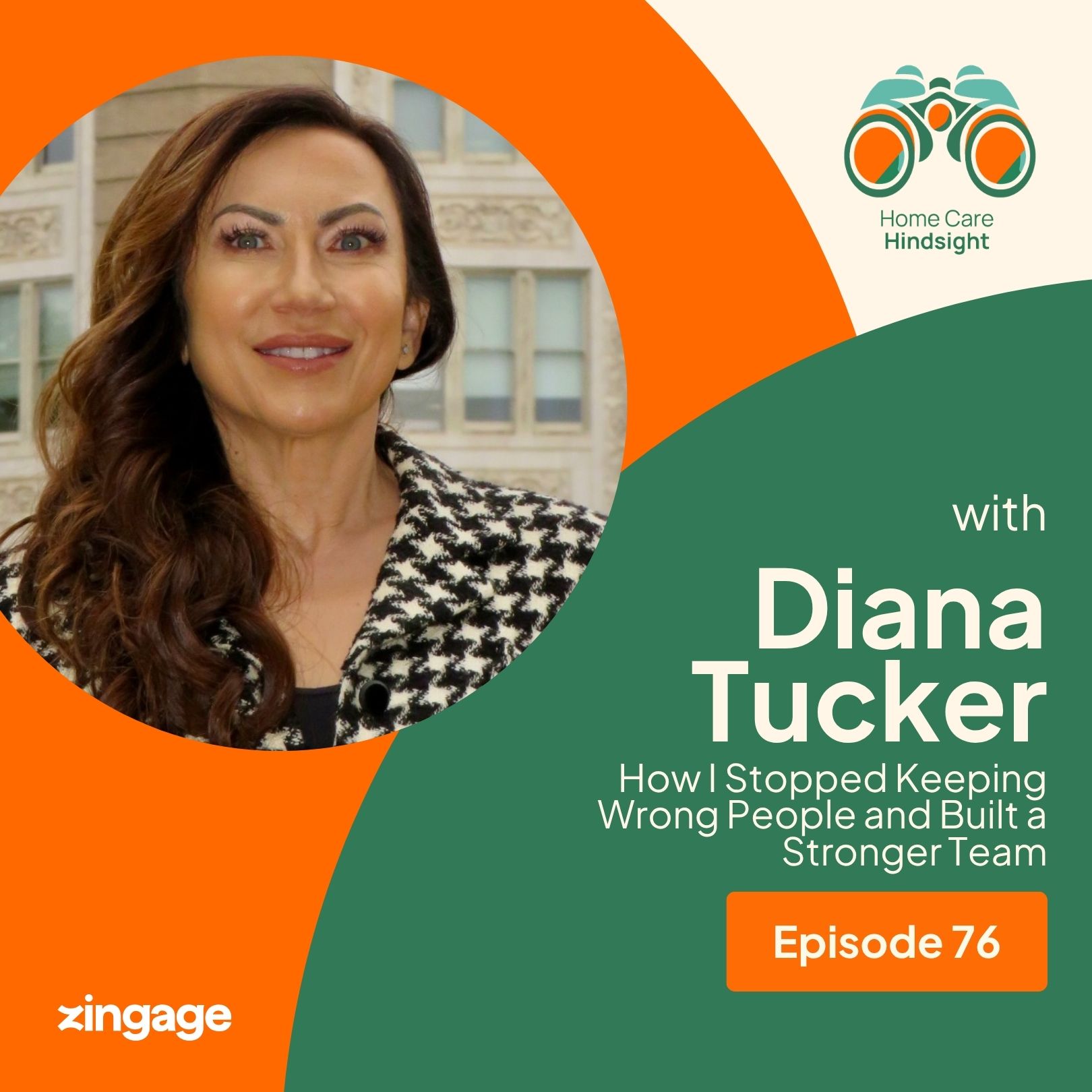
  • #76
    March 24 · 33 min

    How I Stopped Keeping Wrong People and Built a Stronger Team — Diana Tucker

    Diana Tucker, co-founder and President of Private Home Care, joins host David Knack to share the hard-learned lesson that reshaped how she leads her multi-state home care company. After 11 years of growth from St. Louis into Illinois and Kansas, Diana opens up about her biggest mistake: tolerating underperformance for too long because people were kind, loyal, or simply because she didn't want to disrupt the team. Diana reveals how she learned that kindness without accountability isn't compassion, it's complacency, and how this realization transformed her approach to team building. The conversation explores the nuanced challenges of acquisitions, why Private Home Care prioritizes caregiver experience as the foundation of client care, and how Diana's Background on hospitality management shaped her service-first philosophy. She also discusses implementing predictive AI sensors in homes, why trying to be the hero in every situation burns out owners and disempowers teams, and how technology like Zingage's Riley helps maintain consistent caregiver engagement. Lesson Takeaways: 1. Kindness Without Accountability Is Complacency: Tolerating underperformance because someone is nice or has tenure isn't compassion. In home care, keeping the wrong person in the wrong role impacts client wellbeing. Honor people for their contributions, but don't let nostalgia shape your future. 2. Not Every A-to-B Player Gets You to C: Team members who excelled at getting you from startup to stability may not be the right fit for scaling. Recognize when someone's season with your company has ended and empower them to find a better fit elsewhere. 3. Put Caregivers First, Client Care Follows: Your caregivers are your product in home care. When they feel supported, engaged, and valued, they provide better care. Invest in above-industry wages, benefits, training, and systems that keep them connected to your team. 4. Stop Being the Hero in Every Situation: Jumping in to solve every scheduling issue, caregiver conflict, or anxious family call creates bottlenecks and burns you out. Teach your team how to solve problems without you so your business becomes calmer and your clients get better care. 5. Know Your Acquisitions Before You Buy: The best acquisitions happen when you already know and trust the sellers. Misaligned expectations with unfamiliar owners can lead to challenging transitions. Strong relationships and shared values create seamless integrations that retain both staff and clients. Timestamps: 00:00 – Introduction to Diana Tucker and Private Home Care's AI innovation 04:18 – The big mistake: Tolerating underperformance for too long 06:42 – When team members outgrow their roles in scaling companies 09:32 – Building a team culture, not just a family 12:25 – Acquisition lessons: Chicago versus St. Louis experiences 16:38 – What's underrated: How caregivers feel about their jobs 20:13 – Diana's hospitality background and the customer-is-always-right philosophy 22:23 – The little mistake: Trying to be the hero in every situation 25:06 – Creating caregiver stability through AI and consistent engagement 30:41 – Recent win: 11-year caregivers still showing up with smiles Quotes: Diana Tucker: "I held onto people because they were kind, or they had been with us from the start. But in home care, keeping the wrong person in the wrong role isn't just a business risk. It impacts the wellbeing of our clients." Diana Tucker: "I had to accept that kindness without accountability isn't compassion, it's complacency. Now I lead with a different philosophy: Honor people for the part they played in your journey, but don't let nostalgia shape your future." Diana Tucker: "We have to put caregivers first. When they're supported, they would provide better care for our clients. Sometimes if you just help someone very little bit when they need it most, that goes long way." David Knack: "Sometimes your team members may feel threatened or unhappy at first, but in the long run they would understand that now I can do my job better because I'm not doing someone else's job as well." Resources: 1. Connect with Diana Tucker on LinkedIn: https://www.linkedin.com/in/dianatuckerphc/ 2. Learn more about Private Home Care: https://privatehomecare.com/ 3. Connect with David Knack on LinkedIn: https://www.linkedin.com/in/david-knack/ 4. Powered by Zingage: https://zingage.com 5. Watch this episode on Zingage's YouTube: https://www.youtube.com/@Zingage

  • #75
    March 17 · 42 min

    The $19 Million HR Mistake (And Why Arbitration is Your Flood Insurance) — Angelo Spinola

    Angelo Spinola, the "attorney for the home care industry" at Polsinelli, joins host David Knack for a candid conversation about the legal landmines buried in the home care business. A former caregiver himself, Angelo brings a unique, empathetic perspective to the complex web of regulations that providers face. He reveals why compliance isn't just about avoiding lawsuits, it's about protecting your enterprise value, your freedom, and the business you've worked so hard to build. Angelo breaks down the biggest blind spots he sees, from the explosion of city and state-specific laws (like domestic worker bills of rights) to the often-misunderstood reach of HIPAA and anti-kickback statutes in private pay settings. He shares a staggering story of a $19 million lawsuit triggered by a simple HR clerical error, underscoring the critical importance of having a properly implemented arbitration agreement. He also offers a realistic look at the current enforcement landscape, including aggressive DOJ investigations and what providers can expect from the shifting regulatory winds on AI and the companionship exemption. Lesson Takeaways: 1. The home care industry is a "flood zone" for litigation. A legally sound, well-executed arbitration agreement is your flood insurance. It forces individual claims instead of devastating class actions, protecting you from catastrophic, business-ending settlements. 2. Don't wait for a lawsuit, investigation, or sale to uncover your problems. Being proactive about compliance is exponentially cheaper than the reactive "strip-down and rebuild" phase, which can decimate your company's valuation and lead to massive escrows or holdbacks during an M&A transaction. 3. New laws, especially industry-specific ones like wage transparency or domestic worker bills of rights, are often "strict liability." A plaintiff's lawyer can easily scan job postings for non-compliance and build a class action, turning a simple oversight into a six or seven-figure headache. 4. Just because "everyone is doing it" doesn't make it legal. Angelo recounts the $300 million pay-per-visit case, where an industry-wide operational norm was fundamentally non-compliant, creating a massive, unforeseen liability for major providers. 5. Don't get distracted by the latest tech. Identify your single biggest operational struggle: retention, scheduling, travel time, and then find the AI tool specifically designed to solve that problem. Adoption and real ROI depend on solving a tangible pain point. Timestamps: 00:00 – Welcome to Home Care Hindsight by Zingage 01:18 – From caregiver to legal advocate: Angelo's origin story 03:06 – The shifting regulatory landscape: Companionship exemption and state laws 05:28 – The nightmare of city and municipality-level compliance 06:32 – How Polsinelli tracks the "hodgepodge" of local laws 07:44 – AI in home care: Opportunity, hype, and the regulatory whiplash 10:25 – Why AI won't replace caregivers, but will make them more efficient 12:00 – Tailoring solutions to the unique dysfunction of every agency 13:10 – The "shiny toy" syndrome: Solving a problem vs. buying a gadget 14:44 – The biggest mistake: The "me too" mentality and ignoring "flood insurance" 16:00 – The three ways providers find Angelo (and only one of them is good) 18:00 – How compliance risk destroys enterprise value in an M&A deal 20:41 – The $300 million case: When an industry-wide practice becomes a liability 22:04 – A modern horror story: The FBI visit, jail time, and cooperating the wrong way 25:03 – "Monopoly money": How potential liability impacts your sale price 28:43 – Blind spots: Fraud, HIPAA in private pay, and "gotcha" claims 31:26 – Industry-specific laws (like Philadelphia's) that fly under the radar 33:27 – Practical advice for small providers without a legal budget 34:14 – The #1 defense tool: A properly implemented arbitration agreement 35:17 – The $19 million mistake: A single wrong email and a class action nightmare 38:15 – Angelo's final plug: Why industry-specific counsel matters Quotes: Angelo Spinola: "The home care industry is a flood zone. And if you're living in a flood zone, you need flood insurance. The argument isn't, 'well, I haven't seen it flood yet.'" Angelo Spinola: "When you find a problem in diligence, you see these assessments... 'For $40 million of potential exposure.' As a litigator, we're not paying $40 million. But that potential becomes 'funny money' used to change your deal price or create massive holdbacks." David Knack: "Every home care agency is dysfunctional in its own way." Resources: 1. Connect with Angelo Spinola on LinkedIn: https://www.linkedin.com/in/angelospinola/ 2. Learn more about Polsinelli's Home Care Practice: https://www.polsinelli.com/health-care 3. Connect with David Knack on LinkedIn: https://www.linkedin.com/in/david-knack/ 4. Powered by Zingage: https://zingage.com 5. Watch this episode on Zingage's YouTube: https://www.youtube.com/@Zingage

Showing 1–20 of 20 episodes