Skip to content
Artwork for History Lab
EducationSociety & Culture

History Lab

Impact Studios

History Lab || exploring the gaps between us and the past || This series is made in collaboration by the Australian Centre for Public History and Impact Studios at the University of Technology, Sydney.

Play
  • 21 episodes
  • fortnightly
  • Avg 42 min
  • English
Counted on this page — what you have heard stays on this device, so it is not something the list can be paged by.
  • #55
    September 3 · 37 min

    55. Australia and Wikipedia: the bias in the map, from All That We Touch

    Wikipedia doesn't set out to play favourites. But when a made-up Melbourne suburb has more history than real Australian places, something is shaping what gets written. Who - or what - decides which Australian places matter on Wikipedia? Hosts Heather Ford and Francesca Sidoti go looking, through a map of 35,000 places, a street corner in Penrith, and a fight over one island's name. How is Wikipedia biased, and why? The answer will surprise you. This episode comes to History Lab from All That We Touch, a brand new Impact Studios podcast about the entangled relationships between humans, technology, nature and politics. Its inaugural takes a close look at Wikipedia - what it knows, and how it shapes what we know. Subscribe or follow All That We Touch to hear more. Voices Heather Ford is an ARC Future Fellow and Professor in the School of Communication and Social Sciences at UTS. She is the author of “Writing the Revolution: Wikipedia and the Survival of Facts in the Digital Age” published by MIT Press. Dr Francesca Sidoti is a Postdoctoral Research Associate with the ARC Discovery project ‘Wikipedia and the nation’s story: towards equity in knowledge production’ in the Faculty of Arts and Social Sciences. Dr Michael Falk is a Senior Lecturer in Digital Studies at the University of Melbourne, and is a computational literary scholar, data scientist, speaker and writer. In all his work, he aims to combine the creativity of the arts with the rigour and precision of data science. Research links Australian places and Wikipedia Map of Australian places on Wikipedia (Wikihistories: 2025) Map showing Edit intensity of Australian place articles: English Wikipedia (Wikihistories: 2025) Full report: How Australian places are represented on Wikipedia (Wikihistories: 2025) We analysed 35,000 Wikipedia entries about Australian places. Some of them sanitise history (The Conversation: 2024) Erinsborough Wikipedia Page Penrith Wikipedia page K'gari Wikipedia page Bias and Wikipedia Can History be Open Source? Wikipedia and the Future of the Past by Roy Rosenzweig (The Journal of American History Volume 2006) Wikipedia's known unknowns (The Guardian 2009) The earliest geographical analyses of Wikipedia’s geographical biases is described Professor Mark Graham. ‘Anyone can edit’, not everyone does: Wikipedia’s infrastructure and the gender gap ( Social Studies of Science 2017) How Wikipedia’s infrastructure introduces new and less visible sources of gender disparity, by Heather Ford and Judy Wajcman. Who Gets To Be Notable And Who Doesn't: Gender Bias On Wiki (NPR All Things Considered 2021) On Wikipedia, gender inequality is hiding in plain sight. Of more than a million and a half biographies - that's on the English-language version - fewer than 19% are about women. A recent study by Francesca Tripodi brings some new insight into why that is. Demographic disparity in Wikipedia coverage: a global perspective (EPJ Data Sci. 2025)Even though people identifying as female and non-binary genders have been better represented in terms of the number of Wikipedia language editions over time, and they are currently better covered than males, current global coverage of people on Wikipedia still shows disparities in both gender and geographical location of biographical subjects in various dimensions. Wikipedia editors Who is contributing to Wikimedia projects? (Wikimedia Foundation, nd) The Wikipedia “Change the Stats” page that collates research into the Wikipedia editor base as a baseline for increasing the diversity of Wikipedia editors. Community Insights Report (Wikimedia Foundation, 2020) A survey with 2500 Wikimedians looking at their demographics, social and technological experiences. Findings from the survey included: Wikimedia contributors are 87% male. Almost half live in Europe and one-fifth in Northern America, as compared to 9.7% and 4.8% of the global population. Fewer than 1% of Wikipedia’s editor base in the U.S. identify as Black or African American. Although women were still markedly underrepresented among contributors, there was a modest increase in women contributors between 2019 (11.5%) and 2020 (15.0%). Further reading “Finding Eliza: power and colonial storytelling” by Larissa Behrendt (2016) “Finding Eliza” exhibition at Hervey Bay Regional Gallery until 16 August 2026 Clips Jimmy Wales on bias: Lex Fridman podcast 19 June 2023 Comedian Guy Williams on visiting Rottnest Island Herbs French Letter World Heritage Fraser Island officially restored to Indigenous name, K'gari, supported by public (ABC News 7 June 2023) Credits The executive producer of this series is Heather Ford. The series is hosted by Heather Ford, Francesca Sidoti and Richard Cooke. Produced by Jane Curtis. Associate producer is Francesa Sidoti. Story consultant is Rachael Cusick. Sound by John Jacobs. Thanks for feedback from Sarah Gilbert, Regina Botros, Celine Teo-Blockey, Siobhan Moylan, Lachlan A Court, Zlata Maltceva, Rosa Ellen, and Kate Lawrence. All That We Touch artwork by Alexandra Morris. Episode tiles by Jane Curtis. Bell music composition by Maksim Voloshin-Cleary. Executive Producer of UTS Impact Studios is Sarah Gilbert. It’s produced on Gadigal Country in Sydney Australia. wikihistories is supported by Australian Research Council Grant DP220100662, ‘Wikipedia and the Nation’s Story: Towards Equity in Knowledge Production’. Find out more at wikihistories.net Transcripts Wikipedia and Australia: the bias in the map Transcript Word doc Wikipedia and Australia: the bias in the map Transcript PDF

  • #54
    August 19 · 47 min

    54. Field Notes 4: History Beyond Humans - Environmental Histories

    Environmental history in Australia has moved from the margins to something close to the centre of the discipline — but the path there was longer and less obvious than it might appear. Jarrod Hore and Nancy Cushing map that path from different vantage points. Hore came of age as a scholar inside the field; Cushing arrived at it gradually, via urban history, historical geography, and a childhood in Nova Scotia that made her attentive to the materialities of place. They trace the field’s prehistory through Keith Hancock and the historical geographers, and its institutional emergence through the Green Stream at the 2016 AHA conference in Ballarat, which gave environmental historians in Australia a genuine community for the first time. The conversation turns on the field’s core contribution: refusing the false separation of humans from the environments they inhabit, and refusing equally the separation between the humanities and the sciences. Voices Jarrod Hore is a Scientia Lecturer in the School of Humanities and Languages at the University of New South Wales. His research covers landscape photography, geology, and commodity histories in settler colonies. His first book is Visions of Nature (2022). Nancy Cushing is an Associate Professor at the University of Newcastle, where she recently marked thirty years. She is a past Coral Thomas Fellow at the State Library of New South Wales and has published widely on human-animal relations in Australia. Credits Recorded and edited by Lachlan D’Acourt. Executive producers: Michelle Arrow and Kate Fullagar. Executive producer, Impact Studios: Sarah Gilbert. History Lab is made by UTS Impact Studios and the Australian Centre for Public History. Field Notes is made in collaboration with the Australian Historical Association. Further Reading Katie Holmes, Andrea Gaynor and Ruth Morgan, “Doing Environmental History in Urgent Times,” History Australia (2020) Bill Gammage, The Biggest Estate on Earth (2011) Keith Hancock, Discovering Monaro (1977) Tom Griffiths, "Discovering Hancock: the journey to Monaro" (1999)

  • #53
    August 5 · 40 min

    53. Field Notes 3: Which China Do You Belong To? Chinese-Australian Histories

    In this episode of Field Notes, historians Sophie Loy-Wilson and Mei-fen Kuo trace their paths into Chinese Australian history — one drawn by questions of racism and resistance, the other by the discovery of long-neglected Chinese-language newspapers and Qing Dynasty consular records. They discuss the ethical challenges of community history, the archival work required to recover women’s lives, and a question that has shadowed Chinese communities in Australia across two centuries: first, who counts as Australian, and then, after the Second World War, which China do you belong to? The conversation is as much personal as scholarly. Kuo reflects on growing up in Taiwan at the end of martial law, a grandmother whose name will never appear in any archive, and the journey from Irish nationalism to Chinese Australian history. Loy-Wilson recalls being an eleven-year-old in Beijing when her father pointed to the crowds on Chang’an Avenue and said, everyone under forty survived the Cultural Revolution. Voices Sophie Loy-Wilson is an Associate Professor of History at the University of Sydney. Her research focuses on the Chinese Australian diaspora and the politics of race and labour. Her current book project examines Chinese men during the gold rushes of the 1850s to 1880s. Mei-fen Kuo is a historian at Macquarie University specialising in Chinese Australian and Taiwanese migration history. Her archival discoveries include consular records from the Qing Dynasty period held in Melbourne’s Chinatown. Her forthcoming book traces the political life of a Taiwanese Australian intellectual and his engagement with democracy movements across the Asia-Pacific. Credits Recorded and edited by Lachlan D’Acourt. Executive producers: Michelle Arrow and Kate Fullagar. Executive producer, Impact Studios: Sarah Gilbert. History Lab is made by UTS Impact Studios and the Australian Centre for Public History. Field Notes is made in collaboration with the Australian Historical Association. Further Reading John Fitzgerald, Big White Lie: Chinese Australians in White Australia (2007) Cathy May, Top Sawyers: Chinese in Cairns 1870s–1920s (1984)

  • #52
    July 22 · 33 min

    52. Field Notes 2: When the War is Over - Military Histories

    Military history in Australia carries a weight that few other subfields do — it sits at the intersection of popular memory, national identity, and institutional commemoration in ways that make it both unusually accessible and unusually prone to distortion. Maggie Hutchison and Tom Rogers make a case for what serious military history looks like. It demands an active voice — soldiers don’t “lay down their lives”; they are killed by someone, with something, for reasons that can be named. And it insists on the connections between home front and battlefield that have too often been treated as separate stories. The conversation includes the Australian War Memorial’s 2022 decision to reverse its long-standing position about the frontier wars — a change, Rogers argues, that came directly from decades of academic research, not popular opinion. They discuss the centenary wave and its aftermath, the digitisation of First World War records, and the way genealogy pulls people into military history and then requires them to understand the broader context. Voices Maggie Hutchison is a Senior Lecturer in History at UNSW Canberra. Her research covers war art, commemoration, and the long-term costs of military service. She is currently working on an interdisciplinary project on veteran suicide. Tom Rogers is a historian in the Military History section at the Australian War Memorial. His research focuses on the colonial period and the frontier wars. He is currently working on soldiers’ letters published in newspapers during the South African War. Credits Recorded and edited by Lachlan D’Acourt. Executive producers: Michelle Arrow and Kate Fullagar. Executive producer, Impact Studios: Sarah Gilbert. History Lab is made by UTS Impact Studios and the Australian Centre for Public History. Field Notes is made in collaboration with the Australian Historical Association. Further Reading Joan Beaumont, Broken Nation: Australians in the Great War (2013) Margaret MacMillan, Paris 1919: Six Months That Changed the World (2019) Evan S. Connell, Son of the Morning Star (1984) Andrew Gordon, The Rules of the Game: Jutland and British Naval Command (1996)

  • #51
    June 24 · 43 min

    51. Field Notes 1: Ending Empires - Decolonisation Histories

    What does decolonisation mean as a field of historical inquiry — and what does it demand of the historians who work in it? Jon Piccini and Angela Woollacott approach these questions from different generations and starting points. Woollacott came to postcolonial thinking through the new imperial history in 1990s American universities, where the field felt genuinely revolutionary. Piccini came through the study of 1960s transnational activism, and found his way to decolonisation proper only when a supervisor’s question stuck with him long enough to send him back to sources he thought he’d already exhausted. They discuss what a decolonial approach actually requires: taking positionality seriously, working across archives that are not equally preserved, and refusing to let the boundaries of the logo map define Australian history. The conversation moves through the historiography — Frantz Fanon, CLR James, the landmark work of Tracy Banivanua Mar on decolonisation as an oceanic movement — and into practical questions about how the history is made. Piccini describes working with Papua New Guinean archives and the irreducible privilege involved in that encounter, while Woollacott discusses the seminal work of Henry Reynolds and the influence of the Colonial Frontiers Massacres Map as presenting incontrovertible evidence of frontier violence. Voices Jon Piccini is a Senior Lecturer in History at Australian Catholic University in Brisbane/Meanjin. His work spans transnational activism, human rights history, and Australia’s colonial relationships in the Pacific. He is completing a book on Australia and decolonisation. Angela Woollacott is Distinguished Professor Emerita in the School of History at the Australian National University, on Ngunnawal Country. Her books include Settler Society in the Australian Colonies (2015) and a biography of Don Dunstan. Her current project examines Australians who shaped the intellectual and political challenge to colonialism in the mid-twentieth century. Credits Recorded and edited by Lachlan D’Acourt. Executive producers: Michelle Arrow and Kate Fullagar. Executive producer, Impact Studios: Sarah Gilbert. History Lab is made by UTS Impact Studios and the Australian Centre for Public History. Field Notes is made in collaboration with the Australian Historical Association. Further Reading Tracy Banivanua Mar, Decolonisation and the Pacific (2016) CLR James, The Black Jacobins (1938; rev. ed. 1963) Shannyn Palmer, Unmaking Angus Downs: Myth and History on a Central Australian Pastoral Station (2022) — Prime Minister’s History Prize winner Jessica Urwin, Contaminated Country (forthcoming, Melbourne University Press) Henry Reynolds, Looking from the North (2024)

  • #50
    June 10 · 51 min

    50. Spirits of the Hoey: a rock 'n' roll archive

    Before social media, before streaming, before algorithms decided what you'd hear next, Sydney had the street press — and the street press had the Hopetoun Hotel. In this episode, State Library Fellow Dr Liz Giuffre takes us inside her archival forays into On the Street and Drum Media, two free weekly publications held in the State Library of NSW's collection that served as the first draft of Sydney's music history from the early 1980s to the early 2010s. Combing through 375 issues of On the Street and 685 issues of Drum Media, Giuffre reconstructed the full gig history of the Hoey — a 200-capacity pub in Surry Hills that somehow managed to be the centre of a very special universe. The numbers tell part of the story: 375 slots for live music in just the first decade, the majority free, Wednesday nights the busiest, genres and genders far more diverse than the "blokey pub rock" myth would have you believe. But archives only get you so far — the rest is memory, and this panel has plenty of it. From Machine Gun Fellatio forming almost by accident after a misprint in a gig listing, to Box the Jesuit's anatomically ambitious birthday cakes, to the gentleman's agreements between venue bookers that briefly kept Paul Kelly off the Hopetoun stage, the conversation ranges across what made the Hoey's ecosystem tick: the bands, the bookers, the barflies, the street press journos, Terry the Pieman, and Johnny's fish and chips next door. The panel also looks forward — at what's been lost to unaffordability and dispersal, what's quietly thriving in record stores and warehouse spaces and jewellery shops on Parramatta Road, and why culture, as one panellist puts it, always finds a way. Voices Dr Liz Giuffre is a Senior Lecturer in Communications at UTS, a music and arts journalist, and a fan. Her work has been published widely for academic and general audiences, and she is still an active commentator online and on radio via TheMusic, 2SER FM and ABC Radio Sydney. She was one of the Library’s Visiting Fellows in 2024. Her new book, Spirits of the Hoey, is a love letter to the iconic Hopetoun Hotel. Chit Chat von Loopin Stab is a filmmaker, lyricist, music producer, TV presenter, radio announcer, film score composer and gardener. He cowrote The Whitlams’ hit song ‘No Aphrodisiac’, which was voted number one on the Hottest 100 of 1997 and won the 1998 ARIA Award for Song of the Year. Chit Chat is also founding member, producer, manager, keyboardist and occasional vocalist for Machine Gun Fellatio, as well as a music TV presenter on Foxtel’s Max for 12 years. His score for the 2003 Australian crime film Getting Square won multiple awards. Chit Chat’s first band Vrag were regulars at the Hopetoun, as was Machine Gun Fellatio. Emily Collins is a seasoned music industry leader with deep expertise in strategy, policy and program development. Prior to her appointment as Head of Sound NSW, Emily served for eight years as the Managing Director of MusicNSW, where she played a pivotal role in strengthening the state’s contemporary music sector. Emily’s career began in major music festivals, including the Cockatoo Island Festival and the Great Escape Festival, before expanding into marketing roles at Underbelly Arts Festival, Sydney Writers’ Festival and Darwin Festival. A long-standing champion of the NSW music industry, she has been a prominent advocate for the sector and continues to support artists, venues, festivals and industry organisations across the state through her leadership at Sound NSW. Lex Davidson is the manager of Cultural Strategy for the City of Sydney and the Chairperson of the Music Cities Network, a global network of music policy professionals. Under his stage name Lex Lindsay, he is a multidisciplinary artist, theatre maker and music composer with a background in directing film and music festivals. Lex has produced work for two Biennales of Sydney and is a contributing artist to pieces in the permanent collections of the Museum of Contemporary Art (MCA) and the Australian Centre for the Moving Image (ACMI). His current project, composing choral works for CREATION, a speculative queer climate action religion, has been performed at the Sydney Opera House, Art Gallery of NSW, Carriageworks, and will feature in the grand reopening of the renovated Newcastle Art Gallery in 2026. Susie Beauchamp is half of the songwriting/performance powerhouse Box The Jesuit, an incredible live and recorded Sydney band from the mid 1980s until early 1990s. They supported Nirvana at the first Big Day Out and, more importantly, gave Hoey patrons all singing, all dancing, all death-defying, all pornographic cake eating nights to remember! The band ended when Susie’s partner in music and life, Goose (Stephen Gray) passed away. The legend remains, and the music remains completely captivating. Tamson Pietsch is director of the Australian Centre for Public History and History Lab's presenter. Credits This episode of History Lab was recorded on Gadigal Land, Sydney, at the State Library of New South Wales. For more literary events like this one, see the library's What's On page. Edited and mixed by Lachlan A'Court. History Lab is brought to you by the Australian Centre for Public History and UTS Impact Studios. Executive producer is Sarah Gilbert. Further reading and listening Explore the Spirits of the Hoey web page. Buy Spirits of the Hoey at Melbourne Books. For more Hoey memories, listen to another Impact Studios podcast ep featuring authors Liz Giuffre and Greg Ferris speaking with singer-songwriters Sarah Blasko and Sally Seltman, along with Hoodoo Gurus bassist Clyde Bramley about the life and times of the Hopetoun Hotel.

  • #49
    May 14 · 45 min

    49. Fringe to Famous: building and sustaining creative industries

    What made Australia's fringe cultural scene so generative in the 1980s — and what can it teach us about sustaining creative industries today? Tony Moore and Mark Gibson, co-authors with Chris McAuliffe and Maura Edmond) join Reg Mombassa (of Mental as Anything and Mambo fame) to launch their book Fringe to Famous: Cultural Production in Australia After the Creative Industries. In a wide-ranging discussion, hosted by journalist and academic Catharine Lumby, the panel examines how music, comedy, film and design crossed over from fringe scenes into the mainstream — and why that transition was never a sellout, but a negotiation. The discussion ranges from the Sydney pub rock circuit and the role of Countdown, to the institutional infrastructure — public broadcasters, independent labels, accessible welfare — that quietly made it all possible. And they ask the harder question: without that scaffolding, what does the future of Australian creative life actually look like? Enjoy a cameo appearance from Paul Fenech, actor, director, producer and comedian (Pizza, Fat Pizza and Housos). Fringe to Famous is published by Bloomsbury Academic, and the launch was held on Gadigal land, at Sydney's Gleebooks. Voices Tony Moore is a cultural historian and Professor of Media and Communications at Monash University, where he leads major ARC-funded projects on Australian comedy and the convict roots of democracy. A former ABC documentary maker and book publisher, his previous books include Dancing with Empty Pockets: Australia's Bohemians, Death or Liberty: Rebels and Radicals Transported to Australia, and The Barry McKenzie Movies. He is co-author of Fringe to Famous: Cultural Production in Australia After the Creative Industries. Mark Gibson is Professor in the School of Media and Communications at RMIT University. His research spans cultural and creative industries, the history of cultural studies, comedy and the role of audiences in cultural production. He is the author of Culture and Power: A History of Cultural Studies and co-author of Fringe to Famous: Cultural Production in Australia After the Creative Industries. Reg Mombassa is a New Zealand-born Australian artist and musician. A founding member of Mental as Anything — inducted into the ARIA Hall of Fame in 2009 — he is also a member of Dog Trumpet alongside his brother Peter. As principal artist and designer for Mambo Graphics, his work helped define the visual identity of one of Australia's most iconic and irreverent surf and streetwear labels. He continues to work as a visual artist and musician. Catharine Lumby (host) is Professor of Media and Communications at the University of Sydney and foundation chair of its Media and Communications Department. The author and co-author of six books, she writes regularly for The Guardian, the Sydney Morning Herald and the ABC, and has advised the public and private sectors on cultural diversity, bullying prevention and social media. She is a leading public intellectual on media, culture and gender in Australia. Paul Fenech is an Australian filmmaker, writer, director, producer and actor. After winning Tropfest in 1998, he was able to parlayed his 1995 third-place entry, about his life as a pizza delivery driver, into the SBS series Pizza, which ran for five seasons from 2000. He went on to create Housos — winner of the Logie for Most Outstanding Light Entertainment Program in 2014. Credits This episode of History Lab was recorded on Gadigal Land, Sydney, at Gleebooks. For more literary events like this one, see the Gleebooks events page. Edited and mixed by Daniel Wiggins. History Lab is brought to you by the Australian Centre for Public History and UTS Impact Studios. Executive producer is Sarah Gilbert.

  • #48
    April 30 · 53 min

    48. Looking back: Drusilla Modjeska on women artists and what they saw

    What happens to women's art when the world stops looking? That's the question at the heart of A Woman's Eye: Her Art, Drusilla Modjeska's book about a century of women artists who made radical, visionary work — and were then, largely, forgotten. Recorded live at Gleebooks before a packed house, this is a conversation about art history as a political act: who gets remembered, who gets written out, and why it keeps happening. In conversation with literary biographer Bernadette Brennan — who is currently writing Modjeska's own biography — and joined by artist Julie Rrap, Modjeska moves from Wilhelmine Germany to 1920s Paris to the liberation of Dachau, tracing the lives of women who saw things their own way. Voices Drusilla Modjeska is the author of Poppy, Stravinsky's Lunch, The Orchid, The Mountain, Second Half First, and A Woman's Eye: Her Art, published by Penguin Books Australia. Bernadette Brennan is a literary critic and the author of A Writing Life: Helen Garner and Her Work and Leaping into Waterfalls: The Enigmatic Gillian Mears. She is currently writing a biography of Drusilla Modjeska. Julie Rrap is one of Australia's most significant contemporary artists. Her survey exhibition Past Continuous, centred on SOMOS, was held at the Museum of Contemporary Art Australia in 2024–25. SOMOS is now in the permanent collection of the Art Gallery of Western Australia. A Woman's Eye: Her Art is published by Penguin Books Australia. Credits This episode of History Lab was recorded on Gadigal Land, Sydney, at Gleebooks. For more literary events like this one, see the Gleebooks events page. Edited and mixed by Maksim Voloshin-Cleary. History Lab is brought to you by the Australian Centre for Public History and UTS Impact Studios. Executive producer is Sarah Gilbert. Works mentioned Paula Modersohn-Becker Self-Portrait on the Sixth Wedding Anniversary (1906) — nude self-portrait depicted as pregnant Paula Modersohn-Becker Museum, Bremen https://online-sammlung.hamburger-kunsthalle.de | Google Arts & Culture entry from the Böttcherstraße Museums: https://artsandculture.google.com/story/IwVRLMk5ACZUJQ Lying Mother with Child II (1906) — nude mother reclining with child Paula Modersohn-Becker Museum / Museen Böttcherstraße, Bremen Google Arts & Culture: https://artsandculture.google.com/asset/lying-mother-with-child-ii-paula-modersohn-becker/LgGzY69gnE9o7Q Portrait of Clara Rilke-Westhoff (1905) — Clara with rose Hamburger Kunsthalle, Hamburg Collection record: https://online-sammlung.hamburger-kunsthalle.de/de/objekt/HK-2362 Claude Cahun I Am in Training, Don't Kiss Me (c.1927) — self-portrait with pursed lips and curls Jersey Heritage Collection Jersey Heritage page on Cahun: https://www.jerseyheritage.org/history/claude-cahun-and-jersey/ Que me veux-tu? / What Do You Want From Me? (1928) — double-exposure composite self-portrait Musée d'Art Moderne de la Ville de Paris Also held in the Met collection: https://www.metmuseum.org/art/collection/search/838682 Self-portrait in jester jacket (c.1928) — catching the viewer's gaze Jersey Heritage Collection (as above) Dora Maar Untitled [Assia] (1934) — model casting dramatic shadow Centre Pompidou, Paris (various versions held there and elsewhere) Pompidou reproduction page: https://editions.centrepompidou.fr/en/home-decor/dora-maar-reproduction-untitled-assia/1577.html Nusch Éluard on the beach (c.1935) — photograph of Éluard lying on beach Centre Pompidou, Musée national d'art moderne, Paris AWARE Women Artists entry with collection details: https://awarewomenartists.com/en/artiste/dora-maar/ Lee Miller Tanja Ramm under a Bell Jar (1931) — woman's head enclosed in glass bell jar Lee Miller Archives (Farley Farm, Sussex); widely reproduced but not in a single permanent public collection page — the Lee Miller Archives hold the primary rights: https://www.leemiller.co.uk Lee Miller in Hitler's Bathtub, Munich (1945) — photographed by David Scherman Held at Tate Britain Tate collection record: https://www.tate.org.uk/art/artworks/miller-scherman-lee-miller-in-hitlers-bathtub-munich-x100252 Julie Rrap SOMOS (Standing On My Own Shoulders) (2023) — life-sized bronze, artist standing on her own shoulders Permanent collection, Art Gallery of Western Australia; also shown at MCA Sydney Ocula interview with full context: https://ocula.com/magazine/conversations/julie-rrap-standing-on-her-own-shoulders/ MCA exhibition page: https://www.mca.com.au (search "Julie Rrap Past Continuous")

  • #47
    April 16 · 26 min

    47. The Last Tour: Ann Curthoys on Paul and Eslanda Robeson

    In this episode of History Lab Live, we revisit a remarkable moment in Australian history: the 1960 visit of Paul Robeson and his wife, Eslanda Robeson. Paul Robeson was one of the most famous voices in the world — a singer who could fill concert halls, but also a lawyer, actor, athlete, and one of the most outspoken civil rights activists of the 20th century. Alongside him was Eslanda, an anthropologist, author, actress and political organiser. Their arrival in Australia came after nearly a decade of enforced silence during the Cold War, when the US government stripped Paul Robeson of his passport. Recorded live at Gleebooks, historian Ann Curthoys joins journalist and academic Lorena Allam to discuss Curthoys' book, The Last Tour – a look at what happened when the Robesons finally made it to Australia. What emerges is a portrait of the Robesons as “figures of the future” — speaking a political language that echoes today. History Lab Live brings you recordings of conversations about Australian history from bookshops, universities and public institutions around the country. This episode is brought to you in partnership with our friends at Gleebooks. Head to the Gleebooks events page to discover more great literary events featuring some of Australia’s best and best known authors. Voices Professor Ann Curthoys is an eminent Australian historian who has researched, taught, and published on many aspects of Australian history, and also on questions of feminism, cultural studies, and historical writing and theory. Her major publications include Freedom Ride: A Freedomrider Remembers (2002); (with John Docker) Is History Fiction? (2005, 2010); and (with Jessie Mitchell), Taking Liberty: Indigenous Rights and Settler Self-government in the Australian Colonies, 1830 – 1890. The Last Tour: Paul and Eslanda Robeson's visit to Australia and New Zealand was published in 2025 by MUP. Lorena Allam is a multiple Walkley Award-winning journalist, a Gamilaraay and Yuwaalaraay woman, and an Industry Professor of Indigenous media at the Jumbunna Institute for Indigenous Education and Research at the University of Technology Sydney. Credits This episode was introduced by Tamson Pietsch, and mixed by Siobhan Moylan. History Lab is an Impact Studios podcast. Its executive producer is Sarah Gilbert.

  • #46
    April 1 · 14 min

    46. Red Light, Green Light

    In this episode from History Lab's archive, we stay in Darlinghurst with the award winning Red Light Green Light story from our Listen to Darlinghurst series. Going back to the street corners and safe houses where sex workers competed for customers in Darlinghurst in the 1980s, you will hear the stories of members of the community who fought for law reform and sex worker's rights. The last time we heard this story, a petition had been started to bring back the statue of Joy, one of relatively few statues in Sydney that represents a woman - in this case, a sex worker. We are proud and excited to say that Joy has been returned to her rightful place in Darlinghurst, now in bronze and fully permanent! This episode of History Lab won a Signal Award in the social impact category. Voices Julie Bates, veteran sex worker activist; Principal of Urban Realists Planning and Health Consultants. Chantell Martin, veteran sex worker; Co-CEO of Sex Workers Outreach Project. Credits This audio story is a production of the Australian Centre for Public History and Impact Studios at UTS, in partnership with the Paul Ramsay Foundation. It is part of the award-winning Darlinghurst Public History Initiative. Producer: Catherine Freyne Sound engineer: Judy Rapley Music: Blue Dot Sessions Archival: ABC Library Sales

  • #45
    March 18 · 37 min

    45. Darlinghurst's AIDS Crisis: Bonus episode with Leigh Boucher and Tamson Pietsch

    In this bonus episode, History Lab's Tamson Pietsch speaks with historian Leigh Boucher about the making of Darlinghurst's AIDS Crisis — our three-part History Lab series exploring one of the most intense and concentrated episodes of loss, activism, and community life in Australian history (if you haven't listened yet, go to episodes 42-44 of History Lab). Leigh is an historian based at Macquarie University who has lived in Darlinghurst for years. Walking the streets of the neighbourhood every day, he found himself asking a question the existing histories hadn't quite answered: what did it actually feel like to live in this neighbourhood as the epicentre of an epidemic? The series was his attempt to find out. Here, Leigh describes the tension between oral history practice — open-ended, associative, unhurried — and what podcasting demands. Leigh also reflects on the way his research, his interviewees and the collaborative work of making the podcast were able to complicate the story of how AIDS played out in Australia - zooming in to the local experience, and listening to voices that can help us hold that complexity rather than resolve it. Voices Leigh Boucher and Tamson Pietsch, presented by Regina Botros. Credits Recorded by Siobhan Moylan, edited and mixed by Regina Botros. History Lab is a UTS Impact Studios production, in collaboration with the Australian Centre for Public History at UTS. Support This series of History Lab was made with the support of the support of the Paul Ramsay Foundation and is part of the Foundation's Darlinghurst Public History Initiative, a collaboration with UTS' Australian Centre for Public History and Impact Studios. Thanks to Macquarie University for its support of this series. A special thanks goes to the staff and management of City Gym, Darlinghurst, for their generous hospitality. Heartfelt thanks also to Anni Turnbull at the Powerhouse Museum in Sydney for her time and expertise, and to the Australian Queer Archives. Thanks also to the National Library of Australia, the State Library of New South Wales, ACON and the Pride History Group Sydney.

  • #44
    March 5 · 43 min

    44. Darlinghurst's AIDS Crisis Ep 3: Faultlines and farewells

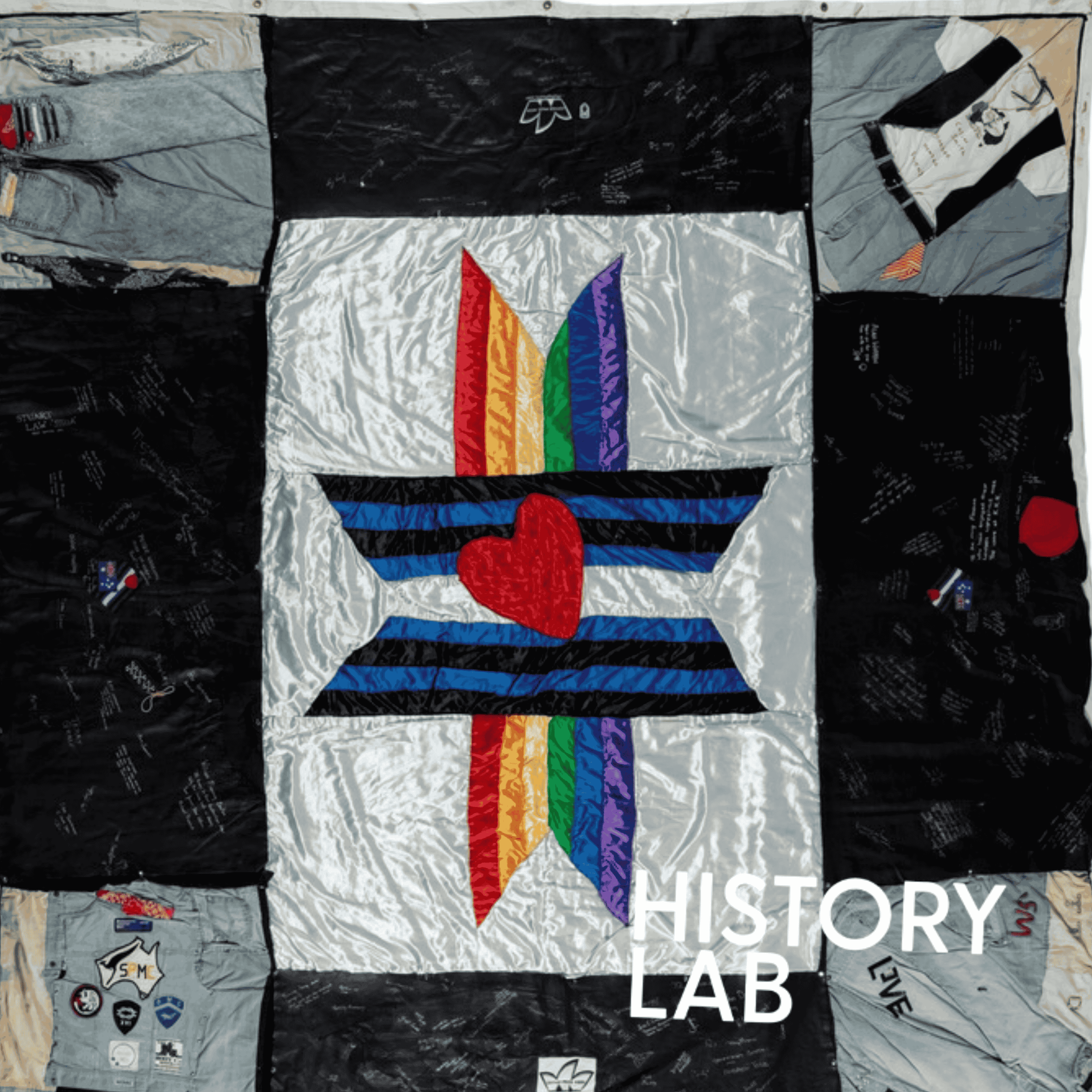
    By the early 1990s, AIDS had reached its devastating peak in Darlinghurst. Obituaries filled the pages of the Star Observer, funerals became routine. Sickness and loss touched almost every friendship and street in the neighbourhood. In this episode, we move inside the hospitals, hospices and homes where nurses, carers and volunteers supported a generation of young men facing terminal illness. Beyond the wards, grief and anger spilled into public life — through candlelight vigils, the AIDS Memorial Quilt, and growing activism demanding faster access to life-saving drugs. Then, in 1996, combination therapies changed the course of the epidemic. Soon, for the first time in a decade, the Star Observer ran without a single obituary. But survival came with a new question: how do you rebuild a life — and a community — after so much loss? This episode explores the final grueling years of the crisis and its aftermath — and the complex and unruly legacies it left for generations to come. Voices Narrator: Regina Botros Historian: Leigh Boucher Interviewees: Pierre Touma, Lizzie Griggs, Bill Patterson, Frank McCabe, Billy Kokkinos, Tim Vincent, Sara Lubowitz, Bruce Carter, Tess Ziems, Scott Petrie and Ian Innes. Archive voice actors: Sam David Harris and Michael J Ryan. Radio news and current affairs archive from Gaywaves, 2SER. Credits This special History Lab Original series was created on the lands of the Gadigal people of the Eora nation. Produced, written and narrated by Regina Botros, in collaboration with Macquarie University historian Leigh Boucher. Story development by Leigh Boucher and Michelle Ransom-Hughes. Interviews by Leigh Boucher. Research assistance from Eli Branagh. Story and script editing by Sarah Gilbert. History Lab is a UTS Impact Studios production, in collaboration with the Australian Centre for Public History at UTS. Support This podcast was made with the support of the support of the Paul Ramsay Foundation and is part of the Foundation's Darlinghurst Public History Initiative, a collaboration with UTS' Australian Centre for Public History and Impact Studios. Thanks to Macquarie University for its support of this series. A special thanks goes to the staff and management of City Gym, Darlinghurst, for their generous hospitality. Heartfelt thanks also to Anni Turnbull at the Powerhouse Museum in Sydney for her time and expertise, and to the Australian Queer Archives. Thanks also to the National Library of Australia, the State Library of New South Wales, ACON and the Pride History Group Sydney. Further reading To learn more about the history and complex legacies of AIDS in Darlinghurst, read these articles by Leigh Boucher: Reciting the names of the dead: how Australia's response to HIV/Aids was emotionally - and politically - powerful, Guardian Australia, 1 Dec 2025. What have we lost with 2026's Mardi Gras Parade after party cancellation?, Star Observer, 13 Feb 2026.

  • #43
    February 25 · 37 min

    43. Darlinghurst's AIDS Crisis Ep 2: Dancing as fast as we can

    By the mid-1980s, the epidemic had taken hold in Darlinghurst. Fear was rising, homophobia was intensifying, and uncertainty shaped everyday life. Who had the virus? What did a positive test mean? And could the state be trusted with that information? In this episode, historian Leigh Boucher moves into the heart of the crisis as the neighbourhood marshals every last drop of queer energy, love, creativity and strength to hold back the tide. Safe sex campaigns and innovative health responses proliferate – in bars, on dance floors and among squat racks. For Peter Vincent and his friends, the party is far from over, even as they face the stark reality of a disease without a cure and the homophobic judgment beyond the gaybourhood. This is Darlinghurst – dancing as fast as it can. Voices Narrator: Regina Botros Historian: Leigh Boucher Interviewees: Bill Patterson, Lizzie Griggs, Frank McCabe, Tim Vincent, Pierre Touma, Bruce Carter, Scott Petrie and Sara Lubowitz. Archive voice actors: Sam David Harris and Michael J Ryan. Radio news and current affairs archive from Gaywaves, 2SER. Credits This special History Lab Original series was created on the lands of the Gadigal people of the Eora nation. Produced, written and narrated by Regina Botros, in collaboration with Macquarie University historian Leigh Boucher. Story development by Leigh Boucher and Michelle Ransom-Hughes. Interviews by Leigh Boucher. Research assistance from Eli Branagh. Story and script editing by Sarah Gilbert. History Lab is a UTS Impact Studios production, in collaboration with the Australian Centre for Public History at UTS. Support This podcast was made with the support of the support of the Paul Ramsay Foundation and is part of the Foundation's Darlinghurst Public History Initiative, a collaboration with UTS' Australian Centre for Public History and Impact Studios. Thanks to Macquarie University for its support of this series. A special thanks goes to the staff and management of City Gym, the Albion Centre and ACON's Needle and Syringe Program for their generous hospitality.

  • #42
    February 19 · 42 min

    42. Darlinghurst's AIDS Crisis Ep 1: Under the mirror ball

    In the late 1970s and early 80s, Sydney’s Darlinghurst was the place to be for queer fun, sex and joy – all bubbling alongside a measure of danger. Packed bars, late-night gyms, house music, new friendships and the thrill of seeing and being seen. For many, this was the place to connect, to belong, to “grow up under the mirror ball.” In the first episode of this three-part series, historian Leigh Boucher steps into that world of parties, cruising, chosen families and hard-won freedom — a queer neighbourhood alive with possibility. But as the music plays and the nights stretch on, whispers of a mysterious illness begin to circulate. To understand how that powerful, fragile world of Darlinghurst felt and moved, Leigh talks to ordinary people who lived there and built the “gaybourhood” from the ground up. How might their stories help us to a fresh understanding of a history we think we know? Voices Narrator: Regina Botros Historian: Leigh Boucher Interviewees: Pierre Touma, Sara Lubowitz, Bruce Carter, Gary Dunne, Lizzie Griggs, Tess Ziems and Frank McCabe. Archive: Dr Jim Curran and Dr Ron Penny (courtesy of Gaywaves, 2SER) Archive voice actors: Sam David Harris and Michael J Ryan. Radio news and current affairs archive from Gaywaves, 2SER. Credits This special History Lab Original series was created on the lands of the Gadigal people of the Eora nation. Produced, written and narrated by Regina Botros, in collaboration with Macquarie University historian Leigh Boucher. Story development by Leigh Boucher and Michelle Ransom-Hughes. Interviews by Leigh Boucher. Research assistance from Eli Branagh. Story and script editing by Sarah Gilbert. History Lab is a UTS Impact Studios production, in collaboration with the Australian Centre for Public History at UTS. Support This podcast was made with the support of the support of the Paul Ramsay Foundation and is part of the Foundation's Darlinghurst Public History Initiative, a collaboration with UTS' Australian Centre for Public History and Impact Studios. Thanks to Macquarie University for its support of this series. A special thanks goes to the staff and management of City Gym, Darlinghurst, for their generous hospitality.

  • February 13 · 1 min

    0. Welcome to Darlinghurst's AIDS Crisis - a new History Lab Original

    Australia’s response to HIV and AIDS is often remembered as a national success story — one shaped by public health policy, activism and community action. But how does that history change when you zoom in close? Darlinghurst’s AIDS Crisis is a three-part History Lab Original series with historian Leigh Boucher. Focusing on the Sydney neighbourhood at the centre of the epidemic, the series traces how the crisis was lived day by day — through friendships and care networks, and in the hospital wards, gyms, bars and streets of Darlo. Hearing the stories of ordinary people, many of them sharing their stories for the first time, you'll discover how their voices help us revisit this familiar history, and make it anew. Episode 1 lands on Thursday, February 19, so subscribe to History Lab now. Voices Narrator: Regina Botros Historian: Leigh Boucher Interviewees: Sara Lubowitz, Pierre Touma, Frank McCabe and Lizzie Griggs. Archive voice actor: Sam David Harris Credits This special History Lab Original series was created on the lands of the Gadigal people of the Eora nation. Produced, written and narrated by Regina Botros, in collaboration with Macquarie University historian Leigh Boucher. Story development by Leigh Boucher and Michelle Ransom-Hughes. Interviews by Leigh Boucher. Research assistance from Eli Branagh. Story and script editing by Sarah Gilbert. History Lab is a UTS Impact Studios production, in collaboration with the Australian Centre for Public History at UTS. Support This podcast was made with the support of the support of the Paul Ramsay Foundation and is part of the Foundation's Darlinghurst Public History Initiative, a collaboration with UTS' Australian Centre for Public History and Impact Studios. Thanks to Macquarie University for its support of this series.

  • #41
    February 5 · 1 hr 15 min

    41. Vale Emeritus Professor Heather Goodall – Reflecting on a Life in History

    Professor Heather Goodall was a pioneering historian whose research transformed understandings of Indigenous history, both in her field and in the broader community. Her work demonstrated a deep personal and professional commitment to social and environmental justice. In this episode we pay tribute to her and celebrate her legacy. Heather died peacefully on 29 January 2026, aged 75. In this special episode, we hear her reflecting on her life’s work — more than five decades of historical research, teaching and community engagement. Across two in-depth conversations with UTS historian Anna Clark, Heather traces the intellectual, political and personal threads that connect her work: oral history, Aboriginal land rights, rivers and environments, Indian Ocean networks, labour activism and the ethics of historical practice. This is a conversation about history as activism, about place and belonging, and about the long afterlives of colonial power — but also about resilience, curiosity, and the joy of intellectual work done in company with others. In Heather’s own words, “Scholarship can sit alongside activism, relationships and responsibility — it doesn’t have to be separate from life.” From the Darling River to Salt Pan Creek, from Indian seamen in wartime Australia to the Battle of Surabaya and Indonesian independence, Heather’s scholarship consistently centred on people whose histories were ignored, dismissed, or actively erased — and asks what historians owe to the communities whose stories they tell. To learn more about Professor Goodall, see her obituary published by the Royal Society of New South Wales, Guests Professor Heather Goodall was an Australian historian whose work spanned Aboriginal history, labour history, environmental history, Indian Ocean studies, and public history. A leading figure in oral history and community-based research, she worked closely with Aboriginal organisations, activists, educators and communities for decades, helping to reshape how history is researched, written and shared in Australia. Her publications include influential studies of the Darling River, Aboriginal land rights, Indian seamen and soldiers, and the Georges River, among many others. In 2025, she was awarded the History Council of NSW’s Annual Citation for fifty years of historical research and community engagement. Her book Invasion to Embassy won the 1996, NSW Premier Prize for Australian History. Over a long career at UTS, Goodall became a leading figure in Australian historiography, recognised through major ARC grants and influential publications. She was appointed Emeritus Professor on her retirement in 2016. Associate Professor Anna Clark is an historian and public commentator based at the Australian Centre for Public History at UTS. Her book, Making Australian History, was published by Penguin in 2022 and was longlisted for a Walkley Award and an NIB Literary Award. I'm also the creator of the successful podcast for primary schools, Hey History! Credits Executive Producer, Sarah Gilbert. Mixed by Siobhan Moylan Find more episodes of History Lab wherever you get your podcasts.

  • #40
    January 23 · 1 hr 9 min

    40. Making history: the 2025 federal election

    In this episode of History Lab Live, historians and political analysts step back from the daily churn to review the May 2025 Australian federal election through a long lens: a decisive Labor victory built on an historically low primary vote, a further erosion of the major-party duopoly, and a growing sense that Australian politics is both shifting, and hollowing out. Is this a genuine realignment, or an old pattern repeating under new conditions? Our guests track the election’s deeper storylines: the long decline of two-party dominance, the changing geography of power, the rise of “anti-politics”, and the way class, gender and asset ownership are now reshaping who votes for whom. Hosted by Dr Emily Foley, this thoughtful, historically informed conversation brings together George Megalogenis, Frank Bongiorno, Ben Spies-Butcher and Elizabeth Humphreys to reflect on where Australian democracy has been — and where it may be headed. Guests George Megalogenis has thirty years’ experience in the media, including over a decade in the federal parliamentary press gallery. His book The Australian Moment won the 2013 Prime Minister’s Literary Award for Non-fiction and the 2012 Walkley Award for Non-fiction. He is also author of Faultlines, The Longest Decade, Australia’s Second Chance, The Football Solution and three Quarterly Essays. Frank Bongiorno is an Historian at the Australian National University. Author of "Dreamers and Schemers: A Political History of Australia" (November 2022) Ben Spies-Butcher teaches Economy and Society in the School of Communication, Society and Culture. He is Deputy Director of the Macquarie University Housing and Urban Research Centre and co-director of the Australian Basic Income Lab. Elizabeth Humphreys is a political economist of labour and work, and the Head of Discipline of Social and Political Sciences at UTS. Her book, How Labour Built Neoliberalism, was described in the Sydney Review of Books as a ‘tremendously important’ contribution to understanding economic change in Australia’s recent past. Credits This episode was introduced by Tamson Pietsch and mixed by Siobhan Moylan. History Lab is an impact studios podcast. Its Executive Producer is Sarah Gilbert.

  • #39
    January 7 · 53 min

    39. From page to screen: the Idea of Australia

    In this episode of History Lab Live, we bring you a conversation about the joys and challenges of translating Australian history to television. Writer and academic Julianne Schultz joins director Benjamin Jones and producer Darren Dale to discuss the process of adapting her book, The Idea of Australia, into a four‑part documentary series for SBS. Their exchange highlights the creative decisions, editorial tensions and narrative strategies that are all part of turning big, sometimes challenging historical ideas into entertaining and informative television. Recorded live at Gleebooks and hosted by the ABC’s Cassie McCullough, the discussion explores: how the team mined Australia’s vast screen archive to build a visual language for the series the responsibility of telling national stories that deal with both pride and pain the challenge of engaging the TikTok generation while doing justice to complex histories how they used the medium to explore the contradictions at the heart of Australia's history and self-mythology the translation process from page to screen: what is lost, what is gained, and what surprised them If you haven’t watched the series yet, all four episodes — hosted by actor Rachel Griffiths — are still available on SBS On Demand. This episode is brought to you in partnership with our friends at Gleebooks. Head to the Gleebooks events page to discover more great history events featuring some of Australia’s best and best known authors. Credits This episode was introduced by Tamson Pietsch, and mixed by Siobhan Moylan. History Lab is an Impact Studios podcast. Its executive producer is Sarah Gilbert.

  • #38
    Dec 17, 2025 · 55 min

    38. Kim Williams on Memory, Institutions and Freedom

    History Lab Live presents the 2025 David Scott Mitchell Oration, delivered by Kim Williams at the State Library of New South Wales. A passionate advocate for the arts, media, and public institutions, Williams—currently Chair of the ABC—offers a sweeping and deeply personal reflection on the role of libraries and memory institutions in preserving truth, fostering democracy, and inspiring creativity. The episode is brought to you in partnership with the State Library of New South Wales. Williams delivered his oration at the Library, on Gadigal land, on 25 June, 2025. Kim Williams AM has had a long involvement in the arts, entertainment and media industries here and overseas and has held various leadership positions since the late 1970s, including as Chief Executive at News Corp Australia, Foxtel, Fox Studios Australia, the Australian Film Commission, Southern Star Entertainment and Music Viva Australia. History Lab is an Impact Studios podcast, made in collaboration with the Australian Centre for Public History at UTS.

  • #37
    Dec 4, 2025 · 28 min

    37. [Caribbean Echoes 6] Caribbean Convicts

    Caribbean Convicts weaves together the story of the Caribbean men who arrived in Sydney onboard the convict ship the Moffatt on August 30, 1836. Most had been enslaved, including William Buchanan, a Jamaican man transported for participating in the Christmas Day slave uprising in Jamaica in 1831-32. Join historical novelist Sienna Brown as she explores the diverse fates of Buchanan and the other men who arrived that day. As they fanned out across the country, some became bushrangers, others stalwarts of the community, but they all worked hard to make a new home for themselves. Voices Cassandra Pybus is a FAHA Fellow and specialises in historical narratives about people who have been marginalised, forgotten or written out of history. An award-winning author she has published 13 books including Black Founders: The Unknown Story of Australia’s First Black Settlers and the bestselling biography, Truganini. She has held research professorships at the University of Sydney, Georgetown University in Washington DC, the University of Texas and King’s College London. Elizabeth Wiedemann is a local historian in Inverell, NSW. Marg Young is a relative through marriage of Dick Holt, Richard Holt’s Son who is featured in the program. Felix Cross is a composer, director and producer whose work has been performed nationally and internationally. From 1996 to 2015, he was the Artistic Director of Nitro/Black Theatre Co-op in England, developing and producing new musical-theatre from a black British perspective. He also worked as a composer for a number of major theatre companies in England. In 2012, he was awarded an MBE for services to Musical Theatre. In 2013 he moved with his family to Australia, working as a freelance director and composer. In 2025, he’s living back in London, while studying for a PhD at Western Sydney University. Michael St George is one of the most unique performance artists to have emerged from Jamaica. Of Maroon heritage, he’s a poet/singer/songwriter who has worked with national and international artists and dedicates his work to equity, justice and universal love. St George uses poetry and music to dismantle borders, celebrate the power of diversity and self-elevation. The Ontario Federation of Labour presented St. George with the Art and Culture Award for outstanding contribution to his field. Archival documents read by Scott Cumming and Christian Price Credits This series was produced on the lands of the Gadigal people of the Eora Nation and Burramatagal people of the Dharug nation. Narrator, writer, and producer: Sienna Brown Sound recordist, writer, and producer: Ben Etherington Supervising producer: Jane Curtis, UTS Impact Studios Executive producer: Sarah Gilbert, UTS Impact Studios Sound designer and engineer: John Jacobs An earlier version of this episode was made for the ABC Radio National's History Listen programme, with Michelle Rayner as Executive Producer. Support The research for this series was funded by the Australian Research Council Discovery Project Creole Voices in the Caribbean and Australia: Poetics and Decolonisation (DP220101256). We are also grateful to the Writing and Society Research Centre and School of Humanities and Communication Arts at Western Sydney University for their generous support in the production of this series.

Showing 1–20 of 21 episodes