Skip to content
Artwork for Gospel Conversations podcast

Gospel Conversations podcast

Tony Golsby-Smith

Gospel Conversations takes a creative approach to attaining a deeper understanding of the gospel and what it means to us today. Our speakers are not ministers, but range from a diverse community of Christian thinkers who lead their various fields of knowledge in history, design thinking, theology, philosophy, and organisational leadership—among others. Each month we host a live event in Sydney, then publish it as a podcast.

gospelconversations.substack.com
Play
  • 21 episodes
  • monthly
  • Avg 56 min
  • English
Counted on this page — what you have heard stays on this device, so it is not something the list can be paged by.
  • Wednesday · 1 hr 10 min

    How to read Scripture as a living document

    Inspiration and Scripture is a two way process - it includes our reading of scripture not just its delivery through authors. That is the fascinating perspective that Ben Myers offers in this thought provoking interview I did with him recently. It builds on Mark Strom’s recent talk on his journey through a widening perspective on what ‘Scripture’ means. Ben begins with the opening of Erich Auerbach’s famous book on Western Literature, Mimesis. Auerbach contrasts Homer and Moses - in particular the story of Abraham in Genesis 22. He says that Moses’ narrative is deep and mysterious, in contrast to Homer which is shallower and eloquent. For Ben (and Auerbach) this suggests the unique way that Scripture works - as in invitation to the reader to enter the text and start a conversation with God about what is going on. The picture that emerges from Ben’s ideas is really important for us today. It defies the view that Scripture is a flat text with clear and precise meaning which we are called to excavate. Rather the scripture is like a deep ocean with the surface visible but the depths hidden and attractive. So in this view our ‘reading’ is part of the inspiration process. Enjoy this talk. Between Mark and Ben, they offer rich depth to the idea of what ‘scripture’ and ‘inspiration’ mean. Get full access to Gospel Conversations at gospelconversations.substack.com/subscribe

  • August 15 · 53 min

    Theology and Mental Health

    This is a talk by our beloved colleague Leisa Aitken. You will be familiar with her work on hope from previous talks. Here is her introduction to the talk. This Talk is adapted from a paper entitled, “Responding to a crisis of hope- Gregory of Nyssa in dialogue with contemporary psychology” presented at the John Behr conference at Alphacrucis College last year. Ben Myers and I co-wrote the original paper, and I am grateful for Ben’s theological input. This version also reflects some of my further reading and thinking. I offer it as an example in my life of the ‘So What’ question we are exploring this year in Gospel Conversations. How might the more expansive theological landscapes of the Church fathers and mothers reshape not only our understanding of God himself, but our intellectual and professional life? As a Clinical Psychologist with an academic interest in the psychology of hope, I have been reflecting on how patristic theology intersects with my own work. The content is therefore quite ‘niche’ but hopefully illustrates the ‘So What’ exercise. As Ben more eloquently puts it (as always), it is an exercise in ressourcement – returning to ancient texts to illuminate contemporary questions. An important personal caveat is that, until recently, I have spent my Christian intellectual life in the undulating lowlands of the reformed evangelical world. It has only been in the last few years, through Tony’s encouragement via Gospel Conversations, that I began reading the towering figures of patristic theologians. I have read many of Gregory of Nyssa’s books and writings, but I am by no means an expert on his grand theological vision, which has its own assumptions, internal coherence and historical situatedness. In drawing on those aspects of Gregory’s fourth century thought that connect to my own, I know I do not yet fully inhabit his intellectual and theological landscape. I haven’t done the full pilgrimage - it feels like I’ve been flown in to hike the last few kilometres of Everest! I may not have done the full ascent from basecamp, but I can still glimpse some of the rewards of the final view. His mountaintop concepts- epektasis, apokatastasis, the mystery of God - have provided a rich new vantage point to view my theological and psychological homelands. I understand, for example that for many universalist theologians like Gregory (and more recently Bulgakov and Bentley Hart), the reconciling of all things in Christ is the natural consequence of other ‘basecamp’ foundational understandings of scripture and cannot be simply be ‘an option’, as I present my own position in this talk. Like many GC listeners, I am still working out which hermeneutic makes the best sense to me and how new thinking integrates with my existing frameworks. That pilgrimage itself involves quite steep and rocky terrain and will take time. I am thankful that relationship with Jesus himself doesn’t require theological acumen or certainty on such matters, and only that I come to him as his child. On this challenging and exciting journey, I rest in that. Get full access to Gospel Conversations at gospelconversations.substack.com/subscribe

  • July 20 · 1 hr 3 min

    Changing ways to read the Bible

    In churches around the world, Christians will affirm that ‘the Bible is the word of God’. But what do they mean by this? Whether they realise it or not, they are making a claim about a genre - a certain class of literature that is special and ‘inspired’. But this claim has been a stumbling block for Christians and onlookers alike. Do we really claim that all 66 books are literally true? And what does ‘true’ even mean? This is the huge topic that we asked Mark Strom to address for us. It really is one of the ‘so what’ questions for our day and age. Mark is uniquely qualified to give us some wisdom on this because, among things, he wrote a significant book on how to read the Bible called ‘The Symphony of Scripture’. (Still readily available and if you have not got a copy - buy it). So at first we just expected him to give us a summary of the book. But he went further. He decided to give us a story of how his relationship with the Bible - the way he interpreted what ‘scripture’ meant - developed over the years. He gives us nine different perspectives he went through. They are not ‘right or wrong’ but rather growing perspectives on the Bible, his experience of reading it, and how we should respond to it. Marvellous stuff and very very thought provoking. More than that - very wise and we can benefit from Mark’s long, and at times, torturous experience. He used slides in the talk - if you watch on youTube you will see them spliced into the talk. If not, here they are to download. Get full access to Gospel Conversations at gospelconversations.substack.com/subscribe

  • July 6 · 1 hr 20 min

    AI and the Image of God

    A recent (Christian) book puts up the white flag of surrender before the insurgent world of Artificial Intelligence; ‘Intelligence is no longer a quality that marks out human beings from the rest of the world…’ So - machines can think and think better than us? Or can they? And what does this say about what it means to be a human being and what the vast Christian vision of being ‘made in the image of God’ means? That is what I address in this talk. This year we are taking a ‘so what’ view for the Creation gospel… in other words, what are its consequences and how does it help us see the world and serve? One of our precious themes in Gospel Conversations is a high view of humanity. I have thought for years that we need to get a higher view of humanity if we are to have any chance of grasping the incarnation and indeed the whole gospel. So if we start from that mountain top - how do we view the threat of AI - and it is scary. Very scary. As I explain in this talk my perspective is pretty unique on this particular topic for a couple of reasons. Firstly I have spent my professional career helping people ‘think’ better in the face of complex problems. So I have a lot of ideas about what ‘intelligence’ means. My consulting company spent years helping some very large clients address ‘wicked’ problems, and we pioneered design thinking on a global scale. And secondly I am now the chair of one of the most innovative tech start ups in genAI - so I have a front row seat on what it means and on the new economy that is emerging. So my views on AI come from the front line of experience not from reading articles about it. I end up in a very different place from the quote of our friend that I began with. So our job is not to surrender in the face of AI but to discover at ever deeper levels the mystery of thought and of being human and to stand beside Shakespeare after all those years and say “What a piece of work is man - how noble in reason, how infinite in faculties, in form and moving; how express and admirable in action; how like an angel in apprehension; how like a god; the beauty of the world; the paragon of animals.” I used Powerpoint slides when I first delivered this talk at the St James Institute in Sydney. Here they are if you want to download them. Get full access to Gospel Conversations at gospelconversations.substack.com/subscribe
  • June 3 · 1 hr 4 min

    Do we need a new theory of sin?

    Nothing is more foundational to the traditional gospel than a ‘theory of sin’. But for most of us, it is a messy topic that we have not thought about enough. Hence Christianity has all too often suggested a dark anthropology that defines humanity as ‘totally depraved’ or incapable of ‘any good thing’. This is not exactly a good place to start an evangelistic conversation! So we need a better model of what we mean by ‘sin’. In this interview with Rob, Tony develops a different ‘theory of sin and evil’ - one that emerged years ago mainly in conversations with Mark Strom. Mark and Tony both were deeply dissatisfied with traditional models - but felt that the ball was in our court to develop and explain an ALTERNATIVE model of sin, not just critique the old evangelical models. This talk is based on a paper that I (Tony) wrote years ago which we upload here. The first 20 minutes seem to be a slow start. You could skip them - but the point I make there is quite helpful. The Gospel is an argument and the critical foundation of any argument is to find the deep structures of the problem. That is what I am doing in this talk, and the opening explains why that is so important. Get full access to Gospel Conversations at gospelconversations.substack.com/subscribe
  • April 20 · 1 hr 5 min

    Do Christians withdraw or engage??

    This is the third in Ben Myer’s wonderful series on the thinking of the early church fathers. This talk examines their view on the burning question of discipleship - what does it mean to follow Christ in how we live particularly in the public square? Ben’s first talk covered their view of salvation - and how they did not have a ‘penal substitution’ model of redemption. His second talk covered their view of the inner life - how we live righteously in our souls and thoughts. So this talk moves to the vexed place of the public square - how do Christians participate in the ‘world’ (or not). This talk is in a sense ‘unfinished’ - as Ben says, they never got to a simple clear position and there were conflicting positions on this question. What I found illuminating and relevant to us, is that how they confronted this question varied according to the changing circumstances in which they found themselves. So our lesson would be that we have the same task - understand our circumstances and then work out how our faith should work out in today’s world. Ben finishes with St Augustine’s ‘City of God’ where Augustine developed the theory of our ‘double citizenship’ in two very different kingdoms. And Ben laments how later centuries turned some of this thinking into forms of ‘Christian nationalism’. Finding God or the echoes of the divine in the public square is a vital concern for us all - and particularly relevant as we realise the Christ is Lord of the cosmos not just individual lives. In fact, his Lordship was expressed in very political terms for the first century church - something that Edwin Judge and Mark Strom have stressed in previous talks. So this is challenging topic and one for which there are probably no easy answers. But Ben’s talk gives us a great perspective to think it through. This year we will be following a ‘so what’ theme in Gospel Conversations - ie what are the ‘so what's for the Creation Gospel so this talk is a great door opener for our year. Our next talk will address the question of evangelism and how we frame the ‘creation gospel’. I will give this talk and it will focus on our ‘theory of sin’ - a vital topic. I will critique the dominant mental model of sin (or at least the one I grew up with as an evangelical) and offer what I think is a much richer and more biblical model of what this critical thing called ‘sin’ means. Get full access to Gospel Conversations at gospelconversations.substack.com/subscribe
  • March 24 · 1 hr 6 min

    John Behr on Maximus

    Welcome to our final conversation with John Behr on Maximus. Alongside this episode you’ll find the handouts John distributed — well worth having open as you listen, as he works through them closely and the text repays careful attention. If you haven’t already, we’d also recommend starting with the recent introductory episode, where the grand themes of this series are laid out. Gospel Conversations is a reader-supported publication. To receive new posts and support our work, consider becoming a free or paid subscriber. Get full access to Gospel Conversations at gospelconversations.substack.com/subscribe
  • March 9 · 32 min

    Maximus - the Mt Everest of Patristic Theology

    If you are about to embark on an important meal, it is nice to begin with some antipasto. Well this talk is my ‘antipasto’ for John Behr’s final talk on Maximus, the third of the great Church Fathers whose theology he has summarised for us. This talk is about thirty minutes long, and is my attempt to offer a ‘Plain English’ paraphrase of both John and Maximus. Make no mistake - we have two great minds at work here - John Behr and Maximus, and we are watching them in dialogue with each other. I just want to say what a privilege it has been to have John join us on Gospel Conversations as he is the leading scholar on the Church Fathers - but he is more than a scholar, he is a philosopher and a theologian. And more than that he is pastoral - as challenging as his material is, he always wants it to change our lives. And studying these profound thinkers has certainly had that effect on me. You see, I think we need a big God and a big story to confront the modern world - and by that I include the modern world in our hearts and minds. We are really stuck in a materialist paradigm courtesy of the Enlightenment which has systematically robbed creation of its mystery and its magic. In a very real way, Maximus puts all the mystery back and he goes further, he reimagines all of creation as the ‘big idea’ of God. If you read Maximus through the lens of the new physics, he actually appears very modern. But Maximus does something else - he puts ‘humanity’ right back at the centre of creation, and the model of humanity he takes is Christ. (By the way, ‘humanity’ or imago dei is the theme of my current doctorate - and John suggested to me that I make the final chapter on the text of Maximus that he discusses in this talk - ie Ambiguum 41). So my summary will help you absorb John’s talk. Make no mistake, it is a paradigm shifting talk, and that is why a summary to get your mind ready, or an ‘antipasto’ to whet your appetite is helpful for the ‘digestion’. You will see that I centre my introduction around a comparison of how Maximus’ gospel reframes and contrasts with the way we often hear the gospel today. Basically he moves it from a law court scenario to a cosmic scenario. Enjoy, and thanks for your support. We will post John’s talk in a week or so after my introduction. Get full access to Gospel Conversations at gospelconversations.substack.com/subscribe
  • February 11 · 32 min

    The Creation Gospel - So What & What Next?

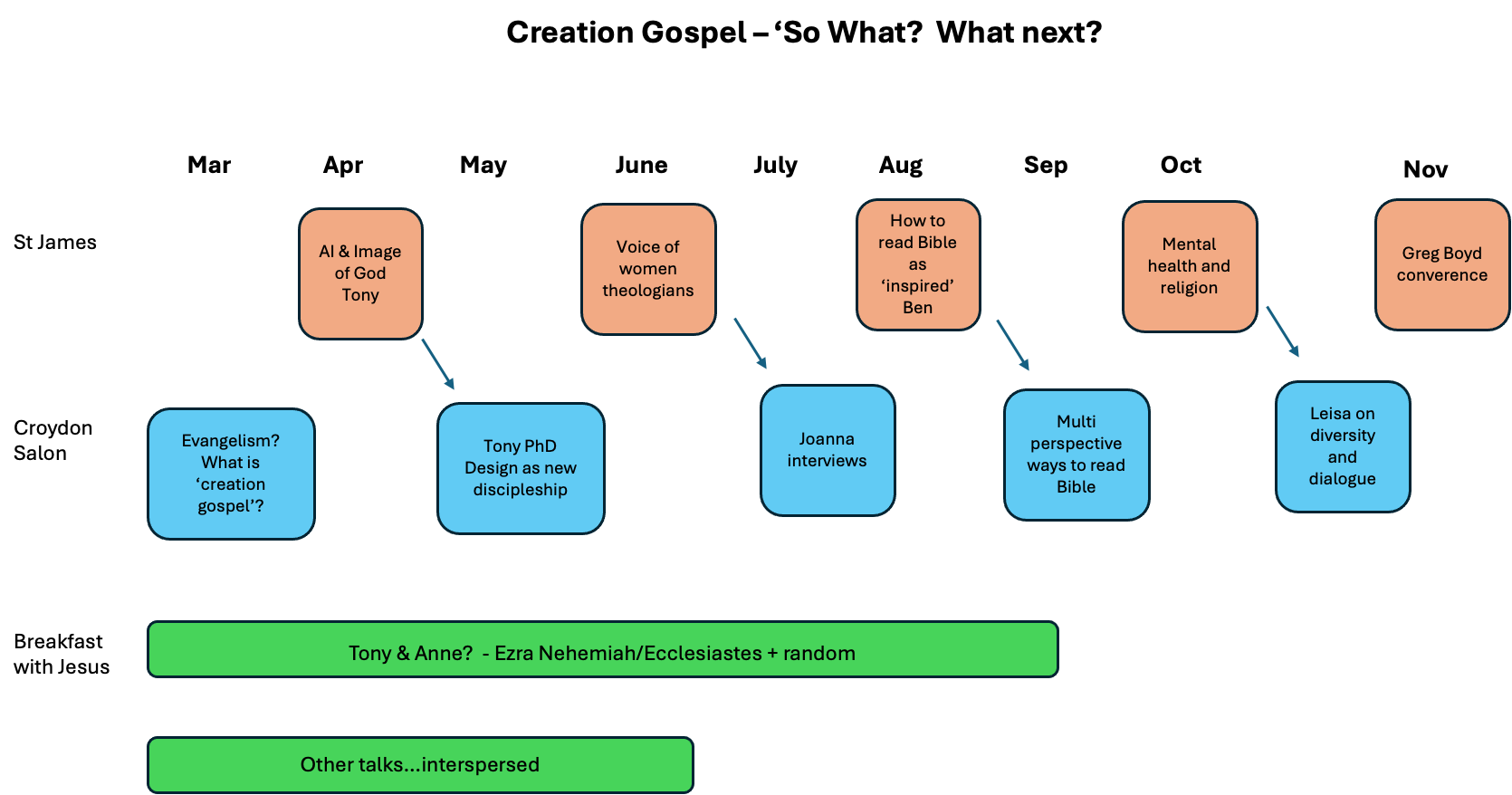
    In this talk I give an overview of our upcoming topics for the year. The ‘creation gospel’ is exciting - but what are the ‘so what's’? This is the theme we want to explore together in 2026, and in this short talk I give a snapshot of our agenda and topics. The monthly talks will come in ‘couplets’ - one at the St James Institute in the city of Sydney, and the second one more intimately at our home. Both will be ‘salons’ or ‘forums’ where we EXPLORE rather than pontificate. There are six main topics. Here they are …. * Creation gospel - core principles (including ‘new’ evangelism) * AI and the ‘image of God’ - what does it mean to be a human being? * Voice of women in theology through the centuries * How to read the Bible? “Inerrant” or ‘Inspired’? * Mental health and religion - why we need dialogue not dogma * Violence in the OT (Greg Boyd) And like an informal domestic drumbeat underneath, we will revive the ‘Breakfast with Jesus’ channel - reflections on books of the Bible based on the morning conversations between Anne and I. And in keeping with our theme of honouring women - Anne might join in to keep me honest… and tie my philosophy to the real world. God bless you, Tony Gospel Conversations is a reader-supported publication. To receive new posts and support our work, consider becoming a free or paid subscriber. Get full access to Gospel Conversations at gospelconversations.substack.com/subscribe
  • January 13 · 1 hr 28 min

    John Behr on Gregory's Stunning Vision of Humanity and the Divine

    Welcome to 2026 and as promised here is John Behr’s talk on Gregory of Nyssa and his view of what it means to be a human being. I gave an extended introduction to this talk at the end of year, and sorry there has been a lapse of time between that and this talk I was introducing…. a thing called ‘Christmas’ intervened. Anyway, to refresh our minds. This is the third talk John gave at our Gospel Conversations conference in 2025. The theme of them all is the Patristic vision of what it means to be a human being (the last talk was on Irenaeus). Both Irenaeus and Gregory thought about humanity not just in terms of salvation from sin, but more broadly in terms of what is the role of humanity in the creation? One of the problems with the sin-based view of redemption is that it begs this question - why did God create humanity in the first place? That is where Gregory’s mind goes, and thankfully Gregory had a profound and godly mind to help us answer that question! When I interviewed David Bentley Hart on Gregory, he claimed that he was the most innovative theologian of the Patristics world (a big prize given the competition!!) and it was around exactly the point of this talk that David made that claim. It takes a bit to wrap your head around… (or at least that is my experience) largely because in our modern theology we don’t ponder the problem that they pondered. For us the problem is the problem of sin - how can a holy God save sinners? But that was not the primary problem of the Patristic thinkers - rather it was the ‘creational’ problem of how can a divine - ie unchanging - God relate to a created - ie changing - creation? This is not just a philosophical problem - it gets to the angst of life today. We are bound on a wheel of change and this change makes meaning hard to find. Where is the ‘still point of the turning world’??? Hopkins captures the poignancy of the problem best in his painful lines on the ephemeral nature of beauty…. (‘The Leaden Echo and the Golden Echo’) ‘How to keep - is there any, any, is there none'Such, nowhere known some, bow or brooch or braid or brace, lace, latch or catch or key to keepBack beauty, keep it, beauty, beauty, beauty …from vanishing away? Gregory’s stunning answer to this dilemma, according to David, was to see in humanity’s very ‘changeability’ the terms of our ultimate destiny with the divine. Somehow we are called to link the changing with the unchanging - and to take changing ‘nature’ with us! It is this paradox that John untangles in this talk. so it is a golden treasure of a talk. I know of no-one more qualified than John to help us dive into this. And to tease you further, I think this is theme of Ecclesiastes… (Anne and I are studying it at present using Iain Provan’s profound commentary - so I may include a talk or two on this later in the year). Get full access to Gospel Conversations at gospelconversations.substack.com/subscribe
  • Dec 8, 2025 · 42 min

    A New Conception of Humanity: Introducing Gregory of Nyssa

    This is an introduction that became a stand alone little talk. Why? Because John’s talk on Gregory at our conference was mind- bending - but hard to follow. No fault of John’s - he was trying to condense two profound thinkers (Plato and Gregory) into a one hour talk! So I worked hard to crystallise the main themes in ‘simple Plain English’ terms - so that it can provide a runway for you into John’s actual talk which we will publish shortly. First up I explain simply just why Gregory used Plato as a platform to communicate the ‘imago dei’ gospel - and what we can learn from that. He and his colleagues had very open minds and were able to recognise the ‘eternity’ in the hearts of ‘pagan’ philosophers like Plato, much like Paul did on Mars Hill in Acts 17. I think that is a big lesson for the church today. Then I dive into the major theme of Gregory’s work according to John. Gregory’s question is the profound Psalm 8 question - ‘What is a human being?’ His answer takes up the whole of his majestic work, ‘On the Making of Man’, and John’s talk unpacks that answer. It is an answer, according to both John and David Hart, that is ‘mind-blowing’ and that offered the world a new conception of humanity ‘in the image of God’. I try to give you the big picture of that answer in this talk. I finish off with a summary of the flow of John’s talk - how he has arranged the talk and the sequence he follows. John is an old finished ‘literature’ teacher so he uses the text (which he translated) a lot - and when we publish John’s actual talk in coming days we will also upload a copy of his handouts for everybody to download. Gospel Conversations is a reader-supported publication. To receive new posts and support our work, consider becoming a free or paid subscriber. Get full access to Gospel Conversations at gospelconversations.substack.com/subscribe
  • Nov 5, 2025 · 53 min

    John Behr - Why didn't God create us perfect?

    This is our second talk in John Behr’s series on the Church Fathers. This talk outlines the ‘wild’ world of how Irenaeus of Lyon (around 170 AD) saw the Gospel - not as a rescue mission but as a plan for humanity to share in the ‘uncreated’ life of God. In case you don’t know already, Irenaeus was Bishop of Lyons in France, just after it suffered terrible persecutions. He was a disciple of Polycarp, who was in turn a disciple of John. So that makes Irenaeus a ‘grandson’ of John. Some of my theological friends rate him the greatest theologian of all…. at least he is in the top ten!! This talk is a bit mind-bending, but then again so is the topic of ‘God’ and ‘creation’ and that is where Irenaeus starts his thinking. He begins with time - and why God created time as a necessary framework for us humans to dwell in. Along the way, he confronts really modern questions such as our title - Why did God not just create us all perfect and skip over the problems of sin and conflict? Why allow all this mess to happen? The big idea that will organise all of Irenaeus’ theology is GROWTH. And not just any kind of growth but growth on the part of humanity towards participation in the divine and uncreated life of God. Clearly we are not just getting an academic summary from John here - we are getting a meeting of minds across two thousand years, with John Behr in dialogue with Irenaeus. And John is inviting us to join the dialogue. As before I have crafted an introduction that gives a short overview of the big ideas as a coat hanger to help you absorb the sheer profundity of these ideas. Gospel Conversations is a reader-supported publication. To receive new posts and support our work, consider becoming a free or paid subscriber. Get full access to Gospel Conversations at gospelconversations.substack.com/subscribe
  • Oct 20, 2025 · 1 hr 6 min

    John Behr - Was Adam created 'perfect'?

    I can remember lots of times when Christians have speculated about whether salvation means returning to the ‘perfect’ state of Adam before the Fall - or do we go one better and somehow improve on the first Adam? This talk by John Behr demolishes that whole worldview…. It is the first in a series of four talks that John Behr gave at our recent Gospel Conversations conference. In this talk John introduces us to the radical way the Church Fathers thought about the gospel - and how they read the Scriptures. Of course for them, the ‘Scriptures’ meant what we call the Old Testament. John’s stuff is paradigm shifting - that means it is clearly explained but conceptually challenging. He is inviting us to stand on the shoulders of these early church fathers and think like them. So I have added a short ten minute introduction to this talk to give you an overview of the big idea in summary. I think that will help you absorb the guts of what John has to say. As you know, John and David Bentley Hart, admire each other’s thinking - and they are both very innovative. But they have something else in common - both of them have had their OWN paradigms shifted by the deep translation work they have done on early Christian literature. David translated the New Testament, and John has translated the Church Fathers. Both of them have told me how that task has changed the way they think, because they had to get inside the minds and paradigms of the early church writers. And in so doing they found that they thought rather differently to how we do about the gospel. And, unsurprisingly, they thought in rather larger terms than we do about the gospel. All of that makes these talks very expansionary of both our faith and our understanding. Gospel Conversations is a reader-supported publication. Get full access to Gospel Conversations at gospelconversations.substack.com/subscribe

  • Sep 24, 2025 · 44 min

    David Bentley Hart on his Revolutionary Translation of Romans 5:12

    As promised here is the concluding section of my conversation with David exploring the meaning of the word ‘sin’. In this conclusion we do a deep dive into the text of Romans 5:12 - a pivotal verse for the concept of ‘original sin’ - and David explains how his completely different translation changes the traditional meaning significantly. The traditional meaning is that we all sinned ‘in Adam’ and as a result of that death followed. David’s translation turns that around and implies that it was death that initiated the contagion of sin. It is a good idea to have the text open as you listen, as the discussion is detailed and grammatical. It is not really that difficult as it all hinges on how you translate the Greek preposition ‘epi’ in this context. Talk about a pivot! David explains how the Latin text misled people for centuries, and cemented a distorted interpretation of original sin. Along the way I ask David about one of my bugbears with most translations - including the NIV - which is the gratuitous translation ‘wrath of God’ a few verses earlier. Some of you may know that there is NO ‘of God’ in the Greek - it was just stuffed in to make the point clear!?! It is a crystal clear case of retro-fitting a modern theology back onto the original text. Simply indefensible as far as I am concerned - so I was interested to hear David’s view. I think this series is David at his best. Taken together it is a very coherent and biblical picture of what ‘sin’ means - how to take it seriously but also how to position the specifics of the Christian argument. ‘Sin’ is a crucial aspect of the Christian worldview - and a very necessary one - as it addresses the problem of evil in the world which everyone is concerned about. So it is vital that we get our thinking clear on this matter and not let stereotypes overtake our thoughts. Get full access to Gospel Conversations at gospelconversations.substack.com/subscribe

  • Sep 4, 2025 · 28 min

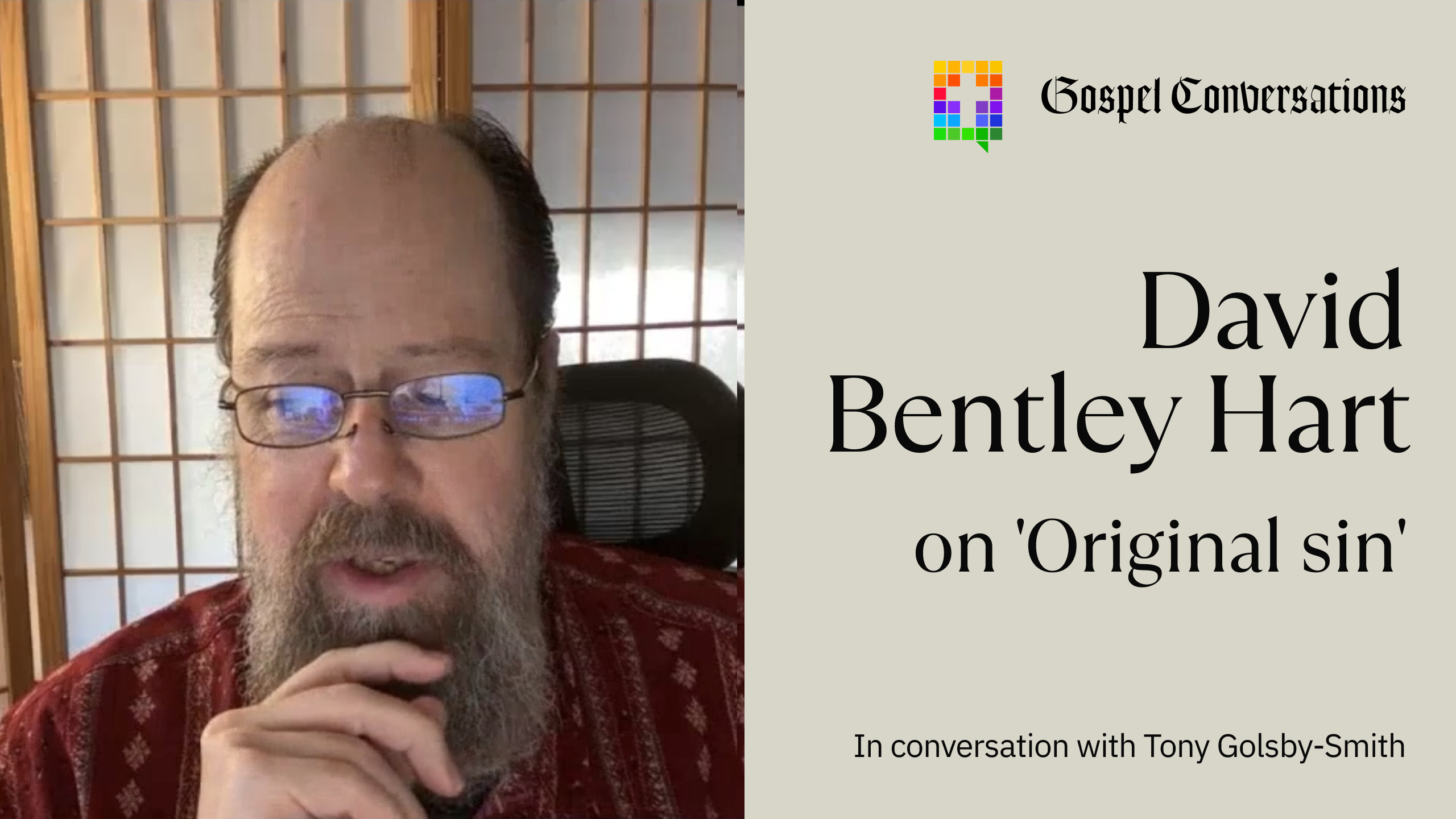
    David Bentley Hart on 'Original sin' Part 1

    “Original sin” is - apparently - one of the bedrock doctrines of Christianity. But what exactly does it mean? This is how I began this discussion with David. Our main focus was Romans 5 and in particular verse 12 - the main ‘proof text’ for the doctrine of original sin. But before we got down into the details of that verse - we started with the big picture. What does ‘original sin’ mean? And in particular in what ways has it veered off into a rather dark and guilt-ridden picture of the human condition? This discussion is so important that I decided to split the discussion in two. This one is the first half and covers the big picture. The next one will dive down into the radically different translation that David has offered of this verse - a translation that shifts the game significantly. Frankly most Christians have no real ‘theory’ of sin and instead just rely on murky ideas that make them susceptible to manipulation and fears. This talk really clears the ground of this murkiness. David lays out two competing ideas of ‘original sin’ - and we discuss how the 'dark’ view prevailed to become the dominant - but wrong - view. A couple of points that we mention in this discussion that you might want to look up. At one point we mention some of our favourite Thomas Hardy poems but we both struggled to remember their titles. One was ‘The Man He Killed’ and the other was the group of poignant poems Hardy wrote in memory of his dead wife Emma. They are called simply ‘Poems 1912-1913; Veteris Vestigia flammae’ or vestiges of an old flame. She died suddenly and they were slightly estranged when she died - so he had had no opportunity to say goodbye - hence he said goodbye in these heart wrenching poems. We also reference the esteemed Greek classical dictionary by Liddell and Scott - but I got confused for a moment with the epic histories of the First and Second World Wars by Sir Basil Liddel Hart…. and finally we both confessed our admiration for George Eliot’s Middlemarch - surely a candidate for greatest English language novel of all time - and in particular the agonising scene where the idealist young doctor, Lydgate, sells his soul and votes for the dark forces of commerce that he has spent his life contesting. All part of our discussion of the ‘system of sin and death’ in which we are all encumbered. As you will find in this talk, David and I focus on ‘death’ as the great enemy of humanity not just ‘sin’. Hardy’s poems on the death of his wife, capture the emptiness of death and how it robs us of relationship. If you have never read them, try this poignant opening verse from ‘The Going’… “Why did you give no hint that nightThat quickly after the morrow’s dawn,And calmly, as if indifferent quite,You would close your term here, up and be goneWhere I could not followWith wing of swallowTo gain one glimpse of you ever anon!” _  In a few days time, we'll post the second half of this interview. We'll dive down into the text of Romans five, verse 12 in particular. Gospel Conversations is a reader-supported publication. To receive new posts and support our work, consider becoming a free or paid subscriber. Get full access to Gospel Conversations at gospelconversations.substack.com/subscribe

  • Aug 4, 2025 · 35 min

    Macrina: The Forgotten Woman Who Helped Shape Early Christian Theology

    One of the critiques of Christian theology is that it has been largely framed by men - and thus is susceptible to masculine views of God and humanity. I can only speculate on this, but I have often privately thought that behind the Cappadocian Fathers’ generous theology lay the influence of women. It began with their grandmother, who was a martyr and continued through their wealthy but pious parents. Macrina was the elder sister and she never married. She was apparently beautiful and intelligent but her betrothed died young and she remained ‘married to Christ’ for the rest of her life. She based her celibacy on her faith in the resurrection - arguing that her betrothed was ‘not dead but alive in God’ and so it would be a sin to marry another. She was clearly a brilliant and strong minded woman, who influenced her younger brothers to pursue faith in Christ. She converted the family’s estate into a monastic community. Her younger brother Gregory of Nyssa noted that ‘such parts as you would think incomprehensible to young children where the subject of her studies’ - thus highlighting his respect for her precocious intellect. In this talk I dive into the dense dialogue between Gregory and his sister in the epic work entitled ‘On the Soul and the Resurrection’. They are talking about the passions - rather than sin per se - and the model that Macrina builds up is very rich and very different from what we are used to. Frankly I find her model much more helpful in trying to live a good life, than the traditional morality based approaches to discipleship that we used to today. She bases her model of good living on a very deep model of humanity made in the image of God. So rather than seeing holiness as defined by a moral code, she sees it defined by the vocation of humanity to channel creation upwards towards the knowledge of God. Thus she leaves us with a discipleship model that is positive not just negative. I take time to read out some her passages at length so you can get a sense of the power of her thinking. The actual book is short but pretty condensed so I am trying to put its arguments in accessible Plain English. I hope you enjoy it. Get full access to Gospel Conversations at gospelconversations.substack.com/subscribe
  • Jul 14, 2025 · 38 min

    John Behr on the 'mind blowing' theology of the Church Fathers

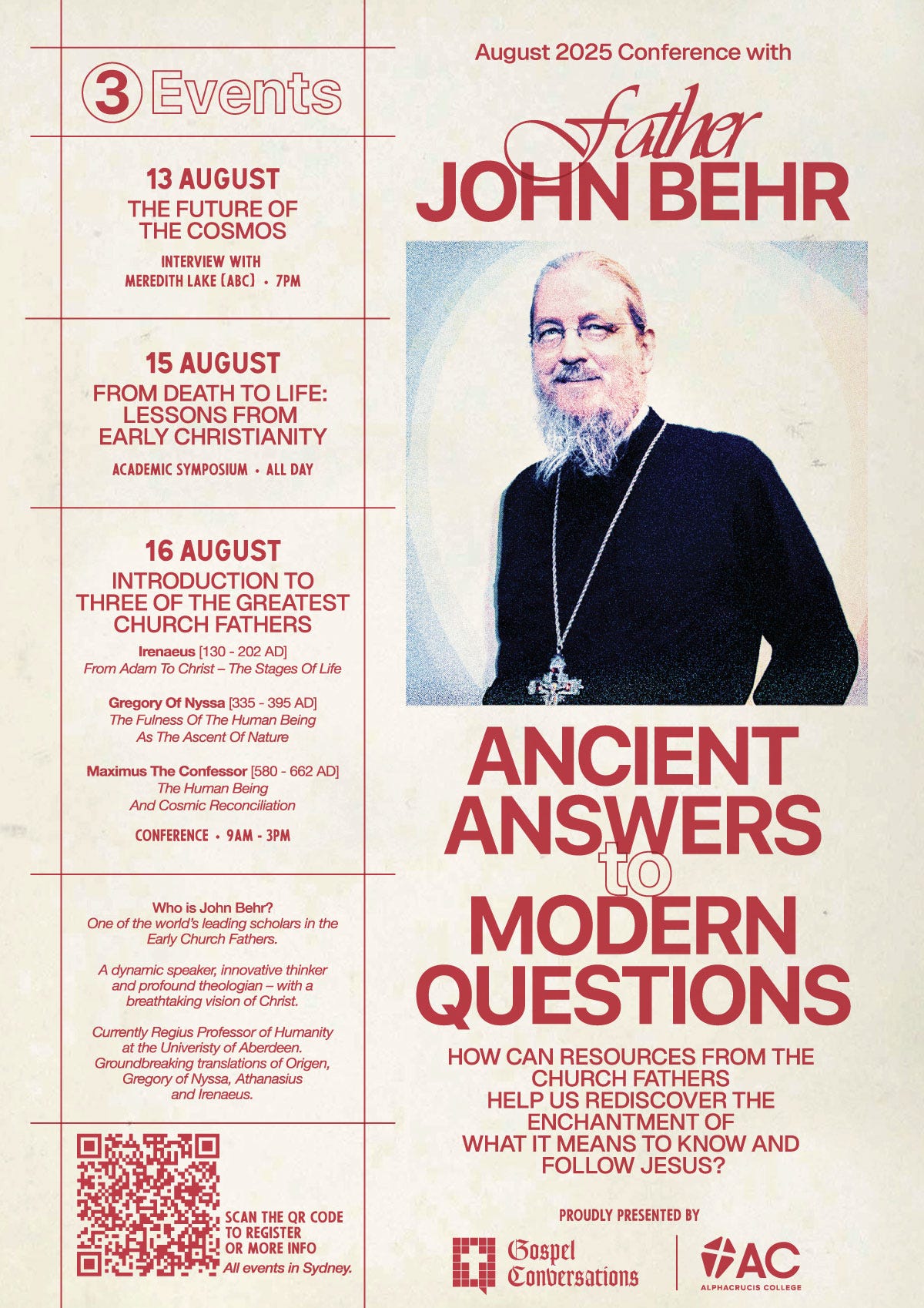
    Fr John Behr’s visit to Australia is just over a month away. I interviewed him recently to get a foretaste of what he will be talking to us about. John is clearly a major thought leader in modern theology. I got a taste of this recently from a post I read by Brad Jersak. Brad had just been to a retreat on the remote Scottish island of Iona led by Rowan Williams and John Behr (made me jealous!!). He recounts how a conversation with John (and Chris Green) was very significant for him - and helped him unravel some questions that had blocked him for years. This just confirms what a treasure John is. This interview is a foretaste - it gives us the overall sweep of John’s ‘image of God’ theology and his wondrous vision of Christ as the ultimate ‘human being’. So if you have not registered for the conference, get onto it now. The Saturday conference is one of three events we are hosting (together with Alpha Crucis and the St James Institute). What I liked most about my chat with John was how excited he is by this vision. It is not merely academic for him but as he says ‘it blows your mind’. PS here is a link to Brad’s post. Register here: Get full access to Gospel Conversations at gospelconversations.substack.com/subscribe

  • Jun 23, 2025 · 52 min

    David Bentley Hart on the real meaning of 'sin'

    What exactly does the word ‘harmatia’ (usually translated as ‘sin’) mean in the New Testament? This is where my conversation with David begins in this podcast. I asked him this question because when he was in Australia, David told me that he was uncomfortable using the modern word ‘sin’ to translate ‘harmatia’. This is obviously pretty important as the idea of ‘sin’ is at the foundation of the. gospel. What was going to be a limited conversation about translation soon developed into a fascinating tour through the thinking of the early church about the ‘gospel’ and what it means - all built on a very different understanding of the what ‘sin’ means. This conversation with David charts out a radical landscape for the word ‘sin’ as it is used in the New Testament and the early church. In the modern world we have a view of sin as a kind of transgression of a moral code. And the corollary of this is ‘original sin’ - the view that we are somehow infected by the Fall with a natural propensity for doing evil not good. So like a lot of ‘big’ concepts words, the word ‘sin’ sits in a large mental landscape for us - and David explains how far this modern landscape for ‘sin’ differs from the world of the early church. That is where we began, but it turned into a launching pad for a far ranging coverage of the conceptual landscape behind ‘sin’ and redemption in the early church. This is clearly very significant for us Christians to understand well because our gospel is framed as a redemption and ‘sin’ is normally presented as the ‘problem’ that the gospel solves. So we need to be clear and scriptural about exactly what that ‘problem’ space is. And this is the landscape that David maps out for us. As I look back on this conversation, it reminded me of my talks about a year ago, on the Exodus story as a framework for the gospel. My Exodus talks followed the series that Andrew Baartz led for us on the weaknesses of the Penal Substitution model of atonement. In essence, I explained how the Exodus story positions the ‘problem space’ the gospel confronts as slavery not judicial guilt. So David’s talk confirms this ‘Exodus’ orientation for the gospel. I will repost one of these talks soon. Get full access to Gospel Conversations at gospelconversations.substack.com/subscribe
  • May 29, 2025 · 53 min

    The Patristic model of growth; we are 'mini Christs'...

    Ben’s talks on the Patristic model of atonement led to the obvious question - what about their views on growth? This is the first of two talks by Ben on this topic. In this talk he focuses on the individual and morality and in the next talk he focuses on society and politics and how they viewed Christian contributions there. Patristic views on growth are built on their views of atonement; and that is where Ben begins - with a reminder of the ground he covered in his early talks. Unlike us, they did not struggle with a model of ‘penal substitution’ and its associated picture of an angry God. Instead they viewed atonement as ‘participation’ in the Godhead. So if ‘atonement’ qualifies humanity to ‘participate’ with God - then growth is all about making that participation real by our decisions and character development. That means that the Church Fathers did NOT have a moral code as their model - with lists of behaviours and do’s and don’ts. For them ‘growth’ is defined entirely by Christ. He is the model and thus all growth is growing into the PERSON of Christ. In the most amazing and memorable part of the talk for me, Ben made this real by explaining the term ‘Christian’ literally means ‘little Christs’ - and that is what we are. So for the Patristics we are to be as Christ on the earth - in miniature for sure but still following the same pattern our Lord has set. To make this tangible, he centres on an essay by Gregory of Nyssa where he lays out this pathway of development in concrete examples. This is very liberating stuff. It leaps over our typical concepts of morality and virtue and instead declares that all ‘virtue’ is shaped and defined by a Person - THE human being who defined in flesh and blood what it means to be human. As always Ben is so lucid on these complex topics - and he is helping us make a paradigm shift from a concept of growth as behaviour defined, to a concept of growth as Christ defined - so the we may be ‘as Christ’ in the world. Get full access to Gospel Conversations at gospelconversations.substack.com/subscribe
  • May 12, 2025 · 1 hr 8 min

    Power, patriarchy and the cross

    Well … this interview was unexpected. David Artman runs a podcast (Grace Saves All) dedicated to the topic of universal salvation. But he is very disturbed by the rise of Trump and what he sees as the ‘first stage of facism’ taking root in his country. So he wanted to interview me - to get an international comment and also a ‘systems’ perspective on what is going on. I am not an expert in US politics but like all of us I am fascinated (horrified) by what is going on - and in particular the role of white evangelicals in supporting Trump. (David Hart has stressed that it is white evangelicals not African American evangelicals). So my perspective - one that has occupied my mind - is how did Christians get sucked in to this demagogue and is there anything intrinsic in the way evangelicals frame the gospel that made them susceptible to a manipulator like Trump. Frankly what has happened has made me question evangelicalism (whatever that means) deeply. As you might imagine this interview was quite a journey. It became a discussion about power, patriarchy and the cross. And I framed it within the overarching theme of ‘rule’ - which I see as the divine mandate for humanity on the earth - a mandate confirmed and affirmed in Christ and the cross/new creation. If you are interested in other views on this same topic, David interviewed Douglas Campbell the episode before me and Brian Zanhd the week after me. Both were really good according to my wife Anne who listened to them all. Get full access to Gospel Conversations at gospelconversations.substack.com/subscribe
Showing 1–20 of 21 episodes