Skip to content
Artwork for Fullstack HR
BusinessManagement

Fullstack HR

Johannes Sundlo

Fullstack HR is a podcast by HR professionals for HR professionals, hosted by Johannes Sundlo, an active HR manager shaping the future of work. We dive deep into the latest trends in HR, AI, and digital tools, offering insights from someone in the trenches daily. Whether you’re looking to future-proof your HR strategies or stay ahead of industry shifts, this podcast delivers actionable advice and expert perspectives to elevate your HR game.

www.fullstackhr.io
Play
  • 22 episodes
  • Avg 11 min
  • English
Counted on this page — what you have heard stays on this device, so it is not something the list can be paged by.
  • Thursday · 21 min

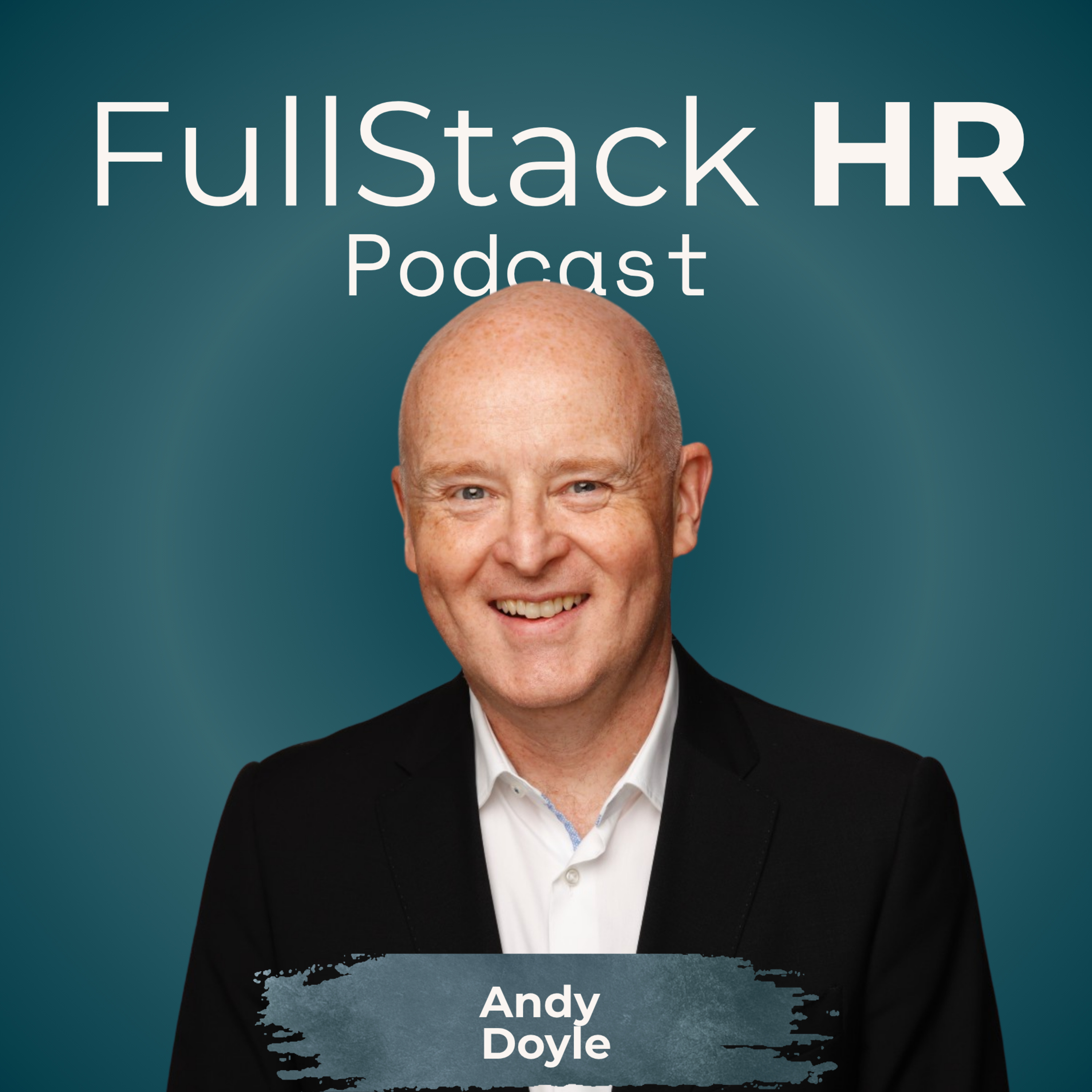
    The Chief People and Agent Officer with more agents than employees

    Kantar has around 12,000 employees and around 15,000 agents. Andy Doyle is responsible for both, and he explains how they reached that scale in 18 months without an engineering army. In this episode: Why the CEO pushed for the title Chief People and Agent Officer, and what it changes in practice The bet behind giving all 12,000 people Copilot in three months, from 300 pilot licenses to everybody Change influencers instead of change champions, and the control Andy gave up to make it work The agent that cut a monthly HR and finance reconciliation from a week to 10 minutes Kantar's target of resolving 95% of HR service queries without a human, and the three agents that guard the risk line The agent factory, run out of HR, with 70 citizen builders and none of them from the technology function Why the HR community has the highest AI usage of any function at Kantar With Andy Doyle, Chief People and Agent Officer at Kantar. Links mentioned: Andy Doyle on LinkedIn → https://www.linkedin.com/in/ajdoyle/

  • Tuesday · 8 min

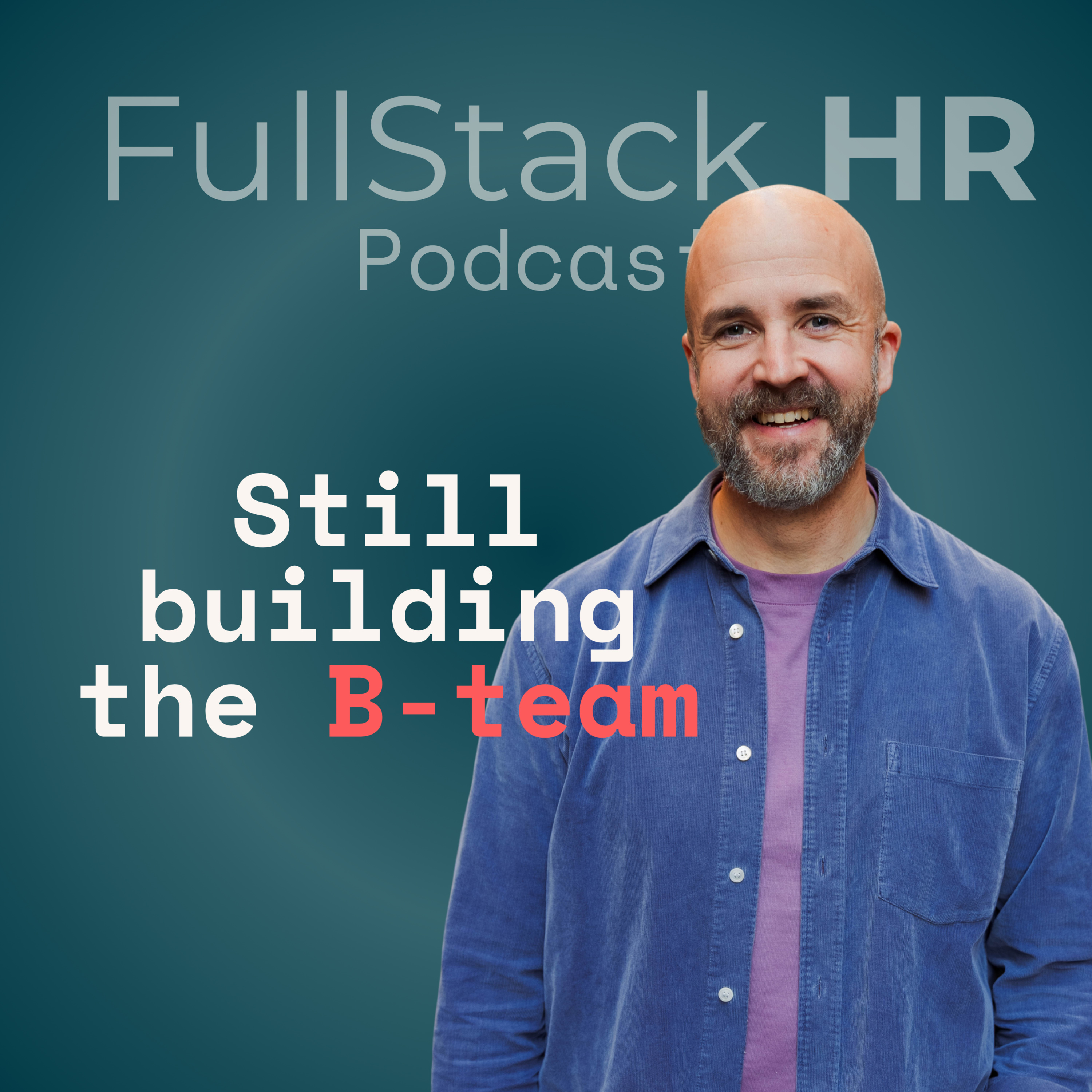
    Still building the B-team

    In May I argued that AI is a work tool, not a perk. Three months and a lot of client work later, the gap between the people who have it and the people who don't is not closing. It's growing, and most organizations are fuelling it without meaning to.In this episode:- Why well-intentioned license decisions end up splitting your workforce in two- The two cohorts living side by side in the same organization, one running fast with their own Claude and ChatGPT setups, one barely started- The mechanism behind it, licenses follow whoever is comfortable asking- Why one client is taking AI access to the union negotiating table, and why I think they're right- Equal opportunity has to include the tools, not just the loud and vocal- The real missing piece, nobody has defined why AI matters for this organization- Why leaders can't be strategic about AI without being practical with it firstLinks mentioned:- AI Is a Work Tool, Not a Perk → https://www.fullstackhr.io/p/ai-is-a-work-tool-not-a-perk Subscribe to the FullStack HR newsletter → https://fullstackhr.io

  • August 20 · 27 min

    AI Transformation in HR: Redesigning Work Without Losing Human Judgement with Joe Shahmoradian

    First episode of the new interview series with people who do stuff with AI, not people who talk about AI. Joe Shahmoradian runs talent acquisition for EMEA at Morningstar, and everything in this episode is running in his team today. In this episode: How his team cut post-call admin by 75% with AI transcription on screening calls, and why the first tool got killed Amira, the AI teammate that works like a journalist and turned five-day market intelligence reports into 90-minute video briefings The AI clone Joe built before paternity leave, and what it did when he prompted it maliciously at 1 AM Morningstar's playbook for adoption at scale, an AI Academy, a champions community that grew from 5 to nearly 200, and an idea hub with real ownership What Joe would do in his first 90 days at a company starting from zero, and why governance comes before agents Why the workforce of the future is humans and agents as teammates, and why the discourse needs more boldness With Joe Shahmoradian, Director of Talent Acquisition EMEA at Morningstar. Links mentioned: Joe Shahmoradian on LinkedIn → https://www.linkedin.com/in/joeshahmoradian/ FullStack HR newsletter → https://fullstackhr.io

  • August 18 · 7 min

    Slop is slop

    Subscribe to the FullStack HR newsletter → https://fullstackhr.io Claude started watermarking every text it writes. Substack scores your posts for AI. Recorded from the car after two weeks off, this episode is about why both miss the point. In this episode: What Anthropic's new invisible watermark does, and what it can't do How Substack's Pangram scan works, and why it's easy to circumvent Why the human-versus-AI framing is the wrong test The pieces I let AI write on its own, and why they tanked The pieces I wrote alone that got the exact same feedback My workflow, dictate in the car, let Claude turn it into an article Why turning off the AI scan reads as shame, and what to do instead Links mentioned: How Claude's text watermarking works → https://www.anthropic.com/news/claude-text-watermark How can I detect AI on Substack → https://support.substack.com/hc/en-us/articles/50891130623508-How-can-I-detect-AI-on-Substack Pangram → https://www.pangram.com

  • June 30 · 10 min

    "You may only use Copilot."

    Subscribe to the FullStack HR newsletter → https://fullstackhr.io A week at Almedalen made one thing obvious. Most leaders shaping how Sweden thinks about AI have only ever touched Copilot or the free ChatGPT, and that single reference point is quietly capping what entire organizations believe AI can do. In this episode: Why almost nobody picks their own model, and how a Microsoft license becomes an AI strategy by accident The screwdriver vs power drill problem. Copilot solves the job, but it sets your expectations far too low How a single default tool shrinks the whole organization's sense of what AI is capable of The shadow IT trap, where your best people quietly run Claude or ChatGPT on the side and you lose both security and their hard-won knowledge Why limiting people to one tool becomes an employer branding problem over time What the real frontrunners do instead. Securing Copilot, ChatGPT, Claude, and Gemini and letting people choose The blunt take on IT departments that claim multi-model access is not doable on security grounds

  • June 11 · 13 min

    Claude Fable 5 is here. The models are ready, your organization isn't

    Anthropic just dropped Claude Fable 5, and I've run it through the same test suite he's used on every major model for 2.5 years. The verdict is clear, but the bigger lesson isn't about the model at all. In this episode:- Why Fable 5 feels like the most human-like model yet, and how it gives honest, direct feedback instead of patting you on the back- The worker scheduling test (30 people, legal requirements, hard constraints) and how Fable 5 handled it- A real client case where Fable 5 reworked a Copilot Studio workshop deck and improved the flow- The Mythos connection, the security guardrails, and why hacking headlines might be part PR- The pricing cliff on June 22. $10 per input token, $50 per output token, and Johannes's plan to pair Opus 4.8 for creation with Fable 5 for evaluation- The real bottleneck. Models are capable, organizations are not, and why experimentation time is the thing HR must fight for- McKinsey's warning that HR risks becoming a sub-department of IT if it doesn't take the driver's seat now Links mentioned:- McKinsey HR Monitor 2026 → https://www.mckinsey.com/capabilities/people-and-organizational-performance/our-insights/hr-monitor

  • June 10 · 7 min

    AI Shame and Why You Can't Skip the Grunt Work

    Subscribe to the FullStack HR newsletter → https://fullstackhr.io Organizations keep telling Johannes Sundlo, the host here, "we've got the basics covered, skip ahead." Then he asks them to show how they use AI, and gets blank stares. This episode is about AI shame, where it comes from, and the one step you can't skip. In this episode: AI shame, what it looks like and why it's more common in 2026 than 2025 The pattern behind it. Buyers say "we're proficient, go straight to processes," but the proficiency is a sliver of what the models can do Why this shows up most in leadership teams, and why leaders who skip the grunt work can't set credible AI expectations for their organization The missing step. You can't jump to agentic processes before you've done the unglamorous work of learning what the model can do Educate everyone, including truck drivers without computers, because employees are already getting AI advice on salary and managers in their spare time Why being practical beats strategic-only thinking in AI adoption right now Lessons from roughly 110 workshops this winter and spring, and why Johannes is scaling that down

  • June 6 · 5 min

    Connect HR to Claude & ChatGPT with MCP (Easier Than You Think)

    Subscribe to the FullStack HR newsletter Yes, you can connect your HR system, ATS, or engagement tool to Claude and ChatGPT. In this episode Johannes Sundlo walks through the exact steps to add an MCP server to both tools, using a safe read-only demo. In this episode: What an MCP server unlocks for your AI, explained simply Adding a pre-made connector in Claude Adding a custom MCP server in Claude with a URL Why you should start with read-only access Enabling Developer mode and creating an app in ChatGPT Connecting and testing the server in ChatGPT Authentication, security, and why to bring IT in early New to MCP? Start with the written primer that explains connectors and MCP from scratch:https://www.fullstackhr.io/p/connectors-and-mcp-explained-for Links mentioned: MCP and connectors explainer → https://www.fullstackhr.io/p/connectors-and-mcp-explained-for

  • June 2 · 12 min

    Is AI adoption now a bigger edge than the model itself?

    Subscribe to the FullStack HR newsletter → https://fullstackhr.io OpenAI just ran an event called Intelligence at Work, and the releases say a lot about where the world of work is going. Here is what dropped and why it matters for anyone leading AI adoption. In this episode: Why the bottleneck has shifted from model intelligence to a company's ability to absorb the tech The stat to sit with: 74% of AI's economic value is captured by 20% of companies Codex moving into ChatGPT, and what that means if you are on ChatGPT Enterprise Six role-specific agent plugins, including a data analytics agent that writes queries, builds charts, and produces a deck Annotations: editing one piece of an output instead of regenerating the whole thing, and whether it solves the "last mile" problem Sites: turning Codex outputs into shareable, live dashboards and internal apps (Lovable meets Artifacts) Why OpenAI keeps framing adoption as a human transformation, not an IT project Sam Altman on the next phase: proactive agents that fix things in the background before you ask Links mentioned: OpenAI Intelligence at Work (the event) → https://openai.com/sv-SE/business/intelligence-at-work/

  • June 2 · 9 min

    What does good performance look like in the age of AI?

    Subscribe to the FullStack HR newsletter Performance reviews have looked the same since the 1950s, and they are still mostly task-based. AI breaks that. This episode asks what we should reward when the tasks get automated and the only thing left to value is human judgment.In this episode:- Why the task-based performance review is the wrong tool for the AI era- The judgment problem. If an agent does the work, how does an employee prove their value, and does the manager even see it- A real CHRO dilemma. Two standard performers became superstars with AI, two former high performers fell behind, and bonus season arrived- Rewarding the behavior of using AI versus rewarding valid, validated output- Why AI makes the manager's job harder, not easier- The hidden cost of a thumbs-up task that creates a ripple of rework downstream- Should we scrap the performance review, hand growth to AI plus manager, or build something new Links mentioned:- Nate B. Jones, Nate's Substack

  • May 31 · 10 min

    Is your AI consultant in the weeds, or just talking strategy?

    Subscribe to the FullStack HR newsletter → https://fullstackhr.io Three and a half years into the AI shift, most leaders still know AI matters but have no idea how to use it. This episode is about why that gap exists, and why the answer is getting practical. In this episode: Why leaders keep asking for agentic workflows before they've done the basic Copilot grunt work The uncomfortable question every AI educator should answer: are you in the weeds, or only working "strategically"? Why you can't set new expectations for your team until you understand the new way of working yourself What buyers should demand from anyone selling AI upskilling How to do this for free with YouTube and disciplined facilitation if you don't want to hire someone Why AI should serve your existing strategy, not become a separate "AI strategy" The one-gear Ferrari problem: everyone owns Copilot, almost nobody drives it past first gear This podcast is hosted by Johannes Sundlo, one of Europe's leading voices on AI adoption in HR and the workplace. He helps organizations move from talking about AI to actually using it, through hands-on workshops, keynotes, and the FullStack HR newsletter.

  • May 28 · 10 min

    AI Bubble or Not? Why Token Costs Aren't What You Think

    Subscribe to the FullStack HR newsletter An impromptu between-episodes take on the AI bubble panic. Johannes cuts through the headlines about rising token costs, Microsoft cutting Claude Code, and Uber's COO questioning AI ROI, and explains what's signal and what's noise. In this episode:- Why nobody can actually call a bubble, and what the market is and isn't telling us right now- The arguments for a bubble (circular money between NVIDIA and OpenAI) versus against it (Anthropic's first profitable quarter)- Why "rising token costs" is a mislabel. Per-token prices are flat or lower, total spend is what's climbing- How Moore's Law underpins the whole thing: more powerful models for the same or lower price- The full context on Uber blowing its AI budget, and why the COO is far more nuanced than the headlines suggest- Why early subsidize-then-correct cycles are normal, same as railroads, electricity, and the internet- How to do the token economics yourself: if an agent solves a problem cheaper than a human at equal quality, you have your answer- Why the model companies are targeting a ~$58 trillion global labor market, and what that means for their valuations Links mentioned:- Rapid Response podcast, Andrew Macdonald (Uber COO) interview - Fortune coverage of the Uber AI budget story

  • May 26 · 10 min

    Do We in HR Need to Be More Technical?

    The short answer is yes. But yes deserves an explanation. In this episode I make the case for why HR needs to get technically curious right now, and why that has nothing to do with becoming a programmer. We cover what's worth understanding (APIs, databases, MCP servers, and why they matter for HR), why playing around with tools like Claude Code, Codex, Lovable and Replit makes you a sharper buyer of HR tech, and how one curious person on a team can shift an entire organization. It might not be the CHRO. It might be the HR assistant fresh out of university. I share what it felt like walking into Spotify with close to zero backend knowledge, why the threshold for connecting systems has dropped, and why "I'm not the technical type" no longer holds as an excuse. This is where the world is heading. You can ignore it, or you can skate to where the puck is going.

  • May 21 · 8 min

    AI Is a Work Tool, Not a Perk

    In this episode, Johannes Sundlo explores a growing issue inside organizations adopting AI: the creation of an “A and B team.” Some employees get access to AI tools, licenses, education, and experimentation opportunities. Others are left behind. Not because of role or capability, but because of interest, visibility, or who happened to push hardest internally. Johannes argues that this is becoming one of the most overlooked leadership and employer branding challenges in AI adoption. He discusses: Why selective AI access creates organizational inequality The hidden cultural risks of AI “elite groups” Why the cost argument often falls apart under scrutiny The chicken-and-egg problem of AI adoption Shadow AI and the risks of unsupported tools Why HR cannot leave this entirely to IT How AI access is increasingly becoming a workplace infrastructure question, not an innovation experiment This is not a conversation about hype or future speculation. It’s about what happens inside organizations right now when some employees are allowed to work with modern tools while others are expected to continue without them. A practical reflection on leadership, fairness, AI adoption, and the future of work.

  • March 2 · 13 min

    4,000 People Fired for AI. I Have Thoughts.

    Block just fired 4,000 people in a single day. Their CEO Jack Dorsey said it was because of AI. The stock jumped 20%. And the internet lost its mind. Half the people say this is pure hype. The other half say AI is coming for all of us. I think both sides are wrong, and I have thoughts. In this video I go through what actually happened at Block, weigh the evidence for and against the AI narrative, talk about why Wall Street loved this so much, and share what I think it means for leaders, employees, and anyone trying to figure out where AI and jobs are actually heading. I also take on the myth that AI skills will protect you from layoffs.

  • January 20 · 12 min

    Would AI Be a Better Boss Than Yours?

    What if an AI manager could do a better job than your current boss? Johannes explores this deliberately provocative question – not to argue that we should replace managers with AI, but to challenge our assumptions about what management is actually for. From the industrial revolution roots of the manager role to DoorDash's algorithmic task distribution, he examines whether the core function of "making sure work gets done" might be ripe for reinvention. If AI can handle delegation, and some managers already lack the empathy we claim only humans possess, what should human leaders actually focus on? A call to start the conversation about leadership's future before it's decided for us.

  • January 6 · 11 min

    From four weeks to 45 minutes.

    What happens when a four-week project takes 45 minutes? That's what I experienced over Christmas with Claude Code. In this episode, I share what I built, why this matters beyond coding, and the hard questions organizations need to start asking. Because this isn't slowing down.

  • Nov 17, 2025 · 11 min

    Only 5 percent use AI in ways that change their job

    Transforming Work with AI: Insights from EY and PWC SurveysIn this episode, Johannes Sundlo discusses the limited transformative use of AI in workplaces, referencing new surveys from EY and PWC. Despite high adoption rates for basic AI tasks, only a small percentage of employees leverage AI for advanced purposes. Sundlo emphasizes the need for better training, organizational alignment, and inclusive AI programs to bridge capability gaps and enhance productivity. The episode also explores the psychological challenges of AI learning and the potential for AI to replace HR roles, urging organizations to focus on strategic AI adoption and workforce development.00:00 Introduction and Overview00:49 EY Work Reimagined Survey Insights03:05 PWC Global Workforce Survey Findings06:54 Challenges in AI Learning and Adoption08:57 Future of HR in the AI Era11:04 Conclusion and Final Thoughts

  • Nov 7, 2025 · 12 min

    100,000 Hours Saved with AI - When AI Hits the Earnings Call

    Read the full article here and get all the links: fullstackhr.io ROI Reality Check - IBM study shows 66% of companies already see significant AI productivity gains, with 41% expecting ROI within a year. But the gap between large enterprises and SMEs is widening fast. Ernst & Young's Smart Move - They've built a tool that shows employees exactly how their jobs are changing, what'll be automated, and what skills they need next. Over 200,000 employees have engaged with it. Citigroup's Scale - 1 million automated code reviews, 7 million AI tool uses, freeing up 100,000 developer hours weekly. This is what productivity at scale actually looks like.The Recruiting Arms Race - 50% of hiring managers use AI to screen candidates. 70% of candidates use AI to write applications and prep for interviews. It's like two AIs playing chess, neither realizing it. Chipotle's Results - Used conversational AI for 20,000 seasonal hires. Application completion jumped from 50% to 85%, time-to-hire dropped from 12 days to 4.The Big Questions:How do we redesign roles when AI does significant work?What does "knowledge" even mean in the AI era?Do we need to completely rethink the recruitment funnel?The pattern? Companies treating AI as a campaign fail. Those treating it as an operating model win. This isn't about buying licenses and booking training sessions—it's about fundamentally redesigning how work gets done.

  • Nov 1, 2025 · 8 min

    Why is AI training DECREASING?

    Link to all the articles mentioned here. This week's news highlights the rapid acceleration of white-collar automation, posing significant challenges for the workforce as training programs lag behind in preparing employees for an ai-driven future. The latest developments in ai adoption are transforming industries at an unprecedented pace, with companies like OpenAI making substantial investments, such as a $1.4 trillion bet on artificial general intelligence. As ai training becomes increasingly crucial for professionals to remain relevant, it is essential to address the gap between the pace of automation and the availability of effective training programs. In this video, we will delve into the implications of these trends and explore the potential consequences for the job market and the future of work. With ai adoption on the rise, it is more important than ever to prioritize ai training and ensure that the workforce is equipped to thrive in an automated economy.

Showing 1–20 of 22 episodes