
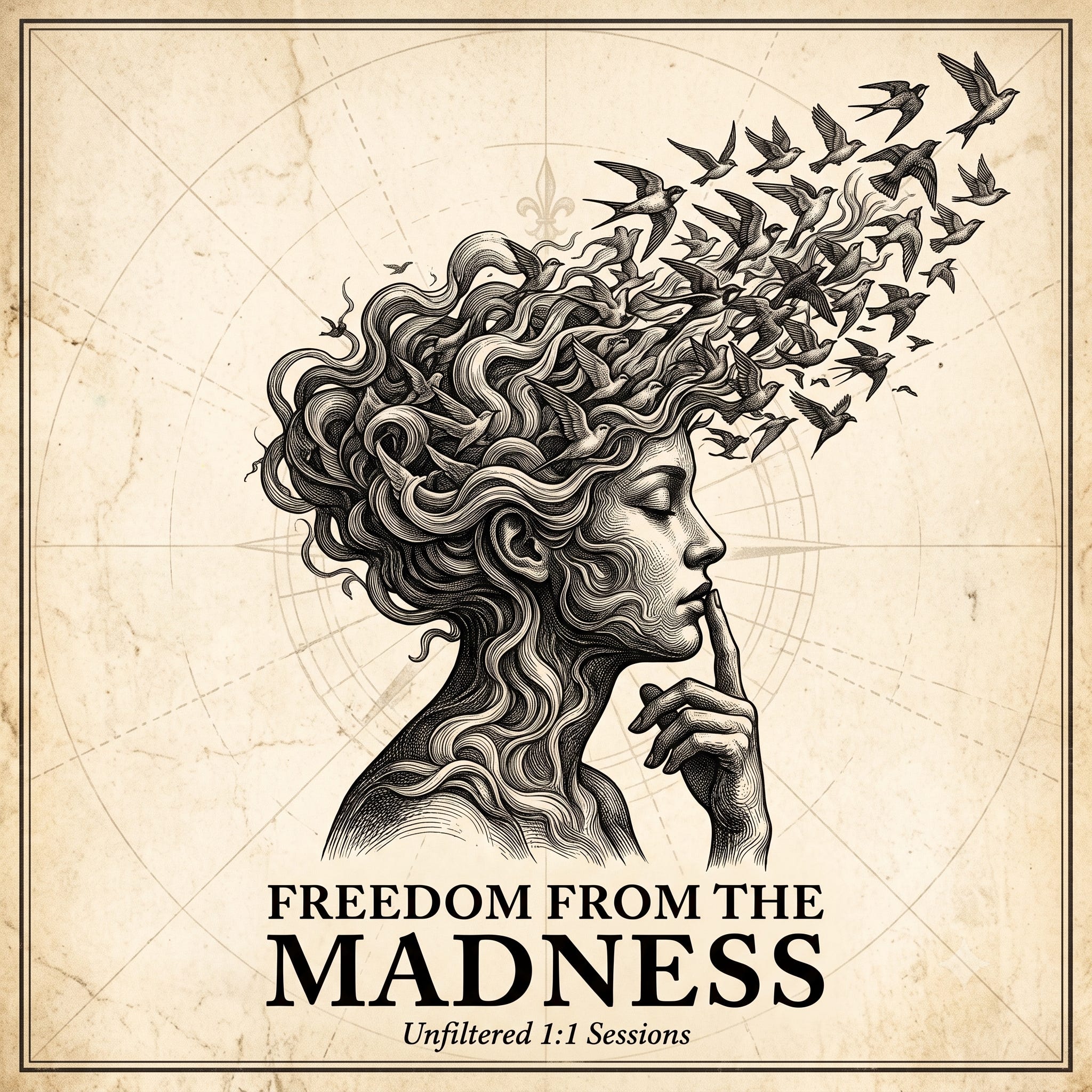
Moving Beyond Toxic Relational Patterns |Unfiltered 1:1 (#4)
Streams straight from the publisher. podnod never proxies or re-hosts episode audio.
🎙️ Be Part of the Journey: Ready to break through your own cycles and do the inner work? You have two ways to work with me:
* 👉 Book a free, recorded 1:1 session for the podcast
* 👉 Book a private, confidential paid 1:1 session
📱 Join my Instagram Community of more than 350k people, who seek to live a life of truth and authenticity.
🔓 Dive Deeper: Insights & Essays. Subscribe for free on Substack to receive the key insights and top quotes from each unfiltered 1:1 session, as well as full weekly articles exploring consciousness, non-duality, and the human condition.
In this raw, unedited session, Andy unpacks the devastating loop of staying in a toxic relationship two years longer than he wanted out of fear, pity, and guilt.
How many of us are in love with the potential of someone?
Do not get me wrong, to see the best in someone is beautiful, and focusing on that trait can amplify and expand it.
The problem begins when there is only potential and no reality. When reality is painful, we only love the potential.
This is one of the reasons conflict is born in relationships. The conflict is between what is, which is reality, and what should be, which is potential.
This is the inner conflict Andy experienced in a relationship that became more toxic as time passed.
Episode Timestamps
04:31 - Pity, Guilt, and the Two-Year Extension
* Summary: Andy reveals he stayed in his past relationship for two years longer than he wanted due to his partner’s threats of suicide, trying to use acts of care to fix her mental instability.
* Key Insight: Operating out of pity or guilt is completely separate from love. When choices are born out of obligation rather than alignment, the entire dynamic becomes structurally unsound.
* Notable Quote:
“I stayed in that relationship probably two years longer than I actually wanted to. I felt like I couldn’t leave because I was convinced she would commit suicide if I did. That was the baseline. I really stayed in this relationship entirely out of fear and guilt.” — Andy
10:16 - Blurred Boundaries and Absolute Chaos
* Summary: The fallout of unstated boundaries. Andy explains how a lack of explicit agreements at the end of the relationship resulted in financial disputes, broken communication, and stolen property.
* Key Insight: Failing to clarify your boundaries out of a desire to remain “nice” creates a dangerous vacuum that invites resentment and toxic violations.
* Notable Quote:
“I told her, ‘It would be nice if you could pay rent,’ since we lived together. She was also using my car. Even then, I wasn’t clear about my boundaries from my perspective now. It ended up with her blocking me, stealing things from the apartment, refusing to pay rent, and stealing the car.” — Andy
15:46 - Forced Connection & Weaponized Vulnerability
* Summary: Andy shares how difficult it was to be open in an environment dictated by emotional threats, and how forced vulnerability damages safety.
* Key Insight: Intimacy cannot be pressured. When openness is forced rather than naturally volunteered, whatever is shared will inevitably be weaponized in future arguments.
* Notable Quote:
“It was incredibly difficult for me to open up in that relationship because there were so many threats. In general, I didn’t feel safe. When she finally pushed me to open up, she just used what I shared against me in our next fight.” — Andy
20:31 - The Somatic Reality of the Anxious-Avoidant Dynamic
* Summary: Michalis challenges Andy’s perspective as a victim, exploring how his deep avoidance subtly triggered his ex-partner’s volatility.
* Key Insight: What looks like an irrational overreaction is often a completely logical somatic response to the energetic reality of being unchosen. A woman can feel in her bones when a partner is mentally planning an exit.
* Notable Quote:
“At the end of the day, if anyone were inside her body during those moments when she lashed out, they would have reacted exactly the same way. Looking at it logically, you can say she didn’t feel seen. But underneath that is a somatic dynamic—the physical sensations, the discomfort, the heaviness in her chest. What did her body experience when she felt rejected? If you had made her feel safe enough to express that, you would realize she wasn’t overreacting. Based on what was happening inside her, she was likely under-reacting.” — Michalis
26:16 - The Secondary Gain of Dating Instability
* Summary: A look at why we select unstable partners. Andy admits that choosing someone fragile protected him from his own fear of not being good enough.
* Key Insight: Dating someone you perceive as a “downgrade” provides an avoidant safety net. You convince yourself they won’t leave because you are the one carrying the relationship.
* Notable Quotes:
Andy: “I realize it’s easy for me to choose a partner who is unstable because I can control the dynamic. When she isn’t in her full power, it’s easier for me to avoid my own fear of facing someone who is—while simultaneously making myself feel good for taking care of someone else to soothe my own fear of not being good enough.”
Michalis: “When you date someone who is mentally unstable, you position yourself as the one sacrificing or downgrading. They can’t easily leave you because you are the one carrying the relationship. This makes you feel safer and artificially boosts your self-esteem.”
32:01 - The Real Problem: Facing Your Own Avoidance
* Summary: Exploring how passive deception operates when an avoidant partner stays in a relationship that they already know has an expiration date.
* Key Insight: You cannot expect stability from a partner when you are quietly holding onto past fights and planning your exit route.
* Notable Quote:
“Your deep avoidance constantly triggered her because she could sense you weren’t fully present or committed. You saw her instability and mentally decided, ‘I cannot stay with this person for life; this has an expiration date.’ Even if you didn’t say it out loud, she felt it. Her volatile behavior was simply an unconscious reaction to that somatic perception.” — Michalis
38:21 - Loving the Potential vs. Living the Reality
* Summary: Andy and Michalis break down the ultimate relational fallacy: falling in love with who a person could be rather than who they actually are.
* Key Insight: You must be completely at peace with a partner staying exactly as they are right now. If the answer is no, you are loving an idealized project, not a real human being.
* Notable Quotes:
Andy: “I didn’t want to be with her as she actually was; I was in love with her potential, with who she could be. I only realized later that I couldn’t build a relationship on potential. The potential was a caring, loving, joyful person, but the reality was overwhelmed by depression, a lack of direction, and blame.”
Michalis: “Your willingness to enter the relationship based on potential is what initiated this entire mess... You can never fall in love with potential. Look at the reality and ask yourself: ‘Am I willing to spend the rest of my life with this person if they stay exactly like this?’ If the answer is no, you are loving a project, not an individual.”
43:11 - Hiding Your Truth Multiplies the Pain
* Summary: The cost of withholding the truth. Michalis explains how hiding your lack of alignment out of fear simply extends the timeline of shared misery.
* Key Insight: True connection requires tracking a partner’s lived embodied experience rather than intellectually managing their trauma. Expressing your truth immediately saves both parties.
* Notable Quote:
“When the relationship project isn’t going well, frustration, exhausting effort, and anger take over... You chose not to communicate your truth because you feared she would flip out or harm herself. But by hiding it, you simply extended the timeline of misery, adding two years of pain for both of you and allowing her to get more attached to an illusion. It would have been far kinder to say early on, ‘You are too unstable, and I can’t do this anymore.’” — Michalis
46:56 - The Myth of External Fulfillment & The Abused Dog Analogy
* Summary: Andy maps out his realization that he was looking outside of himself for happiness. Michalis uses a powerful analogy to describe the mechanics of codependent caretaking.
* Key Insight: As long as you don’t give love to yourself, you won’t have the capacity to give it to anyone else. Looking outside for fulfillment is an escape driven by the discomfort of looking within.
* Notable Quotes:
Andy: “My biggest realization is that I was looking for someone else to make me happy. I was projecting that responsibility outward, rather than learning how to look within, take care of myself, and generate my own fulfillment.”
Michalis: “If you don’t offer that love to yourself, you lack the capacity to give it to anyone else. Your unhealed presence acts as a trigger that multiplies a wounded person’s pain. It’s like bringing home an abused dog from the street because its vulnerability makes you feel safe from abandonment, but failing to fully commit to it. The dog senses your reservation and grows aggressive, which makes you angry in return. Have you actually offered them real love to begin with, or offered it to yourself?”
50:16 - Halting Self-Rejection & The Intellectual Ideals of Peace
* Summary: How to actually love yourself. Michalis describes the importance of tracking self-rejection and addresses the trap of using spiritual detachment to hide from human needs.
* Key Insight: Intellectual non-dual concepts do not erase human desires, needs, or wants. True peace requires holding both truths simultaneously rather than forcing a conceptual detachment.
* Notable Quotes:
Michalis: “Every time you actually force yourself to do something you don’t wanna do and does not feel true, that is the beginning of self-rejection. Bring some mindfulness in your everyday life... relax into who you actually are. And at the same time, be honest about the things that you reject in yourself...
Living strictly by the ideal that nothing external is needed is a form of internal resistance to your own reality. Non-dual texts tell us that nothing outside will ever fully satisfy us, but that intellectual concept doesn’t instantly erase your human desires, needs, or wants. You have to honor both truths simultaneously: one is a philosophy, the other is your active reality. It is precisely by directly pursuing your external wants and needs that you naturally experience their limitations and step into a genuine, unforced peace, rather than trying to force a conceptual detachment.”
53:41 - Relationships as the Essential Mirror
* Summary: Michalis explains why isolating yourself to find inner peace is impossible, pointing out that human relationships are transactional mirrors.
* Key Insight: In complete isolation, your patterns of self-rejection remain invisible. Relationships are the only setting where you can understand your boundaries, establish your hard “no’s,” and find your authentic “yes.”
* Notable Quote:
“You cannot escape relationships because they are the only transactional mirrors through which you can see yourself clearly. In isolation, your self-rejection remains invisible. It is only within a relationship—down to noticing how your behavior shifts or what stories you tell on a first date—that the parts of yourself you refuse to accept are exposed. The relational arena is the only setting where you can understand your boundaries, establish your hard ‘no’s,’ and ultimately uncover your authentic ‘yes.’” — Michalis
55:11 - The Mental Prison vs. Somatic Presence
* Summary: A deep dive into how a hyperactive mind—constantly scanning for approval or anticipating rejection—destroys our ability to connect with the present moment.
* Key Insight: True presence means being grounded in your body and your heart. When you are caught in a mental loop of trying to please others, you create a gap that cuts you off from enjoying nature or yourself.
* Notable Quote:
“You cannot sit by a lake and be present if your mind is entirely trapped in its own narrative. Presence means being grounded in your body and your heart, away from a hyperactive mind. If you are constantly spinning—obsessing over how you should behave, scanning your surroundings for rejection, regretting what you said, or trying to fit into everyone else’s expectations to please them—you are absent from your own life, even when you are alone. You create a massive gap that cuts you off from the beauty of nature or enjoying yourself. Returning to your internal truth is the only remedy.” — Michalis
56:36 - Mechanical Conditioning, The Void, and Living in Truth
* Summary: The ultimate realization of the session. Michalis challenges Andy to stop running from the void of loneliness, and Andy commits to stepping out of mechanical conditioning.
* Key Insight: True communication is blocked by our inability to handle the discomfort of loneliness. To break the loop, you must drop the force, delete the “shoulds,” let things fall apart completely, and stand firmly in your truth.
* Notable Quotes:
Michalis: “Human beings routinely operate like automated machines without any real awareness, conditioned to run away the moment they encounter an uncomfortable emotion... Breaking this mechanical cycle requires you to stop letting emptiness dictate your movements. Drop the force, remove the ‘shoulds’ and ‘musts,’ and let things fall apart completely. If you choose to sit firmly with the discomfort of the collapse instead of rushing to escape it, loneliness transforms into an authentic, effortless presence where life becomes easy... Real connection requires you to express exactly how you feel in the moment, recognizing that if someone leaves because of your truth, their departure is a blessing that clears the space for what is real.”
Andy: “Truth, living truth.”
This is a public episode. If you'd like to discuss this with other subscribers or get access to bonus episodes, visit freedomfromthemadness.substack.com/subscribe
Book a free, recorded 1:1 session
calendly.comBook a private, confidential paid 1:1 session
calendly.comJoin my Instagram Community
instagram.comSubscribe for free
substack.comthe key insights and top quotes from each unfiltered 1:1 session
open.substack.comfreedomfromthemadness.substack.com/subscribe
freedomfromthemadness.substack.com
