
Skip to content
Artwork for First Branch Forecast Podcast
GovernmentNewsPolitics

First Branch Forecast Podcast

Daniel Schuman, Chris Nehls

Interviews with people with insights into how Congress really operates

firstbranchforecast.substack.com
Play
  • 7 episodes
  • Avg 45 min
  • English
  • Thursday · 42 min

    First Branch Forecast Podcast - Caucus Rules

    For this episode, Daniel and I discussed the little-known but important set of rules that govern how Democrats and Republicans how to operate as caucuses within the House of Representatives. These rules determine how members are selected to committees, how leadership has to treat legislation, various punishments for misconduct and falling out of line, and a host of other things the parties need to decide on to work as a single unit. The Democrats keep theirs secret. The caucuses typically revisit caucus rules at the start of every Congress. With the House majority potentially flipping in November, adopting caucus rules will be important for how the Democratic caucus decides how to share power and what potential the rank and file will have to impact the chamber. Members arriving in Washington after the election, we explain, should be thinking not only about the rules that govern the House, but govern themselves as party members. Chris Nehls: Hi, this is Chris Nehls with the American Governance Institute. Welcome to another episode of the First Branch Podcast. This time around, we decided to keep it local. I was thinking of a conversation to have with someone about caucus rules, and it turned out that the person that probably knows the most about them is Daniel Schuman, who is nearby and easy to contact. So here we are. We’re going to have a conversation about What the caucus rules are, how they relate to the chamber rules in the house and why you should care about them. So thank you, Daniel, for taking the time. Daniel Schuman: Thank you for having me on my show. Nehls: It’s the nightmare scenario. Two of us talking to each other. At least it’s two of us because it could be even worse, right? That’s just be one. Schuman: That’s true. It could be just be one. There’s a word for that. It’s called radio. Nehls: Yeah, monologues are probably not the thing that we need to be promoting. But yeah. So each Congress, the parties get together and write their own rules in the House. And they’re usually held close. And by hook or crook, you’ve been able to get a copy usually of what took you some time. But why don’t you talk about what these things are and why the caucuses go through this process. Schuman: Thank you for the question. As regular listeners of this podcast know, there are lots of different rules that relate to the legislative branch. Of course, there’s rules that come from the Constitution, the House of Representatives every two years, usually, but not always on the first day of the new Congress will adopt rules that governs its operations. But in the 20th century, the congressional parties took on some new and different roles, and some of the authority or some of the mechanisms for governing the operations of members in the chamber happened in the caucus rules and not in the chamber rules. And this often flies below the radar, but it really controls a lot of how things work. Nehls: And just to clarify, the caucuses, it’s basically everybody that’s of a party in the House. It’s not the specific caucuses, we’re talking about the entire body of Democrats or Republicans. Schuman: Yeah, so of course, everything is lingo and Democrats and Republicans can’t even agree on what to call their thing. So the Democrats have a Democratic caucus... C-A-U-C-U-S, if you’re hearing me otherwise, that’s not what I’m saying. For Republicans, they have a conference. And basically, this means that the people that are affiliated with those parties that the party recognizes as being members of that party. You don’t have to be a member of the Democratic caucus or the Republican conference, but since one of the things that these rules govern as it relates to the operations of the chamber is who gets to sit on committees, in the modern era, if you’re not a member of the caucus or the conference, then you don’t get a committee assignment, which is no bueno if you’re actually trying to do stuff. So even if you’re an independent, you probably have to say I’m affiliating with someone. So the Constitution says that you need to have a clerk of the House. The chamber rules talk about the election methods. But then if the Democrats have a majority, they actually have a process by which they pick the people who would serve in those roles. They decided among themselves. And then they turn around and they’re like, all right, hey, everybody, we’re going to vote. It’s called the fait accompli. Who’s ready? And that’s how it works for a lot of things. So when you wonder, like, how do Republicans pick Who’s going to serve on what committee or be the committee chair? Their party rules govern that. So, they have term limits for committee chairs, which Democrats don’t have. That is not a function of the chamber rules, although it could be. It is a function of their party rules. Nehls: So, let’s dig in a little bit. You mentioned committees. First off, let’s just start with who gets to determine what these caucus rules are? Does the caucus all get together and have a big Caucus conference and throw out a whole bunch of ideas and then they write them up or how do they? I’m pretty sure that’s not how that happens. How do they do that? Schuman: That is not how that happens. Maybe at times. So, the party became more relevant, certainly on the Democratic side, when there was a significant effort to overthrow the Democratic committee chairs. Back in the days of old, if once you were on a committee, you got to stay on the committee by virtue of a seniority, not by virtue of being appointed. Not by virtue of election process where you could not be appointed, right? That basically always happened. And you ended up with a whole bunch of very conservative Democrats running both the policy committees and also the rules committee, having significant control there. And that was against the interest of the majority of the party. Nehls: And we’re talking about the 50s and 60s. Schuman: Yeah, that’s right. So they got together, they formed a working group called the Democratic Study Group. And they got together and they tried to revise these systems. In 1961, they expanded expanded the Rules Committee. And in later on, like early 1970s, they moved the locus of power away from the committee chairs that were very powerful — so powerful that they would make you come in for a vote and you wouldn’t know what you were voting on, right? They were just extraordinarily powerful to move that power to the party — So they create a mechanism by which people will get reappointed as their party’s leader on the committee or members of the committee, but also mechanisms by which you could not return necessarily in that role. And while they give a lot of deference to seniority, they don’t always defer to seniority. And just if you’re a Democratic member of a committee and they really don’t like you or a Republican member of a committee, they will kick you off. They will find ways to punish you and the party will vote to punish you. And then they bring it to the fore and the floor vote reifies that. One weird thing is the detente between the parties, right? The Democrats will generally defer to the Republican choices for who’s on a committee and vice versa. So, if the Republicans decide to punish someone, the Democrats will be like, cool, and let it happen and vice versa. So there’s a lot of power that is asserted through this mechanism. The writing of the rules, which was your question — See, I remembered it. So in theory, the party members can propose changes in the rules at any time. They have regular caucus meetings. They don’t usually have a quorum at those meetings. Those meetings are also not public, by the way, just for fun. So you can propose rules changes. The Democrats have a committee on caucus rules. I think the Republicans have something similar that is usually chaired by a person who is the right arm of the Speaker, whose job it is to protect the Speaker’s prerogatives, not necessarily to reflect the interests of the members. So, you go and you talk to the chair of the committee on caucus rules or procedures or whatever it’s called, and you will try to persuade them of things. Good luck with that. This is basically a mechanism of both leadership control, but also where the factions will fight things out a little bit within the structure of something that is set up by leadership. The reality is these rules don’t change very often. The last big change that I remember to the Democratic Party rules was like, changing the pronouns. There are other changes that can happen over time, but they’re really not that visible. Until just a handful of years ago, they weren’t even publicly available. You couldn’t see what the party rules were for the Democrats, although Republicans were much better, they had published their conference rules for a number of years. It is possible to change them. Members have worked to change them. Members have used these mechanisms to change the way the party works because it changes the way the chamber works. But people don’t usually organize around this as a mechanism to do things. Nehls: But originally,the Speaker, at least in the late 60s and 70s, the idea was that the caucus would get to what the majority wanted to do based the powers that they had collectively given to the Speaker to get stuff done. And over time, the caucus rules have remained fairly static as the power of the Speaker has increased and as the Speaker has taken on more and more of the actual House rules, right? Schuman: Yeah. So that’s right. They have changed to some extent at different points. Leadership is very good about finding little points of leverage. You just change your word, you change the phrase, you move a comma and it significantly changes how power works. And some of these things you need in the rules themselves written down in black and white, but if you’re having a vote and the Speaker’s on the other side of that vote, things are not going to go well for you as a general rule, unless there’s a lot of people with you. One of the most powerful mechanisms inside this is the steering and policy committee for the Democrats. The Republicans have broken their steering and policy committees separately. Steering, it makes you think of cattle, I think, makes me think of cattle or maybe a car, but it’s about who gets to be on the committees and who gets to be the chair. And that entity, the steering and policy committee is created by the caucus rules, but they operate differently. We don’t actually know what their rules are because while they in theory have adopted them, I have never run into anyone who has ever seen them. So it is the secret committee that runs the democratic party to a fair extent, to the extent that they run anything. I don’t know if they meet, maybe they meet, do they have an independent existence outside what the Speaker wants? It’s an open question. I will see if I can find it because I’ve got the document out in front of me. The people who serve on the steering and policy committee for the Democrats are by and large the speaker and majority leaders people. This is not the different factions being represented. There is some efforts to include regional representation. They elect a handful of representatives from each region, but the Speaker gets to pick a bunch of people. The Majority Leader gets to pick a bunch of people. I think the Whip gets to pick a bunch of people. I’d have to go back and look. And I think the speaker gets three votes just to make things even more fun. Nehls: Oh, wow. Schuman: I think that’s right. As a functional matter, this body makes recommendations to the caucus about who to name. And at times the Speaker’s preference can lose, but it’s just not that common. Oh, here we go. I’ve got the list. So you’re ready for this? Sorry, this is going to be the most boring minute of podcasting, but let’s see if I can do it. The Democratic Steering and Policy Committee shall consist of the Speaker, the Democratic Leader, the Democratic Whip, the Assistant Speaker, by the way, who’s chosen by the Speaker, the Caucus Chair, the Caucus Vice Chair, the Chair of the DCCC. The DPCC chair, the DPCC co-chairs, the CLR, the FLR, the BLR, this is literally, it’s written, I’m reading it to you, right? The chair of the committee on caucus rules, the three co-chairs of steering and policy. So the Democratic steering and policy committee shall include the three co-chairs of steering and policy. This is recursive. The parliamentarian of the steering and policy, the senior chief deputy whip, all the chief deputy whips, How many chief deputy whips are there? There’s a lot. A member of the freshman class, a single member of the freshman class, by the way, 12 members who shall be elected from the 12 equal regions to set forth in Rule 11, then up to 15 members who shall be appointed by whom? The Speaker. You also get the Chair of the Appropriations Committee, the Chair of the Committee on Budget, the Chair of the Committee on Rules, the Chair of the Committee on Energy and Commerce, the Chair of the Committee on Financial Services, and the Chair of the Committee on Ways and Means. Ways and Means, by the way, was the formal process mechanism by which people were appointed to committees back in the days of old. And when do you get kicked off steering and policy? When a successor is elected or appointed. That’s great. But you’re not allowed to serve more than two terms. And who gets to chair the steering and policy committee? Come on. One word. You know what it is, Chris. Who gets to be the chair? Nehls: Is it the Speaker? Schuman: Yes. Yes, it is. In fact, the Speaker. So Mel Brooks had it wrong: It may be good to be the king, but it’s really good to be the Speaker. And what do you get to do? The functions of the committee is to report its nominations for House committee memberships, to report its nominations for House committee chairs. They could also recommend vacating committee chairs and removing members from committee. By majority vote, they can declare that a chair or subcommittee chair position is vacant. And that’s not a description of a member’s qualities, right? Nehls: So you’re saying that they can just decapitate the leadership of a committee if they get mad enough? Schuman: They can recommend to the caucus by majority vote, and then the caucus will vote. Then, should such a recommendation be made, the caucus shall meet to consider such a recommendation. I like to think that whoever wrote this was doing it tongue-in-cheek. Within five to ten legislators after the committee reports these recommendations, they can debate for up to 60 minutes, equally divided between proponents and opponents, and then they vote. They also play a role in policy development to create policy priorities. And if a majority of the caucus votes for a policy priority, then the members are bound, whatever that means. I assume not literally, but the members are bound to follow that policy directive. So we’ve got the regional whips, right? There is a voting mechanism for that. That’s like the only part of this thing that is actually democratic, right? Each of the people in a different region — there’s 12 regions of the country — the members get together and they vote for the person that they want. And if you serve them for 12 years, then you have to get booted. There’s also regional whips, right? The whips are the people who work for the whip to get members to vote the way that who wants? Right. And they’re elected by secret ballot. Isn’t that nice? What you have is a a nucleus, perhaps. Or a cadre of in this very Soviet process of how decisions, how people are appointed, how people can in theory be removed. Some control over decision-making where the democratic leader, the Speaker in the majority is the one who’s in charge. And also just in case you were concerned, the caucus chair is also responsible for codifying and revising the caucus rules and for recommending modifications when advisable. So the person who’s in charge of this is the person who is responsible for overseeing the process by which the rules change that would affect potentially their power. Isn’t that special? Nehls: That’s pretty well insulated. Yeah. Now, let me take the other side. You have seen in this Congress a fair amount of freelancing in the majority party. By members who have been upsetting the Republican Party’s apple cart a little bit, and maybe you’ve got a big agenda. You’re coming into the 120th Congress, or pick your favorite Congress. You’ve got a big agenda you want to get accomplished. The leadership team has a big job of organizing everybody. So from the leadership perspective, what are they really trying to accomplish with this kind of level of lockdown? Schuman: A number of things. One is control, right? Control of outcomes. Another is, so you’ve had to suffer through Chris like this annoying talk that I gave about three mechanisms of control in a legislature, right? You have control over what gets to the floor. That’s what the rules committee is for, largely, right? That is the Speaker dominated process. You have control over who gets to write the legislation. And then you have control over who gets elected. So in the caucus rules, we see who gets to write it in part back when the committees did the work you get to control is on the committees. And then of course you also have the money side, right? It’s the DCCC, the campaign committee is also chosen through this mechanism. So that’s two of the three major levers are being asserted through here. But it’s worth remembering that this is just a group of people who came together and wrote rules for themselves. How are they any different from any of the other parties that have existed over time and have chosen to organize one way or another? How are they different from a subset of members who decide they want to operate differently? Why should your committee membership be dependent upon the operations of the Democratic and Republican parties? Shouldn’t all members get to sit on committees? Or maybe a lot of members shouldn’t sit on committees like at the British Parliament. A lot of people don’t sit in committees at all. When you look at the Senate went through five different variations on this as well. As it turns out, it’s really freaking annoying to try to figure out who gets to sit on what because everybody wants to be on the most powerful committees. Part of the rules that we haven’t gotten into, it’s like there are exclusive committees and non-exclusive committees. An exclusive committee is a committee you want to be on. A non-exclusive committee is one that you don’t as much. So if you want to be an appropriator on Ways and Means or Financial Services — I believe those are the exclusive committees and you can only be on that one — there’s a process by which you serve on that. And if you’re on those, you can’t be on others unless, of course, you get a waiver from whom? From the Speaker in the caucus that can give you a waiver to be on more committees than you might be able to be on otherwise. Jamie Raskin got to be on 27 different committees. I exaggerate slightly. Because he got waivers. And as it turns out, he’s an incredibly capable member, being on multiple committees is fine. But this is how they start. Because you can sort by single transferable vote, right? You could do it by melee where you have them fighting whoever’s the strongest gets to do. You could do it that way. You can do it by seniority. We’ve seen the problems with that. You could do it by the chamber. You could do it by parties. This is a little bit of like a PR system, like a proportional representation, like a party-less system, kind of. It’s where those things kind of smoosh together a little bit where the political system has become. Nehls: It’s interesting who’s the committees that weren’t on that list. Health, Education, and Labor. Schuman: Who cares? Nehls: Even some of the foreign policy oriented ones, right? Schuman: I went to look here at the committee [caucus rules] and Appropriations, Ways and Means and Rules shall be the exclusive committees. But then also Energy and Commerce became an exclusive committee exclusively starting in the 104th. Then Financial Services became exclusive for the 109th. Now, what do all these have in common? The ability to raise boatloads of money. Boatloads. Absolute boatloads of money. And the non-exclusive ones for those playing along at home. Agriculture is non-exclusive. Armed services, it says here, is non-exclusive. I find that hard to believe, but maybe it’s true. Budget. No one wants to be on Budget. Education, Labor, Foreign Affairs. Homeland Security. House Administration. Judiciary, Natural Resources, Oversight and Reform, Science, Space and Technology, right? And then the best of them all, the Small Business Committee. Yeah, no one’s ever heard of it. Transportation, Infrastructure and Veterans Affairs are non-exclusive. This is what it is. Nehls: Some of these committees, these are the ones that are deeply invested in what we would consider public policy that affect most Americans. Obviously, financial services has a huge impact on the economy and things like regulation of crypto or whatever. Schuman: It’s not valuable from a fundraising perspective, right, which is why you can serve on more than one of them. You can be on whatever, on Agriculture and Education and Labor, and that’s okay. And I should say just, there are several committees that aren’t even on this list. The Ethics Committee, you’re appointed by the Speaker. House Administration Committee, which used to be a spoils committee, appointed by the Speaker. And the House Intelligence Committee, foolishly, is also appointed by the Speaker and the Minority Leader. So they pick the people that they want and not necessarily the people that would be best, which there’s a real disjunction here. Why does this, the party rules could say the Speaker or the minority they can recommend, but the part, nope, it’s just given to them. They can do what they want. And it’s very weird. Nehls: So talk about how this impacts the way that a majority would operate in terms of you have a pretty big tent party in the case of the Democratic Party. We love to talk about the factions. You have a fairly large left of center progressive faction. You have a centrist New Dem faction. You have a small, but once mighty Blue Dog faction. You’ve got all the kind of affinity caucuses. Schuman: And some people that are none of them. Nehls: I think you’ll probably see this next Congress, people that ran against both party labels and might be interesting free agents out there. So if the caucus rules are shaping it around leadership, its preferences, let’s talk about what the impact of that is on the legislative operations of the House. Schuman: So one, as the factions try to assert power, they can recommend people to the Steering and Policy Committee on the Democratic side or the Steering Committee on the Republican side about who they want to be on these things. So when you look at the committees, progressives and new Dems are not represented equally on the committees, as it turns out. House Intelligence, which is all national security hawks, just about., the Financial Services Committee are much more conservative pro-business Democrats. You take the progressives, you put them on the House Oversight Committee, right? And the Republicans put the Freedom Caucus there because it makes a lot of noise, but they’re trying to put them in a place where they can’t do as much. So leadership and giving out chits and trying to balance the pressures that are on them or what they’re trying or to balance their agenda. It creates unrepresentative committees that focus around weird kind of things. And also, Mr. Speaker, Madam Speaker, I really want to be on this committee. Okay, I’ll help you, but now you owe me. You’re creating this system of mutual relationships and dependencies where you do me a favor now, and maybe one day in the future, I’ll, you’ll do me a favor then. Right. It’s very Don Corleone-ish. Nehls: Yeah. I’ll give you the rug, but eventually you got to help me out, get rid of this body. Right. Schuman: That’s right. And we’re painting a unpleasant picture of it. It’s politics, but it doesn’t have to work necessarily this way. There’s many other ways that has worked, but what’s interesting is when was the last time — I was gonna say you opened up a newspaper — when you open a newspaper online and they talked about this. The Democrats and the Republicans don’t even publish a list publicly of all the members who have been appointed to the policy and steering committee, for example. You have to go and really dig for it. They sent an internal dear colleague, but it’s not online. And that’s kind of telling, right? The way that power is being exercised and decisions are being made, and not just decisions on an issue, but decisions around the range of issues that a committee might consider, it is all set by who’s on there. Nehls: So there’s a super conference or super Congress that we don’t know about. Schuman: There is, except as far as I can tell, don’t think it’s real. I think that it’s really just the Speaker having tools that are available to hide some of the assertions of these power, or maybe there’s a balance in that. I can’t really tell. It’s tough to tell what’s really happening behind the scenes. In addition to these rules,  there is this huge culture of deference that these rules inculcate, in part because if you piss off the wrong person, they're... I'm just thinking about what Nancy Pelosi would do to AOC repeatedly, just massively undermining her. Or what Speaker Pelosi did to help people like Abigail Spanberger, who's now governor. Yeah. Who put her put rockets on her career. Nehls: Or lead balloons on Katie Porter. Schuman: Yeah, that’s right. So it’s really interesting to see This is really how power is asserted, or one of the ways that power is really asserted. And it’s just not talked about that much. Nehls: For the rank and file that want to have impact on policy, obviously, the more junior you are, you get the one freshman. Schuman: Its a big deal to be elected by your freshman class. As president of the freshman class of the 120th Congress it’s a thing. 40 years later, they still mention it in their bios. It’s still a thing. Nehls: So it’s, yeah, weird summer camp stuff. I don’t know. Schuman: I was thinking the movie Election, right? Nehls: Yeah. Pick Flick. So there are going to be limits to some of the rank and file out of the gate, right? You’re going to have to incur some level of seniority. But for the folks that have been there, know how the place works, these seem like they’re pretty limiting to — and we’ve talked a lot about The legislative process being pretty bottled up by leadership anyway — But let’s just pull on that of how does this really limit the legislative possibilities for the rank and file? Schuman: One, if you’re placed on the Committee on Macrame and Ballroom Dancing, that’s what you’re doing. And you can change committees, but it’s hard. And then you have to kiss the ring to do it. And they’re going to take into account, did you pay your party dues? And have you been sufficiently deferential to leadership? Party dues, I didn’t mean this as a metaphor. Did you kick up money, right? Like to Tony Soprano, did you take bags of money and transfer it as part of your dues process? You combine that with not enough staff. You combine that with the challenges of forming these intergroup collaborations like congressional member organizations and if you’re a member just hanging out by yourself, you don’t have a lot of capability of doing stuff. And so you have some incentives, right? Incentive number one is you try to climb the caucus power structure. You have the stations of the cross, right? You got to serve an Ethics Committee for a while. It sucks, but you got to do it. And you go to House Admin and you do it and you do these other things and you slowly, and after 173 years, then maybe you have a chance to be the deputy dog catcher, right? And that is one mechanism by which you rise. The second mechanism by which you rise is you just have to outlive everybody else on your committee. And you get to be subcommittee chair eventually, even though all the caucus rules, gives the committee chair the power to control the staff, the power to set its direction. You can do things, but there’s limitation. You can be really vigorous and you can rise, but even talent must give way to seniority and other assertions of power. Every so often you get members who are no longer competent to be chairs of their committee or people who are rising up. Eleanor Holmes Norton was vying to be the chair of the House Oversight Committee and she was just not capable of it. So sometimes what they do is they layer you where they give you someone else who actually does the work, but you get to keep the title until you retire. That’s not great. And sometimes every so often they will let someone jump over you as well. Just because you are manifestly incapable. And they only do that if you’re in the majority and it really matters, but otherwise they tend to defer to seniority. That’s also tied up with the tri-caucus that is the [Congressional Black Caucus] and so on that are very interested in seniority as a anti-racism mechanism that allowed them to rise, but in return for this rigid, you’re rising based upon how long you’ve been in that particular place. So for a lot of members, it’s really limiting. So you try to rise to the committee, you may try to rise through leadership. The other place you may try to rise is through your faction, right? Progressives, New Dems, Blue Dogs, or maybe something else. And that is another way where if you can get enough members standing behind you, then you can assert political power outside the structure a little bit. And that works too. That is an effective way to gain and assert power and some members will pursue that. Nehls: So, Daniel, what should members be thinking about in terms of changing the caucus rules or approaching the caucus rules in the next Congress? Schuman: That’s a great question. The first thing they should be thinking about is actually knowing what the rules are, both for the caucus and also for the steering and policy committee for the Democrats or the steering committee for the Republicans, which apparently has rules, but no one has ever seen them and they’re not publicly available. So the Steering and Policy Committee is what is the larger leadership control at this moment, people that recommend who gets appointed to the various committees, but we don’t know how it operates. We don’t know what its rules are, although it says that it has rules, but we don’t actually know what the rules are. And when I’ve talked to members, they don’t know what the rules are either. So they should have rules. There should be minutes from the decisions that should be made available to everyone. The decisions that they make members should probably be thinking about changing who sits on steering and policy. So that is more reflective of the members of the caucus because right or the conference, because right now it’s dominated on the Democratic side by leadership. They get two thirds of the members so it’s really hard to kind of do stuff. That said, they may want to pull some things into that away from the Speakers or the party leaders. So right now the party leader chooses who is on House Admin, Ethics Committee, the super-powerful Rules Committee, and the Intelligence Committee. But maybe that should be decided or recommended by the Steering and Policy Committee. Or maybe that should be decided through some other mechanism. But it probably shouldn’t just be one person. A good starting point is let’s require the information about Steering and Policy to be made available at least to the members and probably publicly available. That would be a really smart thing to do. That’s one set of things because it governs composition of the committees. Nehls: So what do you think we would learn if we had those, the steering and policy committee rules open? Schuman: No way of answering that question. We have seen reporting and rumors that you have to kick in a certain amount of money to be appointed to one of these committees. Is that a rule? We would learn if there are real rules or if this is Calvin ball, if it’s just the vibes, right? If it’s they make these appointments based upon God knows what, we would find out, particularly with how the decisions have been made in the past, we would find out how it works so that people would know what they’re supposed to do besides just endlessly sucking up. This could help, but we don’t know what else is in there, but we should. Nehls: You mentioned changes to appointments to the other, the standing committees in the House. For people who might not be so familiar with why the Rules Committee matters so much or why the Ethics Committee doesn’t do so much at all… Schuman: The Rules Committee matters because the Rules Committee controls what goes to the floor. And if you have members that are not able to be appointed or removed by your party leader, then they can more represent the different perspectives from inside the faction, for one. So with the Freedom Caucus, they got three of their members on there, which meant that for things like surveillance that they disagreed with, they were able to defect and extract concessions from leadership that was trying to jam through things that their party didn’t support. The Ethics Committee is a different matter. Nehls: Let’s talk about Admin [the House Administration Committee] just for a second, because Admin Committee is about operations Schuman: It used to be about spoils, but maybe a more responsive Admin Committee or people that are there differently. Maybe they lean toward the election stuff, which is less exciting for me, but maybe they lean more towards the chamber operation stuff, which would be more interesting. Making the place work better, that is a great place to get. You want people from your caucus or conference to be doing that work, as opposed to it just simply reflecting whatever it is that the speaker wants. There’s a balance there. In the Intel Committee, because the last couple of speakers have all been intelligence hawks, they basically mass surveillance forever, right, instead of operating as intended, which is oversight of the intelligence community, it’s their biggest cheerleader. It’s a bunch of lapdogs. So maybe it should more reflect the perspectives of the members of the caucus and not the perspective of the person who’s the Speaker. Nehls: Just going back to House Administration, it’s the authorizing committee, but the Speaker gets to determine who’s on it — authorizing committee for the legislative branch’s offices, which most of which the Speaker gets to select the person that’s going to run those offices, too. Schuman: The Speaker has a lot of say. Nehls: And you’re, oversight is of the Speaker’s person. And in the past that hasn’t really gone particularly swimmingly in terms of making the things that members need to do their jobs effective, like making sure these offices are run well. I think we’re in a better place now. Schuman: And it goes back and forth. It’s useful to have folks who have relationships with the Speaker because they support all of what the Speaker does, but they also need to have an institutional perspective. That can get lost. And they have to be the right person for the job. One time we had a person who was named chair of the Admin Committee and they picked her because she was a woman because they had no other women who were chairs of any of the other committees. So that was how they decided. And that’s not right. One, you shouldn’t have only one committee chair by a woman, but then you shouldn’t choose the chair of the House Admin committee on that basis. Nehls: She probably wasn’t super enthusiastic about doing that. Schuman: And you had a bad result, right? You just shouldn’t operate things that way. But looking at the party rules, there’s lots of other things to do as well. So we’ve talked before about ethics, where there’s the Ethics Committee that sometimes it operates, but largely it doesn’t. There are some minor ethics rules within the party rules. If you’re the chair of a committee and you get indicted, then you’re supposed to temporarily step down. But one, why is indictment the trigger? And why is it only the chairs? And if there are other things that are going on, if you’re working on Financial Services and it seems like you’re engaged in financial crimes and the Ethics Committee is investigating, maybe that should be a basis on which you step down. But so there’s other things that could be enforced through these mechanisms as well. It doesn’t necessarily have to just be through the Ethics Committee. You can do policing through other processes. We also see members who have high turnover rates. There should be someone that goes and investigates that’s not just the party leader who has mixed incentives to kick someone out who’s doing really bad stuff or to try to help them. So there’s lots of these operational things that get bound up within these [rules.] This is the secret Congress. This is where power is asserted in some ways. There should also be regular meetings of the caucus. You can imagine opportunities through this, too. Find the caucus to vote for certain ways on legislation, for example, to move things or to prevent them from being advanced. To direct the Rules Committee to report amendments or not. This stuff happens, that’s what’s happening underneath, right? They’re not just free agents deciding on their own. They’re doing, in many respects, or at least some respects, the bidding of the party or the bidding of the party leader. That could have more of a direct connection to what the members want and not just what a couple of members want. And you can imagine other pieces that sort of connect to this as well. They work hand in glove, chamber rules and party rules, but the party rules are largely not visible. This is where a lot of power can be exercised, where the decisions to shape who gets appointed and how they can exercise power. The rules talk about the staff on committees are controlled by the committee chair. Maybe some of them should be controlled by the subcommittee chairs. Maybe the staff should serve all the members. It says something to that effect, but that’s not how it works in practice. But maybe it could be set up where it does work that way in practice. You could do a lot of different things. And look, this is not an anti-leadership rant, right? I’ve got one of those, but this is not it. In this era, the parties are relevant. The parties need to be able to exercise some level of control as should the factions, as should the committees, as should individual members. And there needs to be a better balance and the caucus rules or the conference rules are one place to do this. Nehls: I love that idea of the caucus and the chamber rules going hand in glove. I think people are much more aware, at least I hope they are, because we’ve been talking about it for years and years of the importance of the chamber rules in determining what happens in terms of the power that members can have legislatively. People now are more people are interested in suggesting new House rules, but the caucus rules seem still a little under the radar and probably something that members-elect are not going to really, the incoming freshman class are not going to hear about until they show up and are told, all right, here’s what they are, vote yes. Schuman: That’s right. And members don’t even think about this, even the senior members, this isn’t something they really think about. It’s just not on the radar as an effective way to exercise power, but it should be. We saw the Republican Conference in 2022. They figured out for incoming members, we’re going to teach you about the Republican Conference rules. We’re going to give you this really great document that they produced that talks about what happens after you’re elected before you’re sworn in and how the conference rules work and how you can assert power and how leadership uses this to assert power over you. And for the Freedom Caucus wing, that seems to have worked out really well for them to actually organize around that. You would think that other folks would learn from that example? Nehls: They did outreach directly to like, like the people that they wanted to have join their caucus and said, you’re going to hear from leadership, but don’t listen to them. Here’s what you should do. And it was a great PowerPoint. I think we put it in the First Branch Forecast and wrote about it a bunch of times. Schuman: The only other place I’ve ever seen recommendations for caucus rules is from us. There is a Democratic Caucus Committee, which is run by leadership. So here’s your suggestion box. It’s a great way to identify, address some minor problems, but also identify malcontents. Does that work? Maybe it does, but there could be much better ways to do all of these things. Nehls: Whenever anyone mentions the Freedom Caucus out loud, it sounds like you’re looking for a new recipe for a new group of the obstructionists, but it’s really not about That necessarily, right? Schuman: This is what the Democratic Study Group did, right, when they wanted to overthrow the Southern Committee chairs. They spent years organizing. They caused the Democratic Caucus to meet on a monthly basis. They proposed a series of reforms in 1970 and 1972 or three in the 1974 that fundamentally changed the way the Democratic Caucus worked so that it was more representative to the people that were electing Democrats to Congress, right? This is not anti-leadership. This is about The different factions and the different power points, leadership, rules, committee, party, committees themselves, factions in the rank and file, all sharing power in ways that make some kind of sense. And when you have secret rules, then things get out of whack and things need to be more back into balance. Nehls: Yeah. Well, thanks so much, Daniel. Thanks for joining our show. Schuman: I’m always glad to join our show. Anytime you need me to join our show, just let me know and I will make it a point to be there. Thank you. I know this was fun to do. Get full access to First Branch Forecast at firstbranchforecast.substack.com/subscribe

  • August 20 · 56 min

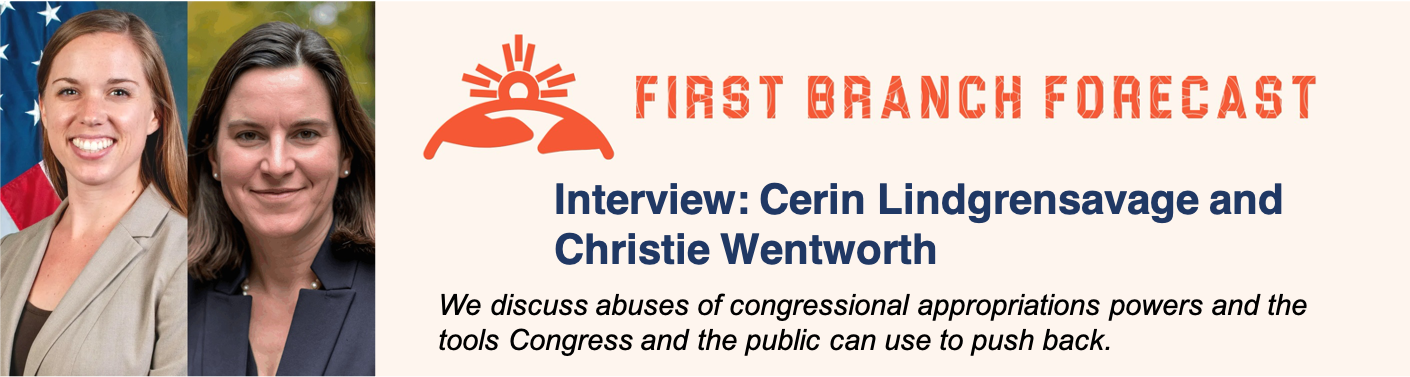
    Interview: Cerin Lindgrensavage and Christie Wentworth

    For this episode, I spoke with two experts in appropriations law who have worked in and out of government — Cerin Lindgrensavage of Protect Democracy and Christie Wentworth of Citizens for Responsibility and Ethics in Washington — about White House attempts to appropriate funds as it sees fit, not as Congress has directed, and the legal and political means available for Congress and civil society to push back. Lindgrensavage is counsel at Protect Democracy and previously worked at the Department of Justice’s Antitrust Division and for Senator Barbara Boxer. She also clerked at the U.S. Court of Appeals for the District of Columbia. Wentworth is a senior policy counsel at CREW and previously served as an attorney at the Government Accountability Office and as counsel for the House Budget Committee. Chris Nehls: Hi, this is Chris Nehls with the American Governance Institute. I’m here with Cerin Lindgrensavage and of Protect Democracy and Christie Wentworth of Citizens for Responsibility and Ethics in Washington. We’ll do our best to put all of that on the title card of this podcast. We’re here to talk today about appropriations and appropriations law and how when Congress approves appropriations, how does the federal government spend it? And what’s been going on in this administration that’s made it kind of unusual. So, thanks for joining me today. Christie Wentworth: Thanks for having us. Cerin Lindgrensavage: Yeah, happy to be here. Nehls: We have 12 appropriations bills a year, theoretically, that Congress approves. Sometimes, it doesn’t get there and does a continuing resolution, but there’s still the money it gets out to the federal agencies to spend. Well, how does that work after these bills move from the president’s desk to the agencies. Wentworth: A great question to start with. I’m going to take us back a second and just emphasize at the top here, because Cerin and I are both very power of the purse friendly individuals in that Congress does have the power of the purse, which is why they are the ones that are in charge of actually figuring out how much money the federal government has to spend. So that’s based in the Constitution. And as you mentioned, Chris, that usually results in 12 different bills appropriating funds for the federal government, including all three branches. After those funds are appropriated, they go through a process called apportionment at OMB. This is a responsibility that Congress gave to the president back in the day because agencies were blowing through their appropriations. They would enter into contracts, they would promise to spend money, and then they’d say, well, Congress, you know, we already said we’re going to spend this stuff. I know that you only gave us $10 and we spent $100, but we’re obligated now, and you have to give us this money. Congress said to the president, do a better job managing these funds and gave the president the responsibility to say, okay, agencies, you’re going to get 25% of your funding in quarter one for salaries and expenses, and then you’ll get another 25% in quarter two and so on and so forth. So, OMB now has that responsibility pursuant to a delegation from the president and they can apportion funds by time. They can apportion funds by program and they can do it through a combination of those two things. The purpose of that is still to make sure that the agencies aren’t spending funds too quickly so that they have to go back to Congress and ask for a deficiency appropriation. So that is the general framework for apportionments. I will say when I worked at GAO, we spent two and a half days teaching appropriations law principles to folks at agencies, so doing this in 2 to 3 minutes is a challenge. But that’s the apportionment process. I’m going to briefly share some of the components that we see in appropriations acts that agencies have to look for when they’re actually spending the funds. And then, Cerin, I’ll kick it to you to talk a little bit about the Impoundment Control Act and how Congress can act to actually claw back some of that money if it agrees with the president that it should. In the appropriations acts, the three things that agencies are looking for are the purpose, time, and amount of the appropriation: So, what they can spend this on, how much they can spend and how long they have to spend it. And there have always been disagreements between Congress and the executive about what exactly falls into each of these buckets, especially with respect to purpose. But those are the three general things that you’re looking for and that the agencies have to comply with when they’re spending these funds. So Cerin, do you want to talk about the Impoundment Control Act? Lindgrensavage: Sure. One thing of interest to know about the apportionment process is that it has at some various points in history been abused. And that’s important because it’s the mechanism that OMB and past presidents have used essentially to rob Congress of its power of the purse to steal some of that power for the president, the White House, in this case, the Office of Management and Budget. If you went back and looked at the hearings in 1972 and three over the Nixon era impoundments, what you will find is actually page after page of accounts where they’ve used the apportionment process in some cases to actually affect delay to what they did at the time, called creating a reserve. And there was a provision in law that was a little bit squishy, a little bit of a choose your own adventure for the president and his budget officers to try and say, oh, well, we’re just creating a reserve for this sort of broad purpose. Nehls: So, what was Nixon actually trying to trying to do there? Lindgrensavage: What he was trying to do was actually say, hey, I don’t want to spend these funds. Congress passed the money, but I don’t want to. And he was trying to just essentially assert his power not to spend the funds. As you can imagine, Congress reacted poorly to this assertion of the executive authority. And the law that they passed was both a remaking of the budget process that really put foundationally in place the fiscal years and steps as we know them today, and also what we call the Impoundment Control Act. That passed in 1974 and essentially said, no, we’re, we’re erasing that provision that made you think that you could just hold on to money for whatever purpose you wish to. And now you have three options: you can defer; you can delay spending the money -- but then you have to tell Congress, and Congress has a chance to tell you not to through a resolution they can pass. You can propose a rescission, but that only goes into effect if Congress passes a law rescinding the appropriations that were previously passed in a law. And the third option is you can spend the money. Those are the three options contemplated by the Impoundment Control Act. Here are some things that are not contemplated in the Impoundment Control Act: unjustified delays for programmatic review -- the entire category of programmatic delay invented in the early ‘70s -- none of that is contemplated in the act. The act contemplates those three options: deferral, rescission, spending the money. It also left three different purposes that OMB can use to establish reserves, but they’re narrower. It’s to provide for contingencies to achieve savings or as specifically provided by law. So if you have a law that you can point to that says, okay, you can hold on this money for these purposes, that’s okay, but it has to be specific in the law. It really did ground and narrow OMB’s ability to screw around with money using the apportionment process or any other process because it doesn’t just bind OMB, it also binds folks at the agency level as well. Nehls: Well, we’ve had a couple of rescissions bills, this Congress and, and there have been some in the past. So how has that how has that worked generally since the passage of the Impoundment Control Act as a congressional tool? Lindgrensavage: I would say that your mileage may vary. There’s been some hiccups in the road. I think one of the things that’s happened more recently is that deferrals haven’t been reported in this century. We’re going on our 26th year of the administration not using the deferral provision. If you look at OMB management of funds, there are arguably a bunch of things that probably would or should qualify and be reported as a deferral, but I wouldn’t hold your breath on that happening anytime soon. One of the things that’s happened is but I think that entire third of the sort of statute of the scheme has been rendered inoperable in a really significant way. And for whatever reason, Congress and GAO haven’t come back at OMB or the administrations across Democratic or Republican administrations for not for not adhering to that part of the statute. And the other thing that went awry is that OMB has interpreted the rescissions provision in a way that at least the current OMB has said what gives them the authority to essentially cancel funds unilaterally. And Christie, do you want to walk through the mechanics of how that rescission gone awry can happen? Wentworth: Sure. In the law, it says that funds can be proposed for rescission, and it doesn’t provide a specific time frame for which those funds can be proposed for rescission. What that means is, we talked earlier about how funds have certain time limitations. And some funds might expire at the end of the fiscal year. Some funds might be available for multiple years and some funds might be available forever. They might be no-year funds. For those funds that expire at the end of the fiscal year, you have this problem where under the Impoundment Control Act, while a rescission proposal is pending, the president is authorized to withhold those funds. You can see the practical reason for this, right? If the president says, okay, you gave me $100 for DoD for this year -- just bear with me on that -- give me $100 for DoD for this year, I only need 50 of it, and so they propose $50 for rescission. You don’t want the agency to have to continue to spend that $50 while Congress is considering the rescission proposal because if they end up clawing back that money by law, then you have DoD in a position where maybe they spent more than they were allowed to because now they only have $50 and that money is now gone. And so it gives Congress time to actually give good faith consideration to a rescission proposal. And then the ICA prescribes a 45-day period for that temporary withholding, the funds have to be released. That is how much time Congress has for these expedited procedures. I think Cerin mentioned this earlier, but again, you only need a simple majority under the ICA to actually pass the rescission bill that that cancels these funds. That’s generally how the process works. So, if you have a rescission proposal that comes in near the expiration date of those funds -- let’s operate on a fiscal year basis that ends September 30th. If you have a rescission proposal that comes on September 1st, then that withholding period in a very technical sense will span past the expiration date of those funds. And so, in theory, the president could withhold the funds for 45 days going into October 15th. The funds will have expired. They can no longer be used for obligation, and so they’re effectively unilaterally canceled. Now, the reason that that is not allowed under the ICA is because the ICA says that the funds have to be made available for obligation after 45 days. And you just can’t do that if you withhold for the 45-day period. There are several folks, the GAO included, who believe that that is how the law should be interpreted. The executive branch has taken a different view. And so last year, we saw this happen near the end of the fiscal year with a proposal to rescind billions of dollars in foreign aid funding. We got past October 1st, and the administration was still withholding the funds and they expired and were effectively unilaterally canceled. So that is a new use of the ICA. I will say it’s an abuse of the ICA. We are at August 12th right now, so we can see this timeline coming forward again at this time in the fiscal year. So that is one way in which this process has, has been abused. Go ahead Cerin. Lindgrensavage: I will say that like there are folks at OMB who have pointed at a literal handful of historical examples from just after the passage of the Impoundment Control Act to say like, hey, Ford did it. Hey, Carter did it. This is like just a normal thing that people have done. But if you actually go and take a look at those examples -- and I absolutely did -- you find a lot of breadcrumbs to understand why this is a world apart from what those examples were. First, in response to several of those attempts, Congress actually passed laws forcing the administration to spend the funds. In response to that initial encroachment on Congress’s authority laid out in the Impoundment Control Act, when the administration put in a late rescissions request, Congress said no, thank you, and then they actually reappropriated the funds. They had a follow-up hearing. They looked the political appointee who had not spent the funds in the eye, and they said, you saw that we appropriated those, right? And they’re like, yes. And you’re going to spend it this time, right? And he said, yes. I think it’s important to unpack that history because if you just look at the fact that the request went in and you don’t look at how Congress responded, you might read it as sort of this initial grant of permission they try to claim and it’s really not. And so that’s one thing to put in context. I think the other thing to pause and reflect on is how alone OMB is [on pocket rescissions]. Former appropriations and OMB staff have gone on the record saying that this is an impermissible interpretation of the law. A variety of law professors who are expert in appropriations laws have gone on the record saying that this is an impermissible interpretation of the law. Like literally the only folks familiar with these laws that are comfortable with this interpretation are the folks who are actively using that misinterpretation at OMB right now. Nehls: This Congress hasn’t really taken up this issue, have they? You’ve been tracking this probably more closely than I have. How has the Congress 119th responded then? Wentworth: So I’ll give an example from back in, oh, I’m going to forget the exact year, but I think it was 2018 or 2019. At that time, the Office of Management and Budget had implemented two different things. Number one was what they refer to as brief withholding of funds, while agencies provided an accounting of how much money was left in their accounts. This was supposedly so that they could get information to figure out how much money to propose for rescission. And this was in August of that fiscal year. So again, pretty close to the end of the fiscal year. That year, the president ultimately did not send up a rescission proposal, but they had paused this foreign aid funding for a certain period of time and then after that pause had started trickling out funding for foreign aid. So typically, that funding it depends on the account, how it’s apportioned, but typically it’s not given in one day, one week or one month increments because that is really hard for program implementation. But that is exactly what OMB did: They said, okay, you’re going to get a certain percentage of funding every day from now until the end of the fiscal year. For anybody who’s ever implemented a grant program, you will know that that makes it pretty much impossible to get the funding out the door by September 30th. So, the agencies went back to OMB and said, can you please give us more money? OMB said, okay, you can have a weekly rate. And it made it really hard for that funding to get out the door. At the same time, we saw that there was funding withheld for Ukraine. In that situation, the Office of Management and Budget had put a footnote on Ukraine funding that said, this is not available for a certain period of time. I think we’re all familiar with the facts of that, so I won’t go into that particular example [It led to Trump’s first impeachment]. But in that situation, the agency was not able to get all the funding out the door by the end of the year, even though OMB ended up giving it access to all the funds at a certain point. Congress went back and reappropriated that funding that had expired in the next fiscal year. They recognized that this had been a violation of the law, as we saw in the impeachment proceedings and then said, you know what? We still want the agency to execute this program, so they reappropriated the money. And so, it’s not an example of a pocket rescission per se, but it is a way, an analogy by which funding expired at the end of the fiscal year and then Congress took action to say, we disagree with how you did this and we’re going to re-appropriate this money to make sure that you can actually do this thing. I think the question about the current Congress and how it’s responded is much more challenging, because we haven’t seen that same kind of response, bipartisan response to the actions from last year. But it doesn’t mean that across the board, Congress is acquiescing or agreeing that this is a lawful use of the Impoundment Control Act. We have seen some responses from some of the appropriations leadership. There was an initial version of I think what used to be the state foreign ops bill, but is now, I think the national security appropriations bill that would have put in a restriction against these kinds of rescissions proposals, particularly for those foreign aid funds, which were the ones that were subject to the pocket rescissions proposal last year. Now that came out when the bill went up to the full committee, but I think it was incredibly telling that was the subcommittee that even under majority leadership of the bill on the House side contemplated making that kind of movement. Even though that one didn’t go forward, there are a lot of other places that if you’re looking at the details of the appropriations bills, you can see appropriators working to tighten the language and reduce the discretion that OMB has. For example, one of the things they did in the Labor, Health and Human Services bill, where there’s a lot of discrepancies between what Congress has funded and what the administration asked Congress to fund was, they started incorporating several of the tables that lay out specific funding amounts for specific programs within an appropriation or within an account into the text of the law. They made them binding on OMB and binding on the agency in a new way. Now, I think, again, the mileage is varied on how much those decisions were respected by both OMB and the agencies, but it was an initial attempt. And the thing that Congress has going for it is that it’s an iterative player in this back and forth with the administration. So, if that method doesn’t work, the Appropriations Committee in the Congress as a whole is going to have another chance in fiscal year ‘27 to take a bite at the apple that could actually constrain OMB and the agencies more effectively. Nehls: Outside of a rescissions message or just the announcement, we’ve seen a lot of announcements of canceling of grants and things like that coming out of the white House. How can Congress kind of understand or if you’re, if you’re on the Appropriations Committee, how can you track what’s going on with spending and make sure that OMB is following the law. Lindgrensavage: In 2022, Congress passed a wonderful law requiring the Office of Management and Budget to post apportionments online, including the footnotes. And they were very specific about it. And so, in 2022, OMB started doing that. Congress made the law permanent in ‘23, and we got to look at what apportionments looked like for the first time as the public. Then at the beginning of the current administration in 2025, they took the website dark. I think it gives you an idea of their preference that they would like to be able to manipulate this process without the sunlight of public scrutiny or congressional scrutiny on their day to day. Christie and my organization sued OMB and secured an injunction requiring them to put that information back on the internet. And PD is actually supported what’s called OpenOMB.org, which is a site that you can go to, search and browse apportionments and you can subscribe to updates. For example, if you wanted to follow the money on the White House ballroom, you could actually put in White House as a search and just subscribe to updates. Every time there’s a new apportionment giving the ballroom more ballroom money, you can find out at the same time as the [Washington] Post and Congress and everybody else. Those are actually done on a two-business day delay, so it’s not real time, but it’s pretty great. It can give members of Congress and also like folks like you and me, advocates, reporters, whoever needs to know a lot more visibility into at least that one part of the process where OMB is deciding whether or not to push the button or not to move money out to make it available for agencies to spend. Nehls: That’s great. Wentworth: I think I’ll provide one example that was pretty extreme about how the availability of this information allowed public civil society members of Congress to push back on an OMB apportionment action. So back in, I guess it was almost a year ago, the end of September 2025, right before the beginning of fiscal year 2026, Congress got a letter from the from the Council of Inspectors General on Integrity and Efficiency, also known as CIGIE, that said, OMB has made a policy decision to not apportion any funds for us for the entirety of fiscal year 2026. I’m going to pause for a second to flag another provision that Congress has included an annual appropriations acts every year that encourages that kind of communication with Congress and can flag when issues arise so that folks can go to places like OpenOMB and look to see what’s actually happening. I almost said behind closed doors, but it’s not behind closed doors anymore because of this law. Right? You can actually see what OMB is doing with the money. There is there’s a rider in the in one of the appropriations acts every year -- and this is relatively new, but it requires agencies to tell Congress when OMB is not apportioning funds in the way that it should. We refer to this as the tattle provision and would love for that to go viral if we can make that happen. But typically, it’s section 749 of the Financial Services and General Government Appropriations Act, and this requires agencies, not OMB, to tell the Appropriations and Budget Committees if an apportionment is not made in the time required, if it [OMB] conditions the ability, the availability of the appropriation on additional action, or if it would hinder what we refer to as the prudent obligation of funds. So basically, can you get this out the door in a way that is responsible and that actually furthers the intent of the appropriation? And so instead of having OMB say, oh, we’re not going to apportion these funds, it’s actually on the agency that is affected by those apportionment actions to go to Congress and say, mom or dad is not giving us the money that we asked for. Nehls: Now, do they have to do this in like a public letter, or is this an agency had to have to put their name on this, or is this done anonymously? Wentworth: One of the flaws of the law is that it does not require that the letter be public, it just has to go to these particular committees. We on the outside do not know how often agencies are using this. My Spidey sense is that it is not as much as they should be based on all of the apportionment abuses that we are seeing at the moment. But the letter became public -- and I should caveat that the letter itself does not cite those provisions, so we don’t know that that’s why they sent it, but it lines up pretty well with the requirements of this provision and also gave us those particular committees the information that they needed to say what is going on OMB. We saw responses from Congress to OMB saying, why are you withholding this money? When do you plan to make it available? What is your legal justification for this? And asking all of the questions that you would want Congress to ask in an oversight capacity. One of the beautiful things about OpenOMB and the requirement that this information be made public is that you can also go and see what’s not there. The apportionment statute requires that apportionments be made within certain time frames of when an appropriation is enacted or when or the availability of funds. If you’re wondering like, oh, usually I apply for a grant through this particular program. I wonder how much money they’ve gotten -- you can go and see, has there been an apportionment? How much is it for? Are there any conditions on it? And you can actually go there and look. I’m saying OpenOMB because that is the only place that I go for this information. But you could technically go to OMB less user-friendly website as well, but you can go to OpenOMB, you can go to an apportionment and you can see how much money they got in prior years. You can see that typically they get a big lump sum at the at the beginning of the fiscal year that allows them to use their funding for the whole year, and that that did not happen this year, so it allowed for that oversight. So, the story there is that CIGIE had to shut down, right? They did not get an apportionment because apportionments are legally binding and an agency needs one to be able to spend money they could not operate. They had to send all their staff home, they had to shut down all of their programs, all of their supports that they give to inspectors general. And for about a month and a half, they were totally shut down. Now eventually, they got a little tiny apportionment -- I’ll call it a pittance -- through January 30th that was available for salaries and expenses for legally required expenses while OMB conducted a programmatic review. So, they did get some money and that was on Open OMB. You could go you could look you could see how much money they got. And then when they later got an apportionment for the rest of quarter two, you could see how much money they got. You could compare that to prior years, and that allows you to see what is actually happening with these agencies and how much money they’re getting on this really piecemeal basis as OMB drags them along. Now, one additional part of that that I’ll flag is that there is another public database that unfortunately, Protect Democracy has not made a more user-friendly version for yet. Lindgrensavage: I’m going to try to do it someday. It’s on my list. Wentworth: But you can look at SF 133, and this is a very comprehensive resource that that shows you obligation and expenditure data. You can see if you pull up cities’ SF 133 for example, that as they got fewer funds apportioned during this fiscal year, they’ve also spent a lot less. You can see that by the end of January in in prior years, they had obligated more than $8.8 million, and in this year they had only obligated $3.2 million. Nehls: Inspectors general are the people that are investigating agencies themselves internally investigating agencies for all sorts of things, including waste, fraud and abuse. And they’re under kind of a slow shutdown. Wentworth: So yeah. And CIGIE does more than that, right? They support those entities by providing trainings and providing facilitating peer reviews, but they also are the watchdog of those watchdogs, right? They run the integrity committee and facilitate those investigations so that if an IG is itself committing wrongdoing or fraud, waste and abuse, you have somebody else that’s checking that. With fewer funds and fewer staff now and in a lessened ability to do that, how can they effectively do that work? So, that’s one example of how you can see both apportionments, which are SF 132 and SF 133, and use that data together to see how this again, like hamstringing of the funding that was supposed to go to CIGIE that had been appropriated is affecting its actual ability to get the funds out the door. Nehls: Let’s say you’re a public health or you’re a state and you have block grant programs, or you’re a hospital, you’re waiting for federal funds for something, and you’re not quite sure where the money is. This is beyond a Congress problem: civil society is probably in the same boat. So what can people do about that when their state program is delayed because of a delayed grant or what have you? Lindgrensavage: Well, the first thing you can do is go look up your money on open OMB, and you can subscribe for updates. You can look it up and if it hasn’t come out, you can hit that little subscribe button, and the next time there is an apportionment, it will email you if you’re waiting for your money and you haven’t gotten it and you’re going to get an update. Especially if it’s causing heartburn, you should reach out to your member of Congress and complain because there’s a lot that members of Congress can do in response to these kinds of delays. There’re two things that I’ve seen move funds after there’s a delay at the agency or OMB level. One of them is in particular bipartisan outrage. If there’s a bipartisan group of members who raise concerns, I’ve seen that really effectively overcome delays. Last summer, there was an announcement that there were concerns that OMB was holding up NIH funds, and there was a bipartisan group of members of Congress who raised concerns about that. You can actually see in the apportionment data, because we got a release after that, the apportionment was redone about four days later to remove the footnote that was holding things up. So, you can literally see the effect that that kind of opposition has. And you should absolutely advocate with your members of Congress. If you’re a member or their staff, you should be working together to get the folks that you need to weigh in with the agency or OMB leadership to make clear with them that Congress is paying attention and they’re concerned. The other thing, unfortunately, that I’ve seen move money is litigation. That there are a number of folks who’ve taken a difficult step in a lot of cases to bring litigation. It’s time consuming. It’s resource consuming. It also causes, I think, a lot of heartburn for folks who really don’t want to be in the position of suing but did everything else right to engage with programs that serve their communities and their missions. I think, really unfortunate that now it’s not enough to advocate with Congress to get the appropriations at the committee level to get the appropriations law passed by Congress, but that you have this whole new sort of area of work that’s starting to open up to have to advocate to get the law implemented, which is crazy to me, but that is what’s happening right now. Wentworth: I would plus one to all of that and just double plus one the squeaky wheel gets the grease aspect of this. There are so many different important government programs that have different constituencies that rely on them and either receive the funding directly or benefit from it as just people in this country who are relying on those services. Making sure that your member of Congress knows about that is incredibly helpful because figuring out what is being withheld is really hard. There are a couple of reasons for that. Part of it is not everything is going to be in the public data. We have the data that we have, which is great, but there are sometimes legitimate delays in in program execution. If you look at GAO’s impoundment decisions from before 2016, for example, there aren’t many in this century at least, but you’ll see that there have been situations where there are legitimate reasons that funds aren’t going out the door. So, it’s not somebody sitting there saying, we have a policy disagreement with this appropriation, we have an issue with this program in general, but we don’t have -- let’s see, I was going to say something about not having enough staff, but that is a totally different issue that I don’t want to get into right now. But as an example, if an agency is trying to hire and nobody is applying, then that might be a reason that there aren’t as many salaries and expenses funds going out the door. If they are trying to implement a grant program and there aren’t applications, that might be a legitimate reason why they haven’t actually awarded the grants yet because they are waiting for better applicants. So, there are a couple of things that we’ve seen in the past that might legitimately delay funds. Figuring out whether there are legitimate delays behind closed doors or whether this is part of a process that is not lawful and is not consistent with the appropriations acts, with the Impoundment Control Act, is something that it’s really hard to get information on. Making sure that you are raising these issues so that members of Congress can do that oversight and reach out and get that information that isn’t always public is just so it’s so important. I can’t emphasize that enough because without information, we don’t have anything to go off of, right? So again, it’s also really important to keep in mind lawmaking is not the only tool that members of Congress have. Like all these different incidents we’re talking about, it’s not like they passed a new spending law that’s like, hey, we really mean it. I mean, they can do that, but a lot of these cases, it was members raising things outside of the formal legislative process. I’ll give you another example: There was a series of apportionments for Smithsonian funds that were on their face like a straight up impoundment. The president had asked for a lower amount of money, Congress had passed a higher number of money that provided the funds that the agency had had the last year, plus enough to account for inflation, and the apportionment literally said only take the amount that the president requested. Don’t touch any of the money that Congress gave you above that. And they re-upped it, I think, about 4 or 5 times until Senator Merkley asked in a question for the record, in Mr. [Hal] Duncan’s recent nominations hearing [for Deputy Director of OMB], hey, what are you doing? This doesn’t seem legal. And OMB defended the legality. They’re like, oh, it’s just an apportionment. That’s just us using our apportionment process. But the next apportionment did not have that language. And I found that like a really instructive example that even raising things in this method that’s not necessarily in the public eye, but is in the permanent record, can be effective in that back and forth between Congress and the agencies and OMB. Nehls: That’s a great example. Let’s just say hypothetically or maybe, maybe semi hypothetically, that a presidential administration is ideologically against spending money on X, something it doesn’t like it, doesn’t want to spend money on and Congress appropriates it and they just refuse. What, consequences are there legally? What would happen to you basically if you just never spent the money? If you’re the director of the OMB. You’re both smiling and laughing at me like I just asked a question that you either ... Wentworth: I guess let’s start by talking about the only appropriations law that has any teeth on its own. We probably should have started with this in the framework because I know we’ve referred to it without actually it’s the elephant in the room, right? So, the Antideficiency Act is a law that. Nehls: Yes, of course we forgot the Antideficiency Act. Wentworth: Well, we didn’t forget because we know that we know that our listeners know exactly what this is. But for those who would like to talk more about it specifically says that agencies cannot spend more than Congress appropriates. They can’t spend money before Congress appropriates it. Also, they can’t spend more than OMB, than the president apportions. And so, they have these limits, and if an agency goes over those limits, then an official shall be subject to administrative penalties and may be subject to criminal penalties. That could be jail time, it could be up to $5,000, which has never been adjusted for inflation. So, there are penalties associated with the Antideficiency Act. Now I’ll share a couple of practical limits on that. Number one, nobody has ever been prosecuted under the Antideficiency Act. And you might be surprised to hear that the Department of Justice has never prosecuted somebody in the executive branch, but perhaps you are not surprised by that. Nehls: Shocked. Wentworth: Second, GAO collects and compiles Antideficiency Act reports from agencies. So, another quote-unquote consequence of the ADA is that agencies have to report these violations to the president with a copy to GAO and GAO takes these and puts them all together and gives them to Congress. If you read through them, when the agency is identifying the responsible official, they’ll say, oh, you know, Jan did this, but Jan retired last year. It’s all it’s very frequently somebody who is no longer with the agency who conveniently retired. When you think about the effectiveness of these administrative penalties, they’re not necessarily the strongest. We do see a lot of times agencies make really good faith mistakes that result in ADA violations. It might be a systemic issue. It might be somebody put in a zero. It might be that funds were apportioned and were rounded to a certain number, and so they went over by $0.20 because they didn’t realize that they actually had been apportioned fewer funds than they could spend. And so that might result in an additional training for staff. It might result in in better systems in making sure that they’re actually working. So, there are ways in which the ADA has positive consequences and also deterrent effects because nobody wants to have the threat of criminal prosecution hanging over them. None of that exists, flaws and all, for the Impoundment Control Act. In recent years, Congress has required in the annual appropriations acts that agencies report ICA violations in the same way that they report ADA violations. But the administrative penalties and the criminal penalties have not carried over to the Impoundment Control Act. As far as what consequences there are, as far as what’s in the law there, there isn’t much there. I do think that because impoundments have an effect on people in a way that some other funding violations don’t -- for example, if I am relying on a service that is provided by a nonprofit who typically gets a grant from the federal government, and I no longer get that service, I feel that, right? I feel that withholding as somebody who is directly connected to the federal government in that way. There might be political consequences, right, if you can make those connections. But as far as consequences in the law, I don’t really see any. Cerin, have you thought of any consequences that might come from Impoundment Control Act violations? Lindgrensavage: Well, no, I think it’s an area for improvement. I think it’s an area where absolutely like we would be looking to, if not this Congress, then the next Congress to really dig in on ways to improve it. And I think it’s going to be a difficult conversation to have, but one that’s necessary if Congress is going to guard its prerogatives over the purse. The one thing that is a benefit of this is that we do have years of experience that are now, I think, making it quite clear that there is this need for a middle ground between the penalties that are too weak on the administrative side and the criminal penalties that are strong, but because they’re so severe, they’re so rarely used. And so, what that middle ground exactly looks like, I think there’s folks who have good ideas, but the thing that they really need is a bipartisan group of members who are willing to take on the project of pushing something like that forward. I think there’s a few other things too that that Congress could come together on, but in the meantime, there’s also stuff on the books that they could use to combat this kind of stuff. There’s a provision that David [Super, Georgetown Law professor] and I wrote a piece in the Hill about section 739 of the government wide general provisions of the FSGG Appropriations Act that actually says that there are no funds provided for the administration to make effective cuts proposed by the president that were rejected by Congress. In each of the instances that you’re talking about, if they try and put through a pocket rescission, if, say, the OMB director puts through a pocket rescission, and it was a cut that was proposed by the president’s budget that the Congress rejected by providing the funding anyway, he could be held responsible, actually, under the Antideficiency Act, for any act that he took. There’s no de minimis requirement for these provisions. There’s actually a really great Department of Transportation provision where they violated a rider on an appropriations bill by retweeting something and even something as small as hitting that retweet button on something you shouldn’t can trigger a no funds provision. So apportioning funds to withhold them in a way that can absolutely trigger it. The act doesn’t have to be huge. It doesn’t have to use a ton of government resources to trigger consequences. And it’s really important to keep that provision in mind because there are a bunch of places where the president’s budget proposed cuts -- and we see in the data that Christie and I sued to make public that they’re actually using abusing this authority to make them. There’s actually a remedy that Congress has already given itself to start holding them responsible: they have only to use it. They can send letters to those people who are making those apportionments to put them on notice that if they continue that behavior, they could see a criminal referral. And while the criminal penalties haven’t been used very much, they do have a five-year statute of limitations, so you’re really making a bet on who’s going to be sitting at the DOJ in the next five years if you keep on doubling down on that kind of misbehavior. Nehls: It seems to me, just as somebody kind of new this issue like that the worry because government seems to be primed to act that you assume that the bad actors are going to be spending more money on stuff that underneath the radar, right. And you’re not maybe it just didn’t -- aside from the Nixonian abuses that just didn’t want to spend money on a certain social safety program -- maybe people didn’t theorize that enough an administration that just didn’t want to help the people that were getting the grants right? Lindgrensavage: It took it took 100 years for Congress -- year after year, Congress, after Congress of agencies blowing through their budgets too quick. It wasn’t until 1870 that Congress is finally like, okay, okay, we think that, when somebody shows up the way they’re going to show up, you gotta believe them about themselves. It’s been 100 years. We’ve finally learned about you. You are incapable of sticking to your own budgets. I kind of feel like we’re maybe now, just now coming up on the 100 years since impoundments kind of started becoming a thing. Honestly, we did this retrospective called “The Myth of Presidential Impoundment Power,” and the person who has the longest section of the appendix is FDR. Whatever is 100 years from FDR, I feel like that’s about maybe when Congress might be ready to come back around and say, okay, we believe you. Impoundments are the shape of the risk we’re dealing with to the constitutional structure. Wentworth: And I would also say that just because we are talking a lot about impoundments doesn’t mean that we don’t also see ADA violations left and right. So, I don’t want to take that off the table. When we think about different kinds of spending violations that folks should be looking out for, it’s also what type of thing you’re allowed to spend money on and how you’re spending it. So as we see, for example, private donations coming into the government and kind of being shuttled around through different mechanisms, that is, if you’re looking to issue spot and think about what kinds of things might be working might be worth looking into as, as a congressional staffer, that that is one red flag that I would encourage folks to look into because the federal government cannot accept and keep gifts unless Congress gives it specific authority to do so. When it does so, it typically says when you take money in, you either have to give it to Treasury or here are the specific things that you can use it for. There are pretty much always going to be some kind of specific purpose limitation on those funds, so that is something to look out for. Obviously, we have seen during recent very, very long shutdowns, lots of programs that kept running that we did not think should keep running. So that is another red flag that I would say folks should look out for. That’s, that is not something that we’re sleeping on, but obviously, because impoundments have not always been the hot topic of the day, it is important to think about where we are now and what kind of reforms we think could elevate that issue to make sure that it’s something that we’re addressing. Lindgrensavage: The ballroom funds actually provide an example. First of all, I could not agree more with what Christie said, but the ballroom funds provide an example of both of those issues that she raised about both the purpose violations and the gifts, because they’re actually combining both of those to find the funds they need for the ballroom. I think the purpose violations are particularly important to pause on because that also means that they’re robbing funds from something Congress did provide money for and taking it away to something that Congress didn’t. At the same time that there was a conversation where the White House was asking Congress to provide funds in the second reconciliation bill for the ballroom, and there weren’t the votes for it, Congress effectively said no to the request. They repurposed like $400 million from Secret Service funds passed as part of the first reconciliation bill, the One Big Beautiful Bill Act, to White House security measures and transfer the money to the repair and restoration account they’re using for ballroom construction. At the same time, the Congress said, oh, no, thank you, not for us, the White House helped themselves. And they could because the flexibility and the reconciliations laws provide them some latitude to do that. And also, sometimes they’re just running roughshod over the guardrails that do exist to make those kinds of decisions. And then to the extent that that money wasn’t enough for the ballroom, they’re buttressing it with the gifts that they get from the National Park Service Gift Authority. Nehls: Right, right. Well, I mean, the drones on the roof aren’t going to pay for themselves, right? So you gotta shake down some more folks. Lindgrensavage: There is a whole different drone repurposed violation for Senator Cruz got his $170 million in the reconciliation bill for maritime domain awareness and they used that money for monitoring the World Cup games for security purposes. Nehls: Oh goodness. Lindgrensavage: So, purpose violations abound for all Chris. Nehls: So we’ve got a lot of problems: where do we start on trying to bring this under some kind of order with some kind of reforms? What’s at the top of your list for things that either the next Congress or future Congresses should be thinking of? I should clarify if the goal is for the money that Congress appropriates to be -- with all caveats that, yes, it’s complicated to spend money sometimes -- that the money that it’s appropriating gets spent as the way that Congress has designed the programs and appropriated the funds. Lindgrensavage: I think I would just plus one a lot of the suggestions Christie’s already made. And I’ll just sort of tick through them a little bit because we’ve been like, weaving them in something that prevents pocket rescissions that forces the administration to spend funds, even if they’ve been proposed for rescission before they expire. Again, that’s what we understand the law to require now, but clearly there is this difference reading by the current OMB, so buttoning it up to make it even more clear would be wonderful. A middle ground of penalties for the Antideficiency Act to make the act more effective and imposing penalties on Impoundment Control Act violations to prevent impoundments. And then I think guardrails on the gift authorities to provide some limits. And I think to make those guardrails, Congress is going to need some more information about how agencies are actually using these gift authorities. So initially some accounting of, okay, who’s taking in gifts and what for? And how much money are talking about? And where is it coming from? Which, let’s just pause, is probably answers to questions that Congress should have already been asking and should have already been getting, but better late than never to start doing that now. Wentworth: I think on that, Cerin, I 100% agree with you. What I would urge Congress to do is to not hold all the information itself. One of the most powerful things about the apportionment transparency law is that it required that the information be made public. What that does is it allows groups like ours, the media litigators, members of Congress, anybody can go in there, look at the information and analyze it. And that’s really powerful to have so many people that can go in and do that. And I know, Chris, you all focus so much on Congress’s institutional capacity. It’s helpful to Congress to have groups like ours be able to go and look at the data and figure out what’s there, what’s not. What kind of trends that we’re seeing. To the extent that Congress is putting in new requirements in law that require agencies to provide information or data to Congress, make that to the public, there, there is very little risk in doing that. And there’s a ton of reward to getting others to be able to look at and evaluate this information. And then something else that I would add coming from an organization where we file a lot of FOIA requests, is that FOIA is an incredible information law. And for those unfamiliar, it’s the Freedom of Information Act. But requests filed under FOIA require somebody to make the effort to make the request. They do not always comply with the statutory timelines. In fact, they frequently do not. It might take years to get information back. Particularly in the funding context, when you’re thinking about impoundments that are happening now or other funding abuses that are happening now, circling back to what we talked about at the top about the time availability of funds, appropriations related issues are inherently urgent. Getting information as quickly as possible to as many people as possible is important. As we’re thinking about reporting requirements or sending information to Congress, I would urge Congress to consider making those requirements public, whether it’s on a public website or having the agency disclose it otherwise, but that that is a really a really critical accountability measure. Lindgrensavage: Two, I would also urge Congress to think about the schedule for updating. I think one of the reasons this information is so meaningful is because it comes out only two business days after it’s done. And so that means that it’s not real time, but like pretty close. It’s certainly actionable information when the public and when Congress gets it. Imagine how much more useful the Plum act database would be -- the database of all the political appointees across the federal government that was passed in law several years ago. Imagine how much more useful that information would be if it was updated every time a new person came on board in their next pay period or something like that instead of agencies updating the database once a year, so that actually multiple people could have held the job in different capacities over that period of time and nobody will have any visibility into that unless you have a tighter requirement for that reporting. Are agencies going to be happy about reporting that information? No, of course there’s going to be some burden. But the opposite choice is to burden everybody else who’s trying to do business with those agencies with the ignorance of not having the information about who’s running our government. I think like questions about burden should be approached by understanding who the burden is falling on and the absence of the data and the absence of the data about apportionments, the burden is falling on, as Christie said, everybody who’s on the wrong end of an empowerment. Nehls: I totally agree with you on obviously on the on the public angle, on the political pressure angle of the public being able to know things as it’s as it’s happening, as you said, pretty close to a daily accounting. And we just kind of stumbled upon this story on the Washington Post picked it up. This professor, Matthew Dull, was doing some research on the appropriations oversight capacity and there was actually a team of investigators they could hire detailees from the FBI and GAO and other agencies to go and do these stealthy fiscal investigations of big spending programs. It was started in the middle of World War II, so particularly on defense projects and programs. And it basically got starved for resources and winnowed down and shut down a couple of years ago. But, that’s another way that maybe Congress can take back some of its own power is reinvesting in some of its own capacity. I’m just kind of curious what you guys think about that. Lindgrensavage: I would obviously be very happy to sign up for that kind of enterprise. In some ways, that is the kind of work that we spend at least some of our time doing now is we’re flagging apportionments that are at risk for withholding funds. And so to Christie’s point, one of the benefits of sharing information publicly is that even though you don’t have a staff of people doing that, in some sense, you’ve deputized everybody who has capacity to engage in the exercise to help you doing it. I think it would be great if there was a more regular form of cooperation and communication by folks who could use that information within Congress and the people who are generating that information outside of Congress. To the extent that there’s a mechanism to formalize that, I think that would be hugely useful. And so literally, call any time, please. But I think that Congress has a lot of capacity constraints and a lot of things that they could be putting resources towards. I think it will depend on their ability to do that. I would certainly be fascinated to see these records. But by and large, that’s true of most legislative records as well. And I just shout out to the legislative archives, the National Archives building for being really willing to entertain requests about appropriations and other laws that we’ve been digging into. Nehls: Amazing. Any last thoughts or words? Wentworth: If anyone’s if anyone’s still, still listening, I’d love to scream into the void about things that things that we can be doing. I guess what I would say as we wrap up here is power of the purse issues have historically, they have really great history of bipartisan support because it is an institutional concern. Members of Congress want their constituents to be supported and they want a federal government that that operates effectively and that does the things that Congress wants. And the money runs the world, right? And so this is the most powerful tool that that the legislative branch has to give money to the executive branch to make it do things, and to keep money from the executive branch to prevent it from doing things. There has been a lot of really positive engagement in this area in the past. I hope it continues into the future. But I would just hammer home a couple of the top lines that that we’ve talked about today, which are number one, public pressure really matters. Number two, a lot of the work that folks are doing now to conduct oversight to investigate these issues is creating a historical record so that, as Cerin mentioned, as these 100 years keep passing, we can look back in ten years when there’s some new issue that we’re dealing with and say, you know, impoundments is something that we should still consider tightening up if this becomes an issue in the future. Building that historical record is incredibly important. And then lastly, there are a lot of resources out there right now that that members can be using to both evaluate existing data and conduct that oversight, so use what’s out there now. Obviously, we are always happy to talk about potential reforms, way to make ways to make that data more accessible, more useful, other kind of information that in our list of dreams we would want to ask for. But there is a lot out there now that can allow members to really dig into what’s happening in the executive branch. Nehls: Great. Thanks so much, both of you. This was a very illuminating conversation, and I’m sure folks are going to really enjoy. Thanks again for your time. Get full access to First Branch Forecast at firstbranchforecast.substack.com/subscribe

  • July 23 · 27 min

    Interview: James Wallner

    Daniel interviewed the Foundation for American Innovation fellow James Wallner about how Senate Republicans appoint members to committees. The process is governed by Rule 24 of the Senate standing rules and Rule 5 of the Republican Conference rules, with appointments made through a "Committee on Committees" led by the Republican leader. The discussion covered how committee assignments work at the start of each Congress. They also examined a specific example involving Lindsey Graham's absence from the Budget Committee and Appropriations Committee, where his sister needed to be appointed to replace him. They also discussed how Democrats could potentially use procedural tactics to gain control of committees like Appropriations during this transition period. James noted that while procedural hardball is possible, party leaders typically resist such actions because they prioritize party unity and election strategy over immediate legislative action. The transcript below has been edited for length and clarity Daniel Schuman: I’m here today with James Wallner, and we’re going to talk about how Senate Republicans appoint members of committees. James, thank you for joining me. How do Senate Republicans appoint people to their committees? James Wallner: So there’s a magical, storied mountain, at the top of which are a group of people in robes. They got some chicken bones and there’s a smoldering cauldron. And they just do some chants. And then the smoke rises. And then it’s this person shall be on the committee. No, it’s not far off of that, to be honest with you. It is a very interesting process and it is a very insular and closed process. It’s hard to get a peek into. Right. There’s two kinds of governing authorities here. One is the standing rules of the Senate. Rule 24 governs the appointment of committees. The way this works is that the Senate shall approve a resolution, and that resolution will name the chairman of each committee or a committee, and it will also include the members on that committee. So if we work backwards, you have a committee and it’s got a chairman and members. The way they get there is that the Senate takes action on the Senate floor. They approve a resolution that says, like the Energy Committee. And at the top there’s a chairman, and then there’s the Republican and Democratic members of the Energy Committee underneath that. And once the Senate approves that, those members are now on that committee. The Democratic and Republican parties have different internal party rules that govern that process, and the Republican rules are written down. You can find them online. And rule five of the Senate Republican Conference really spells out that appointment process, where the party, in essence, is making a recommendation to the full Senate, saying, these are the members that we want on these committees. Schuman: The Senate, unlike the House, considers itself a continuing body. So its committees continue on from Congress to Congress. So for the Senate, you have the committee, and then you’re just moving people around from chair to ranking member or moving people on the committee and off the committee. Is that right? Is that what the organizing resolution does? Wallner: Yeah, more or less. Look, the Senate is a continuing body in the sense that only one third of its members are up for election at any given time. Now, in practice, committees in the organizing resolution are going to be populated at the beginning of each Congress. But the reality of the situation is, if you’re on a committee, you’re going to keep that committee for the most part. And the parties have their own rules. They don’t have to follow the seniority process. But for the most part, once you get a committee assignment, not always and not on every committee, but once you get a committee assignment, that’s your committee moving forward. The Republican conference rules spell this out. Rule five says, except as otherwise provided by this rule, once selected and confirmed, no member of any committee shall be deprived of his assignment or his rank on a committee, except by the conference. It just makes a lot of sense that they, in essence, retain their committee seats. Schuman: Let’s talk about what happens at the change of the Congress. How does the Senate put people onto these committees? What needs to be done specifically to make that happen or to move people around if they’re changing committees? The example that I want to get to is Senator Graham passed on July 12th, and his sister was sworn in on the 14th. He was the chair of the Budget Committee. He was a member of other committees, including the Appropriations Committee. So both of those committees now have vacancies. And she’s a new senator, but she doesn’t have any committee assignments. And this has implications for the way the Senate operates. Let’s just start with it’s the start of a new Congress. Wallner: This gets back to how do you populate those committee rosters on either side in either party before you make that recommendation to the full Senate? For all intents and purposes, the Senate is going to approve that, although you can filibuster the resolution. One of my favorite white whales was to filibuster the organizing resolution that populates the committees, but then also divide it. And this is getting farther afield. But you can divide that resolution by that. You can say you can force votes on each individual member, if you want, of each committee, and you can also amend it. Right. And so you can move people around, you can do all kinds of stuff you could do. But working back from that, the Republican conference has what they call, and this is all spelled out in rule five of the conference rules, the process they use to populate their committees or recommend to the full Senate. The Republicans that want to serve on those committees are governed by what they call a committee on committees. And the Committee on Committees has a chairman. The Committee on Committees is, for all intents and purposes, one person working with the Secretary for in this case, the majority, the top kind of floor staffer for the Republican Party. And they basically, within the confines of the conference rules, are going to make these lists, and they’re going to solicit input from the rank and file members. Conference rules say you can retain certain committees over others. They’re going to work within that. Members will come and say, hey, I really want this spot or that spot. And going by seniority, they’ll work through the conference and basically putting people on these different committees. The other thing that makes this a little bit more complicated is that you have what they call committees, and then you’ve got B committees, right? And so the Republicans many years ago decided, I think it started the in 108th Congress maybe, but they said that every Republican senator is going to be given A committee slots in order of seniority. And so your A committees are like your Energy or your Environmental and Public Works committees, Appropriations, like all of those committees. And each committee is going to be given two slots on two different committees in order of seniority, working down the list. Remember, you retain your committee seat, so you’re really just taking the vacancies that happen. And then they’re allowed to retain one B committee. What’s interesting here is that the Republican Party has empowered the Republican leader to basically name half the A committee spots in all of the B committee spots without going through the order of seniority. And so you have this kind of convoluted process. So in this case, Lindsey Graham’s committees, they’re going to the A committee slots are going to be filled by the leader because there’s only one. Right. If you had two the leader would offer one fill one. And then the kind of committee on committee would work through the seniority process to fill the other one. But in this case, that’s not happening. So it’s just the leader. And then for the budget committee, which is a B committee, the leader is going to make that appointment as well. Schuman: You said they follow seniority, but when I was looking at the Republican conference rules, it says that you don’t always have to follow seniority, that there have been instances, I think with foreign, foreign, I can’t remember if it’s foreign relations with foreign affairs, but it was with Lugar became chair of that committee instead of Helms. So they don’t have to do the appointments necessarily by seniority. Wallner: But that’s regarding the top spot, right? Yeah. And that’s a slightly different process, right. So once you populate a committee, those committee members, according to the conference rules are going to meet and they’re going to select one of them to be the chairman. And the conference rules explicitly say that they don’t have to be governed by seniority. And conference rules also say, and I found it here, effective in the 108th Congress, all Republican Conference members shall be offered two A committee slots in order of seniority. There’s something similar with Warner as well. ‘I think the most recent is when Jim DeMint was still serving in the Senate. He wanted a slot on the Finance Committee. And McConnell at the time, who’s not best buds with DeMint. They don’t always get along. And there was a vacancy on the Finance Committee, but there was only one. And so McConnell got to name the Republican senator to sit on the Finance Committee. Jim DeMint made it very clear and known that he wanted that spot. And the conservative movement was really agitating for DeMint to get that spot. It put McConnell in an awkward position, because he’s trying to show people that he is a conservative and he doesn’t hate conservatives. But now he’s got to name his nemesis to this committee. Right. Because he’s the one who gets to make the pick or he has to, or he has to say, I don’t like DeMint, and I’m not going to put you on this committee. And he doesn’t want to do either one of those things. Right. And so he basically convinces Burr to give up one of his committees, because Burr was the only senator who was senior to DeMint who could get that spot. And then McConnell can put Burr on that spot and say to the world, I’m just following seniority. Right. But he had to convince him to give up a committee to take that spot. And so it shows you this kind of it’s a weird, convoluted process, but the basic outlines of it are pretty well set. Schuman: So let’s play it out for a little bit. Lindsey Graham was the chair of the Senate Budget Committee. He is obviously no longer able to serve in that role. The Budget Committee is down one Republican. The Budget Committee doesn’t have a chair. Republicans want to do reconciliation. You need a chair of the budget committee, presumably to make that process work. Right? There isn’t as far as I can. There isn’t an acting chair. There’s either a chair or not a chair. So someone has to get that role, which means the Senate needs to pass a resolution which requires 60 votes if the Democrats are willing to filibuster. Like how? Like, how does that play out? Or does that play out? Wallner: Just to start with an interesting aside, if the Democrats tried to filibuster an organizing resolution or not an organizing resolution, but a resolution to put somebody on a committee amid Congress? It’s pretty remarkable how little tolerance Thune and Senate Republicans will have for that. And you will see very readily how little the Senate rules empower senators, much less a minority of senators, to stop a majority. But when you juxtapose it to the talking filibuster debate and the Save America Act, it’s remarkable. They’re like, we can’t do anything. We want to do something. They just do it. Schuman: Senator Schumer has said in the past he wants to get rid of the filibuster. And other Democrats have said this as well. This is a chance to chip away at parts of that. Right? You could give Schumer a win win. He could, on one hand, try to stop reconciliation or extract a concession from Republicans saying, we’re not going to do reconciliation 3.0. If you want to do it, your chair has to agree to not do this right. Or, on the other hand, go ahead, go nuclear. This seems like it’s a win-win from at least what he said publicly. Wallner: It’s also a way to, regardless of how successful it is, to show action to your base, to get excitement, to raise money, all that kind of stuff. But the reality of the situation is that even if Republicans were unable to get the Senate to approve a new member of the Budget Committee to give them the votes to name a new chairman. They don’t need to in this instance. Look, the House can pass a budget resolution. Budget resolution could come to the Senate. The Senate can put it on the floor and vote on it. They don’t have to go through the committee process. Schuman: Although it’s unlikely that the Senate is going to accept whatever budget resolution comes from the House. Right. Wallner: And they can change it on the floor. And then if that does open up reconciliation, in essence, what happens then is that the House can pass a reconciliation bill. It can come to the Senate. We’ve seen this, the last reconciliation bill, and it doesn’t have to go to committee, and it doesn’t have to go to the Budget Committee. And in fact, if it only ends in one committee, the Budget Committee by law, is not involved in that process either. There’s avenues procedurally to having the Senate act, even if the Budget Committee is, in essence, defunct. What I find very interesting is that when the Democrats have more votes on certain panels now, it’s remarkable. The Senate rules are very clear and committee rules are very clear. Majorities on committees have a lot of power. Certainly since the 70s, to call hearings, to schedule markups, to take action with or without the chairman’s permission. And it is remarkable when the Democrats are in these positions, how little they actually are trying to do anything. If you really want to do something to save the world, it seems to me you’re going to spring at any moment you can to take advantage of any advantage you have. But they don’t. Schuman: Yeah. So let’s talk about that specifically. So the Senate Appropriations Committee. Senator Graham was a member of the Appropriations Committee, and now he’s not. Senator McConnell is ill and he’s not coming back anytime soon, as far as we can tell. And the Senate’s going to go into recess soon enough. And the appropriations process had been they’ve nixed all of their markups that were scheduled to happen. But the Democrats at the moment have a functional majority on the Appropriations Committee, and they could convene proceedings. They could move legislation if they were to want to. Is there anything that’s stopping them from acting? Wallner: I think when I worked in the House and Senate, I started there were three parties on Capitol Hill, right? You had the Democrats, Republicans and appropriators. The appropriators, even to this day, conduct their work in a bipartisan way. I think that the first hurdle to the Democrats doing that would be the Democrats on the Appropriations Committee. My guess is that they would be very resistant to that kind of hardball on top of that. I think that the temperament of appropriators typically doesn’t, setting aside the bipartisan stuff, they’re just not the type of people who are going to press every procedural advantage. And if they’re not the ones leading the charge on this, the party’s kind of out of luck because it’s the committee members themselves that have to do it. The other thing is appropriators are like a lot of the other committees – we saw appropriators this Congress, at least Republican appropriators, go along with the reconciliation process that basically takes their jurisdiction out of their hands and puts them into these other committees. You see the House this week, it’s remarkable. They’re considering a CR, right? They’re not even waiting until September. Schuman: The House appropriations process, as far as I can tell, is totally broken down from an institutionalist perspective. The Republican leadership there is happy to go on with impoundments. They’re happy to go along with pocket rescissions. They’re happy to go along with multi-year funding in ways that would have never been permissible before. But the Senate, there is an opportunity right now if they wanted to make at least a political point where either they could put forward a proposal that Collins would say that she would support, and then they would actually. James Wallner: They want to create distinction, but they also don’t act on a lot of stuff. But, you know, I think it’s very simple. You don’t try to hijack a plane that is falling out of the sky, right? You don’t, it’s just like you wouldn’t do it. You’re like, this plane’s a waste of time. And I think when you think about the Appropriations Committee and the appropriations process today, I think there’s lots of reasons why Democrats aren’t going to do that. But at the end of the day, why, if the committee is basically moribund, why on earth would you play procedural hardball and press the envelope and do things that you know, maybe the other side might also do? It’s like, what’s the point? Schuman: So if you were a Democratic member of the Senate Appropriations Committee, you suggest limitations on ICE and CBP to act in places like border states like Maine. Wallner: Well, sure, but they could also be offering these amendments on the floor without playing procedural hardball. And they haven’t been doing that right. I think it is a very telling thing to identify the procedural possibilities that members have at their disposal, because what that does is it exposes the gap between their rhetoric and their action, or lack thereof. And I think that is a very telling thing. But look, yes, can they do all this stuff right now and take advantage of this moment of 100%? But the kind of people that would do that are also the kind of people who would literally just offer an amendment, right? They’re the kind of people who would take all of these other steps before you get to that point, right? But they’re not doing that. And so I think it’s I think that the most telling thing is the fact that a completely inactive Senate does not take itself seriously, does not see itself as a serious place where things of consequence happen. And when that is the case, people are going to spend a lot of effort to try to take over that place outside of the electoral process, precisely because what’s the point, right? And so they haven’t been. Schuman: The context of the Senate, for example. There’s a lot of presidential nominees, right? There’s a lot of people that Democrats, in theory, would want to block, which it’s not going to go through Budget. There’s not a lot that goes through appropriations, but appropriations could limit things. There may be other committees that Senator Graham was on. I didn’t look at his other committee assignments that maybe they can’t move nominations as a consequence. Senator Schumer, for example, has come under a tremendous amount of criticism for not being willing to fight. Right. The shutdown that happened, in part, was a consequence of the exposure of his unwillingness to fight, and he wanted to demonstrate that he was willing to do something for a period of time. And here is the opportunity to take control of the Appropriations Committee, the opportunity to exercise some influence over the Budget Committee and perhaps other committees as well. And they can use the rules in the same way that Senator McConnell used against the Democrats when he prevented the organization of that chamber for 15 days, until he got a commitment that the Democrats wouldn’t get rid of the filibuster. Wallner: McConnell is a master at appearing to do one thing and doing something completely different. You know, very rarely do you take McConnell’s actions at face value. I think that the behind the scenes stuff, the machinations, the negotiations, he’s with the other side, with the other leader. They’re always there. And what he does is he will exploit the inevitable. He will exploit a situation that is going to happen anyway. And then he will use that to basically portray himself in a different light. Look, Schumer, Democrat leaders in general notwithstanding, McConnell is loathe to normalize these types of behaviors, right? You do raise an important point with nominations in the Senate. You don’t have to go through committee for a lot of things. We call it rule 14. Any senator can just put a bill on the floor on the calendar. They can offer an amendment, but you can’t rule 14 nominees. Yeah, there’s ways around that, but they’re very rarely done. With that being said, though, we only have what, like two and a half years left in the Trump administration. And so once we get past December, any person that he puts in an interim basis in a position is going to serve out the term. And so the nominations, the leverage there isn’t as great. James Wallner: Yes. An interim nominee can’t do everything. A regular nominee, a confirmed nominee can. But you have to put yourself into like, how are the leaders going to because they don’t want to normalize senators running around like crazy people using their power. That’s just not what they like doing. You have to think about how, what are the arguments that they’re going to make to try to dissuade you and your colleagues, or get your colleagues to think that you’re crazy, to isolate you so that you won’t ultimately go through with it. And they’re going to say things like on the nominees that he’s just going to do this anyway because it’s the end of his term, and he can just make these interim recess appointments, right? That’s what they’re going to say. He’s going to say that’s not going to work on the appropriation stuff. He’s going to stand up and say, look, I’m with you, I get it. But you know what we really need to do right now is let the Republicans blow this up themselves. Right? Let’s keep the focus on them right now because we have an election coming. Right. And then hold on. But that doesn’t. Daniel Schuman: Isn’t it the inverse? Doesn’t Schumer want to show that they’re fighting so that there is more energy among the base to do things? He wants to take control of the Senate. He needs to fire up support. Wallner: No, but fighting exposes divisions in your own party. And that’s what both sides don’t want to do. I think what they’re going to do is say, look, let’s keep the focus on them. Let’s show them what shows the American people that they’re not doing anything for affordability. They’re not doing anything. We’ve got this war in Iran. We got all this stuff. Why on earth would we want to become the situation, the focus right before midterm. That’s exactly what McConnell would say. The same thing. Thune will say the same. That’s what they do. That’s because the way you fight is not inside the Senate. It’s in an election. And the only way to win that election is to be unified and keep the focus on the other side. So anytime somebody stands up like a Merkley or somebody and says, we should probably do this and do that, they’re going to these are the types of arguments they’re going to get back. And those arguments aren’t designed to persuade Merkley not to fight. They’re designed to persuade all of the other people that Merkley is a knucklehead and he shouldn’t follow him, because if you do, we’re never going to be back in the majority. And that’s the same dynamic that you get when you’re conservative Republican trying to get. It’s like, what’s happening to Lee and Scott right now when they’re trying to push the Save America Act internally, they’re getting these same types of arguments thrown right back at them. Schuman: It’s better to wait and try to win the election than to do something when you have the opportunity to actually do something in power. Wallner: Yeah. But the kicker is that there’s always another election. Schuman: Which is why, as you were saying, they never do anything because it’s always about what’s next and not what’s happening right now. Wallner: Look, I would just say Mike Mansfield put the Civil Rights Act of 64 on the Senate floor and a presidential election year in March. I think it was March of a presidential election year. He thought this was going to destroy his party. That’s how far we have come. Schuman: So there used to be senators who were willing to do things because they thought that they mattered, or because they were important, or because it screwed the timing. We’re going to do it now because we have a chance to do something. Wallner: In the halcyon days of long ago, the way you did, the way you did stuff, was that you tried to do it right. Today, the way you do stuff is that you literally don’t do it. You gotta wait. And if you try anything, then that’s going to mean that we can’t ever do it. That’s the kind of dynamic. You saw this with the Green New Deal, when leaders tried to push AOC to not push it in the House. Right. I’m with you. But if you do this, we’ll never be able to do it because we’ll lose the election and our Our moderates won’t support it, and then there’ll be Republicans in the future. So let’s not do it. So that one day we can do it. Schuman: Yeah. This is why people keep throwing out the status quo candidates. They can’t stand it anymore. And they’re the maybe you feel this, but where I sit, it feels like the party system is starting to fundamentally change. You’re seeing the personalism in the Republican Party right now. You’re seeing Democratic candidates to some extent starting to lose against insurgents. The political organization of the House is breaking apart in ways that are really interesting. And the Senate just looks like the graveyard of any type of hope and ideas. And McConnellism is gone or is leaving. It seems like there’s just transitions that are happening in whatever the political system is. And the old keep your team together, screw the other side and wait till the election model of governing. Maybe that’s not the thing anymore. Wallner: Yeah, you can’t keep pushing. You can’t keep punting forever. It doesn’t work. At some point, the system is going to demand action. The Senate has gone through the most dramatic, radical, significant and far reaching institutional change in its history over the last 20-25 years. I firmly believe that the Senate of today is not recognizable to the Senate of the 90s or the early 2000s. It’s not. And compared to the 60s, it’s like Mars. It’s not even on the same planet. And it is remarkable how thorough and swift and extensive this change has been. And I don’t think it’s sustainable. It’s not because Congress is a crucible of conflict. It’s where we send the people we elect to adjudicate our differences and make collective decisions. And you cannot avoid having arguments in that place forever. And all it takes is 1 or 2 people. And the next thing, the whole thing is going to be different like that. Schuman: Yeah. And if we don’t fight in Congress, then we’re going to fight elsewhere. And fighting elsewhere is bad. Wallner: Yeah. You don’t want to fight elsewhere. You want to fight in Congress. It’s important. It’s a hallowed place. I would always say in the 19th century, we had all these fights. I don’t think we should be fighting physically, but people fought over in the House and Senate. They hit each other, right? Schuman: Yeah. Yeah. The book. There are 80 or 90. Yeah. Feel the blood. There are 80 or 90 incidents of members beating the ever loving crap out of each other in the 19th century that they could document with gang members waiting for other members to ambush them. Wallner: I read a review of that book a while ago for Law and Liberty, and my opening line was, the problem with members of Congress today is they can’t take a punch. And I don’t mean that literally. Schuman: But yeah. Wallner: They people fought over the House and the Senate because those places were important. It is a signal if somebody’s giving a speech on the House or Senate floor, could piss you off enough to make you go down there and punch them in the face. Like this, a Democratic senator from South Carolina listened to another Democratic senator from South Carolina give a speech about Cuba. And like whether or not we should take Cuba. And he walked up to him and punched him in the face. If the Senate floor is important and it has to be for you to go punch somebody for something they say standing on it, that’s something we need. Not the punching, but the Senate floor being important today. If somebody said something on the Senate floor, you’re like, whatever. You probably don’t even know what they say. Nobody cares. They’re not listening. Schuman: Yeah, yeah, it has to matter. And I guess that comes down to if the Senate matters, then the Democrats would be willing to play this type of procedural hardball, and the Republicans be willing to respond with this type of procedural hardball. And if it doesn’t matter, then, yeah, then then go do something else someplace else. Wallner: The Senate floor is a liability to winning elections in each party. That’s how they see it. You see this with the Save America Act debate in the Republican conference. It’s we can’t they’re having this whole internal debate that is, the president gave a prime time address. This is basically ripping the party apart. Right. And the base is all agitated. It’s all over. Should we try? Since the debate you’ll see in the Democratic Party as well. Schuman: If Schumer plays two dimensional chess. I’m making a joke here, or at least trying to instead of the not checkers. Right? Not three dimensional chess, but two dimensional chess. Like he could expose the Senate Republican thing. On one hand, we can’t do the Save America Act. On the other hand, we can go and get rid of the way that we put people on committees and high in that contradiction. Wallner: Yeah, but Schumer also doesn’t want people doing this when he’s in control. Schuman: Yeah. You’re right. Wallner: Party leaders have no power in the Senate. It’s like they’re like a tin can village or something. They’re like, it’s just all an illusion. And the last thing you want to do is normalize aggressive behavior and procedural hardball. Because when you’re in that position and look, the Senate minority leader is the second most powerful senator, the majority leader is the first, most powerful senator. And those two work together, especially in the nominations process. Those two, Thune and Schumer, managed the Senate on a daily basis. The last thing that Schumer doing this would do was basically go in and be like, I’m not working with you. And then the whole Senate would be upended because then those two wouldn’t be able to manage the institution. And so I think, never underestimate the kind of bipartisan comedy between the minority and majority leader, even when Reid and McConnell were like, trashing each other publicly, they’re still working together privately on a regular daily basis because that’s how the Senate functions today. Schuman: Yeah. The real adversary is the rank and file, not the other party leader. Wallner: Yeah. The real adversaries are the progressive and conservative knuckledraggers who are like, you’re like, please don’t look at the rule book and realize what you can do and then try to do it. And that’s how they come down so swiftly against them because they want to make examples of them so that the other rank and file don’t go along with them. Right? It’s all about trying to keep everybody together behind you and not to think for themselves. Schuman: James, you are a phenomenal resource and a treasure. Thank you so much for explaining this. Get full access to First Branch Forecast at firstbranchforecast.substack.com/subscribe
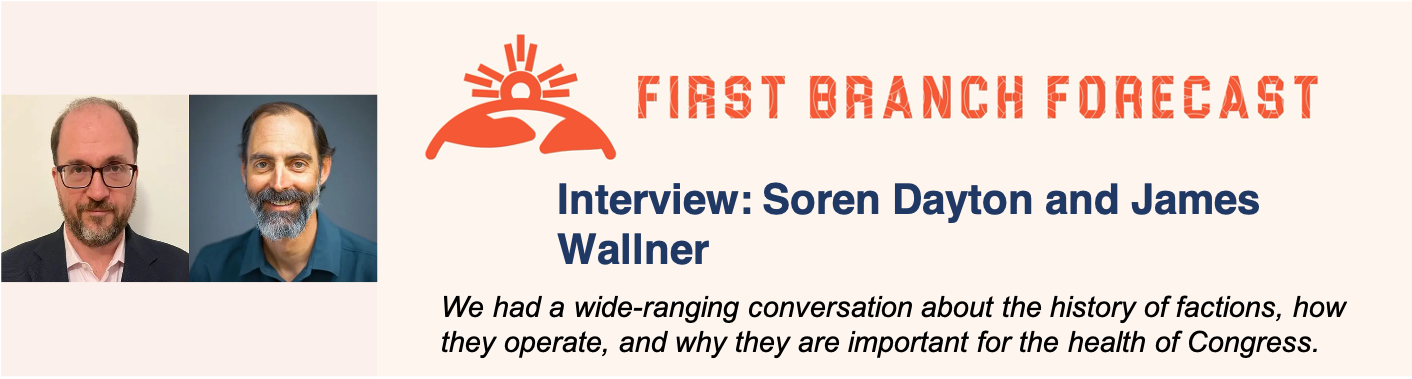
  • June 18 · 30 min

    Interview: U.S. Capitol Police Chief Michael Sullivan

    Daniel Schuman: June 30th marks one year on the job. How are things going? Chief Michael Sullivan: Terrific. This is an incredible organization with an incredible mission, much different than other jobs that I’ve had in major municipal cities. Really focusing on what we do here, which is protecting members, protecting this place, and protecting the legislative process. And that protective mission-- while policing is certainly part of that mission -- security and the protection piece is something that is much stronger than any other place. I would say it’s flip-flopped. I had protective missions in other places; however, it was a small piece of my portfolio. I would argue that protection piece of this place and the members is a much larger piece of the portfolio here at the United States Capitol Police. Schuman: The legislative branch has tremendous security needs and of course you can’t do everything, you can’t focus on everything. Is there something that you’re focusing on right now? Sullivan: There’s a lot of things that I’m focusing on right now. I met with a lot of folks over the last year right after my entry, hearing members’ concerns about safety, the concerning emails, phone calls, and threats that were coming to them directly. And, I can tell you there was deep concern across the entire membership that I talked to directly and had those one-on-ones on how we’re handling those. Being able to have those conversations really made me understand that difference in that policing mission versus what I would call a protection or security mission. It was helpful in instructing some of the areas I needed to make sure that I assessed and focused and did the best we can with the resources that we currently have. That’s been part of what I’ve looked at. I’ve also looked at, making sure -- because this agency made incredible strides since January 6th -- making sure that we have systems in place that embed that progress, that we don’t backslide. We have to make sure that we are always prepared, and a day like that, if it ever comes, that we’re there to meet that day and meet that purpose. I truly believe that we are today, but we’re going to kick the tires and if we’re failing in any way, we’re going to fix it. Schuman: Can I just stay on this for a second? In prior years, with some of your predecessors, there were questions around are you focusing on training, because training was a big issue, particularly [on January 6th] Are you focusing on communications? Are you focusing on particular aspects of member security? There’s a million things that someone in your role, of course, needs to be paying attention to, and you had spoken about the security mission. You gave us a good top level, but is there a particular thing that you’re trying right now to address? Sullivan: I can tell you as the chief of a major organization, I have to focus on all those things at once. Training is a huge issue. Making sure that we have leadership training, embedded in this organization. We have people up in Boston right now at the Senior Management Institute, which is an executive leadership school. I’ll be up there speaking to them and that entire cohort this Friday. That’s incredibly important to me. We’re investing in that. This is a very busy time of year, but we found time to send our senior folks there to get that training. Then we look at how do we embed the training, because it’s different here, right? Every place else I’ve been there’s been a state post that requires and mandates so much training. We don’t have that here, and making sure that we get our folks the training that they need, whether it’s around their critical needs like just something as simple as... and it’s not simple, but screening at the doors. We can’t just ask people to do that without giving them the training. We focused on improving policy, improving training. One of the things that I’ve learned over my time ... When I came up in this profession, you’d make a policy change, sometimes a significant policy change, and it would come across to you at roll call, you would sign for it, and after you signed for it, you were responsible for it. That was the impetus of your training of this many times a very important policy. We need to train our folks and if we make a significant consequential policy change, it needs to be followed up with training. What that training looks like can be many different things depending on what the policy changes are. But policy changes, are great, but they’re only great if they’re actually embedded in the culture, followed up on, and then our people are trained to be able to be held accountable to them. Chris Nehls: I want to go back to … you mentioned the threats that members have been experiencing, staff have been experiencing. We’ve seen the reporting and the information out from the department is there’s 15,000, almost 15,000 of these threats last year. This is up, almost double from just five, six years ago; but it’s hard for us to understand what that all means in terms of context. First, how do you define a threat? Sullivan: When we talk about that 15,000-number, we talk about threat cases. Okay. These are concerning cases. Some of them have a criminal nexus. Some of them, I would say the majority of them, do not -- it’s First Amendment protected speech. But I can tell you, as the executive over this organization, if we did not capture something that is a concerning statement and causes a member’s offices concern, and then that person comes up on the radar again, we don’t see that escalation, that would be a bad thing. So, it’s incredibly important for us to make sure that we do our due diligence on each of these concerning statements, threats that are risen to us, because if an office is reaching out to us and has concerns about it, we should have concerns about it. When I talk about that 15,000, those are 15,000 cases that are threats agents are working and have to manage. Certainly, First Amendment protected activity, that investigation is much different than a full-blown threat investigation where we don’t have somebody identified, where we have to go out and get legal service to be able to identify that person and then we have to engage with the US attorney, whether it’s here locally or somewhere out in the United States, to be able to facilitate a prosecution. As you talk about these cases, we all want to look at prosecution as the bottom line. That’s a tool that we have in the tool belt. It’s certainly something that we want to use when it’s appropriate, but our mission is to keep these members safe. Sometimes keeping members safe means getting them engaged with family that they’re not engaged with right now because of some issue, mental health, so all of a sudden, this person that has been a consistent issue because of some other challenges that they have in their life. Maybe the prosecution isn’t necessarily the right way to go. Many times, if we can do those interventions, we solved a problem and we kept a member safe in the long run, maybe safer than prosecution. With that said, we don’t hesitate to prosecute. We can’t stand for people to make, blatant, outright threats, to our members and to this place and to the people that work here. We’re focused on that and focused on keeping people safe. Nehls: Could you give us a little bit of a sense of how you filter through... It seems like such an enormous amount of work that goes into investigating, as you said, investigating 15,000. How do you manage or filter through what sounds like it might be somebody just calling up randomly who’s mad and yelling at an intern versus things that go higher in a threat matrix? Can you just talk through how the department, works that through? Sullivan: We stood up a protective intelligence operations center. It’s an operation center, so it manages all those operations that are outside the NCR [National Capitol Region] that are going on with members, making sure that we’re focused on and understanding what that looks like. In addition to doing that, the concern is with 15,000 cases coming in 18 different places, we needed one central collection point. So that one central collection point is our Protective Intelligence Operation Centers. It allows us to triage and then assign the cases. It makes sure that they all have that one entry point so we don’t miss something, which is always the fear that you have, that you miss that one string that you could have pulled. There are assessments that go on during that process. There has to be communication with the offices because if you’ve given this to us, the follow-up that we have to have -- which has been one of the most challenging, just to be quite frank, one of the most challenging pieces that we’ve had because of the sheer volume -- making sure that we get back and keep members’ offices or other victims apprised of where we are, what we’ve been able to find, whether we’re waiting on maybe potentially legal process or a conversation of this doesn’t meet the level for a criminal prosecution: This is First Amendment protected activity. This is why sometimes that doesn’t feel good. I’ve had threats personally against me that didn’t rise to the level of something, but threatened my family. It doesn’t feel good, and I can tell you that it doesn’t feel good to members, but being able to have those discussions are incredibly important. We have talented and very skilled investigative agents look at this, but we also have PhD-level doctors that are skilled and experts in this that take a look to understand this person’s entire picture, to help us look for different mitigation techniques. So being able to filter it all to one place. This is difficult. While I’m not going to share the number of threat officers I have, I’ve expanded that. It’s expanded significantly since I’ve been here and we have plans to continue to expand. Nehls: There’s been a discussion about political violence and political language becoming incendiary. Does the department think about how do you get that number to go down from a policing standpoint, or is that not really a way that we should think about that? Sullivan: I think everybody would like it to go away, but I can tell you we’ve had political violence for years, between Gabby Giffords, Representative Scalise and the baseball game. But it seems like over the last year, year and a half, you have the governor in Pennsylvania, you have Minnesota, you have the president, you have Charlie Kirk, you have the president. The level, it seems to be accelerating and becoming more the norm. Certainly, it’s our job, and I think it’s my job, to speak out against political violence. I have in a number of forums, whether it be on media or at conferences that I’ve talked to folks. It can’t become the norm. When we can hold people accountable, we will. I’ve worked with federal prosecutors my entire career. Federal cases are some of the hardest to bring. There’s a reason when I came through that they have a 90-plus-percent conviction rate in the federal system compared to the state system: It’s because they only take those cases after they’re fully vetted and they’re confident in where they are. So, that’s a challenge, but I’ve seen a willingness to take some cases that I’d I would just say years ago maybe they wouldn’t take because of where we are today. I thank, the US Attorneys office around the country for their participation with us in that. In addition to that, I think it’s our outreach. We have incredibly, good relationships with people around the country, and that’s been a focus of mine since I’ve been here. One of the other things that has expanded significantly is a program where we have memorandums of understanding with people around the country. We had about 100 when I got here, and we’re pushing 600 now. That’s because we’ve had a concerted effort. It’s not because we just sat back and said, “Hey, you want to come join us?” No, I’ve been on the phone, I’ve been at conferences, explaining what this program is. The program really is, hey, let’s have this piece of paper in place, and if I pick up the phone as the Capitol Police and say, “Hey, we need help at this event,” and it’s something that you normally wouldn’t do, it’s outside of your regular course of business but you can provide potentially people to help us -- whether it’s on straight time, whether it’s on overtime -- but it’s for our mission that we will reimburse you. While that’s expanded, it doesn’t mean the work’s expanded. What it means is our reach and our ability to reach out and touch people and pull them in to this work that we have is terrific. And it’s been well-received as I’ve talked to chiefs and sheriffs across the country. Nehls: What else goes into the MOU besides, events? what other activities? Sullivan: It could be events; it could be there are specific threats. There’re different mitigation techniques that other departments can use. I don’t want to go into the specifics of it, but it’s anything to do with member security and protection when they’re back in their home districts. I know the House and the Senate have their own programs now. It’s an ability for us to leverage all of these different tools that we have to keep members safe, which is what we’re all focused on. Schuman: With the 15,000 concerning statements, is the language is concerning statements, behaviors, and communications and whatnot? can you break that down? How many of those roughly are deemed to be credible threats? Sullivan: We break them down into threats and direction of interest cases. Direction of interest could have a whole lot of stuff in there. And like I said, the vast majority are direction of interest cases. It’s a small subset that are threats. I don’t have the breakdown with me. Schuman: Your predecessor, Chief Manger, was asked about this, and he said it was a couple hundred things that were credible threats. So you’ve got this year it’s, 15,000 directions. But, there’s something out there that’s causing you to look more deeply, so you’ll maybe open a preliminary investigation. You’ll look at it in some facet, you’ll make an assessment. Then of those you can’t, there’s no way with the resources that you have, even though they’re significant, you can look at all of them. There’s a point where you’re going to winnow it down significantly: these are the ones that are much more concerning we’re going to put more resources in, we’re really going to investigate this. And then of those that you go and you put more resources into, and you deem them credible or substantive or whatever the term of art is, then there’s, a further cut, right? All right, we’re going to send this over to a prosecutor. What I’m trying to get a sense of, when the press reports on this, they look at this number that’s gone from 8,000 to 15,000. That’s a huge increase. What I’m trying to get a sense of underneath that big number that can reflect a lot, how much it’s something that is actionable. It’s something that you guys are saying, “We have to go to the next level of investigation and do something about.” I’m not expecting you to have on the top of your head, but just to get a sense of it, is it 10% or 5%? Is it a couple hundred? that’s why I’m asking the question. Sullivan: No, absolutely. And the vast majority, it’s hundreds versus thousands of DOIs. And of those threat cases, I can have a credible -- I don’t want to use the word credible-- I can have a threat case and it is something that if I identify who made this it’s prosecutable. The first step is identify who that person is, which can be a challenge depending on what media it comes in on and what information we have, what’s been preserved, how long has it been since we received the information. There could be a case that, yes, vis ery concerning. However, we’ve exhausted all our leads, which takes a lot of time, put out subpoenas potentially to the the different places and we can’t get it because of a number of reasons, so you could run into that. Then, you run into cases, okay, I have the person identified: this person, did they truly have the means? They’re sitting in a basement in Alaska and making a threat about a member who lives on the East Coast. Do they truly have the means to facilitate what they’re doing? Probably getting a prosecutor to pick that up is slim. But those are conversations that we have to have going forward, and goes to my point of why we want to capture all of the escalating behavior potentially behind. Unfortunately, many of the things that we see, this is the first time people pop on our radar when they do something. Schuman: Do you track the prosecutions? Do you keep track of the number of prosecutions that occur based upon the work that you’ve done? Sullivan: We have numbers on what that is. I don’t have those with me today. Once again, it’s a subset of those hundreds. Schuman: What we had heard before was that it was very difficult to get prosecutors to prosecute. The Capitol Police is subsidizing, I think, a couple of AUSAs to help focus so that they’re willing to spend time on something that they wouldn’t necessarily have been willing to do otherwise. Let me turn my question to a statement. It would be helpful, to have a sense of, looking at the last couple years, just being able to break it down, not as a way of, diminishing the work, but I think to help the members better understand the nature of the work. Because we see every time the new number, the new top-line number comes out, there’s increasing panic from them. Yes, the threat number has gone up to 15,000 or 17,000, but we’re calculating a lot of people by social media. Some of these are threats from people in Tasmania, right? They may have a threat, but they’re not likely to be able to cause any type of injury. Would you be willing to, or else would you be willing to look at, providing a little bit more detail in the numbers to help break down the directions of interest, the threats, the number of prosecutions, either going backward in time or going forward in time so we can just better understand that environment? Sullivan: That was one of the things that I actually asked when I first got here, and I was concerned. We were managing the work that we did in a records management system, which is not the way you manage cases. The ability for me to get detail was very limited. Very limited, very time-consuming, hand counts, Excel spreadsheets. USCP staff: Do you mind if I was just going to add something just for context. So, try to tell a member of Congress that if they get a voicemail that says, “I wish someone would cut off your f*****g head,” try to tell them that’s not a threat. But it’s not a threat. Sullivan: It’s not a threat; that’s a direction of interest. So, the hysteria that you guys talk about, that is what they’re bringing to us because they’re getting those calls. We’re not dramatizing the numbers. We’re running down all the threat assessment cases. I think if we tried to say I’m just making a number They’re going to go, “No, it’s not. Do you know how many calls I have? Do you know how many emails I have?” They’re getting them every day. So we’re not causing the hysteria. No. The feeling of that threat is very real every day. Schuman: Part of our job is to provide better context for them, and I think that’s -- and I don’t, I’m not to put words in your mouth, so I apologize -- but that’s part of your mission as well to help them understand how to be safe and what the threat environment looks like, and how to behave in those circumstances. And you’re releasing a number that is an alarming number. There’s nothing wrong with you releasing it. I think it is appropriate for you to do I think it’s great that you’re doing so. I think that providing these are the terms that we use: here’s a direction of interest. This is a direction of interest versus it’s, a credible threat. We define this way and this that way. We want you to know that we are tracking this well. It sounds like there have been records challenges, and I’ve heard about that as well that the data has been difficult. Trying to go backward in time, it is not as reliable as one might necessarily want. But even just on a going forward basis, being able to help people understand a little bit better if there’s only a couple of prosecutions, that’s not necessarily a bad thing if you’re finding ways to divert the attention, if you’re finding, ways to better protect the members. I think that’s fine. Right now, all we have is the statement for each of the years for the last eight years. Would you be willing to, if you could to release it? Sullivan: That’s one of my first assessments when I got here: this is crazy, we can’t manage 15,000 cases in an RMS system. It’s a records management system: We need a case management system to be able to do that, and we’re in the process of bringing on a modern case management system that will allow us to have better insight. Schuman: I’ll just put a final button on that and move on: if Congress were to express support for you releasing this number, these numbers in a greater level of detail, you wouldn’t have any objections to doing so? Sullivan: We work with Congress every day, and we follow their lead, we work to support them. Schuman: A number of years ago, Congress directed the Capitol Police to create a FOIA-like process and to consult with civil society in developing those regulations. It was in the appropriations bill. Obviously, this is before your tenure. The department, in fact, did issue a FOIA-like policy. There are several legislative branch agencies that have done so. The GAO has a FOIA-like policy, the Library of Congress has one, and the Capitol Police has one. But in doing so, while there was direction to have consultations with the public, those consultations didn’t occur, and the resulting policy seems to hold back categories of information beyond what would be typical for a law enforcement agency if we’re located in a city or even that applies to the executive branch. So, the information that the FBI normally would release is significantly broader than what’s currently coming out of the Capitol Police. And by way of example, I had made a public records request for who else is filing public records requests and what were those requests, and that was denied. Those types of FOIA logs are routinely released. Is this something at all that you’ve been tracking? I know you’ve got a million other things going on. Have you been looking at these aspects of transparency? Obviously, your having a conversation with us is a significant commitment to doing so. Are you looking at the records practices as well? Is this something that you might be willing to look at? Sullivan: Certainly, I’m going to follow the laws that Congress makes for me in this area and it’s something I’m tracking. I know that there’s been challenges and there’s ongoing challenges that are part of the legal process in this area. I rely on my team to make sure that we’re doing that. With that, I think it’s important to get information out and balance the information that the public needs to hear and the security of this campus and the members that we’re challenged with. So, it’s that balance between the two. But to your point, I’ve sat down with everybody that’s asked and had conversations in the year that I’ve been here, and would continue to do that, making sure that we can get out what we can get out. Schuman: And we would welcome the opportunity to have a conversation with you or with, with your colleagues about, how to further strengthen that process. Nehls: I want to just shift: the Architect of the Capitol testified at the House Administration Committee last week. They didn’t really get into it but they’re going to produce a master plan by the end of the fall. Of course, the AOC is on the police board, they work with you on different security structures and things. I’m just curious, as they wrap that master plan up if the department feels like it has the physical infrastructure it needs, or if you feel like you’re getting behind on something. Sullivan: I’ve only been here a year, and one thing that I’ve learned is you never give up space, and if you can get space, you better grab it and hold on to it. Space is at a premium here. We certainly need additional space and we certainly are understaffed to complete the mission that we’re asked to do. That means I need to get people here, which many times means parking as they come to and from. It means locker space for them to be able to do this. One of the things I was surprised at was when I heard roll call, I expected it to be what I had experienced roll call at a table like this. Everybody sits down and you have a nice conversation, pass information along and go forward. Depending on where you are, it’s a very different place, whether it’s down in the Senate roll call room or it’s on the House side or the library side. It could be in a hallway rather than a place that’s conducive to what I would call the most important 15, 20 minutes of the day: to be able to share the information that have gone across. That being said, we understand, we’re here. They’re not here to support us, we’re here to support this entire operation. Being part of that, we’ve expressed the needs, challenges that we’ve had. I know that we’ve looked at opportunities to move that forward and we’ll continue to work with the Architect in partnership to be able to do that. One of the other big challenges that we have is training, and the facilities at Cheltenham (Maryland) are less than ideal. We need to have significant investment to be able to get that where it needs to be. One of the other organizations I came in, the place that we trained was abysmal. There was cardboard and duct tape on the windows. It was a terrible place to bring new employees in and say, “Hey, welcome. This is how much we value you, and we bring you to a place like that.” I’m not saying that’s where we are with Cheltenham, but it’s certainly not ideal. And then just where we are right now with our staffing with the 9/11 folks that now can retire. This hiring is not going to stop for the foreseeable future, to grow us, and it’s going to take a number of years to get us to where we potentially need to be looking at it forecasting today. Who knows what technology will be in place and what things that we can put in place in the future. But looking at what it needs just to staff where we are today, if we want to say, “Hey, how can we staff what we want to staff here on campus and on our protective model,” we’re hundreds short on both the protective mission and the mission here on campus. Schuman: You have, and please correct me, it’s 2,350 authorized, and you need another 300 more? Sullivan: I have a staffing office that’s working on a report that literally, they’re taking a look at every post that we have, which changes sometimes weekly if somebody wants another door open or there’s another security measure that requires us to fill that. We have the discussions about it, but when we’re asked to do that, it takes a toll on our folks. That means overtime, which means we’re holding people over or drafting people, which is a concern of mine when it comes to wellness of our officers. Schuman: Part of why we ask about spacing is we know that there are challenges with the Rayburn Building. It’s going to need to be remediated almost immediately, and of course, there are some Capitol Police facilities in the sub-basement there. There are other buildings that are... Longworth is in deep trouble. One or two of the Senate buildings are also in a challenging circumstance and there are challenges inside the Capitol Building as well. And we’re not even talking about Ford and some of the other congressional buildings. Of course, you have other facilities, that are separate from the main campus. And, we’re seeing House and Senate appropriators trying to grapple with investment in the campus has not kept up with the needs, and the buildings, some of them are in terrible shape. And I think we’re going to see in the next five or 10 years a tremendous change in the way that we organize all of this. the Capitol Police has more than doubled in size in the last 25 years in terms of people and it’s quadrupled in terms of budget, right? You’re doing a much better job of keeping track of your equipment, which was a challenge for January 6th and before. So, I’m just trying to think about what the physical space needs and how to make sure that you guys can get to where you need to get to. Not to mention that you’re responsible for the entirety of the legislative branch with the exception of GPO, so it’s a tremendously large mission. So that’s why we’re asking about, your needs for the buildings. Sullivan: Yeah, we have tremendous needs, and we’ll continue to have tremendous needs. There’s ways that we can mitigate that, whether it’s on campus or immediately off and the Architect’s looking at all those in the conversations that I’ve had with that office. Nehls: What other things would you like to communicate to the congressional community, that we haven’t talked about yet? Sullivan: We’re lucky that we have an incredibly resilient workforce, a workforce that is so positive. It’s unbelievable the interaction when I go out and talk with officers -- and this comes from somebody that … I’ve had experience across the country with law enforcement, but the positivity with which they look forward to this job is something that is refreshing. And we have also a very young workforce. I talk about that workforce really changing over. We lost a lot of people after January 6th and we’ve been doing consistent hiring since then. We’re getting to that point that our workforce is getting younger, which means that we have to make sure that we give them the training and supervision that they need to be able to do their job and guide them so they have successful careers and complete and focus on the mission. I’m incredibly proud to lead them. It’s a challenging mission every day. We’ve been challenged a number of times since I’ve been here and they’ve performed incredibly and will continue to do that every single day. When we fall down, we’re going to learn from it, and we’re going to move forward and be better the next day. Schuman: Wonderful. Thank you so much for your time. Really appreciate it. Get full access to First Branch Forecast at firstbranchforecast.substack.com/subscribe

  • June 11 · 1 hr 3 min

    Interview: Soren Dayton and James Wallner

    Daniel and I recorded this conversation with Soren Dayton, the Director of American Governance at the Foundation for American Innovation, and James Wallner, non-resident fellow at FAI, about their paper “Rebuilding Congress from Within, How Factions Facilitate Deliberation and Lawmaking.” It posits a view we share that too much of what goes on in Congress now is directed by leadership, to the detriment of the deliberation and negotiation between members that the institution is designed for. Factions, they argue, are one of the few tools currently available to rank-and-file members to restore collective decision-making and fix Congress. We had a wide-ranging conversation about the history of factions, how they operate, and why members of Congress, the philanthropic community, and the public should embrace energetic debate rather than the false goal of finding bipartisan, politically moderate policy solutions. Daniel Schuman: We are here today with Soren Dayton and James Wallner with the Foundation for American Innovation. And we’re here to talk about their new paper, Rebuilding Congress from Within How Factions Facilitate Deliberation and Lawmaking. Thank you both for joining us. James Wallner: Thanks for having us. And can I just say off the top real quick? I really wanted to name it something different. I mean, Soren was like, let’s just go with that. It’s a good name. I was thinking more like, you know, Kong versus Godzilla, you know, rise of the factions or something, spicy to get people in. But, you know, we went with Soren’s title. Schuman: That’s fair. I mean, you could have done the facts on factions, but that would also be kind of a pedestrian approach. Wallner: Or factions of life. Schuman: Oh yeah. You take the good, you take the bad, that kind of thing. Wallner: There’s so many options. Good thing we’re going to have a never ending series of factions papers after this just for the titles. Schuman: Your paper argues that Congress is dysfunctional because the members are not organized to deliberate and legislate in the present environment. James? What do you mean by that? Wallner: Well, I want to take a step back. I think it’s important to maintain a clear focus on agency in this, as you and I have talked about in all of our writings and conversations around town and over the years. It’s important to maintain focus on agency when we say Congress isn’t organized. I think the way to rephrase that, if I’m teaching one of my writing classes and colleges, where it’s active voice, active voice, active voice. And it is that lawmakers are not organizing themselves to facilitate their own participation in the process and to enhance their own ability to deliberate and to impact outcomes. There’s lots of different ways that Congress can organize themselves, but one way is through these things called factions congressional caucuses, intraparty caucuses -- people call them different things -- but they’re in essence, factions, sub-party kind of units. Sometimes they can be cross-party -- not so much in this day and age. We zero in on these in particular, because if you are an opponent of the status quo – and most of the reform throughout Congress’s history has been driven by opponents of the status quo, the outliers, if you will – you’re not going to be able to rely on existing kinds of legislative organization, right? So, congressional committees and the political in the party structure in the House and Senate, because those are set up by winners of the status quo, they’re set up by the people who are the reason why the status quo is the status quo, and so they’re going to be less inclined to kind of rock the boat. They’re not very friendly to the skunks at the garden party or the ants at the picnic. Factions really become important in that scenario. And then when you look at Congress today and the dysfunction that we see in Congress today, and the bipartisan frustration from the far left to the far right, that all seem to be echoing the same sentiment. It’s just astonishing to me that they are not using this tool to the degree that it has been used in the past and that it could be used to enhance their own stated goals. Schuman: So would it be fair to say that Congress is organized, but it’s organized by leadership and it’s not organized by the members? Or is that too much of an overstatement? Wallner: I wrote a piece a long time ago. There was an open letter in the Washington Post and it was by all these former members and it was like, Congress is broken, the Senate is broken. And then they went through and they’re like, it’s not leadership’s fault. Then they’re like, it’s not the committee’s fault. They’re like, it’s not the rank and file fault. I’m like, well, whose fault is it? Is it some guy from Scooby Doo? Earl down the street? You know, he pulls off his mask or some invisible ghost? No, the Senate is dysfunctional, the House is dysfunctional because the members of the House and Senate make it dysfunctional. They make it dysfunctional when they defer to their leaders, when they empower their leaders to run things certain ways. They make it dysfunctional when they continue to acquiesce in that environment. Look, I’m not pretending like there’s not a cost to this, a social cost or political cost, etc.. Of course there is. But I think it’s important to keep really focused on the main point, which is that the members themselves are the ones who are in charge, and they’re the ones who are responsible for the House and the Senate operating the way the House and Senate operate. And they have many, many tools at their disposal to change things. If they don’t like how they are operating or try to change things, they are not victims. They talk about themselves in the third person all the time. If you think about how Congress talks like the bill was passed, I’m like, no, you passed it or your colleagues passed it over your objections. The bill wasn’t passed when we just woke up. Oh my God, did you see that the bill was passed? No, you did this. And so I think it’s important to keep that focus, laser focus on that. This paper, I think, gets into one of those key tools that I think is a kind of a foundational tool. And Soren, I know, shares this thought that allows them to facilitate their own organization, their own cooperation, and then use other tools at their disposal much more effectively. Schuman: Perfect. So let me pick up on that and turn to Soren. You guys are talking about factions. Are there examples of factions in Congress now? What do they look like? What and what do you mean by faction? Soren Dayton: So I think in the House there’s two things. There’s two caucuses that look something like what we have thought of historically as a faction. They are the Freedom Caucus and the Progressive Caucus. The Republican study committee is almost just an information machine. They’re not actually a coordination machine. To go back to the Progressive Caucus and the Freedom Caucus, they both have things like rules about how they should vote together. They have membership requirements. They have regular meetings where it is expected of the members that they will coordinate on activities. And, I think it’s very helpful to read the books of someone like Ruth Bloch Rubin, who goes into a key element of successful factions is that internal rule making process, that internal coordination process that binds people, that requires them to act in certain ways. There are other things, like I think the New Dems and the Republican Study Committee are these huge monstrosities that are essentially a branding vehicle in some cases, or the Republican Study Committee, if you’re a Republican member or a Republican staffer, you want to be in the study committee because it is the only source of information other than leadership. And this is history James knows better than me: the Freedom Caucus got frustrated with the status quo the RSC had been and broke off to be not just the right wing in a sort of substantive policy version, but also more adversarial to leadership and more revolutionary on process. And in some ways, the Progressive Caucus I think is less adversarial with leadership than the Freedom Caucus through a variety of ways, partially. It’s hard to do when it’s that big, and so many of its members are committee chairs and things like that. But at times you’ve seen the Squad be a little Freedom Caucus-like in its sort of adversarialness to leadership, but it’s not organized. I think you have a slightly different set of entities in the caucus in the Democratic Party: the Black Caucus, the Hispanic Caucus and the APIA -- I’m probably getting the letters wrong -- caucus. There’s affiliated C3s and C4s. There’s staff pipelines, but those are actually really concrete problems they have. But so going back to the Progressive Caucus and the Freedom Caucus for a second, there is a sense of shared subjectivity that I don’t see in the bigger ones, right. These are people that have a certain ideological location within the party, and they have a theory of the need to change the party in a certain way. And I think most of the other things that are factions or that purport to be factions are just sort of people. They’re in a space not with the theory of change about how the parties should change in their direction, or they should leverage their power within the parties, even though they sometimes do leverage their power. Schuman: Can I push you on that just a touch? Dayton: Yeah, absolutely. That’s what we’re here for. Schuman: looking at the affinity caucuses, like the CBC: the CBC, from where I sit, except on a handful of issues, does not necessarily have a policy agenda that it shares, but it does have a procedural agenda that the members share about how the committees are going to function. It’s going to be more based on seniority. I think it also on the Senate side with the Republican steering committee you know. Wallner: Just the Senate steering committee, it’s not Republican Study Committee. Schuman: Thank you for correcting me. I knew you were going to do that as the former Grand Puba. Wallner: I mean, I guess, but I left before we could change the title. It was just executive director. Harry Reid would get very upset about it. [Sen. Robert[ Byrd gave a famous speech on the floor about how there’s no Senate steering committee. That’s a problem. We’re like, we’re not Republican. Schuman: Yeah. You’re just the Senate steering committee just composed of Republicans, which isn’t the same. Wallner: There were Democrats when we first got started, but that’s another story. Schuman: Yeah. Well, I want to come back to that story. But on this, it seems like there can be procedural factions or organizations in the House like you organize by state: the California caucus or the Texas caucus is very powerful, and they achieve goods to bring home and to organize and to elevate their own people into power that they wouldn’t necessarily have. Would those be to your way of thinking a faction as well? Dayton: Well, one I’m not too worried about, the definitions, and in Congress, people don’t call those factions. They just call them the delegation. Right? I mean, they have their own label for that. It does have many of those elements. When I worked on the Hill, my boss was a Michigan Republican, and the Michigan Republicans had a delegation meeting once a week. And every once in a while there was a bipartisan delegation meeting, but they often voted together. They often had shared interests that sometimes, interests in the state, either political, agricultural, industrial, popped up. You can get manifestations of that with the Dingell family that was tied into Ford or GM, I forget which one Debbie Dingell was a lobbyist for before she became a member. You certainly have examples of alignment of interests that aren’t by party narrowly, or that aren’t purely by ideology. I think in Congress, that is the dirty little secret, right? Anyone who works on a low salience issue sees that all the time. But the important part about factions is often are you willing to leverage your power sort in a higher salience fight? And, that’s probably where I put that distinction. But I also wouldn’t worry about the distinction too much, because there’s a reason that Congress uses the language delegation to talk about it. And there’s all sorts of entities like political parties that sort of capture and support that. Schuman: So, James, people have a tendency when they talk about Congress to talk about the House. But the Senate, as it turns out, is also a thing that matters at times. Does the Senate, and if you read like Ruth [Bloch Rubin’s] book in some of the other books, like they talk about gangs, but there’s also more like you were the executive director of a more organized, a more organized faction within that chamber. How is it different on the Senate side? How do factions work there? Wallner: First, let me just say, I did start my career in the House, working for a Southeast Alabama congressman. I helped write the peanut title in 2008, farm bill. I am the founding executive director of the Congressional Peanut Caucus. And when I left, I don’t know if anybody...I think I’m still the executive director of the congressional caucus. I mean, I’ve never you know, we never really talked about it... But, there’s different reasons to have some kind of organized or semi-organized factions. What I like to say is everything that’s in the Senate is in the House and vice versa, they just manifest themselves differently, right? Members are going to have different access to the floor in the House and Senate. That’s why factions in the House, historically, have focused on information, right? Going back to the DSG, the Democratic Study Group, RC was modeled on that as well. Even in its founding, RC was much more of a kind of information policy pipeline kind of development organization. Freedom Caucus when it was created -- I was very much there at the time -- was created to be much more operational and focused than to have one goal and one goal only, and that was to vote against rules as leverage and of facilitate the ability of members and the party to withstand the pressure and to vote against rules and then bring that pressure to bear. And you’ve seen them do that time and time again. We wrote a piece on the Kevin McCarthy speakership thing where people are like, the sky is falling. And we’re like, it’s fine. You saw that it was a very successful use of leverage by a kind of a subset of the Freedom Caucus banding together until they got what they wanted. But yeah, the Senate is a little different because the members in the Senate are going to be much more autonomous. They have much more access to the floor. The Steering Committee was founded by Paul Weyrich around the same time that one year after Ed Feulner founded the RSC with his members in the House. From the very beginning, it took on a much different flair. It’s much more kind of like the Freedom Caucus today, although they have written rules. We don’t have written rules: I got all the files in my closet, I guess they call me and they’re like, what’s the rule for this? I’m like, let me go check the files. It started off just like this weekly meeting, and then everybody started coming to the meeting. Then all the Republican senators are coming to the meeting, and the conservatives are like, well, we gotta get an executive committee now. Then everybody thought they were in the steering committee. And then it turns out, no, they’re not. They’re just coming to our lunch. We got a new thing called the executive committee. It was always much more operational and staff had a much different function, steering staff or monitoring hotlines. We were inserting ourselves in negotiation with committees and party leaders. It’s mainly staff driven: the executive director is kind of like the face of it, but staff are really working with outside groups. They’re working with key interested members on the committee on different things they care about. And as I told my staffers all the time, look, you got to be three, four, five steps out in front of your members. Just make sure if they go left, you’re not going right because that’s going to be problematic. It’s a lot more negotiation based, a lot more kind of operational and tactical and not so much policy development, although there’s certainly parts of that. Chris Nehls: I want to build on what you’re both talking about and go back to. Soren’s identification of the Freedom Caucus and the Progressive Caucuses like the two that seem most actually factionally faction. One of the things I think is great about your paper is you’re trying to change the way people are looking at the activity in Congress and understand what they’re seeing and what they should be seeing. There’s this conventional wisdom that Congress is dysfunctional because of polarization, and what we really need are moderate members to come together and negotiate and come up with kind of practical solutions and things like that. People have funded that activity very thoroughly. And you’re saying that’s not what we’re talking about at all. Actually, you need to understand the way Congress should be working differently, and faction is one part of that. Could you guys kind of riff on where you think that conventional wisdom came from and why it’s wrong? Wallner: Let me just give the kind of high level answer and I’ll turn to Soren. I think the conventional wisdom is just wrong. But I think the reason why I think people have lost sight of factions, lost sight of all of these tools that members look -- I mean, the Congress in the 60’s and 70’s, when it was actually relying on subs like the the conservative Southerners who were trying to stop civil rights, you got other civil groups that are supportive of civil rights that are working together, some formal, some not so formal, working with outside groups advancing inside outside games. The 60’s and 70’s was Congress’s most productive legislative period in its history, hands down, and this country was on fire. People across the board are pissed off. There’s violence in the streets. The CIA is killing God knows who, who knows where, all kinds of terrible stuff is happening, and we are picking up the most controversial issues you can imagine, and we’re legislating on them. They picked up the Civil Rights Act of ‘64 in the Senate in March of a presidential election year. [Mike] Mansfield, the majority leader at the time, is convinced it’s going to destroy his party, and he does it anyway. I mean, it’s amazing today we’re like, we can’t do that. We’re gonna have an election in three years, you know? And it’s like nonsense. But I think that is indicative of a different view of conflict. Today, we have this sense that conflict, that the messy realities of legislating, of disagreeing are a bad thing. And when you see it as a bad thing, you then try to insulate Congress from it and you try to get new people into Congress that aren’t going to facilitate it. You get this emphasis on the moderates and everything. Moderates in the past, moderates have driven change, too. Think about the 20s and the institutional reforms, particularly in the House, they were driven by moderates in the center, like the progressive Republicans, but they were moderates working with Democrats, trying to force a more decentralization of the process and empower their rank and file. But I don’t like the idea of moderates and extremes. I think it comes down to do you support the status quo or do you not? And if you don’t support the status quo, are you willing to use the tools at your disposal to change it? My problem with the emphasis on moderates these days is that one, it centers on people who aren’t necessarily so upset with the status quo. Then number two, it centers on people who don’t have the temperament to think like a John McCain. I don’t think he’s an outlier conservative, knuckle dragging conservative or something. I think he is a maverick and he would do things. And that’s a personality trait that I think that we -- or a Howard Metzenbaum, for instance -- I think that the kind of moderates that we, the kind of philanthropic community, the media, the party establishment center around typically lack that personality trait and they’re not it’s not fun upsetting the apple cart, but I think it does come down to this idea that conflict itself is bad. But last time I checked, the way you get compromise is that you first disagree. And it is literally impossible, impossible to compromise if you do not have disagreement first, right? If you can agree without disagreeing, that’s a consensus. If it’s a consensus, we don’t need Congress, right? We do not need to deal with that. The whole point of Congress is that it is where we go to negotiate the non-negotiable. But our I think our commentary in the academy, in the media, certainly among kind of the reform community and, the members themselves seem to have forgotten that that is the whole point of Congress and that sometimes people are going to disagree with you and you need to roll up your sleeves, get out of bed, put your feet on the ground, look yourself in the mirror and be like, I’m gonna go to work today and I’m gonna try to win. Dayton: So I have a related, but I think somewhat different take. There are certainly plenty of times in recent years where moderates have leveraged their power to accomplish various things. I would point to the modernization committee itself, where the Problem Solver Dems held out on the speaker’s vote to get some concessions. I think some pretty weak concessions. That said, some important ones you had in a variety of fights, and we include some of these in the paper. You had Gottheimer and similar moderate Dems holding out on a set of issues. But I think one key part of the difference that people in different ideological locations have is how they’re negotiating for power within the party. And for the most part, there is an alignment between the leadership and the moderates, not on ideology, but on sort of electability, right. They’re all interested in getting the majority, whether they use it for things or not. And, and so there is a pretty clear straight line of consensus there. And, and you see this in critiques from, I won’t say the extremes, but from the edges, maybe, in both parties. You know that said, you could imagine and you’ve seen in the past factions out of the moderates. I think historically, the Blue Dogs, there’s not enough of them to matter that much, certainly not in the minority. But you know, there have been actions by moderate Dems in the last couple of years. That’s a distinct public identity and it’s important for them to organize as such and leverage that identity as such. There’s also this inside-outside game where, for most people in both parties in the House, they’re essentially running as the generic “R” “D.” So the question becomes for people that are organizing in factions, are they not generic because of ideological or cultural positioning? Think Blue Dogs. Are they not generic because of a status quo critique? Or are they essentially running, alongside the party, and in which case, at least on brand and image, they’re aligned. Now, I do think there’s some interesting cases that you run into that there’s very little publicly written on. Both parties in the House have steering committees and how the steering committee seats are allocated is a really important set of questions. And in some ways, for example, the moderate factions in the Republican Party have owned that process really certainly for the last probably 40, 50 years. That’s only really stopped with Johnson, and nobody’s really figured out what’s going on there yet. I mean, a little bit, like McCarthy traded away some seats. But I think that is one of the most interesting things that’s happening right now. What will happen to House Republican moderates if they aren’t winning the fights in the steering committee and if they aren’t getting the steering committee spots? And how does that change their incentives to organize? You also have a similar sort of question for the New Dems. As Daniel noted, really the power of the Black Caucus is seniority and committee chairs, and the Progressive Caucus has some of that too. And so there is potentially an incentive for the New Dems not on substantive policy, because they’re mostly getting that from the party, but on distribution of power within the caucus where you could see some hardball. And that’s where I look for right now as places where interesting activity could emerge from. Schuman: So what you’re describing from a certain perspective, not my perspective, I should say, but it sounds like chaos and anarchy, right? This sounds like James, a deep cut sounds like parliamentary war, right? It sounds like just everybody, trying to organize around their own stuff. Nehls: The Dems are in disarray. Schuman: Or the inverse statement which drives me up the wall: our unity is our strength, which makes me want to take my head and hit against the wall several times. How do robust factions actually help Congress to organize the disagreements that they have and to facilitate decision making? I mean, not that what we’ve had over the last 5 or 10 years has been a model of the greatest deliberative process that one could imagine, but how would having more and stronger factions make it possible for Congress to do more? Wallner: I think it just comes down to a realization of how the process works. It’s easier to see in the Senate, but it’s the same in the House. In the Senate, my job at the steering committee was to stop things my members didn’t like. That’s what you do. And so I’d hire people and I’d be like, you got to go stop that bill. And they’re like, how do I stop a bill? I’m like, what do you mean? You just try to win the day. You just freeze action. You figure out a way to freeze the process just as long as you can, and then, you do it again and you do it again. Maybe stuff builds up. Things begin to collapse under its own weight, and then the bill dies. That’s how you stop a bill when the bill goes. I remember Allen Freeman, the former parliamentarian, was telling me about for this book the rules of the Senate, the rules of the House, there’s a logic to them. There’s a logic to the process, no matter how absurd it may seem on the outside, and that logic facilitates participation, it orders it and it structures it and it produces outcomes. It always, 9.9 times out of ten is going to lead to an outcome. The kicker is you can’t know what that outcome is in advance. You can’t define it. You can’t know with any certainty. You can’t protect what you would like to pass. Today we have this idea that this is the bill we want to do. And then like the floor now is this really dangerous place. What the leadership does is that they literally freeze the process right when they start the process, which is like doing my job for me. And so I think on a broader level, it makes it really hard to advance bills that people have a lot of disagreements about on the most salient issues for the American people, because it then goes behind closed doors. And when you’re behind closed doors, it is harder to call people’s bluffs. It is harder to set up the debate in such a way, to put people in positions where they feel compelled to go along with what you want, even though they don’t agree with it. It’s harder to bring the outside into play. The system itself becomes much less dynamic, and it becomes harder to get an agreement that everybody can come together on. And then there’s no fight, you don’t see the fight. Losers in the debate aren’t reconciled to the outcome. People on the outside of Congress, the activists and the American people, they’re like, what? Schumer comes out, he’s like, this is the best we could do, and they’re like, well, I don’t trust you. That’s the best you could do? Y’all don’t even try. Maybe they did. Who knows? It was all behind closed doors. What factions do is that they empower lawmakers to open up that process. And it’s not chaos and it’s not anarchy. It’s just that you can’t control it. If you’re a leader today, that looks like chaos and that looks like anarchy. In reality, the grand scheme of things, Congress is a very permeable institution, and it is going to follow what the people want it to do. It is. And if there is a big debate, a big fight that goes on for a little while, guess what happens? People are going to start paying more attention. More people are going to get involved, more activist organizations. That’s the [story of the] Civil Rights Act. What tipped the balance there was what Martin Luther King was doing across the South with civil disobedience and others, John Lewis and others, and all of a sudden it’s on the news in the Midwest. Then you have the Civil Rights Act now on the floor and it’s frozen out everything else and you have Midwesterners who are like, we’re kind of with you on this, but we don’t really care, we just want to do this other stuff. Then you have the religious communities, the Lutherans in particular, some of the great unsung heroes of the civil rights movement, like really mobilizing people in the Midwest and getting them to demand that their members get in there with the Northern Democrats. And that’s what ultimately tipped the balance. You would not have had that if there was not a sustained effort on the floor to pass civil rights, coupled with a sustained effort using the same principles out in the streets with civil disobedience. If the whole point of the House is like, we’re going to figure out what we can pass the majority and we’re going to put something on the floor and we’re going to vote on it. Well, sometimes you can’t do that in a room, right? Sometimes, you need to do it out in public. And what I think the factions do there is that I could see a scenario where the House, if you’re the speaker and there’s a big thing coming up, what you want to do is get buy-in on the front end, not the back end. So you call together, you know, your Freedom Caucus or SC. Maybe you get the moderate, the Wednesday group or whatever they call themselves now, and you get the factions in the room and you say, this is what we’re thinking, and you kind of try to get them in the process and you say, what do you guys think? And then you bargain with them, and then you try to figure that out so that in the back end, you’re not going to get the whole thing blown up and surprised. I think, ironically, by decentralizing the process more, by empowering members to participate more and to facilitate more conflict, you are going to get more outcomes, more compromises. And those compromises are going to be sturdier, and they’re going to be viewed as more legitimate. And then it’s not going to then result in this kind of thing that we have today. When Congress doesn’t do anything, kicks it to the executive branch or the judiciary, or they do stuff, but it’s like they wait until the last minute and they try to jam you, and it just leaves everybody feeling worse. Dayton: I can tell a fun story: James mentioned civil rights and the Wednesday group or whatever their name is. The actual history of the Wednesday group is amazing. It was the Republicans that voted to expand the Rules Committee in 1961, when Democrats in the House wanted to expand the Rules Committee to get civil rights and other legislation through under JFK. And Halleck, the Republican whip, wanted that expansion to fail just so the other team failed because that’s in fact, what your job is, mostly in the minority. And these were the people who wanted to pass it to get civil rights legislation. And they were ostracized in the party and got and just they started doing what you do in Congress: they started drinking together on Wednesday nights, and that’s how they became the Wednesday group. And they organized themselves later. That experience in 1961, they became the Wednesday group because they had lunches on Wednesdays. Then you had the conference lunch on Wednesdays, so they had to become the Tuesday group. The Tuesday Lunch Bunch was the name, right, because they organized on Tuesday. Wallner: but they never got anything done. Dayton: Yeah. Wallner: Monday through Friday was just…They never even saw them. They’re just tanked, schnockered all the time. Soren Dayton: Well, many of them are already schnockered across the ideological spectrum in both parties, but that’s a somewhat separate question. But the idea of these people working together and shaping the institution and changing the rules of the institution is a perfect example of how people can have power. But it’s also that time when our politics was much less presidentialized. I think one of the hard questions and part of what we were trying to do in this paper, and also the connection to philanthropy and outside groups is that you can’t solve these problems in today’s world without solving external brand issues, right? This is why the Blue Dogs have such a clear identity. You know, the Black Caucus doesn’t need an identity. mean, it’s sort of baked in, shall we say, same same for the Latino caucus. The Freedom Caucus certainly has an identity. The Progressive Caucus has an identity and works with parts of the ideological ecosystems. But if that recognition that it’s an inside outside play in a time of a presidentialized media ecosystem is a key part of the story here as our parties have hollowed out and we just communicate by email and, and TV ads. Nehls: So is it going to be on the outside groups to cultivate faction then? Or can we incentivize or encourage members to start to map on to that 60s and 70s experience into their own, their own negative experiences now of just being basically cattle and getting them to do something different. Wallner: I think there’s a couple of things. The ethics environment’s a little different today than it was when the RNC and the steering committee were founded. I think Heritage [Foundation] was paying Weyrich. I think there’s a kind of a scholarly component, an academic component of trying to educate people on the historical parallels, what is possible and that’s how members typically relate to things and ideas: how has this ever worked in the past? I think that’s important. And, various organizations, nonprofits, philanthropy can help to fund those efforts. I think there’s a space for philanthropy in particular, and people don’t appreciate this, but it’s so critical. The role of space. Space is so important, because space is where people gather together to talk and deliberate and negotiate and bargain with one another. And right now, all of the spaces inside Congress are pretty much dominated by the party leadership. And you may have some of these factions that meet, but even then, if you got a big faction, you have to find a place to get everybody together in the room. In the Senate, we’ve got big personal offices. The steering committee had like 16 people when I was there. When I started, it was like eight, so you could fit everybody in the room. We would have a weekly lunch of just the LDs for the steering committee members over at the Heritage Foundation where we met and talked. It was the meeting before the meeting every week. It wasn’t necessarily a faction thing, but I started an LD lunch in the Senate with AEI and they would bring in [experts] and they would educate people. They would have a speaker that would come and talk, but then they would leave at the end and we had this room. I created this environment where the LDS all got together just like the members doing the steering lunch and could talk to one another and yell at one another and tell each other what they thought and say, this is what my boss is thinking. And it was the leadership was not in control. I was in control of the meeting, and I made sure no one was in control of the meeting. And I’ve heard from people across the spectrum in our conference how valuable that was. And so I think philanthropy can, with existing rules, provide spaces for the members, provide spaces for their staff to help facilitate their own internal conversations and negotiations instead of having to rely on the leadership controlled spaces in essence. Dayton: It’s not an accident that FAI’s new office is two blocks from the Senate, and it’s very nice. Across the street is Searchlight, right, which is Adam Jentleson’s organization. It is a place where it’s still hard to get members to come off, but we’re about as far away as Heritage was. One of the one of the things that I think is unfortunate about the political science discipline -- and I mean, there are many things that are unfortunate about the political science discipline -- is I actually don’t think the sort of mechanics of that history with Heritage are well understood. And I’m not saying there’s anything wrong with it, but the Heritage Steering Committee and our SC role started in the 70’s, as James said. I think some of it’s over at CPI now to some extent with the Freedom Caucus, they’re probably still connected to our SC, but I think that’s a really important model. And similarly, in a although through a very different mechanism, the Black Caucus and the Hispanic Caucus and the P caucus and the Democratic side have these outside groups that provide paid internships because, internships aren’t paid on the Hill and provide talent pipelines for staff because in many cases, those are the big challenges that those caucuses have. I do think along these lines, an interesting test case may be the attempt to rebuild the Blue Dogs, because you have now a self-conscious C4, Blue Dog Action, and you have potential allies in something like Searchlight and a lot of things. If Searchlight’s the [John] Fetterman thing, there’s a lot of cultural connectivity there. I could see something emerging there. You have the components, you have some funders, you have you have members, but not too many because too many members, you have to feed too many children. And, and you have a distinct ideological location that’s being sold to voters as such. So that’s one of the places where I think something could emerge that’s new and interesting. Schuman: One thing that would be fascinating to do, I haven’t seen anyone do it well, is just mapping the geography around Capitol Hill about who owns what buildings – not just the holding companies, but who is actually operating in there is really because I’ve walked around a bit and I’ve looked at it, and it’s fascinating to see the trade associations and the advocacy groups. What I wanted to ask is, if factions are so useful, how can they become weak compared to what they were previously? What happened? Do we know? James Wallner: I think it’s a change in how people think about politics, when you think that the way you win policy is you win elections, right? We have this idea now that politics has shifted and it’s now like a factory, like Congress becomes a factory. The number one thing you have to do if you want to control the factory is you have to control the means of production, right? Let’s put all our, Marxist hats on, you got to control the means of production. How do you do that? Well, you win elections. That’s how you get gavels. That’s how you get votes. That’s how you get majorities. And then you have to keep winning elections. We have this idea that the way you win elections is by unified parties. And then we have this further idea that you can’t divide your party, which is why all this messy legislating has now been migrating away from public spaces and the parties try to present a unified view. So, Chris, to your point about polarization, we talk about our politics like it’s polarized, right? But in many respects, it’s just reflecting this like kabuki dance. The parties, as you see, are just an utter disarray internally. But yet they don’t like to present that. Ultimately, we in that environment, if you are trying to do something and it’s going to expose rifts and divisions in the party, which by definition, anything meaningful that you do is going to do that, If you’re trying to change the status quo, then you’re going to be ostracized. You’re going to be marginalized and you’re going to be made an example of, and it’s going to be very unpleasant, and you’re going to be told you’re the reason why everything bad is happening. The republic’s falling in the ocean, right? It’s not really about you, it’s about everybody else so they don’t get the same idea. Over time, that has translated into this view of conflict being bad. We just need to win the next election. We got to keep our moderates. We got to do this. We got to do that. Can’t push too hard, you know, and it’s not the way we do politics. It’s not the way we’ve ever done successful politics in this country. Any big meaningful stuff from the left to the right doesn’t matter. That’s not how we do it. But in this environment, it is very hard for members because at first they have to establish that it is legitimate to have a faction in the first place, and then to go to war to fight your own party and then everybody says, well, we were with you. I’d love to do that. Of course, of course I’m with you. But if we do it, we’re not going to be able to do it ever. So we shouldn’t try to do it if you want to do it right. And they never talk about the actual thing you’re trying to do. And it’s always about, well, you’re just undermining control. I think that right now, instead of just saying it’s already hard enough to organize, it’s hard enough to band together, it’s hard enough to navigate the space, it’s hard enough to find people who know how to do it from staff to members, it’s hard enough to go to war with your own party, much less your own president sometimes. But to add on top of that, you have to legitimize the very basic fact of your acting as an okay thing to do, is it makes it almost impossible for anybody. And I think right now that’s where we are. The idea now is that it is not legitimate for individual members to go out and act on their own, to try to do things, that is not an okay thing to do. We had this civil war in both parties in the Senate from 2008 to 2014 or so, 2015. And the side that said we should individuals acting as an okay thing to do lost. We lost that on both sides of the aisle, that’s what we’re grappling with. Members have to both defend what they want to do, but also they have to defend the very tool they’re trying to use to do. It is not being something that’s disruptive and is going to undermine the whole enterprise. Dayton: The other thing is it’s got to be worth something to organize and there are two issues here. Again, I go back to sort of presidentialized, national branded politics where members have to make a decision how and when they’re going to differentiate from the party brand. One important strategy is what I call squeal and cave: complain, complain, complain so that you get press, you get press in the district and then, cave to the party, give party leadership what they want or the party interest groups what they want so they can’t actually campaign against you on like substantive things. I refer you to the literature on what happens in times when elections are closely or when majorities are closely contested. All the incentives for the reasons James mentioned are to just line up and provide support for winning. I still think there’s factional activity on low salience things, but not on high salience things because they don’t have those sorts of branding opportunities. That’s why you see things like the talent pipelines in the tri caucus, and that’s why you see on regional issues, things work a little differently. Finally, and this goes back to the moderate discussion, I’ve heard from moderates in both parties that one of the challenges they face is finding good campaign staff that actually knows how to campaign on moderate issues. I won’t share the name in a broadcast format, but one high profile moderate chief of staff told me once that they had an education issue that they were working on and their campaign manager in the district didn’t know how to run a campaign on a moderate education issue. He only knew how to run sort of red meat issues. And so they basically Wallner: Gonna reveal all names on the Patreon page. Be sure to subscribe. $100 fee to know what the guy is talking about. We’re going to name his name. Names will be named on Patreon. Dayton: I think sort of really thinking deeply about the political challenges these people have like talent pipeline challenges and positioning challenges are important. Finally, it’s only worth doing if you’re going to make policy. Is it worth a fight with your party if there’s not real wins, if there’s not a real branding win, if you’re not actually changing activity. That’s the history of these things at their best. The blue Dogs had those. I used the governance group, the civil rights people were fighting over real substantive policy and cultural identity. These are the fights that matter. But you’re not just going to stand up and fight over nothing, and I think a lot of discourse has been fighting over nothing. Wallner: I tried to convince a steering chair once to pick a fight with McConnell, because I wanted the Daniel Webster statue outside his office. Let’s just pick a fight and then in the end, be like, we’re going to cave. But I need that statue. Nehls: But rejoinder we hear is leadership is just going to shut you down. Wallner: Leadership can’t shut you down unless you give them the power to do so. They can make your life difficult. They can make it unpleasant, of course. Any effort to change how Congress operates in the current environment is going to take away power from leadership, so of course they’re going to resist anything that would do that. It makes complete sense. But leadership, especially in the Senate, but also in the House leadership does not have the power to stop you. They can try to do various things and you can push back. I mean, look at Mark Meadows. It took his gavel, they took him off these subcommittees. And what did he do? He ended up getting Boehner fired. Boehner resigned, he said, okay, fine, he followed his motion to vacate the chair. And people are like, I can’t believe he did that. And I’m like, well, then don’t take away his committee, Boehner. Right. Like we’re like, oh my God, what are you doing? And it’s like, he’s just using a tool he has at his disposal. I mean, a lot of that angst and energy at the time also went into the Freedom Caucus and Mark Meadows, Jim Jordan, the founding members, because they were frustrated with the RNC and its inability for it to kind of coordinate action with the members. But yeah, leadership is great. I mean, but they’re not like Zeus. They don’t have bolts. They’re not sitting up in the sky throwing things down, smiting us mere mortals. They work for the rank and file. Full stop. Schuman: And I’m going to take that point and aim it at Soren, which some of the paper argues that this is actually good for leadership. Dayton: Certainly there are certainly cases. This is Ruth Rubin’s second book, [Divided Parties, Strong Leaders]. I’ve heard a delicious story that I have instincts on how I’d check, but the history of the Mainstreet Republicans, which is sort of the second moderate Republican faction, as it were. I joke it’s the moderate Republicans in red in red seats when the Freedom Caucus was created. Leadership was like, that means when the table has Freedom Caucus, RSC and one moderate, we need to make another moderate group. And that this is the actual story of where it came from, because they needed to be able to balance a room of human beings. I also think it doesn’t matter, to James’s point. You have power and you can fight and get what you want. Here’s where I go back to the modernization committee, here’s where I go back to many of the things that Gottheimer has done over the years. People get annoyed, people hate it. He gets good press and actually sometimes even gets policy wins and that’s like, you can fight. You can fight in the center. You can fight at the edges. There are plenty of proof points. And the question is, do you have the disposition to do it? Especially for the people in the center, they have a play that’s tucked tail behind leadership. I keep giving Republican examples because that’s what I know, but the only time you ever saw letters from the moderate Republicans was explicitly in defense of leadership, because they know they can go to leadership in private. They don’t have to do it in public. Wallner: Factions also offer a pressure release valve, especially in the House. If you have a structure, an institutional structure that is more or less formal that facilitates participation of disgruntled members in the process, gives them a voice. And then it’s a sore point about the table and they’re interacting with leadership all the time, and that voice is then percolating up and it can change things here and there in various things. It doesn’t put the leaders and these kinds of disgruntled members in an adversarial position throughout the process. It actually, by creating that structure, helps to release pressure, helps to generate buy-in, even if they don’t prevail in the end. It’s not as bad versus if you’re just sitting there getting kicked over and over and over again and you’re ignored, then you know what’s going to happen: You’re going to blow up the party, you’re going to leave the party, you’re going to do the kinds of things that, like the progressive Republicans were doing in the 20s and that’s not good. Then you have the Freedom Caucus. They try to be, so far as I can tell, a team player. They use their leverage to push their team here and there, but they’re not bolting. They’re not trying to completely undermine their party because they see their party is their source of power. What they’re trying to do is use the various leverage points they have at their disposal, both in public and in private, to influence negotiations inside the party. And so I don’t think factions are adversarial, but when you’re a leader and everybody expects that you’re the ones who figure out what’s going to happen, you can control what’s going to happen, and then if things don’t happen that way, it’s on you and it’s your fault, which is absurd, right? But if that’s what you kind of embrace and imbibe that worldview, then you’re going to be terrified of anything that doesn’t make that easier. Schuman: This is a good chance to get to the final section of your paper. Leaders are getting blamed for not making the trains run on time. I know if I were writing this paper for you, James, you would mark it up because who’s blaming the leaders for not making the trains to run on time? It’s the people who donate to the party, but it’s also the editorial boards and the journalists who report on it. One thing that we were talking about was having space to meet. I’m sure that the FAI building was provided at no cost to the organization as a general rule. If you want space, you need money, right. And if you want lunches, there’s money. But when you talk to a lot of funders and some former funders who are commentators in this space, they are very much drawn to either non-partisan approaches. We’re we’re above the fray, We’re not we’re not Democrats or Republicans, or bipartisan approaches where you got to get a lefty and you got to get a righty and you got to bring them together. But what you’re describing as a factual approach is not bipartisanship. Not really. It’s not non-partisanship. It seems like it’s like multipartisanship or something. What can funders do and why should they embrace a different way of thinking about supporting organizations that are playing in the space? Why is this worth their time? Why should they be different? Wallner: First off, just look at what’s happened. Has the considerable investment in this space produced any meaningful change? I would argue the modernization committee aside, this stuff here and there aside, no it hasn’t. Doesn’t mean it’s all been wasted. Doesn’t mean there’s good stuff that’s happened, of course, but it hasn’t produced meaningful change. And the reason why it’s not focused on the stuff that produces change, if we just make it as simple as we possibly can -- which is what I always try to do, I try to dumb it down so much where it’s like, I feel like I might be dumb at this point -- But if you are concerned about Congress not functioning, not legislating, not deliberating, if that is what you are concerned about, it seems to me that the what you need to do is to get members legislating and deliberating and arguing. You don’t need to get the right members arguing about the right things and being reasonable and all this other stuff. No, you just literally want to poke people until they start acting and one person does something and another person’s going to try to stop them. And then, next thing they’re going to be legislating, And so I think we need to have a much more focused approach on not trying to control what the outcomes are. And I think a lot of the space, a lot of the philanthropy in this space, a lot of the work in the reform community in this space is all focused on outcomes. We need to get the appropriations process working better. How about we just get members trying to appropriate? If they do that, they’re going to do it, it’s going to happen, and then stuff’s going to happen in the end. How about we empower members, whoever they may be, to know what the rules are, to know what their tools are so that they can use them and get out there and try to achieve their goals. We’re not going to empower the people we agree with, and I think it’s this idea of funding efforts, funding organizations, funding spaces and working with people on the Hill through ethics compliant means, of course, but doing it all in a way that is its nonpartisan approach, because you’re doing it by definition for everybody. I’m a conservative Republican, but throughout my entire career, on and off the Hill and certainly off, I help everybody who comes to me, every member, every staffer, I will tell you every single thing that you can do to achieve your goals and then the cost and trade offs that might come along the way. Because my true goal is not policy: my true goal is institutional. That’s what wakes me up and keeps me up at night; it’s the concern about this institution. And so for me, if I can get a liberal or a conservative doing something that is a huge victory. And so I think it’s that kind of nonpartisan type approach. Dayton: I would add that the question about philanthropy has a couple of different versions. One is, there are the sorts of philanthropy, the sorts of foundations that have funded things like the modernization stuff and sort of the big institutional investors. But another one is the ideological ones, If you’re giving millions to help members get elected. Maybe there’s some logic in giving some of that money that’s going to the TV guys and some of that’s some of that money that’s going to the digital guys and putting some of that in capacity building for your ideological allies. I’m not even saying give money to the modernization project. I’m saying, and you actually have seen this on the right and I think to some extent on the left, although I don’t understand the CPC’s, the CPC Foundation funding source in the same way, but like the people that spend money electing Republicans often also give money to Heritage or to some of these other groups. There’s also an argument here that these people can be spending their hard money, but they can also use their C3 on this stuff and build something. One of the things that would be useful from mainstream philanthropy is to see that kind of politics is constructive. Here, I actually think we’re making progress with some parts of philanthropy and the academics where they’re like, no, no, no, these people fighting could actually be useful if they had that institutional capacity and point of view in their associated C3 and C4s, where they could think in better institutional ways. My ideal world is actually leveraging some of the analytic credibility of the big philanthropy and matching it up with the ideological fervor of the people that give hard money to elect people and soft money too, for that matter. But too many people only think of politics of getting involved in supporting factions is spending money. The hard money side and the superPAC side of the C4 side, when they can also be doing it in these other ways and making the members that they support and help get elected more effective once they’re actually in office. Schuman: Who would think that the two years in between the congressional election cycle would actually be a place where you’d want to put some effort and interest? Wallner: Who knew? One other thing I just want to say, factions will generate more inter-party collegiality. It will facilitate more respect. This is just a basic thing that we’ve lost sight of. John Quincy Adams, when he came back to Congress, this guy didn’t like slavery. John C Calhoun is the first statesman, is a brilliant guy in a lot of ways, but he’s the first guy who argues for the moral good of slavery. This is a big deal. This is the issue, right? They fight on it. They disagree with one another. Same thing with Webster and Calhoun as well. When John Quincy Adams dies, before he dies, he asked Calhoun to be a pallbearer in his funeral. Then, when Webster is giving a speech on the floor, he goes and sees Calhoun. Calhoun’s on his deathbed across the street at this boarding house. And he’s like, I need you to come hear this speech. Webster’s giving a speech where he is bashing Calhoun. He’s like, this guy is wrong. And Calhoun says, I can’t make it in. Webster’s giving the speech. And then Calhoun struggles up, gets over there, and he keeps trying to say that he’s there. And Webster’s talking on the floor, and Calhoun’s on the floor, and Calhoun can’t speak. He’s got consumption, he’s about to die. And finally he bangs his cane on the floor, and he just croaks out, I’m here! And Webster turns around and sees him. He bows to him. Calhoun bows to Webster. Then Webster turns around and proceeds to go on bashing Calhoun. It’s this premise that game respects game. When you go to battle with somebody in the arena and you lose or you win, and the other side puts up a good fight, you generate a relationship with that person and a familiarity with that person, even though you do not agree with that person. And over time you get a respect, a begrudging respect. And that is one thing, I think that everybody in this climate of ours today misses about old politics, and I think that it can come back. It can come back. And one way it can come back is through a robust, rigorous, deliberative process. And the best way, I think, to get that it’s not the only way, but one of the best ways to get that is to facilitate members’ participation in that process by empowering them through factions. Dayton: Also, these people are just really lonely. Wallner: There’s a loneliness epidemic among lawmakers. Dayton: Yeah, there absolutely is. These people need more hanging out with their buddies and need to develop more buddies. Maybe they do some of that with the in state delegations, but they certainly don’t do it much in committees these days. This is a way to help people experience each other a little bit more and work together a little bit more. That’s the only way you ever get anything done in politics. But let’s face it, being a lawmaker is really hard right now. And so another thing we’re talking about here is just giving people more friends to get things done together with. Wallner: Stay tuned. I want to have a television show. It’s like a 17 foot flat skiff, you’re in the Florida Keys, two members because it’s a tiny boat. You’re on there all day long, just fly fishing or something. And it’s like Bernie Sanders and Ted Cruz and then like a video crew and you’re just stuck on the boat. I bet you there’ll be some interesting stuff that comes out of that. Call it precisely to Soren’s point, it’s crazy what happens when you bring people together. Schuman: You call it Cruz Control, maybe. Wallner: Oh, I had that when we were at steering. I’ll just say this, maybe say it for the Patreon page. We were at steering, and I want to do this thing called Cruz Control. And we’re going to have Cruz over at Union Station. We’re going to do like a live shot from the lunch and it would be like Cruz walking up to people going, what do you think about Mitch McConnell’s amnesty effort or something? And they’d be like, we hate it because of course we’d plant the people. And it was all it was Cruz control. I like that. He didn’t like it. We didn’t do it. Schuman: Before this gets worse, I’m glad that we’ve established that factions are good and that philanthropy should consider if they want civility, they need to encourage more fighting. And that. I guess the final thing is that Doren and James, Chris and I just really appreciate you making the time to talk with us. Dayton: Thank you. Yeah. Thanks for having me. Schuman: Game recognizes game. Wallner: Daniel, I, I love you, man. We’ve worked together a lot. We disagree on a lot, and we also agree on a lot. I think this is a great example of the kind of thing that we’ve all been talking about, you’ve been talking about in your work as well. You can have intense respect and admiration for people that you disagree with on some policy questions. I guarantee you’re not going to disagree on all policy questions. And this also represents, I think, for philanthropy out there, you and I have the same goal. I think this is a great example of how this kind of effort can produce institutional change for the better. Get full access to First Branch Forecast at firstbranchforecast.substack.com/subscribe

  • June 3 · 50 min

    Rep. Brian Baird

    This transcript has been lightly edited for readability. Daniel Schuman: So, we’re here today with Brian Baird, former member of Congress from 1999 to 2011, and as far as I know, the only clinical psychologist to serve in Congress in modern times. Rep. Brian Baird: Well, actually, Ted Strickland served as well. He was a psychologist as well, but think he had a slightly different degree. Schuman: We’re focusing on member security and the way that members relate to each other. There have been a number of mass attacks on members of Congress in the last handful of years. There was the attack recently at the Hilton Hotel, where, of course, President Trump and his Cabinet were -- but there were also journalists in attendance and many members of Congress. And while the executive branch officials were sort of whisked away, many members of Congress were sort of left to fend for themselves in light of an uncertain environment. And of course, we had the January 6th attack just a handful of years ago, where, again, members of Congress were the subject of a mass attack that presumably could leave significantly different attitudes towards their colleagues or how they felt about the institution. And I’m hoping that you could talk a little bit about how members of Congress view their own safety and how these repeated attacks may have changed the way that members, view and relate to one another. Baird: I’m really glad to have a chance to talk about this. I think it’s a hugely important topic that, I think is worth doing. First of all, is just talk about the security situation. And, sadly, there’s grim news on that front, and every member of Congress needs to understand this, as do their spouses, and families. And it’s not pretty: If someone really wants to kill a member of Congress, it’s not hard to do so. All the security measures that have been proposed -- let’s get more Capitol Police on the Capitol grounds, maybe an individual guard when you’re about your official duties. They may make some difference. Certainly, we need to secure the Capitol and the Congressional Office Buildings. But when you’re going about your daily life as a member of Congress, and as a human being, set aside the member of Congress, you still have to go grocery shopping. You still have to come in and out of your house. If you’re doing, parades or town halls or things like that, you’re in the public, and if a person really wants to hunt you down, they can do it. I don’t say that to be alarmist. But the question is then how do we deal with that? Even just the walk to a vote, if somebody’s hanging out outside the Capitol Grounds and they’re not in that narrow perimeter where you’ve got the magnetometers, just walking up the steps somebody can approach you and shoot you. My experience talking to members of Congress, there is a paradoxical, logical inconsistency. On the one hand, everybody talks about how we have to be more secure, but then they don’t necessarily take the individual precautions or the institutional precautions to deal with that. As you know, one of the things that I firmly believe is we need to take measures to ensure the continuity of representation of members of Congress. The first thing we need to do, not for our individual sakes initially, but for the sake of the representative democracy, is provide mechanisms by which you can replace House members if they die through natural causes, accidents, or assassinations. We’ve done nothing to deal with that since September 11th, which is now almost 25 years ago, and the problems remain the same. Why do I start with that? Because it’s one thing to say somebody just doesn’t like me as a person or as a representative and they want to kill me. That’s a challenge and it’s unpleasant. But it’s another thing to say, “If I kill enough of these guys, I could change the balance of power in the House or Senate.” As I’ve said before, right now you could fit more bullets into the magazine of a single semi-automatic pistol than it would take to change the balance of power in both the House and the Senate. In one pistol, it’d be so easy to do. The first thing I would do is assure representation and secondly, I would reduce the incentive, the political incentive for assassination. If there were a way to replace members of Congress with like-minded temporary replacements who could fill the role until a special election occurred, then you could kill 30 of us and they would be replaced promptly by people who probably vote about the same way, and there’s no political gain, no chaos, no disruption, no breakage of representation. So that’s the first point. The second point though is, okay, if you understand that, why are people not acting? And I think there’s this kind of unconscious, if you will, sense that on the one hand I’m cavalier about it -- “Well, that could happen” -- and then on the other hand, that absolves me from taking responsible measures to correct the situation. You still have to do your job, and your staff have to do their job, and your families have to live with the unpleasantness that you could be harmed or they could be harmed even worse. But that doesn’t mean you do nothing. So, step one is take care of the institutional continuity and then remove the political incentive for harming. Step two then is what are the practical measures that you can take to protect yourself and your family and your staff and the constituents? Really we began to see a dramatic turnaround in threats to members, just the general attitude, back in the early rise of the Tea Party and in the days of the assault weapons ban votes and some other controversies, and Obamacare. We went from having town halls -- I had, by the way, more than 350 town halls when I was in office, I think more than almost anybody I know, and they were usually very informal affairs. We’d meet at a fire station in a rural town or at a library or a high school auditorium or something. Anybody’d show up. There were no magnetometers. There were no crazy crowds. People respected one another. Yes, they sometimes criticized me. It’s their right. I have to honor that right, but there were not massive crowds of people pushing one another to try to get in. Back in that era, believe it or not, there were actually websites created dedicated to telling people how to disrupt town halls. You could log online and search that, and a website would come up that would say, “Get there early. Try to occupy all the spaces. Scatter your supporters around the room. If the member tries to speak, interrupt them. Shout them down. Don’t let there be a rational conversation. Call them liar. Insult...” These were strategic publicized mechanisms for creating a dangerous and threatening environment and disrupting legitimate and essential dialogue between members of Congress and their constituents. It’s only gotten worse. To give you a sense of how significant it was at the time, during the Obamacare, debates and public discussion, the crowds were so large, we actually held one town hall in an outdoor rock amphitheater and we had 3,500 people in attendance. It was totally different, and there were some pretty hostile folks there. So one of the things that has happened now is members of Congress are getting oftentimes plainclothes police officers at their town halls, and they’re getting more security. We actually had town halls in my era of Obamacare where ambulances were parked at the back of the stage in case I got shot. That’s a true story. So, we have to take those kinds of precautions. But somewhere along the line, and this is step three, we’ve got to restore the civility of dialogue and have members of Congress, and the President of the United States and his appointees or designees, stop demonizing people on the other side and stop endorsing hatred. When you have a president of the United States, as we have in the case of Trump, essentially, endorsing people being bullied or beaten up from the podium, when he’s saying things like that, that creates that environment. There’s also a potential hypocrisy here and duplicity that people can say, “Well, if you criticize the president for making those remarks, then you yourself are somehow inciting violence against the president,” that’s duplicitous. I mean, the fact is if you have people who are knowingly and willfully inciting violence through their rhetoric, and condoning violence and you point that out, you are not equal in culpability. So, the first step is to acknowledge the threat, try to reduce the threat through safety mechanisms. By the way, there’s a whole list of things members of Congress can and should do to secure their offices, to make sure that they know who’s coming in, when they’re coming in, that there is an exit strategy. Every member of Congress should do a safety audit with themselves, their staff, and their families. There should be code words that are used if we need to evacuate. There should be designated routes for evacuation. There should be precautions for your family members to take if they see anything coming. There should be ways in which you can contact them if there’s an emergency, et cetera. And every member of Congress should make sure their local law enforcement, at all levels, sheriff, police, state patrol, they all know where the member of Congress lives. They should all have a photo of the member of Congress. I hate to say it, but it’s true, especially members of Congress of color, because there may be a default assumption that the members of Congress are going to be white, or if somebody’s not white, they’re not a member of Congress. They need to really say, “this is who I am. This is what my family looks like. Here’s where we live. If you get a call from 417 North Rogers Street, by God, get there fast. And when you get there, this is what the good guys look like.” There should be safety audits, there should be great contact with your local law enforcement, et cetera, et cetera. I don’t know if that is being done. I’m not hearing of it being done at an organized institutional level, but I think it should be done. I can speak to there has been progress on those lines. There’s more funding available for coordination, between, Congress, and the Capitol Police, and the local law enforcement. Whether it’s sufficient, whether it’s being done properly, we don’t have visibility into that. But there have been a lot more resources put into trying to address at least that particular concern through reimbursing local law enforcement to be incentivized to provide that kind of support. That’s great, and I encourage every member of Congress to reach out proactively to some members of their law enforcement to do just this. Don’t leave it up to the Capitol Police. That’s, that’s a key message, hardening the targets, if you will. I hate to say it that way, but that’s what you have to do. Then there’s the issue which you contacted me with, and that is how do we cope with this risk of assault? The first is acknowledge that it’s there, try to reduce it, but don’t imagine that, that you’re going to be 100% safe. What we found post-September 11th, when I led initiatives to try to help staff and, to some degree, members of Congress cope with the reality of being targets now, and with the massive loss of human life that was unprecedented on civilian targets at the time, we found that one of the essential ingredients was a deep sense of purpose to help people get through this. Why are we doing this? Why are we exposing ourselves to potential risk when there’s a thousand other jobs we could do that are probably less stressful, pay more, and have less risk? It’s a tragedy that public officials at all levels now, not just members of Congress -- school board members, library officials, elections officials, almost all public officers are, both elected and hired, employed -- are now denigrated and criticized and potential targets for not only opprobrium but attacks. That’s been a concerted rhetorical effort and consequence. When people despise their own government and say that their own employees are worthless, lazy, criminal, dishonest, as frankly, the President of the United States did during COVID, implying that medical doctors and nurses were stealing or misappropriating protective equipment, well, that conduct on his part was reprehensible, but it’s also damn dangerous. And it’s destructive to the fabric of the society. So back to the sense of calling, members of Congress ideally should be called to serve. They shouldn’t be there to become famous or to make a lot of money, or to pave the way to their next job as a YouTube influencer or something. They should be there to serve, and, that’s a service with humility, I believe. But it’s also a service that carries with it some risk. Nobody said the job would be easy. It shouldn’t, carry mortal risk, but it is a degree of risk that one faces. So, getting at peace with that, yes, I understand there’s a risk, but I’m willing to take that risk to do my job responsibly. One important element about that is that you not be cowed into either changing your policy judgment out of fear. And, interestingly enough, whether that’s fear of reelection or fear of assassination, at some point you have to say, “What do I think is the right thing for the good of this country, even if it means I get unelected?” It’s funny, I think I’ve talked to members who probably are more afraid of losing an election than they are about losing their lives. But neither should be the governing factor in a democratic republic. You should be able to say, “this is what I believe. Here’s why I believe it. Here’s why I’m voting this way,” and certainly be willing to risk a defeat in an election, but possibly willing to risk even your own life for it if you think it’s that important. Schuman: can I hone in on that for a second? I think a lot of members -- and you would know better than I do -- have the sense of calling. They have the sense of responsibility. Baird: Members don’t pass legislation on their own. There is a collaboration that happens. You often hear people talking about the need for bipartisan collaboration. The January 6th attacks… I call it the Trump insurrection. President Trump incited a mob to go and sack the Capitol. Previously, there had been a crazy person who went and tried to kill Majority Leader Scalise and a number of other Republican members who was also motivated by ideology. Certainly, as I talk to different folks, both members and staffers, they say that something has changed, that the willingness or ability to collaborate across the aisle for members has changed, because they view the other side as not just being the loyal opposition, but some of them as aiding and abetting, efforts to kill them. On one hand in Congress, you have to find ways to work together. On the other hand, you are afraid that some folks are inciting your death. Schuman: Can you talk about how a member’s perspective changes in those circumstances? How do you cope with that in a body that’s supposed to be collegial but clearly is not? Baird: Well, it doesn’t work easily. I’ve talked to so many, current members and former members as well, and their staff, and especially as you were saying, Daniel, post January 6th, things really changed. Since the Civil War, there had never been that kind of an insurrection. Prior to the Civil War there were beatings, there were duels, there were people carrying swords and guns onto the floor. But that hadn’t happened to that magnitude since the Civil War. Post-January 6th, you now had people who condoned, and actually who encouraged the insurrection, who perpetrated the lies upon which the insurrection was based and refused to sanction the president or the would-be assassins who entered the building calling for the execution of the Vice President of the United States and the Speaker of the House, and possibly would’ve done so if they’d have had the opportunity. So now you’re working with people who have condoned a crime, have excused people who conducted violent and destructive acts, and that’s really difficult. In fact, I’ll be speaking at a conference in two days on how to reduce polarization, and my first point is we have to understand that not everybody wants to reduce polarization. Not everybody believes collaboration and compromise and mutual respect are not values they adhere to. They see those as weaknesses and causes for scorn and disdain. Well, that changes the calculus and the rules about how we normally interact and collaborate. Even then, there are still often possibilities, however, where we can find common ground. Even in the presence of that vitriol and that level of animosity, we could still try to find areas of common ground. My own belief is without diminishing or denying this very problematic exculpation of threats and enticements and encouragement for threats and acts, we could still try to say, “where are some areas where we agree,” and try to start there. It doesn’t mean you excuse the conduct that led to January 6th or followed January 6th: But it does mean you still try to function in a positive way where you can. What it should not mean is that you get on the bandwagon of the people who call for insurrections. It should not mean that you join the chorus of people who excuse such things. That’s partly where it’s a problem, when you say to yourself, “this person who is doing that is doing things that are antithetical to the foundations of this country, and I don’t respect their values, and I don’t respect their thinking, and I don’t respect how they view this country.” Those folks you have to try to defeat in election. But that’s the key word. You have to try to defeat them in election, not try to condone violence against them. Again, when it came to January 6th, one of the things that’s been very difficult for people is the false equivalency. I have spoken to people and said -- and many members, sitting members have had the same experience -- “how do you possibly excuse what happened on January 6th,” and the answer is this false equivalency. “Well, you condone Antifa.” They’re completely different, vastly different. But cognitively, the dissonance reduction is, “we haven’t done anything bad. You do bad things as well. We’re equal,” this false equivalency. There’s a vast difference between the two events and the two organizations. Antifa is not a major political party. It is not the Democratic Party. It is a bunch of ruffians in black outfits. But even then, they never did anything approximating what January 6th has done. That false equivalency becomes a problem and, and it’s very difficult to reason with folks. I’ve got good friends on the Republican side who say, “Well, on the Democratic side, they’re inciting violence when they use words like fascist.” Well, okay, take out the word fascist, but ask yourself what is the conduct of certain members of the administration or members of Congress? What are their actions, and what does that remind you of? It’s frightening to people. The hard part is as a psychologist, there’s a temptation to say, “Okay, a traumatic event has happened. How do you deal with that trauma?” I’ve worked with people who’ve been in combat in the military. I’ve worked with people who have been police officers. I’ve worked with people who’ve been in severe car accidents, victims of crimes, et cetera. In all of those cases, there was, there was an end point. In, in other words, the person who assaulted you is not assaulting you today. The war that you were fighting in in Fallujah, you’re not in that combat zone today. Yes, you had this terrible car wreck, but you’re, but that’s a thing of the past. There’s always an awareness after such events of our own fragility. There’s a break in the assumption of normalcy, the assumption of security, but we can begin to heal that wound as psychologists and as human beings by recognizing that those threats or those events were improbable and in the past and I can now move forward in a secure new way. The challenge with what we’re dealing with and the risk that the members of Congress are facing is it’s not a past event. January 6th still lingers. We still have the people who promoted January 6th in power, in fact, more empowered than ever before. The people who committed the crimes of January 6th have been liberated. So now the dynamic that we usually deal with in terms of trying to help people deal with trauma, the keyword is post-traumatic stress syndrome. if it’s not post-trauma because it can still emerge and is actually being condoned and expanded, that changes how you have to deal with it. The word that comes to my mind is resolve. It is you’re not going to become the kind of person who incites or condones violence towards the other side, but you are going to resolve yourself steadfastly to not pretend there is not a threat and to use that to channel the energy to make a difference. In the congressional context, the trauma is not over. Members of Congress and their staff have to work with each other. Legislation passes by a majority. The Republicans, many of them are themselves in a bind where they may abhor what happened. Politically, they separate their personal views from their performative behaviors because it’s to their advantage to do so, or because they know that if they don’t it, the machine of animosity will get aimed at them either politically or personally where they themselves might be subject to threat. Schuman: Knowing that the situation is ongoing, you talked about perseverance, what else can members and staff do to be able to do their jobs even in the wake of this ongoing trauma that they’re continuing to experience? Baird: Well, it’s a great question. The first thing, Daniel, is every totalitarian regime in history has depended on the ability to coerce people to shut up and to not speak out, to take the side of the abuser, take the side of the aggressor out of fear of themselves. They may in private lament the choice, but justify it nevertheless. That’s not just fascists on the right, it includes Stalinists on the left. It includes dictators in Latin America on the left and the right and in Africa. The point is, people have to recognize that if you condone totalitarianism and autocracies and cults of personality, eventually you’ll become the victim of that yourself. The first thing we need is for the people who are in the side of those condoning violence to step up and to their own side, “stop this.” Not to say, “oh, the other side does it too, so therefore,” whatever. Not to think it’s funny, not to think it’s manly, not to think it’s necessary, not to condone it, but to say, “no, this is wrong. The rhetoric is wrong, the policy is wrong, the attitude is wrong, the conduct is wrong, and I insist that you change that.” Now, some courageous people have done that, and some have been defeated: but there are worse things in life than be defeated in election. To really deserve the job, you have to be willing to lose the job. And if you’re willing to see a rational, deliberative, collaborative democratic republic turn into an autocratic cult of personality so you can get reelected, you don’t deserve to be reelected. You don’t deserve to have violence sent your way, but you don’t deserve to hold the seat. Schuman: Can, can I push you on that? One of the rationalizations is if I’m not here, worse things will happen. And it’s better for me to be here to stop some of these terrible things that might otherwise emerge so that when there’s an opportunity to do the right thing, I’m the person that’s here to be able to do that. But if they replace me with some zombie, some true-eyed believer, then it’s going to be even worse. What would you say to someone who has that perspective? Baird: Well, the nature of politics is you sometimes have to make some compromises: but you also have to draw red lines. You have to say, “this one I’m not going to cross. There are certain things I won’t, I won’t condone.” You know, my dear friend Bob Inglis from South Carolina, who was willing to lose his congressional seat because he recognized the dangerous threat to the world of climate change, has told me many times he’s talked to Republicans behind the scenes who say, “Bob, I’ve seen the droughts. I’ve seen the floods. I’ve seen the sea level rise. I’ve, I’ve lost my crops. I understand that something is happening to the climate, and I’ll give you that it’s probably human-caused. But if I say that, I’ll lose my election.” And Bob and I have both marveled at that: so you’re saying that the potential fate of the planet, you’re willing to sacrifice that for the sake of getting reelected on the belief that somehow then you can do something more important. Yeah. I mean, that’s pretty crazy. Well, there, there’s a, a phrase, “Man’s not a rational animal, he’s a rationalizing animal.” At some point you’ve got to look yourself in the mirror and say, “what do I stand for? Why am I here?” The problem is silence is condoning in many cases. I’ve been in town halls, where folks are getting up and shouting at each other, and I’ve seen a courageous person stand up and say, “Hey, friends, I don’t agree with this man, but can’t we treat each other with respect? This is not helping. can’t we tone the rhetoric down just a little bit?” Now, sometimes they get shouted at, et cetera, but oftentimes there’s that voice of conscience that reminds us of who we need to be, and that voice is really important. When that voice is silenced, then where are the breaks? Where are the constraints? What can we do to empower those people in this environment, because the congressional environment is a team environment. How do we empower people to act as a check, to break away from this Manichean type of dialogue. Well, you and I have talked a lot about house rules and how important they are. You work so hard as an individual to get elected to what you think is the great deliberative body, and it turns out leadership on both sides of the aisle -- and here’s where it is not a false equivalence -- leadership in both sides of the aisle just wants you to vote the way you’re told and be a good puppy. Now, that doesn’t mean you should be a bomb thrower demagogue yourself and a grandstander and say, “hey, look at me. I’m, I’m louder in my criticism of the other side than the other side is of me.” That’s not what I’m talking about. I’m talking about willingness to stand up for a functional, collaborative, representative, deliberative body for rules that allow the legislative process to move forward as it was intended with real debate, time to study legislation, the opportunity to introduce and have amendments on what we would call in the business regular order, which hasn’t been regular for at least three decades almost. We need institutionalists. We need people who say, “we’ve got to make this organization work.” And yes, even if the person on the other side is going to have a policy or that I disagree with, I must have a process by which they do that and by which they can succeed. I personally think there needs to be a significant movement before the next election to get well-intentioned people from both sides to really think about the House rules and what kind of institution they want to serve in, and put forward some reforms, that can do that. Chris Nehls: We had the same kind of conversation with Steny Hoyer actually, where he challenged us on if changing the rules would change the culture. He was very much on the you need better people to run for office side. It sounds like you think if you have it more open, regular set of rules and processes, more members can participate, you do create an environment where the bad actors are going to get shut out. Nobody’s going to want to work with the jerks, right? They’re going to be less successful legislators, so maybe it’s a self-healing culture. What do you think about that? Baird: Well, the great paradox of our constitutional democratic republic today and in the modern era is that the skills and behaviors that it takes to achieve the office are not the skills and behaviors that are required to function well in the office. In fact, they’re often antithetical. So right now, it’s raising money, bombast, demagoguery, grandstanding, extremism. But those skills that it takes to get elected are antithetical to what it takes to govern well. Too much of the debate has been issue-related debate and not character-related debate, and I think we really need profoundly to change that. I’ve talked to the local paper awhile back and said, “Look, instead of asking, where do you stand on guns, abortion, you know, gay and lesbian rights, blah, blah, blah, pick your topics, right, because, frankly, anybody of any character and capacity can tell you where they stand. That’s not what gets you good representation.” I said to the paper, “ask people this question: Name a time when you had a strongly held position but information changed your opinion, and why did it do so? Give me an example of where you have dedicated yourself to serving others at some significant personal sacrifice. Give me some examples of people you admire on the other side who you think you could work with. how do you feel about collaboration and compromise, and give us example. Tangible examples in your life, not just rhetorical flourish or promises on issues.” Because at the end of the day, it’s the character of the person, it’s how they conduct themselves, it’s their capacity to listen, to understand, and it’s most importantly of all, their commitment to service. One way we change this is by changing what people look for when they vote for people, by really putting that forward. What have you done with your life that tells us you’re willing to play well in the sandbox and you’re willing to put somebody else’s needs over your own? Then I guess the other question is, how do you make decisions? Does somebody just tell you what to do, or do you study issues and reach rational decisions? All of that, from how we select people to begin with, how we prepare people, how we prepare the institution through our rules package, how we conduct ourselves once we’re in there, how we relate to one another in our rhetoric and in our conduct, all of that makes a difference. So, I think all that package has to be there. Nehls: It seems right now censure is the main way to try to bring some kind of discipline or better behavior from some members, and there’s been a big rise in the number of censure votes. What do you make of that? Some members are pushing back like this is just a waste of time. What do you think about it? Baird: Well, if institutional norms mattered, censure matters. but the problem is that if you’re from the extremes, censure is a badge of honor. You know, it’s a it’s a campaign tactic. “I’m proud to have been censured because you’re censuring a man who tells the truth or a woman who tells the truth, blah, blah, blah, blah, blah.” When you achieve office by denigrating the institution you’re seeking to become a participant in, you create a vicious and destructive cycle. Now, it’s fine to say, “Congress doesn’t work, and I want to fix it,” in a sincere manner, but that’s different than saying, “it’s a corrupt and horrible institution, and everybody in it is bad,” or, “only people who agree with me are telling the truth.” There’s some epistemology -- what does it mean to know something? How do we know? What is a fact? How do we reason together? So, you know, you still have to be able to say you are conducting yourself contrary to the norms of this institution. But frankly, that has to come from leadership. It has to mean something. I mean, for God’s sakes, we’re in a situation with the margins so close that we have people who’ve done pretty damn bad things: breaking the law, dishonesty, misappropriation of funds, abuse of staff, et cetera, and people [in leadership are not saying, “is this the kind of person we want in the United States Congress,” they’re saying, “gee, what’s the vote count?” I get it that the margins are close, but you know what? The tragedy is the public smells that. They say, “you guys aren’t interested in integrity. You’re not interested in solving the problems. You’re just interested in who’s got the most votes.” Censure’s important, but if somebody says, “the election was stolen,”how do you censor someone for a belief that they believe is true, but is actually inflammatory, false, and destructive, and dangerous? That’s the challenge. Schuman: It seems like there’s two different types of credibility gaps and you’ve described them both well. One is the credibility gap between, what people campaign on and how they act behind the scenes. I still think that most members of Congress and most staff are there trying to do the right thing. Baird: Totally agree. And they feel this obligation to play in the bombastic space. Trump is always right or Harris is, whatever, that is their public face. But then their private face is, “no, we can reason together. We can still do deals.” And a lot of, I think, where Republicans feel unhappy is they feel like Democrats are judging them by their actions and not by their intent. Everybody wants to be judged by, of course, by what you mean to do, but the way we really judge people is by what they actually do. And the same thing is happening with voters. Most members of Congress want to do the right thing, but we see the outliers, at least what I hope are the outliers. Because the other members are not censuring them, are not punishing them in some way, separating themselves, from our perspective, they all look the same because we can’t tell that most of these people mean to do the right thing, but they’re only tolerating Congressman X because the vote margin is thin or some other functional purpose. Awhile back, many years ago, after I left Congress, I thought it’d be fun to have a dialogue. Actually, Bob Inglis and I worked on this. We had a briefly lived podcast called A Reasonable Conversation. That was an easy domain name to buy because nobody wanted a reasonable conversation. Everything we’ve just said about politicians is, exponentially greater among influencers and streamers. They get their bread buttered by being extreme, by not saying, “hey, here’s a different perspective that I’ve had on my show before. I realized something I said last week is inaccurate. The other people had a good case to make, and I think we should listen to that.” That’d be an almost an Onion episode. I do believe that most members of Congress are well-intentioned. I especially believe most staff members are. And, but again, if your leadership is out there spewing hate, and you’re not there saying, “no, that’s not right,” or “well, I agree with his policies, just not the things he says,” I’m sorry, words have consequences, and it gets people killed sometimes. What’s wrong with saying, “I disagree with what he says. I don’t hate the other side. I don’t want to see people harmed”? Nobody whose conduct is detrimental to the wellbeing of the institution and the society should be exempt from, from criticism or correction. It could be respectful, but to say, “I respectfully think the President of the United States should not talk this way, or the speaker, or the minority leader, or et cetera.” If, if they’re conducting themselves in ways that are damaging, we got to call out on that. And, and if we do it ourselves, we need to say, “I sincerely regret that I...” So now to it back to where we started, the key point I think is there was a time when people looked up to the president and to members of Congress as not just elected officials, but ideally role models, exemplars of what a constitutional democratic republic can be when we elect good people. To the extent that our conduct and our rhetoric and our attitudes deviate from that and appeal to the lowest and most base and vitriolic desires, we create an environment that raises the threat profile. So yes, we can help people cope with that threat profile, but the most important thing we should do is reduce the threat profile itself, is reduce the factors that that are leading to that. The issue of affective polarization in Congress -- affective polarization means we don’t just disagree on policy, we think the other side is evil and bad and in some way deserving of harm -- that’s the danger. We need both sides to say we got to bring that back together. Now as you know, I really believe service is a way to do that. I believe that when people serve together, truly serve together, they can set aside their differences and find common ground because that motive of service transcends our divisions. I think trying to restore that motive of service in the general public, not necessarily through some big national program, but honoring local -- I don’t want to use the word heroes -- just local people who through their character and kindness make a difference. I think a lot of the changes have to come at the local level, Daniel and Chris. I really think we need to start looking in our own communities and finding examples of people who are engaging in kindness and making a difference and make that the preeminent sense of who we are as people. And then from that emerge better candidates and better parties. One last thing, I also think there are a whole package of reforms in how we conduct elections, how we redistrict or do districts, et cetera. I personally have come to believe that the response to the gerrymandering decisions of the court is a multi-member congressional district, first two pass the post because right now, one out of three voters in this country never gets to vote for somebody who is from their same party who actually gets elected. One out of three. It’s probably 30, 40 million Americans. Historically it was blocked by civil rights activists who were believing that it was diffusing minority votes. Well, that argument’s gone. But if you had multi-member districts, you could conceivably elect persons of color in the second position possibly. You would have people from different parties representing the same district with some common interests. They both need the water treatment plant, they both need the overpass, et cetera, et cetera. I think some reforms like that might help us get there in surprising ways. I think putting forward packages like that -- progressive, constructive changes to the rules package, et cetera -- can get us there. Schuman: Well, I, on behalf of Chris, thank you so much, Congressman Baird. Incredibly helpful, really thoughtful. Thank you. Baird: The last thing I would say, Daniel, would be we’ve got to make sure that this message gets down to the staff level. We have to help the staff say, “look, regardless of what the big public rhetoric is, you have an opportunity every single day you work in this institution to conduct yourself with kindness and respect and professionalism.” The staff can. They’re not on TV, they’re not running for election. You mentioned earlier it’s a collaborative team. They can say, “I am going to conduct myself with dignity and courtesy and respect because that’s the kind of person I want to be.” Now, not all are going to do that, but if enough do that, it makes a big difference in how the institution works. Get full access to First Branch Forecast at firstbranchforecast.substack.com/subscribe

Showing 1–7 of 7 episodes