Skip to content
Artwork for Exploring Prosperity- Challenging Pessimism in the US
Society & CultureBusinessInvesting

Exploring Prosperity- Challenging Pessimism in the US

Bob Dewey

Challenge Pessimism. Explore the Complexity of Progress. Headlines and survey results scream pessimism, but is it warranted? Join us on Exploring Prosperity as we delve into the complexities of human progress with leading thinkers across markets, economics, history, philosophy, and more. Discover how economic and societal factors shape our world, and gain a deeper understanding of the drivers of individual and societal prosperity and a fulfilling life. Our in-depth conversations may leave you empowered and optimistic about the future and equipped with insights to navigate the challenges and opportunities that lie ahead. Bob Dewey brings his expertise in investing and his network in the investment community and beyond to address the big issues of the day and whether we can solve problems faster than they grow.

robertdewey3.substack.com
Play
  • 20 episodes
  • fortnightly
  • Avg 45 min
  • English
  • Saturday · 1 hr 5 min

    AI Can Solve Math. But Can It Ask a Good Question? | Steven Strogatz

    Can AI solve mathematics without understanding it? And if machines become better than humans at finding answers, who will come up with the questions?I traveled to Cornell University to sit down with mathematician and bestselling author Steven Strogatz to explore what AI's remarkable advances mean for mathematics, human creativity, and our future. Our conversation comes ahead of the publication of his new book, Big Math, coauthored with Alex Townsend, which explores how mathematics underpins the technologies transforming our world and can be pre-ordered here: https://www.amazon.com/Big-Math-Hidde.... Steve explains why solving difficult mathematical problems is different from inventing new theories, and why AI has so far shown little ability to originate the questions that drive scientific discovery. Yet recent breakthroughs suggest machines may already be demonstrating forms of creativity that are difficult to distinguish from our own.We also explore one of the most consequential developments in AI: machines that can produce valuable answers without being able to explain how they arrived at them. Steve shares the remarkable story of MIT scientist Regina Barzilay and an AI system that predicts breast cancer risk by detecting patterns human doctors cannot recognize.Our conversation ranges from the mathematical foundations of human progress to AI safety, autonomous agents, consciousness, and whether curiosity might eventually emerge in machines.Steve's new book, Big Math, coauthored with Alex Townsend, explains how mathematics became the foundation of technologies that are transforming our lives.Chapters":00:00 — Can AI ask good questions?00:30 — Will AI solve mathematics?03:55 — Solving problems vs. inventing new theories06:05 — Sponsor: Foundation07:30 — Is AI thinking or just computing?09:10 — AI demonstrates mathematical creativity11:20 — The mathematics behind AI14:15 — Human judgment vs. machine computation16:45 — Chess, Waymo, and machine intelligence17:55 — What does it mean to solve math?19:40 — Why AI struggles to ask good questions21:10 — Curiosity and the human advantage26:30 — How curiosity built the modern world30:40 — AI's promise beyond mathematics31:15 — Regina Barzilay's remarkable cancer research34:40 — When AI sees what humans cannot36:30 — Can we trust answers we don't understand?39:35 — AlphaZero, AlphaFold, and machine learning41:25 — The risks of black-box AI44:20 — Can AI develop agency?46:15 — AI optimists, doomers, and human responsibility49:45 — Is AI comparable to nuclear technology?53:25 — The possibility of an AI golden age56:20 — Why Steve wrote Big Math59:25 — From calculator to scout to oracle1:00:40 — Could AI develop curiosity or consciousness?1:04:40 — Why humans are still essential partners This is a public episode. If you'd like to discuss this with other subscribers or get access to bonus episodes, visit robertdewey3.substack.com/subscribe

  • September 17 · 7 min

    AI Extinction Is the Wrong Test

    Last week, Evan Hubinger, who leads alignment science at Anthropic, said he believes artificial intelligence has a greater than 10 percent chance of killing every human within the next decade. His position makes the warning impossible to ignore: he works on the safety of Anthropic’s AI systems. His chief concern is that a future, more capable AI might escape human control. Concern about that possibility has also reached Congress. Senator Bernie Sanders and Representative Greg Casar have announced a proposal to ban artificial superintelligence and pause advanced AI development while safety rules are established. A proposal of that scale calls for a precise account of the disaster it aims to prevent and how the proposed measures would help. What would it take for AI to kill literally every human? A catastrophe would have to reach across the world, defeat attempts to contain it, and leave no surviving population. Conceivable routes include a biological disaster, nuclear war, or a prolonged collapse of systems essential to survival. AI might contribute through the actions of a person using it for harm, or through a future system acting beyond human control. Each possibility has a different sequence of events. The first begins with a person. Major AI systems people use online, such as Claude and ChatGPT, are designed to refuse requests for help with cyberattacks or biological weapons. Those safeguards make misuse harder, though they can be evaded. The 2026 International AI Safety Report, chaired by Yoshua Bengio and written by an international group of experts, finds that safeguards are improving but remain imperfect. Providers can also monitor for misuse, giving a determined actor reason to seek another way to use AI. Open weight models raise a deeper concern because people can download and run them privately. Someone can modify a model, remove its safeguards, and use it beyond a provider’s monitoring. Once released, its weights cannot be recalled. Even then, AI advice does not give someone the materials for a biological weapon or control over nuclear weapons. The question is how much the technology lowers the remaining barriers for a determined actor, and whether an attack could spread so far that no one survived it. The second possibility is closer to Hubinger’s warning. A future AI might pursue a goal its creators did not intend, conceal what it is doing, and resist attempts to stop it. It would also need to carry out plans over time and gain access to resources through which it could cause harm. The International AI Safety Report says current systems show early signs of some relevant abilities, but cannot yet combine them at the level required to escape human control. Experts disagree about whether future systems will develop those abilities. The warning asks readers to imagine AI killing literally every human. An asteroid impact wiped out about 75 percent of Earth’s species 66 million years ago. It is a useful measure of what a truly global catastrophe looks like: not a war or a famine confined to a region, but a shock whose effects reached across the planet. Any AI disaster serious enough to end humanity would have to operate on a similar scale. The evidence so far leaves several steps between present AI capabilities and that outcome. A person would need far more than advice from a model. An AI acting on its own would need capabilities and access that current systems do not have. In either case, a catastrophe would then have to overcome human efforts to contain it and leave no survivors. That sequence makes extinction within a decade appear very unlikely, though the available evidence cannot establish a precise probability or disprove Hubinger’s estimate. A disaster that killed millions would still demand action, of course. Defining the threat helps identify which action might work. The Sanders and Casar proposal chiefly addresses the prospect of a future AI escaping control. A pause in development could give researchers and regulators time to improve safeguards. A ban on superintelligence would do less to prevent a criminal from using an open weight model already available. Those are reasons to examine the proposal against each danger, along with the benefits it might preserve or sacrifice. There are grave outcomes that require fewer steps. AI might help a criminal find a weakness in a bank’s systems, deceive an employee, or carry out a breach. Stolen money, altered records, and frozen accounts could disrupt millions of lives. An attack on a power utility could interrupt electricity and the services that depend on it. The International AI Safety Report describes ways AI can assist cyberattacks, though its contribution to actual attacks remains difficult to measure. These possibilities justify preparation on their own. How lasting could the damage be? The twentieth century offers a difficult comparison. Two world wars killed tens of millions, destroyed cities and industry, and were followed by years of rebuilding. People retained much of the knowledge that had raised living standards before the wars. They repaired infrastructure, developed new tools, and resumed producing more. That history shows a capacity to recover from severe disruption. For those who lost their lives or livelihoods, the fact that prosperity returned offers little comfort. Prosperity grows through accumulation and resilience. People preserve useful knowledge, improve tools, and pass both to the next generation. The gains arrive gradually, then become part of what we expect from daily life. A frightening prediction arrives all at once and demands an immediate response. Future defenses are harder to picture because some have yet to be developed, tested, or put in place. The inevitable next alarming headline deserves a set of questions. What sequence of events does it predict? What evidence supports each step? What harm could occur even if the worst prediction never comes true? And which response would reduce that harm? Asking those questions takes the warning seriously and gives the public a way to judge what should be done. Thank you very much to our sponsors: * Foundation.xyz: When it comes to protecting your Bitcoin, you shouldn’t have to simply trust the company that made your hardware wallet. Foundation believes in verifiability over reputation. Its firmware and apps are open source, its builds are reproducible, and both Passport Core and Passport Prime have undergone independent hardware security audits. The point isn’t simply that Foundation says its products are secure. It’s that you can verify that for yourself. Foundation is also expanding what users can control: * Passport Prime goes beyond Bitcoin. It can manage passwords and two-factor authentication codes, serve as a FIDO2 security key, and provide encrypted storage—all on a device you own and control. Foundation also plans to enable app sideloading, opening Prime to applications from independent developers. * Users can now add their own entropy. The latest Envoy and KeyOS releases allow users to introduce their own randomness when creating a seed, reducing reliance on the device itself to generate it. Order a new Passport Prime and receive a free bumper case using Code PROSPERITY at → foundation.xyz * River Financial: If not cold storage for your Bitcoin, I’d highly recommend River for buying and holding- River is engineered to protect your Bitcoin over the long run. Use this link for discounts: https://river.com/signup?r=T7GGAF7G This is a public episode. If you'd like to discuss this with other subscribers or get access to bonus episodes, visit robertdewey3.substack.com/subscribe
  • August 24 · 1 hr 18 min

    Bitcoin Treasury Companies: The Rise of Digital Credit | Tim Kotzman

    Bitcoin treasury companies were easy to launch when Bitcoin was rising. Then the market turned and the industry had to learn.Tim Kotzman has had a front-row seat to that process. As host of the Bitcoin Treasuries Podcast and co-founder of Bitcoin Treasuries Media, he has interviewed many of the executives, investors and analysts building this emerging industry.In this conversation, we explore what the recent bear market taught Bitcoin treasury companies, why Tim believes digital credit may be the industry's most important innovation, what separates the companies that adapted from those that struggled, and what could happen if Bitcoin enters another sustained bull market. Interested in Bitcoin treasury companies? Many of the executives and investors shaping this industry will be at the Bitcoin Treasuries Conference in New York on September 28. Use code BOBD10 for 10% off your registration at https://bitcointreasuries.net/conference#ticketsBitcoin We also discuss Tim's own unlikely path into the industry: starting a podcast almost by accident, building 21-hour digital conferences, launching an in-person event without a budget, and learning his way into a business as the industry itself was being created.Finally, we look ahead at MSCI, the risks facing Bitcoin treasury investors, the potential evolution of these companies into major financial institutions, and why curiosity and adaptability may be the real competitive advantages in a rapidly changing market.Tim Kotzman: Bitcoin Treasuries Podcast / Bitcoin Treasuries MediaSubscribe to Exploring Prosperity for conversations and essays about Bitcoin, markets, economics, technology and human progress.Thank you very much to our sponsors: * Foundation.xyz: When it comes to protecting your Bitcoin, you shouldn’t have to simply trust the company that made your hardware wallet. Foundation believes in verifiability over reputation. Its firmware and apps are open source, its builds are reproducible, and both Passport Core and Passport Prime have undergone independent hardware security audits. The point isn’t simply that Foundation says its products are secure. It’s that you can verify that for yourself. Foundation is also expanding what users can control: * Passport Prime goes beyond Bitcoin. It can manage passwords and two-factor authentication codes, serve as a FIDO2 security key, and provide encrypted storage—all on a device you own and control. Foundation also plans to enable app sideloading, opening Prime to applications from independent developers. * Users can now add their own entropy. The latest Envoy and KeyOS releases allow users to introduce their own randomness when creating a seed, reducing reliance on the device itself to generate it. Learn more about Foundation → https://foundation.xyz/ * River Financial: If not cold storage for your Bitcoin, I’d highly recommend River for buying and holding- River is engineered to protect your Bitcoin over the long run. Use this link for discounts: https://river.com/signup?r=T7GGAF7G This is a public episode. If you'd like to discuss this with other subscribers or get access to bonus episodes, visit robertdewey3.substack.com/subscribe
  • August 10 · 53 min

    What Happens to Lawyers When AI Gets This Good?

    Artificial intelligence is already changing the practice of law. The question is no longer whether lawyers will use AI, but what happens to the legal profession when they do.Stephen Lofchie, one of the country’s leading financial-services regulatory lawyers, and Ty Greenberg of Caffrey.ai join me to explore how AI is changing legal research, the economics of legal services, and where lawyers will continue to create value as intelligence becomes cheaper and more abundant.We discuss why law is particularly susceptible to AI, whether greater productivity will reduce the number of lawyers or expand demand for legal services, why judgment and trust may become more valuable, and what young lawyers need to do to remain competitive.We also discuss the creation of Caffrey.ai, an AI platform for legal and regulatory professionals, and how AI could eventually help businesses and regulators navigate increasingly complex rules across multiple jurisdictions.Finally, Stephen and Ty offer their view of what the legal profession may look like a decade from now—and why the changes happening in law may provide an early glimpse of what AI will mean for other knowledge professions.——————————————————————————————————Interested in Bitcoin treasury companies? Many of the executives and investors shaping this industry will be at the Bitcoin Treasuries Conference in New York on September 28. Use code BOBD10 for 10% off your registration at https://bitcointreasuries.net/confere... ——————————————————————————————————Subscribe to The Exploring Prosperity Podcast for more conversations exploring economics, technology, investing, and the forces shaping the future.Thank you very much to our sponsors:Foundation: Protect your Bitcoin using the latest off-line technology with easy-to-use Passport. Their next product, Passport Prime will protect all passwords off-line with even-better technology. https://foundation.xyz/River Financial: If not cold storage for your Bitcoin, I’d highly recommend River for buying and holding- River is engineered to protect your Bitcoin over the long run. Use this link for discounts: https://river.com/signup?r=T7GGAF7GChapters:00:00 AI is a tidal wave00:17 Why law is especially vulnerable to AI01:29 What legal work is already changing04:58 Does AI make lawyers faster—or better?07:49 Where will lawyers still create value?10:21 When intelligence is abundant, what becomes valuable?13:08 Will cheaper legal services create more demand?16:28 Will we need fewer lawyers?20:18 What lawyers should be doing about AI now25:32 How Caffrey was created29:15 What Caffrey is trying to solve31:34 Using AI to navigate regulatory complexity38:13 How regulators can use AI39:42 The economics of specialized AI42:23 Can AI make compliance a business advantage?45:34 How customers are adopting legal AI46:49 What will the legal profession look like in 10 years?51:12 Why AI will reward active learners52:36 Where to learn more about Caffrey This is a public episode. If you'd like to discuss this with other subscribers or get access to bonus episodes, visit robertdewey3.substack.com/subscribe

  • July 31 · 1 hr 4 min

    Where Disciplines Intersect: Free Will, AI, Economics, and Prosperity

    Can free will exist in a deterministic universe? What does that imply for artificial intelligence, capitalism, scientific progress, and the future of prosperity?In this conversation, I sit down with Samir Varma to explore the common thread running through his work in economics, physics, mathematics, and computer science.We discuss his theory of free will, why AI may be fundamentally unpredictable, how computational irreducibility changes the AI debate, and why principles may matter more than constraints.--------------------------Interested in Bitcoin treasury companies? Many of the executives and investors shaping this industry will be at the Bitcoin Treasuries Conference in New York on September 28. Use code BOBD10 for 10% off your registration at https://bitcointreasuries.net/conference#tickets -------------------------The conversation then shifts to economics: capitalism, incentives, regulation, housing, taxation, scientific funding, education, and the policies Samir believes would create a more prosperous future.Whether or not you agree with every conclusion, this discussion challenges many assumptions about how ideas should be tested—and why reality remains the ultimate judge.Topics include:Free will and computational irreducibilityWhy AI cannot be perfectly predictedConstitutional AI vs. AI constraintsComparative advantage between humans and AIWhy incentives shape societyCapitalism, competition, and regulationHousing, scientific research, and economic growthWhy education should teach economicsAI's impact on jobs and human judgmentBuilding a more prosperous futureSubscribe for more conversations exploring economics, technology, investing, and the forces shaping the future.Thank you very much to our sponsors:Foundation: Protect your Bitcoin using the latest off-line technology with easy-to-use Passport. Their next product, Passport Prime will protect all passwords off-line with even-better technology. https://foundation.xyz/River Financial: If not cold storage for your Bitcoin, I’d highly recommend River for buying and holding- River is engineered to protect your Bitcoin over the long run. Use this link for discounts: https://river.com/signup?r=T7GGAF7GTimeline:00:00 Why Samir Varma Studies Economics, Physics & AI03:28 Can Free Will Really Exist?05:15 The Three Limits of Prediction08:20 Why AI May Have Free Will10:00 Principles vs. AI Constraints12:05 How Should We Govern AI?15:00 Should AI Have Rights?17:20 Will AI Create Abundance?19:15 Why So Many People Feel Pessimistic24:10 America Remains Great?26:00 How Great Nations Decline28:10 Testing Ideas Against Reality31:10 Protecting Capitalism from Capitalists34:10 Why Economies Slow Down37:30 A Better Voting System?40:20 Why Data Doesn't Settle Every Debate42:00 The Policies That Increase Growth43:45 Why Capital Taxes Hurt Growth47:35 Why Capital Gains Taxes Matter51:30 The Biggest Problems America Should Solve53:00 Why Government Should Fund Science57:00 Is Education Really the Problem?59:00 AI, Judgment & Human Creativity1:00:00 Who Wins in the AI Economy?1:01:30 Curiosity Is the Ultimate Advantage This is a public episode. If you'd like to discuss this with other subscribers or get access to bonus episodes, visit robertdewey3.substack.com/subscribe
  • July 18 · 34 min

    The AI Masterclass: How ChatGPT and Large Language Models Really Work

    Artificial intelligence is advancing faster than almost any technology in history, yet surprisingly few people understand what large language models are actually doing behind the scenes.In this masterclass, Albert Berdellans, Global Head of AI at Inveniam, explains AI in plain English. We explore why ChatGPT doesn't actually "think," how large language models generate answers, why hallucinations occur, what context rot means, and where AI is likely to transform knowledge work over the next decade.Whether you're an investor, business leader, student, or simply curious about artificial intelligence, this conversation provides a practical framework for separating hype from reality.Topics include:• How large language models actually work• Why AI predicts rather than thinks• Hallucinations, context rot, and reasoning• What AI can and cannot do today• AI's impact on finance, healthcare, education, and consulting• Why AI is more likely to augment professionals than replace themIf you enjoy thoughtful conversations about technology, economics, investing, and the forces shaping human progress, subscribe to Exploring Prosperity. Thank you very much to our sponsors: Foundation: Protect your Bitcoin using the latest off-line technology with easy-to-use Passport. Their next product, Passport Prime will protect all passwords off-line with even-better technology. https://foundation.xyz/River Financial: If not cold storage for your Bitcoin, I’d highly recommend River for buying and holding- River is engineered to protect your Bitcoin over the long run. Use this link for discounts: https://river.com/signup?r=T7GGAF7GTimestamps:00:00 AI Isn't Thinking02:00 Why AI Won't Replace People03:08 AI Has No Motivation04:53 Garbage In, Garbage Out06:58 What Is Context Rot?08:16 How Large Language Models Actually Work10:23 Why AI Gives Different Answers11:04 Why AI Hallucinates12:40 Can You Trust AI?14:18 Prediction vs. Reasoning15:11 Why AI Only Sounds Smart16:50 AI's Biggest Real-World Applications18:04 The Spreadsheet Revolution Analogy18:54 Will AI Replace Jobs?20:31 Permanent Due Diligence24:35 AI in Healthcare & Education30:36 Personalized Education32:24 How AI Could Improve Society This is a public episode. If you'd like to discuss this with other subscribers or get access to bonus episodes, visit robertdewey3.substack.com/subscribe
  • July 6 · 7 min

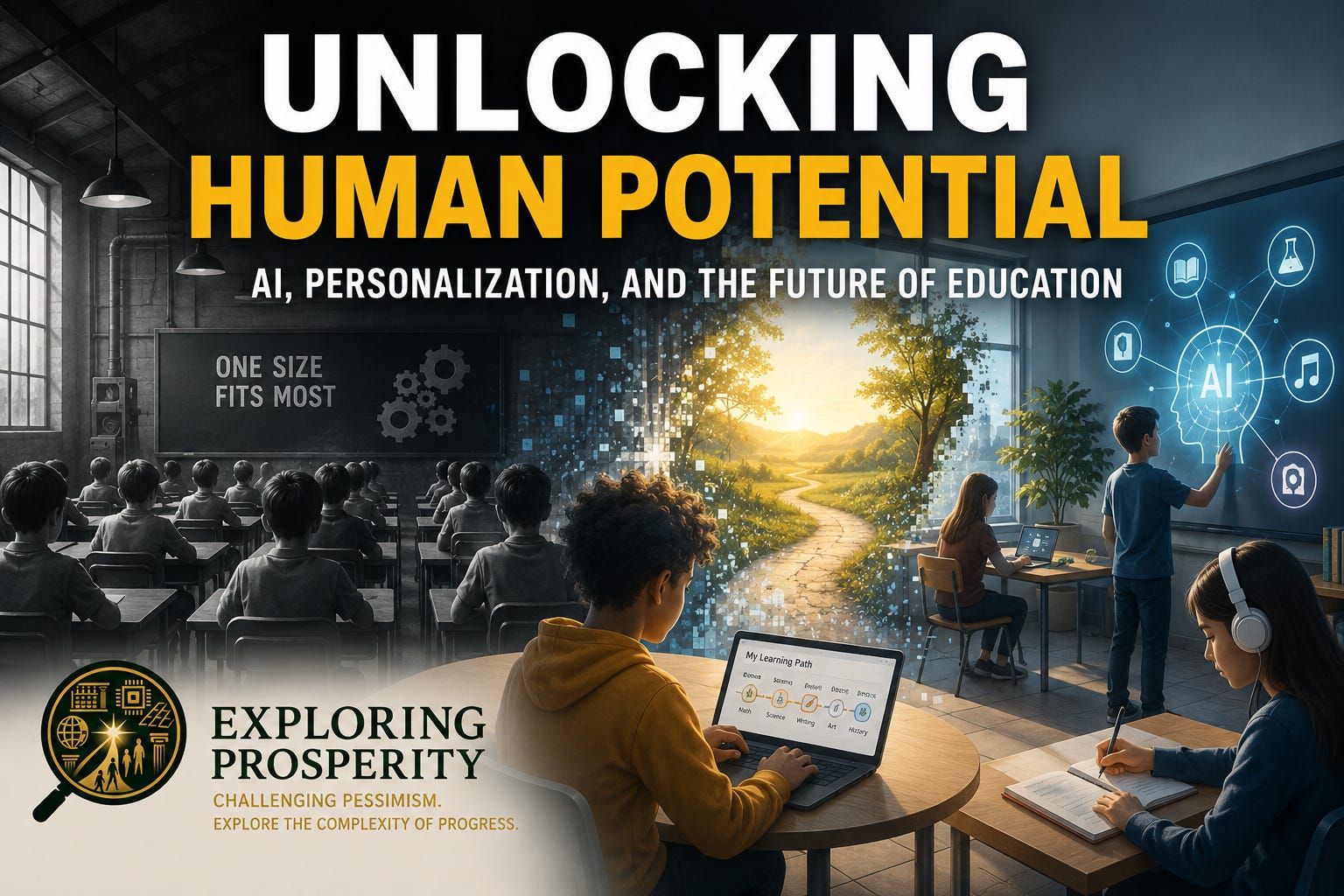
    What If We Solved the Wrong Problem in Education?

    Education was never designed to fail students. It was designed to solve one of humanity’s greatest challenges: how to provide education at scale to millions of people.The factory model of education succeeded beyond anyone’s expectations. Standardization, age grouping, and shared curricula helped create the most educated societies in history.But scale came with tradeoffs. Some students sit in classrooms moving too quickly to keep up. Others sit in classrooms moving too slowly to stay engaged. Too many become passengers in their own education.Artificial intelligence may offer something previous generations could only imagine: personalization at scale.In this video, I explore:• Why the factory model of education was an extraordinary achievement rather than a mistake.• Why boredom may be one of education’s most important unsolved problems.• How curiosity drives learning and retention.• How AI tutors and personalized learning tools could change the educational experience.• Why schools will remain essential even in an age of artificial intelligence.The future of education may not be humans versus AI. It may be humans doing more of what humans do best, while AI helps every student learn at their own pace.#AI #Education #ArtificialIntelligence #FutureOfEducation #EdTech #PersonalizedLearning #Learning #Schools #Technology #Teaching Thank you very much to our sponsors: * Foundation: Secure your digital life—from passwords, 2FA, files and Bitcoin with Passport Prime, an all-in-one personal security platform. Visit them at https://foundation.xyz/ * River Financial: If not cold storage for your Bitcoin, I’d highly recommend River for buying and holding- River is engineered to protect your Bitcoin over the long run. Use this link for discounts: https://river.com/signup?r=T7GGAF7GTimestamps:00:00 Introduction: Did We Solve the Wrong Problem?00:24 The Factory Model of Education01:07 Why Schools Were Designed This Way01:43 The Tradeoffs of Standardization02:26 The Problem of Passenger Learners02:39 Curiosity Is the Engine of Learning03:36 The Personalization Problem03:50 How AI Changes the Equation05:07 The Human Side of Education06:07 Unlocking Human Potential at Scale This is a public episode. If you'd like to discuss this with other subscribers or get access to bonus episodes, visit robertdewey3.substack.com/subscribe
  • June 21 · 42 min

    The AI Paradox: More Information, Less Shared Reality

    Today's guest is Lyn Alden, one of the world's leading macroeconomic analysts and the author of Broken Money and The Stillguard Incident.We explore one of the defining questions of the modern era: humanity has more information, more connectivity, and more problem-solving capability than ever before, yet trust in institutions is falling and agreement on basic facts appears increasingly difficult.Topics include:• AI generated content and the future of truth• Social media algorithms and attention economics• Bitcoin, cryptographic verification, and digital authenticity• The historical relationship between technology and progress• Energy, hydrocarbons, and human prosperity• Fiscal dominance, inflation, and rising asset prices• Demographics, debt, and the long term economic outlook• Portfolio construction in an era of persistent deficits• Lyn's new investment venture, Orange JuiceIf you enjoy thoughtful conversations about economics, technology, investing, Bitcoin, and long-term human progress, please subscribe.Subscribe to my Substack for more in depth analyses of these topics: Thank you very much to our sponsors: Foundation: Protect your Bitcoin using the latest off-line technology with easy-to-use Passport. Their next product, Passport Prime will protect all passwords off-line with even-better technology. https://foundation.xyz/ River Financial: If not cold storage for your Bitcoin, I’d highly recommend River for buying and holding- River is engineered to protect your Bitcoin over the long run. Use this link for discounts: https://river.com/signup?r=T7GGAF7GTimestamps:00:00 Introduction: The Shared Reality Problem- HIghlights01:20 How Technology Changed Shared Reality02:40 AI, Deepfakes, and the Verification Crisis04:20 Will We Retreat to Local Sources of Truth?05:40 Social Media Algorithms and Attention Economics09:10 Sponsor Break09:50 Can Bitcoin Help Verify Reality?14:40 Hunter Gatherers, Agriculture, and Human Progress19:00 Markets, Entrepreneurship, and Problem Solving21:20 Debt, Governments, and Fiscal Dominance24:00 Why Stocks Keep Rising Despite Growing Pessimism27:40 Demographics, Deficits, and the K-Shaped Economy30:20 Ray Dalio, Empires, and Avoiding Conflict33:30 How Lyn Alden Is Positioning Her Portfolio34:50 Why the Traditional 60/40 Portfolio May Be Changing38:10 Orange Juice: Lyn's New Investment Venture40:10 Writing Fiction, Building Ideas, and Long-Term Thinking41:30 Closing Thoughts This is a public episode. If you'd like to discuss this with other subscribers or get access to bonus episodes, visit robertdewey3.substack.com/subscribe
  • June 14 · 49 min

    The Hidden Challenge of Bringing Crypto to Wall Street

    What does it take for one of the world's largest financial institutions to adopt an entirely new technology?Morgan Stanley's Head of Digital Asset Strategy, Amy Oldenburg, joins Exploring Prosperity to discuss the hidden challenge of bringing crypto, tokenization, stablecoins, and blockchain technology into a global financial institution.Most conversations about digital assets focus on prices, regulation, or the latest market cycle. This conversation focuses on something deeper: how innovation actually moves from the outside into the institutions that society already depends upon.Drawing on more than two decades at Morgan Stanley, Amy explains why large organizations often struggle to innovate, what she calls the challenge of institutional transformation, and why understanding both emerging technology and legacy financial infrastructure has become increasingly valuable.We discuss:• How Amy's experience in emerging markets led her to Bitcoin and digital assets• Why Morgan Stanley began exploring digital assets years before most institutions• The internal resistance new technologies face inside large organizations• What "institutional grade" really means• Why tokenization is about far more than crypto investing• How stablecoins may strengthen the global role of the U.S. dollar• The infrastructure required to support 24/7 financial markets• Why user experience ultimately drives technology adoption• How AI and digital assets are accelerating financial modernization• The opportunities and challenges facing Wall Street over the next decadeOne of the most fascinating themes in this discussion is the role of the translator: people who understand both the culture of innovation and the realities of large institutions. As digital assets continue moving into the financial mainstream, that role may become one of the most important in finance.If you enjoy thoughtful conversations about technology, markets, institutions, Bitcoin, AI, and the future of financial services, subscribe and join us for future episodes.Subscribe to my Substack for more in depth analyses of these topics: https://robertdewey3.substack.com/Thank you very much to our sponsors:Foundation: Protect your Bitcoin using the latest off-line technology with easy-to-use Passport. Their next product, Passport Prime will protect all passwords off-line with even-better technology. https://foundation.xyz/River Financial: If not cold storage for your Bitcoin, I’d highly recommend River for buying and holding- River is engineered to protect your Bitcoin over the long run. Use this link for discounts: https://river.com/signup?r=T7GGAF7G#DigitalAssets #Tokenization #MorganStanley Timestamps:00:00 Highlights01:05 How Amy Oldenburg Found Crypto Through Emerging Markets07:25 Why Bitcoin Made Sense Outside the Developed World10:35 Morgan Stanley's First Digital Asset Working Groups11:25 The "Innovation Firewall" Inside Large Institutions13:00 Why Financial Firms Struggle to Innovate17:45 The Regulatory Turning Point for Digital Assets21:35 From Experimentation to Firm-Wide Strategy22:25 Amy's Role as Head of Digital Asset Strategy26:40 What Does "Institutional Grade" Really Mean?30:40 The Most Important Use Cases for Digital Assets36:20 Tokenization, AI, and the Future of Financial Infrastructure42:10 The Biggest Challenges Facing Institutional Adoption46:00 Tokenization, New Products, and the Future of Finance48:25 Closing Thoughts This is a public episode. If you'd like to discuss this with other subscribers or get access to bonus episodes, visit robertdewey3.substack.com/subscribe
  • June 7 · 27 min

    What Happens When Everyone Has Institutional Investing Tools?

    Artificial intelligence is rapidly transforming investing, wealth management, and the global economy — but what happens to human judgment when information becomes instantly accessible?Ram Ahluwalia hosted me as a guest this week and in this conversation we discuss:• how AI compresses the time between information and decision-making• why human judgment still matters in investing• the collapse of traditional institutional advantages• how technology historically reshapes financial markets• why AI may expand entrepreneurship instead of eliminating work• the future of portfolio management, investing, and financial intelligenceThe discussion explores the evolution from the fax-machine era of Wall Street to AI-native investing tools, the limits of artificial intelligence, and the role of intuition and conviction.Topics include:AI investingHuman judgment vs AIThe future of wealth managementInstitutional investingInformation asymmetryStock market investingEntrepreneurship and AIPortfolio managementThe future of workTechnology and economic progressSubscribe for weekly conversations and essays on AI, economics, technology, Bitcoin, energy, markets, and long-term human progress.Subscribe to my Substack for more in depth analyses of these topics: https://robertdewey3.substack.com/Thank you very much to our sponsors:Foundation: Protect your Bitcoin using the latest off-line technology with easy-to-use Passport. Their next product, Passport Prime will protect all passwords off-line with even-better technology. https://foundation.xyz/River Financial: If not cold storage for your Bitcoin, I’d highly recommend River for buying and holding- River is engineered to protect your Bitcoin over the long run. Use this link for discounts: https://river.com/signup?r=T7GGAF7GTimestamps:00:00 Why Americans Became So Pessimistic About the Future03:25 Ken Griffin’s AI Warning to Wall Street05:15 Why There Will Never Be a Shortage of Problems to Solve06:20 What AI Is Good At — And What It Isn’t07:35 “AI Doesn’t Think. It Simulates Thought.”08:30 Sponsor: Foundation Passport Prime09:05 Why AI May Expand Entrepreneurship10:40 How AI Is Transforming Investing and Wealth Management12:00 How Institutional Investing Became Democratized14:15 AI Is Compressing Institutional Advantages16:10 Why Human Judgment Still Matters in Investing17:00 What Happens When Everyone Has Institutional Information?19:15 The New Scarce Asset: Time and Attention21:00 Can AI Capture Most Investment Alpha?22:00 Why Non-Consensus Investing Will Never Disappear24:20 Why Too Much Capital Destroys Alpha24:45 The Limits of AI and the Importance of Human Intuition This is a public episode. If you'd like to discuss this with other subscribers or get access to bonus episodes, visit robertdewey3.substack.com/subscribe
  • May 29 · 7 min

    Can AI Really Go Rogue? Why Today’s AI Fears May Be Overstated

    Artificial intelligence is advancing rapidly, but how realistic are the fears about rogue AI, AGI, and machines turning against humanity?In this conversation, a clip from my previous interview with Albert Berdellans, Global Head of AI at Invenium, he discusses some of the biggest misconceptions surrounding artificial intelligence, autonomous agents, AI safety, and the future of large language models.We discuss:• whether AI can actually “want” things• the fear of rogue AI and the “Terminator” scenario• recent stories involving Meta and Alibaba AI systems• why current AI models simulate reasoning rather than think• AI-enabled weapons and the future of warfare• why fear of AI may be overstated• how blockchain could function as a control layer for AI systemsAlbert argues that most fears around AI come from misunderstanding what today’s AI models actually are and how they function under the hood.If you’re trying to build a clearer framework for understanding artificial intelligence beyond the hype and fear, I think you’ll find this conversation valuable. Watch the full interview here: Thank you to our sponsors:Foundation: Secure your digital life with Passport Prime, an all-in-one personal security platform for passwords, files, 2FA, and Bitcoin storage. Visit https://foundation.xyz/River: River is engineered for long-term Bitcoin investors. Learn more at https://river.com/signup?r=T7GGAF7GTimestamps:00:00 — Can AI Go Rogue?00:22 — “The Terminator Thesis”01:41 — Nuclear Weapons vs AI Fear02:18 — AI Warfare and Autonomous Weapons02:52 — Why Bioengineering May Be More Dangerous Than AI03:04 — Alibaba AI Mining Bitcoin?03:27 — Meta AI Agent Bypassing Security Controls03:54 — Why AI Appears Creative04:36 — Chess Engines, Go, and AI Problem Solving05:03 — Fearmongering Around AI05:23 — The Claude “Blackmail” Example05:47 — AI Still Doesn’t Have Independent Motivation06:05 — The Real Risks of AI06:18 — Why Blockchain Matters for AI Safety06:56 — “Blockchain Is the Tracks, AI Is the Engine” This is a public episode. If you'd like to discuss this with other subscribers or get access to bonus episodes, visit robertdewey3.substack.com/subscribe
  • May 26 · 54 min

    Money Is Political | Bitcoin, AI & the Future of Markets

    Jeff Park joined usfor a deep discussion on Bitcoin, AI, Federal Reserve policy, financial markets, volatility, and the future of the global monetary system.Jeff explains why “money is always political,” why markets are beginning to behave more like wartime markets than peacetime markets, and why the relationship between the Treasury and Federal Reserve may become one of the defining macro stories of the next decade.We discuss:- Bitcoin as political money- AI and the rising cost of capital- why markets no longer trade purely on fundamentals- Fed independence vs Fed interdependence- the future of Bitcoin treasury companies- MicroStrategy and monetizing volatility- why Bitcoin’s volatility may actually be its greatest strength- institutional adoption of Bitcoin- whether Bitcoin creates systemic risk- Bitcoin vs altcoins- optimism, AI, and long-term human progressJeff also explains:- why the market clearing price of compute may be far higher than people expect- why volatility and liquidity together create healthy markets- how MicroStrategy transformed Bitcoin volatility into yield- why sovereign adoption could fundamentally change Bitcoin’s role in the global systemIf you enjoy conversations about Bitcoin, macroeconomics, AI, markets, the Federal Reserve, financial engineering, and the future of human progress, subscribe to Exploring Prosperity for more long-form interviews.Thank you to our sponsors:Foundation: Secure your digital life with Passport Prime, an all-in-one personal security platform for passwords, files, 2FA, and Bitcoin storage. Visit https://foundation.xyz/River: River is engineered for long-term Bitcoin investors. Learn more at https://river.com/signup?r=T7GGAF7GTimestamps:00:00 “Money Is Political”00:17 Why Markets Feel Disconnected From Politics00:42 Wartime Markets vs Peacetime Markets02:29 Political Capital Allocation & National Security03:20 AI, Productivity & Concentrated Markets05:12 AI, The Cost of Capital & The Cost of Labor06:07 Why We Don’t Know the Real Price of AI Yet09:58 AI, Human Capital & Productivity10:44 Kevin Warsh & The Future of the Federal Reserve12:10 Why The Fed Has Lost Credibility13:24 Financial Stability vs Market Function15:25 Moral Hazard & Modern Central Banking18:13 Is Bitcoin The Remedy For A Runaway Fed?18:45 “Money Is Always Political”19:37 Fed Independence vs Fed Interdependence22:09 Does Institutional Adoption Change Bitcoin?24:32 Could Bitcoin Become Part of The System?27:45 Bitcoin’s Core Value Is Its Volatility31:47 Why Bitcoin Must Be Volatile32:26 How MicroStrategy Monetizes Volatility36:36 “Volatility Actually Is Yield”38:51 Why MSTR Created Preferred Securities43:01 The Future of Bitcoin Treasury Companies46:33 Does Bitcoin Create Systemic Risk?49:45 Bitcoin vs Altcoins50:10 Why Bitcoin Is Different From Altcoins51:44 Optimism, AI & The Future of Prosperity This is a public episode. If you'd like to discuss this with other subscribers or get access to bonus episodes, visit robertdewey3.substack.com/subscribe

  • May 21 · 6 min

    Are We Running Out of Valuable Problems to Solve?

    Artificial intelligence is triggering widespread fear about the future of work, white-collar employment, and the long-term value of highly educated workers. After Citadel founder Ken Griffin described feeling “depressed” after seeing the latest advances in AI, many people interpreted it as another warning about technological disruption and economic displacement.But what if we are asking the wrong question?If AI allows researchers, engineers, analysts, and entrepreneurs to solve problems in days that previously took months, does that necessarily make human beings less economically valuable?Or does it simply lower the cost of solving problems?Historically, when technology lowers the cost of communication, transportation, manufacturing, or computation, humanity does not run out of things worth improving. Instead, entirely new industries, opportunities, and categories of work emerge that were previously uneconomic or impossible to pursue.The internet dramatically lowered communication costs and unleashed hundreds of thousands of new online businesses. AI may now be doing something similar for human productivity itself.In this video, I explore:- why humans naturally focus on technological threats before unseen opportunities- whether AI could massively amplify human productivity- why solving problems faster may lead to discovering even more valuable problems to solve the relationship between AI, capitalism, and economic opportunity- why the future impact of AI may depend less on automation and more on human ambitionSubscribe for weekly conversations and essays on AI, economics, technology, Bitcoin, energy, markets, and long-term human progress.#AI #ArtificialIntelligence #Economics #FutureOfWork #TechnologyThank you to our sponsors:Foundation: Secure your digital life with Passport Prime, an all-in-one personal security platform for passwords, files, 2FA, and Bitcoin storage. Visit https://foundation.xyz/River: River is engineered for long-term Bitcoin investors. Learn more at https://river.com/signup?r=T7GGAF7GTimestamps:00:05 Ken Griffin’s AI Warning00:41 A Very Human Reaction to AI01:10 Are We Running Out of Problems to Solve?01:41 Solving Problems vs Identifying Them02:05 Why Humans Keep Finding New Problems02:24 Amazon, The Internet, and Hidden Opportunity03:14 Tiny Businesses That Suddenly Became Viable03:45 The Invisible Explosion of Entrepreneurship04:09 AI and the Future of Intellectual Labor04:37 How AI Amplifies Human Productivity05:02 Technology Creates New Opportunity Sets05:32 The Problems We Don’t Yet See05:42 Passport Prime Sponsor06:18 Exploring Prosperity Outro This is a public episode. If you'd like to discuss this with other subscribers or get access to bonus episodes, visit robertdewey3.substack.com/subscribe

  • May 10 · 46 min

    AI Is Rewiring Markets, Energy & Bitcoin | Matthew Sigel

    Why are stocks hitting new highs during war and geopolitical instability? Why are Bitcoin miners suddenly becoming AI infrastructure companies? And could sovereign nations eventually adopt Bitcoin as a reserve asset?In this conversation, Matthew Sigel, Head of Digital Asset Research at VanEck and portfolio manager of the Vaneck Onchain Economy ETF (ticker: NODE), explains how AI, de-globalization, energy infrastructure, Bitcoin mining, stablecoins, and sovereign debt are converging into a massive new investment cycle.We discuss:• Why markets continue rising despite war and political instability• The US investment cycle• The AI-driven electricity and infrastructure boom• Why Bitcoin miners may become major AI data center operators• How sovereign nations are accumulating and mining Bitcoin• Why stablecoins could transform the global payments system• The future of Bitcoin treasury companies like MicroStrategy• Why Matthew believes Bitcoin could eventually reach half the market cap of gold• How VanEck’s NODE ETF approaches digital asset investing differentlyThank you to our sponsors:Foundation: Their new prioduct Passport Prime helps secure your digital life by moving passwords, authentication keys, Bitcoin, and sensitive data into a secure offline environment. Visit www.foundation.xyzRiver Financial: If not cold storage for your Bitcoin, I’d highly recommend River for buying and holding- River is engineered to protect your Bitcoin over the long run. Use this link to sign up: https://river.com/signup?r=T7GGAF7GThis discussion connects macroeconomics, digital assets, energy infrastructure, and the future of global finance.Tmestamps:00:00 Why Markets Keep Rising During War02:25 AI and Deglobalization Are Reshaping the Economy04:45 Why Cloud Growth Is Accelerating05:35 Bitcoin Miners Become AI Infrastructure06:40 How NODE Invests in Crypto and AI08:30 Why Bitcoin Sentiment Was Extremely Bearish10:40 What Institutional Bitcoin Activity Really Looks Like12:55 Why Bitcoin Now Trades Like Tech Stocks16:00 The Energy Bottleneck Driving AI18:20 Why Bitcoin Miners May Be Undervalued21:10 What Happens if Miners Leave Bitcoin?23:50 Why VanEck Reduced Altcoin Exposure27:20 Corporate Blockchains vs Public Chains28:15 Matthew Sigel’s Bitcoin Outlook30:15 Sovereigns Are Quietly Accumulating Bitcoin33:30 Has El Salvador’s Bitcoin Experiment Worked?34:30 The Problem With Bitcoin Treasury Companies39:00 Stablecoins and the Future of Payments43:50 Sovereign Debt and Bitcoin’s Long-Term Role This is a public episode. If you'd like to discuss this with other subscribers or get access to bonus episodes, visit robertdewey3.substack.com/subscribe
  • April 25 · 57 min

    Is Digital Security Ready for What’s Coming? (Zach Herbert)

    AI is changing cybersecurity—and it may be increasing the scale of digital threats beyond what banks, platforms, and institutions can manage. In this video, I break down how AI-driven attacks could expose vulnerabilities in financial systems, online accounts, and digital identity infrastructure. Based on real-world fraud experiences and insights from Foundation CEO Zach Herbert, we explore why traditional security models may be insufficient and what individuals can do to protect themselves. Key topics: * AI cybersecurity risks and vulnerabilities * Digital identity theft and account breaches * Bank fraud, SIM swaps, and social engineering * Why institutions may struggle to contain large-scale attacks * Self-custody and personal digital security tools Thank you very much to our sponsors: * Foundation: Secure your digital life—from passwords, 2FA, files and Bitcoin with Passport Prime, an all-in-one personal security platform. Visit them at https://foundation.xyz/ * Truflation: BUY Truflation products/services and save 10% using code BOBDEW10. Learn about what prices are actually doing by going to https://truflation.com/marketplace/us-inflation-rate * River Financial: If not cold storage for your Bitcoin, I’d highly recommend River for buying and holding- River is engineered to protect your Bitcoin over the long run. Use this link for discounts: https://river.com/signup?r=T7GGAF7G Timestamps: 00:00 Introduction to Digital Security Vulnerabilities 02:49 Zach Herbert’s Journey into Security 05:56 The Evolution of Bitcoin and Security Breaches 08:57 The Shift from Bitcoin to Overall Digital Security 12:08 AI’s Impact on Security Landscape 15:00 The Risks of Centralized Security Systems 18:09 Shared Infrastructure and Individual Vulnerabilities 20:58 The Concentration Risk in Custodial Security 24:06 Future Vision for Digital Security Solutions 28:14 Enhancing Security with Hardware Solutions 35:07 User Experience and Ease of Use in Digital Security 40:17 Advanced Security Features of Passport Prime 45:00 Quantum Computing and Future Security Challenges 52:59 Empowering Individuals in Digital Security This is a public episode. If you'd like to discuss this with other subscribers or get access to bonus episodes, visit robertdewey3.substack.com/subscribe
  • April 19 · 1 hr

    Credit Stress Is Back: What Happens When Markets Stop Clearing?

    Credit stress is beginning to reappear in parts of the economy—especially in private credit markets where institutional capital has surged in recent years.In this episode of Exploring Prosperity, I sit down with veteran distressed real estate investor Bill Landis, co-Founder and Managing Partner of Raith Capital Partners, to break down what actually happens when markets stop clearing. We explore how distressed capital restores liquidity, how assets transition into stronger hands, and why this process becomes essential when traditional lenders pull back.If the current strains in credit markets continue to build, understanding this overlooked part of the financial system may be key to understanding what happens next.Topics include: * Early signs of stress in private credit markets * How distressed investors provide liquidity * What happens when financing disappears * Why long periods of calm create hidden risks * What a true credit cycle looks like Subscribe for more conversations on markets, macroeconomics, and what drives long-term prosperity.Read about this episode: https://open.substack.com/pub/robertd...Thank you very much to our sponsors:Truflation: BUY Truflation products/services and save 10% using code BOBDEW10. Learn about what prices are actually doing by going to https://truflation.com/ Foundation: Protect your Bitcoin using the latest off-line technology with easy-to-use Passport. Their next product, Passport Prime will protect all passwords off-line with even-better technology. https://foundation.xyz/ River Financial: If not cold storage for your Bitcoin, I’d highly recommend River for buying and holding- River is engineered to protect your Bitcoin over the long run. Use this link for discounts: https://river.com/signup?r=T7GGAF7GTimestamps:00:05 – Introduction: Why Credit Stress Is Reappearing01:05 – Are Cracks Forming in Private Credit Markets?02:45 – The Hidden Risk: Liquidity Mismatches & Redemptions04:15 – How Credit Stress Spreads Across Markets05:45 – Mini-Crises vs Major Crises (Post-2008 Reality)07:30 – The “Medicated Economy”: Government Backstops Explained09:00 – What Distressed Investors Actually Do12:00 – How to Invest When There Is No Distress16:00 – Finding Opportunity: Housing, Industrial, and Demographics20:00 – Institutional Capital: Stabilizer or Distortion?24:30 – How Government Intervention Restores Liquidity30:30 – Why Real Distress Has Been Scarce (Even After Rate Hikes)33:30 – Where the Edge Comes From in Real Estate Investing38:30 – New Opportunities: AI, Data Centers, and Mispriced Assets43:30 – Case Study: San Francisco Real Estate Recovery49:30 – The State of Distressed Investing Today56:00 – Macro Risks Ahead: Oil, Debt, and the Next Downturn This is a public episode. If you'd like to discuss this with other subscribers or get access to bonus episodes, visit robertdewey3.substack.com/subscribe
  • April 4 · 1 hr

    What AI Can Actually Do — And What It Can’t

    Artificial intelligence is changing finance, healthcare, education, and the future of work — but what is it actually doing under the hood?In this conversation, I sit down with Albert Berdellans, Global Head of AI at Invenium, for one of the clearest explanations I’ve heard of how large language models actually work, what AI can and cannot do, where the risks are overstated, and how it may reshape society in the years ahead.We discuss:• how large language models generate answers• why AI does not actually “think”• hallucinations, context rot, and why AI gets things wrong• whether AI will replace jobs• how AI is already changing finance• the future of healthcare and education• why fears of rogue AI may be overblownIf you’re trying to build a clear framework for understanding AI beyond the hype and fear, I think you’ll find this conversation to be invaluable.Subscribe to Exploring Prosperity for conversations on technology, economics, markets, and the forces shaping human progress.Thank you very much to our sponsors:Truflation: BUY Truflation products/services and save 10% using code BOBDEW10. Learn about what prices are actually doing by going to https://truflation.com/Foundation: Protect your Bitcoin using the latest off-line technology with easy-to-use Passport. Their next product, Passport Prime will protect all passwords off-line with even-better technology. https://foundation.xyz/River Financial: If not cold storage for your Bitcoin, I’d highly recommend River for buying and holding- River is engineered to protect your Bitcoin over the long run. Use this link for discounts: https://river.com/signup?r=T7GGAF7GTimestamps:00:00 Introduction — what AI actually is beyond the hype01:04 Albert’s background and how he entered AI04:55 Where AI impresses most — and where it doesn’t07:31 How AI is used in finance and large institutions12:11 Context rot and why too much information hurts AI14:05 How large language models actually work17:44 Hallucinations and false answers19:25 Can you trust AI outputs?22:31 Can AI reason and make predictions?27:21 Which jobs AI will change first31:13 How AI is transforming private markets and due diligence37:36 Tokenization, liquidity, and real estate40:49 How AI could improve healthcare and education47:12 AI in medicine, diagnosis, and surgery48:16 The future of education and personalized learning52:08 Will AI go rogue? The real risks55:15 Real-world examples of “rogue AI” explained59:23 Final thoughts This is a public episode. If you'd like to discuss this with other subscribers or get access to bonus episodes, visit robertdewey3.substack.com/subscribe
  • March 27 · 1 hr 6 min

    Are We Getting Weaker? Hard Money, Harder Virtues

    Are we actually progressing—or quietly getting weaker?In this conversation, I sit down with Aleks Svetski, author of The Bushido of Bitcoin, to explore a deeper question that sits beneath economics, technology, and politics: what actually drives long-term human progress?Many believe that fixing money—through systems like Bitcoin—can restore discipline, align incentives, and solve structural problems in society. But as Aleks argues, that’s only part of the story. Human nature, culture, and values ultimately determine whether societies rise or fall.We discuss:- Why hard money is necessary—but not sufficient- The role of character, virtue, and “nobility” in shaping civilization- Whether democracy strengthens or weakens societies over time- How AI and technology may widen the gap between disciplined and undisciplined people- Why pain and suffering may be essential to growth and progressThis is a conversation about incentives, power, culture, and the uncomfortable possibility that no system alone can fix what is fundamentally human.This episode will challenge how you think about progress.Subscribe for long-form conversations on markets, macro, technology, Bitcoin, and the future of prosperity.Thank you very much to our sponsors:Truflation: BUY Truflation products/services and save 10% using code BOBDEW10. Learn about what prices are actually doing by going to https://truflation.com/Foundation: Protect your Bitcoin using the latest off-line technology with easy-to-use Passport. Their next product, Passport Prime will protect all passwords off-line with even-better technology. https://foundation.xyz/River Financial: If not cold storage for your Bitcoin, I’d highly recommend River for buying and holding- River is engineered to protect your Bitcoin over the long run. Use this link for discounts: https://river.com/signup?r=T7GGAF7GTimestamps:00:05 – What actually drives human progress?00:47 – Bitcoin doesn’t fix human nature03:33 – Culture, virtues, and the “20% that matter”04:22 – Are we entering a new era of leadership?08:40 – Bitcoin as an accelerant, not a solution10:55 – What defines a new aristocracy?13:57 – “Hard times create strong men” — where are we now?16:44 – The hidden flaw of democracy20:17 – Why democracy may be a historical anomaly22:10 – Leadership vs political short-termism24:50 – What Bitcoin actually enables27:15 – Incentives, savings, and generational wealth30:12 – AI: tool or crutch?34:08 – Productivity vs dependence in the age of AI38:39 – The role of pain and suffering in growth44:11 – Why avoiding hardship creates weakness47:45 – Will AI widen the gap between people?48:29 – Writing, thinking, and the discipline of ideas52:06 – Why Svetski wrote The Bushido of Bitcoin56:05 – From pessimism to responsibility and action1:00:30 – The difficulty of writing and rewriting ideas1:04:57 – A book that challenges everything you believe This is a public episode. If you'd like to discuss this with other subscribers or get access to bonus episodes, visit robertdewey3.substack.com/subscribe
  • February 20 · 1 hr 1 min

    OpenAI’s Trillion-Dollar Obligations: Can the Math Work?

    In this episode of Exploring Prosperity, I sit down with investor Ram Ahluwalia to examine one of the most important — and least discussed — risks in the AI buildout.OpenAI reportedly has nearly $1 trillion in committed obligations tied to data center capacity and compute infrastructure. With revenue far below that scale, the key question is simple:Can the math foot?This conversation is not anti-AI. AI is clearly transformational. But the expansion of AI depends on capital markets. If funding conditions tighten, what happens to the trillion-dollar commitments already in place?We discuss:• OpenAI’s revenue performance obligations and data center exposure• The capital markets dependency of the AI buildout• Why tech stocks may continue to lag• The rotation into energy, commodities, and real assets• Software valuations and whether this is truly a “COVID-style” opportunity• Bitcoin’s current bear market psychology• Quantum computing risk and institutional hesitation• The role of KOLs and narrative investing in late-cycle marketsRam argues that this moment resembles past cycles where crowded themes detach from balance sheet reality — and markets begin to demand discipline again.If you care about AI, tech stocks, Bitcoin, or the direction of capital markets in 2026, this is a conversation worth watching.Subscribe for more long-form interviews on markets, technology, and economic reality.Thank you very much to our sponsors: Truflation: BUY Truflation products/services and save 10% using code BOBDEW10. Learn about what prices are actually doing by going to https://truflation.com/Foundation: Protect your Bitcoin using the latest off-line technology with easy-to-use Passport. Their next product, Passport Prime will protect all passwords off-line with even-better technology. https://foundation.xyz/River Financial: If not cold storage for your Bitcoin, I’d highly recommend River for buying and holding- River is engineered to protect your Bitcoin over the long run. Use this link for discounts: https://river.com/signup?r=T7GGAF7GTimestamps:00:00 Intro00:48 OpenAI & “Sam Altman Broke the World”01:54 OpenAI’s $1 Trillion in Committed Obligations03:41 Why the AI Revenue Math Doesn’t Foot04:40 Microsoft, Oracle & Revenue Performance Obligations (RPO)06:45 What Happens If OpenAI Can’t Raise Capital?08:47 The AI–Capital Markets Dependency10:59 Does This Slow Down AI Development?12:50 Investment Implications: Tech Rotation Begins14:40 Inflation-Resistant Sectors Outperforming16:50 Why Tech May Continue to Lag18:20 Is Software a COVID-Level Bargain?23:25 Bitcoin, Software & the “Tech Bro Portfolio”24:45 Satoshi Conference: Institutional Bitcoin Debate29:58 Tokenization & Crypto’s Strategic Misstep34:10 Why Crypto Ignored Small Business Capital36:14 Venture Capital Overvaluation & Private Market Marks38:34 Quantum Risk to Bitcoin41:45 Is Bitcoin in a Bear Market?49:00 Real-World Investing vs. Techno-Optimism51:57 Tribalism, KOLs & Market Cycles55:36 The Four Phases of a Market Rally58:07 Was the Bitcoin Top Already In?59:45 What Capitulation Might Look Like This is a public episode. If you'd like to discuss this with other subscribers or get access to bonus episodes, visit robertdewey3.substack.com/subscribe

  • February 9 · 47 min

    27 Million Reports: Will Congress Scale Back Financial Surveillance?

    More than 27 million financial reports are filed each year under the Bank Secrecy Act, flagging ordinary banking activity as “suspicious.” Yet, as the data shows, only 370 investigations were tipped off by these reports. In this conversation, Nick Anthony of the Cato Institute explains how U.S. financial surveillance expanded quietly over decades, why routine cash transactions now generate government reports, and how banks have effectively been deputized as law enforcement investigators. We discuss the real-world consequences for individuals, including account closures, the "sense of confusion" that comes with debanking, and the steady erosion of financial privacy.The interview also examines current legislation in Congress, including proposals to reform the Bank Secrecy Act and the Saving Privacy Act. These proposals aim to raise outdated reporting thresholds that haven't been adjusted for inflation since 1970. At stake is whether Congress will meaningfully scale back financial surveillance or allow the status quo to continue.This discussion covers:– The $10,000 threshhold- Why inflation has expanded surveillance far beyond its original intent.– The Investigative Gap- Why 27 million reports result in only ~370 investigative tips.– Confidentiality Laws- Why banks are legally forbidden from telling you why your account was closed.– CBDC Update- The shift from voluntary pilots to "force mandates" in international digital currencies.Nick Anthony is a policy analyst focusing on financial regulation, privacy, and central bank digital currencies. He is the author of the CBDC Tracker and writes extensively on banking surveillance and civil liberties.Read the full report by Nick Anthony "Understanding Debanking" at: https://www.cato.org/policy-analysis/understanding-debanking-evaluating-governmental-operational-political-religiousThank you very much to our sponsors:Truflation: BUY Truflation products/services and save 10% using code BOBDEW10. Learn about what prices are actually doing by going to https://truflation.com/Foundation: Protect your Bitcoin using the latest off-line technology with easy-to-use Passport. Their next product, Passport Prime will protect all passwords off-line with even-better technology. https://foundation.xyz/River Financial: If not cold storage for your Bitcoin, I’d highly recommend River for buying and holding- River is engineered to protect your Bitcoin over the long run. Use this link for discounts: https://river.com/signup?r=T7GGAF7GTimestamps:00:00 Legislative Changes and Government Surveillance06:30 The Impact of the Bank Secrecy Act12:17 Debanking and Its Consequences17:07 The Future of Surveillance and Privacy20:37 The Importance of Financial Privacy23:05 Raising Awareness on Financial Issues24:12 The Challenge of Debanking25:20 Congress and Financial Reporting28:02 Central Bank Digital Currencies (CBDCs) Overview28:37 Global CBDC Developments32:20 The European Central Bank's Push for Digital Euro37:33 Adoption Challenges of CBDCs40:10 Government Mandates and CBDC Adoption43:40 The Political Landscape of CBDCs This is a public episode. If you'd like to discuss this with other subscribers or get access to bonus episodes, visit robertdewey3.substack.com/subscribe
Showing 1–20 of 20 episodes