Skip to content
Artwork for EUV The Focal Point
EUV The Focal Point · August 14 · 26 min

[057] Deep Dive Topic - New Ways to Store Bits

This post was created using AI. Please check the information if you want to use it as a basis for decision-making. EPISODE TEASER Why is the memory industry exploring RRAM, MRAM, and new DRAM concepts when SRAM, DRAM, and NAND already work so well? This episode explains the physical storage mechanisms, the engineering trade-offs, and the most realistic application paths. It also clarifies why “DRAM+” is an umbrella term rather than one standardized memory technology. KEY TAKEAWAYS - Every memory tier trades speed, density, energy, endurance, retention, cost, and integration complexity. - Conventional DRAM stores charge in a capacitor and must refresh it because the charge leaks away. - “DRAM+” can describe enhanced DRAM approaches such as HBM, gain-cell or capacitorless DRAM, three-dimensional integration, embedded DRAM, and processing near the memory. - RRAM stores information as resistance by moving ions or defects in a switching layer; variability is one of its central challenges. - STT-MRAM writes through a magnetic tunnel junction, while SOT-MRAM separates the read and write paths. - Nonvolatile memories reduce standby and refresh energy, but active write energy and peripheral circuits still matter. - RRAM and MRAM can support compute-in-memory, but array parasitics, data conversion, write control, and device variation limit idealized gains. - Advanced DRAM is the strongest near-term route for main memory; MRAM and RRAM are more likely to expand first in embedded and specialized roles. - The likely future is a more heterogeneous memory hierarchy, not one universal replacement. GLOSSARY DRAM — Dynamic random-access memory. Volatile memory that usually stores each bit as charge in a capacitor and requires periodic refresh. DRAM+ — A nonstandard umbrella term used here for enhanced DRAM cells, architectures, packaging, stacking, and processing-near-memory concepts. SRAM — Static random-access memory. Fast volatile memory commonly used for processor caches; a typical cell uses several transistors. NAND flash — Dense nonvolatile storage that retains data without power and is programmed and erased in larger groups than RAM. RRAM or ReRAM — Resistive random-access memory. Nonvolatile memory that stores data in different resistance states. MRAM — Magnetoresistive random-access memory. Nonvolatile memory that stores data in magnetic orientation and reads it through a resistance difference. STT-MRAM — Spin-transfer torque MRAM. A form of MRAM in which write current passes through the magnetic tunnel junction. SOT-MRAM — Spin-orbit torque MRAM. A form of MRAM with a separate lateral write path that acts on the magnetic free layer. Crossbar array — A grid of crossing conductors with a memory element at each intersection; useful for dense storage and parallel analog operations. Compute-in-memory — An architecture that performs selected operations in or very near memory arrays to reduce data movement.


0:00-26:10

transcript

No transcript — this publisher did not publish one.

show notes

This post was created using AI. Please check the information if you want to use it as a basis for decision-making.


EPISODE TEASER


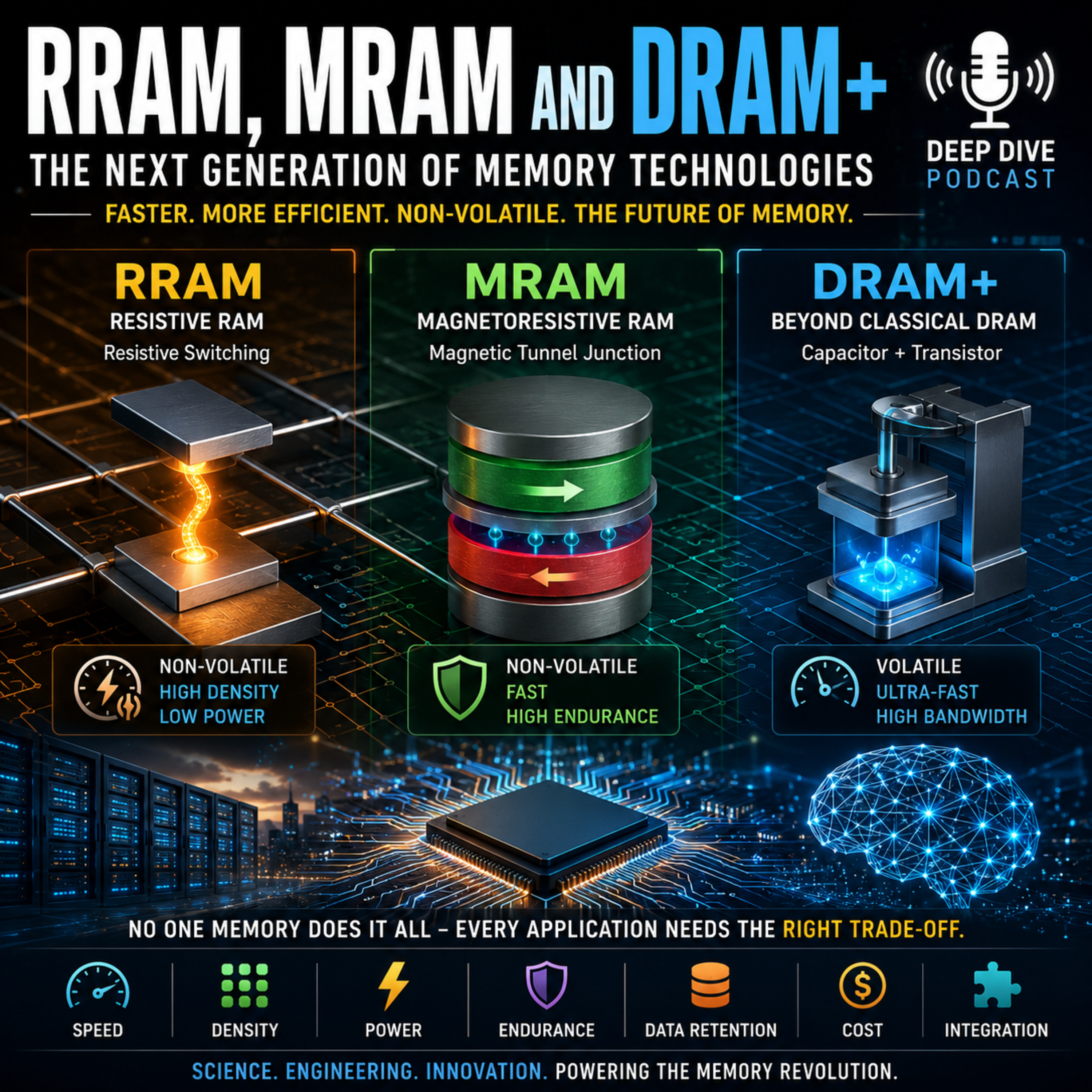
Why is the memory industry exploring RRAM, MRAM, and new DRAM concepts when SRAM, DRAM, and NAND already work so well? This episode explains the physical storage mechanisms, the engineering trade-offs, and the most realistic application paths. It also clarifies why “DRAM+” is an umbrella term rather than one standardized memory technology.


KEY TAKEAWAYS


- Every memory tier trades speed, density, energy, endurance, retention, cost, and integration complexity.

- Conventional DRAM stores charge in a capacitor and must refresh it because the charge leaks away.

- “DRAM+” can describe enhanced DRAM approaches such as HBM, gain-cell or capacitorless DRAM, three-dimensional integration, embedded DRAM, and processing near the memory.

- RRAM stores information as resistance by moving ions or defects in a switching layer; variability is one of its central challenges.

- STT-MRAM writes through a magnetic tunnel junction, while SOT-MRAM separates the read and write paths.

- Nonvolatile memories reduce standby and refresh energy, but active write energy and peripheral circuits still matter.

- RRAM and MRAM can support compute-in-memory, but array parasitics, data conversion, write control, and device variation limit idealized gains.

- Advanced DRAM is the strongest near-term route for main memory; MRAM and RRAM are more likely to expand first in embedded and specialized roles.

- The likely future is a more heterogeneous memory hierarchy, not one universal replacement.


GLOSSARY


DRAM — Dynamic random-access memory. Volatile memory that usually stores each bit as charge in a capacitor and requires periodic refresh.


DRAM+ — A nonstandard umbrella term used here for enhanced DRAM cells, architectures, packaging, stacking, and processing-near-memory concepts.


SRAM — Static random-access memory. Fast volatile memory commonly used for processor caches; a typical cell uses several transistors.


NAND flash — Dense nonvolatile storage that retains data without power and is programmed and erased in larger groups than RAM.


RRAM or ReRAM — Resistive random-access memory. Nonvolatile memory that stores data in different resistance states.


MRAM — Magnetoresistive random-access memory. Nonvolatile memory that stores data in magnetic orientation and reads it through a resistance difference.


STT-MRAM — Spin-transfer torque MRAM. A form of MRAM in which write current passes through the magnetic tunnel junction.


SOT-MRAM — Spin-orbit torque MRAM. A form of MRAM with a separate lateral write path that acts on the magnetic free layer.


Crossbar array — A grid of crossing conductors with a memory element at each intersection; useful for dense storage and parallel analog operations.


Compute-in-memory — An architecture that performs selected operations in or very near memory arrays to reduce data movement.