Skip to content
Artwork for Entra.Chat
TechnologyNewsTech News

Entra.Chat

Merill Fernando

Entra Chat is a weekly podcast hosted by Merill Fernando and delivers practical insights for Microsoft administrators and security professionals through conversations with identity experts who've been in the trenches. Episodes feature seasoned Entra practitioners sharing real-world deployment experiences and Microsoft Entra team members who build the features you use daily. Get the inside track on best practices, implementation strategies, and upcoming capabilities directly from those who design and deploy Microsoft identity solutions. Join us for actionable takeaways you can apply immediately in your Microsoft 365, Azure, and Entra environments. --- Entra.Chat, its content and opinions are my (Merill Fernando) own and do not reflect the views of my employer (Microsoft). All postings are provided “AS IS” with no warranties and is not supported by the author. All trademarks and copyrights belong to their owners and are used for identification only.

entra.news
Play
  • 22 episodes
  • weekly
  • Avg 50 min
  • English
Counted on this page — what you have heard stays on this device, so it is not something the list can be paged by.
  • #72
    Tuesday · 42 min

    Microsoft Entra memberOf Retirement: What Admins Must Do

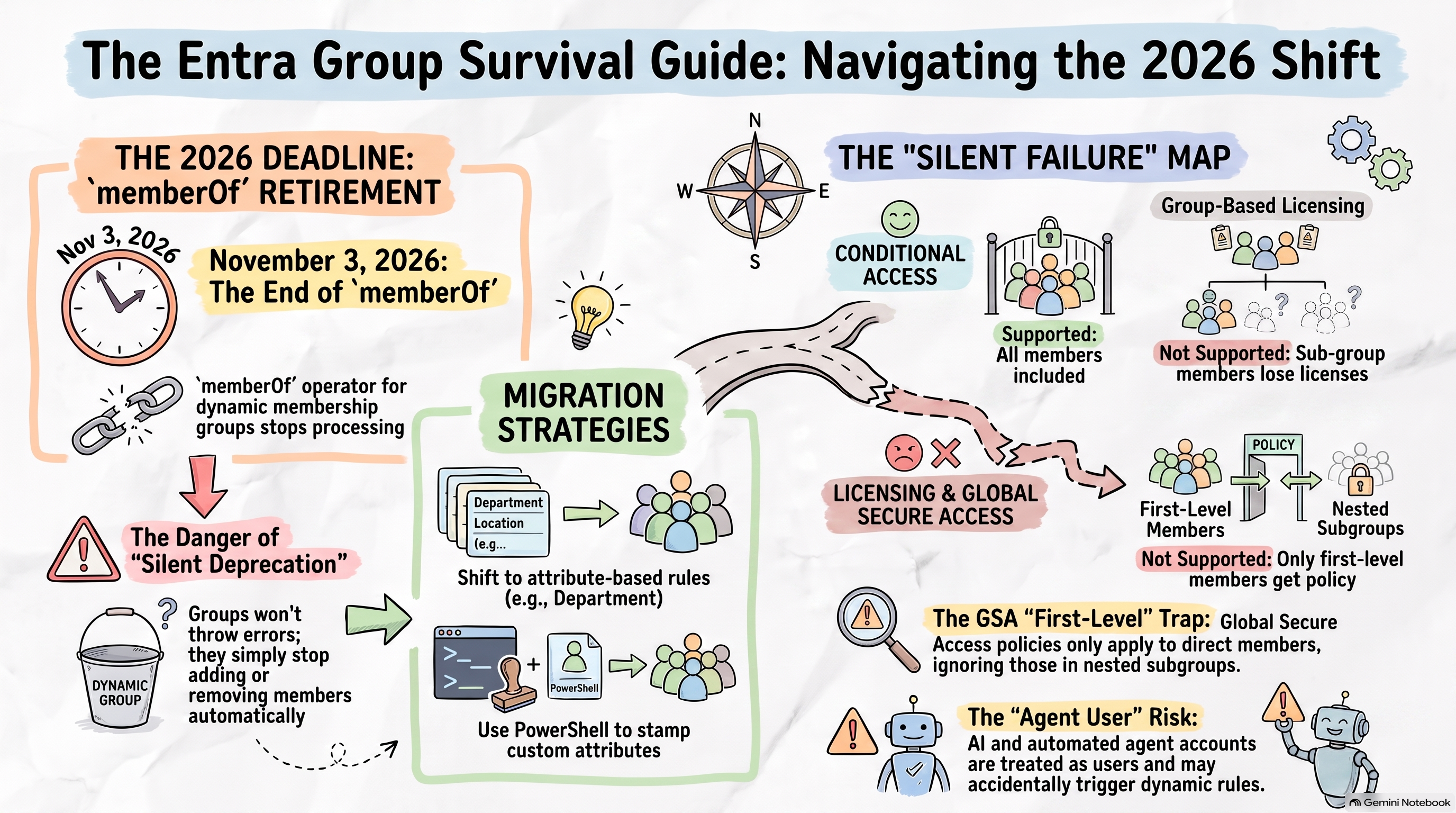
    On 3 November 2026, the memberOf operator in Microsoft Entra dynamic membership groups stops working. Nothing errors. Nothing breaks loudly. Every dynamic group, dynamic administrative unit and entitlement management auto-assignment policy that uses it simply freezes in its last known state the people who should be added are not added, and the people who should be removed stay. It was a preview feature for four years. It is in a lot of production tenants. In this episode of Entra.Chat, Merill is joined by three guests for the first time: Gregor Reimling, Chief Azure Technologist at adesso SE and Microsoft MVP for Azure and Security; René Wasel, a Microsoft 365 specialist and Microsoft MVP; and returning guest Eric Woodruff, Chief Identity Architect at Semperis. Gregor and René co-organise the Cloud Identity Summit, which happens to fall on the same date the deprecation lands. The conversation starts with the deadline and quickly becomes something more useful: an honest audit of what groups in Entra actually do, versus what administrators assume they do. The memberOf operator existed because Entra does not resolve nested groups the way Active Directory does. It was a flattening trick — take the members of several groups and produce one flat group that applications, licensing and policies could read. With it going away, the panel walks through the realistic replacements: move to supported attribute-based rules where an attribute exists, stamp an attribute with PowerShell where one does not, or convert the group to assigned membership and script it. Gregor and René both raise the version of this that is easy to forget — a rule written years ago that nobody documented, using a sync rule editor nobody wants to reopen. Then the discussion turns to the part that is not on any deprecation notice. Nested groups are supported in Conditional Access. They are not supported for group-based licensing, where only first-level members get a licence. They are not supported for Global Secure Access, where a nested group assigned to a traffic forwarding profile applies only to its direct members with no error, no warning, and nothing in the portal to tell you. Chris Brumm found that one and wrote a Maester test for it, because the only way to know is to go looking. There is a new group property that blocks nesting in both directions, undocumented when this was recorded. Sensitivity labels have reached Entra security groups in preview, bringing a guest-access control that stops new guests but does not evict the ones already in the group. And Merill spotted something through Entra.News Daily that deserves more attention than it has had: an agent’s user account is a user identity, so existing dynamic user rules already evaluate it. If your licensing group has a broad rule and your developers start creating agent accounts, those accounts qualify. If it is a group behind a Conditional Access policy or an exclusion, that is a different conversation entirely. Which leads to the sharpest point in the episode, and Eric makes it plainly: the security of a dynamic group is the security of the write permissions on the attributes in its rule. Some of those attributes are self-service. Some flow up from on-premises Active Directory, changed by people who are not thinking about the cloud at all. Microsoft Learn now carries an explicit warning about exactly this, and it is why groups used for privileged access cannot be dynamic. The last third is about the Cloud Identity Summit itself. More info below. If you have memberOf in a rule anywhere, the useful thing to do this week is find it. Everything else in this episode can wait until after November. Featured sponsor Cloud Identity Summit 2026 → One Day, One Topic, In the Room Identity. Security. 2026. On Tuesday 3 November in Frankfurt, the Cloud Identity Summit gives cloud identity a conference of its own, now in its seventh year, and free to attend. Two parallel tracks, Identity Management and Identity Security, run 50-minute sessions in English. It is deliberately vendor-neutral: Microsoft Entra, AWS, Google Cloud and whatever else you actually run. Eric Woodruff keynotes with Identity Security Kindergeburtstag fourteen years of identity being called “the new security perimeter”, and an honest look at what that has actually got us. Why it is worth the trip: * It is in person only. No livestream, no catch-up recordings. The organisers built it that way on purpose — “a strong focus on face-to-face conversations to support networking and exchange of experiences.” If you want the hallway conversation, you have to be in the hallway. * Everything is identity. No filler tracks. A whole day of people who work on the same problems you do, from an international mix of industries. * The Community Ticket is 100% free. There is an optional paid Supporter Ticket if you want to help fund the event. * It is easy to get to. adesso SE, Prisma Frankfurt-Niederrad — around ten minutes by S-Bahn from Frankfurt Airport, ten from Frankfurt Hauptbahnhof, and a short walk from Frankfurt-Niederrad station. * Travelling in? The Crowne Plaza Frankfurt is a ten-minute walk, €89 single with breakfast on the “Cloud Identity Summit” booking code — 50 rooms, held until 5 October. One more thing, given what this episode is about: 3 November is also the day Microsoft retires the memberOf operator. If you are going to spend that Tuesday thinking about Entra groups anyway, spend it in a room with people solving the same problem. Subscribe with your favorite podcast player or watch on YouTube About Gregor Reimling Gregor is a Microsoft MVP in Azure and Security, Chief Azure Technologist at adesso SE, and a passionate advocate for the Microsoft cloud community. His expertise spans Azure architecture, Microsoft Entra, Zero Trust and hybrid cloud environments; he helps organizations successfully navigate their cloud journey. Beyond his day job, Gregor is a frequent speaker at international events, co-host of the Cloud Inspires podcast and co-founder of the Cloud Identity Summit. As a Microsoft Certified Trainer, he enjoys sharing knowledge, mentoring others, and helping IT professionals get the most out of Microsoft technologies. LinkedIn - https://www.linkedin.com/in/gregorreimling/ About René Wasel René is a Microsoft 365 specialist, and a Microsoft MVP for Microsoft 365. He describes his work as helping people actually use the technology they have been given, and he is active in the community as a meetup and event organiser. He co-organises the Cloud Identity Summit. LinkedIn - https://www.linkedin.com/in/renewasel/ About Eric Woodruff Throughout his 25-year career in the IT field, Eric has sought out and held a diverse range of roles. Currently the Chief Identity Architect for Semperis; Eric previously was a member of the Security Research and Product teams. Prior to Semperis, Eric worked as a Security and Identity Architect at Microsoft partners, spent time working at Microsoft as a Sr. Premier Field Engineer, and spent almost 15 years in the public sector, with 10 of them as a technical manager. LinkedIn - https://www.linkedin.com/in/ericonidentity/ Related Links * MC1448379 - Microsoft Entra ID: Replace MemberOf rules by November 3, 2026 - https://mc.merill.net/message/MC1448379 * Entra.News Daily, Merill’s daily diff of Microsoft Entra documentation changes (mentioned at 26:26) - https://daily.entra.news/changes/2026-08-14/manage-rules-for-dynamic-membership-groups-in-microsoft-entra-id-16/ * Maester, the open-source test framework used for the dynamic-group and nested-group checks discussed (mentioned at 06:09 and 30:06) - https://maester.dev/contributors/agnivesh * Configure dynamic membership groups with the memberOf operator - the official retirement notice and migration guidance - https://learn.microsoft.com/entra/identity/users/groups-dynamic-rule-member-of * Manage rules for dynamic membership groups - covers agent user accounts and the attribute write-permission warning - https://learn.microsoft.com/entra/identity/users/groups-dynamic-membership * Assign users and groups to Global Secure Access traffic forwarding profiles - confirms nested groups are not supported (discussed at 15:50) - https://learn.microsoft.com/entra/global-secure-access/how-to-manage-users-groups-assignment * Group-based licensing - confirms only first-level members receive licences - https://learn.microsoft.com/entra/fundamentals/concept-group-based-licensing * Assign sensitivity labels to Microsoft Entra security groups (preview) (discussed at 25:09) - https://learn.microsoft.com/entra/identity/users/groups-sensitivity-labels * Eric’s Cloud Identity Summit keynote, “Identity Security Kindergeburtstag” (mentioned at 34:12) - https://www.identitysummit.cloud/speaker Related Entra.Chat Episodes * Operational Groups in Entra with Nathan McNulty - https://entra.news/p/operational-groups-in-entra-with * Mastering Microsoft Entra ID: Real-World Passkey Deployment Tips - Eric’s previous episode, referenced at 02:12 - https://entra.news/p/mastering-microsoft-entra-id-real * From Active Directory to AI Agents: The 25-Year Saga of Microsoft’s Identity - the keynote-turned-podcast Merill promised to link (mentioned at 40:16) - https://entra.news/p/from-active-directory-to-ai-agents Chapters 00:00 Intro 01:17 Meet Gregor, René and Eric 02:12 Passkeys: what comes after the rollout 04:17 memberOf is being retired 06:45 Workarounds: attributes, PowerShell and sync rules 10:41 Why Entra wants your groups flat 14:36 Where nested groups silently fail 17:45 The new property that blocks nesting 19:27 AD-sourced groups vs Entra-sourced groups 25:09 Sensitivity labels come to security groups 26:23 Agents are already in your dynamic groups 28:23 Why dynamic groups are not a security control 31:31 Inside the Cloud Identity Summit 35:21 Identity is not the “new” perimeter 41:44 November 3, tickets and wrap-up Podcast Apps Apple Podcast - https://entra.chat/apple YouTube - https://entra.chat/youtube Spotify - https://entra.chat/spotify Overcast - https://entra.chat/overcast Pocketcast - https://entra.chat/pocketcast Others - https://entra.chat/rss Merill’s socials YouTube - youtube.com/@merillx LinkedIn - linkedin.com/in/merill Twitter - twitter.com/merill TikTok - tiktok.com/@merillf Bluesky - bsky.app/profile/merill.net Mastodon - infosec.exchange/@merill Threads - threads.net/@merillf GitHub - github.com/merill Get full access to Entra.News - Your weekly dose of Microsoft Entra at entra.news/subscribe
  • #71
    August 17 · 36 min

    Pass-the-Passkey: What Michael Grafnetter's Black Hat Research Means for Entra Admins

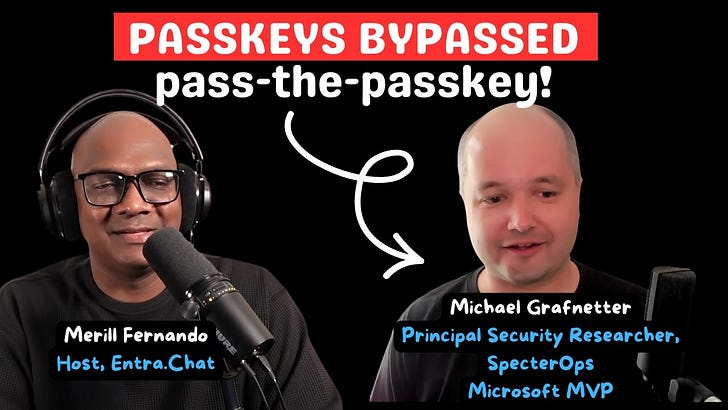
    Passkeys are phishing-resistant. But that resistance is enforced by your browser, which binds every authentication to the origin that requested it. Skip the browser, and the guarantee weakens. In this episode of Entra.Chat, I spoke with Michael Grafnetter, Principal Security Researcher at SpecterOps and Microsoft MVP, about the Pass-the-Passkey research he presented at Black Hat USA 2026. A family of attacks against passkey implementations across Windows, Microsoft Entra ID, browsers and password managers. Michael starts with the vulnerability chain he reported to Microsoft. Windows was writing the complete passkey assertion into the event log, and Microsoft Entra ID would accept a replay of that assertion for up to ten minutes. Any user able to read those logs including a member of Remote Desktop Users on a shared server, or unprivileged malware quietly reading event logs without tripping EDR could impersonate whoever had just signed in. If that person was a Global Administrator, so was the attacker. Windows now truncates the logged message, and Microsoft Entra ID checks authenticator signature counters to reject replays. One clarification Michael is emphatic about: private keys were never written to the event log. They stay bound to the TPM or never leave the security key at all. What leaked were the short-lived digital signatures made by those keys and for this attack, that was enough. We also covered the attacks that do not depend on any single bug. Malware running without administrator rights can call the native Windows WebAuthn APIs directly and raise a passkey prompt flood that keeps returning until the user gives in and approves it. Synced passkeys, exported from a password manager and decrypted with a keylogged password, hand an attacker a credential with no ten-minute limit at all. And a browser-hooking technique Michael calls a passkey detour attack quietly redirects a legitimate assertion into the attacker’s own session. The defensive thread running through all of it is the same: every one of these attacks assumes malware is already on the device. That makes device trust the key control. Privileged access workstations for administrators, Conditional Access requiring compliant devices with EDR running, and the clean source principle that says a system can only be as trustworthy as whatever it depends on. Michael closes on an optimistic note, and it is worth repeating. Passkeys are still the future. They remain far better than passwords and phishable MFA, and every attack here costs an adversary vastly more effort than sending a phishing link. But as passkeys become the default in Microsoft Entra, the threat model deserves an honest read. Watch the demos. This episode includes three on-screen demonstrations that are much easier to follow on video than on audio. This episode brought to you by Workplace Ninjas US Workplace Ninjas US isn’t just another tech conference. It’s where Microsoft experts, MVPs, engineers, and IT professionals come together to learn, network, and build lasting connections. We are a community built on diversity, mentoring, fellowship, and creating a place where everyone belongs. Our core DNA comes down to a few pillars: * Over 60 sessions from the largest collection of MVPs and SMEs you will find in any event in America. * Amazing mentoring, development, and growth through our one on one mentoring system with any speaker, our hackathon, community theatre and more. * A diverse expo hall featuring some of the best Microsoft partners in the world that will help you drive deep efficiencies from your M365 stack. * A place where you will learn how to think differently and collaborate better through a collection of activities and can return refreshed and invigorated to drive change in your organization. * Don’t miss out on our early bird tickets while supplies last Subscribe with your favorite podcast player or watch on YouTube About Michael Grafnetter Michael Grafnetter is a Principal Security Researcher at SpecterOps and a Microsoft MVP, based in Prague. He specializes in Microsoft Entra ID and Active Directory security and PowerShell. He is the author of the DSInternals PowerShell module and the researcher who originally discovered the Shadow Credentials attack technique, now widely used by penetration testers, red teamers and attackers alike. He has presented his security research at international conferences including Black Hat Europe, Black Hat USA, SecTor, TROOPERS and BSides Lisbon. * LinkedIn - https://www.linkedin.com/in/grafnetter/ Related Links * Pass-the-Passkey research and tools, including Passkey Injector and the DSInternals.Passkeys module (discussed at 14:57 and 34:22) - https://github.com/SpecterOps/pass-the-passkey * Pass-the-Passkey research paper from Black Hat USA 2026 (introduced at 07:34) - https://specterops.io/wp-content/uploads/sites/3/2026/08/Pass-the-Passkey_A4_v2.pdf * Shadow Credentials, Michael’s earlier Active Directory research (mentioned at 01:46) - https://specterops.io/blog/2021/06/17/shadow-credentials-abusing-key-trust-account-mapping-for-account-takeover/ * DSInternals PowerShell module (mentioned at 01:34) - https://www.dsinternals.com/en/ * Passkeys (FIDO2) authentication in Microsoft Entra ID (context throughout) - https://learn.microsoft.com/entra/identity/authentication/concept-authentication-passkeys-fido2 * Synced passkeys, device-bound passkeys and passkey profiles (discussed at 23:21) - https://learn.microsoft.com/entra/identity/authentication/how-to-authentication-passkeys-fido2 * Deploy phishing-resistant passwordless authentication (context at 18:08) - https://learn.microsoft.com/entra/identity/authentication/how-to-deploy-phishing-resistant-passwordless-authentication * Require device compliance with Conditional Access (recommended at 21:12) - https://learn.microsoft.com/entra/identity/conditional-access/policy-all-users-device-compliance * Privileged access devices and the clean source principle (discussed at 21:55 and 35:41) - https://learn.microsoft.com/security/privileged-access-workstations/privileged-access-devices * Unit 42, “Pass the Passkey: A Novel Attack Surface in Passwordless Authentication” — the Palo Alto research on Google Password Manager passkeys (mentioned at 26:27) - https://unit42.paloaltonetworks.com/passwordless-authentication-security-risks/ Related Entra.Chat Episodes * From SMS MFA to Passkeys: A Practical Microsoft Entra Migration Plan - https://entra.news/p/from-sms-mfa-to-passkeys-a-practical * 5 Lessons from Rolling Out Passkeys to Millions of Users - https://entra.news/p/5-lessons-from-rolling-out-passkeys * Attackers Are Targeting The AI Ecosystem You Cannot See - https://entra.news/p/attackers-are-targeting-the-ai-ecosystem Chapters 00:00 Intro 01:02 Meet Michael Grafnetter 03:09 How the Research Started 06:50 Windows Hello for Business Was the First Passkey 07:30 The Signature in Your Event Log 10:18 No, Private Keys Are Not Logged 12:25 How Entra Mitigated the Replay 13:44 Demo: Signing In With a Stolen Signature 15:22 Malware-Initiated Passkey Phishing 18:08 The Browser Is What Makes Passkeys Phishing-Resistant 20:42 What Defenders Should Actually Do 23:04 Synced Passkeys and the Export Problem 26:13 Credential Exchange and Password Manager Risk 28:19 The Passkey Detour Attack 30:43 The Authentication Broker Debate 31:57 RDP Redirection and Remote Passkey Abuse 32:59 Spotting a Suspicious Passkey Prompt 34:46 Passkeys Are Still the Future Podcast Apps Apple Podcast - https://entra.chat/apple YouTube - https://entra.chat/youtube Spotify - https://entra.chat/spotify Overcast - https://entra.chat/overcast Pocketcast - https://entra.chat/pocketcast Others - https://entra.chat/rss Merill’s socials YouTube - youtube.com/@merillx LinkedIn - linkedin.com/in/merill Twitter - twitter.com/merill TikTok - tiktok.com/@merillf Bluesky - bsky.app/profile/merill.net Mastodon - infosec.exchange/@merill Threads - threads.net/@merillf GitHub - github.com/merill Get full access to Entra.News - Your weekly dose of Microsoft Entra at entra.news/subscribe
  • #70
    August 10 · 53 min

    From SMS MFA to Passkeys: A Practical Microsoft Entra Migration Plan

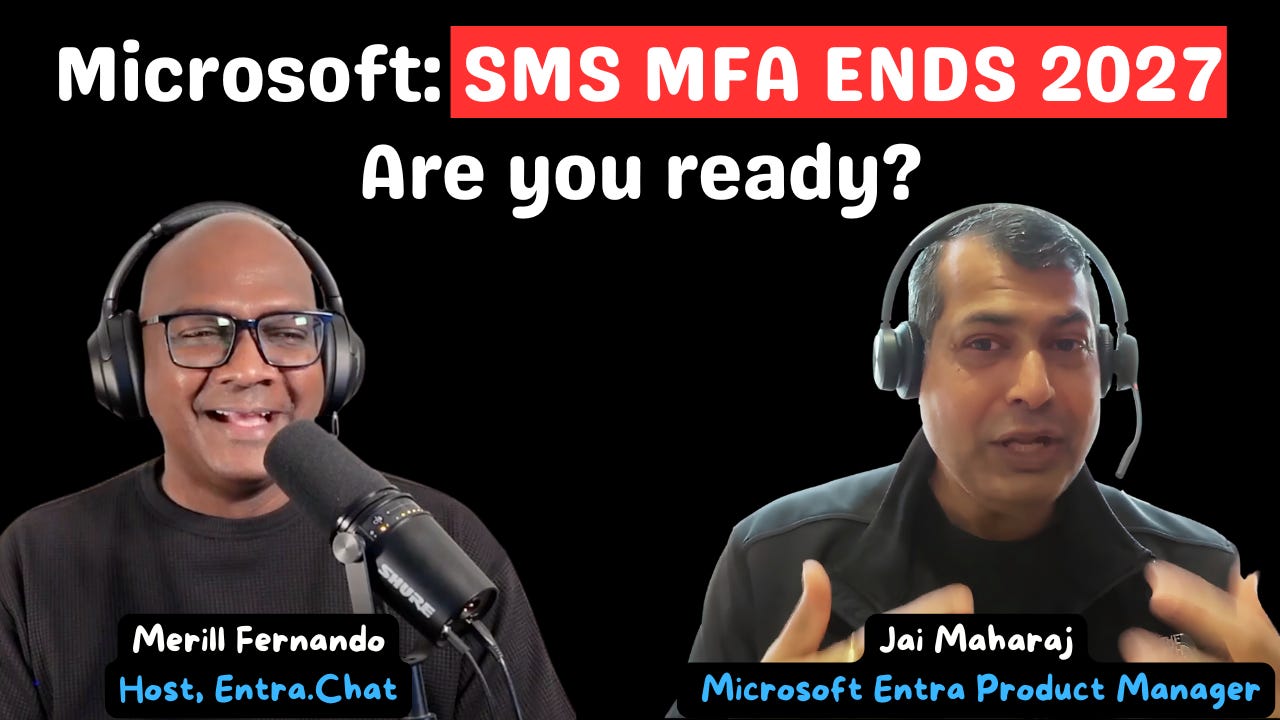
    Microsoft-managed SMS and voice MFA will stop working on February 1, 2027. That deadline makes passkey planning urgent, but enabling a new authentication method is only the first milestone. In this episode of Entra.Chat, Merill speaks with Jai Maharaj, Product Manager at Microsoft, about the practical journey from legacy MFA to a passwordless Microsoft Entra environment. Jai explains what is actually being retired, why organizations can still use a customer-managed telecom provider, and how passkey profiles support synced and device-bound passkeys for different user personas. The user-experience case is compelling: Microsoft reports roughly 69 seconds for password plus traditional MFA compared with about three seconds for a synced passkey. The security case is stronger still. Passkeys resist phishing by design, but Jai stresses that deploying them does not make an organization phishing-resistant until it enforces the right authentication strength and addresses the passwords and legacy applications still in the environment. The conversation then follows the complete identity lifecycle. How do you ensure the right person receives a passkey during onboarding? How do you verify someone requesting a sensitive role? How do you recover an account without relying on knowledge-based help-desk questions? Jai connects those scenarios to Microsoft Entra Verified ID, verifiable credentials, Face Check, identity verification partners, and self-service account recovery. Sponsored by Scan, Score, and Secure Your Applications in Entra Application identities represent one of the largest attack surfaces in Entra and are often among the least consistently governed. ENow AppGov Score helps IT and identity teams understand where risk exists. Its 25-check assessment evaluates Entra ID application integrations against Microsoft-recommended governance practices, analyzing: * App registrations and enterprise apps for excessive permissions * Expired or unmanaged secrets and certificates * Risky consent grants * Privileged service principals Results are delivered as a clear, defensible risk score with actionable findings. No scripts. No manual inventory. Just a fast, read-only scan that reveals app sprawl, identity misconfigurations, and blast radius so you can prioritize remediation and strengthen your security posture. Subscribe with your favorite podcast player or watch on YouTube 👇 About Jai Maharaj Jai Maharaj is a Senior Product Manager at Microsoft. He works with customers and engineering teams across Microsoft Entra, with experience spanning ID Governance, Verified ID, External ID, and passkeys. He helps enterprise and public-sector organizations move from legacy authentication methods to phishing-resistant authentication. * LinkedIn - https://www.linkedin.com/in/jai-maharaj-0938305a/ Related Links * Microsoft-managed SMS and voice retirement timeline (discussed at 02:19 and 06:31) - https://learn.microsoft.com/entra/identity/authentication/concept-sms-voice-retirement * Customer-managed telecom provider FAQ (mentioned at 03:41 and 07:13) - https://learn.microsoft.com/entra/identity/authentication/phone-providers-faq * Passkey profiles, synced passkeys, and device-bound passkeys (discussed at 09:44) - https://learn.microsoft.com/entra/identity/authentication/how-to-authentication-passkeys-fido2#passkey-profiles * Passkey concepts and Microsoft performance figures (mentioned at 14:22) - https://learn.microsoft.com/entra/identity/authentication/concept-authentication-passkeys-fido2#what-are-passkeys * Microsoft Entra Verified ID Face Check (introduced at 31:57) - https://learn.microsoft.com/entra/verified-id/using-facecheck * ASD/ACSC Essential Eight maturity model (mentioned at 33:41) - https://www.cyber.gov.au/business-government/asds-cyber-security-frameworks/essential-eight/essential-eight-maturity-model * Microsoft Entra account recovery overview (discussed at 36:59) - https://learn.microsoft.com/entra/identity/authentication/concept-account-recovery-overview * Verified ID identity verification partners (discussed at 37:12) - https://learn.microsoft.com/entra/verified-id/idv-partners * Microsoft Entra licensing (discussed at 39:27) - https://learn.microsoft.com/entra/fundamentals/licensing * Verified ID and Face Check pricing model (discussed at 39:27) - https://learn.microsoft.com/entra/verified-id/verified-id-pricing * Deploy phishing-resistant passwordless authentication (mentioned at 52:34) - https://learn.microsoft.com/entra/identity/authentication/how-to-deploy-phishing-resistant-passwordless-authentication Related Entra.Chat Episodes * Microsoft Is Auto-Enabling Passkeys in March 2026 - https://entra.news/p/microsoft-is-auto-enabling-passkeys * Mastering Microsoft Entra ID: Real-World Passkey Deployment Tips - https://entra.news/p/mastering-microsoft-entra-id-real * Entra Ignite Recap: Synced Passkeys, Agent ID & The Future of Identity - https://entra.news/p/entra-ignite-recap-synced-passkeys Chapters 00:00 Intro 02:19 Why Microsoft Is Retiring Managed SMS and Voice 03:32 What the February 2027 Deadline Means 09:27 Synced vs Device-Bound Passkeys 14:22 From 69 Seconds to Three 19:02 Making Passkeys Easier for Users 23:14 Customer Passkey Deployment Lessons 28:41 The Secure Bootstrapping Problem 31:57 Verified ID and Face Check 33:41 Essential Eight and High-Value Access 36:24 Self-Service Account Recovery 39:27 Licensing and Recovery Economics 44:45 Why Face Check Augments Passkeys 49:40 Enforce Phishing Resistance and Build a Roadmap Podcast Apps Apple Podcast - https://entra.chat/apple YouTube - https://entra.chat/youtube Spotify - https://entra.chat/spotify Overcast - https://entra.chat/overcast Pocketcast - https://entra.chat/pocketcast Others - https://entra.chat/rss Merill’s socials YouTube - youtube.com/@merillx LinkedIn - linkedin.com/in/merill Twitter - twitter.com/merill TikTok - tiktok.com/@merillf Bluesky - bsky.app/profile/merill.net Mastodon - infosec.exchange/@merill Threads - threads.net/@merillf GitHub - github.com/merill Get full access to Entra.News - Your weekly dose of Microsoft Entra at entra.news/subscribe
  • #69
    August 3 · 48 min

    The Ultimate Microsoft Entra Global Secure Access Migration Guide

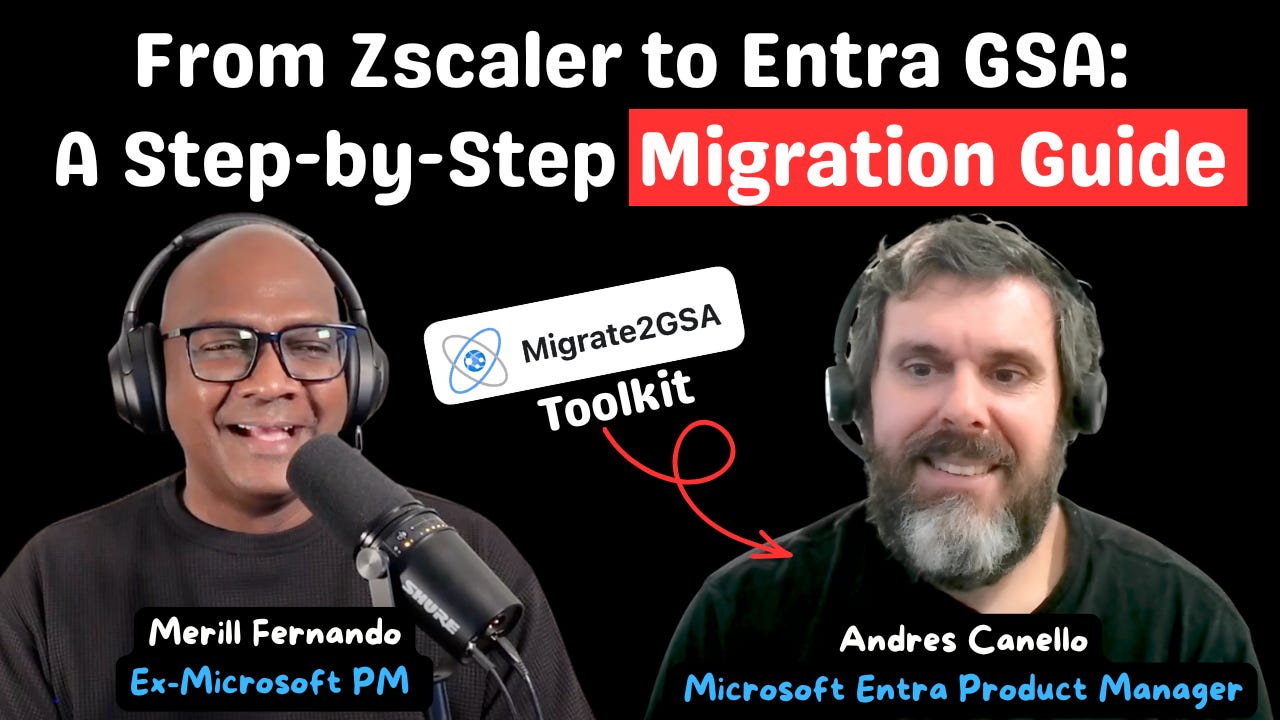
    An Entra GSA migration should not mean throwing away years of useful SSE policy work and rebuilding every application, segment, and rule by hand. Existing configuration carries hard-won intent: which populations need access, which destinations should be blocked, and which exceptions keep the business running. Migrate2GSA creates a path to preserve the useful parts while making the migration a deliberate cleanup opportunity. In this episode of Entra.Chat, I spoke with Andres Canello, Principal Product Manager at Microsoft and creator of Migrate2GSA. Andres demonstrates how the open-source toolkit exports configuration from third-party products, converts it into a common CSV schema, gives administrators an intentional review step, and provisions the approved configuration into Global Secure Access through Microsoft Graph. The goal is not to configure the product end to end or remove human judgment. Andres describes it as a way to accelerate the repetitive 80%. Conflicting segments default to “do not provision,” existing applications are skipped, generated Conditional Access policies remain disabled, and there is no delete API call in the toolkit. The conversation also covers greenfield provisioning, backup and restore, reusable consultant baselines, and the unusual development story behind more than 30,000 lines of PowerShell. Andres explains why detailed, published specifications produced better AI-generated code than incremental prompting—and why the intent and edge cases in an open-source contribution matter more than who typed the implementation. Subscribe with your favorite podcast player or watch on YouTube. About Andres Canello Andres Canello is a Principal Product Manager at Microsoft, where he works at the intersection of modern identity and Secure Service Edge. Over his 15 years at Microsoft, he was a founding member of the Entra Global Secure Access team, helping shape the product before it launched, and has since guided some of the largest identity and secure-access deployments in the industry, from banks and miners to national governments. He’s the creator of Migrate2GSA, an open-source migration toolkit used by organizations around the world, which he built end-to-end using AI-assisted, spec-driven development. * Andres Canello on LinkedIn * Andres Canello on X/Twitter Sponsored by Maester Cloud turns every Maester and Microsoft Zero Trust Assessment run into a durable evidence trail. See new failures, fixes, accepted risks, and posture changes across every tenant - without digging through old HTML reports. * Keep 5+ years of tenant history in your chosen Azure region * Compare runs, spot drift, and get change alerts Become a Founding Supporter for $99/month to fund open-source Maester development, shape the roadmap, and get self-hosted private-preview access plus 10% off hosted for life. Related Links * Plan and troubleshoot UserPrincipalName changes in Microsoft Entra ID (mentioned at 04:07) * Azure AD Mailbag: Conditional Access Q&A by Andres Canello (mentioned at 06:43) * Migrate2GSA documentation (mentioned at 45:37) * Migrate2GSA source repository (mentioned at 45:37) Related Entra.Chat Episodes * How to Migrate from Legacy VPNs to Entra Private Access (Real Strategies from a Veteran) * Global Secure Access Explained: Real-World Rollouts, Mistakes, and Best Practices * Identity-Centric Network Security: Entra Global Secure Access Architecture & Benefits Chapters 00:00 Intro 01:05 Andres Canello's 15 Years in Microsoft Identity 06:43 A Conditional Access Mistake Admins Still Make 11:29 From Early Customer Pilots to Entra GSA 13:21 Why SSE Migrations Should Not Start From Scratch 18:31 Beyond Migration: Backup Restore and Greenfield 23:27 Export Convert Review and Provision 27:02 How Specifications Made AI-Generated PowerShell Work 35:22 Conflict Detection and the Human Review Gate 39:14 Microsoft Graph Provisioning with Safety Built In 43:35 Automating the Repetitive 80 Percent 46:15 Contributing to Migrate2GSA Podcast Apps * Entra.Chat * Apple Podcast * YouTube * Spotify * Overcast * Pocketcast * Other podcast apps Merill’s socials * YouTube * LinkedIn * Twitter * TikTok * Bluesky * Mastodon * Threads * GitHub Get full access to Entra.News - Your weekly dose of Microsoft Entra at entra.news/subscribe

  • July 28 · 54 min

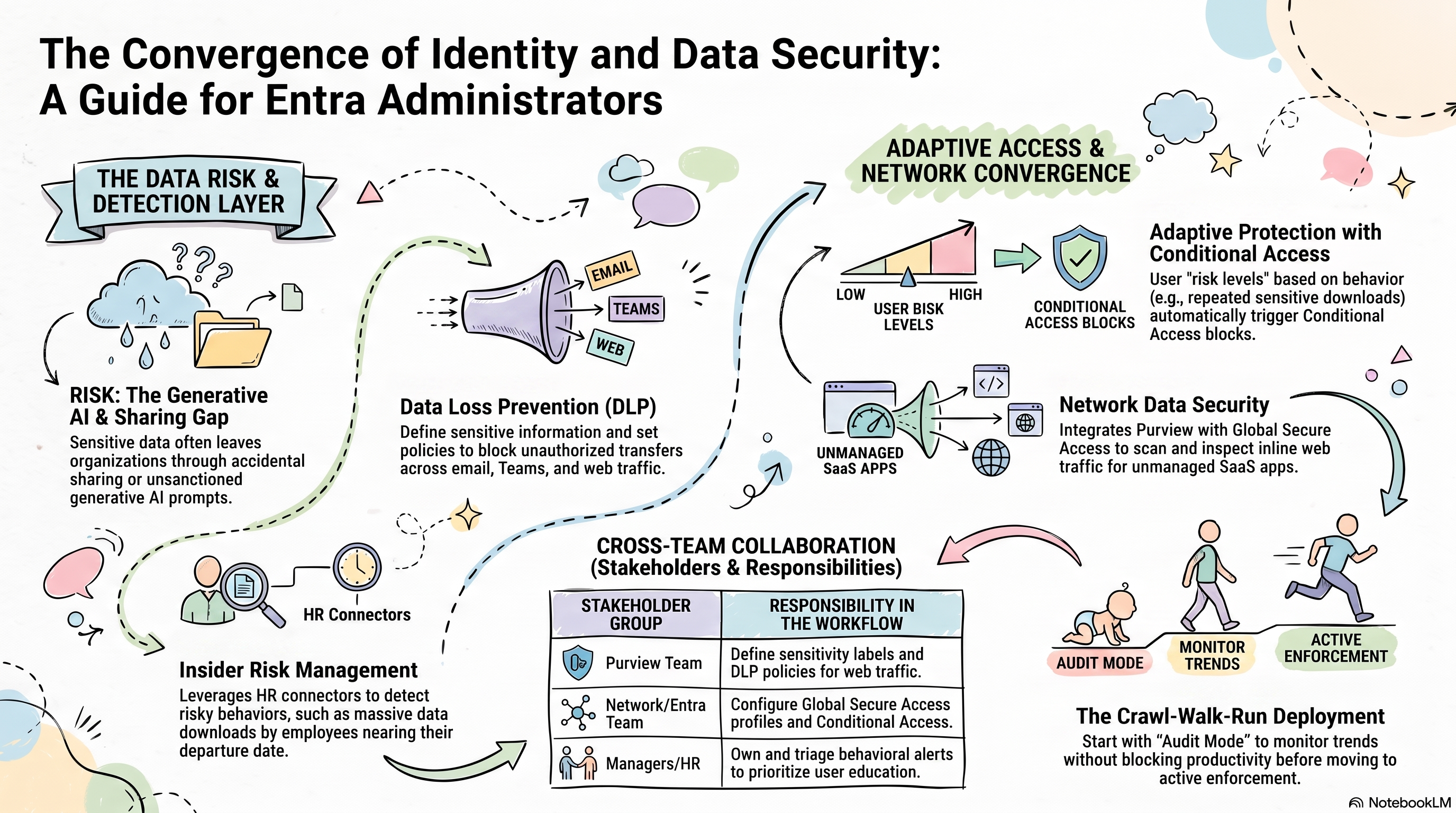
    Why Entra Admins Need Microsoft Purview Now

    Conditional Access no longer begins and ends with identity signals. Microsoft Purview can now influence the controls Entra administrators are asked to implement. From insider-risk conditions in Conditional Access to inline protection for sensitive data moving toward unsanctioned AI apps. That means Entra teams need enough Purview knowledge to understand what triggers a policy, how users experience it, and who should respond when an alert fires. In this episode of Entra.Chat, Merill speaks with Ray Reyes, Principal Security Consultant at Engage Squared and author of Mastering Microsoft Purview Deployment in the Era of AI. Ray explains Data Loss Prevention and Insider Risk Management in plain language, then follows their integrations into Microsoft Entra ID, Microsoft Defender XDR, and Global Secure Access. The conversation moves beyond product configuration. A policy can be technically simple and still require identity, network, data-security, HR, management, and data-owner teams to agree on scope, ownership, education, escalation, and remediation. Ray’s practical advice is to understand the neighbouring Microsoft security products at a high level and deploy Purview gradually: start in audit mode or with a limited group, learn from the impact, and expand with the business. Ray also shares the story of the charity he and his wife started in Nepal, how it grew from supporting roughly 30 street children to reaching thousands, and how that chapter changed his perspective on work and stress. He and Merill close with an honest discussion about burnout, layoffs, gratitude, personal branding, and building a career safety net outside any one employer. Sponsored by Recent layoffs have left a lot of strong professionals in limbo. That’s why we built Sponsor a Seeker, a simple way for the community to lift each other up. For just $29, you can gift a full 3-month Job-Hunt Pass packed with: • Unlimited resume & job description scans • AI-powered rewrites that actually beat ATS systems • Professional cover letter generation Every dollar goes directly to the seeker. You can: → Sponsor someone like Alex M. (recently laid off front-end engineer) → Or request sponsorship for yourself Either way, you’re helping keep momentum alive in a tough market. 👉 Take action here: pastthebots.com/sponsor Let’s turn “I was laid off” into “Someone had my back.” Thank you for being part of this community, Rod Trent Past the Bots Subscribe with your favorite podcast player or watch on YouTube. About Ray Reyes Ray Reyes is a Principal Security Consultant at Engage Squared and the author of Mastering Microsoft Purview Deployment in the Era of AI. He previously worked at Microsoft, where he led data-security subject-matter expertise across Asia Pacific and Japan and helped customers deploy Microsoft Purview and Microsoft Defender XDR. His work now spans identity, data security, and the wider Microsoft security stack. * LinkedIn → linkedin.com/in/ray-reyes-598062125 Related Links * Mastering Microsoft Purview Deployment in the Era of AI by Ray Reyes (mentioned at 00:00 and 02:25) * Microsoft Purview overview (discussed from 03:29) * Adaptive Protection in Microsoft Purview (discussed at 22:09) * Learn about Data Loss Prevention for Network Data Security (discussed at 33:31) * Configure Microsoft Entra Internet Access content filtering (discussed at 34:18) * The Resilience Project: Finding Happiness through Gratitude, Empathy and Mindfulness by Hugh van Cuylenburg (mentioned at 47:25) Related Entra.Chat Episodes * How Microsoft Is Securing AI Agents in Entra — Conditional Access, Zero Trust & the “Block” Debate * How to Migrate from Legacy VPNs to Entra Private Access * What’s New in Microsoft Entra — May 2026: Passkeys, Agents & Cloud Sync Chapters 00:00 Intro 03:29 Why Purview Matters to Entra Admins 05:39 How Microsoft Purview Evolved 09:46 Data Loss Prevention Explained 16:04 Insider Risk and Employee Departures 22:09 Adaptive Protection Meets Conditional Access 25:00 Education and Alert Ownership 28:51 Breaking Down the Security Silos 33:31 Network Data Security and Unsanctioned AI 38:29 How to Roll Out Purview Safely 41:20 Ray’s Charity Work in Nepal 47:10 Resilience Burnout and a Career Safety Net Podcast Apps Apple Podcast - https://entra.chat/apple YouTube - https://entra.chat/youtube Spotify - https://entra.chat/spotify Overcast - https://entra.chat/overcast Pocketcast - https://entra.chat/pocketcast Others - https://entra.chat/rss Merill’s socials YouTube - youtube.com/@merillx LinkedIn - linkedin.com/in/merill Twitter - twitter.com/merill TikTok - tiktok.com/@merillf Bluesky - bsky.app/profile/merill.net Mastodon - infosec.exchange/@merill Threads - threads.net/@merillf GitHub - github.com/merill Get full access to Entra.News - Your weekly dose of Microsoft Entra at entra.news/subscribe

  • July 20 · 46 min

    How Xbox Secures 70+ Entra Tenants Every Night with Maester

    Xbox Security runs a gaming-specific Microsoft Entra baseline across more than 70 tenants every night. The scale is striking: about 50 controls, dozens of independently operated game-studio tenants, and one parallel pipeline that checks whether each environment still matches Xbox’s security intent. When a Conditional Access policy moves to report-only or a required service principal loses a permission, the next run finds it. In this episode of Entra.Chat, Merill speaks with Audrey Long, Principal Cloud Security Architect in Xbox Security at Microsoft, and Sam Erde, SecureShield Architect at Patriot Consulting and a Maester maintainer. Audrey explains how Xbox Security extended Maester with custom PowerShell, GitHub Actions, a multi-tenant service principal, federated identity credentials, dashboards, ticketing, and time-bound exceptions. The result is more than a posture report. Findings flow into an operational lifecycle with owners and deadlines. Studios get readable reports, deep links to the affected object, and remediation guidance. Security teams can answer audit questions without interrupting all the tenant admins, while the Maester pipeline keeps read-only observability separate from remediation authority. The conversation also covers why a Microsoft-wide baseline needs adapting for gaming acquisitions, how custom tests encode an organization’s intent, why security configuration deserves regression tests, the Investigate status Audrey’s team helped introduce, and how administrators can use AI as a first-draft assistant for PowerShell and CI/CD without outsourcing validation. Subscribe with your favorite podcast player or watch on YouTube Sponsor Maester Cloud turns every Maester and Microsoft Zero Trust Assessment run into a durable evidence trail. See new failures, fixes, accepted risks, and posture changes across every tenant—without digging through old HTML reports. * Keep 5+ years of tenant history in your chosen Azure region * Compare runs, spot drift, and get change alerts Maester Cloud is in active development. Join the waitlist for hosted, self-hosted, or enterprise onboarding updates. About Audrey Long Audrey Long is a Principal Cloud Security Architect in Xbox Security at Microsoft. She focuses on Microsoft Entra and identity security, as well as securing Azure, AWS, and Google Cloud environments across Xbox and its game studios. In this episode, she shares how her team built a gaming-specific Entra baseline and operationalized it across more than 70 tenants. * LinkedIn - https://www.linkedin.com/in/aulong/ About Sam Erde Sam Erde is part of the Maester core maintainer team, a Microsoft MVP, and a SecureShield Architect at Patriot Consulting. He focuses on Active Directory, Microsoft Entra ID, Microsoft 365 security, and practical PowerShell tooling for defenders. LinkedIn - https://www.linkedin.com/in/samerde/ Related Links * Maester, installation guide, and source code (mentioned at 02:19) - Maester · installation guide · GitHub source * Continuous monitoring with Maester and GitHub Actions (mentioned at 14:38) - https://maester.dev/docs/monitoring/github/ * Writing custom Maester tests (mentioned at 22:39) - https://maester.dev/docs/writing-tests/ * Connect-Maester permissions and read-only access (mentioned at 24:38) - https://maester.dev/docs/connect-maester/ * Zero Trust Assessment: Secure your tenant (mentioned at 25:46) - https://entra.news/p/find-your-tenants-hidden-flaws-in * Maester’s Investigate test-result status (mentioned at 34:02) - https://maester.dev/docs/writing-tests/formatting-test-results/ * Making Security Invisible for Game Developers (mentioned at 45:52) - https://opsmatters.com/videos/making-security-invisible-game-developers Related Entra.Chat Episodes * How to Secure Copilot Agents, Azure DevOps & Defender (+ more) with Maester 2.1 (Full Breakdown) * Zero Trust Assessment: Secure your tenant * How to Design Bullet-Proof Conditional Access Policies in Microsoft Entra ID Chapters 00:00 Intro00:42 Meet Audrey Long02:19 From 50 Controls to 70+ Tenants05:11 Making an Entra Baseline Gaming-Specific08:32 Why Custom Maester Tests Matter11:07 Governance and Nightly Automation15:27 From Findings to Remediation18:07 Reports Studios Can Actually Use22:39 Building Custom Multi-Tenant Tests28:07 Security Intent as Regression Tests30:48 Catching Drift and Producing Audit Evidence41:39 CI/CD and AI for Security Admins Podcast Apps Entra.Chat - https://entra.chat Apple Podcast - https://entra.chat/apple YouTube - https://entra.chat/youtube Spotify - https://entra.chat/spotify Overcast - https://entra.chat/overcast Pocketcast - https://entra.chat/pocketcast Others - https://entra.chat/rss Merill’s socials YouTube - youtube.com/@merillx LinkedIn - linkedin.com/in/merill Twitter - twitter.com/merill TikTok - tiktok.com/@merillf Bluesky - bsky.app/profile/merill.net Mastodon - infosec.exchange/@merill Threads - threads.net/@merillf GitHub - github.com/merill Get full access to Entra.News - Your weekly dose of Microsoft Entra at entra.news/subscribe
  • #66
    July 12 · 54 min

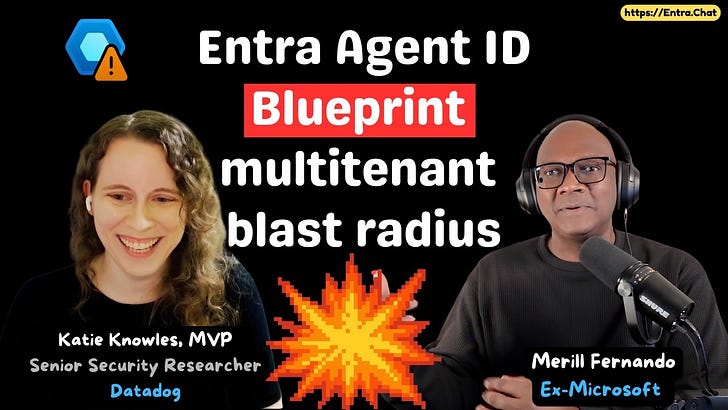
    One Compromised Agent ID Blueprint Can Cross Tenant Boundaries

    Microsoft Entra Agent ID uses familiar application and service-principal objects under the hood, but its one-to-many hierarchy creates a different security boundary. A blueprint can be associated with many agent identities. When that blueprint belongs to a third-party provider and is trusted across customer tenants, the provider’s credential security becomes part of every customer’s risk model. In this episode of Entra.Chat, Merill speaks with Katie Knowles, Senior Security Researcher at Datadog, about her three-part security analysis of Microsoft Entra Agent ID. Katie explains the blueprint, blueprint principal, agent identity, and agent-user relationships before walking through a cross-tenant compromise demonstration: compromised blueprint credentials, enumeration of associated agents, token requests in trusting tenants, permission inspection, and selection of a useful target identity. That path does not automatically grant Global Administrator access. Its impact depends on what the target agent identity has been permitted to do. The important lesson is the control point: one blueprint can sit upstream of many identities, tenants, and permission sets. Katie and Merill also discuss tenant-owned versus vendor-owned blueprints, the Agent ID Administrator role, first-party agent creation through Microsoft platforms, why production client secrets compound the blast radius, workload identity federation, separating blueprints by risk, reusing app-registration detections, and Microsoft Entra ID Protection for agents. REGISTER: Hidden Risk of App Permissions in Entra ID Many Microsoft Entra ID environments contain third-party and custom applications with permissions that are broader than necessary, and most organizations lack visibility into how those permissions are being used. Excessive Microsoft Graph permissions and unused access increase the risk of OAuth abuse and privilege escalation. Join our live session on July 22 to learn how to: * Evaluate delegated versus application permissions * Build an effective app governance strategy * Reduce unnecessary access without disrupting users You’ll also see how a free AppGov Score assessment can help identify governance gaps and where unused permissions reporting fit into a least-privilege approach. Subscribe with your favorite podcast player or watch on YouTube About Katie Knowles Katie Knowles is a Senior Security Researcher at Datadog focused on Azure security research, cloud identity, and securing emerging technologies. * LinkedIn - https://linkedin.com/in/kaknowles * X/Twitter - https://twitter.com/_sigil * GitHub - https://github.com/siigil * Website - https://kknowl.es/ * Microsoft MVP profile - https://mvp.microsoft.com/en-US/MVP/profile/a3547b6a-6a4d-4aa0-840f-23b858c43c8b Related Links * Entra Agent ID: The blueprint blast radius (mentioned at 51:39) - https://securitylabs.datadoghq.com/articles/agent-id-blueprint-blast-radius/ * Entra Agent ID: Inside a cross-tenant agent compromise (mentioned at 51:39) - https://securitylabs.datadoghq.com/articles/agent-id-inside-agent-compromise/ * Entra Agent ID: Protect, detect, respond (mentioned at 51:39) - https://securitylabs.datadoghq.com/articles/agent-id-protect-detect-respond/ * Disable agent identities in your tenant (mentioned at 04:00 and 49:33) - https://learn.microsoft.com/entra/agent-id/disable-agent-identities * Investigating suspicious AI workflows in Microsoft Entra Agent ID: Agent’s user account (mentioned at 05:14) - https://redcanary.com/blog/threat-detection/entra-id-ai-workflows-teams/ * Entra Agent ID from a Security Perspective (mentioned at 20:38) - https://blog.compass-security.com/2026/06/entra-agent-id-from-a-security-perspective/ * Spying On Your ISVs Credential Choices (mentioned at 38:11) - https://ericonidentity.com/2025/01/13/spying-on-your-isvs-credential-choices/ * Who Are the Robots? Uncovering AI Agents Identities (mentioned at 51:39) - https://www.youtube.com/watch?v=mMxACHKIAwY * AzTier (mentioned at 51:39) - https://aztier.com/ * Microsoft Entra Agent ID key concepts - https://learn.microsoft.com/entra/agent-id/key-concepts * Workload identity federation - https://learn.microsoft.com/entra/workload-id/workload-identity-federation * ID Protection for agents - https://learn.microsoft.com/entra/id-protection/concept-risky-agents Related Entra.Chat Episodes * If You Manage Entra Permissions, Watch This Before Deploying Agents - https://entra.news/p/if-you-manage-entra-permissions-watch * From Windows Core to Leading Agent ID: Vince Smith’s Microsoft Story - https://entra.news/p/from-windows-core-to-leading-agent * Attackers Are Targeting the AI Ecosystem You Cannot See - https://entra.news/p/attackers-are-targeting-the-ai-ecosystem Chapters 00:00 Intro 01:12 Katie’s Three-Part Agent ID Research 05:40 Agent ID Objects Under the Hood 06:24 One Blueprint, Many Agent Identities 08:43 The Multitenant Trust Boundary 17:33 Cross-Tenant Compromise Walkthrough 28:29 First-Party and Third-Party Blueprints 36:56 Stop Using Client Secrets 38:40 Workload Identity Federation 46:24 Permissions and Privilege Boundaries 49:33 Detecting and Responding to Agent Abuse 51:29 What Comes Next for Agent ID Podcast Apps Apple Podcast - https://entra.chat/apple YouTube - https://entra.chat/youtube Spotify - https://entra.chat/spotify Overcast - https://entra.chat/overcast Pocketcast - https://entra.chat/pocketcast Others - https://entra.chat/rss Merill’s socials YouTube - youtube.com/@merillx LinkedIn - linkedin.com/in/merill Twitter - twitter.com/merill TikTok - tiktok.com/@merillf Bluesky - bsky.app/profile/merill.net Mastodon - infosec.exchange/@merill Threads - threads.net/@merillf GitHub - github.com/merill Get full access to Entra.News - Your weekly dose of Microsoft Entra at entra.news/subscribe
  • #65
    July 4 · 44 min

    Attackers Are Targeting The AI Ecosystem You Cannot See

    AI agent security is not just about attackers using AI. It is also about attackers targeting the agent ecosystem most organizations cannot see clearly yet: MCP servers, agent skills, packages, API keys, prompts, tools, and the identity layer underneath all of it. In this episode, I sit down with Thomas Roccia, founder of Security Break and a former Microsoft threat researcher, to look at AI agents from the threat-intelligence side. Thomas explains why the easiest path for attackers may not be futuristic autonomous hacking. It may be the boring weak spots that already exist: malicious packages, untrusted MCP servers, hostile agent skills, leaked API keys, and AI-generated code that chooses the fastest path instead of the safest one. For Entra admins and security teams, this is where Agent ID, non-human identity, workload identity, logging, sponsorship, and governance start to matter. Entra Agent ID gives teams a way to identify and govern agents, but identity is only one part of the picture. You still need to understand what agents can discover, what tools they can call, what context they consume, and whether you can replay what they actually did. Thomas also breaks down his practical AI threat-intelligence work, including how teams can use agents for CTI, how adversarial prompts and context flooding change the risk model, and why defenders need to understand the attacker side of agent security before these systems become invisible production infrastructure. Sponsored by Secure BYOD Wi‑Fi Without MDM enrollment Keytos Connect is a new mobile and desktop app that makes it easy for users to connect personal and BYOD devices to enterprise and campus Wi‑Fi without shared passwords, manual certificate installs, or traditional MDM enrollment. Users simply download the app, sign in with their work or school account, and Keytos handles the rest. It also works alongside Intune, allowing organizations to continue managing corporate-owned devices while simplifying connectivity for personal devices. * Connect in minutes: users download the app, sign in, and get securely onboarded to Wi‑Fi * No MDM required: enable secure access for personal devices without giving IT full control of them * Works alongside Intune: keep your existing management workflows for corporate devices while enabling secure BYOD access * Automatic certificate management: certificate issuance and renewal happen behind the scenes * Secure by default: EAP-TLS authentication eliminates shared Wi‑Fi passwords and provides unique credentials for every user * Multi-OS: Available across iOS, Android, Windows, and macOS devices * Included at no additional cost with existing EZRADIUS and EZCA subscriptions Learn more about Keytos Connect and see how easy secure BYOD connectivity can be. About Thomas Roccia Thomas Roccia is a threat researcher and founder of SecurityBreak, focused on AI threat intelligence, malware analysis, and AI agent security. He previously worked in incident response, malware analysis, threat intelligence, Microsoft Defender, and AI threat research. He is also the author of Visual Threat Intelligence and teaches practical AI for threat intelligence and agentic workflows. LinkedIn - https://au.linkedin.com/in/thomas-roccia Subscribe with your favorite podcast player or watch on YouTube 👇 Related Links * Thomas Roccia on LinkedIn - https://au.linkedin.com/in/thomas-roccia * SecurityBreak - https://securitybreak.io/ * Practical AI for Threat Intelligence training - https://securitybreak.io/training-genai * SHIELD.md: A Security Standard for OpenClaw and AI Agents - https://blog.securitybreak.io/shield-md-a-security-standard-for-openclaw-and-ai-agents-b38637031460 * Microsoft Entra Agent ID - https://learn.microsoft.com/en-us/entra/agent-id/what-is-microsoft-entra-agent-id * Microsoft Entra Agent ID key concepts - https://learn.microsoft.com/en-us/entra/agent-id/key-concepts * Agentic Resource Discovery specification - https://agenticresourcediscovery.org/ * GitHub Agent Finder - https://github.blog/changelog/2026-06-17-agent-finder-for-github-copilot-now-available/ Chapters 00:00 Intro 00:33 Meet Thomas Roccia 01:48 From Malware Analysis to AI Threat Intel 03:30 Why AI Security Is Moving So Fast 05:49 Agentic Resource Discovery and New Standards 09:25 Attackers Are Already Using AI Agents 11:47 The AI Ecosystem Is The Target 15:26 Prompt Injection, MCP, Skills, and API Keys 20:28 Vibe Coding vs Production Security 23:47 Agent ID and Identity for AI Agents 32:30 Practical AI for Threat Intelligence 39:13 Monitoring Agents Like Threat Actors Do 42:28 Context Flooding and What’s Next Podcast Apps Apple Podcast - https://entra.chat/apple YouTube - https://entra.chat/youtube Spotify - https://entra.chat/spotify Overcast - https://entra.chat/overcast Pocketcast - https://entra.chat/pocketcast Others - https://entra.chat/rss Merill’s socials YouTube - youtube.com/@merillx LinkedIn - linkedin.com/in/merill Twitter - twitter.com/merill TikTok - tiktok.com/@merillf Bluesky - bsky.app/profile/merill.net Mastodon - infosec.exchange/@merill Threads - threads.net/@merillf GitHub - github.com/merill Get full access to Entra.News - Your weekly dose of Microsoft Entra at entra.news/subscribe
  • #64
    June 28 · 47 min

    From Windows Core to Leading Agent ID: Vince Smith’s Microsoft Story

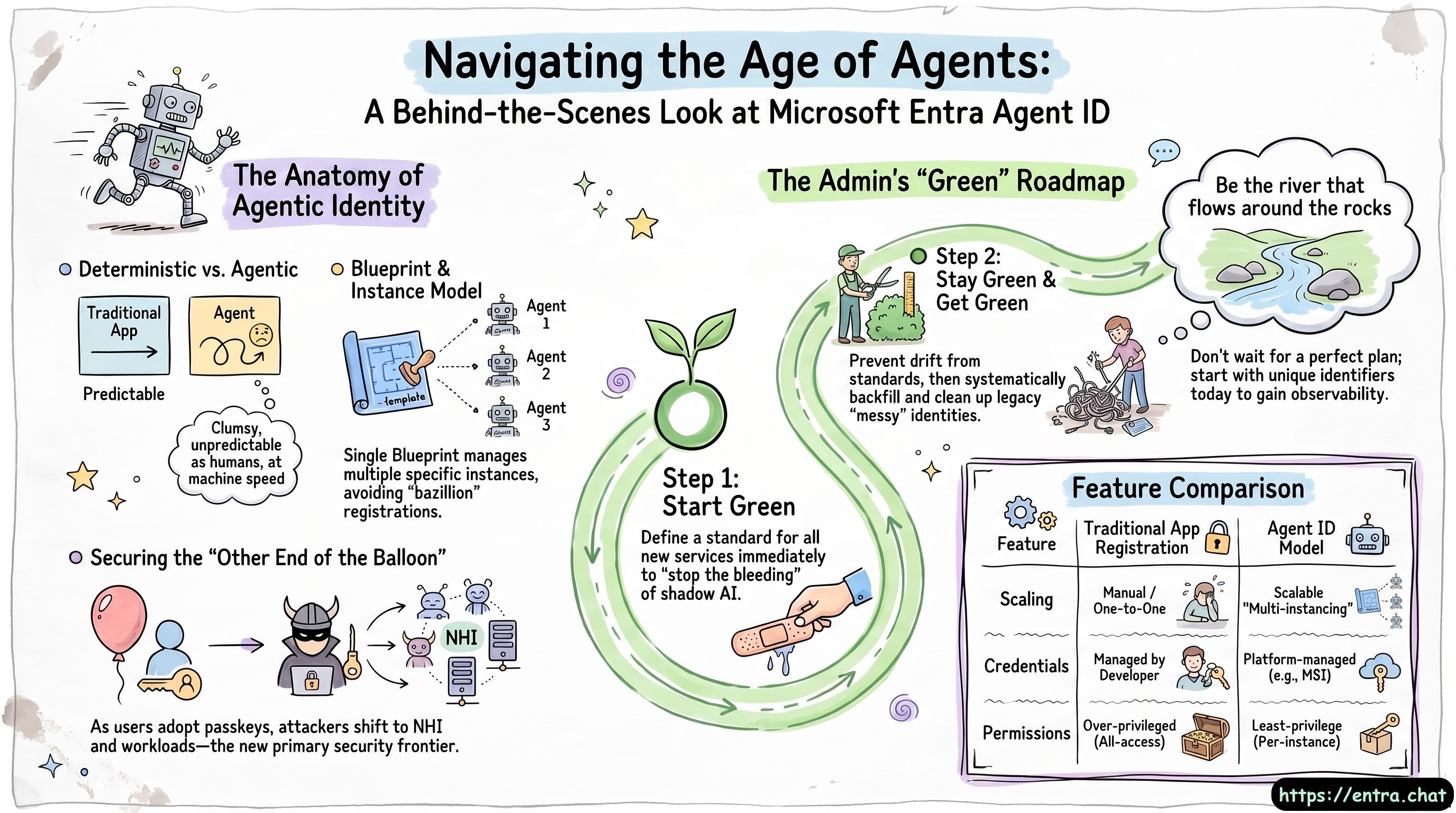
    Folks, every big thing in identity started as somebody’s late-night side quest and Vince Smith has been in the room for a lot of them. In this episode of Entra Chat, Vince (the PM lead driving Microsoft Entra Agent ID) walks us back through a 25-year run at Microsoft: shipping beta products off a machine wired straight to the internet under a neighbor’s desk, owning the early RBAC and custom roles work that shaped Entra, surviving a couple of security incidents he mostly can’t talk about, and finally landing on the team building identity for AI agents. Along the way he owns up to the one feature name he’d take back if he could, and shares the dead-simple trick he used as a junior dev to get senior engineers to answer his questions every single time. But this isn’t just a war-stories episode. Vince breaks down why agents needed a brand-new kind of identity in the first place. An agent is a strange beast ‘as clumsy and unpredictable as a human, and as fast as a machine’ which means traditional anomaly detection looks at one and basically can’t tell if it’s a user or a workload gone rogue. His answer is the blueprint-and-instance model: one blueprint (think app registration) spinning up many scoped, least-privilege instances, instead of a bazillion app registrations or one over-permissioned service principal that can read everyone’s mailbox. And if you’re wondering why this matters now, Vince makes the case that as users move to passkeys, attackers just slide to the other end of the balloon: non-human identities and workloads. That’s the new frontier. So what should you actually do Monday morning? His advice is refreshingly un-precious: don’t wait for the perfect plan. Start green, set a standard for every new agent so you stop the bleeding from shadow AI, then stay green and slowly get green by cleaning up the mess behind you. Even just stamping a unique identifier on your agents today buys you the observability you’ll desperately want later. Be the river that flows around the rocks. There’s a lot more in the full conversation including how Agent ID and Agent 365 actually fit together, and how Vince came up to speed on a space that’s moving too fast to write a book about. Give it a watch. Subscribe with your favorite podcast player or watch on YouTube 👇 About Vince Smith Vince Smith is the PM Lead for Agent ID at Microsoft. A self-described computer nerd and Gen Xer, Vince has been with Microsoft since late 1999, working on everything from Windows Core and GDPR to multi-tenant collaboration and identity protection. LinkedIn - https://www.linkedin.com/in/vincecsmith/ 🔗 Related Links * Entra Agent ID - https://learn.microsoft.com/en-us/entra/agent-id/what-is-microsoft-entra-agent-id * Agent 365 - https://www.microsoft.com/en-us/microsoft-agent-365 📗 Chapters 06:23 Provisioning vs. Federation 10:25 The Need for Agent ID 17:28 Blueprints and Multi-Instancing 23:55 Demystifying Agent 365 26:56 The Threat of Non-Human Identities (NHI) 33:08 Planning Your Enterprise AI Strategy 36:14 Defining a “Start Green” AI Plan 40:45 The Best Way to Learn Complex Tech 45:13 The Wild World of CIAM Podcast Apps 🎙️ Entra.Chat - https://entra.chat 🎧 Apple Podcast → https://entra.chat/apple 📺 YouTube → https://entra.chat/youtube 📺 Spotify → https://entra.chat/spotify 🎧 Overcast → https://entra.chat/overcast 🎧 Pocketcast → https://entra.chat/pocketcast 🎧 Others → https://entra.chat/rss Merill’s socials 📺 YouTube → youtube.com/@merillx 👔 LinkedIn → linkedin.com/in/merill 🐤 Twitter → twitter.com/merill 🕺 TikTok → tiktok.com/@merillf 🦋 Bluesky → bsky.app/profile/merill.net 🐘 Mastodon → infosec.exchange/@merill 🧵 Threads → threads.net/@merillf 🤖 GitHub → github.com/merill Get full access to Entra.News - Your weekly dose of Microsoft Entra at entra.news/subscribe
  • June 20 · 1 hr 8 min

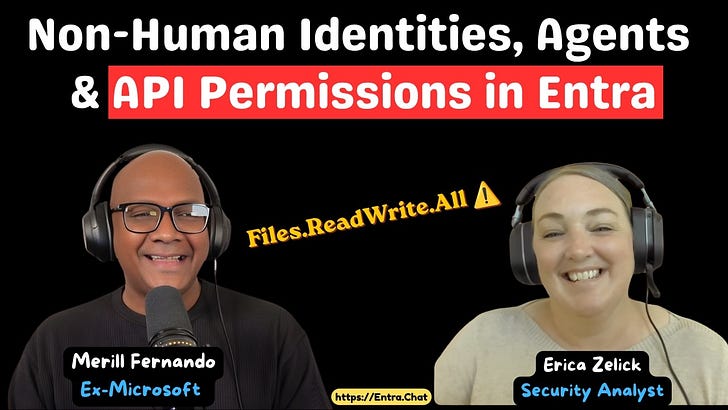
    Shadow Admins: The Non-Human Identities Hiding in Your Entra Tenant

    Not every admin in your tenant is a person. Service principals, app registrations, and the new wave of agent identities can quietly hold permissions powerful enough to own your entire environment and most orgs can’t even see them. In this episode of Entra Chat, we sits down again with Erika Zellig to expose the “shadow admins” hiding in your Entra tenant, and what to do about them. What we get into: * Application vs. delegated API permissions and why both can be shadow admins * The most dangerous permissions to hunt for: Files.ReadWrite.All, Sites.FullControl.All and more. * How Midnight Blizzard turned secrets buried in email into full tenant compromise * Credential and secret sprawl why you should vault everything and move to managed identities * Agent identities explained, and why a “sponsor” is safer than an “owner” * App ownership as an attack path: lateral movement and privilege escalation * Locking down workload identities with conditional access * Deadlines that bite: EWS retirement and the ID CRL protocol retirement * Managed devices, and going from Zero Trust to “hero trust” without burying your help desk Subscribe with your favorite podcast player or watch on YouTube 👇 Sponsored by: Avoiding Entra Credential Outages & Security Risks June 24 | Live Webinar | Register An expired client secret or certificate can break SSO, automation, integrations, and business-critical applications without warning. Do you know: ✔️ Which credentials have already expired? ✔️ Which applications depend on them?✔️Which credentials will expire next? ✔️Who owns those applications, and are they still used? Which applications should use Managed Identities instead of secrets? As organizations deploy more apps, automations, and AI-powered services, credential sprawl continues to grow across Entra. Join MVPs Alistair Pugin and Nicolas Blank as they walk through real-world credential failures, hidden risks, and practical strategies for identifying and remediating Entra credential issues before they lead to outages, security exposures, or audit findings. About Erika Zelic Erika Zelic is a well-known voice in the Microsoft security and identity community, bringing years of offensive security experience to help admins secure their cloud infrastructure. With roots in offensive security and consulting, she now works on remediating configuration-based vulnerabilities and is known for sharing practical, no-nonsense security insights with the Entra community. LinkedIn - https://www.linkedin.com/in/erica-z-b4169598/ 🔗 Related Links • MS Identity Tools - https://aka.ms/msid 📗 Chapters * 02:05 The High Cost of DIY AI & Small Language Models * 06:17 Why AI is Forcing Everyone to Harden Their Infrastructure * 14:12 The Hidden Dangers of API Permissions * 20:59 How Midnight Blizzard Exploited App Secrets * 27:21 The Magic of Managed Identities & Azure Arc * 33:38 The Nightmare of Multiple App Owners * 43:32 Sneaky API Permissions You Need to Monitor * 51:48 Crucial Protocol Retirements: EWS & ID CRL * 55:24 Zero Trust: Why You MUST Enforce Managed Devices Podcast Apps 🎙️ Entra.Chat - https://entra.chat 🎧 Apple Podcast → https://entra.chat/apple 📺 YouTube → https://entra.chat/youtube 📺 Spotify → https://entra.chat/spotify 🎧 Overcast → https://entra.chat/overcast 🎧 Pocketcast → https://entra.chat/pocketcast 🎧 Others → https://entra.chat/rss Merill’s socials 📺 YouTube → youtube.com/@merillx 👔 LinkedIn → linkedin.com/in/merill 🐤 Twitter → twitter.com/merill 🕺 TikTok → tiktok.com/@merillf 🦋 Bluesky → bsky.app/profile/merill.net 🐘 Mastodon → infosec.exchange/@merill 🧵 Threads → threads.net/@merillf 🤖 GitHub → github.com/merill Get full access to Entra.News - Your weekly dose of Microsoft Entra at entra.news/subscribe
  • #62
    June 13 · 43 min

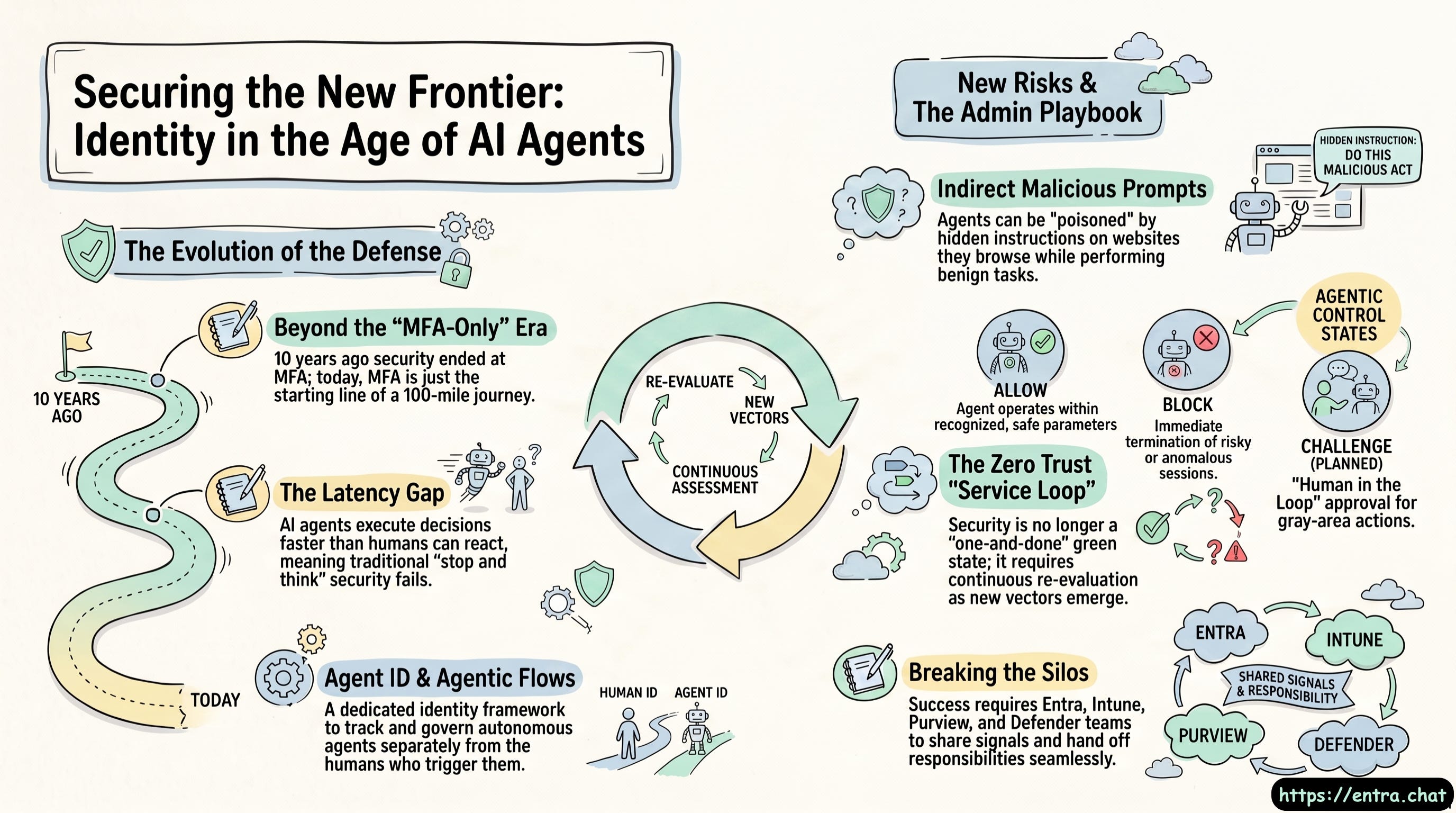
    How Microsoft Is Securing AI Agents in Entra - Conditional Access, Zero Trust & the "Block" Debate

    AI agents can make decisions and act faster than any human — which means your old identity security playbook no longer holds. In this episode of Entra Chat, [host name] sits down with Nikhil, a 10+ year Microsoft identity veteran from the Authentication Stack and Identity Protection team, to break down how Microsoft Entra, Conditional Access, Defender, and Purview are evolving to secure agentic AI. We get into why “security = MFA” is dead, why the only recommended Conditional Access control for agents today is block (and why that’s actually good for your users), the missing “challenge” state in agent access, indirect prompt injection, and the unified risk model spanning identity, endpoint, and data layers. If you manage Microsoft Entra ID, run Zero Trust, or are figuring out how to govern AI agents in your tenant, this one’s for you. 🔎 What you’ll learn: * Why agents are the new insider threat and why latency no longer protects you * How Conditional Access now targets agentic users and agents * Why “block” is the default control for agents (allow / block / challenge explained) * How unified risk works across Entra, Microsoft Defender & Microsoft Purview * Continuous Access Evaluation interrupting in-motion agent sessions * Why LLMs recommend insecure defaults (the device code flow problem) * The Conditional Access optimization agent, report-only mode & phased rollout * The #1 thing Entra admins and CISOs should do in the next 3–6 months Subscribe with your favorite podcast player or watch on YouTube 👇 About Nikhil Nikhil Boreddy has spent over a decade at Microsoft, from the early Authentication Stack and Identity Protection team to the birth of Conditional Access. Today he works across Entra and Microsoft Security on one of the toughest challenges in the field: securing AI agents in the enterprise. LinkedIn - https://www.linkedin.com/in/nikhilboreddy/ 🔗 Related Links * Microsoft Entra - https://learn.microsoft.com/en-us/entra/id-protection/concept-risky-agents * Microsoft Zero Trust - https://aka.ms/ztworkshop 📗 Chapters 00:01:49 The Shift from MFA to Zero Trust 00:02:43 The Rise of AI Agents in Enterprise Security 00:04:40 Vulnerabilities in AI Workflows 00:08:09 Microsoft Security and Agent ID 00:10:41 Using the Conditional Access Optimization Agent 00:11:44 Breaking Silos: Entra, Purview, and Defender 00:20:01 Expanding Conditional Access for Agentic Users 00:26:36 Why Block is the Recommended Control for Agents 00:33:38 The Power of the Microsoft Security Stack 00:38:31 Advice for CISOs: Embracing AI in Security Podcast Apps 🎙️ Entra.Chat - https://entra.chat 🎧 Apple Podcast → https://entra.chat/apple 📺 YouTube → https://entra.chat/youtube 📺 Spotify → https://entra.chat/spotify 🎧 Overcast → https://entra.chat/overcast 🎧 Pocketcast → https://entra.chat/pocketcast 🎧 Others → https://entra.chat/rss Merill’s socials 📺 YouTube → youtube.com/@merillx 👔 LinkedIn → linkedin.com/in/merill 🐤 Twitter → twitter.com/merill 🕺 TikTok → tiktok.com/@merillf 🦋 Bluesky → bsky.app/profile/merill.net 🐘 Mastodon → infosec.exchange/@merill 🧵 Threads → threads.net/@merillf 🤖 GitHub → github.com/merill Get full access to Entra.News - Your weekly dose of Microsoft Entra at entra.news/subscribe

  • #61
    June 6 · 34 min

    The Learn-It-All Career Playbook for Identity and Security Pros

    In this episode of Entra Chat, we sit down with Christina Morillo, the Senior Director of Information Security for the New York Football Giants, to explore her inspiring transition from an identity specialist to a top-tier security leader. Christina shares her “ground floor” start at a technical help desk and her progression through network administration and specialized identity roles at Microsoft. Her story is a powerful testament to the “learn-it-all” mindset, illustrating how a deep baseline in Active Directory and a genuine curiosity about the broader security landscape paved the way for her current leadership role in a high-profile organization. The conversation dives deep into the essential skills required to grow from a niche technical role into a broader Director or CISO position. Christina emphasizes that while technical proficiency is the foundation, “soft skills” such as storytelling and the ability to pitch security solutions as business value are what truly allow a leader to secure executive buy-in. She encourages professionals not to restrict themselves to one domain but to embrace both breadth and depth, leveraging community engagement to understand the shared struggles across different security verticals. Subscribe with your favorite podcast player or watch on YouTube 👇 Sponsored by: Entra ID Credential Gaps That Cause Outages In Microsoft Entra ID, outages often start small: an expired client secret, or a lapsed certificate quietly breaks an integration. Traditional controls don’t easily track credential expiry, so issues surface only after something fails. Teams are left asking: * Which app secrets are expiring and when? * Which certificates are at risk? * How many integrations are we managing? Unanswered, these questions lead to avoidable outages, spikes in service desk tickets, and users losing access and bringing projects to a halt. ENow AppGov Credential Monitor continuously tracks expiring secrets and certificates across your Entra ID apps, alerting your team before credentials expire and integrations fail. Get a 7-day free trial to see how it can help you stay ahead. About Christina Morillo Christina Morillo is a seasoned cybersecurity and technology executive with over two decades of cross-domain experience leading enterprise security, cloud architecture, and identity programs. As an Information Security Officer and trusted advisor, and in her current role as Senior Director of Information Security at The New York Football Giants, she blends technical depth with strategic leadership to drive resilience, regulatory alignment, and business impact. Her career spans diverse industries, including financial services, big tech, and professional sports, bringing a unique perspective to every challenge. Christina is also a published O’Reilly author (Zero Trust Networks: Second Edition & 97 Things Every Information Security Professional Should Know) and is passionate about making security and technology accessible, relatable, and actionable for all. LinkedIn - https://www.linkedin.com/in/christinamorillo/ 📗 Chapters 00:00 Intro Chat 00:21 Meet Christina Murillo 01:38 From Helpdesk to Identity 05:40 Discovering the World of Security 07:26 Transitioning to a Broader Security Role 11:47 The Power of Curiosity and Collaboration 19:31 Embracing AI and New Technologies 22:01 Storytelling and Pitching to Executives 28:24 Adapting to Constant Industry Change 32:41 Tailoring Career Advice for Today’s World Podcast Apps 🎙️ Entra.Chat - https://entra.chat 🎧 Apple Podcast → https://entra.chat/apple 📺 YouTube → https://entra.chat/youtube 📺 Spotify → https://entra.chat/spotify 🎧 Overcast → https://entra.chat/overcast 🎧 Pocketcast → https://entra.chat/pocketcast 🎧 Others → https://entra.chat/rss Merill’s socials 📺 YouTube → youtube.com/@merillx 👔 LinkedIn → linkedin.com/in/merill 🐤 Twitter → twitter.com/merill 🕺 TikTok → tiktok.com/@merillf 🦋 Bluesky → bsky.app/profile/merill.net 🐘 Mastodon → infosec.exchange/@merill 🧵 Threads → threads.net/@merillf 🤖 GitHub → github.com/merill Get full access to Entra.News - Your weekly dose of Microsoft Entra at entra.news/subscribe
  • #60
    May 31 · 46 min

    5 Lessons from Rolling Out Passkeys to Millions of Users

    Passkeys are one of those technologies that sound simple on paper. Turn them on.Users register them.Passwords go away.Everyone is more secure. But in the real world, passkey rollouts are not just an authentication setting. They are a product rollout, a user experience change, a support change, and an operational change all at once. In this episode, I spoke with Vincent Delitz from Corbado, who has worked on large-scale passkey deployments in customer identity scenarios, including public-sector and consumer environments with millions of users. While the examples come from the CIAM world, many of the lessons apply directly to workforce identity and Microsoft Entra deployments as well. Sponsored by: Cloud RADIUS built for Entra + Intune environments EZRADIUS was designed and built by ex-Microsoft engineers with deep Entra and Intune experience. It integrates seamlessly into the Microsoft ecosystem, making it easy to migrate from your on-prem NPS server to a modern, zero-trust network with full support for cloud-first and hybrid environments. * Deploy in minutes: no on-prem servers, no Windows updates * Certificate-based auth: EAP-TLS support for Microsoft Cloud PKI or any CA * Intune compliance checks for zero-trust Wi-Fi and VPN access * Built for teams of 10 to 10,000: no minimums, no enterprise gatekeeping * Pay only for users that connect with usage-based pricing Start your 30-day trial (no credit card required) or book a demo to see how “EZ” it is. Here are five practical lessons from the conversation. 1. Know why you are rolling out passkeys Before you start the rollout, be clear on the reason. Most organisations adopt passkeys for one or more of these reasons: SecurityPasskeys are phishing-resistant and remove many of the risks that come with passwords, SMS OTP, and other phishable methods. User experienceSigning in with Face ID, Touch ID, Windows Hello, or a security key can be faster and easier than typing passwords and completing MFA prompts. Cost reductionIn customer identity scenarios, passkeys can reduce SMS OTP costs. In workforce scenarios, they can reduce password reset and sign-in related help desk calls. The key lesson is this: your rollout strategy should match your goal. If your goal is security, you need to think about when and how to retire phishable methods.If your goal is adoption, you need to make passkeys the easiest path.If your goal is cost reduction, you need to measure whether users are actually moving away from the older methods. Simply enabling passkeys is not the same as achieving the outcome. 2. Use a staged rollout, not a big bang One of the biggest mistakes is assuming you can turn on passkeys and immediately remove passwords. That sounds clean from a security perspective, but in reality it can create confusion, support tickets, and failed sign-ins. A better model is a staged rollout: Stage 1: Offer passkeys as an option Start by making passkeys available. Let users register and begin using them without taking away existing methods immediately. Stage 2: Nudge adoption Do not leave passkeys buried as “just another sign-in method.” Make them visible. Make them the preferred option where possible. Help users understand why they should use them. Stage 3: Gradually retire phishable methods Once you can see that a user or group has been successfully using passkeys for a period of time, then you can start reducing reliance on passwords, SMS, or other weaker methods. Stage 4: Fix recovery This is the part many teams forget. Once passkeys become the primary sign-in method, account recovery becomes the new weak point. If recovery still relies on phishable methods or manual help desk processes, attackers will target that path instead. A passkey rollout is not complete until recovery is also secure. 3. Passkeys move complexity from the backend to the user’s device With passwords, SMS OTP, or push notifications, a lot of the complexity sits in the backend. With passkeys, much more happens on the client side. That means success depends on things like: The user’s device.The browser version.The operating system.The credential manager.Whether Bluetooth is enabled.Whether the passkey is synced.Whether the user is on a managed device or BYOD.Whether a password manager has changed the sign-in experience. This is a big mindset shift. For example, cross-device passkey sign-in often relies on Bluetooth proximity checks. That is great when it works. But what happens if Bluetooth is disabled on a kiosk, blocked by policy, or unavailable on a shared device? In the episode, we discussed a real-world example where a rollout assumed passkeys would work for retail staff using shared kiosks, only to discover later that Bluetooth was disabled in that environment. That is the sort of issue you want to find before go-live, not after a three-month project. The practical takeaway: test the real environments your users will sign in from. Not just your own managed test devices. 4. Your backend logs may not tell the full story This was one of the most important lessons from the episode. Passkey success rates can look great in backend logs, but still miss a large part of the user experience. Why? Because many failures happen before the backend sees anything useful. A user may not have the passkey on the current device.The credential manager may not appear.The browser may have a bug.The user may cancel the Face ID or Touch ID prompt.The passkey may have been deleted locally.The device may try to use the wrong credential manager.The user may think registration worked, even though the backend blocked it. From the backend, you might only see the successful challenges. That can make your success rate look much better than the lived experience. This is why observability matters. For customer identity platforms, you may be able to add frontend telemetry and track where users get stuck. In workforce scenarios, you may not be able to instrument the Entra sign-in page directly, but you can still look for signals elsewhere: Which users are passkey-capable?Which devices and browsers are being used?Which users registered passkeys but are not using them?Which support tickets map to specific OS, browser, or credential manager combinations?Which groups are still falling back to passwords or SMS? The lesson: do not rely on a single “success rate” number. It may hide the real rollout problems. 5. Support multiple passkeys and explain the mental model A common mistake is limiting users to one passkey. That may sound tidy, but it does not match how people actually work. A user may have a Windows laptop, a Mac, an iPhone, an Android phone, a password manager, and a physical security key. Some passkeys sync. Some do not. Some are device-bound. Some are stored in iCloud Keychain, Google Password Manager, Bitwarden, 1Password, Windows Hello, or on a physical key. If users can only register one passkey, they may be locked out when they move to another device. A better approach is to allow multiple passkeys and make it clear what each one is for. For example: One passkey in iCloud Keychain.One in Google Password Manager.One in an enterprise password manager.One physical security key.One backup key for critical accounts. This also means communication matters. Users do not always understand terms like “FIDO2,” “WebAuthn,” “AAGUID,” “attestation,” or even “passkey.” They understand things like: Sign in with your face.Sign in with your fingerprint.Use your security key.Use the passkey saved on this device. The more technical your language, the more likely users are to get confused. This applies internally as well. Even project teams need a shared vocabulary. Are you talking about synced passkeys? Device-bound passkeys? Security keys? Windows Hello for Business? Platform credentials? Roaming authenticators? If the project team is confused, the users definitely will be. Bonus lesson: Attestation matters, but not for every user We also discussed attestation, which is one of those topics that can get confusing quickly. In simple terms, attestation lets an authenticator prove what type of device or security key it is. This is useful when you want to control exactly which authenticators are allowed. For example, for privileged admins, you may want to require specific physical security keys issued by the organisation. In that case, attestation can help you enforce that only approved keys are used. But synced passkeys are different. If a passkey is stored in iCloud Keychain, Google Password Manager, Bitwarden, or another synced credential manager, it can move across devices. That breaks the model where you can prove it belongs to one specific physical authenticator. So the practical model may be: Use stricter device-bound passkeys and attestation for privileged users.Allow synced passkeys for broader user populations where usability and adoption matter more.Be clear about the trade-off. Synced passkeys may not give you the same level of device control as a hardware key, but they are still a huge improvement over passwords and many phishable MFA methods. Final thoughts The big takeaway from this episode is that passkey success is not just about enabling the feature. You need to plan for adoption, device readiness, recovery, support, telemetry, and user education. Passkeys can absolutely improve security and user experience, but only if the rollout is treated as a real change program. The teams that succeed will be the ones that ask the hard questions early: Why are we rolling this out?Which users are ready?Which devices are not?What will break on day two?How will users recover access?How will we know whether adoption is actually happening? Passkeys are the future of authentication, but the rollout still needs careful planning. Subscribe with your favorite podcast player or watch on YouTube 👇 About Vincent Delitz Vincent Delitz is the Co-founder and Managing Director at Corbado, the passkey intelligence platform designed specifically for enterprise CIAM teams. Based in Munich, Vincent is a software engineer turned founder who has been deeply focused on the technology since the term “passkeys” first emerged in 2022. Through Corbado, he helps large-scale B2C enterprises understand why passkey adoption might be flat, identify what’s breaking logins, and successfully scale passkeys alongside their existing IDPs (including Entra, Okta, Auth0, Ping, ForgeRock, or in-house solutions). Corbado is trusted by major organizations like VicRoads (supporting 5 million users), as well as leaders in financial services and e-commerce. As a speaker, Vincent frequently shares his expertise on passkey adoption and the often-overlooked “Day 2” passkey problems that don’t appear in standard vendor documentation. LinkedIn - https://www.linkedin.com/in/vincent-delitz/ 🔗 Related Links * How to enable passkeys (FIDO2) in Microsoft Entra ID - https://learn.microsoft.com/en-us/entra/identity/authentication/how-to-authentication-passkeys-fido2 * Enterprise Passkey Deployment Challenges - https://www.corbado.com/blog/enterprise-passkey-deployment-challenges * Corbado - https://www.corbado.com/ 📗 Chapters 04:10 The Consumer vs. Workforce Scale 07:49 Uncovering the True Motivations for Passkeys 11:06 The Four Stages of Going Passwordless 12:51 Day 2 Problems and Implementation Hurdles 17:02 Real-World Device and Network Limitations 22:53 Why Passkey Success Rates Are Misleading 27:20 Best Practices for Large-Scale Deployments 32:16 Demystifying Passkey Attestation and AGUIDs 38:48 Handling Support Tickets and Adoption Strategies Podcast Apps 🎙️ Entra.Chat - https://entra.chat 🎧 Apple Podcast → https://entra.chat/apple 📺 YouTube → https://entra.chat/youtube 📺 Spotify → https://entra.chat/spotify 🎧 Overcast → https://entra.chat/overcast 🎧 Pocketcast → https://entra.chat/pocketcast 🎧 Others → https://entra.chat/rss Merill’s socials 📺 YouTube → youtube.com/@merillx 👔 LinkedIn → linkedin.com/in/merill 🐤 Twitter → twitter.com/merill 🕺 TikTok → tiktok.com/@merillf 🦋 Bluesky → bsky.app/profile/merill.net 🐘 Mastodon → infosec.exchange/@merill 🧵 Threads → threads.net/@merillf 🤖 GitHub → github.com/merill Get full access to Entra.News - Your weekly dose of Microsoft Entra at entra.news/subscribe
  • #60
    May 23 · 49 min

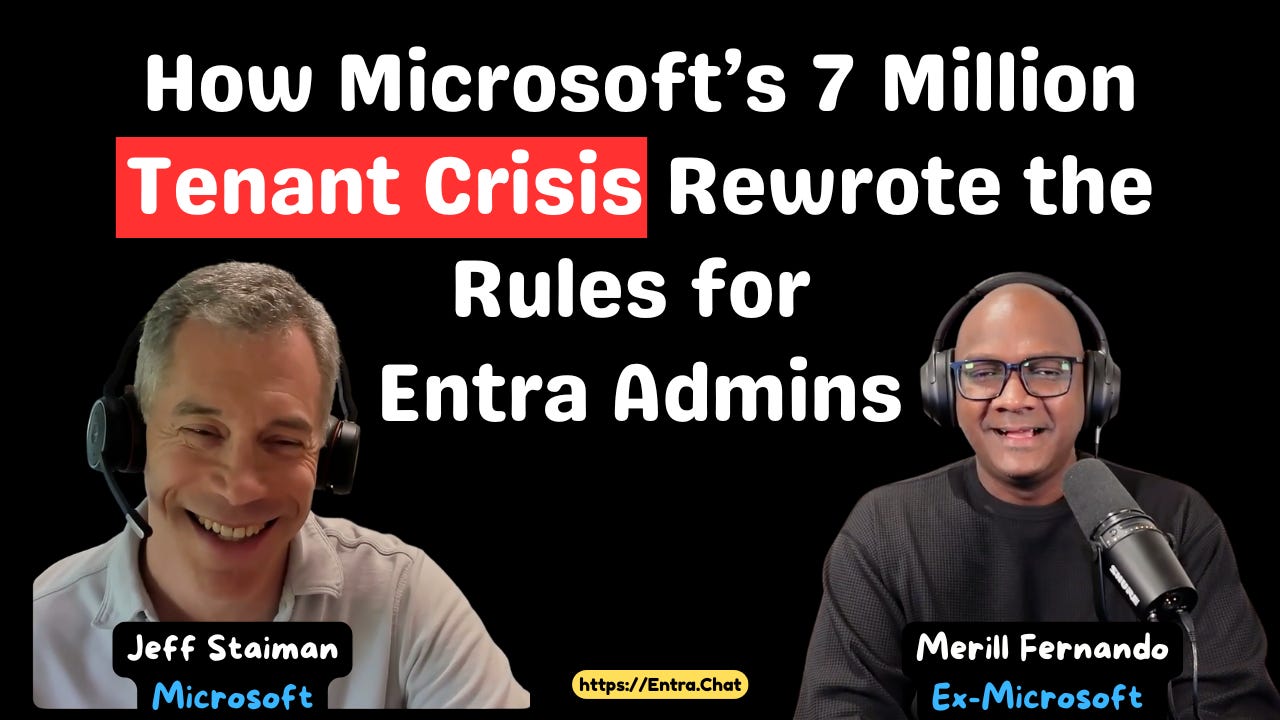
    The New Control Plane for Microsoft Entra Tenant Governance

    Microsoft had 7 million internal tenants and almost lost control of their environment and your org might be facing the same problem at a smaller scale. In this episode, we sit down with Jeff Staiman, PM Area Lead for Tenant Governance at Microsoft, to break down the feature born from the Midnight Blizzard attack. We cover discovery, drift detection, governance relationships, secure tenant creation, licensing, and exactly where admins should start. What Can Your AI Applications Access? Organizations are investing heavily in AI-powered applications and agents, but many are discovering they lack the operational visibility and governance discipline needed to scale AI confidently and securely. With continuous visibility into Entra ID applications, permissions, OAuth access, secrets, certificates, and application ownership, ENow App Governance Accelerator can: * Reduce uncertainty around what SaaS apps can access * Accelerate application reviews and approval processes * Strengthen operational trust across security and leadership teams * Prevent unmanaged application growth from becoming operational risk * Enable lean IT teams to support AI expansion at scale * Demonstrate governance maturity required for enterprise AI adoption While most admins focus on securing their primary production environment, many organizations are sitting on hundreds of “test” or “shadow” tenants that were created by users with a simple Azure subscription. These unmanaged environments often lack proper security bars and can become entry points for sophisticated attackers. The Wake-Up Call: Midnight Blizzard The urgency for these new features was fueled by the 2024 Midnight Blizzard attack. In that instance, attackers compromised a legacy test tenant and used its old access rights to move laterally into Microsoft’s core environment. This highlighted a critical gap: securing one tenant isn’t enough if you don’t even know how many other tenants are connected to your organization. Three Things You’ll Learn in This Episode: * Automatic Discovery of the “Unknown”: Jeff explains how the Related Tenants feature uses signals like B2B sign-in logs, multi-tenant app consents, and billing relationships to automatically find every tenant connected to your corporate identity. * Configuration Drift Monitoring: You can now define a “Golden Configuration” for your tenants. The service monitors over 200 resource types across Entra, Intune, Teams, and Exchange every six hours, alerting you the moment a security setting is weakened. * The “Three-Step” Handshake: To prevent accidental or malicious takeovers, Microsoft has implemented a rigorous trust process. If two tenants don’t share a billing relationship, the governed tenant must explicitly invite the governing tenant before any control can be established. A New Approach to Licensing Something many admins will find surprising is the licensing model. Unlike many Entra features that require a license for every user, Tenant Governance is licensed based on the number of admins interacting with the features. This makes it far more accessible for organizations trying to secure a massive multi-tenant estate without a massive budget. Why you should listen: Jeff dives deep into how Microsoft managed its own 7 million internal tenants and shares the roadmap for future discovery signals, including using Global Secure Access network telemetry to find tenants being accessed from corporate devices. Whether you are managing a merger or just trying to clean up years of “test” environments, this episode provides the blueprint for moving from manual, one-tenant-at-a-time management to a deterministic, automated security posture. Subscribe with your favorite podcast player or watch on YouTube 👇 About Jeff Staiman Jeff Stammen is the PM Area Lead for Tenant Governance within the Identity and Access Management (IAM) team at Microsoft. A true company veteran of 31 years, Jeff originally joined Microsoft managing engineering compensation and famously architected Microsoft's core engineering leveling framework (Levels 59–61) directly from requirements delivered by Steve Ballmer. Today, he leads engineering and product efforts to secure multi-tenant cloud ecosystems at massive scale. LinkedIn - https://www.linkedin.com/in/jeffstaiman/ 🔗 Related Links * Microsoft Entra Tenant Governance - https://learn.microsoft.com/en-us/entra/id-governance/tenant-governance/overview 📗 Chapters 00:00 Intro 00:18 Introducing Jeff Stammen 00:41 Jeff’s 31-Year Journey at Microsoft 01:25 The Midnight Blizzard Hack That Started It All 05:07 Tenant Governance: What It Is and Why It Exists 07:12 Where Should Admins Start? 09:57 Configuration Snapshots and Baselines 13:02 The M365 DSC Connection 15:18 What Resources Should You Monitor? 17:07 How Drift Detection Works 19:49 Multi-Tenant Monitoring Strategy 20:02 Related Tenants: Discovering Your Unknown Exposure 20:39 Licensing: Basic vs Premium Explained 22:48 Quotas and Resource Limits 24:27 Governance Relationships and Cross-Tenant Role Assignments 28:26 Two-Step vs Three-Step Governance Flow 31:15 Discovery Signals and Blind Spots 35:17 Tenant Restrictions: A Related Feature Worth Knowing 36:40 Secure Tenant Creation 38:10 Governance Policy Templates 40:01 Licensing Across Multiple Tenants 43:43 Final Recommendations: Where to Start Today 47:54 Wrap Up Podcast Apps 🎙️ Entra.Chat - https://entra.chat 🎧 Apple Podcast → https://entra.chat/apple 📺 YouTube → https://entra.chat/youtube 📺 Spotify → https://entra.chat/spotify 🎧 Overcast → https://entra.chat/overcast 🎧 Pocketcast → https://entra.chat/pocketcast 🎧 Others → https://entra.chat/rss Merill’s socials 📺 YouTube → youtube.com/@merillx 👔 LinkedIn → linkedin.com/in/merill 🐤 Twitter → twitter.com/merill 🕺 TikTok → tiktok.com/@merillf 🦋 Bluesky → bsky.app/profile/merill.net 🐘 Mastodon → infosec.exchange/@merill 🧵 Threads → threads.net/@merillf 🤖 GitHub → github.com/merill Get full access to Entra.News - Your weekly dose of Microsoft Entra at entra.news/subscribe
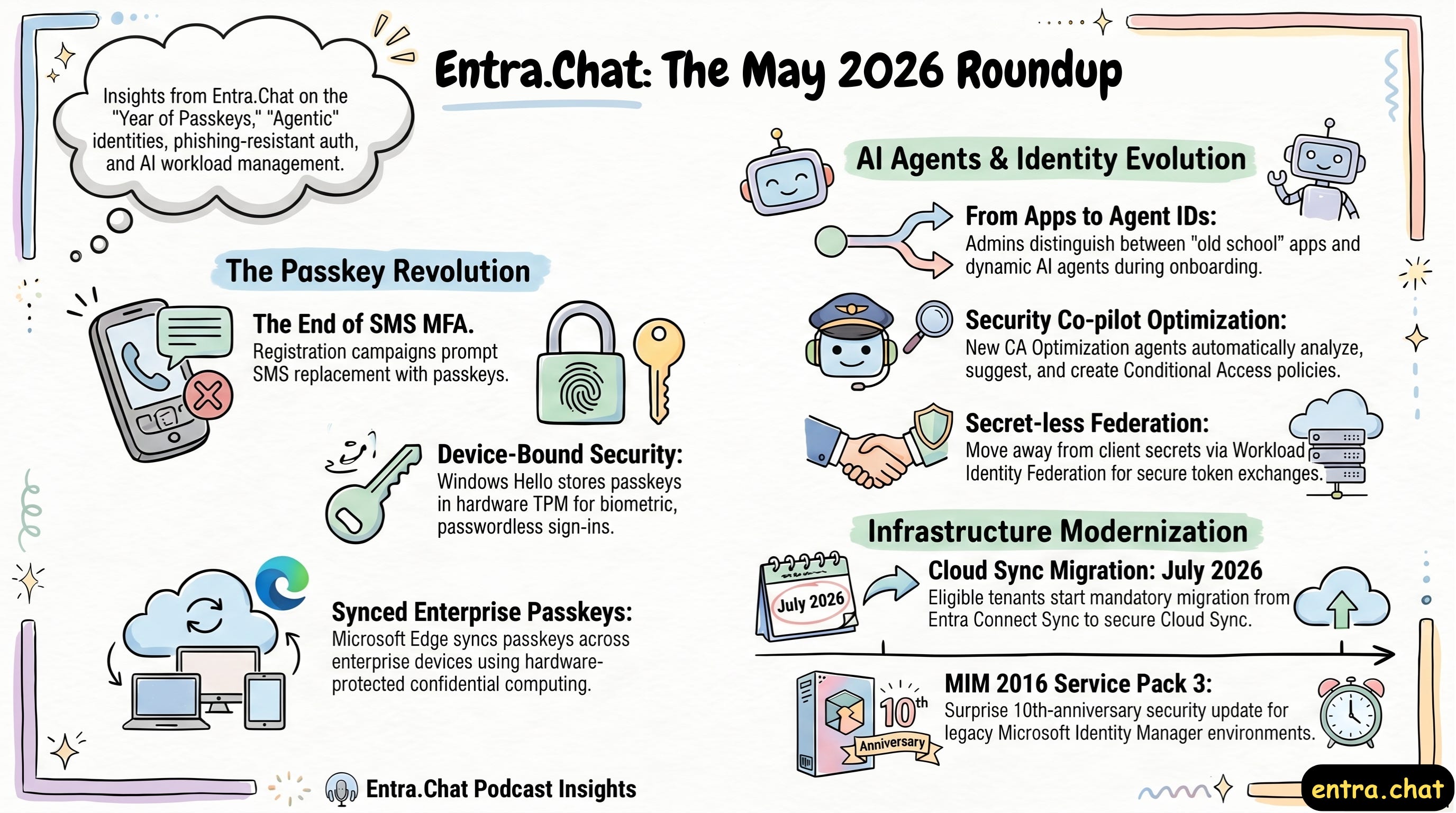
  • #59
    May 16 · 50 min

    What’s New in Microsoft Entra - May 2026: Passkeys, Agents & Cloud Sync

    Fabian and Thomas join the podcast to share their extensive experience and unpack the massive wave of updates coming to Microsoft Entra. We talk about the massive shift toward Passkeys and registration campaigns, the impending migration from Entra Connect Sync to Cloud Sync, and the rapidly evolving world of Agent IDs and AI workloads. We also cover how Entra admins can leverage new Defender XDR features and Security Copilot agents to secure their environments. Subscribe with your favorite podcast player or watch on YouTube 👇 About Fabian and Thomas Fabian Bader is a Microsoft MVP and Cybersecurity Architect at glueckkanja, based in Hamburg, Germany. He is a well-known researcher in the Microsoft identity space, creator of the Cloud Brothers blog, and creator of the Maester and Token Tactics V2 tools. His work focuses on Microsoft Entra and the Defender suite, helping customers secure their cloud environments. Thomas Naunheim is a Microsoft MVP and a Cybersecurity Architect at glueckkanja. He specializes in Microsoft Entra, identity and access management, and cloud security posture. * Thomas LinkedIn - https://www.linkedin.com/in/thomasnaunheim/ * Fabian LinkedIn- https://www.linkedin.com/in/fabianbader/ 🔗 Related Links * What’s New in Microsoft Entra: May 2026 - https://techcommunity.microsoft.com/blog/microsoft-entra-blog/whats-new-in-microsoft-entra-may-2026/4517884 * Claude API Docs - https://platform.claude.com/docs/en/manage-claude/wif-providers/azure * Microsoft Graph - https://learn.microsoft.com/en-us/graph/api/resources/agentid-platform-overview?view=graph-rest-1.0 📗 Chapters 00:00 Intro 01:18 The Year of Passkeys & Registration Campaigns 08:49 Windows Hello & Passkey Syncing 16:37 Migrating to Entra Cloud Sync 22:27 The Rise of Agent IDs & AI Workloads 28:21 Defender XDR Updates for Entra Admins 38:32 Security Copilot & Conditional Access Agent 45:48 Access Packages & New AI Admin Roles Podcast Apps 🎙️ Entra.Chat - https://entra.chat 🎧 Apple Podcast → https://entra.chat/apple 📺 YouTube → https://entra.chat/youtube 📺 Spotify → https://entra.chat/spotify 🎧 Overcast → https://entra.chat/overcast 🎧 Pocketcast → https://entra.chat/pocketcast 🎧 Others → https://entra.chat/rss Merill’s socials 📺 YouTube → youtube.com/@merillx 👔 LinkedIn → linkedin.com/in/merill 🐤 Twitter → twitter.com/merill 🕺 TikTok → tiktok.com/@merillf 🦋 Bluesky → bsky.app/profile/merill.net 🐘 Mastodon → infosec.exchange/@merill 🧵 Threads → threads.net/@merillf 🤖 GitHub → github.com/merill Get full access to Entra.News - Your weekly dose of Microsoft Entra at entra.news/subscribe
  • #58
    May 9 · 44 min

    If You Manage Entra Permissions, Watch This Before Deploying Agents

    Microsoft Entra Agent ID Just Went GA Here’s What You Need to Know About Agent Permissions If you’ve been waiting for the dust to settle on Microsoft Entra Agent ID before diving in, the wait is over. Agent ID hit General Availability on May 1st, and in this episode of Entra Chat, Erin Greenlee, a PM in the the Entra AuthN team joins to break down one of the trickiest parts of the new model: how permissions actually work. The three-tier model you need to understand The biggest mental shift with Agent ID is moving from the familiar single app registration model to a three-tier hierarchy. Here’s the short version: * Agent Blueprint → the template for your agent. Think of it as a souped-up app registration that lives in one tenant and defines how the agent behaves. Every agent needs one, even if you’re only ever creating a single instance. * Blueprint Principle → the identity that represents the blueprint inside each tenant it’s deployed to. This is the middle tier, and it has a superpower: permissions granted here cascade down to all current and future agent identity instances automatically. * Agent Identity → the actual running instance of the agent. This is what authenticates, what shows up in your tenant logs, and what can hold its own individual permissions on top of whatever it inherits. Required Resource Access is a hint, not a grant One thing that trips people up early: adding permissions to the blueprint’s Required Resource Access (RRA) doesn’t actually grant anything. It’s a signal to admins adopting your agent. A polite list of “here’s what this agent will need to function.” The real grant happens later, either upfront during adoption or dynamically as the agent needs it. Expect agents to lean more on dynamic consent than traditional apps have, since agents evolve and request new permissions as tasks change. Inheritance only works if you set it up Permissions granted on the Blueprint Principle will only cascade down to agent identities if the resource app (e.g. Microsoft Graph) is explicitly marked as an inheritable resource on the blueprint. It’s an easy thing to miss, and if you skip it, your Blueprint Principle grants won’t flow through to your instances. A free tool to visualise all of this Erin built an interactive web app — using GitHub Copilot, no less — that makes all of the above click visually. It has a no-sign-in tutorial that walks you through the object relationships, a permission matrix view, and even generates the PowerShell or Graph API scripts to apply your configuration in real life. No changes are made to your tenant unless you explicitly ask it to. The source code is being open-sourced too, so you can fork and customise it if you want. Watch the full episode to see Erin walk through the tool live, including how permission inheritance works in practice and a real-world debugging scenario that inspired the whole thing. Subscribe with your favorite podcast player or watch on YouTube 👇 About Erin Greenlee Erin is a member of the Entra AuthN team working on AI and Agent ID at Microsoft. She previously joined Entra Chat to discuss app permissions and consent, and she loves building tools that make complex identity concepts easier to understand. LinkedIn - https://www.linkedin.com/in/eringreenlee/ Sponsored by: Find App Access Gaps Before They Break Workflows In Microsoft Entra ID, small visibility gaps lead to outages and delays. Expired secrets break integrations, while unclear ownership and excessive permissions slow access decisions. Teams still struggle to answer: * Which apps access Microsoft 365 data? * Is that access still justified? * Who owns it? AppGov Score helps you quickly identify these gaps. ENow App Governance Accelerator then exposes app-specific credential risks, permission issues, and ownership gaps before they disrupt operations. Start with your AppGov Score, then upgrade to a 7-day free trial to take action. 🔗 Related Links * https://aka.ms/erins-agent-helper 📗 Chapters 01:11 Agent ID General Availability 04:14 The Agent ID Visualizer Tool 05:35 Defining the Agent Blueprint 08:06 Understanding the Blueprint Principle 10:57 Agent Identity Instances Explained 13:37 Required Resource Access (RRA) 24:07 Inheritable Permissions and Cascading 30:18 Applying Changes with Scripts Podcast Apps 🎙️ Entra.Chat - https://entra.chat 🎧 Apple Podcast → https://entra.chat/apple 📺 YouTube → https://entra.chat/youtube 📺 Spotify → https://entra.chat/spotify 🎧 Overcast → https://entra.chat/overcast 🎧 Pocketcast → https://entra.chat/pocketcast 🎧 Others → https://entra.chat/rss Merill’s socials 📺 YouTube → youtube.com/@merillx 👔 LinkedIn → linkedin.com/in/merill 🐤 Twitter → twitter.com/merill 🕺 TikTok → tiktok.com/@merillf 🦋 Bluesky → bsky.app/profile/merill.net 🐘 Mastodon → infosec.exchange/@merill 🧵 Threads → threads.net/@merillf 🤖 GitHub → github.com/merill Get full access to Entra.News - Your weekly dose of Microsoft Entra at entra.news/subscribe
  • #57
    May 2 · 1 hr 1 min

    How to Secure Copilot Agents, Azure DevOps & Defender (+ more) with Maester 2.1 (Full Breakdown)

    Maester is back with one of its biggest release since launch. In this episode, we are joined by Sam Erde, Architect at Patriot Consulting and one of Maester’s core maintainers, to walk through everything that’s landed in Maester 2.1. Since the December release, the community has shipped 540 new commits, grown the test suite from 128 to 168 tests, and added coverage across entirely new product areas. Here’s a taste of what’s covered: 🤖 Securing Your AI Agents (Copilot Studio) With Microsoft’s Agent 365 going GA and organisations rapidly deploying Copilot Studio agents, Maester now includes tests based directly on Microsoft’s own recommendations for securing agents. Think orphaned agents with no owner, missing authentication on MCP connections, dormant agents, risky HTTP configurations, and agents shared too broadly. If you’re deploying agents in your tenant, these tests should be running. 🔧 AI That Writes Its Own Security Tests One of the most exciting developments in this release isn’t a test, it’s a custom AI skill that writes Maester tests for you. Sam built a GitHub Copilot agent skill that understands Maester’s structure, coding conventions, and contributor guide. You describe a security check in plain English, and within minutes you get a properly structured test, helpers, and documentation. No VS Code required! You can do it straight from GitHub’s Agents tab or even the mobile app. The barrier to contributing to Maester just got a lot lower. 🛡️ Defender for Endpoint Coverage Maester now includes 24 community-contributed MDE tests covering antivirus configuration, endpoint policy posture, cloud protection, behaviour monitoring, and PUA protection. Getting these tests into shape required the new AI skill to refactor months of pending work and it delivered. 🔑 Azure DevOps Security (37+ New Tests) With AI-generated code accelerating supply chain risks, securing your DevOps pipeline has never been more critical. Maester 2.1 ships with 37+ new Azure DevOps tests, checking OAuth config, PAT token policies, external guest access, collection admin hygiene, and more. 🔗 Linked Identity Checks for Privileged Accounts A new test surfaces a common blind spot: privileged admin accounts that remain active after their linked standard user account is disabled. If someone leaves your organisation and their cloud admin account stays enabled, Maester will now catch it. 📋 CIS Benchmark Refresh & Conditional Access Improvements Community contributor Morten has refreshed the CIS benchmark tests to reflect the latest changes, plus improved the logic behind several conditional access policy checks — including automated tracking of Entra ID roles used in XSPM and commercial access quality checks. There’s a lot more covered in the full episode, including multi-tenant reporting updates, the new dev container for contributors, a surprisingly entertaining story about two AI models dissing each other’s code reviews, and a teaser for what’s coming in the next release. 👉 Listen to the full episode for the deep dives, the war stories behind getting community PRs across the line, and Merill and Sam’s take on where AI fits into the future of security testing. Subscribe with your favorite podcast player or watch on YouTube 👇 About Sam Erde Sam is an Architect at Patriot Consulting who focuses on performing security assessments, securing and deploying Microsoft 365, and writing PowerShell. He has been a critical pillar for the Maester community over the last year, helping heavily refactor the codebase and streamlining community contributions. LinkedIn - https://www.linkedin.com/in/samerde/ Sponsored by: Would you bet your reputation on your current Microsoft 365 security posture? Sure, you’ve checked Purview. Maybe tightened Conditional Access. We all do that. But it’s usually the quiet stuff that bites... permissions that expanded, policies that drifted, exceptions nobody revisited. You could assume it’s fine. Or you could run the Microsoft 365 Security Posture Check. It’s free. It runs locally. And no, it doesn’t send your tenant data back to us. We’ll even help you set it up. 🔗 Related Links * What’s new in Maester 2.1.0 - https://maester.dev/blog/whats-new-since-maester-2-0 📗 Chapters 00:00 Intro 05:49 Securing Copilot Studio & AI Agents 08:53 The Challenge with Defender for Endpoint Tests 013:39 Using AI to Automate Writing Security Tests 22:30 Dev Containers for Easy Contributions 24:58 New Azure DevOps Security Checks 31:02 Multi-Tenant Reporting & Xbox’s Secret 37:00 Active Directory Tests & The Future of Hybrid 43:00 The Long-Term Vision for Maester 54:48 CIS Benchmarks & Linked Identity Tests Podcast Apps 🎙️ Entra.Chat - https://entra.chat 🎧 Apple Podcast → https://entra.chat/apple 📺 YouTube → https://entra.chat/youtube 📺 Spotify → https://entra.chat/spotify 🎧 Overcast → https://entra.chat/overcast 🎧 Pocketcast → https://entra.chat/pocketcast 🎧 Others → https://entra.chat/rss Merill’s socials 📺 YouTube → youtube.com/@merillx 👔 LinkedIn → linkedin.com/in/merill 🐤 Twitter → twitter.com/merill 🕺 TikTok → tiktok.com/@merillf 🦋 Bluesky → bsky.app/profile/merill.net 🐘 Mastodon → infosec.exchange/@merill 🧵 Threads → threads.net/@merillf 🤖 GitHub → github.com/merill Get full access to Entra.News - Your weekly dose of Microsoft Entra at entra.news/subscribe
  • #56
    April 25 · 46 min

    What an ID Governance Consultant Wishes You Knew About Entra

    Identity Governance is often treated as a “nice-to-have” compliance checkbox, but as ID Governance expert Sandra Saluti reveals, it is actually the foundation of a secure, scalable environment. In this technical deep dive, we move past the marketing slides to discuss some of the common real-world “gotchas” that break Entra ID deployments. In this episode, you will learn: * The Golden Rule of Automation: Why you must stop using “presentation data” (like UPNs or Email addresses) as your anchor. We explain why the Object ID is the only immutable truth for your automation. * The “Marriage Bug”: A cautionary tale of how a simple name change can break hybrid joins and lead to accidental laptop wipes and how to prevent it. * The “Unsexy” Side of Governance: Why the most important part of your job isn’t writing PowerShell, but interviewing HR and stakeholders to map out process flow diagrams before you ever touch the portal. * Closing the “Rehire Gap”: How to solve the common crisis where contractors lose access for 48 hours during a renewal because of lifecycle synchronization delays. * Directory Extensions vs. Exchange Attributes: Technical advice on where to store your identity metadata for the most reliable governance. Sponsored by: Entra ID Gaps That Cause Outages In Microsoft Entra ID, outages often start small: an expired client secret, a lapsed certificate, or a suddenly failing integration. Traditional controls don’t track credential expiry or enforce application ownership, so issues appear only after something breaks. Teams are left asking: * Which applications can access Microsoft 365 data? * Is that access still appropriate? * Who owns the app? Unclear answers stall reviews, weaken accountability, and slow delivery. ENow App Governance Accelerator closes these gaps by highlighting expiring credentials, surfacing permission risks, and identifying ownership gaps before they disrupt operations. New Standard Tier pricing makes it accessible for organizations under 10,000 users, typically $3,500–$9,500 annually. Subscribe with your favorite podcast player or watch on YouTube 👇 About Sandra Saluti Sandra Saluti is a consultant at Epical working with Microsoft Entra ID and identity governance. She helps organisations design secure and practical identity solutions with a focus on governance, access management, and Zero Trust. LinkedIn - https://www.linkedin.com/in/sandra-saluti-6866a686/ 🔗 Related Links * Sandra’s Blog - https://agderinthe.cloud/author/sandra/ 📗 Chapters 00:00 Welcome to Entra Chat 03:18 Explaining Identity Governance 08:51 Handling Late Hires and Rehires 11:25 Using Directory Extensions Effectively 18:50 Stop Targeting UPNs for Automation 25:18 Managing Chaos with Guest Access Reviews 30:56 Deciding Who Approves App Access 33:51 Replacing Nested Groups with Access Packages 39:29 Closing Thoughts and Community Podcast Apps 🎙️ Entra.Chat - https://entra.chat 🎧 Apple Podcast → https://entra.chat/apple 📺 YouTube → https://entra.chat/youtube 📺 Spotify → https://entra.chat/spotify 🎧 Overcast → https://entra.chat/overcast 🎧 Pocketcast → https://entra.chat/pocketcast 🎧 Others → https://entra.chat/rss Merill’s socials 📺 YouTube → youtube.com/@merillx 👔 LinkedIn → linkedin.com/in/merill 🐤 Twitter → twitter.com/merill 🕺 TikTok → tiktok.com/@merillf 🦋 Bluesky → bsky.app/profile/merill.net 🐘 Mastodon → infosec.exchange/@merill 🧵 Threads → threads.net/@merillf 🤖 GitHub → github.com/merill Get full access to Entra.News - Your weekly dose of Microsoft Entra at entra.news/subscribe
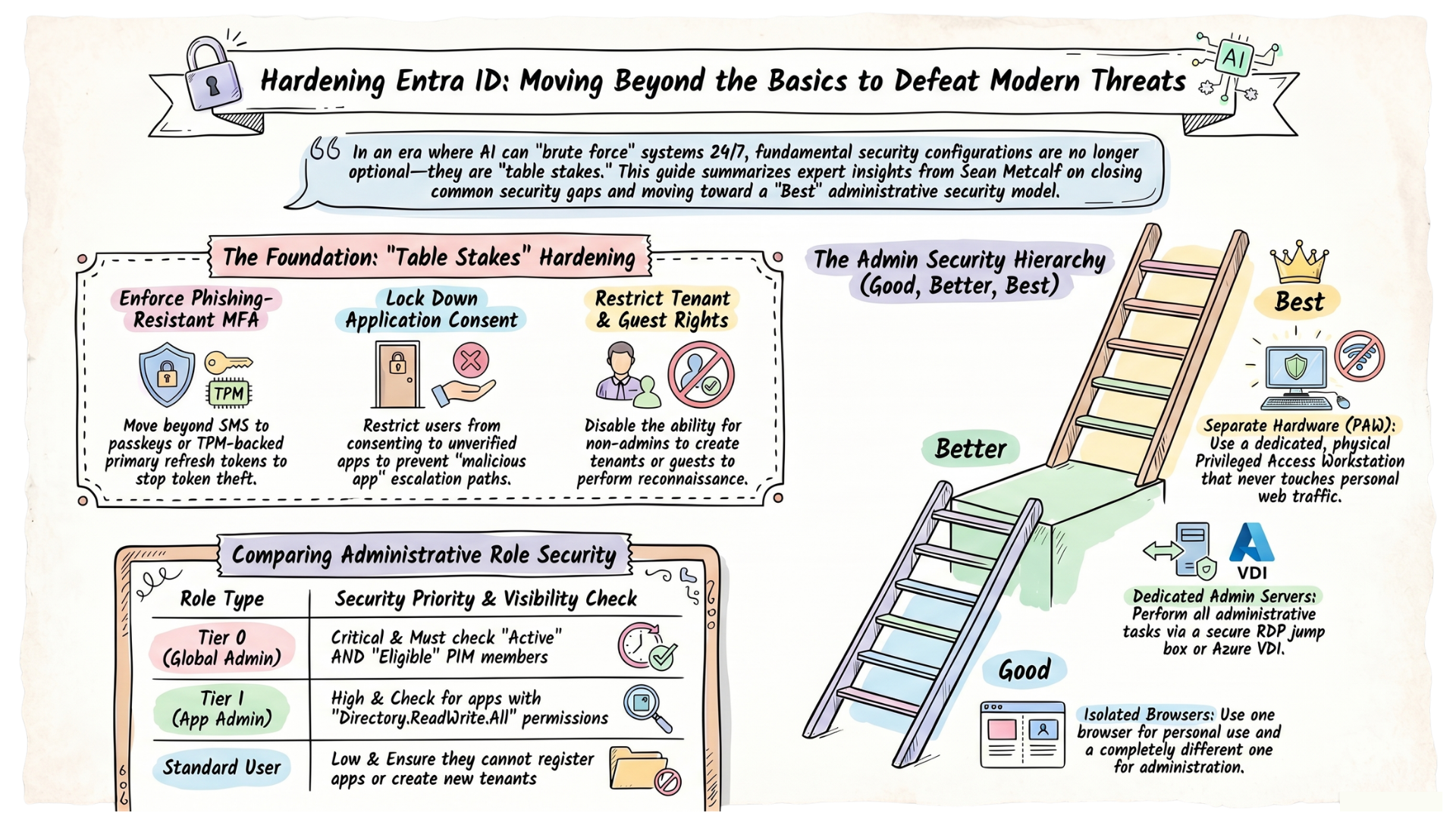
  • #56
    April 18 · 59 min

    Stop Leaving the Door Open: The Entra ID Hardening Checklist Security Experts Actually Use

    Microsoft Entra security is evolving and the way organizations think about identity protection needs to evolve with it. In this episode, I’m joined by Sean Metcalf, one of the foremost identity security experts in the industry, whose work has helped shape how many organizations approach securing both Active Directory and Microsoft Entra.Sean shares the hardening steps many teams still overlook, and why advances in AI are making it easier for both defenders and attackers to work faster than ever before. From MFA and application controls to protecting privileged accounts and reducing unnecessary exposure, this conversation offers a practical look at where strong identity security starts and why getting the fundamentals right matters more than ever. Subscribe with your favorite podcast player or watch on YouTube 👇 About Sean Metcalf Sean Metcalf is the Identity Security Architect at TrustedSec and a renowned expert in Microsoft identity security. He holds the rare Certified Master in Active Directory certification and has spoken at major security conferences including Black Hat, DEF CON, and BlueHat on how to defend cloud and hybrid environments. LinkedIn - https://www.linkedin.com/in/seanmmetcalf/ 🔗 Related Links * Securing Entra ID Administration: Tier 0 - https://trustedsec.com/blog/securing-entra-id-administration-tier-0 * Managing Privileged Roles in Microsoft Entra ID: A Pragmatic Approach - https://trustedsec.com/blog/managing-privileged-roles-in-microsoft-entra-id-a-pragmatic-approach * Improve Entra ID Security More Quickly - https://adsecurity.org/?p=4825 * Microsoft Graph Skill - https://graph.pm 📗 Chapters 00:04:05 AI and the Evolution of Attacks 00:06:42 The Importance of Hardening Fundamentals 00:12:03 Securing Entra ID Quickly 00:16:24 Protecting Tokens with VBS and TPM 00:19:58 Restricting Consent and Guest Users 00:23:40 Managing Rogue Tenants 00:27:36 Cloud Admin Workstation Strategies 00:34:14 Delegated Admin Privileges 00:44:32 The Danger of Application Permissions 00:57:06 Artemis Mission Trivia Podcast Apps 🎙️ Entra.Chat - https://entra.chat 🎧 Apple Podcast → https://entra.chat/apple 📺 YouTube → https://entra.chat/youtube 📺 Spotify → https://entra.chat/spotify 🎧 Overcast → https://entra.chat/overcast 🎧 Pocketcast → https://entra.chat/pocketcast 🎧 Others → https://entra.chat/rss Merill’s socials 📺 YouTube → youtube.com/@merillx 👔 LinkedIn → linkedin.com/in/merill 🐤 Twitter → twitter.com/merill 🕺 TikTok → tiktok.com/@merillf 🦋 Bluesky → bsky.app/profile/merill.net 🐘 Mastodon → infosec.exchange/@merill 🧵 Threads → threads.net/@merillf 🤖 GitHub → github.com/merill Get full access to Entra.News - Your weekly dose of Microsoft Entra at entra.news/subscribe
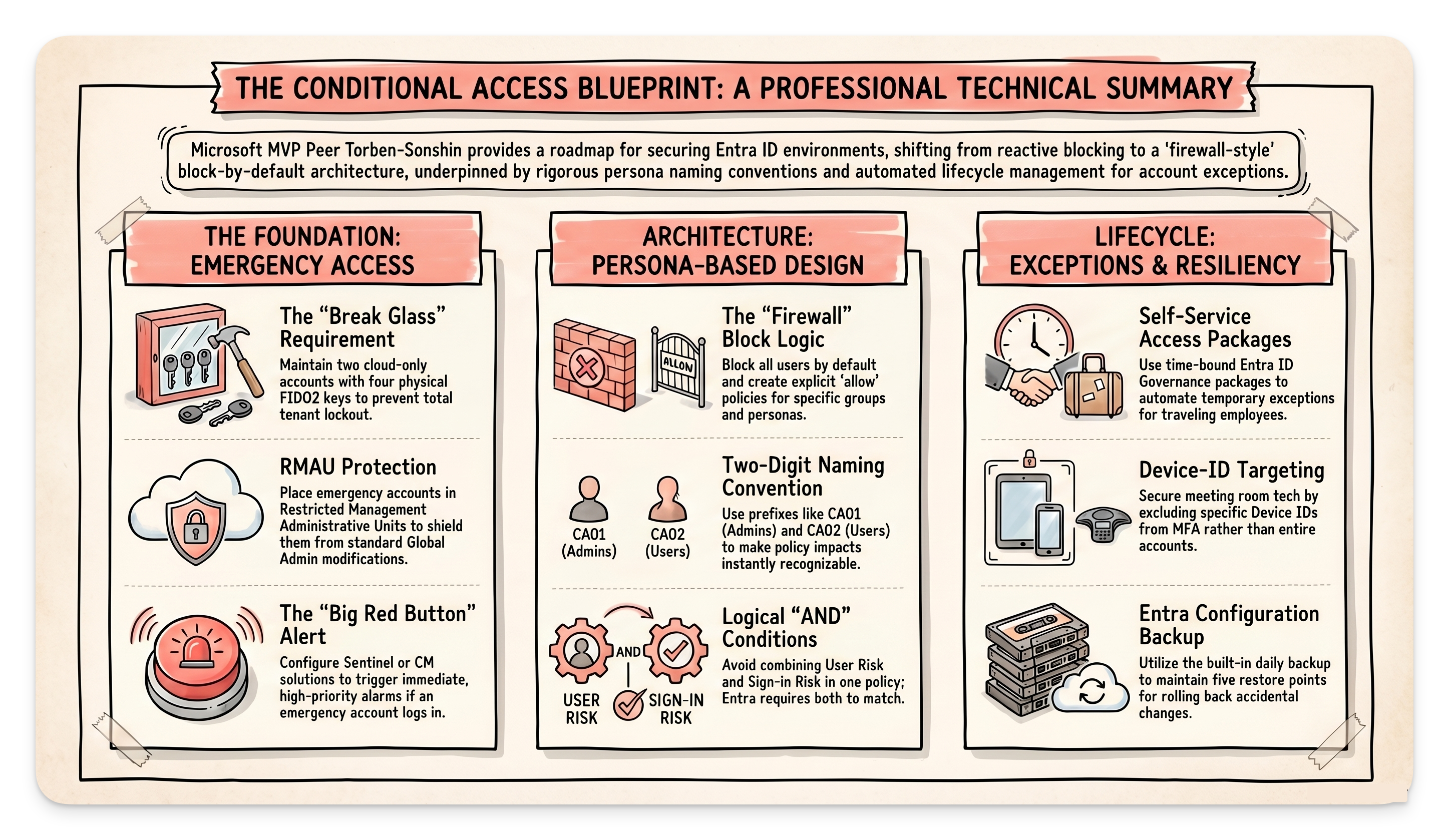
  • #55
    April 11 · 56 min

    How to Design Bullet-Proof Conditional Access Policies in Microsoft Entra ID

    If you can’t immediately name your break glass accounts and the last time you tested them → you’re already at risk. In this episode of Entra Chat, Microsoft MVP Per Torben walks through the conditional access mistakes he sees even large enterprises making, and the practical framework he actually uses with customers. You’ll learn how to set up emergency access accounts the right way, why your CA policies should be built more like a firewall than a checklist, and the one naming convention that makes managing dozens of policies actually manageable. 🎧 Hit play, your tenant will thank you. Sponsored by: Entra ID Gaps That Cause Outages In Microsoft Entra ID, outages often start small: an expired client secret, a lapsed certificate, or a suddenly failing integration. Traditional controls don’t track credential expiry or enforce application ownership, so issues appear only after something breaks. Teams are left asking: * Which applications can access Microsoft 365 data? * Is that access still appropriate? * Who owns the app? Unclear answers stall reviews, weaken accountability, and slow delivery. ENow App Governance Accelerator closes these gaps by highlighting expiring credentials, surfacing permission risks, and identifying ownership gaps before they disrupt operations. New Standard Tier pricing makes it accessible for organizations under 10,000 users, typically $3,500–$9,500 annually. Subscribe with your favorite podcast player or watch on YouTube 👇 About Per Torben Per Torben is a Senior Architect at Crayon and a Microsoft MVP for Identity and Access. Based in Norway, he frequently writes highly-read posts featured on Entra.News and runs the collaborative tech blog “Agder in the Cloud”. LinkedIn - https://www.linkedin.com/in/pertorbensorensen/ 🔗 Related Links * Agder in the Cloud - https://agderinthe.cloud * I.D.E.A. for creating/configuring break-glass accounts * GitHub - https://github.com/Per-Torben/I.D.E.A. * Blog - https://agderinthe.cloud/2026/01/06/introducing-i-d-e-a-and-i-d-e-a-001/ * Protected actions: https://agderinthe.cloud/2025/02/12/protected-actions-adding-extra-guards-to-your-entra-id-gate/ * Conditional Access hardeing (series): https://agderinthe.cloud/2024/12/05/how-to-fix-the-fundamental-flaw-in-conditional-access-part-1-introduction-and-coverage-gapsCA geo filter (series): https://agderinthe.cloud/2025/11/06/diving-into-geo-filter-with-entra-conditional-access-part-1 * Entra Backup - https://learn.microsoft.com/en-us/entra/identity/role-based-access-control/backup-restore 📗 Chapters 06:22 The importance of Break Glass accounts 09:02 Securing emergency access with FIDO2 and RMAUs 18:10 Configuring Conditional Access: The “Block by Default” strategy 27:26 Managing scope and preventing accidental lockouts 29:31 Persona-based naming conventions for CA policies 35:38 Grouping settings and avoiding bloated policies 41:54 Handling exceptions and travel access with Access Packages 44:55 The flaw in Protected Actions for Conditional Access 53:38 Using the new Entra Backup feature for quick restores Podcast Apps 🎙️ Entra.Chat - https://entra.chat 🎧 Apple Podcast → https://entra.chat/apple 📺 YouTube → https://entra.chat/youtube 📺 Spotify → https://entra.chat/spotify 🎧 Overcast → https://entra.chat/overcast 🎧 Pocketcast → https://entra.chat/pocketcast 🎧 Others → https://entra.chat/rss Merill’s socials 📺 YouTube → youtube.com/@merillx 👔 LinkedIn → linkedin.com/in/merill 🐤 Twitter → twitter.com/merill 🕺 TikTok → tiktok.com/@merillf 🦋 Bluesky → bsky.app/profile/merill.net 🐘 Mastodon → infosec.exchange/@merill 🧵 Threads → threads.net/@merillf 🤖 GitHub → github.com/merill Get full access to Entra.News - Your weekly dose of Microsoft Entra at entra.news/subscribe

Showing 1–20 of 22 episodes