Skip to content
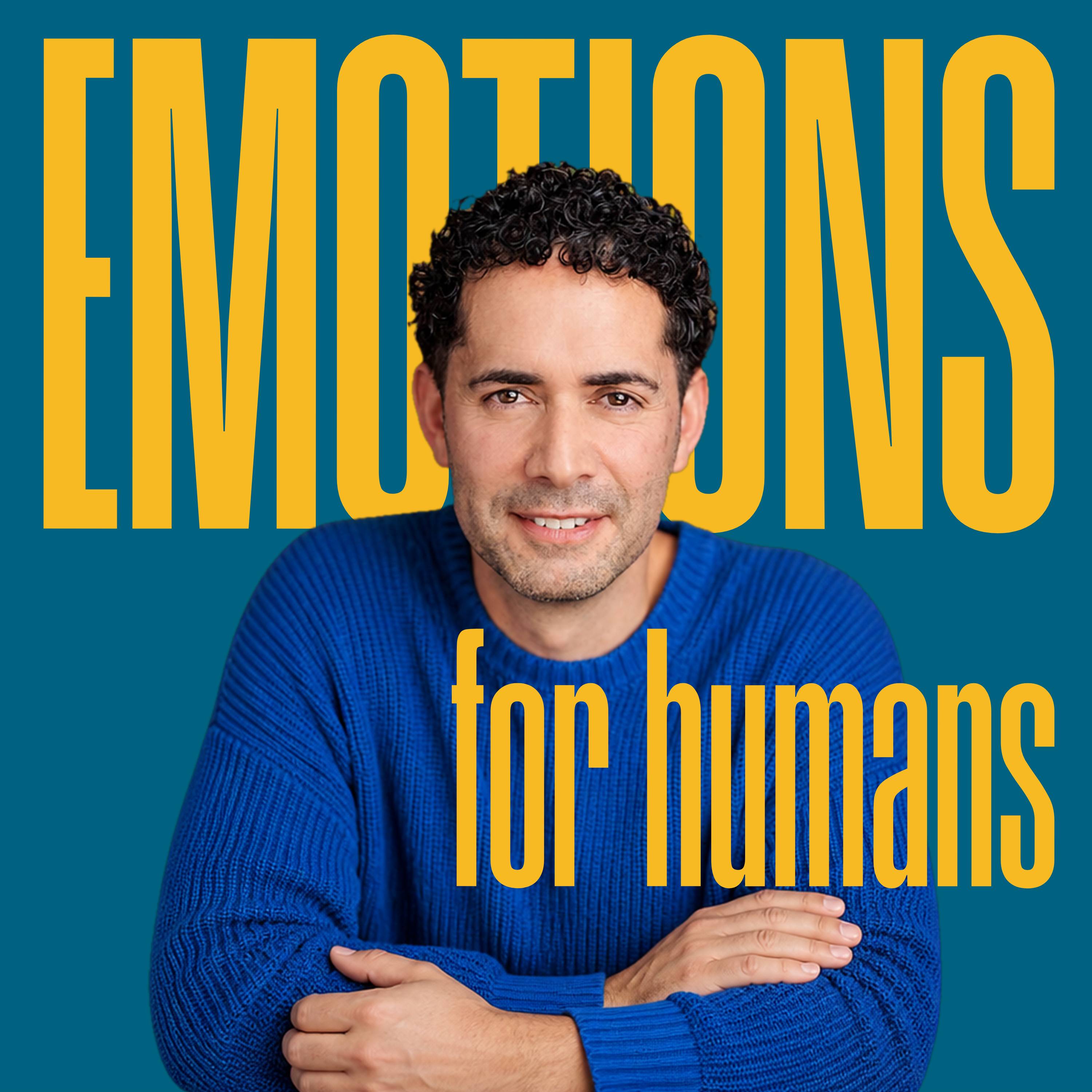
Artwork for Emotions for Humans
EducationSelf-ImprovementHealth & FitnessMental Health

Emotions for Humans

Jon Hunter

Actors train emotions on purpose. Everyone else gets them by accident.


Acting coach Jon Hunter spends his days teaching professional actors how emotion actually works - in the body, on demand, under pressure. Emotions for Humans takes that training out of the studio and hands it over.


Each episode is an honest conversation about the emotional work nobody teaches you. The anger you swallow at work. The tears that ambush you at weddings. The confidence that shows up ten minutes after you needed it.


No therapy-speak. No "good vibes only". No pretending there's a right way to feel.


Science-informed, studio-tested, human-first.


Whether your room is a studio, a meeting, or a kitchen table at midnight: you have emotions, you're a human, and this show is for you.


Now.

Go be a human.

Play
  • 6 episodes
  • weekly
  • Avg 10 min
  • English

Support the show

Goes straight to the publisher. podnod takes nothing.

  • #5
    Monday · 13 min

    The Rules You Were Handed

    There’s a rulebook nobody announced – you were handed the rules anyway. This episode is about the rules you inherited about what it’s appropriate to feel, show, and do – and what they cost. Because some of the barriers were never yours – they arrived from outside. And if you want company while you catch your rule, there’s a guided audio practice for this episode at the episode page – https://emotionsforhumans.com/005-the-rules-you-were-handed – Jon talks you through it, one step at a time. Barriers come in two kinds: the ones you build for yourself, and the ones you were handed. The built ones protect a story about you. The handed ones were installed – taught, absorbed, inherited – and they run from somewhere nobody checks. Science has names for both halves of it. Display rules govern what you’re allowed to show. Feeling rules govern what you’re allowed to feel – and the second kind reaches further, because it appoints an overseer inside. A sociologist even reached for acting’s own vocabulary to describe it: surface acting, deep acting. Three rooms where the scripts bite: a man taught crying isn’t his to do, an actor wary of wanting, a woman pricing anger by what the room will call her. The emotion the work needs is the body in action – a rule can’t delete it, but it can stall it at the door. The cost isn’t access to a feeling – it’s the action potential itself. The feeling survives; the doing doesn’t. Naming is where the unlearning starts. This episode names the barriers, not the methods – the methods live in my studio. This week, find one rule you were handed – one feeling you learned isn’t yours to have – and name whose voice it arrives in. Now. Go be a human. REFERENCES The display rules – Ekman, P., & Friesen, W. V. (1969). The repertoire of nonverbal behavior: categories, origins, usage, and coding. Semiotica, 1(1), 49-98. doi.org/10.1515/semi.1969.1.1.49 The masking study – Friesen, W. V. (1972). Cultural differences in facial expressions in a social situation: An experimental test of the concept of display rules. Unpublished doctoral dissertation, University of California, San Francisco. The feeling rules – Hochschild, A. R. (1979). Emotion work, feeling rules, and social structure. American Journal of Sociology, 85(3), 551-575. doi.org/10.1086/227049 The managed heart – Hochschild, A. R. (1983). The Managed Heart: Commercialization of Human Feeling. University of California Press. The emotion–feeling distinction – Damasio, A., & Carvalho, G. B. (2013). The nature of feelings: evolutionary and neurobiological origins. Nature Reviews Neuroscience, 14(2), 143-152. doi.org/10.1038/nrn3403 All references with clickable links: https://emotionsforhumans.com/005-the-rules-you-were-handed

  • #4
    October 19 · 11 min

    How Quickly Can We Get to the Work?

    Here’s a question that changes rooms: what’s the work? This episode is about the question that gets you past the hardest part of any room or relationship – the part where the focus swings back onto you. Because trust isn’t a feeling you summon – it’s what evidence builds. Confidence asks how you feel. Trust asks what you’ve done. Trust is built from evidence – the memory of having done the work and lived. Two things get called feelings, and only one of them is yours to manage. What you feel about yourself is psychological. The emotion the work needs is physiological – action, not commentary. That distinction is neuroscientist Antonio Damasio’s, and it’s the spine of the whole episode. Attention decides access. Research on attentional focus keeps finding the same thing: attention on the effect of the action beats attention on the self performing it. The barriers come in two kinds – the ones you build and the ones you were handed. The built ones have a research name: self-handicapping. The handed ones are the scripts you were taught about what it’s appropriate to feel and show. There’s training built for exactly this. The episode names the barriers, not the methods – the methods live in the studio. No separate tool this week – you don’t need one. The next room you care about is where you test it: before you walk in, ask what the work asks of you – name whatever stands between you and the answer – and do what the work asks. And if the work goes dark in there, ask it again: what is the work asking of you now? Now. Go be a human. REFERENCES The emotion–feeling distinction – Damasio, A., & Carvalho, G. B. (2013). The nature of feelings: evolutionary and neurobiological origins. Nature Reviews Neuroscience, 14(2), 143-152. doi.org/10.1038/nrn3403 The attention research – Wulf, G. (2013). Attentional focus and motor learning: a review of 15 years. International Review of Sport and Exercise Psychology, 6(1), 77-104. doi.org/10.1080/1750984X.2012.723728 The self-handicapping study – Berglas, S., & Jones, E. E. (1978). Drug choice as a self-handicapping strategy in response to noncontingent success. Journal of Personality and Social Psychology, 36(4), 405-417. doi.org/10.1037/0022-3514.36.4.405 The interview callback – Kageyama, N. (2026, August 2). Lorna McGhee: Treating confidence as something you do, not something you feel. Bulletproof Musician. bulletproofmusician.com/lorna-mcghee-treating-confidence-as-something-you-do-not-something-you-feel All references with clickable links: emotionsforhumans.com/004-how-quickly-can-we-get-to-the-work

  • #3
    October 12 · 14 min

    Confidence is Overrated

    Nobody feels as confident as they look. Not even the people who look it most. This episode takes the myth apart, with help from a principal flautist who found out where pressure goes in the body: Confidence is really overrated. The people on stage aren’t feeling what you think they’re feeling – and even the most rehearsed performer in the world can walk out without it. Pressure has an address. In the final round of one of the world’s great auditions, her low D’s stopped speaking – because the pressure went to her jaw. The shoulders don’t get tight on their own. It doesn’t matter how you feel, it’s what you do. Two words, three times, right before walking on stage: choose courage. A choice, not a feeling. Your nerves are less visible than they feel. The research on the illusion of transparency says the room can’t read you nearly as well as you fear – which is bad news for defensive playing. Playing generous, not defensive. Playing in order not to go wrong earns admiration, not contact. What reaches people is commitment to the task – and the body staying out of its own way. Generosity settles the body. In a stress study, people who wrote a supportive letter to a friend showed smaller stress responses under pressure – while feeling just as anxious as everyone else. The feeling didn’t move – the body did. Playing not to lose is physically the harder way through. No separate tool this week – you don’t need one. Pick the next room you actually care about. Name what playing not to lose looks like for you in that room – then choose the generous version of your first move. Now. Go be a human. REFERENCES The interview – Kageyama, N. (2026, August 2). Lorna McGhee: Treating confidence as something you do, not something you feel. Bulletproof Musician. bulletproofmusician.com/lorna-mcghee-treating-confidence-as-something-you-do-not-something-you-feel The line she quotes – Sinclair, D. (2023). Dialed In: Do Your Best When It Matters Most. (book – no link; quoted as McGhee cites it in the interview) The illusion of transparency – Gilovich, T., Savitsky, K., & Medvec, V. H. (1998). The illusion of transparency: Biased assessments of others’ ability to read one’s emotional states. Journal of Personality and Social Psychology, 75(2), 332-346. doi.org/10.1037/0022-3514.75.2.332 The spotlight effect – Gilovich, T., Medvec, V. H., & Savitsky, K. (2000). The spotlight effect in social judgment: An egocentric bias in estimates of the salience of one’s own actions and appearance. Journal of Personality and Social Psychology, 78(2), 211-222. doi.org/10.1037/0022-3514.78.2.211 The generosity research – Inagaki, T. K., & Eisenberger, N. I. (2016). Giving support to others reduces sympathetic nervous system-related responses to stress. Psychophysiology, 53(4), 427-435. doi.org/10.1111/psyp.12578 Episode 2 callback – Bandura, A. (1977). Self-efficacy: Toward a unifying theory of behavioral change. Psychological Review, 84(2), 191-215. doi.org/10.1037/0033-295X.84.2.191 All references with clickable links: https://emotionsforhumans.com/003-confidence-is-overrated

  • #2
    October 5 · 14 min

    10 Minutes Too Late

    The perfect thing to say arrives in the car park, 10 minutes after the meeting ends. Confidence that clocks in late. It’s a specific kind of misery – and it happens most to the people who care most. This episode is about why – and the answer isn’t that you’re slow. It’s about what your body and brain actually do with time and pressure: Your state has a switch. Ramping up is just how everyone starts. A century of arousal research (Yerkes and Dodson) shows performance lives on a curve – and untrained nervous systems get there slowly. Actors train the ramping up shorter and shorter until it behaves like a switch: physical processes that produce specific emotional energy, on demand, in seconds. Pressure makes thinking expensive. Beilock’s choking research shows pressure steals attention and turns it inward – which is why the perfect thing to say arrives in the car park, not the meeting. It was never missing. It was queued. Confidence is evidence, not a feeling you wait for. Bandura’s work on self-efficacy shows confidence is built from mastery experiences – the memory of having done the thing. Which means waiting to feel confident is doing it backwards. Routines make ramping up automatic. Pre-performance routines are one of the most-studied tools in sport psychology – a fixed sequence that settles arousal, aims attention, and buys you the first 30 seconds. The breath, the anchor, the word, the first move: these are entry-level physical processes that let the body lead, so the feeling follows. Breath is the fastest lever you have on the whole system. One slow exhale at a time. Actors train the ramping up. Everyone else improvises it – so whether your room is a boardroom, a first date, or a difficult phone call you’ve been putting off for a week, the 90 seconds before the door belong to you too. Your tool for this episode is just below – the Pre-Room Routine. Four moves, 90 seconds, every room, no exceptions. There’s no 10 minutes before the room – 90 seconds is all the before there is. Episode 1’s reflection tool, also below, is the 10 minutes after. THIS EPISODE'S TOOL The Pre-Room Routine – 90 seconds before you open the door 1. Breathe (~40 seconds). A double inhale through the nose, then a long, slow exhale through the mouth. Two or three rounds. 2. Anchor (~10 seconds). One physical action that isn't thinking – feeling your feet on the floor, rolling the shoulders, tapping thumb to finger. 3. Word (~10 seconds). One word to walk in with. Not a speech to yourself. A single word – something like steady, open, serve. Or your own. 4. Move (~30 seconds). Take your word with you, and decide your first move – something like a steady stride, an easy smile, or the way you say your first line. Then run it the same way every time. 90 seconds, every room, no exceptions – the routine only becomes automatic when it stops being a decision. Online version: https://emotionsforhumans.com/practice/pre-room-routine/ Printable version: https://link.hunterstud.io/preroom Episode 1 Keep It Tool: https://emotionsforhumans.com/practice/keep-it-tool/ Now. Go be a human. REFERENCES The arousal-performance curve – Yerkes, R. M., & Dodson, J. D. (1908). The relation of strength of stimulus to rapidity of habit-formation. Journal of Comparative Neurology and Psychology, 18(5), 459-482. doi.org/10.1002/cne.920180503 Choking under pressure – Beilock, S. L., & Carr, T. H. (2001). On the fragility of skilled performance: What governs choking under pressure? Journal of Experimental Psychology: General, 130(4), 701-725. doi.org/10.1037/0096-3445.130.4.701 Self-efficacy – Bandura, A. (1997). Self-Efficacy: The Exercise of Control. W. H. Freeman. (book – no link) Pre-performance routines – Cotterill, S. (2010). Pre-performance routines in sport: Current understanding and future directions. International Review of Sport and Exercise Psychology, 3(2), 132-153. doi.org/10.1080/1750984X.2010.488269 Meta-analytic support – Rupprecht, A., Tran, U., & Gröpel, P. (2024). The effectiveness of pre-performance routines in sports: a meta-analysis. International Review of Sport and Exercise Psychology, 17(1), 39-64 (first published online 2021). doi.org/10.1080/1750984X.2021.1944271 Routines and emotional regulation – Orbach, I., & Blumenstein, B. (2022). Preparatory routines for emotional regulation in performance enhancement. Frontiers in Psychology, 13, Article 948512. doi.org/10.3389/fpsyg.2022.948512 The physiological sigh – Balban, M. Y., Neri, E., et al. (2023). Brief structured respiration practices enhance mood and reduce physiological arousal. Cell Reports Medicine, 4(1), 100895. doi.org/10.1016/j.xcrm.2022.100895 If-then plans – Gollwitzer, P. M. (1999). Implementation intentions: Strong effects of simple plans. American Psychologist, 54(7), 493-503. doi.org/10.1037/0003-066X.54.7.493 All references with clickable links: https://emotionsforhumans.com/002-10-minutes-too-late

  • #1
    September 28 · 10 min

    You Lived It. Now Keep It.

    Here’s a sentence to sit with: the class is not the learning. You can have the experience that cracks something open, the note that finally makes sense, the moment where you surprise yourself – and if you walk out of the room and never think about it again, most of that learning is gone. Not weakened. Gone. This episode is about why – and it’s not a lecture about homework. It’s about what your body and brain actually do with an experience: Experience alone doesn’t teach. Kolb’s learning cycle shows reflection is the bridge between something that happened to you and something you can use. Experts are built on feedback loops, not hours. Ericsson’s research on deliberate practice shows the self-evaluation step is where the gains are consolidated. Seeing your own work clearly is trainable. John Hattie’s synthesis of more than 800 meta-analyses found that accurately judging your own performance is among the most powerful influences on achievement. Your brain keeps working after practice ends. Motor learning research calls it offline learning – the hours after class are when skill gets filed away. Naming feelings regulates them. Lieberman’s affect labelling studies and Pennebaker’s expressive writing research show that putting emotion into words changes what it does in your body. Actors do on purpose what everyone else does by accident – so whether your room is a studio, a meeting, or a kitchen table at midnight, the ten minutes after the experience belong to you too. Actors do on purpose what everyone else does by accident. So whether your room is a studio, a meeting, or a kitchen table at midnight, the 10 minutes after the experience belong to you. Your tool for this episode is just below – the Keep It Tool. Three questions, originally built for actors, useful for anyone. One of them works on the episode itself: think back – what surprised you? THIS EPISODE'S TOOL The Keep It Tool Three questions. One takeaway. Then close the book. 1. Name what you felt (about 1 minute) One word is enough. Not the story – just the word. Naming a feeling is how you change what it’s doing in your body. One word for what I felt is… 2. What surprised you? (about 2 minutes) Surprise is the freshest data you will ever have. Within a day or two, memory flattens everything into “brilliant” or “terrible”. Capture the nuance while it still has resolution. What surprised me was… 3. Same / Different (about 5 minutes) What would you keep? What would you change next time? This is the expert’s question. One honest evaluation, in your own words. What I’m keeping is… / What I’d change next time is… Also: if you were given feedback or direction – at an audition, in rehearsal, on set, after a performance – write it down verbatim. It’s the note you’d otherwise pay a coach to give you again. One takeaway (about 2 minutes) Then close the book. You’re done – the 10 minutes after the experience belong to you. Next time, I will… Online version: https://emotionsforhumans.com/practice/keep-it-tool/ Printable version: https://link.hunterstud.io/keepit Now. Go be a human. REFERENCES Experiential learning and the learning cycle – Kolb, D. A. (1984). Experiential Learning: Experience as the Source of Learning and Development. Prentice-Hall. Worked example in medical education: https://pmc.ncbi.nlm.nih.gov/articles/PMC9112303/ Deliberate practice and feedback loops – Ericsson, K. A., Krampe, R. T., & Tesch-Römer, C. (1993). The Role of Deliberate Practice in the Acquisition of Expert Performance. Psychological Review, 100(3). https://graphics8.nytimes.com/images/blogs/freakonomics/pdf/DeliberatePractice%28PsychologicalReview%29.pdf Motor memory consolidation and offline learning – Bönstrup, M., et al. (2019). A Rapid Form of Offline Consolidation in Skill Learning. Current Biology, 29(8). https://doi.org/10.1016/j.cub.2019.02.049 Self-regulated learning – Zimmerman, B. J. (2000). Attaining self-regulation: A social cognitive perspective. See also Panadero (2017), A Review of Self-regulated Learning: Six Models and Four Directions for Research, Frontiers in Psychology (reviews Zimmerman’s model): https://pmc.ncbi.nlm.nih.gov/articles/PMC5408091/ Self-assessment and achievement – Hattie, J. (2009). Visible Learning. Effect size rankings: https://visible-learning.org/hattie-ranking-influences-effect-sizes-learning-achievement/ Affect labelling: putting feelings into words – Lieberman, M. D., et al. (2007). Putting Feelings Into Words. Psychological Science, 18(5). https://pubmed.ncbi.nlm.nih.gov/17576282/ and https://newsroom.ucla.edu/releases/Putting-Feelings-Into-Words-Produces-8047 Expressive writing – Pennebaker, J. W. (1997). Writing about emotional experiences as a therapeutic process. Psychological Science, 8(3). https://pmc.ncbi.nlm.nih.gov/articles/PMC3830620/ All references with clickable links: https://emotionsforhumans.com/001-you-lived-it-now-keep-it

  • September 21 · 1 min

    Welcome to Emotions for Humans

    Quick question: when was the last time you felt something and had no idea what to do with it? This short episode is the front door to the show. In a couple of minutes, I’ll tell you what Emotions for Humans is, who it’s for, and the one idea everything here is built on: emotion isn’t something that happens to you. It’s something you can train. I’m Jon Hunter, and I’m an acting coach – which really just means I teach people how emotion actually works. Not in theory. In the body. On demand. For years I’ve taught this to actors, and here’s the secret: actors aren’t special. They’re just the people who signed up to practise. This show is for everyone else with a nervous system – the anger you swallow at work, the tears that ambush you at weddings, the confidence that shows up ten minutes after you needed it. No therapy-speak. No “good vibes only”. No pretending there’s a right way to feel. Now. Go be a human.

Showing 1–6 of 6 episodes