Skip to content
Artwork for Education Futures
EducationKids & FamilyEducation for KidsSociety & Culture

Education Futures

Svenia Busson & Laurent Jolie

A podcast about the future of education in the age of AI. We bring together interdisciplinary voices to explore how we can shape more desirable futures for learning.

Play
  • 25 episodes
  • a few times a week
  • Avg 46 min
  • English
Counted on this page — what you have heard stays on this device, so it is not something the list can be paged by.
  • S1 · E69
    Today · 47 min

    What the AI debate misses about the Global South

    Dr. Maria Mercedes "Didith" T. Rodrigo is a Professor in the Department of Information Systems and Computer Science at the Ateneo de Manila University in the Philippines, where she directs the Ateneo Laboratory for the Learning Sciences (ALLS) and co-heads the Ateneo Virtual, Augmented and Mixed Reality Laboratory. For over two decades she has studied what students actually do and feel while learning with technology — detecting boredom, confusion, frustration and engaged concentration from interaction data inside intelligent tutoring systems, educational games and programming environments. She is a former President of the Asia-Pacific Society for Computers in Education (APSCE) and a recipient of its Distinguished Researcher Award, and sits on the Executive Committee of the International Artificial Intelligence in Education Society. Her opinion piece "Is the AIED Conundrum a First-World Problem?" (International Journal of Artificial Intelligence in Education) argued that the classrooms most likely to benefit from AI are the ones structurally least able to deploy it. In July 2025 she delivered the keynote "The Technopolitics of AIED: A Developing Country's Perspective" at the AIED conference in Palermo, and later that year argued for culturally-responsive AI at the K-EDU EXPO in Korea. In this episode, Didith talks with Svenia Busson about: Why AI in education is built on Western psychological constructs — and whether boredom in Manila is the same as boredom in Michigan The Scooter experiment: US students deliberately provoking a scolding animated dog, Filipino students insisting "Scooter cares about me" "Gaming the system" — why students in the Philippines pretend to work rather than walk out, and what generative AI does to that instinct Findings from WHIMC, the University of Illinois Minecraft science environment, where lower-performing Filipino students made almost no observations — the cost of saving face Testing LLM grading bias on Filipino English, after earlier work showing essays written in African American English scored lower AI Ed Unplugged — Seiji Isotani and Ig Ibert Bittencourt's Brazilian movement to design AI for classrooms with one device, one connection, and paper exams Why she'd give the scarce resources to the teacher first — including the maths teacher assigned to teach relaxation massage Epistemic vigilance as the successor to critical thinking, and why friction, confusion and struggle have to be designed back in The trade-offs a Global South education minister actually faces — including feeding programmes, because hungry children cannot learn Mentioned in this episode: For those who wish to know more about the Education Futures fellowship: https://educationfutures.ai/fellowship

  • S1 · E68
    Thursday · 45 min

    Building schools where 25 Million have none

    Zia Akhter Abbas is President & CEO of The Citizens Foundation (TCF), one of the world's largest privately-run networks of formal schools for low-income children and the largest private employer of women in Pakistan. He came to education sideways: an IB diploma at Lester B. Pearson United World College in Canada, an MBA from LUMS, then seventeen years in senior business and risk roles at Citi and Standard Chartered, plus a board seat at 1Link, Pakistan's leading payments switch. He left banking for TCF in 2014. For a decade he led TCF's global resource mobilisation, working with a volunteer movement across 14 countries, building the organisation's global governance framework, stewarding its Government Partnership Schools network (400+ public schools now run by TCF), and driving TCF's Strategy 2030. He became President & CEO in June 2025. The organisation he now runs began in 1995 with six friends in Karachi who met every Wednesday, decided education was the closest thing to a root cause, and built five schools with their own money. Today TCF operates 2,261 school units across 60+ districts, educates roughly 300,000 students, employs ~24,000 people including 15,000+ female faculty, runs its own construction company that completes two to three schools a week, and moves teachers 75,000 kilometres a day in a fleet of nearly 1,000 vans. Its results: 55% of TCF students complete intermediate (vs 27% nationally) and 26% enter university (vs 12% nationally). Zia is a Schwab Foundation / World Economic Forum social entrepreneur and a board member of the Global Schools Forum. In this episode, Zia talks with Svenia Busson about: Leaving banking for education after seventeen years — and why the nonprofit job turned out to be harder How TCF scaled from five schools to 2,261 units using the "unit concept," a cookie-cutter template for an entire school system — and what a sacred template costs you Pakistan's 25 million out-of-school children — a population the size of Australia — and why the state stopped building schools decades ago Funding 300,000 students with no government money: $60M+ last year from diaspora volunteers, chapters in 14 countries, institutional funders, and zakat acting as a global community endowment The all-female faculty decision, made intuitively rather than from research — and the finding that girls' enrolment drops 15% for every 500 metres of walking distance What broke when EdTech built for paying markets met dust, theft-prone tablet racks and 24-hour power cuts — and why TCF may have to build its own tools The Khan Academy Pakistan / Khanmigo pilot for Grades 6–8 maths and science, why it went teacher-facing rather than student-facing, and what principals said when asked if they'd ever use AI Why AI literacy training was rolled out before any AI tools — and why you educate 24,000 people rather than police them The Global South inversion: why the biggest unlock may be language, not tutoring, in a country where everything meaningful requires English Why the acute Western harms — mental health, isolation — look different when eight people share a room and the phone belongs to your father Mentioned in this episode: For those who wish to know more about the Education Futures fellowship: https://educationfutures.ai/fellowship
  • S1 · E67
    August 24 · 56 min

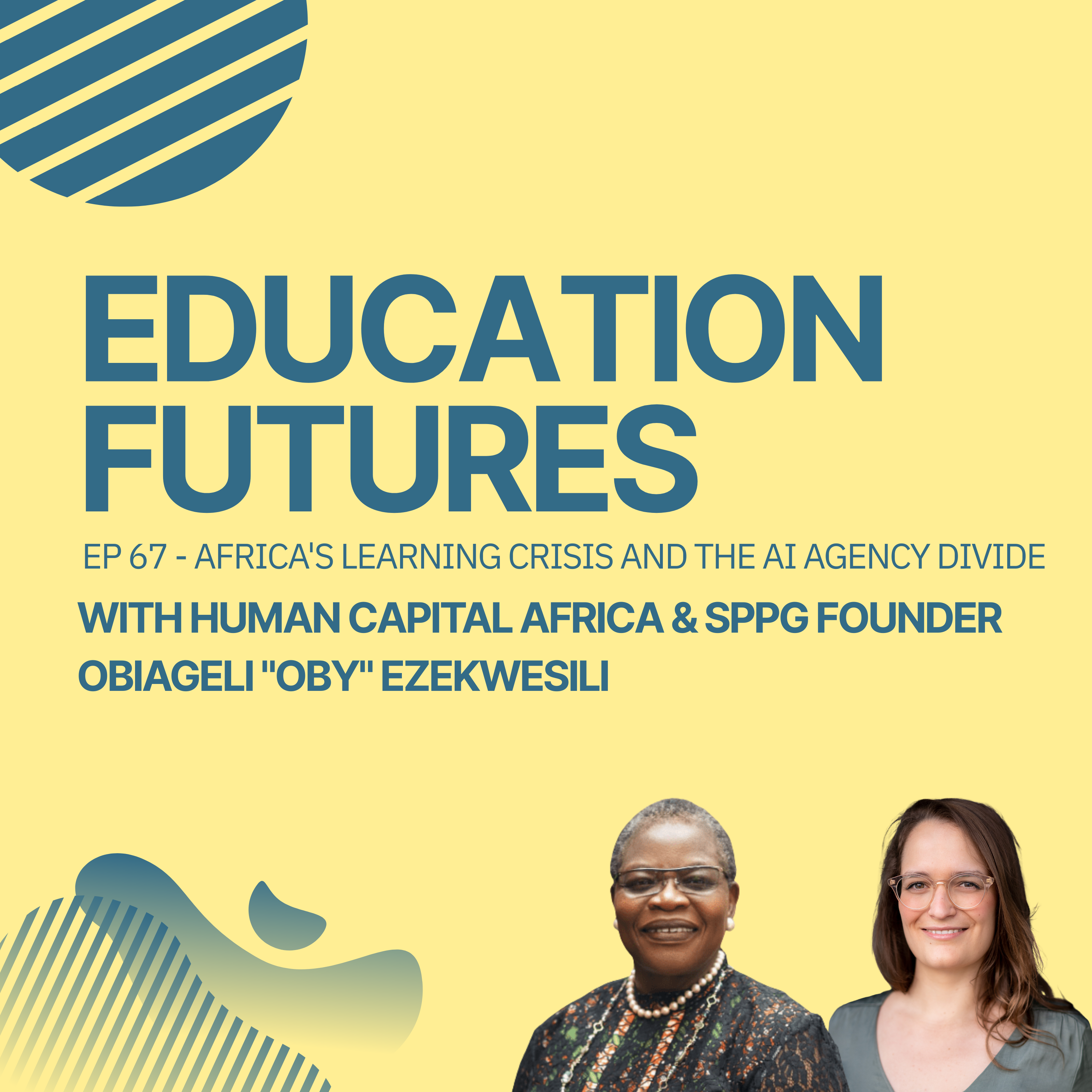
    Africa's learning crisis and the AI agency divide

    Dr. Obiageli "Oby" Ezekwesili is Founder and President of Human Capital Africa, an accountability and advocacy organization devoted to Africa's foundational learning crisis — getting every child reading, writing and counting by age 10. An economic policy expert and chartered accountant by training, she was a co-founder of Transparency International and later served in the Nigerian government as Minister of Solid Minerals and then as Federal Minister of Education. She led the public procurement reform agenda that earned her the nickname "Madam Due Process." She went on to serve as Vice President for the Africa Region at the World Bank, overseeing operations across 48 sub-Saharan countries. She co-founded the #BringBackOurGirls movement, ran for President of Nigeria in the 2019 elections, and founded the School of Politics, Policy and Governance (SPPG), an unconventional school now operating in Nigeria, Senegal and Kenya, with Ghana opening this year, whose graduates are already running for and winning public office. She also advises Club de Madrid, the forum of former democratic heads of state and government democracies and economic development including on AI regulation and governance. In this episode, Oby talks with Svenia Busson about: Human dignity as the through-line of a career spanning Transparency International, two ministries and the World Bank — and why she now calls education "a living thing" Africa's demographic pivot — average age 18.9 years, and 85% of global workforce growth by 2050 — and why it leads to either a dividend or a disaster Why she stopped "wasting her voice on incorrigible leaders" and built a school to manufacture better ones instead, refusing national accreditation to escape captured systems The foundational learning crisis as a matter of life and death — nine in ten children in sub-Saharan Africa unable to read a simple sentence by age 10, and why she refuses to call a spade an agricultural implement What actually causes it: no early-childhood preparation, teaching in languages children don't speak, curricular overload, untrained and uncoached teachers, and ministries with no learning data What works and has been proven at scale — structured pedagogy, teaching at the right level, teacher coaching, and the question she puts to presidents: "Mr President, what did our children learn today?" Sobral in Brazil and India's NIPUN Bharat — a 20% improvement in learning outcomes in four to five years — as evidence that political will, not technical solutions, is the binding constraint Why the mobile telephony leapfrog (Nigeria: 500,000 landlines in 50 years, 200 million mobile lines after liberalisation) is the right mental model for AI in Africa The agency divide, not the digital divide — a child can have the most advanced AI system and still lack the knowledge and capability to use it purposefully and critically Data sovereignty, AI sweatshops on the continent, and why AI must free teachers for individualised attention and values — never replace them Her three game changers for Africa: young people, African women, and technology as their enabler. Mentioned in this episode: For those who wish to know more about the Education Futures fellowship: https://educationfutures.ai/fellowship

  • S1 · E66
    August 20 · 39 min

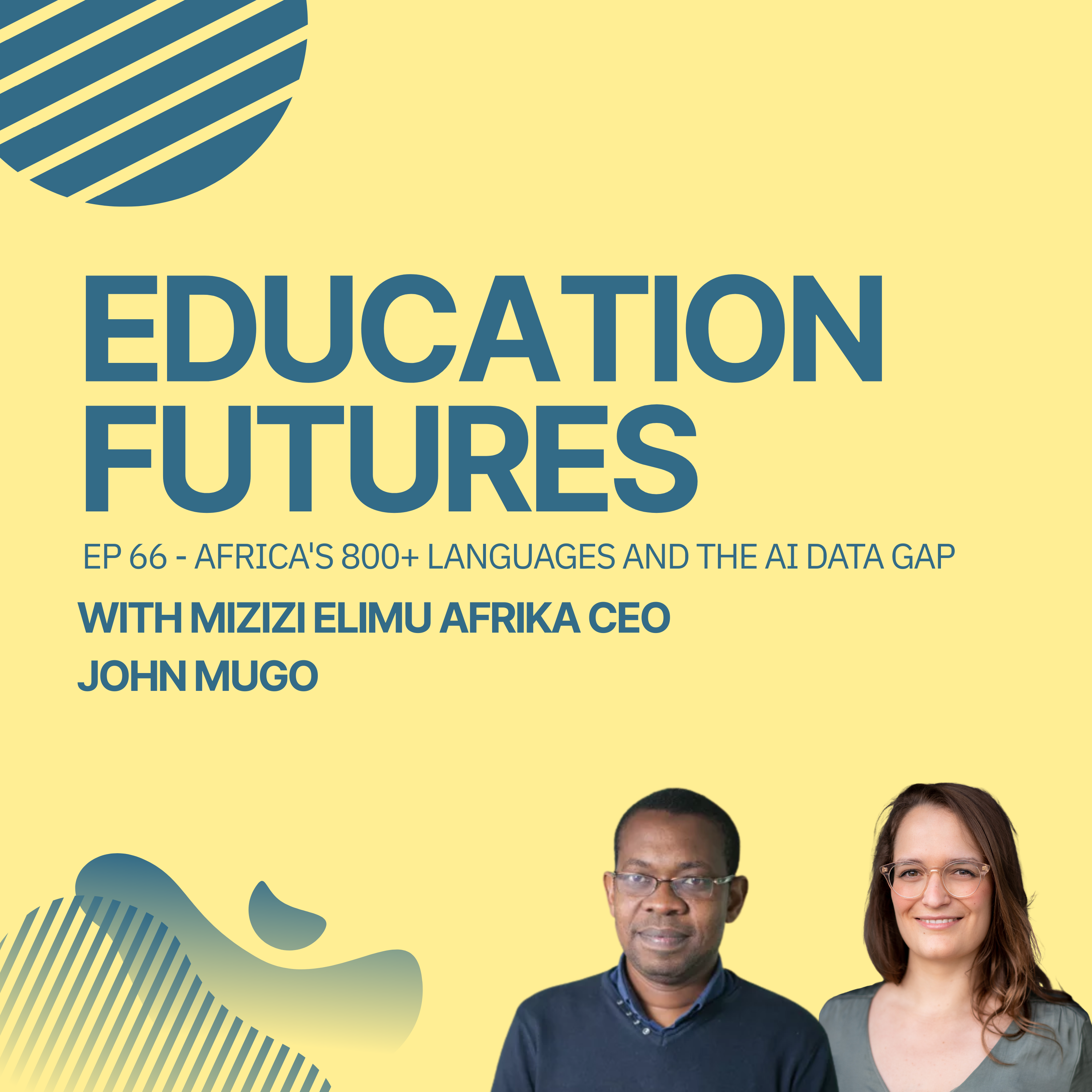
    Africa's 800+ languages and the AI data gap

    Dr. John Mugo is the Chief Executive Officer of Mizizi Elimu Afrika, the African-led education organization based in Nairobi, Kenya, formerly known as Zizi Afrique Foundation. He holds a Doctorate and a Master's degree in Special Needs Education from the University of Hanover, Germany, and a Bachelor of Education (Music) from Kenyatta University, where he went on to chair the Department of Special Needs Education. Before founding the organization in 2018, he headed Uwezo, one of East Africa's largest citizen-led learning assessment initiatives, measuring what children actually know rather than what systems claim to teach. He leads ALiVE (Action for Life Skills and Values in East Africa), a regional framework and assessment system that has now assessed life skills and values in over 45,000 adolescents across Kenya, Uganda and Tanzania, and works directly with the Kenya Institute of Curriculum Development on values-based education and teacher training reform. In March 2026, Zizi Afrique rebranded as Mizizi Elimu Afrika — "mizizi" is Kiswahili for "many roots" — and launched Vision 2040: Strong Foundations for Lasting Change, a 15-year strategy to reach more than 10 million children across 10+ African countries with stronger foundational learning. His organization currently works across Kenya, Tanzania, Uganda, Rwanda, Malawi and Cameroon, and is piloting AI-supported teaching with Fab AI and Gemini in 15 Kenyan schools. In this episode, John talks with Svenia Busson about: Why fewer than 20% of children in much of Sub-Saharan Africa are learning at grade level — and why he calls that an "80 to 90% leakage" no amount of university investment can fix Vision 2040 and the two-lever theory behind it: strengthening government systems instead of building parallel NGO programmes, and forcing a competitive civil society sector to collaborate Why Africa's real AI problem isn't models but data — 800+ languages, oral cultures, and knowledge trapped in unpublished grey literature The case for voice data and mother-tongue AI as the fastest route to reading — drawn from his own experience learning to read in Kikuyu, not English What the Fab AI and Gemini pilot in 15 schools is showing about real-time assessment — and the widening gap between connected private schools and public schools without electricity The whole-school approach to values built with Kenya's curriculum institute and piloted in 79 schools — because responsibility and integrity can't be taught in a lesson slot Why place value in Grade 1 explains Kenya's KCSE maths results, and the 10-year roadmap to move Grade 3 numeracy proficiency from 30% to 75% His blunt advice to ministries drafting AI policy: stop banning it, start investing in your own data, and put young people in the driver's seat Why Africa's median age of 19 is an asset rather than a fiscal crisis — and what has to be true for that to hold Links: Mizizi Elimu Afrika · ALiVE · Uwezo · Fab AI · AI for Education · KICD · John Mugo on LinkedIn Mentioned in this episode: For those who wish to know more about the Education Futures fellowship: https://educationfutures.ai/fellowship
  • S1 · E65
    August 17 · 45 min

    Redesigning school for the AI age

    Dan Effland is the Chief of Staff & Strategy at Summit Public Schools, where he leads the continued evolution of Summit's school model. He holds a Master's in Special Education from Dominican University and a Master's in Public School Building Administration from Columbia University's Teachers College. Before entering education, Effland spent over a decade as a professional musician in Chicago. He changed careers in his mid-thirties, teaching guitar to middle schoolers before joining Teach For America — where his cohort, mostly in their twenties, nicknamed him "Stepdad." He became a special education teacher in Chicago and then Seattle, joined Summit Public Schools in 2017, and went on to serve as Dean of Culture & Instruction at Summit Sierra and Executive Director of Summit Atlas High School in West Seattle. He now leads Summit's innovation work: designing "Summit 3.0", an evolved school model that builds on what Summit has promised families for over two decades and responds to the demands of the AI powered era. Summit operates seven charter schools across California and Washington serving roughly 3,000 students, following its earlier "Summit 2.0" personalization model, which scaled the Summit Learning Platform to nearly 400 schools and 100,000 students nationwide. He also sits on the board of the Washington State Charter Schools Association. In this episode, Dan talks with Svenia Busson about: Stripping school down to three elements — kids, outcomes, and resources — to redesign without inherited assumptions Why AI doesn't replace a school model, it reveals whether you actually have one Rebuilding Summit's model for the third time: from "college for all" to personalized learning to an AI-native design Treating AI as infrastructure — a data layer and knowledge graph — to dynamically match resources to students, not just as a set of tools Why "beliefs come first, model comes next, tools come last," and Summit's push to "create the market" for AI-native school infrastructure Rethinking "cheating": protecting the learning while empowering the learner in an AI-saturated classroom Redesigning Expeditions — two-week, ungraded, off-campus career immersions — and why "learning without walls" might be where school is headed Which durable skills matter more, not less, when a chatbot can write a competent essay in seconds A former teacher now redesigning what school itself should be in the age of AI. Mentioned in this episode: Summit Public Schools · Marshall Street Initiatives · Robin Lake / Center on Reinventing Public Education, who recommended Dan as a guest · Futre, Diane Tavenner's career-exploration platform, used by Summit juniors and seniors · Justin Reich's MIT Teaching Systems Lab, referenced from an earlier Education Futures episode Mentioned in this episode: Education Futures Fellowship A six-week programme starting on September 22nd, where seven world-leading experts in developmental psychology, neuroscience, and AI child safety will share everything they know with you: educationfutures.ai/fellowship.

  • S1 · E64
    August 13 · 41 min

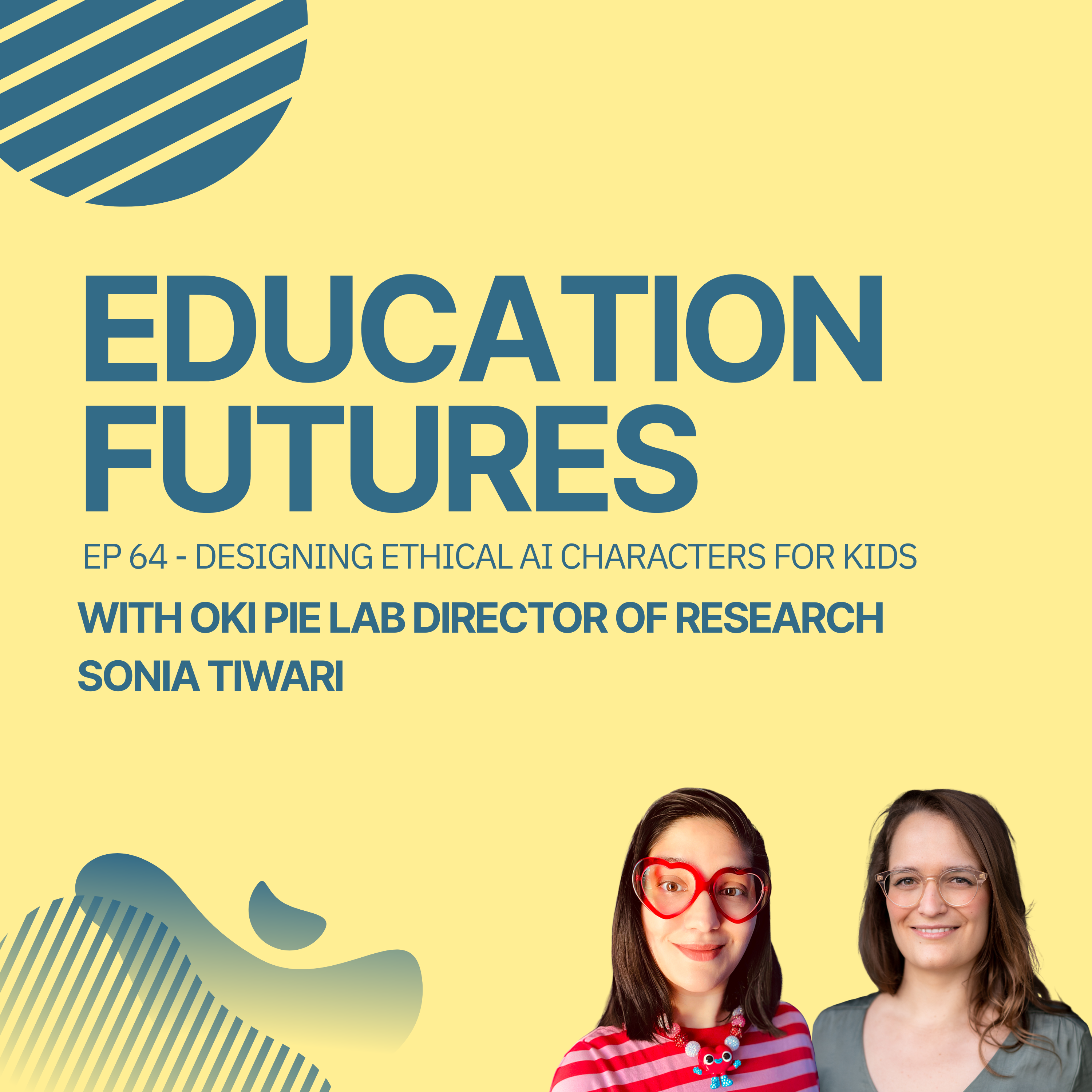
    Designing ethical AI characters for kids

    Dr. Sonia Tiwari is a children's media researcher based in the San Francisco Bay Area and Director of Research at Oki Pie Lab. She holds a PhD in Learning, Design, and Technology from Penn State University, along with an MFA in Animation and a BS in Film, credentials she first put to work as a character designer in the video game industry before turning to research on how children bond with characters and, more recently, AI. At Oki Pie Lab, she runs weekly art workshops for children ages five to ten — more than 100 to date — using what she observes each week to test where AI helps kids create and where it gets in the way. Her research includes Tiwari, S. (2025). Designing Expressive Arts Workshops for Families Using AI Tools. International Journal of Designs for Learning, 16(2), 194–204, and Tiwari, S. Designing ethical AI characters for children's early learning experiences. AI Brain Child 1, 11 (2025) — built from analyzing 60 social media videos of 20 AI characters marketed to children as young as three. She consults with edtech founders — including Jules Stories, a UK-based screen-free storytelling companion — on whether their AI characters genuinely serve children's development, and in 2025 she was selected for the Falling Walls Foundation's Female Science Talents Intensive Track. In this episode, Sonia talks with Svenia Busson about: Why visual design — not just language or policy — shapes how children bond with AI characters The psychology of "cute" character design, from Japan's Kawaii culture to Germany's Kindchenschema, and how it's used to mask age-inappropriate AI The "sticky chat patterns" she's studying with Dr. Jennifer Shen (Keene University) — and their cost to kids' ability to explore beyond one interest Her AI Character Assessment framework in AI Brain Child, built from analyzing characters marketed to ages three to eight Why safety needs three layers — design, family, and law — and why design alone can't fix a systemic problem The patchwork of AI regulation worldwide, from loophole-prone California state laws to stricter approaches across Europe Rating efforts underway, from Common Sense Media and Digital Promise to the kidSAFE Seal Program What Blake, Carter and Velloso's CHI 2026 research reveals about why teens build their own Character.AI companions Sonia's recommendation for a future guest: Diana Joseph, CEO of the Corporate Accelerator Forum and an innovation and entrepreneurship strategist working at the intersection of AI and organizational innovation. Mentioned in this episode: Education Futures Fellowship A six-week programme starting on September 22nd, where seven world-leading experts in developmental psychology, neuroscience, and AI child safety will share everything they know with you: educationfutures.ai/fellowship.

  • S1 · E63
    August 10 · 46 min

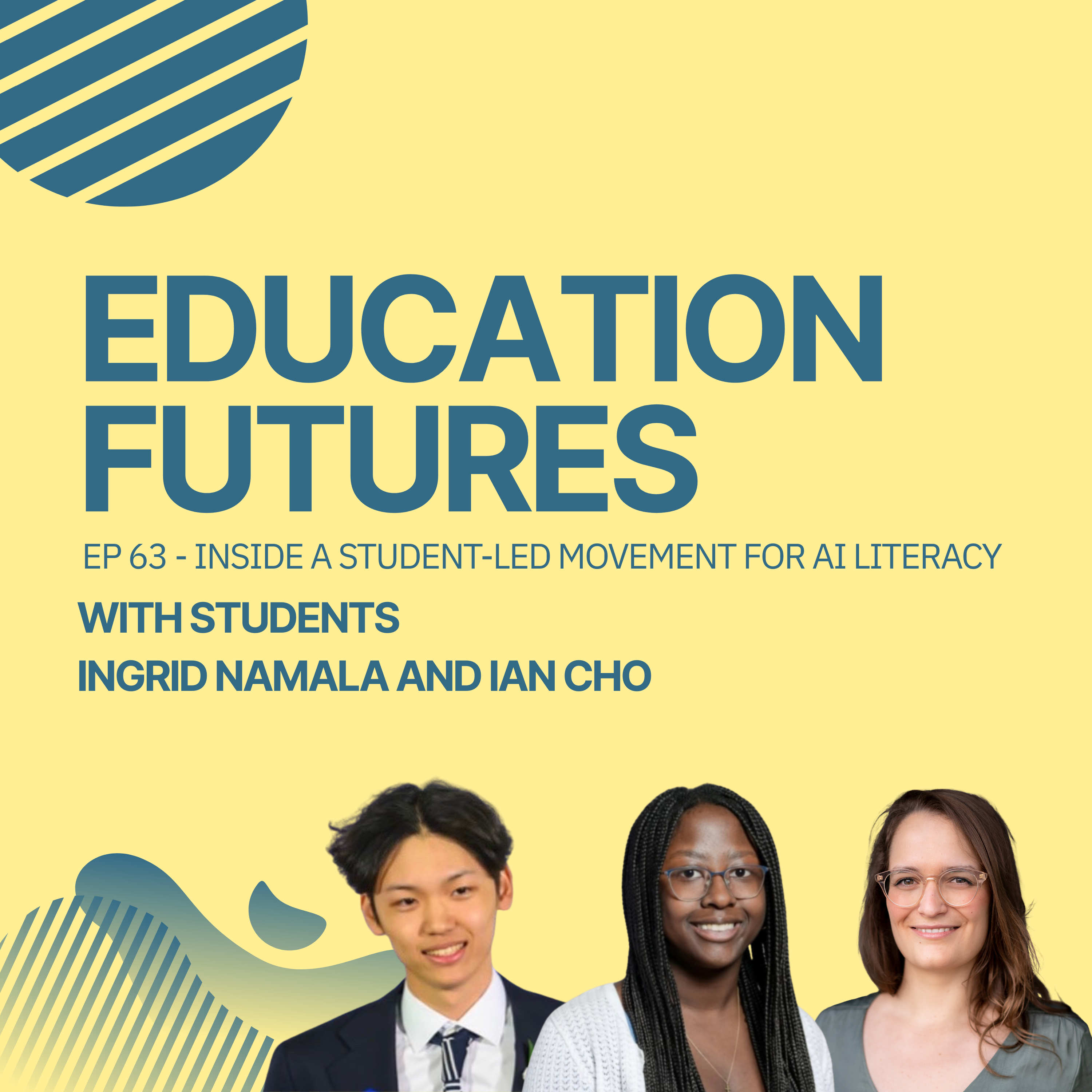
    Inside a student-led movement for AI Literacy

    Ian Cho graduated from St. Mark's School in Southborough, Massachusetts, and heads to Yale University this fall to study cognitive science. Frustrated that AI had quietly become a "taboo subject" wrapped in cheating anxiety, he founded what is now called Sailing (Student AI Literacy Interscholastic Navigator Group), a peer-led initiative that gives students across schools a space to talk openly about how they use AI and the policies governing it. Outside of Sailing, Ian builds his own AI-powered tools, including productivity apps that pause a Pomodoro timer whenever he looks away from his desk. Ingrid Namala is entering her fourth and final year at St. Mark's School, where she plans to study neuroscience. She joined Sailing shortly after Ian launched it and now co-leads the group, having presented her own research on the history of generative AI and prompting technique at Sailing's first interscholastic symposium alongside a student from another school. Much of her advocacy centers on protecting academic integrity and destigmatizing honest conversations between students and teachers about when and how AI should be used. Inspired by AI Co-Lab, the teacher network launched by their teacher Maureen Russo Rodríguez, they grew Sailing into a virtual community spanning more than fifteen schools, running hybrid symposiums, "four corners" debates, and informal salons between students and faculty. In this episode, Ian and Ingrid talk with Svenia Busson about: Sailing (sailingedu.org) — how a "taboo" subject became a peer-led dialogue across 15+ schools The Chinese Room thought experiment — and what it reveals about outsourcing understanding to AI The hidden toll of unequal AI use — academic integrity, trust, and the students left behind Reimagining assessment — in-class writing, oral exams, and whether it's "the death of the essay" Why the brain needs friction — reframing struggle as a skill worth protecting, not a bug to eliminate The craft of prompting — from lazy fragments to elaborate, metacognitive prompts, and staying polite with AI The case against banning AI for under-21s — literacy over prohibition AI, authenticity, and the future of work — why staying human might be the real advantage Mentioned in this episode: Education Futures Fellowship A six-week programme starting on September 22nd, where seven world-leading experts in developmental psychology, neuroscience, and AI child safety will share everything they know with you: educationfutures.ai/fellowship.

  • S1 · E62
    August 6 · 51 min

    When AI meets grassroots education in India

    Dr. Rukmini Banerji is one of the world's most influential figures in grassroots education. Trained as an economist — a Rhodes Scholar at Oxford and a PhD from the University of Chicago — she chose classroom-level work over academia, returning to India in 1996 to join Pratham, one of the world's largest education NGOs, where she served for over a decade as CEO before recently stepping into the role of Senior Advisor. In 2005 she launched the Annual Status of Education Report (ASER), the citizen-led household survey that has demonstrated, year after year, a hard truth: going to school is not the same as learning. She also pioneered Pratham's Teaching at the Right Level (TaRL) approach — grouping children by what they can actually do rather than their age — now used across India and adapted in parts of Africa and Asia. For this body of work she was awarded the 2021 Yidan Prize for Education Development, the world's highest education accolade. Today she is bringing that same rigor to AI. Pratham has partnered with Anthropic to deploy a Claude-powered "Anytime Testing Machine" (ATM) — an assessment tool that grades handwritten student work and generates curriculum-aligned questions, with teachers reviewing AI feedback before it reaches learners. First adapted for over 5,000 women in Pratham's Second Chance program, it is now piloting across 20 schools with plans to reach 100 by the end of 2026. In this episode, Rukmini talks with Svenia Busson about: Why she left economics for the classroom — and how "big ambition and not much money" shaped Pratham's community-driven model The origin of Teaching at the Right Level — teach the child where they are, not where the curriculum says they should be What ASER has revealed every year since 2005 — that enrollment and learning are two very different things Pratham's partnership with Anthropic and the Claude-powered "Anytime Testing Machine" — and why human oversight is non-negotiable The gap between what edtech companies want to sell and what the ground actually needs — "technology rains on you, then you're expected to use it" Assessing learning in the age of AI — why the process (the questions a student asks) matters more than the final essay Why middle school (ages 10–14) is education's next great frontier — and why the 15-year-old of 2031 must look different from the one of 2026 Mentioned in this episode: Education Futures Fellowship A six-week programme starting on September 22nd, where seven world-leading experts in developmental psychology, neuroscience, and AI child safety will share everything they know with you: educationfutures.ai/fellowship.

  • S1 · E63
    August 3 · 41 min

    A maker's guide to creativity and AI

    Christine Braun is the Chief Creative Officer of Cresconova, the education charity behind Cresconova Labs, a hands-on studio for ages 8–16 in Chelsea, London. She holds a BFA from the University of the Arts and a Master of Artisanry from the University of Massachusetts, a grounding in material-making that runs through everything she's built since. Her path began with founding Robots for Kids Too, a hands-on robotics company she and her husband ran in Vermont after homeschooling her own gifted son, before she went on to manage the Innovation Lab at The Nueva School in Silicon Valley, one of the country's leading schools for gifted learners. She later directed Harvard's REEF Makerspace at the School of Engineering and Applied Sciences, working to break down the silos between academic disciplines, and served as an Adjunct Professor of Engineering at the University of San Francisco. She won the 2020 Lemelson-MIT Excite Award for invention education and mentored on Disney+'s Shop Class. Today, as CCO of Cresconova, she shapes the creative vision behind both Cresconova Global (online, ages 6–11) and Cresconova Labs, the organization's new in-person studio. In this episode, Christine talks with Svenia Busson about: Her path from sculpture and furniture design to founding a robotics company for her own gifted son What "design thinking" really means inside The Nueva School's Innovation Lab Building Harvard's REEF Makerspace to break down the walls between academic disciplines The difference between "gifted" and "inspired" students — and why Cresconova doesn't test for talent Cresconova's Inquiry, Systems Thinking, Design Thinking framework — and how it scales from age 5 to 18 The "human-to-AI interaction" protocol: question, frame, unpack, own, iterate Why she believes AI expands creativity rather than threatening the maker tradition Why students turn to AI instead of trusted adults — and the role shame plays in that shift (Christine also recommended Stephanie Couch, Executive Director of the Lemelson-MIT Program, as a future guest.) Mentioned in this episode: Education Futures Fellowship A six-week programme starting on September 22nd, where seven world-leading experts in developmental psychology, neuroscience, and AI child safety will share everything they know with you: educationfutures.ai/fellowship.

  • S1 · E63
    July 30 · 45 min

    Can AI leapfrog India's learning crisis?

    Gouri Gupta is Senior Project Director for EdTech at Central Square Foundation (CSF), one of India's leading education nonprofits, based in New Delhi, where she has led the EdTech portfolio for nearly a decade. A Chartered Accountant (rank holder) and IIM Bangalore MBA, she began her career at the Boston Consulting Group before helping build the National Skill Development Corporation, a Government of India public-private partnership tackling skilling at national scale. At CSF, Gouri has turned EdTech from scattered pilots into system-level infrastructure for children in low-income India. She co-built EdTech Tulna, a quality-standards index developed with IIT Bombay that has shaped roughly $173M in government procurement across 21,000+ schools; leads the LiftEd accelerator supporting eight solutions reaching over 3 million children; and launched AI Samarth, India's first AI-literacy curriculum framework, built with IIT Madras and Google.org, targeting 5 million students, teachers, and parents. Her team also runs TicTacLearn (200M+ video plays) and the Bharat Survey for EdTech, a first-of-its-kind household study of technology use in low-income India. In this episode, Gouri talks with Svenia Busson about: The two ways AI actually moves the needle — powering proven EdTech (Chimple, RocketLearn, ThinkZone) and creating experiences like teacher coaching, tutoring, and assessment that weren't possible before Why CSF acts as an ecosystem enabler rather than a product builder — supply shaping, evidence generation, and government adoption Hard evidence from the ground — Chimple's 0.3 SD gain in an RCT, ConveGenius, and an AI teacher-coaching pilot in Uttar Pradesh The Indic-language gap — why AI being two-to-five years behind on India's 22 official languages could widen inequity, and what AI4Bharat and Bodhi AI are doing about it What AI in a government classroom really looks like — labs, smart TVs, shared home phones, and the rise of two-phone households Defining AI literacy through AI Samarth — empowered, ethical, safe use, not "AI as Google search" Resilience and collaboration — the human skills at risk of "cognitive stunting," a term she borrows from Brookings Why pilots break at scale — product, program, governance, and the unsolved question of how governments budget for AI A clear-eyed look at what it takes to make AI serve 250 million children — not just the ones who already have the most. Links mentioned in this episode Central Square Foundation — https://www.centralsquarefoundation.org/ EdTech Tulna (quality standards index) — https://edtechtulna.org/ AI Samarth (AI literacy curriculum) — https://www.aisamarth.centralsquarefoundation.org/ TicTacLearn — https://www.centralsquarefoundation.org/edtech Bharat Survey for EdTech (BaSE) — https://www.centralsquarefoundation.org/reports-and-publications AI4Bharat (Indic-language models, IIT Madras) — https://ai4bharat.iitm.ac.in/ Development Innovation Lab, University of Chicago (Prof. Michael Kremer) — https://bfi.uchicago.edu/development-innovation-lab/ Khan Academy / Khanmigo — https://www.khanacademy.org/ Madhi Foundation (Tamil Nadu, guest recommendation) — https://www.madhifoundation.org/ Mentioned in this episode: Education Futures Fellowship A six-week programme starting on September 22nd, where seven world-leading experts in developmental psychology, neuroscience, and AI child safety will share everything they know with you: educationfutures.ai/fellowship.

  • S1 · E63
    July 28 · 7 min

    Designing safe & pedagogically sound AI

    On building safe, pedagogically sound AI for young people and the fellowship we built to do it. This fellowship is for builders of AI x education products or anyone thinking to do so in the future. https://educationfutures.ai/fellowship https://educationfutures.substack.com/
  • S1 · E63
    July 27 · 48 min

    No grades, no homework: inside a self-directed school

    Dr. Tyler S. Thigpen is the co-founder and Head of School at The Forest School: An Acton Academy, a self-directed K3–12 microschool in Trilith, near Atlanta, Georgia, and co-founder of the Institute for Self-Directed Learning. He holds a doctorate in Education Leadership (Ed.L.D.) from the Harvard Graduate School of Education, a Master's in Public Administration from the Harvard Kennedy School, and a Master's in Theological Studies from Regent College. Before founding The Forest School in 2018, Tyler wore many hats — church minister, Spanish teacher, and public-school principal — and co-founded Chattahoochee Hills Charter School and MENTOR Georgia, later working as a partner at the school-redesign nonprofit Transcend. Today The Forest School serves roughly 160 learners on campus, plus Forest School Online, which reaches students across the US, Kenya, Uganda, Costa Rica, China, Mexico, and Thailand. Tyler is also an instructor and Academic Director at the University of Pennsylvania Graduate School of Education, where he teaches "Introduction to Teaching With AI"; the author of The Playbook for Self-Directed Learning (Routledge, 2025); and the creator of the Story Arts curriculum, which was adopted statewide by Georgia's Department of Education. In this episode, Tyler talks with Svenia Busson about: The thread connecting a church minister, a Spanish teacher, and a self-directed microschool founder Inside The Forest School — no homework, no grades, guides instead of teachers, badges instead of tests "Practicals": oral defenses and performance tasks that make learning AI-proof — you can use AI along the road, but you have to prove mastery at the end Why discernment and judgment are "the new literacy" — and where he agrees with MIT's Justin Reich that AI literacy can't really be taught Cognitive debt — keeping learners in the "challenge zone" so the thinking never gets outsourced to AI The four phases of self-directed learning: desire, resourcefulness, initiative, and persistence Scaling without cloning — the Institute for Self-Directed Learning and redesigning models with 20 Georgia superintendents Sliding-scale tuition and "diverse by design" — why being self-directed makes the school leaner and more affordable

  • S1 · E61
    July 23 · 51 min

    Why AI should (and can) make schools more human

    Robin Lake is Director of the Center on Reinventing Public Education (CRPE), based at Arizona State University's Mary Lou Fulton Teachers College. For more than two decades she has been one of the most respected systems thinkers in American education — researching charter schools, district–charter collaboration, portfolio strategy, and urban school reform, and testifying before the U.S. House Education and Labor Committee and state legislatures. She holds a BA in International Studies and an MPA in Education and Urban Policy from the University of Washington, and was named to the 2016 class of Pahara-Aspen Education Fellows. Over the past three years, Robin has pivoted CRPE's work toward AI in education. She writes the newsletter Think Forward: Learning with AI, leads the inaugural Think Forward Fellowship (bringing together policymakers, system leaders, educators, researchers, funders, and technologists), and convenes the annual Think Forward: Learning with AI Forum. Her recent work includes Getting Beyond the Lightbulb Stage: Why AI Is Not Yet Transforming Education (CRPE, 2026), based on 50+ stakeholder interviews. In this episode, Robin talks with Svenia Busson about: The "lightbulb moment" vs. the transformation moment — why AI is saving teachers time but hasn't yet changed how schools actually work "Precision learning" picking up where personalized learning failed — inspired by a Fred Hutch cancer-center billboard, "We treat your cancer like it's YOUR cancer" Why the real prize is making schools more human — using AI to deepen relationships, not replace them Fixing measurement and accountability first — why old assessment systems block the durable skills (adaptability, resilience, judgment) the future demands AI governance as an R&D endeavour — balancing guardrails against innovation, and the case for state-backed "innovation districts" The charter school model as a "license to dream" — what Agua Fria's AI-powered career academies and Summit Public Schools reveal Why schools of education are failing to prepare new teachers for AI — and the certification signals that could change it fastest A clear-eyed case that AI's greatest gift to education could be making school human. Links mentioned Robin's newsletter — Think Forward: Learning with AI: https://crpe.substack.com CRPE — AI in Education: https://crpe.org/projects/ai-in-education/ Getting Beyond the Lightbulb Stage (CRPE, 2026): https://crpe.org/getting-beyond-the-lightbulb-stage-why-ai-is-not-yet-transforming-education/ 2026: A Year for Leadership (CRPE): https://crpe.org/2026-a-year-for-leadership/ Wicked Opportunities: Leveraging AI to Transform Education (CRPE): https://crpe.org/wicked-opportunities-leveraging-ai-to-transform-education/ Summit Public Schools: https://summitps.org

  • S1 · E60
    July 20 · 50 min

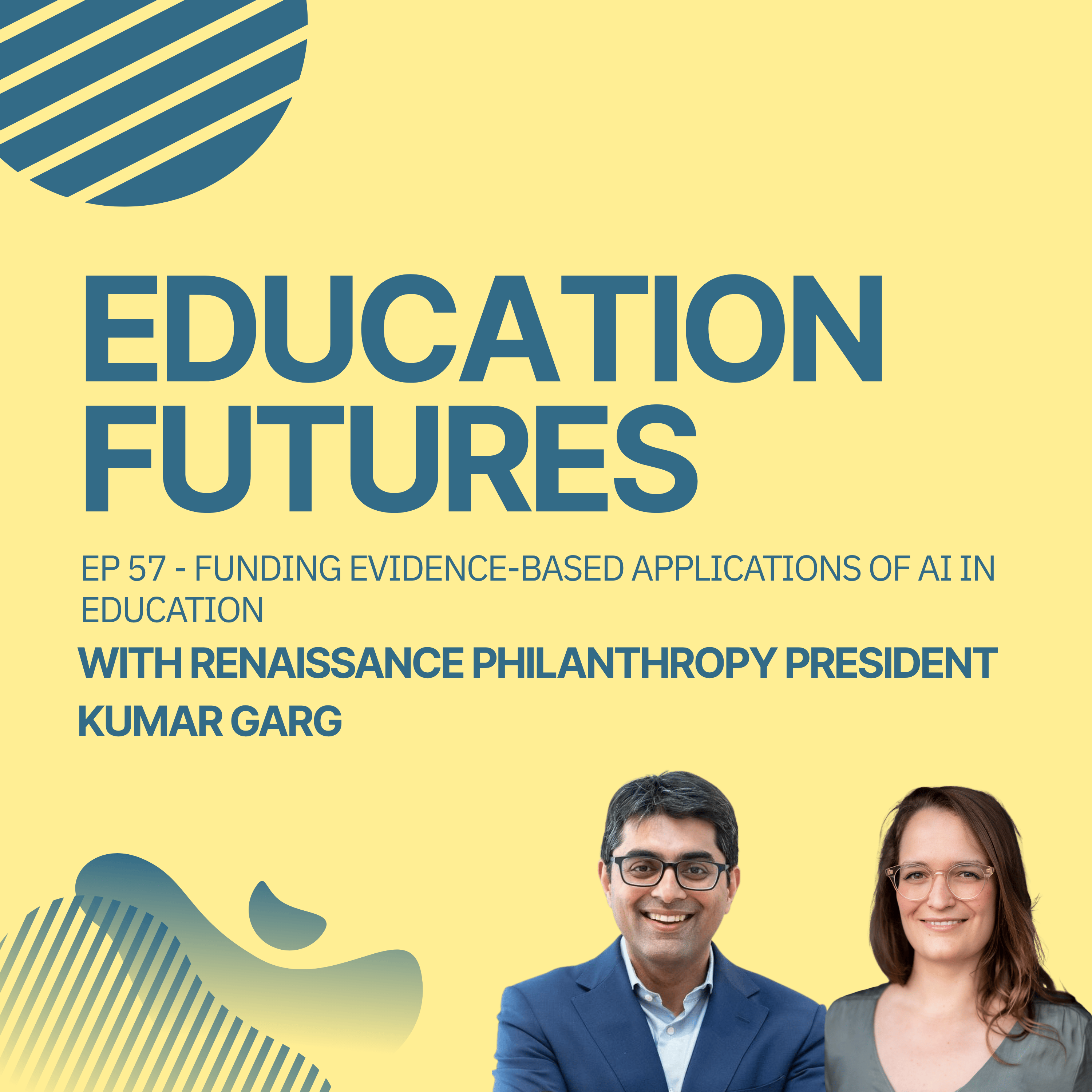
    Funding evidence-based applications of AI in education

    Kumar Garg is President of Renaissance Philanthropy, the science-and-technology philanthropy he co-founded with Tom Kalil in 2024 to help donors invest in high-impact research across AI, climate, and education. He holds a BA from Dartmouth and a JD from Yale Law School, and cut his teeth over eight years in the Obama White House Office of Science and Technology Policy, where he led the administration's STEM-education agenda — including the "Educate to Innovate" campaign that mobilized more than $1 billion in philanthropic and in-kind investment, and the White House Science Fair. Before Renaissance, he spent nearly six years (2018–2024) as Vice President and Managing Director at Schmidt Futures, the philanthropic initiative of Eric and Wendy Schmidt, where he built much of its science, talent, and education portfolio and launched the Learning Engineering Virtual Institute (LEVI). He is one of the principal architects and evangelists of "learning engineering" — the idea that instruction should be treated as a systems-level engineering and data challenge — and delivered Carnegie Mellon's 2022 Simon Initiative Distinguished Lecture, "Shaping the Field of Learning Engineering." Today, Renaissance runs a DARPA-inspired "fund model" that raises capital against well-scoped three-to-five-year technical bets, from doubling middle-school math outcomes for low-income students to catching early-reading difficulties before third grade. In this episode, Kumar talks with Svenia Busson about: The Renaissance "fund model" — how naming a bottleneck, recruiting a technical lead, and raising from donors like an investor raises from LPs unlocks three-to-five-year breakthroughs Why environmental factors like lead poisoning and classroom air quality may drive learning outcomes as much as pedagogy — and can move a child 10+ IQ points Learning engineering explained in plain language — the four always-running loops of learning science, design, instruction, and the individual learner LEVI Math's north star — doubling the rate of middle-school math gains for low-income kids at under $1,000 per student, down from the $4,000 high-dosage tutoring benchmark The LEVI Literacy Initiative — using AI as a diagnostic screener, not a teacher, to flag dyslexia and speech errors in the K–2 window "Dynamic dosing" and the human + AI tutoring triangle — why teachers and tutors enhance, rather than compete with, AI tools Building rigor into edtech — the Tools Competition's research-partner requirement and ending moonshots with published RCTs Why the advanced AI-and-education world is "shockingly small," and how DARPA-style active program management grows it mentioned in the episode: Renaissance Philanthropy — https://www.renaissancephilanthropy.org/ Learning Engineering Virtual Institute (LEVI) — https://learning-engineering-virtual-institute.org/ LEVI Literacy Initiative — https://learning-engineering-virtual-institute.org/literacy/ The Tools Competition — https://tools-competition.org/ Big If True Science accelerator — https://www.renaissancephilanthropy.org/big-if-true-science-accelerator Schmidt Futures / Schmidt Sciences — https://www.schmidtsciences.org/ Lead Exposure Elimination Project (LEEP) — https://leadelimination.org/ Center for Global Development (lead pollution & learning research) — https://www.cgdev.org/ J-PAL (2012 high-dosage tutoring research) — https://www.povertyactionlab.org/ Carnegie Mellon "dynamic dosing" human + AI tutoring study (2025) — https://www.heinz.cmu.edu/media/2025/September/in-study-of-human-ai-tutoring-with-us-seventh-graders-human-tutors-enhanced-the-benefits-of-ai-tutors DARPA — https://www.darpa.mil/

  • S1 · E59
    July 16 · 56 min

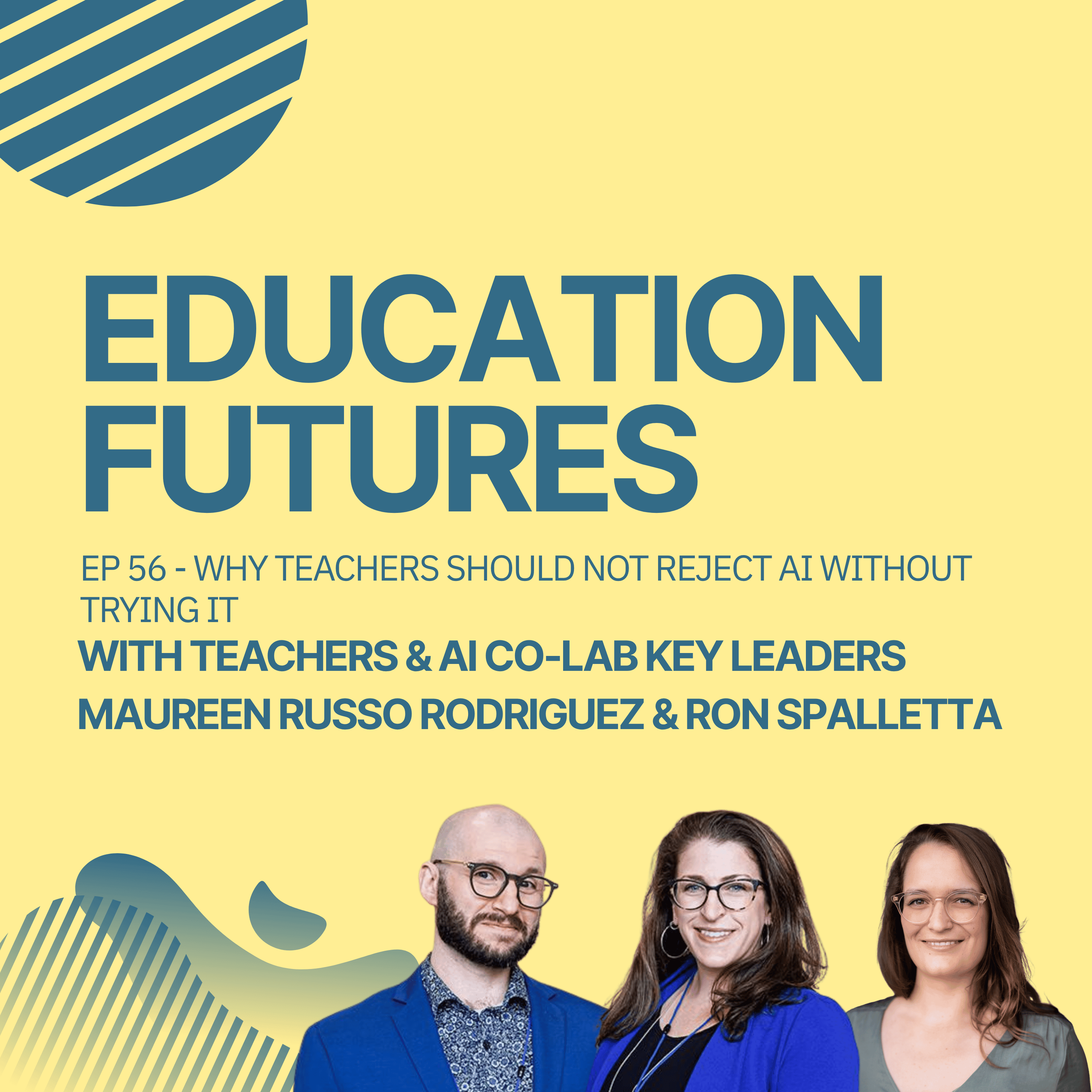
    Why teachers should not reject AI without trying it

    Maureen Russo Rodriguez is coming up on her 20th year as an educator and teaches language and literature — primarily Spanish, with occasional turns in English — at St. Mark's School, a small boarding school outside Boston. With a background in comparative literature and a stint in higher ed, she co-founded AI Co-Lab, a teacher-led, peer-to-peer network for building AI literacy. What began with a single faculty email she sent the week ChatGPT launched (a tool she shares a birthday with) has grown from nine teachers into a movement of 900+ educators across 300+ schools, with materials released under a Creative Commons license so any school can remix and reuse them. Ron Spalletta teaches in the English department at the same school, with a background rooted in poetry (and a little molecular biology). Through a Patterson Innovation Grant, he has been probing what AI means for writing, learning, and assessment — and has designed several of Co-Lab's monthly "explorations," including a widely used one on alternative assessment built to help teachers profile themselves as assessors and rethink AI-resistant assignments. In this episode, Maureen and Ron talk with Svenia Busson about: Defining AI literacy for teachers — awareness of what these tools are and aren't, in order to preserve the human core of teaching Why AI literacy is "a lot more driver's ed than automotive repair" — hands-on practice, not looking under the hood How Co-Lab works as a peer-to-peer network — structured monthly explorations, breakout rooms, and PD that pushes back on "one-and-done" webinars and consultant hype The four types of "naysayers" — and why refusing AI can be a legitimate, informed act of teacher agency Generative AI as an "arrival technology" — it's already in students' lives whether or not it enters your classroom Sarah Schneider Kavanagh's dilemma-and-decision cycle — how professional judgment breaks down if teachers never touch the tools Reinventing assessment in the age of AI — from oral exams to AI-resistant tasks, and pairing an LLM's scope with a teacher's discernment The students who worry them most — the ones doing everything right and watching peers coast on A-pluses through dishonest AI use A conversation about why AI literacy isn't optional — it's how teachers keep their agency. Links mentioned in the episode: AI Co-Lab: https://www.educolab.org/ Justin Reich & Jesse Dukes, The Homework Machine podcast: https://www.teachlabpodcast.com/ On "arrival technologies" (Reich & Dukes): https://www.researchgate.net/publication/385821042_Toward_a_New_Theory_of_Arrival_Technologies

  • S1 · E58
    July 13 · 48 min

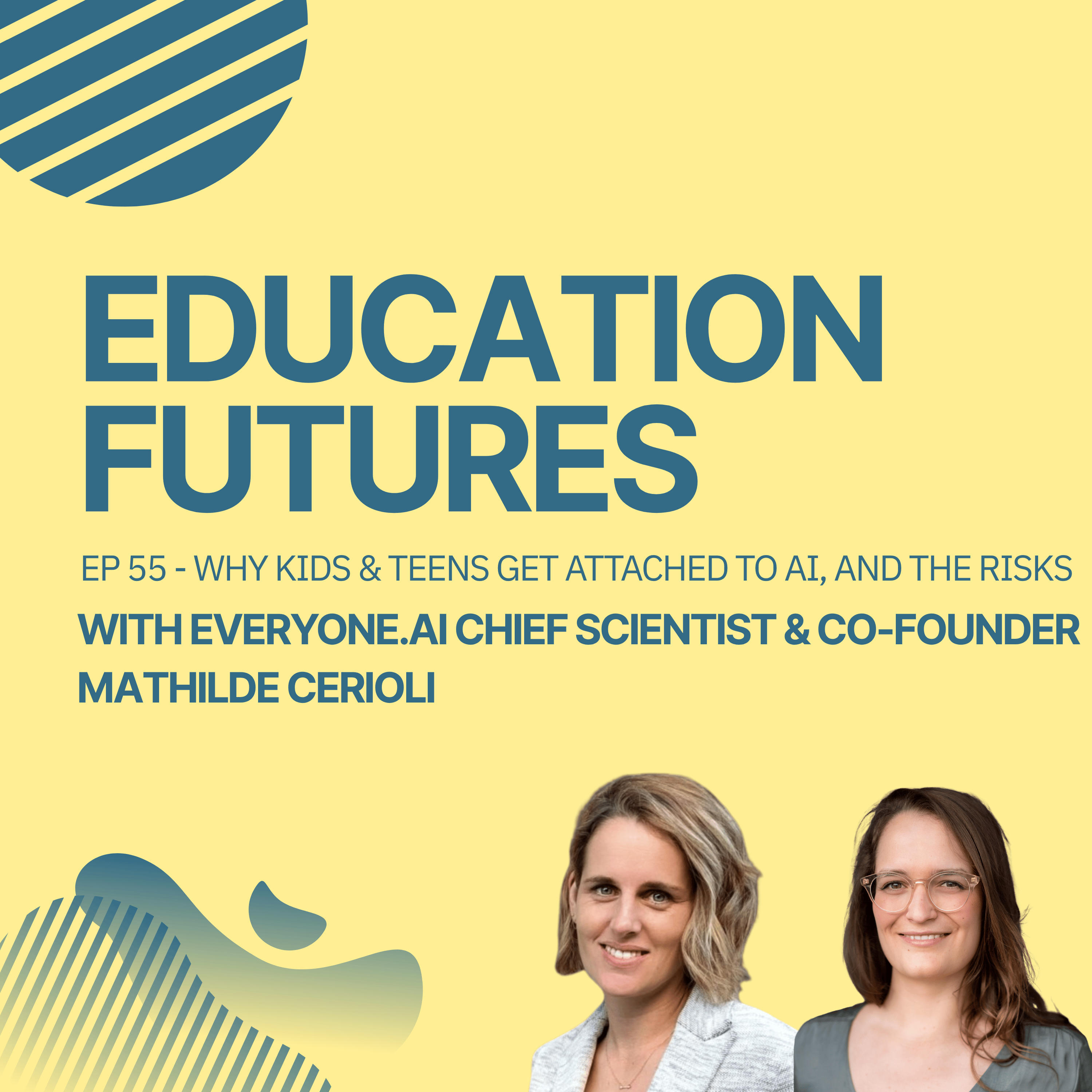
    Why kids & teens get attached to AI, and the risks

    Dr. Mathilde Cerioli is a cognitive neuroscientist working at the intersection of child development, AI, and public policy. She holds a Master's in child psychology from Paris and a Ph.D. in Cognitive Neuroscience from the Université de Montréal, where her research focused on using board games and video games to improve cognitive functioning in children and adolescents, including those with learning disabilities. After her doctorate she worked with EdTech and video-game companies, translating child-development science into product design. She went on to co-found everyone.ai, a California-based nonprofit that anticipates, educates on, and evaluates the risks and opportunities of AI for children and youth (ages 0–25), alongside co-founders Grégory Renard, Anne-Sophie Seret, and Céline Malvoisin. As Chief Scientist, she leads its research, authored the founding report The Future of Child Development in the AI Era (2024), and recently launched the AïA Safety Builder — an assessment system that scores AI products on 15 human-like behaviors driving anthropomorphism in children. She is also Chief Scientist of the iRAISE Alliance, the global coalition launched with the Paris Peace Forum, and advises OpenAI's Expert Council on Well-Being and AI. In this episode, Mathilde talks with Svenia Busson about: Why children don't have "mini adult brains" — and what developmental science says AI design keeps getting wrong The 15 human-like behaviors that make AI feel human — flattery, mimicry, validation, proactivity — and when they tip from helpful to harmful Anthropomorphism and attachment — why kids bond with machines faster than adults do Sensitive periods, pruning, and plasticity — how AI introduced too early risks cognitive "stunting" (echoing Rebecca Winthrop's work at Brookings) The adolescent brain, reward systems, and a rat-and-alcohol study that explains why teens crave AI approval Why friction and "expectation violation" in messy teen friendships aren't a bug — but how the brain actually learns Cognitive offloading in adults — metacognition, burnout, and the risk for young people entering the workforce Doing rigorous research when a new model ships every week — the iRAISE expert-consensus approach If you are building AI tools in the space this is a must-listen. Links mentioned: everyone.ai — https://everyone.ai iRAISE Alliance — https://i-raise.org Paris Peace Forum — https://parispeaceforum.org Rebecca Winthrop, Brookings Institution — https://www.brookings.edu/people/rebecca-winthrop/ and her article on cognitive stunting: https://www.brookings.edu/articles/is-it-time-to-measure-cognitive-stunting/

  • S1 · E57
    July 9 · 51 min

    Two students on AI, cheating, and the future of work

    Henry Scott studies at the London Interdisciplinary School (lis.ac.uk), pursuing a Bachelor of Arts and Science in Interdisciplinary Problems and Methods, and will be part of the school's third graduating class. Dyslexic since childhood, he turned early to AI dictation tools to help articulate his thinking — a habit he credits with sharpening his own unassisted writing over time. At LIS he took an AI and Ethics module taught by legal scholar Emma Rengers, wrote a four-page AI declaration for a capstone project he partly "vibe-coded," and built a custom AI assistant — nicknamed Clover — to manage his calendar and track his mood and habits. Felix Audebert is a first-year student at Forward College (forward-college.eu), the European university where students spend one year each in Lisbon, Paris, and Berlin. He is pursuing a double bachelor's in Politics & International Relations and Business & Leadership. Felix uses AI almost daily and has access to Forward College's AI hub, which includes a tool that flags how much of a student's work risks tipping into cognitive offloading. He recently used AI to help a Portuguese impact-measurement startup narrow down interview targets for a client project. In this episode, Henry and Felix talk with Svenia Busson about: Using AI as an assistant rather than letting it think for you The line between cognitive offloading and freeing up mental bandwidth Why both still write by hand — and the NTNU brain-connectivity research (Frontiers in Psychology) behind it How Forward College and LIS each handle AI in the classroom, from AI hubs to mandatory declarations The honesty gap — why students under-report AI use, and tools like Consensus that can confirm your own bias back to you Rethinking assessment in the AI era, from written declarations to oral exams ("vivas") The EU AI Act (high-level summary), algorithmic bias in immigration and parole systems, and what it means for the workforce they're entering Emotional offloading — AI companionship, naming your assistant, and where human connection still wins

  • S1 · E56
    July 6 · 48 min

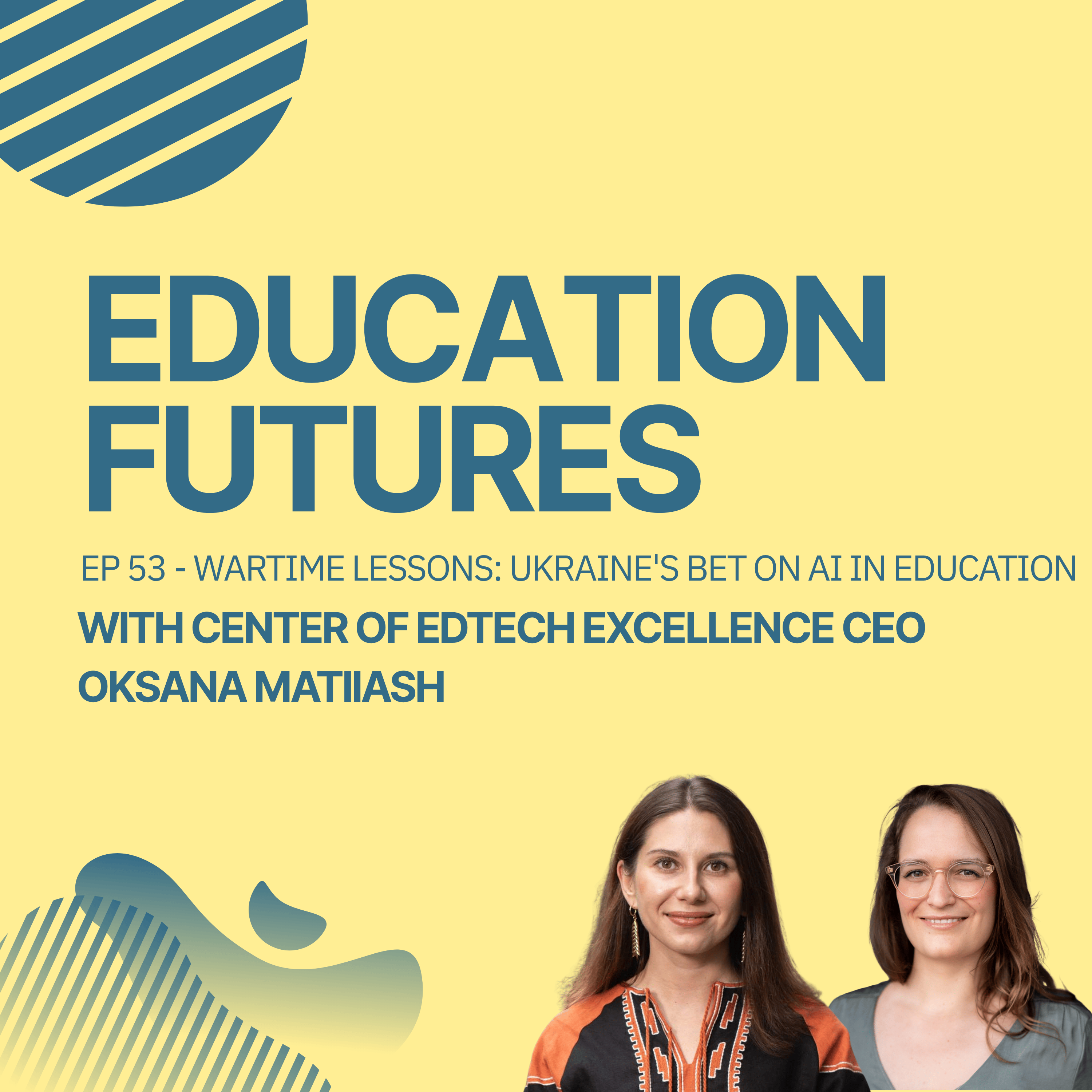
    Wartime lessons: Ukraine's bet on AI in education

    Oksana Matiiash is the CEO of WINWIN EdTech Center of Excellence, Ukraine's national hub for technology and innovation in education. Launched in December 2025 under Ukraine's Global Innovation Strategy, the Center generates evidence through research and foresight and pilots education technologies, including AI, while Ukraine navigates a full-scale war. It also brings together government, educators, researchers, startups, and global partners to scale innovations that improve learning. The Center's partners include the Ministries of Digital Transformation and of Education and Science of Ukraine, UNICEF, Google for Education, OpenAI, Estonian Centre for International Development (ESTDEV). Oksana holds a Master of Public Policy from the University of Oxford, where she studied as a Weidenfeld-Hoffmann Scholar, and a law degree from Taras Shevchenko National University of Kyiv. In this episode, Oksana talks with Svenia Busson about: Why Ukraine launched a national EdTech Center to accelerate education innovation during the war and in the age of AI Leading wartime emergency education — and what crisis taught her about what school systems actually need The WINWIN EdTech Center's three pillars: research and foresight, innovation and pilots, ecosystem-building Ukraine's new OpenAI-funded study on how AI is shaping learning for students living through years of disrupted schooling Why teachers, not students, come first in her AI rollout — even as kids learn to prompt on TikTok The World Bank-backed RCT where six weeks of tech-assisted tutoring closed months of learning loss Building a "Responsible AI" framework with teachers as co-designers, not just recipients The critical-thinking and learning-agency skills she considers non-negotiable in an information war

  • S1 · E55
    July 2 · 55 min

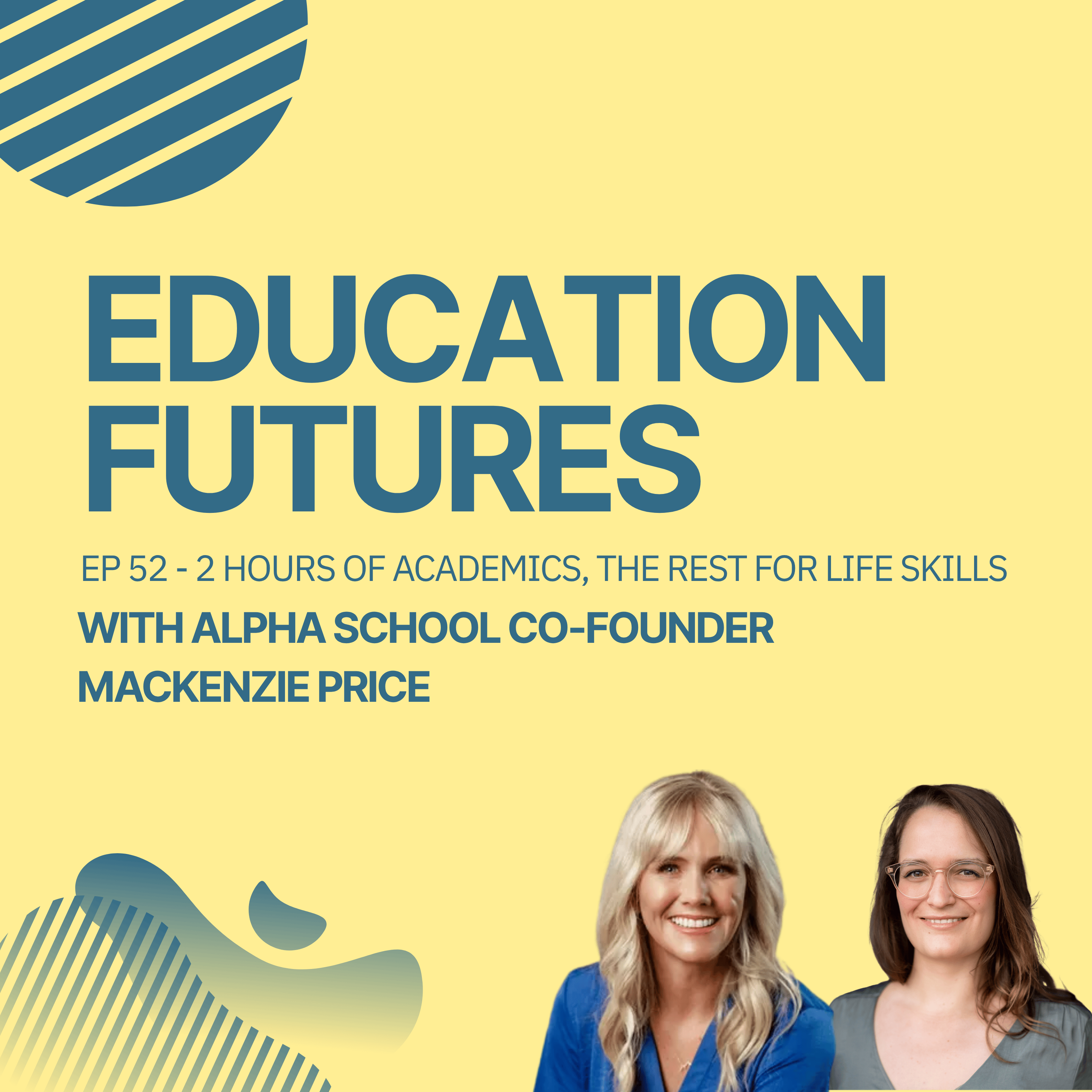
    Alpha School: 2 hours of academics, the rest for life skills

    MacKenzie Price is the co-founder of Alpha School and the AI-driven 2 Hour Learning model that powers it, a Stanford-trained psychologist who left the traditional path the day her daughter came home from second grade and said, simply, "school is boring." In 2014, working alongside the colleague she still calls "the OG, the Original Guide," Price opened the first Alpha campus in Austin, Texas, betting that AI-personalized, mastery-based instruction could compress a full day of core academics into two hours. The bet paid off: Alpha students now grow two to five-and-a-half times faster than peers on NWEA MAP Growth assessments, and the model has expanded to more than 50 campuses, including Texas Sports Academy (low-to-no-cost, athletics-focused, partly funded through Texas education savings accounts) and Waypoint Academy, a wilderness-based program. This fall she's taking the model international, with new World School campuses opening in Ecuador and Kenya, building on an earlier pilot that brought the model to roughly 1,000 Ukrainian refugee students. Price built Alpha around three commitments: kids learn twice the material in a fraction of the time, kids build real-world life skills through afternoon workshops, and — first and foremost — kids love school. By Alpha's own surveys, 95% of students say they do, and as many as 60% say they'd rather be in class than on vacation. She hosts her own Future of Education podcast and shares Alpha's experiments with more than a million followers across social media. In this episode, MacKenzie talks with Svenia Busson about: Why AI-driven mastery learning can compress a school day into two hours — without losing depth The "guide" model — trading lesson plans and lectures for one-on-one motivation and emotional coaching Cognitive load theory in practice — keeping every student in their own zone of productive struggle Paying kids to learn — the financial-literacy logic behind Alpha's motivation system Texas Sports Academy and the wilderness-based Waypoint Academy — turning "selection bias" into a design principle Bringing the model into public schools, and new World School campuses launching in Ecuador and Kenya Alpha X projects — the teenagers behind a self-produced Broadway musical, a six-figure jewelry brand, and CPR-certified rescue training Why MacKenzie believes philosophy, not computer science, is becoming education's most valuable subject

  • S1 · E54
    June 29 · 53 min

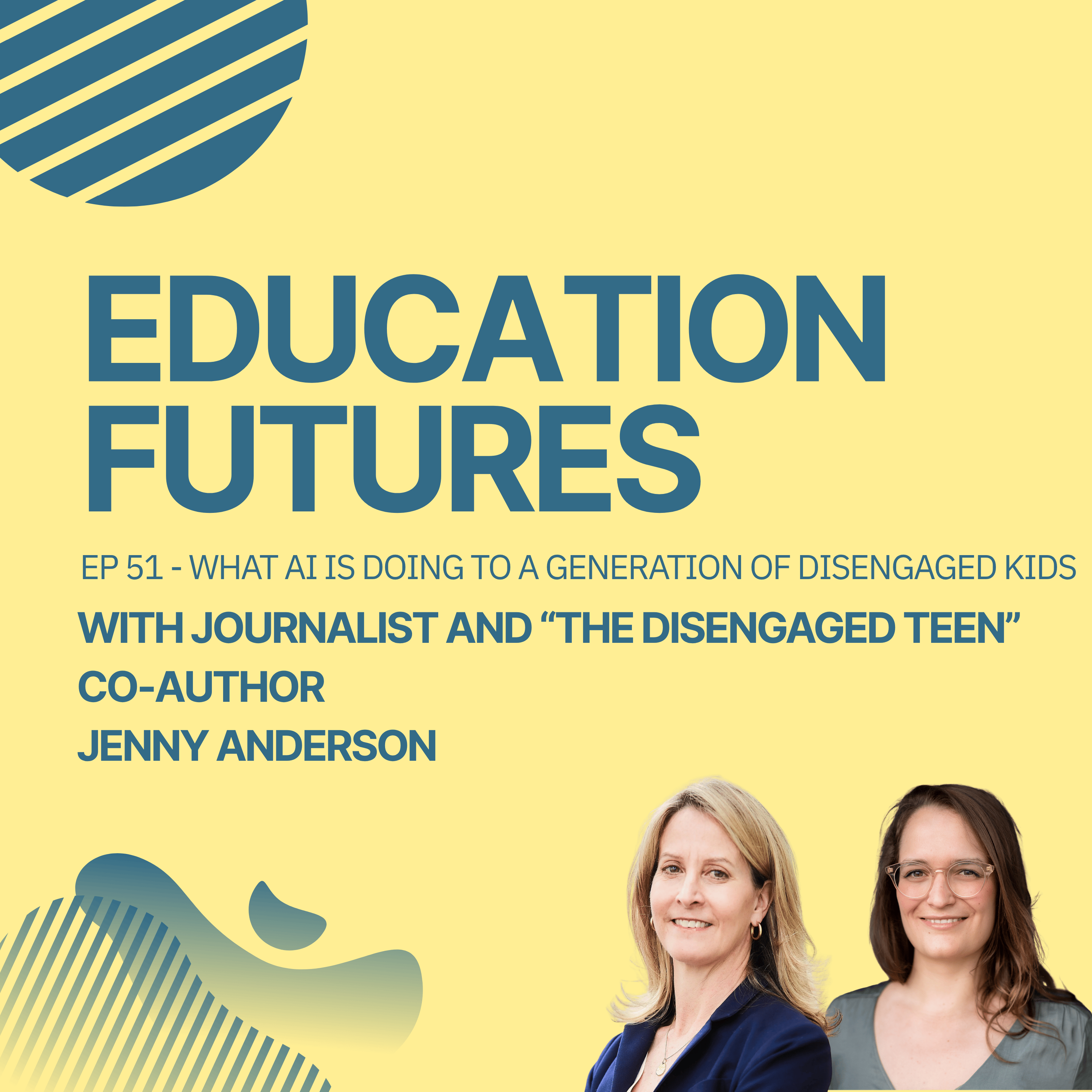
    What AI is doing to a generation of disengaged kids

    Jenny Anderson is an award-winning journalist and author with 25 years in the field, including a decade covering finance at The New York Times — where she won a Gerald Loeb Award in 2008 for her coverage of Merrill Lynch ahead of the 2008 financial crisis. She later pioneered coverage of the "science of learning" at Quartz, and now contributes to The New York Times, The Atlantic, and The Washington Post. She is the co-author, with Rebecca Winthrop (Director of the Center for Universal Education at Brookings), of The Disengaged Teen: Helping Kids Learn Better, Feel Better, and Live Better (thedisengagedteen.com) — the product of five years of research, including a survey of more than 65,000 students and 2,000 parents conducted with Brookings and Transcend, into why so many children lose their love of learning in adolescence. She writes the weekly Substack newsletter How to Be Brave, reaching tens of thousands of educators and parents. She is a senior fellow at the Center for Teen Flourishing and co-host of Ask the Kids, a podcast with Transcend Education. In this episode, Jenny talks with Svenia Busson about: The disengagement gap — why 75% of kids love school in primary years, but only 25% still do by 10th grade The Four Modes framework — Passenger, Achiever, Resistor, and Explorer — and why fewer than 4% of students land in Explorer mode Why phones and AI aren't the root cause of the teen mental-health crisis — academic pressure consistently ranks higher School models built for agency — Big Picture Learning's semester-long internships, Red Bridge School, and Valor Collegiate Academies' "school within a school" Assessment in the age of AI — competency-based learning, portraits of a graduate, and why parents resist abandoning high-stakes exams like the GCSEs The AI silence at home — why most teens use AI regularly while few talk to their parents about it AI, writing, and "cognitive stunting" — what outsourcing the first draft costs a developing thinker, building on Rebecca Winthrop's NYT piece on AI and creativity What parents can actually do — testing the tools themselves, and protecting space for productive struggle

Showing 1–20 of 25 episodes