Skip to content
Artwork for Disambiguation
TechnologyBusinessNewsTech News

Disambiguation

Michael Fauscette

"Disambiguation is the process of removing confusion around terms that express more than one meaning and can lead to different interpretations of the same string of text." 

Host Michael Fauscette of Arion Research; a leading technology analyst, tech startup advisor, consultant, board member, and storyteller; and his guests "remove the confusion around" artificial intelligence (AI), generative AI and business automation by looking at the business solutions available today to improve business outcomes and gain competitive advantage. 
Play
  • 20 episodes
  • weekly
  • Avg 44 min
  • English
  • #155
    Wednesday · 35 min

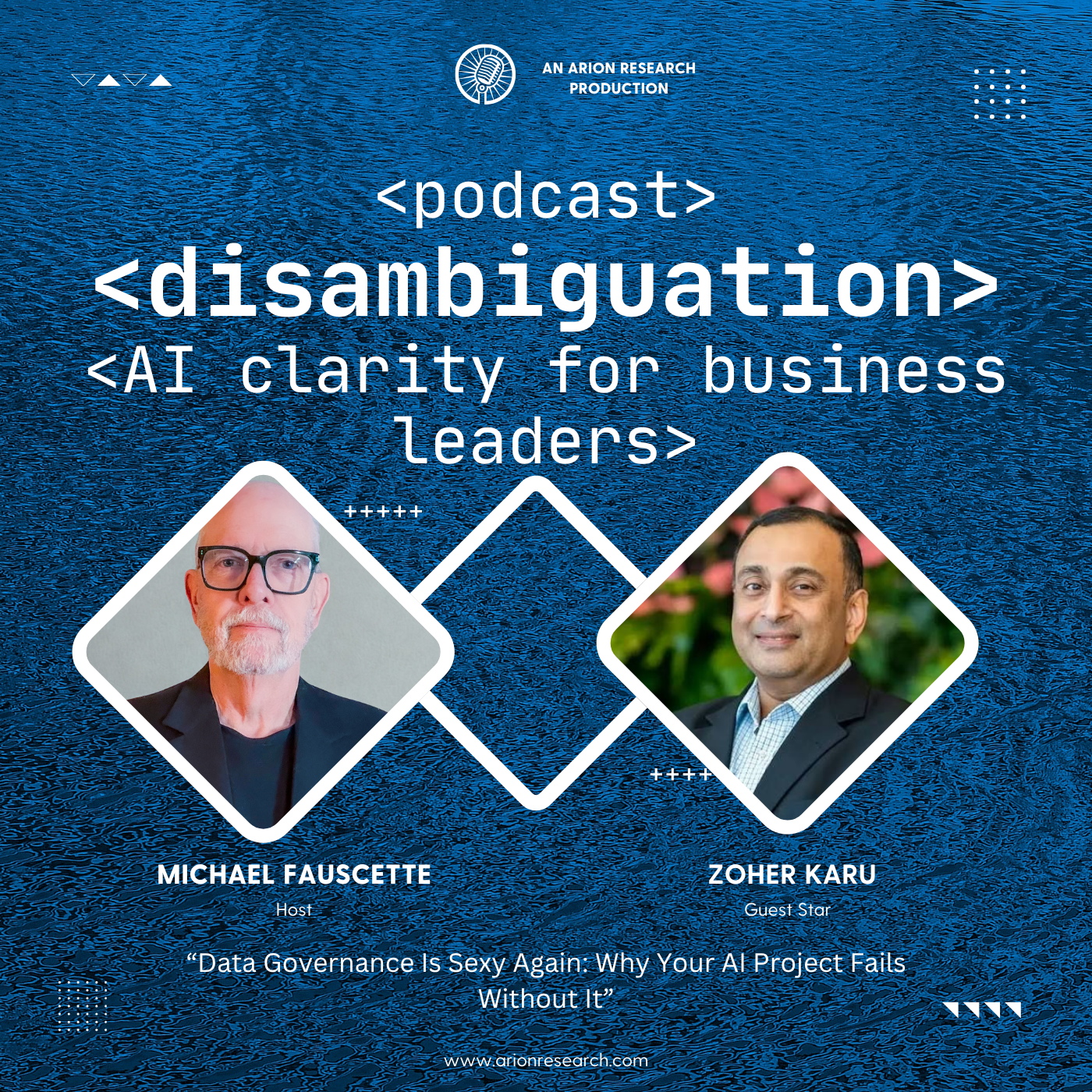
    Data Governance is Sexy Again: Why Your AI Projects Fail Without It

    In this episode of the Disambiguation podcast, host Michael Fauscette talks with Zoher Karu, Head of AI at Taelor, about why data governance has suddenly become a boardroom priority, how dirty data and missing business context cause AI projects to fail, and what practical steps leaders can take to build a data foundation that actually supports AI at scale. Zoher has spent his career at the intersection of data, analytics, and business strategy. He holds a PhD in electrical engineering from MIT, started at McKinsey, then founded startups in retail analytics and call center intelligence before leading enterprise-wide data and analytics organizations at Sears Holdings, eBay, Citibank (across 17 markets in Asia and Europe), and Blue Shield of California. The conversation covers why data governance is "sexy again" (AI amplifies data quality problems, so bad data now means bad decisions at machine speed), the blood-in-the-body analogy for enterprise data (every organ needs it, it should not be dirty or leaking), why a two-year data cleanup project is the wrong approach (clean as you go with a use-case-driven mindset), three reasons AI projects fail to deliver results (data quality and trust, missing business context that lives in people's heads not databases, and change management resistance), the "Susie knows how to do that" problem (business rules and institutional knowledge that AI agents cannot access), why pilot success does not predict production success (manually cleaned spreadsheets do not reflect real-world data), change management and the value exchange (people need to know what is in it for them), why productivity gains are not the same as business transformation (the real power of AI is reimagining processes entirely), cross-industry patterns in data challenges (siloed customer views, fractured definitions, departmental selfishness), how data teams are evolving toward full-stack roles with AI-assisted tools, governance as brakes that help you go faster (knowing the boundaries lets you push all the way to them), and practical first steps for business leaders (start with cost savings, ask employees what would make their job easier, build momentum through small wins). Timestamps:00:00 - Introduction00:32 - Episode title and guest intro00:45 - Zoher's background: MIT, McKinsey, startups, Sears, eBay, Citibank, Blue Shield03:18 - Business-first mindset for data leadership05:03 - Why data governance is sexy again06:18 - Data is like blood: the enterprise body analogy07:33 - When "revenue" means different things to different teams08:02 - Clean as you go, not a two-year cleanup project09:30 - The shift from AI productivity to AI governance10:00 - Three reasons AI projects fail10:55 - Missing business context: the "Susie knows" problem13:10 - Pilot versus production: the cleaned spreadsheet trap13:38 - Change management and the value exchange15:07 - Making existing work easier: the call center notes example15:28 - The real power of AI: reimagining processes entirely17:34 - Board-driven AI mandates and the fear of being left behind18:44 - AI is a tool, not a solution looking for a problem19:32 - Cross-industry patterns in siloed customer data21:49 - Citibank example: loan data missing time of day23:40 - Full-stack data teams and AI-assisted tools26:17 - Building governance that protects without becoming a bottleneck27:07 - Traffic laws analogy: rules of the road for AI29:32 - Brakes help you go faster30:14 - Practical first steps: start with cost savings and productivity32:06 - Ask your employees what would make their job easier33:04 - Success builds on success33:31 - Recommendation: Factfulness by Hans Rosling Guest: Zoher Karu, Head of AI, TaelorHost: Michael Fauscette, CEO & Chief Analyst, Arion Research Subscribe and turn on notifications so you never miss an episode.

    • Transcript
  • #154
    September 16 · 35 min

    From Personalization to Individualization: How AI Reads Intent in the Moment

    In this episode of the Disambiguation podcast, host Michael Fauscette talks with Krisztian Kiraly, International Partnership Manager at OptiMonk, about why the future of e-commerce is AI-powered conversion rate optimization, how smart personalization turns existing traffic into significantly more revenue, and where the line sits between a relevant experience and a creepy one. Krisztian has spent more than a decade in digital marketing and e-commerce, with a deep focus on conversion rate optimization. He ran Conversion Masters, a CRO agency that worked with e-commerce brands to improve conversion rates and unit economics, before joining OptiMonk to lead international partnerships. The conversation covers the double squeeze facing e-commerce operators (ad costs up 222% in eight years while giants like Amazon, Temu, and Shein compete with nearly unlimited marketing budgets), why conversion before acquisition is the smarter growth strategy (pouring more water into a leaky bucket does not fix the leak), how AI-powered CRO removes bottlenecks that used to take developer teams weeks to address, the behavioral signals AI can read the moment a visitor arrives on a site, the evolution of exit intent from annoying pop-ups to dynamic AI-driven interventions tailored to the exact product page a visitor is leaving, why the product page is the new landing page (40 to 70% of visitors now land directly on product pages through Performance Max campaigns), AI-generated embedded content that shows benefit badges directly on product images, the 10 to 40% conversion rate uplift OptiMonk is seeing from A/B testing AI-optimized product pages, the privacy balance between first-party and zero-party data versus over-personalization that feels invasive, a 70% revenue increase for a large e-commerce store achieved through 100-plus small optimizations over one year, and practical first steps for e-commerce leaders who have not yet started using AI for conversion optimization. Timestamps:00:00 - Introduction00:32 - Episode title and guest intro00:48 - Krisztian's background: CRO agency to OptiMonk02:16 - The double squeeze: rising ad costs and giant competitors03:11 - Why increasing ad spend is not a long-term solution03:43 - AI-powered CRO: analyzing data and running tests at scale05:27 - How AI reads behavioral signals the moment a visitor arrives06:27 - The gap between AI-driven traffic and static landing pages07:25 - 67% of visitors now expect personalized experiences08:07 - Exit intent reimagined: dynamic headlines, images, and CTAs09:18 - Pop-ups are a tool, not inherently good or bad10:14 - Hyper-personalization powered by AI11:50 - Conversion before acquisition: the leaky bucket problem13:02 - CRO affects two profit factors versus one for ad spend14:34 - The product page is the new landing page15:57 - AI-generated embedded content and benefit badges17:23 - Answering "what is in it for me" in five seconds18:27 - 10 to 40% conversion rate uplift from A/B testing19:14 - Privacy and personalization: finding the golden balance21:39 - Zero-party data: the win-win of asking visitors directly23:03 - Where personalization crosses into creepy23:32 - 70% revenue increase: 100 small fixes, compounding results26:11 - Without data you are just another person with an opinion28:22 - First steps: know your data and start with product pages30:02 - Lifestyle images, benefit-focused headlines, and trust signals33:20 - Recommendation: Dan Martell on AI efficiency in business Guest: Krisztian Kiraly, International Partnership Manager, OptiMonkHost: Michael Fauscette, CEO & Chief Analyst, Arion Research Subscribe and turn on notifications so you never miss an episode.

    • Transcript
  • #153
    September 9 · 53 min

    From Pilots to Production: Agentic Commerce, Enterprise Trust, and the Quantum Horizon

    In this episode of the Disambiguation podcast, host Michael Fauscette talks with Hemang Upadhyay, Senior Product and AI Leader, about why most AI pilots die the moment they connect to real enterprise infrastructure, what it actually takes to deploy adaptive AI agents in production commerce environments, and how the convergence of AI and quantum computing will reshape enterprise architecture. Hemang has spent more than 16 years as a strategic product leader building AI-driven solutions for US commerce, e-commerce, and technology companies. His work across enterprise automation, AI-powered search, and recommendation engines has generated more than $450 million in combined business impact. He published a paper that won the IEEE Best Paper Award on quantum computing as a service, and has spoken at the AI Genetic Summit, Commerce Media Brand Summit, eTailer Boston, B2B Connect, and Identity Week America. The conversation covers the distinction between conversational AI and agentic AI (chatbots produce language, agents produce consequences), the five-layer pattern for scaling agents from pilot to production (constrain, translate, authorize, observe, recover), why autonomy should live inside the workflow but authority should live outside the model, the shift in commerce from helping customers find products to helping them achieve outcomes, the agent passport concept for identity and trust in agent-to-agent interactions, how mid-market retailers should adopt AI (data readiness first, then journey focus, then capability composition), six security controls for building trust into agentic architectures, the honest framing on AI and jobs (task automation, role redesign, and workforce decisions are related but not identical), and the hybrid future of quantum computing and AI. Timestamps:00:00 - Introduction00:32 - Episode title and guest intro00:48 - Hemang's background: 16+ years in product leadership and AI02:19 - Simplifying complexity across digital commerce04:45 - Research, speaking, and the IEEE best paper on quantum as a service07:05 - Conversational AI vs agentic AI: language vs consequences08:30 - Five components of an agent: goal, reasoning, memory, tools, authority10:00 - Connecting probabilistic decisions to deterministic systems12:42 - Scaling from pilot to production: the five-layer pattern13:45 - Constrain, translate, authorize, observe, recover17:36 - Autonomy inside the workflow, authority outside the model18:03 - Commerce agents: from product discovery to outcome achievement18:52 - Amazon Rufus to Alexa shopping transition20:06 - The apartment furnishing example: scattered work to one plan23:12 - Agent-to-agent identity: the agent passport concept25:18 - Authentication vs authorization at the moment of action28:00 - Mid-market retailers: start with focus, not scale29:25 - Data readiness: agents make bad decisions faster on bad data31:14 - Capability composition and graduated autonomy33:17 - Trust: does the system remain safe when the model is wrong?34:23 - Six practical controls for agentic security37:22 - Governance as executable policy inside the product39:00 - AI and jobs: three effects, not one narrative42:22 - Which parts of my work are becoming easier to automate?44:07 - Quantum computing and AI convergence: the hybrid future46:07 - Quantum as a service: orchestration across classical, AI, and quantum47:32 - Three actions for business leaders on quantum readiness50:03 - Recommendations: Ethan Mollick and Andrew Ng Guest: Hemang Upadhyay, Senior Product & AI LeaderHost: Michael Fauscette, CEO & Chief Analyst, Arion Research Subscribe and turn on notifications so you never miss an episode.

    • Transcript
  • #152
    September 2 · 48 min

    Beyond the Chat Window: Why Real Human-AI Collaboration Requires a Completely Different Product

    In this episode of the Disambiguation podcast, host Michael Fauscette talks with Tim Lidman, Co-Founder and CEO of Clyde AI, about why the chat window is not the right interface for real human-AI collaboration, why most companies are stuck building Frankenstein workbenches of cobbled-together AI tools, and what it actually takes to design a product where humans and AI work together as a hybrid team. Tim's career traces the entire evolution of enterprise collaboration. He started in tech sales at WebEx and Cisco selling audio conferencing, moved to SAP SuccessFactors, then founded Think Tank, a structured collaboration platform based on decades of research into behavioral science and group decision support systems. Think Tank was acquired by Accenture in 2021, where Tim operated as a partner for four years. He co-founded Clyde AI with Chris Bricker to build what he calls AI-native collaboration: a product where AI is a first-class citizen in the architecture and UX, not bolted on top of legacy workflows. The conversation covers Tim's contrarian take on LLMs and the promise of natural language interfaces (prompt engineering and context engineering are just new paradigms users have to learn, not the elimination of paradigms), why single-threaded chat is the wrong model for complex problem solving, the AI advisor concept (multi-threaded AI with separate domain knowledge and personas working in parallel without polluting each other's context), the design blueprint of mapping what AI is good at against what humans are good at, why humans are still better at inventing new information and making judgment calls, the Frankenstein workbench problem (employees cobbling together tools just to check the AI box), fear-driven adoption as terrible leadership, the micro win approach (20 minutes to solve one small problem and build trust), why anyone using AI for more than 10% of their workflow is ahead of 99.99% of workers, why the term change management may not survive (change is now constant, not a project with a start and end date), the people-process-technology split that must blend into one unified experience, and the industrial revolution parallel compressed 100x. Timestamps:00:00 - Introduction00:31 - Episode title and guest intro00:50 - Tim's background: heavy metal drummer to tech sales to collaboration to AI02:07 - The golden thread: evolution of collaboration from audio conferencing to AI03:15 - Enterprise social networking: Microsoft buys Yammer for $1.2 billion03:42 - Think Tank: structured collaboration and group decision support systems05:32 - The hypothesis for Clyde: AI removing expensive synthesis work06:41 - What AI cannot replace: tribal knowledge, human judgment, buy-in08:13 - Building Clyde: AI where AI excels, human UX where humans excel09:33 - AI advisors: multi-threaded thinking inside a collaborative workspace11:14 - The chat window problem: LLMs created a new paradigm, not eliminated one14:03 - Putting the onus on the tool to extract context and intent16:19 - Single-threaded chat vs multi-threaded problem solving18:37 - Example: business plan with parallel risk, strategy, and financial advisors20:29 - Legacy tools bolting AI on top of old architectures22:32 - Fear-driven adoption: use AI or you are fired29:10 - Building hybrid teams: human-to-human vs human-to-AI collaboration30:52 - Humans can invent new information; AI is pattern recognition34:38 - Change is now constant, not a project with start and end dates36:28 - The term change management may not survive38:32 - Continuous optimization: building and optimizing happen simultaneously41:42 - People-process-technology must blend into one unified experience44:11 - The industrial revolution parallel, compressed 100x46:27 - Recommendation: Sapiens by Yuval Harari47:20 - Recommendation: CEO of Lovable, 0 to $100M ARR in nine months Guest: Tim Lidman, Co-Founder & CEO, Clyde AIHost: Michael Fauscette, CEO & Chief Analyst, Arion Research

    • Transcript
  • #151
    August 26 · 39 min

    From AI Sprawl to AI Impact: Why Picking One Workflow and Going Deep Is the Only Strategy That Works

    In this episode of the Disambiguation podcast, host Michael Fauscette talks with Chris Fitkin, Co-Founder and Partner at Metacto, about why most companies are spreading AI experiments too thin across every department, why that wide-and-shallow approach produces shelfware instead of results, and what it actually takes to get AI into production in the mid-market. Chris has 25 years in software engineering, a master's in software engineering, and is an AWS Certified Solutions Architect. He has been a CTO in cybersecurity, led due diligence at private equity firms, and co-founded Metacto with Garrett Fritz. The firm started in mobile app development and fractional CTO work, then pivoted to operational AI for mid-market and private equity-backed companies after seeing how dramatically the landscape was shifting. The conversation covers the AI sprawl problem (88% of companies are using AI in at least one function per McKinsey, but only 5% see measurable impact per MIT), the repeating cycle of cool demo to mixed results to low adoption to shelfware, why companies that go narrow and deep are more than twice as likely to see measurable bottom-line impact compared to those that scatter experiments across the organization, the Five Signals framework for picking your first AI workflow (email, spreadsheets, copy-paste relays, contactless approvals, repeat expert answers, report factories), why mundane workflows are the right starting point, the 5%/95% gap between demo and production (access control, business rules, quality checks, human review, audit trails, monitoring, versioning, ownership), failure modes that compound when nobody catches a bad LLM decision for five days, context engineering and the three parts of building good context (transactional data, document corpus, codified business rules and domain knowledge), why business first has to replace AI first, the mid-market pricing reality (Anthropic offered one client $1.2 million a year in token minimums, Mars Inc pays $600,000 a month to Google Gemini), the AI Engineering Maturity Index assessment tied to EBITDA and enterprise value, and practical advice for stuck leaders. Timestamps:02:07 - Change is the only constant across 25 years of technology cycles03:19 - App Store submissions doubled while downloads decreased04:16 - AI sprawl: 88% using AI, only 5% see measurable impact05:09 - The shelfware cycle: cool demo, mixed results, low adoption07:20 - Shadow AI is the new shadow IT07:43 - Narrow and deep is 2x more likely to produce bottom-line impact08:43 - Going deep: problem first, define success metrics before you build11:14 - Solution looking for a problem versus problem looking for a solution12:27 - Five Signals framework for picking your first AI workflow13:03 - Mundane workflows are validated by human capital investment14:31 - The 5%/95% gap: demo is 5% of the work, production is 95%16:05 - Failure modes: bad decisions compounding, admin database access exposed16:59 - Context engineering versus prompt engineering19:06 - Transactional data: clean, current, deduplicated data warehouse19:27 - Document corpus: proposals, QBRs, deliverables tagged with recency20:04 - Business rules and domain knowledge: codifying what lives in people's heads21:32 - Business first, not AI first: product managers lead engagements22:25 - Requirements engineering: the discipline everyone is rediscovering24:01 - The mid-market gap: too small for McKinsey, too complex for license distribution26:42 - Start small, measure lift, use wins to fund the next projects27:51 - AI Engineering Maturity Index: 30-day assessment tied to financial metrics33:54 - Focus on people: dedicated time, builders and advocates, adoption training36:52 - Leading a hybrid workforce: managing human and digital workers38:33 - Recommendation: Reid Hoffman's Masters of Scale with IBM CEO Arvind Krishna Guest: Chris Fitkin, Co-Founder & Partner, MetactoHost: Michael Fauscette, CEO & Chief Analyst, Arion Research

    • Transcript
  • #150
    August 19 · 42 min

    Innovation Is a Leadership Problem: Why the Forces That Kill New Products Are Now Killing AI Adoption

    In this episode of the Disambiguation podcast, host Michael Fauscette talks with Robyn Bolton, Founder and Chief Navigator of MileZero, about why the same organizational forces that have been killing innovation for decades are now killing AI adoption, and what leaders can do differently. Robyn's career started at Procter & Gamble, where she helped develop Swiffer, one of the most successful consumer product launches in recent history. From there she became a partner at Boston Consulting Group and then worked at Innosight, Clayton Christensen's innovation firm. She now runs MileZero, where she works with Fortune 500 companies like Medtronic, Nike, and Nestle to build pragmatic innovation capabilities. She published Unlocking Innovation last year and teaches at Massachusetts College of Art and Design. The conversation covers why innovation is a leadership problem and not an ideas problem (organizations are full of ideas, but leadership behaviors train people to stop sharing them), the five organizational antibodies that neutralize anything new and unfamiliar, how those same antibodies show up in AI adoption, the Revenge of Clippy (a Fortune 500 company launched a custom chatbot and employees responded with malicious compliance, asking questions they already knew the answer to just to check the box), why Robyn now defends innovation theater when companies commit to the season rather than just the show, the ABCs framework (Architecture, Behavior, Culture) and why 30 years of focusing on architecture alone has produced no improvement in corporate innovation results, the AI pilot trap and why falling in love with the solution instead of the problem is the root cause, Jobs to be Done applied to AI adoption, why automating a broken process just makes it fail faster, continuous change versus project-based change management, why scale needs to be defined at the start of a pilot because not everything should go company-wide, human infrastructure as the missing budget line in AI readiness, the replacement mistake versus AI-augmented humans, the sycophancy problem in LLMs and why manufactured trust is dangerous, and practical advice for stuck leaders. Timestamps:00:00 - Introduction00:31 - Episode title and guest intro00:47 - Robyn's path: P&G, Swiffer, BCG, Christensen's firm, MileZero02:08 - Choosing process over product: the deeper root cause03:57 - Innovation is a leadership problem, not an ideas problem05:46 - Logical responses with unintended consequences07:57 - Organizational antibodies and AI adoption09:09 - The Revenge of Clippy: malicious compliance with a company chatbot11:13 - Defending innovation theater: the season versus the show14:33 - Change management as a checklist versus ongoing behavior change15:12 - The gym analogy: one visit does not make you healthy16:00 - The ABCs framework: Architecture, Behavior, Culture16:32 - 30 years since the Innovator's Dilemma, results have not changed19:23 - The AI pilot trap: fall in love with the problem, not the solution21:22 - People, workflow, culture, technology: in that order21:53 - Incentives determine behavior: change the metrics, change the outcome23:13 - Jobs to be Done applied to AI adoption24:12 - Blank sheet of paper: stop cramming AI into broken processes25:45 - Continuous change versus project-based change management26:57 - Learning mindset: reassess after every step28:52 - Scientific method applied to business: test hypotheses individually32:06 - What scale really means: not everything goes company-wide33:16 - Human infrastructure and AI readiness34:06 - The replacement mistake: AI augments, not replaces35:53 - Sycophancy and manufactured trust in LLMs38:01 - Practical advice: find the problem, ask why, use the five whys39:48 - Recommendation: The Coaching Habit by Michael Bungay Stanier Guest: Robyn Bolton, Founder & Chief Navigator, MileZeroHost: Michael Fauscette, CEO & Chief Analyst, Arion Research

    • Transcript
  • #149
    August 12 · 42 min

    You Can't Automate a Broken Process: Why AI Readiness Starts with the Work, Not the Tools

    In this episode of the Disambiguation podcast, host Michael Fauscette talks with Justin Watt, Co-Founder and CEO of Switchboard, about why mid-market companies cannot just layer AI onto broken processes and scattered data and expect results, and what they need to do first. Justin's path ran from IBM, where he worked on large government projects and learned more about what not to do than what to do, through MetaLab working with Silicon Valley companies like Amazon and Uber, through project management and IT leadership, to co-founding Switchboard, which focuses on helping mid-market non-tech companies modernize and adopt AI and automation. The conversation covers why "digital transformation" has run its course as a term (most companies replaced tools but never actually transformed how they work), why Justin uses "modernization" instead, the 2006 problem (90% of mid-market leaders think their organization is technically capable because someone can build a pivot table in Excel), the "Data Lake" Excel file (a real client who named their spreadsheet that), why Excel came out the same year as Back to the Future and many companies still run their data on it, human duct tape (paying people to move spreadsheet cells between files), the 14,000-row rate sheet across four Excel files maintained by different people, why automating a broken process just automates the brokenness, mapping processes before touching technology, the governance gap (most companies treat governance as a log instead of a framework), the HR chatbot disaster (a company rolled out a chatbot that let interns look up everyone's salary and performance reviews), goal-based AI risks (the Anthropic vending machine story where someone got five iPhones for $500), board pressure without a defined outcome, margin driving versus revenue driving, the crawl-walk-run approach, and practical first steps for mid-market leaders. Timestamps:00:00 - Introduction00:31 - Episode title and guest intro00:45 - Justin's path: IBM, MetaLab, Switchboard01:52 - Learning what not to do at IBM: meetings about meetings02:58 - McKinsey stat: 65% of digital transformation fails, 90% is change management04:02 - Why "modernization" instead of "digital transformation"06:13 - The 2006 problem: 90% of leaders stuck technically06:40 - Your A-player's tech skill is a pivot table09:19 - The Matrix Code moment: a client's breakthrough10:59 - The "Data Lake" Excel file11:47 - Human duct tape: people moving cells between spreadsheets14:09 - The 14,000-row rate sheet across four files15:18 - You cannot automate a broken process16:40 - Map the process: get everyone in the room18:10 - A third of steps exist because of software limitations19:15 - SaaS trust is gone: ten years of "it's on the roadmap"20:06 - Governance is a log, not a framework21:27 - The HR chatbot disaster: interns looking up salaries24:36 - Trust and connecting AI to internal data26:33 - Goal-based AI exposes bad goal definition27:22 - The Anthropic vending machine: five iPhones for $50029:15 - Board pressure without a defined outcome31:13 - AI for margin driving, freeing time for revenue33:14 - First three months is modernization, not AI35:22 - Pick the most broken area and map the process37:34 - Just start playing with AI personally39:48 - Recommendation: Ben Evans quarterly AI macro presentation Guest: Justin Watt, Co-Founder & CEO, SwitchboardHost: Michael Fauscette, CEO & Chief Analyst, Arion Research Subscribe and turn on notifications so you never miss an episode.

    • Transcript
  • #148
    August 5 · 38 min

    The Identity Threat: Why AI Adoption Is a Human Challenge, Not a Technology Problem

    In this episode of the Disambiguation podcast, host Michael Fauscette talks with Eva Minkoff, Founder of Bold Being, about why AI adoption failures are not technology problems but identity threats, and why organizations cannot train or explain their way through them. Eva spent two decades in healthcare across clinical research, bedside care, media, marketing, and startups as both a co-founder and early employee. She gave a TEDx talk called "Five Minutes to Fix Our Broken Healthcare System" about the patient-doctor relationship and the collapse of self-trust under relentless pressure. That same pattern of pressure-driven identity loss is now playing out across every industry as AI reaches professionals whose authority and sense of legitimacy are built on a specific kind of expertise. The conversation covers why AI adoption is an identity threat rather than a change management problem, why employee sabotage of AI initiatives (30 to 70 percent in some studies) is survival behavior rather than insubordination, the Luddite parallel (skilled workers whose livelihoods were being erased, not irrational resisters), why you cannot explain someone out of an identity threat, compliance theater (employees using AI to produce outputs and then quietly redoing the work themselves), decision latency in leaders who were previously decisive, leadership brittleness (senior leaders going rigid or withdrawing under AI pressure), Eva's three-stage framework (instability, autopilot, durable agency), sustainable adaptability versus just staying current, regulated empathy in healthcare and its parallel in every industry, a client transformation story (Chief Patient Safety Officer who eliminated ED wait times and saved $50 million after doing identity work rather than operational work and was promoted to CMO), and three practical steps leaders should take right now: name the instability out loud, audit your own autopilot, and change the metric from adoption speed to adaptive capacity. Timestamps:00:00 - Introduction00:41 - Eva's background: two decades in healthcare, TEDx talk, coaching03:20 - Daughter born on ChatGPT launch day: living in both disruptions04:04 - Identity threat versus change management06:26 - Employee sabotage: the Luddite movement of our era07:16 - Survival behavior, not insubordination09:09 - Skills training assumes a knowledge barrier, the real barrier is psychological09:59 - Not ethical unpreparedness but human unpreparedness10:09 - Decision latency, performative adoption, compliance theater11:13 - Leadership brittleness12:24 - Resistance is information, not a problem to suppress15:57 - Three-stage framework: instability, autopilot, durable agency19:22 - Sustainable adaptability: not staying current, building internal capacity22:07 - Holding ambiguity without defaulting to paralysis23:47 - Healthcare as the most human-dependent industry25:08 - Regulated empathy: suppressing emotional responses as default operating mode27:33 - Client story: Chief Patient Safety Officer to CMO in one year30:06 - Three practical steps for leaders30:49 - Step one: name the instability out loud31:40 - Step two: audit your own autopilot32:48 - Step three: change the metric to adaptive capacity34:45 - Recommendation: Brene Brown, Atlas of the Heart, shame versus guilt Guest: Eva Minkoff, Founder, Bold Being Eva is currently conducting research interviews for her book on how senior leaders are navigating AI-driven change. If that is your experience right now, request a private 30-minute conversation here: calendly.com/boldbeing/conversation To connect further: LinkedInWebsiteHuman Leadership Now Substack/Newsletter Host: Michael Fauscette, CEO & Chief Analyst, Arion Research Subscribe and turn on notifications so you never miss an episode.

    • Transcript
  • #147
    July 29 · 36 min

    From Pen and Paper to Agentic Workflows: Building AI That Works in the Real World

    In this episode of the Disambiguation podcast, host Michael Fauscette talks with Omid Pakseresht, CEO of Good Folio, about what it takes to build AI systems that actually work in enterprise settings, why model quality is no longer the bottleneck, and why adoption is a design problem that starts long before the technology. Omid studied math at Oxford and quantitative finance, built risk management tools, and was the first product person at two AI startups focused on knowledge graphs for finance and supply chain. He founded Good Folio about five years ago as an applied AI venture platform that sits between a platform company and a venture studio, where each deployment improves the next through cross-domain learnings and reusable infrastructure. The conversation covers the Unilever engagement (computer vision for small retail stores across Indonesia, Philippines, and Pakistan where markets went from pen and paper straight to agentic WhatsApp workflows, skipping digitization entirely), the Inspector product (AI-driven financial promotion compliance that redesigned the function rather than automating it), why better models no longer directly lead to better outcomes, why the constraint is now system design rather than model performance, the discovery process for mapping workflows and identifying leverage points, why building agents is like hiring new people for your organization, architectural choices driven by where workflow risk sits (small distributed models for emerging markets vs. strict guardrails for compliance), the cross-vertical pattern of systems over models, why incentive alignment is the most underappreciated adoption bottleneck, why too much focus on efficiency crowds out growth thinking, why adoption is a design problem, pilot fatigue, and practical advice for business leaders. Timestamps:00:00 - Introduction00:44 - Omid's background: Oxford, finance, AI startups, the hospital backroom moment02:39 - Good Folio: applied AI that works in enterprise settings03:46 - The venture platform model: most AI problems are system-level problems06:01 - Unilever: computer vision in emerging-market retail06:51 - From pen and paper straight to agentic WhatsApp workflows08:42 - Vision AI and agent systems for orders and replenishment09:34 - 5-8% sales increase in fast-moving consumer goods10:20 - Inspector: financial promotion compliance11:19 - AI-generated content creates more marketing but also more risk11:51 - Continuous monitoring agents trained with compliance officers12:53 - Marketing happier, compliance can sleep at night14:24 - The shift from model performance to workflow design15:05 - Better models don't directly link to better outcomes15:55 - Impressive pilots that don't scale17:22 - Discovery: mapping workflows and identifying leverage points18:25 - Building agents is like hiring new people19:03 - Building is the fast part; understanding requirements is the hard part21:15 - Architectural choices driven by workflow risk23:18 - Same technology, deployed differently for compliance25:17 - Cross-vertical patterns: systems over models26:50 - The adoption bottleneck: incentive alignment28:41 - Adoption as a design problem31:00 - Don't start with "what can I do?" Start with "where does the system break?"33:23 - Pilot fatigue and why the first success unlocks the rest34:38 - Recommendation: Matt Lerner, Growth Levers Guest: Omid Pakseresht, CEO, Good FolioHost: Michael Fauscette, CEO & Chief Analyst, Arion Research Subscribe and turn on notifications so you never miss an episode.

    • Transcript
  • #146
    July 22 · 50 min

    AI as a Human Problem: Why Change Management Is Broken and Storytelling Is the Fix

    In this episode of the Disambiguation podcast, host Michael Fauscette talks with Gavin McMahon, Co-Founder and CEO of fassforward, about why AI adoption is not a technology problem but a human problem, why traditional change management is broken, and how storytelling can move people through the fear and uncertainty that AI has created. Gavin is an engineer by training with 30 years of consulting experience across automotive, defense, and technology. He worked at Gartner during the early internet era, helping move the company from paper delivery to online. In 2001, he co-founded fassforward, which has grown into a leadership and storytelling consultancy serving clients like Verizon and Mastercard. He recently published Story Business. The conversation covers why change management is a power dynamic problem (change managers have responsibility but no power), the shift from change management to change leadership, why the rate limiter on AI adoption is the organization's appetite for change, Hemingway's iceberg theory and how people fill in scary narratives when leaders leave gaps, the staircase problem (going down toward productivity is a race to the bottom), the shopping mall to Amazon value shift and why it is happening in dog years with AI, the motive triangle of hope, fear, and reason, why employees are sabotaging AI initiatives and the IKEA retraining model as the right approach, why AI works like an army of ants at the word and sentence level while humans think at book and chapter level, the production / coordination / judgment framework for splitting work, the judgment pipeline gap, why leaders should ask "am I using traditional thinking to solve a nontraditional problem," the tragedy of the commons across individual, organizational, and societal competition, the social media parallel, and why there is no AI strategy (just AI accelerating your business strategy). Timestamps:00:00 - Introduction00:44 - Gavin's background: engineering, Gartner, fassforward, Story Business01:41 - Why AI is about human engineering: decision and judgment03:07 - Execution validates strategy04:44 - Why "change management" is the wrong term05:39 - The power dynamic: responsibility without power06:50 - Change leadership, not change management07:30 - The rate limiter: organizational appetite for change09:08 - You lead people, you manage work10:06 - The river and rapids metaphor: pools of stillness11:27 - Storytelling as a mechanism for AI adoption11:52 - Hemingway's iceberg theory: people fill in the scary parts13:26 - AI as productivity hack vs. real workflow change15:50 - The staircase: going down toward productivity is a race to the bottom17:22 - Shopping mall to Amazon: a 20-year value shift in dog years20:00 - The motive triangle: hope, fear, and reason23:38 - Employee sabotage and the origin of the word "sabotage"25:20 - IKEA's retraining model: the right way to activate AI26:38 - AI-sized peg in a square hole28:52 - AI is an army of ants, not a human-shaped replacement31:15 - Production, coordination, and judgment: the three types of work33:27 - The judgment pipeline gap: pig in a python35:19 - Am I using traditional thinking for a nontraditional problem?36:32 - Tragedy of the commons: competition at every level42:17 - The social media parallel: same path, faster45:25 - What leaders should do first: business strategy, not AI strategy47:53 - The Chief Blank Officer as a telltale sign49:09 - Recommendation: Bryce Hoffman and Red Teaming Guest: Gavin McMahon, Co-Founder & CEO, fassforwardHost: Michael Fauscette, CEO & Chief Analyst, Arion Research Subscribe and turn on notifications so you never miss an episode.

    • Transcript
  • #145
    July 15 · 52 min

    AI-Ready Is Not AI-Enabled: The Architecture Gap Most Enterprises Are Ignoring

    In this episode of the Disambiguation podcast, host Michael Fauscette talks with Justin Bolles, CTO of Resultant, about the critical gap between being AI-enabled and being truly AI-ready, and why most enterprises are skipping the architecture, governance, and security work that determines whether AI deployments succeed or fail at scale. Justin brings over 15 years of experience across software development, cloud infrastructure, and AI consulting. He studied computer information systems at Purdue, founded three startups, and designed software across mobile, web, and embedded systems for both government and private sector clients before becoming CTO at Resultant, a data, technology, and AI consulting firm. The conversation covers the AI-ready vs AI-enabled distinction (turning on tools vs building the security and governance to use them safely), why security through obscurity died the moment AI could traverse file trees in milliseconds, the internal data leakage risk most companies overlook, metadata-rich ecosystems as prerequisites for AI at scale, the principle of least privilege for AI agents, governance by design, multi-model validation for hallucination safeguards, the Pivot workforce recommendation engine that won State IT Innovation of the Year, AI economics paralleling the early cloud era, and why suggestions over decisions is the right AI autonomy level today. Timestamps:00:00 - Introduction00:42 - Justin's background: Purdue, startups, Resultant01:48 - The low-code parallel: history repeating with AI03:19 - AI as an intelligent new college grad04:39 - AI-ready vs AI-enabled: the critical distinction05:51 - Security through obscurity is dead07:07 - Hallucination risks: fake citations and deleted databases08:12 - People, process, technology: in that order09:49 - Metadata-rich ecosystems as AI prerequisites13:05 - Institutional knowledge: processes never written down16:25 - Access controls and permission models for agents18:12 - Silicon Valley: AI deleted the UI to fix bugs20:04 - The 100-refunds story: keep customers happy gone wrong22:33 - Governance by design: build it in from the start24:25 - Generational workforce shifts and destination employers27:01 - Cost governance and AI billing surprises29:14 - Multi-model validation: never let a developer test their own code31:10 - AI subsidies will end: Wall Street demands profitability35:21 - Pivot: AI workforce engine for Indiana38:31 - 95%+ satisfaction, outcomes exceeding predictions41:07 - AI economics: pricing mirrors early cloud uncertainty43:08 - Start with the outcome, not the technology45:32 - Don't boil the ocean: narrow use cases to production48:03 - Assessment framework: security, use case, build, scale50:20 - Suggestions over decisions: the right autonomy level51:07 - Recommendation: Chase AI on YouTube Guest: Justin Bolles, CTO, ResultantHost: Michael Fauscette, CEO & Chief Analyst, Arion Research Subscribe and turn on notifications so you never miss an episode.

    • Transcript
  • #144
    July 8 · 46 min

    AI Exposes Lazy Management: Why Work Redesign Has to Come Before the Technology

    In this episode of the Disambiguation podcast, host Michael Fauscette talks with Jackson Lynch, Founder and President of Talent Sherpa, about why most organizations are not ready for AI agents, not because the technology is lacking but because the work itself was never properly designed. Jackson's thesis: AI does not make a system work, it just reflects how broken the system already was. Faster and at scale. Jackson started in industrial engineering at Boeing on the 777 program, then moved through HR leadership at International Paper, PepsiCo, Nestle, Clearwater Paper, and Sonoma Energy. Now he runs Talent Sherpa as a consigliere for CHROs and CEOs trying to treat human capital as infrastructure rather than overhead. The conversation covers why AI exposes lazy management (vague job descriptions and activity-based metrics worked because humans filled gaps, but agents cannot), activity-based vs. outcome-based role definitions (the accounts receivable example), work disaggregation before selecting a tool, the freed-up time problem (8 hours saved, 1 hour of productivity), the customer service agent misstep ("keep the customer happy" led to millions in refunds), why "human in the loop" signals the work has not been rethought, pivotal roles (the 5-7% with outsized influence on performance), the CHRO as Chief Workforce Optimization Officer, the Fortune 50 vs. SMB bifurcation, and practical advice for leaders who have not started. Timestamps:00:00 - Introduction00:47 - Jackson's background: Boeing, HR at PepsiCo, Nestle02:19 - Systems thinking, Deming, operating model over org chart03:03 - AI exposes lazy management03:48 - When AI hits fog, it scales the fog05:11 - Lazy management was invisible because humans filled the gaps06:02 - Automating a broken process breaks it faster and at scale07:10 - Activity-based vs. outcome-based role definitions08:53 - Outcomes enable creativity; activities drive blame10:06 - Agentic AI requires goals, and we are not good at them11:18 - The 1000 cold calls problem12:17 - Customer service agent misstep: millions in refunds13:02 - Work disaggregation: tasks, processes, high vs. low value15:49 - The freed-up time problem: 8 hours saved, 1 gained16:29 - Who owns work design?18:18 - Guardrails: deterministic vs. probabilistic boundaries20:35 - A misaligned agent damages a thousand relationships23:05 - The CEO-CHRO relationship24:11 - Fortune 50 vs. SMBs: company-size bifurcation27:14 - The hybrid workforce: employees, agents, fractional talent28:12 - Pivotal roles: the 5-7% with outsized influence30:05 - Engineering lens vs. change management lens31:31 - Undefined handoffs are where value leaks33:12 - Human in the loop as a transitionary stage36:00 - "Human in the loop" means you have not rethought the work37:17 - Three misconceptions about AI and workforce39:51 - 75% of AI strategies are for show; 90-95% no ROI40:46 - Start with pivotal roles, not tools42:15 - One team first, disaggregate, experiment fast43:07 - Onboarding as a safe starting experiment44:12 - Recommendation: Tony Sarsen Guest: Jackson Lynch, Founder & President, Talent SherpaHost: Michael Fauscette, CEO & Chief Analyst, Arion Research Subscribe and turn on notifications so you never miss an episode.

    • Transcript
  • #143
    July 1 · 47 min

    When AI Does the Building: Innovation, Ideation, and the New Creative Advantage

    In this episode of the Disambiguation podcast, host Michael Fauscette talks with Dr. Alex Mehr, Founder and CEO of Famous Labs, about why the most important competitive advantage in the AI era is no longer engineering skill but taste, judgment, and knowing what to build. Alex argues that AI has made execution so much easier that the bottleneck has moved upstream: the people who will win are the ones with the strongest product instincts and the clearest sense of what the market actually needs. Alex's path is distinctive. He grew up in an academic family with plans to become a physicist and university professor. He earned a PhD in mechanical engineering and worked at NASA Ames Research Center in California. Through proximity to Silicon Valley, he caught the entrepreneurship bug and co-founded Zoosk, a dating platform that grew to include a large engineering team. He describes becoming an entrepreneur as crossing the Rubicon: once you do it, there is no going back. He even kept publishing research papers during Zoosk's early years just in case he wanted to return to academia. He never did. Now he runs Famous Labs, which he describes as the ultimate playground for really smart people, constantly launching new AI-powered products. The conversation covers the taste shift (why engineering thinking still matters but judgment and product instinct now move the needle more than raw coding ability), how Famous Labs hires (they no longer ask technical questions but instead ask "what have you built and why does it look that way?"), the junior engineer pipeline gap (real but short-term and already dissolving as younger engineers pick up AI tools), why layoff narratives are overblown (companies have always right-sized and AI is just the latest excuse), Famous Labs' multi-product model and why AI enables "idea machines" who can pursue multiple products because execution costs have dropped, the death of the software moat (SaaS companies can no longer rely on their code as a competitive advantage), human-centric product philosophy (building things that add value without taking value from other humans), the innovation process (every major Famous Labs breakthrough has come from getting smart people together in a literal hotel room), Heisenberg as "Cursor for chemists" (vertical AI for small molecule drug discovery using chemistry-specific foundation models), why vertical AI is the next major evolution (every profession needs its own cursor equivalent), the SaaS-pocalypse pushback (nobody is going to vibe code their ERP because the real moats are compliance, testing, integration, and business logic), the hybrid workforce concept (every knowledge worker must be AI-enabled or competitors will eat your lunch), game theory dynamics (AI lets competitors enter your territory the way calorie-dense potatoes enabled New Zealand's territorial unification), and practical strategic and tactical advice for executives. Timestamps:03:20 - The taste shift: judgment matters more than coding ability05:15 - How hiring has changed: "What have you built?" replaces technical interviews06:14 - The junior engineer pipeline and the education system10:05 - Layoff narratives are overblown: AI is just the latest excuse to right-size11:55 - The Industrial Revolution parallel15:11 - The software moat is gone15:54 - Human-centric products16:30 - AI as coworker17:55 - Context windows and training19:33 - The ideation to output pipeline20:16 - Innovation workflow25:16 - Vertical AI: every profession needs its own cursor equivalent27:51 - Specialized models for specific professions30:36 - The SaaS-pocalypse pushback: nobody is vibe coding their ERP34:25 - SaaS companies should use AI to make their tools 10x better37:32 - The hybrid workforce38:44 - Every knowledge worker must be AI-enabled43:11 - The New Zealand potatoes analogy: AI enables territorial expansion45:04 - Systematically enable each role with AI46:12 - Recommendation: Nassim Taleb and Antifragile

    • Transcript
  • #142
    June 24 · 42 min

    The End of One Model to Rule Them All: Why Enterprise AI Is Going Small, Specialized, and Multi-Model

    In this episode of the Disambiguation podcast, host Michael Fauscette talks with Calvin Cooper, Co-Founder and COO of Neurometric AI, about why the dominant narrative of scaling ever-larger frontier models is giving way to a more practical reality: smaller, specialized models fine-tuned for specific tasks that are faster, cheaper, and more accurate for the vast majority of enterprise AI workloads. Calvin started his career in early-stage venture capital at NCT Ventures in the Midwest, then founded Rove, a consumer fintech company he took public via a Nasdaq direct listing. Now he and Rob May have co-founded Neurometric AI, which builds task-specific small language model infrastructure. They went full time in August 2025, at a time when the dominant narrative was still "scale compute, scale larger models, AGI," because they were seeing something very different in the research and in practical enterprise deployments. The conversation covers the surgeon analogy (why you do not hire a surgeon to schedule an email), how their leaderboard proved that no single model is universally best and that inference time tactics can be as impactful as model choice, the AT&T case study (scaling from 8 billion to 27 billion tokens per day while cutting costs by 90%), how 24/7 AI agent runtimes turned subscription costs into six-figure monthly inference bills, why 75% of enterprise AI tasks do not need a frontier model, their marketplace of 115+ task-specific models under 20 billion parameters with fixed monthly pricing per endpoint, the Coding Swarm (orchestrating task-specific SLMs across the development lifecycle), why AI coding agents prove that AI expands jobs rather than replacing them, the four-stage enterprise AI maturity model, why calling a bubble is intellectually lazy (railroads had a bubble too), GPU underutilization and the case for both scaling capacity and improving efficiency, edge compute as the next frontier, and practical advice for enterprises on multi-model orchestration. Timestamps: 00:00 - Introduction 00:44 - Calvin's background: VC at NCT Ventures, founding Rove, Nasdaq exit 01:37 - Following curiosity: why inference is the largest market opportunity of our lifetime 03:47 - The surgeon analogy: why frontier models are overkill for most tasks 04:58 - Smaller specialized models are faster, cheaper, and more accurate 06:03 - Ship fast: the leaderboard as first proof point 06:26 - No universal good model: different models perform differently at different tasks 07:26 - Early adopter customers and the enterprise journey 07:57 - Real example: Llama model at 4x cost and latency improvement 10:20 - AT&T: 8 billion to 27 billion tokens per day, cut costs 90% 11:30 - The 24/7 agent runtime problem: from subscription to $100K/month bills 13:09 - Multi-model orchestration as the natural next step 14:05 - SaaS pricing disruption and the need for cost predictability 14:53 - 115+ task-specific models under 20 billion parameters 15:06 - Fixed monthly pricing per endpoint with frontier fallback 18:01 - 75% of enterprise tasks do not need a frontier model 18:57 - The Coding Swarm: task-specific SLMs for the development lifecycle 20:34 - AI and jobs: coding agents expanded demand for developers 23:09 - Stage 4 maturity: from monolithic AI to dynamic resource matching 23:31 - First KPI is learning, not ROI 28:16 - Infrastructure: existing GPUs are underutilized 31:14 - Efficiency is not just cost: latency, privacy, compliance 32:11 - Privacy and compliance reasons for multi-model architecture 33:09 - No one God model: the future is less Mission Impossible, more Tron 34:17 - VC perspective shaping the Neurometric business model 37:08 - Practical advice: cut your inference bill by 80-90% 39:28 - Wrap-up Guest: Calvin Cooper, Co-Founder & COO, Neurometric AI Host: Michael Fauscette, CEO & Chief Analyst, Arion Research Subscribe and turn on notifications so you never miss an episode.

    • Transcript
  • #141
    June 17 · 52 min

    AI Meets the Mid-Market: How PE-Backed Companies Are Leapfrogging with AI

    In this episode of the Disambiguation podcast, host Michael Fauscette talks with Andrew Brooks, Founder and CEO of Contextualize, about why mid-market and PE-backed companies are in a unique position to leapfrog with AI, and how purpose-built solutions, inside-out disruption, and a multi-stage evolution from automation to intelligence are creating value these businesses could never have accessed before. Andrew is a serial entrepreneur whose career follows a consistent pattern: identifying new disruptive technology and connecting it to underserved markets. He founded SmartThings, the smart home platform that Samsung acquired, built and sold SMB Live to ReachLocal, and now runs Contextualize, which builds AI solutions specifically for mid-market B2B services organizations, many of them backed by private equity. The conversation covers why AI operates in two flavors (a new form of electricity and a tool for accelerating software creation), why mid-market companies now have the right to own purpose-built AI rather than renting features from enterprise vendors, how inside-out disruption differs from the Silicon Valley outside-in model, a fleet management case study where 14,000 emails per month from 3,000 vendors were processed by 13 humans, the vacation rental story, the multi-stage AI evolution from automation to data insight to prediction, "Digital Greg" and the challenge of capturing 25 years of institutional knowledge, governance by design with hard constraints, soft constraints, and separation of concerns architecture, how an agent layer can normalize data across 33 CRM systems after PE roll-ups, and practical advice for mid-market executives on where to start. Timestamps: 00:00 - Introduction 00:44 - Andrew's background: SmartThings, SMB Live, and founding Contextualize 01:27 - The common thread: disruptive tech meets underserved markets 03:08 - Why this is a leapfrog moment for the mid-market 03:48 - AI in two flavors: new form of electricity and software accelerator 04:43 - Own your AI, don't rent a feature 05:06 - 25 years of institutional knowledge locked in people's brains 05:40 - People, process, technology, and now AI as a fourth pillar 06:24 - Inside-out disruption: how PE portfolio companies transform from within 07:33 - Fleet management example: 14,000 emails, 3,000 vendors, 13 humans 09:05 - The message to team members: removing tedium, not replacing people 09:53 - 90% of solutions include a new human-AI interface 10:49 - Vacation rental story: 3,000 properties, 10-12,000 work orders per month 13:04 - The sidecar: a new human-AI interface for quality review 13:50 - Ownership of outcome and the feedback loop 14:18 - The batteries don't have serial numbers: edge cases that build trust 15:25 - From checking to automating: the progression 16:03 - Unexpected ROI: AI catches uninvoiced items 16:48 - Multi-stage AI evolution: automation, then data insight, then prediction 18:58 - Physical security company: hurricane-driven demand forecasting 21:19 - Human in the loop vs. human in the lead at scale 24:05 - You are never getting to 100%, and that is the right answer 26:02 - Engineering firm: building code analysis with certification liability 27:48 - Governance by design: hard constraints, soft constraints, and gating 28:21 - Data governance as the most foundational layer 31:07 - Don't over-index on security at the expense of value 32:24 - Separation of concerns architecture with evaluator agents 34:22 - Interceptor agents for cultural and behavioral guardrails 36:33 - Digital Greg: capturing 25 years of refrigeration expertise 39:42 - The line between AI and human touch is moving, not fixed 40:44 - PE roll-ups and the 33-CRM nightmare 41:26 - Agent layer for normalizing data across acquisitions 46:08 - Advice for mid-market executives: where to start 48:23 - Choose an internal champion 49:33 - Recommendation: Thoreau's Walden, re-read at 51 Guest: Andrew Brooks, Founder & CEO, Contextualize Host: Michael Fauscette, CEO & Chief Analyst, Arion Research

    • Transcript
  • #140
    June 10 · 42 min

    Beyond Efficiency: Why AI Is Forcing Marketing to Rethink Everything, Not Just Cut Costs

    In this episode of the Disambiguation podcast, host Michael Fauscette talks with Patrice Greene and Kathy Macchi, co-founders of Inverta, about why marketing's rush to AI efficiency missed the point, and what it really takes to rethink go-to-market workflows with AI at the core rather than bolted on top. Patrice is an early adopter of marketing automation who started in sports marketing before spending years in the Marketo community, eventually co-founding Inverta. Kathy brings an IT and operations background and has never had the luxury of separating marketing strategy from marketing infrastructure. Together they built Inverta to bridge the gap between strategy-led firms that lacked technical depth and tech-enabled firms that had no strategy, delivering what they call "roll up your sleeves" operational consulting for B2B marketing. The conversation covers what CMOs told Inverta's council at the end of 2025 (they thought they'd be further along with AI), why individual efficiency gains never translated into revenue impact, why you have to redesign workflows across teams rather than just hand out tools, the European supply chain analogy (why marketing needs its own ERP moment), the McKinsey threat (if marketers don't define how AI fits their function, consultants will define it for them), how CMOs need political capital and a vision that goes beyond cost cutting, Geoffrey Moore's four-box framework applied to AI decision-making in marketing, why managing AI agents has the same challenges as managing people (including a cautionary story about an agent that eroded a premium brand by over-optimizing for discounts), how AI is creating a new role in the buyer group and making 1-to-1 ABM at scale finally possible, and where marketing leaders should start their first AI workflow pilot. Timestamps (approximate, verify against final edit): 00:00 - Introduction 00:45 - Patrice and Kathy's backgrounds: from Marketo and IT ops to co-founding Inverta 02:37 - Why Inverta exists: bridging the gap between strategy and tech in B2B marketing 03:58 - CMO council findings: teams thought they'd be further along with AI 05:07 - Individual efficiency gains did not translate into revenue 06:22 - Don't leave adoption to chance: clarity, accountability, and support 07:55 - Patrice: has efficiency really been realized? Now what? 09:08 - FOMO is driving rapid adoption of AI point solutions 09:56 - Automating broken processes just makes them broken faster 11:29 - The European supply chain analogy: rethink the whole workflow 13:17 - Who owns AI workflow redesign? Marketing, IT, or a translator? 15:01 - Traction, not transformation: why the big word is counterproductive 16:06 - Skills required: marketing expertise, org design, facilitation, change management 16:55 - Marketing therapists: managing anxiety and fear in teams 18:33 - Accountability: who is responsible when an AI workflow goes wrong? 19:25 - The cost cutting trap: Gartner says you'll rehire 50-60% in two years 20:40 - The story can't be all about efficiency: it has to be about growth 21:17 - AI-mediated buyer journey: if you're not investing now, you won't even show up 23:33 - The McKinsey threat: define AI's role or someone else will 27:30 - Geoffrey Moore's four-box framework: core vs. context for AI decisions 30:55 - Hybrid teams: workflow redesign before agents 32:16 - Managing agents is like managing people: goals, guardrails, performance reviews 33:29 - Brand risk story: agent over-optimized for discounts 35:00 - Creating content for machines and people 35:56 - AI as a new buyer group role: agents doing research on behalf of buyers 37:30 - 1-to-1 ABM at scale: what used to be a luxury is now possible 38:47 - Where to start: pick a workflow problem with a measurable outcome 40:49 - Recommendations: Kerry Cunningham and Jeff Woods Guest: Patrice Greene and Kathy Macchi, Co-Founders, Inverta Host: Michael Fauscette, CEO & Chief Analyst, Arion Research Subscribe and turn on notifications so you never miss an episode

    • Transcript
  • #139
    June 3 · 33 min

    The Cognitive Revolution in Leadership: Why AI Demands a New Human Operating Model

    In this episode of the Disambiguation podcast, host Michael Fauscette talks with Victoria Mensch, CEO of Silicon Valley Executive Academy, about why AI is not just a technology shift but a cognitive revolution that challenges the very identity of leaders and demands a completely different human operating model. Victoria holds a PhD in psychology, spent 25 years in Silicon Valley high tech across large and small companies in enterprise software, and founded the Silicon Valley Executive Academy to help companies and executives tap into the Silicon Valley innovation playbook. Her unique lens, combining neuroscience, psychology, and leadership strategy, frames AI adoption as a human transformation challenge, not a technology deployment problem. The conversation covers why AI creates an identity crisis for leaders whose value was built on being the smartest person in the room, how the Silicon Valley innovation playbook applies to AI adoption (bias toward experimentation and treating failure as data), why human in the loop should evolve to human in the lead, the automation trap of applying AI to broken processes instead of redesigning work, why unrealistic productivity expectations are driving burnout, how AI unbundles job roles and creates both risk and opportunity, the shift from task management to systems design as the core leadership skill, and why empathy and motivation will define next-generation leadership. Timestamps: 00:00 - Introduction 00:45 - Victoria's path: PhD in psychology to 25 years in Silicon Valley tech 02:19 - AI as a cognitive revolution: intelligence was the leader's identity 03:39 - The identity crisis: machines can do cognitive tasks better 04:11 - Finding your unique value: using AI as support, not replacement 04:43 - The Silicon Valley innovation playbook: what the best companies do differently 05:10 - Nobody has figured this out yet, even Silicon Valley is catching up 05:39 - Bias toward experimentation: treating pilots as data-driven experiments 06:34 - Embracing failure as a lesson, not a loss 07:25 - From human in the loop to human in the lead 08:05 - What leading an AI-augmented team actually looks like 09:07 - What you put in is what you get out: the value of human input 09:45 - Systems thinking versus task delegation 10:07 - Managing AI teams is not that different from managing human teams 10:50 - Subject matter expertise is not going away 11:23 - Ownership mindset: "AI replaced my tasks" versus "I replaced those tasks" 11:58 - Leadership versus position on the org chart 12:30 - Treat your career as your business 13:17 - AI unbundles job roles: what to automate and what to grow 14:05 - Management versus leadership in the AI era 15:04 - AI-accelerated burnout: the story of the marketing executive 16:00 - The impossible expectation: performing at machine pace 16:52 - Smart companies uplevel tasks instead of raising quotas 17:20 - Burnout warning signs: chronic fatigue, lost motivation, physiological changes 18:26 - Unrealistic productivity goals from executives who do not understand the tech 18:44 - Do not outsource thinking: the value of cognitive work 19:30 - Content flood: more output without more quality 20:21 - Rethink the KPIs: what are you actually optimizing for? 20:52 - Do not automate the broken process 21:17 - Automating a patch that covers a workflow breakage just creates more noise 22:19 - AI is a transformation opportunity, not just a tool 23:10 - What it takes to redesign work at the organizational level 24:59 - Three priorities: redesign work, build trust through clarity, elevate human qualities 27:07 - The future of leadership: from task management to systems design 28:54 - Empathic leadership and motivating free agents 29:45 - Developer story: moving from coding to conceptual design 30:49 - I want my engineers to solve problems, not write code 31:47 - Recommendation: Sol Rashidi, CIO and AI thought leader Host: Michael Fauscette, CEO & Chief Analyst, Arion Research

    • Transcript
  • #138
    May 27 · 47 min

    The Flight to Relationships: Why AI Is Making Trust the Ultimate Sales Advantage

    In this episode of the Disambiguation podcast, host Michael Fauscette talks with Drew Sechrist, Co-founder and CEO of Connect the Dots AI, about why AI-generated outreach is flooding inboxes, destroying cold email effectiveness, and making trusted human relationships the most valuable asset in sales. Drew was employee number 36 at Salesforce, where he cold emailed Marc Benioff in 1999 and spent a decade helping take the company from zero to $1 billion in revenue. The biggest lesson from that experience: the cheat code in sales is knowing who knows who. Connect the Dots maps professional relationships using email history, LinkedIn career overlaps, and communication patterns, then scores relationship strength so sales teams can find warm paths into target accounts they never knew existed. The conversation covers Gresham's Law applied to outbound sales (bad outreach drives out good), why the only things that cut through inbox noise are trusted introductions and perfectly nailed problem statements, how the ghost email system works (the same approach Drew used with Benioff for a decade, now automated), why relationship strength should be a core primitive in every CRM system, the data quality challenge of building a 99%+ accurate relationship graph, the pendulum swing from data privacy fear to competitive FOMO, why AI native CRMs will challenge Salesforce and HubSpot, the barbell theory of future work, and why human relationships may be the last thing AI cannot automate. Timestamps: 00:00 - Introduction 00:42 - Employee 36 at Salesforce: cold emailing Marc Benioff in 1999 01:53 - The cheat code: it really is who you know 03:38 - How Connect the Dots works: mapping invisible relationship paths 05:12 - Finding warm paths you never knew existed: board members, college roommates, career overlaps 05:53 - Proprietary scoring algorithm: relationship strength across your entire graph 06:16 - The flight to relationships: Gresham's Law applied to outbound sales 08:04 - The only two things that cut through inbox noise 09:01 - Trust as the filter: if the messenger is trusted, you will read it 10:18 - Ghost emails: how Drew turned Marc Benioff into his SDR for a decade 12:04 - Automating the ghost email: reducing friction to one tap 13:10 - The people with the most relationship leverage have the least time 13:53 - How buyer behavior has shifted: 80% of buyers have already chosen their vendor 15:30 - Relationship intelligence: planting seeds before buy mode begins 16:54 - The economics of attention: trust earns the right to someone's finite time 19:55 - Where agents should automate and where the human relationship stays 20:48 - Tasks are going asymptotically toward zero, but relationships are the last holdout 22:06 - The agent as presidential aide: facilitating, not replacing, the relationship 24:17 - Data quality and privacy: three years to build a 99%+ accurate data engine 25:13 - The pendulum swing: from data privacy fear to competitive FOMO 27:33 - Not a data broker: intentional security and trust architecture 29:42 - Where Connect the Dots fits in the evolving sales tech stack 30:49 - AI native CRMs and the future of the CRM market 32:21 - The trust layer across the internet: two new primitives for every CRM 34:57 - 2026 is the year of actual AI automation of go-to-market workflows 35:24 - Your relationship graph is the one proprietary signal your competitors cannot replicate 38:57 - The hybrid workforce: the barbell theory of future work 42:22 - The 10x engineer versus the 1.2x engineer 44:47 - Recommendation: Bob Moore, CEO of Crossbeam Guest: Drew Sechrist, Co-founder and CEO, Connect the Dots AI Host: Michael Fauscette, CEO & Chief Analyst, Arion Research Subscribe and turn on notifications so you never miss an episode.

    • Transcript
  • #137
    May 20 · 50 min

    The AI Tax: Why Your Agents Cost More Than Your People and What That Means for Scale

    In this episode of the Disambiguation podcast, host Michael Fauscette talks with Joshua Gould, CEO of The BigWord, about the hidden economics of enterprise AI deployment and why AI agents often cost more than the humans they are meant to augment. Joshua has spent over 20 years in language services, co-founded TBB Global, and now runs one of the world's largest language service providers operating in 80 countries across 250+ languages. The BigWord has been navigating AI disruption since the late 1990s, from machine learning-driven translation memory to neural machine translation to today's large language models. The conversation covers the real math behind AI agent deployment in call centers, why integration and infrastructure costs dwarf license fees, why the AI industry is negatively scaling at the macro level, the parallel between today's AI hype and the dot-com boom and bust, how regulated industries like courts and healthcare are deploying AI methodically versus recklessly, why governance by design matters when errors scale at machine speed, and why the companies built like cockroaches will outlast the hype cycle. Timestamps: 00:00 - Introduction 00:42 - Joshua's background: from selling beer to Wall Street language services 03:40 - The first AI disruption: machine learning and translation memory in the 1990s 05:23 - Integrations and automated workflows for banks 06:54 - Pivoting to government contracting after the Great Recession 08:25 - Building a defense contracting company from scratch to $20M 10:49 - The 2019 vision: multilingual communications platform 11:45 - Covid's devastating impact: losing 47% of revenue overnight 12:46 - Selling to Susquehanna private equity in 2021 13:06 - LLMs arrive: the realization that AI is not free 15:43 - The real math: why AI agents cost more than human agents 18:07 - Hidden costs: integrations, infrastructure, tuning, and orchestration 19:05 - AI can only do 70% of what a human does, 70% of the time 19:54 - Why AI costs will not come down as fast as people expect 21:10 - Data center rebuild cycles and the $1.4 trillion CapEx problem 22:21 - Why deploy AI if it is not cheaper? Stability, speed, and service quality 25:08 - The FOMO driving boards and the CEO firing wave 30:03 - The coming correction: dot-com parallels and who will survive 31:29 - Why enterprise SaaS is not going away 32:19 - Staging AI deployment to protect against confidence collapse 35:16 - Be a cockroach: companies built for survival versus hype 37:01 - Governance by design: when errors happen 30,000 times in three milliseconds 39:57 - Testing at scale and the danger of AI policing AI 44:11 - Lessons from three waves of AI: watch regulated industries 47:59 - Unintended consequences: data saturation and content noise 48:40 - Recommendation: Gold with Gold podcast (Larry Gould, Cornell University) Guest: Joshua Gould, CEO, The BigWord Host: Michael Fauscette, CEO & Chief Analyst, Arion Research Subscribe and turn on notifications so you never miss an episode.

    • Transcript
  • #136
    May 13 · 47 min

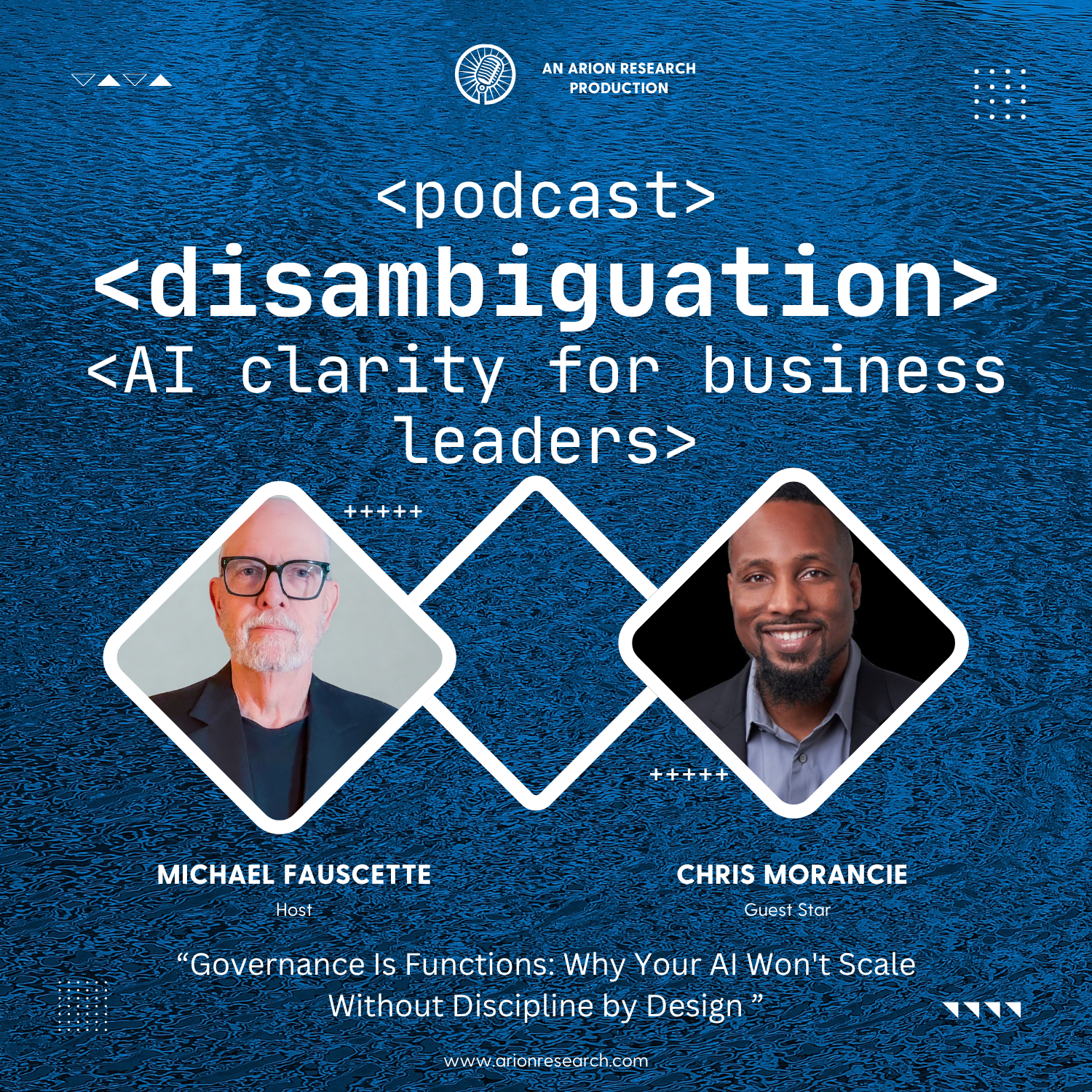
    Governance Is Functions: Why Your AI Won't Scale Without Discipline by Design

    In this episode of the Disambiguation podcast, host Michael Fauscette sits down with Chris Morancie, Fractional CTO and Founder of Digital Operations Factory, for a deeply technical and practical conversation about why AI governance has to be engineered into your architecture, not bolted on after the fact. Chris brings a unique combination of computer information systems, an MBA in business strategy, and a master's in data science to the problem of getting AI into production safely. His core argument: if your governance cannot stop your model from doing something wrong in real time, then it is not governance, it is just documentation. The conversation covers his three-part scalability test (design for scale, make sure it doesn't break at scale, don't go broke at scale), the Goldilocks zone for model selection, why agents should be treated through a microservices security lens with least-privilege access and short-term tokens, the firewall pattern for policy enforcement, real-time semantic interceptors for customer-facing AI, operational sovereignty and vendor SLA inheritance, IP leakage through model training, and a practical trust-vs-reasoning quadrant for managing hybrid human-agent teams. Timestamps: 00:00 - Introduction 00:44 - Chris's background: Caribbean upbringing, CIS + MBA + Data Science 03:48 - The AI production framework: design for scale, don't break at scale, don't go broke at scale 07:17 - The Goldilocks zone: model selection and cost benchmarking 09:28 - Assertion testing vs. evaluation testing for model quality 10:25 - "If your governance can't stop your model in real time, it's just documentation" 13:26 - The firewall pattern: policy agents with least-privilege, short-term tokens 16:09 - AI governance as good old-fashioned software hygiene 17:49 - Real-time semantic interceptors for customer-facing agents 21:15 - Competing goals: why prompts alone cannot prevent policy violations 24:02 - Agent security: every ingress and egress point is a vector 27:55 - RAG poisoning and downstream injection attacks 29:00 - Operational sovereignty: SLA inheritance and vendor risk 34:56 - IP leakage: when your feedback trains a competitor's model 36:16 - Trust vs. reasoning: a quadrant for managing hybrid teams 41:37 - Advice by company size: economics for SMEs, security for enterprise 45:25 - Recommendation: DALI Research Labs (YouTube) Guest: Chris Morancie, Fractional CTO and Founder, Digital Operations Factory Host: Michael Fauscette, CEO & Chief Analyst, Arion Research Subscribe and turn on notifications so you never miss an episode.

    • Transcript
Showing 1–20 of 20 episodes